Introduction
Patterns of succession in lichen communities have been observed in many non-Australian forest communities, with certain lichen species being characteristic of younger and of older forests (Rose Reference Rose, Brown, Hawksworth and Bailey1976; Lesica, et al. Reference Lesica, McCune, Cooper and Hong1991; Kuusinen Reference Kuusinen1996; Boudreault et al. Reference Boudreault, Gauthier and Bergeron2000; Campbell & Fredeen Reference Campbell and Fredeen2004; Radies & Coxson Reference Radies and Coxson2004;). Within Australia, studies in Tasmania have also alluded to such patterns and been able to suggest distinctive species assemblages for young and old habitats (Kantvilas Reference Kantvilas1988, Reference Kantvilas1990). Kantvilas (Reference Kantvilas1990) described succession between lichen communities as extremely complex, entailing not only ageing of the lichen vegetation itself, but also that of its tree substratum and the surrounding forest. Each successional stage was therefore characterized by a different suite of lichens in response to the particular light, substratum and moisture conditions prevailing at that time (Kantvilas Reference Kantvilas1990).
The trunk of a tree represents a complex assortment of integrated microhabitat types which influence the epiphytic community (Kenkel & Bradfield Reference Kenkel and Bradfield1986), and a number of authors (Adams & Risser Reference Adams and Risser1971; James et al. Reference James, Hawksworth, Rose and Seaward1977; Eversman et al. Reference Eversman, Johnson and Gustafson1987; Kantvilas and Minchin Reference Kantvilas and Minchin1989) have implied that the microclimate was more important than macroclimate in determining lichen distribution. Factors such as light, bark texture, bark pH, availability of water, humidity, aspect, inclination of trunks, age of forest and stand heterogeneity have been suggested as important in determining distribution of lichens at the local level (Adams & Risser Reference Adams and Risser1971; Brodo Reference Brodo, Ahmadjian and Hale1973; Gough Reference Gough1975; Kantvilas et al. Reference Kantvilas, James and Jarman1985; Eversman et al. Reference Eversman, Johnson and Gustafson1987; Kenkel & Bradfield Reference Kenkel and Bradfield1986; Lesica et al. Reference Lesica, McCune, Cooper and Hong1991; Pirintsos et al. Reference Pirintsos, Diamantopolous and Stamou1995). However, Kantvilas et al. (Reference Kantvilas, James and Jarman1985) indicated that most of these factors can be interpreted almost entirely in terms of light and substratum characteristics. For example, temperature is affected by the amount of sunlight, and forest age is related to differing substrata characteristics, such as fissured bark (Kantvilas et al. Reference Kantvilas, James and Jarman1985; Kantvilas Reference Kantvilas1990).
Nothofagus cunninghamii (Hook.) Oerst., a dominant cool temperate rainforest species in Victoria and Tasmania, has been shown to be a very successful host for many lichen species (Kantvilas et al. Reference Kantvilas, James and Jarman1985; Kantvilas Reference Kantvilas1988, Reference Kantvilas1990; Kantvilas & Jarman Reference Kantvilas and Jarman1993; Jarman & Kantvilas Reference Jarman and Kantvilas1995; Louwhoff, Reference Louwhoff1995; Ford Reference Ford1996). This is thought to be due to these bark characteristics and inclination of trunks forming distinct wet and dry sides (Mark et al. Reference Mark, Scott, Sanderson and James1964; Kalgutker & Bird Reference Kalgutker and Bird1969; Pike et al. Reference Pike, Denison, Tracy, Sherwood and Rhoades1975; Kantvilas et al. Reference Kantvilas, James and Jarman1985; Kenkel & Bradfield Reference Kenkel and Bradfield1986; Kantvilas Reference Kantvilas1990; Louwhoff Reference Louwhoff1995). Fissuring produces a continual cycle of decortication and recolonization of bark in ageing trees that has been linked to an overall increase in the number of lichen species supported by N. cunninghamii in Tasmania (Kantvilas Reference Kantvilas1990), Quercus in Britain (Rose Reference Rose, Morris and Perring1974), Pinus albicaulis Engelm. in Canada (Kalgutker & Bird Reference Kalgutker and Bird1969) and Pseudotsuga menziesii (Mirb.) Franco and Abies lasiocarpa (Hook.) Nutt. in Colorado, USA (Gough Reference Gough1975). Conversely, some authors have suggested fissuring and flakiness as causing a decline in species richness for other tree species (Adams & Risser Reference Adams and Risser1971; Yarranton Reference Yarranton1972; Griffin & Conran Reference Griffin and Conran1994; Kuusinen Reference Kuusinen1996; Radies & Coxson Reference Radies and Coxson2004).
Some rainforest trees do not shed their bark periodically, for example species of Acacia and Atherosperma moschatum Labill. These species generally have lichen communities that differ from those of N. cunninghamii (Louwhoff Reference Louwhoff1995; Ford Reference Ford1996, Reference Ford2001; Ford et al. Reference Ford, Gibson and Duke2000). Louwhoff (Reference Louwhoff1995) suggested that bark stability and some degree of fissuring accounted for the higher lichen diversity on Acacia found at Mt. Donna Buang, Victoria. In Tasmania, smooth barked trees such as A. moschatum often retained pioneer lichen species throughout their life as bark, and lichen, are not shed periodically (Kantvilas et al. Reference Kantvilas, James and Jarman1985). In eastern Victoria, A. moschatum forms the dominant component of the rainforest canopy. The Atherosperma-Elaeocarpus rainforests of the Errinundra Plateau are the southern extremity of this type of cool temperate rainforest which extends north through the tablelands of New South Wales (Ladd Reference Ladd, Werren and Kershaw1991; Peel Reference Peel1999). The lichen communities in these rainforests have not been studied until the present survey.
In this study, we explore lichen species richness and patterns of lichen succession on rough barked N. cunninghamii trees and on smooth barked A. moschatum trees in cool temperate rainforests in Victoria, Australia. We hypothesize that lichen community composition will change as the host tree ages. Furthermore, we believe that these changes will be less distinct on A. moschatum than on N. cunninghamii as smooth barked trees are difficult for lichen propagules to colonize.
Victorian rainforests exist primarily in narrow, fire protected gullies. They are limited in extent, and often exist as small pockets within a sea of eucalypt-dominated forest. They often suffer from edge-effects and disturbance, especially the effects of fire (Busby & Brown Reference Busby, Brown and Groves1994). Our final aim was to establish whether older trees support lichen assemblages not represented on younger trees, and therefore, whether these trees may be acting as ‘island reservoirs’.
Methods
This investigation represents a portion of a much larger research endeavour examining lichens in rainforests across Victoria. We have used a subsample of this larger dataset to examine patterns of succession on N. cunninghamii (Yarra Ranges) and A. moschatum (Errinundra). However, due to differences already established in lichen community composition between rainforests in the Yarra Ranges, where N. cunninghamii is dominant and those from the Errinundra region where A. moschatum is dominant (Morley & Gibson Reference Morley and Gibson2004), we will not be directly comparing the two tree species with each other in a single statistical analysis. Rather, we will be looking at patterns of species richness and succession on each host, as inferred by a snapshot (a single sample in time) of variously sized trees. While it is logical to be able to suggest successional patterns from a single sampling event in time using trees of different sizes (ages), these conclusions are inferences only, as ideally, given the historical differences that even small patches of rainforest might undergo, a long term study will give the most accurate picture of successional changes as forests age. Time constraints rarely permit long term investigations, and this study was no exception.
Study Area
In Australia, temperate rainforests occur in Tasmania, disjunct areas in south-central Victoria and in small patches along the Great Dividing Range in New South Wales and southern Queensland (Busby & Brown Reference Busby, Brown and Groves1994). Victorian rainforests usually occur in scattered patches of less than 100 hectares, and are generally confined to deeply dissected country within gullies and along streams and rivers (Department of Conservation, Forests & Lands 1987; Busby & Brown Reference Busby, Brown and Groves1994; Peel Reference Peel1999). Pure rainforest stands (those without a eucalypt component) occur only in the most fire protected niches where catastrophic bushfire occurs at intervals of 100–500 years (Peel Reference Peel1999). Although they account for less than one percent of Australia's rainforest, those in Victoria are nevertheless of ecological, botanical, recreational and educational significance (D.C.F.L., 1987).
Rainforests from two regions in Victoria were used in this study. Yarra Ranges cool temperate rainforests (central Victoria) are dominated by N. cunninghamii and have a subdominant canopy of A. moschatum. Rainforests of Errinundra (far east Victoria) are dominated by A. moschatum with Elaeocarpus holopetalus F. Muell. and Telopea oreades F. Muell. occurring in some pockets. Annual rainfall is quite high in both regions, with Yarra Ranges receiving 1391mm and Errinundra receiving 1341–1725mm per annum (Bureau of Meteorology, public records). The altitude range of quadrats in the Yarra Ranges was 560–960m, and at Errinundra, 940–1080m.
Field Method and Study Sites
Nothofagus cunninghamii trees from 20m by 20m quadrats in the centre of ten Yarra Ranges rainforest patches, and A. moschatum trees from the same number and size of quadrats in rainforests of the Errinundra Plateau were used in the analyses for this study. The lichen communities up to 2 metres high on different ranked size classes were examined on each of these two species. The size classes were defined as small (0–5cm radius), medium (6–10cm radius), large (11–20cm radius) and extra large (>21cm) (Ford Reference Ford2001). The size classes were determined on the basis of distinct changes in the appearance of the bark of N. cunninghamii trees. The small to medium ranked trees had similar smooth textured bark; however, they were divided into two size classes for a more detailed analysis of lichen patterns. Large trees were determined as those where the deeper fissures had begun to form in the bark, and extra-large trees were those with deeply dissected ‘plates’ of bark that were easily dislodged from the tree. These size classes were used for all tree species throughout the larger study. Further information on the field method and study areas can be found in Morley & Gibson (Reference Morley and Gibson2004).
Statistical Analysis
Unequal numbers of trees representing each size class occurred in field collected data, representing natural variation in tree sizes in forests. In order to compare size class characteristics, random sub-sampling of the two dominant hosts was undertaken to get even sample sizes for each size class. The original number and the number in the random subsample for each host are presented in Table 1. These data are used in all analyses of differences between size classes.
Number of trees sampled from each size class of Nothofagus cunninghamii and Atherosperma moschatum in rainforests at Yarra Ranges and Errinundra.

Non-parametric ANOVA was used to test for significant differences in lichen species richness between the four size classes of each dominant host. The data were square root transformed in order to improve normality. Lichen species cover data were mostly skewed towards lower numbers, reflecting the low abundance and frequency of many lichens in Victorian rainforests. Transformations on data of this nature often fail to improve normality enough to meet the assumptions of parametric statistical tests, therefore, the cover of particular lichen species was compared between the four size classes of dominant hosts using the non-parametric equivalent of ANOVA, the Kruskal-Wallis test. For this analysis, lichen species occurring on three or four size classes, and occurring on 10% or more of trees for at least two of the size classes in the sample, were examined to ensure adequate sample size. Generally, most lichen species were not sufficiently abundant to be included in this part of the investigation.
When using the parametric equivalent of this test, ANOVA, it is possible to follow up significant findings using Post Hoc tests, such as the Tukey test, to determine which groups are different. No such tests are available for the non-parametric tests, so, while it was possible to say that significant differences existed in the cover of certain lichen species, it was not possible to determine which size classes were causing significant differences, except through obvious presence or absence of species from one of the size classes.
Results
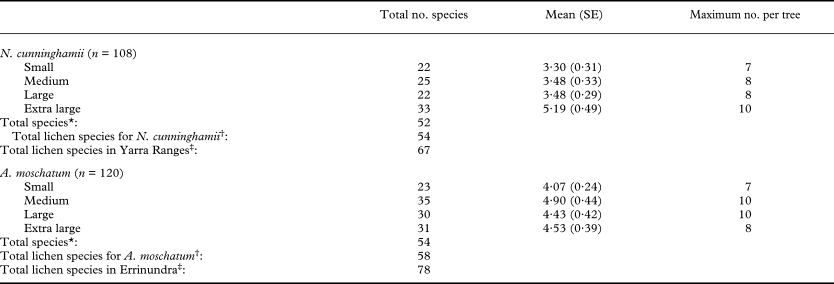
In total, 52 and 54 lichen species occurred on N. cunninghamii and A. moschatum respectively (Table 2). These totals were 77% of the total lower trunk lichen flora recorded in the Yarra Ranges, and 69% of the total for Errinundra (Morley & Gibson Reference Morley and Gibson2004). Subsampling captured over 93% of the lichens recorded from each host in both cases.
Variation in lichen species richness between the four size classes of Nothofagus cunninghamii and Atherosperma moschatum at Yarra Ranges and Errinundra.

* Total lichen species included on that host species in subsample.
† Total lichen species for host includes all lichens recorded on that host in that region (from Ford Reference Ford2001).
‡ Total lichen species for each region includes all available hosts in that region, and excludes canopy species (published in Morley & Gibson Reference Morley and Gibson2004).
Species richness did not clearly increase with increasing girth, although on N. cunninghamii the richest trees were from the extra large size class (Table 2). Extra large N. cunninghamii had a total of 33 lichen species, and a maximum of 10 lichens on a single tree. Conversely, the medium sized A. moschatum trees were the richest, with 35 lichens. Maximums of 10 lichens on single trees were recorded for both medium and large A. moschatum. Small trees of both species supported the fewest lichen species.
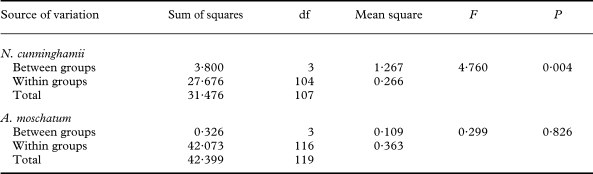
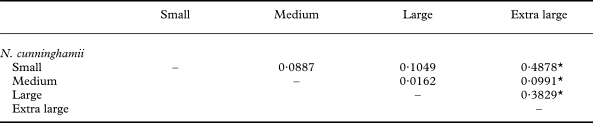
The differences observed in species richness between N. cunninghamii trees of different size classes was significant (4.760df3, P = 0·004) (Table 3), and Tukey tests revealed that the differences existed between the extra large size class and all other size classes (Table 4). On the other hand, no significant differences were found in species richness between size classes for A. moschatum (0.299df3, P = 0·826) (Table 3).
Results of ANOVA examining differences between number of lichen species supported by each size class of each dominant host. Data were square root transformed.

Table of differences between means (Tukey's HSD multiple comparisons) for N. cunninghamii.

* Significant at the P < 0·05 level.
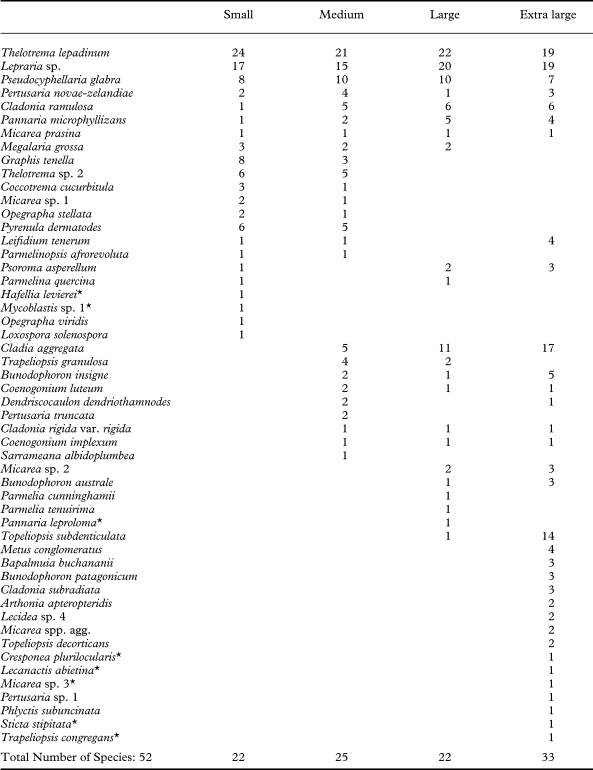
Differences in species composition between the different size classes for both host species occurred. For each host species, a ubiquitous group of lichens was noted, consisting of species for which the size of the tree did not appear to be important (Tables 5 & 6). The number of ubiquitous species was higher on A. moschatum (11 species) (Table 6) than on N. cunninghamii (7 species) (Table 5). Some lichen species appeared to be confined to, or more prevalent on, a particular size class; however, often these species were recorded only once. These data were too skewed in one direction and could not be normalized, hence were not statistically analysed.
Frequency of lichens on each size class of Nothofagus cunninghamii trees from the Yarra Ranges (n = 27 for each size class). Species have been manually ordered to reflect compositional drift as tree size increases. Species occurring on all size classes are presented first, followed by those on small, medium, large and extra large size classes.

* Species considered to be rare in Victorian rainforest (Morley & Gibson Reference Morley and Gibson2004).
Frequency ranking of lichens on each size class of Atherosperma moschatum trees from Errinundra (n = 30 for each size class). Species have been manually ordered to reflect compositional drift as tree size increases. Species occurring on all size classes are presented first, followed by those on small, medium, large and extra large size classes.

* Species considered to be rare in Victorian rainforest (Morley & Gibson Reference Morley and Gibson2004).
On N. cunninghamii, Pseudocyphellaria glabra (Hook.f. & Taylor) C. W. Dodge, Pertusaria novae-zelandiae Szatala, Cladonia ramulosa (With.) J. R. Laundon, Pannaria microphyllizans (Nyl.) P. M. Jørg., Micarea prasina Fr., Thelotrema lepadinum (Ach.) Ach. and Lepraria sp. occurred on all host size classes with the latter two species being most frequent (Table 5). Pseudocyphellaria glabra was more frequent on trees of medium and large size classes. Cladonia ramulosa and Pannaria microphyllizans were more abundant on larger trees (medium, large and extra large), and their presence on the small size class may have been incidental, as they were reported once only. There was a large number of lichen species, 15, that occurred only on extra large N. cunninghamii trees. The species Metus conglomeratus (F. Wilson) D. J. Galloway & P. James, Bapalmuia buchananii (Stirt.) Kalb & Lücking, Bunodophoron patagonicum (C. W. Dodge) Wedin, Cladonia subradiata (Vain.) Sandst., Arthonia apteropteridis Kantvilas & Vězda, Lecidea sp. 4, Micarea spp. agg. and Topeliopsis decorticans (Müll. Arg.) A. Frisch & Kalb all occurred rarely, but more than once. A further seven species were reported only once on extra large trees.
Much of the lichen flora of A. moschatum trees in the Errinundra region occurred only once, and this was especially true on medium, large and extra large size classes (Table 6). Eleven species occurred on all size classes, with T. lepadinum, P. glabra and P. microphyllizans showing the same frequency throughout each size class. This suggested that the characteristics of A. moschatum trees did not vary with increasing size, at least for those ubiquitous lichen species with wide ecological tolerance within the rainforest. Indeed, there were few examples of species that had higher frequency on a particular size class (excluding species occurring once only), exceptions were Graphis tenella auct. non Ach., which was more frequent on small and medium trees, and Pyrenula occulta (C. Knight) Müll. Arg. and Lepraria sp. which were more frequent on large and extra large trees.
Few lichens had sufficient cover to allow for Kruskal-Wallis comparisons. The species that did meet the requirements tended to be members of a ubiquitous group of rainforest lichens that occur frequently, and often abundantly, in Victoria's rainforests (Morley and Gibson Reference Morley and Gibson2004). On N. cunninghamii, these species were: Bunodophoron spp. agg. Cladia aggregata (Sw.) Nyl., Lepraria sp.,Pertusaria novae-zelandiae, Pseudocyphellaria glabra, Pannaria microphyllizans and Thelotrema lepadinum. Only Bunodophoron spp. agg. (χ2df3 = 16·33, P = 0·001) and Cladia aggregata (χ2df3 = 29·29, P < 0·001) showed significant differences between size classes, probably due to their absence on small trees. For A. moschatum, Arthothelium interveniens (Nyl.) Zahlbr., Bunodophoron spp. agg., Coccotrema cucurbitula (Mont.) Müll. Arg., Graphis tenella, Lecidea immarginata R. Br. ex Cromb., Lepraria sp., Menegazzia nothofagi (Zahlbr.) P. James & D. J. Galloway, Pseudocyphellaria glabra, Pannaria microphyllizans, Pyrenula dermatodes (Borrer) Schaer., Pyrenula concatervans (Nyl.) R. C. Harris and Thelotrema lepadinum had sufficient cover to allow for Kruskal-Wallis comparisons. Only G. tenella (χ2df3 = 21·17, P = 0·000) and Lepraria sp. (χ2df3 = 8·13, P = 0·043) showed significant differences in cover between size classes, which may be due to the prevalence of G. tenella on small and medium trees and, conversely, the prevalence of Lepraria sp. on large and extra large trees (Table 6).
Discussion
That N. cunninghamii supported a very rich lichen flora in the Yarra Ranges rainforests was expected. A rich lichen flora has also been observed on this host in other Victorian studies (Ashton & McRae Reference Ashton and McRae1970; Ford Reference Ford1996; Louwhoff Reference Louwhoff1995) and in Tasmanian studies (Kantvilas Reference Kantvilas1988, Reference Kantvilas1995; Kantvilas & Jarman 1991; Jarman & Kantvilas Reference Jarman and Kantvilas1995) and, hence, the results of this part of our study support previous survey efforts. Although A. moschatum has smooth bark, when compared to N. cunninghamii, it still proved to be an excellent host for lichens in Errinundra cool temperate rainforest. In fact, on average, A. moschatum trees from the Errinundra region supported slightly more species than N. cunninghamii trees in the Yarra Ranges (see Table 2). In optimum habitats in Tasmania, smooth barked communities of A. moschatum and Telopea spp. supported a community of 32 species, with the most common being lush foliose forms of Pseudocyphellaria billardieri (Delise) Räsänen and Pannaria microphyllizans (Kantvilas Reference Kantvilas1988). At Errinundra, the dominant components of the A. moschatum rainforest community also included P. microphyllizans, which was reasonably frequent on all tree sizes. Pseudocyphellaria billardieri was uncommon and occurred mostly on medium sized trees. It was apparently replaced by P. glabra as the dominant lush foliose form in the Victorian forest type. Otherwise the bulk of the common flora on A. moschatum were crustose forms: Arthothelium interveniens, Thelotrema lepadinum, Graphis tenella. Overall, the status of N. cunninghamii as an ideal host for rainforest lichens was further established by the results of this study and, A. moschatum, when present as a dominant component of the rainforest canopy, is also an excellent host for lichens.
Successional relationships of lichens were indicated by comparing the frequency of lichen species to the size class of the host tree. We found that the composition of lichen communities changed as the host tree aged and that these changes were generally more distinct on N. cunninghamii than on A. moschatum. Hedenås & Ericson (Reference Hedenås and Ericson2000) also found distinct changes in composition with increasing age of aspen stands in Sweden, with a general increase in numbers of species found in older stands. They cite a number of studies demonstrating the importance of successional stages in explaining differences in species composition. Extra large N. cunninghamii trees supported significantly more species than other size classes. These differences in species richness and composition may be attributable to differences in the levels of bark fissuring, with the deeply fissured bark of older trees being more conducive to the growth of some species, compared to the smooth bark of young trees. Furthermore, species that appeared to predominate on older, rough barked N. cunninghamii were rare on the smooth bark of A. moschatum (e.g. Metus conglomeratus (F. Wilson) D. J. Galloway & P. James, Topeliopsis subdenticulata (Zahlbr.) A. Frisch & Kalb and C. aggregata). No significant differences in species richness were noted for the A. moschatum trees of Errinundra. On A. moschatum, the species Coccotrema cucurbitula (Mont.) Müll. Arg. and Graphis tenella (which were frequently found on smooth barked small to mediumN. cunninghamii) were frequent on all size classes. As predicted, succession on A. moschatum was much less clear, possibly because obvious changes in substratum characteristics did not occur with increasing girth. It is likely that this has led to retention of pioneer species in the community, perhaps at the expense of a significantly richer community developing as tree diameter increased. In addition, the pronounced shading effect of the larger leaves of A. moschatum (Kantvilas et al. Reference Kantvilas, James and Jarman1985; Kantvilas & Minchin Reference Kantvilas and Minchin1989), and the absence of obvious trunk inclination, may afford a more equable microclimate as the rainforest matures. Indeed, a comparatively large number of lichen species on A. moschatum were present on all of the different size classes, and those species confined to one size class only were reported once only. Overall, patterns of succession were less distinct for A. moschatum than for N. cunninghamii. We believe that the comparatively stable microclimate found in A. moschatum rainforests, while providing excellent conditions for a very rich lichen flora to develop, provided less opportunity for clear patterns of succession to establish.
Forest fragmentation and isolation can have a detrimental effect on lichen populations, however, studies have shown that relict stands of ancient forest can provide refugia for particular lichen communities, in an otherwise unsuitable, disturbed or developed landscape (Rose Reference Rose, Brown, Hawksworth and Bailey1976; Kantvilas & Jarman Reference Kantvilas and Jarman1993). Indeed, even single remnant trees may provide a temporary link between old and young forests for some lichen species (Hedenås & Hedström Reference Hedenås and Hedström2007) and provide a source from which propagules may disperse to nearby ageing forests. In the present study, we found many rare or uncommon species on extra large N. cunninghamii trees, and a large proportion of species represented only once in this study occurred on these very old trees. It is feasible that the combined elements of increasing bark fissuring and flakiness with age, increased canopy openness, which may reduce the barrier effect of the closed rainforest canopy, plus the appearance of suitable specialized microhabitats on older trees is contributing to this influx of rare species. These factors provide a rich and varied microclimate with recurring opportunities for colonization of new species, especially rare lichens. Hedenås & Ericson (Reference Hedenås and Ericson2000) also found that particular lichen species (especially those with blue-green photobionts) required certain habitat conditions for successful establishment. As many Victorian rainforests represent sub-climax or regenerating communities (Cameron Reference Cameron, Gell and Mercer1992), the scarcity of specialized niches, such as the dry sides of very old N. cunninghamii trees, may have contributed to the absence of species usually associated with these microhabitats in Tasmania, for example Sagenidium molle Stirt. and Chaenotheca brunneola (Ach.) Müll. Arg. (Kantvilas Reference Kantvilas1988), and the rarity of species such as Lecanactis abietina (Ach.) Korb. and Arthonia apteropteridis Kantvilas & Vĕzda. This has implications for management of rainforests, as regenerating rainforests may not provide the habitat niches for a wide variety of lichens, especially rare species. Therefore, extra protection of Victoria's oldest rainforest pockets is considered critical as they represent a source of rare, potentially threatened, lichen species and act as a reservoir of propagules for other, ageing rainforests.
Concluding Remarks
Worldwide, rainforests are coming under increasing pressures due to climate change, pollution, logging and the rapid rise of ecotourism. With their sensitivity to changes at the microhabitat level, lichens are at risk. In southern Australia, cool temperate rainforests are very limited in extent, and particularly vulnerable, as they often occur as small pockets in a sea of fire-prone, eucalypt-dominated forest. Many, more easily accessible rainforest pockets, are also threatened by excessive tourism development. Given that the results of this study reveal that single, large, old trees may support high numbers of lichen species, including rare species, it seems critical that even small pockets of old rainforest be afforded the protection required to conserve these refuges of lichen biodiversity. As reservoirs of a distinct lichen flora and sources of propagules for ageing forests, even small pockets of rainforest with one or two very old trees must be protected.
We thank the following people for their aid in identification of particular groups of lichens: Alan Archer, Jack Elix, Gintaras Kantvilas, Patrick McCarthy and Nell Stevens. We also thank the Department of Natural Resources and Environment for granting collection permits, and Deakin University. This research was carried out through funding from an Australian Postgraduate Award scholarship. We would also like to thank Professor David Lindsay, and two anonymous referees for helpful advice on the manuscript.