Introduction
Kelps are a widely studied group of macroalgae that are important components of marine ecosystems, providing habitat and food for various species and serving as keystone species in kelp forests (Teagle et al., Reference Teagle, Hawkins, Moore and Smale2017). Apart from these ecological functions, kelp provides important economic value such as raw material for a variety of industries, including those that produce pharmaceutical products, cosmetics, fertilizers, and culinary products (Beaumont et al., Reference Beaumont, Austen, Mangi and Townsend2008; Cuba et al., Reference Cuba, Guardia-Luzon, Cevallos, Ramos-Larico, Neira, Pons and Avila-Peltroche2022; Eger et al., Reference Eger, Marzinelli, Beas-Luna, Blain, Blamey, Byrnes, Carnell, Choi, Hessing-Lewis, Kim, Kumagai, Lorda, Moore, Nakamura, Pérez-Matus, Pontier, Smale, Steinberg and Vergés2023). Kelp forests belonging to the Order Laminariales are found in temperate, subtropical, and subpolar marine systems (Graham et al., Reference Graham, Kinlan, Druehl, Garske and Banks2007). Kelp forests are also recognized as critical ecological habitats that provide several direct and indirect ecosystem services (Smale et al., Reference Smale, Burrows, Moore, O'Connor and Hawkins2013; Vásquez et al., Reference Vásquez, Zuñiga, Tala, Piaget, Rodríguez and Vega2014; Filbee-Dexter and Wernberg, Reference Filbee-Dexter and Wernberg2020). These globally significant, highly productive ecosystems are however under threat from climate change, habitat destruction, and over-fishing (Harley et al., Reference Harley, Anderson, Demes, Jorve, Kordas, Coyle and Graham2012; Spalding et al., Reference Spalding, Amado-Filho, Bahia, Ballantine, Fredericq, Leichter, Nelson, Slattery, Tsuda, Loya, Puglise and Bridge2019; Wernberg et al., Reference Wernberg, Coleman, Babcock, Bell, Bolton, Connell, Hurd, Johnson, Marzinelli, Shears and Steinberg2019a; Buglass et al., Reference Buglass, Kawai, Hanyuda, Harvey, Donner, De la Rosa, Keith, Bermúdez and Altamirano2022; Coleman et al., Reference Coleman, Reddy, Nimbs, Marshell, Al-Ghassani, Bolton, Jupp, De Clerck, Leliaert, Champion, Pearson, Serrã, Madeira and Wernberg2022; Pessarrodona et al., Reference Pessarrodona, Franco-Santos, Wright, Vanderklift, Howard, Pidgeon, Wernberg and Filbee-Dexter2023), and require ongoing research to better understand and communicate their socio-ecological value, and to improve their conservation and management.
In South Africa, four species of kelps are currently recognized: Macrocystis pyrifera (Linnaeus) C. Agardh, Ecklonia maxima (Osbeck) Papenfuss, Ecklonia radiata (C. Agardh) J. Agardh, and Laminaria pallida Greville (Rothman, Reference Rothman2015). Ecklonia maxima commonly known as ‘sea bamboo’, is the most dominating and abundant component of the kelp forest assemblage in the temperate waters of South Africa, followed by L. pallida kelps comprising the understorey layer (Graham et al., Reference Graham, Kinlan, Druehl, Garske and Banks2007; Vásquez et al., Reference Vásquez, Zuñiga, Tala, Piaget, Rodríguez and Vega2014; Rothman, Reference Rothman2015). Deeper subtidal populations have been recorded in False Bay (10–30 m), on the Agulhas Bank off De Hoop/Agulhas (35 m depth) (Tronchin and De Clerck, Reference Tronchin, De Clerck, De Clerck, Bolton, Anderson and Coppejans2005; Rothman, Reference Rothman2015). M. pyrifera is found only in a few sheltered sites on the southwest coast whereas E. radiata grows along the south coast but is usually limited to small stands in the sublittoral fringe (Rothman, Reference Rothman2015). Until recently, the distributions of E. maxima and E. radiata did not overlap, but in the last decade E. maxima spread ca. 70 km eastwards to De Hoop, where populations of these two species now co-occur (Bolton et al., Reference Bolton, Anderson, Smit and Rothman2012) and where the distinction between some individuals of the two species is not always clear.
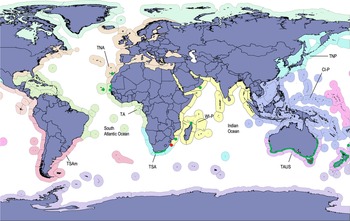
E. radiata is a small, brown kelp species with a short, solid stipe and irregular, prickly fronds that is widely distributed throughout much of Australia, New Zealand, and south-eastern Africa (Figure 1). Unlike many other kelp forest ecosystems, where multiple species of laminarians coexist (Steneck et al., Reference Steneck, Leland, McNaught and Vavrinec2013, Steneck & Johnson Reference Steneck, Johnson, Bertness, Bruno, Silliman and Stachowicz2014; Wernberg et al., Reference Wernberg, Coleman, Babcock, Bell, Bolton, Connell, Hurd, Johnson, Marzinelli, Shears and Steinberg2019a), E. radiata typically creates forests that consist solely of this laminarian species. This is because E. radiata is the only laminarian kelp found in much of its habitat range. However, it is worth noting that in certain regions of New Zealand, while E. radiata is the primary kelp species, it can also co-occur with some Lessonia species, particularly in the more exposed coastal areas within the distribution range of Ecklonia (Wernberg et al., Reference Wernberg, Coleman, Babcock, Bell, Bolton, Connell, Hurd, Johnson, Marzinelli, Shears and Steinberg2019a). In South Africa, the ranges of E. maxima and E. radiata have been distinct until recently. However, over the past 10 years, E. maxima has expanded its range by approximately 70 km to the east. Now, these two species are found together in the same location (Bolton et al., Reference Bolton, Anderson, Smit and Rothman2012; Rothman, Reference Rothman2015).
Distribution of E. radiata in the Southern Hemisphere (adapted from Hawkins et al., Reference Hawkins, Allcock, Bates, Firth, Smith, Swearer and Todd2019). Colour shades in the background represent different marine realms. TA, tropical Atlantic; TNA, temperate northern Atlantic; TSAm, temperate South America; TSA, temperate southern Africa; WI-P, western Indo-Pacific; CI-P, central Indo-Pacific; TAUS, temperate Australasia; TNP, temperate northern Pacific. Red circles indicate new kelp bed forest observed inside the iSimangaliso MPA at the iSimangaliso Wetland Park World Heritage Site on the east coast of South Africa. Green lines and circles indicate confirmed populations of E. radiata (see Wernberg et al., Reference Wernberg, Coleman, Babcock, Bell, Bolton, Connell, Hurd, Johnson, Marzinelli, Shears and Steinberg2019a, Reference Wernberg, Krumhansl, Filbee-Dexter, Pedersen and Sheppard2019b; AlgaeBase).

E. radiata is considered to be a warm temperate species (Bolton, Reference Bolton2010) and is known to form important habitats in the coastal rocky reefs of New Zealand, Australia, and South Africa (Rothman et al., Reference Rothman, Mattio, Wernberg, Anderson, Uwai, Mohring and Bolton2015). E. radiata is the prevailing and extensively distributed kelp species in the Southern Hemisphere. Notably, it is one of the kelps that exhibit a high level of tolerance to temperatures, thriving in warm-temperate and subtropical waters (Wernberg et al., Reference Wernberg, Coleman, Babcock, Bell, Bolton, Connell, Hurd, Johnson, Marzinelli, Shears and Steinberg2019a; Coleman et al., Reference Coleman, Reddy, Nimbs, Marshell, Al-Ghassani, Bolton, Jupp, De Clerck, Leliaert, Champion, Pearson, Serrã, Madeira and Wernberg2022). E. radiata is typically found within the temperature range of about 8–25°C (Bolton and Anderson, Reference Bolton, Anderson and Akatsuka1994), and temperature plays a crucial role in determining its regional distribution. However, the correlation between ocean temperature and local abundances can be influenced by physiological adaptations and biological factors such as competition and herbivory (see Wernberg et al., Reference Wernberg, Coleman, Babcock, Bell, Bolton, Connell, Hurd, Johnson, Marzinelli, Shears and Steinberg2019a).
In shallower waters at similar low latitudes, E. radiata stands tend to become increasingly fragmented and rare, possibly due to higher summer sea temperatures, increased herbivory, and variability in the availability of rocky reef habitats. Recent anomalies in water temperature in Australia during a severe marine heatwave have also resulted in declines of E. radiata, prompting shifts from canopy-dominated to turf-dominated reefs at low latitudes (see Wernberg et al., Reference Wernberg, Coleman, Babcock, Bell, Bolton, Connell, Hurd, Johnson, Marzinelli, Shears and Steinberg2019a).
While E. radiata is largely confined to the shallow subtidal areas on the southeast coast of South Africa they do occur on the south coast, where it is not as dominant as in other regions within its range. E. radiata, is common in the sublittoral fringe and rock pools at various locations between De Hoop and Port Edward, seems to be absent from many other subtidal regions on the south- and south-east coast (Rothman, Reference Rothman2015). The westernmost distribution of E. radiata are around 60 km east of Cape Agulhas, a major biogeographical break on the south coast of South Africa (Rothman et al., Reference Rothman, Mattio, Wernberg, Anderson, Uwai, Mohring and Bolton2015; Hawkins et al., Reference Hawkins, Allcock, Bates, Firth, Smith, Swearer and Todd2019; Branch et al., Reference Branch, Branch, Griffiths and Beckley2022). On the eastern end of its distribution, E. radiata only grows in the subtidal fringe in Port Edward at the boundary between the Eastern Cape and KwaZulu-Natal provinces (Tronchin and De Clerck, Reference Tronchin, De Clerck, De Clerck, Bolton, Anderson and Coppejans2005).
E. radiata has also been documented in the subtropical waters of the south-western Indian Ocean (SWIO) region, in Madagascar (Silva et al., Reference Silva, Basson and Moe1996; Tronchin and De Clerck, Reference Tronchin, De Clerck, De Clerck, Bolton, Anderson and Coppejans2005; Vieira et al., Reference Vieira, N'Yeurt, Rasoamanendrika, D'Hondt, Thi Thram, Van de Spiegel, Kawai and De Clerck2021; Guiry and Guiry, Reference Guiry and Guiry2022) and in southern Mozambique, off the coast of Zavora, at a depth of 34 m (Wernberg et al., Reference Wernberg, Coleman, Babcock, Bell, Bolton, Connell, Hurd, Johnson, Marzinelli, Shears and Steinberg2019a; Coleman et al., Reference Coleman, Reddy, Nimbs, Marshell, Al-Ghassani, Bolton, Jupp, De Clerck, Leliaert, Champion, Pearson, Serrã, Madeira and Wernberg2022), and in the Northern Hemisphere from Oman (Rothman, Reference Rothman2015; Wynne, Reference Wynne2018). Anderson et al. (Reference Anderson, McKune, Bolton, Declerck and Tronchin2005), Wernberg et al. (Reference Wernberg, Coleman, Babcock, Bell, Bolton, Connell, Hurd, Johnson, Marzinelli, Shears and Steinberg2019a), and Coleman et al. (Reference Coleman, Reddy, Nimbs, Marshell, Al-Ghassani, Bolton, Jupp, De Clerck, Leliaert, Champion, Pearson, Serrã, Madeira and Wernberg2022) noted an anecdotal report (from Sink, pers. comm.) of E. radiata occurring in deep waters off Sodwana Bay in the iSimangaliso marine-protected area (MPA) at a depth of 50 m but the observations were not confirmed or documented. E. radiata has a bathymetric range that extends to 80 m in sub(tropical) Australasia, with large forests discovered at 60 m or more on the Australian east coast and up to 80 m at its northern limit in New Zealand, approximately 30°S (Marzinelli et al., Reference Marzinelli, Williams, Babcock, Barrett, Johnson, Jordan, Kendrick, Pizarro, Smale and Steinberg2015; Nelson et al., Reference Nelson, Duffy, Trnski and Stewart2018, see also Wernberg et al., Reference Wernberg, Coleman, Babcock, Bell, Bolton, Connell, Hurd, Johnson, Marzinelli, Shears and Steinberg2019a).
In this short communication, we report on the discovery of a dense E. radiata kelp bed forest within the upper mesophotic zone (40–70 m) of the southern part of the iSimangaliso MPA (Natal bioregion), extending at least 35 km, at the iSimangaliso Wetland Park World Heritage Site, as well as the presence of E. radiata kelp on upper mesophotic reefs dominated by soft corals and sponges throughout the length of the MPA (in both the Natal and Delagoa bioregions). These discoveries were made during multiple expeditions conducted as part of the Oceans Alive project, led by the Wildlands Conservation Trust (Wildtrust), aimed at surveying the biodiversity and habitats of the mesophotic zone within the iSimangaliso MPA between 2020 and 2023.
Materials and methods
Study area
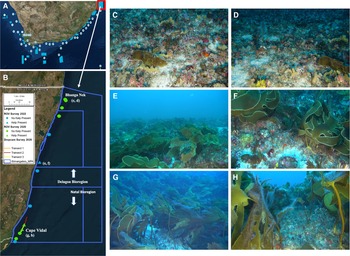
The iSimangaliso MPA in KwaZulu-Natal is a coastal and offshore MPA stretching from the South Africa–Mozambique border in the north, to Cape St. Lucia Lighthouse in the south, extending offshore to a maximum depth of almost 2000 m. The MPA spans both the Natal and Delagoa bioregions of the SWIO, stretching along about 200 km of coastline from the Mozambique border southwards to Cape St. Lucia (Figure 2A, B). The MPA extends from the high-water mark of the shoreline to 20 nm (at the northern boundary) and 45 nm (at the southern boundary) out to sea, making it the largest MPA in South Africa. The park's marine environment is strongly influenced by the Agulhas Current and its variability (Schumann, Reference Schumann and Schumann1988). The Agulhas Current transports warm, nutrient-poor surface waters from the Indian Ocean, resulting in a tropical environment with high biodiversity. It is strongly defined by the continental slope where it is thought to drive Ekman veering along the shelf edge, and is known to promote kinematically driven upwelling at certain locations (Lutjeharms, Reference Lutjeharms2006).
(A) Location of the iSimangaliso MPA on South Africa's eastern coast. The figure also showcases the network of 41 MPAs present in South Africa. (B) Boundary and zonation details of the iSimangaliso MPA showing the positions of the ROV and drop camera surveys in 2020 and 2022. NB: green and blue circles indicate areas where no kelp was recorded, green and blue triangles indicate areas were kelp was observed. (C) ROV photographs of E. radiata kelp species discovered in the north (C, D), central (E, F), and south (G, H) regions of the iSimangaliso Wetland Park MPA, during 2020 and 2022 surveys, respectively.

The continental shelf in northern KZN is very narrow, with a shelf break in many places only 2–4 km from the shore (Anderson et al., Reference Anderson, McKune, Bolton, Declerck and Tronchin2005; Lutjeharms, Reference Lutjeharms2006). To the south of Cape St. Lucia, the continental shelf widens, forming the shallow Natal Bight, with a maximum width of about 45 km, and causing the Agulhas Current to move offshore (Schumann, Reference Schumann and Schumann1988). Topographic upwelling of cooler subsurface water causes the temperatures over the bight to fall about 2°C below those of Agulhas-dominated areas to the north (Lutjeharms et al., Reference Lutjeharms, Valentine and Van Ballegooyen2000; Lutjeharms, Reference Lutjeharms2006), resulting in the decline in tropical species and prevalence of warm temperate species over this area (Bolton et al., Reference Bolton, Leiliaert, De Clerck, Anderson, Stegenga, Engledow and Coppejans2004). The iSimangaliso MPA is home to South Africa's only subtropical hard corals; although, there are no extant coral reefs, they are the most southerly high-latitude coral reefs in Africa (Obura et al., Reference Obura, Celliers, Machano, Mangubhai, Mohammed, Motta, Muhando, Muthinga, Pereira, Schleyer and Wilkinson2000; Porter and Schleyer, Reference Porter and Schleyer2017). Mean sea surface temperature varies between 22 and 26°C, whereas the lowest temperature recorded was 18°C and the highest was just under 30°C (Anderson et al., Reference Anderson, McKune, Bolton, Declerck and Tronchin2005; Porter and Schleyer, Reference Porter and Schleyer2017) off Sodwana Bay, the central section of the park. The iSimangaliso MPA receives freshwater input from just three distinct estuaries that directly flow into the ocean. Additionally, the narrow continental shelf is intersected by numerous canyons that cut through it.
Surveys
Three surveys were conducted in the mesophotic zone (40–120 m) of ISWPMPA between 2020 and 2022 as part of the Oceans Alive project of Wildlands Conservation Trust (Wildtrust) with an aim of improving the knowledge of ecosystems in the upper mesophotic zone of the iSimangaliso MPA. They used a remotely operated vehicle (ROV – SAAB SeaEye Falcon 12177) and a drop camera system aboard the research vessel RV Angra Pequena. The ROV was equipped with a depth sensor, altimeter, and internal compass for navigational purposes. The 2020 ROV survey covered the Natal and Delagoa bioregions at depths of 40–80 m (Figure 2B). Delagoa was divided into northern and southern section's thus generating three survey blocks (Figure 2B). Eight ROV dives were performed during the first survey undertaken in November 2020. Video footage was captured for 60 min while the ROV was flying at an inconsistent speed (<0.3 m s−1) at various angles (0–90°) at a height of approximately 1.2 m above the seafloor to enable optimal viewing of the habitats, substrates, and related macrobenthic organisms during the survey. Each dive during the 2020 survey comprised a set of transects, each measuring 50 m in length, that started from the centrepoint marked by a submerged clump weight suspended below the anchored vessel, 5 m from the bottom. The 50 m transect was measured by flying the ROV on a compass bearing from the clump weight, to which its umbilical was tethered, until a premeasured 50 m of free umbilical became taught and prevented the ROV from travelling any further from the clump weight.
Due to adverse conditions and strong currents exceeding 2 knots, the use of the ROV had to be discontinued during the ninth dive (ROV 9) between First Rock and St. Lucia in favour of a drop camera system. This system involved affixing a camera, composed of a depth-rated housing containing a single Gopro Hero 8 and two LED lights which were attached to a clump weight of 250 kg and measuring 31 cm in length, 27.5 cm in width, and 47.5 cm in height. The system was tethered to the crane on the RV Angra Pequena research vessel and drifted along a desired transect line within the mesophotic ecosystem (40–100 m), with the camera and LED lights directed towards the seafloor, approximately 5 m above the sea floor. By employing this technique, four transect surveys of mesophotic habitats while drifting along the transect line at a consistent speed were conducted, even under marginal conditions, covering the stretch between First Rock and St. Lucia (Natal bioregion).
The second survey carried out in 2021 used the modified drop camera system to survey from north to south along the length of the iSimangaliso MPA (Figure 2B). It covered the upper mesophotic zone with a combined transect length of approximately 70.5 km along the iSimangaliso MPA (Figure 2B). Over a period of 9 days, comprehensive surveys were conducted throughout the park, effectively accomplishing 26 transects that ranged from depths of 44 to 100 m.
The third survey was conducted in 2022 using the same ROV equipment with one site in the southern section (Natal bioregion, survey block 3) and three in the central section (Delagoa bioregion, survey block 2) (Figure 2B). Five ROV dives were completed at depths of 40–60 m. Video footage was captured for 60 min while the ROV was flying at various angles at a height of approximately 1.2 m to enable optimal viewing of the habitats, substrates, and related macrobenthic organisms during the survey. Only surveys in the south and central blocks of the iSimangaliso MPA were possible during the 2022 survey due to unfavourable sea conditions.
Analysis and data processing
Camera footage was viewed live during the ROV deployments and organisms and habitats of interest were photographed in HD. Footage from all gear deployments was stored and carefully reviewed. Identification of species and classification of habitats as described in CATAMI technical working group report (2014) and Althaus et al. (Reference Althaus, Hill, Ferrari, Edwards, Przeslawski, Schönberg, Stuart-Smith, Barrett, Edgar, Colquhoun and Tran2015) (see also Geldenhuys, Reference Geldenhuys2015; Makwela et al., Reference Makwela, Götz, Sink, Samaai, Kerwath and Wilke2016; Makwela, Reference Makwela2017; Adams, Reference Adams2021; Button et al., Reference Button, Parker, Coetzee, Samaai, Palmer, Sink and Kerwath2021) is ongoing, but the footage has been screened to assess the distribution of kelp habitats within the survey area.
Temperature and Conductivity, Temperature & Depth (CTD) data for each site were downloaded and processed.
Results
Notably, a remarkable discovery was made during the ROV dives 6, 7, and the drop camera survey in 2020. In the mesophotic zone (46–59 m) of the southern part of the iSimangaliso MPA within the Natal bioregion (stretching from Cape Vidal to St. Lucia), an expansive and significant kelp forest consisting of E. radiata was identified (Figure 2G, H) at a depth 50–52 m. This kelp forest spans over 35 km from north to south. In addition to the kelp bed, observations included starfish, cup sponges, red algae, and various small-fish species, all found to be associated with the kelp bed. Currently, the available footage affords only general taxonomic resolutions for the observed fish and invertebrate fauna.
Furthermore, ROV footage captured a kelp patch on a reef in the far northern part of the MPA near Bhanga (Figure 2C, D). However, the clarity of the footage was insufficient, and we were unable to confirm whether it was an E. radiata kelp bed or not. Despite this uncertainty, we have included the images in Figure 2.
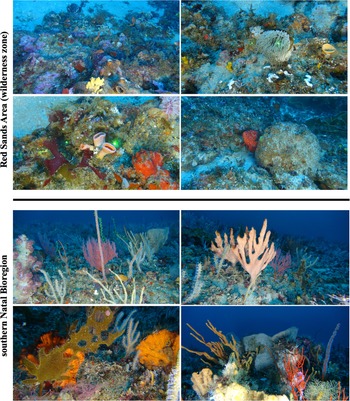
Moreover, during the ROV 12 dive in 2022 at a depth of 50 m a relatively sparse kelp bed was observed in the Delagoa bioregion, specifically in the Leadsman/Red Sands wilderness zone located north of Cape Vidal, near Diepgaat Canyon, and south of Sodwana Bay (Figure 2E, F). The habitat is formed by a well-established reef formed out of rock/gravel fragments harbouring different epifauna, including sponges. A greater area is covered by dead rhodoliths in the form of a mound and aggregation of sponges in one area with a white bryozoan. Other sightings included sea pans, big white greyish sea anemone, orange cushion star, soft coral (Dendronephthya sp.), a variety of small-fish sizes above the reef, including a tomato rockcod (Cephalopholis sonnerati) (Figure 3).
ROV photographs showing some of the species on reefs dominated by soft corals and sponges in the same depth zone, where kelp forest of the iSimangaliso Wetland Park but where dense ‘forests’ were absent (occasional kelp only).
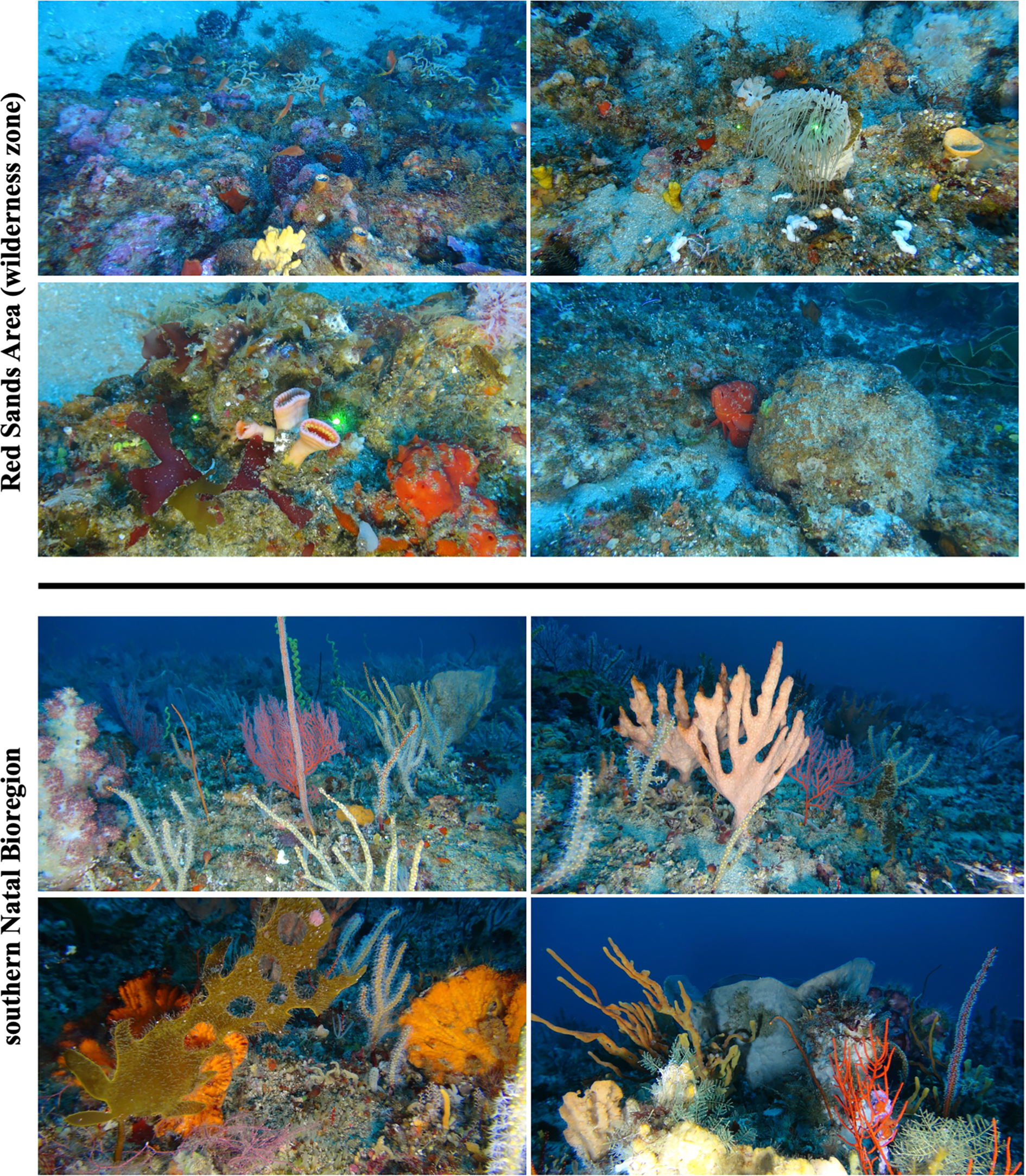
The kelp observed in the southern areas that are in the Natal bioregion (ROV 6, 7, drop camera survey in 2020) differed from the central and northern kelp which are both in the Delagoa bioregion (ROV 12 in 2022) in terms of density as well as morphology. In the southern MPA region, E. radiata appears to be much more abundant, forming denser beds with plants having a longer stipe than in the central region (Figure 2G, H). Due to bad weather we could not collect a specimen of the kelp, E. radiata. The habitat for this section of the transect was typified by a flat relief seabed comprising of 100% cover of kelp.
CTD measurement taken with SBE Seabird 19plus V2 CTD during the surveys ROV 6 and 7 in 2020 provided a temperature of 24°C at a depth of 38 m. No measurements were taken within the kelp bed found at a depth 50–52 m in these two ROV dives. Temperature measurements taken with a probe attached to the ROV during the survey ROV 12 dive in 2022 provided a temperature of 24°C at a depth of 38 m.
Discussion
Our observations represent the first verified report of this species occurring at mesophotic depths in the iSimangaliso MPA, and for the first time it has been documented in subtropical and tropical South Africa, north of its previously recorded range (Rothman, Reference Rothman2015; Rothman et al., Reference Rothman, Mattio, Wernberg, Anderson, Uwai, Mohring and Bolton2015; Coleman et al., Reference Coleman, Reddy, Nimbs, Marshell, Al-Ghassani, Bolton, Jupp, De Clerck, Leliaert, Champion, Pearson, Serrã, Madeira and Wernberg2022).
The discovery of E. radiata at mesophotic depths in the iSimangaliso MPA is significant for several reasons. Firstly, E. radiata is a warm temperate kelp species (Bolton, Reference Bolton2010; Rothman et al., Reference Rothman, Mattio, Wernberg, Anderson, Uwai, Mohring and Bolton2015) reported from shallow reefs in South Africa with the most northern confirmed record was at Port Edward (Tronchin and de Clerck, Reference Tronchin, De Clerck, De Clerck, Bolton, Anderson and Coppejans2005). Kelp forests are typically absent in mesphotic coral reef ecosystems (MCEs), which are characterized by low light levels and stable environmental conditions, which are associated with tropical oligotrophic waters. The presence of E. radiata at these depths adds to the growing body of literature that suggests that kelp forests in deeper waters may be more abundant in lower latitudes than previously thought. Secondly, iSimangaliso MPA is an important biodiversity hotspot in the SWIO with critical ecosystems that include coral reefs, submarine canyons, estuaries, rocky and sandy shores, and the presence of E. radiata at mesophotic depths adds to this list of habitats.
The discovery of kelp forest inside the iSimangaliso MPA reinforces the significance of the deeper mesophotic ecosystems in the region. In their study, Graham et al. (Reference Graham, Kinlan, Druehl, Garske and Banks2007) describe these deep-water kelp beds in tropical waters as crucial habitats that offer protection (refugia) and are potentially rich in biodiversity and productivity. Staehr and Wernberg (Reference Staehr and Wernberg2009) indicate that the optimal temperature for net photosynthesis for E. radiata is 25°C, which is similar to that of the Ecklonia cava kelp species (Sakanishi et al., Reference Sakanishi, Yokohama and Aruga1989). This temperature range, from 9 to 25°C, is essential for the growth and productivity of E. radiata, but thermal stress can lead to its mortality at 26°C (Nelson et al., Reference Nelson, Duffy, Trnski and Stewart2018; Coleman et al., Reference Coleman, Reddy, Nimbs, Marshell, Al-Ghassani, Bolton, Jupp, De Clerck, Leliaert, Champion, Pearson, Serrã, Madeira and Wernberg2022). These specifics about E. radiata's temperature ranges, combined with the similarity to E. cava, suggest that the iSimangaliso MPA might have unique environmental conditions that support the survival and proliferation of these kelp species. Such details underscore the iSimangaliso MPA's ecological importance, emphasizing the significance of the recent kelp forest discovery for the broader marine ecosystem's health and diversity.
In Nine Mile Reef, Sodwana Bay, the lowest recorded temperature is 18°C and the highest is just below 30°C. Porter and Schleyer (Reference Porter and Schleyer2017) verified these monthly mean temperature values by analysing the same 20 year temperature dataset from Sodwana Bay. The surface temperatures of the Agulhas Current range from 27°C in summer to 22°C in winter and typically exhibit a temperature excess of about 6°C compared to the surrounding oceanic environment (Lutjeharms, Reference Lutjeharms2006). The temperature range experienced by E. radiata within the mesophotic zone of the iSimangaliso MPA falls within its physiological window for growth and productivity. However, a significant concern arises when considering the potential effects of prolonged heatwaves or sustained elevated temperatures. If temperatures consistently surpass E. radiata's optimal range, especially nearing the upper extremes observed, it could stress the kelp beds, possibly leading to reduced health, growth, and productivity. The consequence of such thermal stress might result in fragmented populations or even a decline of E. radiata within the iSimangaliso Wetlands Park, jeopardizing the ecosystem's balance.
Kelp ecosystems are becoming increasingly threatened because of a variety of external stresses, the most severe of which is climate change. As global temperatures rise, marine heatwaves and elevated sea surface temperatures may stress E. radiata populations, which have optimal temperature ranges for growth and production. Prolonged exposure to temperatures outside of this range may result in diminished growth, poor health, and potential kelp mortality. Furthermore, climate change can cause ocean acidification and modify oceanic current patterns, both of which can have an impact on the health and dispersion of kelp forests. Other risks, in addition to climate change, include coastal expansion, pollution, and increased human activity within the park, all of which can alter the natural balance of the environment. These combined stresses endanger not just the kelp forests but also the diverse species they support, emphasizing the critical need for comprehensive conservation measures (Wernberg et al., Reference Wernberg, Coleman, Babcock, Bell, Bolton, Connell, Hurd, Johnson, Marzinelli, Shears and Steinberg2019a, Reference Wernberg, Krumhansl, Filbee-Dexter, Pedersen and Sheppard2019b; Coleman et al., Reference Coleman, Reddy, Nimbs, Marshell, Al-Ghassani, Bolton, Jupp, De Clerck, Leliaert, Champion, Pearson, Serrã, Madeira and Wernberg2022).
In the context of the discovery of a kelp bed in the mesophotic zone of iSimangaliso MPA, it is important to understand the various factors influencing the marine environment at iSimangaliso Wetland Park World Heritage Site and iSimangaliso MPA. The marine environment benefits from freshwater intake from multiple rivers, but their overall influence is limited, particularly in terms of nutrient concentration, because river outflows may hinder primary production by elevating turbidity levels (Carter and Schleyer, Reference Carter, Schleyer and Schumann1988; Lamont et al., Reference Lamont, van den Berg and Barlow2016). However, in narrower shelf regions, the freshwater outflow tends to disperse within 2–3 km of the river mouth (Goschen et al., Reference Goschen, Schumann, Bernard, Bailey and Deyzel2012; Russo et al., Reference Russo, Lamont, Tutt, van den Berg and Barlow2019).
The Agulhas Current, on the other hand, is the primary shaper of the marine environment (Lutjeharms, Reference Lutjeharms2006). It transports warm, nutrient-poor waters from the Indian Ocean, creating a tropical environment with high biodiversity (Lutjeharms, Reference Lutjeharms2006). However, its deflections cause cyclonic eddies, which contribute to the upwelling of colder, nutrient-rich waters, which is aided further by local canyons and wind events. One such critical location between St. Lucia and Richards Bay experiences kinematically driven upwelling, bringing colder, nutrient-rich waters onto the shelf and into the surface layers (Lutjeharms et al., Reference Lutjeharms, Gründlingh and Carter1989; Lamont and Barlow, Reference Lamont and Barlow2015). Deflections of the Agulhas Current offshore lead to the formation of cyclonic eddies along the landward side. These eddies are associated with inshore current reversals and the upwelling of colder waters onto the shelf (Roberts et al., Reference Roberts, van der Lingen, Whittle and van den Berg2010; Lamont et al., Reference Lamont, Louw, Russo and van den Berg2021). While several canyons on the narrow continental shelf provide pathways for the upwelling of colder, nutrient-rich water (Roberts et al., Reference Roberts, Ribbink, Morris, van den Berg, Engelbrecht and Harding2006), such upwelling is typically observed during the influence of mesoscale eddies and upwelling-favourable wind events (Morris et al., Reference Morris, Lamont and Roberts2013; Wells et al., Reference Wells, Pringle and Stretch2021; Rautenbach et al., Reference Rautenbach, Hermes, Halo, Morris and Veitch2023).
These upwellings along with associated inshore cyclonic eddies significantly increase primary production, altering phytoplankton distributions and concentrations (Huggett et al., Reference Huggett, Kakora, Rasoloarijao, Ockhuis, Batyi-Nkwenkwe, Mabongo, van der Merwe, Ferguson, Edward, Le Bihan and Lamont2018; Russo et al., Reference Russo, Lamont, Tutt, van den Berg and Barlow2019; Barlow et al., Reference Barlow, Lamont, Gibberd, Russo, Airs, Tutt, Britz and van den Berg2020). Phytoplankton dominance and production vary throughout the year due to fluctuating environmental conditions on the shelf, which are particularly influenced by mesoscale eddy variability (Lamont et al., Reference Lamont, Brewin and Barlow2018).
The existence of the E. radiata beds in iSimangaliso MPA could potentially be attributed to localized cool water upwelling, which provides a favourable environment for this species to thrive despite the predominantly warm seascape. It is possible that the adoption of an annual life history by E. radiata occurs due to the temperature tolerances of sporophytes being exceeded in warmer months, while gametophytes remain unaffected (Rothman, Reference Rothman2015).
The shallow phylogeographic history and low-genetic diversity observed in E. radiata, as indicated by Coleman et al. (Reference Coleman, Reddy, Nimbs, Marshell, Al-Ghassani, Bolton, Jupp, De Clerck, Leliaert, Champion, Pearson, Serrã, Madeira and Wernberg2022) and Rothman (Reference Rothman2015), suggest a recent evolutionary origin. It is intriguing to consider the origins of the deep water E. radiata kelp beds in iSimangaliso MPA and how they established themselves in the mesophotic zone. It is possible that within its range, long-distance dispersal is feasible despite the absence of floating structures. The colonization of these kelp beds may have occurred through ‘stepping stone’ dispersal, involving movement between cooler regions such as Port Edward and Dwesa, as well as warmer tropical locations like Mozambique or cooler deep reefs in places like Madagascar.
Another hypothesis for the presence of E. radiata in the deep waters of iSimangaliso MPA or the greater Western Indian Ocean (WIO) region is the possibility of introductions from the east. It has been found that a single widely distributed haplotype (H1) exists across all major regions of the Indian Ocean, including Oman, Australia, and Africa (Coleman et al., Reference Coleman, Reddy, Nimbs, Marshell, Al-Ghassani, Bolton, Jupp, De Clerck, Leliaert, Champion, Pearson, Serrã, Madeira and Wernberg2022). However, proving introductions via general maritime trade routes is challenging. Overall, these potential explanations shed light on the origins and establishment of E. radiata in deep water beds in ISWPMPA and the WIO region.
Conclusion
The discovery of E. radiata kelp populations at mesophotic depths in the iSimangaliso MPA provides valuable information for the management of this MPA. The presence of E. radiata suggests the potential for greater biodiversity and ecological significance in these mesophotic coral ecosystems, which may warrant increased conservation efforts. It is hypothesized that these kelp populations may be associated with local upwelling in the park. To aid the effective management and protection of these ecosystems, comprehensive research on the distribution, abundance, and ecological importance of these kelp forests and other deep-water faunal communities within this world heritage site is planned for the near future. Key research areas for future research will focus on comparing the biodiversity associated with the kelp forests to that of adjacent deep reef communities, their ecological importance within the larger mesophotic ecosystem as well as parameters that best explain their establishment and persistence within tropical and subtropical ecosystems.
Data availability statement
Data sharing is not applicable to this article as no new data were created or analysed in this study.
Acknowledgements
We would like to thank crew members of the RV Angra Pequena, a WILDTRUST research vessel, and several other scientists who participated in these surveys including Dr Lucy Woodall of the University of Exeter, Musawenkosi Phakathi, Thembelani Zulu, Sandile Ntuli, and Chanelle Govender of the Wildtrust for their respective roles, and the Blue Action Fund for financial support. We express our gratitude to Marcel Van Den Berg and Dr Tarron Lamont for their valuable assistance in reviewing the CTD data and their insightful contributions to understanding the Oceanography of the east coast region. We would like to express our sincere gratitude for the opportunity to participate in the mesophotic zone surveys conducted in the iSimangaliso World Heritage Site and Marine-Protected Area. We would like to acknowledge the invaluable technical support provided by the ‘DSI/NRF/SAIAB/ACEP marine platform’ in the form of their ROV (remotely operated vehicle, Seaeye Falcon). Additionally, we extend our thanks to the Department of Forestry, Fisheries, and the Environment (DFFE) Oceans and Coasts and DFFE Fisheries Research for granting permission to T. S. and S. E. K. to join the 2022 survey.
Author's contribution
J. M. H. is the principal investigator and funded the research on mesophotic reef. J. M. H. conceived the mesophotic reef study and W. Q. carried out the sampling. J. M. H., W. Q., T. S., S. E. K., and R. M. P. discovered the southern kelp bed on the 2022 survey. R. M. P. was the ROV pilot and was present on all three surveys. W. Q. viewed the video footage. The manuscript was prepared by T. S., with assistance and inputs from all other authors. All authors reviewed and edited the manuscript.
Financial support
This work was supported by the Blue Action Fund (grant number 03-07-19-23 Wildtrust Indian Ocean).
Competing interests
None.
Ethical standards
We acknowledge that it is understood that with the submission of this article the authors have complied with the institutional and/or national policies governing the humane and ethical treatment of the research subjects and that we are willing to share the original data and materials if so requested. No ethics clearance was required for the survey. The national collection permits were obtained from the Department of Forestry, Fisheries and Environment, Oceans and Coasts Branch and ISWPMPA Authority.