1. Introduction
Creative practice involving the use of field recordings has had a considerable boost in the last decade (Carlyle Reference Carlyle2007: 4–5; Lane and Carlyle Reference Lane and Carlyle2013: 9–13). In recent years professional field recording equipment has become more accessible and flexible, making it easier for practitioners from diverse disciplines such as anthropology, architecture, film, music and visual arts to engage in artistic projects involving the use of field recordings (Bull and Back Reference Bull and Back2003: 6; Krause Reference Krause2004: 73; Labelle Reference LaBelle2006: 203–5; Licht Reference Licht2007: 73–7; Crook Reference Crook2011: i; Sterne Reference Sterne2012: 2–4). In the last decade, new environmental legislation and the limited results of traditional noise abatement projects for cities have led to the development of ambitious interdisciplinary research projects investigating acoustic, ecological, perceptual and social features of environmental sound (Botteldooren et al. Reference Botteldooren, Lavandier, Preis, Dubois, Aspuru, Gustavino, Brown, Nilsson and Andriga2011; Davies Reference Davies2013: 223; Lercher and Schulte-Fortkamp Reference Lercher and Schulte-Fortkamp2013; Kang and Schulte-Fortkamp Reference Kang and Schulte-Fortkamp2016: vii). While more and more people are making use of field recordings for artistic and research purposes, there is still limited understanding among artists and researchers of ways of engaging with audiences from different backgrounds through the use of environmental sound (Demers Reference Demers2010: 113). The following article describes two site-specific installations that were conceived and implemented as part of interdisciplinary collaborations using innovative compositional methods aimed to increase awareness among audiences about individuals’ everyday relationships with urban, rural and wildlife sonic environments.
2. Interdisciplinary Pilot Projects
One of the most original and innovative features of the soundscape concept developed by Murray Schafer was his visionary understanding of soundscape research as an interdisciplinary collaborative field (Schafer Reference Schafer1977: 3–4; Westerkamp Reference Westerkamp2002: 52; Schafer Reference Schafer2007: 25–6). Schafer conceived the soundscape concept stimulated by ideas and practices that incorporated methods and theories from diverse fields such as acoustics, architecture, biology, cognition, music composition, phonetics, urban planning and others. Motivated by Schafer’s pioneering interdisciplinary research approach, the last decade has seen a considerable amount of ambitious soundscape ecology research projects carried out by practitioners and researchers from various backgrounds, which aimed to explore and understand environmental sound using a holistic approach (Krause and Ellen Reference Krause and Ellen2008: 73; Pijanowski et al. Reference Pijanowski, Farina, Gage, Dumyahn and Krause2011a: 1214; Truax and Barrett Reference Truax and Barrett2011: 1205; Davies et al. Reference Davies, Adams, Bruce, Cain, Carlyle, Cusack, Hall, Hume, Irwin, Marselle, Plack and Poxon2013: 224; Norman Reference Norman2013; Schulte-Fortkamp Reference Schulte-Fortkamp2013: 765; Polli Reference Polli2016: 3).
Inspired by the outcome of some of these projects and motivated by an increasing interest in the topic by undergraduate and postgraduate students, two pilot research projects were carried out investigating the impact of interdisciplinary collaborations within a soundscape research context. The first pilot project involved Lancaster University BA students and intended to explore the role that spatialised sound can play as a dynamic tool to foster the development of collaborative creative projects among students and staff from various backgrounds, such as dance, fine arts, music, music technology and theatre (Otondo Reference Otondo2013: 184–5). In line with Watts’s findings, the outcomes of the project revealed the important role that sound can play as a common language among practitioners from different backgrounds to nurture key employability skills such as critical listening, teamwork and communication skills (Watts Reference Watts2004: 298). Stimulated by these early findings, a second pilot project focusing on environmental sound was carried out during an introductory acoustics module delivered to first-year engineering students at Universidad Austral in Chile. Students were asked to carry out field recordings on different types of locations in the city of Valdivia and use the generated sound materials as the basis for a short project exploring various interdisciplinary features of context-based composition.
These projects provided a suitable framework for introducing students to important topics related to environmental sound discussed during lectures, such as soundscape ecology, timbre, sound perception, spatial sound, recording techniques and critical listening. During the project, diverse activities, aimed at providing students with a better understanding of the limitations and the potential of field recordings, were carried out such as listening seminars, recording workshops and soundwalks. Student surveys carried out at the start and the end of the project showed that environmental sound can provide a suitable framework for students to collaborate and at the same time engage with basic principles of creative sound. In line with the results of the first pilot project discussed here, surveys revealed the importance of encouraging students to develop simple and effective compositional methods and engage with critical listening, audio editing and mixing compositional techniques. These results and the very positive feedback received from participants throughout the project inspired the conception of more ambitious creative projects exploring intrinsic features of environmental sound. The following sections describe two organic compositional methods which were used for installation works. The methods were based on temporal and spatial montage techniques intended to enhance the inherent sonic features of the sites where the field recordings were carried out.
3. Space-Based Montage Technique
The inspiration for the development of this technique stems from conversations with the sound recordist Chris Watson during his visit to Lancaster University in 2011 (Watson Reference Watson2016). During the visit, Watson gave a concert and a lecture to undergraduate students where he discussed the advantages and limitations of seashore field recordings for film and TV projects. During the talk, Watson explained that, due to unpredictable seaside weather conditions and particular geographic features of coastline landscape, beach recordings carried out at different distances from the shore tend to display very large timbral and spatial fluctuations. These recording limitations led to the idea of exploring the potential of using sound colourations and spatial variations as creative tools in an installation piece which explored the sonic landscape of various coastal locations close to the city of Valdivia in Chile. The installation was commissioned by the 2014 Relincha experimental music festival and implemented in one of the rooms of the permanent collection of the Natural Science museum Rudolph Armandus Philippi in Valdivia (Museo de la Exploración R. A. Philippi 2016).
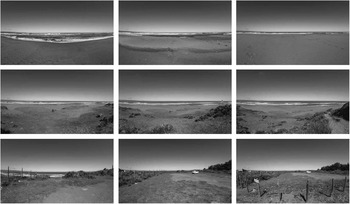
Field recordings were carried out on the Curiñanco beach, a long dark volcanic sand coastline located at approximately 45 kilometres from the city of Valdivia. This particular area has a considerable slope and is normally under very strong coastal winds, which makes weather conditions on the beach fairly unpredictable. On location, photographic material produced by the artist Natán Ide was used as a geographical reference in order to find a suitable location where recordings could be carried out at different distances from the shoreline. After several pilot tests, a specific spot was chosen where the landscape exhibited a dramatic slope from the access road to the seashore. Twenty stereo recordings were carried out in a line at different distances from the seashore, using a portable Marantz PMD661 recorder with a Rycote filter and a pair of DPA 4060 microphones in an AB recording disposition with 20 centimetres separation. Figure 1 shows a selection of pictures of the 20 microphone positions from the seashore to the access road.
Frontal view of microphone positions where some of the field recordings for the installations were carried out.

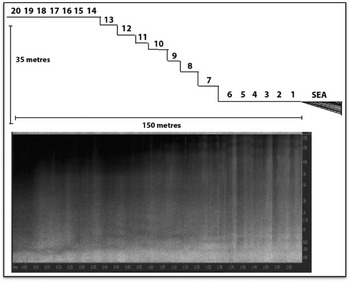
Recordings obtained showed an increasing low pass filtering process that became more apparent as the distance from the microphone to the shore increased. Recordings carried out closer to the shore contained a rich spectrum with a very well-defined stereo field, while recordings carried out further away from the shore contained mostly low frequency components and a very poor spatial resolution, resembling a monophonic source. The 20 recordings obtained were then edited and transformed into various short samples that were subsequently combined using a simple crossfading montage technique that aimed to recreate a continuous aural journey from the shore (10 metres) to the road at the top of the beach (200 metres).
Figure 2 shows the microphone positions used for the seashore recordings (top) in relation to spectral changes in one cycle of the installation soundtrack (below). Various sample durations were tested in order to obtain a soundtrack mix that would be suitable in artistic and practical terms for the installation. Aiming to convey a sense of timbral and spatial development in the piece, it was decided to use the shortest sample duration possible (8 seconds). The overall soundtrack cycle (2 minutes) was designed to fit within the museum’s average visitor time per room in order to allow visitors to get familiar, in a relatively short period of time, with the timbral and spatial features of the installation. The installation was presented in a 40 m² room using a four-channel loudspeaker setup, playing two synchronised stereo mixes of the cycle mentioned above, and ran continuously as part of the museum’s permanent collection for a period of three weeks. During that period, around two hundred people of all ages and backgrounds visited the installation and several visitors used the museum´s guest book to comment on the piece. Visitors’ comments mostly highlighted the immersive character of the acoustical experience generated by the four-channel system used in the installation and the spectral richness of the sound materials.
Seashore microphone positions used to capture sound samples in relation to a spectrogram of a 2-minute cycle of the installation sound track, moving from more distant (top) to closer positions (bottom).

4. Temporal-Based Montage Technique
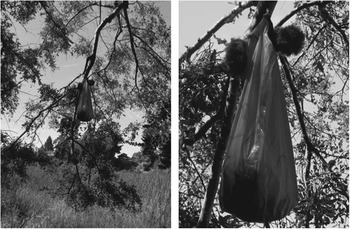
As part of an investigation which explored public perceptions of wetlands in the city of Valdivia, a second installation project involving the use of environmental sound was conceived. In 1960 one of the most powerful earthquakes on record hit Valdivia, generating dramatic topographic depressions in various areas of the city and leading to the natural development of various wetlands that have, ever since, covered large areas of some of the city’s most populated neighbourhoods (Chester Reference Chester2008: 53; Barbosa Reference Barbosa2014). While wetlands are an important natural feature of the city’s landscape, there is a considerable lack of awareness among Valdivia’s citizens about some of their basic features and environmental relevance (Barbosa and Villagra Reference Barbosa and Villagra2015: 301–2). With some of these ideas in mind, a project to investigate public perceptions of wetlands in the city was carried out in collaboration with the architects Carolina Ihle and Roberto Burgos. After visiting various urban wetlands, pilot field recordings were carried out on the outskirts of a wetland located in the southeast part of the city. This particular wetland is an interesting urban case study because it is surrounded by a park with large trees and has an abundant bird population, as well as a large number of newly built housing developments (Parque Urbano 2016). A standalone recording system was especially designed and implemented to carry out 24-hour continuous stereo recordings in a non-compressed audio format in different types of weather conditions. The recording setup included a portable Tascam DrII recorder powered by a portable mobile phone battery connected to a pair of BSM9 omnidirectional Microphone Madness microphones fitted with Rycote mini windjammers. The system allowed the possibility of recording continuously in 16 bit 44.1 kHz stereo audio format without interruptions for a period of up to 36 hours. Figure 3 shows pictures of the setup used to carry out the 24-hour field recordings at the mentioned wetland in Valdivia.
Recording setup used for recordings at the wetland in Valdivia, Chile. Left: stereo microphone array hanging from a tree at the side of the wetland. Right: close up of recording setup showing omnidirectional microphones with windjammer filters hanging at the sides of a hermetic plastic bag.

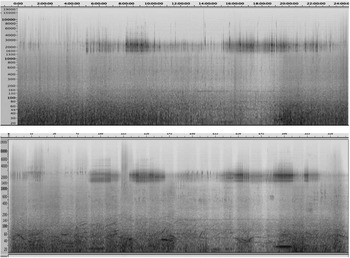
In line with temporal compression techniques used by Schafer and the World Soundscape Project in their compositions Summer Solstice and Entry to the Harbour (Truax Reference Truax2001: 239; Truax Reference Truax2012: 199), a similar approach to the previous installation with seashore recordings, a soundtrack assembling short recording samples for each hour of the day was created using a simple montage method. Various sample durations were tested to assess the best aural result, which would provide an organic and natural development of the track. Informal tests with various sample durations showed that shorter samples were more effective in providing a sense of temporal development in a reasonably short period of time. Three tracks with field recordings from different sites on the wetland were assembled using 12-second samples. The final soundtrack mix including the 24 samples had an overall duration of approximately 240 seconds (4 minutes). Figure 4 shows a spectrogram of the 24-hour recordings at the wetland (top) contrasted with the 4-minute montage created for the installation’s soundtrack. When comparing both spectrograms, it can be observed that the mix created using the montage method roughly resembles the main spectral features of the 24-hour track. In this case, the time-lapse method can work as an effective tool to recreate in a short period of time the sonic evolution of a particular landscape. Ways of optimising this montage method could involve the use of listening tests to optimise sample durations, taking into account acoustic and practical features of different field recording methods.
Spectrograms of 24-hour recordings at the wetland (top) and 4-minute time-lapse montage created for the installation soundtrack (below).

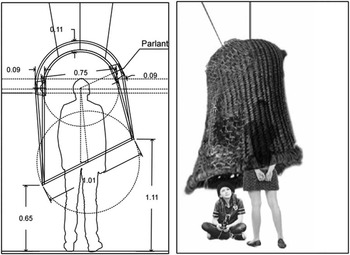
The soundtracks created using the time-lapse montage methods will be used as the basis of a sound installation that will take place at Universidad Católica in Santiago during 2016. Three especially designed cane baskets hosting pairs of small loudspeakers will be placed in different positions of a listening room. Loudspeakers will be playing the time-lapse soundtracks, aiming to provide a private immersive environment where listeners will be able to experience the daily temporal evolution of the wetland’s soundscape. Figure 5 shows diagrams of the wicker baskets especially designed for the installation.
Installation setup with wicker basket.

5. Discussion
The design and implementation of the two site-specific installations included a simple listening exercise with students in order to investigate audience responses to the two montage methods discussed above. In this case the experimental design was inspired by perceptual audio evaluation tests carried out by Bech and Zacharov (Reference Bech and Zacharov2006: 3) and a previous study about contemporary trends in the use of space in electroacoustic music carried out by the author (Otondo Reference Otondo2008: 77). Short versions of both installation sound tracks were played simultaneously to 22 first-year acoustic engineering students at Universidad Austral in Valdivia, Chile, who were recruited following an open call to take part in the experiment. Students listened once to each installation soundtrack through a pair of Yamaha HS7 studio monitors in an acoustically treated classroom and were subsequently asked to complete a simple questionnaire about the heard sound materials. Before playing each soundtrack, students were given a basic introduction to the methods used to obtain the recordings for each track and the locations where the source field recordings were carried out. The questionnaire contained three simple questions:
-
1. What are the most interesting sonic attributes of the first track?
-
2. What are the most interesting sonic attributes of the second track?
-
3. What are the similarities and differences between both tracks?
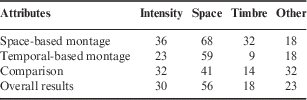
A summary of the listening exercise’s results is shown in Table 1.
Questionnaire results in percentages for twenty-two students that took part in the listening exercise.

While some participants answered the questions in a very subjective fashion, commenting on personal views or emotions related to the tracks played, most respondents provided a very fine and detailed analysis of the sound materials heard on both tracks. Replies showed that respondents mostly concentrated on three main sonic attributes: intensity, space and timbre. When listening to the first track created using the spatial-based montage technique with seashore sounds, respondents focused mostly on sonic spatial attributes, followed by intensity and timbral features. A similar tendency was observed for answers gathered for the temporal-based montage track, but with a larger gap between responses for spatial attributes and the other two features. When asked to compare both tracks, student responses showed a similar tendency to their answers to the previous questions, highlighting spatial features, closely followed by intensity and, to a lesser extent, timbral features. Overall results for all questions showed that preferences for spatial attributes were almost twice as many as those for intensity and three times more than those for timbral features.
The outcome of the listening exercise revealed an interesting tendency of respondents to favour space over intensity and timbre, which probably relates to a more intuitive approach to specific features of spatial sound, also observed in a previous study exploring spatial features of electroacoustic music composition mentioned above (Otondo Reference Otondo2008: 79–80). Minor differences were also observed in the way that participants responded to both installation soundtracks. The soundtrack created using the spatial-based montage seemed to provide listeners with stronger cues that allowed them to distinguish more clearly dynamic and timbral variations in the track. When listening to the soundtrack created using the temporal-based montage, listeners found it more difficult to identify clear variations due to the more static and less obvious sonic evolution of the track.
6. Conclusion and Future Work
The installations discussed above were the result of interdisciplinary collaborations which explored specific spatial and temporal features of urban and rural field recordings. By using simple organic compositional methods to capture and organise field recordings samples, it was possible to provide listeners with an aural experience that allowed them to easily relate to specific sonic features of urban and rural landscapes. In line with recent soundscape ecology studies where spatial and temporal qualities of particular landscapes were explored using fixed monitoring stations, the current study showed that simple montage methods can provide listeners with intricate and subtle audible relationships that can enhance the specific sonic features of particular locations (Farina Reference Farina2014: 12; Pijanowski et al. Reference Pijanowski, Villanueva-Rivera, Dumyahn, Farina, Krause, Napoletano, Gage and Pieretti2011b: 209). Questionnaire results discussed above showed that simple audio montage methods could become powerful compositional tools to effectively engage listeners with spatial and temporal features of environmental sound. Listening as an assessment strategy could provide an interesting field for potential research and artistic development in soundscape ecology.
Future developments of the projects presented here will explore ways of optimising the described montage techniques. By effectively integrating temporal and spatial montage techniques in soundscape ecology monitoring systems like the ones proposed by Farina and Pijanowski, listeners’ experience could be integrated in the sonic assessment of landscapes (Pijanowski et al. Reference Pijanowski, Villanueva-Rivera, Dumyahn, Farina, Krause, Napoletano, Gage and Pieretti2011b: 209; Farina Reference Farina2014: 12). Listening tests involving trained panels to assess the development of a landscape’s particular sonic features over a period of time could be used as an original soundscape assessment tool to raise awareness among audiences about relevant issues related to soundscape ecology such as climate change, urban planning, wildlife conservation and others (Marry Reference Marry2011: 245–6; Pijanowski et al. Reference Pijanowski, Villanueva-Rivera, Dumyahn, Farina, Krause, Napoletano, Gage and Pieretti2011b: 213; Krause and Farina Reference Krause and Farina2016: 250–1). Further studies could also consider ways of designing and implementing an automated sampling device that would allow massive, spatially distributed monitoring stations to capture uncompressed stereo samples over a large period of time and to automatically compile reduced montage versions of these samples in discrete soundtracks of various durations that could be heard online through live streaming. This could allow listeners to experience in a short period of time soundscape variations that would otherwise take hours, days or months. The same approach could be considered for assembling simultaneous field recordings carried out on various locations. This would allow listeners to experience gradual transitions between two or more soundscapes.
Acknowledgements
The research that led to this article was funded by the Chilean National Commission for Scientific and Technological Research under grant CONICYT PAI/ACADEMIA 79130014. The author would like to thank Natán Ide, Carolina Ihle, Roberto Burgos, Juan Pablo Ayala and Cristina Sin for their inspiration and help to carry out some of the research activities presented in this article.