I. INTRODUCING EURO-CRISIS AND THE ILO
A. The EU Sovereign Debt Group as a New Site of Interest for ILO Mobilization
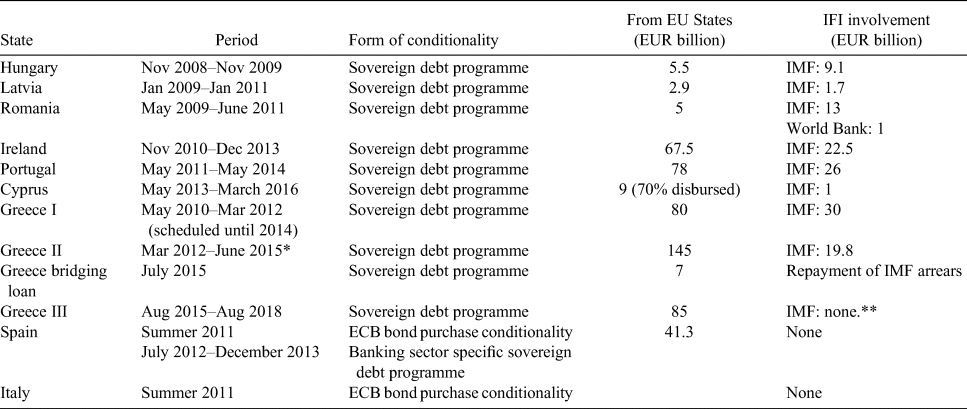
The EU's sovereign debt crises have made it a new site of interest for labour and social rights mobilization. For the first time, it was the EU institutions, in many cases alongside the IMF, which required these wide-ranging changes downgrading labour and social rights. The EU's relationship with internationally protected social and economic rights therefore underwent a very sharp change of direction during euro-crisis. This article focuses on the nine EU Member States that had specific labour and social conditions applied by the EU and/or the IMF because of sovereign debt weaknesses. These are set out in Table 1 below. These include the seven with full bailouts—Cyprus, Greece, Hungary, Ireland, Latvia, Portugal, Romania—as well as Spain and Italy which had distinctive forms of social conditionality applied because of banking and sovereign weaknesses. It is worth noting that these are not just single currency States. The balance of payments crisis triggered by the 2007–2008 financial crisis had led to the EU-IMF loan conditions being road-tested in Hungary, Latvia and Romania before the euro area sovereign debt crisis led to extensive EU action from May 2010 onwards.Footnote 1 Table 1 sets out the dates in which conditionality applied. The length of conditionality varied considerably within this group. Hungary was in a programme for only one year while Greece was in a programme for over eight years. Importantly too, the intensity and range of social and labour conditionality also varied considerably within the group. This explains the decision to focus on the 2010–2015 period when looking at the ILO supervision system. The 2010–2015 period captures the crisis's epicentre when the largest number of EU States were experiencing the effects of sovereign debt loan conditions and is therefore the most suitable window for capturing changed mobilization effects within the supervisory machinery. As annual change is less significant in relation to ILO complaints, for those I consider the full 2010–2018 period.
The EU Sovereign Debt Group

* Scheduled until end 2014, extended because of elections won by Syriza in January 2015.
** The IMF withheld support until July 2017 when it in principle approved 1.6 subject to EU assurances on Greek debt relief. However, limited debt relief was agreed by the Eurogroup only in late June 2018.
Of course, other EU Member States had significant austerity programmes and budgets during the same period, most notably the UK.Footnote 2 Why then focus on the sovereign debt group rather than identifying a broader ‘austerity’ group of EU States? Three linked reasons underpin this choice, all of which relate to the presence of EU and international requirements to make changes to social and labour rights. First, unlike domestic austerity drives, mainly focused on intense fiscal consolidation, and having therefore a greater impact on social rights requiring State spending, programme requirements range more widely, and typically have a greater focus on restructuring labour and social regulations and institutions. Hence, rapid cuts in State spending are only one of their goals. Second, the sovereign debt crisis highlights the central role of the EU institutions, especially the Commission and the ECB, as drafters, monitors and enforcers of the social and labour conditions applied in these States. Never before had these EU institutions been at the centre of allegations of extensive labour and social rights breaches. Yet the EU is not a member of the ILO and only States are subject to its obligations. Third, in addition, the IMF is a key player in those seven EU States with full bailouts. All these features can affect ILO mobilization. They make it more likely that the programmes will target labour rights and institutions. Their source in normative-institutional instructions from the IMF and EU institutions may affect resolve to mobilize against them. Finally, as it is these institutions alongside or even rather than the States that are the primary targets of challenges, this can shape mobilization decisions and strategies.
B. The EU as a Star Pupil in Ratification and Supervision
The contrast between the EU Member States before and after the onset of sovereign debt requirements should be made clear. It is the very contrast between the previously good record of EU States in relation to ILO standards and the challenge presented by the widespread application of sovereign debt labour and social conditionality that makes this analysis of interest. There is a clear before and after that allows for meaningful comparisons in mobilization to be made.
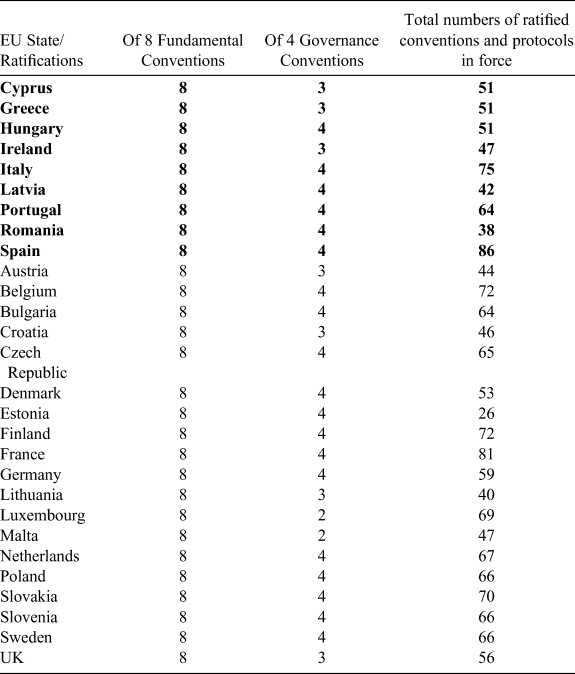
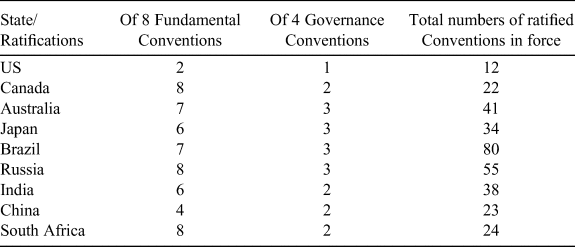
By comparing EU States with some prominent comparators, it is clear why EU States have traditionally been seen as ‘star pupils’Footnote 3 in the ILO. The ILO itself has identified 12 of its Conventions as being of particular importance, eight fundamentalFootnote 4 and four governanceFootnote 5 or priority Conventions and, along with the total number of ratified binding ILO instruments,Footnote 6 these can be used as a benchmark for comparing patterns of ratification as Tables 2 and 3 show. These show a consistent pattern of complete ratification of the eight Conventions identified as fundamental by the EU Member States as well as a very high level of ratification of the four governance Conventions, including in the sovereign debt group highlighted in the table. In comparison with ratification figures for other advanced economies and the BRICS,Footnote 7 set out in Table 3, EU Member States are indeed star pupils of the ILO. Moreover, in the supervision system the EU States typically raised comparatively lower numbers of rights violationsFootnote 8 in contrast with the pattern of ‘complex and pervasive’ concernsFootnote 9 identified by the ILO in certain Member States during the EU sovereign debt crisis.
EU as the Star Region for ILO Ratifications

Comparator States for ILO Ratifications

C. Introducing ILO Actors and Venues
A feature of the ILO is that it offers several venues for mobilization, with a range of complaints mechanisms alongside the supervision system. It is well known that unions and employers have a special place alongside States in ILO governance, with between them half the votes in the International Labour Conference (ILC) for setting new standards and in the Governing Body, the ILO's 56-strong executive organ. This is also the case for supervision and complaints where workers’ and employers’ organizations are accorded special roles.
1. Supervision at the ILO: CEACR and CAS
The regular supervision function of the ILO is carried out by two Committees, the two linked pillars of the supervisory system, both created and in operation from 1926: the Committee of Experts on the Application of Conventions and Recommendations (the CEACR or the Committee of Experts) and the Committee on the Application of Standards (CAS).Footnote 10 The role of the Committee of Experts, made up of 20 jurists meeting at the end of each year, is to provide an impartial and technical evaluation of application of international labour standards in States. It fulfils its mission in a range of ways, the most central of which is production of observationsFootnote 11 in an annual report containing comments on fundamental questions raised by the application of a particular Convention by a State. The CEACR operates on the basis not only of government reportsFootnote 12 (currentlyFootnote 13 there is a three-year government reporting cycle for the 12 fundamental and governance conventions and a five-year reporting cycle for all other ratified conventions) but also (potentially) inputs from employer and workers’ organizations. Article 23(2) ILO Constitution obliges governments to send copies of all reports on ratified and unratified conventions to employer and workers’ organizations.Footnote 14 From this has developed a practice whereby those organizations may make any observations they wish either via their government or direct to the ILO which will acknowledge receipt and send a copy to their government.Footnote 15 It is worth underlining that the last 25 years has seen a remarkable increase in the number of worker organization observations to the CEACR.Footnote 16 In addition, ILO Office procedure in relation to obligations is to endeavour to ensure that national worker and employer organizations receive copies of relevant comments of supervisory bodies and requests for reports so this too could encourage subsequent employer or workers’ organization participation. Indeed, the CEACR and CAS regularly emphasize the value of such comments from employer and worker organizations as a means of assisting them, in particular, in assessing the effective application of ratified conventions.
The Committee of Experts has a range of ways to express its concerns.Footnote 17 One such is the very decision to make an observation on a particular Convention. Others are explored later in this analysis.Footnote 18 However, one special institutional means of signalling concern should be highlighted. This is the use of ‘footnotes’ or special notes as an essential feature of CEACR operation. Footnotes can either specify an earlier reporting requirement to the Committee of Experts (called a single footnote) or additionally ask the government to supply full particulars on the matter to the next International Labour Conference (called a double footnote).Footnote 19 The existence of observations, especially those containing footnotes,Footnote 20 from the Committee of ExpertsFootnote 21 is crucial for the second pillar of the supervisory system, the CAS.
CAS is the Conference Committee on the Application of Standards, a largeFootnote 22 tripartite Committee of government, worker and employer members. It selects 24 or 25 individual casesFootnote 23 drawing on the 700 or so CEACR observations produced each year for tripartite discussion. On the basis of these discussions it produces Conclusions which can recommend specific steps by States to remedy a problem or to invite ILO missions or technical assistance.Footnote 24 Situations of special concern are highlighted in special paragraphs of its General Report. The CAS report is submitted to the June International Labour Conference for discussion in plenary session. As Swepston, a former high-level ILO official notes, the two Committees have a complementary rather than hierarchical relationship with the CAS adding ‘a public and political element of direct discussions with selected governments in a tripartite setting to gather additional information and put additional pressure on them in a public setting to implement the Conventions they have ratified. Each Committee bases its work in large part on the other, in a circular and complementary way.’Footnote 25
2. ILO complaints mechanisms used in euro-crisis
The supervision machinery does not exhaust the ILO venues unions can turn to. Two ILO complaints mechanisms were activated in the Crisis Europe period: Representations and the Committee on Freedom of Association.Footnote 26 Under Articles 24 and 25 of the ILO Constitution of 1919 employer or worker associations can present to the ILO Governing Body a Representation against any Member State which, in its view, ‘has failed to secure in any respect the effective observance’ of any ratified convention. The Governing Body can set up a three-member tripartite committee to examine the representation, create a report for the Governing Body on facts and law and make recommendations. The Committee on Freedom of Association (CFA) is a special committee of the Governing Body set up in 1951 for complaints about violations of freedom of association (irrespective of whether or not States have ratified the key Conventions 087 and 098). Its independent chairman and three representatives each of employer, worker and government representatives decide on the facts and on whether a violation exists. Its report, issued via the Governing Body, recommends how the situation could be remedied.
II. MEASURING CHANGES IN MOBILIZATION AT THE ILO DURING EURO-CRISIS
A central challenge in measuring changes in mobilization is data-oriented: what can and should be measured and how can one identify changes in mobilization at the ILO and the changes mobilization brings to venues? The fundamental orientation that seems most productive to adopt in such measurement is to compare the crisis epicentre with the period preceding it (that is a before/after comparison). However, developing this method is not straightforward. A good part of my analysis tries out and tests various ways of measuring or tracking mobilization through the ILO supervisory and complaints systems. It also entails a use of numbers and tables that departs from the prose format of much legal scholarship. I test various mainly quantitative ways of identifying and measuring euro-crisis mobilization around the possible venues offered by the ILO system. Ultimately, the analysis shows how certain measurements, combined with appropriate follow-up inquiries and interviews, suggest knowledgeable actors collaborating nationally and transnationally to mobilize against Crisis Europe in a range of ILO venues. The main finding therefore is that certain measurements illuminate how euro-crisis constituted a trigger for new quantities and kinds of mobilization at the ILO.
A. Crisis Europe at the CEACR
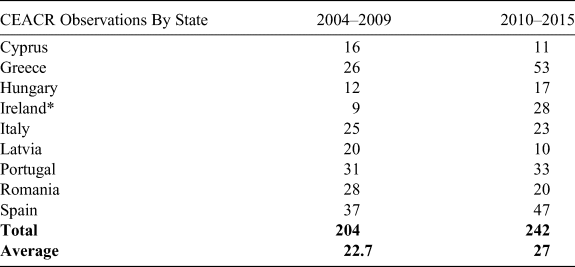
A powerful way to show the difference a focus on mobilization makes is to inquire beforehand into what difference Crisis Europe made to the Committee of Experts supervisory activities. All CEACR observations between 2010 and 2015 in the nine euro-crisis States are mapped. In these 9 EU Member States 53 different conventions were the subject of observations in 2010–2015 and there are 242 observations in total. How though can these figures be evaluated? Table 4 compares the numbers of observations in these States over the six-year time period preceding the euro-crisis period of 2010–2015 to see if any important differences can be noticed.
CEACR Observations before and during Euro-Crisis

* Ireland, very unusually for an EU State, failed to fulfil its reporting obligations for a long period from 2002 onwards. This affected the nature of the observations addressed to it.
This tells us that such straightforward quantitative comparison provides quite limited indications that euro-crisis was felt within the supervision system. There was an increase in the average annual number of observations from 22.7 in the pre-crisis period to 27 in the crisis period. However, the table demonstrates that there are important variations within the group of sovereign debt programme States. While in some States observations doubled (Greece) or more than tripled (Ireland), in others they decreased (Cyprus, Latvia). Hence the table certainly does not evidence an across-the-board transformation in how the EU sovereign debt crisis affected States’ assessment by the CEACR. If one stopped here, one might conclude that the ILO supervision system had been, at best, modestly affected by the dramatic changes to social rights wrought by sovereign debt loan conditionality.
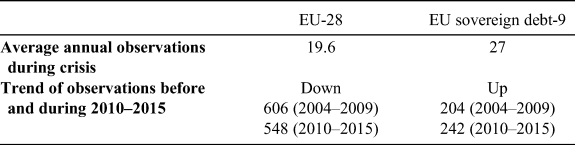
Yet probing further elicits richer answers. One avenue is to set the EU sovereign debt group within the EU-28. This allows us to see if the changes in numbers of observations before and during crisis differ in ways that are significant. This is done in Table 5.
Comparing the EU-28 and the EU sovereign debt group at the CEACR

Overall the number of observations during the crisis went up in the sovereign debt States (from 204 to 242), but down across the EU (from 606 to 548). While not a huge difference, it shows that the direction of travel differed for euro-crisis and other EU States. And while the average annual number of observations for all EU States 2010–2015 is 19.6 observations for sovereign debt States it is 27 observations. Setting the sovereign debt group within the EU-28 does therefore indicate trends indicating a different interaction of the sovereign debt group with the ILO supervision system during euro-crisis.
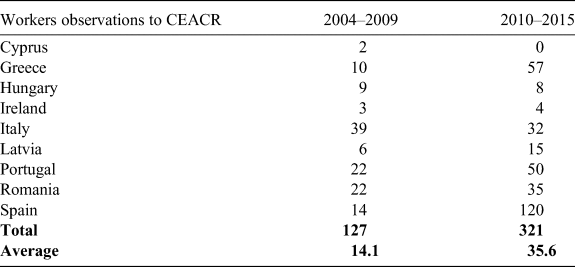
More importantly, we can ask, looking back at Table 4, why Spain and Portugal have such ‘bad’ records of observations across both time periods compared to, say, Cyprus and Latvia. An important path to answering is to consider the channels through which the CEACR obtains its information. What matters, in other words, is finding out what produces an observation rather than simply counting those that result. This is the key to linking supervision and mobilization. As noted above in introducing ILO supervision, in addition to government reports the CEACR can also receive observations from workers and employers’ organizations. Tracking workers’ organizations seems the most promising path to investigate changing mobilization during euro-crisis. What emerges when worker organization observations to the CEACR are mapped in sovereign debt States?
Table 6 shows a very significant jump in workers’ observations, driven by dramatic spikes in the numbers of observations sent from certain sovereign debt States. The figures from Latvia, Portugal and Romania all show substantial (double or close to double) increases while exponential (five- or tenfold) increases occurred in Greece and Spain. In a third group, containing Cyprus, Hungary and Ireland, numbers remained low. This is key mobilization data, showing unions turned to the ILO supervision system with many more observations in the crisis. If we add in who made observations, further interesting information emerges. A notable shift in the States with most workers’ observations in euro-crisis, Greece and Spain, was wider participation by more national workers’ organizations. Hence in Greece, while the Greek General Confederation of Labour (GSEE) was the most active participant, sectoral Greek unions also made observations.Footnote 27 In Spain, the small number of observations pre-crisis made by the CCOO (Trade Union Confederation of Workers’ Commissions) became a flood of observations from both them and the UGT (General Union of Workers) as well as repeated interventions (in 2011, 2012, 2014 and 2015) from the ITUC on Conventions 87 and 98. Sectoral unions combined forces at national and international level to submit joint observations such as the International Transport Workers’ Federation (ITF) and the Panhellenic Seamen's Federation. And global union federations—the International Trade Union Confederation (ITUC) and the World Federation of Trade Unions—also made observations about Greece.Footnote 28
Worker organization observations to CEACR before and during Euro-crisis

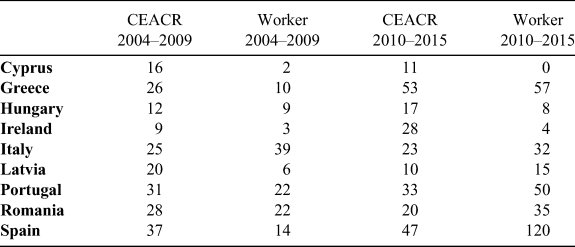
While we should not seek any straightforward or mechanical correspondence between CEACR and workers’ observations, as the CEACR also acts on the basis of government reports (and, where made, employer organization observations), we can productively juxtapose workers and CEACR observations as shown in Table 7 below. This suggests a hypothesis worth exploring: that a signal of a healthy and vibrant supervision system, especially when alerted by crisis developments, is when worker observations exceed CEACR observations (here, for example, Italy) while higher CEACR observations than worker inputs (here, for example, in Cyprus, Hungary and Ireland) merits further investigation to find out the reasons for this.Footnote 29 In this regard it is worth noting that in Greece, Portugal, Latvia, Romania and Spain, the order was reversed during the crisis period so that during the crisis there were more worker observations than CEACR observations while prior to the crisis there were more CEACR than worker observations.
Worker and CEACR observations mapped together

These measurements suggest that the crisis activated worker organizations in a number of States to use the supervision system. It is unfortunate that, unlike the shadow reports produced by NGOs in the UN Human Rights supervision system, the observations of worker and employer organizations are not made public in the ILO system as that would provide a productive line of inquiry allowing tracking of the influence workers’ observations have had on the CEACR observations.Footnote 30 Nonetheless, this shows that the public material can be measured in ways that allow tracking of changing mobilization in the supervision system. However, what is not clear from these measurements is whether these were free-standing and unconnected mobilization decisions in each Crisis Europe State or whether some elements of a transnational strategy were present.
B. Preliminary Evidence of a Transnational Mobilization Strategy
The measures of ILO supervisory mobilization suggest that follow-up interviews could usefully elicit even further information: about decisions to send worker organization observations and about linkages between national union and international confederations in approaching the CEACR and CAS. One such interview, with the global legal officer of the ITF (the International Transport Workers’ Federation),Footnote 31 suggests elements of a transnational strategy. He notes the clear presence of an inter-union globally agreed strategy driven by shared recognition that the EU-IMF nature of the euro-crisis programme requirements made them a global priority to challenge. While unions in sovereign debt States were free to choose which if any ILO mobilization route to take, when that route was taken there was a strategic decision to design worker observations to highlight the gravity or seriousness of the matter (ie regressive reforms) to the Committee of Experts in a concerted manner. A first institutional feature favouring a transnational strategy is the annual nature of the process in a Crisis episode spreading over multiple years. What is agreed and learnt in the first year can feed into the supervision process in the next. The second crucial institutional feature fostering transnationalization of mobilization in the ILO supervisory system is the need for tripartite agreement on a limited number of cases from all the CEACR observations to go forward to the CAS. This leads to the workers’ organizations from across the world having to agree on strategic priorities. In March or April of the year following the December report from the Committee of Experts the ITUC caucus meets to draw up the long list of cases it wishes to submit for consideration by the CAS in June. Each global region brings its wish list: in these meetings, it was agreed that EU sovereign debt States should be a priority, a decision bolstered by the prior strategic decision to elicit appropriate engagement from the Committee of Experts for those States. Of course, that union wish-list then has to be part of tripartite negotiations before becoming one of the 25 or so individual cases considered by the CAS. Yet this account of the ILO supervisory system shows where and why elements of a transnational strategy can be fostered and developed. The why of transnational agreement on Crisis Europe as a priority was based on the involvement of the EU and IMF in multiple States.
C. The Outcomes of Mobilization at the CEACR
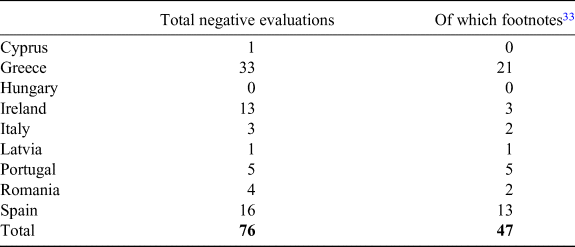
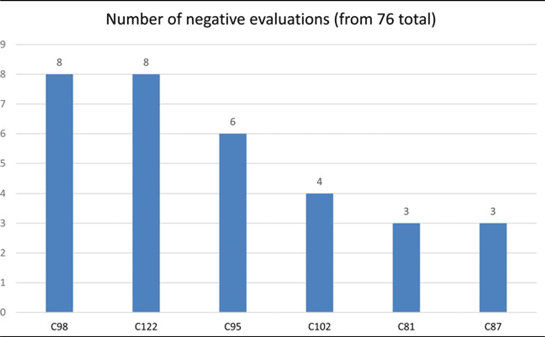
The CEACR has a range of ways to express concerns within its observations. To create the data in Table 8 only those at the most negative end of the spectrum were measured: expressions of (deep) regret or concern highlighted by the CEACR itself (by placing in bold text) and the decision by the Committee to issue footnotes, requiring either earlier reporting to the CEACR (single footnote) or also requiring (double footnote)Footnote 32 the government to supply the International Labour Conference with details. There are 76 of these most negative evaluations within, as noted earlier, a total of 242 observations. Ireland is an outlier as its negative evaluations also relate to its failure to comply with its reporting obligations. Again, the States fall into three groups. There are those with no footnotes but also little or no national union mobilization around the CEACR (Cyprus and Hungary). At the other end of the spectrum are Greece and Spain where exceptionally high numbers of negative evaluations and footnotes align with very high numbers of workers’ observations. In between sit those States with low to moderate levels of workers’ observations and negative evaluations (Latvia, Italy, Romania, Portugal). We can also see, by looking at those Conventions attracting the most negative evaluations, a clear clustering around six ILO Conventions. These are set out in Table 9 above. Most concern was expressed with regard to the Right to Organise and Collectively Bargain (C98) and the Employment Policy (C122) Conventions. Protection of wages (C95) and social security (102) were also a central focus with labour inspection (C81) and freedom of association (C87) also attracting the attention of the CEACR. The crisis shaped these outcomes. The crisis and the sovereign debt status of this group is repeatedly adverted to in CEACR observations.Footnote 34 Of 13 observations addressed to Greece in 2011, all but one contained a footnote. The linked nature of the two stages in the supervision system allow us to trace how such concerns fed through into the CAS stage.
CEACR Negative Evaluations in Crisis Europe Observations 2010–2015 by State

Top Negative Evaluations at CEACR by Convention in Crisis Europe

D. Crisis at the CAS
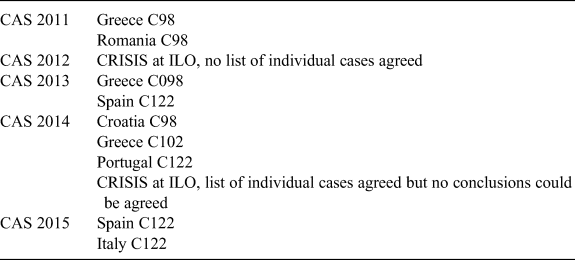
Around 25 individual cases are selected by the CAS each year, drawing on the CEACR observations, for debate and Conclusions. During Crisis Europe, use of this avenue was impaired by a parallel crisis in this part of the ILO supervisory system. Because of employer objection to the right to strike being covered by ILO supervision, this part of the supervisory system struggled during this period. It broke down entirely in 2012 and partially in 2014. Nonetheless, Table 10 tells us that Crisis Europe was clearly identified as a problem by the CAS: aside from Croatia, every EU State selected as an individual case in 2011–2015 was a euro-crisis State. In addition, the conventions selected for focus, collective bargaining (C98), social security minimum standards (C102) and employment policy (C122) also signal special crisis concerns. Moreover, we can see the strong link between those Conventions with the largest number of negative evaluations from the CEACR and the selection of individual cases by the CAS.
CAS and Crisis Europe 2011–2015

The various ways in which we have measured the supervisory system: by comparing CEACR observations before and during the crisis; by comparing Crisis Europe with EU-28 observations; by tracking worker observations and mapping them onto CEACR observations; and by seeing how concerns of workers and the CEACR in turn feed into the second stage of supervision at the CAS, provide convincing evidence that the crisis changed mobilization and created changes in the supervisory system.
E. ILO Complaints Mechanisms and Crisis Europe
Representations were an important and notable avenue in Romania, Spain and Portugal when compared with pre-crisis use of this avenue.Footnote 35 Romanian unions made their first ever representations in 2016 and 2017, on non-observance of the Protection of Wages Convention (C95) and the Discrimination in Employment Convention (C155).Footnote 36 Four representations each came from SpainFootnote 37 and PortugalFootnote 38 after 2010 when unions in these countries had not used this avenue for decades. The ten representations came from many different unions and cover a wide range of subject matters including wage-fixing, labour inspection and termination of employment. Accordingly, a change in mobilization is evident in the use of representations in Crisis Europe. At the same time, representations also illustrate the variable use of ILO venues in crisis States as the representation avenue was not turned to even in States with active crisis mobilization. Most strikingly there have been no Greek representations.
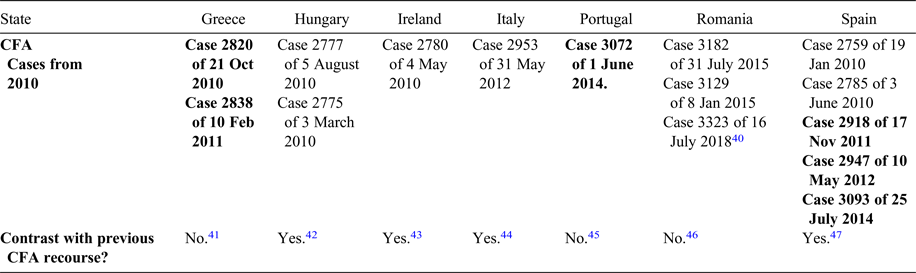
Table 11 sets out Crisis Europe at the Committee on Freedom of Association. At least three issues worthy of further reflection emerge. First, in four of the nine EU sovereign debt States, Hungary, Italy, Spain and Ireland, there was a contrast with previous engagement with the CFA. Second, in at least two of those States, Spain and Italy, that contrast could be described as striking or marked. Third, out of the five States where no quantitative contrast is apparent, that does not mean no significant activity before the CFA. In Greece and Romania, Crisis Europe signified a continuing pattern of active recourse to the CFA. The substance of the CFA complaints, indicated in Table 11 in bold, also shows that Crisis Europe was the precise reason for increased use of this avenue in Greece, Spain and Portugal. In other States, such as Romania, sovereign debt resistance which led to a broader use by unions or civil society of international rights venues may have a diffuse mobilization effect so that mobilizers become accustomed to using these venues and use them also for issues not strictly connected to sovereign debt measures.
Crisis Europe and the CFA from 2010 contrasted with previous recourse (crisis-focused complaints in bold)Footnote 39

Adding complaints mechanisms to the analysis of supervision shows that the plurality of ILO venues opens interesting questions about ILO venue choices. Greek unions focused their attention on the supervisory system and the CFA. Spanish unions, by contrast, adopted an all venues approach, with much more intense activity in the supervisory system, representations and before the CFA. Portuguese unions maintained their previous levels of activity in the supervisory system and at the CFA but added representations to their range of venue-choices. Romanian unions increased their activity in the supervisory system and started to use representations.
III. WHAT CAN BE LEARNT ABOUT THE ILO FROM THE ANALYSIS OF CHANGING MOBILIZATION
This analysis of Crisis Europe at the ILO is the first to focus on mobilization in ILO supervision and complaints. Whilst ILO literature does not focus on this question,Footnote 48 studies of the ILO can fruitfully draw inspiration from the flourishing literature on mobilizing for human rights developed around the UN Human Rights regimes.Footnote 49 This mobilization focus questions existing ILO literature and brings new insights. Five are outlined here: the ILO is more than existing literature assumes; it questions the depiction of the ILO as a ‘toothless tiger’; the sharp divide between unions and NGOs is overstated; the ILO is a good venue for transnational mobilization because of certain institutional design features; the ILO is not transparent in terms of access to documents relevant to mobilization and compares poorly in this respect with UN Human Rights Treaty Bodies.
A. The ILO Is More Than Existing Literature Assumes
This analysis of ILO standards is institutional and comparative. It examines how the ILO institutional machinery operated during the EU sovereign debt crisis by comparing changes in mobilization along three dimensions: across multiple States; across the range of ILO instruments; and across time periods (before/during crisis). A focus on mobilization around existing ratified standards using long-established supervision and complaints mechanisms in response to a labour and social rights shock can demonstrate and remind us of the utility and vitality of what the ILO already has in place. Attention has already been drawn to the absence of work on mobilization in ILO supervision and complaints. However, this analysis contrasts with the focus of recent literature in other ways too.
Such an intra-ILO angle of inquiry contrasts with the focus on how ILO norms are taken up, used or understood in a much wider series of locations such as in multinational corporations’ Codes of Conduct, in trade agreements or by domestic or regional courts. Much work on the ILO over the last few decades is soul-searching and reflection on how it can find its way in the contemporary worldFootnote 50 with focus placed on the shift away from standard-setting to principles and the roles the ILO and its standards or principles play in global supply chains and bi- or multi-lateral trade agreements.Footnote 51 Without denying the importance of such reflections, an intra-ILO focus can usefully correct perceptions that action on ILO norms primarily takes place outside established ILO mechanisms.
The recent scholarship that does focus on the ILO supervisory machineryFootnote 52 focuses almost exclusively on the protection of one right, the right to strike. The last decade has seen an outpouring of scholarship on the ILO and the right to strike, driven principally by interruption of supervision from 2012 for the first time from its inception in 1927 because of a much-analysed disputeFootnote 53 from the employers’ side about how supervision operates in relation to the right to strike. The intersections of this scholarly focus with that presented here are threefold. Because Crisis Europe took place during the ILO supervisory crisis, as noted above, its supervision was disrupted.Footnote 54 At the same time, the intense analysis of this dispute has led to increased explanation of the design of the supervisory system and attention to the diffusion of its outputs. With regard to supervisory design, the complementary nature of the two components of the ILO supervisory system and the characterization of the output of the Committee of Experts as ‘working interpretations’ of ILO standards has been stressed and elaborated. Such a reading reconciles, on the one hand, the ‘interpretative function’ of that Committee with, on the other, the fact that the ILO Constitution reserves formal interpretation to the ICJ.Footnote 55 In relation to diffusion of its outputs, by suggesting that the increased salience of the outputs of the ILO supervision system outside the ILO—in national (especially Canada) and regional courts (ECtHR) or other locations—provoked employer action to weaken that ILO supervision system,Footnote 56 this example illustrates the complex interactions that can develop between the international and the transnational dimensions of ILO standards and supervision. A third dimension of the right to strike analysis is an EU focus: mainly on how internal market judgments of the Court of Justice of the EUFootnote 57 are in conflict with ILO and regional (Council of Europe) norms on freedom of association and public procurement. This intersects with this analysis in the sense that it shows Europe as becoming a place where protection of social and labour rights is no longer normally assured albeit by focusing only on one specific example.
However, the contrasts of this analysis with this intensive focus on the right to strike should equally be signalled. Above all this analysis highlights the wide range of ILO Conventions that unions found it useful to engage with. As charted above, employment policy, protection of wages, social security and labour inspection were of central importance and the focus on collective freedoms touched a much broader range of issues than the right to strike. Accordingly, the ILO Conventions invoked in Crisis Europe demonstrate the value of the wider range of standards beyond ‘core labour standards’. In this sense, this analysis echoes with the debates on the 1998 ILO Declaration of Fundamental Rights and Principles at Work.Footnote 58 Just as the rise of ‘core labour standards’ and the 1998 Declaration is closely associated to the fall of the Berlin Wall, so too can Crisis Europe be associated with an understanding of the renewed value in Europe of a wider set of ILO Conventions.
B. It Questions the Depiction of the ILO as a ‘Toothless Tiger’
The most important contribution human rights mobilization approaches bring to the study of the ILO (and the UN International Human Rights (IHR) regimes more broadly) is to escape the characterization and evaluation of such regimes along a hard–soft law axis. The ILO has been particularly afflicted by the ‘toothless tiger’ labelFootnote 59 and arguments oriented within hard–soft law debates. A good recent example is provided by Brian Langille who depicts ILO supervision as follows:
It is all lawyers talking to lawyers, unable to resolve the huge and unmanageable object of trying to negotiate simple de jure compliance let alone effect de facto compliance. The process has become a legal island within the ILO and largely disconnected from the substantive ‘on the ground work’ of the organization … the legalistic, hard law, formalistic way of proceeding has large costs for the abilities of the ILO to work for, measure, and achieve results in the real world.Footnote 60
A mobilization perspective on ILO supervision and complaints is very different from his depiction of that same system. Such a perspective does not see only lawyers but civil society actors mobilizing. It sees those mobilizers going between domestic and international venues (and not just legal venues) rather than ILO bodies ‘jurisprudence’ as the key conduit through which ILO sources can have effects ‘in the real world’. In contrast with hard–soft law approaches, mobilization approaches share the feature that rather than placing the emphasis on calibrating the legal normativity of outputs, they underline that what makes change happen, what makes human rights norms come to life as agents for change in the world, is their use by actors.Footnote 61 Hence the hard–soft law nature of the norms is neither determinative nor even necessarily central. This central mobilizing insight is, I suggest, an exceptionally productive one in the context of the ILO.
C. The Sharp Divide between NGOs and Unions Is Overstated
One reason that human rights mobilization approaches may not have resonated with ILO work is that the former are associated with NGOs and ‘civil society’ whilst the ILO is associated with a tripartite governance structure in which there is little or no space for NGOs. The tripartite features of the ILO have led to resistance to initiatives of ILO Director-Generals over the last few decades to widen the ILO to a wider range of NGO and civil society actors with interest in the rights of those performing work, including acknowledgment of those falling outside traditional employee or employer categories.Footnote 62 The case for widening the ILO to more constituencies was perhaps made most explicitly by Juan Somavia as Director-General in 1999 in his report to the International Labour Conference:
NGOs have been behind many voluntary initiatives that address corporate citizenship and workers’ welfare, such as codes of conduct and social labelling. Successful NGOs display strength, flexibility and imagination. They have their drawbacks; their action may be sporadic, their representation uncertain, their life-span limited and their funding unstable. The ILO has to support ways in which its constituents can work more effectively in partnership with these groups to pursue shared objectives.Footnote 63
These are important debates. However, one should be wary of drawing too sharp a line, especially in times of labour and social rights shocks in States, between unions and NGOs. In some European States, Greece for example, the principal organized civil society actors resisting the crisis measures were the unions.Footnote 64 Stability and scale in membership and representation have many positive dimensions especially in times of crisis. At the same time, and reinforcing the same point in a different way, it is also important not to stereotype unions as rigid, stale bureaucracies and NGOs as effervescent, dynamic and ever-changing. Not only is it true that the opposite can be the case, as documented in my analysis, in Crisis Europe unions acted in new ways worthy of our attention. Lastly, we should not overlook the roles INGOs do already play in ILO supervision, making use of their observer status in the second pillar of ILO supervision, the Committee on the Application of Standards. Over 20 INGOs, given official status,Footnote 65 typically attend the Committee.Footnote 66
D. The ILO Is a Good Venue for Transnational Mobilization because Institutionally Well Suited
This analysis also showed that transnational strategizing combined with domestic mobilization choices at crucial points in the ILO supervision system. This was institutionally facilitated by design features of the ILO supervisory system. Two are particularly noteworthy. One is the annual nature of the supervisory cycle, in a context of multiple States raising linked issues engaging multiple Conventions, which allowed strategies to be built up in a relatively short time period. The second is the need for tripartite agreement on a list of 25 cases to be singled out for discussion and high-profile focus at the Committee on the Application of Standards and the International Labour Conference from a pool of 700 plus options of observations produced by the Committee of Experts. The need for agreement from unions from different parts of the world on a negotiating list drives the creation of reasoned debate on criteria for prioritization. As noted, the presence of EU/IMF loan conditionality was a criterion that led to prioritization of EU sovereign debt States. This points to the interest of comparative institutional analysis with other rights supervisory bodies to see what design features they possess which shape mobilization.
E. The ILO Is Not Transparent in Terms of Access to Documents Relevant to Mobilization and Compares Poorly in This Respect with UN Human Rights Treaty Bodies
Unlike the shadow reports produced by NGOs in the UN Human Rights supervision systems, the observations of worker and employer organizations are not made public in the ILO system. This is unfortunate as it precludes a productive line of inquiry tracking the influence worker and employer organizations’ observations have on CEACR observations.Footnote 67 The lack of transparency may arise from the informal practices that led to workers and employers’ organizations observations, alongside the existence of complaints venues at the ILO those organizations may also use.Footnote 68 Whatever the reasons, it would substantially enhance transparency and academic study of the supervision system to align ILO practice with that of the UN Human Rights Treaty Bodies.
IV. What we learn about mobilization
The focus on changing mobilization also introduces new strands of inquiry into the broader human rights mobilization scholarship. Having situated my inquiry within the existing scholarship, the most important identified here are: rejecting the assumption that mobilization inevitably follows a significant rights shock such as euro-crisis; enhancing our understanding of who wishes to use such ‘soft law’ procedures and why they wish to use them; operationalizing the measurement of mobilization; dealing with an international organization which is both a mobilization venue and an engaged actor.
A. Changing Mobilization within Existing Scholarship
We can draw on the different perspectives offered by the most interesting mobilizing for human rights literature to ask: what is mobilization the measure of? By setting out the very different answers given to this question, the distinctive focus of this analysis can be better situated.
For Beth Simmons, domestic mobilization explains why UN international human rights (IHR) treaties bring about change on the ground such as, for example, to women's education levels under CEDAW. It is the latter that is her focus of measurement.Footnote 69 Gráinne de Búrca focuses rather on characterizing IHR Treaties, with their iterative reporting requirements and shadow reports from NGOs, as a system of experimental governance. Mobilization or use by NGOs of IHR Treaty reporting accordingly becomes an essential governance input to keeping the governance system, the main focus, functioning and vibrant.Footnote 70 From a legal anthropological perspective, Sally Engle Merry's account of CEDAW mobilization stresses the contingent, layered and very partial ‘trying on’ of human rights by most individuals as a frame for understanding and action. It is translators inhabiting more fully that human rights frame, including by ‘going to the UN’, who connect the local and global in processes of human rights ‘vernacularisation’.Footnote 71 Others, such as Keck and Sikkink, instead focus on the mobilizers, by considering how and when they link across borders, and the processes they employ to identify and build effective campaigns and networks such as around ‘gender violence’. Such activist network analyses see human rights legal venues and language as one possible avenue in which others (such as media campaigns, public demonstrations such as circles of silence) may well be taken.Footnote 72
This analysis is distinct from these various mobilizing for human rights approaches. The focus is upon changes in mobilization—its amount, its actors and their strategies. Regime-specific (ILO) rights-focused analysis is undertaken which is used to measure changes consequent upon a specific kind of ‘rights-shock’, conditionality imposed by supranational and international institutions. As, following Simmons, most scholarship on mobilizing for human rights identifies ‘unstable’ States as those where human rights are likely to have most traction, with the consequence that EU States, and especially Western EU States, have rarely been their focus, Crisis Europe is an interesting new focus. However, rather than pre-identified ‘unstable’ States being the focus, the focus here is on the period of change or shock or transition and how that is expressed through rights mobilization. Further, unlike Simmons’ focus, there is no attempt to measure changes on the ground in Europe as a result of this mobilization. The focus of interest is in the operation of ILO systems as a way of capturing how they are turned to and how they respond to significant disruptions to the status quo rather than, as in de Búrca's analysis, to characterize a governance system receiving civil society inputs. There is a focus on novel actors and strategies at the ILO rather than, as Engle Merry does, investigating how they or others, such as Greek pensioners, ‘try on’ ILO standards as a way of resolving disputes. Nor does this analysis consider in any detail alternative venues and actions for challenging sovereign debt loan conditions, other than to suggest that the range of strategies and venues deployed by civil society in Crisis Europe is a fruitful area for further analysis along the lines explored here.Footnote 73
B. Rejecting the Assumption That Mobilization Inevitably Follows a Significant Rights Shock Such as Euro-Crisis
An important objection to the kind of study carried out here is that it is surely obvious that a rights shock such as euro-crisis will generate increased mobilization and therefore the pay-off for the work invested in measuring that increase is too small to make it worthwhile. Measuring changes in mobilization simply verifies something we could surely safely assume. There are two answers to this objection.
The first is that, even if it might seem obvious, such work has never been done and so even if it only verified what we might assume, it might nonetheless be worth doing to make that assumption more robust. However, by far the most significant and interesting answer is that doing the work actually upsets and disturbs the assumption that mobilization inevitably follows a rights-shock.Footnote 74 This ILO study shows that there are dramatic variations between States which cannot be explained simply by variations in the conditions applied. To give one telling example, Spanish mobilization vastly outstrips Greek mobilization. The important differences in ILO venue choices our mapping and measurement showed also belies a general undifferentiated assumption of increased mobilization. Instead Spanish unions took an all venues approach, increasing their observations in the supervision system as well as making Representations and taking cases to the CFA while Greek unions did not make any use of Representations. Moreover, looking beyond the ILO to wider mobilization in Crisis Europe thoroughly puts paid to any ‘obvious assumption’ that rights shocks automatically lead to mobilization. There was, for example, much less mobilization around the supervisory system of the European Social Charter. To take one specific example, we have noted that Romanian unions were more active before more ILO venues during euro-crisis, increasing their activity in the supervisory system and making their first ever Representations. At the same time, there was zero participation by Romanian unions or any other civil society group in the supervisory activities of the European Social Charter. Far then from assumptions of naturally increasing mobilization, a focus on changing mobilization shows instead a series of variable choices and interactions between actors and venues.
C. Addressing the Puzzles of Union ‘Mobilization’ and Motivation
A first puzzle to address is one of characterization. Why call it ‘mobilization’ by unions rather than simply the ‘use’ or ‘invocation’ of ILO procedures? This is where a focus on measuring changes is powerful and merits use of the ‘mobilization’ characterization. One can contrast an approach by unions to making observations within the supervisory system which is routinized and systematic with one that is triggered by unions deciding to engage in an activity to address grievances identified as potential violations of ILO Conventions. The latter is better characterized as mobilization as that better captures phenomena such as the tenfold increase in Spanish workers’ observations to the ILO Committee of Experts after 2010. Unions have decided to ‘go to the ILO’ because of a determination that such an engagement can be helpful or meaningful in some way.
A second puzzle is one of motivation: why did unions in some sovereign debt States bother repeatedly turning to the ILO to obtain only soft negative evaluations and findings of non-compliance? By soft, we refer to both the substance of ILO findings in euro-crisis some of which commentators have found disappointingFootnote 75 as well as the non-binding nature of ILO findings. Again, the human rights mobilization literature can sharpen possible answers. It was surely not in the expectation that this would lead to a prompt about-turn by the EU institutions or the IMF. There is no point then measuring their aims or success against the Simmons’ yardstick of seeing whether mobilization improved relevant domestic labour rights outcomes.Footnote 76 Nor was euro-crisis mobilization primarily concerned with creating new coalition-building frames for labour rights, as was the case for instance in the construction of a new category of ‘gender violence’ around CEDAW by women's rights activists to bridge North and South in the women's rights movement.Footnote 77 Nonetheless, this fits with the identification of ‘EU-IMF conditionality’ as a frame generating global union consensus that EU sovereign debt States and issues should be prioritized. Overall though the outcome sought from ‘going to the ILO’ seems concerned with meaningful activity and with planting a flag, that is to say, with obtaining a finding of rights violation which can used for past and future accountability purposes in relation to the EU, the IMF and sovereign debt States.
D. Operationalizing Measurement of Mobilization against the Backdrop of Venue Choices
The central challenge arising from the focus on changing mobilization was how to measure that within a complex supervision and complaints system such as that of the ILO. To do so, how different procedures work was analysed and a variety of before and after measurements were tested: by comparing Committee of Expert observations before and during the crisis; by comparing Crisis Europe with EU-28 observations; by tracking worker organization observations and mapping them onto CEACR observations; by seeing how concerns of workers and the CEACR in turn feed into the second stage of supervision at the CAS; and by examining changed use of ILO complaints mechanisms. The analysis showed that following what mobilizers do (here worker organizations) and how that feeds into their mobilization venue is key. It is clearly more challenging but also distinctly valuable to measure change within the supervisory system than within complaints procedures where before and after measurements are straightforward.
A further perspective changing mobilization and its measurement opens is that it is worth exploring the differences, and interactions, between non-judicial international treaty rights monitoring systems, including the ILO, the UN Human Rights regimes and the European Social Charter, and international human rights courts such as the European Court of Human Rights. Rights monitoring systems have features that make them less straightforward but better suited to study changing mobilization than courts. The systemic iterative nature of rights supervisory systems, as also brought out in different ways by de Búrca and Engle Merry,Footnote 78 relying on periodic reporting, gives mobilizers regular opportunities to participate in ongoing systems checking observance of norms. In turn this allows those studying mobilization to chart how the use of that opportunity changes over time. Even the more quasi-judicial elements of many of these systems, whereby individual or collective complaints can be lodged, often have features such as specialization or a special standing for unions and NGOs that make them more conducive and readily accessible venues for mobilization and its study than international human rights courts. Mobilizers are not required, for example, to exhaust domestic remedies as they are before the European Court of Human Rights or, to take a further requirement of that court which complicates access, to show that they are ‘victims’.Footnote 79 However, mobilizers may still wish to choose courts where they are an option because of the greater compliance effect they think a favourable court judgment may create. This in turn can create a significant caveat to the greater reliability of measuring certain kinds of non-judicial mobilization as well as a significant block on approaching more than one rights venue. This arises because human rights courts may refuse to find admissible issues already considered by other international bodies. Hence the European Court of Human Rights has found that decisions by the ILO CFA on the right to strike preclude admissibility of a complaint on the same issue under the European Convention of Human Rights.Footnote 80 This means that mobilizers are sometimes required to choose ex-ante between judicial and quasi-judicial rights mobilization and must take into their strategic reasoning knowledge of when approaching one venue will or may preclude access to another.
E. Dealing with an International Organization That Is Both a Mobilization Venue and an Engaged Actor
It makes sense to speak of actors mobilizing around courts and around ILO and other human rights supervisory or complaint bodies: they do so to seek the interpretation and application of norms by bodies considered as especially authoritative, legitimate or determinative to a situation they wish to contest. However, it is impossible to capture the ILO's roles in euro-crisis, and indeed more broadly, without also considering its actions as an autonomous agent and actor, what might be called ILO engagement. Unlike courts, the ambit and mission of the ILO is not exhausted by its complaints or supervision functions. Of course, aspects of ILO activity bear some resemblances to traditional judicial roles: this is so when the ILO Committee of Experts draws on the reports submitted by governments to assess compliance and even more so when the Committee on Freedom of Association decides a dispute submitted to it. However, the EU sovereign debt crisis exemplifies the much broader set of roles the ILO can play and its distinctive agency that make it much more than these supervision or complaint functions. These broader roles include its High-Level Mission to Greece in 2011Footnote 81 and various forms of interaction with the EU institutions and the IMF.
At the same time, it is important to be aware that the duality of the ILO as a mobilization venue and as an engaged actor are likely to interact in ways it would be highly interesting to investigate. In the context of my inquiry focused on ILO mobilization, the key question is whether these interactions between ILO agency as an engaged actor and the ILO as a mobilization venue are such as to make it non-viable to focus solely on mobilization. The argument could be advanced that mobilization will or could be transformed by ILO engagement and that this could significantly skew any mobilization data. Certainly, the arc of euro-crisis raises important questions about measuring mobilization and engagement diachronically and looking in particular for evidence of institutional learning and adjustment by the ILO and also by the EU. For example, the early and extensive engagement with Greece provided the ILO not only with knowledge about the issues raised by EU sovereign debt social conditionality, it also meant it could potentially act preventively in subsequent sovereign debt episodes elsewhere such as in neighbouring Cyprus, which entered into a programme between March 2013 and March 2016 so as to try to prevent similar violations occurring such as an absence of social dialogue or legislative override of collective agreements. Importantly, this could mean that what might read as decreasing mobilization might actually mean effective pre-emptive ILO or EU action to prevent recurrence of identified areas of concern in terms of compliance with ILO norms. Despite these interesting caveats, a focus on mobilization is viable and worthwhile. A primary goal of the analysis is to see if overall, during the peak sovereign debt programme period, there was an increase in ILO findings of concern or violation of its norms; such a finding will remain even if there is some engagement related effect. ILO engagement can be one possible explanation for changes in mobilization. And mobilization in turn can drive ILO engagement.Footnote 82 Exploring mobilization then can enhance and open further avenues for research into ILO roles in the EU sovereign debt crisis or indeed more broadly.
V. Changing Mobilization and Rights Shocks
The focus of this analysis has been on whether changing mobilization occurs because of a rights shock. Mobilization, in a changing mobilization frame, is the measure of whether and how civil society actors change their rights activities and strategies in response to triggers of perceived rights violations. The euro-crisis at the ILO has been used to explore this. The analysis shows how changing mobilization could be measured and traced at the ILO in response to the rights shock of the euro-crisis. It then set the findings of this case study against existing ILO and international human rights mobilization research to suggest that, in a significant number of ways, changing mobilization is a productive focus, opening new pathways for analysing international rights institutions and mobilization.