Introduction
Insects that inhabit temperate and polar zones have evolved numerous adaptations to cope with seasonally changing conditions. In response to the predictable nature of these changes, many insects enter a form of dormancy called diapause. There has been a long debate on the relationship between diapause and cold tolerance, and evidence for both dependence and independence has been presented (Denlinger, Reference Denlinger, Lee and Denlinger1991; Hodková & Hodek, Reference Hodková and Hodek2004). In some species, the diapause program seems to directly influence resistance to adverse environmental conditions in winter, while in other species a period of cold acclimation is needed to reach a certain level of cold tolerance. The relationship between diapause and cold tolerance may vary from purely coincidental to tightly linked.
In many insects, the diapause program seems to be a prerequisite for cold tolerance, enabling them to successfully pass through the cold acclimation process. Some insects, which normally enter diapause, however have been reported to develop certain levels of cold tolerance upon cold acclimation, independently of diapause program (Milonas & Savopoulou-Soultani, Reference Milonas and Savopoulou-Soultani1999; Šlachta et al., Reference Šlachta, Berková, Vambera and Košťál2002; Khodayari et al., Reference Khodayari, Moharramipour, Kamali, Javaran and Renault2012). The level of cold tolerance in these insects, however, is typically lower compared with that they typically reach when cold acclimated after entering diapause.
Cold acclimation can be considered as a reversible phenotypic change that occurs in response to declining ambient temperatures and that enhances the level of cold tolerance. It comprises various physiological and biochemical mechanisms such as the restructuring of biological membranes, the synthesis of specific proteins, and, most notably, the accumulation of cryoprotective compounds such as sugars, polyols, and free amino acids (Sømme, Reference Sømme1999; Ramløv, Reference Ramløv2000; Clark & Worland, Reference Clark and Worland2008). A high concentration of cryoprotectants increases an insect's supercooling capacity and also improves water management during the cold season (Danks, Reference Danks2000; Yoder et al., Reference Yoder, Benoit, Denlinger and Rivers2006). Some sugars and free amino acids are also known to protect various biological structures by non-colligative action from the damage that low temperatures and/or accompanying dehydration may cause (Clegg et al., Reference Clegg, Seitz, Seitz and Hazlewood1982; Timasheff, Reference Timasheff2002).
Since the overwintering period may last many months in temperate regions, insects may suffer a significant loss of body water. The water and ion homeostasis seems to play an important role in insect cold tolerance (MacMillan et al., Reference MacMillan, Andersen, Davies and Overgaard2015; Des Marteaux & Sinclair, Reference Des Marteaux and Sinclair2016). Low hydration, on the other hand, results in increased concentrations of cryoprotective compounds, which in turn increases the proportion of osmotically inactive water and slows down further dehydration (Storey & Storey, Reference Storey, Storey, Lee and Denlinger1991).
Diapause programing also changes insect behaviour. In addition to seeking protected hibernacula or migrating, many insects cease to feed at some point and empty their gut before winter, supposedly to remove ice nucleators (Sømme & Block, Reference Sømme and Block1982; Worland et al., Reference Worland, Leinaas and Chown2006; Hiiesaar et al., Reference Hiiesaar, Williams, Luik, Metspalu, Muljar, Jõgar, Karise, Mänd, Svilponis and Ploomi2009). Removal of ice nucleators, which are thought to be present in food, results in further depression of the supercooling point (SCP) and thus increases supercooling capacity and improves cold tolerance (Lundheim, Reference Lundheim2002; Wilson et al., Reference Wilson, Heneghan and Haymet2003).
The bean bug (Riptortus pedestris) is a field crop pest of soybeans and some other legumes in Japan and other East and South-East Asian countries (Panizzi et al., Reference Panizzi, Schaefer, Natuhara, Schaefer and Panizzi2000). It enters a facultative adult diapause in response to a short-day photoperiod. Although overwintering site is unknown in R. pedestris, adult bugs are thought to overwinter at a forest edge or near the roots of dry Japanese pampas grass (Moriya, Reference Moriya2005). While diapause in R. pedestris has been described well, information on overwintering behaviour and cold tolerance, as well as on the relationship between diapause and cold tolerance, is very limited, despite the high economic impact of this species. In the present study, we investigated the effect of photoperiod, feeding status, and cold acclimation on cold tolerance in R. pedestris. Our aims were (1) to examine the cold tolerance of adults and 5th instar nymphs, (2) to assess the effect of photoperiod, cold acclimation, and feeding status on cold tolerance, and (3) to identify the physiological and biochemical factors that may play a role in cold tolerance in the bean bug.
Material and methods
Insects
Insects from laboratory cultures of R. pedestris were used in this study. The insect cultures originated from adult bugs collected in Fukuyama City (34.5°N, 133.4°E) from October to November 2006. The insects were reared in transparent plastic boxes in Sanyo MIR 154 incubators (Sanyo Electric, Osaka, Japan) and supplied with food (soybeans) and water containing 0.05% sodium ascorbate and 0.025% l-cysteine. The insect cultures were maintained under long-day conditions (LD; 16 h light : 8 h dark, 16L:8D) at a constant temperature of 25 ± 1°C to promote direct development and reproduction. The insects used in the experiments were reared under short-day conditions (SD; 12 h light : 12 h dark, 12L:12D) and at a temperature of 25 ± 1°C until adult emergence. After adult emergence, males and females were kept separately and reared under acclimation conditions until the age of 20 days.
Fifth instar nymphs (the last larval instar before adult emergence), 2–3 days after moulting, were also used in our study. Unlike the adults, the nymphs were reared under acclimation conditions from the egg stage.
Acclimation
The adult insects were exposed to six different treatments: (1) LD – 16L:8D at a temperature of 25°C to promote direct development without diapause; (2) SD – 12L:12D at 25°C to induce diapause; (3) LDC – cold acclimation under long days; (4) SDC – cold acclimation under short days; (5) LDS – starvation under long days; and (6) SDS – starvation under short days. During the cold acclimation, the adult bugs were exposed to successively decreasing temperatures of 20°C, 15°C, 10°C, and 5°C, with each temperature maintained for 5 days. The LDC adult females were dissected in order to assess ovarian development. We found 36% of females did not develop ovaries (n = 28). The insects subjected to starvation had access to food for 10 days and then were starved for another 10 days. Water was supplied in all acclimation conditions without limitations.
The 5th instar nymphs were exposed to four different treatments: (1) LD – 16L:8D at 25°C; (2) SD – 12L:12D at 25°C; (3) LDC – cold acclimation under long days; and (4) SDC – cold acclimation under short days. Since the adult is the overwintering stage, a rather mild temperature of constant 20°C was chosen for cold acclimation in 5th instar nymphs. The effect of feeding status was not tested in the nymphs. For detailed schematics of the experimental design see online Supplementary fig_S1.
Analysis of cold tolerance
After acclimation, both adults and 5th instar nymphs, were exposed at −10°C in an Electrolux ECB105 freezer (Electrolux, Stockholm, Sweden) for periods of time ranging from 1 h to 72 h. The rather severe temperature of −10°C was chosen based on the adult bugs’ SCP, which was, with only two exceptions (2 of 119), below −10°C. After cold treatment, the bugs were moved to LD at 25°C and were supplied with food and water. Survival was assessed after a 24 h period of recovery. The bugs were judged alive when capable of active, coordinated locomotion. The SCP was measured in an Eyela NCB-2500 bath thermostat (Tokyo Rikakikai Co., Tokyo, Japan) at a cooling rate of approximately 0.5°C min−1, and freezing exotherms were recorded with a temperature data logger GL220 (Graphtec Corporation, Yokohama, Japan).
Mass and hydration
Fresh mass (FM) was measured in ten bugs in each treatment using a balance with a sensitivity of 0.1 mg. Dry mass (DM) was measured after drying the specimens at 65°C until constant weight was reached, and hydration was calculated as the difference between FM and DM, and expressed as % of water per FM.
Analysis of metabolites
Metabolomic profiles were investigated in whole body samples (ten replicates for each treatment) by a set of mass spectrometry-based methods described earlier (Košťál et al., Reference Košťál, Korbelová, Rozsypal, Zahradníčková, Cimlová, Tomčala and Šimek2011). Briefly, the specimens were homogenized and extracted in 70% ethanol. Low molecular weight sugars and polyols were determined in ethanolic extracts after o-methyloxime trimethylsilyl derivatization and subsequent analysis by gas chromatography coupled to mass spectrometry (GC/MS). Additional profiles of free acidic metabolites (organic acids, amino acids) were obtained using a combination of GC/MS and LC/MS techniques in the same ethanolic extract after treatment with ethyl chloroformate under pyridine catalysis and simultaneous extraction in chloroform. The concentrations of all metabolites were expressed in nmoles per mg of FM.
Statistical analysis
The lethal time to kill 50% of a population sample (Lt50) was calculated from sigmoidal dose-response survival curves (logistic regression) as the inflection point between the top and bottom (constrained to 100 and 0, respectively). The differences in survival between treatments were then assessed using one-way analysis of variance (ANOVA) followed by Tukey's post-hoc test (P < 0.05) when Lt50s and standard errors calculated from survival curves were put into analysis. The influence of acclimation conditions on the measured physiological parameters was tested using one-way ANOVA. Tukey's post-hoc test was applied to find the differences among acclimation conditions. Differences between males and females were analyzed using a t-test. Since we found no differences between the sexes in any of the parameters we measured, males and females were analyzed together. Statistical calculations were performed using Prism v.6 (Graphpad Software, San Diego, USA).
The complex associations of the metabolomic changes in relation to the treatments were determined by principal component analysis (PCA) using Canoco v.5 for Windows (Ter Braak & Šmilauer, Reference Ter Braak and Šmilauer2012). The influence of acclimation conditions on concentration of individual metabolites was tested using one-way ANOVA. Tukey's post-hoc test was applied to find the differences among acclimation conditions.
Results
Cold tolerance
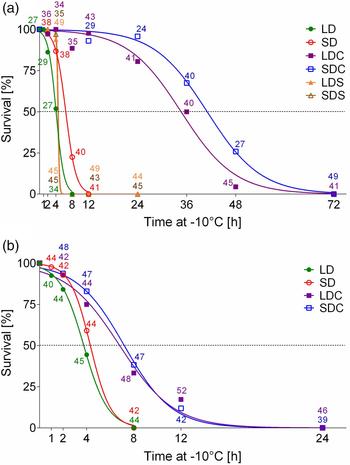
We have found that cold acclimation treatment had the strongest impact on survival (fig. 1), while the effect of other treatments was much smaller (photoperiod) or negligible (starvation). The LDC adults (Lt50: 34.6 h) exhibited 4.4% survival after 48 h at −10°C. The SDC bugs (Lt50: 41.0 h) showed a significantly higher survival compared with the LDC bugs, with 26% surviving the same cold exposure. Cold acclimation of 5th instar nymphs also significantly increased their survival (Lt50: LDC = 6.8 h, SDC = 7.2 h) but the difference was not as pronounced as in the adult bugs, and no nymph survived 24 h exposure to cold.
Cold tolerance. Survival at −10°C in differently acclimated adults (a) and 5th instar nymphs (b) of Riptortus pedestris. Each point is the percentage of survivors in a sample of n bugs (n = flanking number). Sigmoid survival curves (logistic regression) were fitted to the data (goodness of fit, R 2: (a) LD = 0.9957, SD = 0.9998, LDC = 0.9860, SDC = 0.9952, LDS = 0.9999, SDS = 0.9999; (b) LD = 0.9985, SD = 0.9996, LDC = 0.9861, SDC = 0.9975).

Although short-day conditions had a positive effect on survival in both adults and 5th instar nymphs the increase in cold tolerance was insignificant. No adult bug (Lt50: LD = 4.1 h, SD = 6.4 h) survived exposure at −10°C for 12 h and no 5th instar nymph (Lt50: LD = 3.8, SD = 4.3 h) survived 8 h at the same temperature.
Starvation had only a negligible and rather negative effect on cold tolerance (Lt50: LDS = 4.5 h, SDS = 4.6 h), with none of the bugs surviving 8 h exposure at −10°C.
Supercooling point
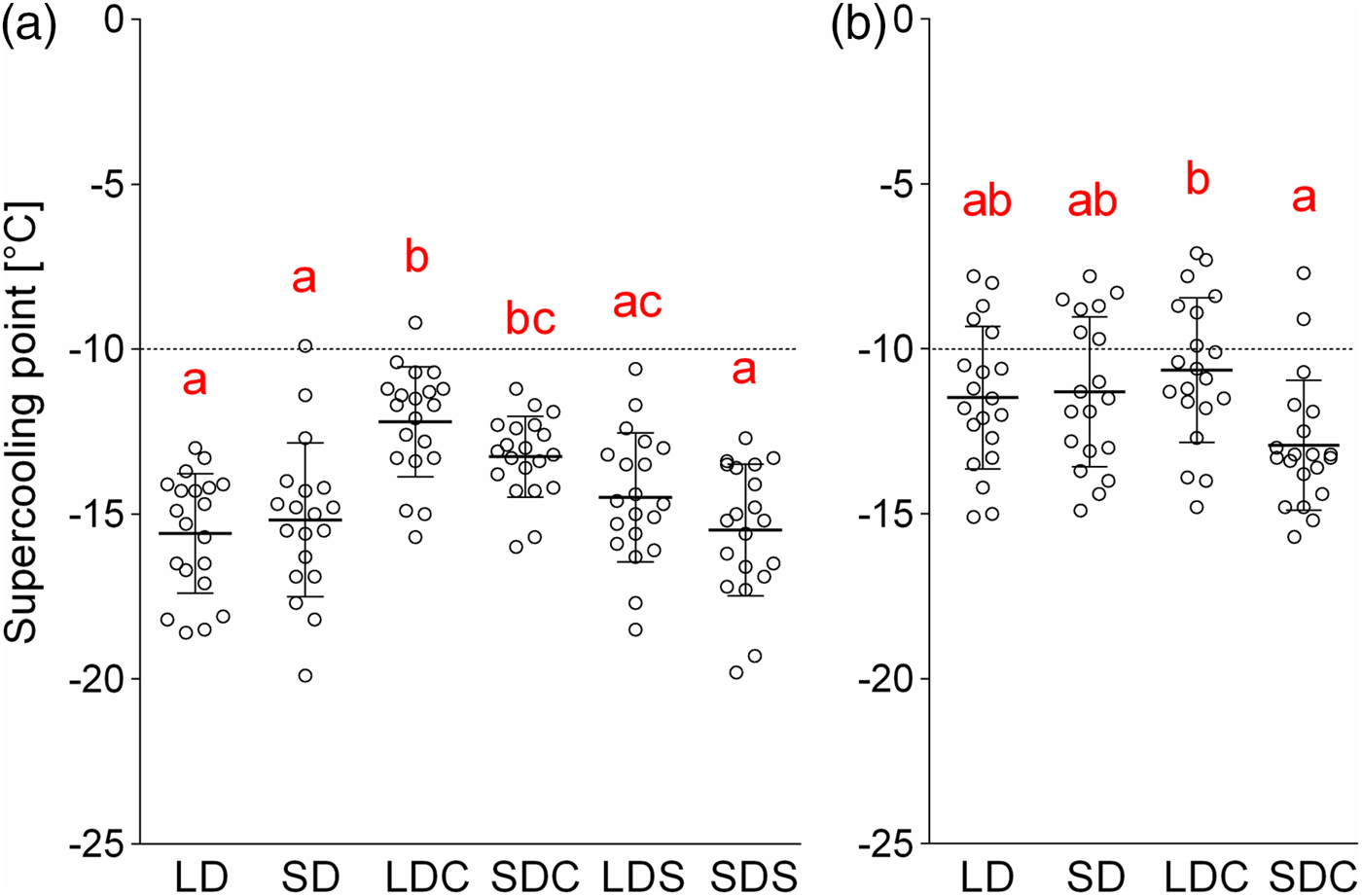
The supercooling capacity (fig. 2) in LD and SD adult bugs was relatively high, which means the SCP was relatively low (−15.6°C in LD and −15.2°C in SD). The difference between LD and SD treatments was insignificant. Cold acclimation unexpectedly resulted in significant decreases in supercooling capacity in both LDC and SDC adult bugs (−12.2°C in LDC and −13.3°C in SDC). Starvation had no significant effect on supercooling capacity (−14.5°C in LDS and −15.5 in SDS).
Supercooling point. Whole body SCP of differently acclimated adults (a) and 5th instar nymphs (b) of Riptortus pedestris. The figure shows means ± S.D. of samples of 19–20 bugs. Influence of acclimation conditions on SCP was tested by ANOVA followed by Tukey's post hoc test. Means marked with different letters are significantly different (P < 0.05). The dashed line indicates the temperature the bugs were exposed to in the cold survival experiment.

The 5th instar nymphs had, on average, a lower supercooling capacity than adults. The differences between treatments were mostly insignificant (−11.5°C in LD, −11.3°C in SD), except between LDC (−10.7°C) and SDC (−12.9°C).
Water content
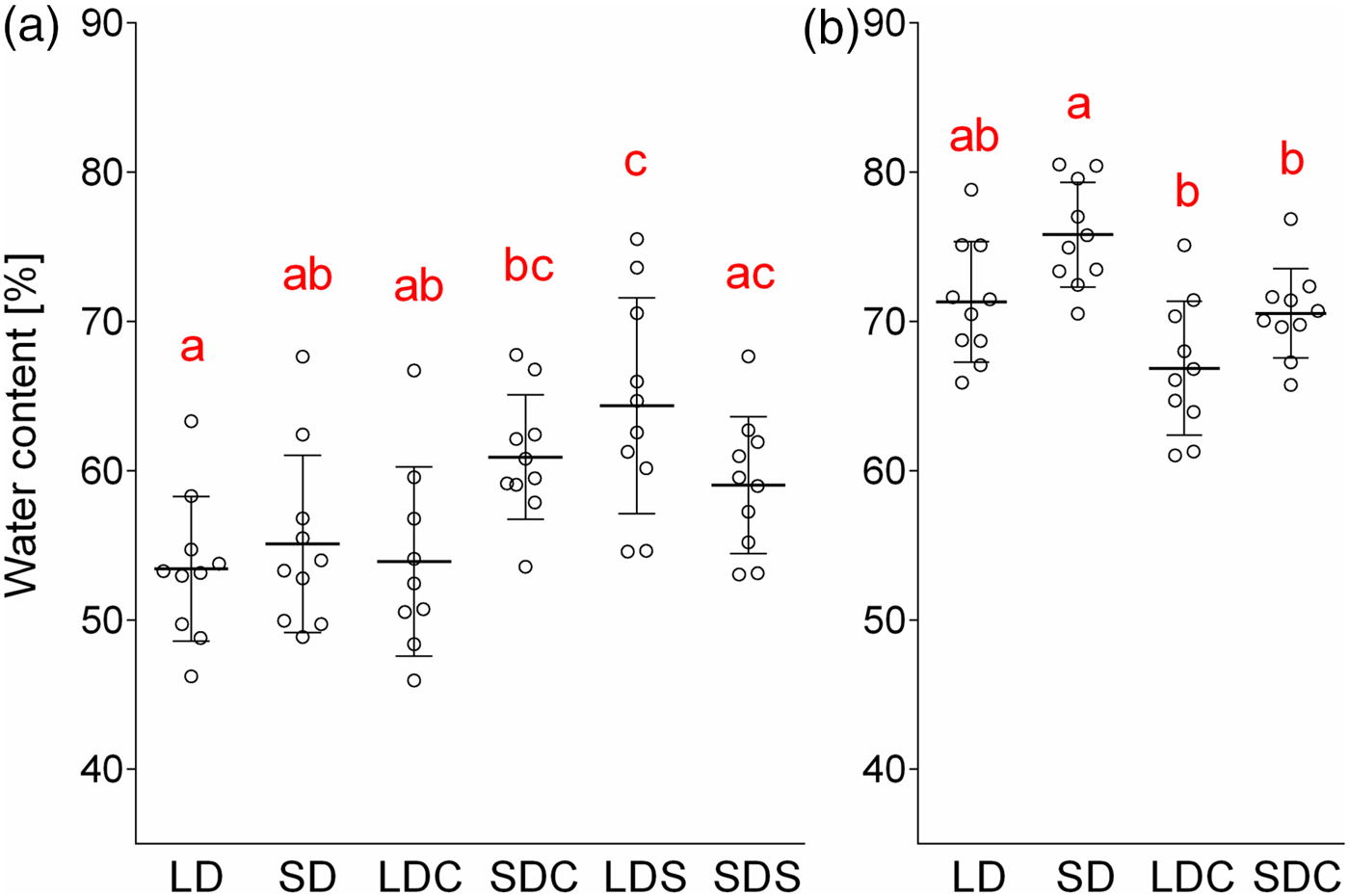
The average water content (fig. 3) was rather steady in adult bugs across treatments, although within-treatment variability was high. The LD and SD bugs had the lowest water content (53.4% in LD, 55.1% in SD) and did not differ significantly from each other. Cold acclimation had no significant effect on water content (53.9% in LDC, 60.9% in SDC). Starvation resulted in higher water content in the LDS group (64.4%), which was the highest among adult bugs. The SDS group had a water content of 59.0% and did not significantly differ from SD.
Water content. Whole body water content of differently acclimated adults (a) and 5th instar nymphs (b) of Riptortus pedestris. The figure shows means ± S.D. of samples of ten bugs. Influence of acclimation conditions on whole body water content was tested by ANOVA followed by Tukey's post hoc test. Means marked with different letters are significantly different (P < 0.05).

The 5th instar nymphs had higher water content than the adult bugs. The differences between LD (71.3%) and LDC (66.9%) were insignificant, as were those between LD and SD (75.8%). The only significant difference in water content was found between SD and both cold acclimations: SDC (70.5%) and LDC.
Metabolomic composition
A total of 58 metabolites were analysed in the samples of differently acclimated adult bugs and 5th instar nymphs (online Supplementary Dataset S1). Twelve of these metabolites were either not present in our samples or their concentrations were below the limit of quantification, which was 4 nmol in whole ethanolic extract (800 µl)/66 ± 10.6 mg per one bug.
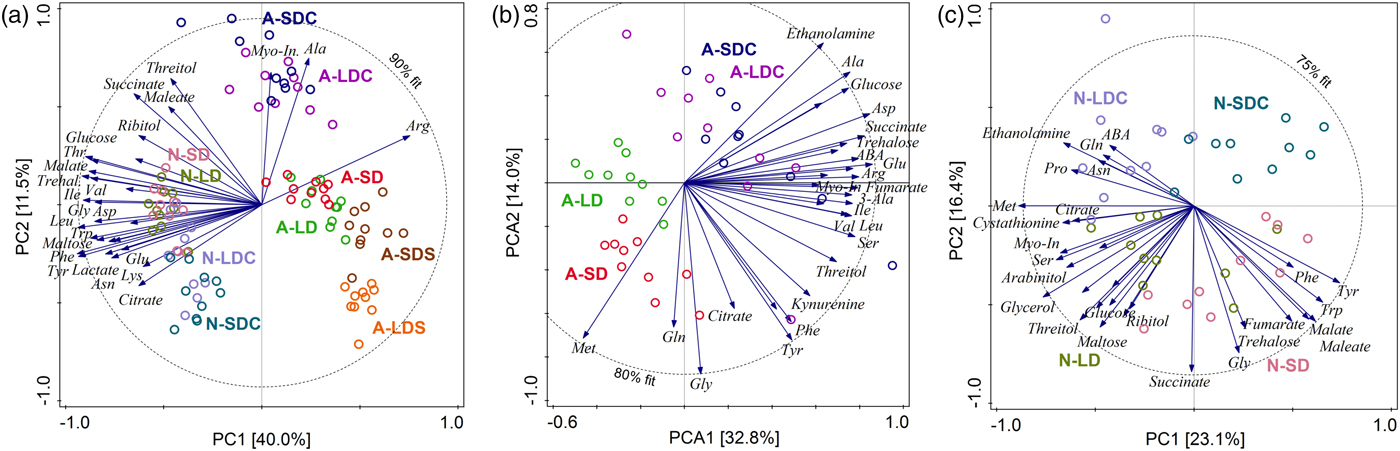
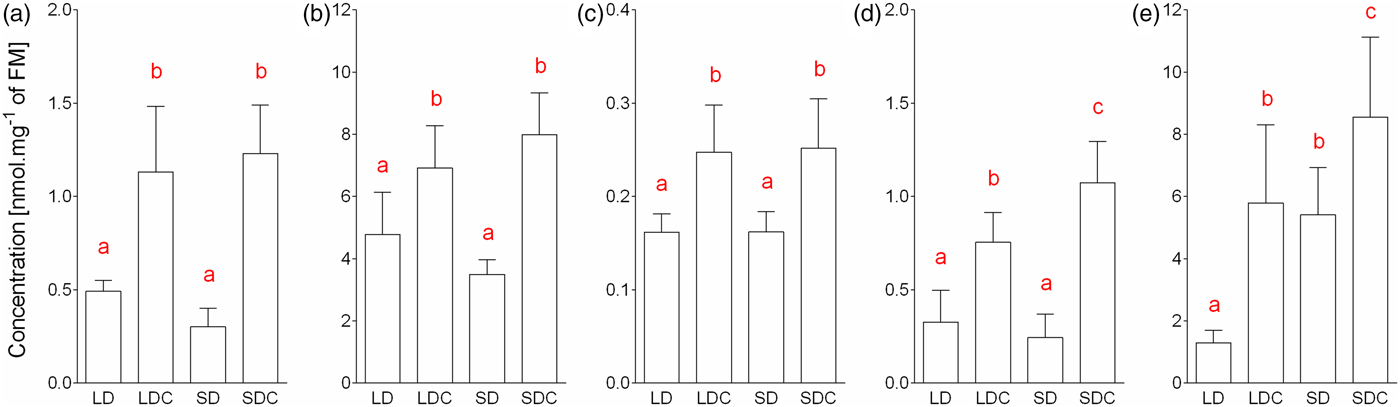
The PCA revealed the differences in metabolomic composition between the treatments (fig. 4). The differences shown in fig. 4a (all treatments, both adults and nymphs) were strongly driven by the 5th instar nymphs, which had higher concentrations of many metabolites than adult bugs. Fig. 4b depicts the differences in metabolomic composition among adult bugs. Only three metabolites (ethanolamine, alanine, and aspartate) extended beyond the circle delimiting 80% fit to the model. These three compounds, together with glucose, were the ones most associated with cold acclimation in both the LDC and SDC groups (fig. 5). Fig. 5e also includes myo-inositol, which was found to be driven by cold-acclimated adult bugs in the PCA of all treatments together. Fig. 4c shows the differences in metabolomic composition in 5th instar nymphs.
Whole body metabolome. Principal component analysis showing the association between acclimation conditions (coloured circles) and concentrations of 30 of the most prominent metabolites (eigenvectors) in the whole body of Riptortus pedestris: (a) all acclimation conditions, (b) adult bugs (starvation excluded), and (c) 5th instar nymphs; (adults (A-), 5th instar nymphs (N-)). The dashed circles delimit the fit of the model (a = 90%, b = 80%, c = 75%).

Metabolites associated with cold acclimation in adults of Riptortus pedestris. Concentration of ethanolamine (a), alanine (b), aspartate (c), glucose (d), and myo-inositol (e) in the whole body of non-acclimated and cold-acclimated adults of Riptortus pedestris. The figure shows means ± S.D. of samples of ten bugs. The influence of acclimation conditions on metabolite concentration was tested by ANOVA followed by Tukey's post hoc test. Means marked with different letters are significantly different (P < 0.05).

Although the PCA could explain only a relatively small part of the variability, it clearly separated the treatments from one another. The most significant point was the difference in metabolomic composition between adult bugs and 5th instar nymphs. The PCA also clearly showed the differences between cold-acclimated, non-acclimated, and starving adult bugs. Similarly, it also separated the non-acclimated and cold-acclimated 5th instar nymphs.
Discussion
Cold acclimation had the strongest effect on cold survival among the treatments when LDC and SDC adult bugs survived significantly longer exposures at −10°C compared with LD or SD adults. Although the statistical analysis found that SDC adult bugs exhibited significantly higher survival than LDC adults, the actual difference does not appear to be meaningful which suggests very little effect of diapause on cold tolerance.
The significant decrease in supercooling capacity in LDC and SDC adults was unexpected and atypical for freeze-avoiding insects. Since no bug survived the SCP measurement we can most likely rule out the possibility of freeze tolerance in R. pedestris. Some insect species, however, that rely on supercooling, have been reported to survive partial freezing upon inoculation with ice at high subzero temperatures (Fields & McNeil, Reference Fields and McNeil1986; Gehrken et al., Reference Gehrken, Strømme, Lundheim and Zachariassen1991; Košťál & Havelka, Reference Košťál and Havelka2000; Rozsypal et al., Reference Rozsypal, Košťál, Zahradníčková and Šimek2013); such a capacity was not tested in our study. Several insects have been reported not to adjust their supercooling capacity in response to cold acclimation (Rojas et al., Reference Rojas, Riemann and Leopold1989; Košťál, Reference Košťál1993; Li et al., Reference Li, Gong and Park2000), but no freeze-avoiding insect (to our knowledge) has been found to decrease its supercooling capacity upon cold acclimation. Some insects have been found to have a supercooling capacity that is dependent on body water content (Block, Reference Block2003). We found higher water content in SDC adults but not in LDC adults. Moreover, the LDS adult bugs that had the highest water content did not differ in their supercooling capacity from LD or SD adults. Our results thus suggest that supercooling capacity in R. pedestris is unrelated to cold tolerance.
We have found that part of LDC females (36%, n = 28) did not fully develop their ovaries. Although this may indicate that exposure to short days in nymphal stage might have interfered with later acclimation in adult stage, our findings rather suggest that low temperature was the factor that influenced ovarian development in LDC females. Several studies reported that R. pedestris changes its programing very fast and develops gonads within 20 days after transfer from SD to LD (Numata & Hidaka, Reference Numata and Hidaka1983; Nakamura & Numata, Reference Nakamura and Numata2000; Ikeno et al., Reference Ikeno, Tanaka, Numata and Goto2010; Omura et al., Reference Omura, Numata and Goto2016). Moreover we have found that the newly emerged females had fully developed ovaries with oocytes with yolk deposition as soon as 6 days after transfer from SD to LD at 25°C (Rozsypal & Goto, unpublished). Doležal & Sehnal (Reference Doležal and Sehnal2007) reported that exposure of a non-diapause reproducing bark beetle (Ips typographus) at 5°C resulted in regression of ovarian development, which, however, was quickly resumed after transfer to 20°C. We thus assume some sort of dormancy, other than diapause, such as a low-temperature-induced quiescence, is more likely to suspend ovarian development in LDC adult females of R. pedestris. We find support for this assumption in the highly variable extent of ovarian development in LDC females, which ranged from fully developed ovaries and oocytes with yolk deposition to reduced diapause-like ovaries. This implies that ovarian development was suspended at different points or was even regressed by some external factor (temperature) rather than internally (diapause).
Many freeze-avoiding insects (and also other invertebrates) have been reported to empty their gut before winter supposedly to get rid of ice nucleators present in food. Starvation in R. pedestris, however, had no significant effect on supercooling capacity, although it did have a negative effect on cold survival. This implies that ice nucleators may have no effect or only a negligible effect on cold tolerance in R. pedestris. The lower cold survival of starved bugs probably can be attributed to partial depletion of energy reserves since maintaining a certain metabolic rate at relatively high temperatures (25°C in the case of LDS and SDS) costs energy (Vesterlund et al., Reference Vesterlund, Lilley, van Ooik and Sorvari2014; Klepsatel et al., Reference Klepsatel, Gáliková, Xu and Kühnlein2016).
Our analysis of the metabolomic composition of R. pedestris revealed that the concentration of several compounds increased with cold acclimation in adult bugs.
Many insects when exposed to low temperatures accumulate compounds with cryoprotective roles, such as sugars, polyols, and free amino acids. The concentration of single cryoprotectant or several cryoprotectants often reaches hundreds of nmols per mg of FM. The high concentration of cryoprotectants has a strong colligative effect on supercooling capacity (Storey et al., Reference Storey, Wilkie, Cairns, Thomas, Cowan, Baust, Pullin, Russell and Jaenicke1990). Some compounds are known, however, even in relatively low concentration, to protect various biological structures from the damage caused by low temperatures or dehydration by non-colligative action (Clegg et al., Reference Clegg, Seitz, Seitz and Hazlewood1982; Timasheff, Reference Timasheff2002). The increase in concentration of several compounds supposedly linked to cold acclimation that we found in R. pedestris, although it was twofold or higher, cannot explain the increase in cold tolerance since the absolute concentration was too low to have a considerable effect, either colligative or non-colligative. The metabolites that we found to increase upon cold acclimation thus appear to be only markers of cold tolerance rather than actual cryoprotectants.
Conclusions
We found that adult bugs cold-acclimated under long days can become cold tolerant to an extent comparable to bugs cold-acclimated under short days, which indicates that cold tolerance is independent of diapause in R. pedestris. We have found similar effect of cold acclimation also in 5th instar nymphs. The other treatments (photoperiod or feeding status) had only negligible effect on cold tolerance.
Neither the physiological parameters (SCP, hydration) nor the biochemical characteristics (metabolites) we measured can explain the significant increase in cold tolerance in cold-acclimated adults and 5th instar nymphs of R. pedestris. It appears instead that mechanisms such as adjustments to the composition of biological membranes, protection against oxidative stress, or synthesis of specific proteins (heat shock, HSP; antifreeze, AFP) may be involved. Further study is needed to elucidate the mechanisms that play a role in cold tolerance in R. pedestris.
Supplementary material
The supplementary material for this article can be found at https://doi.org/10.1017/S0007485317001006.
Acknowledgements
This work was supported by Japan Society for the Promotion of Science (FY2014 JSPS Postdoctoral fellowship ID No. PE14039 to J.R.).