Significant outcomes
• PLOSL, which is a rare fatal disease affecting nervous and musculoskeletal systems, also deeply affects personality.
• Polycystic lipomembranous osteodysplasia with sclerosing leukoencephalopathy (PLOSL) patients show similar personality features to those typical for frontal type of dementia.
• The Rorschach, as a perceptual-cognitive problem-solving test, is suitable also for patients who are neurologically impaired.
Limitations
• The data were collected mostly in third and fourth illness phases, thus we do not know the primary personality functioning of these patients.
• We were able to analyse only a part of the collected data because those in the most severe disease phase were not able to produce valid Rorschach protocols.
• Small sample size caused problems for statistical analysis.
Introduction
PLOSL or Nasu-Hakola disease is a rare fatal disease affecting both brain and bones. This disease has been found in the 1960s in Finland and Japan (Reference Hakola1,Reference Nasu, Tsukahara and Terayama2). About 200 patients have been diagnosed in the world, most in Japan (about 100 cases) and in Finland (35 cases), but also in Sweden, Norway, USA, Italy and many other countries (Reference Paloneva, Autti and Raininko3). PLOSL is a recessively inherited disease (Reference Hakola1,Reference Hakola4). The team of late Leena Peltonen-Palotie has first located the mutation on the chromosome 19q13.1 (Reference Pekkarinen, Kestilä and Paloneva5), then identified it as DAP12 gene in all Finnish and some Japanese patients (Reference Paloneva, Kestilä and Wu6,Reference Paloneva, Mandelin and Kiialainen7). The mutation in 100% of Finnish patients and some Scandinavian patients is deletion of exons 1–4, in Japanese patient deletion of G 141 (Reference Paloneva, Autti and Raininko3). Surprisingly, the mutation in TREM2 gene can cause clinically entirely similar disease picture as the mutations in the DAP12 (TYROBP) gene (Reference Paloneva, Manninen and Christman8). Both DAP12 and TREM2 are expressed by central nervous system microglial cells and oligodendrocytes. DAP12 deficiency results in functional defects of these cells and also leads to synaptic abnormalities. Molecular genetic studies have also found that the mutations in the DAP12 gene cause disorders in the function of the osteoclast cells in the bones (Reference Kiialainen, Hovanes, Paloneva, Kopra and Peltonen9–Reference Kiialainen, Linturi, Saharinen, Lanier, Kopra, Peltonen and Kiialainen11). Regrettably, these studies have not yet lead to any result helpful in the care of PLOSL patients.
The course of PLOSL is steady progressive. It has been divided into four stages: 0, 1, 2 and 3 (Reference Hakola1,Reference Hakola4). The childhood is mostly symptomless (the latent phase = 0) but around the age of 20 years patients start to suffer from pains and tenderness in the ankles and wrists and later from fractures (the phase of skeletal symptoms = 1). The radiological picture is diagnostic (Reference Hakola1,Reference Virtama, Hakola and Hakola12). The clinical neuropsychiatric features of PLOSL are known on the ground of, for example, a follow-up study of 22 PLOSL patients (Reference Hakola4). Neuropsychiatric symptoms appear insidiously during the fourth decade of life and gradually form a disease picture which consists of dementia with prefrontal psychosyndrome, signs of upper motor neuron involvement apraxic–aphasic symptoms and myoclonic twitches (the early phase of neuropsychiatric symptoms = 2). These symptoms progress steadily and they are later accompanied with other symptoms, especially epileptic seizures (the late phase = 3). The death follows before the age of 50 years.
The picture of the neuropathological changes in PLOSL has been well outlined. On neuropathological examination, atrophy and sclerosis of the white matter are found particularly in the frontal and temporal lobes of the brain (Reference Paloneva, Autti and Raininko3,Reference Akai, Tateishi and Cheng13–Reference Tanaka18). The changes in the brains of the patients still living are visible with the neuroradiological methods: PEG (Reference Hakola and Iivanainen19,Reference Hakola and Puranen20), MR and CT (Reference Iivanainen, Hakola and Erkinjuntti21). Electroencephalogram shows also alterations (Reference Hakola and Partanen22).
In the early phase of the neuropsychiatric symptoms the most prominent symptoms are the frontal psychosyndrome and the advancing deterioration of memory. These both symptoms have been described in casu in the monographs of Hakola (Reference Hakola1,Reference Hakola4). The deterioration of visual memory has been published separately (Reference Hakola23) as well as the defect of verbal memory (Reference Vanhanen, Hakola, Ilonen and Tiihonen24). The test pattern used by Hakola in his follow-up studies contained the Rorschach test also to assess personality functioning of these patients. Some findings have been described formerly in these monographs (Reference Hakola1,Reference Hakola4) but as far as we know, any broader report about the results in the Rorschach test has not been formerly published in this fatal but fascinating disease.
Rorschach (Reference Rorschach25) found that the strategies people use to formulate inkblot responses allow descriptions of how they are likely to handle real-world situations. He was the first to examine responses of organically ill individuals to the inkblots. Later, Piotrowski (Reference Piotrowski26) examined cortical and subcortical patients and introduced 10 signs of organic conditions. Dorken and Kral (Reference Dorken and Kral27) found that patients with senile dementia have difficulties to adequately respond in the test. The number of responses was low, and thus they offered only few movement, colour and shading determinants. Poor form quality was related to their level of deterioration. In a study of Insua and Loza (Reference Insua and Loza28), the lack of percept involving human movement, indicating a weak energy level, differentiated the elderly demented group from the normal comparison group. Perry et al. (Reference Perry, Potterat, Auslander, Kaplan and Jeste29) studied patients with dementia of the Alzheimer type. They found significant differences between Alzheimer patients and normal controls for most of the Rorschach test variables.
PLOSL patients are characterised by frontal type of dementia. Frontal lobe disturbances tend to have repercussions throughout the behaviour (Reference Stuss, Cow and Hetherington30). According to Lezak (Reference Lezak31), the behavioural disturbances with frontal lobe damage can be classified into problems of starting (e.g. decreased productivity), difficulties in making mental or behavioural shifts (e.g. perseveration, rigidity), problems in stopping (e.g. impulsivity, loss of control), deficient self-awareness (e.g. inability to perceive events) and a concrete attitude. Patients with frontal deficits are expected to produce an inefficient approach to the task. There are many relevant Rorschach variables that relate to behaviour described in patients with frontal lobe disturbances. On the basis of the earlier studies of neurological disorders and the behavioural disturbances with frontal lobe damage described by Lezak (Reference Lezak31), we hypothesised that in comparison to normative data (Reference Exner32) PLOSL patients have behavioural disturbances.
Aims of the study
The purpose of this study was to describe personality functioning of PLOSL patients with the Rorschach test. The structural variables in the Rorschach are organised around the seven dimensions of personality functioning that they assess. We investigated PLOSL patients' coping style and resources, how they organise information, how they perceive their events, how they form concepts and ideas, how they handle their emotions, how they view themselves and how they relate to other people.
Materials and methods
Subjects
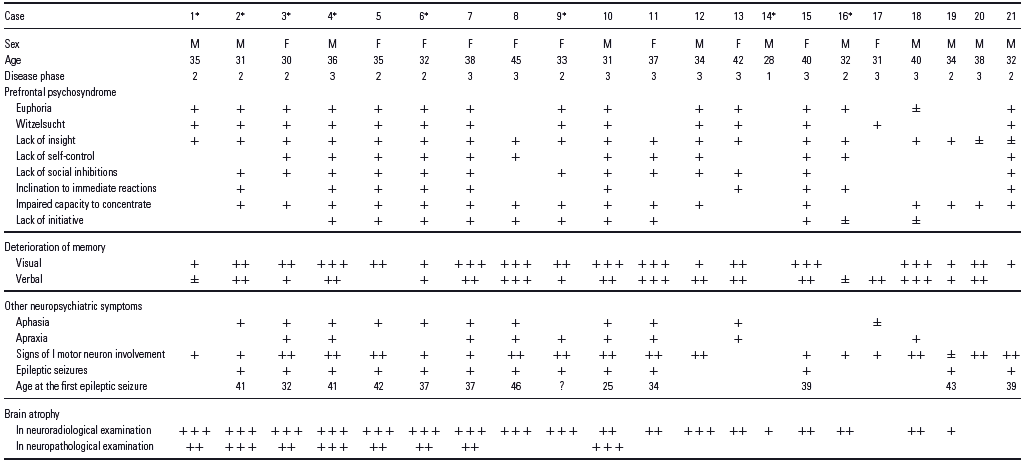
Material comprised 21 of the 35 PLOSL patients diagnosed until today in Finland (Table 1). Our 21 patients included all cases that could be reached for evaluation, and 14 patients were excluded due to practical reasons such as remote geographical location. Therefore selection was random and not by the severity of the illness. They were 11 male and 10 female. The mean age was 34.9 (SD = 4.3; range = 28–45). In all cases, the diagnosis was confirmed with radiographs of bones. In addition to this, typical neuropsychiatric symptoms were observed in clinical examinations (in one case after Rorschach test), and in most cases, typical findings were observed also in neuroradiological examination.
The patients by sex, age and most important neuropsychiatric, neuroradiological and neuropathologiacal findings
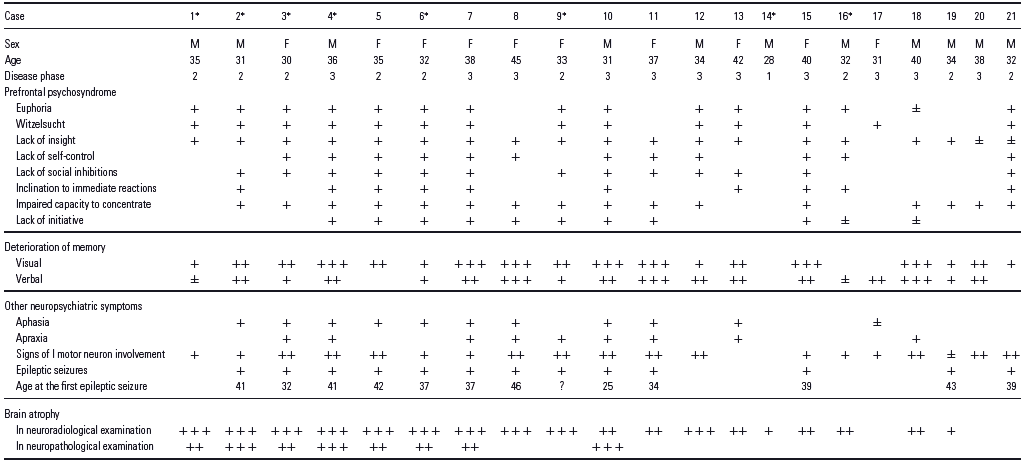
* Produced valid Rorschach protocol. Disease phase 1 = mild, 2 = marked, 3 = severe deviation. Prefrontal psychosyndrome + = symptom existed, ± = uncertain. Deterioration of memory, other psychiatric symptoms and brain atrophy + = mild, ++ = moderate, + + + = severe. Case 14 showed no neuropsychological symptoms at the time when Rorschach was done. However, he developed florid symptoms during follow-up afterwards.
Rorschach assessment
All patients were administered the Rorschach test by Dr Hakola (n = 14), or psychologists Luostarinen (n = 3) or Peltokorpi (n = 4). The protocols were scored and interpreted following Exner's (Reference Exner32,Reference Exner33) Comprehensive System guidelines with the structural summary produced through the Rorschach Interpretation Assistance Program (version 5) by the first author who is an expert in using the method. Reliability and validity estimates are established and described extensively elsewhere (Reference Exner32–Reference Viglione and Taylor35). The protocols with more than 13 responses (R) provide reliable data and support valid inferences (Reference Exner33). Thirteen of the 21 patients could not respond to the test sufficiently, and thus we included only eight valid protocols (R ≤ 14) for analysis. The mean age of patients with R ≤14 was 32.1 (SD = 2.6; range = 28–36). Cases 1, 2, 3, 4, 6, 9, 14 and 16 produced a valid protocol for interpretation (Table 1). All but one (case 4) was on disease phase 1 or 2. The symbols in Table 1 refer generally to the time when the Rorschach test was performed. Only exceptions are the epileptic seizures which have begun at the time presented, and the brain atrophy in neuroradiological and/or neuropathological examination considerably later.
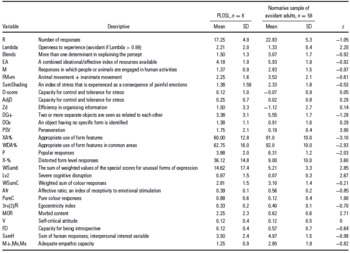
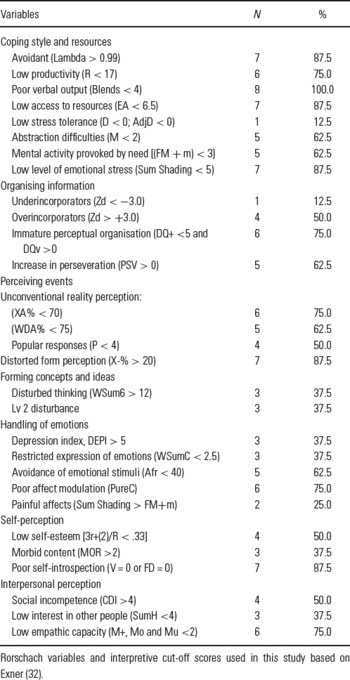
The selected personality variables and interpretive cut-off scores as presented by Exner (Reference Exner32) are presented in Table 2 and Table 3.
Descriptive statistics for selected Rorschach variables from PLOSL patients and normative sample of avoidant adults(Reference Exner32)

Personality functioning in the PLOSL patients

Results
The results of the Rorschach assessments are summarised in Table 2 and Table 3. PLOSL patients gave responses for 11 variables (R, Lambda, DQ+, PSV, XA%, WDA%, P, X-%, WSum6, Lv2 and PureC) that were significantly different from normative sample of avoidant adults with z-scores more than 1 SD from the mean (Table 2). As shown in Table 3, using interpretive cut-off scores as presented by Exner (Reference Exner32), a majority of PLOSL patients showed an avoidant coping style, low productivity, poor verbal output and limited resources to cope with problem-solving task. Half of the patients demonstrated abstraction difficulties in low number of movement responses, and more than half low level of emotional stress experience. Problems in organising information efficiently, and perceiving events realistically as well as signs of disturbed thinking and concept formation were observed in many patients. Handling of emotions was characterised by avoidance of emotional stimuli but at the same time poor affect modulation. Low self-esteem was observed in half of PLOSL patients. Capacity for being introspective was limited in almost all of PLOSL patients. Half of the patients scored in the pathological range on the coping deficit index (CDI), indicating a lack of social skills and ineffective ways of attempting to cope with ordinary aspects of everyday living. More than half of the patients seemed to have a normal interest in other people but empathic capacity was inadequate.
In 13 cases, the protocols contained less than 14 responses (R ranged 8–13), and thus these were not possible to analyse using Exner's (Reference Exner32,Reference Exner33) Comprehensive System guidelines. The majority of these patients suffered already the late phase of PLOSL (10/13), and they were older (mean 36.7 + 4.3) than the patients of the group analysed (mean 32.1 + 2.6).
Discussion
This study is the first to describe personality functioning in patients with PLOSL. As expected the overall approach to the test was constricted. Our results are in line with previous studies that have demonstrated that patients with neurological disorders perform differently than healthy controls on the Rorschach test (Reference Piotrowski26–Reference Perry, Potterat, Auslander, Kaplan and Jeste29). PLOSL patients showed more or less difficulties on all seven dimensions of personality functioning. As potential psychological indices of prefrontal impairment the patients showed low productivity in the number of responses, and consistently a decrement in verbal abilities in low number of Blends.
What kind of coping style characterises PLOSL patients? Can they muster adequate resources for meeting the demands they are facing? Successful adaptation requires openness to experience and mustering adequate resources. In our study, all but one patient who was ambitent, showed an avoidant coping style. Avoidant style includes a marked disposition to simplify complexity by disregarding or even denying some aspect of stimulus event (Reference Exner32). Ambitents are people who do not have a consistent approach to problem solving. The lack of consistency in the use of feelings may cause ambitents to become confused by them or lead to erratic forms of emotional display (PureC). On the other hand, the lack of consistency in the manner by which they conceptualise and make decisions reduces efficiency and leads to errors in judgment. Because of the inconsistency and lack of flexibility of their coping style PLOSL patients show high vulnerability to experience adjustment problems. In addition, they showed fewer resources available than most people for coping with the ordinary ideational and emotional everyday life demands. Low number of human movement responses indicates limitation of the ability for higher order cognitive elaboration. Still most of the patients had D and AdjD scores in the zero or plus range indicating adequate frustration tolerance and adaptive capacity for stress control. However, along with avoidant coping style and fewer resources available stress tolerance is likely to be overestimated. These patients were poorly responsive to environmental demands. The attention paid to internal stimuli also was poor. Because of their limited self-awareness PLOSL patients are at risk for becoming precipitated into limited frustration tolerance, and poor impulse control, typical for frontal lobe damage (Reference Lezak31).
How carefully and thoroughly PLOSL patients pay attention to events in their lives, and how they organise their perceptions? Organising information efficiently consists of an adaptive balance between the amount of information individuals take in and their capacities to process this information adequately. Successful adaptation requires efficient organisation of information. Processing efficiency variable Zd ranges normatively from −3.0 to +3.0. Within this range individuals tend to be taking in just as much information as they can process adequately. In our study one patient was underincorporator, i.e. he/she took in too little information. Thus he/she did not pay attention to relevant considerations but came to conclusions hastily. By contrast, half of the patients were overincorporators taking in more information than most people require in order to make decision. These patients invested effort and energy into scanning activities, but despite having made their best efforts they at the same time were hesitant and uncertain in making decisions. Further, DQ distribution refers to the quality of the processing activity. Low DQ+ and high DQv showed that the quality of their perceptual organisation is immature and regressive. Thus, their cognitive activity is concrete and impressionistic representing a diffuse and inept form of processing typical for neurologically impaired persons (Reference Exner32). Also the presence of perseveration responses suggests problems in processing efficiency reflecting cognitive inflexibility and incapacity. Perseveration is common finding in individuals who have neurologically related problems (Reference Exner32). Let it be noted that the Rorschach test revealed tendency to perseverate earlier than the feature was seen clinically. Our findings are in line with earlier findings that patients with prefrontal damage show information-processing deficits that reduce their sensitivity to novel stimuli (Reference Knight36).
How PLOSL patients perceive their events? Successful adaptation is promoted by realistic and conventional perception of events and environments. This ability was measured by three form quality variables, Form Appropriate (XA%), Form Appropriate-Common Areas (WDA%) and Distorted Form (X-%). Perceptual disturbance is typically considered a primary feature of schizophrenia but is also observed in patients at high risk of psychosis (Reference Ota, Obu, Sato and Asada37). A majority of PLOSL patients demonstrated a severe impairment, often misperceiving events and forming mistaken impressions of people and what their actions signify. Their inaccurate perceptions of people and events are likely to lead them to erroneous conclusions and actions. Most people with this degree of impairment reality testing have difficulty in managing basic psychological aspects of everyday living without assistance.
How PLOSL patients form concepts and ideas? Forming concepts and ideas consists of how people think about the experiences they have and the impressions they form of events in their lives. People adapt best when they can think logically and coherently. Contrary to Perry et al. (Reference Perry, Potterat, Auslander, Kaplan and Jeste29) who studied patients with dementia of Alzheimer type, signs of disturbed ideation were observed in some of PLOSL patients indicating abstraction and linguistic difficulties. Thus, some of PLOSL patients have lost capacity to think logically, and as a consequence tend to reason arbitrarily. Their answers including deviant verbalization and deviant response indicated that their ideas tend to emerge out of sequence or intrude on each other to produce rambling or tangential and unintelligible verbalisations.
How PLOSL patients experience and express feelings? Handling of emotions provides information about the manner with which people process emotional experience. Three patients (37.5%) had depression index (DEPI) = 5 indicating that their psychological organisation was marked by features that give rise to experiences of emotional disruption. One of those whose DEPI was positive also CDI was positive indicating depressive features mainly characterised by hopelessness and helplessness because of interpersonal difficulties or social incompetence. Differently from most depressive individuals they did not demonstrate data of sad feelings or anger although they had to know they were close to death. Their ability to recognise their inner state and feelings was limited. Perhaps the lack of sadness made it difficult to identify clinically notable depression. Withdrawal from affective experience increased towards the most severe disease phase. Personality tended to fade. Consistently with the avoidant coping style, 37.5% of patients scored WSumC < 2.5 indicating insufficient capacity to experience and express feelings. On the other hand, PureC > 0 indicated impulsive affects and difficulties in affect modulation. The inability to modulate emotions and limited awareness of subjective feelings of distress [(FM+m) + Sum Shading = 3.6 + 2.3] may contribute to impulsive behaviour. Impaired emotional processing and deficits in the ability to recognise the affective state of other people characterise also patients with Alzheimer's disease (Reference Mclellan, Johnston, Dalrymple-alford and Porter38). Disordered expression of affect is frequently a result of frontal system lesions (Reference Stuss, Cow and Hetherington30).
How PLOSL patients view themselves and how they relate to other people? Capacities to view oneself in favourable ways maintain adequate self-esteem and contribute to a stable sense of identity. Now, low self-esteem was found in half of PLOSL patients indicating that they tend to judge themselves more unfavourably in comparison with others. Further, MOR answers reflect either pessimistic thinking or signal that their self-image is marked by many negative attributions in which they tend to perceive themselves as damaged or distorted. The absence of introspection suggests that they are also rather naïve about themselves. They do not have a grasp of the kind of persons they are. Lack of self-awareness may be a risk for adjustment difficulties. Normally, the abilities to sustain a reasonable level of interest in interacting with other people and to perceive people and social situations in an accurate and empathic manner characterise adaptive interpersonal relationships. Disorders of social behaviour may suggest frontal lobe dysfunction (Reference Grattan and Eslinger39). In interacting with others, PLOSL patients are characterised by social incompetence (50% of patients with CDI > 3), low empathic capacity and limited interest in people. Their social ineptness may make them vulnerable to experiencing failure in social situations and to being ignored by others who see them as an ineffective person (Reference Exner32).
The findings of our study provide the first descriptive statistics for the Rorschach test in patients with a rare fatal neurological disease. One obvious problem with our sample was a small sample size. Those who were in the most severe disease phase were not able to produce valid Rorschach protocols evidencing that impairment in personality functioning becomes more pronounced and worsens with illness progression. Further, our study was cross-sectional and patients were tested during phases 2 and 3. In future it is important to assess personality functioning across all different illness phases to identify changes in personality dimensions. It was interesting that as a perceptual-cognitive problem-solving task, the Rorschach test was able to use with patients who are neurologically impaired and even intellectually limited. Our study may shed further light on the multifaceted clinical phenomenology and psychopathology of PLOSL. The personality profile of PLOSL patients resembles that of frontal personality disturbance, and is in line with clinical findings. Our results are consistent with study of Stuss et al. (Reference Stuss, Cow and Hetherington30) who reported that frontal lobe disturbances tend to have repercussions throughout the behaviour.
In summary, PLOSL patients have difficulty attending to their surroundings openly, efficiently, realistically and conventionally. Thinking tends to be disturbed, affect modulation insufficient and capacities to view themselves and others thoroughly limited.