Introduction
Corporate environmental responsibility (CER) is a fundamental component of corporate social responsibility (CSR), encompassing activities that directly benefit the natural environment and serving as a key indicator of corporate commitment to environmental quality (Holtbrügge & Dögl, Reference Holtbrügge and Dögl2012; Wong, Miao, Cui, & Tang, Reference Wong, Miao, Cui and Tang2018). The institutional perspective on CSR posits that firms exhibit socially responsible behavior by adhering to state regulations, highlighting the critical role of corporate CEOs in shaping a company’s response to regulatory frameworks (Campbell, Reference Campbell2007; Li & Lu, Reference Li and Lu2020; Marquis & Lee, Reference Marquis and Lee2013). Notably, top executives’ attitudes toward environmental issues, shaped by their personality traits, significantly influence corporate environmental decisions (Aragón-Correa, Reference Aragón-Correa1998).
Politically connected top executives (PCTEs), defined as executives with government affiliations, are expected to actively support stringent government initiatives and play a pivotal role in regulating corporate economic behaviors (Marquis & Qian, Reference Marquis and Qian2014). In transitional economies such as China, where market systems are evolving, PCTEs significantly contribute to the establishment of informal institutions that align with governmental and societal objectives (Fan, Wong, & Zhang, Reference Fan, Wong and Zhang2007; Peng & Luo, Reference Peng and Luo2000). However, existing literature reports conflicting findings on the relationship between PCTEs and CER practices, with studies revealing both positive (Zhang, Reference Zhang2017) and negative (Cheng, Wang, Keung, & Bai, Reference Cheng, Wang, Keung and Bai2017; Deng, Wu, & Xu, Reference Deng, Wu and Xu2020) correlations. These discrepancies, observed within the same institutional context but under different theoretical frameworks, suggest a lack of consideration for boundary conditions that may influence the heterogeneous responses of PCTEs to uniform institutional demands for CER.
A potential source of this heterogeneity lies in the interplay between organizational and institutional dynamics that shape decision-making (Hoffman, Reference Hoffman2001). Previous research on CER antecedents primarily relies on institutional theory (e.g., Aronson & LaFont, Reference Aronson and LaFont2022; Greenwood, Hinings, & Jennings, Reference Greenwood, Hinings, Jennings, Henderson, Gulati and Tushman2015; Hoffman & Jennings, Reference Hoffman and Jennings2015) to examine the pressures exerted by institutional stakeholders. This perspective argues that organizations with higher visibility are subject to greater institutional scrutiny and expectations, prompting them to adopt common and desirable environmental behaviors to maintain legitimacy, reduce risks, and secure necessary resources (Chiu & Sharfman, Reference Chiu and Sharfman2009). Integrating political connection research with institutional theory offers a new lens to explore how organizational and institutional factors jointly influence PCTEs’ environmental behavior. Specifically, examining organizational visibility provides a means to clarify the inconsistent findings regarding PCTEs’ impact on CER practices.
This study integrates insights from the political connection literature and institutional theory to investigate how PCTEs respond heterogeneously to external demands for CER. First, we explore the direct influence of PCTEs on CER by examining their simultaneous impact on firms’ engagement in both environmentally responsible and irresponsible behaviors. By conceptualizing CER as an institutional requirement and drawing on institutional theory, we argue that PCTEs face heightened pressures to adopt CER initiatives to safeguard their interests, leading to positive responses to government expectations. Additionally, we propose that ownership type modulates this pressure, with PCTEs in privately controlled firms exhibiting more proactive engagement in environmentally responsible practices to enhance legitimacy.
Second, we investigate the moderating role of organizational visibility to better understand factors influencing PCTEs’ diverse responses to external CER demands. We hypothesize that firms with higher visibility face intensified scrutiny and institutional pressures, which in turn shape PCTEs’ environmental strategies. This analysis elucidates the mechanisms by which PCTEs respond to government signals regarding CER and demonstrates how organizational visibility amplifies or mitigates these responses.
This study makes the following key contributions: First, in line with recent CER research, we differentiate between firms’ engagement in environmentally beneficial activities (e.g., pollution reduction) and environmentally harmful practices (e.g., emissions violations) (Jiao, Reference Jiao2010; Wu, Reference Wu2014; Wu, Liang, & Zhang, Reference Wu, Liang and Zhang2020). Second, by integrating institutional theory with the political connection perspective, we address a critical gap in understanding how organizational factors, particularly visibility, influence PCTEs’ responses to institutional CER pressures. Third, we provide a nuanced framework for analyzing PCTEs’ environmental behavior in transitional economies, emphasizing the interaction between institutional context and organizational characteristics. Lastly, by considering ownership type (state-owned enterprises and privately controlled firms), we find that PCTEs with different ownership exhibit discrepant performance in responding to external requirements for CER, particularly in terms of their proactive involvement in environmentally responsible practices. This differentiation provides insights into the varying institutional and organizational dynamics shaping PCTEs’ environmental behaviors in developing countries, particularly in China. Lastly, we contribute to research on institutions and political connections by empirically studying how PCTEs address institutional pressures for CER to acquire or maintain critical resources necessary for their survival and success. Their activities facilitate the generation of new practices, managerial models, and occupational structures (Fu, Tang, & Chen, Reference Fu, Tang and Chen2020), effectively meeting the needs and expectations of diverse stakeholders and, ultimately, fostering the development of sustainable informal institutions.
Theoretical Background and Literature Review
Political connections are a critical institutional linkage between firms and government authorities, representing a form of interorganizational exchange realized through various individual and organizational ties to the government (Okhmatovskiy, Reference Okhmatovskiy2010; Sun, Mellahi, & Wright, Reference Sun, Mellahi and Wright2012). These ties often take the form of executives’ affiliations with formal institutions, such as politicians assuming corporate leadership roles or business figures being appointed to political positions (Liu, Nandhakumar, & Zachariadis, Reference Liu, Nandhakumar and Zachariadis2018; Sun et al., Reference Sun, Mellahi and Wright2012; Wang & Qian, Reference Wang and Qian2011). This exchange is particularly pervasive in transition economies like China, where the evolving market system fosters reciprocal relationships between businesses and government (Marquis & Qian, Reference Marquis and Qian2014; Peng & Luo, Reference Peng and Luo2000).
Politically connected executives (PCTEs) exhibit distinct characteristics shaped by their interactions with government authorities. First, they attract heightened social and governmental attention compared to nonconnected executives, resulting in increased organizational scrutiny and oversight (Dickson, Reference Dickson2003; Hillman, Reference Hillman2003). Second, to enhance career prospects, they actively engage in government-endorsed social objectives, leveraging their political ties for career advancement (Burt, Reference Burt1997; Granovetter, Reference Granovetter1985). Third, PCTEs strategically align their actions with government priorities, including proactive participation in CSR practices, to maintain favorable relationships and ensure access to essential political and economic resources (Kostka & Zhou, Reference Kostka and Zhou2013; Wang & Qian, Reference Wang and Qian2011). Additionally, they tend to adopt conservative economic strategies to preserve political legitimacy and avoid jeopardizing their political appointments (Marquis & Qian, Reference Marquis and Qian2014).
Institutional theory posits that organizational behaviors and practices are shaped by external social environments, encompassing laws, regulations, cultural norms, and societal expectations (DiMaggio & Powell, Reference DiMaggio and Powell1983; Scott, Reference Scott1987). In China, where environmental governance operates under a unified legal framework, firms and their managers experience significant institutional pressure to conform to environmental standards (Wu, Reference Wu2024). Failure to align with these expectations often results in increased scrutiny or resource constraints (Colwell & Joshi, Reference Colwell and Joshi2013). Consequently, institutional theory has become a dominant perspective in environmental management research, providing a robust framework for analyzing how institutional stakeholders – such as governments, NGOs, and consumers – exert pressure to drive homogenous environmental practices (Greenwood et al., Reference Greenwood, Hinings, Jennings, Henderson, Gulati and Tushman2015; Hoffman & Jennings, Reference Hoffman and Jennings2015).
While existing literature on the ecological implications of PCTEs has predominantly adopted resource dependence or rent-seeking perspectives, these frameworks often overlook insights from institutional theory. Studies suggest that PCTEs may either endorse CER practices to align with institutional expectations (Zhang, Reference Zhang2017) or evade them due to opportunistic motivations (Cheng et al., Reference Cheng, Wang, Keung and Bai2017; Deng et al., Reference Deng, Wu and Xu2020). However, these behaviors may reflect underlying institutional pressures, which remain underexplored. To address this gap, this study applies an institutional lens to examine whether and how powerful institutional stakeholders influence PCTEs’ engagement in CER activities (Hoffman & Jennings, Reference Hoffman and Jennings2015).
In the context of Chinese firms, this study focuses on the chairman of the board, who holds supreme authority comparable to the CEO in Western corporations (Meng, Zeng, Tam, & Xu, Reference Meng, Zeng, Tam and Xu2013). The chairman not only oversees daily operations but also assumes full responsibility for strategic decisions and ensures alignment with institutional pressures (Li & Yang, Reference Li and Yang2003; Song, Reference Song2004).
Hypotheses Development
PCTEs Engagement in CER Activities as Responses to Institutional Pressures
Promoting CER is a trend in national environmental governance and one of the objectives of formulating environmental policies. A key research theme in the CER domain is the investigation of antecedents. Some scholars have pointed out that corporate environmental practices may be driven by instrumental and strategic motivations (Cho & Patten, Reference Cho and Patten2007; Li, Li, Chen, Xiang, & Ruan, Reference Li, Li, Chen, Xiang and Ruan2019). For example, CER can help firms improve impression management (Merkl‐Davies, Brennan, & McLeay, Reference Merkl‐Davies, Brennan and McLeay2011), boost their public image (Meng et al., Reference Meng, Zeng, Tam and Xu2013), act as legitimizing tools to resist social opprobrium caused by poor environmental outcomes (Cho & Patten, Reference Cho and Patten2007), and be a sociopolitical strategy for acquiring political and resource access (Marquis & Qian, Reference Marquis and Qian2014; Zhang, Reference Zhang2017). However, some scholars hold a passive view of firms forced to take action, because environmental protection is beyond their interests (Haque & Ntim, Reference Haque and Ntim2018; Li et al., Reference Li, Li, Chen, Xiang and Ruan2019).
Scholars have recently combined the active and passive points of view to suggest that in some institutional settings, CER practices may be a response to institutional stakeholders’ expectations (e.g., Sun, Zeng, Chen, Meng, & Jin, Reference Sun, Zeng, Chen, Meng and Jin2019). These studies are mostly based on institutional theory and explain how institutional forces shape CER practices in terms of compliance with regulations, standards, and norms (DiMaggio & Powell, Reference DiMaggio and Powell1983; Qin, Harrison, & Chen, Reference Qin, Harrison and Chen2019; Wang, Reimsbach, & Braam, Reference Wang, Reimsbach and Braam2018). As one of the key internal drivers of CER practices, top executives experience pressure from multiple shareholders (e.g., government, industry peers, competitors, and activists) based on social, government, and cultural macro-factors (Matten & Moon, Reference Matten and Moon2008; Qin, Harrison, & Chen, Reference Qin, Harrison and Chen2019). Meanwhile, a firm’s decision largely reflects its top manager’s strategic response to environmental stimuli (Carpenter, Geletkanycz, & Sanders, Reference Carpenter, Geletkanycz and Sanders2004; Hambrick & Mason, Reference Hambrick and Mason1984). Therefore, the external regulatory pressures perceived by top executives can affect corporate environmental practices. There is some rationale suggesting that PCTEs might have the opportunity to lobby environmental regulators and acquire political legitimacy, which may trigger their opportunistic behavior and less motivation to respond to external environmental protection requirements. While these arguments may apply under some conditions, we argue that, on average, PCTEs may have a greater propensity to be involved in corporate environmentally responsible practices because of their increasing institutional pressures from the government and the general public, as well as their subsequent acquisitions, bundling, and allocation of advantageous resources in response to pressures for CER initiatives (Luo & Wang, Reference Luo and Wang2021; Marquis & Qian, Reference Marquis and Qian2014; Zhang, Reference Zhang2017).
The government seeks to foster a strong connection between government officials and business leaders, either by recruiting top executives to join the government or by encouraging officials to take on executive roles in firms. This initiative aims to establish an informal control over the economy (Dickson, Reference Dickson2003; Fan, Wong, & Zhang, Reference Fan, Wong and Zhang2007). These politically connected executives are expected to uphold high ethical standards and are subjected to heightened government monitoring to facilitate the effective implementation of policies (Zhang, Marquis, & Qiao, Reference Zhang, Marquis and Qiao2016). According to Fan et al. (Reference Fan, Wong and Zhang2007), the political appointment of CEOs is directly linked to the government’s objectives. Moreover, firms that actively participate in environmental practices play a crucial role in easing the government’s burden of environmental protection (Zhang, Reference Zhang2017). This proactive engagement can be viewed as a response to governmental expectations. Firms with a commendable CER record also serve as a protective buffer when confronted with increased government pressures for CSR involvement (Luo & Wang, Reference Luo and Wang2021). The PCTEs, who operate under higher oversight and are subject to government expectations for CSR (Marquis & Qian, Reference Marquis and Qian2014), feel a heightened need for pressure buffering through environmentally responsible practices. Consequently, the perceived necessity for engaging in environmentally responsible practices is significantly greater among PCTEs compared to their non-connected counterparts.
Furthermore, the consistent influx of favorable resources facilitated by political connections may compel executives to proactively engage in social and ecological welfare initiatives to align with their political standing (Marquis & Qian, Reference Marquis and Qian2014; Wang & Qian, Reference Wang and Qian2011). On one hand, political connections can create additional political opportunities and confer a competitive advantage, motivating PCTEs to embrace the government’s perspective and commit to environmentally responsible activities for ecological well-being. On the other hand, the apprehension of jeopardizing favorable connections with the government may tether PCTEs to governmental expectations, leading to increased investment in corporate environmentally responsible practices. Given that their political standing could be susceptible to competition from non-politically connected executives vying for similar positions, adopting more positive environmental practices becomes a strategic way for PCTEs to outperform in such competition (Marquis & Qian, Reference Marquis and Qian2014; Wang & Qian, Reference Wang and Qian2011). In summary, we posit that a higher level of political connection among top executives correlates with increased involvement of the firm in environmentally responsible practices.
Hypothesis 1a (H1a): A positive relationship exists between PCTEs and firms’ engagement in environmentally responsible practices.
PCTEs can also exert influence on a firm’s engagement in environmentally irresponsible practices. Existing research highlights the coexistence of both positive and negative aspects of corporate participation (Muller & Kräussl, Reference Muller and Kräussl2011; Tang, Qian, Chen, & Shen, Reference Tang, Qian, Chen and Shen2015). Luo and Wang (Reference Luo and Wang2021) suggest that firms might selectively choose to participate in socially responsible activities while behaving poorly in other aspects, aligning with previous literature on firms strategically responding to government signals under legitimacy norms (Marquis & Qian, Reference Marquis and Qian2014). Moreover, environmental responsibility and irresponsibility are not necessarily two sides of the same coin; a firm’s involvement in environmentally responsible activities does not preclude engagement in environmentally irresponsible activities. Recent studies have explored the impact of different dimensions of CER, such as CER strength and CER concern, with varied implications for firms (Wu et al., Reference Wu, Liang and Zhang2020).
In this study, we introduce corporate participation in environmentally irresponsible practices as an additional dimension of CER. We argue that PCTEs are likely to discourage firms from engaging in environmentally irresponsible activities due to legitimacy concerns regarding environmental violations that could jeopardize their access to essential resources for survival and success. Firms involved in environmentally irresponsible practices create negative externalities and suffer reputation damage (Lin, Zeng, Wang, Zou, & Ma, Reference Lin, Zeng, Wang, Zou and Ma2016; Wu, Reference Wu2014). Notable examples include BP’s oil spill in the Gulf of Mexico, Volkswagen’s emissions scandal, and Mitsubishi’s prolonged cheating on fuel tests, all of which faced public criticism.
Given the extensive organizational oversight experienced by PCTEs and their cautious approach to economic affairs tied to government interests, they are motivated to maintain a positive connection with the government for resource acquisition (Faccio, Reference Faccio2006). Consequently, PCTEs are likely to steer firms away from socially irresponsible behaviors, such as unethical environmental actions, to avoid the risks of losing trust, facing criticism, and potentially experiencing degradation due to ethical lapses. Officials are particularly sensitive to environmental scandals closely linked to their political development (Hong, Yu, & Mao, Reference Hong, Yu and Mao2019). Hence, PCTEs are expected to work towards reducing environmentally irresponsible practices within firms, even if it entails an expensive-costing strategy for the firms. Consequently, we anticipate that a higher level of top executives’ political connection is advantageous for firms in steering clear of environmentally irresponsible activities.
Hypothesis 1b (H1b): A negative relationship exists between PCTEs and firms’ engagement in environmentally irresponsible practices.
Our theoretical focus revolves around understanding how the organizational characteristics of political connections shape responses to environmental demands arising from institutional pressures imposed by influential stakeholders (Delmas & Toffel, Reference Delmas and Toffel2008; Doshi, Dowell, & Toffel, Reference Doshi, Dowell and Toffel2013). Previous research on political connections has often been intertwined with firm ownership types, distinguishing between state-owned enterprises and privately controlled enterprises (Chen, Li, Luo, & Zhang, Reference Chen, Li, Luo and Zhang2017; Cheng, Wang, Keung, & Bai, Reference Cheng, Wang, Keung and Bai2017; Li, Song, & Wu, Reference Li, Song and Wu2015; Li & Zhang, Reference Li and Zhang2007; Liu, Lin, & Wu, Reference Liu, Lin and Wu2018). Executives with political connections, based on their ownership type, exhibit evident differences in legitimacy (Hong, Reference Hong2004), political dependence (Marquis & Qian, Reference Marquis and Qian2014), and dominant benefits (Li & Zhang, Reference Li and Zhang2007; O’Brien, Reference O’Brien1990; Peng & Luo, Reference Peng and Luo2000). These differences may impact the willingness and ability of organizations to respond to institutional pressures for CER practices. Aronson and LaFont (Reference Aronson and LaFont2022) proposed that an organization’s capacity to identify, evaluate, and exploit environmental management due to institutional pressures is closely tied to its strategic organizational characteristics. Hence, variations in the responses of politically connected executives to institutional pressures for CER are expected between state-owned enterprises and private firms.
In comparison to state-owned enterprises, privately controlled firms lack a positional advantage (Marquis & Qian, Reference Marquis and Qian2014), characterized by lower legitimacy, limited government protection, and less straightforward access to political resources (Cheng, Wang, et al., Reference Cheng, Wang, Keung and Bai2017; Hong, Reference Hong2004; Li & Zhang, Reference Li and Zhang2007). Historically, private enterprises represent a relatively recent organizational form in China, with entrepreneurs and owners experiencing lower social status and more discrimination than their counterparts in state-owned firms (Hong, Reference Hong2004; Peng & Luo, Reference Peng and Luo2000). Private entrepreneurs are incentivized to compensate for their lower status by cultivating relationships with government agencies, which they cherish and maintain diligently. Although recent analysis suggests a diminishing influence of government ties on a firm’s economic performance compared to business ties (Luo, Huang, & Wang, Reference Luo, Huang and Wang2012), indicating weakened benefits motives for pursuing political ties today, there remains a growing interest among private-firm entrepreneurs in seeking political appointments for economic and social reasons (Li & Liang, Reference Li and Liang2015).
Top executives with political connections in private enterprises are more inclined to engage in the positive aspects of CER compared to their counterparts in state-owned enterprises. On one hand, executives in private firms face vulnerability in their political status due to competition from non-politically connected counterparts aspiring to attain similar positions (e.g., private owners seeking political connections by winning seats in congress, which reconvenes every five years) (Marquis & Qian, Reference Marquis and Qian2014). This pressure motivates them to actively align with government expectations and, consequently, become more involved in CER initiatives. Additionally, based on the Confucian social model of role transition, where individuals are expected to shift from self-orientation to social-orientation after achieving success, successful private entrepreneurs are more likely to be driven by prosocial concerns (Li & Liang, Reference Li and Liang2015).
On the other hand, executives in state-owned firms are less likely to actively seek legitimacy because it is inherent, and they are more concerned about their political prospects within the national system (Li & Zhang, Reference Li and Zhang2007). This may diminish their motivation to respond to institutional pressures for engaging in environmentally responsible practices, as there are asymmetric incentives related to the conduct of local government for promotion. Hong et al. (Reference Hong, Yu and Mao2019) suggest that officials are more prone to demotion for poor environmental performance but are seldom promoted if the areas under their responsibility exhibit better environmental performance. Furthermore, proactive CER initiatives are long-term and generally require time to realize benefits (Dixon-Fowler, Slater, Johnson, Ellstrand, & Romi, Reference Dixon-Fowler, Slater, Johnson, Ellstrand and Romi2013; Graves & Waddock, Reference Graves and Waddock1994), which contradicts the short-term performance goals of PCTEs in state-owned enterprises with high turnover within the national system.
However, in terms of the negative aspects of CER, ownership type exerts no significant influence on PCTEs’ avoidance of environmentally irresponsible practices. As previously argued, compared to PCTEs in private firms, those in state-owned enterprises are less likely to actively engage in positive CER practices due to their inherent legitimacy and misaligned incentives related to promotion directives. However, if CER activities undermine the legitimacy of PCTEs in state-owned firms and hinder their promotion prospects, their response to CER demands may converge with their counterparts in privately controlled firms.
Environmental irresponsibility reflects lower management attention to environmental issues and tends to attract more media scrutiny due to its negative nature, often yielding greater public and institutional impacts compared to positive CER activities (Lin et al., Reference Lin, Zeng, Wang, Zou and Ma2016; Wagner, Bicen, & Hall, Reference Wagner, Bicen and Hall2008). Moreover, promotion-related asymmetric incentives suggest that while exceptional environmental performance rarely leads to promotion, environmentally harmful actions are more likely to result in punishment or demotion (Hong et al., Reference Hong, Yu and Mao2019). Therefore, environmental irresponsibility significantly reduces the promotion prospects of PCTEs in state-owned firms.
Based on the above arguments, we propose the following hypotheses:
Hypothesis 2 (H2): The positive relationship between PCTEs and firms’ engagement in environmentally responsible practices is more significant for private firms. The negative relationship between PCTEs and firms’ engagement in environmentally irresponsible practices exerts no significant difference between private firms and state-owned firms.
How Organizational Visibility Affects PCTEs’ Sensitivity to Institutional Pressure
If PCTEs influence firms’ environmental decision-making and both positive and negative aspects of CER engagement, it is crucial to examine the boundary conditions that may constrain this influence. Understanding these conditions can advance the study of institutions and political connections by emphasizing the need to integrate research on institutional context and sociopolitical strategy. Additionally, it holds practical implications for both firms and the government.
In the Chinese institutional context, institutional stakeholders place significant expectations on firms to invest in environmental practices, particularly in the face of serious environmental pollution (Herremans, Nazari, & Mahmoudian, Reference Herremans, Nazari and Mahmoudian2016; Li, Huang, Ren, Chen, & Ning, Reference Li, Huang, Ren, Chen and Ning2018). The evaluation of local officials is predominantly tied to the level of economic growth, rooted in the institutional framework of fiscal decentralization. This creates a trade-off between environmental investment and corporate financial growth, allowing PCTEs a flexible space to engage in opportunistic environmental management and participate in symbolic environmentally responsible activities without substantive progress (Cheng, Wang, et al., Reference Cheng, Wang, Keung and Bai2017; Hong et al., Reference Hong, Yu and Mao2019). Institutional theory posits that the legitimacy of firms is vital for their survival and sustainable development, requiring compliance with a common set of regulations, standards, and norms to produce similar initiatives across organizations that share a common organizational domain (DiMaggio & Powell, Reference DiMaggio and Powell1983). This poses a challenge to PCTEs’ symbolic environmental behaviors driven by economic growth. It becomes essential to identify contingent factors that may restrain the PCTEs’ opportunistic behavior of engaging in superficial environmental efforts.
Identifying these contingent factors enables us to rigorously test the core logic behind our main hypotheses, which are rooted in the response of PCTEs to institutional pressures from multiple stakeholders. When PCTEs perceive heightened expectations from the public and recognize the importance of responding to government demands, they are motivated to participate in ethical activities rather than unethical ones that could have detrimental consequences. While assessing and measuring PCTEs’ perception of pressure from multiple stakeholders is challenging, we can identify factors that influence the degree to which stakeholders’ attention is captured. Specifically, when PCTEs are exposed to public scrutiny, they become more cautious in preventing negative events and actively engage in activities that benefit society.
Previous studies indicate that organizational visibility can heighten an organization’s responsiveness to stakeholder expectations, leading to strategic environmental decisions (Hassan, Reference Hassan2018; Sundgren, Mäki, & Somoza-López, Reference Sundgren, Mäki and Somoza-López2018). Building on this research, we explore the role of organizational visibility as a factor that amplifies the attention of institutional stakeholders, consequently influencing the inclination of PCTEs to yield to institutional pressures.
Organizational visibility can be categorized into generic and domain-specific visibility (Marquis & Toffel, Reference Marquis and Toffel2012). Generic visibility emphasizes an organization’s overarching characteristics, such as high reputation, status, and prominence, which contribute to widespread recognition in society. On the other hand, domain-specific visibility focuses on an organization’s specific characteristics, like labor relations or information security, directly linked to a particular issue, making it more susceptible to institutional pressure in that specific domain. Given the increasing significance of CER among diverse stakeholders across institutional environments and the intensified pressure on prominent organizations regarding environmental management, our emphasis in this work is on the impact of an organization’s generic visibility on the involvement of PCTEs in CER.
Powerful, urgent, and institutional stakeholders are progressively acknowledging the importance of environmental management issues (Zhang & Zhu, Reference Zhang and Zhu2019) and have heightened expectations for legitimate organizations to directly address environmental concerns (Deephouse & Heugens, Reference Deephouse and Heugens2009). Organizations with higher visibility typically have more information accessible to stakeholders, facilitating a more detailed scrutiny of the organization and its practices. This enhanced visibility enables stakeholders to make well-informed assessments of the organization’s acceptability (Aronson & LaFont, Reference Aronson and LaFont2022).
Previous research suggested that ‘not only are highly visible firms subject to greater scrutiny, but the plethora of information about them also enables stakeholders to monitor their behaviors’ (Ge & Micelotta, Reference Ge and Micelotta2019: 4). Consequently, the ethical behaviors of organizations become more conspicuous and widely observed, while irresponsible practices face a higher risk of being magnified, leading to more severe negative consequences due to the loss of legitimacy. Considering the career concerns of politically connected executives, there is a likelihood that they would opt for conservative strategies, shutting down risky projects to prevent potential negative outcomes. PCTEs are inclined to engage in fewer environmentally irresponsible practices and more environmentally responsible ones to reduce uncertainty, maintain or gain legitimacy, and ultimately secure the resources necessary for their survival and success (Hirshleifer & Thakor, Reference Hirshleifer and Thakor1992; Holmstrom & Costa, Reference Holmstrom and Costa1986; Li & Lu, Reference Li and Lu2020).
Conversely, a lower level of organizational visibility is likely to result in PCTEs gaining fewer benefits from environmentally responsible initiatives in response to institutional pressures. Additionally, they may experience less damage to their legitimacy from engaging in environmentally irresponsible practices (Udayasankar, Reference Udayasankar2008). Thus, we propose that organizational visibility moderates the regulatory mechanism linking PCTEs and CER as follows:
Hypothesis 3a (H3a):The positive relationship between PCTEs and firms’ engagement in environmentally responsible activities will be strengthened when organizational visibility is high.
Hypothesis 3b (H3b): The negative relationship between PCTEs and firms’ engagement in environmentally irresponsible activities will be strengthened when organizational visibility is high.
Methods
Sample and Data
The samples of this study cover all Chinese firms in heavily polluting industries listed on the Shanghai or Shenzhen Stock Exchange from 2010 to 2018. The data sources include the Chinese Corporate Social Responsibilities (CCSR) databaseFootnote 1 and the Financial News Database of Chinese Listed Companies (CFND) databaseFootnote 2 from the Chinese Research Data Services Platform (CNRDS; https://www.cnrds.com), the China Stock Market and Accounting Research (CSMAR) database, and corporate annual reports. CNRDS is a comprehensive data platform for China’s economic, financial, and business research. The corporate annual report provides a biographical sketch of chairmen, including their previous political experiences in the government. CSMAR is the source of information on Chinese stock markets and executives’ characteristics of listed firms. We complement the chairman’s characteristic information obtained from Baidu, the largest Chinese search engine in the world. After merging the information from these databases and screening the observations that were missing the information required for the analysis. The final sample included 626 firms, 1090 unique chairmen, and 3622 firm-year observations.
Dependent Variable: CER
We selected a set of components extracted from the CCSR database to measure CER strength including: (a) developing or applying innovation products, equipment, or technologies, which are beneficial to the environment; (b) adopting technologies or measures for reducing waste water, waste gas, waste residue, and greenhouse gas; (c) implementing policy of renewable energy and circular economy; (d) adopting policies, measures, or technologies for energy conservation; (e) adopting policies and measures of green office; (f) the acquisition of ISO 14001 certification; (g) obtaining environmental rewards or other positive assessments of environmental performance; and (h) other environmentally beneficial advantages. A dummy variable was employed to measure each component that takes a value of 1 if the corresponding items occur in firms in a given year and 0 otherwise. CER strength is the total score of all components (Jiao, Reference Jiao2010). For CER concern, we measured it based on the environmentally irresponsible components from the CCSR database: (a) being punished in terms of the environment and (b) existence of pollutant emissions. Specifically, the value of the CER concern was assigned as 0 if a firm had no pollutant emissions in the sample year; otherwise, it was cumulatively summed according to the threshold of 200,000 penalty amounts for the environment. For example, if a firm has a penalty of 100,000 at the end of the sample year, the value of the CER concern will be 1, and if the fine penalty is 250,000, the value of the CER concern will be 2.
Independent Variable: PCTE
In the Chinese context, political regimes comprise three fundamental systems: the National People’s Congress (NPC), the Chinese People’s Political Consultative Conference (CPPCC), and administrative systems. Each system exercises authority within its jurisdiction at three levels: central/national, provincial, and municipal. It is possible for the chairperson to develop connections with the three systems at each level. In addition, the political system has a strict hierarchy of rankingsFootnote 3 ranging from the premier of the State Council to administrative clerks. Officials with higher rankings have more power than their lower-ranking counterparts do. This leads us to consider quantifying the strength of political connections possessed by a chairman. The assignment of the chairman political connection index depends on the type of established connection (Chen, Li, et al., Reference Chen, Li, Luo and Zhang2017), namely, through the administrative government or the NPC/CPPCC system. The former refers to a chairman with government work experience, while the latter refers to a chairman is/was a member of the NPC/CPPCC. The rational assignment rules are as follows: For connections with the administrative government, the political jurisdiction rank and hierarchy of rankings are both taken into consideration. Specifically, a chairman receives a score according to his/her political jurisdiction rank (where 3 refers to connection with the central level, 2 refers to connection with the provincial level, and 1 refers to connection with the municipal level), adding it to the corresponding hierarchy of rankings of the chairman as the final score. For the NPC/CPPCC systems, where no clear political rank, assigned scores of 6, 4, and 2 for connections at the central, provincial, and municipal levels, respectively (Chen, Li, et al., Reference Chen, Li, Luo and Zhang2017). We assigned a chairman a score of 0 if he/she had no political experience. In addition, we excluded the case where a private-firm chairman is connected to the administrative system (that is, assign it to 0) because the connected chairman has completely broken away from government control and does not bear government and social expectations (Zhang et al., Reference Zhang, Marquis and Qiao2016). Accordingly, we obtain scores for the chairmen’s political connections in year t − 1 for the sample.Footnote 4 Next, to address the skewness of the scores of political connections, we transformed the score using a natural logarithm (the detailed method is the logarithm of the score of a chairman’s political connection plus one), denoted as the PC-chair index.
In addition, we employed an alternative dummy variable to replace the PC-chair index for robustness tests. According to the previous definition of political connections, politically connected executives have been defined as executives who have been officers in the central or regional governments or the military (Wang & Qian, Reference Wang and Qian2011) and private firm entrepreneurs who have been representatives of the NPC or a member of the CPPCC (Li & Liang, Reference Li and Liang2015). In this study, if the chairman of a state-owned enterprise has work experience for the state, or the chairman of an enterprise currently holding or having previously held a position in the People’s Congress or the People’s Political Consultative Conference in year t − 1, he/she is considered a chairman to be politically connected and assigned a value of 1; otherwise, it is 0.
Moderating Variable: Organizational Visibility
Organizations face multiple stakeholders; therefore, we employed several indicators that can reflect the extent to which organizations are visible to this range of stakeholders to capture organizational visibility. First, we used the CFND database to collect the number of news media mentions of the firm from China’s mainstream financial newspapers and websites. We also collected data on the number of analysts and the number of employees from CSMAR. We employed a 1-year lag because visibility in time period t might not be recognized until a later time period in which relevant stakeholders are more easily notified by visible information (Chiu & Sharfman, Reference Chiu and Sharfman2009). We then standardized the three indicators and conducted exploratory factor analysis with oblique rotation. Employing eigenvalues, we extracted a single factor that accounted for 53% of the variance in our dataset (α = 0.61). The alpha value indicates that the construction and measurement of organizational visibility have strong convergent validity and internal consistency.
Control Variables
This study controls for firm and chairman characteristics. Firm characteristics include the following:
(1) Firm age: Aged firms are more likely to be responsible than newly established firms, as they are more concerned about the reputation and trust that they have built over the years. Firm age is computed based on the logarithm of the treatment on the number of years since the firm’s establishment.
(2) Firm size: An increase in scale has been linked to socially responsible corporate behaviors (Burke, Logsdon, Mitchell, Reiner, & Vogel, Reference Burke, Logsdon, Mitchell, Reiner and Vogel1986). The natural log of total assets was used as a control variable to represent firm size.
(3) Financial performance: Financial performance relates to firms’ engagement in environmental activities (Walker & Wan, Reference Walker and Wan2012). We used two financial variables: leverage (the ratio of total liability to total assets) and return on assets (ROA).
(4) Share concentration: The concentration of ownership significantly influences a firm’s strategy. As Craighead, Magnan, and Thorne (Reference Craighead, Magnan and Thorne2004) propose, executives’ compensation incentives based on environmental goals are related to firms’ ownership concentration. We used the proportion of the largest shareholder’s shareholding as the proxy variable for the concentration of shareholder ownership.
The chairman characteristic variables were also controlled as follows:
(1) Chairman gender: Chairman women have a propensity to pursue long-term business growth and are considered more cautious (Ho, Li, Tam, & Zhang, Reference Ho, Li, Tam and Zhang2015). Thus, we control for it and generate a dummy variable that equals 1 if the chairman is male and 0 if the chairman is female.
(2) Chairman age: Research involving ethics has shown that older chairmen are more concerned with social responsibility (Daboub, Rasheed, Priem, & Gray, Reference Daboub, Rasheed, Priem and Gray1995). Thus, we also controlled for the natural log of the chairmen’s ages.
(3) Chairman duality: Prior work has demonstrated that the separation of the chairman and CEO roles can contribute to corporate governance (Westphal & Zajac, Reference Westphal and Zajac2013), such as curbing corporate misconduct (Neville, Byron, Post, & Ward, Reference Neville, Byron, Post and Ward2019). A dummy variable is employed and generated to control for chairman duality, that is, 1 if a firm’s chairman also serves as CEO, and 0 otherwise.
(4) Chairman education: Top executives’ education level has been linked to corporate social responsibility behaviors (Zhang, Reference Zhang2017). Top managers with higher levels of education make more rational decisions (Finkelstein & Hambrick, Reference Finkelstein and Hambrick1996), including socially and environmentally responsible practices. Therefore, the highest level of education gained (master’s degree or below = 0; PhD degree = 1) was used as a control variable for the chairman’s education.
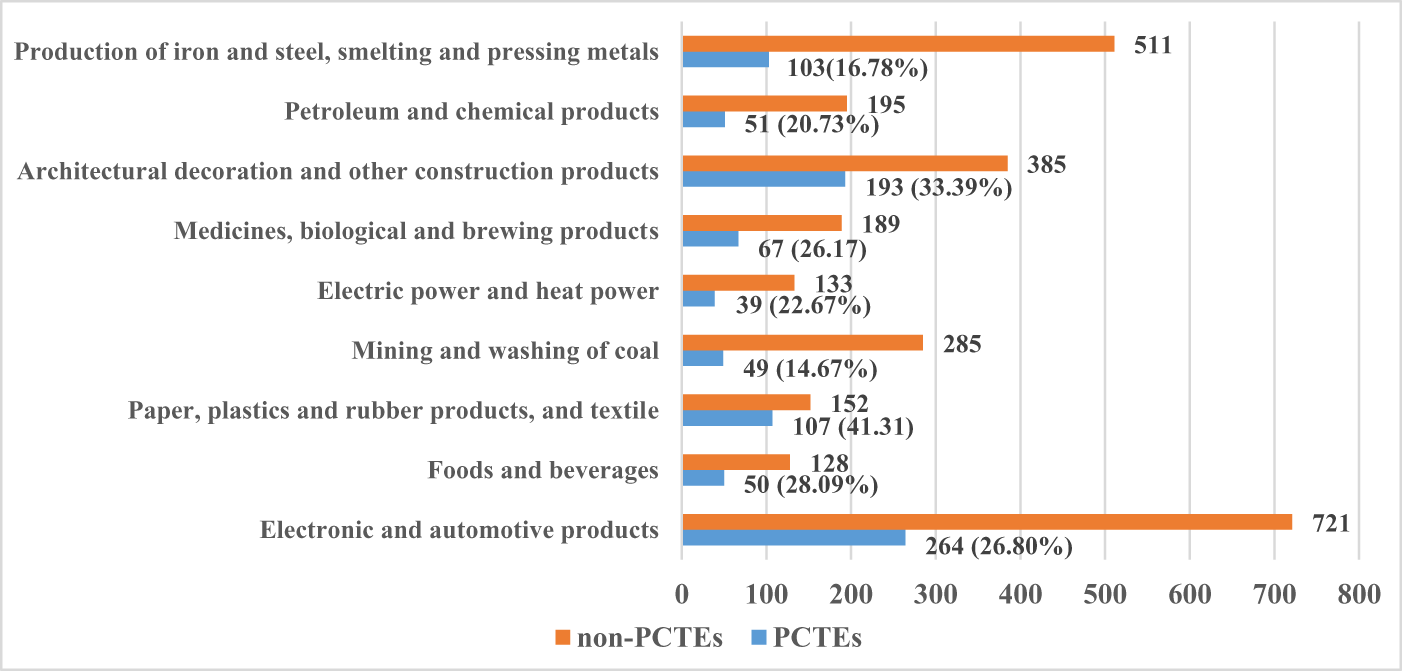
Figure 1 presents the distribution of sampled firms with PCTEs by industry. The sampled firms are distributed into nine industries, with the production of metal products, construction products, the manufacture of chemical materials and chemical products, the supply of electric power and heat power, and the manufacture of medicines, foods, textiles, and other light industry products; the manufacture of electronic and automotive products accounts for nearly one-third of the sampled firms. The numbers and percentages (in brackets) of firms conducted by PCTEs are shown in the histogram. This shows the cross-industry variation in firms with PCTEs. The highest percentage of PCTEs exists in the paper, plastics, rubber products, and textile industries, nearly half (41.31%) of which are operated by PCTEs. The lowest percentage of PCTEs occurred in the mining and washing of the coal industry (14.67%).
Distribution of PCTEs by industry

Results
Descriptive Statistics and Correlation Analysis
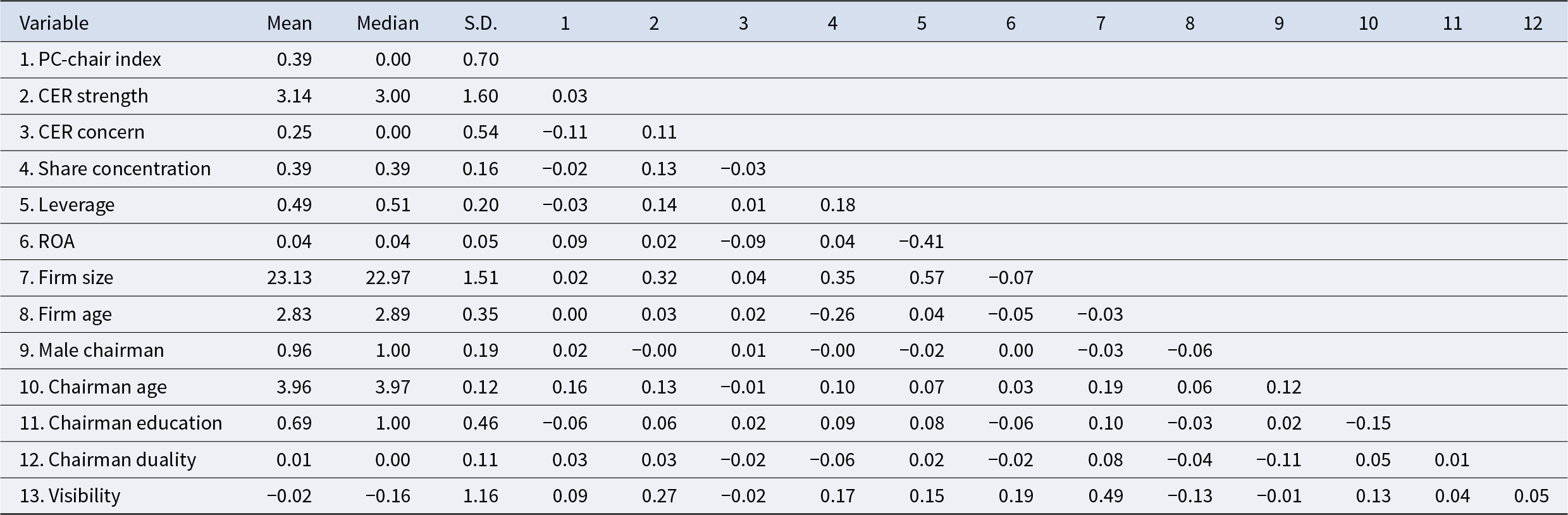
Table 1 shows the means, medians, standard deviations, and correlations for all the variables. The mean (median) values of PC-chair index, Chairman education, Chairman duality, Male chairman, and Chairman age are 0.39 (0.00), 0.69 (1.00), 0.01 (0.00), 0.96 (1.00), and 3.96 (3.97) respectively, reflecting the characteristics of chairmen. The mean (median) values of CER strength and CER concern are 3.14 (3.00) and 0.25 (0.00), respectively, suggesting that the sampled enterprises have serious evasion problems in implementing environmental responsibility. To test for multicollinearity issues, we evaluated the highest zero-order correlation coefficients (Firm size = 0.16; Visibility = 0.14) and calculated the variance inflation factors, indicating no worrying multicollinearity among these variables (Kalnins, Reference Kalnins2018).
Descriptive statistics and correlations

Notes: N = 3622.Correlations larger than |0.03| are significant at a level below 10%.
Hypotheses Testing
The research hypotheses were tested using a series of panel regression models with fixed effects (FE). The main findings are presented in Panels A and B of Table 2. Panel A presents the results of the hypotheses testing for environmentally responsible practices. The dependent variable was CER strength. Models 1−3 presented the regression results for all samples in our study. Model 1 includes all the control variables. Then, the independent variable was added to Model 2, and the moderating variable and interaction between PC-chair index and the moderating variable were added to Model 3. The main independent effect on CER strength in Model 2 shows that PC-chair index is positively but non-significant  $(\beta = 0.06,.\rho = 13)$ related to CER strength; thus, H1a is not supported. The moderating effect of organizational visibility on CER strength is presented in Model 3 of Panel A. The interaction term between PC-chair index and Visibility is significantly positive
 $(\beta = 0.13,.\rho \lt {0.001})$, suggesting that organizational visibility strengthens the effect of PC-chair index on CER strength, consistent with H3a. Models 4−7 presented the regression results in different groups to compare the ownership type differences as predicted. The results show that one unit PC-chair index lead to an increase of 0.01 units in firm’s CER strength
 $(\beta=0.01,.\rho=0.81)$ for state-owned firms and an increase of 0.17 units in firm’s CER strength
 $(\beta = 0.17,.\rho \lt 0.01)$ for private firms. Seemingly unrelated regression compared the absolute values of the two corresponding coefficients, further indicating that the PC-chair index has a stronger positive impact on CER strength for private firms than for state-owned firms (p= 0.036).
Estimates from FE regression of PCTEs on a firm’s CER

+ Notes: Robust standard errors are in parentheses; p < 0.10; *p < 0.05; **p < 0.01; ***p < 0.001.
Panel B of Table 2 presents the results of the hypotheses testing for environmentally irresponsible practices. The dependent variable was CER concern. Model 8-10 successively added all the control variables, the main independent PC-chair index, the moderating variable, and the interaction between the PC-chair index and the moderating variable. PC-chair index is negatively related to CER concern  $(\beta = - 0.03,.\rho \lt 0.01)$, suggesting that a PCTE is associated with less environmentally irresponsible activities, providing support for H1b. A 1 standard deviation increase in a chairman’s political connection beyond the mean decreases corporate environmentally irresponsible practices by 0.02. The moderating effects on CER concern are tested in Model 10 in Panel B. The interaction between PC-chair index and Visibility is marginally significantly negative
 $(\beta = - 0.02,.\rho \lt 0.05)$, consistent with H3b that in the case of high organizational visibility, the negative relationship between PCTEs and CER concern is stronger. This provides data support for H3b. Moreover, the results based on the ownership type difference (as shown in Models 11−14) also demonstrate a negative relationship between the PC-chair index and CER concern (p < 0.001 for state-owned firms and p < 0.05 for private firms), as well as a positive moderating role of organizational visibility (p < 0.05 for state-owned firms and p = 0.48 for private firms). Likewise, by using seemingly unrelated regression, we found no statistically significant differences (p = 0.859) in the effect of the PC-chair index on CER concern between privately controlled firms and state-owned firms. This finding aligns with the results of coefficient comparisons concerning the impact of the PC-chair index on CER strength, as presented in Models 4−7 of Panel A. These results collectively indicate that H2 is supported, showing that while the positive relationship between PCTEs and firms’ environmentally responsible practices is more pronounced for private firms, there is no significant difference in the negative relationship between PCTEs and environmentally irresponsible practices across ownership types.
Robustness Tests
We conducted robustness tests to examine potential endogeneity issues such as causal ambiguity and selection bias. To address concerns of potential simultaneous changes to PCTEs, organizational visibility, and CER, we employed the Arellano-Bond two-step system generalized method of moments (GMM) estimator to test causal ambiguity (Blundell & Bond, Reference Blundell and Bond1998). The results are exhibited in Models 1−4 of Table 3, which are similar to our previous results, indicating no endogeneity issues.
Robustness tests: application of systematic GMM and alternative measures for PCTEs and CER

+ Notes: Robust standard errors are in parentheses, except for Hansen test, AR(1) and AR (2), which are p-values; p < 0.10; *p < 0.05; **p < 0.01; ***p < 0.001.
In addition, we employed an alternative operationalization of variables based on fixed-effects regression to further ensure the robustness of the empirical results. First, we employed the data on CER strength and CER concern of Chinese listed firms in heavily polluting industries calculated by ASSET4Footnote 5 as the alternative dependent variables. In addition, to alleviate the concern that the results are only specific to indexation setting, instead of the continuous values of political connection, another widely used dummy variable was adopted (Dum PC-chair) to reflect PCTEs; that is, a state-owned chairman has work experience for the state, or a chairman currently holding or has previously held a position in the People’s Congress or the People’s Political Consultative Conference. We then rerun the regression to test the main and moderating effects. The empirical results are shown in Models 5−8 of Table 3, which imply that similar conclusions are obtained. In other words, the estimation results in terms of the magnitude and significance of the coefficients are similar to our prior estimated regressions and hence robust under alternative operationalization.
Moreover, our sample only employed heavily polluting firms that release social responsibility reports (as the CER was collected from the CCSR database, which only evaluated firms that have issued CSR reports). This may have led to endogeneity resulting from sample selection bias. We applied Heckman’s two-stage method to correct for the selection bias (Heckman, Reference Heckman1979). In the first-step regression, we used the probit model to predict firms that issued CSR reporting and obtained the Inverse Mill Ratio (IMR) for all Chinese-listed firms from to 2010−2018. In the second-step regression, the IMR was included in all the models (the relevant files are available upon request).
Discussion
This study aims to unravel how PCTEs respond heterogeneously to homogeneous institutional pressures for CER practices. While prior research has predominantly focused on the impact of political connections on corporate environmental management, yielding mixed results (e.g., Cheng et al., Reference Cheng, Wang, Keung and Bai2017; Zhang, Reference Zhang2017), these inconsistencies may be attributed to boundary conditions or the neglect of the dual dimension of CER.
Institutional pressures, emanating from both government and public expectations, incentivize politically connected managers to align with advocated initiatives (Marquis & Qian, Reference Marquis and Qian2014). Scholars have explored the influence of organizational factors on the relationship between political connections and corporate environmental management (Cheng et al., Reference Cheng, Wang, Keung and Bai2017; Kuo & Yu, Reference Kuo and Yu2017). However, the role of organizational visibility, affecting the degree of institutional pressure on PCTEs in implementing CER, has received limited attention (Aronson & LaFont, Reference Aronson and LaFont2022; Chiu & Sharfman, Reference Chiu and Sharfman2009). Addressing this gap is crucial, especially since political connections are established, in part, to enhance firms’ social and environmental performance, aligning with the government’s goals for sustainable development (Haveman, Jia, Shi, & Wang, Reference Haveman, Jia, Shi and Wang2017; Wang & Peng, Reference Wang and Peng2018; Wang et al., Reference Wang, Reimsbach and Braam2018).
Our examination focused on how PCTEs influence both environmentally responsible and irresponsible corporate activities, considering the moderating effect of organizational visibility. Beyond confirming the regulatory role of institutional pressures on PCTEs’ unethical environmental actions, our results reveal that the impact of these pressures on PCTEs’ engagement in ethical environmental initiatives varies by ownership type. Particularly, the positive relationship between PCTEs and firms involved in environmentally responsible activities is more significant for private firms than in state-owned enterprises.
Additionally, we theorized and found support for the positive moderating role of organizational visibility on the relationship between PCTEs and both environmentally responsible and irresponsible corporate activities. These results emphasize the need for the government to mobilize PCTEs to actively cooperate with environmental regulations and motivate organizations to enhance their visibility, contributing to a comprehensive improvement in CER.
Our contribution extends to the literature on political connections and CER. While previous research has explored the social and environmental implications of political connections, their effects on corporate environmental behavior have remained unclear. We argue that it is crucial to distinguish between the positive and negative dimensions of CER, as they can generate distinct stimuli that pressure PCTEs to make heterogeneous strategic decisions (Groening & Kanuri, Reference Groening and Kanuri2018; Ocasio, Reference Ocasio2011). This separation is instrumental in probing the role of PCTEs in CER implementation and clarifying whether they hinder or promote environmental management.
We also contribute to the understanding of environmental behavior research on politically connected executives in developing countries, with a particular focus on China. Given China’s unique political environment, this work considers the specific institutional characteristic of state ownership, which influences PCTEs’ attributes such as legitimacy, political dependence, and access to dominant benefits (Hong, Reference Hong2004; Marquis & Qian, Reference Marquis and Qian2014; Peng & Luo, Reference Peng and Luo2000). These institutional factors shape their willingness and capacity to respond to external pressures for environmental management (Aronson & LaFont, Reference Aronson and LaFont2022).
The findings indicate that PCTEs in private firms are more likely to engage in ethical environmental initiatives to enhance their legitimacy, secure political resources, or leverage such engagement for competitive advantages. Conversely, our results suggest that PCTEs in state-owned firms show no significant correlation with the positive aspects of CER, supporting the notion that politically connected executives in these firms are primarily driven by political interests rather than genuine concern for environmental protection and pollution reduction (Cheng et al., Reference Cheng, Wang, Keung and Bai2017).
Furthermore, this study enhances the understanding of heterogeneous PCTEs’ engagement in CER practices by integrating the political connection perspective with institutional theory. From the political connection perspective, we propose that political connections amplify corporate institutional pressures, creating opportunities for corporations to acquire resources by responding to these pressures, thereby enabling PCTEs to engage in CER initiatives. Drawing on institutional theory, we argue that organizations with greater visibility perceive increased institutional pressure to engage in CER to maintain or obtain legitimacy and the necessary resources for survival or success. By linking institutional theory with the political connection perspective, this study emphasizes the role of perceived institutional pressures in influencing the PCTEs-CER relationship. Accordingly, organizational visibility has been identified as a critical factor leading to PCTEs’ heterogeneous involvement in CER activities.
Theoretical Contributions and Limitations
Theoretical contributions extend to the intersection of institutions and political connections (Allen, Qian, & Qian, Reference Allen, Qian and Qian2005; Peng & Luo, Reference Peng and Luo2000). We propose a process wherein PCTEs address institutional pressures for environmental management by increasing their CER activities, thereby aligning with the regulatory, societal, and environmental expectations of key institutional stakeholders. This process contributes to the development of sustainable informal institutions. Effectively meeting CER demands enables PCTEs to strengthen their access to critical resources, supporting broader and more diversified future CER engagement and further fostering the establishment of sustainable informal institutions.
Despite these contributions, this study has limitations. We were unable to directly quantify institutional pressures from multiple stakeholders, relying instead on organizational factors influencing the sensitivity of PCTEs to these pressures. Future research could develop a theoretical framework to identify monitoring-based organizational factors curbing managerial opportunistic behavior, quantify PCTEs’ perception of pressures from multiple stakeholders, and triangulate the results presented here.
In conclusion, by merging political connections literature with institutional theory, this study advances our understanding of factors influencing PCTEs’ engagement in CER. The theorized and empirically tested moderating effect of organizational visibility on the PCTEs’ relationship with environmentally (ir) responsible practices offers additional explanatory power. The findings support the idea that organizational visibility helps elucidate PCTEs’ heterogeneous responses to homogeneous institutional pressures for CER.
Data availability statement
Data available on request from the first author.
Acknowledgements
This work was supported by the National Natural Science Foundation of China (Grant No. 71471047), the Fundamental Research Funds for the Central Universities (Grant No. HIT.HSS.202104), the Research Grant Council of Hong Kong (Project Reference 15503222) and The Hong Kong Polytechnic University (G-SB2K).
Yuxuan Li (xuan916794682@163.com) obtained her PhD in management from Harbin Institute of Technology, China. She is a lecturer at the Business School of Ludong University. Her research interests center on issues relating to government-enterprise relationship, corporate environmental responsibility, and managerial behavior in Chinese publicly listed firms. She has published several research papers about top executives’ environmental strategies in emerging economies in international journals.
Xin Miao (miaoxin@hit.edu.cn) research interests include sustainable development management and environmental risk management. He has led over 10 national and provincial research projects and published more than 60 papers. Recognized as a Distinguished Young Talent at Harbin Institute of Technology, he had also conducted postdoctoral research at the University of Oxford, served as a Hong Kong Scholar at the Hong Kong Polytechnic University, and been a visiting scholar at the University of North Carolina at Chapel Hill and a visiting research fellow at the University of Leeds.
Christina W. Y. Wong (christina.wy.wong@polyu.edu.hk) research interests include sustainability practices and has secured funding from multiple countries. A Research Grants Council Senior Research Fellow (2024/25) and Humanities and Social Sciences Prestigious Fellow (2017/18), she is among Asia’s top 1% and globally ranked in Stanford’s Top 2% Scientists Report. She is the Director of the Research and Innovation Office, leading initiatives to foster research and innovation.
Zhou Liang (liangzhou0805@163.com) obtained her PhD in management from Harbin Institute of Technology, Harbin, China, in 2022. She is currently an assistant professor at the Beijing Institute of Technology, Zhuhai. Her research interests include digital transformation of business and managerial practices, technological innovation, and corporate social responsibility. Her work has been published in ABS ranked and SSCI indexed journals. She is also serving as a reviewer for many journals.