Authoritarian regimes throughout the world have implemented reforms designed to increase transparency and participation in governance and the provision of public goods.Footnote 1 The Chinese Communist Party (CCP), for example, has experimented with participatory budgeting and village elections.Footnote 2 Such experiments raise a fundamental question regarding contemporary China: to what extent do governance reforms transform policymaking processes or, alternatively, bring nothing more than a veneer of transparency and participation to the political system?
One prerequisite of transformation in Chinese policymaking is the institutionalization of transparency and participation. Institutionalization is the “process by which organizations and procedures acquire value and stability.”Footnote 3 As this classic definition suggests, institutionalization entails the realization of two basic outcomes. First, institutionalized governance reforms are stable, that is, they persist beyond their initial applications. Novel experiments, regardless of their transformational possibilities, do not necessarily become durable means of making public decisions.Footnote 4 Second, institutionalized governance reforms offer procedural and substantive value to stakeholders in the political system. One such manifestation is enhancing the quality of information transmission between officials and citizens, a development that is of potential value to both government and society.Footnote 5
The institutionalization of governance reforms – durable instruments that enhance transparency and participation in Chinese policymaking – is a salient concern for a number of reasons. Although government decision making has long featured elements of openness and involvement, the transmission of information is inherently limited by state control of the media and organized opposition.Footnote 6 Research demonstrates that citizens have preferences not only regarding government outcomes but also the processes through which public policies are developed.Footnote 7 In other words, transparency and participation are consequential attributes of policymaking on their own merits. As a result, governance reforms that promote the ongoing realization of such values in policymaking present a means of fostering citizen satisfaction and bolstering the legitimacy of the CCP.Footnote 8
This article informs such concerns by examining the institutionalization of online consultation, a prominent instrument of governance reform.Footnote 9 Online consultation is an instrument of policymaking in which government organizations make public proposed laws and regulations and solicit input from interested parties prior to finalizing decisions. Two decades ago, the National People's Congress established the broad principle that citizens have the right to participate in policymaking.Footnote 10 Consistent with this principle, the State Council has adopted the practice of employing “the Internet as a standard method of inviting public opinion on draft laws and regulations.”Footnote 11 Dozens of government organizations have experimented with online consultation, using their websites to circulate proposed policies and request public feedback.Footnote 12 Despite such experiments, there remains uncertainty about the extent to which online consultation is a durable reform that has enhanced transparency and participation in policymaking.
To address these uncertainties, this article investigates the institutionalization of online consultation at two government organizations, the Ministry of Commerce (MOC) and Guangzhou Municipal Government (GMG). These organizations have been in the vanguard of the implementation of online consultation and, therefore, present plausible contexts for institutionalization. According to the Chinese Academy of Social Sciences, the MOC ranks as a leading agency in implementing transparency practices such as the disclosure of information about policymaking.Footnote 13 Guangzhou was the first municipality to adopt open government information regulations and is widely known as the “transparency city.”Footnote 14 Research demonstrates that the MOC and GMG disseminate the full text of draft laws and regulations and post to the internet feedback submitted in response to proposed policies, a combination of practices unmatched by other government organizations.Footnote 15
With regard to the MOC and GMG, this article examines the extent to which online consultation is an institutionalized governance reform. More specifically, it investigates whether online consultation can be considered to be a durable means of enhancing transparency and participation in policymaking at the MOC and GMG.
The empirical investigation entails the creation of original datasets consisting of hundreds of policies proposed by the MOC and GMG and thousands of public comments submitted in response to these draft laws and regulations.Footnote 16 These data are coded (in the manner described below) as a means of facilitating analysis of the information and opportunities that the MOC and GMG provide to parties interested in proposed policies, as well as the characteristics of feedback submitted in response to these proposals. By examining the behaviour of government organizations and members of the public, the analysis generates insight into the durability of online consultation, as well as the extent to which this governance reform enhances transparency and participation in policymaking.
The analysis does not explore the responsiveness of the MOC and GMG to comments submitted in response to draft laws and regulations. Case studies have documented – through detailed process tracing – examples of online consultation in which feedback is associated with changes in the content of policies.Footnote 17 It is not feasible, however, to determine the influence of public participation on government decision making in the context of large numbers of proposals and comments. Owing to the opacity of the Chinese policymaking process, “the scope and extent of the public comments’ influence on the final rules cannot be observed or assessed.”Footnote 18
The empirical analysis uncovers four main patterns regarding the durability and quality of online consultation at the MOC and GMG. First, both organizations have utilized online consultation frequently over the years and across policy areas. Second, the organizations disseminate detailed policy information and provide ample opportunities for public feedback. Third, despite such information and opportunities, the volume and professional expertise of participation is typically rather modest. Fourth, participants do not hesitate to express political viewpoints, including opposition (sometimes strident) to draft laws and regulations. Collectively, these findings suggest that online consultation is a durable governance reform that has enhanced the quality of government transparency more consistently than public participation. Although online consultation has the potential to transform policymaking, the evidence suggests that strong confidence in such an outcome is not warranted.
Experimentation with Governance Reform
Online consultation possesses a combination of characteristics that differentiate it from other governance reforms. In what follows, online consultation is juxtaposed with deliberative polling and village elections, two reforms that have attracted extensive researcher and practitioner attention in recent decades. These comparisons – although not exhaustive of participatory innovations (for example, the social assessment of government performance is not discussedFootnote 19) – place online consultation in the context of the institutionalization of governance reform more generally.
Characteristics of online consultation
Online consultation is defined by three basic characteristics.Footnote 20 The first is that public involvement is open to all interested parties. As a result, participants self-select into online consultation. Other governance reforms realize participation through alternative means. In recent decades, deliberative polling has been applied to public decision making in Wenling 温岭, a coastal city in Zhejiang province.Footnote 21 In deliberative polling, probability sampling is used to construct bodies of citizens who participate in moderated discussions of particular issues in public affairs.Footnote 22
Second, communication in online consultation entails the provision of information by government organizations and the expression of preferences by interested members of the public. Online consultation, in other words, is not designed to foster interaction, negotiation or deliberation among participants. In this regard, online consultation is similar to village elections in which citizens select officeholders from established slates of candidates.Footnote 23
Third, in online consultation, government organizations commit to receiving outside input on prospective decisions but maintain sole authority to establish policy. By contrast, village elections determine the identity of village officials.Footnote 24 In deliberative polling, officials have consented to implement priorities expressed by citizen bodies regarding spending on infrastructure projects such as roads, bridges, schools and parks.Footnote 25
Sources of governance reform
The Chinese approach to innovation has been called “experimentation under hierarchy.”Footnote 26 This top-down system entails coordination by the central government. The Organic Law of Village Committees, for example, has promoted the spread of periodic elections to hundreds of thousands of villages.Footnote 27 Despite such centralization, local officials at times play a central role in the implementation of policymaking innovations.Footnote 28 In Wenling, officials have expanded deliberative polling to encompass discussions of the city's budget in general.Footnote 29 Government support, however, has eroded when pivotal officials are transferred to other jurisdictions, and deliberative polling has not become a common feature of budgetary decision making across the country.Footnote 30
As these examples illustrate, both central government coordination and local entrepreneurship are potential pathways for the implementation of durable governance reforms that enhance transparency and participation in policymaking. How do such pathways operate in the specific context of online consultation, which differs in a number of crucial respects from reforms such as village elections and deliberative polling? Prior to analysing institutionalization at the MOC (a central government organization) and the GMG (a local jurisdiction), the following section reviews what is known about online consultation.
The Operation of Online Consultation
Research has investigated the operation of online consultation in particular policymaking contexts. These cases typically focus on policies attracting substantial attention, such as procedures governing the undisclosed detention of criminal suspects.Footnote 31 Analysis has specifically illuminated a variety of elements of participation in the making of healthcare reform.Footnote 32 Public feedback was extensive, with nearly 30,000 comments submitted in response to the prospective reform.Footnote 33 Participants were for the most part highly knowledgeable about issues in healthcare and willing to express criticisms of the government's proposed course of action.Footnote 34
Research has considered the implications of online consultation for government and society. An examination of sub-national policymaking processes and outcomes suggests that online consultation is more than mere “window dressing.”Footnote 35 Provinces that regularly utilize online consultation experience relatively high levels of compliance with government decisions. Such areas also encounter disputes and mass contestations on a relatively infrequent basis.Footnote 36 These patterns suggest that online consultation has the potential to foster citizen satisfaction and bolster the legitimacy of the CCP.Footnote 37
Building on prior research, this article examines the institutionalization of online consultation in policymaking at the MOC and GMG. The analysis breaks new ground by collecting and coding information derived from hundreds of draft laws and regulations, as well as thousands of comments submitted in response to these proposed policies. Despite the unprecedented scope of the analysis, the results are not necessarily generalizable across the Chinese government. If, however, online consultation has not institutionalized at the MOC and GMG (leading organizations in the implementation of this governance reform), then such outcomes are unlikely to manifest in other contexts.
Operationalizing Institutionalization
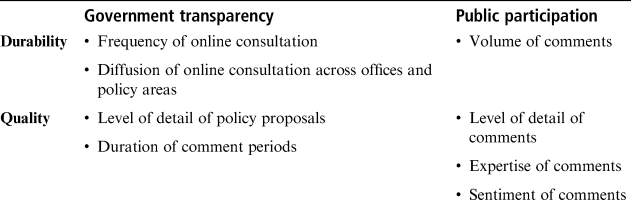
The analysis focuses on the institutionalization – durability and quality – of online consultation. Table 1 presents the manner in which durability and quality are operationalized. Both elements of institutionalization are measured in the context of the behaviour of government organizations and members of the public.
Indicators of Institutionalization

Assessing government transparency
The durability of government transparency is assessed through the frequency of online consultation and the diffusion of online consultation across offices and policy areas. Research on institutionalization points to an increase in organizational utilization and the spread of governance reform across jurisdictional boundaries as benchmarks of durability.Footnote 38 In the analysis that follows, the institutionalization of online consultation is therefore indicated by a rise over time in frequency and the diffusion across offices and policy areas of the MOC and GMG.
The quality of government transparency is evaluated through the level of detail of policy proposals and the duration of comment periods in online consultations conducted by the MOC and GMG. The benchmark for institutionalization in the level of detail is an increase over time in the number of characters in draft laws and regulations. This approach is consistent with prior research, which defines transparency as “the extent external actors are afforded access to information about the way public organizations operate.”Footnote 39 A core component of such access is the provision of detailed information regarding proposed policies.Footnote 40 Regarding the benchmark for the duration of comment periods, the State Council has recommended that draft laws and regulations be accessible for a minimum of 30 days.Footnote 41 Given this recommendation, the sustained implementation of such durations serves as demonstration of institutionalization.
Assessing public participation
The durability of public participation is operationalized as the volume of comments received by the MOC and GMG. Research has documented the submission of thousands of comments in response to policy proposals.Footnote 42 These cases typically occur in the context of unusual government, media and citizen attention, suggesting that such volumes represent the upper bounds of participation.Footnote 43 In the analysis, the durability of participation is therefore denoted by the sustained submission of comments that, while not numbering in the thousands, nevertheless represent robust responses to draft laws and regulations.
The quality of public participation is measured according to three elements: the level of detail of comments, the expertise of comments and the sentiment of comments. Research on governance reform highlights the informed exchange of diverse viewpoints as hallmarks of institutionalization.Footnote 44 The institutionalization of online consultation is indicated by the sustained submission of lengthy comments, comments that draw upon the professional expertise of participants, and comments that express a variety of perspectives including opinions critical of MOC and GMG draft laws and regulations.
Data Collection and Coding
Information about MOC and GMG draft laws and regulations, as well as feedback submitted in response to policy proposals, was collected from the internet. Both organizations have consultation and feedback websites. From these websites, the full texts of proposals and comments were assembled dating from the time the organizations began utilizing online consultation through 2016.Footnote 45 Collectively, these documents constitute a historical record of proposals and comments posted by the MOC and GMG.
Given the dictates of government censorship,Footnote 46 it is not necessarily the case that the MOC and GMG post all documents associated with online consultation. MOC policy proposals concern issues in trade and the economy, areas that for the most part do not threaten the legitimacy of the CCP. A handful of GMG online consultations, however, address issues that have at times been characterized by serious contestation between government and society. Despite such political sensitivities, controversial proposals and associated comments are posted to the GMG's website. For example, 363 comments submitted in response to a proposal concerning family planning policy are included in the analysis. The presence of such feedback is consistent with prior research, which indicates that comments concerning contentious issues occur in online consultation.Footnote 47 In the end, proposals and comments not posted by the MOC and GMG necessarily fall outside the analysis.
Altogether, information was extracted for 564 MOC online consultations posted between 2002 and 2016, as well as 2,820 comments submitted in response to these consultations. The GMG began utilizing online consultation in 2010 and, by 2016, had posted 137 policy proposals and 9,098 comments. Both sets of consultations and comments were coded along a variety of dimensions as a means of assessing the durability and quality of online consultation. Documents were evaluated according to a process of consensus, a common approach to coding qualitative texts.Footnote 48 Two trained coders examined each document separately, coming up with preliminary assessments. The coders then compared these judgements and came to agreement on final determinations. Any remaining uncertainties or discrepancies were resolved by coding supervisors.
Analysis of Institutionalization
The analysis of the institutionalization of online consultation proceeds as follows. The transparency practices of the MOC and GMG are first examined. The analysis then turns to an evaluation of the participation generated by the draft laws and regulations of these organizations.
Durability of government transparency
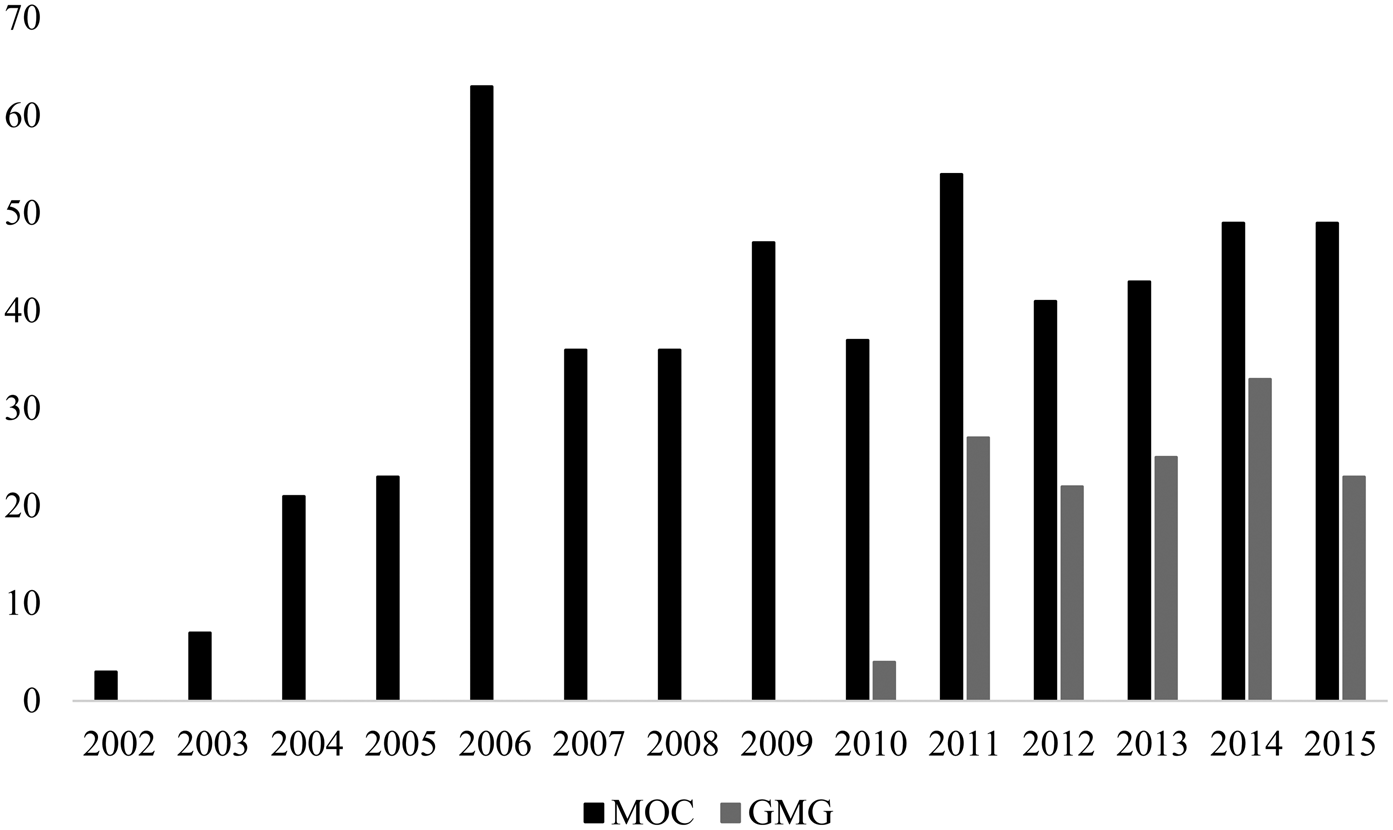
The fact that the MOC and GMG have conducted hundreds of online consultations serves, in and of itself, as an indicator of durability. As Figure 1 illustrates, the utilization of online consultation rapidly increased in frequency after its initial application in both organizations. The MOC commenced with three online consultations in 2002, expanded to a peak of 63 consultations in 2006, and maintained an annual level of approximately 40 consultations in subsequent years. The GMG initiated its first four online consultations in 2010 and conducted approximately 25 consultations per year during the 2011–2015 period. Overall, both organizations have sustained the rate at which they make policy through online consultation.
Number of Consultations, by Year
Notes:
The y-axis represents the number of online consultations conducted in a particular year. Since the MOC and GMG websites were scraped in the spring of 2016, the consultation counts for this partial year were excluded from the figure. The information in this figure, and all figures presented in the article, was collected and coded by the authors.

Not only is online consultation common as an absolute occurrence, it is a regular means of policymaking when judged against the overall number of actions taken by the MOC and GMG. From the GMG website, a list was obtained of regulations promulgated during the period under analysis.Footnote 49 Of the regulations that are not amendments or rescindments, 86 per cent entailed the utilization of online consultation. It is difficult to obtain a list of regulations in effect for the MOC, as no comprehensive source exists.Footnote 50 Among the regulations for which information is accessible, 52 per cent involved online consultation.Footnote 51 Durability is indicated by the fact that for both organizations, the proportion of regulations subject to online consultation increased during the period under analysis.
The GMG has jurisdiction over a broad array of policy areas, from commerce and transportation to health and safety. In 2010, the organization initially conducted online consultations in three areas, housing, environment and government operations.Footnote 52 In 2011, online consultations occurred for the first time in an additional seven areas. By 2014, the organization had requested public feedback on draft laws and regulations in 13 areas. In most of these areas, online consultation has occurred on a regular basis, thereby demonstrating durability across the jurisdictions of the GMG.Footnote 53
At first glance, similar jurisdictional durability has occurred at the MOC, with 22 departments having conducted consultations during the period under analysis. The vast majority of these online consultations, however, were initiated by four departments: European Affairs, Treaty and Law, Asian Affairs, and American and Oceanian Affairs. Most of the remaining departments have utilized online consultation on no more than a handful of occasions.Footnote 54
It is no coincidence that a number of the most active MOC departments work on international trade issues. As a condition of its 2001 accession to the World Trade Organization (WTO), the Chinese government committed to make public all proposed trade-related policies, as well as to provide interested parties with opportunities to comment on proposals prior to implementation. Transparency and participation have also factored significantly in negotiations regarding bilateral investment between China and the United States.Footnote 55
Only 189 of the MOC's 564 online consultations consisted of the solicitation of comments on policy proposals. The majority of online consultations were announcements of intergovernmental meetings related to trade or intellectual property. On 13 June 2013, for example, the Department of European Affairs announced that the 27th China–European Union Economic and Trade Joint Committee was to be held in Beijing. The announcement solicited comments from departments, local governments and enterprises regarding issues they encounter and suggestions for enhancing economic and trade relations between China and the European Union. Although such meetings entail interaction with interested parties from outside of the MOC, the announcements do not consist of draft laws and regulations that government organizations solicit feedback on prior to finalization. This limitation, together with the fact that most departments do not conduct online consultation on a regular basis, tempers the conclusion that this governance reform has diffused across organizational units of the MOC.
Quality of government transparency
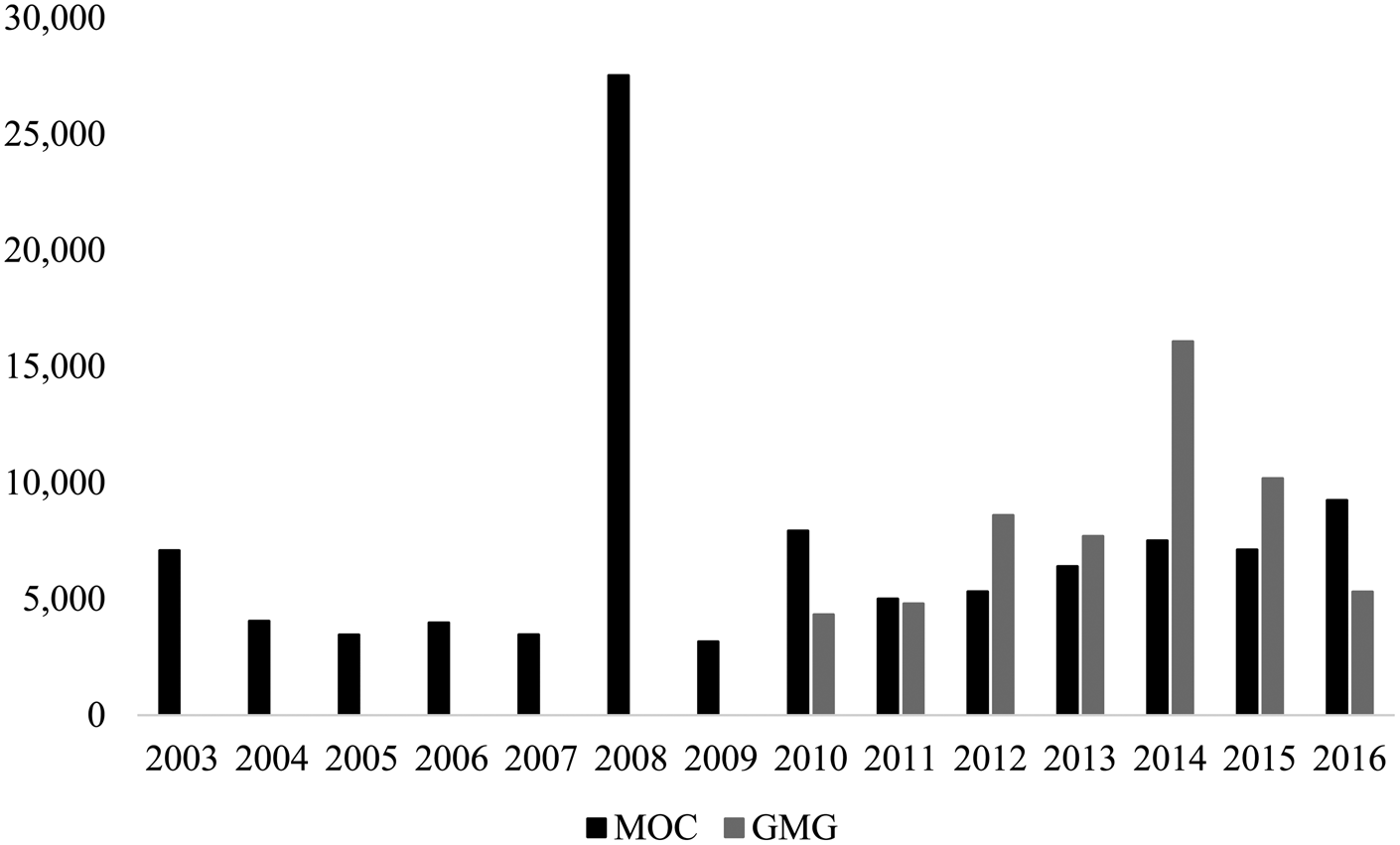
The level of detail of MOC and GMG policy proposals points to a rapid increase in transparency that has been sustained over the years. Among the MOC online consultations that solicited comments on draft laws and regulations, the average proposal contains 7,581 characters.Footnote 56 For GMG online consultations, the average proposal consists of 9,771 characters. As Figure 2 illustrates, the draft laws and regulations of both organizations have never dropped below an average of 3,000 characters on an annual basis. In the first two years of the utilization of online consultation, the proposals of the MOC and GMG averaged 4,360 and 4,771 characters, respectively. By 2015–2016, these averages had increased to 7,641 and 9,633 characters. Such patterns are indicative of the institutionalization of detailed proposals at the MOC and GMG.
Number of Characters in Policy Proposals, by Year
Notes:
The y-axis represents the average number of characters in policy proposals in a particular year. The year 2002 is not included in the figure because no MOC online consultations soliciting comments on draft laws and regulations occurred in that year; 2008 is an outlier for the MOC because of an unusually lengthy proposal (nearly ten times the number of characters of the second-longest proposal).

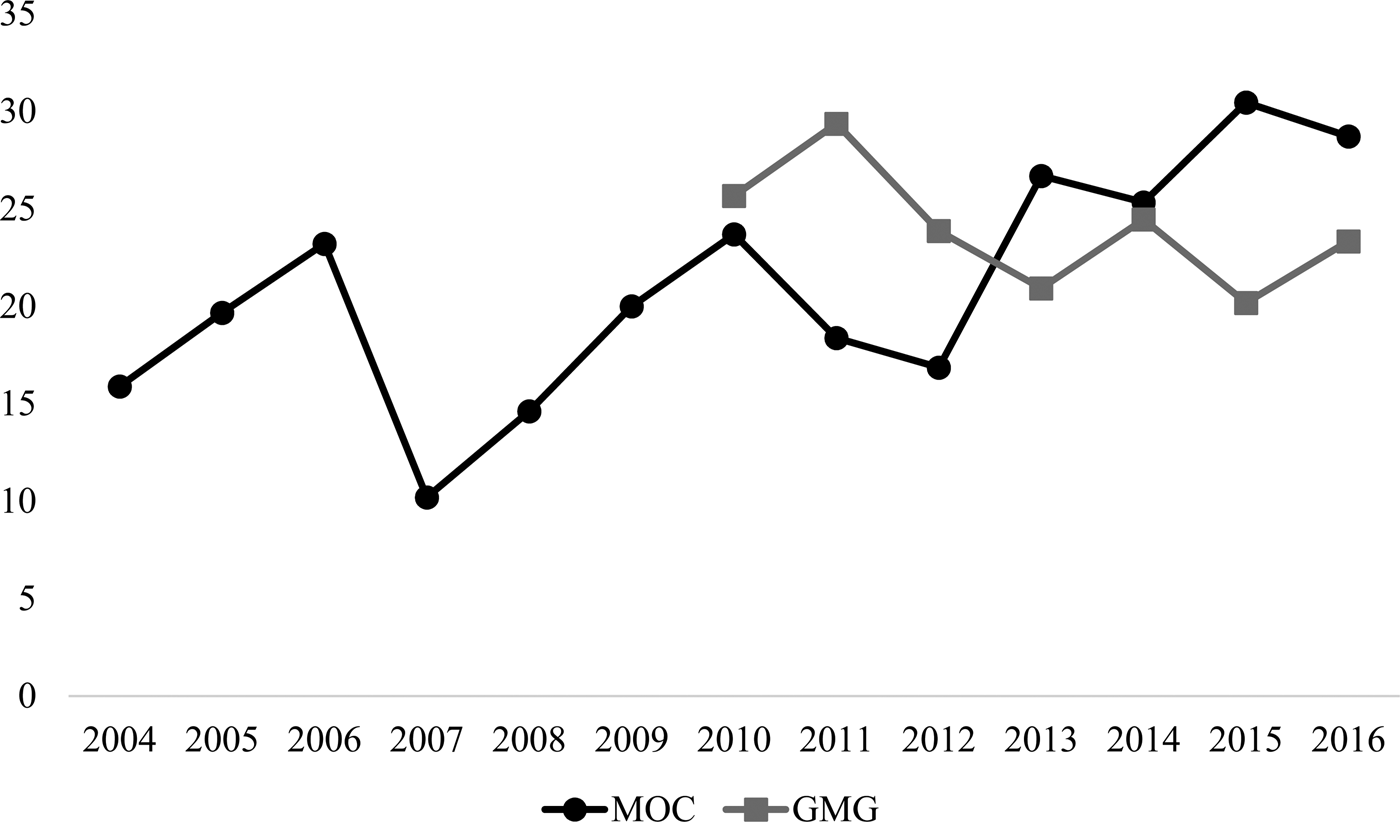
Among the MOC online consultations that solicited comments on draft laws and regulations, the mean comment period has a duration of 22 days. As Figure 3 illustrates, the duration of comment periods has gradually increased through the period during which the MOC has utilized online consultation. Since 2013, the average duration has approached 30 days, the amount of time recommended by the State Council for public feedback.Footnote 57
Duration of Comment Periods, by Year
Notes:
The y-axis represents the average number of days of comment periods in a particular year. The year 2003 is not included in the figure because information about comment period duration is not available for that year.

For the GMG, the most common duration for comment periods is 30 days, with nearly two-thirds of comment periods lasting for 25 days or longer. A small number of comment periods are exceptions, with durations of two weeks or shorter. The majority of these brief comment periods (which have the effect of reducing the annual averages reported in Figure 3) are associated with proposals concerning government operations. Apart from such exceptions, GMG practices regarding the duration of comment periods have institutionalized in a manner consistent with government recommendations.Footnote 58
Durability of public participation
Of the 189 MOC online consultations that solicited public feedback on draft laws and regulations, comments were available for 135 policy proposals. A similar pattern holds for GMG online consultations in that comments were extracted for 80 of 137 proposals. For the remaining online consultations, there are two explanations – among which definitive adjudication is not readily apparent – for the absence of comments. Either the MOC and GMG did not post feedback to their websites or no comments were submitted in response to these 54 and 57 proposals, respectively.
There are no substantive or procedural differences regarding the characteristics (for example, level of detail of proposals, duration of comment periods) of online consultations for which comments were available and consultations for which no feedback was extracted. One exception concerns the time period during which the online consultation occurred. For both the MOC and GMG, comments were generally not visible for the first several years during which online consultation was utilized. In subsequent years, by contrast, comments were accessible for the majority of online consultations. This pattern indicates that the submission and posting of comments has become an institutionalized (albeit not universal) feature of online consultation at the MOC and GMG.
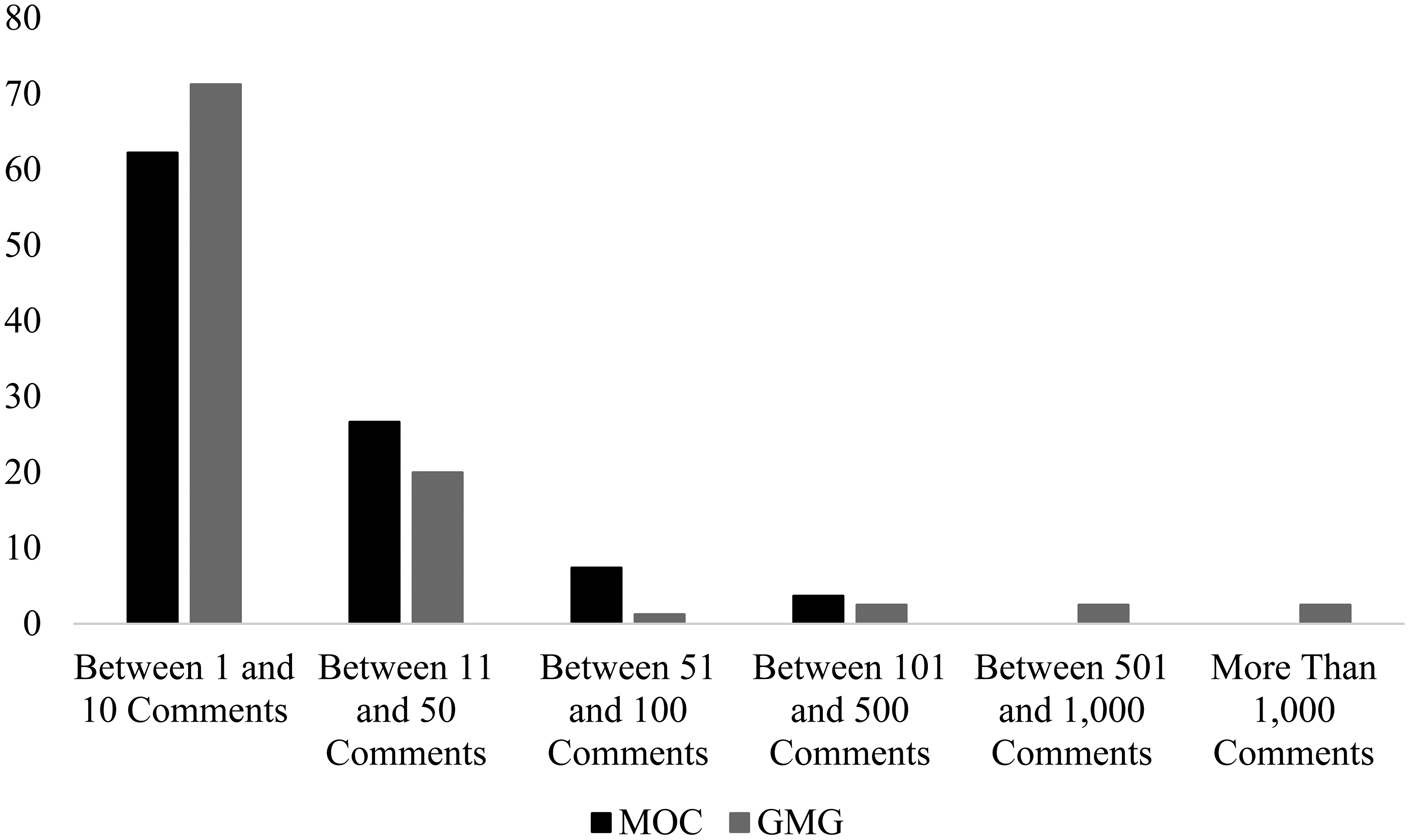
As Figure 4 illustrates, the number of public comments generated by MOC draft laws and regulations is typically rather modest. Of the 135 policy proposals with visible feedback, the average volume was 20 comments. Only five proposals received in excess of 100 comments. These proposals share no obvious characteristics in common, addressing such issues as direct marketing, food safety and the scrapping of motor vehicles.
Number of Comments on Policy Proposals
Notes:
The y-axis represents the percentage of policy proposals receiving a particular range of comments.

The volume of public comments submitted during GMG online consultations is, for the most part, consistent with these patterns. As Figure 4 illustrates, participation was limited to the submission of a small number of comments (i.e. 50 comments or fewer) in response to the vast majority of draft laws and regulations. Of the 80 policy proposals with available feedback, the average number was 114 comments. This average (relatively large in comparison to the MOC) reflects the fact that two proposals generated substantially greater volumes of comments than that induced by other online consultations. The largest volume – 4,807 comments – came in response to a proposal requiring elementary schools to provide after-school programmes. Although parents strongly supported this proposal, teachers (who were to staff the programmes) expressed firm opposition. Public interest was also unusually high regarding the sale and use of motorcycles and other vehicles (for example, electric bicycles), as evidenced by the fact that the GMG received 1,782 comments during the feedback period for this online consultation.
The volume of public feedback generated by MOC and GMG policy proposals has not increased over the years. For example, MOC draft laws and regulations that were proposed in 2010 or earlier received a median of seven comments per online consultation, a slightly larger number than consultations occurring between 2011 and 2016 (for which the median was six comments).Footnote 59 In both organizations, the median volume of comments has remained modest, generally not exceeding ten comments per online consultation on an annual basis. This consistent absence of large volumes of feedback – only occasionally disrupted by outlying occurrences – is indicative of a lack of institutionalization of robust public participation in MOC and GMG online consultations.
Quality of public participation
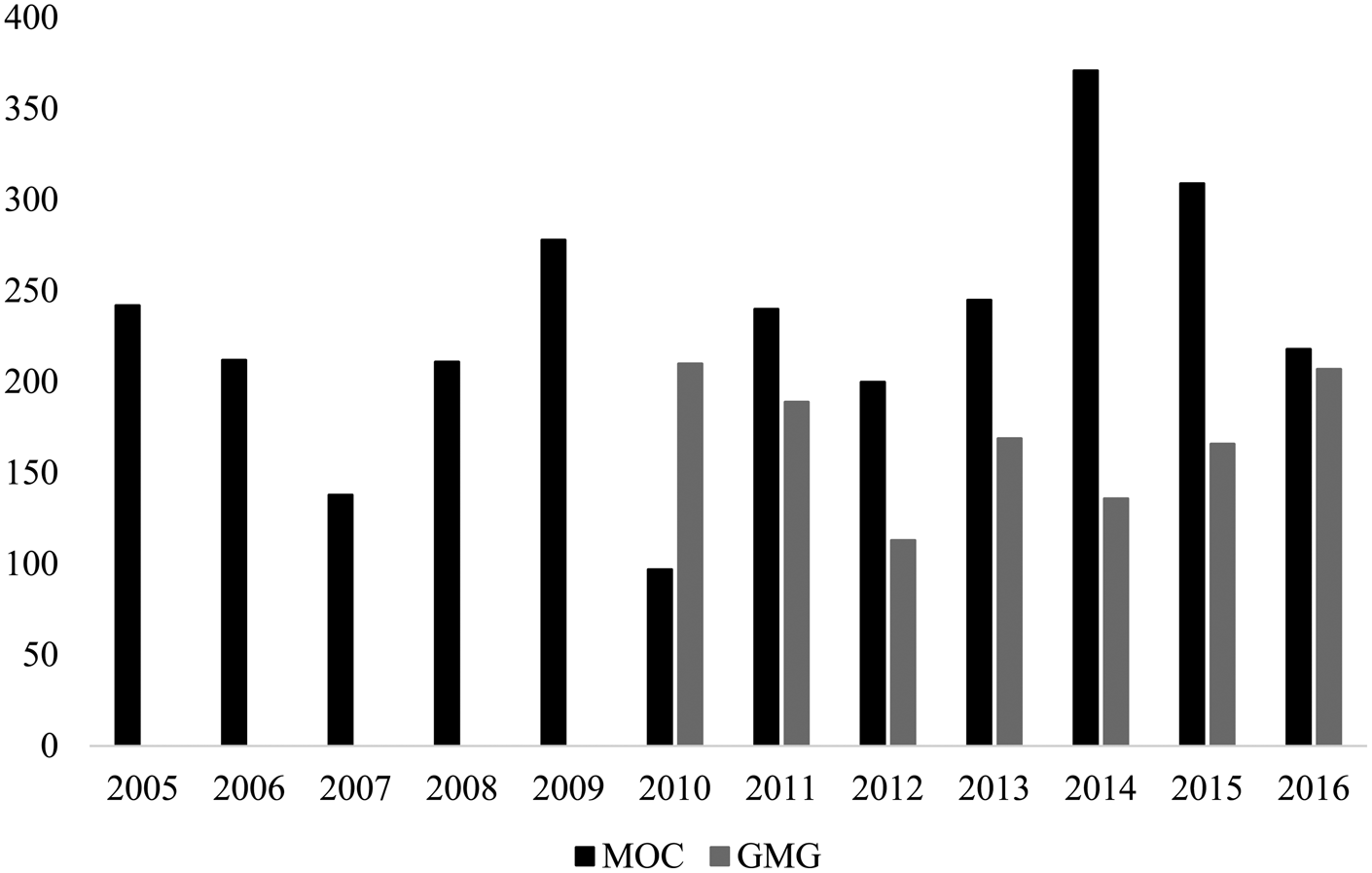
Public comments are typically relatively short in length and, therefore, do not provide detailed feedback on MOC and GMG draft laws and regulations.Footnote 60 For the MOC, the average comment consisted of 230 characters. The corresponding measure was 135 characters for comments submitted in response to policies proposed by the GMG. As Figure 5 illustrates, neither organization has experienced a sustained increase in comment length over the years during which online consultations have been conducted. This ongoing prevalence of comments not offering detailed feedback on draft laws and regulations is indicative of a lack of robust public participation during MOC and GMG online consultations.
Length of Public Comments, by Year
Notes:
The y-axis represents the average number of characters of public comments submitted in a particular year. 2005 is the first year for which the texts of comments on draft laws and regulations are available on the MOC's website.

Little information exists regarding the identity of participants in the online consultations under analysis. During the submission process, MOC commenters are given the option of identifying the organization with which they are affiliated. The GMG does not provide interested parties with such an opportunity. Approximately half of MOC commenters provided affiliation information. This information indicates that the MOC received feedback from local governments, private companies, non-profit organizations, institutions of higher education, state-owned enterprises and unaffiliated individuals.
Each comment on MOC policy proposals was coded for the referencing of professional knowledge and information. The coding is dichotomous in that comments are deemed as either referencing professional expertise or not. The following excerpt provides an example of a comment that cites occupational expertise: “I am a lawyer from the Shanghai Huguang Law Firm. I am delighted that the Ministry of Commerce is soliciting feedback on the proposed and much-needed Foreign Investment Law. As a lawyer, I have some comments on the ‘national security screening system’ that is mentioned in the draft law.” This comment addresses national security concerns regarding foreign investment in China, referencing the legal framework in the United States as a potentially useful guidepost for the Chinese government.
Of the public comments submitted to the MOC, 7 per cent contained expressions drawn from occupational experiences. Such comments were approximately twice as lengthy on average as submissions not incorporating professional information. The prevalence of comments informed by occupational expertise has not increased over the years, an indication of a lack of institutionalization in the transmission of professional knowledge on the part of participants in MOC online consultations.
The referencing of professional expertise was also uncommon in feedback received by the GMG. Only 6 per cent of public comments contained information derived from occupational experiences, a prevalence that has not increased through the years.Footnote 61 The following excerpt offers an example of the transmission of profession-specific knowledge to the GMG: “As a newspaper courier, I do not support a prohibition on electric bicycles. This restriction would be devastating to our industry and others that rely heavily on electric bicycles. Electric bicycles cut our delivery times in half and make our work less arduous. If this proposal is enacted, our efficiency will decrease and our workload will increase dramatically.”
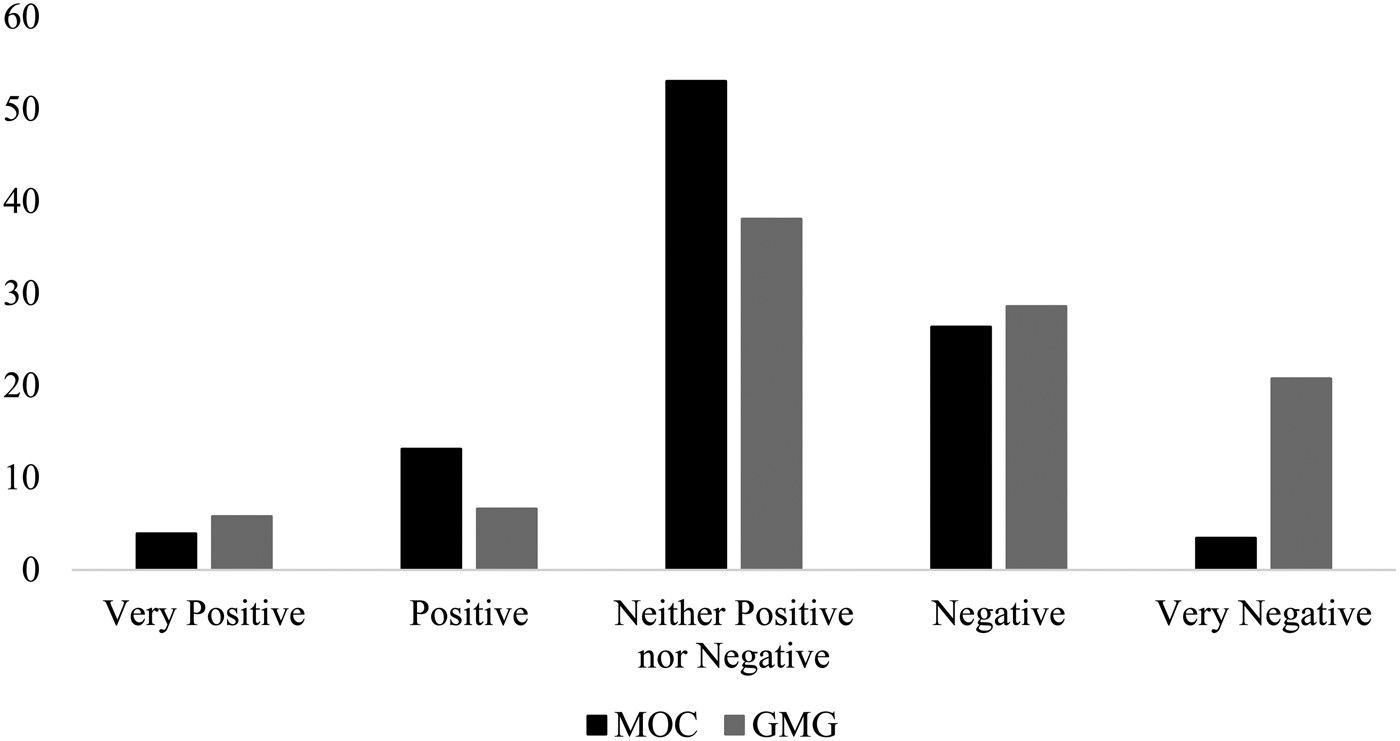
As a means of assessing the sentiment of public comments towards MOC and GMG draft laws and regulations, submissions were coded according to a five-point scale.Footnote 62 The categories of this scale are very positive, positive, neither positive nor negative (neutral), negative, and very negative. The scale summarizes the overall sentiment of comments towards the policy proposals in response to which they were submitted. If a comment does not render either a positive or negative judgement, then the submission is coded as neutral. A submission is also deemed to be neutral if the comment contains approximately equivalent expressions of both positive and negative sentiments. If the positive tone in the comment outweighs the negative sentiment, then the submission is coded as positive, and vice versa if the negative tone is more pronounced than the positive sentiment.
As Figure 6 illustrates, public comments submitted to both the MOC and GMG articulate a broad array of perspectives. It shows that 53 per cent of MOC comments and 38 per cent of GMG submissions did not express predominantly positive or negative sentiments regarding draft laws and regulations. The following excerpt, for example, communicates information about a proposed MOC alcohol distribution management policy without directing praise or blame towards the draft itself: “It is difficult to enforce alcohol distribution rules at the county level when wholesalers do not obtain the necessary documents from local commerce officials.”
Sentiment of Public Comments
Notes:
Each bar represents the percentage of public comments expressing a particular type of sentiment.

For the MOC, approximately one-third of public comments expressed negative sentiments, roughly double the percentage of submissions stating support for policy proposals. For the GMG, nearly half of the comments articulated opposition towards proposals, while only 12 per cent of submissions exhibited positive sentiments. The relative prevalence of negative comments at the GMG is primarily the result of objections expressed by large numbers of teachers towards the after-school proposal highlighted earlier. These objections constitute half of all negative comments submitted to the GMG.
Some negative comments were rather strident in their opposition to draft laws and regulations, as illustrated by the following excerpt from a GMG consultation on the classification of household waste: “I object! Rather than squander departmental resources classifying household waste, it would be better to promote even-odd driving restrictions. You government leaders should leave your offices, come outside and take a look at the sky in Guangzhou. I hope that after you see how bad the air is, you can maintain those smiles on your faces.”
The relative prevalence of public comments expressing negative, as opposed to positive, sentiments has persisted throughout the respective periods during which the MOC and GMG have utilized online consultation.Footnote 63 For example, positive comments have never exceeded 28 per cent of submissions on an annual basis at either organization. In contrast, negative comments have constituted a majority of submissions in particular years at both organizations. Such patterns demonstrate that feedback expressing a variety of viewpoints, including opinions critical of proposed policies, is an institutionalized feature of public participation in online consultation at the MOC and GMG.
Summary of analysis
Taken together, the analysis of policy proposals and public comments points to the conclusion that online consultation is a durable governance reform that has enhanced government transparency in the making of laws and regulations. Online consultation has been utilized frequently over the years by both the MOC and GMG. The GMG has been persistent in conducting online consultations across policy areas. At both organizations, draft laws and regulations are typically quite detailed and comment periods are routinely robust. Over time, both the MOC and GMG have regularized the practice of making comments publicly available on their websites.
By contrast, the feedback generated by MOC and GMG proposals does not indicate the consistent occurrence of quality public participation in online consultation. The number of comments submitted in response to draft laws and regulations is typically rather modest, particularly in the context of MOC online consultations. Comments are for the most part relatively short in length (especially feedback received by the GMG) and do not communicate professional knowledge and information. One dimension along which robust feedback practices have developed concerns the sentiment of comments. At both the MOC and GMG, participants regularly offer feedback from a range of perspectives, including opposition (sometimes strident) to draft laws and regulations.
The Transformation of Chinese Policymaking?
The analysis has demonstrated that online consultation is a durable governance reform, which has been more consistent in enhancing government transparency than it has public participation. What does this record of institutionalization imply for broad concerns regarding Chinese policymaking? Is online consultation a means of transforming government and society, or does this governance reform approximate business as usual in the political system?
A number of patterns revealed by the analysis suggest the transformational possibilities of online consultation. Online consultation has promoted the dissemination of detailed information about policy proposals, thereby institutionalizing a form of transparency that has not historically characterized policymaking in China.Footnote 64 Furthermore, the regular occurrence of negative feedback indicates the potential of online consultation to serve as a “safety valve” in Chinese politics.Footnote 65 According to this notion, participation, particularly feedback that challenges the status quo and proposed courses of action, provides the public with opportunities to “blow off steam” and therefore relieves pressure on the legitimacy of the CCP.
On the basis of the analysis presented, strong confidence in such interpretations is not warranted. For example, the efficacy of online consultation in promoting pressure relief is in part contingent on the responsiveness of government organizations to public criticism. Unmet expectations run the risk of fostering discontent with government accountability and performance.Footnote 66 Such discontent is particularly salient for online consultation, in which the sole authority to make decisions is maintained by government organizations. By contrast, governance reforms such as village elections and deliberative polling are explicitly designed to incorporate public opinion into personnel and policy decisions. A concern for future research, therefore, is broadly assessing government responsiveness to public participation in online consultation.
Another concern is the extent to which patterns at the MOC and GMG – leading organizations in the implementation of online consultation – manifest in other contexts. Research demonstrates that government organizations possessing two characteristics are generally in the vanguard of online consultation.Footnote 67 These characteristics are extensive fiscal resources and jurisdiction over policy areas in which political sensitivities – such as issues with implications for the territorial legitimacy of the CCP – are not present. To put it differently, economically disadvantaged provinces and central government ministries charged with protecting national defence and public security have been laggards in the adoption of online consultation. If, therefore, the institutionalization of online consultation is to occur outside of the MOC and GMG, then the most likely settings are well-resourced coastal jurisdictions and organizations that make policy in areas – such as education, healthcare and retirement – with implications for the everyday economic and social well-being of the Chinese public.
A final concern is the extent to which the institutionalization of online consultation, even to the limited degree experienced at the MOC and GMG, is likely to persist in the years ahead. In 2014, President Xi Jinping 习近平, in an address honouring the 65th anniversary of the Chinese People's Political Consultative Conference, praised consultation as a process through which the CCP draws upon the “wisdom and strength of the entire nation to pursue wide consensus.”Footnote 68 Has the practice of online consultation during Xi's administration reflected such commendations?
As a means of addressing this question, analysis was conducted separately on the MOC and GMG online consultations that have occurred since Xi assumed office in late 2012. These subsets were juxtaposed with online consultations that took place during the preceding Hu Jintao 胡锦涛 presidency. The analysis demonstrates little in the way of differences across the Xi and Hu administrations in both the information and opportunities that the MOC and GMG provide to parties interested in draft laws and regulations and the characteristics of feedback submitted in response to these proposed policies.Footnote 69 For example, the utilization of online consultation did not diminish during the years of the Xi presidency under analysis. Similarly, the number of comments submitted in response to draft laws and regulations did not decrease under the Xi administration.
This pattern of no difference holds for comments expressing negative sentiments towards MOC and GMG proposed policies, a reality seemingly at odds with characterizations of an authoritarian turn under President Xi.Footnote 70 The institutionalization of online consultation at the MOC and GMG, although limited, has proceeded in a period during which dissenting voices have been suppressed in other forums.Footnote 71 Such continuity underscores the value to both government and society of the transmission of information, at least in the context of processes and policy areas not posing an imminent threat to the monopoly on political power enjoyed by President Xi and, more generally, the CCP. It is therefore plausible that online consultation will exhibit durability as an institutionalized governance reform in the years ahead without transforming the Chinese political system in a consequential manner.
Acknowledgements
Previous versions of this article were presented at the 2019 annual meetings of the Association of Chinese Political Studies, Law and Society Association, and Midwest Political Science Association. We benefited considerably from the insights of Sarah Binder, Chris Carrigan, Bruce Dickson, Bridget Dooling, Jerry Ellig, Pierre Landry, Colin Provost, Jessica Teets, Annemieke van den Dool, Li Zheng and anonymous reviewers. We gratefully acknowledge the financial support of the George Washington University Confucius Institute and Regulatory Studies Center, as well as the research assistance of Lixue Chen and Jingyan Wu and the Research Center for Contemporary China at Peking University.
Conflicts of interest
None.
Biographical notes
Steven J. BALLA is associate professor of political science, public policy and public administration, and international affairs at The George Washington University and a senior scholar at the George Washington University Regulatory Studies Center. He researches government consultation and public participation in policymaking in China and the United States. He has been a senior Fulbright scholar in China on two occasions, at Peking University in Beijing and Nankai University in Tianjin. His research has been published in such journals as the American Political Science Review, American Journal of Political Science and Journal of Contemporary China.
Zhoudan XIE is a PhD student in economics at The George Washington University and a senior policy analyst at the George Washington University Regulatory Studies Center. Her research interests include the economic effects of regulation, bureaucratic behaviour in regulatory processes, and public participation in regulatory policymaking.