The next care to be taken, in respect to the Senses, is a supplying of their infirmities with Instruments, as it were, the adding of artificial Organs to the natural …
Robert Hooke, Micrographia (1665)In his Musikalisches Lexikon of 1802 Heinrich Christoph Koch likened the chamber-music composer to a painter who ‘shades and colors a picture destined to be viewed at close range much more delicately than, for example, a ceiling painting, which is far removed from the eye, and in which these details would not only be lost, but might even weaken the effect of the whole’.Footnote 1 Resting on the spatial limits common to vision and hearing, Koch's analogy expressed the need for painter and composer alike to take those limits into account. While a number of scholars have employed the notion of an ‘implied listener’ (modelled on the ‘implied reader’ of literary studies) to discuss the learned expectations and degree of passive or active engagement required to make sense of a composition in time,Footnote 2 Koch's analogy calls also for attention to the ways musical compositions imply listeners' positions in space.
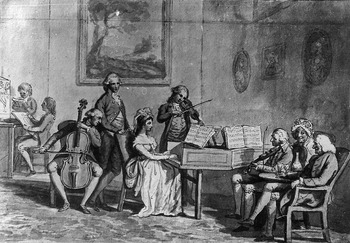
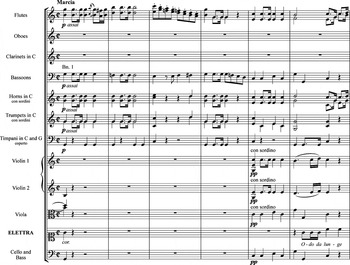
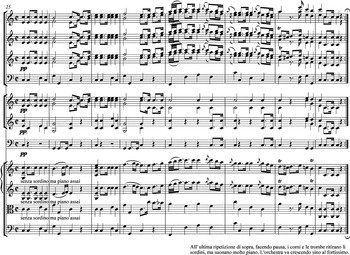
The term ‘point of audition’ – coined by film scholars by analogy with ‘point of view’ – may be recruited to describe the spatial position a work implies for its auditors.Footnote 3 Two brief examples will illustrate the concept as it applies to eighteenth-century music. In the slow movement of Haydn's Piano Trio hXV:20 (London, 1794) the pianist is instructed to play the opening theme with ‘the left hand alone’ (Figure 1). The instruction has no obvious audible effect, but its visible effect could be appreciated from a position occupied in numerous period illustrations of domestic music-making: seated or standing close behind the keyboard player (Figure 2).Footnote 4 In the theatre, text, scenery and music could work together to imply a virtual point of audition – that is, one dissociated from the position of listeners' bodies in the auditorium.Footnote 5 An example of this phenomenon occurs in Act 2 of Mozart's Idomeneo (Munich, 1781). Where the libretto indicates that ‘a harmonious march is heard in the distance’, Mozart provides a march scored for muted instruments playing piano or pianissimo (Example 1a). Over the muted march, Electra sings, ‘I hear from afar a melodious sound which calls me to go aboard; it is time to go’. She exits in haste, and ‘the march is heard ever closer as the scene is changed’ to the port of Kydonia – an effect Mozart achieves by means of a staggered removal of mutes, addition of oboes and clarinets, and crescendo to fortissimo (see the instructions given at the end of Example 1b). Through this simulation of sound changing with motion towards its source, the orchestra implies a mobile point of audition for its stationary auditors, thereby positioning them within the fictive world on stage.
Haydn, Piano Trio in B flat major, hXV:20/ii, bars 1–5. Trois sonates pour le piano-forte, avec accompagnement de violon et violoncello, op. 70 (London: Longman and Broderip[, 1794]). Department of Special Collections, Charles E. Young Research Library, University of California Los Angeles. Used by permission

Samuel Collins, Musical Party, latter half eighteenth century

Mozart, Idomeneo, No. 14, Marcia, bars 1–6 (Wolfgang Amadeus Mozarts Werke, series 5, volume 13 (Leipzig: Breitkopf & Härtel, 1881))

Mozart, Idomeneo, No. 14, Marcia, bars 25–32

Like Koch's analogy, these two examples work by assuming a constant relationship between spatial position and perceptual capacities. By the late eighteenth century, however, perceptual capacities were not so fixed: they could be altered technologically. Instruments for extending the senses had, of course, existed for some time. As a seventeenth-century commentator remarked with reference to the telescope and speaking trumpet, ‘it seems to be the privilege of this century that man should devise inventions aimed to make him, so to speak, bigger than natural, by expanding the limits of the action of his senses’.Footnote 6 It was in the eighteenth century, however, that instruments for extending the senses became basic accoutrements of cultured life. Common possessions by the 1770s, magnifying instruments yet carried the supernatural aura and sense of limitless possibility that so often attends new technologies, as Goethe's comment in the voice of Wilhelm Meister attests:
Sehrohre haben durchaus etwas Magisches. Wären wir nicht von Jugend auf gewohnt hindurch zu schauen, wir würden jedesmal wenn wir sie vors Auge nehmen schaudern und erschrecken. Wir sind es die erblicken und sind es nicht, ein Wesen ists, dessen Organe auf höhere Stufe gehoben, dessen Beschränktheit aufgelöst, das ins Unendliche zu reichen berechtigt ward.Footnote 7
There is something magical about spyglasses. If we had not been used to looking through them from when we were young, we would be shocked and frightened each time we set them before our eyes. It is we who see and yet it is not; it is a being whose organs are elevated to a higher plane, whose limitations are dissolved, who is enabled to see into infinity.
In the late eighteenth century, sensory extensions – the ‘adding of artificial Organs to the natural’, in Robert Hooke's phrase – made possible new points of audition and musical techniques for implying them. Although the magnifying instruments of the laboratory, drawing-room and parterre extended vision alone, the operatic stage and philosophical and fictional literatures drew analogies between vision and hearing that helped to shape ways of thinking about and listening to music. For, as Goethe's remark begins to suggest, extending the senses did more than bring new objects to view: it also inflected the relationship between observer and world, interpretative stances towards objects of observation and assumptions about what could be revealed – all in ways contingent upon the materiality and epistemological status of the instruments involved. While the history of sensory extensions confirms how open they were to varying uses and interpretations, for those concerned with music at the turn of the nineteenth century their most salient effects were the separation of observer from observed, and the obtainment of access to hidden realms. Additionally, mediation – the bringing of the otherwise separate into relation – provided an alternative framework to mimesis and expression, one that valorized sensory engagement with phenomena beyond rational understanding.Footnote 8 At a time when listening to music was widely regarded as a worldly, sociable activity, technologically mediated observation provided access to realms beyond, and prefigured an orientation and a bodily discipline characteristic of romantic descriptions of musical listening.
EFFECTS OF TECHNOLOGICAL MEDIATION
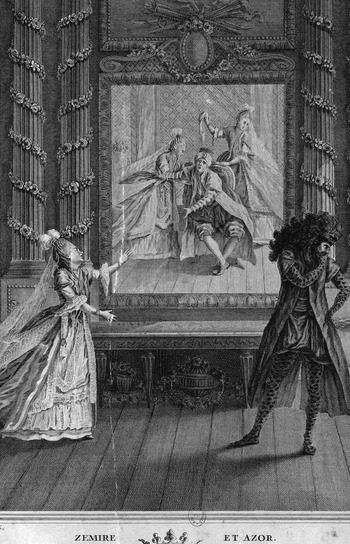
Reflecting the association of sensory extensions with magic, an early instance of technologically mediated observation on the operatic stage comes from the realm of fairy tale. Grétry's Zémire et Azor was first performed at the Comédie-Italienne in Paris in 1771, and remained popular throughout Europe into the nineteenth century.Footnote 9 In a celebrated scene, Azor (the beast in this retelling of beauty and the beast) allows Zémire (the beauty) to see her distant family by means of a magic picture (Figure 3). The same device is found in librettist Jean François Marmontel's main source for the story, La belle et la bête by Jeanne Marie Le Prince de Beaumont. There, however, a mirror shows Zémire's home, Zémire reads the expressions on her father's and sisters' faces, and the image spontaneously disappears. For the opera, Marmontel elaborated the episode and transformed the mirror into an audiovisual display. First, Azor tells Zémire that her family will appear in a magic picture, but warns, ‘if you approach, everything will vanish’. The picture then shows Zémire's father and two sisters; they appear to be reaching towards her and trying to speak to her, but the picture remains mute. After Zémire pleads with Azor to let her hear as well, the three sing a trio lamenting Zémire's absence. In the libretto, Marmontel labelled this trio ‘en sourdine’ – muted.Footnote 10
François-Robert Ingouf, magic-picture scene from Grétry's Zémire et Azor (Zemire et Azor, dédié à madame la marquise de Montesse par son très humble et très obéissant serviteur Elluin), engraving c1771. Bibliothèque Nationale de France. Used by permission

This magic-picture scene has received substantial attention for its depiction of absorbed spectatorship. As Stefano Castelvecchi and Downing Thomas have argued, the scene demonstrates the new stage–spectator relationship that mid-eighteenth-century reformers advocated for the theatre.Footnote 11 As part of an effort to enhance the emotional involvement of spectators in the dramatic representation, reformers sought to establish the stage as a self-contained world. This new dramatic conception involved what has become known as the ‘fourth wall’ – an imaginary barrier at the edge of the stage blocking playwrights and actors from addressing or otherwise acknowledging their audience. Functioning as a ‘fourth wall’, the magic picture lets Zémire's family be seen and heard while leaving the family unaware of having observers. Zémire, through her reactions to the picture, demonstrates ‘the link between spectatorial exclusion and emotional involvement’ theorized by reformers of the time: wholly absorbed and profoundly moved by her family's lament, Zémire models the way opera-goers should experience dramatic representations (this very scene among them) that similarly deny their presence.Footnote 12
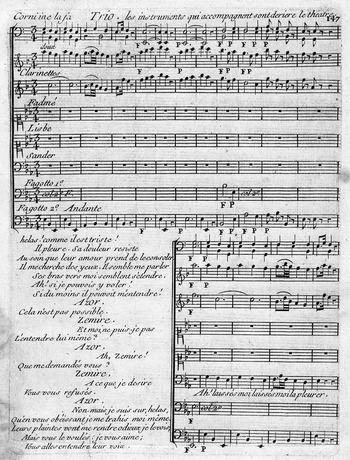
To this scene of model spectatorship, Grétry's music has been credited with adding the effects of enchantment and distance. The repeated three-note descending figure that opens the trio has struck modern commentators as ‘hypnotic’, suggesting a similarity between spectatorship of the magic picture and a state of enchanted sleep (Figure 4).Footnote 13 Grétry scored the trio for a wind sextet of two clarinets, two horns and two bassoons, positioned behind the stage. In this scoring, scholars have recognized the supernatural and otherworldly; in its backstage location, the evocation of distance.Footnote 14 Taking stock of the dream-like quality and sonority of the number, David Charlton sensed a preview of musical romanticism, concluding that Grétry's ‘televisual trick … represents a union of special music and the supernatural no less than German Romantic opera was to do’.Footnote 15
Grétry, Zémire et Azor, magic-picture trio, beginning (Paris: Chés Houbaut[, c1772]). Jean Gray Hargrove Music Library, University of California Berkeley, M1500.G7 Z4. Used by permission

Considered in terms of listeners' point of audition, the special sonority of the trio – while still enchanting and suggestively romantic – becomes indicative of technological mediation. To appreciate this, we may return to Marmontel's indication for the trio, ‘en sourdine’. It does not appear in Grétry's score (the marking ‘doux’ in the horns indicating soft expression without damping). Yet it was how early critics, probably taking their cue from the libretto, described Grétry's music. Following the opera's premiere, the Mercure de France wrote that all the music was exquisite and true in its expressions of the soul, but that ‘one will never be able to give sufficient praise to the muted Trio of the father and his two daughters who appear in the magic picture’ (‘on ne pourra jamais assez louer le Trio en sourdine du pere & de ses deux filles qui paroissent dans le tableau magique’).Footnote 16 Whereas Mozart's muted instruments made the march in Idomeneo sound distant, Grétry's distant (backstage) instruments made the trio sound muted. The difference between distant and muted acquires significance from the dramatic context: Zémire's family is not just far away, but seen and heard by means of the magic picture – by means of technological mediation.
Marmontel was equally concerned to secure the visual effect of technological mediation for the magic-picture scene. At the Comédie-Italienne, Zémire's father and sisters were surrounded by a frame and placed behind a semi-transparent curtain. In his memoirs Marmontel took credit for the semi-transparent curtain, writing:
Avec deux aunes de moire d'argent, pour imiter la glace du trumeau, et deux aunes de gaze claire et transparent, je [le décorateur] appris à produire l'une des plus agréables illusions du théâtre.Footnote 17
With two ells of silver mohair to imitate a pier looking-glass, and two ells of clear and transparent gauze, I taught [the decorator] how to produce one of the most pleasing stage illusions.
Gauze had appeared in Parisian stage decorations since at least the 1720s, when G. N. Servandoni had used silver gauze gliding over two wheels to imitate a waterfall.Footnote 18 In the nineteenth century, gauze became a secret ingredient in atmospheric lighting effects, casting an otherworldly pall over the stage. As the mirror-like surface of the magic picture, however, gauze both imitated a worldly object and imparted an otherworldly appearance to the stage picture, the imitation of technology proving transitional between the two modes of stagecraft.
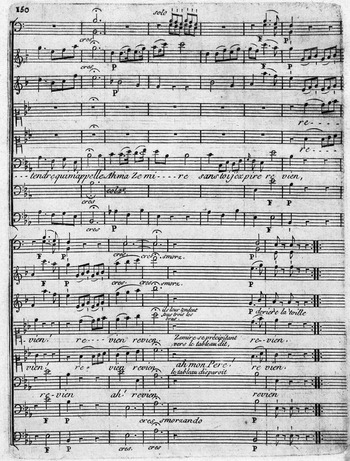
Beyond colouring the sights and sounds it delivers, the magic picture disciplines its users. Upon an expressive high point of the trio, Zémire forgets Azor's warning that the picture will vanish if she approaches and rushes forward, calling to her father (Figure 5). An illustration of the scene by François-Robert Ingouf captures Zémire's feeling of proximity to her father at this moment, as it seems the two, reaching towards one another, are about to touch (refer again to Figure 3). Then, however, the picture goes dark, and Zémire is left to hear her family call ‘revien’ (return) one more time before their voices too disappear.Footnote 19 By approaching the picture, Zémire does not get closer to her family but rather loses her ability to see and hear them. This counterintuitive result reinforces the dependence of Zémire's point of audition on mediation: the magic picture joins, in its partial, tantalizing way, what is otherwise completely separate.
Grétry, Zémire et Azor, magic-picture trio, end

By permitting only one-way access, the magic picture turns its users into secret observers. In this, the magic picture was not only a fictional device that made concrete the theatrical ideal of the ‘fourth wall’, it also resembled those real-life technologies of mediated observation: magnifying instruments.
OBSERVATION THROUGH MAGNIFYING INSTRUMENTS
In 1665 Robert Hooke introduced the microscope to the public with his richly illustrated treatise Micrographia (1665). Expounding the virtues of the instrument, Hooke cast its users as stealthy peepers:
when we endeavour to pry into [nature's] secrets by breaking open the doors upon her, and dissecting and mangling creatures whil'st there is life yet within them, we find her indeed at work, but put into such disorder by the violence offer'd, as it may be easily imagined, how differing a thing we should find, if we could, as we can with a Microscope in these smaller creatures, quietly peep in at the windows, without frightening her out of her usual bays.Footnote 20
With his reference to ‘breaking open the doors’ of nature, Hooke alluded to the practice of vivisection, or ‘live anatomy’ as it was then called, which numbered among his duties as the Curator of Experiments for the Royal Society in London.Footnote 21 While the contrast with vivisection carries ethical implications, however, Hooke's praise for the microscope is primarily epistemological: the instrument provides a superior means of accessing nature's secrets because it maintains a separation between observer and observed, and thereby preserves the integrity – the truth – of the object under view. Though Hooke elsewhere mentioned the inherent difficulty of interpreting the images produced by the microscope, his magnifying instruments more often appeared as they do here: as infinitely improvable windows onto hitherto unknown realms.
In the late seventeenth and the eighteenth centuries a growing body of popular literature echoed Hooke's advocacy for the use of instruments to study nature. Works such as Bernard de Fontenelle's Entretiens sur la pluralité des mondes (1686) and Francesco Algarotti's Il Newtonianismo per le dame (1737) – both widely translated and frequently reprinted – presented the discoveries of natural philosophers in dialogues between a learned gentleman and naive lady, enlivening the subject matter with conversational banter appropriate to genteel society. Authors who were also instrument makers, such as Benjamin Martin in England and Cosmus Conrad Cuno and Martin Frobenius Ledermüller in Germany, placed particular emphasis (among other devices) on the telescopes and microscopes that they offered for sale. In contrast to their English, French and Italian counterparts, however, German popularizers of science tended to eschew dialogues in favour of more sober forms of reportage addressed to amateurs and connoisseurs. One reason for the regional difference is suggested by Immanuel Kant, who considered natural philosophy an inappropriate pastime for ladies:
Deep reflection and a long drawn out consideration are noble, but are grave and are not well suited for a person in whom the unconstrained charms should indicate nothing other than a beautiful nature … The beauties can leave Descartes' vortices rotating forever without worrying about them, even if the suave Fontenelle wanted to join them under the planets; and the attraction of their charms loses nothing of its power even if they know nothing of what Algarotti has taken the trouble to lay out for their advantage about the attractive powers of crude matter according to Newton.Footnote 22
Kant's objection to involving women attests both to the association of natural philosophy with intellectual labour and solitude in Germany, and to the international circulation of literature that would have the study of nature be entertaining and sociable.Footnote 23
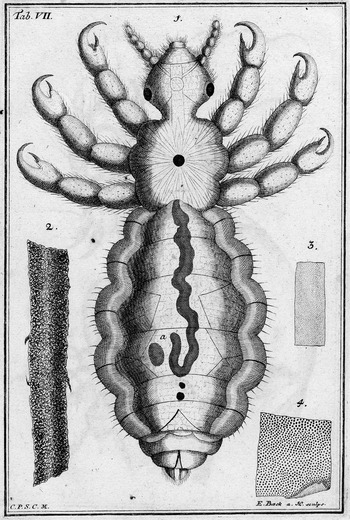
Popular literature on natural philosophy not only fuelled the market for magnifying instruments, but also informed the ways people used and thought about those instruments. While varying across time and geography, the literature also featured recurring themes that are relevant to the roles magnifying instruments played in musical contexts.Footnote 24 One such theme was the idea that microscopes can provide access not just to the tiny, but to the moving interiors of things. The passage from Micrographia cited above, for example, appears in the context of Hooke's description of a water-insect with ‘transparent shell’ that allows the microscopic observer to see inside the living creature. In his treatise for amateurs and connoisseurs, Observationes durch dessen verfertigte Microscopia (1734), Cosmus Conrad Cuno also included observations of insect interiors. His Plate VII illustrates the circulatory and digestive systems as seen through the back of an insect, and which he described in the text in living colour and motion (see Figure 6).
Microscopic view revealing interior of insect, from Cosmus Conrad Cuno, Observationes durch dessen verfertigte Microscopia (Augsburg: Samuel Fincke, 1734). The Bancroft Library, University of California Berkeley, QL466.C7. Used by permission

Popular scientific literature also promoted an interpretative stance in which technologically mediated observation produced knowledge, without need of further analysis or inquiry. For example, in Benjamin Martin's The Young Gentleman and Lady's Philosophy (1759), a learned gentleman shows his sister the microscopic structure of mouse hair. Upon viewing the hairs, she wonders what the purpose of such ‘hidden Beauties’ can be. He replies by adapting a line from Alexander Pope's An Essay on Man: ‘whatever is, is right, whether you understand it or not’.Footnote 25 Cuno's treatise offered a more explicitly natural theological version of the same stance: observation of minute structures – such as the arteries radiating from a single point within the insect on Plate VII – ends in wonder at God's handiwork. In the context of natural philosophy, technologically mediated observation thus provided an alternative to the paradigm of ‘analytic eyes’ that, as Patrick Singy has argued, governed observation across the sciences and fine arts in the eighteenth century. As Condillac succinctly described, ‘our eyes must analyze, for they will not grasp the whole of the less composed shape if they have not observed all its parts, separately, one after the other, and in the order in which they are’.Footnote 26 By contrast, when one's senses were extended by instruments, there was little need for such analysis: objects of observation acquired significance by virtue of being hitherto hidden, and now instrumentally revealed.
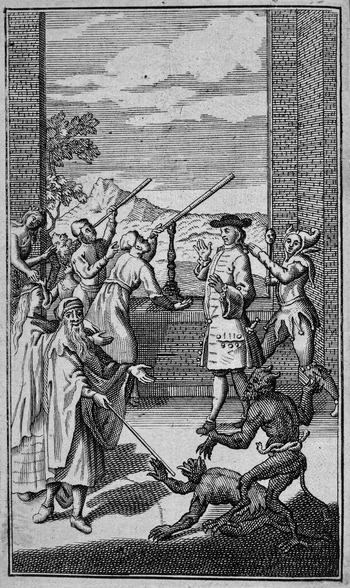
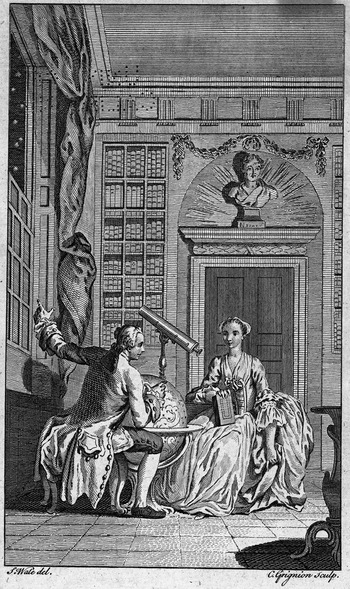
Such faith in magnifying instruments, however, required setting aside concerns over their ability to produce erroneous impressions. Until well into the eighteenth century, magnifying instruments frequently figured as instruments of deception. As the English naturalist Henry Baker warned readers of The Microscope Made Easy (1743), ‘When you employ the Microscope, shake off all Prejudice, nor harbour any favourite Opinions; for, if you do, ’tis not unlikely Fancy will betray you into Error, and make you think you see what you would wish to see.’Footnote 27 For the French philosopher Claude Adrien Helvétius, the telescope furnished a ready and compelling illustration of the misinterpretation of sensory information. In his treatise De l'esprit (1758) Helvétius recounted the ‘well known story of a country clergyman and an amorous lady’. Having heard that the moon is inhabited, the lady and clergyman try to view the lunar people through their telescopes. The lady sees two shadows inclining towards each other and identifies them as two happy lovers. The clergyman, also seeing two shadows, dismisses her interpretation: clearly, the two shadows are the two steeples of a cathedral.Footnote 28 The dubious status of the telescope also finds expression in the frontispiece to Laurent Bordelon's L'histoire des imaginations extravagantes de monsieur Oufle (1710), where it is allied with conjurors and tricksters (Figure 7). The contrast between Bordelon's frontispiece and that of Benjamin Martin's The Young Gentleman and Lady's Philosophy attests to a shift in the popular image of magnifying instruments that the literature on natural philosophy, in conjunction with the widening commercial availability of magnifying instruments, helped bring about (Figure 8). Showing a telescope in a well-appointed parlour between a lady and the gentleman who instructs her, the frontispiece illustrates the acceptance of magnifying instruments into cultured life and the natural order.
Laurent Bordelon, L'histoire des imaginations extravagantes de Monsieur Oufle, frontispiece (Amsterdam: Estienne Roger, 1710). Rare Books Division, Department of Rare Books and Special Collection, Princeton University Library, 3236.63.346. Used by permission

Benjamin Martin, The Young Gentleman and Lady's Philosophy, volume 2, frontispiece (London: W. Owen, 1772). The Bancroft Library, University of California Berkeley, QB42.M3. Used by permission

The telescope scene in Carlo Goldoni's opera Il mondo della luna, written for the Venice carnival season of 1750, lies closer to Bordelon's frontispiece than to Martin's. Goldoni adapted the story from Nolant de Fatouville's Arlequin, Empereur dans la Lune, a comedy about a moon-world hoax first performed at the Comédiens Italiens du Roi in Paris in 1684, when telescopes were objects of popular suspicion.Footnote 29 As Il mondo della luna begins, Buonafede (whose name reflects his credulous nature) arrives at the astronomer Ecclitico's home in search of ‘a theory explaining the moon’. To Buonafede's surprise, Ecclitico tells him the moon is a transparent body inside of which there is another world. When Buonafede asks how he knows this, Ecclitico explains in terms that echo Hooke's image of ‘quietly peeping in at the windows’ of a transparent insect: ‘I have built a telescope which pierces through so much that it offers the view of both the surface and the core. Not only does it show kingdoms and provinces, but also houses, squares and people. With my big telescope I can see up there, to my pleasure, the women undress themselves before going to bed.’Footnote 30 Buonafede then enters Ecclitico's observatory, peeps through his giant telescope and spies lunar men and women in various private scenes.
Little does Buonafede realize that Ecclitico's telescope is trained not on the moon but on an earthly machine. When Buonafede first enters the observatory, Ecclitico commands his servants to ‘move the machine, drag it near the telescope so that, by looking through it, Signior Buonafede thinks he sees every figure move in the World of the Moon’. According to Goldoni's stage directions, the audience should see ‘an illuminated machine drawn to the top of the telescope, inside of which some figures are moving’.Footnote 31 Three times in total, Buonafede enters the observatory, then returns and reports to Ecclitico what he has seen in an aria. First it is a young girl caressing an old man, then a man beating his unfaithful wife, and finally, a man leading by the nose his lover, who is begging for mercy. While Buonafede looks through the telescope, Ecclitico comments to the audience about his credulity, singing remarks such as ‘Buonafede now believes he sees lunar women up there, while lunar women are down here’.Footnote 32 Unlike Marmontel's magic-picture scene, where Zémire and the audience share the position of mediated observation, Goldoni's scene contrasts Buonafede's position as telescopic peeper with audience members' position as knowing parties to his deception – their view free from technological trickery.
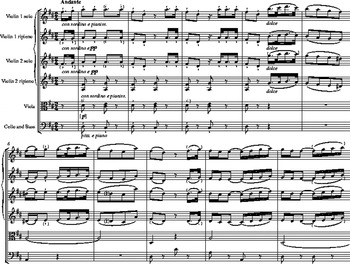
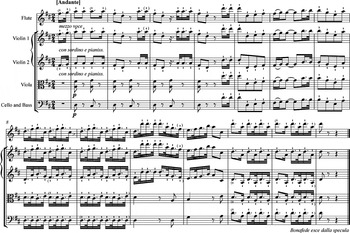
When Haydn took up Goldoni's text in 1777, however, he altered the telescope scene by adding instrumental numbers.Footnote 33 As Buonafede sees a young girl caressing an old man, the audience hears not Ecclitico's recitative, but rather the first of three intermezzos scored for muted violins (Example 2). Caryl Clark has aptly called these intermezzos ‘pantomimic’, for they seem matched, at least in part, to the gestures Buonafede sees.Footnote 34 The first and third (identical but for the key of E flat major and added bassoons of the latter) feature a lyrical second phrase suited to the caressing and beseeching actions of their respective lunar scenes (Example 2, bars 4–10).Footnote 35 The second intermezzo lacks this lyrical material, instead featuring dotted figures and unison passages that illustrate the violent beating in the second lunar scene (Example 3, bars 4–14). Though no evidence survives of how the scene was staged at Eszterháza, the pantomimic nature of the numbers suggests they were to accompany the figures seen moving inside the ‘moon’.
Haydn, Il mondo della luna, Act 1 Scene 3, Intermezzo No. 1, bars 1–10 (disseminated version) (Joseph Haydn Werke, series 25, volume 7/1, ed. Günther Thomas (Munich: Henle, 1979)). Used by permission

Haydn, Il mondo della luna, Act 1 Scene 3, Intermezzo No. 2

Haydn's intermezzos thus work to draw attention away from the total mise en scène, and to focus it instead on the ‘lunar world’. Fixation on the ‘moon’, indeed, seems to be the modus operandi of the first phrase of the intermezzos. All three begin with the same stilted and repetitive melody over a bass line tick-tocking between scale degrees one and seven. In its opening gesture, the phrase recalls the Adagio, ma semplicemente of Haydn's Symphony No. 55, composed three years previously (Example 4). Both employ the same melodic figure (a dotted stepwise ascent to  , which pitch is then repeated in quavers), supported by an accompaniment of downbeat quavers separated by rests. From here, however, the intermezzos take on a static and repetitive quality not found in the symphonic slow movement. Where the first four bars of the Adagio proceed from tonic to subdominant and close with a ii–V–I cadence, the intermezzos oscillate between I and V6; and where the symphonic melody falls into two halves, the first arching upward, the second proceeding downward, the intermezzo melody lacks larger shape and direction, instead reiterating the same three-note descending figure. Like the repeated opening gesture of Grétry's magic-picture trio, that heard at the outset of Haydn's intermezzos evokes the stasis of absorbed spectatorship.Footnote
36
Haydn, Symphony No. 55 in E flat major/ii, bars 1–8 (Joseph Haydn, 55. Symphonie für Orchester Hob. I:55. Kritische Ausgabe sämtlicher Symphonien, ed. Helmut Schulz (Vienna: Universal, 1951). © With kind permission by Universal Edition A. G., Wien/PH 755

That this is a special kind of absorbed spectatorship is suggested by the scoring of the intermezzos. Here too, comparison with the Adagio, ma semplicemente of Symphony No. 55 proves instructive. Whereas the symphony movement begins in two-voice texture, the intermezzo multiplies the number of voices through divisi scoring in the violins and double stops in the accompaniment. With these added voices reinforcing the upper partials of the symphonic scoring, it is as if previously unheard frequencies have become newly audible. The association between the enriched sonority of divisi scoring and the lunar world is confirmed in the Sinfonia to Act 2 of the opera, where it returns to establish the change in location from the Earth to the ‘moon’ (in reality, Ecclitico's garden) (Example 5).
Haydn, Il mondo della luna, Act 2, Sinfonia, bars 1–5

Only the telescopic intermezzos, however, combine scoring with violins con sordino. Paired with the telescope, the muted violins imply that the lunar sound, later heard directly on the ‘moon’, here is heard by means of sense-extending technology. In fact, the mutes play the same trick on listeners that the telescope plays on Buonafede: they make objects that are actually close seem far away. By focusing attention on the ‘moon’ and implying listening at a technologically mediated distance, the instrumental numbers put spectators in the same position as Buonafede: that of quietly peeping through the windows onto another world. With this alteration to Goldoni's telescope scene, Haydn replaces its critique of credulity with the pleasures and promises of mediated observation.
KEYBOARD IMPROVISATION AS SOUL MICROSCOPE
While opera possesses rich textual and scenographic dimensions with which to imply novel points of audition, instrumental music relies more heavily on listeners' expectations and interpretative frameworks. In general, the separation characteristic of mediated observation remained foreign to instrumental music in the eighteenth century. Even where theatrical models suggested the possibility of spectatorial exclusion in instrumental performance, late eighteenth-century theorists included listeners in the scene and circle of musical communication. Koch, for example, likened the concerto to ‘the tragedy of the ancients, where the actor expressed his feelings not towards the pit [that is, the audience], but to the chorus … Then the listener, without losing anything, is just the third person, who can take part in the passionate performance of the concerto player and the accompanying orchestra’.Footnote 37 Casting listeners as participants rather than spectators, Koch placed them in the shared social space of performance.
There was a type of instrumental music, however, associated with a different point of audition: the keyboard fantasy. Eighteenth-century theorists described fantasizing as the first stage of the compositional process – a stage devoted to the search for musical ideas, prior to the rational stages of elaboration and organization that yielded a coherent composition suitable for performance.Footnote 38 In the 1770s a convergence of keyboard fantasizing with theories of inspiration fuelled a special fascination with the activity, described as taking place in a dream-like state characterized by complete withdrawal from the surrounding world.Footnote 39 When in 1774 J. F. Unger invented a fantasy machine to capture the spontaneous products of inspiration automatically, he also described the ideal circumstances under which one would observe the fantasizing composer: ‘the effects of this extraordinary state are, however, neither to himself nor to anyone else to such advantage, as to whoever by accident has the luck to serve, unnoticed, as an observer’.Footnote 40
The advantage of the secret observer's position over even that of the composer himself owed much to the fact that the fantasizing composer could not be fully conscious of his music-making. As Unger explained, ‘many of the most powerful musical geniuses never handle their instrument more excitingly than when they gradually withdraw their mind [Seelenkräfte] from it completely, and concentrate on quite another object. However, they subside into something more dull as soon as their occupation once again becomes conscious.'Footnote 41 While the listener's unnoticed presence could confer the same advantages as the ‘fourth wall’, the keyboardist's mental absence from his own playing assured something more: that his music was pure inspiration, coming from beyond his conscious mind.
It was in the revelation of a beyond that Kant identified an analogy between keyboard fantasizing and magnifying instruments. When he took up the topic of ‘representations that we have without being conscious of them’ in his Anthropologie in pragmatischer Hinsicht (Anthropology from a Pragmatic Point of View) (published in 1798, based on lectures given as early as 1772), Kant acknowledged that the very notion of having internal representations (or ideas) without being conscious of them seemed contradictory, ‘for how could we know that we have them if we are not conscious of them?’.Footnote 42 In answer, he summoned magnifying instruments and keyboard fantasies as evidence for the existence of such representations. Telescopes and microscopes, Kant explained, work not by bringing new images to the eye but rather by spreading out images already on the retina ‘so that we become conscious of them’.Footnote 43 He continues:
Exactly the same holds for sensations of hearing, when a musician plays a fantasy on the organ with ten fingers and both feet and also speaks with someone standing next to him. In a few moments a host of ideas is awakened in his soul, each of which for its selection stands in need of a special judgment as to its appropriateness, since a single stroke of the finger not in accordance with the harmony would immediately be heard as discordant sound. And yet the whole turns out so well that the freely improvising musician often wishes that he would have preserved in written notation many parts of his happily performed piece, which he perhaps otherwise with all diligence and care could never hope to bring off so well.Footnote 44
Kant's elaborate description of the scene and the process of improvising, with its fortuitous musical results arising from decisions beyond the musician's conscious control, serves his point: that keyboard fantasizing is a mechanism for bringing representations – otherwise inaccessible and destined to remain in obscurity – to consciousness. Magnifying instruments provided the model for understanding keyboard fantasizing in these terms. Just as certain images on the retina required a magnifying instrument to make them visible to the mind, certain musical ideas in the soul required keyboard fantasizing to make them audible and bring them into (creative) focus.
In his story ‘Der Besuch im Irrenhause’ (The Visit to the Madhouse) Friedrich Rochlitz took further the implications of an analogy between magnifying instruments and keyboard fantasizing.Footnote 45 Published in 1804, the story appeared as a lead article in the Allgemeine musikalische Zeitung, of which Rochlitz was founding editor. Though fictional, the story fitted into an established genre of travel writing in which accounts of madhouses were commonplace.Footnote 46 A place for the sick in soul just as hospitals were for the ill in body, madhouses not only contained the insane but also put them on display, to potentially edifying effect. As Carl Friedrich Pockels explained in ‘Meine Beobachtungen im Cellischen Zucht- und Irrenhause’ (My Observations in the Prison and Madhouse of Celle) (1794), he sought ‘to arouse the attention of readers regarding certain manifestations of the human soul’.Footnote 47
The aim to observe the soul likewise motivates the narrator of Rochlitz's story to visit a madhouse. However, whereas madhouse visitors normally studied the outward appearance of inmate's bodies for manifestations of the soul within, Rochlitz's narrator wishes for a different method.Footnote 48 As he explains in the first paragraph of his account:
Die meisten Lebenden hatten für mich nur das Interesse, das die Todten für den Anatomen haben, und es schmerzte mich oft, dass man nicht einmal eine recht bedeutende Seele mit der Zanger fassen und unter das Mikroskop bringen könnte.Footnote 49
Most living people held for me exactly the interest that the dead have for an anatomist, and it often pained me that one could not just grab a truly significant soul with a pair of forceps and bring it under the microscope.
The desire to apply instruments of natural philosophy to the soul was something that Rochlitz's narrator shared with leading thinkers in the emerging discipline of psychology. As the physician Johann Gottlob Krüger wrote when he proposed to make an experimental study of the soul in 1756, ‘Experiment, one will say, can be done only with bodies. Is it being suggested that spirits be brought under the airpump, that their shapes be viewed under the microscope, that their forces can be weighed?’.Footnote 50 Krüger answered that it was wrong to assume that only those instruments found in the physical scientist's cabinet could be used in experiments with the soul. Krüger proposed as an alternative the clinical history, which maintained its importance as psychology developed over succeeding generations.
On his visit to the madhouse, Rochlitz's narrator discovers a tool more akin to the microscope for coming to know the ‘exterior and interior history of an excellent young man’: the keyboard fantasy.Footnote 51 Upon his arrival at the madhouse, the narrator hears unusual piano playing coming from another room. The pianist is Karl, a resident lunatic who seems to live entirely in music. When the narrator meets Karl, however, the improviser refuses to play for him. Unwilling to forgo hearing more of Karl's wild improvisations, the narrator pretends to leave the madhouse, then stations himself in the room adjacent to Karl's. The asylum warden – the narrator's partner in this deception – asks Karl innocently, ‘Now, will you give me anything to hear?’.Footnote 52 Believing the visitor gone, Karl resumes playing.
From the next room, behind a half-closed door, the narrator listens with rapt attention. He describes what he hears and its effects upon him: ‘As that quick section had strangely stimulated me and this slow one gently moved me, so was I deeply affected by the gradual reawakening of that wild inspiration and power which now gushed out in the most extraordinary Allegro, yet more impassioned.’Footnote 53 Becoming absorbed in Karl's fantasizing, the narrator forgets his surroundings and – without realizing what he is doing – moves into the doorway to Karl's room. The madman sits with his back to the doorway, but a mirror hangs over the piano. When Karl notices the narrator in the mirror, he immediately stops playing and flies into a rage.
Like Hooke at his microscope and Buonafede at the telescope, Rochlitz's narrator adopts the position of a secret observer peeping into another world; that Karl requires a mirror to look back at the narrator reinforces the way in which his point of audition is associated with optical technologies. Listening to Karl's improvising allows the narrator to observe not only exterior surfaces but also a living interior: in place of internal anatomical structures or private lunar affairs, he finds the unconscious workings of Karl's soul. By crossing the doorway, however, he becomes like the vivisectionist, throwing into disarray the object he would study. The event recalls too Zémire at the magic picture, who by approaching violated the conditions of access. In terms of the analogy with the microscope, it is as if the narrator tried to get a closer look by moving the instrument out of the way, with the result that Karl's soul once again became invisible.
As John Hamilton has pointed out, the narrator ultimately ‘confesses his incapacity to comprehend’ what he observes.Footnote 54 Mystified by Karl's practice of muttering while playing, the narrator concludes:
Ob es also nur ganz unwillkührliche Bewegung war, wie etwa das öftere, schnelle Blinken mit den Augen bey manchen andern heftigen Menschen im Affekt; oder ob seiner, dann erhitzten Phantasie Gestalten vorschwebten, zu denen er wirklich in einer neuen Sprache zu sprechen und verständlich zu sprechen glaubte; oder auch ob er durch das öftere Zusammendenken von ‘Sprache’ und ‘Musik’ – (z. B. Musik, Sprache des Herzens, ohne Worte u. dgl.) beydes, wenn er entzündet wurde, erst im Begriff, hernach in der Ausführung vermischte, oder wie es sonst damit war: das weiss ich nicht.Footnote 55
Whether his movement was entirely arbitrary, for example, like the rapid blinking of the eyes often observed in other impetuously emotional persons, or whether shapes of his then-heated fantasy hovered before him, to whom he believed he was really speaking in a private language and speaking understandably, whether by confusing ‘language’ and ‘music’ – (e. g. ‘music’, ‘language of the heart’, ‘without words’ and the like), he mixed both up whenever he was inflamed, first conceptually and thereafter in execution; or what it otherwise meant: I do not know.
The narrator's profusion of interpretations, still not exhausting the possibilities, makes plain his inability to make sense of Karl's fantasizing. For listeners expecting a musical performance to address to them familiar ideas or emotions, such incomprehension would be a problem – a mark of failure on the part of composer and/or performer. From the narrator's point of audition, however, unfamiliarity and incomprehensibility are legitimate qualities for the musical performance to possess. The model of the microscope provides an alternative to the imitation of familiar phenomena and the expression of conscious feelings, figuring music instead as revealing the hitherto unknown. As the narrator marvels at what he cannot understand, the framework of mediation authenticates his access to phenomena beyond the unaided reach of senses and mind.
LISTENING TO BEETHOVEN
Annette Richards has suggested that the lunatic Karl ‘mirrors and prefigures Beethoven … the great improviser, musical solitary, and constant scribbler whose own indulgence in musical fantasy, already the topic of some debate, was to provoke heated reaction with the appearance of the Eroica Symphony in [the] same year’ as Rochlitz's story.Footnote 56 Rochlitz's narrator also prefigures Beethoven's listeners. Following Beethoven's withdrawal from public performance owing to hearing loss, the pianist-composer became the object of eavesdropping stories.Footnote 57 The first of these appeared in the 1820s, when John Russell reported that Beethoven's ‘horror of being any thing like exhibited’ meant that hearing him play required a charade much like that in ‘The Visit to the Madhouse’. On the social evening Russell described, would-be listeners left the room where only Beethoven and an intimate acquaintance remained; by playing one of Beethoven's pieces with many errors, the acquaintance lured Beethoven's hands to the keyboard, at which point the composer could not resist beginning to play; as the composer ‘ran on during half an hour in a phantasy’, those assembled in the next room watched and listened, ‘enraptured’.Footnote 58 In the numerous reminiscences published after Beethoven's death, stories of secretly listening to Beethoven from an adjacent room multiplied, often with reference to the composer's aversion to listeners.Footnote 59
Those who knew Beethoven in his earlier years, however, told a different kind of story. They described a young pianist who demanded quiet attention during his salon performances, and refused to play when he did not get it. Citing an account of Beethoven halting mid-piece in 1802 when silence could not be secured (and declaring, ‘I will not play for such swine!’), Tia de Nora has credited Beethoven with being ‘one of the first musicians to campaign consciously for a reform of the conditions of musical reception in Vienna’, his actions communicating that ‘ritualistically solemn devotion to the performance was the appropriate form of audience conduct’.Footnote 60 The offending party in this particular story was a count sitting in the doorway to the next room – the same liminal position, neither inside a social circle nor outside the performer's radius of awareness, from which Rochlitz's narrator upset Karl.
Like the pilgrimages to Beethoven examined by K. M. Knittel, tales of listening to Beethoven tell us less about ‘the composer per se’ than about his admirers, and the positions they were prepared to adopt.Footnote 61 The salon and eavesdropping scenarios offer similar lessons in how to conduct oneself when listening to Beethoven: whether an admitted auditor or a secret observer, one should remain silent and still so as not to disturb the performer. Yet the two story types also register a shift in listeners' adopted points of audition – a remapping of listening space. Where once one listened to Beethoven within a shared social circle, outside of which one turned one's attention elsewhere, by the 1820s being outside, listening in, was a desirable position. Listening to Beethoven, in other words, acquired the form of mediated observation, with its characteristic separation and special access to the otherwise unknown.
Stories of eavesdropping from the next room describe a position available to listeners of Beethoven's works as a virtual point of audition. We might then ask whether Beethoven's works encourage us to imagine such a virtual point of audition. In Beethoven's late string quartets, modern commentators have sensed a quality of ‘inwardness’ – of esotericism and self-absorption – that denies listeners' presence, and thus turns audience members into eavesdroppers.Footnote 62 Beethoven's contemporaries, however, might have discovered the conditions of eavesdropping – as well as those of sensory extension – in keyboard fantasizing and muted tone. Both topoi are found in the Adagio un poco mosso of Beethoven's Fifth Piano Concerto, Op. 73, which coordinates them so as to suggest listening in to realms beyond normal hearing. Dating from his withdrawal from public performance, this movement may have served to teach concert-goers how to listen to Beethoven's music, even in the composer's absence.
Beethoven composed his Fifth Piano Concerto in 1809, seeing it to publication by Breitkopf & Härtel in February 1811. The last of his completed piano concertos, it was the only one that he did not himself premiere. It was additionally the only concerto Beethoven published with a fully notated solo part, the note ‘non si fa una Cadenza, ma s'attacca subito il seguente’ in the first movement anticipating and pre-empting the soloist's desire to add a cadenza.Footnote 63 While Leon Plantinga suggests the shift from a contingent to a fixed text was ‘a natural result of publication’ that simply came to the concerto later than to other genres in which Beethoven worked, Stephen Rumph has identified the work as part of ‘a campaign in defense of serious musical culture’, reflecting Beethoven's concern to protect the integrity of the musical work from the insertion of merely exhibitionist displays by virtuosos.Footnote 64 Both recognize the Fifth Piano Concerto as novel within the genre for being a fully realized musical conception, impervious to the specifics of where, when or by whom it might be performed – a design that may speak to Beethoven's realization that he would never himself perform the concerto.
The Fifth Piano Concerto also enjoys special status as a consummate realization of Beethoven's heroic style. Though its ‘Emperor’ nickname is specious, its composition in 1809 – the year Napoleon invaded Vienna – has lent a biographical lens through which to read its military topoi. The enlarged orchestral forces and powerful individuality of the soloist – asserted from the outset by tutti chords setting off cadenza-like displays by the pianist – also support the work's status as a concerto of unprecedentedly heroic proportions and dynamism.Footnote 65
Lacking military topoi and heroic features, the slow movement of the concerto has been considered subordinate to the outer movements, and received substantially less attention. William Kinderman calls it ‘an immense parenthesis’ in the overall design of the concerto, while Plantinga characterizes it as a ‘great unhurried introduction to the finale’.Footnote 66 Discussing changes in the piano concerto from Mozart to Beethoven, Simon Keefe demonstrates an increasing emphasis on brilliance and grandeur in first movements, while only mentioning a concomitant trend towards ‘a more general atmosphere of intimacy’ in slow movements.Footnote 67 The slow movement of the Fifth Piano Concerto indeed sustains a special atmosphere in ways its predecessors do not, but to call that atmosphere one of intimacy is to miss the production of distance and exclusion in which the movement engages, and which suggests not the mutual recognition of intimacy but the unidirectional access of mediated observation.
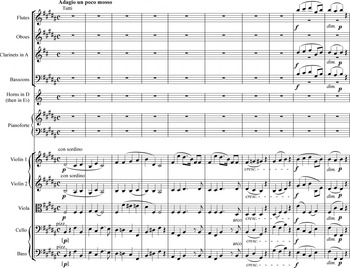
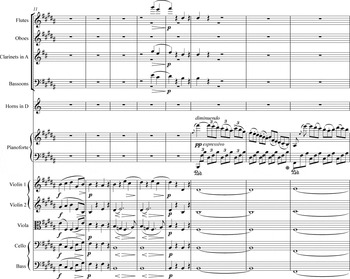
In its opening bars (Example 6), the Adagio un poco mosso seems little different from Beethoven's previous concerto slow movements. Like those of the first three piano concertos, the Triple Concerto and the Violin Concerto, it begins softly with a conjunct melody, richly harmonized in homophonic texture. As in the Third Piano Concerto (1803) and the Triple Concerto (1804), Beethoven combined this dynamic level and melodic style with change to a remote key and reverberant or muted tone – effects that scholars commonly equate with transport to another world or the evocation of a higher reality.Footnote 68 In the Largo of the Third Piano Concerto (in E major, raised mediant of the concerto's C minor key) the piano soloist plays the main theme with dampers raised before handing it off to the orchestra, which restates the theme on muted violins and flutes over an arpeggiated accompaniment. The Largo from the Triple Concerto (in A flat major, flat submediant of the concerto's C major key) begins with string orchestra; the muted violins introduce a melodic fragment that the cello soloist then takes up and weaves into an expansive cantabile melody, harmonized by the muted violins and low strings.
Beethoven, Piano Concerto No. 5 in E flat major/ii, bars 1–10 (Beethoven, Klavierkonzert Nr. 5: Es-dur, Opus 73, ed. Hans-Werner Küthen (Munich: Henle, 1999)). Used by permission

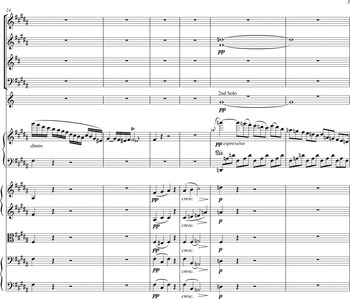
With a hymn-like theme presented by muted violins in the key of B major (flat submediant of the concerto's E flat major key), the Adagio un poco mosso draws from the same fund of expressive gestures and effects as these earlier slow movements. Its novel conception emerges, however, with the entrance of the piano soloist (Example 7). Beginning with an octave leap up to f♯3, the soloist immediately surpasses the range of the opening theme, abandoning its hymn-like melody for a distinctly pianistic gesture. The orchestra does not prepare this entrance with the typical dominant harmony. Instead, the last three bars of the orchestral introduction sit on the tonic, extending its duration through repeated figures in the upper strings and winds (Example 7, bars 13–15). After the soloist's grace-note pickup to bar 16, the strings repeat and sustain their previous chord, as if frozen in place by the pianist's appearance. That the piano solo enters when it does seems less a response to the orchestra than a fortuitous accident.
Beethoven, Piano Concerto No. 5 in E flat major/ii, bars 11–29

continued

continued

Ignoring the theme introduced by the orchestra, the pianist proceeds with independent material. The slow movement of Beethoven's Fourth Piano Concerto (1808) provides a precedent for such thematic independence between orchestra and soloist. In that movement, however, the contrast in musical ideas and emotional character heightens the sense of dialogue between orchestra and soloist. The alternation between forte unisono strings and languishing molto cantabile material played by the piano – the former gradually softening over the course of the movement – have earned the Andante con moto its comparisons to Orpheus swaying the furies.Footnote 69 Here, by contrast, the soloist adopts an improvisatory style, the right hand alternately soaring across the keyboard and building melodic sequences over the left hand's constant triplet arpeggiation. The strings neither wait silently for their turn to reply nor actively participate in the pianist's expression, but rather provide an accompaniment of sustained chords that could be played in spontaneous reaction to the pianist's slow-changing harmonies (an effect heightened in performance if the orchestra lags slightly behind the pianist in its chord changes).
When the soloist first comes to rest in bar 26, the strings recall bars 7–8 of the opening theme, but the pianist again takes no notice, entering in bar 28 with the same figuration as earlier, now a third higher. In Beethoven's other concerto slow movements, the interaction between individual soloist and collective orchestra positions the two parties on a shared stage, and the listener – as Koch wrote – as ‘the third person, who can take part in the passionate performance’. In the slow movement of the Fifth Piano Concerto, by contrast, the soloist gives the impression of being oblivious to the orchestra, and likewise to the presence of an audience – of believing himself alone.
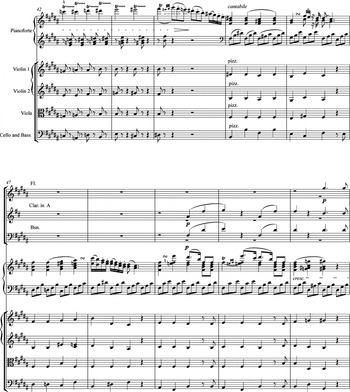
The soloist's apparent obliviousness to his surroundings, combined with the improvisatory style of his lines, suggests inspired fantasizing. After a passage of trills, the fantasizing results in the discovery of the theme initially sounded by the orchestra (Example 8). We might identify at this moment a shift from eavesdropping to mutual recognition between soloist, orchestra and listeners. Or the discovery can be heard to suggest, retrospectively, that listeners have been privy to the original source of the fantasizer's new-found idea. Beethoven's student Carl Czerny gave this source a worldly origin with the claim, ‘when Beethoven wrote this Adagio, the religious songs of devout pilgrims were present to his mind’.Footnote 70 Given the process of keyboard fantasizing that the movement establishes, however, the source may also be assigned an otherworldly origin. Here, the muted tone of the violins plays a crucial role, lending the impression that the theme sounded in the orchestral introduction issues from a distance beyond the pianist's normal perception – from the heavens above or the unknown depths of the soul.
Beethoven, Piano Concerto No. 5 in E flat major/ii, bars 42–51

The piano pedals, meanwhile, contribute to the sense of distance between listeners and pianist. The pianist's entrance in bar 16 is marked pianissimo and with dampers lifted, the pedal to be changed two bars later with the change of harmony. Czerny instructed that throughout the movement the shifting (una corda) pedal should also be used in passages marked pianissimo.Footnote 71 The resulting hushed and reverberant tone makes it seem as if one hears the piano not from within a shared space, but rather from somewhere apart. The sustained string accompaniment – with its muted violin tone – adds the need to listen through something in order to perceive the piano's sound. These factors help imply a point of audition made possible by mediation: a position of separation as well as access, from which to observe phenomena that acquire significance from the fact that they exist beyond the reach of the unaided senses.
For the concerto listener, the position of mediated observation proves to be the one from which to witness Beethoven's creative process. As James Webster has written with respect to Haydn's keyboard music, improvisatory passages in fixed compositions ‘blur the usual distinction between the composer of the work, and the persona (or musical “subject”) in the work’, introducing a ‘kind of slippage between composer, persona, and performer’.Footnote 72 In Beethoven's Adagio un poco mosso, the improvisatory style encourages a conflation of listening to a performance of Beethoven's composition with listening to Beethoven in the act of spontaneous music-making – a conflation that, with Beethoven no longer at the piano, could be obtained only as a carefully composed effect.
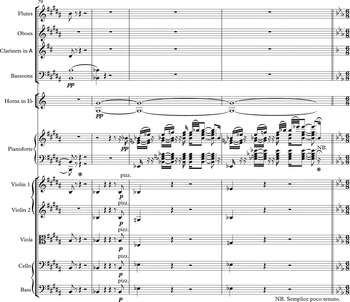
This point of audition is maintained until the moment the finale begins. In place of the silence that would have occasioned applause and audience acknowledgment, Beethoven composed a transition to the third movement (see Example 9). After the piano dies away through an arpeggiated passage on B major, the orchestra descends a semitone to B♭. Having exited the B major region of the slow movement, the soloist hits upon a new idea: an ascending arpeggio in two-note groupings. He sounds this idea pianissimo, damper pedal raised, then suddenly launches into the finale by restating the figure, fortissimo and Allegro, as the theme of the rondo-form movement. Set off as it is from the preceding material of the movement, the transition positions listeners as witnesses not so much to a process of discovery as to a moment in which the third movement seems to come to the pianist – to have come to Beethoven – fully formed.
Beethoven, Piano Concerto No. 5 in E flat major/ii, bar 79–iii, bar 7

continued

With its sudden sonic fullness, the finale brings with it a changed point of audition: the implied listener is no longer a secret observer of realms beyond but rather a member of the public being addressed by the composer and the performers interpreting his work. After the immobilization, separation and rapt attention of mediated observation, the rhythmic vitality and dance-like gestures of the rondo theme invite a return to the body in its shared social space. Or, having practised mediated observation and glimpsed the otherworldly origin of the third movement, one might continue to listen in a state of absorption, despite such cues to conviviality. Where Grétry's magic-picture trio modelled spectatorship for the bourgeois theatre, Beethoven's Adagio un poco mosso taught listeners how to listen to the modern concert.
THE POINT OF AUDITION OF EARLY ROMANTICISM
Oh, wenn wir doch Teleskope erfinden könnten, um in das tiefe Firmament unsrer Seele zu schauen …
Oh, if only we could invent telescopes to look into the deep firmament of our soul …
Ludwig Tieck, William Lovell (1795)Footnote 73Adapting Michel Foucault's notion of the archive, John Tresch has suggested that we call our senses and their technological enhancements ‘the physiological and technological a priori, which enable certain modes of conceptualization and exclude others, setting the conditions of possibility for specific perceptual experiences’.Footnote 74 It is in these terms that we may understand the significance of sensory extensions for musical culture at the turn of the nineteenth century. Analogies between visual and auditory extensions in opera and literature reflect the more general status of magnifying instruments as conditions of possibility for specific musical experiences in the period. The effects of magnifying instruments can be found not only in the trope of eavesdropping on keyboard fantasizing, but also in the characteristic orientation of early romantic listening. As Mary Hunter has written, much of the discourse about listening from the 1790s to the 1810s ‘seems quite spectacularly to occlude the presence of the performer’, and instead to understand sounds as ‘emanations from the spirit world’ or as the basis for spiritual communion ‘between the soul of the composer and that of the listener’.Footnote 75 These two possible sources of music were often conflated, as in Jean Paul's encomium ‘Oh, Music! Reverberation from a more distant harmonious world! Sigh of the angel within us!’ (‘O Musik! Nachklang aus einer entlegnen harmonischen Welt! Seufzer des Engels in uns!’).Footnote 76 Falling outside Koch's typology of art for the unaided senses, the early romantic conception of listening followed the paths of magnifying instruments to other worlds: at a distance and into an interior.
In this light, we may consider again the role of technology in the emergence of musical romanticism. Prevailing wisdom maintains that when – thanks to philosophical, literary and religious discourses – early Romantics conceived of music as otherworldly, performers, instruments, indeed any materials involved in bringing music into the world, were ‘demoted’ to the status of ‘mere vessels’, and even appeared as hindrances to the comprehension of musical works.Footnote 77 In this journal, by contrast, Emily Dolan has argued that the invention of ‘ethereal’ musical instruments contributed crucially to early Romantics' ability to hear musical notes as connected to a distant spirit world.Footnote 78 Magnifying instruments constitute another facet of eighteenth-century material culture that fuelled practical engagement with otherworldly music. Once magnifying instruments gained popular acceptance as tools of knowledge rather than of deception, they became models for thinking about how musical inspiration works, and for how one might approach musical listening. Haydn's telescope scene – with its machine turned into a lunar world when viewed through the optical instrument – may thus stand for a broader historical development: man-made music became otherworldly when listening experiences were appropriately mediated – by both discursive contexts and material technologies.