Although the Scientific and Industrial Revolutions stand as decisive transformations in western society, efforts to link the two run into immediate difficulty.Footnote 1 How could the insights of a few hundred university-educated natural philosophers corresponding with each other in Latin on topics in mathematics, physics, and astronomy have been transmitted to industrial artisans and entrepreneurs whose educational level was often rudimentary at best?
The first response is to deny that any connection between the two revolutions existed or even mattered; see, for example, Mathias (Reference Mathias1972), Hall (Reference Hall and McKendrick1974), and Clark (Reference Clark2012). This skepticism is most systematically developed by Allen (Reference Allen2009, pp. 238–71), who analyses the backgrounds of the major inventors of the Industrial Revolution and shows that most were “active, stirring, and laborious men” with few connections to Enlightenment learning. The second, taken by Mokyr (Reference Mokyr2011, Reference Mokyr2016) and Jacob (Reference Jacob1997), is to stress the diffusion of an Enlightenment culture of improvement and empiricism through popular science demonstrators, coffee shop lecturers, and scientific societies.
What neither side questions, however, is that savants and fabricants formed distinct groups of people. In reality, natural philosophers and artisans merged together through a large and important, if often little known, group known to contemporaries as mathematical practitioners.
The radical economic and political changes experienced by sixteenth-century Europe—changes driven by overseas trade and conquest, agricultural improvement, commercial expansion, and gunpowder warfare—created a growing demand for trained navigators, gunners, surveyors, bookkeepers, military engineers, cartographers, and others: all with skills in taking measurements and making calculations. In response, there appeared: teachers offering lessons in practical arithmetic and geometry; authors writing applied mathematics textbooks in the vernacular; and instrument makers producing tools for navigation, surveying, and other applications. Very often, one person combines several of these activities.
The purpose of this paper is to demonstrate how these mathematical practitioners contributed to European progress in two important ways. First, there is the direct contribution of practical mathematics in causing useful numerical skills—such as decimals in arithmetic, logarithms in navigation, and triangulation in surveying—and the instruments associated with them to diffuse rapidly into everyday use during the seventeenth century.
On top of increased numerical skills across a wide variety of activities, practical mathematics generated a second economic contribution indirectly, through spillovers of skills and technology to other sectors. Watch and instrument makers played a major role in developing the new textile and steam technology of the 1780s, while precision measurement technology developed in navigation and astronomy underlay the machine tools developed in the 1820s to mass produce this machinery.
The technology of the late eighteenth century is often dismissed as having been fairly rudimentary (which raises the question of why it was not invented a good deal earlier). In fact, the two emblematic machines of early industrialization—Arkwright’s spinning frame, with its intricately meshing train of gears, spindles, and rollers, and Watt’s steam engine, with its elaborate valve gear—were unusually complex technologies by the standards of the time. Much of Britain’s success in developing these innovations from interesting concepts into successful industrial products rested on the expertise and versatility of its uniquely large preexisting supply of ordinary instrument makers trained to make tools for navigation and surveying, as well as artisans in the closely related field of watchmaking.Footnote 2 Empirically, Kelly, Mokyr, and Ó Gráda (2023) find that much of the variation in textile employment across the 41 counties of England in 1831 can be explained by their supply of mechanically skilled craftsmen in the late eighteenth century, and this in turn is correlated with the cost of acquiring such skills (measured by the cost of becoming a watch-making apprentice, which serves as a measure of the extent of skilled manufacture) in the county in the mid-eighteenth century.
The next fundamental, albeit little known, transformation of manufacturing occurred when precision measurement entered the workshop in the form of machine tools: machinery designed to cut and shape metal parts to an “almost mathematical exactitude and precision,” in the words of the pioneering builder James Nasmyth (Musson Reference Musson1975).
Contrary to the influential claims of H. J. Habakkuk (Reference Habakkuk1962)—who made machine tools almost synonymous with the “American System of Manufactures” that arose in the 1840s—nearly every important type of machine tool was developed by British engineers in the period from 1820 to 1840, largely to allow the large-scale production of interchangeable parts for textile machinery. It is worth recalling the sheer size of the British cotton industry—where 150,000 power looms already lined factories in the late 1830s and 300,000 a decade later—to appreciate the scale of the demand for precisely cut iron components and to understand why Britain’s machine tool industry was centered on Manchester.
Machine tools were indeed employed on a large scale in the United States, but for mass production in light manufacturing such as woodworking, hardware, and small arms. Habakkuk emphasized how much this machinery impressed Britain’s leading engineer Joseph Whitworth on his visit in 1852, but neglected to add Whitworth’s conclusion that compared with their own “engine tools,” American tools were “similar to those in use in England some years ago, being much lighter than those now in use, and turning out less work in consequence” and that the Americans “are not equal to us in the working of iron” (Musson Reference Musson1975, p. 129, citing British Parliamentary Papers 1854, vol. xviii, Q. 2043).
Machine tools could be no more accurate than the measuring gauges and adjustment screws used to set them, but these vital components had been developed in astronomy since the sixteenth century. Between then and the early nineteenth century, the accuracy of astronomical measurement steadily increased by a factor of 10,000. We show how this technology came to be incorporated into the new precision manufacturing of the 1820s.
Besides highlighting the direct contribution of practical mathematics to the diffusion of useful numerical skills and its spillovers to early machinery and then to the machine tools needed to build them, our analysis gives some insight into other facets of the Industrial Revolution. For some time, the dominant approach to the Industrial Revolution has been Allen’s (2009) factor substitution approach (deriving from Habakkuk (Reference Habakkuk1962)), where new machinery was supposedly adopted to replace expensive labor. This is problematic because, after adjusting for productivity, unskilled English workers were no more expensive than French ones, and skilled English artisans were considerably cheaper (Kelly, Mokyr, and Ó Gráda Reference Kelly, Mokyr and Ó Gráda2014); while within England high wage southern counties failed to adopt new machinery, and deindustrialized while low wage northern ones industrialized (Kelly, Mokyr, and Ó Gráda 2023).
Our approach here returns to an earlier view of the Industrial Revolution, stressed by contemporaries, that Britain’s success rested on its abundant supply of skilled metal workers, ranging from instrument makers and gunsmiths to iron founders and furnace men, whose skills could be transferred to developing the new machinery and industrial processes of the late eighteenth century.Footnote 3
In terms of the existing literature on the origins of the Industrial Revolution, our starting point is to reconcile the studies of Mokyr (Reference Mokyr2011, Reference Mokyr2016) and Jacob (Reference Jacob1997) that emphasize the diffusion of Enlightenment culture of improvement and empiricism with the contribution of ordinary artisan skill emphasized by Allen (Reference Allen2009, pp. 204–6), Berg and Hudson (Reference Berg and Hudson1992), Hilaire-Pérez (Reference Hilaire-Pérez2007), and Kelly, Mokyr, and Ó Gráda (2023). Musson and Robinson (Reference Musson and Robinson1969, pp. 427–58) first showed the importance of a large supply of instrument makers and watchmakers for the development of cotton spinning in the late eighteenth century. However, the revolutionary development of machine tools in Britain in the 1820s and 1830s has received little attention in economic history outside the neglected study of Musson (Reference Musson1975).
The study of early English applied mathematicians and instrument makers was pioneered by Taylor (Reference Taylor1954). The role of ordinary artisans of the late sixteenth century with their culture of empirical experiment, use of geometry, and disdain for academic authority as sources of the Scientific Revolution was first argued by Zilsel (Reference Zilsel1941, Reference Zilsel1942) and Rossi (Reference Rossi1970) (and has been noted in the economic history literature by Mokyr (Reference Mokyr2016, pp. 136–38)); and more recently by Bennett (Reference Bennett1986) among others: see Cormack (Reference Cormack, Lesley, Steven and John2017) for a recent overview.
The rest of the paper is as follows. In the next section, we describe the origins of practical mathematics and its direct economic contributions through increased numeracy and improvements in astronomy, navigation, and surveying. The following two sections outline its indirect contribution, by creating a pool of artisans whose skills could be applied to developing early textile and steam technology; and a precision measuring technology that facilitated the subsequent development of machine tools. The fourth section examines the supply of mechanical skills in England, while the fifth and sixth sections discuss the role of European states in driving advances in navigation and astronomy and the unusual status of highly skilled artisans in Britain.
MATHEMATICAL PRACTITIONERS AND INSTRUMENT MAKERS
Before analyzing its spillovers into later industrialization, we begin with the direct economic contributions of practical mathematics in generating useful numeracy across a wide range of activities. The economic and political transformation of Europe in the sixteenth and seventeenth centuries—with gunpowder warfare, maritime trade, territorial expansion, land enclosure, and agricultural intensification—created a substantial market for practical expertise in navigation, surveying, gunnery, cartography, and other fields, which usually came down to being able to use instruments to measure angles and then to make calculations with these numbers. To provide the necessary training, there appeared a large group of individuals of varying backgrounds making their living as applied mathematicians, teachers, and instrument makers: the so-called mathematical practitioners. While some practitioners offered lessons in subjects ranging from commercial arithmetic and bookkeeping to navigational trigonometry and logarithms, others published textbooks in the vernacular that often included lengthy sections explaining how to use the relevant instruments, as well as where they could be purchased. Some teachers and authors, however, designed, and sometimes also made and sold, instruments for measurement and calculation. Notable early centers of such mathematical practice were Augsburg, with its tradition of exact metal work and engraving, the large port of Antwerp and nearby Louvain, and, from the late sixteenth century, London.
We should introduce some terminology. Before the nineteenth century, the word Science in its modern usage did not really exist, being usually known instead as Natural Philosophy, nor, by extension, did the term scientific instrument.Footnote 4 There were instead three sorts of instruments: philosophical (air pumps, barometers, electric machines), optical (telescopes and microscopes), and, our concern here, mathematical. Mathematical instruments were designed to measure angles for applications in astronomy, navigation, surveying, and so on (alongside calculation instruments like slide rules), and we will usually refer to them, as most of our contemporaries did, simply as instruments.
During the sixteenth and early seventeenth centuries, simple, practical instruments advanced rapidly. For navigators there appeared astrolabes, backstaffs, variational compasses, and nocturnals (for telling time at night); while surveyors replaced ropes and poles with theodolites, sighting compasses, plane tables, and measuring chains; and adopted the technique of measuring distance by triangulation, devised by the mathematician Gemma Frisius in 1533. The new calculating instruments of the early seventeenth century included Napier’s Bones for arithmetic and Gunter’s Rule for navigational trigonometry.
After Napier conceived the idea of logarithms in 1617, within months they had been turned into fairly accurate tables in their familiar base 10 form by Henry Briggs, the Professor of Mathematics at Gresham College in London. His colleague Edmund Gunter incorporated these into his Rule, which had trigonometric values marked on one side and their logarithms on the other, so that navigators could carry out calculations simply by adding or subtracting lengths stepped out with a divider (it was still used by the Royal Navy until the 1840s), while general calculations could be carried out on Oughtred’s slide rule. Another important transfer from mathematical theory to everyday calculation was the replacement of fractions with decimals, advocated by Simon Stevin among others, and applied notably in Gunter’s Chain (a standard surveying tool until the mid-twentieth century), where each yard, indicated by a brass link, was separated by nine iron links.
The Lutheran Reformation drove a rapid growth of one mathematically based form of useful knowledge to which Catholicism was increasingly antagonistic: astrology (Westman Reference Westman2011, pp. 141–70; Barnes Reference Barnes2016, pp. 139–71). Apart from the usually illegal activity of forecasting political events such as the overthrow of kings, astrology gave farmers weather forecasts and, most importantly, allowed doctors to choose the appropriate treatment for individual patients; early mathematicians such as Girolamo Cardano were commonly also physicians. The advances of Tycho Brahe and Johannes Kepler were motivated in part by their active careers as astrologers; and the central role of mathematics in Philip Melanchthon’s fundamental reforms at the University of Wittenberg, which were the foundation for Lutheran Germany’s unmatched university system, stemmed from a perceived need to improve the level of astrological practice. Rutkin (Reference Rutkin, Park and Daston2006, p. 553) sees the Jesuit counterattack, driven by Europe’s leading author of advanced mathematics textbooks, Peter Clavius, as an important factor driving astronomy to separate from astrology.
For many in England, mathematics continued to be “smutted with the Black Arts” of astrology (some parents supposedly forbade their sons to attend Oxford after it established its first Professorship of Geometry in 1619: Taylor Reference Taylor1954, p. 4). In reaction, the first English practitioners were at pains to stress the practical usefulness of their subject, both to individuals and the state (Neal Reference Neal1999), while at the same time disparaging the learning of university scholars “beeyng in their studies amongest their bookes” in favor of the sort of knowledge earned by practical experience and “exact triall and perfect experimentes” (Bennett Reference Bennett, Park and Daston2006, p. 688; Bennett Reference Bennett1986, p. 13).Footnote 5
Among these practitioners, supposed boundaries between desks and workbenches, hand work and brain work, knowledge and know-how, become so blurred as no longer to be useful: in the words of the mathematician-astrologer John Dee “A speculative Mechanicien… differeth nothynge from a Mechanicall Mathematicien” (Bennett Reference Bennett, Park and Daston2006, p. 674). Instead, the practitioners of the sixteenth and seventeenth centuries spanned a continuous spectrum that ranged from anonymous artisans and schoolmasters to figures now usually classified as scientists and mathematicians, but whom their contemporaries saw equally as teachers, instrument makers, and engineers. Such practitioners include Georg Rheticus, Johannes Stoefler, Jost Burgi, Johannes Regiomintanus, Peter Apian, Gemma Frisius, Gerard Mercator, and, most notably, Simon Stevin and Galileo Galilei.
Besides making fundamental contributions to hydrostatics, mechanics, mathematics, and astronomy, Stevin was employed as quartermaster by the Netherlands army, and published on practical topics including bookkeeping, fortification, applied navigation, and drainage, alongside popularizing the use of decimals (Dijksterhuis Reference Dijksterhuis1970). Galileo, as Valleriani’s (2010) pioneering study Galileo Engineer describes, for much of his life earned a considerable share of his income teaching military engineering and manufacturing instruments: first a “geometric and military compass” for performing calculations and setting the elevation of artillery, and then optical instruments. Much of Galileo’s theoretical work, moreover, was informed by his practical activities, notably his theory of the strength of beams that grew out of earlier consultancy on the performance of Venetian galleys.Footnote 6 Indeed, there is very little in the biographies of iconic eighteenth-century engineers like Watt or Smeaton—at first supporting themselves by making and selling scientific instruments and surveying canals and harbors, followed by increasing fame as inventors and engineers—that would have seemed unusual in the early seventeenth century. Even as mathematical practice had begun to separate between artisans and academics in the late seventeenth century, leading mathematicians had not lost sight of practical utility: for Isaac Newton (Reference Newton2008, p. 291) geometry “was devised, not for the purposes of bare speculation, but for workaday use,” which meant that its techniques should be such that “any practitioner should find them readily applicable in his measuring.”
Applied Mathematics Texts
An idea of the growth of practical mathematics in Britain at this time can be derived from the number of mathematics books published in English (as opposed to the Latin used by scholars in communicating with each other). These textbooks were largely aimed at a broad market, unlike the elaborately illustrated Books of Machines of Agricola, Biringuccio, and others discussed by Rossi (Reference Rossi1970, pp. 42–62).
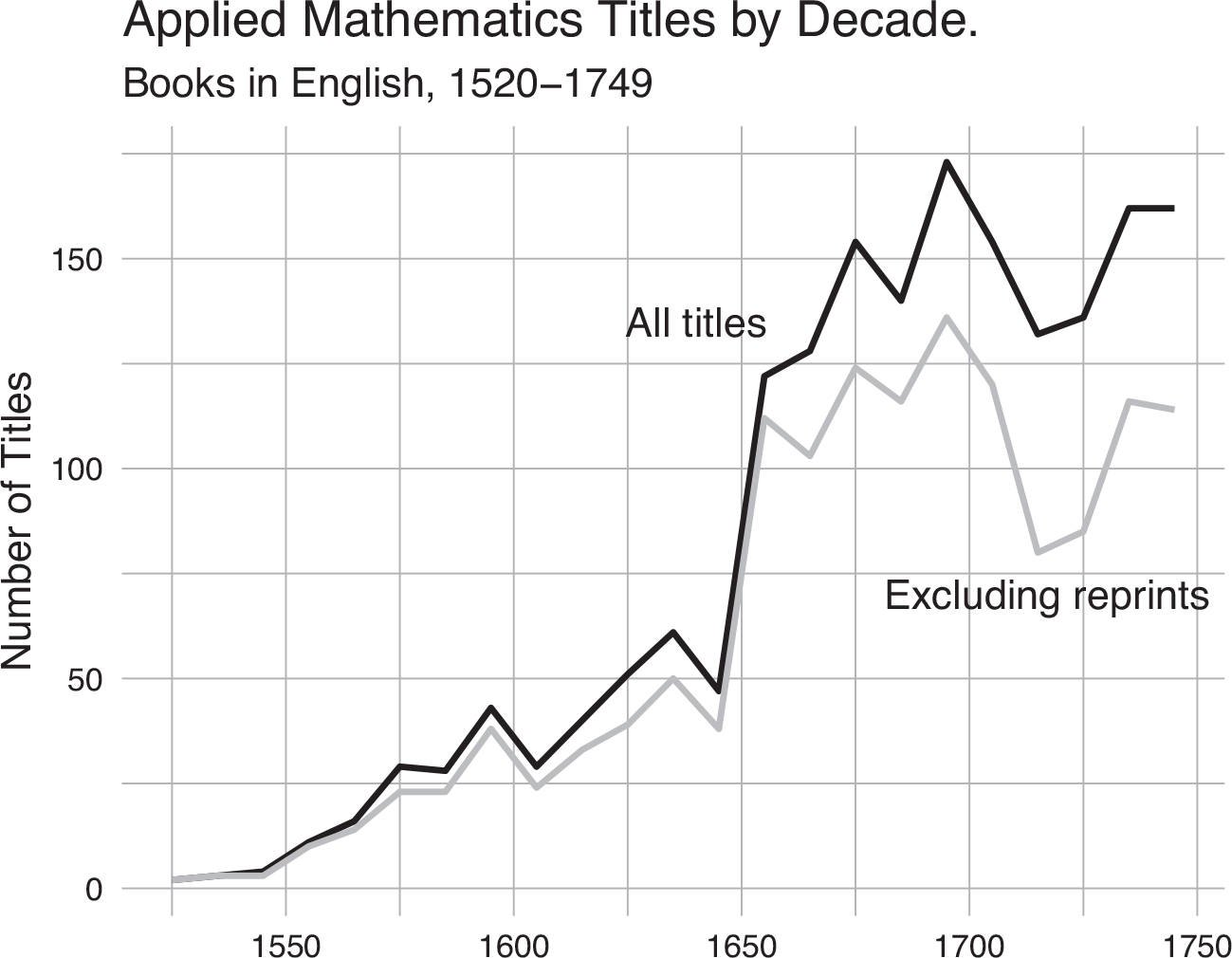
Figure 1 gives the number of applied mathematics books published each decade between the 1520s and the 1740s, taken from titles that are listed in the British Library English Short Title Catalogue Footnote 7 under the subject headings arithmetic (460), astronomical instruments (49), bookkeeping (108), compasses (30), geometry (186), gunnery (58), logarithms (99), mathematics (407), mathematical instruments (93), measuring (155), navigation (538 excluding government publications), shipbuilding (57), surveying (126), and trigonometry (100). After eliminating double counting of books listed in several categories, this gave 1,827 titles, and 1,406 when reprinted editions are removed. As Figure 1 indicates, the number of books on applied mathematics published rose sharply and almost continually, from hardly any in the mid-sixteenth century to over 100 new titles per decade a century later, not counting reprints of titles that had proven popular.Footnote 8
NUMBER OF TITLES IN APPLIED MATHEMATICS PUBLISHED IN ENGLISH BY DECADE, 1520–1749
Source: English Short Title Catalogue.

The more than doubling of titles published during the 1650s does not appear to be the result of any change in the functioning of the publishing industry, which remained under tight state control until the end of the seventeenth century when libel laws took over,Footnote 9 and may reflect a sudden rise in demand. New navigational and surveying techniques and instruments have become mature technologies in widespread use. To put the rapid growth of mathematical titles into perspective, Buringh and van Zanden (2009, table 2) estimate that the number of books printed in England grew only about thirty-fold between the early 1500s and the late 1600s. It is noteworthy that they, too, find a falling off in output growth in the early eighteenth century.
Astronomical Instruments
By the mid-seventeenth century, most of the necessary mathematics for surveying and navigation (plane and spherical trigonometry, and logarithms) had been formulated, as had the instruments in everyday use. Subsequent innovations in instrument design were driven in large part by the demands of state-funded observatories.
At the pinnacle of instrument making stood astronomical instruments and the makers who designed and built them. Unlike modern astronomy (and that of Imperial China), which is concerned with observing interesting celestial objects, until the mid-nineteenth century, western astronomy (like its Hellenistic and Islamic precursors) was mostly about tracking the paths of stars and planets across the sky to make star maps.Footnote 10 This meant recording the precise time and angle at which each star or planet crossed the observatory’s meridian (south-facing line). Along with exact pendulum clocks, this called for large quadrants that had sighting telescopes with cross-hairs and micrometer eyepieces; exactly made angular scales with verniers read through microscopes; and perfectly cut adjustment screws. The development of astronomical instruments is in large measure the history of increasingly accurate technology for dividing scales, as the titles of Bennett’s (1987) and Chapman’s (1990) standard histories—The Divided Circle and Dividing the Circle, respectively—suggest.
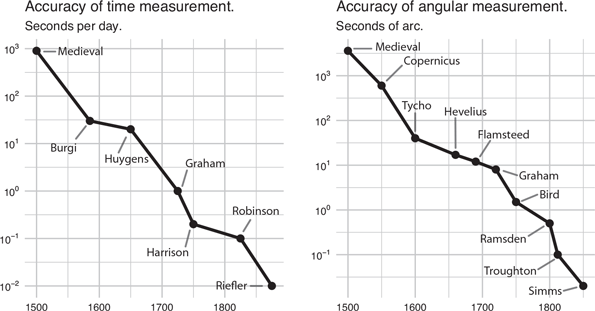
Figure 2 shows the steady rise in the accuracy of observatory clocks and the resolving power of observational instruments from the middle ages until the early nineteenth century; in both cases, instruments were 100,000 times more accurate than they had been 350 years earlier.Footnote 11 These steady advances in accuracy, of five orders of magnitude or 3.5 percent per year, probably mark the longest sustained episodes of rapid technological progress in history and contradict the widespread view that, barring isolated spurts, the technology underlying most goods was static before the late eighteenth century.Footnote 12
ACCURACY OF TIME AND ANGULAR MEASUREMENT FROM MEDIEVAL TIMES UNTIL THE EARLY NINETEENTH CENTURY (LOGARITHMIC Y-AXES)
Sources: Pledge (Reference Pledge1939, p. 70) and Chapman (Reference Chapman1983).

Of vital importance for the subsequent evolution of precision manufacturing were accurately cut adjustment screws, originally developed to move the image of a star exactly into the cross-hairs of a telescope. This technology was first transferred from large and expensive observatory equipment to everyday instruments by the leading instrument builder of the late eighteenth century, Jesse Ramsden. He succeeded in cutting adjustment screws of unprecedented exactness that could then be used as templates in his Dividing Engine to mass produce the scales of sextants. In place of laborious and inexact engraving of scales by hand, each turn of the screw made an exactly spaced division. As we explain later, this fundamental combination of adjustment screws and exact measuring scales was then available for the precision manufacturing of interchangeable machine parts, especially for textile manufacture, that emerged in Britain in the 1820s.
In summary, we have highlighted two direct contributions of practical mathematics to European development between the sixteenth and eighteenth centuries. First, there was the spread of mathematical techniques ranging from arithmetic using Arabic numerals and decimals to trigonometry and logarithms, all part of a culture of increasingly exact quantification.Footnote 13 Then we saw how the development of instruments such as theodolites, quadrants, and sighting compasses contributed to the technology of important activities, in particular, navigation, cartography, and surveying.
SPILLOVERS FROM INSTRUMENT MAKING TO EARLY INDUSTRIALIZATION
Besides these direct contributions from diffusing numerical techniques across a wide range of activities, practical mathematics brought into being a substantial range of skills and technology that facilitated early industrialization in two ways. At the everyday end of commercial instruments was a large labor force of mechanically skilled artisans making navigational and surveying instruments and watches, as well as the lathes, files, and gear-cutting machines needed to make the necessary parts. The skills of these anonymous artisans were at a premium when it came to building the increasingly complex cotton machinery and steam engines of the late eighteenth century.
The second advance, between 1820 and 1840, was the less well-known but equally important machine tool revolution. Driven by the need to mass produce interchangeable parts for increasing amounts of iron textile machinery, British engineers developed heavy but exact metal cutting machinery. This process was facilitated by having access to precise measuring scales and adjustment screws already developed for navigation that originated first in scientific astronomy.
The Early Industrial Revolution
The fact that two of the best-known early mechanical innovations—Hargreave’s spinning jenny and Newcomen’s atmospheric engine—were fairly simple artifacts has contributed to a widespread misconception that the machinery of the early Industrial Revolution was technologically rudimentary. In fact, the next generation of machinery—Arkwright’s water frame with its intricately meshing rollers, spindles, and gears, and Watt’s engine with a sophisticated valve chest—were complicated technology by the standards of the time.
The way that an abundance of watch-making skills in northwestern England expedited the development of the Manchester cotton industry was highlighted by Musson and Robinson (Reference Musson and Robinson1969, pp. 427–58). The fact that the first important textile innovation, the spinning jenny, was a simple artifact has led to the widespread misconception that the cotton machinery of the early Industrial Revolution was technologically primitive. However, as the leading Manchester cotton spinner, John Kennedy, recalled in 1815, with the appearance of Arkwright’s water frame and its intricately meshing metal rollers, spindles, and gearing, “a higher class of mechanics, such as watch and clock-makers, white-smiths, and mathematical instrument makers, began to be wanted; and in a short time, a wide field was opened for the application of their more accurate and scientific mechanism.” This demand can be seen in the abundance of contemporary newspaper advertisements looking for these skills (Musson and Robinson Reference Musson and Robinson1969, p. 436). In the important but often overlooked linen sector, successful spinning machinery developed out of the 1787 design of the clockmaker Thomas Porthouse (Clapham Reference Clapham1939, p. 145). Even after textile machinery building became a specialized activity, artisans were still known as clockmakers, and the gear mechanisms as clockwork.
In 1791, the engineer John Rennie in London was complaining that because of its high wages, “in respect to workmen, the Cotton Trade has deprived this place of many of the best Clock Makers and Instrument Makers so much so that they can scarcely be had to do the ordinary business.” Even in 1825, the London engineer John Martineau could claim that his first response to a rise in demand would be to hire craftsmen from the watch and instrument-making trades because “with a very little practice” they could perform “a great deal of work” in an engineering factory (Woolrich Reference Woolrich, Cantrell and Cookson2002, p. 40).
For early Boulton and Watt engines, apart from the cylinder, nearly all of the other components, notably the boiler, had to be supplied by the customer. However, one component was always produced in their Soho works, and that was the complex valve chest that controlled the flow of steam through the parts of the engine, and that was a part that could be produced easily given a large supply of instruments and watch-makers. The connection between skills and industrialization is tested formally by Kelly, Mokyr, and Ó Gráda (2023), who find that the levels of textile employment across the 41 counties of England in 1831 are strongly predicted by their supply of mechanical skills in the 1790s.
SPILLOVERS FOR PRECISION MEASUREMENT: THE BRITISH MACHINE TOOL REVOLUTION, 1820–1840
The second spillover from practical mathematics into industrialization came with the application of precise measurement technology in the development of machine tools. When it came to working brass for watches and other instrument parts, a substantial range of cutting tools had evolved by the late eighteenth century, including lathes, gear cutters, and files; the catalog of John Wyke of Liverpool ([1797] 1977) had 62 illustrated pages of tools, including, on its first plate, 45 different types of file. Iron parts for machines, by contrast, had to be laboriously chipped into shape using a hammer and chisel and, if necessary, finished off with a file: techniques that had hardly changed since the middle ages. This process was not only expensive and time-consuming but resulted in irregular parts, so that early machinery was built where possible out of wood (including the beam and most of the frame of early Watt engines; and the drive shafts and gearing used to connect machinery with power sources in factories) or, like the gearing of early textile machinery, of rapidly wearing brass. In effect, machine tools represented the scaling up of precision metal cutting instruments from the shaping of brass to the cutting of the iron components needed for the rapidly increasing numbers of ever larger and more powerful machinery.
Habakkuk (Reference Habakkuk1962) made much of Britain’s supposed failure to develop mass production using interchangeable parts in comparison with the “American System of Manufactures” that developed after 1840.Footnote 14 Whereas Britain, Habakkuk claimed, could avail itself of abundant supplies of skilled craftsmen, America was forced to substitute self-acting tools operated by unskilled workers in their place. Habakkuk’s argument is both widely cited and, as demonstrated by Musson (Reference Musson1975, pp. 128–35), historically inaccurate: every major machine tool in use in the mid-twentieth century was developed in Britain, largely in the period 1820–1840, to mass-produce interchangeable parts for iron textile machinery and then, in the early 1850s, to replace skilled engineering workers with cheaper laborers.Footnote 15
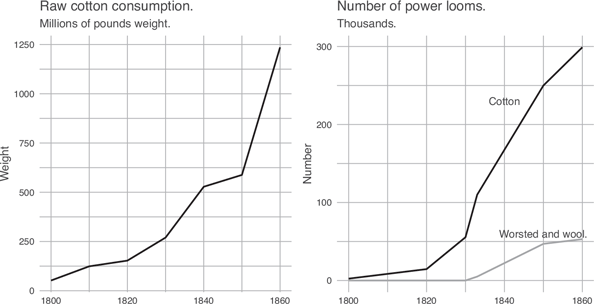
The implausibility of the Habakkuk thesis is suggested in Figure 3, which illustrates the rapid expansion of textile production in the first half of the nineteenth century. The consumption of raw cotton in 1850 was over ten times what it had been in 1800, and this was matched in the 1820s by the growth in power looms. There were already 150,000 cotton looms in the late 1830s, and this had risen to a quarter of a million by 1850, with another 50,000 looms in worsted and wool. Supplying these looms in 1856 were 28 million spindles in cotton and 3 million in worsted and wool, all driven by 140 million horsepower of steam (Bigelow Reference Bigelow1862, tables 104, 108; Cookson Reference Cookson2018, table 8.3). This expansion is matched by the growth in official machinery exports from £0.2 million in 1825, to £1.1 million in 1846, £2.2 million in 1855, and £3.7 million in 1859—nearly 8 percent of the value of cotton exports (Bigelow Reference Bigelow1862, table 94).Footnote 16
U.K. CONSUMPTION OF RAW COTTON AND NUMBER OF POWER LOOMS, 1800–1860
Sources: Bigelow (Reference Bigelow1862, tables 104, 108) and Cookson (Reference Cookson2018, table 8.3).

These large numbers of textile and steam machinery, made from fairly rapidly wearing iron, created a large market for mass produced, interchangeable components needed both for machined iron frames and for a continual stream of replacement gears and other moving parts, all relying on “the exactitude and accuracy of our machine tools… which the unaided hand could never accomplish.”Footnote 17 There was no way that Habakkuk’s skilled British craftsmen, however cheap and abundant, could produce exact parts for the hundreds of thousands of uniform machines that lined early-Victorian textile mills without the aid of heavy iron cutting machinery, particularly lathes, planers, and gear cutters. These machine tools were developed, first in London and then in Manchester, by Henry Maudslay and the circle of men who had spent more or less time in his workshop and included Joseph Clement, James Fox, Richard Roberts, and Joseph Whitworth, as well as the Swiss-born John George Bodmer.Footnote 18
Of these, the most notable is Roberts, who in 1822 patented the first commercially successful power loom, before patenting the self-acting mule in 1830. As well as being a leading locomotive manufacturer and pioneering the large-scale use of standardized templates and gauges, Roberts also developed some of the first effective gear cutting and planing machines (both vital for mass-producing machinery), as well as improved lathes, drills, and slotting machines. In terms of labor saving, producing a large, flat metal part by hand chipping and filing cost 12 shillings a square foot, whereas with a planing machine it cost one penny (Hills Reference Hills2002, pp. 63–113, 127–55).
In contrast, then, to the American mass production of consumer goods—furniture, hardware, and small arms—that preoccupied Habakkuk and Rosenberg, the British industry specialized in machine tools for heavy engineering and retained its technological leadership until perhaps the 1890s (Floud Reference Floud1974). Precision apart, and again contrary to Habakkuk’s notion of cheap craftsmen, British manufacturers were increasingly motivated to adopt machine tools through a desire to replace skilled metalworkers—who, besides insisting on seven-year apprenticeships, were perceived as overpaid and strike prone—with cheaper and more tractable labor.
This process culminated in the successful 1852 Lock-Out by major employers, including Nasmyth, Whitworth, Maudslay, and Fairbairn, of unionized machinists objecting to piecework and overtime (Burgess Reference Burgess1969), an event that in some ways marks the end of artisan mechanical skill as a unique advantage underlying British industrial development. The growing availability of self-acting machine tools meant that shortages of mechanical skills became less of a hindrance for European economies, which can be seen, for instance, in the rapid appearance of locomotive building in France and Germany.
From Mathematical Instruments to Machine Tools
This direct path between scientific instruments and machine tools can be seen in the careers of several pioneers of precision manufacturing. Maudslay began his engineering career in 1789, working for Joseph Bramah (inventor of the hydraulic press) to develop machinery to mass produce the intricate parts for the padlock that Bramah had designed, and to do this he devised a range of cutters that were adjusted with micrometer screws. Accurate machine tools required two things that Maudslay went on to pioneer: gauges to produce perfectly flat guiding surfaces and exactly cut machine screws for setting and adjusting moveable parts. For instrument making, Ramsden had produced an exact screw-cutting lathe in 1777 whose all-metal construction and precision closely anticipate Maudslay’s, leading Daumas (Reference Daumas, Charles Singer, Hall and Trevor1958, p. 388) to suggest that, given Ramsden’s fame and the fact that details of his lathe were published, Maudslay may have been influenced by Ramsden’s design. One of Maudslay’s most noted displays of virtuosity in later life was cutting a five-foot-long adjustment screw threaded to 50 turns per inch for calibrating instruments in the Royal Observatory, receiving a £1,000 prize for the achievement (Rolt Reference Rolt1965, p. 89).
Habakkuk (Reference Habakkuk1962, p. 120) dismissed the automated production of naval pulleyblocks by Brunel and Bentham as a dead end in British manufacturing “with little or no influence on the general manufacturing of the country.” It is noteworthy that this machinery was built by the young Maudslay, who is not mentioned at any stage by Habakkuk.
Maudslay’s successor as the evangelist of precision manufacturing and interchangeable parts was Whitworth, who, early in his career, worked for Clement, cutting the brass gears for Charles Babbage’s Difference Engine. This task needed “a special aptitude for the minute accuracy of detail in mechanical work [that] … Mr Whitworth in after life certainly made the most of.” The role of Babbage’s project in stimulating the development of precision industrial tools was acknowledged by leading contemporary engineers such as Fairbairn and Nasymth, and was summarized in 1855 by the President of the Royal Society: “This Country has received an equivalent many times over for the expenditure on the Calculating Engine, in the improvements in tools and machinery directly traceable to the attempt to make it” (Jones Reference Jones2016, p. 206).
Following the collapse of Babbage’s project, Whitworth returned to Manchester in 1833 to set up his own engineering business. For his employees at the time, working to a sixteenth of an inch was seen as “something like perfection in mechanical finish,” but by the 1850s, Whitworth’s “self-acting machines are made, adjusted, and fitted to the ten thousandth of an inch” using the standard gauges for which he became famous (Hyman Reference Hyman1982, p. 231). This transfer into machine building of an exactitude previously associated with astronomy is encapsulated by the way that in 1775 Boulton could admire how Wilkinson’s boring of their steam cylinder “doth not err the thickness of an old shilling in no part,”Footnote 19 whereas 30 years later Maudslay’s “Lord Chancellor” micrometer was accurate to 0.001 inches (Roe Reference Roe1916, p. 45), and at the 1851 Great Exhibition Whitworth displayed a micrometer accurate to one-millionth of an inch used to set his factory’s measuring gauges (Musson Reference Musson1975). Turning from instruments to theory, a direct connection from mathematics to machinery runs through the question of how to design gearwheels to transmit power with minimal friction and wear. The first mathematicians to lay down the systematic geometrical principles of gear design—showing that teeth should have a cycloid profile—were de Philippe de la Hire in the 1690s and Charles Camus in 1733, and the design of gear teeth to minimize friction was analyzed comprehensively by Leonhard Euler in the 1750s. In terms of industrial applications by elite engineers, Robert Willis in 1838 designed a ruler for measuring out gear profiles, and Whitworth’s cutters from the late 1830s could cut properly shaped teeth; but the first instructions aimed at ordinary shop workers only originated with Rennie in his 1841 revision of Buchanan’s popular Treatise on Mills and Millwork (Woodbury Reference Woodbury1972, pp. 9–31, 62–74).
Although there might appear to be little connection between precision scientific instruments and factory machinery, we have seen that the two are joined directly together in the careers of early machine tool builders such as Maudslay and Whitworth. Moving on from these elite engineers, we now consider the supply of artisan skills that made their creations possible.
THE SUPPLY OF PRECISION MECHANICAL SKILL
None of these technological advances would have been possible without an adaptable supply of skilled workers to implement them. By the time that Adam Smith decried an “altogether unnecessary” guild system that restricted competition and took years to impart artisanal skills that required no “long course of instruction,” guilds in England were far from being the institutional encumbrance he claimed them to be. Minns and Wallis (Reference Minns and Wallis2012) have demonstrated that many apprentices could find employment before completing their full term; and in many trades, including watchmaking, as we will see later, ordinary artisans were often not indentured.
At least from the mid-seventeenth century, enforcement of guild restrictions in London was lax and legal actions against members were uncommon; in the Clockmakers’ Company, the last fine for “Insufficient Quality” recorded in Atkins and Overall (1881, pp. 235–40) took place in 1688. As Stewart (Reference Stewart2005) observes, Livery Companies came to conduct their affairs in a stylized way that had more to do with publicizing their high standards of workmanship than policing members, with “searches” or “walks” purportedly to examine workshops for low-quality products conducted in official costume at pre-announced times.
The Clockmakers’ Company explicitly surrendered its right of search in 1735 as “interfering with the liberty of the trade” and was followed in this by other guilds. By 1753, a committee of the House of Commons, articulating growing concerns that guilds were inimical to the rights of private property, concluded that searches were “injurious and vexations to manufactures, discouraging to industry and trade, and contrary to the liberty of the subject” (Stewart Reference Stewart2005).Footnote 20
Instrument makers were indeed obliged to belong to some guild, but because there was no specific guild for their trade, by the “custom of London,” they were free to join whatever one they pleased, including the Grocers, the Drapers, and many others besides the Clockmakers (Brown Reference Brown1979; Crawforth Reference Crawforth1987; Ogilvie Reference Ogilvie2019, p. 499). This relaxed attitude of the guilds facilitated the rapid growth of out-sourcing and specialization in the watch and instrument-making industries. As McConnell (Reference McConnell1994) shows, by 1750 there was an established hierarchy of instrument firms. At its peak were elite astronomical makers, such as Jesse Ramsden, running large workshops and supplied by an extensive web of subcontractors; and below them were reputable specialists serving larger, commercial markets, especially in navigation and surveying. These were followed by the subcontractors making parts for the firms above them; and, finally, at the bottom were low-quality makers producing cheap instruments such as thermometers and hydrometers for brewers.Footnote 21 The overall result was a flexible structure able to respond swiftly to changes in market demand: see Riello (Reference Riello2008) and Ben Zeev, Mokyr, and van der Beek (Reference Ben Zeev, Mokyr and van der Beek2017).
Numbers of Instrument Makers
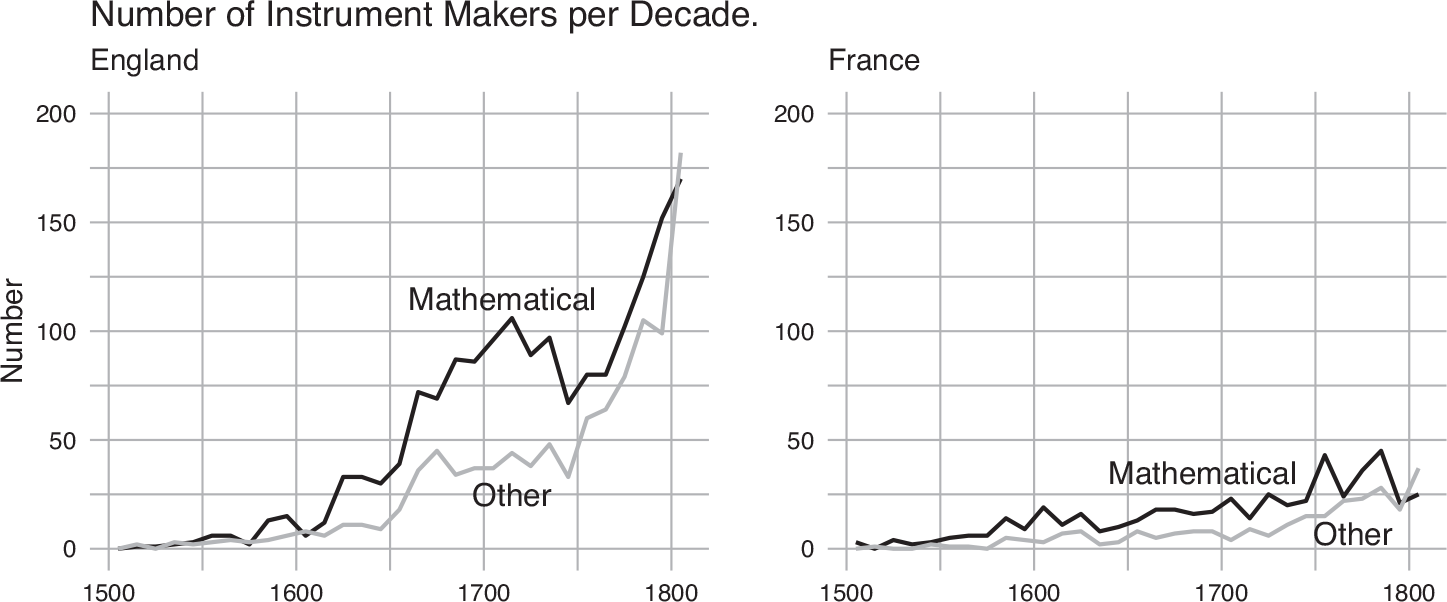
The success of the English instrument industry relative to its less adaptable French counterpart is indicated in Figure 4.Footnote 22 This shows the number of known instrument makers by decade for both countries, from the 1500s to the 1810s, taken from the Webster Signatures Database, which contains entries on 14,946 instruments.Footnote 23 We divide makers into mathematical (including surveying and navigational), and all others: either makers of optical or philosophical instruments, or those on whom no information is available beyond their names. For most early makers, the only date known is when they were active (flourished) and, in those cases, we assign them a date in the middle of their careers. When their date of birth is recorded, we assign makers to the decade when they were 30 years old. In other words, the diagram gives a measure of the flow into the industry rather than the stock of all makers active at any time.
KNOWN ENGLISH AND FRENCH MAKERS OF MATHEMATICAL AND OTHER INSTRUMENTS
Source: Webster Signatures Database.

That the French industry was small and relatively stagnant relative to England’s is immediately apparent, and it is likely that Figure 4 understates the true difference. Not only does it not consider population disparities, but the Webster data are mostly based on museum pieces, which tend to be expensive instruments. As we noted, the French industry was geared towards prestigious markets and a greater share of its output has probably survived than the utilitarian navigational and surveying instruments produced in large quantities in England, instruments that would often have been used until worn out and then discarded. For instance, of 2,711 English entries, only 94 makers of surveying instruments are recorded.
A further reason why the relative scale of England’s industry may be understated in Figure 4 stems from differences in the organization of the two industries. French makers were invariably small operations, whereas many described in England as instrument makers, just like their watchmaker counterparts, were company owners who put their signature on a finished item assembled in their workshops from parts made by anonymous employees or sub-contractors. To repeat, the important thing is not that instrument making was a large sector in its own right, but that it generated substantial spillovers to modernizing sectors.
Watchmakers and Instrument Makers
Given the inevitable selection biases in surviving scientific instruments, a useful complementary indicator of the supply of precision mechanical skills is the number of watch and clock-makers. This can be gauged from the records of the London Clockmaker’s Company, where details of every apprentice taken on in all parts of England between 1700 and 1810 were compiled by Moore (Reference Moore2003). Between the early and late eighteenth century, the annual number of apprentices doubled from around 100 to 200 per year.
Again, these numbers are lower bounds because many watchmakers served no formal apprenticeship. We can, however, roughly gauge the extent of this undercounting in two ways. The first is to use the 1851 census, which lists the number of watch and clock-makers aged 60–64, men who would have been born in the years before 1790 and apprenticed in the early 1800s. There are around 120–150 of these men by year of age. Assuming that 50 percent of men in the early nineteenth century survived from their late teens into their early 60s (which is what Haines (Reference Haines1998) estimated for white American males in 1850), we have somewhere around 2,400–3,000 apprentices trained in the decade around 1800, roughly twice the number registered with the Clockmakers’ Company. To the extent that the English watchmaking industry declined in the face of Continental imports after 1815 (Kelly and Ó Gráda Reference Kelly and Ó Gráda2016), many men trained as watchmakers may have moved into other sectors, so the undercounting in the Clockmakers’ records may be more severe yet (we are grateful to a referee for this observation). For comparison, the census records 298 instrument makers in their 60s (roughly the same as we would expect from Figure 4), and 214 in their 50s.Footnote 24
We can exactly estimate the share of watchmakers who had been formally apprenticed in one important center for making parts and tools: Prescot outside Liverpool. Prescot’s marriage registers record the occupation of the groom, allowing us to check whether each man described as a watchmaker was ever formally apprenticed to the guild.Footnote 25 It turns out that for the eighteenth century only 21 percent (56 out of 269) of these watchmakers appear in Company records. This is well below the national figure and may reflect the low value-added activities conducted there.
THE ROLE OF THE STATE
The role of the state in the economic development of Europe from the sixteenth century has been the subject of considerable debate. When it comes to the increasingly sophisticated measuring technology that eventually facilitated the machine tool revolution, state demand played a central part. By encouraging innovation and generating demand, European states actively promoted the development not only of utilitarian tools for navigation, gunnery, and surveying but of expensive observatory instruments for astronomy. Innovation was encouraged further by governments through patents and prizes. However, an earlier impetus to mathematical practice came from princely courts in the fragmented states of Italy and Germany. In Italy, machine design, fortification, public buildings, and hydraulic projects (building canals, aqueducts, and draining land) engaged architect-engineers like Brunelleschi, Leonardo, and Taccola (Bennett Reference Bennett, Park and Daston2006), while in Germany, where several princes were notable astronomers, an additional concern was improving state mines (Moran Reference Moran1981).Footnote 26
Navigational and Surveying Instruments
Until the late fifteenth century, European sailors mostly engaged in coastal navigation, guided by magnetic compasses and sailing charts (portolans). The impetus to develop new navigation instruments came from state-sponsored voyages into unfamiliar oceanic waters, beginning with the Portuguese in the fifteenth century. Specifically, Portuguese navigators returning from Guinea devised a track that involved sailing in a long westerly arc to take advantage of winds and currents, and then heading due east once they had reached the latitude of Lisbon. Latitude could be estimated straightforwardly from the height of the pole star or noonday sun above the horizon, and during the sixteenth century various astronomical instruments were simplified to do this, first astrolabes and cross-staffs, followed by the more sophisticated backstaff, devised by a sea captain John Davis in the 1590s. By this time, ordinary navigators had a technology that sufficed for their purposes (backstaffs were widely used until the nineteenth century) and the development of navigational instruments largely stalled for a century.
Innovation restarted in the eighteenth century but is now driven by the British Admiralty and Royal Society. Based possibly on earlier ideas of Hooke and Newton, in 1731, a Fellow of the Royal Society, John Hadley, developed a reflecting octant (ancestor of the sextant) that was rapidly adopted by the Navy. After this, Britain’s large naval and commercial demand for accurate navigational instruments supported a large London industry of instrument makers (Sorrenson Reference Sorrenson, Bermingham and Brewer1995).
Similarly, because ordinary mariners relied on traditional navigational techniques, much of the demand for the lessons in mathematical navigation offered by mathematical practitioners derived from the state in the form of young gentlemen aspiring to become officers in the navy or in state-chartered trading companies, beginning with the English Muscovy Company and the Dutch East India Company (Struik Reference Struik1981, pp. 31–52). However, just as state intervention could stimulate navigational innovation, it could stifle it. Spain set the standards in European navigation in the mid-sixteenth century, encapsulated in Martin Cortes’s comprehensive Arte de Navegar of 1551, which, in a simplified version by the mathematician William Bourne, remained the standard English manual until the early seventeenth century. However, the training of Spanish pilots was rigidly controlled by the Casa de la Contración and quickly became archaic by northern standards (Taylor Reference Taylor1971, p. 250).Footnote 27
For simpler instruments, a large private sector market emerged in surveying in the late sixteenth century, driven by the more intensive management of land, the beginnings of enclosure and land drainage schemes, and a growing state interest in the potential of land taxes (Kain and Baigent Reference Kain and Baigent1992). For cartography in England, the decisive impetus came from the need to map land confiscated from monasteries and then the new territory gained during the conquest of Ireland (Taylor Reference Taylor1954, pp. 31–32).Footnote 28 However, as with mariners, the instruments used by ordinary surveyors were simple and changed little after the rapid innovations of the early seventeenth century: a sighting compass, a chain to mark out lengths, a plane table for taking sights of landmarks, and sometimes a simple theodolite. Similarly, for gunnery: although a variety of ranging instruments were invented, including Galileo’s military compass, how often they saw use in combat is uncertain.
One precocious and technologically promising experiment in standardized manufacturing was undertaken in Revolutionary France by Honoré Blanc in an effort to produce interchangeable gunlocks (Alder Reference Alder2010, pp. 240–47, 321–38). The exercise, however, took place against a background of competing government factions where the temporary ascent of one group allowed the project to proceed, but it subsequently collapsed once their rivals returned to influence.
Astronomical Instruments
Large state observatories equipped with increasingly sophisticated measuring instruments were established in the late seventeenth century to meet the needs of navigation, in particular, the estimation of longitude by means of lunar distances (Kelly, Ó Gráda, and Solar Reference Kelly, Gráda and Solar2021).Footnote 29 The Paris Observatory was founded in 1667 for the explicit purpose of obtaining an accurate star map for lunar navigation, as was London’s Royal Observatory (for “rectifying the tables of the motions of the heavens … so as to find out the so much desired longitude of places for the perfecting the art of navigation”) in 1675.Footnote 30
Just as navigation led directly to state observatories, the alternative way to compute longitude through an accurate chronometer led Hooke in the Royal Society to develop a practical spring-driven watch that was the origin of England’s large and innovative watch-making industry (Kelly and Ó Gráda 2016). This, in turn, created Britain’s uniquely large workforce of watchmakers, supported by highly skilled and versatile toolmakers, whose importance for early industrialization we saw earlier.Footnote 31
Besides driving the market for instruments ranging from naval sextants to observatory telescopes, the British state in the eighteenth century sought to encourage navigational innovation through prizes awarded by the Board of Longitude. The Board is best known for its delayed award for John Harrison’s chronometer (it also rewarded Euler at the same time for his contributions to lunar navigation), but it also made frequent awards for other navigational instruments.
Importantly, in return for a prize, the Board required the exact details of an invention to be made public. Harrison did not receive his prize until his watch had been successfully duplicated by another clockmaker, while the astronomical instrument maker, John Bird, was awarded £500 on the condition that he train an apprentice, and Jesse Ramsden’s £615 required him to train other rival instrument makers in making his Dividing Engine for mass-producing the scales of sextants. Over its lifetime, the Board dispensed £53,000 in rewards for innovations and spent a further £45,000 on publications giving their details (Howse Reference Howse1998).
At the same time as the British were offering prizes for innovative technology, the French state encouraged improvement in the level of theoretical knowledge in navigation, astronomy, and practical fields such as shipbuilding through the Academy’s annual essay competition. For instance, topics in the late 1760s included the satellites of Jupiter (won by Lagrange), determining time at sea (won by Le Roy, inventor of the first practical chronometer), and the movement of the moon (Euler one year, Lagrange the next) (Mandron Reference Mandron1881, p. 21). In other words, navigation represents the first and clearest example of the Enlightenment project of creating useful knowledge through the encouragement of the state.
Patents provided an additional source of state support that were either intended to stimulate innovation or, in England’s case at first, to attract foreigners with useful technical skills.Footnote 32 One particular contrast again is between England, where a large commercial market led to a demand for patents, and France, where patenting was unimportant to a small industry that relied on the prestige of supplying instruments to the top stratum of science (Biagioli Reference Biagioli2006).
RESPECTING ARTISANS
So far, our emphasis has been on the technological spillovers associated with practical mathematics, but its cultural contribution should not be overlooked. When it comes to explaining the ultimate economic success of Europe and especially Britain, the role of a distinctive culture of improvement and systematic empiricism has been stressed by Mokyr (Reference Mokyr2011, Reference Mokyr2016) and Jacob (Reference Jacob1997). The high status of the most innovative instrument makers adds another facet to our understanding of cultural contributions to economic transformation, what can be called artisan virtue.
Reaching its apogee in Samuel Smiles’s Lives of the Engineers (1861) and Industrial Biography (1864), Victorian Britain’s reverence for mechanical skill is well known. Artisans turned engineers, typically of modest background, became national celebrities: some were ennobled, others were made Fellows of the Royal Society, with James Watt being buried under a large statue in Westminster Abbey (MacLeod Reference MacLeod2007).Footnote 33 Less familiar is that the respect of British elites for mechanical skill goes back to the instrument makers of the seventeenth and eighteenth centuries.
In 1675, the clockmaker Thomas Tompion (1639–1713) built the first practical, balance spring watch for Hooke (who himself had been Robert Boyle’s assistant) and went on to become “The Father of English Watchmaking.” Despite being the son of a blacksmith and earning his living as a shopkeeper (albeit a highly successful one), he was buried in Westminster Abbey, alongside his later business partner, George Graham. The son of a small farmer, Graham became Europe’s foremost astronomical instrument maker (his name appears in both panels of Figure 2) and a Fellow of the Royal Society.Footnote 34
Many of the foremost instrument makers (who usually designed the instruments they built) of eighteenth-century Britain followed Graham to become Fellows of the Royal Society, and some received the Copley Medal, its highest honor. Fellows included John Dollond (originally a silk-weaver; a developer of the achromatic lens), Edward Nairne (electrical machine), James Short (father, a joiner, telescope maker), and Edward Troughton (father, a small farmer; Copley Medal for dividing scales of observatory instruments in 1809). The most famous European instrument maker of the late eighteenth century was Jesse Ramsden (father, an innkeeper; Copley Medal 1795).Footnote 35 Although not a Fellow, the carpenter and clockmaker John Harrison received the 1749 Medal for one of his early chronometers.Footnote 36 It should be emphasized, of course, that although some leading instrument makers were respected by gentlemen natural philosophers as their intellectual peers, we are not suggesting that they were in any way regarded or treated as their social equals.
In contrast to the prestige of English instrument makers, the attitude of European scientists toward their assistants, going back to the seventeenth century, is largely one of frustration. In attempting to make lenses, both Descartes and Huygens were hampered by the low quality of the craftsmen they commissioned. Descartes had to abandon efforts to build a sophisticated machine that he had designed to grind hyperbolic lenses, and Huygens was reluctantly compelled to become an accomplished lens grinder (Burnett Reference Burnett2005).
The closest that France came to recognizing artisan skill, the Société des Arts (1728–1736), was driven from below by artisans and soon collapsed for a lack of upper-class patronage “emblematic of a dismissive attitude towards people whose knowledge and expertise derived primarily from the world of doing” (Bertucci and Courcelle Reference Bertucci and Courcelle2015, p. 163); and France’s greatest watchmaker, the Englishman Henry Sully, was denied membership of the Académie notwithstanding the support of Leibniz.Footnote 37 The feelings of some Continental savants towards their fabricants are encapsulated by the French Astronomer Royal Jean-Dominique Cassini. On a visit to London in 1787 to order observatory instruments from Ramsden (whom he addresses in their correspondence with marked deference), he concluded that whereas the leading British makers “… are geometers and physicists, our best craftsmen are merely labourers” (Wolf Reference Wolf1902, pp. 287–300).
CONCLUSIONS
For Francis Bacon, the three decisive inventions since classical times were famously “printing, firearms and the compass.” Two hundred and fifty years later, by contrast, after noting how each science is defined by the precision instruments it employs, James Clark Maxwell (Reference Maxwell1871, p. 75) concluded that “… the whole system of civilized life may be fitly symbolized by a foot rule, a set of weights and a clock.” In this paper, we showed a direct line from the mathematical practice of the sixteenth and seventeenth centuries to the Industrial Revolution of the late eighteenth century and the Machine Tool Revolution of the 1820s and 1830s. Practical mathematics appeared in response to market demand for useful numeracy, providing teaching, textbooks, and instruments in navigation, surveying, bookkeeping, and basic arithmetic; and its growth can be gauged, for instance, in the sudden burst of accessible mathematics texts in the mid-seventeenth century. Besides this direct contribution to activities ranging from bookkeeping to navigation and surveying, we saw how it generated subsequent spillovers to later textile and steam machinery in the form of technically skilled instrument and watch makers; and to the machine tools needed to build them in the form of exact measurements from astronomy and navigation.
Naturally, we are not making any claims here that practical mathematics was “the cause” of the Industrial Revolution, simply that the widespread supply of mechanical expertise and precision manufacture that it called into being greatly facilitated the development of later factory technology. Throughout, we have seen how misleading simple dichotomies can be. Instead of artisans versus philosophers, we saw how both groups overlapped through practical mathematics. Instead of Protestant science versus Catholic obscurantism, we saw that enthusiasm toward astrology stimulated mathematical teaching in Lutheran universities and antagonism toward it caused its separation from mathematical astronomy in Jesuit textbooks. Instead of incentives versus capabilities, we saw how each fed off the other with opportunities creating technologies that opened further opportunities. Demand for a range of numerical skills from the sixteenth century onwards created a supply of mathematical practitioners who would later help to develop technologies that facilitated subsequent industrialization.