Adopted children seem to be at risk of developing insecure and disorganized attachment relationships with their adoptive parents (Van den Dries, Juffer, van IJzendoorn, & Bakermans-Kranenburg, Reference Van den Dries, Juffer, van IJzendoorn and Bakermans-Kranenburg2009), while they also have been shown to lack social reticence to strangers, known as indiscriminate friendliness (Chisholm, Carter, Ames, & Morison, Reference Chisholm, Carter, Ames and Morison1995; Marcovitch et al., Reference Marcovitch, Goldberg, Gold, Washington, Wasson and Krekewich1997; O'Connor, Marvin, Rutter, Olrick, & Britner, Reference O'Connor, Marvin, Rutter, Olrick and Britner2003). In addition, experiences of neglect in depriving institutions before the adoption may lead to passive, unresponsive behavior in adopted children (Gunnar, Bruce, & Grotevant, Reference Gunnar, Bruce and Grotevant2000; MacLean, Reference MacLean2003). However, as children's adaptation is also affected by changing psychological conditions (Cicchetti, Reference Cicchetti1993), the positive experiences after the adoption such as sensitive parenting and positive emotional relationships in the adoptive family may ameliorate these risks in adopted children and contribute to their recovery and catch-up growth (Palacios & Brodzinsky, Reference Palacios and Brodzinsky2010). In this study we used a short-term longitudinal design to examine emotional availability (EA; parental sensitivity and child responsiveness), attachment, and indiscriminate friendliness in families with children adopted from institutions or foster care in China.
Several studies have shown that children begin to form an attachment relationship with new parents in the first months after placement in a family (e.g., Dozier, Stovall, Albus, & Bates, Reference Dozier, Stovall, Albus and Bates2001; Pugliese, Cohen, Farnia, & Lojkasek, Reference Pugliese, Cohen, Farnia and Lojkasek2010; Stovall-McClough & Dozier, Reference Stovall-McClough and Dozier2004). We assessed adopted children's attachment relationships, their indiscriminate friendliness and responsiveness, 2 and 6 months after adoptive placement. We examined whether infants adopted from institutions versus foster families differed in their way of adapting to life in a new family, how their adaptation developed across time, and what role the sensitivity of the adoptive parent played in these processes. In the current study we included children adopted around their first birthday, as this period is considered formative for the development of a first attachment relationship (Bowlby, Reference Bowlby1982).
In order to answer the clinically important question of whether adopted children from foster or institutional care are at risk of developing more insecure and disorganized attachments than children reared by their biological parents, we compared the attachment distributions of the adopted children with the normative attachment distribution reported in a meta-analysis on the attachment relationships of children reared in their biological families (van IJzendoorn, Schuengel, Bakermans-Kranenburg, Reference van IJzendoorn, Schuengel and Bakermans-Kranenburg1999). We also examined possible catch-up with regard to attachment security and attachment disorganization over time.
In addition, we assessed children's indiscriminate social behavior and their responsiveness to the adoptive parent, in order to investigate possible differences between children adopted from institutions and children adopted from foster care and to examine their development for these two behaviors over time. Responsiveness refers to the child's eagerness to respond to the parent and her or his emotional connection to the parent during parent–child interaction (Biringen, Robinson, & Emde, Reference Biringen, Robinson and Emde2000; Easterbrooks & Biringen, Reference Easterbrooks and Biringen2009). For child responsiveness we compared the children's scores with cutoff scores representing at-risk development (Vliegen, Luyten, & Biringen, Reference Vliegen, Luyten and Biringen2009). For indiscriminate friendliness a comparison with nonadopted children was not possible, as norm scores for nonadopted children were not available. The present study may contribute to our knowledge of adopted children's chances to overcome early deprivation in a relatively short period of time after adoption. From the broader perspective of developmental psychopathology (Cicchetti & Toth, Reference Cicchetti and Toth2009), this study may shed more light on deviations from normal child development and on children's ability to recover and catch up after experiencing significant deprivation. Studies on children's resilience following prolonged trauma may elucidate pathways to competent adaptation despite exposure to conditions of adversity (Cicchetti, Reference Cicchetti1993).
China's Abandoned Children and International Adoption From China
After years of rapid population growth China implemented the one-child policy in 1979 to prevent social and economic problems such as poverty and famine (Ebenstein, Reference Ebenstein2010). As the name suggests, the one-child policy forbade families to have more than one child, although currently this strict version of the rule only applies to a minority of the population. Families who violated birth-planning restrictions were sometimes punished, for example by handing out substantial fines or confiscating personal belongings (Hesketh, Li, & Zhu, Reference Hesketh, Li and Zhe2005; Johnson, Reference Johnson2004). The stringency with which birth-planning restrictions and punishments were adhered to varied per district and over time (Harrell, Wang, Han, Santos, & Zhou, Reference Harrell, Wang, Han, Santos and Zhou2011; Hesketh et al., Reference Hesketh, Li and Zhe2005; Johnson, Reference Johnson2004). For families who could not afford to raise more than one child and deal with subsequent penalties, an escape route from birth-planning authorities was to abandon their infant. Because of son preference it was mostly girls who were abandoned (Johnson, Reference Johnson2004). Birth parents do not abandon their children lightheartedly and often leave their child at places where they know the child will be discovered almost immediately (Johnson, Reference Johnson2004; Zhang, Reference Zhang2006). Although many Chinese parents have tried to arrange domestic adoptions for their children, for example by abandoning them on the doorstep of a childless couple (Zhang, Reference Zhang2006), numerous abandoned children were placed in Chinese institutions (Johnson, Reference Johnson2004).
In 1992, China officially opened the borders for international adoption to relieve the overcrowded institutions, and within a couple of years China became the main country of origin for international adoptions. Since the 1990s, a large number of children (predominantly girls) have been adopted by families in North America and Europe. For example, in 1998 there were over 6000 adoptions from China and in the following years this number increased to more than 14,000 children in 2005 adopted from China to 23 countries (Selman, Reference Selman, Wrobel and Neil2009a, Reference Selman2009b). According to Selman (Reference Selman, Wrobel and Neil2009a), in a few years the total number of Chinese adoptees worldwide could exceed the 160,000 adoptees from South Korea who have been adopted over a much longer period of time (adoptions from Korea started in the mid-1950s). During the last few years, however, international adoptions from China have decreased, while the group of adoptees changed from predominantly young, healthy girls to older children (also boys) with special needs (Juffer et al., in press; Selman, Reference Selman2010). As a consequence of China's ratification of the Hague Adoption Convention (Hauge Convention on Protection of Children and Co-operation in Respect of Intercountry Adoption, 1993) in 2005 more children are now adopted domestically within China, a preferred option according to the Convention.
In the first years of international adoption, the conditions in the Chinese institutions were severely inadequate and depriving (Johnson, Reference Johnson2004; Miller, Reference Miller2005). In the mid-1990s, after the publication of revealing reports (e.g., by Human Rights Watch), significant changes were made in the care provided to abandoned children (Miller, Reference Miller2005). In recent years, not all adoptees from China have been placed in institutions, as China has developed a foster care system in which some children are taken care of before an international adoption placement (Johnson, Reference Johnson2004).
Institutional Care Versus Foster Care
Many empirical studies have found that early institutional care can have short-term as well as long-lasting negative consequences for adopted children's functioning and development (e.g., Colvert et al., Reference Colvert, Rutter, Beckett, Castle, Groothues and Hawkins2008; Gunnar, Van Dulmen, & the International Adoption Project Team, Reference Gunnar and van Dulmen2007; Kertes, Gunnar, Madsen, & Long, Reference Kertes, Gunnar, Madsen and Long2008; Kreppner et al., Reference Kreppner, Rutter, Beckett, Castle, Colvert and Groothues2007; Rutter & Sonuga-Barke, Reference Rutter and Sonuga-Barke2010; for a review see van IJzendoorn et al., in press). For example, many girls adopted from China showed developmental delays at adoption (e.g., Cohen, Lojkasek, Zadeh, Pugliese, & Kiefer, Reference Cohen, Lojkasek, Zadeh, Pugliese and Kiefer2008). In another study, larger delays in adopted children from China were associated with poorer later behavioral adjustment (Tan, Marfo, & Dedrick, Reference Tan, Marfo and Dedrick2010).
Currently, the number of foster families caring for abandoned children is increasing in China, as foster care is perceived as less detrimental for children's development than institutional care (e.g., Johnson, Reference Johnson2004; Liu & Zhu, Reference Liu and Zhu2009). In the current sample of adoptees from China, the somewhat less pernicious effect of preadoption foster care was demonstrated for motor and cognitive development of the children, as the former foster children showed significantly better mental and motor abilities after adoption compared to the postinstitutionalized children (Van den Dries, Juffer, van IJzendoorn, & Bakermans-Kranenburg, Reference Van den Dries, Juffer, van IJzendoorn and Bakermans-Kranenburg2010). The Bucharest Early Intervention Project (Nelson et al., Reference Nelson, Zeanah, Fox, Marshall, Smyke and Guthrie2007; Smyke, Zeanah, Fox, Nelson, & Gunthrie, Reference Smyke, Zeanah, Fox, Nelson and Gunthrie2010) experimentally showed that foster care has a more positive impact on children's development than does an institutional setting. Unfortunately, in our study we were not able to collect reliable data on the quality of preadoption care for the majority of the sample, which is not uncommon in this type of investigation (e.g., Nelson, Reference Nelson2000; Pomerleau et al., Reference Pomerleau, Malcuit, Chicoine, Seguin, Belhumeur and Germain2005).
Although many studies have examined the development of adopted children in general (for a review, see Palacios & Brodzinsky, Reference Palacios and Brodzinsky2010), hardly any study has contrasted the development of postinstitutionalized and former foster children after their adoption (but see Miller, Chan, Comfort, & Tirella, Reference Miller, Chan, Comfort and Tirella2005). For example, not much is known about potential differences regarding the attachment formation with the adoptive parents, although one study found no differences in parent-reported attachment behavior between former foster and postinstitutionalized adopted children who had lived in their adoptive families for several years (Bruce, Tarullo, & Gunnar, Reference Bruce, Tarullo and Gunnar2009). Whether the observed attachment behavior and responsiveness of former foster and postinstitutionalized adopted children differ from those of nonadopted children and whether there are changes in these behaviors in the first months after adoption is, to our knowledge, examined for the first time in the current study.
In addition, relatively few studies have focused exclusively on young children from China (but see, e.g., Cohen et al., Reference Cohen, Lojkasek, Zadeh, Pugliese and Kiefer2008; Miller & Hendrie, Reference Miller and Hendrie2000). It is important, however, to study specific groups of adoptees because the quality of preadoption care appears to vary greatly between countries (Gunnar et al., Reference Gunnar, Bruce and Grotevant2000; Miller, Reference Miller2005), which hinders the generalizability of developmental outcomes to adoptees from other countries (see also Pomerleau et al., Reference Pomerleau, Malcuit, Chicoine, Seguin, Belhumeur and Germain2005).
Attachment Relationships
Attachment behavior has a biological basis. Infants are equipped with a set of innate attachment behaviors, such as crying, that promote individual and species survival by soliciting parental proximity, care, and protection (Bowlby, Reference Bowlby1982). A central assumption in attachment theory is that infants develop a set of expectations about the availability of their attachment figure(s) in their first year of life, based on caregivers' responses to their attachment behaviors (Bowlby, Reference Bowlby1982). These internal working models of attachment contain mental representations of the attachment figure and the self, and are used to interpret and anticipate the behavior of the attachment figure and thereby influence the child's own attachment behavior.
In normative situations, almost all children develop an attachment relationship with their caregiver(s). However, children who grow up in institutional care often miss the opportunity to develop selective and secure attachment relationships with their caregivers, due to the limited amount and poor quality of contact with their caregivers (Smyke et al., Reference Smyke, Zeanah, Fox, Nelson and Gunthrie2010; Zeanah, Smyke, Koga, Carlson, & The Bucharest Early Intervention Project Group, Reference Zeanah, Smyke, Koga and Carlson2005). Children who are reared in foster homes prior to their adoption are expected to have experienced a preadoption rearing arrangement of higher quality compared to institutional care (Nelson, Furtado, Fox, & Zeanah, Reference Nelson, Furtado, Fox and Zeanah2009; Stovall & Dozier, Reference Stovall and Dozier2000; Van Londen, Juffer, & van IJzendoorn, Reference Van Londen, Juffer and van IJzendoorn2007), as they are raised in family settings where the children receive more individual attention. Foster children are therefore supposed to develop more favorable expectations about the EA of their attachment figure(s) than institutionalized children.
Especially during early childhood children's internal working models are flexible, and can change as a consequence of changing environments (Bowlby, Reference Bowlby1988). Thus, the transition from an adverse preadoption rearing setting to a more sensitive adoptive family may (eventually) result in a corresponding positive change in adopted children's internal working models. That changes in caregiver sensitivity are related to changes in infant attachment security has been confirmed in a meta-analysis on intervention studies, in which increases in parental sensitivity were associated with increases in attachment security in the children (Bakermans-Kranenburg, van IJzendoorn, & Juffer, Reference Bakermans-Kranenburg, van IJzendoorn and Juffer2003). This relation between positive changes in the rearing environment and infant attachment has also been found in postinstitutionalized children. For example, in the Bucharest Early Intervention Project, Smyke and colleagues (Reference Smyke, Zeanah, Fox, Nelson and Gunthrie2010) have found that Romanian institutionalized children who were placed in foster families developed more secure attachment relationships compared to children who remained in institutional care, with better outcomes for children who were placed in foster families before their second birthday. In addition, a meta-analysis on the attachment relationships of adopted children indicated that early placed children were able to form secure attachments as often as nonadopted children, whereas children who were placed after their first birthday were at increased risk of developing insecure attachment relationships with their adoptive parents. Nevertheless, both groups of adopted children showed more disorganized attachment relationships than did nonadopted children (Van den Dries et al., Reference Van den Dries, Juffer, van IJzendoorn and Bakermans-Kranenburg2009).
Finally, forming a secure attachment relationship with a caregiver is a salient developmental milestone for children (Sroufe, Egeland, Carlson, & Collins, Reference Sroufe, Egeland, Carlson and Collins2005). For example, secure attachments are associated with a more positive social development (e.g., Schneider, Atkinson, & Tardif, Reference Schneider, Atkinson and Tardif2001), whereas insecure and disorganized attachments are related to later externalizing behavior (Fearon, Bakermans-Kranenburg, van IJzendoorn, Lapsley, & Roisman, Reference Fearon, Bakermans-Kranenburg, van IJzendoorn, Lapsley and Roisman2010). In adopted children, secure attachments to the adoptive parent in infancy have been found predictive of a more favorable social development in middle childhood and adolescence (Jaffari-Bimmel, Juffer, van IJzendoorn, Bakermans-Kranenburg, & Mooijaart, Reference Jaffari-Bimmel, Juffer, van IJzendoorn, Bakermans-Kranenburg and Mooijaart2006; Stams, Juffer, & van IJzendoorn, Reference Stams, Juffer and van IJzendoorn2002).
Indiscriminate Friendliness
Children showing indiscriminate friendliness (or indiscriminate social behavior) react in too intimate ways toward unknown strangers (e.g., climbing on their lap), without showing “normal” fear or reticence (Chisholm et al., Reference Chisholm, Carter, Ames and Morison1995; Pears, Bruce, Fisher, & Kim, Reference Pears, Bruce, Fisher and Kim2010). Indiscriminate friendliness has been hypothesized to result from the lack of consistent and responsive caregiving. Many studies have found that institutionalized children and postinstitutionalized adopted children show increased levels of indiscriminate friendliness (for a review, see Bakermans-Kranenburg et al., in press). It should be noted that some consider indiscriminate friendliness as an attachment disorder (O'Connor, Rutter, & The English and Romanian Adoptees Study Team, Reference O'Connor and Rutter2000), whereas others argue that it may represent an independent problem rather than a type of reactive attachment disorder as suggested by DSM-IV criteria (Chisholm, Reference Chisholm1998; Zeanah, Reference Zeanah2000; Zeanah & Gleason, Reference Zeanah and Gleason2010; Zeanah, Smyke, & Dumitrescu, Reference Zeanah, Smyke and Dumitrescu2002).
Although both currently institutionalized and adopted children show significantly more severe indiscriminate behavior than do never-institutionalized children (see Bakermans-Kranenburg et al., in press), the distinction between currently institutionalized and adopted children is important. Chisholm (Reference Chisholm1998) suggested that indiscriminate behavior may well be adaptive in the institutional setting, where friendly children may receive what little attention caregivers are able to give. However, the function of indiscriminate behavior after adoption is less clear. In the Bucharest Early Intervention Project, for example, indiscriminate friendliness among institutionalized children was predictive of psychiatric impairment, even for children who left the institution for family placements (Zeanah & Gleason, Reference Zeanah and Gleason2010). The persistence of indiscriminate friendliness (Chisholm, Reference Chisholm1998; Rutter et al., Reference Rutter, Colvert, Kreppner, Beckett, Castle and Groothues2007; Rutter, Kreppner, & Sonuga-Barke, Reference Rutter, Kreppner and Sonuga-Barke2009), in particular when institutionalized rearing extended beyond the age of 6 months, led Rutter to the suggestion that some form of biological programming may be responsible (Rutter et al., Reference Rutter, Colvert, Kreppner, Beckett, Castle and Groothues2007).
Because foster care children probably received (somewhat) more consistent, family-type care in their early lives than postinstitutionalized children, lower levels of indiscriminate friendliness may be expected in foster children. Nevertheless, the one study that compared indiscriminate friendliness in postinstitutionalized and former foster children after their adoption from various countries found no differences between the two groups (Bruce et al., Reference Bruce, Tarullo and Gunnar2009).
EA: Parental Sensitivity and Child Responsiveness
The construct of EA, in this study represented by the observational dimensions of parental sensitivity and child responsiveness, has been referred to as “the ‘connective tissue’ in parent–child relationships, highlighting its role in affective exchanges during childhood” (Easterbrooks & Biringen, Reference Easterbrooks and Biringen2009, p. 179). Not only children's attachment relationships, but also their EA and responsiveness during interactions with caregivers or parental figures can be influenced by a history of deprivation and a lack of individual attention and stimulation. Postinstitutionalized children's behavior can be characterized by a more passive and less responsive interaction style than the behavior of nonadopted children, possibly due to the lack of sensitive care before the adoption (MacLean, Reference MacLean2003). For example, when parents first met the children they were adopting from a Romanian orphanage, less than half of the children smiled back when they were smiled at and 95% of the children showed delays in their social abilities (McMullan & Fisher, Reference McMullan and Fisher1992). However, after their adoption, the number of children with a delay in these social skills decreased remarkably. This implies that the transition to a more sensitive adoptive family may contribute to an increase in children's responsiveness. In the current study we tested whether children's responsiveness shortly after adoption increased and whether possible changes in responsiveness during the first half year in the adoptive family depended on the type of preadoption care they had experienced (institutional versus foster care).
Hypotheses
We examine the following hypotheses:
1. Postinstitutionalized children show higher rates of insecure, in particular insecure disorganized attachments, compared to nonadopted children. Former foster children present a more normative distribution of organized and disorganized attachments.
2. Postinstitutionalized children are expected to exhibit more indiscriminate friendliness than former foster children.
3. Postinstitutionalized children are expected to show less responsiveness to their adoptive parents than formerly fostered children, and both groups of children are expected to show an increase in responsiveness over time.
4. The reversibility of insecure and disorganized attachments is expected to be associated with parental sensitivity, with children who develop a secure and organized attachment relationship between the first and second assessment having more sensitive parents. The relation between parental sensitivity and (a decrease in) indiscriminate friendliness is also explored.
Method
Participants and procedure
Adoptive families, who adopted a girl aged between 11 and 16 months on arrival, were recruited through all three Dutch adoption agencies arranging adoptions from China. As the majority of children adopted from China were female (89% when the data collection started; Ministry of Justice, 2009), we included only girls in our study. None of the recruited girls met our exclusion criteria of being hospitalized after their adoption. In total, 198 families were contacted, of which 152 families responded (77%). Of these 152 families, 100 families agreed to participate (66%), 52 families did not want to participate (most families mentioned that the laboratory was too far away or they found participating too time consuming/exhausting for their child). Eight families dropped out for various personal reasons.
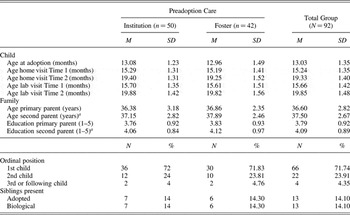
The 92 children (in 92 families) that participated were visited at home and they visited the university, 2 months (Time 1) and 6 months (Time 2) after the children's arrival in The Netherlands. At arrival the children's mean age was 13.03 months (SD = 1.35; Table 1). At the first home and lab visit the children had been in their adoptive family for an average of 2.21 months (SD = 0.19) and 2.64 months (SD = 0.30), respectively. The second visits were on average 6.30 (SD = 0.26) and 6.82 months (SD = 0.48) after arrival, respectively. All visits were conducted with the primary caregiver (90 mothers, 2 fathers), who in this article is referred to as mothers. All parents received questionnaires on their child's preadoption experiences (e.g., months in institutional and/or foster care).
Descriptions of child and family characteristics

Note: No significant differences were found between postinstitutionalized and former foster children.
an = 90 (two missing values because of single parenthood).
Based on preadoption care, children were classified as either postinstitutionalized or former foster children. Postinstitutionalized children had lived in an institution prior to their adoption and had experienced other types of care for a maximum of 1 month (n = 50). Children who had only experienced foster care (or another type of family care) or experienced a combination of both foster care and institutional care were classified as former foster children (n = 42). Sixteen of them had not experienced institutional care at any time. Children with a foster care background had on average experienced 3.65 months of institutional care (range = 0–14) and 9.31 months of foster care (range = 1.44–14.85) before their adoption. To control for this variation, we examined whether the foster children who had not experienced institutional care at any time (pure foster children, n = 16) differed from the children who had received foster care and institutional care (the mixed group, n = 26) on background and outcome variables. As no differences were found, we present the analyses of the foster group (including the pure and mixed group) versus the institutionalized group.
Ninety children were adopted into two-parent families, whereas two children were adopted by single mothers. The mothers' age averaged 36.60 years and fathers' 37.50 years. Most parents had a relatively high education on a scale ranging from 1 (primary school only) to 5 (university; mothers: M = 3.79; fathers: M = 4.09). All children were transracially adopted by White parents.
Measures
Attachment
The Strange Situation procedure (SSP; Ainsworth, Blehar, Waters, & Wall, Reference Ainsworth, Blehar, Waters and Wall1978) is an observational laboratory procedure consisting of eight 3-min episodes with two separations from and reunions with the parent. Attachment in the SSP is classified as secure, insecure-avoidant, insecure-ambivalent, and insecure-disorganized based on the patterns of (in-)secure attachment behavior and the presence of disorganized attachment behavior (Ainsworth et al., Reference Ainsworth, Blehar, Waters and Wall1978; Main & Solomon, Reference Main, Solomon, Greenberg, Cicchetti and Cummings1990). Secure (B) children usually have sensitive caregivers whom they use as a “secure base” when exploring the environment and as a safe haven when they are distressed. Insecure-avoidant (A) children have experienced rejection or uninvolved care, leading to a minimization of their expressions of negative affect, in order to avoid the anticipated rejection of distress signals. Insecure-ambivalent (C) children usually have inconsistently responsive caregivers and maximize negative emotions to evoke care. Secure, ambivalent, and avoidant children show organized strategies of emotion regulation. Disorganized attachment behavior is shown by children who are confronted with an insolvable paradox in stressful circumstances: their caregiver is at the same time a source of fear and the only potential source of comfort (Main & Hesse, Reference Main, Hesse, Greenberg, Cicchetti and Cummings1990). In the SSP, disorganized (D) children show disorganized behavior toward the parent, suggesting a (temporary) breakdown of a consistent and organized attachment strategy while dealing with the stress of the reunion; these children, for example, show contradictory or misdirected attachment behaviors, or fear or apprehension regarding the parent (Main & Solomon, Reference Main, Solomon, Greenberg, Cicchetti and Cummings1990). Because disorganized attachment is thought to be a momentary breakdown of an organized strategy, children classified as D received a secondary best-fitting A/B/C classification for their behavior apart from the disorganized moments.
The videotaped SSPs were coded by two well-trained coders (M.H.v.IJ. and L.R.A.A.) who were blind to the assessment time as well as the children's preadoption care setting. Time 1 and Time 2 assessments of the same child were never coded by the same coder. Administering the SSP twice across 6 months did not result in “practice” effects in other studies using a comparable interval (e.g., Ahnert, Lamb, & Seltenheim, Reference Ahnert, Lamb and Seltenheim2000; Grossmann et al., Reference Grossmann, Grossmann, Fremmer-Bombik, Kindler, Scheuerer-Englisch and Zimmermann2002; Sroufe et al., Reference Sroufe, Egeland, Carlson and Collins2005) or even briefer intervals (e.g., 3 months in Goossens & van IJzendoorn, Reference Goossens and van IJzendoorn1990). The percentages of agreement between both coders were 80% and 67% for the ABC and ABCD classifications, respectively. For the continuous security and disorganization ratings the intraclass intercoder reliabilities were 0.69 and 0.63, respectively. The security scores were computed using the revised Richters, Waters, and Vaughn (Reference Richters, Waters and Vaughn1988) algorithm for attachment security (van IJzendoorn & Kroonenberg, Reference van IJzendoorn and Kroonenberg1990) on the basis of the interactive SSP scores for proximity seeking, contact maintenance, resistance, and avoidance. The algorithm is based on a discriminant function analysis that provides weights for the interactive scales to be used to optimally classify children as securely or insecurely attached. The simplified version leaves out crying behavior as in many studies crying is not coded and the predictive value of the revised algorithm still remains very high (van IJzendoorn & Kroonenberg, Reference van IJzendoorn and Kroonenberg1990). For attachment disorganization all children were assigned a score between 1 (no signs of disorganization) and 9 (definite qualification for disorganized attachment status). Because of technical problems one of the SSP recordings of the second assessment could not be coded.
Indiscriminate friendliness
Indiscriminate friendliness was measured using five multiple-choice questions, each with one of the four answers reflecting indiscriminate friendliness (Chisholm et al., Reference Chisholm, Carter, Ames and Morison1995). At Time 1 and Time 2 mothers reported (a) how friendly their daughter was to new adults, (b) whether she was shy, (c) what she did upon meeting new adults, (d) whether she was willing to go home with a stranger, and (e) whether she had a tendency to wander off without being distressed. Not all mothers had yet observed their child in every situation. For example, at Time 1, 17 mothers were unable to answer Question 4. As earlier research used two subscales for indiscriminate friendliness (items 1–3 versus items 4 and 5; Van Londen, Reference Van Londen2002), we decided to use only the first three items, which were more applicable to the children in our sample. Total scores were computed for children for whom at least two questions were answered. Cronbach α values were 0.65 (n = 82) and 0.65 (n = 87) for Time 1 and Time 2, respectively. Total indiscriminate friendliness scores were transformed to normalize the skewed distribution (1 − 1/[original value + 1]; Tabacknick & Fidell, Reference Tabacknick and Fidell2001).
Maternal sensitivity and child responsiveness
Children's responsiveness and maternal sensitivity were observed at home during 8 min of free play at Time 1 and Time 2 and were coded with the EA Scales (Biringen, Robinson, & Emde, Reference Biringen, Robinson and Emde1998). In this study we have included the sensitivity scale of the EA Scales to examine whether and how parental sensitivity contributed to children's development shortly after adoption. Child responsiveness (7-point rating scale) reflects children's eagerness and willingness to respond to the mother, while taking the affective quality of the response into account. Maternal sensitivity (9-point rating scale) refers to the mother's ability to correctly read and respond to the child's signals, and includes the mother's affective attunement to the child (Biringen et al., Reference Biringen, Robinson and Emde2000). We selected these two scales from the EA Scales because of their specific relevance to our hypotheses. They were also among the most reliable EA Scales with sufficient variance in the current sample to be used in testing our hypotheses on individual differences. Similar selections were made by Zelkowitz, Na, Wang, Bardin, and Papageorgiou (Reference Zelkowitz, Na, Wang, Bardin and Papageorgiou2011) and Koren-Karie, Oppenheim, Dolev, and Yirmiya (Reference Koren-Karie, Oppenheim, Dolev and Yirmiya2009) in their studies on cognitive and behavioral development of toddlers and attachment of preschoolers with autism spectrum disorders, respectively.
In contrast to approaches in which discrete behaviors are counted, the EA Scales make use of global judgments to infer the appropriateness of parent and child behaviors during parent–child interactions (Biringen et al., Reference Biringen, Robinson and Emde2000). Both mother and child scales, and the first and second assessment of all dyads were assessed by different coders, resulting in four coders per dyad. The coders were blind to children's caregiving background and the scores given by the other coders. The intraclass intercoder reliabilities with the expert coder (F.J., trained in line with Biringen, Reference Biringen2005) were 0.77 and 0.79 for responsiveness and 0.76 and 0.89 for sensitivity. Maternal sensitivity and child responsiveness were compared with cutoff scores representing at risk development as reported by Vliegen et al. (Reference Vliegen, Luyten and Biringen2009): maternal sensitivity: risk 1 to 5, nonrisk 5.5 to 6.5, optimal 7 to 9; child responsiveness: risk 1 to 3, nonrisk 3.5 to 4.5, optimal 5 to 7.
Missing data and data analysis
Apart from one missing attachment classification (see above), the attachment of two children could only be classified with the three-way classification system: one child refused to let her mother leave the room (Times 1 and 2), while in another session a procedural mistake prevented proper coding of disorganized attachment (Time 2). For indiscriminate friendliness and the continuous attachment scores missing values were substituted with mean scale scores (range = 0–3 missings). Results were similar when children with missing values were excluded from the analyses.
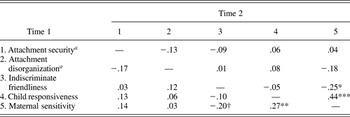
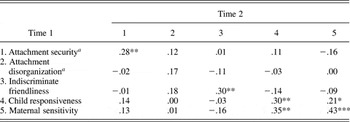
We first present the attachment classifications of the postinstitutionalized and former foster children at Time 1 and Time 2, and compare the classifications of the adopted children with the normative distribution found in middle class nonclinical samples in North America (N = 2,104; 15% A, 62% B, 9% C, and 15% D; van IJzendoorn et al., Reference van IJzendoorn, Schuengel and Bakermans-Kranenburg1999) using Multinom (Kroonenberg, Reference Kroonenberg2009). To examine child responsiveness, the continuous attachment ratings, and indiscriminate friendliness over time and to compare the postinstitutionalized and former foster children, we present repeated-measures analyses of variance (ANOVAs). Maternal sensitivity was included as a covariate to investigate its influence on children's attachment and indiscriminate friendliness. Because maternal sensitivity and child responsiveness were measured in the same situation, sensitivity was not included as a covariate in the analysis of responsiveness. A previous report of the current sample showed that former foster children outperformed the postinstitutionalized children on cognitive and motor development (Van den Dries et al., Reference Van den Dries, Juffer, van IJzendoorn and Bakermans-Kranenburg2010), and therefore we included these variables as covariates in the repeated-measures ANOVAs. When their contribution was not significant, the covariates were removed from the final analyses. Correlations were computed between concurrent outcome variables (Table 2) and for the continuity between Time 1 and Time 2 (Table 3). Two-tailed tests were used in all analyses.
Intercorrelations between outcome variables at Time 1 and Time 2 (N = 92)

Note: The correlation coefficients below the diagonal are for Time 1 and above the diagonal are for Time 2.
aContinuous scores.
†p = .053. *p < .05. **p < .01. ***p < .001.
Correlations between 1 outcome variables at Time 1 and Time 2 (N = 92)

aContinuous scores.
*p < .05. **p < .01. ***p < .001.
Results
Preliminary analyses
Preliminary analyses did not show any differences between postinstitutionalized and former foster children on relevant child variables (age at adoption, physical growth; Van den Dries et al., Reference Van den Dries, Juffer, van IJzendoorn and Bakermans-Kranenburg2010; ordinal position in the adoptive family), nor on parent variables (parents' age and education; Table 1).
Attachment
Attachment classifications
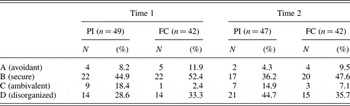
Two months after arrival, 10% of the children were classified as avoidant, 48% as secure, 11% as ambivalent, and 31% as disorganized. Six months after arrival the distribution was: 7% avoidant, 42% secure, 11% ambivalent, and 40% disorganized (see Table 4 for separate distributions of the postinstitutionalized and former foster children). There were no significant differences between the distributions of the postinstitutionalized and former foster children, χ2 (3, n = 91) = 6.01 and χ2 (3, n = 89) = 3.24, ps > .05, at Time 1 and Time 2, respectively.
Attachment classifications of postinstitutionalized (PI) and former foster care (FC) children at Time 1 and Time 2

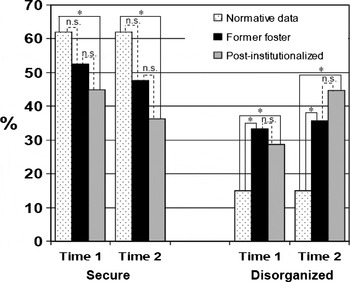
Compared to the normative distribution of attachment (15% A, 62% B, 9% C, and 15% D; van IJzendoorn et al., Reference van IJzendoorn, Schuengel and Bakermans-Kranenburg1999), the postinstitutionalized children showed significantly less secure and more disorganized attachments at both assessments (χ2 values ranging from 6.08 to 32.47, ps < .05, with N = 49 and N = 47 for Time 1 and Time 2, respectively; see Figure 1). The former foster children were as often securely attached as the nonadopted children, χ2 (1, N = 42) = 1.65 and χ2 (1, N = 42) = 3.69, ps > .05, at Time 1 and Time 2, respectively (see Figure 1), but showed more disorganized attachments, χ2 (1, N = 42) = 11.07 and χ2 (1, N = 42) = 14.13, ps < .05 for Time 1 and 2, respectively (see Figure 1).
The percentages of secure and disorganized attachment classification for former foster children, postinstitutionalized children, and normative data from van IJzendoorn et al. (Reference van IJzendoorn, Schuengel and Bakermans-Kranenburg1999).

The ABCD classifications of the children were not stable in the 4 months between Time 1 and Time 2 (κ = 0.01, 0.04, and −0.03, ps > .05, for the total sample, former foster, and postinstitutionalized children, respectively). The three-way ABC-classifications were more stable over time (κ = 0.24, p < .01 for the total sample). For the split between organized versus disorganized attachments, there was no stability over time (κ = 0.03, ns, for the total sample).
Children with a secure attachment classification at Time 1 had equally sensitive mothers as children with an insecure attachment classification at the first assessment, t (89) = .58, p > .05, and the same was true for children with a disorganized versus an organized attachment classification at Time 1, t (87) = −1.17, p > .05. We formed four groups of children based on their attachment classifications at Time 1 and Time 2, forming one group for every possible combination of secure (B) and insecure (non-B) classifications at Times 1 and 2 (thus, B–B, non-B–non-B, B–non-B, and non-B–B). In an ANOVA we found no differences in maternal sensitivity between these four groups of children, F (3, 85) = 0.13, p > .05. When the four groups of children were based on the presence versus absence of disorganized attachments at Time 1 and Time 2, we again found a nonsignificant outcome, F (3, 85) = 1.10, p > .05.
Continuous attachment scores
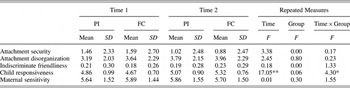
Attachment security scores were significant correlated over time (r = .28, p < .01), whereas this was not true for disorganization (r = .17, p > .05; Table 3). Neither security nor disorganization was significantly correlated with the other outcome variables (Tables 2 and 3). Using repeated-measures ANOVAs, we found no differences between postinstitutionalized and former foster children on the continuous attachment security and disorganization scores. We did not find changes in security or disorganization scores over time, nor did we find an interaction between time and preadoption care (Table 5).
Repeated measures ANOVAs for continuous attachment scores, indiscriminate friendly behavior, child responsiveness and maternal sensitivity of postinstitutionalized (PI) (n = 50) and former foster care (FC) children (n = 42)

*p < .05. **p < .01.
Indiscriminate friendliness
Children of more sensitive adoptive mothers tended to show less indiscriminate friendliness (r = −.20, p = .053 and r = −.25, p < .05, for Time 1 and Time 2, respectively; Table 2). No relation was found between indiscriminate friendliness and the other variables. Scores for indiscriminate friendliness were significantly correlated over time (r = .30, p < .01; Table 3).
Postinstitutionalized children did not show more indiscriminate friendliness than former foster children, nor did we find a change in indiscriminate friendliness over time or an interaction between time and preadoption care (Table 5). Maternal sensitivity and child cognitive development at Time 1 were significant covariates in the repeated-measures ANOVA, F (1, 88) = 6.35, p < .05, partial η2 = 0.07; F (1, 88) = 7.17, p < .01, partial η2 = 0.08, respectively, revealing that children with more sensitive adoptive mothers showed less indiscriminate friendliness than children with less sensitive adoptive mothers, and that children with higher cognitive scores showed less indiscriminate friendliness than children with lower cognitive scores.
Maternal sensitivity and child responsiveness
We examined whether the mothers of postinstitutionalized and former foster children differed in their sensitivity scores and investigated possible changes over time. A repeated-measures ANOVA for maternal sensitivity (Table 5) showed that the mothers of former foster and postinstitutionalized children were equally sensitive and that their sensitivity scores did not change over time. Time 1 and Time 2 sensitivity scores were significantly correlated, r (92) = .43, p < .01 (Table 3). The average maternal sensitivity scores (means = 5.64–5.89) were within the nonrisk zone (5.5–6.5; Vliegen et al., Reference Vliegen, Luyten and Biringen2009).
Using a repeated-measures ANOVA, we found an increase in child responsiveness over time (partial η2 = 0.16), indicating a positive change of the adopted children's responsiveness over time. Postinstitutionalized and former foster children did not differ on responsiveness, but a significant interaction between time and preadoption care showed that former foster children presented a larger increase in responsiveness than postinstitutionalized children (partial η2 = 0.05). The adopted children's mean responsiveness scores (range = 4.67–5.32; Table 5) were well above the cutoff scores for at risk development (1 to 3; Vliegen et al., Reference Vliegen, Luyten and Biringen2009), at both times. Time 1 and Time 2 responsiveness scores were significantly correlated, r (92) = .30, p < .01 (Table 3).
Discussion
In a short-term longitudinal study, we examined the social–emotional development of internationally adopted infant girls from institutional or foster care in China, 2 and 6 months after adoptive placement. To date, hardly any adoption study has examined the development of former foster and postinstitutionalized children separately. Our study allowed us to test whether preadoption family care has beneficial effects on children's social–emotional development compared to preadoption institutional care. In addition, it provided us with the opportunity to test whether differences in preadoption care settings influence children's catch-up after adoption.
Our most compelling findings pertain to child responsiveness and indiscriminate friendliness. Children with more sensitive adoptive mothers and children with higher cognitive scores showed less indiscriminate friendliness. The postinstitutionalized and former foster children did not differ on indiscriminate friendliness, and this behavior did not change over time. In both groups of adopted children, responsiveness was in the nonrisk range and increased over time, but we found a larger increase in child responsiveness over time for the former foster children compared to the postinstitutionalized children.
We found no differences in the attachment classifications of the postinstitutionalized and former foster children, but compared to the normative distribution the former foster children showed a similar percentage of secure attachment, whereas postinstitutionalized children showed significantly more insecure attachments. However, both groups of adopted children showed more disorganized attachments compared to the normative distribution. The continuous attachment security and disorganization scores of the adopted children did not change over time. Maternal sensitivity was not related to child attachment. Adoptive mothers' sensitivity scores were on average in the nonrisk range and did not change between the first and second assessment, suggesting that maternal sensitivity was a stable trait.
This study has several limitations. Like in most adoption studies exact details on quality of preadoption care could not be established reliably (Juffer et al., in press), which hampers insight in the individual developmental pathways of the children. The caregiving background of the former foster children was heterogeneous. However, no differences in study outcomes were found when the “pure” foster children were compared with the children who had received both institutional and foster care. Indiscriminate friendliness was measured with a questionnaire, which may be less valid than observations (Bruce et al., Reference Bruce, Tarullo and Gunnar2009; Lyons-Ruth, Bureau, Riley, & Atlas-Corbett, Reference Lyons-Ruth, Bureau, Riley and Atlas-Corbett2009), but which is similar to most research on indiscriminate friendliness (Bakermans-Kranenburg et al., in press). Although convergence among these somewhat varying interviews and questionnaires for indiscriminate friendliness has been demonstrated (Zeanah et al., Reference Zeanah, Smyke and Dumitrescu2002), it should be noted that in the case of child attachment behavior caregiver report is generally considered less valid than observations. The validity of the Attachment Q-Sort (Waters & Deane, Reference Waters and Deane1985) was meta-analytically established for use by observers, but not for self-report use by parents or caregivers (van IJzendoorn, Vereijken, Bakermans-Kranenburg, & Riksen-Walraven, Reference van IJzendoorn, Vereijken, Bakermans-Kranenburg and Riksen-Walraven2004). In the Bucharest Early Intervention Project indiscriminate social behavior was assessed using the Stranger at the Door Procedure, where a stranger rings at the door and invites the child to go for a walk. In this study the convergence of the child's behavior in this observational procedure and caregiver report of indiscriminate behavior was substantial (κ = 0.70; see Bakermans-Kranenburg et al., in press), which suggests that caregivers can provide valuable information about children's behavior in this regard. Still, observational measures of indiscriminate friendliness may provide important information in addition to caregiver reports of (over-)friendly behavior. Further, the free-play situation was observed for 8 min, which may be too short for a reliable measurement of sensitivity (Biringen & Easterbrooks, Reference Biringen and Easterbrooks2012). Nevertheless, EA sensitivity scores based on comparably short episodes have been found to be related to attachment security in other samples (e.g., Ziv, Aviezer, Gini, Sagi, & Koren-Karie, Reference Ziv, Aviezer, Gini, Sagi and Koren-Karie2000). As children's development is influenced by multiple determinants (Cicchetti & Toth, Reference Cicchetti and Toth2009), including factors as parental attachment representations (Dozier et al., Reference Dozier, Stovall, Albus and Bates2001) and paternal sensitivity would be important. However, this was not feasible in the current study.
From the perspective of developmental psychopathology, studies on internationally adopted children are highly relevant because they can be seen as “natural experiments” to examine deviations from normal development due to (severely) inadequate preadoption rearing conditions and possible catch-up after adoption (Cicchetti & Toth, Reference Cicchetti and Toth2009; Haugaard & Hazan, Reference Haugaard and Hazan2003; O'Connor, Reference O'Connor2003; Rutter, O'Connor, & The English and Romanian Adoptees Study Team, Reference Rutter and O'Connor2004). For the postinstitutionalized adopted children in this study we found a significant deviation from the normative attachment distribution that was probably due to unresponsive preadoption institutional care (e.g., Smyke et al., Reference Smyke, Zeanah, Fox, Nelson and Gunthrie2010). This outcome is consistent with several other studies on the attachment of postinstitutionalized adopted children (e.g., O'Connor et al., Reference O'Connor, Marvin, Rutter, Olrick and Britner2003). Although the postinstitutionalized children in our study probably received relatively good physical and nutritional care in China, as indicated by their only minor growth delays, the absence of responsive care was supported by their large cognitive delays (Van den Dries et al., Reference Van den Dries, Juffer, van IJzendoorn and Bakermans-Kranenburg2010). The normative percentage of secure attachments of the former foster children may be the result of somewhat better preadoption care, which is consistent with the smaller cognitive and motor delays of the former foster children compared to the postinstitutionalized children (Van den Dries et al., Reference Van den Dries, Juffer, van IJzendoorn and Bakermans-Kranenburg2010). However, for the former foster children the adoption was also inextricably associated with the separation and loss of their foster parent(s) in China, which may have had a negative effect on the development of a new attachment relationship with the adoptive parent (Bowlby, Reference Bowlby1982). For the former foster children, the separation from their foster parents in China turned into an unexpected and permanent loss of their attachment figures. This unforeseen loss and the transition to an unfamiliar environment may have be an overwhelming experience resulting in an inability for some children to use an organized attachment strategy in stressful situations, at least in the short run. They may need more time to work through their loss experience (Bowlby, Reference Bowlby1980), and to (re-)establish an organized attachment relationship with their new caregiver. The experience of loss of an attachment figure has been shown to be disorienting in adults as well as in children (Hesse & Main, Reference Hesse and Main2006).
In our study, maternal sensitivity was not associated with attachment. This could be due to the broad concept of sensitivity measured in this study. The EA Scales do not only include the concept of parental responsiveness as measured with the original Ainsworth's sensitivity scale but also include components like variety and creativity in play (Biringen et al., Reference Biringen, Robinson and Emde2000), which may be unrelated to attachment. Nevertheless, several studies have found a relation between the EA sensitivity scale and infant attachment (Aviezer, Sagi, Joels, & Ziv, Reference Aviezer, Sagi, Joels and Ziv1999; Easterbrooks, Biesecker, & Lyons-Ruth, Reference Easterbrooks, Biesecker and Lyons-Ruth2000; Koren-Karie et al., Reference Koren-Karie, Oppenheim, Dolev and Yirmiya2009; Ziv et al., Reference Ziv, Aviezer, Gini, Sagi and Koren-Karie2000). It should be noted that although the relation between sensitivity and attachment is empirically well established, the strength of this association is modest and other parenting dimensions also play an important role (De Wolff & van IJzendoorn, Reference De Wolff and van IJzendoorn1997). This is consistent with the developmental psychopathological perspective, which underscores the presence of multiple determinants and contrasts with the idea of invariant relations between causes and outcomes (Cicchetti & Toth, Reference Cicchetti and Toth2009). Moreover, Stovall and Dozier (Reference Stovall and Dozier2000) indicated that sensitively responding to adopted/foster children's needs may be not enough to influence these children's attachment security. Parents may have to act “therapeutically,” for example, by observing, understanding and challenging children's alienating behaviors. Finally, as especially sensitive responses to infant distress may influence attachment (McElwain & Booth-LaForce, Reference McElwain and Booth-LaForce2006), the use of a free-play situation to measure sensitivity may not have been ideal as it stimulates the expression of positive emotions more than that of negative emotions. In addition, like other coding systems for sensitivity, the sensitivity scale of the EA Scales may not be equipped for the prediction of disorganized attachments compared to systems using more extreme behaviors such as frightening or extremely insensitive parental behavior (Hesse & Main, Reference Hesse and Main2006; Madigan et al., Reference Madigan, Bakermans-Kranenburg, van IJzendoorn, Moran, Pederson and Benoit2006; Out, Bakermans-Kranenburg, & van IJzendoorn, Reference Out, Bakermans-Kranenburg and van IJzendoorn2009). The nonhostility scale of the EA Scales, which includes more extreme forms of maternal behavior such as threatening and/or frightening behavior, may be more useful in this regard. However, in previous studies a link between maternal hostility and attachment disorganization has not been found (Easterbrooks et al., Reference Easterbrooks, Biesecker and Lyons-Ruth2000; Ziv et al., Reference Ziv, Aviezer, Gini, Sagi and Koren-Karie2000). In the current study we did not code maternal hostility as in our nonstressful play context low variability in hostility scores was expected (Biringen et al., Reference Biringen, Damon, Grigg, Mone, Ripp-Siegel, Skillern and Stratton2005; Ziv et al., Reference Ziv, Aviezer, Gini, Sagi and Koren-Karie2000).
At both assessments the postinstitutionalized and former foster children showed higher rates of disorganized attachments to the adoptive parent (29% to 45%; Table 4) than did normative groups (15%; van IJzendoorn et al., Reference van IJzendoorn, Schuengel and Bakermans-Kranenburg1999). These outcomes converge with a meta-analysis on the attachment of adopted children where an average rate of 31% disorganized attachment was found across 11 studies on adopted children (N = 468; Van den Dries et al., Reference Van den Dries, Juffer, van IJzendoorn and Bakermans-Kranenburg2009). The current study thus confirms the risk of disorganized attachment for children shortly after placement in an adoptive family.
However, although the rate of disorganized attachments in adopted children indeed is significantly elevated compared to nonadopted children, institutionalized children present much higher rates of disorganization. Van IJzendoorn et al. (in press) found 72.8% disorganized attachments to the favorite caregiver across six studies of institutionalized children (vs. 15% in normative populations), an alarmingly high overrepresentation because attachment disorganization is a powerful predictor of later psychopathology (Lyons-Ruth & Jacobvitz, Reference Lyons-Ruth, Jacobvitz, Cassidy and Shaver2008; van IJzendoorn et al., Reference van IJzendoorn, Schuengel and Bakermans-Kranenburg1999). The outcomes reported by van IJzendoorn et al. (in press) suggest that the intermediate rate of disorganized attachments in postinstitutionalized adopted children reflects both risk (compared to nonadopted children) and resilience (compared to institutionalized children). Extended to the overall adjustment of adopted children, the current findings fit in with meta-analyses showing massive catch-up after adoption at all domains of development (van IJzendoorn & Juffer, Reference van IJzendoorn and Juffer2006) as well as some remaining delays, for example, regarding behavior problems and mental health referrals (Juffer & van IJzendoorn, Reference Juffer and van IJzendoorn2005).
The adopted children's attachment classifications were not stable over time, suggesting an ongoing rearrangement process of their attachment system as an adaptation to life in the adoptive family. This instability is congruent with a study that showed a mixture of various attachment behaviors in foster children in the first months after placement (Stovall & Dozier, Reference Stovall and Dozier2000). Bowlby (Reference Bowlby1982, pp. 364–365) described attachment in young children as developing “from lability to stability.” In infancy the attachment pattern of the child is more dependent on his experiences with the parent than on the behavioral organization and mental representations within the child himself. According to Bowlby, the inner organization of attachment (internal working model) becomes more stable after the early childhood years. Many children in our study developed secure and organized attachment relationships, but a substantial number of children developed disorganized relationships. For most of these children their ABC-classifications were stable and suggest a partial rearrangement of the attachment system, specifically regarding (dis-)organization of attachment. For adopted children, disorganization may have a different meaning and may reflect “a lack of a coherent strategy for obtaining felt security from a new parent (rather than a lapse in strategy)” (Stovall & Dozier, Reference Stovall and Dozier2000, p. 153), implying that reorganization is necessary to develop coherent attachment strategies. One study has shown that institutionalized children classified as disorganized had the highest security scores 2 years after adoption (Vorria et al., Reference Vorria, Papaligoura, Sarafidou, Kopakaki, Dunn and van IJzendoorn2006), which may suggest that especially these children are open to changes in attachment.
The comparable levels of indiscriminate friendliness in postinstitutionalized and former foster children were unexpected, as higher levels were hypothesized for postinstitutionalized children. Nevertheless, these results converge with the outcomes for disinhibited behavior of former foster and postinstitutionalized children in the study of Bruce et al. (Reference Bruce, Tarullo and Gunnar2009). Rather than, or in addition to, the adaptive value of indiscriminate friendliness to increase the chance of being cared for, it has also been suggested that children may develop indiscriminate friendliness when they lack contingent interactions with stable caregivers, necessary to develop preferences for familiar individuals (Dobrova-Krol, van IJzendoorn, Bakermans-Kranenburg, & Juffer, Reference Dobrova-Krol, Bakermans-Kranenburg, van IJzendoorn and Juffer2010). Our postinstitutionalized children may have received just enough care in China to develop such preferences. This is in line with the assumed improvements in care in Chinese institutions (Johnson, Reference Johnson2004; Van Schaik, Wolfs, & Geelen, Reference Van Schaik, Wolfs and Geelen2009), especially in institutions benefiting from international adoption fees (Johnson, Reference Johnson2004). From another perspective, the two groups of adopted children in our study may have developed similar rates of indiscriminate friendliness because the former foster children also developed or maintained some indiscriminately friendly behavior during their stay in the Chinese foster families, for example, due to previous adversity in their life. A normative period of indiscriminate behavior is present early in the first year of life. Beginning about 2 to 3 months of age, infants are quite interested in engaging in social interaction with almost anyone. At 7 to 9 months this changes and for the first time children begin to exhibit wariness with strangers. This suggests inhibition of the affiliative motivational system described by Bowlby (Reference Bowlby1980). As we suggested elsewhere (Bakermans-Kranenburg et al., in press), children who experience serious neglect may pass the sensitive period for inhibition without the development of a selective or specific attachment in the context of a more or less continuous relationship, so that indiscriminate friendliness persists.
Moreover, when indiscriminate friendliness is the result of biological programming by the neglectful environment (mainly in the area of capacity for focused attention and effortful control, as suggested in Bakermans-Kranenburg et al., in press), the core difficulty for children with indiscriminate friendliness may be a lack of self-control. Indeed, Bruce et al. (Reference Bruce, Tarullo and Gunnar2009) found indiscriminate friendliness associated with attention regulation. Specifically, it may be that the inability to appropriately inhibit either verbal or physical approaches to strangers might be a broader reflection of attention and behavior regulatory problems. It is thus important to include a measure of self control in future assessments of our sample. Our finding that indiscriminate behavior was associated with lower cognitive scores is convergent with outcomes reported by Rutter and colleagues (Reference Rutter, Colvert, Kreppner, Beckett, Castle and Groothues2007) for formerly institutionalized adopted children, and may be associated with attention regulation problems.
The finding that the children formed an attachment relationship with the adoptive parents soon after the adoption suggests that there may have been some basic social contacts available to the children in China (in the foster homes as well as in the institutions). However, it should of course be doubted whether in the preadoption period the institutionalized children received stable and responsive care. The higher cognitive scores of children with lower levels of indiscriminate friendliness may suggest that these children were indeed able to profit from some basic (social) stimulation in China. Sensitive adoptive mothers, as assessed with the EA sensitivity scale, reported lower levels of indiscriminate friendliness for their children compared to the higher levels of indiscriminate friendliness reported by less sensitive adoptive mothers. This suggests some flexibility in indiscriminate friendliness in the first months after adoption, and an influence of parenting on its development. Emotionally available and sensitive parents may trigger and reinforce selective attachment behavior in their adopted children more successfully do than less sensitive parents.
We found a significant increase in child responsiveness over time during the first 6 months in the adoptive family. Of interest, after a transition from suboptimal rearing conditions in China to a more nurturing adoptive family, children's attachments did not (yet) change into a more secure and organized direction (no significant changes in the continuous attachment scores), but their responsiveness did change in a positive direction. This may suggest that in the context of interactions with an adoptive parent whose sensitivity on average was adequate and stable, children's responsiveness was more sensitive to positive change of the environment than was attachment. We also found larger increases in child responsiveness for the former foster children than for the postinstitutionalized children. The former foster children may have felt at ease in the adoptive family more rapidly, due to their familiarity with family rearing, and may therefore benefit more or quicker from this environment. For postinstitutionalized children it may take longer before they respond to their new parents in enhanced affectively attuned ways. Our findings illustrate that after exposure to adversity the same protective factor (in this study adoption into a sensitive adoptive family) can be associated with different developmental trajectories (Cicchetti & Toth, Reference Cicchetti and Toth2009).
In this study the use of the EA Scales as an observational measure for parent–child interaction resulted in the discovery of effects relevant for theory and clinical practice. First, with the parental sensitivity scale we found that more sensitive mothers had children with less indiscriminate friendliness. It would be interesting to experimentally test whether increased parental sensitivity also results in decreased indiscriminate friendliness in adopted or foster children. A meta-analysis has shown that parental sensitivity can be enhanced by attachment-based interventions (Bakermans-Kranenburg et al., Reference Bakermans-Kranenburg, van IJzendoorn and Juffer2003), but as far as we know results on indiscriminate friendliness have not been reported for this type of interventions. Second, with the child responsiveness scale we found a significant increase over time in children's eagerness and ability to respond to a new attachment figure, their adoptive parent. In addition, we found an even larger increase in responsiveness in children who were already familiar with a family setting. As no changes were found for attachment security or disorganization in this period of 6 months after adoption, this may suggest that compared to an observational assessment of attachment the responsiveness scale is more sensitive to trace changes in children's behavior after a positive transition. Alternatively, observed child responsiveness may reveal changes more rapidly after a transition to an enriched environment, whereas observed attachment may show changes in the long run.
Conclusion
Our findings contribute to the body of research showing that adoption is a remarkably positive intervention in the life of children who would in most cases otherwise grow up in institutional care (van IJzendoorn & Juffer, Reference van IJzendoorn and Juffer2006). The adopted children who participated in this study presented lower rates of disorganized attachments than the rate of disorganized attachments reported for institutionalized children. Moreover, after the transition to a more nurturing rearing environment, the adopted children showed a significant increase in their responsiveness to their new adoptive parent. Attachment did not change in a short period of 6 months after adoption, implying that child responsiveness may be more sensitive to change than is attachment. The relatively stable attachment classifications of the children seem to converge with the outcomes of a meta-analysis on the attachment of adopted children (Van den Dries et al., Reference Van den Dries, Juffer, van IJzendoorn and Bakermans-Kranenburg2009). Although adopted children showed a remarkable “spontaneous” catch-up in several developmental domains (e.g., cognitive development, van IJzendoorn, Juffer, & Klein-Poelhuis, Reference van IJzendoorn, Juffer and Klein-Poelhuis2005; and physical growth, van IJzendoorn, Bakermans-Kranenburg, & Juffer, Reference van IJzendoorn, Bakermans-Kranenburg and Juffer2007), the catch-up for attachment was less complete. Meta-analytic results indicated that adopted children showed higher rates of attachment disorganization and that children who were adopted after their first birthday also showed an elevated risk for developing insecure attachment relationships (Van den Dries et al., Reference Van den Dries, Juffer, van IJzendoorn and Bakermans-Kranenburg2009).
For the adopted children in the current study we found lower rates of disorganized attachments than the rates reported for currently institutionalized children. However, we also conclude that adopted children show more disorganized attachments than nonadopted children. Early attachment-based interventions are needed to decrease the rate of disorganized attachments and support adoptive parents (Cicchetti, Rogosch, & Toth, Reference Cicchetti, Rogosch and Toth2006, Reference Cicchetti, Rogosch and Toth2011; Dozier, in press; Dozier, Albus, Fisher, & Sepulveda, Reference Dozier, Albus, Fisher and Sepulveda2002; Dozier, Peloso, Lewis, Laurenceau, & Levine, Reference Dozier, Peloso, Lewis, Laurenceau and Levine2008; Juffer, Bakermans-Kranenburg, & van IJzendoorn, Reference Juffer, Bakermans-Kranenburg and van IJzendoorn2005, Reference Juffer, Bakermans-Kranenburg and van IJzendoorn2008; Moss et al., Reference Moss, Dubois-Comtois, Cyr, Tarabulsy, St-Laurent and Bernier2011; Tarabulsy et al., Reference Tarabulsy, Pascuzzo, Moss, St-Laurent, Bernier and Cyr2008; Toth, Rogosch, Manly, & Cichetti, Reference Toth, Rogosch, Manly and Cicchetti2006).
In a way, our study provided a double “natural experiment” because it not only examined the development of children adopted from less optimal living conditions into more nurturing families, but it also enabled the comparison of two preadoption rearing arrangements—institutional and foster care—and their effects on child development after adoption. In a previous report of the same sample (Van den Dries et al., Reference Van den Dries, Juffer, van IJzendoorn and Bakermans-Kranenburg2010) we found that children who had experienced preadoption foster care had better cognitive and motor skills than children who had been in preadoption institutional care. From our current findings we infer that preadoption foster care is more beneficial for the development of child responsiveness after adoptive placement, compared to preadoption institutional care. In addition, compared to the normative distribution, the former foster children showed a similar percentage of secure attachment, whereas postinstitutionalized children showed significantly more insecure attachments. We therefore conclude that preadoption foster care is preferable to preadoption institutional care. Central authorities, child welfare and child protection services, and adoption agencies should encourage efforts to realize more foster-care placements when children cannot be cared for in their own (extended) family.