Child maltreatment is a significant public health problem. In 2006, 905,000 US children were documented as victims of maltreatment (i.e., 12.1 per 1,000 children), with the highest rate occurring among young children (16.5 per 1,000 for birth to age 3; US Department of Health and Human Services, 2008). Child maltreatment portends an array of behavioral and emotional problems, including depression and other internalizing behavior problems (Johnson et al., Reference Johnson, Kotch, Catellier, Winsor, Dufort and Hunter2002; Toth, Manly, & Cicchetti, Reference Toth, Manly and Cicchetti1992) as well as aggression and other externalizing behavior problems (Keiley, Howe, Dodge, Bates, & Pettit, Reference Keiley, Howe, Dodge, Bates and Pettit2001; Stouthamer-Loeber, Loeber; Homish, & Wei, Reference Stouthamer-Loeber, Loeber, Homish and Wei2001; Widom, Reference Widom and Hansen1998). The earlier maltreatment occurs, the more likely it is to recur and the more detrimental its developmental toll (Cicchetti, Toth, & Maughan, Reference Cicchetti, Toth, Maughan, Sameroff, Lewis and Miller2000; Keiley et al., Reference Keiley, Howe, Dodge, Bates and Pettit2001). Researchers are moving beyond the exploration of direct influences of maltreatment and toward an examination of the developmental processes and mechanisms in this pathway (Cicchetti & Rogosch, Reference Cicchetti and Rogosch1997; Kim & Cicchetti, Reference Kim and Cicchetti2006). In order to develop effective treatments for maltreated children, we must discern the processes through which maltreatment contributes to children's maladjustment and identify protective factors that can lessen these effects.
Our study is guided by a developmental psychopathology perspective and by attachment theory, which posit that negative experiences in parent–child relationships are incorporated into negative perceptions of the self and others, which forecast later emotional adjustment (Bowlby, Reference Bowlby1969/1982; Kim & Cicchetti, Reference Kim and Cicchetti2004; Sroufe, Carlson, Levy, & Egeland, Reference Sroufe, Carlson, Levy and Egeland1999). Maltreatment may contribute to a sense of self as unworthy, resulting in lower self-esteem and increased feelings of loneliness (Harter, Reference Harter1998; Loos & Alexander, Reference Loos and Alexander1997). These negative self-perceptions, in turn, may lead to poorer mental health. Previous research has established links between maltreatment and self-perceptions, as well as between self-perceptions and adjustment, but evidence supporting a mediated process is sparse. At the same time, moderating influences may be operating to enhance maltreated children's outcomes. For example, developmental and attachment theory and research would predict that the experience of positive relationships and social support may offset the deleterious outcomes of maltreatment.
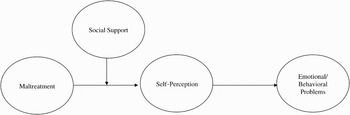
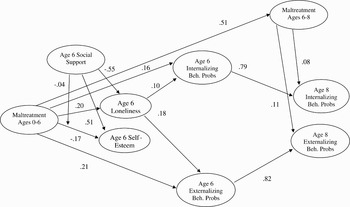
Currently, there is a need for an examination of how these mediated and moderated processes work in concert. In developmental research, combining mediation and moderation approaches may be particularly informative in assessing the generalizability of a mediated effect (Morgan-Lopez & MacKinnon, Reference Morgan-Lopez and MacKinnon2006). In mediated moderation models, the path from the predictor to the mediator (e.g., early maltreatment to self-perception) depends on the level of a moderator (e.g., social support), whereas the effect of the mediator on the outcome (e.g., emotional and behavioral problems) remains constant (Morgan-Lopez & MacKinnon, Reference Morgan-Lopez and MacKinnon2006). From a developmental psychopathology perspective, this approach allows for the statistical examination of the conjoint influences of risk and protective factors on outcomes, and may reveal how protective factors alter maladaptive pathways. Such analyses may point to subgroups for whom particular interventions might be most effective. Using an attachment framework, we will examine how maltreatment influences self-perception, which in turn influences emotional and behavioral outcomes, and will examine social support as a moderator of this pathway (Figure 1).
A conceptual model for the relations among maltreatment, social support, self-perception, and emotional and behavior problems.

The Mediating Role of Self-Perception in Emotional and Behavioral Outcomes of Maltreatment
In this study, we will examine the role of two forms of self-perception: self-esteem (as a measure of positive or negative perceptions of or attitudes toward one's self) and loneliness (as a measure of feelings about one's self in relationships with others). These self-perceptions can be viewed as causes of social behaviors (Rosenberg & Rosenberg, Reference Rosenberg and Rosenberg1978). Low self-esteem (Battle, Jarratt, Snit, & Precht, Reference Battle, Jarratt, Smit and Precht1988; Brown, Bifulco, & Andrews, Reference Brown, Bifulco and Andrews1990; Coplan, Findlay, & Nelson, Reference Coplan, Findlay and Nelson2004; Rawson, Reference Rawson1992) and loneliness and social isolation (Hymel, Rubin, Rowden, & LeMare, Reference Hymel, Rubin, Rowden and LeMare2004; Lau, Chan, & Lau, Reference Lau, Chan and Lau1999) are significantly related to depression and internalizing behavior problems. Such findings are consistent with a hopelessness model of depression, which posits that negative self-perceptions (in response to negative life events) result in hopelessness and depression (Abela & Payne, Reference Abela and Payne2003; DuBois, Felner, Sherman, & Bull, Reference DuBois, Felner, Sherman and Bull1994). These difficulties also appear to be related to conduct problems and externalizing behavior problems (Asher, Parkhurst, Hymel, & Williams, Reference Asher, Parkhurst, Hymel, Williams, Asher and Coie1990; Qualter & Munn, Reference Qualter and Munn2002; Rosenberg & Rosenberg, Reference Rosenberg and Rosenberg1978), perhaps in order to augment or repair negative self-perceptions (Rosenberg & Rosenberg, Reference Rosenberg and Rosenberg1978).
At the same time, self-perceptions are also the product or consequence of social interactions and experiences (Rosenberg & Rosenberg, Reference Rosenberg and Rosenberg1978). That is, negative life experiences may bring about negative self-perceptions, which in turn relate to maladaptive behavioral and emotional outcomes (Coplan et al., Reference Coplan, Findlay and Nelson2004; DuBois et al., Reference DuBois, Felner, Sherman and Bull1994). These processes may be particularly salient for children who experience childhood maltreatment. Maltreatment is associated with negative perceptions of self (Bolger, Patterson, & Kupersmidt, Reference Bolger, Patterson and Kupersmidt1998; Egeland, Sroufe, & Erickson, Reference Egeland, Sroufe and Erickson1983; Feiring, Taska, & Chen, Reference Feiring, Taska and Chen2002; Toth, Cicchetti, Macfie, & Emde, Reference Toth, Cicchetti, Macfie and Emde1997) and higher loneliness (Loos & Alexander, Reference Loos and Alexander1997). The tendency to process self-referent information negatively may put maltreated individuals at increased risk for depression (Loos & Alexander, Reference Loos and Alexander1997; Moran & Eckenrode, Reference Moran and Eckenrode1992; Stein, Burden Leslie, & Nyamathi, Reference Stein, Burden Leslie and Nyamathi2002; Steinberg, Gibb, Alloy, & Abramson, Reference Steinberg, Gibb, Alloy and Abramson2003), as well as for aggression and acting out behaviors (Dodge, Pettit, Bates, & Valente, Reference Dodge, Pettit, Bates and Valente1995; Kinard, Reference Kinard1980).
Much of the literature in this area has been cross-sectional, and evidence for a fully tested, longitudinal mediation pathway is sparse. One compelling exception is Kim and Cicchetti's (Reference Kim and Cicchetti2004) work addressing the role of self-esteem and social competence as mediators of the relations between maltreatment/mother–child relationship quality and children's adjustment. Using longitudinal data, the authors found that maltreatment influenced internalizing and externalizing symptoms directly at Time 1 as well as indirectly through Time 1 social competence. The effects of mother–child relationship quality (although not maltreatment) on Time 2 internalizing and externalizing symptoms was completely mediated through its influences on self-esteem. Our study will also examine how maladaptive experiences with parents become incorporated into self-perceptions and subsequent behavior and will extend this research by examining how these mediated processes may differ according to the level of social support.
The Moderating Role of Social Support
Despite the evidence for the deleterious outcomes of maltreatment, some maltreated children show resilience or adaptation in the face of adversity (Cicchetti & Rogosch, Reference Cicchetti and Rogosch1997). From an attachment perspective, heterogeneity in outcomes may be accounted for by corrective relationship experiences (Cicchetti et al., Reference Cicchetti, Toth, Maughan, Sameroff, Lewis and Miller2000). Social support may offset the deleterious outcomes of maltreatment (Egeland, Jacobvitz, & Sroufe, Reference Egeland, Jacobvitz and Sroufe1988). For example, studies with school-age and adolescent children have found that maltreated individuals with higher social support are less likely to experience depressive and anxious symptoms (Ezzell, Swenson, & Brondino, Reference Ezzell, Swenson and Brondino2000) or to engage in risky or violent behaviors (Maschi, Reference Maschi2006; Taussig, Reference Taussig2002). In addition, ample evidence from developmental literature with nonabused samples suggests that social support is related to higher self-esteem, lower loneliness, and better emotional outcomes (Appleyard, Egeland, & Sroufe, Reference Appleyard, Egeland and Sroufe2007; Brown et al., Reference Brown, Bifulco and Andrews1990; Bryant, Reference Bryant1985; Cohen & Wills, Reference Cohen and Wills1985; Furman, Reference Furman and Belle1989; Guacci-Franco, Reference Guacci-Franco1995; Sandler, Miller, Short, & Wolchik, Reference Sandler, Miller, Short, Wolchik and Belle1989).
The Role of Gender in the Developmental Pathways
There is mixed evidence for gender playing a role in different parts of this hypothesized pathway. For example, regarding gender differences in the influences of perceived social support, girls have been found to benefit more than boys from the buffering effect of support on emotional and health outcomes (Windle, Reference Windle1992). Yet boys in single-parent homes may benefit from male support involvement, specifically (Hetherington, Bridges, & Insabella, Reference Hetherington, Bridges and Insabella1998). Other studies find no gender differences in the influence of social support on depression (Felsten, Reference Felsten1998). Regarding self-esteem, boys with low self-esteem are more likely to develop depression than girls with low self-esteem (Abela & Payne, Reference Abela and Payne2003). Taken together, these findings may not contradict each other, but rather, may differ because of methodological differences or may reveal that the role of gender is complex and may vary depending on the particular predictors and outcomes being assessed. The current study aims to clarify the role of gender.
Summary and Overview of Present Study
The extant literature demonstrates the maladaptive role of maltreatment on the behavioral and emotional outcomes of children and has begun to explore processes underlying these pathways, such as self-perception. Still lacking are examinations of how maltreatment, self-perception, and social support conjointly influence children's emotional and behavioral outcomes over time, as would be expected from a developmental psychopathology and attachment perspective. In the proposed study, we will investigate (a) both direct and mediated influences (i.e., through self-perception) of child maltreatment on internalizing and externalizing behavior problems and (b) social support as a moderator of these mediated influences. We hypothesize that maltreatment will be related directly to higher internalizing and externalizing behavior problems, and related indirectly to these outcomes through negative self-perceptions (i.e., lower self-esteem, higher loneliness). Moreover, we propose that higher social support will buffer this pathway, by attenuating the relations between maltreatment and negative self-perceptions, which in turn will relate to more positive behavioral and emotional outcomes. Given the mixed nature of the extant literature on gender within these pathways, we will examine gender differences in an exploratory approach and no specific hypotheses are proposed.
Method
Participants
Participants included 1,354 children and their caregivers who were participants in the LONGSCAN Study, a consortium of ongoing longitudinal studies of children's health, development, and maltreatment (Runyan et al., Reference Runyan, Curtis, Hunter, Black, Kotch and Bangdiwala1998). Children and their mothers were recruited from five US sites. The samples in the five sites were chosen specifically to have a range of exposure to maltreatment history (i.e., from a sample at risk of maltreatment to one with children in foster care; see Runyan et al., Reference Runyan, Curtis, Hunter, Black, Kotch and Bangdiwala1998). Overall, 795 participants (59%) experienced at least one allegation of maltreatment (physical abuse, sexual abuse, neglect because of failure to protect, neglect because of lack of supervision, or emotional maltreatment) between birth and 6 years of age.
The sample consisted of 657 male participants (49%). Participants included 53% African American; 26% Caucasian; 12% mixed ethnic heritage; 7% Hispanic; and 2% Native American, Asian, or Pacific Islander. At child age 6, 30% of the participating caregivers were married, 34% had less than 12 years of education, and 47% earned $14,999 or less income annually. Among the 1,354 children recruited into LONGSCAN and interviewed at some point in the first 4 years of life, a total of 1,248 children experienced data collection at age 4 (92%) and 1,235 (91%) were followed up at age 6. At age 8, LONGSCAN located and interviewed 1,140 (84%) of the sample. Refusals to participate by age 8 totaled 113 (8%) with the majority being children who were placed for adoption whose adoptive parents chose to stop involvement. Eight children had died by age 8. Retention rates by site varied statistically only in that the Midwestern site (recruited primarily in infancy) experienced the greatest participant loss.
Procedures
With approval from each site's institutional review board, a set of common measures and procedures was implemented across all study sites. Informed consent was obtained from the mothers and included their children's participation. When the children were 6 and 8 years old, mothers participated in a 1.5- to 2-hr face-to-face interview assessing demographic information, family structure, maternal functioning, and children's behavior. Developmental screening and socioemotional functioning were administered with the children.
Measures
Predictor variables
Early childhood history of child maltreatment was defined by the number of allegations made to Child Protective Services (CPS) before the child was 6 years of age. Data were drawn from LONGSCAN's ongoing reviews of CPS case records and state central registry at each of the five research sites. Dimensions of maltreatment were coded from information obtained in the records according to a modified version of the Maltreatment Classification System (Barnett, Manly, & Cicchetti, Reference Barnett, Manly, Cicchetti, Cicchetti and Toth1993). The Maltreatment Classification System and Modified Maltreatment Classification System (MMCS) use CPS records to code dimensions of maltreatment using systematic and reliable criteria. The MMCS modifications involve increased specificity about maltreatment severity and subtype (English, Bangdiwala, & Runyan, Reference English, Bangdiwala and Runyan2005). Coders attained 90% congruence with expert trainers prior to coding field records with the MMCS system.
For analytic purposes, allegations, rather than substantiated cases, were used because previous research with the LONGSCAN data set has demonstrated that the behavioral and developmental consequences of substantiated versus unsubstantiated cases do not differ significantly in this sample (Hussey et al., Reference Hussey, Marshall, English, Knight, Lau and Dubowitz2005). Moreover, there were significant differences on more developmental outcomes comparing children with unsubstantiated reports and children with no maltreatment reports than comparing them with children with substantiated reports (for similar examples, see also Leiter, Myers, & Zingraff, Reference Leiter, Myers and Zingraff1994). Utilizing only substantiated cases results in limited representation presumably from biases in substantiation processes (see review in Black et al., Reference Black, Papas, Hussey, Dubowitz, Kotch and Starr2002). Because children with allegations of maltreatment represent a wider range of maltreatment experiences, and may be functioning in similarly maladaptive ways as those with substantiated cases, examining them may result in more generalizable findings (Manly, Reference Manly2005). For each subtype of maltreatment (i.e., physical abuse, sexual abuse, emotional maltreatment, neglect because of failure to protect, neglect because of lack of supervision), the number of allegations between ages 0 and 6 was used. In the measurement modeling procedure, factor loading for specific subtypes were freely estimated to allow for their differential contributions to the measurement of maltreatment, resulting in an overall measure (or latent trait) of the child's experience of maltreatment. Maltreatment allegations between ages 6 and 8 also were included in the structural model to control for later maltreatment in predicting later (age 8) outcomes.
Mediator variables
Loneliness was measured at age 6 with the Loneliness and Social Dissatisfaction Scale (Cassidy & Asher, Reference Cassidy and Asher1992). The Loneliness and Social Dissatisfaction Scale is a 24-item questionnaire completed by the child that measures the extent to which children feel lonely or socially dissatisfied. The measure has been used frequently with this age group, and shows strong psychometric properties (Asher et al., Reference Asher, Parkhurst, Hymel, Williams, Asher and Coie1990). The questionnaire includes 16 items measuring loneliness and social dissatisfaction and 8 filler items addressing children's hobbies and preferred activities. All 16 substantive items were included to develop the structural equation models.
Children's self-perceptions of competence and social acceptance (self-esteem) were assessed at age 5 or 6 using the Pictorial Scale of Perceived Competence (Harter & Pike, Reference Harter and Pike1984). This 24-item questionnaire consists of four subscales representing the multidimensional and hierarchical nature of self-esteem in children, with 6 items each: cognitive competence, physical competence, peer acceptance, and maternal acceptance. The measure is a well-established, extensively used measure of self-esteem in young children, with demonstrated reliability and validity (Byrne, Reference Byrne1996; Harter & Pike, Reference Harter and Pike1984). Two versions of the questionnaire were used according to the child's age at the time of interview, such that 430 children completed the preschool or kindergarten version and 723 children completed the first or second grade version. The versions differed, but the physical competence and maternal acceptance subscales each had four common items and the peer acceptance subscale had 3 common items that could be used in the structural models. The versions had no common cognitive competence items, because these items varied because of developmental capabilities of the child. Items from this subscale were not included. Eleven common items from the three other subscales were included in the confirmatory factor analysis (CFA) to develop the structural equation model.
Moderator variable
Children's social support was measured using the Inventory of Supportive Figures (Whitcomb et al., Reference Whitcomb, Runyan, DeVos, Hunter, Cross and Everson1994). At age 6, children were asked: “In your life, has there been any adult who has been especially helpful to you—like a grown-up who has given you a lot of attention, helped you figure things out, or has made you feel better when you were sad?” After identifying up to three supportive individuals, children rated their perceptions about four types of social support received from each individual (i.e., caring/emotional support, advice/practical support, time/companionship, tangible/instrumental support). Responses for these four items were coded from 0 (not at all) to 3 (a lot). The majority of children identified at least two support persons. The most frequently identified support persons were mothers (71%), fathers (41%), and grandmothers (31%). To capture the overall quality of support provided to the child, a sum of scores on the four subtypes of support from each individual was calculated, and summed scores were included as items in developing the structural model.
Outcome variables
Children's internalizing and externalizing behavior problems were measured at ages 6 and 8 by primary caregiver report using the Achenbach Child Behavior Checklist (CBCL; Achenbach, Reference Achenbach1991). The CBCL includes 113 items measuring children's behavior. Respondents report the frequency of each behavior in the past 6 months on a 3-point scale. The internalizing subscale incorporates 31 items assessing withdrawn behaviors, anxious/depressed behaviors, and somatic complaints. The externalizing subscale includes 33 items assessing delinquent and aggressive behaviors. Responses on each of the 64 internalizing or externalizing items were used in the CFAs to develop the structural equation models.
Analysis plan and handling missing data
Data analyses started with a series of preliminary CFAs to ensure the psychometric properties of the scales. These CFAs were conducted using the Mplus program (version 4.2) with ordinal scale items specified as categorical and missing values handled by the full-information maximum likelihood procedure. In the current study, 289 of the 1,354 original participants (21%) had missing observations on at least one emotional/behavioral outcome variable (i.e., CBCL at age 6 and 8). Two hundred fifteen of these participants (17%) were missing one out of the two outcome variables and 74 (6%) were missing both observations. Attrition analyses tested whether participants with no data available for the behavioral outcomes (n = 74) were different on important characteristics from participants with behavioral data available (n = 1,280), including child's race and gender and caregiver's education, income, marital status at baseline. Significant differences were found for child race (i.e., nonparticipants were more likely to be Caucasian and less likely to be African American), but not for child gender, caregiver education, income, or marital status at baseline. Thus, race was controlled for in the structural equation modeling. Outcomes for all participants were estimated using full-information maximum likelihood estimation from the available observations on other variables in the model, resulting in a final N = 1,354.
Measurement invariance of these constructs across child gender and over time (i.e., age 6 vs. age 8 measures of internalizing and externalizing) was tested scale by scale by comparing a baseline measurement model without any equality constraints with another nested model that had the factor loadings constrained to be equal across gender or over time with internalizing and externalizing measures. Significant chi-square difference tests corresponding to the difference in the degrees of freedom of the two models suggested certain differences in the measurement. In the multiple tests run, there were no significant loading differences over time, and a few indicators for gender were found to have loadings that were variant but small in magnitude, which would not bias the relations of the latent constructs. Consequently, a single group measurement model with all the constructs and their indicators was estimated with factor scores saved for subsequent multigroup structural equation modeling (SEM) to investigate the longitudinal relations among maltreatment, social support, self-esteem, loneliness, and internalizing and externalizing behavior problems.
Factor scores were utilized in the structural models for several reasons. Factor (latent) scores are interval measures of the constructs that do not have the weaknesses of averaging ordinal scales, including limited ranges and potential biases in relations between latent constructs, and thus are optimal for subsequent complicated modeling (Hambleton, Swaminathan, & Rodgers, Reference Hambleton, Swaminathan and Rodgers1991; Wright, Reference Wright, Embretson and Hershberger1999; Yang, Nay, & Hoyle, in press).Footnote 1 In addition, factor scores obtained from CFA of categorical indicators are equivalent to the latent scores estimated in item response theory (IRT) modeling (Takane & de Leeuw, Reference Takane and de Leeuw1987). Lengthy ordinal scales can be transformed through IRT modeling into latent scores for further modeling (Hambleton et al., Reference Hambleton, Swaminathan and Rodgers1991). IRT describes the probabilities that individuals respond to a set of test items given a particular level of ability or personality trait. The following two-parameter model (a i and b k) model (Samejima, 1969) deals with ordinal scales:

where P is the probability that person j responds to particular category of k of an item at a given trait level θj; k = 1, 2, … , m categories; a i is a discrimination parameter of an item; and b k is a threshold at which person j has a .50 probability for the chosen response category. After estimating unknown a i, b k, and θj, the latent score (θj) for each individual can be obtained for subsequent modeling. Latent scores obtained through this process are theoretically interval with a normal distribution that best reflects a population. Such transformation has been found more likely to eliminate artifactual effects (Embretson, Reference Embretson1996) and detect legitimate effects (Fletcher, Reference Fletcher2005) than using raw scores.
As stated previously, the two-parameter IRT model can be equivalent to CFA with categorical indicators (Takane & De Leeuw, Reference Takane and de Leeuw1987) within the advanced latent variable modeling framework of Mplus (Muthén & Muthén, Reference Muthén and Muthén1998–2006). CFA in Mplus typically models the probability (P) of choosing a response category (µ) given the individual's latent trait level (η) with a probit link (Φ) and a residual (δ):

where thresholds (τ), factor loadings (λ), and factor scores (η) are conceptually equivalent to the threshold (b), the discrimination parameter (a), and the latent trait score (θ) in the two-parameter IRT model, respectively (Reise, Widaman, & Pugh, Reference Reise, Widaman and Pugh1993). Although certain transformations are needed to obtain exactly the same parameter estimates of a (= λδ−1/2) and b (= τ/λ) of a typical two-parameter IRT modeling (Muthén & Muthén, Reference Muthén and Muthén2006), factor scores obtained from CFA with ordinal indicators are equivalent to the latent scores from an IRT modeling. As CFA was recommended as a preliminary step of SEM to ensure unidimensionality and measurement quality of latent constructs (Anderson & Gerbing, Reference Anderson and Gerbing1988), factor scores, as a byproduct of this process, can also be obtained to substitute lengthy scales for SEM. This approach has been found to reflect the relations of latent constructs more accurately than using the sum or mean of items of ordinal scales, particularly when items have two or three response categories (Yang et al., in press).
The hypothesized structural model was estimated with a two-group structural equation model, controlling for race and comparing males versus females. Equivalence of the SEM parameter estimates across child gender was tested using the model comparison procedure described above. The mediation effect was tested using product of the coefficients tests with asymmetric confidence intervals (ACIs; MacKinnon, Fritz, Williams, & Lockwood, Reference MacKinnon, Fritz, Williams and Lockwood2007; MacKinnon, Lockwood, Hoffman, West, & Sheets, Reference MacKinnon, Lockwood, Hoffman, West and Sheets2002; MacKinnon, Lockwood, & Williams, Reference MacKinnon, Lockwood and Williams2004). This procedure uses the coefficients of the paths in the mediating model to test for a joint estimation of mediating variable effects on the outcome, where path a is the path between the predictor (e.g., early maltreatment) and the mediator (e.g., loneliness at age 6) and where path b is the path between the mediator (e.g., loneliness at age 6) and the outcome (e.g., internalizing behavior problems at age 6 or 8). In the tests of mediated moderation, path a is defined as the interaction between the predictor (e.g., early maltreatment) and the moderator (e.g., social support at age 6). First, we computed the product of the coefficients term, ab (coefficient for path a × coefficient for path b). Second, we computed the products of the coefficients test statistic (ab/SE of the product). Third, because the distribution of the test statistic is not expected to be normal (MacKinnon et al., Reference MacKinnon, Lockwood and Williams2004), we computed ACIs for each test statistic based on the distribution of the product of two variables (MacKinnon et al., Reference MacKinnon, Fritz, Williams and Lockwood2007). Mediated effects are significant when the ACIs do not cross zero. The product of the coefficients test of mediation is considered preferable to the traditional causal steps test (Baron & Kenny, Reference Baron and Kenny1986) because it provides a joint estimation of mediating variable effects and because the causal steps test has been demonstrated to be underpowered (MacKinnon et al., Reference MacKinnon, Lockwood, Hoffman, West and Sheets2002).
In the final SEM process, a product term of maltreatment and social support latent factor scores was computed to test its interaction effect (i.e., for mediated moderation) in MPlus. Significant interactions were further examined by simple slopes analyses assessing the significance of the effect of the predictor (i.e., maltreatment) on the mediator (i.e., self-perception) at different levels of the moderator (i.e., mean, ±1 SD social support; Aiken & West, Reference Aiken and West1991) and subsequently by testing simple mediation by rerunning the structural equation models at different levels of social support (Morgan-Lopez & MacKinnon, Reference Morgan-Lopez and MacKinnon2006; Tein, Sandler, MacKinnon, & Wolchik, Reference Tein, Sandler, MacKinnon and Wolchik2004).
Results
Descriptive statistics
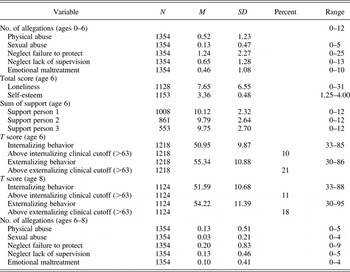
Descriptive statistics for scaled scores of the measures calculated prior to the modeling procedures are provided for review in the appendix. Because we used individual items from each measure or scale as categorical variables in the measurement model, the means and standard deviations of these original scaled scores are inappropriate as descriptive statistics of the variables in the structural model. Appendix A provides an overview of the sample.
Measurement model of the constructs
The final measurement model of all constructs in this study excluded some items from their original scales. Specifically, certain items from the CBCL were dropped as a result of being psychometrically insensitive (loadings < 0.40) because of rare occurrences (e.g., alcohol/drug use, sets fires). Previous research questions the value of utilizing all items from lengthy scales (e.g., CBCL), and suggests shorter scales may have better psychometric properties (Embretson & Reise, Reference Embretson and Reise2000; Lambert et al., Reference Lambert, Schmitt, Samms-Vaughan, Shin, Fairclough and Nutter2003; Moore, Halle, Vandeviere, & Marina, Reference Moore, Halle, Vandivere and Marina2002). Using IRT, Lambert and colleagues (Reference Lambert, Schmitt, Samms-Vaughan, Shin, Fairclough and Nutter2003) found that fewer than 17% of CBCL items discriminated well enough to be considered psychometrically sound. Certain loneliness items were also dropped from the CBCL to reduce overlap between the CBCL and the loneliness mediating construct. This procedure resulted in using 10 of the 31 internalizing and 18 of the 33 externalizing items in the measurement model.Footnote 2 In addition, three items from the Physical Competence Scale of the Harter self-perception measure (i.e., good at swinging, climbing, skipping) were dropped because of low factor loadings (<0.40). Thus, 8 of the 11 scale items were used in the measurement model.
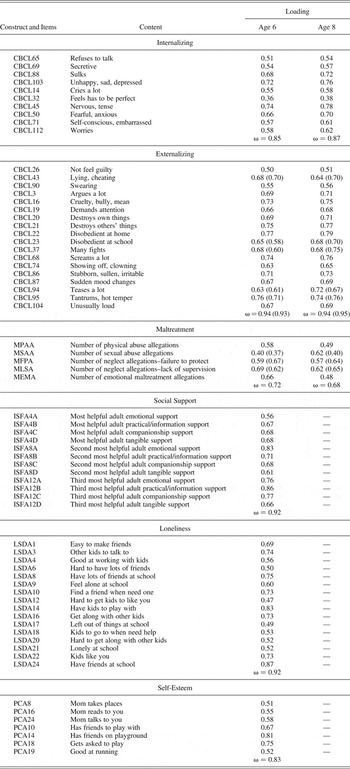
The final measurement model of this study fit the data well (χ2 = 1284.39, df = 498, p = .0001, comparative fit index [CFI] = 0.94, Tucker–Lewis index [TLI] = 0.96, root mean square error of approximation [RMSEA] = 0.03). The indicators retained for each construct and their standardized factor loadings and reliability coefficients (ω) are provided in Table 1. Factor loadings that were found to be variant across child gender are indicated in the table.
Factor loadings and reliabilities for items used in structural equation model

Note: CBCL, Child Behavior Checklist; MPAA, Maltreatment Physical Abuse Allegations; MSAA, Maltreatment Sexual Abuse Allegations; MFPA, Maltreatment Failure to Protect Allegations; MLSA, Maltreatment Lack of Supervision Allegations; MEMA, Maltreatment Emotional Maltreatment Allegations; ISFA, Inventory of Supportive Figures; LSDA, Loneliness and Social Dissatisfaction Scale; PCA, principal component analysis. For externalizing and maltreatment items that significantly differed across gender groups, loadings for females are provided in parentheses. For all other items, loadings did not significantly differ and were constrained to be equal across groups. The reliability of the scales for categorical variables was calculated as ωj=(∑λj)2/ [(∑λj)2 + ∑ψ2], where (∑λj)2 is the square of the sum of the factor loadings and ∑ψ2 is the sum of unique variances (McDonald, Reference McDonald1999).
Structural equation models testing mediated moderation pathways predicting internalizing and externalizing behavior problems
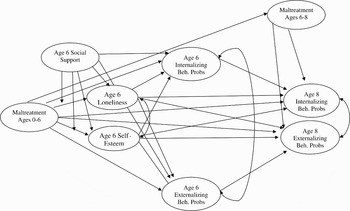
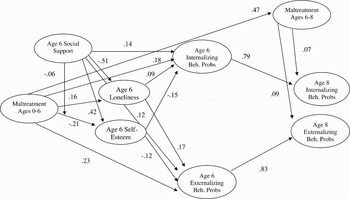
Figure 2 provides the structural equation model investigating the longitudinal relations among maltreatment, social support, self-esteem, loneliness, and internalizing and externalizing behavior problems. The baseline two-group model without any equality constraints imposed on the structural paths did not fit the data well (χ2 = 98.15, df = 16, p = .0001, CFI = 0.099, TLI = 0.95, RMSEA = 0.09) because of the large number of freely estimated parameters. Gender difference in each structural path was tested sequentially by comparing a model with an equality constraint across the two groups with the baseline model. Although the majority of the structural paths were invariant, 11 paths were identified to have gender differences (χ2dif = 43.30, df dif = 11, p < .001). The final model that left the 11 paths freely estimated for each group fit the data well (χ2 = 119.50, df = 43, p = .0001, CFI = 0.99, TLI = 0.98, RMSEA = 0.05). Figure 3 summarizes the significant path results for the structural equation models for males. Figure 4 summarizes the significant path results for the structural equation models for females. Detailed findings of the direct, mediated, and mediated moderation paths are described below.
A structural equation model for the longitudinal relations among maltreatment, social support, loneliness, self-esteem, and internalizing and externalizing behavior problems.

A summarized model fitting the longitudinal relations among maltreatment, social support, loneliness, self-esteem, and internalizing and externalizing behavior problems for boys, controlling for race and ethnicity. Only significant regression coefficients are provided (p < .05). Values are standardized coefficients. To simplify the presentation, the following significant covariances among variables are not depicted: age 6 loneliness with age 6 self-esteem = −0.27, age 6 externalizing with age 6 internalizing = 0.77, and age 8 externalizing with age 8 internalizing = 0.31.

A summarized model fitting the longitudinal relations among maltreatment, social support, loneliness, self-esteem, and internalizing and externalizing behavior problems for girls, controlling for race and ethnicity. Only significant regression coefficients are provided (p < .05). Values are standardized coefficients. To simplify the presentation, the following significant covariances among variables are not depicted: age 6 loneliness with age 6 self-esteem = −0.27, age 6 externalizing with age 6 internalizing = 0.79, and age 8 internalizing with age 8 externalizing = 0.29.

Summary of direct effects among variables in the structural models
The direct effect of early childhood maltreatment (ages 0–6) on age 6 internalizing and externalizing behavior problems was significant for both genders. There was no significant direct effect of early maltreatment on age 8 internalizing or externalizing behavior problems. In addition, direct effects were found for relations between early maltreatment and age 6 loneliness, age 6 self-esteem, and later maltreatment (ages 6–8), as well as between later maltreatment and age 8 internalizing and externalizing problems. Direct relations were also demonstrated between age 6 and age 8 internalizing problems, and age 6 and age 8 externalizing problems. Significant direct effects were also found between age 6 social support and age 6 loneliness and age 6 self-esteem. Direct effects in an unexpected direction were found between age 6 social support and age 6 internalizing and externalizing for boys, whereas no significant direct effects were found for girls. Significant direct paths were identified between age 6 loneliness and age 6 internalizing problems and externalizing problems, and for boys (although not girls) for age 6 self-esteem and age 6 internalizing and externalizing problems. No significant paths were found between age 6 loneliness or self-esteem and later (age 8) behavioral and emotional problems for either gender.
Self-esteem as a mediator of the relations between early maltreatment and internalizing behavior problems
The mediated effect of self-esteem at age 6 was significant for males, ab = 0.021 (CI = 0.008–0.036), indicating that self-esteem significantly mediated the maladaptive influence of early maltreatment (ages 0–6) on internalizing behavior problems at age 6 for boys. Maltreated boys had lower levels of self-esteem, and boys with lower self-esteem were more likely to demonstrate concurrent internalizing behavior problems. There was no significant mediated effect of self-esteem at age 6 for girls. There was no significant longitudinal mediation of esteem for internalizing behavior problems at age 8 for either gender.
Self-esteem as a mediator of the relations between early maltreatment and internalizing behavior problems: The moderating effects of social support
For both genders, social support moderated the pathway from maltreatment to self-esteem. For males, the mediated moderation effect was significant (ab = 0.018; CI = 0.002–0.039). That is, the mediated effect (i.e., maltreatment on internalizing behavior problems through self-esteem) varied across different levels of social support. For girls, there was no significant mediating effect of esteem on internalizing behavior problems, so mediated moderation tests were not performed.
To examine the significant effect for boys, first, visual inspection (i.e., plotting ±1 SD above and below the mean) and simple slope analyses (Aiken & West, Reference Aiken and West1991) demonstrated that the negative effects of maltreatment on self-esteem differed across levels of social support in an unexpected pattern, such that the negative slope of the line was steeper at higher levels of social support. Specifically, early maltreatment related to lower self-esteem for children with low social support (i.e., −1 SD, β = −0.09, t = −3.76), for children with a mean levels of social support (β = −0.13, t = −6.85), and for children with high social support (i.e., +1 SD, β = −0.17, t = −6.22). In subsequent structural models using these estimates and standard errors, significant mediation was found for boys with low social support (ab low support = 0.014, CI = 0.005–0.027), for boys with mean levels of social support (ab mean support = 0.021, CI = 0.008–0.035), and for boys with high social support (ab high support = 0.025, CI = 0.010–0.043). At higher levels of social support, the mediated influence of early maltreatment on internalizing behavior problems through self-esteem remained significant, and increased in magnitude.
Loneliness as a mediator of the relations between early maltreatment and internalizing behavior problems
The mediated effect of loneliness at age 6 was significant for both genders (males, ab = 0.010, CI = 0.002–0.019; females, ab = 0.015, CI = 0.004–0.028), indicating that loneliness significantly mediated the maladaptive influence of early maltreatment on internalizing behavior problems at age 6 for boys. Maltreated children had higher levels of loneliness, and children with higher loneliness were more likely to demonstrate concurrent internalizing behavior problems. There was no significant longitudinal mediation of esteem for internalizing behavior problems at age 8 for either gender.
Loneliness as a mediator of the relations between early maltreatment and internalizing behavior problems: The moderating effects of social support
The direct path between early maltreatment and loneliness and the indirect effect of early maltreatment on internalizing behavior problems as mediated through loneliness did not differ at varying levels by social support, for either gender.
Self-esteem as a mediator of the relations between early maltreatment and externalizing behavior problems
For males, but not females, the mediated effect of self-esteem on age 6 externalizing behavior problems was significant (ab = 0.018, CI = 0.006–0.033), indicating that self-esteem significantly mediated the maladaptive influence of early maltreatment on externalizing behavior problems. Maltreated boys had lower levels of self-esteem, and boys with lower self-esteem were more likely to demonstrate concurrent externalizing behavior problems at age 6. The longitudinal mediated effect was not significant for either gender.
Self-esteem as a mediator of the relations between early maltreatment and externalizing behavior problems: The moderating effects of social support
As was previously reviewed, for both genders, social support moderated the pathway from maltreatment to self-esteem. For boys, the mediated moderation effect at age 6 was significant (ab = 0.015, CI = 0.001–0.036). That is, the mediated effect of maltreatment on externalizing behavior problems through self-esteem varied across different levels of social support. For girls, there was no significant mediating effect of esteem on externalizing behavior problems, so mediated moderation tests were not performed.
Using the estimates and standard errors from the simple slopes tests (reported above) in subsequent structural models, significant mediation was found for boys with low social support (ab low support = 0.012, CI = 0.003–0.025), for boys with mean levels of social support (ab mean support = 0.018, CI = 0.005–0.032), and for boys with high social support (ab high support = 0.022, CI = 0.007–0.040). At higher levels of social support, the mediated influence of early maltreatment on externalizing behavior problems through self-esteem remained significant, and increased in magnitude.
Loneliness as a mediator of the relations between early maltreatment and externalizing behavior problems
For both genders, the mediated effect of loneliness on externalizing at age 6 was significant (males, ab = 0.019, CI = 0.009–0.031; females, ab = 0.029, CI = 0.016–0.044), indicating that loneliness significantly mediated the maladaptive influence of early maltreatment on age 6 externalizing behavior problems. Maltreated children had higher levels of loneliness at age 6, and children with higher loneliness were more likely to demonstrate concurrent externalizing behavior problems. However, evidence for longitudinal mediation predicting age 8 externalizing behavior problems was not found for either gender.
Loneliness as a mediator of the relations between maltreatment and externalizing behavior problems: The moderating effects of social support
Neither the direct path between early maltreatment and loneliness nor the indirect effect of early maltreatment on age 6 externalizing behavior problems as mediated through loneliness differed at varying levels of social support for either gender.
Discussion
This study provides support for the attachment perspective that early childhood maltreatment sets children on a pathway to maladjustment, through the internalization of experience to emotional and behavioral outcomes. Specifically, we found evidence for both direct and indirect pathways to internalizing and externalizing behavior problems through self-perceptions. Consistent with models of resilience, both risk and protective factors predict children's developmental outcomes. The interactions between risk and protective factors in this study, however, demonstrated gender-specific and rather unexpected findings. Higher maltreatment combined with high social support was associated with more negative self-esteem that, for boys, in turn was related to more negative emotional and behavioral outcomes.
The mediating role of self-perception
Overall, our findings support previous research suggesting that maltreatment is related both to negative self-perceptions (Bolger et al., Reference Bolger, Patterson and Kupersmidt1998; Egeland et al., Reference Egeland, Sroufe and Erickson1983; Loos & Alexander, Reference Loos and Alexander1997; Toth et al., Reference Toth, Cicchetti, Macfie and Emde1997) and to problematic emotional and behavioral outcomes (Keiley et al., Reference Keiley, Howe, Dodge, Bates and Pettit2001; Toth et al., Reference Toth, Manly and Cicchetti1992). Moreover, our study expands upon previous literature by demonstrating through mediation analyses that these relations can be partially explained by maltreatment's influence on self-perceptions, such as self-esteem and loneliness. These findings support theories that self-perceptions can result in varied outcomes, including internalizing outcomes (e.g., depression and anxiety; perhaps through hopelessness) and externalizing behaviors (e.g., deviant and acting behaviors; perhaps to gain favor with peers and to augment self-perceptions) (Rosenberg & Rosenberg, Reference Rosenberg and Rosenberg1978). Moreover, our mediated findings are consistent with Stein and colleagues' (Reference Stein, Burden Leslie and Nyamathi2002) retrospective study with adults in which self-esteem mediated the relations between self-reported childhood maltreatment (physical, verbal, sexual abuse) and depression, suggesting that these adult processes may begin in childhood. Kim and Cicchetti's (Reference Kim and Cicchetti2004) longitudinal study with children found no significant mediating relations among maltreatment, self-esteem, and behavioral outcomes, yet did identify mediating relations with (counselor-reported) social competence. It is noted that following the modeling procedure in this study, the self-esteem items used in the SEM emphasized the social acceptance or competence aspects of self-esteem (because the cognitive competence and some physical competence items were dropped). Thus, these aspects of self-esteem may be particularly salient in the processes underlying behavioral outcomes for maltreated children. The implications of these findings are significant, underscoring the role of self-perceptions involved in maltreated children's adjustment and pointing to potentially modifiable mechanisms.
Regarding the role of gender in these pathways, our findings revealed different mediation patterns for males and females. For males there was some evidence for mediated pathways with concurrent emotional/behavioral health through both self-esteem and loneliness, whereas for females these paths were only significant for loneliness. These findings suggest that loneliness is a critical factor in the maladaptive emotional and behavioral outcomes regardless of gender. The lack of significant findings for self-esteem for girls has some precedence in the literature with nonmaltreated children. For instance, Abela and Payne (Reference Abela and Payne2003) found that boys with low self-esteem are more likely to develop depression than girls with low self-esteem. Moreover, self-esteem may not be related to externalizing behavior in girls because girls may not be as likely as boys to attain social approval through deviant behaviors (Rosenberg & Rosenberg, Reference Rosenberg and Rosenberg1978). Perhaps, for girls, low self-esteem engendered by maltreatment may result in other outcomes, such as altered peer relationships (Bolger et al., Reference Bolger, Patterson and Kupersmidt1998). Other mediating mechanisms, such as attributions about the abuse, may better explain links between maltreatment and internalizing behavior problems in girls (Feiring et al., Reference Feiring, Taska and Chen2002). However, because previous literature regarding gender differences has been mixed, additional evidence is needed in order to draw firm conclusions about these patterns and alternative pathways.
The complex role of social support
The current study extends the previous literature by examining the moderating role of social support within this mediated path. Unexpectedly, the findings appear to contrast with previous indications that social support can buffer the deleterious outcomes of child maltreatment (Egeland et al., Reference Egeland, Jacobvitz and Sroufe1988). Recent examinations of the sometimes paradoxical nature of support suggest the effectiveness of social support depends on whether it challenges negative behaviors or matches individual needs (if not, thereby worsening problems; Thompson, Flood, & Goodvin, Reference Thompson, Flood, Goodvin, Cicchetti and Cohen2006). It is possible that the measurement of social support, in combination with the particular challenges of studying maltreated children, contributed to this finding. The measure asks the child to identify three support individuals, and the majority of children rated biological parents and grandmothers. This pattern is typical of young children's support systems that typically comprise parents and close family members (Bryant, Reference Bryant1985; Furman, Reference Furman and Belle1989). However, for maltreated children, there is possible overlap between identified support figures and perpetrators of maltreatment. Positive ratings of maltreating caregivers is consistent with other studies demonstrating that maltreated children tend to show overly positive affect or overly positive assessments of the relationship with their caregiver (Kim & Cicchetti, Reference Kim and Cicchetti2004; Toth et al., Reference Toth, Cicchetti, Macfie and Emde1997). In as much as children's perceptions of the relationship are inflated, the moderating paths may also be distorted. That is, lower self-esteem could be explained by the juxtaposition of the child's perception of this individual as a support provider, yet simultaneous sense of rejection from that same person who is harming them or allowing them to be harmed. To unpack this issue, a measure that taps a range of support providers (vs. only those nominated by the child) as well as support from the various types of providers (e.g., family vs. nonfamily, perpetrator vs. nonperpetrator) would help disentangle the effects of different support providers and discern the most optimal sources of support for maltreated children.
Of note, although it was expected that both pathways through self-perception would be influenced by social support, there were no significant moderation or mediated moderation findings for social support via loneliness. Perhaps there are different mechanisms through which social support influences these pathways; that is, for maltreated children social support may influence how one perceives oneself (i.e., feeling worse about oneself), but not how one perceives oneself in relationship to others (i.e., feeling no more or less depressed about being alone). These speculative hypotheses require further examination.
Regarding both unexpected social support findings, it is possible that social support as a singular protective factor may not overcome the detrimental effects of maltreatment (Thompson et al., Reference Thompson, Flood, Goodvin, Cicchetti and Cohen2006), particularly in the context of additional risk factors. Children who experience maltreatment frequently simultaneously experience other risk factors (e.g., interparental violence, family disruption, low socioeconomic status), which cumulatively affect developmental outcomes (Appleyard, Egeland, van Dulmen, & Sroufe, Reference Appleyard, Egeland, van Dulmen and Sroufe2005). Competence in the face of multiple risks may be a dynamic process, requiring the joint investigation of multiple protective factors and multiple risk factors to predict enhanced outcomes (Yates, Egeland, & Sroufe, Reference Yates, Egeland, Sroufe and Luthar2003). Despite the unexpected findings, the use of mediated moderation analyses provides a more detailed explanation of these developmental processes and holds promise for targeting interventions (Morgan Lopez & MacKinnon, Reference Morgan-Lopez and MacKinnon2006).
Examining pathways over time
With respect to the lack of significant longitudinal paths for either gender, in contrast to previous literature (Brown et al., Reference Brown, Bifulco and Andrews1990; Hymel et al., Reference Hymel, Rubin, Rowden and LeMare2004; Kim & Cicchetti, Reference Kim and Cicchetti2004), our study found no evidence for longitudinal predictions in the paths between self-esteem, loneliness, or social isolation and later emotional and behavioral problems, and thus, no significant longitudinal mediation or mediated moderation. Perhaps age 8 emotional and behavioral problems were contingent upon more proximal (i.e., age 8) self-perceptions. Our study did not have similar measures of self-perception at age 8. Future research with repeated, longitudinal measures could address questions of change over time in these variables and how they relate to levels and changes in behavior problems. Previous studies of changes in self-esteem suggest that instability or change in self-evaluations and self-esteem predicted greater depression above and beyond trait measures of self-esteem (Tevendale, DuBois, Lopez, & Prindiville, Reference Tevendale, DuBois, Lopez and Prindiville1997). Moreover, in an investigation of longitudinal trajectories of self-esteem and depression in maltreated and nonmaltreated children, Kim and Cicchetti (Reference Kim and Cicchetti2006) found that, overall, initial levels of self-esteem and depression were significantly related, and, for boys, changes in self-esteem were significantly related to changes in depression over time. Continued examinations of these issues with multiple measures of the constructs across time will clarify the developmental processes involved in the long-term sequelae of maltreatment.
Future Directions
Future studies could illuminate a number of questions left open by the current study. Because the sample consisted of primarily high-risk groups, it is difficult to make generalizations about these findings to a broader population. Moreover, methodological differences in our study compared with others also may present some challenges to interpretation or direct comparison with previous work and may explain some of the unexpected findings. We first examined maltreatment as defined by allegations, which could be considered controversial (Manly, Reference Manly2005). Benefits of this approach include avoiding the limited representation and possible biases in defining by substantiation (Hussey et al., Reference Hussey, Marshall, English, Knight, Lau and Dubowitz2005). Although we feel confident in this approach (having previously examined allegations versus substantiations in this sample; Hussey et al., Reference Hussey, Marshall, English, Knight, Lau and Dubowitz2005), we acknowledge the need for replication prior to generalizing the findings (Manly, Reference Manly2005).
In addition, our use of factor scores derived from items in each measure (comparable to IRT modeling) as opposed to traditional mean, scaled, or T scores may also present interpretation challenges. For example, it may be difficult to interpret the meaning of the factor scores compared with standard clinical levels expressed in T scores. Our factor scores were highly correlated with the sample T scores. Prior to the modeling, 10% of participants were above the internalizing clinical T score cutoff at age 6 (11% at age 8) and 21% were above the externalizing cutoff at age 6 (18% at age 8), representing the clinical needs of this sample. Acknowledging these challenges, our analytic strategy has improved measurement properties over traditional scaling and T score approaches (Hambleton et al., Reference Hambleton, Swaminathan and Rodgers1991; McCollam, Reference McCollam and Marcoulides1998; Wright, Reference Wright, Embretson and Hershberger1999) and provides a significant advantage in efficiently modeling complex data.
Although longitudinal data were used and specific theoretically driven paths were tested in structural equation modeling, no firm conclusions can be drawn about the directionality of effects, particularly with the concurrent mediation and mediated moderation findings. Alternative pathways also could be examined. For example, maltreatment could lead to emotional/behavioral problems that then lead to loneliness and self-esteem difficulties, or there could be bidirectional effects. Some investigators have found that internalizing behavior problems predict emotional difficulties such as loneliness and depression (Chen et al., Reference Chen, Liu, Rubin, Li, Li and Cen2003). Others have found more evidence for self-esteem predicting externalizing behaviors than for externalizing behaviors predicting self-esteem (Rosenberg & Rosenberg, Reference Rosenberg and Rosenberg1978; Rosenberg, Schooler, & Schoenbach, Reference Rosenberg, Schooler and Schoenbach1989). Consistent with attachment theory, we tested the current models with a particular focus on how maltreatment becomes integrated into behavior through its influences on self-perceptions. Future studies with repeated measures of self-perception and emotional/behavioral problems over time could advance the understanding of the dynamic relations between these psychological constructs.
Our study examined the role of any experience of maltreatment (as a latent construct) as it relates to maladaptive pathways. Although this latent construct allows for differential contributions of each subtype (i.e., factor loadings representing the psychometric weights of each subtype), it does not examine the differential effects by subtype. A burgeoning literature documents that different types of maltreatment have different developmental consequences (Bolger et al., Reference Bolger, Patterson and Kupersmidt1998; Egeland et al., Reference Egeland, Sroufe and Erickson1983; Kim & Cicchetti, Reference Kim and Cicchetti2006). One explanation is that different types of maltreatment or negative life experiences may differentially affect children's attributions and thus their negative views of self (DuBois et al., Reference DuBois, Felner, Sherman and Bull1994). Future studies should continue to examine the differential influence of maltreatment subtypes, and the role of additional mediational processes and mechanisms, such as attributions, in this pathway.
Implications and conclusions
The findings underscore the potential role of prevention of and early intervention in child maltreatment in changing the course of children's self-perceptions and emotional and behavioral functioning. Investigations of key mediating and moderating mechanisms provide insight into specific intervention opportunities that may be most effective in working with maltreated and high-risk populations. The current study suggests that self-perceptions may be a key modifiable mechanism to target in order to prevent and to reduce emotional and behavioral problems in maltreated children. With regard to social support, although many intervention programs currently are designed with the assumption that increasing social support will inherently engender better outcomes, recent work suggests that the effectiveness of social support interventions may rest in their ability to address the multifaceted nature of social support (e.g., matching support provision to individual support needs, addressing recipients' willingness and capacity to seek and accept support; Thompson & Ontai, Reference Thompson and Ontai2000). Our findings suggest that intervening within maltreated children's support systems may include the need for careful assessment of the most appropriate providers and types of support most likely to enhance (rather than potentially harm) the developmental capacities of children, and for interventions to address children's potentially stilted representations or views of supportive others. Taken together, the findings from this study illustrate the complex interplay between risk and protective factors in children's socioemotional development, and support the need for continued intricate research design and methodology in order to better understand and more effectively facilitate optimal development.
Descriptive statistics for scaled scores prior to modeling procedures