Introduction
Patients with stroke-induced damage to the right hemisphere (RHD) often demonstrate evidence for hemispatial neglect (Heilman, Reference Heilman1979; Vallar & Perani, Reference Vallar and Perani1986). When performing tasks such as cancellation, drawing or line bisection, patients with neglect show a spatial bias. In the acute stage, this viewer-centered spatial bias is most often ipsilesional; however, both in the acute and more commonly in the chronic state, patients may demonstrate a contralesional bias (ipsilesional neglect) (Adair, Chatterjee, Schwartz, & Heilman, Reference Adair, Chatterjee, Schwartz and Heilman1998; Kwon & Heilman, Reference Kwon and Heilman1991), also called paradoxical neglect (Robertson et al., Reference Robertson, Halligan, Bergego, Hömberg, Pizzamiglio, Weber and Wilson1994).
The right hemisphere networks that mediate attention are widely distributed and involve the temporoparietal and frontal cortex, the cingulate gyrus as well as portions of the thalamic and mesencephalic reticular formation (Heilman, Reference Heilman1979; Mesulam, Reference Mesulam1981; Karnath & Rorden, Reference Karnath and Rorden2012). Some patients with right hemisphere strokes who have damaged portions of this network might not demonstrate evidence of unilateral spatial neglect or might only demonstrate a spatial bias acutely after the onset of stroke (Bowen, McKenna, & Tallis, Reference Bowen, McKenna and Tallis1999).
To help explain the hemispheric asymmetry of ipsilesional spatial bias that is more commonly associated with right versus left hemisphere strokes, it had been posited and then demonstrated that whereas the left hemisphere primarily directs attention to right hemispace, the right hemisphere can direct attention to either side of hemispace (Heilman & Van den Abell, Reference Heilman and Van den Abell1980; Pardo, Fox, & Raichle, Reference Pardo, Fox and Raichle1991). Thus, with left hemisphere injury, the right hemisphere can also direct attention to ipsilateral right hemispace; but with right hemisphere injury, the intact left hemisphere primarily directs attention toward the right hemispace. Possible explanations of why some RHD patients do not show spatial neglect and most others recover after several months may be that either the uninjured portions of the right hemisphere, or the intact left hemisphere, or a combination of the two are able to compensate and mediate attention to both halves of viewer-centered space.
Several studies have also revealed that the right hemisphere appears to be dominant for mediating global spatial attention while the left mediates focal attention (Vandenberghe, Gitelman, Parrish, & Mesulam, Reference Vandenberghe, Gitelman, Parrish and Mesulam2001). In addition, when spatial attention is mediated by the left hemisphere, it appears that even normal people are more distractible (Powers, Roth, & Heilman, Reference Powers, Roth and Heilman2005). With right hemisphere injury, there is a general loss of arousal (Heilman, Schwartz, & Watson, Reference Heilman, Schwartz and Watson1978) and high levels of arousal are necessary to maintain vigilance. Since patients with right hemisphere damage might be impaired at attending globally (to the entire line), as well as being more distractible and less vigilant when performing the line bisection task, their performance on this task might be more variable compared to LHD and healthy controls. Thus, the main goal of this study is to learn if patients with RHD have more variable performance on the line bisection task than do patients with left hemisphere stroke (LHD) and healthy control (HC) subjects, as well as to learn if this variability might be related to alterations of these patients ability to accurately allocate spatial attention.
Materials and Methods
Participants
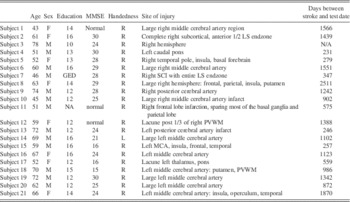
The experimental subjects for this study were 11 patients with RHD and 10 patients with LHD who had their strokes several months to years prior to being tested. Thus, the patients with stroke had passed the steepest component of the recovery curve (i.e., no patients with acute neglect were recruited). Further, 8 age-matched healthy controls (HC) were also assessed. All 11 patients with RHD included in this study had a history of spatial neglect acutely after their stroke. All 11 patients with RHD included in this study had a history of spatial neglect acutely after their stroke. The demographic and clinical characteristics of these participants can be found in Table 1.
Demographic and clinical characteristics of the RHD participants

Apparatus and Procedures
The University of Florida Institutional Review Board approved this study and subjects’ consent was obtained. All participants were instructed to bisect 24 horizontal lines of 242 mm in length and 2 mm in thickness. Each line was placed in the middle of an 8.5 by 11 inch sheet of white paper. The subjects sat on a chair and the sheets of paper with the lines were consecutively placed one at a time on a table directly in front of the subjects so that the subjects’ midsagittal plane bisected these lines. These lines were placed approximately 9–12 inches in front of the patient’s sternum. During the time the subjects performed this bisection task, they were not given any feedback. After each participant’s attempt to bisect each line, the sheet of paper with this line was removed and a new sheet of paper with a line was placed in front of the participant until the participant completed all 24 attempted line bisections.
Deviation from the midpoint of each line was measured to the nearest millimeter. Deviations to the left of midpoint were designated as negative, and deviations to the right of midpoint as positive. Then, for each participant, algebraic means and standard deviations (SD) were calculated. Further, absolute values of the bisection deviations were also computed. The mean absolute deviation from center represented their accuracy; the mean SD per participant represented their precision, or reliability of their midline judgment. Mean left and right deviations were used to assess for the presence of an ipsilesional or contralesional bias. Each participant’s mean deviation was plotted on the x-axis and the standard deviation on the y-axis of a graph. In addition, the mean accuracy and mean variability for each group was also tabulated. Statistical analyses were performed using the SPSS statistics program, Version 19; effect sizes calculated with G*Power.
Results
The mean deviations and biases for the three groups are listed in Table 2.
Group means for bias (averaged deviations from midpoint), accuracy (averaged absolute deviation from midpoint and precision (averaged standard deviations) in the healthy control (HC), left hemisphere damage (LHD), and right hemisphere damage (RHD)

Groups were compared using one-way analysis of variance (ANOVA) with post hoc Tukey’s test to determine of any group differences. There were no significant difference in the means of the biases from the midline (mean left or right deviations) between the three groups, F(2,26)=2.46, p=0.107. The RHD group, however, had larger SDs than did the HC and the LHD groups (mean SD: RHD=7.03, LHD=4.04, HC=2.81) F(2,26)=4.52, p=0.022 (Cohen’s F=0.49). Post hoc analyses reveal that the RHD differed from both other groups but the HC and LHD did not significantly differ from each other. Further, the groups were significantly different in accuracy (absolute deviation from the middle) F(2,26)=4.59, p=0.020 (Cohen’s F=0.52). Specifically, RHD were less accurate than both the LHD and HC groups (mean absolute deviations: RHD=7.52, LHD=3.79 and NC=3.23). The LHD and HC groups did not differ in accuracy.
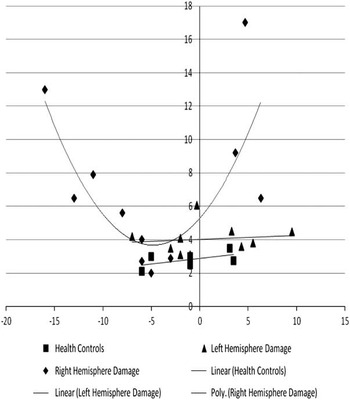
When plotting each RHD participant’s SD as a function of the degree of the left versus right bias, there was a curvilinear relationship such that as the bisection error (spatial errors or magnitude of inaccuracy) increased in either direction away from the mean of typical normal deviation, so did their variability (SD). A quadratic relationship of y=0.069x2+0.668x+5.288 was found by multiple regression analyses to provide the best fit (R2=0.552, f [2,8]; p=0.040). In contrast to the RHD group, there was no relationship between deviation from midline and variability in the controls or LHD groups. The curvilinear relationship is depicted in Figure 1.
Graphic representation of participants’ mean accuracy (deviation from midpoint) and standard deviation. The curvilinear line represents the best-fit line for the RHD group, and the linear line represents the best-fit line for the LHD and HC groups.

Discussion
The results of this study appear to support major predictions that when compared to control subjects without strokes, as well as the LHD subjects, the RHD subjects’ performance on a line bisection task was less accurate (further from midline) and the directional allocation of spatial attention was also more variable. As mentioned in the introduction, with right hemisphere injury, there is a general loss of arousal (Heilman et al., Reference Heilman, Schwartz and Watson1978) and high levels of arousal are necessary to persist at maintaining high levels of attention over time. Patients with right hemispheric lesions, in addition to being inattentive to stimuli in left hemispace which induces rightward deviation on the line bisection task, may also have a contralesional attentional grasp inducing leftward deviation on the line bisection task (Adair et al., Reference Adair, Chatterjee, Schwartz and Heilman1998; Kwon & Heilman, Reference Kwon and Heilman1991).
Alterations of arousal-vigilance (or persistence) and alterations of distractibility (Powers et al., Reference Powers, Roth and Heilman2005) induced by right hemispheric dysfunction may alter the balance between these two opposite directional spatial biases and produce a more variable performance. Anderson et al. (2000) studied five patients with and five patients without spatial neglect, using a reaction time task where subjects responded by pushing a computer key to the onset of a white square appearing on a black screen. The locations of stimuli were randomly varied along the horizontal meridian. The performance of the subjects with neglect were highly variable and for several of the participants with neglect, reaction times showed no or little relation to horizontal location suggesting that these patients with neglect have an inability to consistently detect and respond to target stimuli and this deficit as determined by reaction times may indicate variable levels of attention and arousal-vigilance.
Although we suspect that the RHD group’s highly variable performance is related to attention-arousal-vigilance deficits, such that these patients could not maintain their allocation of spatial attention, there are several other factors that may have influenced these patient performance on the line bisection task. For example, Robertson and coworkers (1994) suggested that the contralesional deviation (ipsilesional neglect) observed after right hemispheric lesions may be related to a compensatory strategy. Patients with right hemisphere injury have been reported to have impersistence (Kertesz, Nicholson, Cancelliere, Kassa, & Black, Reference Kertesz, Nicholson, Cancelliere, Kassa and Black1985) and thus, their attempt at compensation may have not persisted and their performance may have varied.
The overall mean bias demonstrated by RHD was not significantly different compared to the LHD and HC groups suggesting that the RHD participants did not have a persistent spatial attentional bias. However, to correctly bisect a line, a person has to attend to the entire line. Since the right hemisphere has been shown to be dominant for mediating global attention (Vandenberghe et al., 2001), it is possible that an impairment in global attention may explain the greater absolute deviation as noted in our study. Furthermore, the impaired arousal-vigilance noted in patients with RHD may increase the variability as these subjects must maintain vigilance of the entire line until a final decision is made regarding the center of that line. Future studies should examine the relationship between patients’ variability of attempted line bisections as well as the magnitude of this variation with these patients’ ability to allocate global attention.
In addition to being dominant for mediating attention, the right hemisphere also plays a critical role in visuospatial processing. For example, Hamsher, Capruso, and Benton (Reference Hamsher, Capruso and Benton1992) demonstrated that patients with RHD are impaired in making visuospatial judgments and thus, the RHD subjects’ increased variability on the line bisection task might be related to a visuospatial cognitive disorder rather than disordered attention-arousal-vigilance. However, this may not necessarily explain the curvilinear response in our RHD group who demonstrated greater variability in line bisections away from midline as compared to less variability toward the center of the line. Unfortunately, other than their performance on the line bisection task, we not did test our subjects’ visuospatial skills and future studies might want to assess this relationship. There are, however, two observations that appear to support the attentional hypothesis of variability.
As mentioned in the introduction, right hemisphere damage might induce a spatial bias on the line bisection task (hemispatial neglect) and this bias can be either to the ipsilesional side of the line (contralesional neglect or inattention) or to the contralesional side of the line (ipsilesional neglect or an attentional grasp) (Drago et al., Reference Drago, Jeong, Crucian, Fitzgerald, Finney, Mizuno and Heilman2006). In general, the greater the bias the greater the impairment in the right hemisphere mediated attentional system. Thus, the result that in the RHD group the degree of bias found on the line bisection test is directly related to variability would appear to support the attentional hypothesis of these erratic spatial biases.
Although following an acute injury, hemispatial neglect appears to resolve in most RHD patients after several weeks to months, many patients with RHD remain considerably disabled (Barret et al., Reference Barret, Buxbaum, Coslett, Edwards, Heilman, Hillis and Robertson2006). The reason for their disability has not been entirely elucidated, but the persistent inaccurate and erratic spatial allocation of attention may be a contributing factor to their impaired performance. Future research might be directed to better understanding of the pathophysiology of this disorder, and determining how it might be best treated.
Acknowledgment
Supported by the VA Research Service, Brain Rehabilitation Research Center, Malcom Randall VAMC. The authors report no conflicts of interest.