


1.0 Introduction: The Development Problematique
In the 1960s, when most countries in Southeast Asia were attaining their independence, the region was poor and, quite clearly, developing. This period of political transition was accompanied by a new-found enthusiasm for development projects, achieved through the science and practice of planning. The countries of Southeast Asia were not alone, of course, in believing in the power of planning. In December 1961, the UN General Assembly adopted resolution 1708 (XVI), “Convinced of the urgent need of the less developed countries to establish and implement national, all-inclusive and well-integrated development plans to build up their societies…” (UN 1963: 114). Even the World Bank was an enthusiastic supporter of plans and planning (Killick Reference Killick1983: 72), while Gunnar Myrdal saw “…planning [as] the intellectual matrix of the entire modernization ideology” (Reference Myrdal1968: 711). Not only was planning widely accepted as the best means to achieve desirable development outcomes but the policy objectives that inspired such plans were also largely undisputed: to stimulate economies, modernise infrastructures and raise incomes, all with the express intent of achieving development-as-modernisation and, in so doing, reduce poverty (see Hirsch Reference Hirsch1990: 9–16).
The World Bank document that set the groundwork for Thailand's development project was a report on a mission that visited the country between July 1957 and June 1958. The following year, A Public Development Program for Thailand (World Bank 1959) was published, which argued that while economic growth up to that point had been achieved with little government guidance or intervention, this approach could not continue:
…for many of the more important economic problems which Thailand will face in the future are unlikely to be solved save by the initiative of the Government. These are not problems of the distant future. They are sufficiently near that it is essential for the Government to begin preparing its plans now if it is to cope with them before they become critical. Moreover, the Government – given its limited resources and the growing demands upon them – will have to play its part more effectively in the future than in the past if the momentum of the economy and the welfare of the growing population are to be maintained. (World Bank 1959: 1)
While the report emphasised the role of the private sector in achieving development, it also claimed that “[a] basic weakness in the Government's development effort in the past has been a lack of guiding objectives, not only for the effort as a whole but even in individual sectors of the economy” (1959: 11). Planning up to that point had been haphazard, suggested the report, and the mission therefore urged “that there be created a central planning organization for Thailand” (1959: 29).
This, then, marks a shift from development as an immanent process in which the state is only indirectly involved to a project in which it takes a leading role. While the report exaggerates somewhat in claiming that “[h]istorically, the foundations of the economy were built up largely as a natural, unaided and unguided process” (page 2), it was certainly the case that the type of systematic, integrated planning advocated by the UN and World Bank, was absent. In the early decades of the development era, there was confidence worldwide that economic and social transformation could be – indeed, should be – coordinated by states through the new science of development planning.
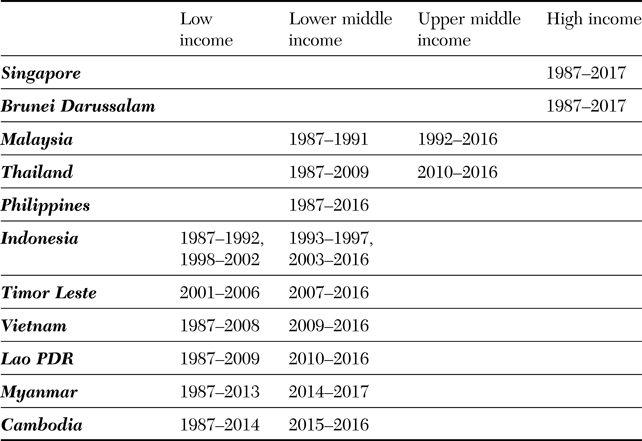
The development mission set out from the late 1950s in countries across the Southeast Asian region, including Thailand, is now largely complete. With the exception of Cambodia, all are now classified as middle income at least (Table 1), and the Asian Development Bank (ADB) has projected that extreme poverty in Southeast Asia will have been eradicated by 2025 (ADB 2014). Of course, these are generalised and in many ways problematic claims, but they do illustrate the degree to which the development mission, evaluated by such means, has achieved its objective.Footnote 1 In light of the region's enviable development record, since the 1980s, scholars (van Donge et al. Reference van Donge, Henley and Lewis2012) and development institutions (Center for Global Development 2008; World Bank 1993) have praised its achievements and attempted to extract lessons learned for future policy. Indeed, there is no region in the world, perhaps with the exception of East Asia, where development projects have seemingly had as much traction as in Southeast Asia.
Stages of growth in Southeast Asia, 1987–2017

Note: these analytical income classifications were produced by the World Bank and date from 1989 when the Bank established a benchmark of $6,000 between middle-income and high-income countries at 1987 prices. Timor Leste's classification dates from 2001 when it achieved its independence from Indonesia. Indonesia is the only country to have fallen into a lower income category when, between 1998 and 2002, its economy contracted by around one-fifth during the Asian financial crisis.
Source: World Bank data accessed at http://data.worldbank.org/about/country-classifications/a-short-history
In this paper, I argue that while the obvious development problems or challenges of the post-Second World War development era – low agricultural productivity, poor health and educational facilities, low incomes, undernutrition, inadequate infrastructure – may have been solved for many people in most places, a deeper, more obstinate development problematique remains. Indeed, it has emerged because of recent achievements. I use problematique in the sense of: first, a continuing problem which is neither ever neatly solved nor completely intractable in its component parts; and second, a problem which is complex or interlocking. There are also two further elements to the development problematique that I address in this paper: the development challenge is reworked rather than neatly solved; and, over time, it has become less conducive or amenable to straightforward solutions.
The term ‘world’ or ‘global problematique’ was first coined by the authors of The Limits to Growth, a report for the Club of Rome (Meadows et al. Reference Meadows, Meadows, Randers and Behrens1972). This report elaborated on two issues that are relevant for the discussion here, that the world problematique “consists of issues that require more than technical solutions” (1972: 187) and is “to a great extent composed of elements that cannot be expressed in measurable terms” (1972: 192). Much the same could be said of the emerging development problematique in the Southeast Asian region.
The broad point I seek to make is regional in its application. In this paper, however, I develop and illustrate the argument drawing on the experience of Thailand, at two levels. First, I describe how the development project has been framed and addressed in the Kingdom, particularly through the five-year national development plans of the National Economic and Social Development Board (NESDB). These development efforts and interventions are then grounded in the data from a longitudinal study of two villages in the northeastern region, before returning to more general propositions towards the end of the paper.
2.0 Developing Thailand, Thai Development
“The happiness of the people depends on four materials: a house to live in, clothes to wear, medicines when sick, [and] food” (Prime Minister Marshal Sarit Thanarat, 1958/59, cited in Insor Reference Insor1963: 35).
“A happy man is a wealthy man. We know how happy a man is by counting his material goods such as car, money, gold, and jewellery. These rich people don't have to work hard” (59-year-old widow from Isan, cited in Jongudomkarn and Camfield Reference Jongudomkarn and Laura2005: 20).
These two quotations, separated by almost half a century and uttered by a Prime Minister on the one hand and a poor, farming widow on the other, reveal Thailand's development experience, the successes achieved and the challenges remaining. At the onset of Thailand's development era in the early 1960s, the challenge was to provide people with the necessities of food, clothing, shelter, education and health, which have all been largely provided. However, as we know, basic needs are transformed into relative needs: the luxuries of one era become the necessities of the next. Gauging how people are thriving is a moving target, and with development, becomes increasingly unpredictable. Traction, as it were, turns to friction.Footnote 2
Since the start of the First Five-Year National Economic Plan in 1961, Thailand's material progress has been extraordinary – in some eyes, miraculous (World Bank 1993). As each development target has been achieved and ticked off, however, it seems other more obstinate development challenges have come into view; like Doctor Seuss's Cat in the Hat Comes Back, one solution just begets another problem. The certainties of the past have been replaced by a growing number of uncertainties: development targets that were broadly agreed, quite easily achieved, and importantly, could be shown to have been achieved – clean water, primary-level education, electricity provision, access to health care and, above all, higher incomes and reduced poverty – have been superseded by aims that are more contentious, more difficult to specify and measure, and harder to fulfil. They focus, for example, on: the quality rather than the amount of provision (of education, health, and so forth); the means rather than the ends of bringing about change (participatory, empowering); and rights and justice/injustice (such as social and environmental justice).
Of these new development challenges, arguably the most important has been the question of whether the achievement of material prosperity has led to an equivalent rise in well-being, and what the connections are between economic growth measured in terms of money-metric indicators and well-being (or thriving). This has required development scholars, practitioners and policymakers to pay attention to the unintended trade-offs and consequences that have accompanied the development path taken by Thailand (and other countries). It has also meant a widening of the debate from a fairly narrow concern with the economics of change to such issues as social development, societal values and development justice. Many development practitioners have felt challenged and distinctly uncomfortable about being asked to judge development, rather than merely measuring its achievement in narrow, usually economic, terms. Yet, as Amartya Sen argues in Development as Freedom, it is necessary to evaluate the market mechanism and its effects, and to acknowledge its deleterious and untoward, as well as beneficial, effects (Reference Sen1999: 7). There has also been a shift from viewing development as a largely technical challenge to, increasingly, a political one.
3.0 From Basic Needs to Sufficiency: Tracking the Path from development to Development
Planning in Thailand and the planning agency – the National Economic and Social Development Board (NESDB) – do not have the power that they once had. From the high point of planning in the 1960s and 1970s, the shift towards the market and away from the state has rendered planning obsolescent. That said, Thailand's plans – of which there have been twelveFootnote 3 since the first five-year plan was released in 1961 – do represent handy compendiums for the concerns of the time. Each has a particular development ‘flavour’, largely reflecting the twists-and-turns in mainstream development theory and practice, although with increasingly local ‘ingredients’. They provide, then, instructive insights into the prevailing development mindset of planners and politicians, the concerns of academics and increasingly, the views of civil society.Footnote 4 Looking across more than half a century of development plans and planning, it is possible to make three general points about Thailand's national development policies:
-
– Throughout the four decades from 1960 to the Millennium, the extension of the market to new geographical areas, populations and activities was a persistent theme. While plans had different emphases, the belief in the market as the engine of growth and the key means to deliver development remained constant. This was an era of development traction, where the policy objectives were quite clearly defined and easily measured, and where, I believe, there was also a fairly broad-based consensus of the need for and desirability of these interventions.
-
– From 1961 to the Millennium, the Thai state was on a particular mission to instil modernist thinking and behaviour into the country's population, through the twin pillars of integration and education. The challenge, as it was originally formulated, was how to make the majority of Thais living in rural areas less contented with their lives: it was thought that this was the only way they would welcome and embrace the gift of development. The challenge of delivering on the promise of development, then, was not only practical and technical but also to create a population no longer content with their current life: to sow discontent.
-
– Since 1997 and in the wake of the Thai economic crisis, national development policies have ostensibly been directed, through the Sufficiency Economy (see section 4.1), on instilling the value of contentment. This has not been accompanied by a shift from a broadly market-based approach, though; sufficiency is not an alternative to market-based growth but rather a change to the normative aspirational rationale that has informed development over the first four development decades. In the years leading up to and since the Millennium, we see development traction increasingly becoming development friction as the development targets become less clear, more contested and less amenable to intervention.
It should also be remembered that enthusiasm for and belief in the efficacy of planning were declining from the late 1970s onwards.
As the empirical detail in this paper comes from research undertaken in the northeastern region, it is also worth noting that in 1961 – the same year that the first five-year national plan was released – a committee was created to address the specific, and particularly severe, problems of that region as reported in The Northeast Development Plan, 1962–1966. Keyes (Reference Keyes2014: 102–108) points out that this plan encompassed six specific target areas: water supply and irrigation; transport and communication; production and improvements in marketing; regional power supply and rural electrification; private industrial and commercial development; and community development. These all reflect the development thinking of the day: the northeast and its population suffered from a lack of development and the government's role was to provide roads, credit, power, water, irrigation, production technologies and marketing facilities. These comprised the ‘northeastern problem’, or panhaa Isan, the amelioration of which, it was assumed and hoped, would then improve everything else.
The northeastern problem was also political, to the degree that the region's underdevelopment was seen as providing fertile ground for communism to take root. A CIA memorandum from August 1967 (discussed in greater detail in section 8.0) refers to the rise of communist insurgency in the northeast and the development of dissidence, due to three factors: physical isolation, political disaffection and poverty. The Northeast Development Plan intended to address the first and third of these problems and, in that way, also address the second. As Deputy Prime Minister and Air Chief Marshal Dawee Chullasap said in a 1966 radio interview, “If stomachs are full, people do not turn to communism” (cited in Dixon Reference Dixon1999: 85).
3.1 Developing Rural Thailand: From Content to Discontent
The first systematic study of rural economic conditions in Thailand was Carle Zimmerman's Siam Rural Economic Survey 1930–31 (1999 [1931]). This predates the coining of the Thai word for development (kaanpattana) and was undertaken a little under three decades before the establishment of the Thai National Economic Development Board (NEDB) in 1959.Footnote 5 Even so, the ethos of the development project infuses Zimmerman's report. The report concludes (Reference Zimmerman1999 [1931]: 317) by setting out three reasons for rural Siam not achieving “full efficiency”: first, “there has been little or no pressure to make the country people extend their imagination into better ways of doing things”; second, rural people have not “completely learned the spirit of the capitalist economy”; and third, “agencies for carrying out this capitalist economy have not been completely developed”.
Thus, the very earliest systematic survey of rural conditions set the tone that has resonated through almost all later mainstream studies. This can be summed up as a development discourse of dearth. Even when Thai peasants live well (Zimmerman Reference Zimmerman1999 [1931]: 112), they lack various things, material and non-material: credit, money, access to markets, technology, capitalist endeavour and a sense of purpose. The state, largely through its promotion of market relations, can address these problematic shortfalls and, in so doing, drag or urge farmers into the modern era. Although farmers may live well, they need to be educated and made aware of what they are missing and missing out on. It should be emphasised that this view is not peculiar to Thailand; it has been the underpinning rationale for many development interventions in the Southeast Asian region.
At a practical level, the aim of Thailand's development planning and associated documents – particularly initially – was to provide a blueprint for the development project. However, along with this technocratic approach was a more silent and insidious, and perhaps in the longue durée, even more important process: to create needs that would give impetus to the modernisation process. As the Buddhist scholar and social critic Sulak Sivaraksa says, “this kind of development [i.e. capitalist modernisation] is always accompanied by some kind of incentive to make people want, to thirst, to desire; and the desire is usually for worldly or material things” (Sivaraksa Reference Sivaraksa1986: 60; see also Sivaraksa Reference Sivaraksa2002). The challenge, then, was to not just deliver on the promise of development in practical and technical terms but also create a population no longer content with their lives. The state had to not only lead the horse to water but also make it drink.
This provides a high-level perspective of Thailand's development project, viewed through the lens of the country's planning documents; however, how do such plans and their rationale take root at the local level, in people's lives? Furthermore, how does this then link back to the traction/friction dualism described earlier? The paper now turns to addressing these two questions through the experience of two villages in the northeastern Thai province of Mahasarakham. This is Thailand's national development writ both small and personal.
THE DEVELOPMENT PROBLEMATIQUE IN BAN NON TAE AND BAN THA SONG KORN
4.0 Development Traction to Development Friction in Ban Non Tae and Ban Tha Song Korn
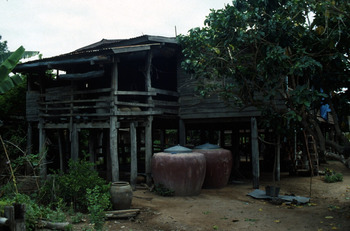
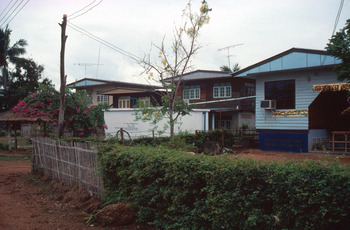
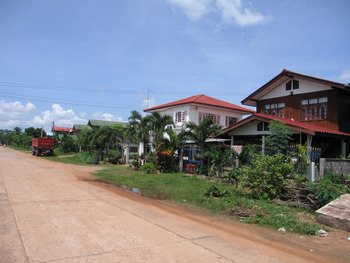
In 1982, I arrived in Ban Non Tae and Ban Tha Song Korn to undertake my PhD fieldwork (Figure 1). In 1994 (Figure 2) and for a second time in 2008–09 (Figure 3), I returned to the villages to track the changing lives and livelihoods of those families (or their descendants) whom I had originally surveyed in the early 1980s.Footnote 6
Tambon Tha Song Korn, 1982

Tambon Tha Song Korn, 1994

Tambon Tha Song Korn, 2008

In the early 1980s, these two villages were poor, semi-subsistence communities, in which most households relied on farming and whose overriding concern was to produce enough rice to feed their families. Rice cultivation relied on traditional or improved varieties of rice, levels of chemical input were low, only a few fields had access to pump irrigation, land was prepared using buffalo and all rice was transplanted and harvested manually. While the inhabitants had access to public transport to the local town, few people had personal means of motorised transport; the only vehicles in the villages were motorcycles. There was certainly some mobility, as villagers travelled to Bangkok and other parts of Thailand for work during the long dry season, and sometimes abroad for longer periods, but most relied on the surrounding land and fields to meet their needs. To use Jacques Amyot's term, who coordinated one of the first systematic set of village surveys in Thailand, this was the ‘intimate universe’ of the inhabitants of Ban Non Tae and Ban Tha Song Korn (Amyot Reference Amyot1976: 45). The local school provided primary education for children, but parents did not think that education beyond bor hok (six years of primary-level schooling) was necessary: children needed to be available for farm work, and the sooner the better.
It was the challenges outlined in the above national and northeast development plans that policies aimed to address, through human capital investment (health, education); infrastructural improvements (roads, power, water, irrigation); market integration (credit, marketing bodies, non-farm work); and the dissemination of new technologies (extension programmes, new rice technologies, chemical inputs). For the villagers of Ban Non Tae and Ban Tha Song Korn, it was by these means that development modalities and ideologies took root and became meaningful at the local level.
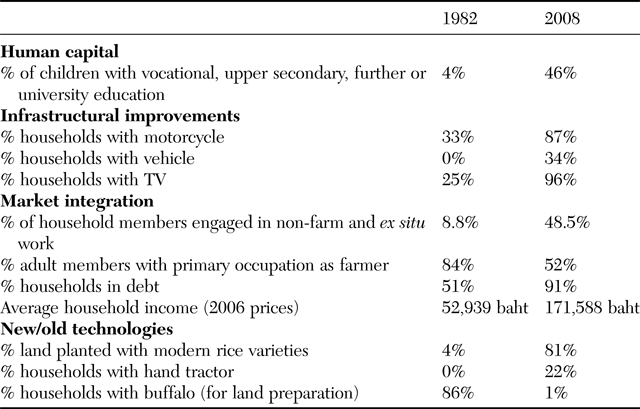
In Ban Non Tae and Ban Tha Song Korn, we can also see how these interventions gained significant traction and were largely achieved or delivered (as they were nationally) (Table 2). Between 1982 and 2008, villagers became notably better educated, non-farm work proliferated and incomes rose; farmers embraced, almost without exception, high-yielding varieties of rice and mechanical means of land preparation; credit became widespread; the great majority of households had access to personal means of transport; and ownership of various consumer goods became widespread, almost universal.Footnote 7 These were considerable achievements in view of conditions in 1980, and even more so when compared to those at the start of the development era in the late 1950s.Footnote 8
Traction: Delivering development in Ban Non Tae and Ban Tha Song Korn, 1982 and 2008

Note: the follow-up surveys in 1994 and 2008 were panel surveys, tracking the same families (or their descendants) that were first surveyed in 1982. The original 1982 sample included 81 households, of which the 1994 and 2008 surveys tracked 77.
Sources: survey questionnaires, 1982 and 2008; n = 77.
The assets recorded in Table 2 illustrates three general points. First, the luxuries of one era become the necessities of the next; necessities are not just physical or basic needs but also determined by “whatever the custom of the country renders it indecent for creditable people, even of the lowest order, to be without” (Smith Reference Smith1776).Footnote 9 In the case of rural Thailand, the transformation of luxuries into necessities has occurred remarkably quickly. Second, it is hard to predict whether particular assets will continue to have the power to discriminate between developed/undeveloped in terms of relative wealth. The motorcycle, for example, was useful in distinguishing rich(er) from poor(er) households in 1982, but by 2008, it had lost its power to discriminate. Likewise, the mobile phone distinguished the poor from the better-off in the late 1990s, but by the end of the 2000s, ownership had become ubiquitous. Third, it is difficult to know what to infer from such data as in Table 2: what does asset ownership reveal about wealth and, even more problematically, well-being? Asset tables do not indicate how the assets were acquired. For instance, Table 2 shows that the proportion of household debt rose between 1982 and 2008 from 51 to 91 per cent. In a separate wealth-ranking exercise, respondents told us that when it came to items such as motorcycles, the key question was not whether an individual owned such an item but how they came to own it, through accumulating debt or spending income/savings. Asset tables therefore share many of the same deficiencies faced by money-metric measures of poverty: both reduce the complexities of development, which is multi-dimensional and variegated, to the simple acquisition of material assets, which are assumed to be straightforward proxies.
It is this type of simplification that has led to a growing call for well-being, quality of life, happiness and flourishing as alternative approaches to judging the success of development: to provide a more holistic insight into the human condition under social and economic transformation. Such studies demonstrate the possibility that increasing wealth and material prosperity might not lead to Chambers’ (Reference Chambers1995) ‘good change’ but instead, ‘bad change’. Such a possibility is growing as the explanatory gap between wealth and genuine progress widens (Clarke Reference Clarke2006: 160; Costanza et al. Reference Costanza, Kubiszewski, Giovannini, Lovins, McGlade, Pickett, Ragnarsdóttir, Roberts, De Vogli and Richard2014; Kubiszewski et al. Reference Kubiszewski, Costanza, Franco, Lawn, Talberth, Jackson and Camille2013). For Clarke, with reference to Thailand, “human well-being…is becoming increasingly disengaged from economic growth” (2006: 161). Thailand's early development plans were not really about development; rather, they were about economic growth, with the assumption that the latter would lead to the former.
In these early plans, well-being was translated as kin dii yuu dii (‘eat well, live well’). This was later seen as problematic, because it essentially linked well-being to material conditions, and the term was therefore extended to include mii sukh (‘have happiness’ or ‘be content’). Well-being thus became kin dii yuu dii mii sukh (‘eat well, live well, have happiness/be content’). The Wellbeing in Developing Countries (WeD) project studied seven villages in two regions of Thailand between 2003 and 2006 – three in the south and four in the northeast – the results of which were not clear-cut and sometimes seemingly contradictory. Nonetheless, the study permitted the following general statements to be made with regard to these particular households, in these villages, at this point in time:
-
– Poor households reported significantly higher life satisfaction than less poor households (Camfield et al. Reference Camfield, Masae, Allister McGregor and Promphaking2013).
-
– There was no statistical difference between poor and non-poor in what they regarded as the necessities of life.
-
– There was a generational divide, with people aged over 65 perceiving luxuries as less important than those aged 25–44 (Camfield et al. Reference Camfield, Masae, Allister McGregor and Promphaking2013).
-
– Expectations outstripped their realisation for many rural people, suggesting that their capacity to aspire was being thwarted (Jongudomkarn and Camfield Reference Jongudomkarn and Laura2005).
-
– Residential location had an important bearing on well-being (McGregor Reference McGregor2008: 14).
4.1 Rural Aspirations
In the background to this discussion is the moving target of aspirations, and the discontent and ill-being that can arise when an individual fails to achieve those aspirations. The WeD study found that some groups “are experiencing an expansion of expectations beyond what they are currently able to fulfil and this has detrimental consequences for their wellbeing” (Camfield et al. Reference Camfield, Masae, Allister McGregor and Promphaking2013). Jongudomkarn and Camfield identified lack of money as a problem across all age groups: “the young who couldn't afford ‘positional goods’, the middle-aged who couldn't fulfil their family responsibilities and the old who couldn't afford to stop work” (2005: 32). In her influential studies of rural Thai migrant women's struggle to be both modern (than samai) and dutiful, Mills (Reference Mills1997, Reference Mills1999) highlights just this sort of aspiration/achievement gap.
In other words, the capacity to aspire (Appadurai Reference Appadurai, Rao and Walton2004) helps to reveal and account for both the forces that drive change in rural (and urban) areas and the discontent that is often found even when, objectively, incomes and material prosperity are rising. These aspirations may be individually articulated, but they are never individually generated: like poverty, they are relational. Aspirations can be relational at either a local, neighbourhood or community level, or a national, even global, level, in that images and lifestyles seen on television and in shopping malls can instil desire – and, when unmet, frustration. Aspirations are also connected, however, to Thailand's development project. Big D development (Hart Reference Hart2001) is about not just delivering on the promise of development but also, and crucially, preparing the ground so that development can take root and achieve momentum independent of the national development project. Where it becomes more complicated is when we consider how – i.e. the basis on which – these development outcomes have been achieved.
Thailand's Sufficiency Economy, or sethakit phorpiang, while drawing on discourses of localism that can be traced back to the 1970s (Hewison Reference Hewison2000), really gained ground from mid-1997 in the wake of Thailand's financial crisis. At the end of that year, the former King of Thailand used his annual birthday speech to develop his ‘New Theory’, which then became known as the Sufficiency Economy (SE). He told his subjects:
Recently, so many projects have been implemented, so many factories have been built, that it was thought Thailand would become a little tiger, and then a big tiger. People were crazy about becoming a tiger… Being a tiger is not important. The important thing for us is to have a sufficient economy. A sufficient economy means to have enough to support ourselves… It doesn't have to be complete, not even half, perhaps just a quarter, then we can survive… Those who like modern economics may not appreciate this. But we have to take a careful step backwards. (UNDP 2007: 20)
SE is often presented by its proponents as a means to think differently about development and development futures. At root, it is seen to comprise three key principles, ‘moderation’, ‘reasonableness’ and ‘self-immunity’, which draw on Buddhist precepts. While some critics view the initiative as impossibly romantic (e.g. Dayley Reference Dayley2011), others direct their attention to the way in which the SE sets its moral compass against the consumerist aspirations of the rural yet-to-be-rich (Rossi Reference Rossi2012; Walker Reference Walker2012: 222). For these scholars, the SE egregiously depicts rural households’ desire for levels of material prosperity that match those in urban areas as ‘greed’, rooted in a lack of right thinking. As Elinoff writes, “…sufficiency projects simultaneously reframe the political and material desires of poor citizens as problematic results of immoderation” (2014: 90). Por piang (enough or sufficiency) is experienced in the lives of the relative poor as piang por (just enough or insufficiency) (Elinoff Reference Elinoff2014: 103).
This highlights one of the contradictions in the well-being debate. There is a good deal of evidence that growing material prosperity has not been accompanied by an equivalent improvement in well-being, as noted above. However, when an initiative is introduced – in this instance, the Sufficiency Economy – that seems to offer a vision of development that goes beyond economic growth and material prosperity, it is viewed as a political project seeking to rework the legitimate desires of the poor as greed, driven by non-Buddhist cravings (tanha).
5.0 The Persistence of the Smallholder in a Context of Deagrarianisation
The households of Ban Non Tae and Ban Tha Song Korn are undoubtedly wealthier in terms of material possessions, three times richer in (real) income terms and also far better off in terms of access to health and education. This trend is repeated for almost everyone across the country, notwithstanding continuing high levels of inequality. This puzzle, however, is the basis on which improvements have been achieved at the village and household levels.
As countries develop, incomes rise, economies diversify and capital replaces labour, farms should (in a normative sense) amalgamate into larger units of production. This is known as the farm size transition and, like other such transitions with their implied teleologies, is seen to have universal, empirical traction:
As per capita income rises, economies diversify and workers leave agriculture, rural wages go up, and capital becomes cheaper relative to land and labour. It then becomes more efficient to have progressively larger farms. Economies of scale in mechanized farming eventually kick in, accelerating this trend. The result is a natural economic transition towards larger farms over the development process, but one that depends critically on the rate of rural-urban migration, and hence on the growth of the non-agricultural sector. (Hazell and Rahman Reference Hazell, Atiqur, Hazell and Rahman2014: 3)
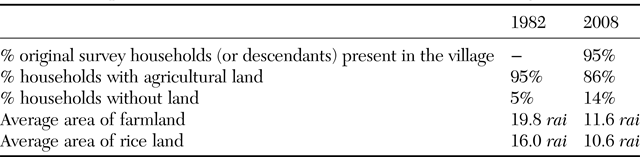
Almost all of the key elements that Hazell and Rahman note are present in Thailand and more particularly, in Ban Non Tae and Ban Tha Song Korn: rising incomes and wages, a diversifying economy and growth of the non-agricultural sector, migration and mechanization of agriculture. Yet, the farm size transition has not – or, at least, not yet – followed. In 1960, the average area of farm holdings in Thailand was 3.5 hectares; over half a century later, in 2013, the average farm extended over 3.2 hectares. The smallholder, as the ‘backbone’ of the Thai nation in terms of both the economy and society, has proved to be remarkably tenacious. The same is true of Ban Non Tae and Ban Tha Song Korn: in 1982, households owned 19.8 rai or 3.2 ha of farmland; in 2008 the figure was 11.6 rai or 1.9 ha (Table 3).Footnote 10 While the application of yield-enhancing technologies was raising output, holdings were nevertheless becoming increasingly sub-livelihood in size as cash needs escalated.Footnote 11 This was accentuated by an underlying anti-rural policy bias over many years: the nominal rate of assistance for agricultural products, taking into account input subsidies and other forms of assistance and taxes, was negative between 1970 and 2004, bar one five-year period from 1994 to 1999 (Anderson and Martin Reference Anderson and Will2008; Warr and Kohpaiboon Reference Warr and Archanun2007). In effect, agriculture was being taxed and therefore depressing farmers’ incomes over this period.
The persistent smallholder in Ban Non Tae and Ban Tha Song Korn

Note: the follow-up surveys in 1994 and 2008 were panel surveys, tracking the same families (or their descendants) that were first surveyed in 1982. The original 1982 sample included 81 households, of which the 1994 and 2008 surveys tracked 77. Area of land in rai: 1 ha = 6.25 rai.
Sources: survey questionnaires, 1982 and 2008; n = 77.
Despite this policy environment, there was no evidence of land accumulation in Ban Non Tae and Ban Tha Song Korn nor significant numbers of households withdrawing from farming (Table 3). How then, did households achieve material prosperity if it was not through farming, and why did they not abandon farming as, in theory, they should have done? The answer lies in engaging in the burgeoning non-farm economy, which, in the main, required migration. This has been instrumental in creating one of the frictions with which this paper is concerned: the emergence of the ‘multi-sited family’.
6.0 The Thai Multi-sited Family
“This is the most difficult period for me. I have to be home alone. I feel lonely. The house is always very quiet when I get back from work in the rice field. All of my children are away to work. They don't send me any money. I have to work every day just to get by. What will happen when I cannot work any longer?” (A 61-year-old Thai rural woman, cited in Jongudomkarn and Camfield Reference Jongudomkarn and Laura2005: 12).
Revisionist historians and anthropologists have been at pains to challenge the sedentary, subsistence farmer paradigm. While this has been a welcome and necessary challenge to the sedentary orthodoxy, it does not fundamentally undermine the contention that the great majority of Thai rural households were, until recently, co-residential. This was because the production and reproduction of the household, in a rural context, were secured on the basis of spatially situated social units, more often than not also embodying familial relationships. Furthermore, the spatially fixed, land-based, nature of livelihoods necessitated that labour, and therefore the household, had a certain spatial geometry.
This is no longer the case: to secure a reasonable level of living, people must withdraw from agriculture (perhaps temporarily) and leave the village, with considerable implications for the family. As the earlier quotation intimates, wealth accumulation in Thailand has been accompanied by a degree of social fragmentation. Surveys reveal that the proportion of children raised by grandparents while both parents were absent quadrupled from two per cent in 1986 to eight per cent in 2006 (Jampaklay et al. Reference Jampaklay, Vapattanawong, Tangchonlatip, Richter, Ponpai and Charita2012: 1). In addition, the proportion of elderly people (aged 60 years or over) living alone in Thailand doubled from 4.3 per cent in 1986 to 8.8 per cent in 2014, while those living alone or only with their spouse in rural areas increased from 11.7 per cent to 28.2 per cent over the same period (Knodel et al. Reference Knodel, Teerawichitchainan, Prachuabmoh and Wiraporn2015: 35).
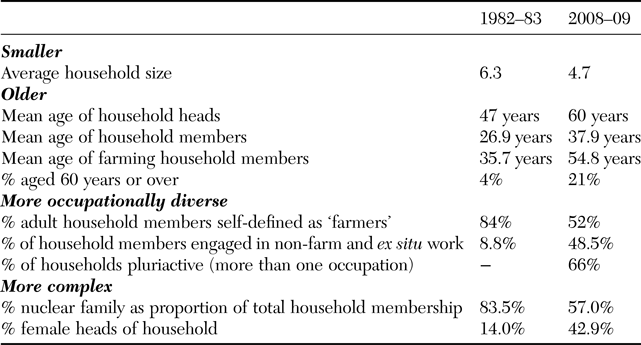
The situation in Ban Non Tae and Ban Tha Song Korn between 1982 and 2009 echoes these studies. Households were becoming smaller, older, more spatially fragmented, more occupationally diverse and, sometimes, more complex in terms of their composition (Table 4). For supporters of Thailand's development model, these changes symbolise homo economicus and the adaptable, neo-liberal Thai peasant; for its critics, they reveal a hollowing out of households and villages, and the undermining of social relations:
The basic building blocks of local society have taken a terrible beating. … Families are scattered by migration. Village populations are hollowed out, with mainly young and old, and few of working age. Many children are brought up seeing their parents only for occasional visits. (UNDP 2007: 2)
The changing household and family, Ban Non Tae and Ban Tha Song Korn, Mahasarakham, 1982–2009

Source: field surveys, 1982–83 and 2008–09.
The changing profile of the Thai rural household has been largely shaped by the changing nature of the Thai economy, the occupational opportunities that have emerged and their spatial signatures. The declining size of landholdings, in many instances to sub-livelihood levels; the shift in terms of trade (until quite recently) against agriculture; the fact that non-farm opportunities are generally distant from natal villages; and the growing requirement that younger generations take advantage of their education by taking up non-farm work have all been instrumental in shaping the new household profiles that have emerged in Thailand.
6.1 Working and Caring in the Contemporary Thai Countryside
“If children are truly our future, then the fate of these 3 million [children left behind] in Thailand are at stake. It is a problem that is slowly, in the background, jeopardising the nation” (Bangkok Post Reference Bangkok2014).
With smaller households, ageing families, increasing numbers of children being raised away from their parents, more and more elderly living alone and millions of supposed ‘rural’ people living away from home for longer, how will the rural farming household reproduce itself, and how will the rural family care for its elderly, children and vulnerable? There are, therefore, important questions of both production and reproduction to consider. There are those who are concerned with how rural society will sustain itself and worry about care for left-behind children and the elderly (reflected in the quotation above). On the other hand, others extol the resilience of rural households and point to their adaptability, over many years, in the face of successive environmental and economic crises (e.g., Knodel et al. Reference Knodel, Vipan and Napaporn2013; Knodel and Saengtienchai Reference Knodel and Chanpen2007).
Traditionally, older generations in rural Thailand were supported by their younger kinfolk through an intergenerational bargain: at least one child would co-reside or at least live very close to their ageing parent(s).Footnote 12 Migration and smaller families, however, render this bargain harder to sustain, at least in its traditional form. In a 2014 survey, those aged between 75 and 79 years had an average of 3.9 living children, while those aged 50 to 54 had 2.0 living children; at the same time, 5.5 per cent of the older cohort were childless compared with 11.4 per cent of the younger (Knodel et al. Reference Knodel, Teerawichitchainan, Prachuabmoh and Wiraporn2015: 23–24).Footnote 13 Migrant absences have grown longer, leaving ageing parents alone, either fending for themselves or seeking support from other relatives or the wider community.
Frequently, accompanying this increase in the elderly living separate from their adult children are children living apart from their parents. In 2014, 15.3 per cent of households with elderly (over 60 years) members co-resided with a grandchild whose parents were absent; for skip-generation households – where there is no middle generation, whether parent or other – the figure was 9.8 per cent of all households with elderly members, and 15 per cent in the northeastern region (Knodel et al. Reference Knodel, Teerawichitchainan, Prachuabmoh and Wiraporn2015: 45).
Whether this is a broadly positive development, because migrant children generate additional income and improve the material well-being of their ageing parents (Knodel and Saengtienchai Reference Knodel and Chanpen2007), as well as fund the education and increase the opportunities of their own children, or on balance, negative (Sudnongbua et al. Reference Sudnongbua, LaGrow and Julie2010), is debatable. Whatever scholars’ views, though, it demonstrates how development processes and the underlying policies lead to other, sometimes unintended, transformations, which are both harder to measure and less amenable to resolution.
Initially the state's vision, reflected in planning documents, was to develop – to modernise – the smallholder. However, rather than smallholder commercialisation, the dominant development motif has been one of deagrarianisation (Rigg Reference Rigg2006). In fact, this has often allowed semi-subsistence production to persist, even while full engagement in the global economy exists in other ways and other development spaces. As Keyes says in his study of Ban Nong Tuen, also in Mahasarakham, villages are “keenly aware that they cannot pursue ‘development’ for themselves and their families by remaining tied to local means of production”, but this has not entailed them abandoning either their village or their farmland (2014: 172).
7.0 Precariousness and Late Capitalism in the Thai Countryside
There is a further paradox to the situation that has evolved in Ban Non Tae and Ban Tha Song Korn, which is also reflected in many other places in Thailand and Asia: if farm sizes are sub-livelihood, policies generally anti-farming, farming increasingly regarded as low status – especially by the young – and numerous better-paid opportunities exist in other places and sectors, why do households hold onto their land and remain in the village?
In this paper, it is argued that it is due to the precarious nature of many occupations in the modern, non-farm sector. Young migrants, with more educational capital than their parents, may not be marginalised in the urban informal sector, but they are working in a formal sector that is becoming increasingly informal, or precarious. For the farm size transition to take root – at least without coercion – it is necessary for those who leave agriculture to find productive, secure and gainful employment elsewhere. This has not been the case in Thailand, or in many other Asian countries where factory and other work is far from secure and state benefits are limited or non-existent. Economic expansion in countries like Thailand has been driven by growth in the non-farm sectors; this has also permitted such farming households as those in Ban Non Tae and Ban Tha Song Korn to achieve a degree of material prosperity and, in that sense at least, to develop. But the inherent precariousness of such work, and the absence of a social safety net in many countries, plays a role in explaining why families are divided with the consequences outlined here (Rigg et al. Reference Rigg, Salamanca and Thompson2016: 130). This was not the outcome anticipated by scholars or policy-makers.
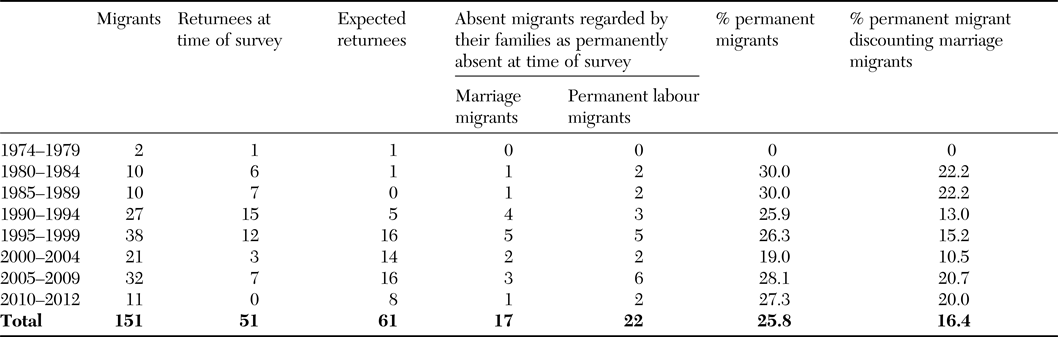
In a separate study of first- and second-generation migrants from three villages in neighbouring Khon Kaen Province, we were surprised by the small number of permanent outmigrants (see Table 5). We concluded that: “The trend towards greater informalisation of work in the formal sector is…a barrier to sustained, long-term engagement with the industrial and service sectors. … The three villages that we studied may be places to leave but they have not become places to leave behind; rather, they are places to return to” (Rigg et al. Reference Rigg, Buapun and Mare2014: 196).
Leaving and returning: Households’ evolving migration signatures

Source: main survey (2012) and follow-up survey (2013).
The expectation was that supporting smallholders would both develop the countryside and ensure that most people would be able to remain working in farming, on the land and in the village. A significant number, though, would be released to work in the urban economy, leaving agriculture and the village. Instead, a situation exists where households manage their lives across space and sectors, with a far less permanent transfer of population to urban areas and non-farm work. The reasons for this lie in a combination of factors: the insecurities connected with much non-farm work; the absence of a sufficient social safety net; the collapse of what were era-defining changes in the global North into generational timescales; the role of government policy; and, perhaps, the rural populations’ abiding attachment to the land. All these mean that in rural Thailand – and rural areas in other Asian countries (for example, on China, see Andreas and Zhan Reference Andreas and Shaohua2016; Huang Reference Huang2011; Huang et al. Reference Huang, Gao and Yusheng2012; Zhang et al. Reference Zhang, Oya and Ye2015) – the smallholder remains the dominant social and economic unit in the countryside, notwithstanding the aforementioned profound changes in the functioning and structure of the smallholder household. Whether the current situation will prove resilient is another matter, however.
8.0 Conclusions: From Market Economy to Market Society
We can see how the Club of Rome's world problematique outlined in section 1.0 resonates with some of the development issues raised in this paper, being: complex, dynamic, not conducive to technical solutions and not easily measured.
The Thai government, having spent four decades convincing the rural population to be discontented with their lives, has focused on trying to reverse this thinking since the Millennium, admonishing them to be contented with a sufficiency of material prosperity. The evidence, however, is that having marched the Thai people to the top of the hill of materialism, it is proving rather harder to march them down again. What has been done, is now hard to undo. In 2003, the US Central Intelligence Agency (CIA) declassified a 1967 intelligence memorandum on the political, security and development challenges facing the Thai government in the northeast region. It noted that almost 80 per cent of farmers in the northeast earned less than 15 USD per capita per year. A survey of villagers’ attitudes in 1966, however, showed how most villagers surprisingly regarded themselves as reasonably well off, not poor (CIA 1967: 750). Today, the rural population in the northeast is undoubtedly far richer; I suspect, however, that a much smaller proportion would regard themselves as reasonably well off.
Arguably, this has opened up three gaps, with accompanying challenges. First, there is a development gap, between what the Thai government is attempting to achieve and the willingness of the Thai population to join in that journey. While social critics may have tried to resist the imposition of market sensibilities in the countryside, rural people themselves were rarely so reluctant. The market imperative, for good or bad, was embraced enthusiastically by poor and rich alike; when there was resistance, it was due to a sense of injustice connected to the inequitable access to the market. However, the point is that the rural population have engaged in and pursued their personal development projects in a manner rather different from that envisaged by the state. The second, a political gap, arises directly from this growing development gap and is evident in Thailand's Red Shirt/Yellow Shirt conflict. Although commentators have strived to avoid characterising this conflict as one that sets the poor, rural masses against the rich, urban elite, there is evidence that the conflict is indeed class-based. Whether it is new, as Phongpaichit and Baker (Reference Pasuk, Chris, Phongpaichit and Baker2015: 16–17) suggest, or long-standing, at the heart of the conflict is unequal access to opportunities and, therefore, development justice. At least at this level and for the Isan region – a centre of ‘red’ activism – the present political disaffection resonates with the northeast problem articulated half a century ago.
The third gap is aspirational, between what has been achieved (which is a good deal) and what is aspired to. In their study of inequality, Phongpaichit and Baker argue that “resentments are created when those with new [unmet] aspirations confront the structures and attitudes founded on economic inequality” (2015: 17). Paradoxically, the Thai government, having delivered on its promise of development-as-modernisation for much of the latter part of the twentieth century, found itself in the early twenty-first century with a rural population who were less contented and more politically disenchanted than, arguably, at any point since the peak of communist insurgency in the 1970s. Such is the contradiction of Thailand's development miracle.
Acknowledgements
This paper draws on a number of earlier studies, but I would particularly like to acknowledge the contribution of Albert Salamanca who worked with me on the 2008–2009 follow-up study of Ban Non Tae and Ban Tha Song Korn. Some of the wider arguments draw on research undertaken by Salamanca and myself and funded by the National University of Singapore's grant ‘Living off the Land in Thailand’ (R109-000-164-133), as well as research led by Eric Thompson and myself in connection with a Singapore Ministry of Education grant ‘Asian Smallholders: Transformation and Persistence’ (MOE2015-T2-1-014). Finally, I would like to acknowledge the valuable comments of the two referees.