To what extent can presidents exert gatekeeping power in opposition-led legislatures? There are two main bodies of literature that provide competing answers. One set of studies extends and modifies cartel theory and focuses primarily on legislative actors, suggesting that either plurality parties (Calvo Reference Calvo2014; Jones and Hwang Reference Jones and Hwang2005) or majority coalitions (Amorim Neto et al. Reference Amorim Neto, Cox and McCubbins2003; Chasquetti Reference Chasquetti2013) set the agenda. In the absence of plurality or stable majority coalition cartels, legislative agenda control reverts to the median party. A separate body of work focuses more heavily on the ability of presidents in multiparty systems to form stable or ad hoc legislative coalitions (Alemán and Tsebelis Reference Alemán and Tsebelis2016; Alemán and Calvo Reference Alemán and Calvo2010; Calvo and Sagarzazu Reference Calvo and Sagarzazu2011; Chaisty and Chernykh Reference Chaisty and Chernykh2017; Hiroi and Rennó Reference Hiroi and Rennó2014; Martínez-Gallardo Reference Martínez-Gallardo2012; Raile et al. Reference Raile, Pereira and Power2011). These studies suggest that presidents and their parties play a large role in setting the legislative agenda.
This article combines insights from both bodies of work and addresses a number of existing gaps in the literature through a case study of agenda setting in the Mexican Chamber of Deputies. First, from a theoretical perspective, existing work on agenda setting has not clearly identified whether plurality parties on their own, regardless of their connection to the president, are able to prevent bills they oppose from passing due to their large numbers, or if plurality parties have gatekeeping power largely due to shared partisanship with the president and presidential agenda-setting powers. Much of the work on plurality cartels focuses on Argentina, where the presidential and plurality party are the same. The Mexican case helps address this gap in the literature because the plurality party in three of the four terms from 2000 to 2012 was also the largest opposition party to the president.
Second, the literature on coalition and cabinet formation in multiparty systems focuses primarily on the executive’s agenda, although we also know that in many legislatures, a significant portion of legislative work does not focus solely on the president’s bills, and that the lack of a majority party provides many opportunities for opposition parties to influence the agenda (Alemán and Calvo Reference Alemán and Calvo2010; Calvo Reference Calvo2014). We know very little about how agenda setting varies based on the origins of proposals. Here, we address this gap in the literature by examining agenda-setting coalitions on initiatives that originate in the executive and legislative branches.
Third, previous work on legislative agenda setting focuses heavily on formal coalition formation, with presidents nominating members of coalition parties into the cabinet (Amorim Neto et al. Reference Amorim Neto, Cox and McCubbins2003; Chasquetti Reference Chasquetti2013; Martínez-Gallardo Reference Martínez-Gallardo2012). However, not all presidents in multiparty settings form coalitions through cabinets, and we know very little about agenda setting in these opposition-controlled environments. The Mexican Chamber of Deputies is an excellent case to examine how legislative coalitions form in a context in which presidents do not construct coalition cabinets (Camp Reference Camp2018; Casar Reference Casar2016; Martínez-Gallardo Reference Martínez-Gallardo2012).
To address these gaps in the literature, this study examines all legislation subject to a roll call vote in the Mexican Chamber of Deputies from 1998 to 2015 and draws on interviews with former legislators and congressional staff. From these data, we examine the institutional and partisan origin of bills voted on in the Chamber and explore the probability of a party being rolled (i.e., voting against a bill that passes) on executive and legislative initiatives and on amendments.
We find that presidents exert weak gatekeeping power over the legislative agenda. While presidents and their parties are rarely defeated on roll call votes regarding presidential initiatives, they generally create stable, informal coalitions with opposition parties in order to shepherd executive bills through Congress. In particular, when the president’s party is not the median party, they rely on informal coalitions with the median party to move their legislation through the Chamber. Moreover, the agenda-setting power of the president and the president’s party is weaker when it comes to initiatives that originate in the legislative branch, where they are occasionally rolled on legislative initiatives and during the amendment stage if they are not also the median party. In sum, agenda-setting power is shared among multiple actors within the legislative and executive branches.
Presidential Agenda Setting and Coalition Formation
In many presidential systems, multipartism is firmly institutionalized in the agenda- setting process through the formation of formal coalitions, through which presidents nominate members of coalition partners into the cabinet (Kellam Reference Kellam2015; Martínez-Gallardo Reference Martínez-Gallardo2012). One framework used to analyze agenda setting in these systems is the parliamentary agenda cartel theory. This theory suggests that the coalition government formed by the executive has the power to set the agenda. In this model, each party in the multiparty coalition has veto power over the agenda, such that all measures that reach the floor are acceptable to each party in the coalition. Support for the parliamentary agenda cartel model has been found in Brazil, Chile, and Uruguay (Alemán and Navia Reference Alemán and Navia2016; Amorim Neto et al. Reference Amorim Neto, Cox and McCubbins2003; Chasquetti Reference Chasquetti2013), although not in Colombia (Carroll and Pachón Reference Carroll and Pachón2016).
While many multiparty presidential systems rely on formal coalitions as a way to secure legislative support, not all presidents do so. According to Calvo and Sagarzazu (Reference Calvo and Sagarzazu2016), 30 percent of governments in Latin America during the period 1980–2008 had legislatures led by the president’s party, which also had a plurality of seats in the legislature. Conversely, 12 percent were led by an opposition party with a plurality of seats. The remaining 58 percent of governments were led by either single-party or coalition majorities. Thus, presidents may form majority coalitions, rely on their own party’s plurality of seats to form ad hoc legislative coalitions (Calvo Reference Calvo2014; Kellam Reference Kellam2015), or work with opposition parties to secure legislative support for their agenda, even without granting them cabinet representation (Chaisty and Chernykh Reference Chaisty and Chernykh2017).
Since 1997, Mexican presidents have either had plurality support in the legislature (1997–2000, 2006–9, 2012–15) or have confronted legislatures led by a plurality party from the opposition (2000–2006, 2009–12).Footnote 1 Given this long period without single-party majorities, the lack of formal coalition formation in the Mexican context is somewhat puzzling in comparative perspective. Other work finds that durable coalitions are more likely when presidents lack strong, unilateral powers and party discipline in the legislature is high, as is true in Mexico (Martínez-Gallardo Reference Martínez-Gallardo2012). Moreover, pre-electoral coalitions are common among the left and the PRI, although the PAN, which controlled the presidency from 2000 to 2012, has been somewhat less willing to form them.Footnote 2
Yet legislative support coalitions in Mexico are fairly stable and predictable. We argue, given the nature of presidential powers in Mexico, that presidents have formed durable, informal coalitions to advance their agendas. The Mexican presidency has few formal legislative powers granted to it by the constitution compared to other Latin American executives (Casar Reference Casar2016). It lacks any form of emergency decree, though it has, since 2012, acquired the power of urgency motions. While presidents can introduce and veto legislative proposals, their only exclusive proposal power is over the budget. However, the president’s right to present amendatory observations can act as an important instrument for influencing the final shape of legislation (Alemán and Tsebelis Reference Alemán and Tsebelis2016a).
Although the loss of single-party majorities in the Mexican Chamber of Deputies in 1997 led to a decline in the number of executive-sponsored proposals, most of the proposals that were submitted did pass, albeit with many amendments (Casar Reference Casar2016; Kerevel and Bárcena Juárez Reference Kerevel and Bárcena Juárez2017). Once Mexican presidents introduce a bill, there are few actions they can take to move the bill through the legislative process without support from gatekeepers in the legislature. Therefore, the president must negotiate legislative support coalitions in order to move legislation through the committee stage and negotiate with party leaders in prefloor institutions to schedule a vote on the floor. While urgency motions since 2012 grant more power to the president to force a vote on executive-sponsored bills within 30 days, presidents can exercise this power on only two bills per session (four per year), and this power does not apply to constitutional amendments.
Furthermore, party discipline is exceptionally high in the Mexican Congress (Casar Reference Casar2016; Jiménez Badillo Reference Jiménez Badillo2006; Kerevel Reference Kerevel2010; Rosas and Langston Reference Rosas and Langston2011), which suggests that presidents must negotiate with party leaders to build support coalitions rather than attempt to build ad hoc coalitions with individual deputies across multiple parties (Rodríguez Carrillo and Santacruz Fernández 2016). Since Mexican presidents have not formed formal coalitions with cabinet representation, the president’s legislative agenda is likely to be subject to approval by the median party in the chamber (Cox and McCubbins Reference Cox and McCubbins2005; Chandler et al. Reference Chandler, Cox and McCubbins2006; Cox et al. Reference Cox, Heller and McCubbins2008).
While there has been some debate in Mexico about moving to a more formal method of organizing governing coalitions in which coalition partners gain cabinet positions, a former PRI senator suggests that the informal coalitions have worked well.
Until now we have been able to govern well with issue-based coalitions. Just imagine how complicated it would be to hand the Greens [PVEM] one or two ministries. Policy programs would end up being mixtures of what the Greens wanted with what the government considered as priority…. [T]he most feasible is that we keep working with tailor-made alliances only in those subjects that the president deems necessary. (Toledo Infanzón Reference Toledo Infanzón2014)
Under PAN governments from 2000 to 2012, the president’s party formed a stable legislative alliance with the PRI to support presidential bills. In an interview, a legislative liaison (enlace legislativo) in Felipe Calderón’s administration suggested that the informal alliance with the PRI to pass presidential bills was not just because the PRI was often the largest party in the Chamber.
Even though PRD had a bigger caucus [in the 60th Legislature] during the Calderón administration, the PAN constantly sought out the PRI as a strategic ally.
… This situation also helped the PRI a lot, since they won concessions in agriculture, housing, and social development that were not what the PAN wanted. In return for their support, priista deputies were free to suggest changes in committees to executive proposals, and if the legal chief of staff endorsed them, these reforms would stay just as the PRI had introduced them. (Legislative Liaison Reference Liaison2018)
In addition, the same interviewee suggested that the PRI was a more reliable coalition partner for the PAN, due to the party’s stronger discipline.
When PAN was in government, we had the order [from the highest ranks] to consider the positions of the PRI in every negotiation. What made us see them always as possible allies was not only the number of legislators they held, which was less than PRD, but the fact that the PRI [caucus] was well controlled by [Emilio] Gamboa as caucus leader, and he was our channel for communicating with the whole PRI caucus. (Legislative Liaison Reference Liaison2018)
Previous work also suggests that it is easier for presidents to negotiate support coalitions with cohesive parties, since fewer individuals are involved in the negotiations (Rodríguez Carrillo and Santacruz Fernández 2016).
During the Enrique Peña Nieto (PRI) presidency, while the PRI was able to form minimal winning coalitions with the Green Party (PVEM) and the New Alliance Party (PANAL), the executive’s major structural reforms required a stable support coalition with one of the major parties in order to pass constitutional reforms. A legislative staffer suggests the PRI considered the PAN its primary coalition partner in the legislature, although it did eventually form a broader coalition that also included the PRD.
I can tell you that the major reforms during Peña’s administration were arranged even before he took office, probably from when he was appointed as a candidate.
From then on, PAN was in the center of the PRI coalition-building plan. They were seen as the principal ally of the government, even before they knew how the elections would turn out. Peña and his [transition] team planned on negotiating first with PAN. This, in turn, would attract the interest of the PRD. And that’s how it was during the transition, PRD leaders did not want to be left out, and so they joined the pact [Pact for Mexico]. (Legislative Liaison Reference Liaison2018)
We assume here that most of the policy space in the Mexican Chamber is organized around a single ideological dimension, and political parties can be located from left to right on this dimension (Colomer Reference Colomer2005; Nacif Reference Nacif2006). While other works have identified several other dimensions in Mexican roll call voting (Cantú and Desposato Reference Cantú and Desposato2012), most of the variation in roll call voting can be explained by a single dimension, which analysts suggest corresponds to the traditional left-right ideology (Robles Peiro Reference Peiro and Adolfo2009). In addition, there is no clear consensus surrounding the nature of additional dimensions in legislative voting and whether or not they are stable across legislatures (Cantú and Desposato Reference Cantú and Desposato2012; Roble Peiro Reference Peiro and Adolfo2009). In the online appendix, we justify the organization of Mexican parties along the left-right dimension.
When the president’s party is the median party, meaning that it contains the median legislator, it is likely to create ad hoc legislative coalitions with parties on either side of the ideological divide, depending on the status quo position of a given policy. However, even absent any agenda-setting power, the president’s party is very unlikely to be rolled on any initiative, given that it occupies the median and that parties to the left or right of the median have difficulty forming majority coalitions without the support of the president’s party. Therefore, the first hypothesis of this study is
H1. The median party will seldom be rolled on roll call votes.
In contrast, when the president’s party does not hold a majority of seats and is located on one extreme of the left-right dimension, the optimal strategy for the president is to form a support coalition with the median party to advance the agenda. Therefore, for presidential initiatives, we expect that presidential parties and their informal coalition partners will rarely be defeated in floor votes if presidents successfully negotiate legislative support coalitions along this single dimension, whether or not the president’s party contains the median legislator.
H2. Presidential parties will rarely be rolled on presidential initiatives.
While presidents may grant significant concessions to other parties in order to secure legislative support for their initiatives, they are unlikely to expend resources to maintain this coalition for all legislative business. Presidents still possess veto power to block legislation they oppose, while opposition parties have strong electoral incentives to use their position in the legislature to advance their own policy agenda to distinguish themselves from the current government. For example, former PRI senator Adolfo Toledo suggests that PRI legislators under PAN governments used their own legislative powers to criticize the PAN government, despite informal coalitions these two parties made to support presidential initiatives.
During those legislative terms [2006–2012], the party [PRI] encouraged legislators to be critical of the [PAN] government through our bills. Despite sounding contradictory, these critical bills would open channels of negotiation with the government. We were freely allowed to legislate as a way to show the government we could draft better reform projects than the president, or to demonstrate that their reforms did not consider very important aspects. (Toledo Infanzón Reference Toledo Infanzón2014)
Thus the president’s party may not always be able to prevent legislation it opposes from reaching the floor. Importantly, when presidential parties do not include the median legislator, we expect the president’s party to be defeated occasionally on floor votes on proposals originating in the legislature, in contrast to executive-sponsored initiatives.
H3. On initiatives originating in the legislative branch, the presidential party will frequently be rolled when it does not include the median legislator.
The Legislative Process and Agenda Setting
Mexican deputies have ample power to propose as much legislation as they wish on any issue, the only restriction being the annual budget, which is the exclusive purview of the executive. Deputies may present bills as unique authors, with other lawmakers endorsing the bill, or as a group (such as the whole caucus, some members of the caucus, as a whole committee, as certain members of the committee, as members of different caucuses, or as members from the same state). More details of the legislative process are included in the appendix. Here, we focus on the key actors that help shape the agenda during the legislative process.
Similar to Argentina, but unlike the United States, the Mexican Congress possesses strong prefloor institutions that shape the legislative agenda (Calvo Reference Calvo2014; Cox and McCubbins Reference Cox and McCubbins2005). The primary agenda-setting institutions in the Chamber of Deputies are the Mesa Directiva (MD, or Chamber Directorate) and the Junta de Coordinación Política (JCP, or Party Leadership Committee), although the JCP is the more powerful of the two bodies. The MD is in charge of running general legislative business, organizing the agenda of plenary sessions, and scheduling votes and who gets to speak on the floor. The MD is made up of one president, three vice presidents, and the secretaries of each political party. Representatives on the MD are elected annually by a two-thirds majority, and the presidency of the MD rotates annually among the three largest parliamentary parties. After bills are drafted, the MD determines whether a bill meets the technical requirements as determined by internal rules, and if these requirements are met, then the MD must submit the bill to a committee for review.
The JCP is made up of the caucus leader (coordinador parlamentario) from each political party with at least five seats in the Chamber of Deputies, and leadership of the JCP rotates between the three largest parties when there is no majority party. Decisionmaking in the JCP is weighted by each party’s seat share in the Chamber, giving greater power to the largest party. The JCP’s powers are fairly extensive. They include the power to name the chairs and vice chairs of each committee and also the power to remove members of committees temporarily or permanently. The JCP also proposes the legislative budget for the year and has the authority to dispense human, material, and financial resources to each party, as well as to individual legislators (Reveles Vázquez Reference Reveles Vázquez and Vázquez2002, 184–86). The national party organizations generally influence the nomination of caucus leaders.
At the beginning of each legislative term, caucus leaders represented in the JCP negotiate which parties will chair which committees. In practice, the two largest parties, PRI and PAN during the terms studied here, reserve for themselves the most important committees, which produce much of the legislation eventually adopted on the floor of the Chamber. In addition, members of the JCP, along with the president of the MD, form the Conferencia para la Dirección y Programación de los Trabajos Legislativos (Conference on Control and Scheduling of Legislative Business), which is in charge of scheduling the plenary agenda (Mora-Donatto Reference Mora-Donatto and Béjar Algazi2009). Decisionmaking in the conference grants greater power to the largest party, as each member has a weighted vote based on their party’s seat share in the Chamber. Thus, as in Argentina (Calvo Reference Calvo2014), leaders of the plurality party not only have significant influence over which committees they will chair; they also have significant influence in a separate institution in charge of scheduling bills that come out of committees before reaching the floor.
While the committee system in the Chamber of Deputies is somewhat weak, committees also play an important role in setting the agenda. Formally, all bills must pass through a committee before coming to the floor, and committee chairs have the power to set the agenda of committee meetings and prevent proposed legislation from being discussed in committee. When a bill is under review by a committee, the committee can modify, delete, or add content to a bill or even mix content from different bills when conducting its review. Its agenda power is institutionally granted, as every bill must receive a committee review before it can be scheduled for discussion on the Chamber floor.
However, committees are required to reflect the proportional distribution of seats in the entire Chamber as long as no party holds a majority, which means multiparty coalitions are necessary to pass a committee report before a bill can reach the floor. Moreover, it is generally not the case that each party uses its control of committees it chairs to block legislation from other parties. Existing evidence suggests that legislation sponsored by each party has a similar probability of making it out of committee, regardless of which party chairs the committee (Báez Carlos Reference Báez Carlos and Béjar Algazi2009). Nevertheless, the JCP can force a bill out of committee if it so desires, and has strong powers to shape which bills make it out of committee (Casar Reference Casar2016; Rivera Sánchez 2004). Occasionally bills may bypass the committee process if supported by a two- thirds majority on the floor, although these instances are rare and generally limited to legislation that has previously passed in the Senate.
Given the strong powers of the MD and the JCP to shape the agenda, as well as the proportional allocation of seats on committees and among committee chairs, one should not expect legislation to reach the floor to be defeated. Instead, one should expect a high degree of consensus in floor votes and in the legislation permitted to reach the floor, as previous studies have argued (Calvo Reference Calvo2014; Casar Reference Casar2016). From 1998 to 2015, only 20 bills were defeated on the floor, and 8 of these bills came from the first legislature without a majority party (57th Legislature, 1997– 2000), providing some initial suggestive evidence that the MD and JCP, along with committee chairs, do a good job of allowing to reach the floor only legislation that will pass.
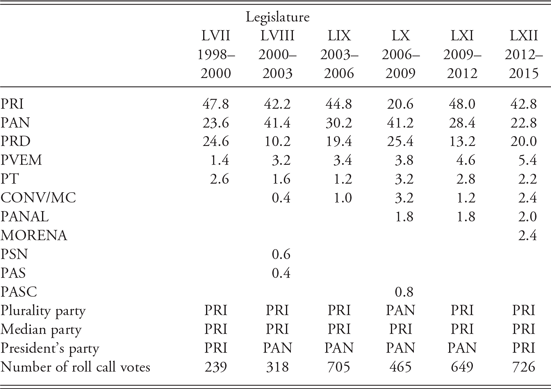
Table 1 presents the partisan breakdown of legislation voted on the Chamber floor, as well as the institutional origins of the original sponsors of this legislation.Footnote 3 More than half of all bills were individually sponsored by one of the three major parties, with the PRI and PAN making up the largest contributors.Footnote 4 The minor parties also appear to be increasingly successful over time at promoting legislation on the floor, which is partly a reflection of the growing presence of small parties in the Chamber (see table 2). Among the small parties, the PVEM was the largest contributor of minor party initiatives across all terms, while the PT generally contributed very little legislation to the agenda.
Who Contributes to the Legislative Agenda? (percent)

Note: PRI, PAN, and PRD entries also include a small number of bills supported by one of the major parties and one or more minor parties. The minor parties entry sums all bills supported by individual minor parties. There are no bills supported by minor party coalitions, but major party coalition bills include bills supported by minor parties. Cross-institutional collaboration bills include committee reports made up of initiatives from at least two of the following: president, deputy, senator, state legislature.
Percentage of Seats in Mexican Chamber of Deputies

Source: Sistema de Información Legislativa, Secretaría de Gobernación
Given the lack of partisan majorities in the Chamber, there were also a large number of bills supported by multiple major parties. Committee reports supported by major party coalitions included not only bills originally drafted by a multiparty coalition but also the generation of compromise legislation drawing on individual bills sponsored by each party. In the 57th legislature, a high of 41 percent of all committee reports were generated by at least two of the major parties, although since 2000, roughly 20 to 33 percent of all committee reports reflect compromise legislation across at least two of the major parties. Among the two major party coalition committee reports, most of these bills represent compromise legislation created by PAN and PRI. In sum, all parties in the Chamber influence the agenda and can successfully pass certain proposals.
However, given the lack of single-party majorities, the possibility still exists in plurality-led legislatures for conflict on the floor. Gatekeepers may successfully prevent legislation they oppose from reaching the floor but may not be able to prevent amendments to that legislation. While bills are rarely defeated on the floor in the Chamber, there is still substantial conflict in floor voting over amendments to proposed legislation. Out of the 793 amendments subjected to recorded votes on the floor, 21 percent were rejected.Footnote 5
The particular nature of floor agenda-setting institutions in the Mexican Chamber gives substantial power to the median party to prevent amendments to legislation it opposes. Unlike many other legislatures, there is no final vote on a bill after a vote on an amendment. A general vote is held first on the entire bill (en lo general), and then a series of amendment votes (en lo particular) on reserved articles are held sequentially following the general vote (Weldon Reference Weldon, Morgenstern and Nacif2002). Amendment votes are held only if the bill was approved during the general vote. In practice, this means that each vote on an amendment functions similarly to a final passage vote on the entire bill.
While agenda setters may use the MD and JCP to restrict legislation from reaching the floor, all deputies have the right to present amendments in writing to be discussed and voted on the floor. Thus, while the president and presidential party are unlikely to be rolled on executive-sponsored bills, the president’s party may not always be able to prevent unwanted floor amendments to presidential initiatives. Instead, assuming a single left-right dimension, the party that includes the median legislator is likely to prevail on nearly all amendment (en lo particular) votes. When the president’s party does not include the median legislator, it may occasionally be defeated on amendment votes to executive initiatives by a majority coalition of the opposition.
H4. On amendment votes, the presidential party will frequently be rolled when it does not include the median legislator.
Data, Research Design, Methodology
To test each hypothesis, we gathered all recorded roll call votes from the Mexican Chamber of Deputies from 1998 to 2015, from the Chamber of Deputies website.Footnote 6 The roll call votes cover six legislative terms, although there is only partial coverage of the 57th Legislature (1997–2000), since electronic roll call voting was not adopted until the middle of the term. These terms cover four separate presidents: Ernesto Zedillo (PRI, 1994–2000), Vicente Fox (PAN, 2000–2006), Felipe Calderón (PAN, 2006–12), and Enrique Peña Nieto (PRI, 2012–18). Table 2 presents the number of recorded roll calls per term and the percentage of seats held by each party, along with the party identification of the plurality, median, and presidential parties in the Chamber of Deputies.
Nearly all substantive legislation is subject to a roll call vote in the Chamber of Deputies, and previous research on the few votes not recorded in the roll call record suggest few differences between recorded and nonrecorded votes (Cantú et al. Reference Cantú, Desposato and Magar2014. Roll call votes on legislation are votes on committee reports (dictámenes), which may include a variable number of individual bills. Committees may draw on several different initiatives to produce draft legislation, which is then reported to the floor for a vote. From these committee reports, we collected information on the institutional origin of the sponsor or sponsors of each piece of legislation that was drawn on in the committee report, as well as the sponsors’ party identification. These data allow us to determine the relative weight of the president versus legislators in shaping the bulk of the legislative agenda, as well as the overall partisan origins of the legislation voted on, which can be seen above in table 1.Footnote 7
While these data are useful for understanding relative partisan and institutional contributions toward shaping the legislative agenda, they are imperfect, since they do not capture the extent to which originally sponsored bills were altered during committee deliberations. Moreover, one should not always expect a party that contributed to the initial legislation to support it on the floor, given the real possibility that the legislation has been altered in committee.
Rolls, generated from roll call votes, provide our measure of partisan support for the legislative agenda (Cox and McCubbins Reference Cox and McCubbins2005; Jenkins and Monroe Reference Jenkins and Monroe2016; Robinson Reference Robinson2015). A roll occurs when the majority of a party votes in opposition to a measure that passes in spite of that opposition. Thus, if a majority of a party’s legislators voted against a bill that passes, that party has been rolled. Rolls are a better indicator of which party supports a bill than identifying the original sponsor, since it is very difficult to measure how much a proposal was altered in committee and who supported the alterations. Rolls are also a measure of negative agenda control and an appropriate indicator when one expects much of the agenda-setting process to happen in prefloor institutions (Jenkins and Monroe Reference Jenkins and Monroe2016).
We identified each time a party was rolled for each legislative term from all votes that passed. We excluded from the denominator proposals that did not pass.Footnote 8 From a theoretical standpoint, it is unclear what failure to pass signals about negative agenda control if most agenda setting happens before bills reach the floor (Jenkins and Monroe Reference Jenkins and Monroe2016). In practice, we excluded very few votes, since very few bills make it to the floor and do not pass, as mentioned above.Footnote 9
In contrast to many studies of rolls where only final passage votes are used (Cox and McCubbins Reference Cox and McCubbins2005; Chandler et al. Reference Chandler, Cox and McCubbins2006), we used all recorded roll call votes, due to differences in the order in which votes are taken in the Mexican Chamber of Deputies. Unlike the US Congress but similar to Chile (Alemán and Navia Reference Alemán and Navia2016), when a bill is considered on the floor in the Chamber, it is first voted on as a whole (en lo general), and then scheduled amendments (en lo particular) are voted on after a bill has been approved. As described above, there is no final vote on the bill after amendments have been defeated or approved; therefore each vote on an amendment is a vote between the new status quo and the proposed change.
To test our hypotheses, we constructed a dataset in which the party vote is the unit of analysis. The dependent variable identifies whether or not a party has been rolled on a given vote. This method allows us to generate the probability of a party being rolled. Since traditional roll rates range from 0 to 1, the probability of being rolled from our regressions produces a similar estimate, although with measures of uncertainty that allow us to identify statistically significant differences between relevant parties. Our independent variables are dichotomous indicators that identify the median and presidential parties as identified in table 2. We use logistic regression to test all our hypotheses; we include legislative term fixed effects and robust standard errors clustered by roll call vote.
To test hypotheses 1, 2, and 3, we identified whether or not the committee report subject to a roll call vote included an initiative sponsored by the president. We then ran separate models predicting rolls among presidential initiatives and legislative initiatives. To test hypothesis 4 and account for differences in rolls on amendments, we ran separate models predicting rolls on amendment votes (votaciones en lo particular) for presidential and legislative initiatives.
In our analysis, the PRI is the median party in all terms from 1997 to 2015. The location of the PRI, between the PAN on the right and the PRD on the left, is supported by other work on the ideological placement of Mexican parties and survey data on Mexican deputies (Casar Reference Casar2016; Cantú and Desposato Reference Cantú and Desposato2012; Díaz-Jiménez and Vivero-Avila Reference Díaz-Jiménez and Vivero-Ávila2015; Klesner Reference Klesner2005; Paolino Reference Paolino2009). As we demonstrate in the online appendix, in no term is the PAN, on the right, capable of forming a majority coalition with other right-leaning and centrist parties without including the PRI. The same is true among left parties. For a larger discussion of left-right ideological placement of parties and the location of the median party in the Chamber of Deputies, see the appendix.
Results
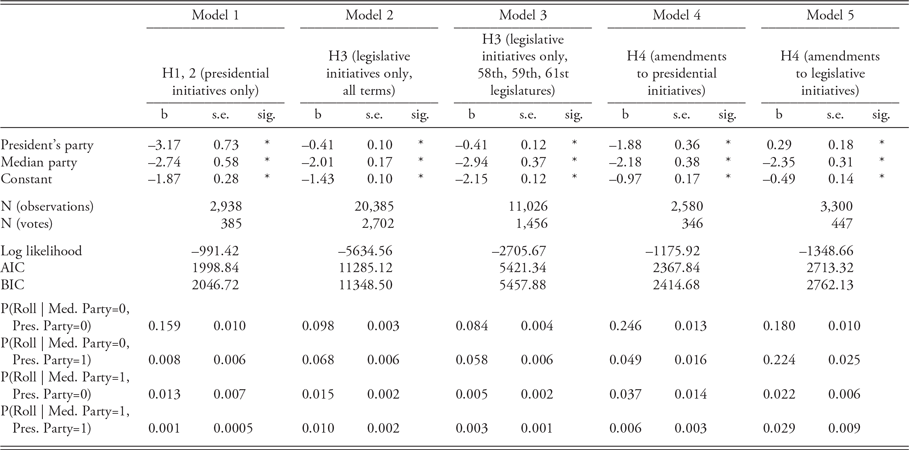
The first hypothesis suggests that when the president’s party occupies the median, it will seldom be rolled, regardless of the type of initiative being considered. In table 3, models 1 and 2 demonstrate that the median party has about a 0.01 predicted probability of being rolled on initiatives that originate in the executive or legislative branches. There is also little difference in the probability of being rolled if the median party is the president’s party or an opposition party, which suggests that parties occupying the median are generally able to prevent legislation they oppose from passing on the floor.
Predicting Rolls on Presidential and Legislative Initiatives

*p <.05, two-tailed.
Notes: Fixed effects for legislative term included but not reported. Robust standard errors clustered by vote. Unit of analysis is the party-vote. Predicted probabilities are reported along with delta-method standard errors.
Hypothesis 2 suggests that when presidents do not occupy the median, they will form informal coalitions with the median party to get their legislative proposals passed, and thus one should rarely observe presidential or median parties being rolled on presidential initiatives. In table 3, model 1, we find substantial support for hypothesis 2. The probability of the party of the president or the median party getting rolled on a presidential initiative is indistinguishable from zero, nor are there significant differences in the probability of being rolled between presidential parties that do not also occupy the median, or median parties that do not hold the presidency.
In practice, these results suggest that under right-leaning PAN governments, PAN will align with the PRI, which occupies the median, in order to secure legislative support for presidential initiatives. Under PRI governments, we expect the PRI to align with parties closer to it on the ideological spectrum to pass presidential initiatives, which may not necessarily include PAN.
For example, during the 1997–2000 term, the PRI was never rolled on President Zedillo’s initiatives.Footnote 10 There is no clear evidence that the PRI and President Zedillo formed a durable coalition to secure legislative support for presidential bills, although the PAN supported most of Zedillo’s initiatives. There are only a few exceptions. One was a vote in 1999 on the revenue bill for the 2000 budget, in which PRI relied on PRD support.Footnote 11 The other exceptions were two votes in which PAN and PRD attempted but failed to block Zedillo from leaving the country.Footnote 12 Among legislative initiatives, all parties experienced a relatively high number of rolls, with no clear evidence that a single party or parties controlled the agenda during this term.Footnote 13
Only in the 59th Legislature (2003–6) was either PAN or PRI rolled on a small number of presidential initiatives. The PAN, which occupied the presidency from 2000 to 2012, was never rolled on presidential initiatives from 2000 to 2003 and 2006 to 2012. The two votes on which the PRI was rolled in this term were the result of divisions within the party. One vote was the result of a conflict throughout Vicente Fox’s term in which the constitution required Congress to approve foreign trips abroad by the president.Footnote 14 While this vote was purely symbolic, the PRI was divided, with 43 voting in favor of Fox’s leaving on a business trip and 107 voting against. The only substantive vote on which the PRI was rolled was a fiscal reform to the state-owned oil company, PEMEX, in which 67 PRI deputies voted in favor, along with PAN and PRD, while 126 PRI deputies voted against.Footnote 15 In contrast, the PRI was able to defeat President Fox and the PAN on two votes. The first of these involved a substantially modified revenue bill submitted by Fox as part of the annual budget process.Footnote 16 The PAN voted against the 2004 revenue bill because of the modifications made by PRI and PRD. The second vote on which President Fox and PAN were rolled was a review of executive branch compliance with the 2001 budget, of which Congress was highly critical.Footnote 17
During Peña Nieto’s presidency (2012–15), the PRI was able to form a stable majority coalition with the centrist PVEM and PANAL. Neither PRI nor PVEM was ever rolled on presidential initiatives, while PANAL was rolled on only 2 out of 68 presidential bills. While the PAN is ideologically closer to the PRI than to parties on the left, the PAN was not a necessary coalition partner for Peña Nieto, which is evidenced by the higher number of rolls for the PAN during the 62nd Legislature. If we distinguish between ordinary legislation and constitutional amendments among Peña Nieto’s proposals, we see a minimum winning coalition between PRI/PVEM/PANAL on ordinary legislation, while PRI/PAN was necessary on constitutional amendments. For ordinary legislation, PAN was rolled on 5 out of 59 presidential bills, while on constitutional amendments, PAN was not rolled on any of the 9 bills. Overall, the empirical evidence from the roll call record suggests that presidents have formed stable, but informal, coalitions to pass their key initiatives.
Turning to hypothesis 3, we expect that the median party in the legislature will rarely be rolled on proposals originating in the legislature, while the president’s party is likely to experience more frequent rolls when it does not include the median legislator. We test this hypothesis in models 2 and 3 of table 3, where model 2 includes all legislative initiatives across all terms, while model 3 limits the analysis to the three legislative terms in which the president’s party was not also the plurality party. The results in table 3 provide substantial support for the third hypothesis. In model 3, presidential parties that do not occupy the median have a 0.06 predicted probability of being rolled on initiatives originating in the legislature. In contrast, the median party has a less than 0.01 probability of being rolled on nonpresidential bills, a statistically significant difference. Other opposition parties have an even higher probability of being rolled, with a 0.08 predicted probability of being rolled on bills originating from the Chamber.
Thus far, our results suggest that the president’s party, even without a majority of seats, is almost never rolled on legislation sponsored by the president. However, the president’s party is more likely to be rolled on legislation sponsored by deputies and senators, although even for these bills, the roll rate for the president’s party is rather low. Thus, even in the case in which the president’s party does not include the median legislator, the president’s party appears capable of preventing a large number of bills it opposes from reaching the floor.
However, during the amendment process on the floor, the median party is largely able to prevent amendments it opposes from passing. Hypothesis 4 suggests that presidential parties will frequently be rolled on amendment votes when they do not include the median legislator, which is what we find in models 4 and 5 of table 3. In model 4, we find that presidential parties that do not include the median legislator have a 0.05 probability of being rolled on amendments to presidential bills. While this probability is rather low, it is much higher compared to the less-than-0.01 probability of being rolled on the initial legislation, before the amendment stage (see model 1), and higher than the less-than-0.01 probability of being rolled on amendments to presidential initiatives when the presidential party contains the median legislator.
For bills that originate in the legislature, as seen in model 5, presidential parties that do not contain the median legislator have a 0.22 probability of being rolled. In practice, these results suggest that when the PAN held the presidency, PAN presidents were unlikely to be rolled on roll call votes for executive-sponsored bills, although they were sometimes unable to prevent unwanted floor amendments to the same legislation. When the PRI held the presidency, because it also included the median legislator, the PRI was rarely ever rolled on floor amendments to executive- sponsored bills and never rolled on amendments to legislative initiatives.
These estimates are consistent with the legislative record. For example, President Fox (PAN, 2000–2006) and his party were rolled on two votes on executive-sponsored bills during the two legislative terms, while President Calderón (PAN, 2006–12) was never rolled on presidential legislation. However, both Fox and Calderón each lost four roll call votes on floor amendments to presidential bills. In contrast, President Peña Nieto (PRI) and his party were not rolled on any presidential bills during the 2012–15 period, nor did they lose any roll call votes on amendments to executive initiatives.
In sum, we find strong support for our hypotheses. Mexican presidents form durable but informal coalitions to secure support for executive-sponsored bills from parties close to them on the left-right dimension. However, these informal coalitions are less likely to extend to legislative initiatives. For bills from legislators, the president’s party does not have sufficient agenda-setting powers to prevent bills it opposes from reaching the floor unless the party also includes the median deputy. In addition, when presidential parties do not also occupy the median, they can occasionally be rolled on the floor during the amendment stage. The legislative amendment process provides opportunities for opposition coalitions to form that lead to outcomes opposed by the president, especially when the president’s party does not include the median legislator.
Conclusions
Previous research on legislative agenda setting in multiparty presidential systems has not provided much attention to how presidents set the agenda in opposition-controlled legislatures. The evidence from Mexico presented here suggests that agenda setting in multiparty presidential systems is divided among multiple actors, but that stable coalitions do form despite the lack of formal coalition cabinets. The president and the president’s party are critical actors on executive initiatives regardless of the party’s seat share or spatial location along the left-right dimension. However, presidential parties must still rely on support from the median party to move presidential bills toward passage. Agenda-setting power in the final bill amendment stage also reverts to the median party on the floor.
The findings presented here suggest that presidents have strategically formed stable, informal policy coalitions in the Mexican Congress to further their agenda. Given that in many of the terms studied here, presidential parties did not include the median deputy, did not control a plurality of seats, and had to navigate committees where a majority of seats were controlled by the opposition, presidents’ success in getting their legislative initiatives passed is surprising. Nevertheless, presidents operating in this legislative environment probably would not have been successful without the support of, and concessions to, the median party.
While our interviews suggest that legislative support for the president was granted in exchange for policy concessions, other studies suggest that presidents often use multiple tools to maintain legislative support. A growing literature focuses on how presidents build majority support in multiparty legislatures through cabinet seats, budgetary influence, and legislative leadership positions (e.g., Chaisty et al. Reference Chaisty, Cheeseman and Power2014; Chaisty and Chernykh Reference Chaisty and Chernykh2017; Hiroi and Rennó Reference Hiroi and Rennó2014; Raile et al. Reference Raile, Pereira and Power2011). Some work also suggests that particularistic parties may provide legislative support in exchange for patronage and pork (Kellam Reference Kellam2015). Given that the PRI is the least programmatic of the major Mexican parties, future research should examine the extent to which Mexican presidents manage their legislative support coalitions through budget allocations.
Another avenue of future research should examine the potential electoral costs of coalition formation in presidential systems. Studies of coalition formation in parliamentary democracies suggest that voters consider the legislative outcomes of votes and that opposition parties may face electoral costs for supporting the government (Austen-Smith and Banks Reference Austen-Smith and Banks1988; Strøm Reference Strøm1990). Other works suggest that the policy compromises in coalitional bargaining may have electoral consequences and influence the development of the party system (Laver Reference Laver1989). Existing work on coalitional presidentialism has not yet examined how participation in presidential legislative support coalitions affects future electoral performance and its impact on the party system. In the Mexican case, one of the common criticisms from left parties was the similarity between PRI and PAN, derisively referred to as “PRIAN.” While speculative, the overwhelming defeat of PRI and PAN by the populist MORENA party in the 2018 general elections suggests that the durable but informal PRI-PAN coalition may have had electoral consequences (Casar Reference Casar2018; Sol de México 2018).
Supporting Information
Additional supporting materials may be found with the online version of this article at the publisher’s website: Appendix.