Child maltreatment is a pathogenic relational experience characterized by parenting behavior that far exceeds acceptable disciplinary practices, fails to meet the child's basic physical and emotional needs, and is destructive to child development in multiple domains of functioning (Cicchetti & Toth, Reference Cicchetti, Toth, Lamb and Garcia Coll2015; Cicchetti & Valentino, Reference Cicchetti, Valentino, Cicchetti and Cohen2006). In 2013, approximately 3.9 million children were subjects of maltreatment reports to child welfare agencies; nearly 700,000 cases were substantiated leading to a national victimization rate of 9 per 1,000 children (US Department of Health and Human Services, Administration for Children and Families, Administration on Children, Youth and Families, 2015). Young children in particular are at increased risk for maltreatment such that nearly 50% of all victims are age 5 or younger. Among investigated cases, up to 50% exhibit clinically significant mental health symptoms (Burns et al., Reference Burns, Phillips, Wagner, Barth, Kolko and Campbell2004), and approximately 68.1% of preschool-aged children exhibit substantial behavioral, emotional, and/or developmental problems (Stahmer et al., Reference Stahmer, Hurlburt, Horwitz, Landsverk, Zhang and Leslie2009). Though present across all demographics, child maltreatment tends to cluster in low-income families, and in 2013, more than 90% of child victims were maltreated by one or both parents (US Department of Health and Human Services, Administration for Children and Families, Administration on Children, Youth and Families, 2015).
Maltreatment, Parent–Child Interactions, and Child Outcomes
Positive parenting is vital in supporting children's appropriate development of biological and psychological functioning (Gunnar, Fisch, & Malone, Reference Gunnar, Fisch and Malone1984; Sroufe, Reference Sroufe2000; Tamis-LeMonda, Shannon, Cabrera, & Lamb, Reference Tamis-LeMonda, Shannon, Cabrera and Lamb2004); thus, in the absence of such parental support, maltreated children are at heightened risk for a host of physical, mental, and cognitive impairments (e.g., Cicchetti & Toth, Reference Cicchetti, Toth, Lamb and Garcia Coll2015; Cicchetti & Valentino, Reference Cicchetti, Valentino, Cicchetti and Cohen2006). With nearly 1 million substantiated cases of child abuse and neglect in the United States each year, child maltreatment is clearly a public health concern requiring efforts to uncover the pathways to child maladjustment (US Department of Health and Human Services, Administration for Children and Families, Administration on Children, Youth and Families, 2015). Yet surprisingly little research has been conducted to identify specific parent–child interactions during early childhood that may link child maltreatment to maltreated children's developmental outcomes at multiple levels of analysis. Theoretical (Nelson & Fivush, Reference Nelson and Fivush2004) and empirical (Fivush, Haden, & Reese, Reference Fivush, Haden and Reese2006) evidence suggests that the way in which parents discuss everyday emotional experiences with their young children (i.e., elaborative reminiscing) has significant implications for child cognitive and socioemotional functioning, and that maltreating parents have a particularly difficult time in engaging in this type of dialogue (Valentino, Comas, Nuttall, & Thomas, Reference Valentino, Comas, Nuttall and Thomas2013). This dyadic interactional exchange therefore has the potential to be an important process variable linking child maltreatment to a host of developmental outcomes. Thus, the current investigation evaluates the role of maternal elaborative reminiscing in associations between maltreatment and child cognitive, emotional, and physiological functioning.
Parent–child interactions that are characterized by warmth, support, and engagement scaffold young children's cognitive development, and provide external emotional and physiological regulation for the child (e.g., Bowlby, Reference Bowlby1969; Spangler, Schieche, Iig, Maier, & Ackermann, Reference Spangler, Schieche, Iig, Maier and Ackermann1994; Sroufe, Carlson, Levy, & Egeland, Reference Sroufe, Carlson, Levy and Egeland1999). In the long term, these skills produce well-adjusted, socially competent individuals with the ability to form positive interpersonal relationships, understand others, articulate one's own feelings and needs, and manage conflict (Coster & Cicchetti, Reference Coster and Cicchetti1993; Parke, Cassidy, Burks, Carson, & Boyum, Reference Parke, Cassidy, Burks, Carson, Boyum, Parke and Ladd1992; Rogosch, Cicchetti, & Aber, Reference Rogosch, Cicchetti and Aber1995; Stock & Fisher, Reference Stock and Fisher2006). For maltreated children, parent–child interactions often fail to foster these critical skills, with particular deficits in children's receptive and expressive language, emotional understanding, and ability to physiologically regulate stress (Cicchetti & Toth, Reference Cicchetti, Toth, Lamb and Garcia Coll2015). Maltreated children use fewer words, have less complex sentence structure, and demonstrate poorer receptive language than do nonmaltreated children matched on socioeconomic status and IQ (i.e., Coster & Cicchetti, Reference Coster and Cicchetti1993, Eigsti & Cicchetti, Reference Eigsti and Cicchetti2004; Pears & Fisher, Reference Pears and Fisher2005; Stacks, Beeghly, Partridge, & Dexter, Reference Stacks, Beeghly, Partridge and Dexter2011). Maltreated school-aged children demonstrate less emotional knowledge (i.e., ability to express and recognize basic emotions, as well as to understand the causes and consequences of emotions) than do nonmaltreated children (Edwards, Shipman, & Brown, Reference Edwards, Shipman and Brown2005; Rogosch et al., Reference Rogosch, Cicchetti and Aber1995; Shipman & Zeaman, Reference Shipman and Zeman1999; Sullivan, Bennett, Carpenter, & Lewis, Reference Sullivan, Bennett, Carpenter and Lewis2008). Finally, the hypothalamic–pituitary–adrenal (HPA) axis, with the end product cortisol, has the dual responsibility of being the body's primary stress response system as well as the primary synchronizer of multiple physiological systems around the 24-hr dark/light cycle (i.e., a diurnal rhythm; Smyth, Hucklebridge, Thorn, Evans, & Clow, Reference Smyth, Hucklebridge, Thorn, Evan and Clow2013). Maltreated children often exhibit dysregulation in this system characterized by a flattening of diurnal cortisol activity, including lower early morning cortisol and less cortisol decline across the day (for review, see Tarullo & Gunnar, Reference Tarullo and Gunnar2006). Taken together these deficits and dysregulations place maltreated children at risk for poor school performance and academic success, as well as later emotion dysregulation and psychopathology (Rogosch et al., Reference Rogosch, Cicchetti and Aber1995; Ruttle et al., Reference Ruttle, Shirtcliff, Serbin, Ben-Dat Fisher, Stack and Schwartzman2011; Shipman et al., Reference Shipman, Schneider, Fitzgerald, Sims, Swisher and Edwards2007; Stock & Fisher, Reference Stock and Fisher2006). To successfully intervene and break this nefarious pathway to maladjustment, critical process variables translating maltreatment into child dysfunction must be uncovered.
Reminiscing as a Pathway to Child Behavioral and Physiological Outcomes
Associations among maltreatment, parenting, and developmental processes are dynamic and require multilevel, multisystemed approaches to elucidate how these transactions unfold across the dyad, and over time (Cicchetti & Valentino, Reference Cicchetti, Valentino and Masten2007). During the preschool years, regulation shifts from being primarily externally supported to more internally mediated processes, with the emergence of more effortful regulation of emotions and behavior (Calkins, Reference Calkins, Olson and Sameroff2009; Kopp, Reference Kopp1989). Likewise, during this time, parenting typically shifts to include more verbal and cognitive coping strategies such as reappraisal, redirection, or emotion coaching to help their children regulate distress and overcome challenge (Gottman, Katz, & Hooven, Reference Gottman, Katz and Hooven1996; Sameroff, Reference Sameroff2009; Sroufe, Reference Sroufe2000). Compared to the extensive literature delineating the parenting patterns of maltreating mothers during infancy and toddlerhood (Barnett, Ganiban, & Cicchetti, Reference Barnett, Ganiban and Cicchetti1999), and highlighting the salience of the mother–child attachment relationship for maltreated children's subsequent development (Toth, Gravener-Davis, Guild, & Cicchetti, Reference Toth, Gravener-Davis, Guild and Cicchetti2013), relatively less work has focused on identifying these more verbal aspects of parenting behaviors among maltreating mothers with their preschool-aged children. In particular, mothers’ ability to co-construct elaborative and emotionally supportive narratives (i.e., elaborative reminiscing) about children's emotional experiences as children's verbal skills develop into the preschool years becomes critical in shaping children's representational models, and in supporting cognitive and socioemotional development (Fivush et al., Reference Fivush, Haden and Reese2006; Thompson, Reference Thompson2006). Whereas reminiscing has been identified as an important factor in associations between parenting and developmental processes among typically developing families, there are gaps in understanding the role of elaborative reminiscing in the context of child maltreatment.
There are several reasons to anticipate that the reminiscing style of maltreating mothers will diverge from nonmaltreating mothers when reminiscing with their preschool-aged children about past emotional events. There are clear individual differences in maternal reminiscing style (e.g., Fivush & Fromhoff, Reference Fivush and Fromhoff1988), particularly with regard to elaboration during past-shared event discussion. Mothers possessing a high elaborative reminiscing style talk in rich, detailed ways about past events with their preschool-aged children by asking more open-ended questions, providing elaborative details, and confirming children's contributions to the conversation (Fivush et al., Reference Fivush, Haden and Reese2006). In contrast, mothers from abusing families engage in fewer verbal interactions with their children throughout infancy (Valentino, Cicchetti, Toth, & Rogosch, Reference Valentino, Cicchetti, Toth and Rogosch2006) and the preschool years (Alessandri, Reference Alessandri1992; Eigsti & Cicchetti, Reference Eigsti and Cicchetti2004), at least during free-play interactions. Furthermore, findings from the emotion socialization literature suggest that maltreating mothers engage in less discussion regarding emotional states with their school-aged children (Cicchetti, Reference Cicchetti and Thompson1990; Shipman & Zeman, Reference Shipman and Zeman1999). To date, there has been no research evaluating the elaborative reminiscing of maltreating mothers with their children during early childhood, the developmental period during which reminiscing may have the largest influence on children's emerging behavioral and regulatory development (Wareham & Salmon, Reference Wareham and Salmon2006).
The way in which parents reminisce about past experiences with their young children may influence child cognitive functioning. An elaborative style of reminiscing benefits preschool-aged children's autobiographical memory, language, and literacy development (Nelson & Fivush, Reference Nelson and Fivush2004; Peterson, Jesso, & McCabe, Reference Peterson, Jesso and McCabe1999; Reese, Reference Reese1995; Sparks & Reese, Reference Sparks and Reese2013). Evidence suggests that maltreating mothers engage in fewer verbal interactions with their children (Alessandri, Reference Alessandri1992; Valentino et al., Reference Valentino, Cicchetti, Toth and Rogosch2006), are less likely to use verbal means of instruction, and are less likely to respond to children's initiatives (Egeland & Sroufe, Reference Egeland and Sroufe1981). Thus, we examined poor elaborative reminiscing as a mechanism explaining associations between child maltreatment and child language development.
Moreover, when reminiscing focuses on children's past emotional events specifically, the parent's reminiscing style has important implications for children's emerging emotional development. In particular, mother–child reminiscing about children's emotions provides a context for children to understand past emotional events, and to integrate these events into a coherent autobiography or self-concept (e.g., Fivush, Reference Fivush and Nelson1993; Nelson, Reference Nelson1993). Mother–child reminiscing that highlights shared positive emotion may foster positive aspects of the parent–child relationship (Nelson & Fivush, Reference Nelson and Fivush2004; Wareham & Salmon, Reference Wareham and Salmon2006). Moreover, supportive reminiscing of children's negative emotions including validation of children's feelings, identification and explanations of children's emotions and resolutions, appears to be uniquely associated with children's emotion regulation (Fivush et al., Reference Fivush, Haden and Reese2006) and self-esteem (Bohanek, Marin, & Fivush, Reference Bohanek, Marin and Fivush2008). When mothers are not able to engage in emotional discussion, however, and are dismissing or avoidant of children's negative emotions, then children may not develop adequate coping skills, thereby increasing risk for psychopathology (Koren-Karie, Oppenheim, & Getzler Yosef, Reference Koren-Karie, Oppenheim and Getzler-Yosef2004). Maltreating mothers engage in less emotion discussion (Shipman & Zeman, Reference Shipman and Zeman1999), less emotion coaching, and more emotion invalidation than nonmaltreating mothers (Shipman et al., Reference Shipman, Schneider, Fitzgerald, Sims, Swisher and Edwards2007), and these behaviors in turn have been shown to mediate the association between maltreatment and school-aged children's emotion regulation (Shipman et al., Reference Shipman, Schneider, Fitzgerald, Sims, Swisher and Edwards2007). Given the importance of young children's emerging emotion knowledge for facilitating emotional competence and regulation, we set out to examine maternal elaborative reminiscing about children's emotions as an explanatory factor between maltreatment and children's emotion knowledge during the preschool years.
A primary mechanism by which early life stressors, such as maltreatment, may be translated into long-term mental and physical well-being is through changes in HPA activity (Essex et al., Reference Essex, Shirtcliff, Burka, Ruttle, Klein and Slattery2011; McEwen, Reference McEwen1998). For the most part, the studies of the physiological ramifications of maltreatment have relied on retrospective reports of early maltreatment (e.g., Carpenter et al., Reference Carpenter, Carvalho, Tyrka, Wier, Mello and Mello2007; Gonzalez, Jenkins, Steiner, & Fleming, Reference Gonzalez, Jenkins, Steiner and Fleming2009; van der Vegt, van der Ende, Kirschbaum, Verhulst, & Teimerier, Reference van der Vegt, van der Ende, Kirschbaum, Verhulst and Teimerier2009), with relatively fewer studies examining prospective or concurrent processes (e.g., Bruce, Fisher, Pears, & Levine, Reference Bruce, Fisher, Pears and Levine2009; Cicchetti & Rogosch, Reference Cicchetti and Rogosch2001). While retrospective studies are informative, they provide limited information on the specific features of parent–child interactions in maltreating dyads that exert regulatory control over the developing HPA axis. Thus, there is a gap in the current knowledge describing the process by which maltreatment “gets under the skin” influencing HPA development and producing enduring traittike adrenocortical profiles.
Although there have not been any studies specifically examining associations between maternal elaborative reminiscing and child HPA functioning, supportive parental responses to children's emotions predict children's physiological regulation of the peripheral nervous system (Gottman et al., Reference Gottman, Katz and Hooven1996; Hooven, Gottman, & Katz, Reference Hooven, Gottman and Katz1995). Moreover, severe disruptions in mother–infant communication have been associated with divergence between maternal and child cortisol levels (Crockett, Holmes, Granger, & Lyons-Ruth, Reference Crockett, Holmes, Granger and Lyons-Ruth2013), and there are higher rates of child maltreatment among mothers who display higher levels of disrupted communication with their infants (Lyons-Ruth, Bronfman, & Parsons, Reference Lyons-Ruth and Bronfman1999). As such, children whose mothers engage in elaborative discussions of children's past emotions may develop more adaptive physiological regulatory abilities to manage emotional arousal (Gottman et al., Reference Gottman, Katz and Hooven1996). Conversely, we expected to find HPA axis dysregulation in maltreated children whose mothers may have difficulties with mother–child communication about emotions.
Hypotheses
The two main objectives of this project were to examine maternal elaborative reminiscing as a mediator between maltreatment and (a) child behavioral outcomes (receptive language and child emotion knowledge) and (b) indices of children's physiological outcomes (cortisol levels and diurnal decline). As a critical step in assessing these mediation processes, we hypothesized that maltreating mothers would demonstrate less elaborative reminiscing with their preschool-aged children than would nonmaltreating mothers. In this scenario, we expected that elaborative reminiscing would mediate associations between child maltreatment and child outcomes in behavioral and physiological domains. In a behavioral sense, we expected that elaborative reminiscing would be positively linked to child language and child emotion knowledge and would account for significant variance in the association between child maltreatment and these outcomes. In a physiological sense, we expected that elaborative reminiscing would be positively linked to child cortisol levels and diurnal decline and would account for significant variance in the association between child maltreatment and these outcomes. In summary, we expected that maltreatment would be related to multiple processes potentially related to developmental outcomes among maltreated children, including receptive language, emotion knowledge, and HPA axis functioning, reflected in cortisol levels and responses, and that maternal elaborative reminiscing would mediate these associations.
Methods
Participants
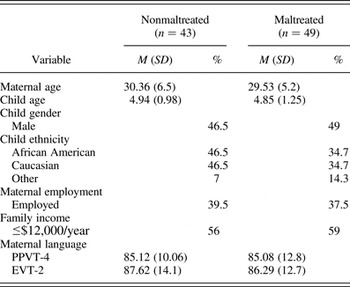
The participants included 92 children between 3 and 6 years of age and their mothers. Forty-three families had substantiated child maltreatment with the mother named as a perpetrator. The other 49 families were demographically comparable to the maltreated families but had no history of prior involvement with the child welfare system. All children were residing with their biological mothers. Maltreated and nonmaltreated dyads did not differ on a number of important demographic characteristics (see Table 1). In addition, maltreating and nonmaltreating mothers did not differ in language abilities, with both groups performing approximately one standard deviation below the mean on standardized assessments of expressive and receptive language.
Sample characteristics by maltreatment group

Note: PPVT-4, Peabody Picture Vocabulary Test, Fourth Edition; EVT-2, Expressive Vocabulary Test, Second Edition.
Maltreating families were recruited through the Department of Child Services (DCS). DCS Family Case Workers initially introduced our project to eligible participants with a verbal script and an informational flyer. They asked whether or not mothers would be interested in sharing their contact information with project staff, who then contacted interested families to discuss enrollment. Nonmaltreating families were recruited in the local community in locations that typically serve a similar demographic population such as the Special Supplemental Nutrition Program for Women, Infants, and Children office, the housing authority, and Head Start. All participating families provided informed consent and signed release forms granting access to their DCS records. The presence or absence of maltreatment was subsequently verified through extensive examinations of each family's case history and through maternal interview. Only families who have never received child protective services through DCS and indicated no maltreatment on the maternal interview were included in the nonmaltreating comparison sample.
Maltreatment classifications
DCS records were coded using the Maltreatment Classification System (MCS; Barnett, Manly, & Cicchetti, Reference Barnett, Manly, Cicchetti, Cicchetti and Toth1993). The MCS utilizes operational criteria for determining the occurrence of subtypes of maltreatment. Subtype categories include sexual abuse, physical abuse, physical neglect, and emotional maltreatment. Sexual abuse is coded when any sexual contact or attempted sexual contact occurred between the child and an adult. Physical abuse is determined by injuries that had been inflicted upon a child by nonaccidental means. Physical neglect is coded for failure of the primary caregiver to meet a child's needs for food, clothing, shelter, health care, education, hygiene, or safety. Emotional maltreatment is coded for chronic or extreme neglect or disregard of children's emotional needs (see Barnett et al., Reference Barnett, Manly, Cicchetti, Cicchetti and Toth1993). In addition, the severity, chronicity, perpetrator, and the developmental timing of each maltreatment incident were assessed. The MCS allows for measurement of reliability of maltreatment classifications between coders. MCS ratings were supplemented by information obtained during the Maternal Maltreatment Classification Interview (Cicchetti, Toth, & Manly, Reference Cicchetti, Toth and Manly2003), a structured interview based on the MCS. More than 50% of the maltreated sample was double coded (n = 32) by two coders, and reliability was established (κ = 0.84–01.0).
Among the maltreated children, 8.3% experienced sexual abuse, 18.8% experienced physical abuse, 70.8% experienced physical neglect, and 50% experienced emotional maltreatment. Consistent with other samples of maltreated children, subtype comorbidity was high (Manly, Kim, Cicchetti & Rogosch, Reference Manly, Kim, Rogosch and Cicchetti2001), such that 54% of the maltreated children experienced more than one subtype. Given the limited sample size, subtype was not considered in subsequent analyses.
Procedure
Data for the current investigation was drawn from a longitudinal randomized clinical trial. Families in all conditions completed a baseline assessment consisting of one session in the home followed by one in the laboratory, typically scheduled within 1 week of each other. Data for the current investigation was drawn from the baseline assessment only. Research staff conducting the home- and lab-based baseline assessments were blind to families’ maltreatment status. At the time of writing, participants were still being enrolled in this study; as such, this report provides data for only a subsample of the full sample. Likewise, cortisol assays had only been completed on 75 of the 94 families. As part of the home assessment, mothers collected three saliva samples (waking, midday, and bedtime) on their child for 2 consecutive days, and completed daily diaries each day of collection. The lab assessment included observations of mother–child reminiscing as well as individual assessments of maternal language, child language, and child emotion knowledge, among other tasks.
Home measures
Daily diary data
To control for variation in family routine, affect, and compliance, mothers completed daily diaries on each day cortisol was collected. On each morning of saliva collection, participants filled out a series of questions assessing morning routine (e.g., “did you wake your child up,” “did your child wake before you,” and “what time did your child wake”) and compliance (“did your child get out of bed before collecting your child's first sample” and “was your child's first sample collected immediately upon waking”). Participants also indicated their saliva collection times. Every evening, participants completed the Positive Affect–Negative Affect Scale (Watson & Clark, Reference Watson and Clark1994), a 20-item scale that measures two distinct dimensions of positive (e.g., excited, proud, and interested) and negative mood (e.g., nervous, afraid, and irritable) on a 6-point Likert scale (0 = not at all, 5 = extremely). Mothers also reported their child's positive (e.g., happy, cheerful, and joyful) and negative mood (e.g., sad, scared, and mad) on a 6-point Likert scale. Internal consistency was high, with α values higher than 0.63 on each day (lowest maternal positive α = 0.85, and negative α = 0.83; and lowest child positive α = 0.77 and negative α = 0.63).
Cortisol
Mothers were trained to collect saliva from their child via sponge (Salimetrics Child Swab, Salimetrics, State College, PA). Samples were collected on 2 consecutive weekend days when mother and child were home together. Collections were based off of each individual's schedule, occurring at waking, before lunch (i.e., midday), and before bed (i.e., bedtime). Participants were instructed to drink water 10 min before collection (except at waking), and not to brush their teeth, eat, or drink within 20 min of providing salivary samples. Respondents were instructed to keep the saliva samples in the freezer and to bring samples to the laboratory on ice in provided portable coolers when they attended their lab assessment. Families without freezers were provided a cooler in which samples could be kept; these samples were picked up by staff and transported to the lab each morning following collection. Samples were transported on ice to the lab and then frozen at –80 °C until assayed.
Samples were assayed for salivary cortisol using a highly sensitive enzyme immunoassay (Salimetrics, State College, PA). The test used 25 ml of saliva (for singlet determinations), had a range of sensitivity from 0.007 to 1.8 g/dl, and had average intra- and interassay coefficients of variation of less than 10% and 15%, respectively. All samples were assayed in duplicate, and the average of the duplicates was used in all analyses. Cortisol values 3.0 mg/ml and higher were trimmed, as were values with coefficients of variation exceeding 15% (unless the absolute value of the difference between repeats was <0.03 mg/ml).
Adherence to the sampling protocol
Numerous steps were taken to increase compliance and protocol adherence. Research staff trained mothers to collect saliva on their children, following which staff observed mothers collect a practice child sample and provided corrective feedback. To objectively record sample collection time, each sample was placed in a bottle sealed with a MEMS (Medication Electronic Monitoring System Aardex Ltd.) cap and stored in the freezer. Caps recorded the date and time of each opening. Mothers were also given a cell phone to facilitate cortisol collection. Mothers estimated their child's waking, lunch, and bedtimes for the following day; based on this schedule, text message-based reminders were sent to the cell phone provided 20 min before each collection time and mothers were asked to respond. According to the MEMS, waking samples were collected 11 min after waking (SD = 00:19), midday samples were collected 4 hr 49 min after waking (SD = 1:18), and bedtime samples were collected 12 hr and 55 min after waking (SD = 1:33). Wake times (r = .50, p < .001) and waking collections (r = .40, p < .001) were highly consistent between the 2 collection days. However, midday and bedtime samples were not (r = .18, ns and r = .23, p = .08, respectively). The nonmaltreatment and maltreatment groups did not differ based on wake time, waking collection time, before lunch collection time, or before bed collection time (ps = .17–.57).
Lab measures
The Peabody Picture Vocabulary Test (PPVT-4)
The PPVT- 4 (Dunn & Dunn, Reference Dunn and Dunn2007) was utilized to assess parents’ and children's receptive language. The PPVT-4 is an individually administered, multiple-choice test designed to assess receptive vocabulary skills in individuals aged 2–90 years old. The PPVT-4 was administered to all mothers to ensure there were no differences between maltreating and nonmaltreating groups. It was also administered to children as the primary language-dependent variable. Standard scores were utilized in analyses.
Expressive Vocabulary Test, Second edition
The Expressive Vocabulary Test (2nd ed.; Williams, Reference Williams2007) is an individually administered vocabulary test designed to assess expressive vocabulary skills. This standardized measure was administered to all mothers to ensure that there were not differences in maternal expressive language ability between the maltreating and nonmaltreating groups.
Child emotional knowledge
The Affect Knowledge Task (Denham, Reference Denham1986) was used to measure multiple aspects of child emotion knowledge. Children's understanding of emotion (nonverbal recognition and verbal labeling of emotional expressions) was assessed using felt faces that depict happy, sad, angry, and afraid expressions (Denham, Reference Denham1986; Denham & Couchoud, Reference Denham and Couchoud1990). Children were asked to identify happy, sad, angry, and afraid facial expressions verbally, by naming them. This was followed by a (receptive) task where children were asked to identify the four emotions nonverbally, by pointing (i.e., show me the sad face). Children received 2 points for a correct answer, and 1 point for correctly specifying only the emotion's positivity or negativity (e.g., choosing a sad rather than the correct angry face). Children's emotion knowledge was operationalized as the total score across the receptive and expressive emotion knowledge tasks.
Mother–child reminiscing
During the lab-based assessment, mothers were asked to nominate on paper four past emotional events that were one-time occurrences and had been experienced by the parent and child together (see Fivush et al., Reference Fivush, Haden and Reese2006; Salmon, Dadds, Allen, & Hawes, Reference Salmon, Dadds, Allen and Hawes2009). Consistent with the Autobiographical Emotional Events Dialogue (Koren-Karie Oppenheim, Haimovich, & Etzion-Carasso, Reference Koren-Karie, Oppenheim, Haimovich, Etzion-Carasso, Emde, Wolf and Oppenheim2003), the mother was instructed to think of a time her child felt happy, sad, scared, and angry, and wrote a brief reminder of each event on an index card. Cues elicited predominantly negative events because maternal reminiscing about negative emotions, in particular, tends to be more elaborative and coherent (i.e., Sales, Fivush, & Peterson, Reference Sales, Fivush and Peterson2003), and more predictive of child well-being (Sales & Fivush, Reference Sales and Fivush2005) than does reminiscing about exclusively positive events. Mothers and children were then asked to sit together on a couch, and mothers were instructed to discuss the events with their children, as they normally would at home, while the experimenter left the room. All mothers were instructed to discuss the happy event first, and the order of the remaining three events was counterbalanced across participants. Conversations typically lasted between 5 and 15 min in length. The conversations were videotaped.
Coding and reliability
Reminiscing conversations were transcribed verbatim, and transcripts were then coded for maternal elaborative quantity. Maternal elaborative quantity was coded with a frequency-based scheme where each utterance (subject–verb proposition) was coded (see Fivush & Sales, Reference Fivush and Sales2006; Fivush & Vasudeva, Reference Fivush and Vasudeva2002; Harley & Reese, Reference Harley and Reese1999; Reese & Newcombe, Reference Reese and Newcombe2007; Valentino et al., Reference Valentino, Nuttall, Comas, McDonnell, Piper and Thomas2014; Van Bergen, Salmon, Dadds, & Allen Reference Salmon, Dadds, Allen and Hawes2009, for similar schemes). Utterances were coded for the presence or absence of wh-questions (open-ended elaborative questions), yes/no questions (closed-ended elaborative questions), elaborative statements, and confirmations. Elaborative statements are utterances that provided the child with new information about the event (i.e., who was there, where it occurred, etc.). Confirmations included maternal positive affirmations of child contributions to the memory conversation (i.e.. “Yes, that's right”). The total number of each type of elaborative utterance made by each mother (wh-questions, yes/no questions, elaborative statements, and confirmations) was counted and summed across event discussions. Interrater reliability was assessed with 20% of the transcripts. Intraclass correlation coefficients for the elaborative reminiscing variables ranged from 0.87 to 0.98.
Analytic strategy
The two main objectives of these analyses were to examine maternal elaborative reminiscing as a mediator between maltreatment and (Objective 1) child receptive language and child emotion knowledge and (Objective 2) indices of child diurnal cortisol. To test these objectives, we created a composite maternal elaborative reminiscing variable. The four elaborative quantity reminiscing variables (wh-questions, yes/no questions, elaborative statements, and confirmations) were square root transformed to normalize their distributions and then averaged together; internal consistency was adequate (α = 0.76). Although some prior research has classified confirmations as evaluations, and distinguished between evaluations and elaborations, we followed Fivush and Sales (Reference Fivush and Sales2006), Fivush and Vasudeva (Reference Fivush and Vasudeva2002), and Valentino et al. (Reference Valentino, Nuttall, Comas, McDonnell, Piper and Thomas2014) and combined confirmations with the other elaborative quantity variables.
To determine the relationships among child maltreatment, maternal elaborative quantity, and child diurnal cortisol (Objective 2), the six cortisol samples collected across the 2 days were combined into two composites, area under the curve with respect to ground (AUCg) and area under the curve with respect to increase (AUCi; for equations, see Pruessner, Kirschbaum, Meinlschmid, & Hellhammer, Reference Pruessner, Kirschbaum, Meinlschmid and Hellhammer2003). These composites measure the two key aspects of daily cortisol (Smyth et al., Reference Smyth, Hucklebridge, Thorn, Evan and Clow2013), namely, the overall cortisol secretion across the day and the diurnal cortisol slope, respectively. Because of the large range of time covered, time was coded in hours and minutes elapsed (as opposed to minutes elapsed). The AUCi measure was not skewed, and thus no transformation was applied; however, AUCg was skewed (skew statistic = 2.22) and subjected to a natural log transformation. This transformation removed the skew (skew statistic = 0.04). Thus, logged AUCg and raw AUCi were used in all analyses with these variables. Only 4 children of the 75 had insufficient cortisol data to compute the composite measures.
All main analyses were conducted in Mplus (version 7.2; Muthen & Muthen, Reference Muthen and Muthen1998–2014) using full information maximum likelihood estimation to handle missing data. To test the main mediation objectives regarding the role of elaborative reminiscing in associations between maltreatment and (a) child behavioral and (b) physiological outcomes, we implemented the nonparametric, bias-corrected bootstrap method recommended by MacKinnon, Lockwood, and Williams (Reference MacKinnon, Lockwood and Williams2004). Specifically we used 1,000 resamples to construct bias-corrected bootstrap 95% confidence intervals around the product coefficient of the indirect effects of maltreatment via maternal elaborative reminiscing on child receptive language and child emotion knowledge (Objective 1). Similarly, we constructed bias-corrected bootstrap 95% confidence intervals around the product coefficient of the indirect effect of maltreatment via maternal elaborative reminiscing on child AUCg and AUCi (Objective 2).
Results
Descriptive analyses
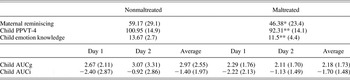
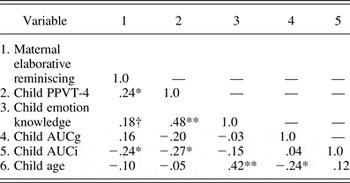
Sample means and standard deviations for maternal elaborative reminiscing, child behavioral functioning, and child physiological functioning by maltreatment group are presented in Table 2. Maltreating and nonmaltreating mothers differed significantly with respect to average maternal elaborative reminiscing, such that maltreating mothers were less elaborative (M = 46.38, SD = 23.4) than nonmaltreating mothers (M = 59.17, SD = 29.1). In addition, maltreated children's receptive language and emotion knowledge scores were both significantly lower than their nonmaltreated peers. No significant differences emerged with respect to child AUCg or child AUCi as a function of maltreatment group. Bivariate correlations among all primary study variables are presented in Table 3.
Means (standard deviations) of variables of interest, separated by maltreatment group
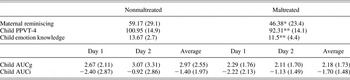
Note: The asterisks indicate significant differences between groups. PPVT-4, Peabody Picture Vocabulary Test, Fourth Edition; AUCg, area under the curve with respect to ground; AUCi, area under the curve with respect to increase. The t tests for AUCg were performed on natural log transformed variables. Negative AUCi values reflect diurnal decline. Cortisol is in micrograms/milliliter (μg/ml).
*p < .05. **p < .01.
Bivariate correlations among primary study variables
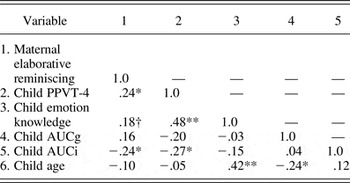
Note: PPVT-4, Peabody Picture Vocabulary Test, Fourth Edition; AUCg, area under the curve with respect to ground; AUCi, area under the curve with respect to increase.
†p < .10. *p < .05. **p < .01.
Indicative of a strong diurnal decline, child cortisol decreased from waking, M = 0.41 mg/ml, SD = 0.44; to midday, M = 0.24 mg/ml, SD = 0.30; t (70) = 7.75, p < .0001; and again from midday to bedtime, M = 0.16 mg/ml, SD = 0.26; t (71) = 4.80, p < .0001. Examining individual cortisol samples across the maltreatment groups revealed lower waking cortisol in maltreated children (M = 0.32 mg/ml, SD = 0.32), compared to nonmaltreated children (M = 0.48 mg/ml, SD = 0.52; b = –0.34, SE = 0.16, p = .04). Cortisol levels at midday and bedtime were not different between the two groups (b = 0.10, SE = 0.22, ns and b = –0.35, SE = 0.29, ns, respectively).
Mother and child person-specific (e.g., age, report of health status, household income, maternal marital status, medication use, and average mood) and day-specific (e.g., number of hours slept, bed time, wake time, and amount of time elapsed between awakening and the first sample) variables were examined as potential control variables for child cortisol AUCg and AUCi. Mother's positive mood as reported on the Positive Affect–Negative Affect Scale was related to child AUCi (r = –.25, p = .04), and there was a trend toward flatter rhythms in children who wake before their mothers (r = .17, p = .15 and r = .22, p = .08 on Day 1 and Day 2, respectively.
Main analyses
Maternal reminiscing as a mediator of the association between maltreatment and child behavioral functioning
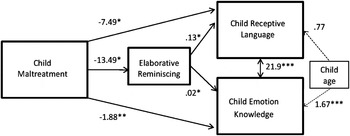
We evaluated the role of maternal elaborative reminiscing in the associations between maltreatment with child behavioral outcomes (see Figure 1). Child age was included as a continuous covariate in the model. The model was saturated. Maltreatment was negatively associated with child receptive language (b = –7.49, SE = 3.17, p < .05) and child emotion knowledge (b = –1.88, SE = 0.68, p < .01). Child age was not associated with child receptive language scores (b = 0.77, SE = 1.7, ns), but was a significant predictor of child emotion knowledge (b = 1.67, SE = 0.40, p < .001) such that older children demonstrated greater knowledge of emotions. Child receptive language and emotion knowledge were significantly associated (b = 21.9, SE = 4.56, p < .001).
Mediation model of child maltreatment on child behavioral functioning via maternal elaborative reminiscing. Path coefficients are unstandardized. Dashed lines indicate the influence of control variables. Error variances are omitted from the figure. *p < .05, **p < .01, ***p < .001.
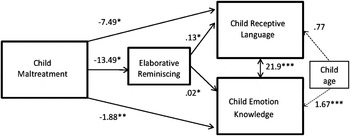
Maltreatment was significantly and negatively associated with maternal elaborative reminiscing (b = –13.49, SE = 5.6, p < .05). Elaborative reminiscing was significantly associated with child receptive language (b = 0.13, SE = 0.05, p < .05). The true indirect effect was estimated to lie between –4.27 and –0.30 with 95% confidence. Because the 95% confidence interval did not contain zero, we concluded that the indirect effect is significantly different from zero at p < .05; thus, the indirect pathway between maltreatment and child receptive language via maternal elaborative reminiscing was significant. Similarly, elaborative reminiscing was significantly associated with child emotion knowledge (b = 0.02, SE = 0.01, p < .05). The true indirect effect was estimated to lie between –0.87 and –0.05 with 95% confidence. Because the 95% confidence interval did not contain zero, we concluded that the indirect effect is significantly different from zero at p < .05; thus, the indirect pathway between maltreatment and child emotion knowledge via maternal elaborative reminiscing was significant.
Maternal reminiscing as a mediator of the association between maltreatment and child physiological functioning
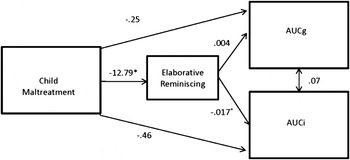
To address Objective 2 regarding the role of maternal elaborative reminiscing in the association between child maltreatment and child physiological outcomes, a parallel model was tested with AUCg and AUCi as the dependent variables (see Figure 2). The model was saturated. The association between maltreatment and AUCg was a negative trend (b = –0.25, SE = 0.18, p = .15), suggesting that maltreated children had lower levels of cortisol than did the nonmaltreated children. The direct association of maltreatment to AUCi was nonsignificant (b = –0.46, SE = 0.43, ns). AUCg and AUCi were not significantly correlated (b = 0.072, SE = 0.17, ns).
Mediation model of child maltreatment on child physiological functioning via maternal elaborative reminiscing. AUCg, area under the curve with respect to ground; AUCi, area under the curve with respect to increase. Path coefficients are unstandardized. Error variances are omitted from the figure. +p < .10, *p < .05.

Maltreatment was negatively associated with maternal elaborative reminiscing (b = –12.79, SE = 5.65, p < .05). Elaborative reminiscing was not associated with AUCg (b = 0.004, SE = 0.004, ns), and the true indirect effect was estimated to lie between –0.202 and 0.03 with 95% confidence; therefore, because the confidence interval includes zero, the indirect effect is not significantly different from zero. In contrast, elaborative reminiscing was marginally associated with AUCi (b = –0.017, SE = 0.009, p = .058) such that more elaborative reminiscing predicted a greater diurnal decline. The true indirect effect was estimated to lie between 0.037 and 0.69 with 95% confidence. Because the confidence interval does not include zero, we concluded that the indirect effect is significantly different from zero at p < .05. This pattern of results remained after controlling for maternal positive mood, child waking before the mother, and child age.
Discussion
The current investigation underscores that the manner in which mothers communicate with their preschool-aged children about children's past emotional experiences has the potential to serve an important organizing and regulatory function for children across multiple developmental domains. When done well, highly elaborative mothers engage children in the coconstruction of these past-event dialogues by asking open-ended questions, providing details, and confirming children's contributions to the discussion (Fivush et al., Reference Fivush, Haden and Reese2006). In doing so, children not only practice and improve their language functioning but also may learn more about their feelings and how to regulate those feelings. In the absence of appropriate elaboration or scaffolding, however, as was the case with maltreating mothers, children are at risk for deviations in language, emotion knowledge, and diurnal cortisol regulation.
A key finding in the current investigation was that maltreating mothers engaged in less elaborative reminiscing than did nonmaltreating mothers when discussing past emotional events with their preschool-aged children. This is consistent with prior work indicating that maltreating mothers engage in less verbal behavior with their infants and toddlers during free play (i.e., Alessandri, Reference Alessandri1992, Eigsti & Cicchetti, Reference Eigsti and Cicchetti2004; Valentino et al., Reference Valentino, Cicchetti, Toth and Rogosch2006), and engage in less discussion of children's emotions (Shipman & Zeaman, Reference Shipman and Zeman1999) with their school-aged children. The current study adds that maltreating mothers engage in less elaborative reminiscing as operationalized more broadly (not specific to emotion language), and that elaborative reminiscing mediates associations between child maltreatment and child behavioral and physiological outcomes during early childhood.
There are several reasons why maternal elaborative reminiscing, particularly about children's emotions during past-event discussion, may facilitate child cognitive, emotional, and physiological functioning. Elaborative reminiscing provides children with opportunities to actively engage in the mother–child dialogue through the use of open-ended questions and confirmations of children's contributions. Related to language development, prior research findings clearly demonstrate the influence of both the quantity and the quality of parental verbal input on child language acquisition (i.e., Hart & Risley, Reference Hart and Risley1995). When focused on children's past emotions, these mother–child dialogues provide an important context in which mothers can help children to identify their feelings, as well as to understand the causes, consequences, and ways to cope with these emotions (Laible, Reference Laible2004; Wareham & Salmon, Reference Wareham and Salmon2006). Because these conversations revolve around past events, children may be in a better position to benefit from maternal elaborative discussion because they are not currently emotionally aroused by the situation and have greater reflective distance (Denham & Burton, Reference Denham and Burton2003; Fivush, Brotman, Buckner, & Goodman, Reference Fivush, Brotman, Buckner and Goodman2000). Furthermore, maternal elaborative reminiscing about children's past everyday emotional experiences may be another example of external parental regulatory behavior that scaffolds children's developing physiological capacity to handle everyday stressors. However, while reminiscing was only related to blunted cortisol slopes and not overall production across the day, flattened rhythms (regardless of the levels) have been associated with a wide range of physical and mental disorders (e.g., Huber, Issa, Schik, & Wolf, Reference Huber, Issa, Schik and Wolf2006; Smyth et al., 2009). Taken together, our findings suggest that maltreating mothers' deficiencies in elaborative reminiscing might be a primary factor linking child maltreatment to long-term maladjustment.
Given that maltreating mothers are engaging in less elaborative reminiscing than are nonmaltreating mothers, and that poor reminiscing partially explains associations between child maltreatment and children's developmental outcomes across multiple domains, it is important to consider what, then, is contributing to why maltreating mothers are less elaborative in their reminiscing style. As noted above, there were no differences in receptive or expressive language between maltreating and nonmaltreating mothers; thus, language ability does not account for these differences in elaborative reminiscing. One possibility may be mothers’ own trauma history and/or their current strategies for emotion regulation. Maternal history of childhood maltreatment or trauma is one of the largest risk factors for child maltreatment (i.e., Dixon, Browne, & Hamilton-Giachritsis, Reference Dixon, Browne and Hamilton-Giachritsis2005), as well as for adult psychopathology, such as posttraumatic stress symptoms, including traumatic avoidance (Anda et al., Reference Anda, Felitti, Bremner, Walker, Whitfield and Perry2006). Avoidance is an emotion-regulation strategy characterized by attempts to not think about prior traumatic experiences. When parents are currently experiencing traumatic avoidance symptoms, they may have difficulty separating their own emotions from those of their children, and may generalize this avoidant strategy to discussions of children's emotional experiences. There is some evidence that the extent to which maternal sexual abuse history has been resolved is predictive of the quality of maternal support and coherence during emotional discussions with her children (Koren-Karie, Oppenheim, & Getzler-Yosef, Reference Koren-Karie, Oppenheim and Getzler-Yosef2008).
Another possible explanation for maltreating mothers’ reduced elaboration might stem from their sensitivity and responsivity to child cues. Sensitive caregivers both accurately perceive children's emotional signals and respond in an appropriate and contingent manner. High rates of parental insensitivity, atypical caregiving, and even frightened/frightening parental behavior, however, are characteristic of maltreating parents (van IJzendoorn, Schuengel, & Bakermans-Kranenburg, Reference van IJzendoorn, Schuengel and Bakermans-Kranenburg1999). If maltreating mothers are not sensitive to recognizing children's emotional signals, then they may, too, be poor at identifying past shared instances where children felt different emotions, and subsequently engaging in a highly elaborative conversation. To date, no research has compared maternal sensitivity to either the quantity or the quality of mother–child reminiscing about children's everyday past experiences.
However, maternal physiological regulation may have an important role in accounting for differences in reminiscing between maltreating and nonmaltreating mothers. Parenting a young child is challenging (Brame, Nagin, & Tremblay, Reference Brame, Nagin and Tremblay2001), causing daily frustrations and irritations (Crnic & Greenberg, Reference Crnic and Greenberg1990) that require emotional and physiological resources to cope with these demands. Recent work suggests that dysregulations in adrenocortical activity during mother–child interactions is associated with harsh parenting practices (Martorell & Bugental, Reference Martorell and Bugental2006), reduced maternal sensitivity (Finegood et al., Reference Finegood, Blair, Granger, Hibel, Mills-Koonce and Investigators2015), and disruptions in mother–infant communication (Crockett et al., Reference Crockett, Holmes, Granger and Lyons-Ruth2013). Given associations between child maltreatment and long-term alterations in stress physiology (e.g., van der Vegt et al., Reference van der Vegt, van der Ende, Kirschbaum, Verhulst and Teimerier2009), and the high rates of intergenerational continuity in child maltreatment, it may be that mothers with less adaptive physiological control have the most difficulty engaging children in discussions of emotion.
Future research should focus on gaining a better understanding of what maltreating mothers are doing during emotion-laden interactions and conversation (or, in this case, not doing), and why maltreating mothers are prone to these disrupted communication styles. A clear understanding of the mechanisms contributing to disrupted reminiscing among maltreating mothers will require examination of factors at multiple levels of analysis, and will inform interventions aimed at improving elaborative reminiscing among maltreating mothers. Successful interventions have the potential to disrupt the negative developmental cascades in children's functioning across multiple domains.
Limitations
The current study has limitations that should be acknowledged. Recent work among at-risk mothers has indicated that the quality of reminiscing, in particular, is most relevant to children's developing self-representations (Valentino et al., Reference Valentino, Nuttall, Comas, McDonnell, Piper and Thomas2014), and deviations in self-development are well documented among maltreated children (Cicchetti & Valentino, Reference Cicchetti, Valentino, Cicchetti and Cohen2006). It will be important for future research to evaluate the quality of maternal reminiscing including the extent to which maltreating mothers facilitate the coconstruction of emotionally supportive and coherent narratives of children's emotional experiences (Koren-Karie et al., Reference Koren-Karie, Oppenheim and Getzler-Yosef2004). In addition, although child maltreatment occurred prior to the assessment of other study variables, maternal elaborative reminiscing and the child behavioral and physiological variables were obtained concurrently. As such, longitudinal research is necessary to confirm the direction of associations between maternal elaborative reminiscing and child language, emotion knowledge, and diurnal cortisol regulation. In addition, the sample size limited our ability to test more complex structural equation models, and to evaluate differences in patterns as a function of maltreatment subtype. Future research with larger samples should consider maltreatment subtype both at the child level and at the maternal level.
Clinical implications
The identification of maternal elaborative reminiscing as an explanatory process that links maltreatment to preschool-aged children's cognitive, emotional, and physiological development has important clinical implications. Establishing maternal elaborative reminiscing as a mediating process between child maltreatment and children's functioning across multiple levels of analysis provides key support for the potential utility of a reminiscing-based intervention for maltreating mothers and their preschool-aged children (Valentino et al., Reference Valentino, Comas, Nuttall and Thomas2013). Because maternal elaborative reminiscing partially accounts for associations between prior child maltreatment and current child outcomes, improving maternal elaborative reminiscing may be effective in facilitating children's cognitive, emotional, and physiological development. Maternal reminiscing style appears to be quite modifiable and responsive to treatment. Experimental research has demonstrated that elements of an elaborative reminiscing style can been taught to parents of middle and low socioeconomic statuses and of diverse backgrounds (Boland, Haden, & Ornstein, Reference Boland, Haden and Ornstein2003; Peterson et al., Reference Peterson, Jesso and McCabe1999; Reese & Newcombe, Reference Reese and Newcombe2007; Salmon et al., Reference Salmon, Dadds, Allen and Hawes2009, Van Bergen et al., Reference Van Bergen, Salmon, Dadds and Allen2009). In this work, mothers were able to be effectively trained in elaborative reminiscing following a relatively brief intervention of between four and six sessions, and maternal improvements in elaborative reminiscing following training appear to endure over time (Boland et al., Reference Boland, Haden and Ornstein2003; Peterson et al., Reference Peterson, Jesso and McCabe1999). Recent work in our lab with maltreated preschool-aged children and their mothers suggests that following a brief, in-home intervention that focuses on facilitating elaborative and emotionally supportive reminiscing, maltreating mothers significantly improve in their reminiscing. Moreover, in the context of these past-event discussions, maltreated children improve in both memory and spontaneous emotion attributions (Valentino et al., Reference Valentino, Comas, Nuttall and Thomas2013). Longitudinal evaluation of this brief intervention approach in a randomized clinical design is currently under way.