Introduction
Scots pine (Pinus sylvestris L.) is a Euro-Asian coniferous tree species with the broadest natural distribution range of all tree species in the world. The northernmost occurrence of natural Scots pine forest reaches Scandinavia and stretches more than 3500 km south to Sierra Nevada in Spain. It is found from the Atlantic Ocean in Scotland in the west, throughout all Europe and Siberia, to the Pacific Ocean at the Sea of Okhotsk in the east (Solon Reference Solon2003). In Europe, the Scots pine occurs in various climatic zones: oceanic, sub-oceanic, sub-continental, continental, mountain and Mediterranean (Ellenberg Reference Ellenberg1988). It is conditioned by its wide ecological amplitude. It flourishes on nutrient-rich peat bogs, on nutrient-poor dry sands, in localities featuring annual precipitation exceeding 1700 mm, and also in areas with a dry climate and annual precipitation of c. 200 mm (Kelly & Connolly Reference Kelly and Connolly2000). The optimal average annual temperature for growth is 0–12°C (Krippel Reference Krippel1965). The distribution of Scots pine forests in particular regions of Europe depends not only on the stress resistance of the trees in extreme habitat conditions, but also on its capability in competitive relationships with other trees, and on Holocene migrations (Solon Reference Solon2003).
The typical dry acidophilous Scots pine forests, classified as the association Cladonio-Pinetum Juraszek 1928, are distributed in sandy areas of Central Europe. Although these forests are naturally poor in nutrients, they are generally rich in terricolous lichens, especially Cladonia species, due to their xerophilous character. Juraszek (Reference Juraszek1928), who described the association, did not state the characteristic species of Cladonio-Pinetum, however she listed species composition of vascular plants with decreasing frequency: Pinus sylvestris, Festuca ovina agg., Carex ericetorum Pollich, Arctostaphylos uva-ursi (L.) Spreng., Calluna vulgaris (L.) Hull, Corynephorus canescens (L.) P. Beauv., Thymus serpyllum L., Quercus robur L., Acetosella vulgaris Fourr., Juniperus communis L., and cryptogams: Cladonia rangiferina (L.) Weber ex F. H. Wigg., Cladonia arbuscula (Wallr.) Flot. em. Ruoss ssp. squarrosa (Wallr.) Ruoss, Polytrichum piliferum Hedw., Dicranum polysetum Sw., Cetraria islandica (L.) Ach., C. aculeata (Schreb.) Fr., C. stellaris (Opiz) Pouzar & Vězda, C. uncialis (L.) Weber ex F.H.Wigg. and C. gracilis (L.) Willd. The main distribution area of this association occurs in Poland (Sokołowski Reference Sokołowski1965; Matuszkiewicz & Matuszkiewicz Reference Matuszkiewicz and Matuszkiewicz1973, Reference Matuszkiewicz and Matuszkiewicz1996; Ermakov & Morozova Reference Ermakov and Morozova2011), Germany (Heinken & Zippel Reference Heinken and Zippel1999; Heinken Reference Heinken2007), the Netherlands (Emmer & Sevink Reference Emmer and Sevink1994), partly in Finland, Norway, Latvia, Lithuania (Solon Reference Solon2003) and also in Estonia (Zobel et al. Reference Zobel, Zobel and Peet1993). The precise occurrence of this association in Slovakia and the Czech Republic is still not clear (Husová & Andresová Reference Husová and Andresová1992; Šomšák et al. Reference Šomšák, Šimonovič and Kollár2004; Mikuška Reference Mikuška2005; Kučera et al. Reference Kučera, Peksa, Košnar, Kučera and Navrátilová2006; Bouda Reference Bouda2009; Stefañska-Krzaczek Reference Stefañska-Krzaczek2010). Although Cladonio-Pinetum forests are widespread (Kelly & Connolly Reference Kelly and Connolly2000), they have become threatened over a large part of the continent (Celiński et al. Reference Celiński, Wika and Parusel1997; van Tol et al. Reference van Tol, Dobben, Schmidt and Klap1998; Prieditis Reference Prieditis2002; Danielewicz & Pawlaczyk Reference Danielewicz, Pawlaczyk and Herbich2004; Szczygielski Reference Szczygielski2007) so that they are now included in the NATURA 2000 network (Kabucis et al. Reference Kabucis, Bambe, Eņğele, Laime, Pakalme, Smaļinskis and Urtáns2000; Kolbek & Chytrý Reference Kolbek, Chytrý, Chytrý, Kučera, Kočí, Grulich and Lustyk2010). Numerous studies have confirmed that anthropogenic impact is a major factor influencing quantitative societal values such as the biodiversity of vascular and especially non-vascular plants, and also natural ecological processes. Intensive forest management leads to even-aged, mono-dominant forests with remarkably low species diversity, especially in cryptogams. The result of this practice is a lack of various microhabitats suitable for the development of diverse cryptogam synusias, including such habitats as dead, large and decaying pine stumps and trunks (Daniëls Reference Daniëls1993). Thus, the age of a forest is of great importance for cryptogam diversity (cf. Meier et al. Reference Meier, Paal, Liira and Jüriado2005).
In Central Europe, the natural Cladonio-Pinetum is a rare and seriously endangered plant community dominated by Scots pine and cryptogams. This threat is increased by the human impact of forest management. The majority of European Scots pine forests are considered not to be natural. They are either intensively managed economic forests or mildly managed semi-natural forests. Many of the localities assigned in the past to the Cladonio-Pinetum association have been affected by forest management (Juraszek Reference Juraszek1928; Fałtynowicz Reference Fałtynowicz1983, Reference Fałtynowicz1986; Lipnicki Reference Lipnicki2003); only small remnants are believed to be natural (Lipnicki Reference Lipnicki2003). The management actions and subsequent changes often led to the degradation of the natural forest ecosystem, which is usually a very difficult situation to remedy by compensatory actions. The natural status of the Cladonio-Pinetum Slovakian forests has been discussed in the past (Ružička Reference Ružička1953, Reference Ružička1960a , Reference Ružička b , Reference Ružička c ; Krippel Reference Krippel1965; Šomšáková Reference Šomšáková1988) and also recently (Hegedüšová et al. Reference Hegedüšová, Škodová and Mikuška2004; Šomšák et al. Reference Šomšák, Šimonovič and Kollár2004; Valachovič Reference Valachovič2005). Some authors currently tend to consider these forests to have had a natural origin, and they disagree with the assumption that the Cladonia-rich pine forests are a post-management successional stage of acidophilous pine forests (Heineken & Zippel Reference Heinken and Zippel1999; Danielewicz & Pawlaczyk Reference Danielewicz, Pawlaczyk and Herbich2004).
The Borská nížina lowland in the south-western part of Slovakia is one of these sites. The cultivation of Pinus sylvestris here dates back as far as 1460 AD (cf. Ptačovský Reference Ptačovský1959), and intensive forest management and cultivation in this area has occurred since the first half of the 17th century (Kalivodová et al. Reference Kalivodová, Bedrna, Bulánková, David, Ďugová, Fedor, Fenďa, Gajdoš, Gavlas and Kalivoda2008).
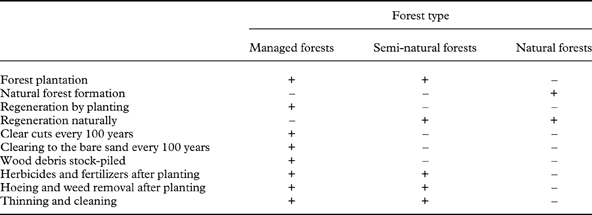
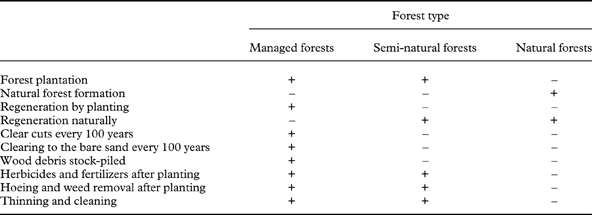
Forest management on sandy soils in Borská nížina has its own specifications (FMP 2005). After clear cuts, the sandy soil is cleared of stumps, larger roots and other debris which are stock piled. Seedlings of Pinus sylvestris are planted in lines and cultivated using herbicides and fertilizers, following hoeing and weed removal. The management thinning and cleaning is repeated two or three times. While felling of the managed forests is repeated approximately every one hundred years after clear cuts, semi-natural forests are left for natural regeneration, as soil protection is considered to be of the utmost importance.
Pine-dominated communities on sandy soils, such as Cladonio-Pinetum, have often been considered to have lichen-moss mats (Brodo Reference Brodo1961; Crittenden Reference Crittenden1991, Reference Crittenden2000). Here, the mechanisms that can influence these mats and their species diversity are examined. It was also important to confirm similarities between Cladonio-Pinetum in the Bory Tucholskie National Park and semi-natural pine forest localities in Slovakia, for consequent improvement in their conservation.
The aims of this study were: 1) to describe the species composition; 2) to discuss the variability of species richness and diversity of the cryptogam layer in dry acidophilous Scots pine forests, with particular attention to terricolous lichens; 3) to address the most significant ecological characteristics which influence the species diversity of the terricolous lichens; and 4) to determine the impact of different management actions and processes in individual Cladonio-Pinetum forest types on the species composition and diversity in the area studied.
Materials and Methods
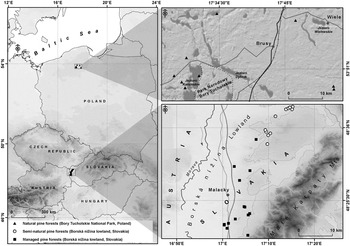
This research was conducted between 2006 and 2011 in the two selected regions of Borská nížina lowland in Slovakia and Bory Tucholskie in Poland (Fig. 1). The Borská nížina lowland lies in the south-western part of Slovakia in the region of Eupannonicum (Futák Reference Futák and Plesník1980). It is characterized by a sub-continental climate with an average annual temperature of c. 9–9·6°C. July is the hottest month here, with a temperature of 19·6–20·2°C, and the growing season is c. 250 days long. The average annual precipitation is 550–650 mm, 300–320 mm of which falls during the growing season (Krippelová & Krippel Reference Krippelová and Krippel1956). The soil pH on top of the sand dunes in the upper horizon is very acidic, at 4·1–4·6 (Kollár et al. Reference Kollár, Balkovič, Mazúrová and Šimonovič2011).
Localities of the Borská nížina lowland (Slovakia) and Bory Tucholskie National Park (Poland).

Bory Tucholskie is a sub-oceanic region with an annual precipitation of c. 600 mm, a mean annual temperature of 7·1°C, and a growing season of about 200 days (Woś Reference Woś1999). The average pH of the contact area between the humus and mineral horizons is 4·8 (Fałtynowicz Reference Fałtynowicz1986).
A total of three types of habitat were selected due to the different management actions and processes among the following forest types: 1) managed forests (forest plantations regenerated by planting), 2) semi-natural forests (forest plantations regenerated naturally) and 3) natural forests [primordial vegetation without visible management from the association Cladonio-Pinetum (Juraszek)] Reference Juraszek1928). While the Borská nížina lowland encompasses the first two types of forests with different management actions, its natural status is still under discussion. Comparison with forests which are reliably natural is useful in the assessment of the natural status of these forests (see Table 1 for differences in management actions for individual forest types). Therefore, the Bory Tucholskie National Park was chosen, and plots from this locality were added to the dataset. A total of 35 localities with the occurrence of dry acidophilous pine forests (Dicrano-Pinion) were studied from both regions. Of these forests, 14 were managed, 11 were semi-natural and 10 were natural. Hence, a total of 35 phyto-sociological relevés of 400 m2 and 350 micro-samples with a 0·25 m2 area were examined in the field. There was 1 relevé and 10 micro-samples in each locality.
Different management actions and processes in individual forest types
All relevés were made using standard procedures of the Zürich-Montpellier School (Braun-Blanquet Reference Braun-Blanquet1964; Westhoff & van den Maarel Reference Westhoff, van der Maarel and Whittaker1978). The modified 9-degree Braun-Blanquet's sampling scale (Barkman et al. Reference Barkman, Doing and Segal1964) was used and data were stored in the TURBOVEG database (Hennekens & Schaminée Reference Hennekens and Schaminée2001), prior to processing in JUICE 6.4 (Tichý Reference Tichý2002). Micro-samples were divided according to current management techniques in the area. This gave 140 micro-samples of managed forests, 110 from semi-natural forests, and 100 from natural pine forests. Canonical correspondence analysis (CCA) performed in the CANOCO 4.5 program package analyzed and depicted the relationships between the floristic composition of the relevés and the environmental variables (ter Braak & Šmilauer Reference ter Braak and Šmilauer2002). These variables comprised: the lichen cover, moss and herb layers, litter cover and depth, the A0 and A1 soil horizon depths, the forest age and the density of the tree canopy cover, and the Shannon-Wiener diversity index. The complete model of the Monte-Carlo permutation test was performed using 499 random permutations to assess the effectiveness of each environmental variable in the ordination model.
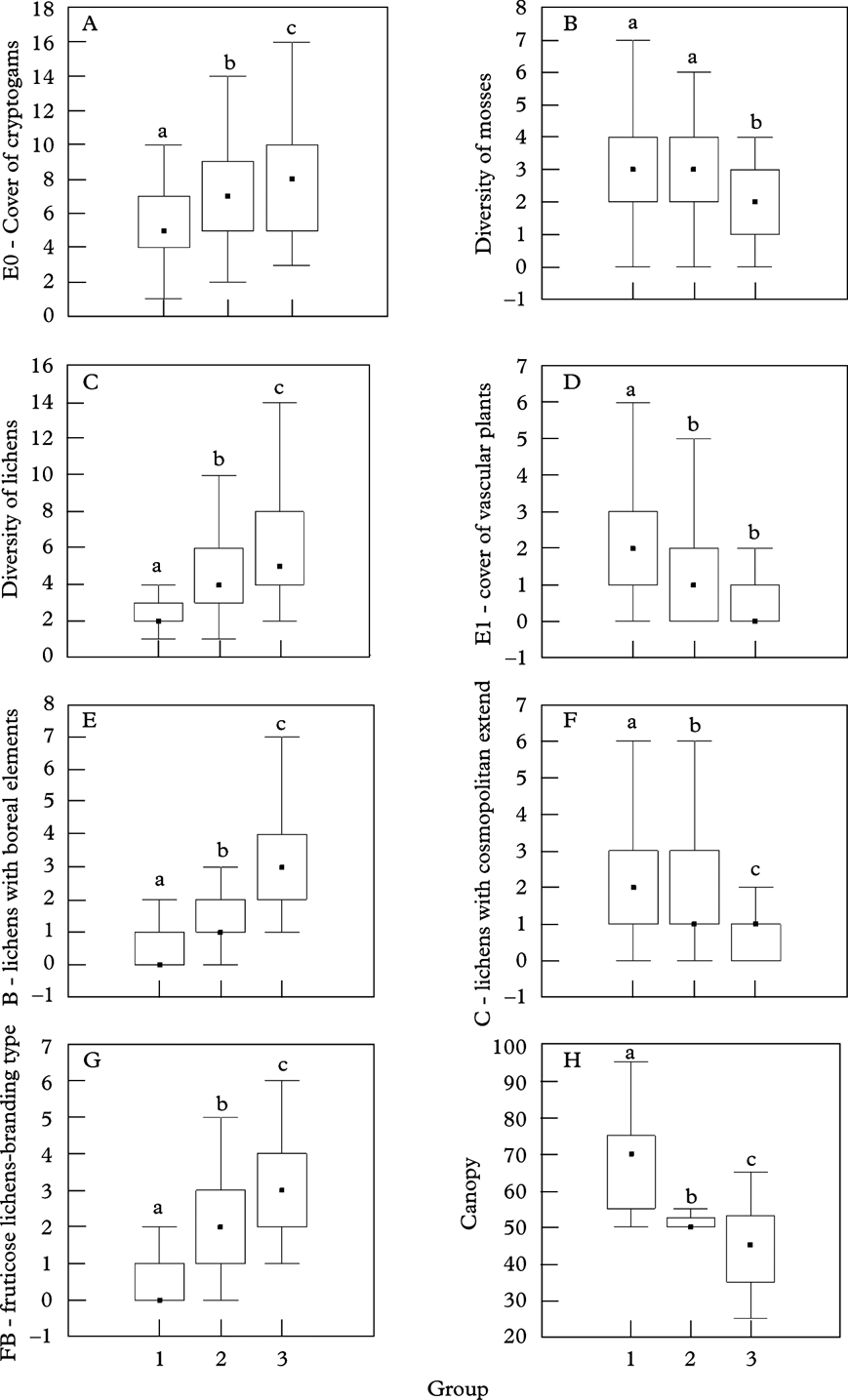
Statistica 9.0 (http://www.statsoft.com/) was used for correlation analysis, and box and whisker plots were constructed for the following selected environmental variables: diversity and cover of vascular plants, mosses and lichens, the frequency of selected geographical elements and life forms, canopy cover in relation to particular vegetation and also the existing management types. The significant statistical differences were tested by the Tukey post-hoc test using multiple comparisons following a one-way ANOVA, and statistical differences are depicted in the diagrams by the letters a, b and c.
The nomenclature of vascular plants follows the checklist of Marhold & Hindák (Reference Marhold and Hindák1998), and the cryptogams are as in the checklist by Bielczyk et al. (Reference Bielczyk, Lackovičová, Farkas, Lökös, Liška, Breuss and Kondratyuk2004).
Several species and sub-species from problematic groups of the genus Cladonia spp. were not distinguished (Hennipman & Sipman Reference Hennipman, Sipman and Vijsma1978; Hammer Reference Hammer1995; Stenroos & Depriest Reference Stenroos and DePriest1998). The content of individual groups was as follows: Cladonia cariosa group (Pino-Bodas et al. Reference Pino-Bodas, Burgaz, Martín and Lumbsch2012): C. acuminata (Ach.) Norrl., C. cariosa (Ach.) Spreng., C. symphycarpia (Flörke) Fr.; Cladonia chlorophaea group (Ahti Reference Ahti1966; Ferry & Pickering Reference Ferry and Pickering1989; Kotelko & Piercey-Normore Reference Kotelko and Piercey-Normore2010): Cladonia chlorophaea (Flörke et Sommerf.) Spreng., C. merochlorophaea Asahina, C. pyxidata (L.) Hoffm.; Cladonia gracilis group (Piercey-Normore et al. Reference Piercey-Normore, Hausner and Gibb2004; Fontaine et al. Reference Fontaine, Ahti and Piercey-Normore2010): Cladonia coniocraea (Flörke) Spreng., C. cornuta (L.) Hoffm., C. gracilis; and Cocciferae group (Burgaz Reference Burgaz2009; Steinová Reference Steinová2009; Osyczka Reference Osyczka2011): Cladonia coccifera (L.) Willd., and C. pleurota (Flörke) Schaer. (Ahti Reference Ahti1980).
Results
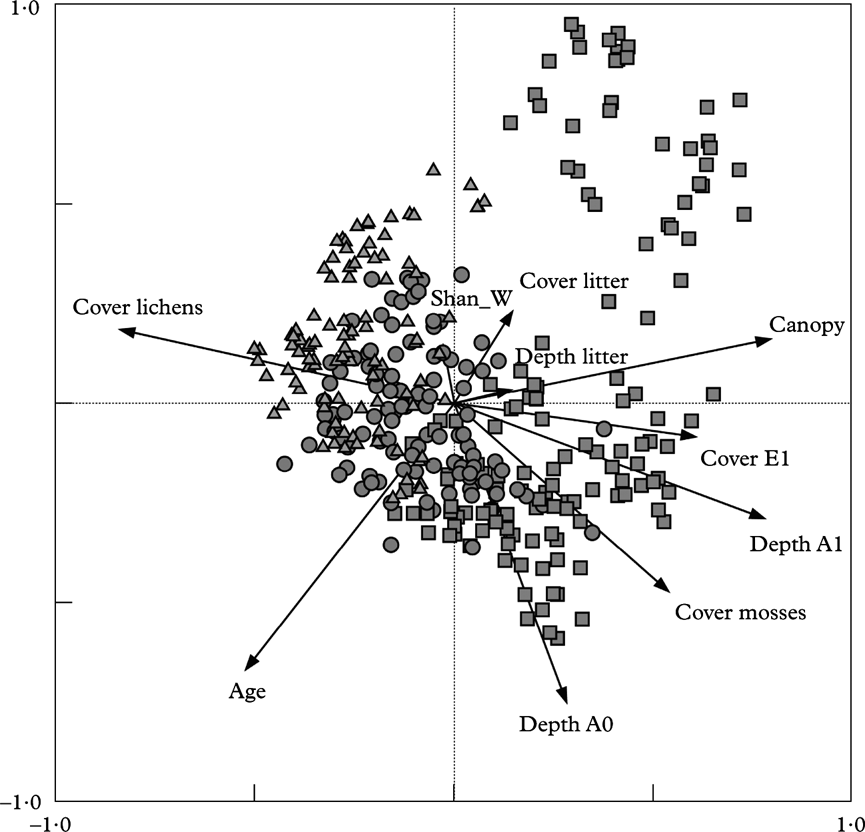
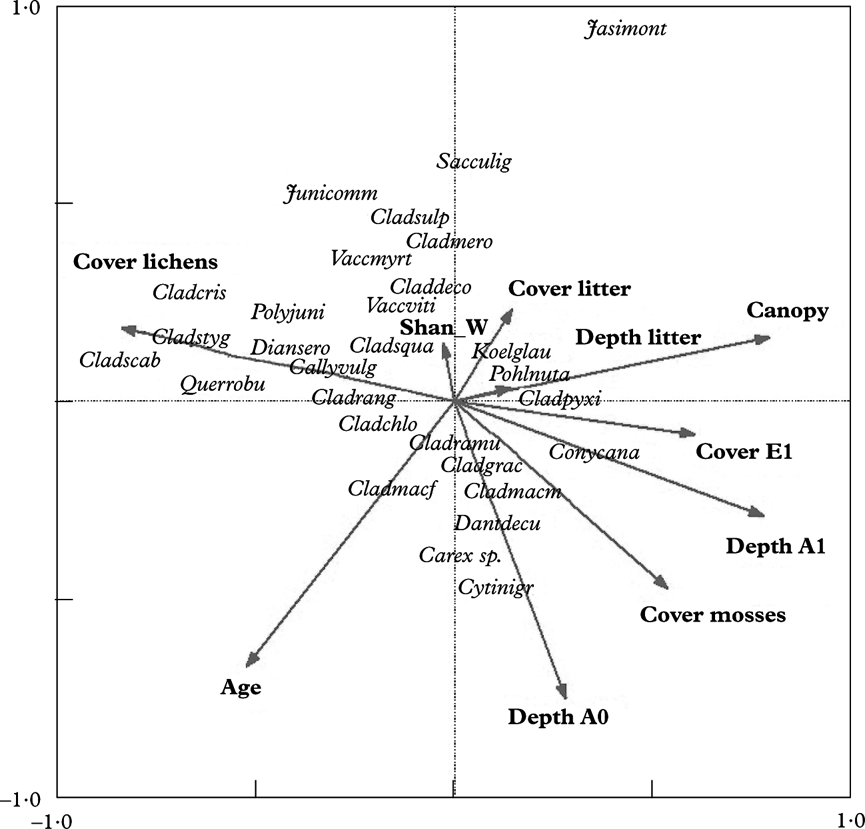
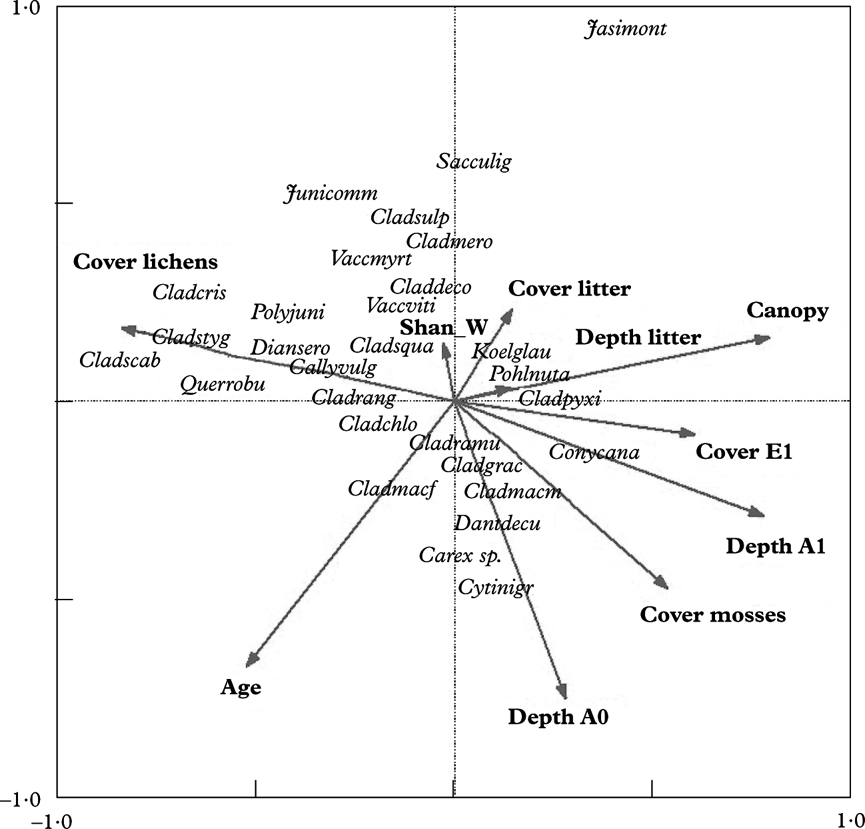
Results of data analysis show that forest management techniques seriously influence the environmental characteristics of Scots pine forests. These affect the cover of the tree canopy layer, with a considerable resultant negative impact on lichen diversity (Figs 2 & 3). The first, horizontal axis was positively correlated with the cover of mosses, vascular plants and soil depth, and negatively correlated with increasing values of lichen cover. Therefore, the relevés from Bory Tucholskie are clearly grouped on the left-hand side of the diagram. These relevés represent open dry forests which are rich in lichens, especially Cladonia crispata (Ach.) Flot., C. chlorophaea, C. gracilis, C. rangiferina, C. scabriuscula (Delise) Nyl. and C. stygia (Fr.) Ruoss. Managed forests, with the occurrence of species such as Cladonia macilenta Hoffm. ssp. macilenta and C. pyxidata, can be distinguished on the right side of the gradient. These forests are characterized by a thicker soil profile, denser canopy, and a less dry environment, which result in higher moss cover. Semi-natural forests occupy their transitional position between the natural and managed forests.
Ordination diagrams of CCA analysis of 350 micro-samples from dry acidophilous Scots pine forests. ▪, managed forests; •, protected forests; ▴, natural forest from Bory Tucholskie National Park. Eigenvalues: 0·546 on the 1st axis and 0·357 on the 2nd axis.
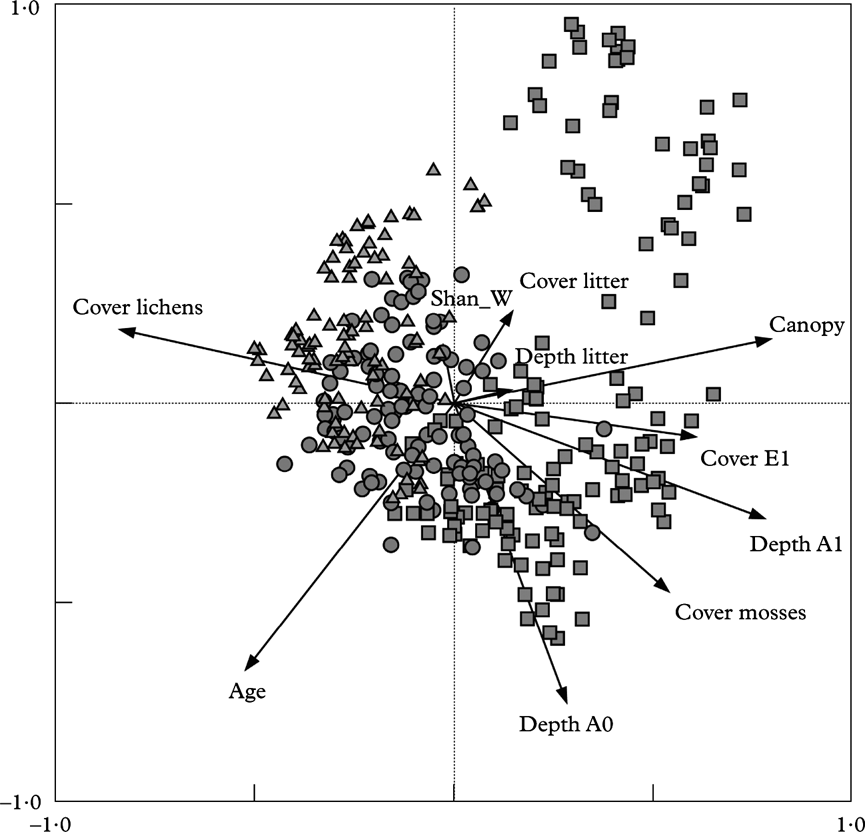
Ordination diagrams of CCA analysis based on 350 micro-samples.
The abbreviations of species in the diagram are as follows: Jasimont-Jasione montana, Sacculig-Saccomorpha uliginosa, Junicomm-Juniperus communis, Cladsulp-Cladonia sulphurina, Cladmero-Cladonia merochlorophaea, Vaccmyth-Vaccinium myrthylus, Vaccviti-Vaccinium vitis-idaea, Claddeco-Cladonia decorticata, Cladsqua-Cladonia squamosa, Keolglau-Koeleria glauca, Pohlnuta-Pohlia nutans, Cladpyxi-Cladonia pyxidata, Conycana-Conyza canadensis, Cytinigr-Cytisus nigricans, Carex species, Dantdecu-Danthoria decumbens, Cladmacm-Cladonia macilenta ssp. macilenta, Cladmacf-Cladonia macilenta ssp. floerkeana, Cladgrac-Cladonia gracilis, Cladramu-Cladonia ramulosa, Cladchlo-Cladonia chlorophaea, Cladrang-Cladonia rangiferina, Callvulg-Calluna vulgaris, Querrobu-Quercus robur, Diansero-Dianthus serotinus, Cladstyg-Cladonia stygia, Cladscab-Cladonia scabriuscula, Polyjuni-Polytrichum juniperinum, Cladcris-Cladonia crispata
The box and whisker plots (Fig. 4A–H) depict the diversity of cryptogams (mosses and lichens), vascular plants and the frequency of selected geographical elements and life forms within individual forest types. In addition, they indicate the range of values of canopy cover and statistical differences between individual vegetation types. While primal dry pine forests are naturally loose and significantly more diverse in lichen species than secondary forests, the managed forests are planted to achieve denser tree formation, and these environmental conditions are therefore more suitable for mosses and some vascular plants.
Diversity of cryptogams (mosses and liverworts), vascular plants, frequency of selected geographical elements and life forms within individual forest types. 1=managed forests; 2=protected forests; 3=Bory Tucholskie National Park. • median, whiskers represent 25–75% of non-outlier range.
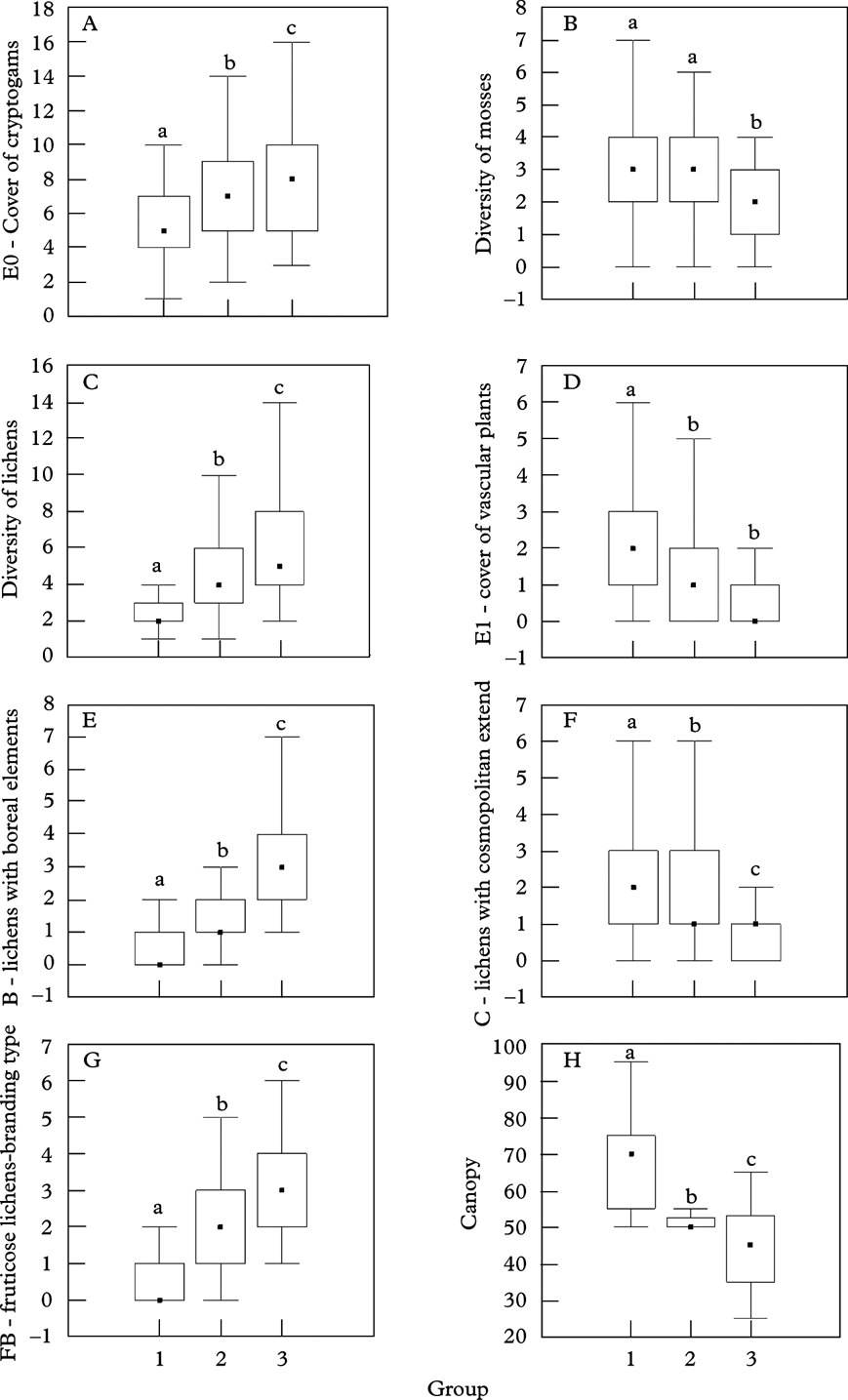
A significant participation of boreal elements is characteristic in natural Cladonio-Pinetum forests because the association is situated mainly in the boreal zone (Fig. 4E). Since fruticose lichens with a branching thallus, such as Cladonia sp. and Cetraria sp., need a longer period for optimal growth, their occurrence in managed forests is limited by time (Fig. 4G).
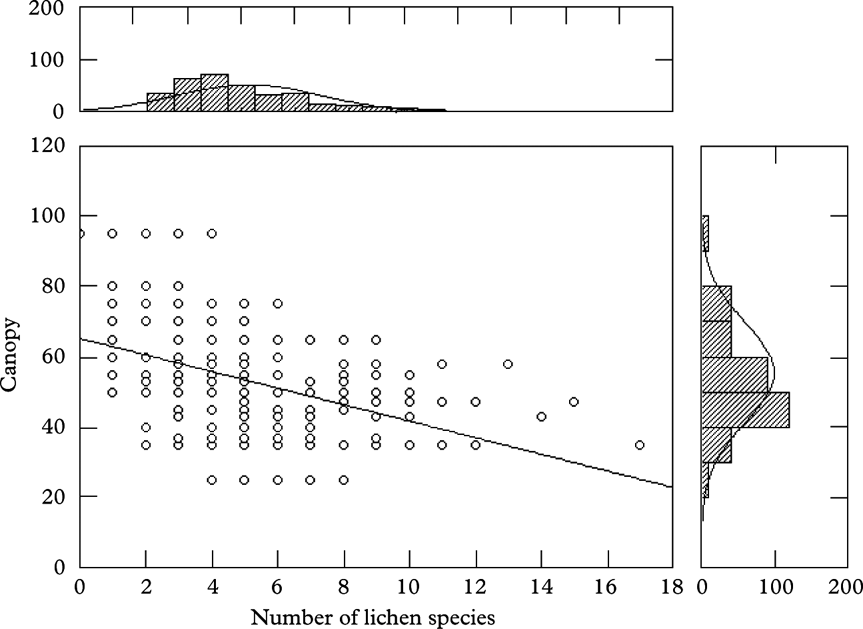
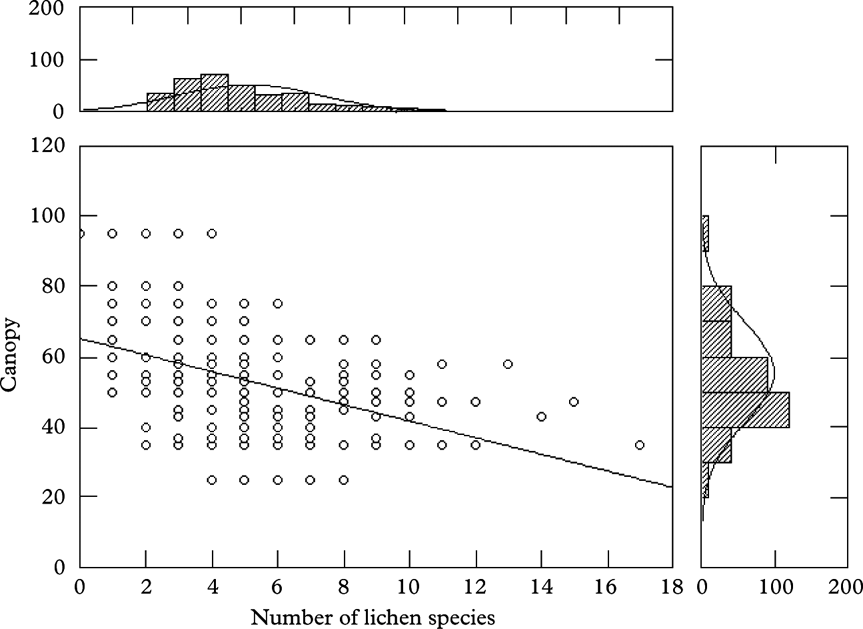
The most significant influence on the diversity of lichens was the density of the tree canopy (Figs 4H & 5). Natural and semi-natural dry Scots pine forests are significantly more diverse in lichen species than managed forests, and are naturally loose according to the various age of trees represented there which formed the gaps between the trees.
Relationship between density of tree canopy cover (%) and number of lichen species in acidophilous Scots pine forests. The top and right hand boxes show the distribution of the values of both variables.
Discussion
Lichens and mosses respond differently to the effect of the canopy layer (Figs 4H & 5). Both groups of cryptogams exhibit the ability to acclimatize to a wide range of light and temperature conditions (Canters et al. Reference Canters, Schöller, Ott and Jahns1991; Sulyma & Coxson Reference Sulyma and Coxson2001; Bruun et al. Reference Bruun, Moen, Virtanen, Grytnes, Oksanen and Angerbjörn2006; Dynesius & Zinko Reference Dynesius and Zinko2006). However, the fact that lichens are more common at open sites suggests that lichens and mosses prefer different light environments. The main lichen species occurring at open sites are: Cladonia arbuscula (Wallr.) Flot. em. Ruoss ssp. mitis (Sandst.) Ruoss, C. chlorophaea, C. coniocraea, C. cornuta, C. crispata, C. furcata (Huds.) Schrad., C. merochlorophaea and C. rangiferina in lichen-rich forests on dry acid sand in Estonia (Kösta & Tilk Reference Kösta and Tilk2008). We observed that Cladonia crispata, C. rangiferina, C. scabriuscula and C. stygia flourish in stands with lower canopy cover, which is typical in natural and semi-natural forests (Fig. 2). Cladonia rangiferina is a taxon with the highest ability to increase its cover when the lichen volume increases (Oksanen Reference Oksanen1986). While lichens overgrow mosses under conditions of high light and low moisture (Sedia & Ehrenfeld Reference Sedia and Ehrenfeld2003), moss cover increases with increasing canopy cover, an abundance of vascular plants and increased litter accumulation, as illustrated in Fig. 2 (Coxson & Marsh Reference Coxson and Marsh2001).
However, increased litter accumulation also allows several lichen species to colonize free niches. These include Cladonia diversa and Placynthiella icmalea (Ach.) Coppins & P. James (Hasse & Daniëls Reference Hasse and Daniëls2006), Cladonia chlorophaea, C. coccifera, C. cornuta and C. glauca Flörke (Magnusson Reference Magnusson1982), and also Cladonia merochlorophaea and C. subulata (Magnusson Reference Magnusson1983). Those are mainly lichen cup-forming species which are not typical for Cladonio-Pinetum forests, and it was obvious from our study that these form a rather fruticose lichen-branching type (Fig. 4G).
Our study suggests that mosses thrive on soils with a thicker organic layer, that is, an A0 layer (Figs 2 & 3), whereas lichens are prevalent in habitats where there is no developed organic layer. Moreover, lichen mats appear to inhibit the development of such layers (Sedia & Ehrenfeld Reference Sedia and Ehrenfeld2003). Species of the family Cladoniaceae are known to produce very low litter input beneath the mats (Haapasaari Reference Haapasaari1988), which could result in the absence of vascular plants from lichen-rich forests (Fig. 4B–D). There is also the possibility that patches containing a mixture of Cladonia spp. can inhibit the germination or establishment of vascular species, most likely through both chemical and physical processes (Hobbs Reference Hobbs1985). Since the presence of an organic layer is crucial for the supply of nutrients, particularly nitrogen (Hyvärinen & Crittenden Reference Hyvärinen and Crittenden1998; Ellis et al. Reference Ellis, Crittenden, Scrimgeour and Ashcroft2003; Hauck & Wirth Reference Hauck and Wirth2010; Hogan et al. Reference Hogan, Minnullina, Sheppard, Leith and Crittenden2010; Freitag et al. Reference Freitag, Hogan, Crittenden, Allison and Thain2011), the different effects of lichens and mosses on the accumulation of organic matter may certainly play an important role in the lichen-mosses-vascular plant interactions.
We concur with the theory that the cover of lichens is higher in natural pine forests and semi-natural forests (Lesica et al. Reference Lesica, McCune, Cooper and Hong1991; Uotila et al. Reference Uotila, Hotanen and Kouki2005), and this is also supported by the results of canonical correspondence analysis (Figs 2 & 3). The most abundant species were the branching types of fruticose lichens forming the mats (Fig. 4G), such as Cladonia arbuscula ssp. mitis, C. arbuscula ssp. squarrosa, C. rangiferina and C. stellaris (Väre et al. Reference Väre, Ohtonen and Oksanen1995; Tømmervik et al. Reference Tømmervik, Høgda and Solheim2003; Olofsson et al. Reference Olofsson, Moen and Østlund2010), and management actions negatively affect them. The semi-natural stands were rich in Cladonia lichens and dwarf shrubs until tree-canopy closure, while the abundance of mosses was lower in these semi-natural stands (Uotila et al. Reference Uotila, Hotanen and Kouki2005); this situation is clearly depicted in Fig. 2. Väre et al. (Reference Väre, Ohtonen and Oksanen1995) suggested that it is natural to assume an increase in minute cup lichens, such as Cladonia sp., which occurs when the impact of maintenance pressure increases. In our study, this increase is visible in Cladonia pyxidata (Fig. 3). The C. pyxidata taxon is well noted as an apophyte occurring in anthropogenic stands (Olech Reference Olech1998), and it is one of the cosmopolitan lichens which can be found on anthropogenic bare soil habitats (Fig. 4F).
Due to forest management, the abundance of grasses increased. A perfect example is Avenella flexuosa (L.) Drejer, which is a species commonly prominent after clear-cutting (Uotila et al. Reference Uotila, Hotanen and Kouki2005). On the other hand, Vaccinium myrtillus L. disappeared and the abundance of Vaccinium vitis-idaea L. and Pleurozium schreberi (Brid.) Mitt. decreased rapidly (Nieppola Reference Nieppola1992). It is obvious from our study (Fig. 4D) that forest management increases the abundance of vascular plants at the expense of lichen diversity (Fig. 2).
The differences in the biodiversity of lichens between managed and natural forests may not be clearly apparent when these forests are of similar age and microclimatic conditions. This especially involves the presence of similar canopy tree cover, and hence similar light conditions (Esseen et al. Reference Esseen, Renhorn and Pettersson1996). An increase in the following species is apparent in stands which are c. 100 years old (from 50–150 years): Cladonia arbuscula ssp. mitis, C. rangiferina, C. stellaris (Opiz) Pouzar & Vězda and C. uncialis (L.) Weber ex F. H. Wigg. (Coxson & Marsh Reference Coxson and Marsh2001). In contrast, the species Cladina sp. and Cladonia sp. appear to flourish more frequently in some types of young managed forests (Söderstörm Reference Söderström1988; Glenn et al. Reference Glenn, Cole, Webb, Hale, Glenn, Harris, Ring and Cole1998; Meier et al. Reference Meier, Paal, Liira and Jüriado2005). This suggests that the management may open up and desiccate the stands, thus resulting in increased lichens on the stands. However, this may happen only where the climax stadium of the pine forests does not belong to the association Cladonia-Pinetum, which are naturally dry and contain fewer nutrients. Here, the lichen mats have persisted in xeric sites for more than 300 years, and the limiting factors of soil moisture and temperature have prevented mosses and vascular plants from taking hold (Fig. 4B & D) (Brulisauer et al. Reference Brulisauer, Bradfield and Maze1996).
Peterken (Reference Peterken1999) suggested several types of forest management which would maintain a forests' natural appearance, and simultaneously retain functional integrity of the ecosystem. These suggestions included 1) maintenance of the continuity of young-growth, 2) retention of old trees in stands and an increase in the volume of dead wood, and 3) application of additional mixed planting to enhance natural regeneration. In terms of our research here, we consider that Peterken's (Reference Peterken1999) concept of natural forestry is extremely advisable. As we have suggested, high insolation is a key environmental factor, characteristic of natural forests of the Cladonio-Pinetum association, and therefore the sparse character of the forest as a result of natural forestry is important. This has been proven in the semi-natural forests where open gaps occur during natural regeneration. Finally, it is important for the Cladonio-Pinetum association, which occurs on poor acidic sands, that tree growth is inhibited and that the tree canopy is not closed.
Alica Dingová is grateful to the Visegrad Fund and IAA600050812 for financial support. Milan Valachovič would like to thank the Grant Agency VEGA Nr. 2/0059/11. For help during field sampling we are grateful to Tomáš Olšovský of the Záhorie Protected Landscape Area Administration and Ludwik Lipnicki of the University School of Physical Education in Poznań, Gorzów Wielkopolski. For the determination of bryophytes we thank Anna Petrášová from Matej Bel University in Banská Bystrica, and Katarína Mišíková from Comenius University in Bratislava, and for improving the English we thank Ray Marshall.