INTRODUCTION
A number of studies have investigated the impact of a traumatic brain injury (TBI) on the injured person’s family, who frequently represent the major long-term source of support to the injured person. These include:Anderson, Parmenter, & Mok, Reference Anderson, Parmenter and Mok2002; Brooks, Reference Brooks1991; Douglas & Spellacy, Reference Douglas and Spellacy2000; Ergh, Rapport, Coleman, & Hanks, Reference Ergh, Rapport, Coleman and Hanks2002; Gan & Schuller, Reference Gan and Schuller2002; Hall et al., Reference Hall, Karzmark, Stevens, Englander, O’Hare and Wright1994; Hanks, Rapport, & Vangel Reference Hanks, Rapport and Vangel2007; Jacobs, Reference Jacobs1988; Kreutzer, Gervasio, & Camplair, Reference Kreutzer, Gervasio and Camplair1994b; Machamer, Temkin, & Dikmen, Reference Machamer, Temkin and Dikmen2002; Marsh, Kersel, Havill, & Sleigh, Reference Marsh, Kersel, Havill and Sleigh2002; Moore, Stambrook, & Peters, Reference Moore, Stambrook and Peters1993; Oddy, Humphrey, & Uttley, Reference Oddy, Humphrey and Uttley1978; Perlesz, Kinsella, & Crowe, Reference Perlesz, Kinsella and Crowe1999; Ponsford, Olver, Ponsford, & Nelms, Reference Ponsford, Olver, Ponsford and Nelms2003; Testa, Malec, Moessner, & Browt, Reference Testa, Malec, Moessner and Browt2006; and Winstanley, Simpson, Tate, & Myles, Reference Winstanley, Simpson, Tate and Myles2006. These studies have reported high levels of emotional distress in relatives of brain-injured individuals: Brooks, Reference Brooks1991; Hall et al., Reference Hall, Karzmark, Stevens, Englander, O’Hare and Wright1994; Kreutzer et al., Reference Kreutzer, Gervasio and Camplair1994b; Livingston, Brooks, & Bond, Reference Livingston, Brooks and Bond1985; Marsh et al., Reference Marsh, Kersel, Havill and Sleigh2002; Ponsford et al., Reference Ponsford, Olver, Ponsford and Nelms2003. There is also strong evidence that the family system may be affected by a family member’s brain injury (Ergh et al., Reference Ergh, Rapport, Coleman and Hanks2002; Gan & Schuller, Reference Gan and Schuller2002; Kreutzer, Gervasio, & Camplair, Reference Kreutzer, Gervasio and Camplair1994a, Kreutzer, et al., Reference Kreutzer, Gervasio and Camplair1994b; Testa et al., Reference Testa, Malec, Moessner and Browt2006; Winstanley et al., Reference Winstanley, Simpson, Tate and Myles2006). The most commonly used measure of family functioning in these studies has been the Family Assessment Device (FAD; Epstein, Baldwin, & Bishop, Reference Epstein, Baldwin and Bishop1983).
The reported causes of family members’ distress and poor family functioning include: changes in the injured person’s emotional control and behavior, such as irritability and aggression (Anderson et al., Reference Anderson, Parmenter and Mok2002; Kreutzer et al., Reference Kreutzer, Gervasio and Camplair1994a; Marsh, Kersel, Havill, & Sleigh, Reference Marsh, Kersel, Havill and Sleigh1998a, Reference Marsh, Kersel, Havill and Sleigh1998b; Oddy et al., Reference Oddy, Humphrey and Uttley1978; Ponsford et al., Reference Ponsford, Olver, Ponsford and Nelms2003), cognitive difficulties (Anderson et al., Reference Anderson, Parmenter and Mok2002; Ergh et al., Reference Ergh, Rapport, Coleman and Hanks2002; Kreutzer et al., Reference Kreutzer, Gervasio and Camplair1994a; Machamer et al., Reference Machamer, Temkin and Dikmen2002; Ponsford et al., Reference Ponsford, Olver, Ponsford and Nelms2003; Testa et al., Reference Testa, Malec, Moessner and Browt2006), severe physical disability (Chan, Reference Chan2007; Marsh et al., Reference Marsh, Kersel, Havill and Sleigh1998a), community participation (Winstanley et al., Reference Winstanley, Simpson, Tate and Myles2006), lack of social and practical supports (Douglas & Spellacy, Reference Douglas and Spellacy1996; Ergh et al., Reference Ergh, Rapport, Coleman and Hanks2002; Ergh, Hanks, Rapport, & Coleman, Reference Ergh, Hanks, Rapport and Coleman2003; Hanks et al., Reference Hanks, Rapport and Vangel2007; Marsh et al., Reference Marsh, Kersel, Havill and Sleigh1998a), and financial issues (Hall et al., Reference Hall, Karzmark, Stevens, Englander, O’Hare and Wright1994). There have been mixed findings regarding the influence of a relatives’ relationship with the injured person on family member distress, with some studies suggesting spouses report more behavior problems than parents (Gervasio & Kreutzer, Reference Gervasio and Kreutzer1997; Kreutzer et al., Reference Kreutzer, Gervasio and Camplair1994b; Rosenbaum & Najenson, Reference Rosenbaum and Najenson1976; Thomsen, Reference Thomsen1984) and others not finding such a difference (Allen, Linn, Gutierrez, & Willer, Reference Allen, Linn, Gutierrez and Willer1994; Brooks, Campsie, Symington, Beattie, & McKinlay, Reference Brooks, Campsie, Symington, Beattie and McKinlay1987; Gan & Schuller, Reference Gan and Schuller2002; Oddy et al., Reference Oddy, Humphrey and Uttley1978; Ponsford et al., Reference Ponsford, Olver, Ponsford and Nelms2003). There is evidence that those in a direct care-giving role are more distressed than other relatives (Gan, Campbell, Gemeinhardt, & McFadden, Reference Gan, Campbell, Gemeinhardt and McFadden2006; Perlesz, Kinsella, & Crowe, Reference Perlesz, Kinsella and Crowe2000; Ponsford et al., Reference Ponsford, Olver, Ponsford and Nelms2003).
There has, however, been little research examining family functioning in large samples over extended periods of time after injury (i.e., greater than one year). The first aim of the current study was to investigate, in a large sample that had access to rehabilitation services, family functioning and relatives’ emotional status two and five years after a family members’ TBI. It was hypothesized that relatives would report poor family functioning and show high rates of anxiety and depression symptoms at both two and five years after injury. The second aim was to investigate factors predicting poorer family functioning and relatives’ emotional status two and five years following TBI. It was hypothesized that both family functioning and relatives’ emotional status would be predicted by the neurobehavioral consequences of the family member’s TBI (behavioral, cognitive, social, and mood changes). It was also anticipated that family functioning and relatives’ emotional status would impact on each other, such that poor family functioning might cause emotional distress in relatives, while emotional distress in the relatives might also affect family functioning.
METHOD
The study was approved by the Ethics committee of Epworth Hospital and all participants gave written informed consent to participate.
Participants
Participants were individuals with TBI who had received rehabilitation in the context of a no-fault accident compensation system, and their relatives. Participants were invited to complete questionnaires as part of a routine follow-up extended to all patients and their families at two and five years after their injury. Hence, the target population was not biased towards families who were actively seeking assistance. All patients who completed the questionnaires at either the two or five year follow-up were included in this study. The 98 patients who had completed them at both follow-up time points were not different from those who had completed them at only the two or five year follow-up, or from other hospital patients in terms of age, gender, duration of post-traumatic amnesia (PTA), and Glasgow Coma Scale (GCS) score (Mann-Whitney U-tests and χ2 tests; all p > .05).
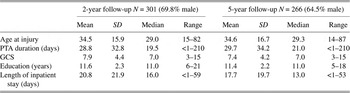
The TBI individuals’ demographic and injury-related characteristics are shown in Table 1. Their injury severity ranged from mild to severe, the majority having sustained moderate to severe injuries, with 2.1% of the TBI participants having a PTA duration of less than one day, 27.6% a PTA of 1–7 days, 35.7% 8–28 days, and 36.7% a PTA duration of > 28 days. While there was a wide age range in the sample, half of the sample was younger than 30 years.
Individuals with TBI: Demographic and injury characteristics

Note
TBI = Traumatic brain injury, PTA = post-traumatic amnesia, GCS = Glasgow Coma Scale.
At two-year follow-up, 42% of the participating close others were parents, 36% were spouses, 8% were siblings, and 6% were children. The majority of the close others (73%) lived with the TBI individual and 49% were the primary caregivers for the injured individual. At five-year follow-up, the number of participating relatives who lived with the injured person was 64%.
Measures
The participants with TBI were asked to complete the following measures:
The Craig Handicap Assessment Reporting Technique (CHART; Whiteneck, Charlifue, Gerhart, Overholser, & Richardson, Reference Whiteneck, Charlifue, Gerhart, Overholser and Richardson1992) was used as a multidimensional and objective measure of current handicap. The Physical Independence, Cognitive Functioning, Mobility, Occupation, and Social Integration subscales were administered, measuring the amount of physical and cognitive assistance required, ability to get around in the community, number of hours spent in paid and unpaid employment, home-making, or leisure activities, and number of social contacts in a month, respectively. Higher scores represent less handicap. Previous studies have shown its sensitivity in the TBI population (Boake & High, Reference Boake and High1996; Ponsford, Olver, Nelms, Curran, & Ponsford, Reference Ponsford, Olver, Nelms, Curran and Ponsford1999).
The Hospital Anxiety and Depression Scale (HADS; Snaith & Zigmond, Reference Snaith and Zigmond1983) was completed as a measure of emotional functioning. The HADS consists of an Anxiety subscale and a Depression subscale. The scale range is 0 to 21. The scores can be categorized as normal (0–7), mild (8–10), moderate (11–14), or severe (15–21). The reliability and validity of the HADS has been shown in several studies (Bjelland, Dahl, Haug, & Neckelmann, Reference Bjelland, Dahl, Haug and Neckelmann2002; Herrmann, Reference Herrmann1997). The HADS has also been used in a number of studies in the TBI population (Draper, Ponsford, & Schönberger, Reference Draper, Ponsford and Schönberger2007; Hoofien, Gilboa, Vakil, & Donovick, Reference Hoofien, Gilboa, Vakil and Donovick2001; Medd & Tate, Reference Medd and Tate2000; Powell, Heslin, & Greenwood, Reference Powell, Heslin and Greenwood2002; Whelan-Goodinson, Ponsford, & Schönberger, Reference Whelan-Goodinson, Ponsford and Schönberger2009; Schönberger, & Ponsford, in press). In the present study, we grouped participants into those with clinically significant levels of anxiety and depression symptoms (HADS scores > 7) and those with lower levels of anxiety and depression symptoms.
Relatives of TBI participants completed the following measures:
The Family Assessment Device (FAD; Epstein et al., Reference Epstein, Baldwin and Bishop1983) was administered to assess current family functioning. The FAD is based on the McMaster Model of Family Functioning. According to Epstein et al. (Reference Epstein, Baldwin and Bishop1983), the model “describes structural and organizational properties of the family group and the patterns of transactions among family members which have been found to distinguish between healthy and unhealthy families.” The FAD items are answered on a four-point Likert scale, ranging from 1 to 4. They fall into seven subscales, namely: (1) Problem Solving (e.g., “We confront problems involving feelings”), (2) Communication (e.g., “You can tell how a person is feeling from what they are telling”), (3) Roles (e.g., “We make sure members meet there family responsibilities”), (4) Affective Responsiveness (e.g., “We express tenderness”), (5) Affective Involvement (e.g., “We are too self-centered”), (6) Behavior Control (e.g., “You can easily get away with breaking the rules”), and (7) General Functioning Scale (e.g., “We don’t get along well together”). Scores are determined by computing average item scores, resulting in scale ranges from 1 to 4, with 1 indicating good family functioning and 4 indicating poor family functioning. Following the recommendations of Miller, Bishop, Epstein, & Keitner, (Reference Miller, Bishop, Epstein and Keitner1985) we also dichotomized the FAD scales in order to examine the percentage of families with unhealthy functioning in each FAD subscale. Miller et al. (Reference Miller, Bishop, Epstein and Keitner1985) reported good psychometric properties for the FAD. It is sensitive to family changes after TBI (Bragg, Klockars, & Berninger, Reference Bragg, Klockars and Berninger1992; Kreutzer et al., Reference Kreutzer, Gervasio and Camplair1994b) and is recommended for use in this population (Rosenthal & Young, Reference Rosenthal and Young1988).
The Hospital Anxiety and Depression Scale (HADS), as a measure of relatives’ emotional status. As for TBI participants, the relatives were grouped into those with clinically significant levels of anxiety and depression (HADS scores > 7) and those without significant levels of anxiety and depression.
The Structured Outcome Questionnaire (SOQ) cognitive, behavioral, and emotional changes sections (Ponsford et al., Reference Ponsford, Olver, Nelms, Curran and Ponsford1999). Respondents were asked to indicate whether or not the brain-injured individual had, since the injury, shown changes in the domains of cognitive functioning (forgetfulness, difficulty with planning, reduced concentration, slower thinking, needing prompting to get things done, mental fatigue), behavior (self-centeredness, impulsivity, inappropriate social behavior), social changes (social isolation, making new friends), and emotional state (anxiety and depression). The authors report satisfactory reliability for this questionnaire. For use in the present study, a sum score of all items was computed, indicating the number of post-injury changes in the brain-injured individual reported by the relative. The relatives’ report of these changes was used because of the possible impact of impaired self-awareness in reports of TBI participants.
Data Analysis
Statistical analyses were performed with SPSS 15.0 (SPSS Inc., USA). In order to examine differences on the SOQ and the CHART scores between two and five year follow-up, Mann-Whitney U-tests were computed. For the comparison of family functioning and level of relatives’ emotional distress between two- and five-year follow-up, Student’s t tests for paired-samples and McNemar tests were computed. For the comparison of levels of family functioning in the present study with other samples, single-sample t tests were performed. For the prediction of levels of family functioning and the levels of relatives’ emotional distress, Spearman’s correlations (ρ), Mann-Whitney U-tests, and χ2 tests were computed. Alpha was set to 5% for these analyses. In addition, in order to examine the relationships between the neurobehavioral and emotional status of the individual with TBI, and the level of general family functioning and relatives’ emotional status in a comprehensive manner, using a structural equation-modelling (SEM) framework, a path analysis was conducted. Path analysis is a flexible approach to regression analysis that allows it to test complex hypotheses, and to enter more than one dependent variable into the analysis. We performed the path analyses in a structural equation-modelling framework, which allowed us to examine not only whether the individual paths in the model were significant, but also whether the model as a whole was supported by (fitted) the data. It is common practice to define a starting model, which, in case it does not fit the data or some regression paths are not significant, is then successively modified, until a theoretically meaningful model has been identified that fits the data well. Ideally, this modified model is then validated by testing it on a different set of data. In the present study, the cognitive, behavioral, and social change scores documented on the SOQ were entered as the measure of neurobehavioral change in the path analysis, together with the injured individual’s HADS anxiety and depression ratings. The SOQ was used, rather than the CHART, because the SOQ tended to be more strongly related to injury severity. The SOQ and the HADS (TBI) scales were the predictor variables in the model and they were expected to be related to each other, which is expressed by the covariances at the left in Figure 1. The dependent variables in the model were the FAD-General Functioning scale, entered as the measure of overall family functioning, together with relatives’ ratings on the HADS as the measure of anxiety and depression symptoms in the relatives. Relatives’ FAD and HADS ratings were expected to be related; see the covariances to the right of Figure 1. In this starting model, all SOQ and HADS scales were assumed to predict all dependent variables, as indicated by the straight arrows in Figure 1. This model was tested on the two-year follow-up data. Guided by the significance level of the path coefficients, modification indices, as well as overall model fit, this starting model was then modified, and after each modification step, it was tested on the two-year follow-up data. A final model was developed (see Figure 2). In order to validate the model, and to examine whether the relationships between the neurobehavioral status of the individual with TBI, the level of family functioning, and relatives’ emotional status were the same at both follow-up time points, we examined whether the path coefficients in this model were identical at two and five year follow-up. As reported in the results section, this was not the case. Therefore, a modified model that fitted the five-year follow-up data was developed. The path analyses were computed with MPLUS 5. Since none of the scales was interval-scaled, the WLSMV estimator was used. This estimator is reliable even in small samples (Flora & Curran, Reference Flora and Curran2004). An alpha of 5% was chosen as the level of significance for the path coefficients and covariances. Several model fit indices were computed, and a good overall model fit was defined as follows: (1) A nonsignificant χ2 test (p > .05), meaning that the model is not significantly different from the data; (2) a Comparative Fit Index (CFI) of > .95; (3) a Root-Mean Square Error of Approximation (RMSEA) < .06.
Starting path model of the relationship between neurobehavioral problems, general family functioning, and relatives’ emotional state.
Cognitive, behavioral, and social changes post-injury in the family member with TBI measured with the Structured Outcome Questionnaire; family functioning measured with the FAD-GF scale; presence of clinically significant levels of anxiety and depression (score > 7) in the patient measured with the HADS; presence of clinically significant levels of anxiety and depression (score > 7) in the relative measured with the HADS.

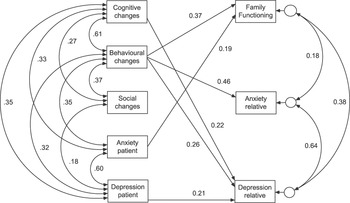
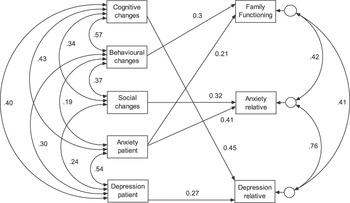
Final path model of the relationship between neurobehavioral problems, general family functioning, and relatives’ emotional state at two-year follow-up.
Standardized coefficients are shown; all coefficients are significant (p < .05).
Cognitive, behavioral, and social changes post-injury in the family member with TBI measured with the Structured Outcome Questionnaire; family functioning measured with the FAD-GF scale; presence of clinically relevant levels of anxiety and depression (score > 7) in the patient measured with the HADS; presence of clinically relevant levels of anxiety and depression (score > 7) in the relative measured with the HADS.

RESULTS
At two-year follow-up, the relatives reported on average 4.3 (out of a maximum of 6; SD = 2.0) cognitive changes on the SOQ, as well as 1.3 (SD = 1.1) out of 3 behavioral changes, 1.1 (SD = 0.6) out of 2 social changes, and 1.4 (SD = 0.8) out of 2 mood changes. These numbers remained unchanged at five-year follow-up (Mann-Whitney U-tests; all p > .05), On the CHART, at two-year follow-up, participants with a TBI had a mean score of 94.9 (SD = 16.4) on the Physical Independence scale, 76.6 (SD = 26.1) on the Cognitive Independence scale, 89.8 (SD = 16.21) on the Mobility scale, 68.7 (SD = 34.8) on the Occupational scale, and 81.4 (SD = 24.0) on the Social Integration scale. At five-year follow-up, participants’ score on the CHART Cognitive Independence Scale and on the Mobility scale had increased (Mann-Whitney U-tests; both p < .05), but scores on none of the other scales (p > .05) had significantly increased.
Fifty-three percent of the TBI participants reported clinically significant symptoms of anxiety at two-year follow-up and 45% reported clinically significant depression symptoms. Similarly, at five-year follow-up, 49% and 44% reported at least a mild level of anxiety and depression, respectively (no significant change over time; McNemar tests, p > .05). With regard to the relatives, 47% showed clinically significant anxiety symptoms and 27% showed depression at two-year follow-up. At five-year follow-up, there was a nonsignificant trend towards a lower, but still high, number of relatives with significant anxiety (35%) and depression symptoms (19%; no significant change over time; McNemar tests, p > .05). These proportions are very high compared with the general population.
We examined the impact of the severity of the injured family member’s TBI on his/her functional status, as well as on family functioning and relatives’ report of anxiety and depression symptoms. In brief, a long duration of PTA was weakly, but significantly, associated with more behavioral, cognitive, social, and emotional changes in the injured individual, as measured by the SOQ at two-year follow-up (Spearman’s ρ; all p < .001) and at five-year follow-up (Spearman’s ρ; all p < .05). A long PTA duration was also weakly associated with all CHART scales except the Social Integration scale at two-year follow-up, and with the Physical Independence Scale and the Occupation Scale at five-year follow-up (Spearman’s ρ; all p < .05). Low GCS scores were only weakly related to behavioral (Spearman’s ρ; p < .01) and social (Spearman’s ρ; p < .001) changes on the SQO at two-year follow-up, and with social changes only at five-year follow-up. Low GCS scores were also weakly associated with the CHART Occupational scale (p < .05) at two-year follow-up, but with none of the CHART scales at five-year follow-up (Spearman’s ρ; all p > .05).
Aim 1: Family Functioning and Emotional Status Two and Five Years Post-injury
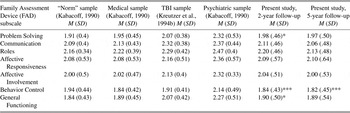
Table 2 shows the overall level of family functioning in the present study, alongside that found in other populations in previous studies. In comparison with a nonclinical sample studied by Kabacoff, Miller, Bishop, Epstein, & Keitner (Reference Kabacoff, Miller, Bishop, Epstein and Keitner1990), at two-year follow-up, families in the present study had significantly higher scores, indicating poorer family functioning, than the “Norm” sample on the FAD Problem Solving scale and the General Functioning scale, and lower scores on the Behavior Control scale, the latter indicating higher levels of behavioral control. There was no significant difference between the overall level of family functioning at two years and that measured at five-year follow-up (Student’s t tests for paired-samples; all p > .05). At five-year follow-up, families in the present study still scored significantly lower than the “Norm” sample on the Behavior Control scale, but the differences on the other scales were no longer significant.
Family functioning on the Family Assessment Device at 2- and 5-year follow-up, compared to other studies

Note
Single-sample t tests comparing the FAD scores in the present study to the “Norm” sample; ***p < .001, 2-tailed; *p < .05, 2-tailed.
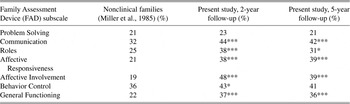
From Table 3 it can be seen that a significant proportion of families were scoring in the unhealthy range across all subscales. Comparison of the rates of those functioning in the unhealthy range with the normative “nonclinical” sample of Miller et al. (Reference Miller, Bishop, Epstein and Keitner1985) revealed a significantly higher percentage of families showing unhealthy functioning in the current sample on all subscales except the Problem-Solving Scale (χ2 tests; all p < .05). Comparison of the rates of families in the “unhealthy” range of the FAD scales (i.e. scores > 2) between two- and five-year follow-up, revealed a significant drop in the percentage of families experiencing problems with affective involvement at five-year follow-up (McNemar test, p < .05; Table 3), but no significant changes for any other FAD scales (McNemar tests, all p > .05).
Percentage of family members scoring in unhealthy range on FAD

Note
***p < .001, 2-tailed; *p < .05, 2-tailed; one-sample χ2 tests, comparing rates of unhealthy families in the current study to the rates in nonclinical families from Miller et al. (Reference Miller, Bishop, Epstein and Keitner1985).
Aim 2: Factors Predicting Poorer Family Functioning and Relatives’ Emotional Status
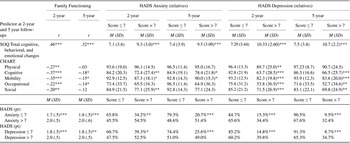
Bivariate statistical analyses revealed that poor family functioning at two-year follow-up was related to the number of cognitive, behavioral, and emotional changes in the brain-injured individual, as measured by the SOQ (all individual items, as well as the sum score), and to handicap on the CHART subscales (Spearman’s ρ; see Table 4). Poorer family functioning was also related to the presence of clinically significant anxiety and depression symptoms (HADS) in the brain-injured individual (Mann-Whitney U-tests; Table 4), as well as in the relatives (not shown in Table 4; Mann-Whitney U-tests; all p < .001). Also the presence of anxiety and depression symptoms in the relatives was related to cognitive, behavioral, and emotional changes in the brain-injured individual (SOQ; Spearman’s ρ), handicap on the CHART (Mann-Whitney U-tests), as well as to the presence of anxiety and depression (HADS) in the brain-injured individual (χ2 tests; see Table 4). A similar pattern of results emerged at five-year follow-up. However, the relationship between family functioning on the one hand and the brain-injured individual’s level of handicap, as measured on the CHART, was weaker (Table 4).
Prediction of general family functioning and relatives’ emotional distress

Note
Spearman’s correlations, Mann-Whitney U-tests, and χ2 tests; ***p < .001, 2-tailed; **p < .01, 2-tailed; *p < .05, 2-tailed. SOQ = Structured Outcome Questionnaire, CHART = Craig Handicap Assessment Reporting Technique, HADS = Hospital Anxiety and Depression Scale, pt = Patients.
Interestingly, although both the SOQ and the CHART were significantly related to severity of the injured family member’s TBI (PTA and GCS), general family functioning (FAD-GF) was not related to PTA or GCS at either of the follow-up time points (Spearman’s ρ; all p > .05). Relatives’ HADS ratings were not related to the injured individual’s GCS score. Relatives’ anxiety ratings were only very weakly related to the duration of the injured individual’s PTA (Spearman’s ρ = .13, p = .045) at two-year follow-up, but not at five-year follow-up (p > .05). Relatives’ HADS depression ratings were only very weakly related to PTA (Spearman’s ρ = .14, p = .03) at five-year follow-up, but not at two-year follow-up (p > .05).
Using path analysis, we then examined the relationships between the TBI individual’s neurobehavioral changes and emotional status, overall family functioning, and relatives’ emotional status in a comprehensive way. We tested the starting model, displayed in Figure 1, on the two-year follow-up data. In this model, we expected all variables to be related to all other variables. The model therefore had zero degrees of freedom. This meant that the overall model fit could not be determined for the starting model. The analysis revealed that in the model, apart from the HADS anxiety scale and the SOQ social changes, all SOQ and HADS (patient) subscales were significantly related to each other, and the HADS (relatives) subscales were significantly related to the FAD-GF scale. Family functioning (FAD-GF) was significantly predicted by behavioral changes and anxiety in the injured individual. Anxiety in the relatives was predicted by behavioral changes in the patient, and depression in the relatives was predicted by cognitive and behavioral changes in the patient (all p < .05). None of the other regression paths was significant.
We then modified the path model, removing one nonsignificant regression path at a time, starting with the weakest coefficient, until only significant paths and covariances were left in the model. The final model for the two-year follow-up is displayed in Figure 2. The model had an excellent overall fit (χ2 (7) = 4.61, p = 0.71; RMSEA < 0.001, CFI = 1.00). The pattern of covariances in this model was identical to the starting model. Again, family functioning was significantly predicted by behavioral changes and anxiety in the injured individual. Anxiety in the relatives was predicted by behavioral changes in the patient, and depression in the relatives was predicted by cognitive and behavioral changes in the patient, and also by symptoms of depression in the injured individual (all p < .05).
We then tested the modified path model on the five-year follow-up data. However, the final two-year follow-up model did not fit the five-year follow-up data (χ2 (7) = 36.09, p < .001; RMSEA = 0.13, CFI = .92), indicating that the pattern of predictors of family functioning and relatives’ distress had changed. Therefore, we modified the model, according to the modification indices provided by MPLUS and the significance level of the coefficients. The final model for the five-year follow-up data is displayed in Figure 3. The overall fit of this model was very good (χ2 (7) = 8.94, p = 0.26; RMSEA = 0.03, CFI = 0.99). The difference from the two-year follow-up model was that, in the five-year follow-up model, anxiety symptoms in the relatives were predicted by social changes and anxiety in the patients, and depressive symptoms in the relatives were not predicted by behavioral changes, but only by cognitive changes, as well as depressive symptoms in the individual with TBI.
Final path model of the relationship between neurobehavioral problems, general family functioning, and relatives’ emotional state at five-year follow-up.
Standardized coefficients are shown; all coefficients are significant (p < .05).
Cognitive, behavioral, and social changes post-injury in the family member with TBI measured with the Structured Outcome Questionnaire; family functioning measured with the FAD-GF scale; presence of clinically relevant levels of anxiety and depression (score > 7) in the patient measured with the HADS; presence of clinically relevant levels of anxiety and depression (score > 7) in the relative measured with the HADS.

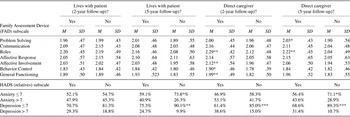
We examined the relationship between level of family functioning, relatives’ level of emotional distress, and relatives’ relationship to the brain-injured individual. Relatives who lived with the injured person reported higher levels of anxiety and depression symptoms at five-year follow-up (but not at two-year follow-up) than those who did not (Table 5). Relatives who were direct caregivers for the injured individual reported both a more unhealthy level of family functioning and higher levels of anxiety and depression at both two- and five-year follow-up (Table 5). Whether the relative was the injured individual’s parent or spouse did not have an impact on the relatives FAD and HADS ratings (Independent samples t tests; p > .05), apart from spouses reporting lower scores for the Behavior Control subscale of the FAD at five-year follow-up (p < .05), suggesting that more rules were used to control behavior in the family.
Relationship between FAD and relatives HADS ratings and relatives’ relation to the brain-injured individual

Note
Independent-samples t tests and χ2 tests; ***p < .001, 2-tailed; **p < .01, 2-tailed; *p < .05, 2-tailed. HADS = Hospital Anxiety and Depression Scale.
DISCUSSION
As in our previous study (Ponsford et al., Reference Ponsford, Olver, Ponsford and Nelms2003), it was apparent that, on average, these families of individuals with TBI who had received rehabilitation were in many respects functioning close to the nonclinical population, as the comparison with findings of Kabacoff et al. (Reference Kabacoff, Miller, Bishop, Epstein and Keitner1990) indicated. However, more than a third of families were functioning in the “unhealthy” range across most FAD subscales. Families appear, on average, to have adopted more rigid rules relating to behavior, perhaps in order to deal with behavioral changes in the injured relative. These findings are similar to those of an earlier study conducted by this group (Ponsford et al., Reference Ponsford, Olver, Ponsford and Nelms2003), based on a smaller sample. They extend the findings to a larger sample, but also examine family functioning at two separate time-points after injury, namely two and five years post-injury. This study found that there was little change in family functioning scores between those studied at two and those at five years post-injury, indicating that the impact of these injuries on families is of a long-term nature. Furthermore, the path analysis indicated that, even though the pattern of predictors may change over time, neurobehavioral changes in the patient have a long-term impact on family functioning and distress in relatives. This finding is in line with the results of Marsh et al. (Reference Marsh, Kersel, Havill and Sleigh2002) who also found that the impact of the injured family member’s cognitive and behavioral changes on the relatives’ level of distress is of a long-term nature.
Our findings indicate that behavioral changes in the injured individual tended to have the stronger impact on both family functioning and relatives’ emotional status at two-year follow-up. While behavioral changes continued to affect family functioning at five years post-injury, apparently resulting in ongoing adherence to rigid rules to control behavior, they were less likely to be associated with distress in relatives, perhaps because of these adjustments. On the other hand, relatives appeared to be more stressed by the social isolation and anxiety in their injured relative and more depressed as a result of the injured person’s cognitive changes at this longer time after injury, perhaps having a better understanding of their long-term negative impact. These analyses have thus made it possible to explore the evolution of sources of distress in relatives over extended periods of time after injury. Anderson et al. (Reference Anderson, Parmenter and Mok2002) also found in their path analysis that behavioral changes in the TBI individual were the strongest predictors of poor family functioning. However, Anderson et al. did not include emotional changes in the patient in the path analysis and assumed a causal influence of family functioning on relatives’ emotional distress. Therefore, their findings cannot be directly compared with the findings of the present study.
Our findings highlight the importance of rehabilitation efforts focusing on behavioral control and cognitive impairments in individuals with TBI, and assisting relatives in learning to cope with challenging behavior and cognitive and emotional changes in the injured person, and to find social outlets for the injured person and for themselves. Furthermore, the long-term presence of anxiety and depression symptoms in the injured individual and their apparent association with relatives’ mood and (indirectly) family functioning even five years after the injury indicate the importance of developing effective interventions for anxiety and depression after TBI. Our finding that relatives who are in a direct caregiving role appear to be at particular increased risk for emotional distress is consistent with findings from another study by Gan et al. (Reference Gan, Campbell, Gemeinhardt and McFadden2006). This indicates the need to provide greatest support to caregivers, who are more directly and frequently having to deal with the consequences of the brain injury.
While many relatives may be affected by a brain injury (Perlesz et al., Reference Perlesz, Kinsella and Crowe2000) where resources are limited, it would appear that direct caregivers are the most important recipients of family interventions, such as education and support groups. These might provide information about how to cope with cognitive and behavioral problems, equip caregivers with coping and problem-solving strategies, and provide them with opportunities for sharing their experiences with others in a similar situation. Further research is required to establish the most appropriate form of such interventions. Findings of a study by Singer and colleagues (Singer et al., Reference Singer, Glang, Nixon, Cooley, Kerns and Williams1994) suggested that such groups may have a greater impact on levels of anxiety and depression in relatives if they include psychoeducation and group sharing regarding coping strategies, rather than just informational support. Carnevale, Anselmi, Busichio, & Millis (Reference Carnevale, Anselmi, Busichio and Millis2002) compared education alone with education combined with education in behavior management on the premise that the latter might be more effective in reducing carer burden, but unfortunately found no significant group differences on the measures used. Rivera, Elliott, Berry, & Grant (Reference Rivera, Elliott, Berry and Grant2008) found that problem-solving training provided in the home reduced depression and health complaints and dysfunctional problem-solving styles in family caregivers of people with TBI relative to general education. Multiple family group interventions, which have a strong psychoeducational and problem-solving focus, have been shown to reduce depression and anger and increase life satisfaction in caregivers of individuals with TBI and spinal cord injury (Rodgers et al., Reference Rodgers, Strode, Norell, Short, Dyck and Becker2007). Family therapy may also be used to support families in adjusting to injury-related changes and redefining family roles (Perlesz, Furlong, & McLachland, Reference Perlesz, Furlong, McLachland, Harris, Burns and Rees1989; Perlesz et al., Reference Perlesz, Kinsella and Crowe1999).
Comparisons with other studies examining family functioning after TBI must be tempered by the possibility that sampling differences, cultural, or other factors may have influenced responses to the scales used. The families in the present study had all had access to rehabilitation and other support services within the context of a no-fault accident compensation system. Although the sample comprised individuals with a broad range of injury severity, they would not necessarily represent those at the milder end of the spectrum, or the most severe cases who are not referred for rehabilitation, or those that did not have access to rehabilitation. Sander et al. (Reference Sander, Sherer, Malec, High, Thompson and Moessner2003) found that a substantial proportion (37%) of caregivers reported emotional distress and 25–35% reported unhealthy pre-injury family functioning before the injury. This study did not include any pre-injury measures, and, as such, one cannot rule out the possible presence of pre-existing vulnerabilities in these people. The possibility of a response bias also cannot be ruled out, because most measures were subjectively rated by either the patients or their relatives. It is therefore possible that response tendencies led to correlations between the constructs under investigation. The families in the present study had access to support services free of charge within the context of a no-fault accident compensation system, designed to minimize litigation. Reports of difficulty are unlikely to have been motivated by attempts to gain financial compensation. One cannot rule out the possibility that they were motivated by a desire for more rehabilitative assistance, however.
Overall, these findings are consistent with those of previous studies (Anderson et al., Reference Anderson, Parmenter and Mok2002; Ergh et al., Reference Ergh, Rapport, Coleman and Hanks2002; Hall et al., Reference Hall, Karzmark, Stevens, Englander, O’Hare and Wright1994; Kreutzer et al., Reference Kreutzer, Gervasio and Camplair1994a, Reference Kreutzer, Gervasio and Camplair1994b; Machamer et al., Reference Machamer, Temkin and Dikmen2002; Oddy et al., Reference Oddy, Humphrey and Uttley1978; Ponsford et al., Reference Ponsford, Olver, Ponsford and Nelms2003; Testa et al., Reference Testa, Malec, Moessner and Browt2006) and highlight the importance of providing long-term support and practical assistance to those family members who struggle to adjust to the consequences of their relative’s brain injury.
ACKNOWLEDGMENTS
Funding for this study came from the Victorian Transport Accident Commission and the Victorian Neurotrauma Initiative. The authors have no conflict of interest.