
1. Introduction
A film coating inside a tube has received long-standing attention from various concerns of scientific investigation. For engineering processes, water-lubricated transport of oil (Joseph et al. Reference Joseph, Bai, Chen and Renardy1997), film condensation for heat exchange (Dalkilic & Wongwises Reference Dalkilic and Wongwises2009) and lab-on-a-chip microfluidics (Stone, Stroock & Ajdari Reference Stone, Stroock and Ajdari2004) are typical applications of this phenomenon. In pathological investigations, the film flow is also of great significance. Surface tension may drive the film inside the pulmonary airways to form plugs and lead to the closure of the airway (Grotberg Reference Grotberg2001), which is the typical symptom of respiratory distress syndrome.
Such flow is susceptible to Rayleigh–Plateau instability. Rayleigh (Reference Rayleigh1892) demonstrated that when the wavelength of an initial perturbation exceeds the circumference of the core, surface tension will break the core into pockets. Goren (Reference Goren1962) first investigated the linear instability of such films in the absence of base flow. It was found that the Rayleigh–Plateau instability can initiate a mode with the largest growth rate and lead to the formation of plugs. Hammond (Reference Hammond1983) studied the instability of such films via lubrication theory. A nonlinear equation for the evolution of the interface was derived, and it was found that small axisymmetric perturbations with sufficiently long wavelength could destabilize the film. Similar results can also be observed when the film is subject to gravity. Hasegawa & Nakaya (Reference Hasegawa and Nakaya1970) and Krantz & Zollars (Reference Krantz and Zollars1976) solved the Orr–Sommerfeld equation of the problem separately. Their results demonstrated that compared with the planar case, the instability of the film coating inside a tube is intensified by capillary force arising from circumferential curvature. Camassa, Ogrosky & Olander (Reference Camassa, Ogrosky and Olander2014) formulated long-wave asymptotic models for the problem and proposed that absolute instability can be a criterion for plug formation. Camassa, Ogrosky & Olander (Reference Camassa, Ogrosky and Olander2017) later considered the effect of the core flow by a local Poiseuille approach.
A common practice in most applications is to use surfactant to alleviate the surface tension and modulate the dynamics of the interface. The inhomogeneous distribution of surfactant will give rise to a gradient of the surface tension, i.e. the Marangoni force, along the interface. For a quiescent film contaminated with insoluble surfactant, plug formation in both compliant and rigid airways was studied by Halpern & Grotberg (Reference Halpern and Grotberg1993) and Otis et al. (Reference Otis, Johnson, Pedley and Kamm1993), respectively. They showed that the Marangoni force pulls fluid into the regions where the film is thin. This retards closure of the airway and enhances the stability of the film. Kwak & Pozrikidis (Reference Kwak and Pozrikidis2001) reached the same conclusion by conducting an investigation of the instability of a liquid thread and an annular layer. Two modes of the problem are identified: one is permanently stable and the other is unstable when the wavelength of the perturbation exceeds the circumference of the unperturbed interface.
However, the situation becomes intricate in the presence of base flow. The surfactant will be redistributed due to the advection of the base flow, which may reshape the influence of the Marangoni force. This, in turn, affects the base flow itself and brings complex dynamics to the film. Frenkel & Halpern (Reference Frenkel and Halpern2002) and Halpern & Frenkel (Reference Halpern and Frenkel2003) reported that insoluble surfactant can trigger the non-inertial instability of a two-layer shear flow, even if it is stable in the quiescent case. This is attributed to the fact that the base flow shifts the phase between the perturbation of the surfactant and the interfacial deflection to make them out of phase. This induces the Marangoni force to drive the flow from the interfacial trough to the interfacial crest and destabilizes the film. This instability was later confirmed by Blyth & Pozrikidis (Reference Blyth and Pozrikidis2004) using a lubrication model. They also investigated the nonlinear saturation of the instability and the nonlinear dynamics of the wave. A similar case in core–annular flow was investigated by Wei & Rumschitzki (Reference Wei and Rumschitzki2005) and Wei (Reference Wei2005). They found that the base flow accumulates insoluble surfactant at the place where the annulus is thin. They also reported the non-monotonic influence of the Marangoni number, which is expected to induce maximum instability at an intermediate magnitude. Via a normal-mode linear instability analysis, Blyth, Luo & Pozrikidis (Reference Blyth, Luo and Pozrikidis2006) identified the dominant modes of the problem, i.e. the interface mode and the surfactant mode, in the context of Stokes flow. They found that the interface mode is responsible for the flow instability. Zhou et al. (Reference Zhou, Peng, Zhang and Zhuge2014) studied the linear instability of core–annular and viscoelastic film with insoluble surfactant. The film is subject to an axial body force (e.g. gravity), and the effect of the air core is simplified to a constant shear. Their results showed that various base flows by arbitrary combinations of gravity and shear can induce complex dynamics, including stabilization, destabilization at long wavelength and destabilization at finite wavelength. Recently, based on the model of Camassa et al. (Reference Camassa, Ogrosky and Olander2017), Ogrosky (Reference Ogrosky2021) investigated in depth a similar formulation in the background of pulmonary flow.
Generally, surfactant is more or less soluble. Solubility, sorption kinetics and bulk diffusivity of surfactant are also important factors influencing surfactant dynamics. Adsorption/desorption of surfactant at the interface can modulate the Marangoni force and thereby influence flow instability. It was commonly believed that mass exchange between the surface surfactant and the bulk surfactant can alleviate the interfacial gradient of the surfactant. The investigation of a film down an inclined plane (Karapetsas & Bontozoglou Reference Karapetsas and Bontozoglou2013, Reference Karapetsas and Bontozoglou2014) well supports the idea. The presence of solubility has been found to attenuate the stabilizing effect of the Marangoni force, thereby aggravating the instability of the film. This is due to the fact that the surfactant flux from the bulk to the interface is nearly  $90^{\circ }$ out of phase with interfacial deflection; this helps the advection of surfactant perturbation by the base flow to counter the advective transport by flow perturbation and thus reduces the interfacial gradient of the surfactant. D'Alessio et al. (Reference D'Alessio, Pascal, Ellaban and Ruyer-Quil2020) considered both the solutocapillary effect of soluble surfactant and the thermocapillary effect, and reached the same conclusion. Kalogirou & Blyth (Reference Kalogirou and Blyth2019, Reference Kalogirou and Blyth2020, Reference Kalogirou and Blyth2021) investigated a two-layer shear flow with soluble surfactant dissolving in the lower layer. They reported that solubility and sorption kinetics could influence interfacial dynamics and the effect of soluble surfactant on the instability could be either stabilizing or destabilizing. They also noticed that mass exchange of surfactant could strengthen the perturbation of surface surfactant in a certain range of solubility or viscosity ratio.
The presence of soluble surfactant is not rare in investigations involving core–annular flow. Campana & Saita (Reference Campana and Saita2006) studied plug formation in airways and found the closure time decreased with an increase of surfactant solubility. Their results indicate that the ability of a surfactant to suppress the Rayleigh instability is diminished by solubility. Muradoglu et al. (Reference Muradoglu, Romanò, Fujioka and Grotberg2019) investigated the propagation and rupture of a liquid plug with soluble surfactant. They found that it is necessary to consider surfactant solubility in core–annular flow, for soluble surfactant can avoid excessive accumulation of the surfactant at the interface and lead to a better estimation of mechanical stress and rupture time. Romanò, Muradoglu & Grotberg (Reference Romanò, Muradoglu and Grotberg2022) investigated the role of soluble surfactant in a nonlinear airway closure model. Regarding the parameters they adopted, they found that the parameters relating to solubility had little effect on airway closure. Craster, Matar & Papageorgiou (Reference Craster, Matar and Papageorgiou2009) studied a jet laden with soluble surfactant. They found that solubility will weaken the Marangoni force, accelerate the breakup of the jet and lead to the formation of large drops. While previous investigations mainly focused on the nonlinear dynamics of the flow, a fundamental understanding of the effect of soluble surfactant has not been well established. This motivates our investigation of the linear instability of a film with soluble surfactant coating inside a tube. Our investigation encompasses the influence of surfactant solubility, sorption kinetics and bulk diffusivity of the soluble surfactant. We discuss a quiescent film and a flowing film driven by an axial body force and an interfacial shearing force. The mechanism of how soluble surfactant influences interfacial dynamics is discussed.
In this study, the linear instability analysis is carried out under the temporal framework, which is generally adopted in previous literature (Camassa et al. Reference Camassa, Ogrosky and Olander2014; Ogrosky Reference Ogrosky2021; Jain, Sharma & Das Reference Jain, Sharma and Das2022). It provides valuable insights into the long-time behaviour of film flow and helps us understand the impact of soluble surfactant on linear instability. By solving a linear eigenvalue problem, we can easily determine the temporal growth rates of the perturbations, which can serve as a foundation for conducting in-depth analysis of the instability of the film flow. Since the growth rates of the perturbation for the film flow are small (Brevdo et al. Reference Brevdo, Laure, Dias and Bridges1999), the spatial instability can also be revealed through Gaster transformation (Gaster Reference Gaster1962) or Taylor expansion (Xu et al. Reference Xu, Liu, Zhang and Wu2023). The remaining content of this paper is arranged as follows. In § 2, the physical description and mathematical formulation of the problem are introduced. The linearized model is derived by a normal-mode analysis. In § 3, a long-wave approximation analysis is performed and the most dangerous modes, the interface mode and the surfactant mode, are investigated. In § 4, numerical results for the perturbations with finite wavelength are presented. Finally, conclusions are given in § 5.
2. Problem formulation
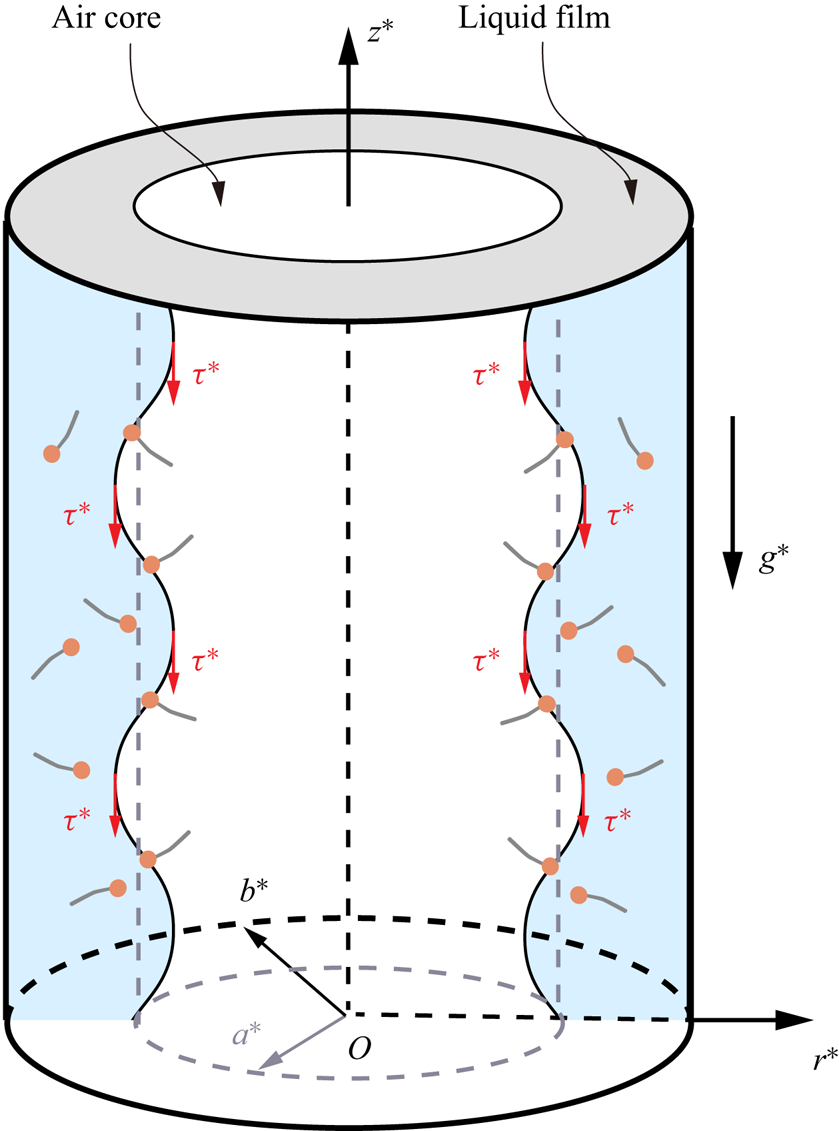
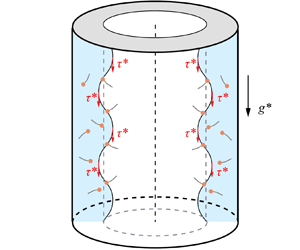
We investigate a film coating inside a rigid tube in the presence of soluble surfactant, as depicted in figure 1. It occupies an annular region between an air core with  $r^{\ast } = a^{\ast }$ and a rigid tube wall with
 $r^{\ast } = b^{\ast }$. The liquid–air interface is initially flat and evolves spatially and temporally with its radius denoted by
 $\eta ^{\ast }(z^{\ast },t^{\ast })$. The film is considered to be incompressible and Newtonian, with constant density
 $\rho ^{\ast }$ and viscosity
 $\mu ^{\ast }$. It is driven by an axial body force
 $g^{\ast }$ and an interfacial shearing stress
 $\tau ^{\ast }$ exerted by the airflow. The surfactant is assumed to reside both at the liquid–air interface and in the liquid bulk with different diffusivities
 $\mathscr {D}_{s}^{\ast }$ and
 $\mathscr {D}_{b}^{\ast }$, which are referred to as surface surfactant and bulk surfactant. Corresponding concentrations of the surface surfactant and the bulk surfactant are denoted by
 $\varGamma ^{\ast }(z^{\ast },t^{\ast })$ and
 $C^{\ast }(r^{\ast }z^{\ast },t^{\ast })$, respectively. The surfactant can be adsorbed by or desorbed from the liquid–air interface with adsorption kinetic rate
 $k^{\ast }_{a}$ or desorption kinetic rate
 $k^{\ast }_{d}$.
The geometry of a liquid film with soluble surfactant flowing down a tube with an interfacial shearing stress. The grey dashed lines denote the radius of the unperturbed interface.

For the sake of brevity, we present the model in dimensionless form directly by using the following scales:
 \begin{equation} \left.\begin{gathered} t = \frac{t^{{\ast}}}{b^{{\ast}}/U_{0}^{{\ast}}},\quad \left\{r, z\right\} = \frac{1}{b^{{\ast}}}\left\{r^{{\ast}}, z^{{\ast}}\right\},\quad \left\{u, \omega\right\} = \frac{1}{U^{{\ast}}_{0}}\left\{u^{{\ast}},\omega^{{\ast}}\right\},\\ \left\{p,\tau\right\} = \frac{1}{\gamma_{0}^{{\ast}}/b^{{\ast}}}\left\{p^{{\ast}}, \tau^{{\ast}}\right\},\quad \varGamma = \varGamma^{{\ast}}/\varGamma^{{\ast}}_{\infty},\quad C = C^{{\ast}}/C^{{\ast}}_{CMC}. \end{gathered}\right\} \end{equation}
Here,  $\gamma _{0}^{\ast }$ is the surface tension of the clean interface,
 $b^{\ast }$ and
 $\gamma _{0}^{\ast }/b^{\ast }$ are the characteristic length and pressure/stress, respectively,
 $U^{\ast }_{0}=\gamma _{0}^{\ast }/\mu ^{\ast }$ is the characteristic velocity,
 $\varGamma ^{\ast }_{\infty }$ denotes the maximum packing concentration of the surfactant at the liquid–air interface and
 $C_{CMC}^{\ast }$ is the critical micelle concentration of the bulk surfactant, above which the bulk surfactant will aggregate into micelles.
2.1. Governing equations and base flow
The film flow is governed by the continuity equation and Navier–Stokes equations:
 $$\begin{gather} \frac{1}{r}\frac{\partial \left(ru\right)}{\partial r}+\frac{\partial\omega}{\partial z}=0, \end{gather}$$
 $$\begin{gather}Re\left(\frac{\partial u}{\partial t}+u\frac{\partial u}{\partial r}+\omega \frac{\partial u}{\partial z}\right)={-}\frac{\partial p}{\partial r}+ \left[\frac{1}{r}\frac{\partial}{\partial r}\left(\frac{r\partial u}{\partial r}\right)+ \frac{\partial^{2} u}{\partial z^{2}}-\frac{u}{r^{2}}\right], \end{gather}$$
 $$\begin{gather}Re\left(\frac{\partial \omega}{\partial t}+u\frac{\partial \omega}{\partial r}+ \omega\frac{\partial \omega}{\partial z}\right)={-}\frac{\partial p}{\partial z}+ \left[\frac{1}{r}\frac{\partial}{\partial r}\left(\frac{r\partial \omega}{\partial r}\right)+ \frac{\partial^{2} \omega}{\partial z^{2}} \right]-Bo. \end{gather}$$
Here,  $u$ represents the radial velocity,
 $\omega$ denotes the axial velocity,
 $Re =\rho ^{\ast }b^{\ast }U_{0}^{\ast }/\mu ^{\ast }$ is the Reynolds number and
 $Bo = \rho ^{\ast }g^{\ast }\left.b^{\ast }\right.^{2}/\gamma _{0}^{\ast }$ is the Bond number, which measures gravity or any other axial body force alike. A film with axisymmetric flow is considered since the axisymmetric perturbations give rise to the most dangerous modes for both clean (Hu & Patankar Reference Hu and Patankar1995) and contaminated (Blyth & Bassom Reference Blyth and Bassom2013) liquid–air interfaces.
The boundary conditions at the liquid–air interface  $r=\eta (z,t)$, including the kinematic condition, the balance of the normal and tangential stresses, can be expressed as
 $$\begin{gather} u=\frac{\partial\eta}{\partial t}+\omega\frac{\partial\eta}{\partial z}, \end{gather}$$
 $$\begin{gather}\sigma_{rr}-2\frac{\partial\eta}{\partial z}\sigma_{rz}+ \left(\frac{\partial\eta}{\partial z}\right)^{2}\sigma_{zz}=\Delta_{\eta}^{2}\left[\left(p-p_{in}\right)+2\gamma\kappa\right], \end{gather}$$
 $$\begin{gather}\frac{\partial\eta}{\partial z}\left(\sigma_{rr}-\sigma_{zz}\right)+\left(2-\Delta_{\eta}^{2}\right) \sigma_{rz}={-}\Delta^{2}_{\eta}\tau-\Delta_{\eta}\frac{\partial\gamma}{\partial z}, \end{gather}$$
where  $\kappa$ is the mean curvature:
 \begin{equation} \kappa =\frac{1}{2}\left(\frac{1}{\eta\Delta_{\eta}}-\frac{1}{\Delta_{\eta}^{3}} \frac{\partial^{2}\eta}{\partial z^{2}}\right), \end{equation}
with 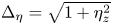 $\Delta _{\eta }=\sqrt {1+\eta _{z}^{2}}$. Parameter
 $\gamma$ is the surface tension, which depends on the concentration of the surface surfactant and can be expressed as
 \begin{equation} \gamma=1 + Ma\ln\left(1-\varGamma\right). \end{equation}
Here,  $Ma = RT^{\ast }\varGamma ^{\ast }_{\infty }/\gamma _{0}^{\ast }$ is the Marangoni number. Parameter
 $p_{in}$ denotes the pressure of the air core and
 $\tau$ measures the mean interfacial shearing force exerted by the air flow. In this study, we mainly try to uncover the effect of soluble surfactant on the liquid film instability in the presence of base flow. For simplification, the flow of the liquid film and the air core are fully decoupled. The influence of the air core on the film dynamics is included by considering the pressure outside the liquid film and the interfacial shearing stress. The effect of the liquid film flow on the dynamics of the air core is ignored since the liquid thickness is small. Therefore, both the pressure
 $p_{in}$ and the shearing stress
 $\tau$ on the liquid–air interface are assumed to be constant, which can be treated as a low-order approximation. Similar treatment can also be found in previous literature (Wei Reference Wei2005; Samanta Reference Samanta2014; Zhou et al. Reference Zhou, Peng, Zhang and Zhuge2014). The expressions of
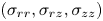 $(\sigma _{rr},\sigma _{rz},\sigma _{zz})$ are
 \begin{equation} \sigma_{rr} = 2\frac{\partial u}{\partial r},\quad \sigma_{rz} = \frac{\partial w}{\partial r} + \frac{\partial u}{\partial z},\quad \sigma_{zz} = 2\frac{\partial w}{\partial z}. \end{equation}
At the tube wall  $r=1$, the no-slip condition is imposed:
 \begin{equation} u\left(1\right)=0,\quad \omega\left(1\right)=0.\end{equation}
The advection–diffusion equation of the surfactant in the bulk can be expressed as
 \begin{equation} \frac{\partial C}{\partial t}+u\frac{\partial C}{\partial r}+\omega \frac{\partial C}{\partial z}=\frac{1}{Pe_{b}} \left(\frac{1}{r}\frac{\partial}{\partial r}\frac{r\partial C}{\partial r} +\frac{\partial^{2}C}{\partial z^{2}}\right). \end{equation}
Here,  $Pe_{b} = U_{0}^{\ast }b^{\ast }/\mathscr {D}_{b}^{\ast }$ is the Péclect number of the bulk surfactant. It signifies the relative importance of the molecular diffusivity of the bulk surfactant compared with the advective transport. The transport equation of the surface surfactant is derived based on the corresponding expression for insoluble surfactant (Peng & Zhu Reference Peng and Zhu2010; Zhou et al. Reference Zhou, Peng, Zhang and Zhuge2014; Ogrosky Reference Ogrosky2021), which reads
 \begin{equation} \frac{\partial}{\partial t}\left(\eta\Delta_{\eta}\varGamma\right)+ \frac{\partial}{\partial z}\left(\omega \eta\Delta_{\eta}\varGamma\right)=\frac{1}{Pe_{s}}\frac{\partial}{\partial z} \left(\frac{\eta}{\Delta_{\eta}}\frac{\partial \varGamma}{\partial z}\right)+\eta\Delta_{\eta} J_{b}. \end{equation}
Here,  $Pe_{s}=U_{0}^{\ast }b^{\ast }/\mathscr {D}_{s}^{\ast }$ is the Péclect number of the surface surfactant. It should be noted that (2.9) is essentially equivalent to that proposed by Stone (Reference Stone1990) and Wong, Rumschitzki & Maldarelli (Reference Wong, Rumschitzki and Maldarelli1996). The mass exchange of the surfactant between the bulk and the interface is described by a source
 $J_{b}$, which indicates the surfactant flux from the bulk to the interface. It can be given according to the Langmuir isotherm (Edwards, Brenner & Wasan Reference Edwards, Brenner and Wasan1991):
 \begin{equation} J_{b}=Bi\left[K_{b}C\left(1-\varGamma\right)-\varGamma\right]. \end{equation}
Here,  $Bi=b^{\ast }k_{d}^{\ast }/U^{\ast }_{0}$ is the Biot number, which is the ratio between the characteristic time scale of the film flow
 $b^{\ast }/U^{\ast }_{0}$ and the time scale for desorption
 $(k^{\ast }_{d})^{-1}$ (Booty & Siegel Reference Booty and Siegel2010). It measures the sorption kinetics of the surfactant. When
 $Bi\ll 1$, desorption of the surface surfactant from the liquid–air interface is suppressed. This tends to reduce the problem to the situation with insoluble surfactant. Parameter
 $K_{b}=k^{\ast }_{a}C_{CMC}^{\ast }/k_{d}^{\ast }\varGamma _{\infty }^{\ast }$ is the ratio between the adsorption and desorption strength of the surfactant, which denotes the surfactant's affinity to the interface (Craster et al. Reference Craster, Matar and Papageorgiou2009). It is clear that the solubility of the surfactant becomes weak as
 $K_{b}$ increases. Following Fick's law, the boundary condition of the bulk surfactant at the liquid–air interface is
 \begin{equation} \frac{\partial C}{\partial r}-\frac{\partial \eta}{\partial z} \frac{\partial C}{\partial z}=\Delta_{\eta}Pe_{b}\beta J_{b}. \end{equation}
Here,  $\beta =\varGamma _{\infty }^{\ast }/b^{\ast }C_{CMC}^{\ast }$ indicates the ratio between the surfactant capacity of the film interface and that of the bulk. As
 $\beta$ increases, more surfactant is located on the film interface. As a result, it is equivalent to weakening the solubility of the surfactant. It is worth noting that
 $K_{b}$ and
 $\beta$ exhibit almost the same influence on the solubility. The product
 $R_{b}=\beta K_{b}$ is more indicative to describe the surfactant solubility (Karapetsas & Bontozoglou Reference Karapetsas and Bontozoglou2013; Kalogirou & Blyth Reference Kalogirou and Blyth2019). The surfactant is highly soluble with
 $R_{b}\ll 1$, whereas it is sparingly soluble with
 $R_{b}\gg 1$. At the tube wall
 $r = 1$, it is assumed that no bulk surfactant is absorbed. The corresponding boundary condition can be expressed as
 \begin{equation} \frac{\partial C}{\partial r}=0. \end{equation}
In this study, we are concerned with the linear instability of a liquid film driven by an axial body force and an interfacial shearing stress, which is assumed to be of annular geometry with  $\bar {\eta }=a$. Corresponding solution of the base flow is
 \begin{equation} \bar{u}\left(r\right) = 0,\quad \bar{\omega}\left(r\right) =\frac{Bo}{4}(1-r^{2}+2a^{2}\ln r)- a\tau \ln r,\quad \bar{p} =p_{in} - \frac{\bar{\gamma}}{a}, \end{equation}
where an overbar is used to denote the base flow. Here  $\bar {\gamma }$ is given by
 $1+ Ma\ln (1-\bar {\varGamma })$, where
 $\bar {\varGamma }$ is the uniform concentration of the surface surfactant for the base flow, which is called uniform base level concentration. At this moment, the surface surfactant
 $\bar {\varGamma }$ and the bulk surfactant
 $\bar {C}$ are in equilibrium with
 $\bar {J}_{b}=0$, and (2.10) yields the following relation:
 \begin{equation} \bar{C} = \frac{\bar{\varGamma}}{K_{b}\left(1-\bar{\varGamma}\right)}. \end{equation}
It should be pointed out that when  $\bar {C}>1$, the bulk surfactant will form micelles. However, in this study, we only consider the situation where
 $\bar {C}<1$, which allows us to focus on the specific properties of the soluble surfactant, i.e. solubility, sorption kinetics and bulk diffusivity.
2.2. Formulation of the linear instability problem
A standard normal-mode method is adopted to investigate the linear instability of the system. An infinitesimal perturbation 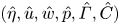 $(\hat {\eta },\hat {u},\hat {w},\hat {p},\hat {\varGamma },\hat {C})$ is applied to the base flow. Accordingly, we assume that
 \begin{align} & \left\{\eta\left(z,t\right),u\left(r,z,t\right),\omega\left(r,z,t\right),p\left(r,z,t\right), \varGamma\left(z,t\right),C\left(r,z,t\right)\right\} \nonumber\\ &\quad =\left\{a,0,\bar{\omega}\left(r\right),\bar{p},\bar{\varGamma},\bar{C}\right\} +\left\{\hat{\eta},\hat{u}\left(r\right),\hat{\omega}\left(r\right),\hat{p}\left(r\right), \hat{\varGamma},\hat{C}\left(r\right)\right\} \exp\left({\mathrm{i} k\left( z - c t \right)}\right) + {\rm c.c.}, \end{align}
where  $k$ is the real wavenumber and
 $c$ is the complex wave celerity. Corresponding linearized governing equations of the film flow and the bulk surfactant yield
 $$\begin{gather} \mathrm{D} \hat{u}\left(r\right)+\frac{\hat{u}\left(r\right)}{r}+\mathrm{i} k \hat{\omega}\left(r\right)=0, \end{gather}$$
 $$\begin{gather}\left(\nabla^{2}-k^{2}-r^{{-}2}\right)\hat{u}\left(r\right)=\mathrm{D} \hat{p}\left(r\right), \end{gather}$$
 $$\begin{gather}\left(\nabla^{2}-k^{2}\right)\hat{\omega}\left(r\right)=\mathrm{i} k \hat{p}\left(r\right), \end{gather}$$
 $$\begin{gather}\left(\nabla^{2}-k^{2}\right)\hat{C}\left(r\right) =\mathrm{i} kPe_{b}\left(\bar{\omega}-c\right)\hat{C}\left(r\right), \end{gather}$$
where  $\mathrm {D}=\mathrm {d}/\mathrm {d} r$ and
 $\nabla ^{2} = \mathrm {D}^{2}+\mathrm {D}/r$. Here, the fluid inertia is ignored by setting
 $Re= 0$, which is feasible for film flow with a relatively small velocity. Linearizing the boundary conditions at the liquid–air interface
 $r=a$, we obtain
 $$\begin{gather} \hat{u}=\mathrm{i} k \left(\bar{\omega}-c\right)\hat{\eta}, \end{gather}$$
 $$\begin{gather}\hat{p}- \bar{\gamma}\left(a^{{-}2}-k^{2}\right)\hat{\eta}+2\left(\mathrm{i} k \mathrm{D} \bar{\omega} \hat{\eta} -\mathrm{D} \hat{u}\right) =\frac{Ma}{a\left(1-\bar{\varGamma}\right)}\hat{\varGamma}, \end{gather}$$
 $$\begin{gather}\mathrm{i} k \hat{u}+\mathrm{D} \hat{\omega}+\mathrm{D}^{2}\bar{\omega}\hat{\eta} =\mathrm{i} k \frac{Ma}{1-\bar{\varGamma}}\hat{\varGamma}, \end{gather}$$
 $$\begin{gather}\mathrm{D}\hat{C}\left(a\right)=Pe_{b}\beta_{b}\hat{J}_{b}, \end{gather}$$
 $$\begin{gather}\hat{J}_{b}=BiK_{b}\left(1-\bar{\varGamma}\right)\hat{C} -Bi\left(K_{b}\bar{C}+1\right)\hat{\varGamma}. \end{gather}$$
The linearized form of the surface surfactant transport equation (2.9) can be written as
 \begin{equation} -\mathrm{i} kc\hat{\varGamma} = \hat{J}_{b}+SF^{\left(dif\right)}- SF^{\left(adv\right)}-SF^{\left(per\right)}. \end{equation}
Here,  $SF^{(dif)}=-k^{2}/Pe_{s}\hat {\varGamma }$ is produced by the diffusion of the surface surfactant,
 $SF^{(adv)} = \mathrm {i} k \bar {\omega }(a)\hat {\varGamma }$ represents the transport of the surface surfactant perturbation due to the base flow and
 $SF^{(per)} = \bar {\varGamma }\hat {u}(a)/a+\mathrm {i} k\bar {\varGamma }[\hat {\omega }(a)+\mathrm {D}\bar {\omega } (a)\hat {\eta }]$ stands for advective transport of the surface surfactant by the perturbed flow. Combined with (2.15), it is clear that as
 $\textrm {Re}(\hat {J}_{b}\exp ({\mathrm {i} k( z - c t )}))>0$, the surfactant is absorbed from the bulk to the interface and the concentration of the surface surfactant is increased; the opposite holds when
 $\textrm {Re}(\hat {J}_{b}\exp ({\mathrm {i} k( z - c t )}))<0$. Furthermore, according to (2.18), it is obvious that
 $\textrm {Re}(SF^{(dif)}\exp ({\mathrm {i} k( z - c t )}))>0$ corresponds to the accumulation of the surface surfactant whereas
 $\textrm {Re}(SF^{(dif)}\exp ({\mathrm {i} k( z - c t )}))<0$ corresponds to the depletion of the surface surfactant. Similarly, for
 $SF^{(adv)}\exp ({\mathrm {i} k( z - c t )})$ and
 $SF^{(per)}\exp ({\mathrm {i} k( z - c t )})$, when the real parts of these two terms are positive, they tend to produce net efflux of the surface surfactant and decrease the concentration of the surface surfactant. When they are negative, the effects are reversed.
The boundary condition at the tube wall  $r=1$ can be linearized as
 \begin{equation} \hat{u}\left(1\right)=0,\quad\hat{\omega}\left(1\right)=0,\quad \mathrm{D}\hat{C}\left(1\right)=0. \end{equation}
It is worth noting that the relationship between  $c$ and
 $(\hat {\eta },\hat {\varGamma }, \hat {C})$ can be determined explicitly according to (2.16d), (2.17a) and (2.18). In the following, the analysis will hinge on dynamics described by these equations.
3. The long-wave approximation analysis
In this section, we study the instability of the system in the long-wave limit, i.e.  $k\to 0$. The perturbation quantities can be expanded as
 \begin{align} \left\{\hat{\eta},c,\hat{u}\left(r\right),\hat{\omega}\left(r\right), \hat{p}\left(r\right),\hat{\varGamma},\hat{C}\left(r\right)\right\} &= \left\{\hat{\eta}_{0},c_{0},k\hat{u}_{0}\left(r\right),\hat{\omega}_{0}\left(r\right), \hat{p}_{0}\left(r\right),\hat{\varGamma}_{0},\hat{C}_{0}\left(r\right)\right\} \nonumber\\ &\quad + k\left\{\hat{\eta}_{1},c_{1},k\hat{u}_{1}\left(r\right),\hat{\omega}_{1} \left(r\right),\hat{p}_{1}\left(r\right),\hat{\varGamma}_{1},\hat{C}_{1} \left(r\right)\right\} \nonumber\\ &\quad +O\left(k^2\right). \end{align}
Here, considering the continuity equation (2.16a),  $\hat {u}$ is one order of magnitude greater than
 $\hat {\omega }$ and thus expanded from the
 $O(k)$ scale. Substituting (3.1) into (2.16)–(2.19a–c), and equating items with the same order of
 $k$ separately, we obtain equations of each order. We focus on the perturbation modes of the system, and the role of the surfactant in the instability of these modes. The detailed derivation process is presented in Appendix A.
3.1. The interface mode and the surfactant mode
As shown in Appendix A,  $(\hat {\eta }_{0},\hat {\varGamma }_{0},\hat {C}_{0})$ satisfy (A8), (A10) and (A15). Similar to Wei (Reference Wei2005), these equations yield two sets of solutions, which correspond to two modes of the problem. One mode is triggered by the deflection of the interface, denoted as the interface mode. The other mode arises from the perturbation of the surface surfactant
 $\hat {\varGamma }_{0}$ irrespective of interfacial deflection, which is denoted as the surfactant mode. Apart from these two modes, the transport equation of the bulk surfactant yields infinite modes due to diffusion, which can be derived by expanding
 $c$ as
 $k^{-1}c_{0}+c_{1}+kc_{2}$ instead, as suggested by Kalogirou & Blyth (Reference Kalogirou and Blyth2019). However, according to a numerical verification (not presented for brevity), these modes are always stable and are ignored in the following discussion.
For the interface mode,  $\hat {\eta }_{0}$ is set to be unity, and other variables vary proportionally to it. According to (A16a), the wave celerity
 $c_{0}$ is independent of surfactant solubility, which is consistent with the insoluble case. Similar phenomena were also observed by Karapetsas & Bontozoglou (Reference Karapetsas and Bontozoglou2014) and Kalogirou & Blyth (Reference Kalogirou and Blyth2019). However, according to (A16b),
 $\hat {\varGamma }_{0}$ is influenced by the advection of the bulk surfactant and surfactant solubility
 $R_{b}$. When
 $R_{b}\gg 1$,
 $\hat {\varGamma }_{0}$ can be reduced to that of Zhou et al. (Reference Zhou, Peng, Zhang and Zhuge2014), where the surfactant is assumed to be insoluble. Furthermore, since
 $c_{0}$ is a real number, the instability of the system is determined by the
 $O(k)$ solution to
 $c_{1}$ with the following expression:
 \begin{equation} c_{1}=\mathrm{i}\frac{A_{3}}{16a^{3}}\bar{\gamma}+\mathrm{i}\frac{A_{4}Ma}{16a^{2} \left(1-\bar{\varGamma}\right)}\hat{\varGamma}_{0}.\end{equation}
Here,  $A_{3}$ and
 $A_{4}$ are related to the geometrical parameters, as presented in (A1), which are positive definite over
 $0< a<1$. Clearly, for (3.2), the first term on the right-hand side is attributed to the circumferential surface tension, and the second term arises from the Marangoni force. Since
 $\hat {\varGamma }_{0}$ is independent of sorption kinetics
 $Bi$ and bulk surfactant diffusivity
 $Pe_{b}$ as shown in (A16b), it can be concluded that soluble surfactant can affect the interface mode exclusively through solubility
 $R_{b}$.
For the surfactant mode, we adopt a method similar to that for the interface mode and set  $\hat {\varGamma }_{0}=1$ and
 $\hat {\eta }_{0}=0$. The wave celerity
 $c_{0}$ of the surfactant mode, which is real, is mediated by the transport of the bulk surfactant, as shown in (A23a). When the surfactant is sparingly soluble (
 $R_{b}\gg 1$), the perturbation wave travels with interfacial speed
 $\bar {\omega }(a)$ (Zhou et al. Reference Zhou, Peng, Zhang and Zhuge2014); when the surfactant is highly soluble (
 $R_{b}\ll 1$),
 $c_{0}$ degenerates into the average speed of the base flow
 $2\bar {q}/(1-a^{2})$ with
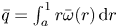 $\bar {q}=\int _{a}^{1}r\bar {\omega }(r)\,\textrm {d}r$. The instability of the surfactant mode is determined by
 $O(k^{2})$ problem and
 $c_{1}$ can be expressed as
 \begin{equation} c_{1}=\mathrm{i}\left(1+\frac{1-a^2}{2aR_{b}\left(1-\bar{\varGamma}\right)^{2}}\right)^{{-}1} \left(-\frac{1}{Pe_{s}}+f_{1}^{(Pe_{b})}+f_{1}^{(Bi)}+f_{1}^{(S)} - SF_{2}^{\left(per\right)}\right). \end{equation}
In the last bracket on the right-hand side of (3.3), the first two terms are attributed to the diffusion of the surface surfactant and the bulk surfactant. Third and fourth terms  $f_{1}^{(Bi)}$ and
 $f_{1}^{(S)}$ denote the contribution of the advection of the bulk surfactant by the base flow, which are expressed in (A33). The fifth term is due to the advective transport of the surface surfactant by the perturbed flow with its expression in (A35). From (3.3), it can be deduced that the instability of the surfactant mode is not only modulated by solubility
 $R_{b}$ but also affected by bulk diffusivity
 $Pe_{b}$ and sorption kinetics
 $Bi$. This is different from that of the interface mode.
Before the elucidation of the two modes, it should be pointed out that there is an exceptional situation, when the film is quiescent, i.e.  $Bo=0$ and
 $\tau =0$. In this situation,
 $\hat {\varGamma }_{0}$ is determined by
 $O(k^{2})$ transport equation of the surface surfactant due to the lack of advection attributed to the base flow. Solutions to the problem are derived by setting
 $\hat {\eta }_{0}=1$ in Appendix A.5. The results show that
 $\hat {\varGamma }_{0}$ for both modes is in the opposite phase of
 $\hat {\eta }_{0}$. According to the expression of
 $c_{1}$ (A37), the interface mode, which corresponds to a weaker
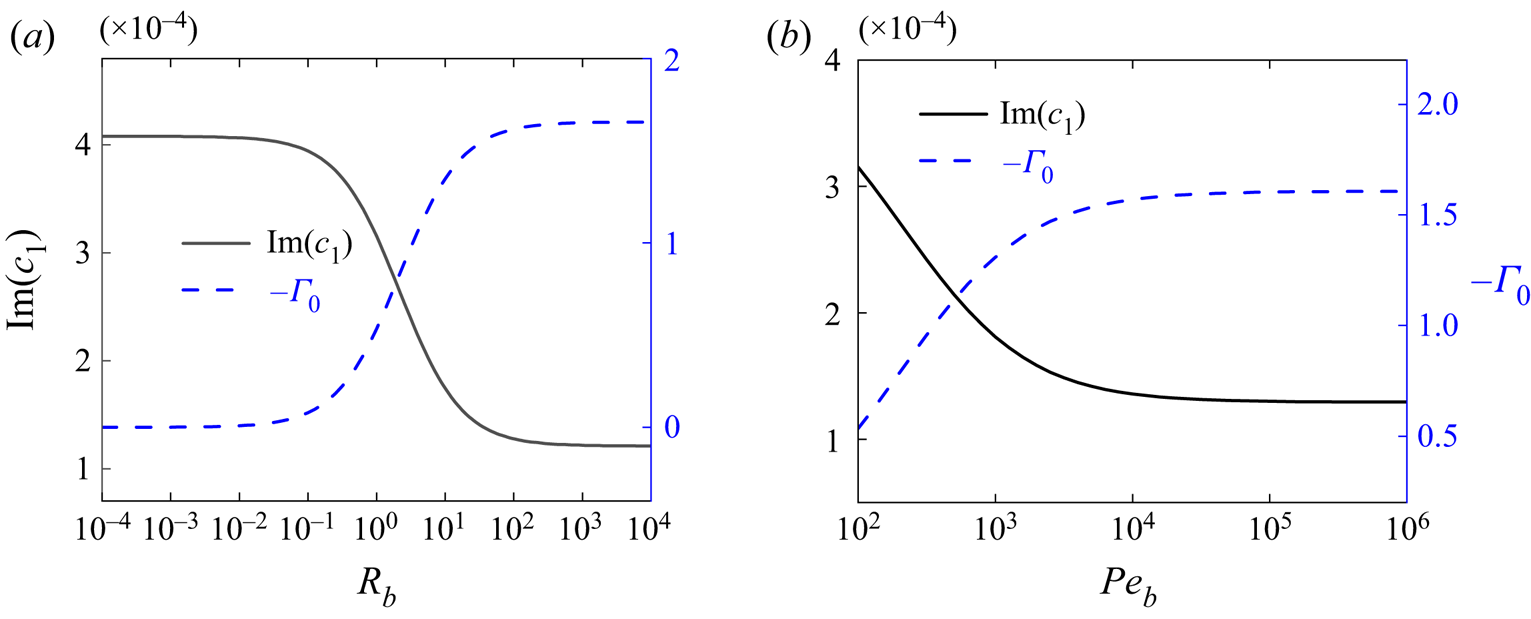
 $\hat {\varGamma }_{0}$, is more dangerous for instability. As illustrated in figure 2(a), Im(
 $c_{1}$) of the interface mode increases with a decrease of
 $R_{b}$. This is because the non-uniformity of
 $\hat {\varGamma }_{0}$ for the interface mode is suppressed with increasing solubility, which acts to attenuate the stabilizing effect of the Marangoni force. Here, we focus on the influence of bulk diffusivity on the linear instability of the system. Thus, the magnitude of
 $Pe_{s}$ is assumed to be larger than that of
 $Pe_{b}$. This indicates that the effect of interfacial diffusion is negligible in comparison to bulk diffusion. A similar assumption can also be found in previous literature (Kalogirou & Blyth Reference Kalogirou and Blyth2019, Reference Kalogirou and Blyth2021). Term Im(
 $c_{1}$) of the interface mode also increases with increasing bulk diffusivity, i.e. decreasing
 $Pe_{b}$, as illustrated in figure 2(b), where the uniformity of the surfactant is improved as well. As a result, decreasing
 $Pe_{b}$ makes the quiescent film more unstable.
The dependence of Im $(c_{1})$ and perturbed surfactant concentration
 $\hat {\varGamma }_{0}$ on (a) solubility and(b) bulk diffusivity for a quiescent film given by long-wave approximation analysis. In (a)
 $Pe_{b} = 100$ and in (b)
 ${R_{b} = 1.0}$, and the remaining parameters for both cases are:
 $a=0.9$,
 $Re=0$,
 $Ma = 0.02$,
 $\bar {\varGamma }=0.4$,
 $Bi = 0.1$ and
 $Pe_{s}=1\times 10^{6}$.

3.2. Instability of the film driven by an axial body force
In this section, we proceed to consider the instability of the film driven by an axial body force, i.e.  $\tau =0$ and
 $Bo\ne 0$. According to (3.2),
 $c_{1}$ of the interface mode is modulated by
 $\varGamma _{0}$, which is derived from (A16b) (more details can be found in Appendix A):
 \begin{equation} \hat{\varGamma}_{0}=\hat{\varGamma}^{\left(ins\right)}_{0} \left(1+\frac{A_{3}+2A_{6}}{4aA_{1}R_{b} \left(1-\bar{\varGamma}\right)^{2}}\right)^{{-}1},\end{equation}
with
 \begin{equation} \hat{\varGamma}^{\left(ins\right)}_{0} ={-}\frac{A_{2}\bar{\varGamma}}{aA_{1}}. \end{equation}
Here,  $\hat {\varGamma }^{(ins)}_{0}$ is the solution to the corresponding problem with insoluble surfactant. Since
 $\hat {\eta }_{0}=1$,
 $\hat {\varGamma }_{0}$ is in the opposite phase of
 $\hat {\eta }_{0}$. This indicates that the concentration of the surface surfactant is higher at the interfacial trough while it is lower at the interfacial crest. The induced Marangoni force directs from the interfacial trough to the crest and the resulting flow acts to stabilize the interface mode. It should be pointed out that the interfacial crest/trough denotes the location with the maximum/minimum radius, which corresponds to the thinnest/thickest location of the film. However, (3.4) suggests that the amplitude of
 $\hat {\varGamma }_{0}$ reduces with decreasing
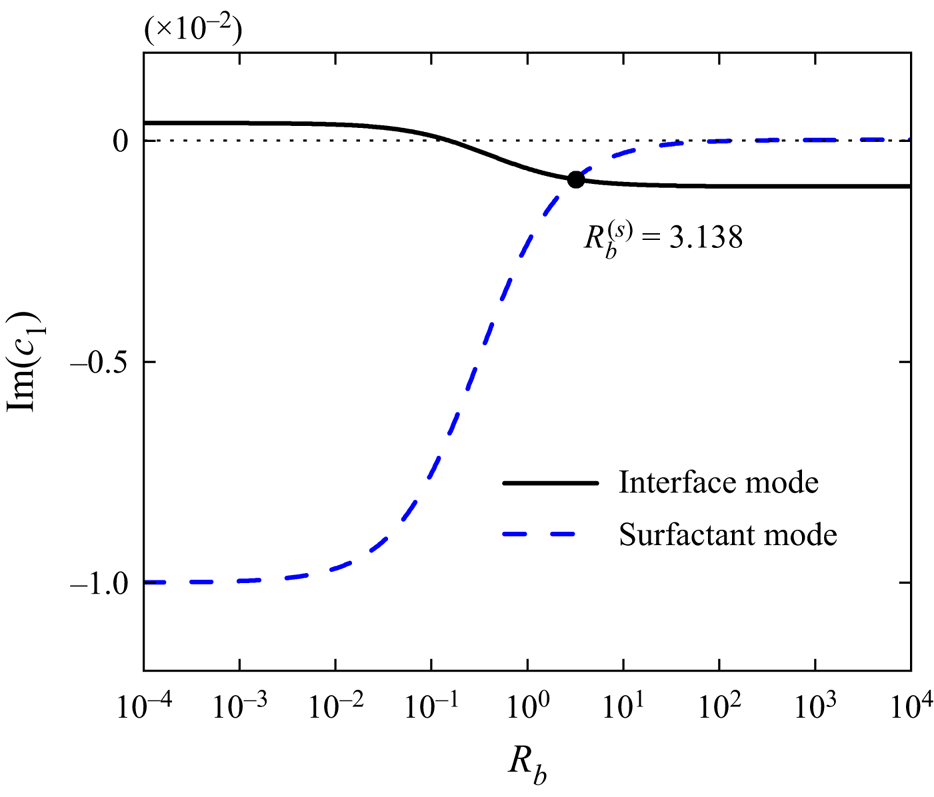
 $R_{b}$. This indicates that solubility plays a destabilizing role in the interface mode, as illustrated in figure 3. This phenomenon is attributed to the four transport pathways of the surface surfactant defined in (2.18). To better elucidate the problem, a reference frame, which moves with the perturbation wave, is introduced. The transport of the surface surfactant perturbation
 $SF^{(adv)}$ can be rewritten as
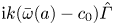 $\mathrm {i} k (\bar {\omega }(a)-c_{0})\hat {\varGamma }$. Corresponding expressions in the
 $O(k)$ order can be derived based on (A11):
 \begin{equation} \left.\begin{gathered} SF_{1}^{\left(adv\right)} ={-}\mathrm{i}\frac{A_{1}Bo}{4}\hat{\varGamma}_{0},\quad \hat{J}_{b1}=\mathrm{i}\frac{Bo\left(A_{3} +2A_{6}\right)} {16aR_{b}\left(1-\bar{\varGamma}\right)^{2}}\hat{\varGamma}_{0},\\ SF_{1}^{\left(per\right)} ={-}\mathrm{i}\frac{A_{2}Bo}{4a},\quad SF_{1}^{\left(dif\right)} = 0. \end{gathered}\right\} \end{equation}
Clearly, the phase of  $SF^{(adv)}_{1}$ lags
 $90^{\circ }$ behind
 $\hat {\varGamma }_{0}$, while the phase of adsorption/desorption flux
 $\hat {J}_{b1}$ precedes
 $\hat {\varGamma }_{0}$ by
 $90^{\circ }$. This means that
 $SF^{(adv)}_{1}$ and
 $\hat {J}_{b1}$ are in anti-phase. According to (2.18), we know that the depletion of the surface surfactant caused by the base flow coincides with the desorption flux from the interface to the bulk. Meanwhile, the accumulation of the surface surfactant caused by the base flow coincides with the adsorption flux from the bulk to the interface. As a result,
 $\hat {J}_{b1}$ is a boost for
 $SF^{(adv)}_{1}$ to counter the surfactant transportation by the perturbed flow
 $SF^{(per)}_{1}$, and alleviates the perturbation of the surface surfactant. In this situation, solubility promotes the uniformity of
 $\hat {\varGamma }_{0}$. It leads to the attenuation of the stabilizing effect of the Marangoni force and enhances the instability of the interface mode.
The dependence of Im $(c_{1})$ on solubility
 $R_{b}$ for a film driven by an axial body force. The solid line denotes the interface mode and the dashed line denotes the surfactant mode, both given by long-wave approximation analysis. Here
 $R_{b}^{(s)}$ is the solubility where the curves of the interface mode and the surfactant mode intersect. The parameters adopted here are
 $Bo=1$,
 $\tau =0$,
 $Pe_{b}=100$ and the others remain the same as in figure 2.

For the surfactant mode, the instability is attributed to the accumulation/depletion of the surfactant at the interface. Parameter  $c_{1}$ of the surfactant mode is expressed in (3.3). Its instability is determined by those five terms in the second bracket on the right-hand side. The first term
 $-1/Pe_{s}$ is attributed to the interfacial diffusivity of the surface surfactant, which is weak and generally ignored. Terms
 $f_{1}^{(Pe_{b})}$,
 $f_{1}^{(Bi)}$ and
 $f_{1}^{(S)}$ are components of
 $\hat {J}_{b2}$ (see (A31)) and their magnitude increases with a decrease of
 $R_{b}$. Term
 $f_{1}^{(Pe_{b})}$ is caused by the diffusion of the bulk surfactant. Recall that the derivation of the surfactant mode is based on
 $\hat {\varGamma }_{0}=1$. Term
 $f_{1}^{(Pe_{b})}$ is in the opposite phase to
 $\hat {\varGamma }_{0}$ and acts to diminish the perturbation of the surface surfactant. For
 $f_{1}^{(Bi)}$, it is obviously non-positive irrespective of
 $Bo$ and plays a stabilizing role. Furthermore, this conclusion holds even for various combinations of
 $Bo$ and
 $\tau$. In
 $f_{1}^{(S)}$, the analytical expression of
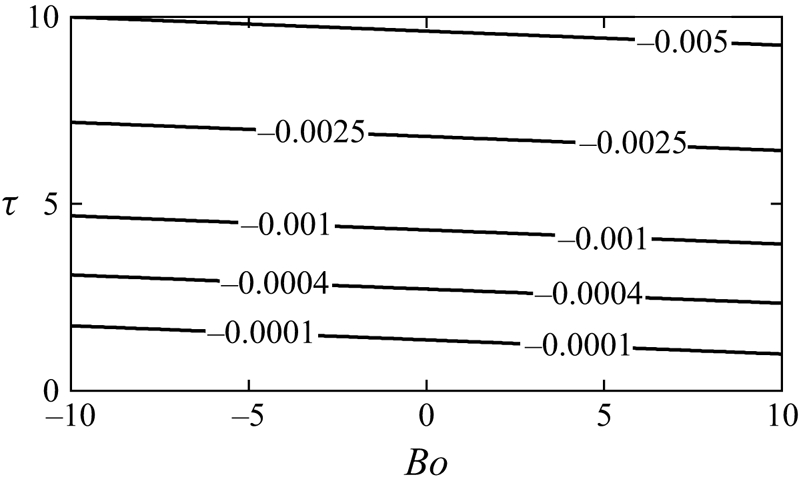
 $S$ is too cumbersome to present here. As illustrated in figure 4, the numerical results show that
 $S$ takes a non-positive value. Thus, it tends to stabilize the surfactant mode. So far, the first four terms in the second bracket on the right-hand side of (3.3) always contribute to stabilizing the surfactant mode. Its instability results from
 $SF^{(per)}_{2}$, which denotes the surface surfactant transported by the perturbed flow. Substituting (2.13a–c) with
 $\tau = 0$ into (A35),
 $SF^{(per)}_{2}$ can be expressed as
 \begin{equation} SF_{2}^{\left(per\right)}=\frac{A_{5}Ma\bar{\varGamma}}{16a^{3} \left(1-\bar{\varGamma}\right)}-\mathrm{i}\frac{A_{2}Bo\bar{\varGamma}}{4a}\hat{\eta}_{1}, \end{equation}
which arises from the Marangoni effect and interfacial deflection. According to (A21),  $\hat {\eta }_{1}$ satisfies
 \begin{equation} \hat{\eta}_{1}=\hat{\eta}_{1}^{\left(ins\right)} \left(1+\frac{A_{6}}{2A_{1}\left(1-a^{2}+2aR_{b}\left(1-\bar{\varGamma}\right)^{2}\right)}\right)^{{-}1}, \end{equation}
with
 \begin{equation} \hat{\eta}_{1}^{(ins)}={-}\frac{\mathrm{i} A_{4}Ma}{4a^{2}A_{1}Bo\left(1-\bar{\varGamma}\right)}. \end{equation}
Here,  $\hat {\eta }_{1}^{(ins)}$ is identical to the first-order interfacial deflection in the corresponding problem with insoluble surfactant. According to (3.8) and (3.9),
 $\hat {\eta }_{1}$ lags
 $90^{\circ }$ behind
 $\hat {\varGamma }_{0}$ and its magnitude is reduced with decreasing
 $R_{b}$. Therefore, the second term on the right-hand side of (3.7) is in the opposite phase to
 $\hat {\varGamma }_{0}$. It acts to destabilize the surfactant mode and this destabilizing effect on the surfactant mode diminishes with decreasing
 $R_{b}$. Combining all the terms in (3.3), Im
 $(c_{1})$ is decreased while
 $R_{b}$ decreases as demonstrated in figure 3. Notably, different from the insoluble case (Jain et al. Reference Jain, Sharma and Das2022), where the surfactant mode is always unstable, the surfactant mode with soluble surfactant could be stable with a certain small
 $R_{b}$.
The contour of  $S$ on the
 $Bo$ versus
 $\tau$ plane with
 $a=0.9$,
 $R_{b}=1$ and
 $\bar {\varGamma }=0.4$.

According to (3.3), we know that the instability of the surfactant mode is modulated by sorption kinetics  $Bi$ and bulk diffusivity
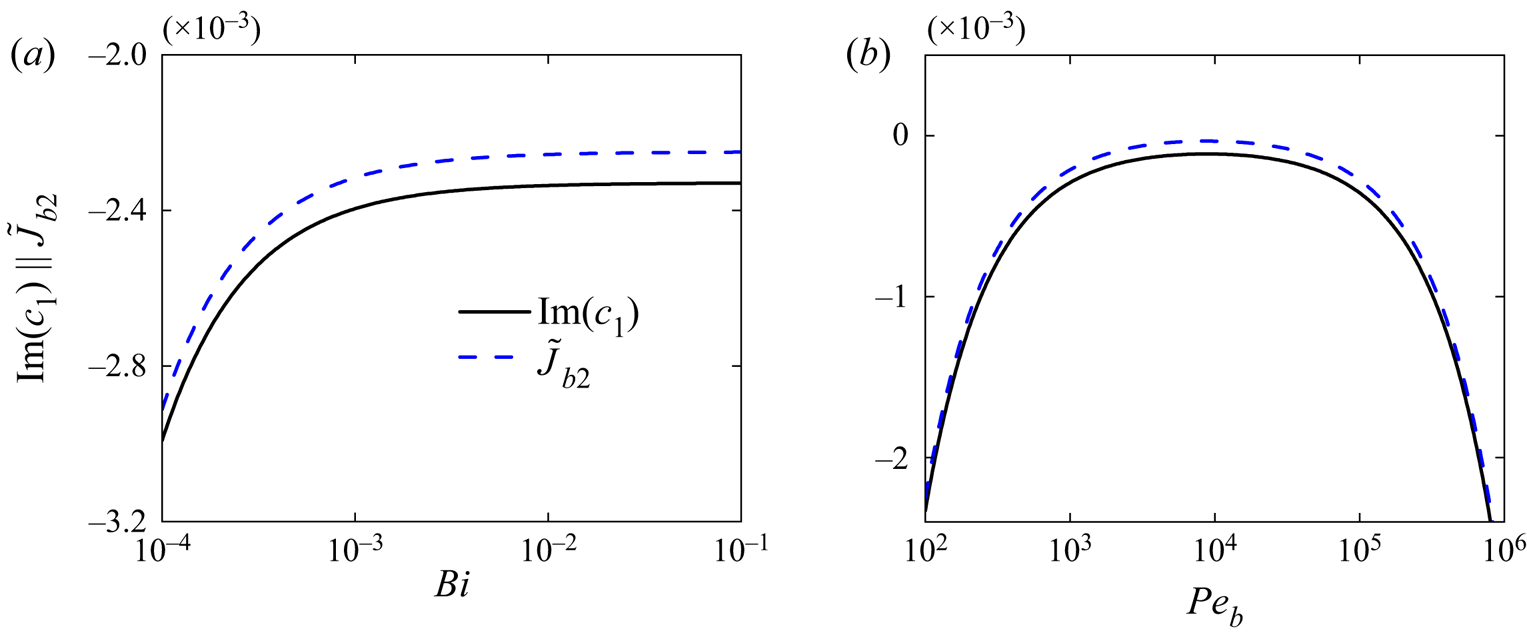
 $Pe_{b}$ as well. As shown in figure 5(a), the adsorption/desorption flux
 $\hat {J}_{b2}$ is intensified as
 $Bi$ decreases, which improves the uniformity of the surface surfactant and stabilizes the surfactant mode. This is attributed to the fact that the effect of
 $f^{(Bi)}_{1}$ in (A31) and (A34) is inversely proportional to
 $Bi$. Moreover, as demonstrated in figure 5(b), bulk diffusivity
 $Pe_{b}$ has a non-monotonic influence on the instability of the surfactant mode and the surfactant mode is relatively stable for both strong and weak diffusivity. When the bulk diffusivity is strong, i.e.
 $Pe_{b}$ is small,
 $f^{(Pe_{b})}$ becomes significant in (A31) and (A34), which leads to strong adsorption/desorption flux and stabilizes the surfactant mode. On the other hand, when
 $Pe_{b}$ is sufficiently large, the stabilizing effect of
 $f_{1}^{(S)}$ will become significant instead. The reason for this is that the gradient of the bulk surfactant is intensified due to weak diffusion. This results in large adsorption/desorption flux and mitigates the growth rates of the surfactant mode.
The dependence of Im $(c_{1})$ and perturbed adsorption/desorption flux
 $\hat {J}_{b2}$ of the surfactant mode on (a) sorption kinetics and (b) bulk diffusivity, where the film is driven by an axial body force. In (a),
 $Pe_{b}$ is fixed at 100 and in (b),
 $Bi$ is fixed at 0.1. For both cases, we take
 $Bo=1$,
 $\tau =0$,
 $R_{b}=1$ and the other parameters remain the same as in figure 2.

3.3. Instability of the film driven by an interfacial shearing force
In this section, we examine the instability of film flow driven by an interfacial shearing force, i.e.  $Bo=0$ and
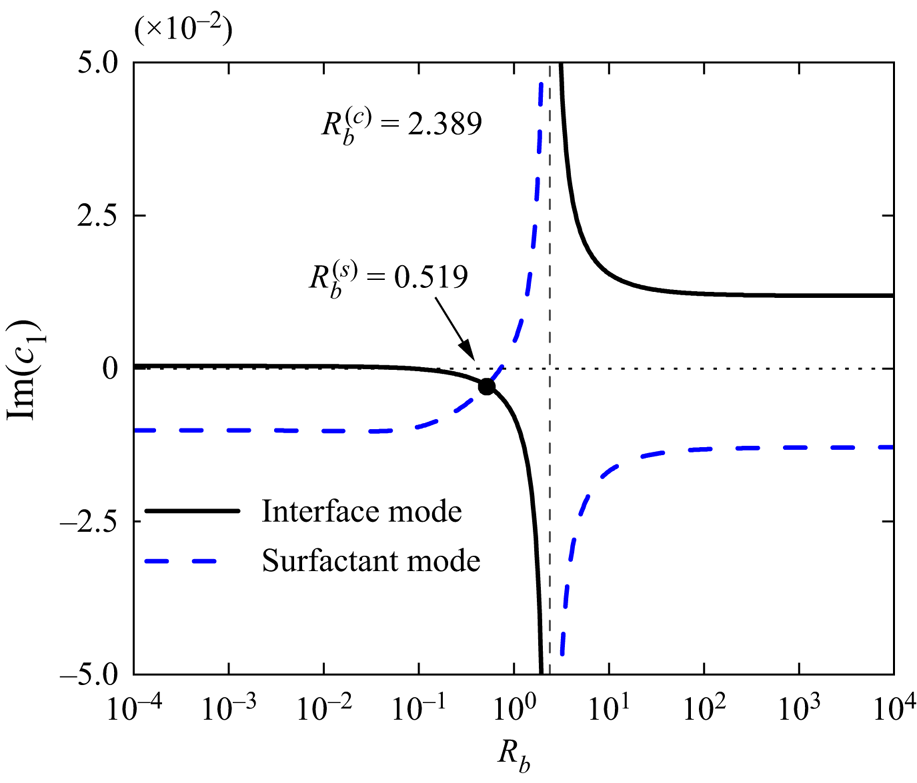
 $\tau \ne 0$. Figure 6 presents the effect of solubility on the instability for both the interface and the surfactant modes. It is interesting that there is a critical solubility
 $R_{b}^{(c)}$, around which Im(
 $c_{1}$) changes dramatically. On both sides of
 $R_{b}^{(c)}$, solubility plays a destabilizing role in the interface mode but a stabilizing role in the surfactant mode. Similar to that presented in § 3.2, the effect of the capillary force on the instability of the interface mode is modulated by the surface surfactant perturbation
 $\hat {\varGamma }_{0}$, which is determined according to (A11). Each item, which denotes one pathway of the surfactant transport, can be expressed in the reference frame travelling with
 $c$ as follows:
 \begin{equation} \left.\begin{gathered} SF^{\left(adv\right)}_{1} = \mathrm{i}\frac{A_{1}\tau}{4}\hat{\varGamma}_{0},\quad \hat{J}_{b1}=\mathrm{i}\frac{\tau\left(A_{4}-3A_{6}\right)}{16a^2R_{b} \left(1-\bar{\varGamma}\right)^2}\hat{\varGamma}_{0},\\ SF^{\left(per\right)}_{1} ={-}\mathrm{i}\tau\frac{4a^{2}-A_{2}}{4a^{2}},\quad SF^{\left(dif\right)}_{1} = 0. \end{gathered}\right\} \end{equation}
In this study, the film thickness is assumed to be small ( $a = 0.9$). Values of
 $(A_{4}-3A_{6})$ and
 $(4a^{2}-A_{2})$ are both positive for a thin liquid film, e.g.
 $a>0.53$. Thus,
 $SF^{(adv)}_{1}$ and
 $\hat {J}_{b1}$ are in the same phase, and play a contrasting role in the surface surfactant transport at
 $O(k)$ order. This is different from that presented in (3.6), and
 $\hat {\varGamma }_{0}$, as given by (A16b), can be simplified as
 \begin{equation} \hat{\varGamma}_{0}=\hat{\varGamma}_{0}^{\left(ins\right)} \frac{R_{b}}{R_{b}-R_{b}^{\left(c\right)}}, \end{equation}
with
 \begin{equation} \hat{\varGamma}_{0}^{\left(ins\right)}=\frac{\bar{\varGamma}(4a^2-A_{2})}{aA_{1}}. \end{equation}
Here,  $\hat {\varGamma }_{0}^{(ins)}$ corresponds to the solution of the problem with insoluble surfactant. The critical solubility
 $R_{b}^{(c)}$ is
 \begin{equation} R_{b}^{(c)}=\frac{A_{4}-3A_{6}}{4aA_{1}(1-\bar{\varGamma})^{2}}. \end{equation}
Notably, if  $SF^{(adv)}_{1}$ equals
 $\hat {J}_{b1}$ in (3.10), we have
 $R_{b}=R_{b}^{(c)}$ and infinite
 $\hat {\varGamma }_{0}$ according to (3.11). This indicates that the presence of
 $R_{b}^{(c)}$ is attributed to the offsetting effect between
 $SF^{(adv)}_{1}$ and
 $\hat {J}_{b1}$ in the surfactant transport. As a result, the surfactant can accumulate/deplete at the interface infinitely due to the presence of
 $SF^{(per)}_{1}$. Moreover, when the surfactant is sparingly soluble (
 $R_{b}\gg 1$),
 $\hat {J}_{b1} \to 0$. According to (A11),
 $SF^{(per)}_{1}$ is balanced by
 $SF^{(adv)}_{1}$. The induced perturbation of surface surfactant is
 $\hat {\varGamma }_{0}^{(ins)}$, which is in phase with
 $\hat {\eta }_{0}$ and induces destabilizing Marangoni flow from the interfacial crest to the interfacial trough. When
 $R_{b}$ reduces,
 $\hat {J}_{b1}$ becomes large and the surface surfactant transported by
 $SF^{(adv)}_{1}$ will be hindered. Consequently,
 $\hat {\varGamma }_{0}$ is prone to become concentrated/dilute, which tends to aggravate the instability of the interface mode. However, when
 $R_{b}$ is below
 $R_{b}^{(c)}$,
 $\hat {J}_{b1}$ has the advantage over
 $SF^{(adv)}_{1}$. According to (A11), we know that
 $SF^{(per)}_{1}$ is now mainly balanced by
 $\hat {J}_{b1}$. Therefore, the phase of
 $\hat {\varGamma }_{0}$ is reversed, which induces the Marangoni flow from the trough to the crest and contributes stability to the interface mode. As
 $R_{b}$ is further decreased,
 $\hat {\varGamma }_{0}$ reduces due to the enhanced adsorption/desorption flux
 $\hat {J}_{b1}$. The stabilizing effect of the Marangoni flow is then attenuated. It is noted that when
 $R_{b}$ approaches
 $R_{b}^{(c)}$, Im(
 $c_{1}$) will tend to be infinite, as shown in figure 6. In fact, under this situation, the current long-wave expansion is inappropriate. Term Im(
 $c_{1}$) is proportional to
 $k^{1/2}$ as presented in Appendix B. Similar results for two-layer planar flow have been reported for clean interface (Halpern & Frenkel Reference Halpern and Frenkel2003) and for soluble surfactant (Kalogirou & Blyth Reference Kalogirou and Blyth2019). It should be pointed out that the current long-wave expansion only fails in a narrow region of
 $R_{b}$, i.e.
 $R_{b}\rightarrow R_{b}^{(c)}$, and it is applicable for the rest of the values of
 $R_{b}$. Halpern & Frenkel (Reference Halpern and Frenkel2003) have made an in-depth investigation of this singularity and pointed out that as soon as the parameter moves slightly away from the critical situation, the growth rates rapidly change to the results given by
 $O(k)$ expansion.
The dependence of Im $(c_{1})$ on solubility
 $R_{b}$ for a shear-driven film given by long-wave approximation analysis. The solid line denotes the interface mode and the dashed line denotes the surfactant mode. Here
 $R_{b}^{(s)}$ is the solubility where the curves of interface mode and surfactant mode intersect. The parameters adopted here are
 $Bo=0$,
 $\tau =1$,
 $Pe_{b}=100$ and the other parameters are the same as in figure 2. Under current circumstance, the critical solubility
 $R_{b}^{(c)} = 2.389$ and is demonstrated as a vertical asymptote.

For the surfactant mode, the instability is determined by (3.3) with  $Bo=0$. Similar to film flow driven by an axial body force, the first four terms in the right-hand bracket of (3.3) play a stabilizing role. Corresponding conclusions in the previous section still hold. Here
 $Bi$ acts to enhance the instability of the surfactant mode while
 $Pe_{b}$ tends to make the surfactant mode relatively stable for both strong (small
 $Pe_{b}$) and weak (large
 $Pe_{b}$) diffusivity. Furthermore, according to (3.3), the instability of the surfactant mode arises from
 $SF_{2}^{(per)}$ as well. Substituting (2.13a–c) with
 $Bo = 0$ into (A35), we obtain
 \begin{equation} SF_{2}^{\left(per\right)} = \frac{A_{5}Ma\bar{\varGamma}}{16a^{3}(1-\bar{\varGamma})} -\mathrm{i}\frac{\tau(4a^{2}-A_{2})\bar{\varGamma}}{4a^{2}}\hat{\eta}_{1}, \end{equation}
where  $\hat {\eta }_{1}$ can be derived via (A25) as
 \begin{equation} \hat{\eta}_{1}=\frac{\hat{\eta}_{1}^{\left(ins\right)}}{R_{b}-R_{b}^{(c)}} \left(R_{b}+\frac{1-a^{2}}{2a(1-\bar{\varGamma})^{2}}\right). \end{equation}
Here,  $\hat {\eta }_{1}^{(ins)}$ corresponds to the
 $O(k)$ order deflection of the liquid–air interface with insoluble surfactant, and its expression is
 \begin{equation} \hat{\eta}_{1}^{(ins)} = \mathrm{i}\frac{A_{4}Ma}{4a\tau A_{1}(1-\bar{\varGamma})}. \end{equation}
Comparing (3.7) and (3.14), we observe that the first terms on the right-hand sides of the equations, which play stabilizing roles, are the same. For the second term, the same critical solubility  $R_{b}^{(c)}$ can also be obtained according to (3.15). On both sides of
 $R_{b}^{(c)}$, although the second term has opposite phases, it is prone to make the surfactant mode relatively stable with decreasing
 $R_{b}$. As a result, solubility tends to decrease the growth rate of the surfactant mode on both sides of
 $R_{b}^{(c)}$ (see figure 6). This is consistent with the role of solubility in film flow driven by an axial body force.
4. The linear instability analysis at finite wavelength
In this section, we investigate the linear instability of the film at finite wavelength, where the high-order perturbation once suppressed in the long-wave regimes will revive due to the increase of wavenumber. This will make an additional contribution to the stability/instability of the film. The influences of surfactant solubility  $R_{b}$, sorption kinetics
 $Bi$ and bulk diffusivity
 $Pe_{b}$ on the linear instability of the film are mainly concerned. Since a large number of parameters are involved in the problem, it is cumbersome to discuss each one in detail. Therefore, we render results that display representative effects of the soluble surfactant on the linear instability of film flow, with
 $a=0.9$,
 $b=1.0$,
 $\bar {\varGamma }=0.4$,
 $Re=0$ and
 $Pe_{s}=1\times 10^{6}$.
4.1. Numerical implementation
The linearized equations (2.16)–(2.19a–c) are discretized by a spectral collocation method based on Chebyshev polynomials (Trefethen Reference Trefethen2000). The film region is mapped onto the spectral space  $x\in [-1,1]$ via the following relation:
 \begin{equation} x = 1 - 2\left(\frac{r-a}{1-a}\right), \end{equation}
where the tube wall and the liquid–air interface are located at  $x = -1$ and
 $x = 1$, respectively. The spectral space is constructed via
 $N+1$ Chebyshev points. Governing equations (2.16) are discretized on this clustering grid, and boundary conditions (2.17)–(2.19a–c) are implemented at the boundary points. The perturbation of
 $\{\hat {u},\hat {\omega },\hat {p},\hat {C}\}$ is expanded on the corresponding Chebyshev polynomials:
 \begin{equation} \left.\begin{gathered} \hat{u}\left(r\right)=\sum_{i=0}^{N}\hat{u}_{i}T_{i}\left(r\right),\quad \hat{\omega}\left(r\right)=\sum_{i=0}^{N}\hat{\omega}_{i}T_{i}\left(r\right),\\ \hat{p}\left(r\right)=\sum_{i=0}^{N}\hat{p}_{i}T_{i}\left(r\right),\quad \hat{C}\left(r\right)=\sum_{i=0}^{N}\hat{C}_{i}T_{i}\left(r\right), \end{gathered}\right\} \end{equation}
where  $T_{i}(r)$ is the
 $i$th Chebyshev polynomials of the first kind. The above discretization renders a generalized complex eigenvalue problem
 $\boldsymbol {A}\boldsymbol {X}=\varOmega \boldsymbol {B}\boldsymbol {X}$. Here,
 $\boldsymbol {X} = \{\hat {u}_{i},\hat {\omega }_{i},\hat {p}_{i},\hat {C}_{i},\hat {\eta },\hat {\varGamma }\}$ is the perturbed variables and consists of
 $4N+6$ elements. Matrices
 $\boldsymbol {A}$ and
 $\boldsymbol {B}$ are complex matrices, which are determined by dimensionless parameters
 $Bo$,
 $\tau$,
 $R_{b}$,
 $Bi$,
 $Pe_{b}$ and
 $Pe_{s}$. Eigenvalue
 $\varOmega =\varOmega _{r}+\mathrm {i}\varOmega _{i}$ is the complex eigenvalue, and its imaginary part
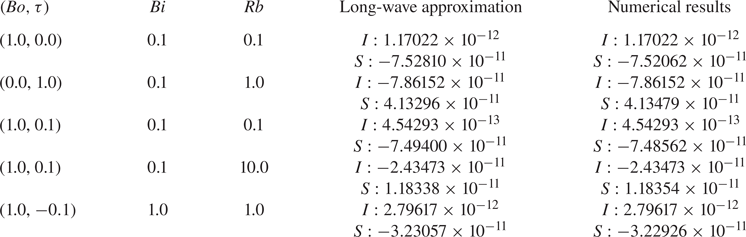
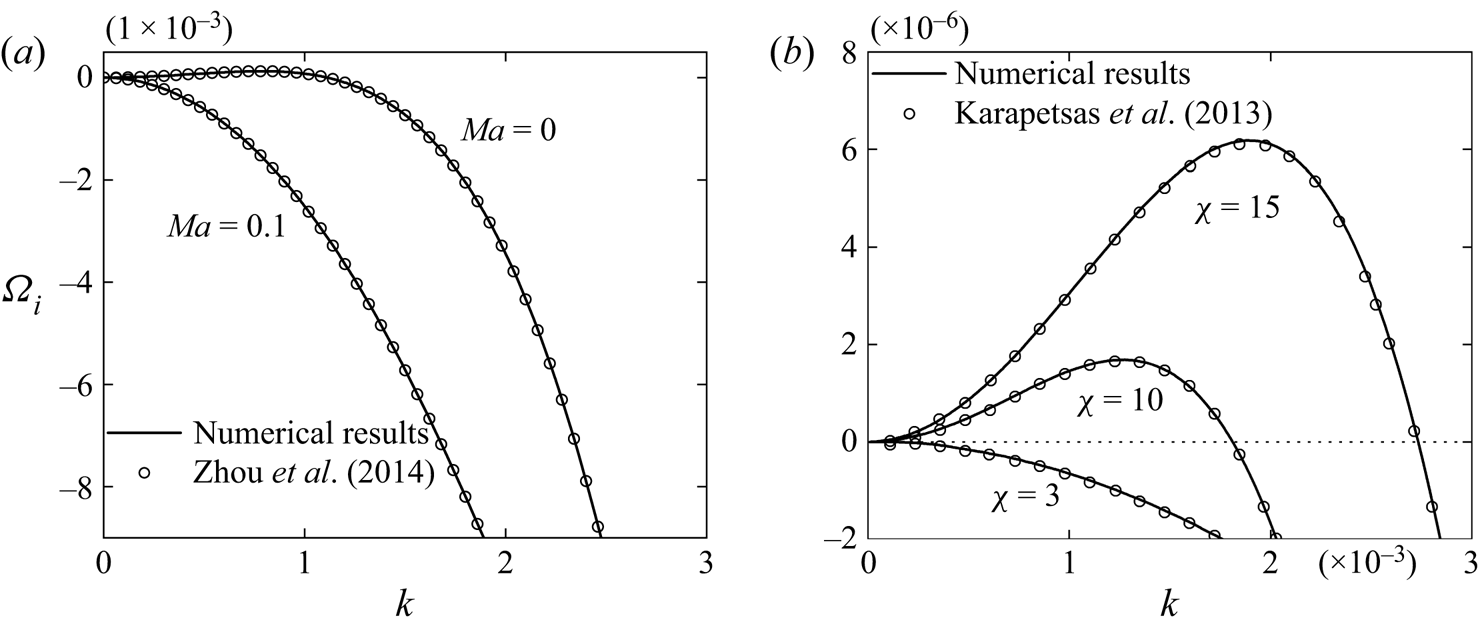
 $\varOmega _{i}$ corresponds to the growth rate at a given wavenumber. The built-in QZ algorithm eig of MATLAB is adopted to obtain the complex eigenvalues and eigenvectors. We utilize Advanpix (Advanpix Reference Advanpix2022), a multi-precision computing toolbox, to ensure computing precision, which enables MATLAB to run with arbitrary precision and meanwhile with high efficiency. The code is verified by comparing the numerical results with those of the long-wave approximation analysis, as listed in table 1. They are consistent when the perturbation wavenumber is relatively small, e.g.
 $k=1\times 10^{-4}$. Moreover, in figure 7(a), the results obtained by Zhou et al. (Reference Zhou, Peng, Zhang and Zhuge2014) for a liquid film coating inside a tube with insoluble surfactant are reproduced by setting
 $Bi=0$ or
 $R_{b}\gg 1$. When
 $a\rightarrow 1$, the film coating inside a tube with soluble surfactant can be reduced to a planar falling film. As shown in figure 7(b), the results are consistent with those presented by Karapetsas & Bontozoglou (Reference Karapetsas and Bontozoglou2013).
Comparison of two dominant growth rates obtained by the long-wave approximation analysis and the numerical method with  $k=1\times 10^{-4}$. Notation
 $I$ represents the growth rate for the interface mode and
 $S$ that for the surfactant mode. The remaining parameters are the same as in figure 2.

Validation of the numerical method with the results of (a) Zhou et al. (Reference Zhou, Peng, Zhang and Zhuge2014) and (b) Karapetsas & Bontozoglou (Reference Karapetsas and Bontozoglou2013). (a) Results of a liquid film coating inside a tube with insoluble surfactant with  $a=0.9$,
 $Bo = 5$ and
 $\tau =-0.4$. Our results are obtained by taking the insoluble limit,
 $R_{b}\gg 1$ or
 $Bi=0$. (b) Results for a falling planar film with soluble surfactant. Our results approximate to the situation via letting the film be extremely thin, e.g.
 $1-a = 1\times 10^{-6}$. The parameters used in (b) follow the definitions of Karapetsas & Bontozoglou (Reference Karapetsas and Bontozoglou2013).

4.2. The quiescent film
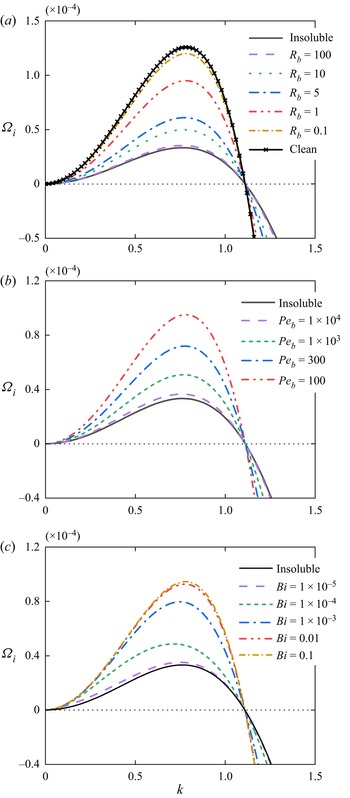
Figure 8(a) shows the growth rates of the perturbation wave with  $Bi=0.1$,
 $Pe_b=100$ and various solubilities
 $R_{b}$. The film is assumed to be quiescent. When the surfactant is sparingly soluble with
 $R_{b}=100$, the growth rates are nearly indistinguishable from those of insoluble surfactant. When
 $R_{b}$ is reduced, e.g. from 100 to 0.1, the flow instability is enhanced. This is in line with the prediction of the long-wave approximation analysis. At
 $R_{b}=0.1$, the surfactant is highly soluble and the perturbation of the surface surfactant will be mitigated by the adsorption/desorption flux. Therefore, the film will experience uniform but decreased surface tension. Corresponding growth rates are a little lower than those of the problem with clean interface. The cut-off wavenumber equals the reciprocal of the unperturbed interfacial radius
 $a$, the same as for the film with clean interface (Hammond Reference Hammond1983) or insoluble surfactant (Wei & Rumschitzki Reference Wei and Rumschitzki2005). Similar results can be observed in figure 8(b), where the cut-off wavenumbers remain
 $1/a$ for various
 $Pe_{b}$. Moreover, the film instability can be strengthened as
 $Pe_{b}$ decreases. Figure 8(c) compares the growth rates of the perturbation wave with
 $R_{b}=1.0$,
 $Pe_{b}=100$ and various
 $Bi$. Similar to previous cases, the cut-off wavenumbers are fixed at
 $1/a$. It is found that the growth rates increase with increasing
 $Bi$. This may be attributed to the fact that the adsorption/desorption flux, which mitigates magnitude of surface surfactant, is strengthened with increasing
 $Bi$. As a result, the stabilizing effect of the Marangoni force is attenuated. Readers may notice that sorption kinetic
 $Bi$ does not involve in the long-wave instability as shown in (A37). This is because the surfactant at the interface and in the bulk is able to reach equilibrium at the
 $O(1)$ orders in the long-wave approximation. Therefore, the influence of
 $Bi$, which modulates the adsorption/desorption flux, vanishes. It should be noted that Romanò et al. (Reference Romanò, Muradoglu and Grotberg2022) conducted an investigation into the nonlinear instability of the quiescent film. It indicated that
 $R_{b}$,
 $Bi$ and
 $Pe_{b}$ have little impact on the flow instability. This does not conflict with the results obtained in this study since parameter values are distinctively different.
The dominant growth rate versus wavenumber  $k$ of a quiescent film under the influence of(a) solubility
 $R_{b}$, (b) bulk diffusivity
 $Pe_{b}$ and (c) sorption kinetics
 $Bi$. In (a)
 $Bi=0.1$ and
 $Pe_{b}=100$ are adopted, in (b)
 $R_{b}=1$ and
 $Bi=0.1$ are adopted and in (c)
 $R_{b}=1$ and
 $Pe_{b}=100$ are adopted. The other parameters remain the same as in figure 2.

4.3. The film under an axial body force
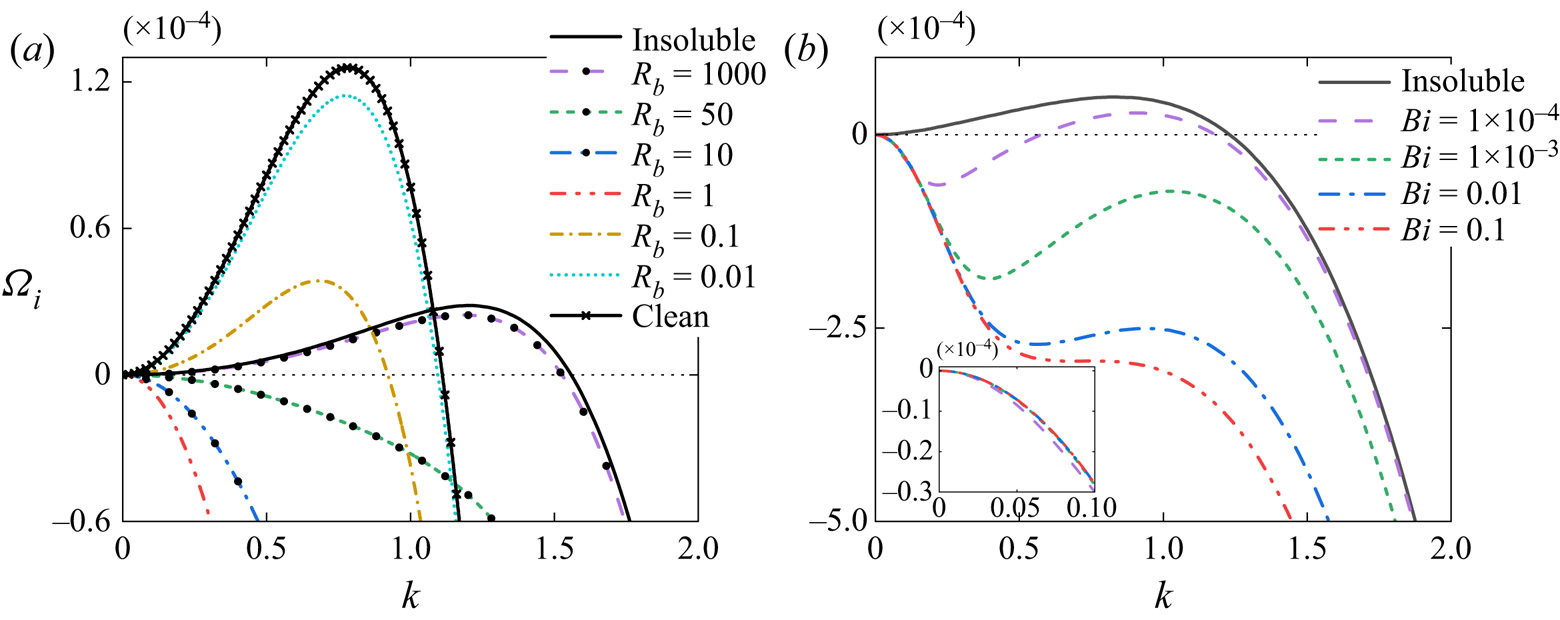
In this section, we proceed to consider the scenario of a film driven by an axial body force, e.g. gravity. Figure 9(a) depicts the growth rates versus wavenumber  $k$ with various
 $R_{b}$. When
 $R_{b}=1000$, the curve of growth rate is close to that of the insoluble problem. As
 $R_{b}$ decreases, the growth rates are reduced and the film tends to be linearly stable eventually, as shown in the curves with
 $R_{b}=50$ and
 $10$. By continuously tracing the growth rates back to
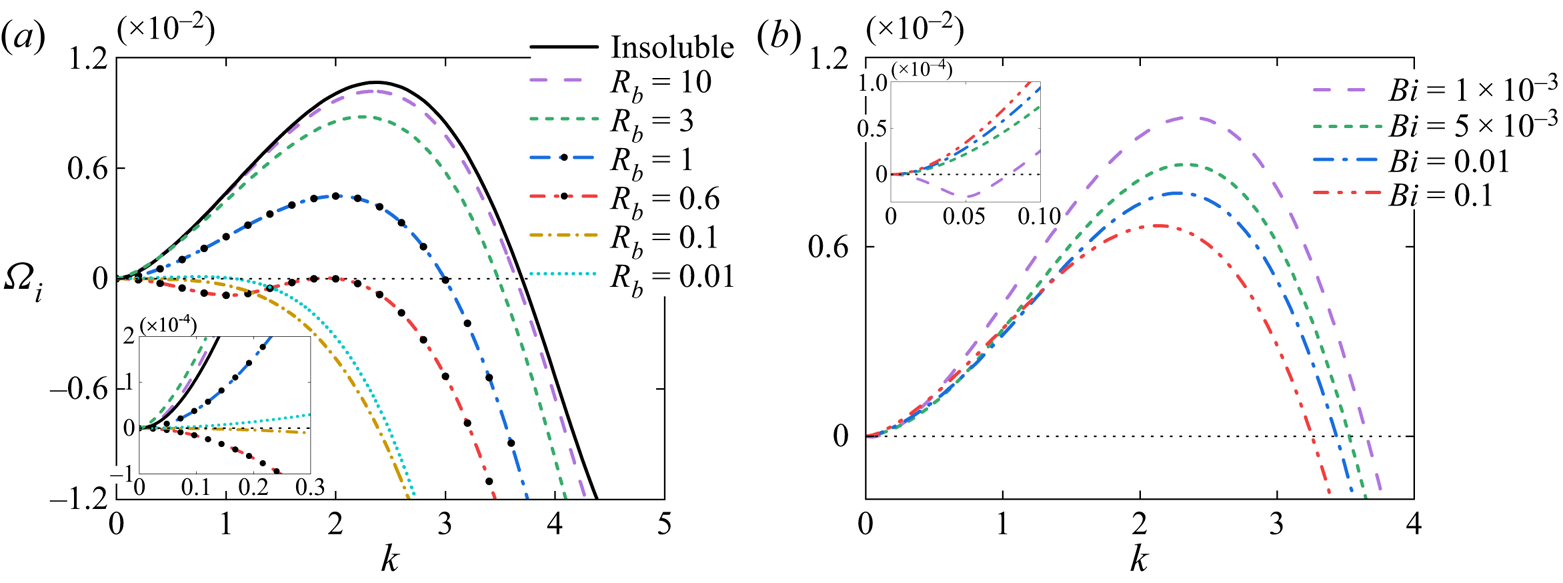
 $k\ll 1$ (defined as the trace-back method in the following), the above curves are found to stem from the surfactant mode according to the long-wave approximation analysis. Thus, the modes corresponding to the above growth rate curves can be referred to as the surfactant modes. As illustrated in figure 9(a), it can be concluded that solubility plays a stabilizing role in the surfactant mode. This is in line with the prediction made by the long-wave approximation analysis. However, when
 $R_{b}$ is decreased to
 $R_{b}^{(s)}=3.138$, the most dangerous mode shifts from the surfactant mode to the interface mode, as depicted in figure 3. As
 $R_{b}$ is further decreased, e.g.
 $R_{b}=1.0, 0.1,0.01$, the growth rates tend to increase, and the film flow is destabilized eventually. Particularly, at
 $R_{b}=0.01$, the surfactant is highly soluble. The performance of the liquid film is similar to that of a clean interface with suppressed surface tension due to the presence of surface surfactant. Similar to figure 8(a), the growth rates are a little lower than those of the clean interface. Moreover, as illustrated in figure 9(a), it can be concluded that the film is linearly stabilized in the presence of soluble surfactant with intermediate solubility. A stability window can be observed ranging from
 $R_{b}=0.165$ to
 $R_{b}=113.579$ for the present setting of parameters. This is different from the situation with insoluble surfactant (Jain et al. Reference Jain, Sharma and Das2022), where the surfactant mode is always unstable. Figure 9(b) shows the effect of sorption kinetics
 $Bi$ on the dominant growth rates. Via the trace-back method, it is found that the instability of the film is dominated by the surfactant mode. In this regard, the main trigger for the instability is the accumulation/depletion of the surfactant at the interface. The results show that
 $Bi$ strengthens the instability for the perturbations with long wavelength but attenuates the instability for the perturbations with finite wavelength. As
 $k\ll 1$ and
 $Bi$ is increased from
 $Bi=1\times 10^{-4}$ to
 $Bi=0.1$, the growth rates of the film increase as predicted by the long-wave approximation. However, for the perturbations with finite wavelength, the situation is reversed. The growth rates of the perturbation wave are decreased with increasing
 $Bi$. This is attributed to the fact that surfactant with larger sorption kinetics
 $Bi$ can dissolve in the bulk more easily and improve the uniformity of the surface surfactant at the interface. Therefore, increasing
 $Bi$ makes the perturbation wave more stable. Notably, these characteristics of
 $Bi$ can stimulate an unstable region bounded away from the origin with
 $k=0$, as shown by the curve for
 $Bi=1\times 10^{-4}$, which has been referred to as the mid-wave instability by Halpern & Frenkel (Reference Halpern and Frenkel2003).
The dominant growth rate versus wavenumber  $k$ of a film driven by an axial body force under the influence of
 $R_{b}$ and
 $Bi$. The results are obtained with
 $Bo=1$ and
 $\tau =0$. (a) Comparison of the growth rates of various
 $R_{b}$ with
 $Ma = 0.02$,
 $Bi=0.1$ and
 $Pe_{b}=100$. (b) Comparison of the growth rates of various
 $Bi$ with
 $Ma = 0.2$,
 $R_{b}=1$ and
 $Pe_{b}=100$. Other parameters take the same values as in figure 2.

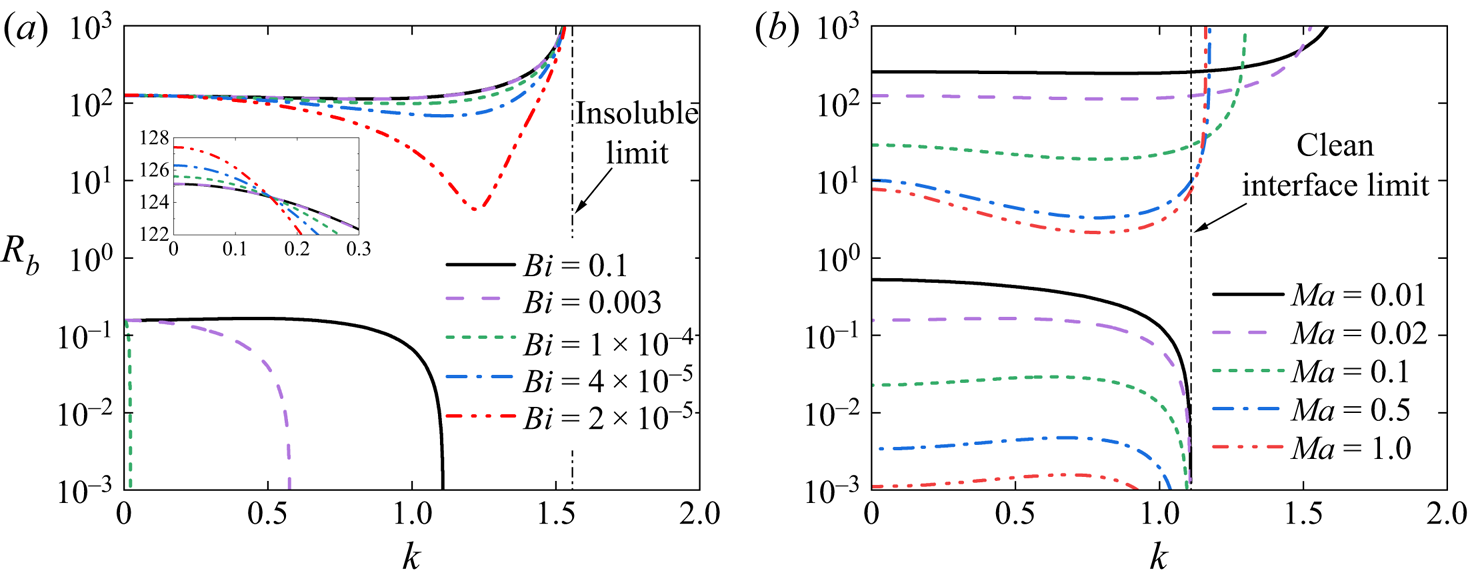
Figure 10(a) shows the neutral curves of film linear instability on the  $k$ versus
 $R_{b}$ plane with various
 $Bi$. For
 $Bi=0.1$, there are two branches, which divide the neutral plane into three regions. The upper one corresponds to an unstable region for large
 $R_{b}$, which is caused by the surfactant mode. The lower one is also an unstable region, triggered by the interface mode instead. Between these two unstable regions, a stable region can be identified, which corresponds to the aforementioned stability window of
 $R_{b}$. As
 $Bi$ is decreased, e.g.
 $Bi=0.003, 1\times 10^{-4}$, the upper unstable region expands, whereas the lower unstable region shrinks. Particularly, when
 $Bi = 1\times 10^{-4}$, the lower region almost disappears. This indicates that the instability of the interface mode can be suppressed with decreasing
 $Bi$. As
 $Bi$ is further decreased to
 $4\times 10^{-5}$ and
 $2\times 10^{-5}$, the upper unstable region continues to expand downward. In the limit of
 $Bi\rightarrow 0$, the neutral curves of the region degenerate into a vertical line with
 $k=1.558$, which equals to the cut-off wavenumber of the problem with insoluble surfactant, as shown in figure 9(a). Figure 10(b) demonstrates the neutral curves on the
 $k$ versus
 $R_{b}$ plane for various
 $Ma$. When
 $Ma \ll 1$, the situation approximates to the case with clean interface and the curve degenerates into a vertical line with
 $k = 1/a$. For
 $Ma=0.01$, similar to figure 10(a), there are two unstable regions, which arise from the surfactant mode and the interface mode, respectively. As
 $Ma$ is increased from 0.02 to 1.0, the upper unstable region, which corresponds to the surfactant mode, expands when the maximal wavenumber of the unstable perturbation decreases. This indicates that the Marangoni effect can destabilize the surfactant mode with long wavelength while stabilize the surfactant mode with finite wavelength. However, for the lower unstable region, which corresponds to the interface mode, it shrinks with increasing
 $Ma$. In other words, the linear instability of the interface mode is suppressed due to the Marangoni effect. Similar results have been reported by Jain et al. (Reference Jain, Sharma and Das2022) in a problem with insoluble surfactant. It should be noted that the stable region, which is located between the upper and lower unstable regions, exists only under the situation with intermediate
 $Ma$. As
 $Ma\gg 1$, the interface becomes rigid and the neutral curves degenerate into
 $k=1/a$ again.
Neutral curves of a film driven by an axial body force with various (a) sorption kinetics  $Bi$ and(b) Marangoni numbers
 $Ma$. The results are obtained with
 $Bo=1$ and
 $\tau =0$. The parameters take
 $Ma=0.02$ and
 $Pe_{b}=100$ in (a) and
 $Bi=0.1$ and
 $Pe_{b}=100$ in (b). The other parameters remain the same as in figure 2.

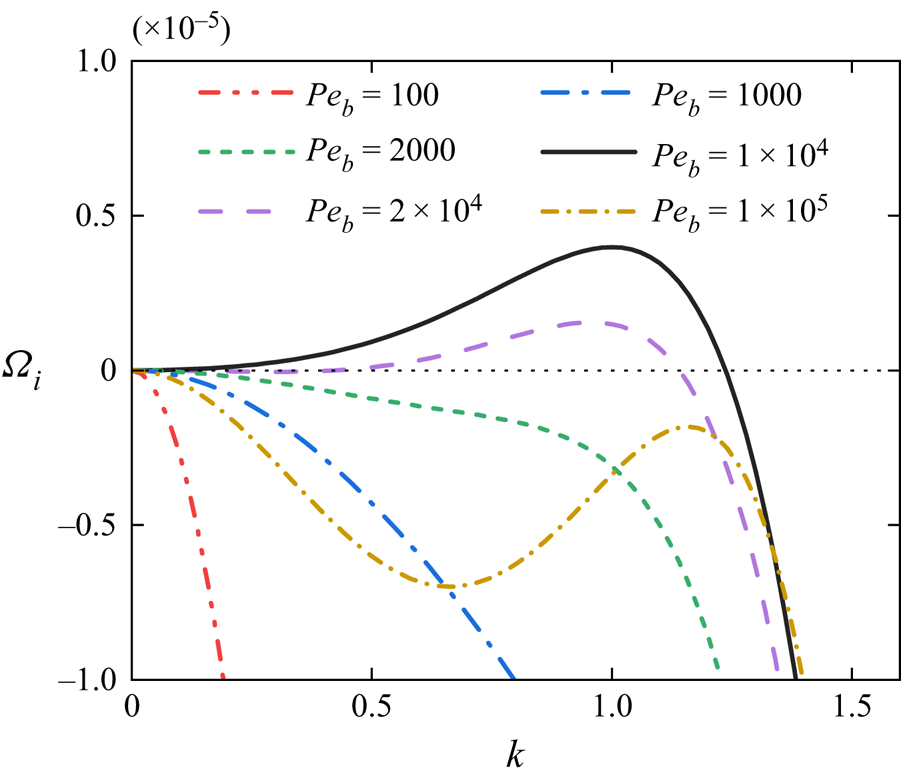
Figure 11 illustrates the effect of bulk diffusivity  $Pe_{b}$ on the growth rates of the perturbations. It suggests that the bulk diffusivity of the surfactant plays a non-monotonic role in the linear instability of the film. When
 $Pe_{b}$ is small, e.g.
 $Pe_{b} = 100$, the film is linearly stable. This is attributed to the stronger diffusivity of the bulk surfactant as
 $Pe_{b}$ decreases. It tends to enhance the uniformity of the bulk surfactant distribution. Due to the presence of the adsorption/desorption process, the concentration distribution of surface surfactant can also be improved, which acts to make the film stable. As
 $Pe_{b}$ is increased from 100 to
 $1\times 10^{4}$, the diffusivity of the bulk surfactant is weakened, and the film tends to become unstable. However, as
 $Pe_{b}$ is further increased, e.g.
 $Pe_{b} = 2\times 10^{4}, 1\times 10^{5}$, the growth rates of the perturbations decrease and the film finally becomes linearly stable again. Physically, this is caused by the sweeping effect of the base flow on the phase shift between
 $\hat {J}_{b}$ and
 $\hat {\varGamma }$. As listed in table 2, the value of phase shift is greater than
 $90^{\circ }$, and it increases as
 $Pe_{b}$ is further increased. This indicates that there is an adsorption/desorption flux at the trough/crest of the
 $\hat {\varGamma }$ perturbation wave, which acts to improve the concentration distribution of the surface surfactant and make the film become stable.
The dominant growth rate versus wavenumber  $k$ of a film driven by an axial body force under the influence of bulk diffusivity
 $Pe_{b}$. The parameters used here are
 $Bo=1$,
 $\tau =0$,
 $R_{b}=10$ and
 $Bi = 0.1$. Other parameters take the same values as in figure 2.

The phase shift between the perturbed adsorption/desorption flux  $\hat {J}_{b}$ and the perturbed surface concentration
 $\hat {\varGamma }$ for various
 $Pe_{b}$ at
 $k=0.15$. Other parameters remain the same as in figure 11.

4.4. The film under an interfacial shearing force
In this section, the linear instability of film flow driven by an interfacial shearing force is considered. Figure 12(a) demonstrates the growth rate versus wavenumber  $k$ for various solubility
 $R_{b}$. Similar to the results presented in figure 9(a), the growth rate curve is close to that of the insoluble case when
 $R_{b}$ is large, e.g.
 $R_{b} = 10.0$. As
 $R_{b}$ is decreased from 10 to 3, the instability of the film flow is dominated by the interface mode according to the trace-back method, and the growth rates of long-wave perturbations (
 $k\ll 1$) are augmented. This is in line with the long-wave results in figure 6. However, the situation is reversed as wavenumber
 $k$ becomes larger. The growth rates for the perturbations with finite wavelength decrease along
 $R_{b}$ and so do the cut-off wavenumbers. When
 $R_{b}$ becomes small enough, e.g.
 $R_{b}^{(c)}= 2.389$ for current parameter setting, the film instability is dominated by the surfactant mode instead of the interface mode. As
 $R_{b}$ is decreased to 1.0 and 0.6, the results indicate that both growth rates and the cut-off wavenumbers are reduced, and the film even becomes stable. However, similar to film flow driven by an axial body force, as
 $R_{b}$ is further decreased below 0.519, the surfactant mode is weakened by solubility and the interface mode becomes dominant again. As a result, the growth rates of the film increase and the film eventually becomes unstable again with an increase of solubility, as the curves with
 $R_{b}=0.1$ and 0.01. Figure 12(b) presents the influence of sorption kinetics
 $Bi$ on the linear instability of film flow. According to the trace-back method, we know that the film instability is dominated by the surfactant mode. It can be seen that the growth rates are increased with increasing
 $Bi$ as
 $k\ll 1$. This indicates that
 $Bi$ acts to destabilize the film with long-wave perturbations, as mentioned in the previous section. However, for the perturbation with finite wavenumber
 $k$,
 $Bi$ tends to stabilize the film instead. This is similar to the role of
 $Bi$ in a film driven by an axial body force.
The dominant growth rate versus wavenumber  $k$ of a shear-driven film under the influence of
 $R_{b}$ and
 $Bi$. The results are obtained at
 $Bo=0$ and
 $\tau =1$. (a) Comparison of the growth rates of different
 $R_{b}$ with
 $Bi=0.1$ and
 $Pe_{b}=100$. (b) Comparison of the growth rates of different
 $Bi$ with
 $R_{b}=1.5$ and
 $Pe_{b}=100$. Other parameters take the same values as in figure 2.

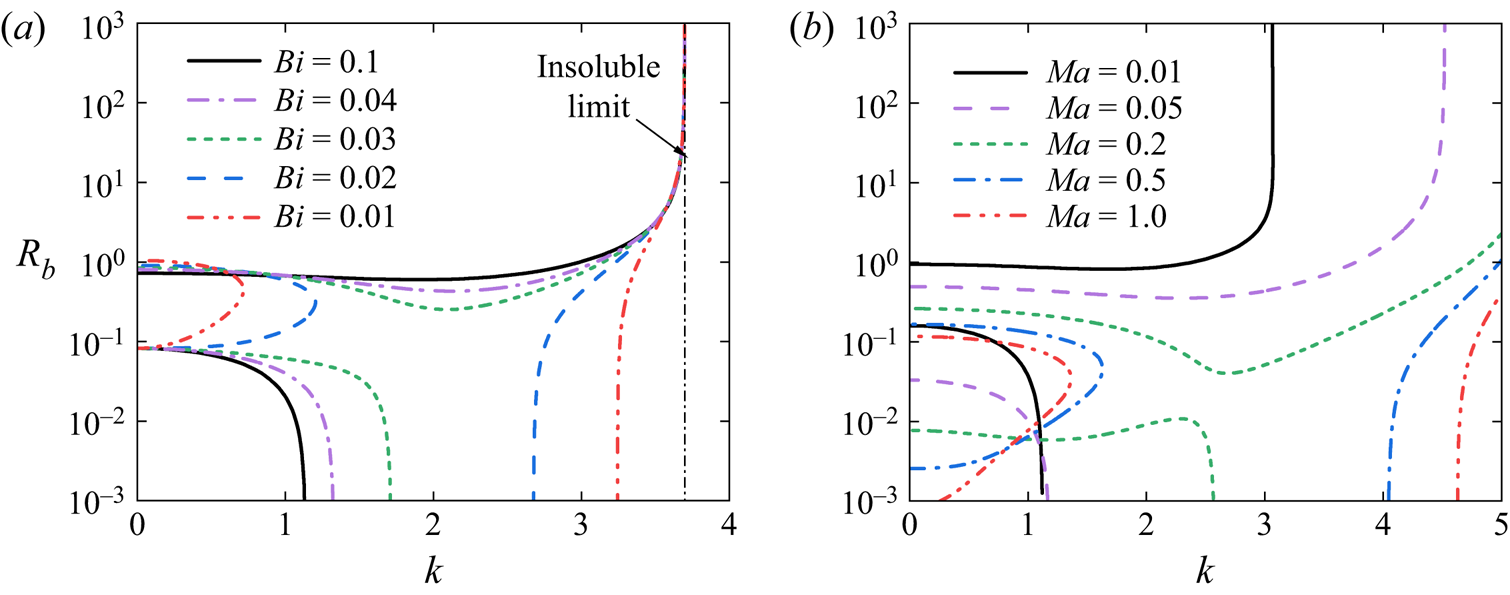
In figure 13(a), the neutral instability curves on the  $k$ versus
 $R_{b}$ plane with various
 $Bi$ are presented. For
 $Bi = 0.1$, similar to film flow driven by an axial body force, there are two neutral branches and the plane is divided into three regions. However, unlike those presented in the previous section, the upper unstable region is attributed to both the surfactant mode and the interface mode. The lower unstable region still arises from the interface mode, and the stable region is located in the middle. As
 $Bi$ is decreased from 0.04 to 0.03, it is observed that the upper unstable regions have changed. This suggests that for the film with slightly soluble surfactant (
 $R_{b}>1.0$), the perturbations with long wavelength (
 $k \ll 1$) are suppressed with decreasing
 $Bi$. The opposite holds for the perturbations with finite wavelength (e.g.
 $k \approx 2.0$). However, as
 $Bi$ decreases, the lower unstable region tends to expand continuously. When
 $Bi$ becomes small enough, e.g.
 $Bi=0.02$ and
 $0.01$, the upper and lower unstable regions contact. The stable region in the middle is pinched off and degenerates into an island clinging to the
 $R_{b}$ axis. This stable island shrinks as
 $Bi$ decreases further. In the limit of the insoluble case with negligible sorption kinetics, i.e.
 $Bi\rightarrow 0$, the island vanishes and the unstable region takes up an area between
 $k=0$ and
 $k=3.698$, which is the cut-off wavenumber of the corresponding problem with insoluble surfactant. Figure 13(b) shows the effect of Marangoni number
 $Ma$ on the neutral instability. For
 $Ma=0.01$, similar to figure 13(a), two unstable regions can be identified. As
 $Ma$ is increased from 0.05 to 0.2, the upper unstable regions are expanded. This suggests that the Marangoni effect tends to destabilize the film with slightly soluble surfactant
 $(R_{b}>1.0)$. However, for the lower unstable region, it can be seen that the Marangoni effect acts to stir the instability of perturbations with finite wavelength. As
 $Ma$ is increased further to 0.5 and 1.0, similar to figure 13(a), the upper and lower unstable regions contact. The stable region in the middle is pinched off, which leads to the appearance of a stable island as well. The island shifts downwards with increasing
 $Ma$.
Neutral curves of a shear-driven film with various (a) sorption kinetics  $Bi$ and (b) Marangoni numbers
 $Ma$. The results are obtained with
 $Bo=0$ and
 $\tau =1$. The parameters take
 $Ma=0.02$ and
 $Pe_{b}=100$ in (a) and
 $Bi=0.1$ and
 $Pe_{b}=100$ in (b). The other parameters remain the same as in figure 2.

4.5. Interaction between soluble surfactant and base flow
In this section, film flow subjected to a combination of the axial body force and the interfacial shearing force is considered. Wei (Reference Wei2007) has demonstrated that a planar falling film with insoluble surfactant can be stabilized when the axial body force and the interfacial shearing force are in the opposite directions. For soluble surfactant, the situation can be more intricate, since the distribution of the surface surfactant will be influenced by the surfactant transport in the bulk.
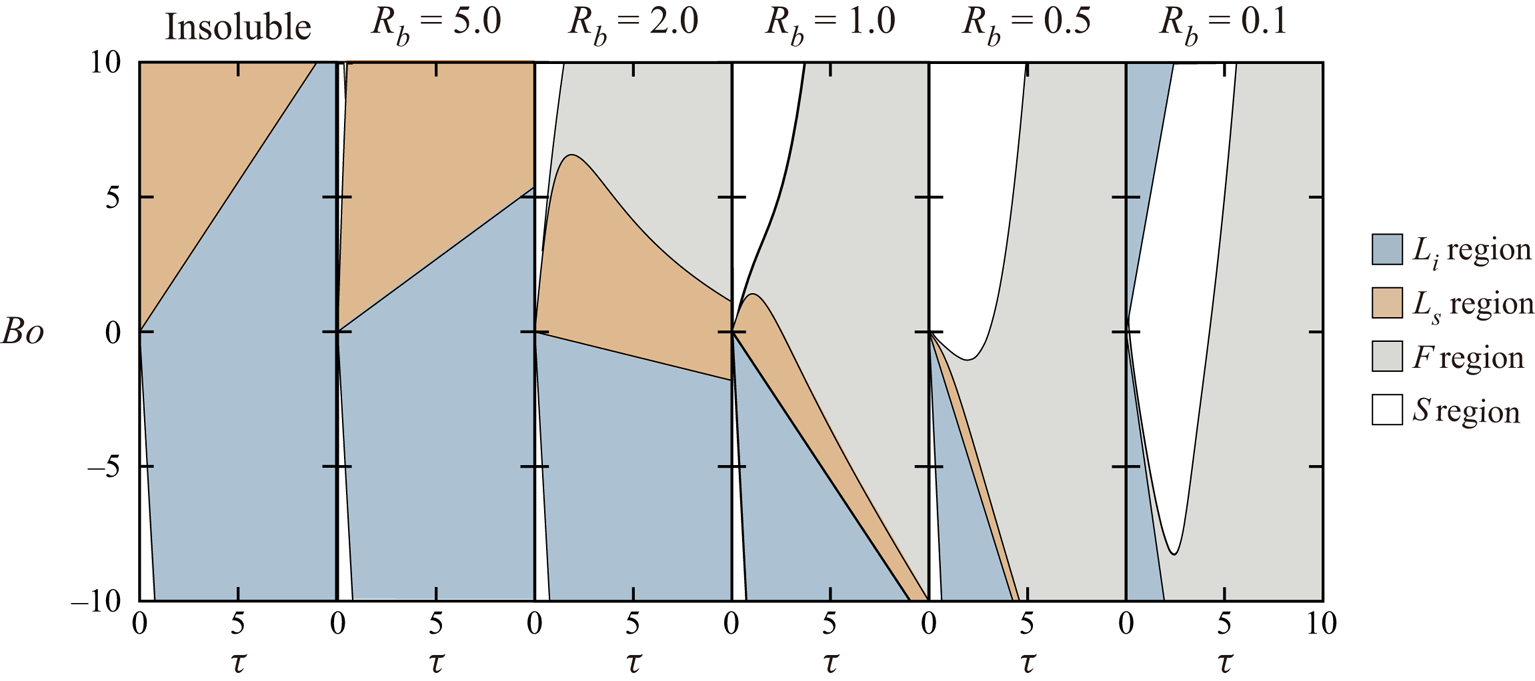
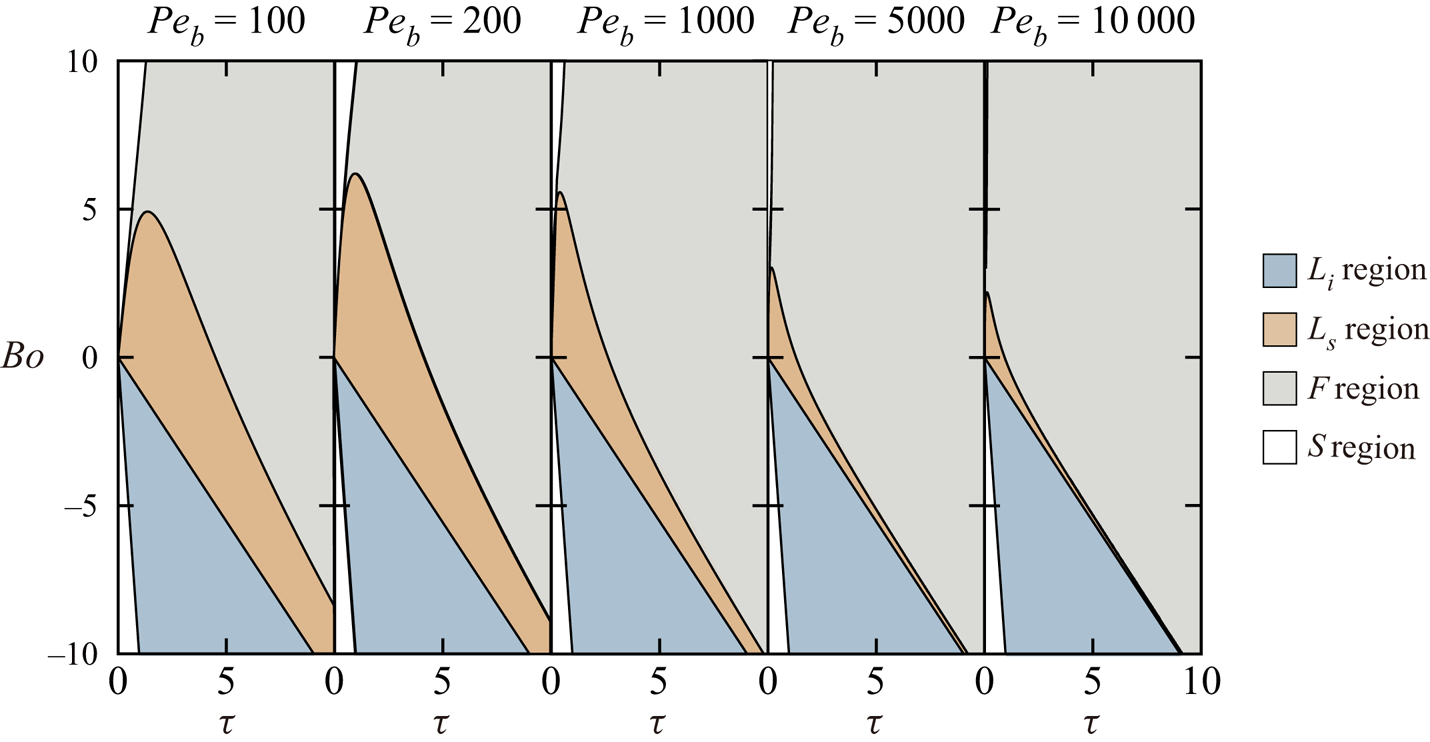
Figure 14 depicts the neutral curves on the  $\tau$ versus
 $Bo$ plane with various
 $R_{b}$. The plane is divided into four regions, which are long-wave unstable region attributed to the interface mode (denoted as
 $L_i$), long-wave unstable region attributed to the surfactant mode (denoted as
 $L_s$), finite-wave unstable region (denoted as
 $F$) and linearly stable region (denoted as
 $S$). For the film contaminated with insoluble surfactant, it is susceptible to long-wave instability. A linearly stable
 $S$ region can be detected, where film is subjected to a strong axial body force and a weak shearing force in opposite directions. When the soluble surfactant is considered, the unstable regions dominated by long-wave instability (
 $L_{i}$ and
 $L_{s}$ regions) tend to shrink with decreasing
 $R_{b}$. Further, new
 $F$ region and
 $S$ region emerge simultaneously. The new
 $S$ region is located in the upper quadrant and enlarges with decreasing
 $R_{b}$. This suggests that the surfactant solubility can stabilize a film subjected to an axial body force and a shearing force in the same direction. This is totally different from that of the problem with insoluble surfactant. In the situation where
 $R_{b} = 0.1$, the
 $L_{s}$ region nearly disappears, and the aforementioned
 $S$ region, which used to be stable with insoluble surfactant, becomes unstable. As
 $R_{b}$ is decreased further, solubility of the surfactant becomes very strong. It is conceivable that the concentration perturbation of surface surfactant would be mitigated by adsorption/desorption flux. The film would be destabilized due to the presence of the surface tension irrespective of the base flow. Therefore, it can be concluded that surfactant with intermediate solubility can achieve the best stabilizing effect for film flow.
Unstable regions on the  $(\tau,Bo)$ plane for various solubilities
 $R_{b}$. The parameters adopted here are
 $a = 0.9$,
 $Ma = 0.02$,
 $\bar {\varGamma }=0.4$,
 $Bi=0.1$,
 $Pe_{b}=100$ and
 $Pe_{s}=1\times 10^6$. The sign of
 $Bo$ or
 $\tau$ is positive, when the direction of the axial body force or the interfacial shearing force is downward. In the first panel for insoluble surfactant, when
 $\tau =0$, the film is linearly unstable caused by the surfactant mode. This is consistent with the results presented in figure 3 based on long-wave approximation. Therefore, there is a neutral curve immediately adjacent to the axis with
 $Bo$ less than zero, which distinguishes the unstable region caused by the surfactant mode, i.e.
 $L_{s}$ region, from the stable region.

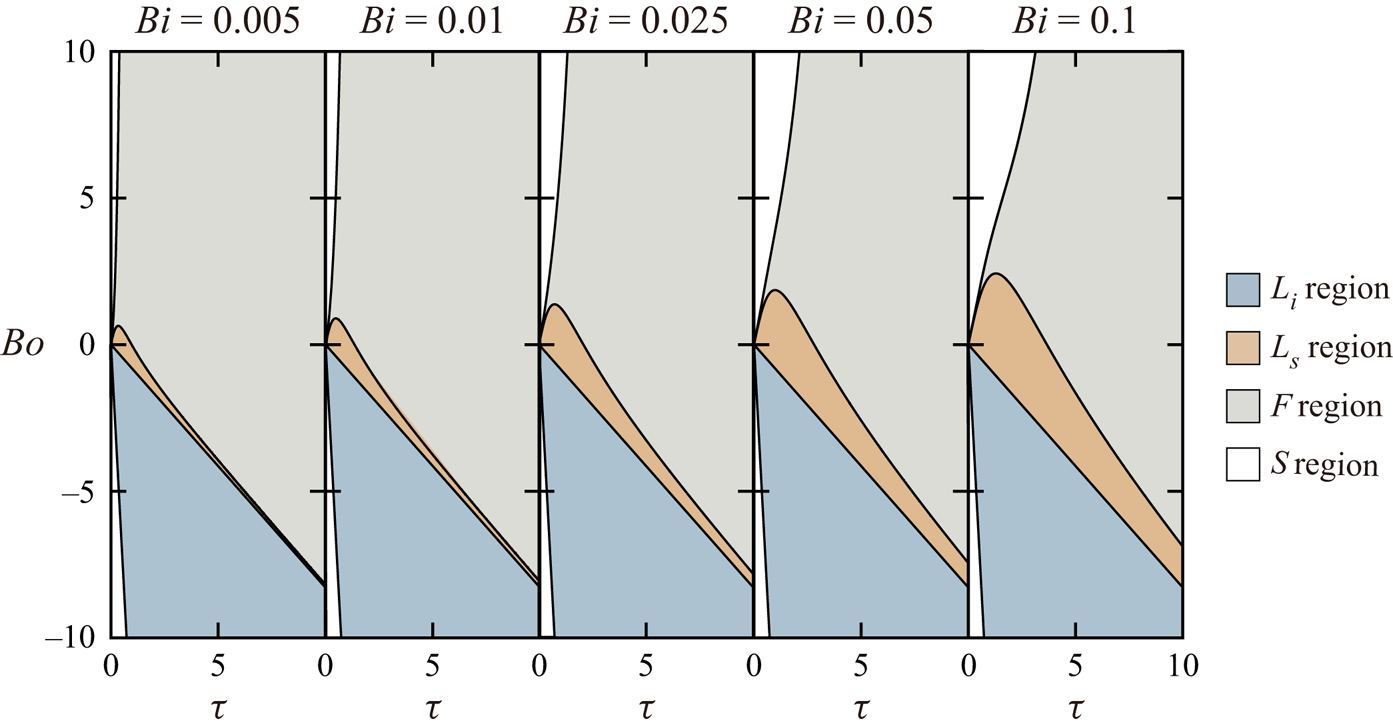
Figure 15 demonstrates the effect of sorption kinetics  $Bi$ on the neutral curves. As
 $Bi$ is increased, the
 $L_{i}$ region tends to have little change. This is attributed to the fact that in the case of long-wave perturbation the instability of the interface mode is not affected by
 $Bi$ as shown in (3.2). However, the
 $L_{s}$ region expands with increasing
 $Bi$, which is due to the role of
 $f_{1}^{(Bi)}$ in (A34). Similarly, the
 $S$ region enlarges with an increase of
 $Bi$. Figure 16 demonstrates the influence of bulk diffusivity
 $Pe_{b}$ on the neutral curves. Similar to figure 15,
 $Pe_{b}$ has no impact on the
 $L_{i}$ region because of the absence of
 $Pe_{b}$ in
 $c_{1}$ of the long-wave interface mode. However, it plays a non-monotonic role in the
 $L_{s}$ region. As shown in figure 16, when
 $Pe_{b}$ is increased, the
 $L_{s}$ region firstly enlarges, reaching its maximum area at intermediate
 $Pe_{b}$, and then shrinks. This indicates that surfactant with either small or large
 $Pe_{b}$ contributes to stabilizing the perturbations with long wavelength. Moreover, in figure 16, the
 $S$ region shrinks with increasing
 $Pe_{b}$. This may indicate that strong bulk diffusivity favours the linear stabilization of film flow.
Unstable regions on the  $(\tau,Bo)$ plane for various sorption kinetics
 $Bi$. The parameters adopted here are
 $a = 0.9$,
 $Ma = 0.02$,
 $\bar {\varGamma }=0.4$,
 $R_{b}=1.2$,
 $Pe_{b}=100$ and
 $Pe_{s}=1\times 10^6$.

Unstable regions on the  $(\tau,Bo)$ plane for various diffusivities
 $Pe_{b}$. The parameters adopted here are
 $a = 0.9$,
 $Ma = 0.05$,
 $\bar {\varGamma }=0.4$,
 $R_{b}=1.0$,
 $Bi=0.1$ and
 $Pe_{s}=1\times 10^6$.

5. Conclusion
In this study, we consider a film coating inside a rigid tube and laden with soluble surfactant. The flow is driven by an axial body force or an interfacial shearing force. The linear instability of the film with soluble surfactant subjected to various base flows is examined comprehensively. The problem is solved by long-wave approximation analysis and the spectral collocation method with Chebyshev polynomials. Two modes, which dominate the film instability, are identified and referred to as the interface mode and the surfactant mode, respectively. The effects of solubility  $R_{b}$, sorption kinetics
 $Bi$ and bulk diffusivity
 $Pe_{b}$ on the linear instability of the film are discussed while ignoring the effect of inertia. For a quiescent film, they play a destabilizing role, which mitigate the perturbation of the surface surfactant and weaken the stabilizing effect of the Marangoni force.
When the film flow is driven by an axial body force (e.g. gravity), its instability exhibits more intricate features. It is found that the solubility  $R_{b}$ plays a destabilizing role in the interface mode. This is attributed to the adsorption/desorption flux of the surfactant, which reinforces the effect of surface surfactant transport induced by the base flow. It promotes the uniformity of the surface surfactant and thereby inhibits the stabilizing role of the Marangoni force. However, solubility
 $R_{b}$ plays a stabilizing role on the surfactant mode instead. Consequently, the dual role of
 $R_{b}$ may lead to a window with intermediate
 $R_{b}$, where the film can be linearly stabilized. The sorption kinetics
 $Bi$ can destabilize the perturbations with long wavelength but stabilize the perturbations with finite wavelength, potentially leading to mid-wave instability. For bulk diffusivity
 $Pe_{b}$, its influence on the flow instability is non-monotonic, which results in maximum growth rates at intermediate
 $Pe_{b}$. Notably, both weak and strong diffusivity of the bulk surfactant can suppress the flow instability. If the base flow is driven by an interfacial shearing force, in addition to the above conclusions, a critical solubility
 $R_{b}^{(c)}$ can be found. When
 $R_{b}>R_{b}^{(c)}$, the adsorption/desorption flux is found to hinder the effect of the surface surfactant transport attributed to the base flow, and exacerbate the non-uniformity of the surface surfactant. Consequently, solubility intensifies the destabilizing role of the Marangoni force. When
 $R_{b}< R_{b}^{(c)}$, the adsorption/desorption flux dominates the surface surfactant transport. Although the Marangoni force plays a stabilizing role under this circumstance, its influence is weakened as
 $R_{b}$ decreases. For the surfactant mode, solubility is found to stabilize it on both sides of
 $R_{b}^{(c)}$. Furthermore, a more general problem involving both the axial body force and the interfacial shearing force is investigated. The neutral curves on the
 $\tau$ versus
 $Bo$ plane indicate that surfactant with strong sorption kinetics and diffusivity and intermediate solubility tends to have the best stabilizing effect on film flow. Particularly, soluble surfactant can stabilize film flow driven by the axial body force and the shearing force in the same direction, which cannot be achieved by insoluble surfactant.
The current work sheds light on the mechanism of the linear instability of a film coating inside a tube. A valuable addition to this work would be the analysis of absolute/convective instability, as it offers valuable insights into the growth of disturbances observed and contributes significantly to practical application in experimental investigations. Moreover, this work may serve as a cornerstone for the systematic investigation of nonlinear dynamics which is considered in our following investigation, particularly in the context of the closure process for pulmonary airways. Additionally, the effects of inertia and non-axisymmetric perturbations on the instability are not clear yet. Further investigations into these problems are also of significance.
Acknowledgements
The authors would like to extend their heartfelt appreciation to the reviewers for their constructive comments and insightful suggestions. We would like to give special thanks to one of the reviewers, as she/he pointed out the potential limitations of the temporal instability analysis and provided guidance for our future work.
Funding
The authors acknowledge the support from NSFC grant no. 12072175.
Declaration of interests
The authors report no conflict of interest.
Appendix A. The long-wave approximation analysis process
A.1. Geometrical parameters
The geometrical parameters  $A_{1}$–
 $A_{6}$, which are involved and correlated with the unperturbed radius of the liquid–air interface
 $r=a$, can be expressed as
 \begin{equation} \left.\begin{gathered} A_{1} = 1-a^{2}+2a^2\ln a,\quad A_{2} = 1-a^{2}-2a^2\ln a,\\ A_{3} = 1-4a^{2}+3a^{4}-4a^{4}\ln a,\quad A_{4} = 1-a^{4}+4a^4\ln a, \\ A_{5} = 1+4a^{2}-5a^{4}-4a^{4}\ln a,\quad A_{6} = 1-a^{4}+4a^{2}\ln a. \end{gathered}\right\} \end{equation}
In this study,  $A_{1}{-}A_{6}$ are positive definite over
 $0< a<1$. Moreover, the combinations of these parameters involved in this investigation, i.e.
 $A_{4}-3A_{6}$ and
 $4a^{2}-A_{2}$, are also positive when
 $a>0.53$. It can be easily satisfied since we focus on the instability of a thin liquid film.
A.2. Long-wave approximation expansion
Substituting the expression (3.1) into (2.16)–(2.19a–c), the items with the same order of  $k$ are equated separately. For the leading order
 $O(1)$, the
 $r$-momentum equation and the normal force balance at the interface read
 \begin{equation} \mathrm{D}\hat{p}_{0}\left(r\right) =0,\quad \hat{p}_{0}\left(a\right)=\frac{\bar{\gamma}}{a^2}\hat{\eta}_{0}+ \frac{Ma}{a\left(1-\bar{\varGamma}\right)}\hat{\varGamma}_{0}, \end{equation}
which yield a constant pressure across the film:
 \begin{equation} \hat{p}_{0}\left(r\right)=\frac{\bar{\gamma}}{a^2}\hat{\eta}_{0} + \frac{Ma}{a\left(1-\bar{\varGamma}\right)}\hat{\varGamma}_{0}. \end{equation}
Similarly, the  $z$-momentum equation and corresponding boundary conditions are
 $$\begin{gather} \nabla^{2}\hat{\omega}_{0}=0, \end{gather}$$
 $$\begin{gather}\mathrm{D}\hat{\omega}_{0}\left(a\right)+\mathrm{D}^2\bar{\omega}\left(a\right)\hat{\eta}_{0}=0,\quad \hat{\omega}_{0}\left(1\right) = 0. \end{gather}$$
The expression of  $\hat {\omega }_{0}(r)$ can be derived by integrating the above equations (A4). Then, we have
 \begin{equation} \hat{\omega}_{0}\left(r\right) ={-}a\mathrm{D}^{2}\bar{\omega}\left(a\right)\ln r. \end{equation}
Substituting (A5) into the following continuity equation and no-slip condition at the tube wall ( $r=1$):
 \begin{equation} \mathrm{D} \hat{u}_{0}\left(r\right) +\frac{\hat{u}_{0}\left(r\right) }{r} + \mathrm{i} \hat{\omega}_{0}\left(r\right) = 0,\quad \hat{u}_{0}\left(1\right) = 0, \end{equation}
we can derive  $\hat {u}_{0}(r)$ as
 \begin{equation} \hat{u}_{0}\left(r\right)=\mathrm{i}\mathrm{D}^{2}\bar{\omega}\left(a\right) \hat{\eta}_{0}\frac{1-r^{2}+2r^{2}\ln r}{4r}. \end{equation}
Substituting (A7) into the kinematic condition at the liquid–air interface  $\hat {u}_{0}=\mathrm {i}(\bar {\omega }(a)-c_{0})\hat {\eta }_{0}$, we have
 \begin{equation} \left(c_{0}-\bar{\omega}\left(a\right)+\frac{A_{1}}{4}\mathrm{D}^{2}\bar{\omega}(a)\right)\hat{\eta}_{0}=0. \end{equation}
Similarly, for the leading order  $O(1)$, the governing equation and boundary conditions of the bulk surfactant
 $\hat {C}_{0}$ can be derived as
 \begin{equation} \nabla^{2}\hat{C}_{0}=0,\quad \mathrm{D}\hat{C}_{0}\left(a\right) = \hat{J}_{b0},\quad \mathrm{D}\hat{C}_{0}\left(1\right)=0. \end{equation}
By integrating the above equation (A9a–c), we have
 \begin{equation} \hat{C}_{0} = \frac{\hat{\varGamma}_{0}}{K_{b}(1-\bar{\varGamma})^{2}}. \end{equation}
So far, it seems that the leading order cannot give adequate constraints for  $\hat {\varGamma }_{0}$ and
 $\hat {C}_{0}$. Therefore, we turn to the first order,
 $O(k)$, equations. In the reference frame travelling with
 $c$, the corresponding transport equation of the surface surfactant reads
 \begin{equation} SF^{\left(adv\right)}_{1}+SF^{\left(per\right)}_{1} = SF^{\left(dif\right)}_{1}+\hat{J}_{b1}, \end{equation}
where
 \begin{equation} \left.\begin{gathered} SF^{(adv)}_{1} = \mathrm{i}(\bar{\omega}(a)-c_{0})\hat{\varGamma}_{0},\quad SF^{(dif)}_{1} = 0,\\ SF^{(per)}_{1} = \bar{\varGamma}\hat{u}_{0}(a)/a + \mathrm{i} \bar{\varGamma} (\hat{\omega}_{0}(a)+\mathrm{D}\bar{\omega}(a)\hat{\eta}_{0}),\\ \hat{J}_{b1}= Bi K_{b}(1-\bar{\varGamma})\hat{C}_{1} (a)-Bi(K_{b}\bar{C}+1)\hat{\varGamma}_{1}. \end{gathered}\right\} \end{equation}
The governing equation and boundary conditions of the bulk surfactant  $\hat {C}_{1}$ at the first order
 $O(k)$ can be derived as
 $$\begin{gather} \nabla^{2}\hat{C}_{1}(r) = \mathrm{i} Pe_{b}(\bar{\omega}(r)-c_{0}) \hat{C}_{0}, \end{gather}$$
 $$\begin{gather}\mathrm{D}\hat{C}_{1}(a)=Pe_{b}\beta\hat{J}_{b1},\quad\mathrm{D}\hat{C}_{1}(1)=0. \end{gather}$$
Here, by integrating (A13a) and combining with the boundary conditions (A13b), we get
 \begin{equation} \hat{J}_{b1}={-}\mathrm{i}\frac{2\bar{q}-(1-a^{2})c_{0}}{2a\beta}\hat{C}_{0}, \end{equation}
where 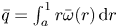 $\bar {q}=\int _{a}^{1}r\bar {\omega }(r)\,\textrm {d} r$. Substituting (A5), (A7) and (A14) into (A11), then we have
 \begin{equation} \left(\tau-\frac{A_{2}}{4a}\mathrm{D}^{2}\bar{\omega}(a)\right)\bar{\varGamma}\hat{\eta}_{0} =\left(\bar{\omega}-c_{0}\right)\bar{\varGamma}_{0}+\frac{2\bar{q}-(1-a^{2})c_{0}}{2a\beta} \hat{C}_{0}. \end{equation}
Thus, (A8), (A10) and (A15) are the basic equations for the long-wave approximation expansion. In the following, two modes, defined as the interface mode and the surfactant mode, are derived.
A.3. The interface mode
According to (A8), (A10) and (A15), the leading order  $O(1)$ solutions of the interface mode, the wave celerity
 $c_{0}$, the perturbation of the surface surfactant
 $\hat {\varGamma }_{0}$ and the bulk surfactant
 $\hat {C}_{0}$ can be derived by setting
 $\hat {\eta }_{0}=1$ and
 $\hat {\eta }_{1}=\hat {\eta }_{2}=0$:
 $$\begin{gather} c_{0} = \bar{\omega}(a) -\frac{A_{1}}{4}\mathrm{D}^{2}\bar{\omega} (a), \end{gather}$$
 $$\begin{gather}\hat{\varGamma}_{0} =\frac{ (4a\tau - A_{2} \mathrm{D}^{2}\bar{\omega}(a)) \bar{\varGamma}(1-\bar{\varGamma})^{2}}{a A_{1} \mathrm{D}^{2}\bar{\omega}(a) (1-\bar{\varGamma})^{2} + 4(\bar{q}- (1-a^{2})c_{0}/2)/R_{b}}, \end{gather}$$
 $$\begin{gather}\hat{C}_{0}(r) = \frac{\hat{\varGamma}_{0}}{K_{b}(1-\bar{\varGamma})^{2}}. \end{gather}$$
By definition,  $c_{0}$ is a real number indicating marginal stability. Hence, the instability of the interface mode is to be determined by
 $c_{1}$. By integrating the governing equation and boundary equations of
 $\hat {\omega }_{1}$,
 $$\begin{gather} \nabla^{2} \hat{\omega}_{1}\left(r\right) = \mathrm{i} \hat{p}_{0}, \end{gather}$$
 $$\begin{gather}\mathrm{D}\hat{\omega}_{1}\left(a\right)=\mathrm{i}\frac{Ma}{1-\bar{\varGamma}}\hat{\varGamma}_{0} -\mathrm{D}^{2}\bar{\omega}\left(a\right)\hat{\eta}_{1},\quad \hat{\omega}_{1}\left(1\right)=0, \end{gather}$$
we have
 \begin{equation} \hat{\omega}_{1}\left(r\right) ={-}\mathrm{i}\hat{p}_{0}\frac{1-r^{2}+2a^{2}\ln r}{4}+\mathrm{i} a \frac{Ma\hat{\varGamma}_{0}}{1-\bar{\varGamma}}\ln r. \end{equation}
Combining the continuity equation and no-slip condition at the wall,
 \begin{equation} \mathrm{D}\hat{u}_{1}\left(r\right)+\frac{\hat{u}_{1}\left(r\right)}{r}+\mathrm{i}\hat{\omega}_{1}\left(r\right)=0, \quad \hat{u}_{1}\left(1\right)=0, \end{equation}
the expression of  ${u}_{1}$ is
 \begin{equation} \hat{u}_{1}(r)=\hat{p}_{0}\frac{(r^{2}-1)(r^{2}-1+2a^{2})-4a^{2}r^{2}\ln r}{16r}+ \frac{aMa\hat{\varGamma}_{0}}{1-\bar{\varGamma}}\frac{1-r^{2}+2r^{2}\ln r}{4r}. \end{equation}
Substituting (A20) into the first-order  $O(k)$ kinematic condition:
 \begin{equation} \hat{u}_{1}=\mathrm{i}\left(\bar{\omega}\left(a\right)-c_{0}\right)\hat{\eta}_{1}-\mathrm{i} c_{1}\hat{\eta}_{0}, \end{equation}
 $c_{1}$ of the interface mode can be expressed as
 \begin{equation} c_{1}=\mathrm{i}\frac{A_{3}}{16a^{3}}\bar{\gamma}+ \mathrm{i}\frac{A_{4}Ma}{16a^{2}(1-\bar{\varGamma})}\hat{\varGamma}_{0}. \end{equation}
A.4. The surfactant mode
Similar to the derivation of the interface mode, the leading-order  $O(1)$ solutions of the surfactant mode, i.e. the wave celerity
 $c_{0}$, the perturbation of the surface surfactant
 $\hat {\varGamma }_{0}$ and the bulk surfactant
 $\hat {C}_{0}$ can be derived according to (A8), (A10) and (A15) by setting
 $\hat {\varGamma }_{0}=1$ and
 $\hat {\varGamma }_{1}=\hat {\varGamma }_{2}=0$:
 $$\begin{gather} c_{0}=\frac{aR_{b}(1-\bar{\varGamma})^{2} \bar{\omega}(a) + \bar{q}}{aR_{b}(1-\bar{\varGamma})^{2}+ (1-a^{2})/2}, \end{gather}$$
 $$\begin{gather}\hat{\eta}_{0}=0, \end{gather}$$
 $$\begin{gather}\hat{C}_{0} = \frac{1}{K_{b}(1-\bar{\varGamma})^{2}}. \end{gather}$$
To determine the system instability, we proceed to render the first-order  $O(k)$ solutions. According to (A17) and (A19a,b), we obtain
 $$\begin{gather} \hat{\omega}_{1}\left(r\right) ={-}\mathrm{i}\frac{Ma}{1-\bar{\varGamma}}\frac{1-r^{2}-2a^{2}\ln r}{4a}-a\mathrm{D}^{2} \bar{\omega}\left(a\right)\hat{\eta}_{1}\ln r, \end{gather}$$
 $$\begin{gather}\hat{u}_{1}(r) = \frac{Ma}{1-\bar{\varGamma}}\frac{(r^{2}-1) (r^{2}-1-2a^{2})+4a^{2}r^{2}\ln r}{16ar} +\mathrm{i} a \mathrm{D}^{2}\bar{\omega}\left(a\right)\hat{\eta}_{1}\frac{1-r^{2}+2r^{2}\ln r}{4r}. \end{gather}$$
Here,  $\hat {\eta }_{1}$ is determined by the combination of the first-order
 $O(k)$ kinematic conditions (A21), (A24a) and (A24b):
 \begin{equation} \hat{\eta}_{1}=\mathrm{i}\frac{Ma}{1-\bar{\varGamma}} \frac{A_{4}}{4a^{2}\left(4c_{0}+A_{1}\mathrm{D}^{2}\bar{\omega}\left(a\right) -4\bar{\omega}\left(a\right)\right)}. \end{equation}
For the perturbation of the bulk surfactant  $\hat {C}_{1}(r)$, it is derived via (A13a) and (A13b) as
 \begin{equation} \hat{C}_{1}\left(r\right) =\frac{\mathrm{i} \left(\bar{\omega}-c_{0}\right)}{Bi K_{b} \left(1-\bar{\varGamma}\right)}+\frac{\mathrm{i} \hat{C}_{0}}{64}Pe_{b}K\left(r\right), \end{equation}
where
 \begin{align} K\left(r\right) &= 16\left(a^2-r^2+2\ln r/a\right)c_{0}+16a \left[r^2-a^2-\left(1+r^{2}\right)\ln r+\left(1+a^{2}\right)\ln a\right]\tau \nonumber\\ &\quad + \left[\left(a^{2}-r^{2}\right)\left(r^{2}+9a^{2}-4\right) +8a^{2}\left(r^{2}\ln r - a^{2}\ln a\right) +4\left(2a^{2}-1\right)\ln r/a\right]Bo. \end{align}
To obtain  $c_{1}$, we turn to the advection–diffusion equation of the perturbed surface surfactant in the second order
 $O(k^{2})$:
 \begin{equation} SF^{\left(adv\right)}_{2}+SF^{\left(per\right)}_{2}=SF^{\left(dif\right)}_{2}+\hat{J}_{b2}, \end{equation}
with
 \begin{equation} \left.\begin{gathered} SF^{\left(adv\right)}_{2} ={-}\mathrm{i} c_{1}\hat{\varGamma}_{0},\quad SF^{\left(dif\right)}_{2} ={-}\hat{\varGamma}_{0}/Pe_{s},\\ SF^{\left(per\right)}_{2}=\bar{\varGamma}\hat{u}_{1}\left(a\right)/a + \mathrm{i} \bar{\varGamma} \left(\hat{\omega}_{1}(a)+\mathrm{D}\bar{\omega}(a)\hat{\eta}_{1}\right),\\ \hat{J}_{b2}= Bi K_{b}\left(1-\bar{\varGamma}\right)\hat{C}_{2} \left(a\right)-Bi\left(K_{b}\bar{C}+1\right)\hat{\varGamma}_{2}. \end{gathered}\right\} \end{equation}
Here,  $SF^{(adv)}_{2}$,
 $SF^{(per)}_{2}$,
 $SF^{(dif)}_{2}$ and
 $\hat {J}_{b2}$ are the four pathways for the transport of the surface surfactant in the second order
 $O(k^{2})$ based on the reference frame where the perturbation wave is stationary. The governing equation and boundary conditions for the bulk surfactant
 $\hat {C}_{2}$ are
 $$\begin{gather} \nabla^2 \hat{C}_{2}=\mathrm{i} Pe_{b}\left(\bar{\omega}-c_{0}\right)\hat{C}_{1}+ \hat{C}_{0}-\mathrm{i} Pe_{b}\hat{C}_{0}c_{1}, \end{gather}$$
 $$\begin{gather}\mathrm{D} \hat{C}_{2}\left(a\right)=Pe_{b}\beta_{b}\hat{J}_{b2},\quad \mathrm{D}\hat{C}_{2}\left(1\right)=0. \end{gather}$$
Integrating (A30a) with the constant determined by the boundary conditions (A30b), we have
 \begin{equation} \hat{J}_{b2} =\mathrm{i} \frac{1-a^{2}}{2aR_{b}\left(1-\bar{\varGamma}\right)^{2}}c_{1} +f_{1}^{(Pe_{b})}+ f_{1}. \end{equation}
Here,
 \begin{align} f_{1}^{(Pe_{b})}&={-}\frac{1-a^{2}}{2aPe_{b}R_{b}\left(1-\bar{\varGamma}\right)^{2}},\end{align}
 \begin{align} f_{1}&={-}\frac{\mathrm{i}}{a}\int_{a}^{1}r\left(\bar{\omega}(r)-c_{0}\right)\hat{C}_{1}\,{\rm d} r \nonumber\\ &=\underbrace{-\frac{ \left((1-a^{2})\bar{\omega}\left(a\right)-2\bar{q}\right)^{2} \left(1-\bar{\varGamma}\right)} {Bi\left(1-a^{2}+2aR_{b}\left(1-\bar{\varGamma}\right)^{2}\right)^{2}}}_{f^{(Bi)}_{1}} + \underbrace{\frac{Pe_{b}S}{64aR_{b}\left(1-\bar{\varGamma}\right)^{2}}}_{f^{(S)}_{1}} \end{align}
and  $S = \int _{a}^{1}r(\bar {\omega }(r)-c_{0})K(r)\,\textrm {d} r$. Substituting (A24a), (A24b) and (A31) into (A28),
 $c_{1}$ of the surfactant mode can be expressed as
 \begin{equation} c_{1}=\mathrm{i}\left(1+\frac{1-a^2}{2aR_{b}\left(1-\bar{\varGamma}\right)^{2}}\right)^{{-}1} \left(-\frac{1}{Pe_{s}} +f_{1}^{(Pe_{b})}+f_{1}^{(Bi)}+f_{1}^{(S)} - SF_{2}^{\left(per\right)}\right). \end{equation}
Here,  $SF_{2}^{(per)}$, which indicates the second-order O(
 $k^2$) advective transport of the surface surfactant by the perturbed flow, can be expressed as
 \begin{equation} SF_{2}^{\left(per\right)}=\mathrm{i}\bar{\varGamma}\left(\frac{A_{2}\mathrm{D}^{2}\bar{\omega} \left(a\right)}{4a}-\tau\right)\hat{\eta}_{1} +\frac{A_{5}Ma\bar{\varGamma}}{16a^{3}\left(1-\bar{\varGamma}\right)}. \end{equation}
A.5. The quiescent film
When the film is assumed to be quiescent, i.e.  $Bo=0$ and
 $\tau =0$, we have
 $\bar {\omega } = \mathrm {D}^{2}\bar {\omega } = 0$. According to (A8), by setting
 $\hat {\eta }_{0}=1$ and
 $\hat {\eta }_{1}=\hat {\eta }_{2}=0$, we have
 \begin{equation} c_{0}=0.\end{equation}
Clearly  $c_{0}$ is real, and the instability of the system is to be determined by
 $c_{1}$ as follows:
 \begin{equation} c_{1}=\mathrm{i}\frac{A_{3}}{16a^{3}}\bar{\gamma}+\mathrm{i}\frac{A_{4}Ma}{16a^{2} (1-\bar{\varGamma})}\hat{\varGamma}_{0}. \end{equation}
Since we consider the quiescent film, (A15) is fulfilled naturally. Therefore,  $\hat {\varGamma }_{0}$ has to be determined by the second-order
 $O(k^{2})$ equations of the surfactant. Combining (A28) and (A30), we have
 \begin{align} & \mathrm{i}\left(1+\frac{1-a^{2}}{2aR_{b}\left(1-\bar{\varGamma}\right)^{2}}\right) \hat{\varGamma}_{0}c_{1} \nonumber\\ &\quad =\frac{A_{4}\bar{\gamma}\bar{\varGamma}}{16a^{4}}+ \left(\frac{1}{Pe_{s}}+\frac{1-a^{2}}{2aPe_{b}R_{b}\left(1-\bar{\varGamma}\right)^{2}} +\frac{A_{5}Ma\bar{\varGamma}}{16\left(1-\bar{\varGamma}\right)a^{3}}\right)\hat{\varGamma}_{0}. \end{align}
Solving (A37) and (A38) yields
 \begin{equation} \hat{\varGamma}_{0} = \frac{-d_{2}\pm\sqrt{d_{2}^{2}-4d_{1}d_{3}}}{2d_{1}},\end{equation}
where parameters  $d_{1}$,
 $d_{2}$ and
 $d_{3}$ are positive with the following expressions:
 \begin{align} \left.\begin{gathered} d_{1} = \frac{A_{4}Ma}{1-\bar{\varGamma}}\frac{\left(1-a^{2}\right)/R_{b}+2a \left(1-\bar{\varGamma}\right)^{2}}{32a^{3}\left(1-\bar{\varGamma}\right)^{2}},\\ d_{2} = \frac{1}{Pe_{s}}+\frac{1-a^{2}}{2aPe_{b}R_{b}\left(1-\bar{\varGamma}\right)^{2}} +\frac{A_{5}Ma\bar{\varGamma}}{16a^{3}\left(1-\bar{\varGamma}\right)} + \frac{A_{3}\bar{\gamma}}{32a^{4}}\frac{\left(1-a^{2}\right)/R_{b}+2a \left(1-\bar{\varGamma}\right)^{2}}{\left(1-\bar{\varGamma}\right)^{2}},\\ d_{3}= \frac{A_{4}\bar{\gamma}\bar{\varGamma}}{16a^{4}}. \end{gathered}\right\} \end{align}
If the right-hand side of (A39) takes the ‘ $+$’ sign, (A37) may degenerate to
 $\mathrm {i} A_{3}\bar {\gamma }/16a^{3}$ as
 $R_{b}\gg 1$ and
 $Ma\ll 1$. This corresponds to
 $c_{1}$ of the interface mode for clean interface. Therefore, it can be classified as the interface mode. If (A39) takes the ‘
 $-$’ sign, it corresponds to the surfactant mode. The corresponding
 $c_{1}$ yields
 $-\mathrm {i}/Pe_{s}$ as
 $R_{b}\gg 1$ and
 $Ma\ll 1$. According to numerical verification, the discriminant of (A39) is always non-negative under the current setting of the problem. It denotes that
 $\hat {\varGamma }_{0}$ is in opposite phase with
 $\hat {\eta }_{0}$. Therefore, the interface mode is the most dangerous mode, which determines the instability of the quiescent film.
Appendix B. Solutions near the critical solubility
As mentioned in § 3.3, the failure of the long-wave approximation is attributed to the fact that the adsorption/desorption flux offsets the effect of the surface surfactant transported by the base flow at  $R_{b}^{(c)}$. Thus, the surface surfactant transported by the perturbed flow makes the surfactant infinitely accumulate/deplete. According to (A16b) or (A25), the critical solubility
 $R_{b}^{(c)}$ can be derived by letting the denominators be zero, which reads
 \begin{equation} R_{b}^{\left(c\right)} =\frac{\left(1-a^{2}\right)\left(4\bar{\omega}\left(a\right)-A_{1} \mathrm{D}^{2}\bar{\omega}\left(a\right)\right) -2\bar{q}}{2aA_{1}\mathrm{D}^{2}\bar{\omega}\left(a\right)\left(1-\bar{\varGamma}\right)^2}. \end{equation}
To resolve this issue, Frenkel & Halpern (Reference Frenkel and Halpern2002) and Kalogirou & Blyth (Reference Kalogirou and Blyth2019) suggested expanding the variables by  $k^{1/2}$ near the critical solubility. That is,
 \begin{align} & \left\{\hat{\eta},c,\hat{u}\left(r\right),\hat{\omega}\left(r\right), \hat{p}\left(r\right),\hat{\varGamma},\hat{C}\left(r\right)\right\} \nonumber\\ &\quad =\left\{\hat{\eta}_{0},c_{0},\hat{u}_{0}\left(r\right),\hat{\omega}_{0} \left(r\right),\hat{p}_{0}\left(r\right),\hat{\varGamma}_{0}/\sqrt{k}, \hat{C}_{0}\left(r\right)/\sqrt{k}\right\} \nonumber\\ &\qquad +k^{1/2}\left\{\hat{\eta}_{1},c_{1},\hat{u}_{1}\left(r\right), \hat{\omega}_{1}\left(r\right),\hat{p}_{1}\left(r\right),\hat{\varGamma}_{1}/\sqrt{k}, \hat{C}_{1}\left(r\right)/\sqrt{k}\right\}+O\left(k^{3/2}\right). \end{align}
Substituting the above equation (B2) into the linearized governing equations and boundary conditions (2.16)–(2.19a–c), we can derive  $(c_{0},c_{1})$ as
 $$\begin{gather} c_{0}=\bar{\omega}\left(a\right)-\frac{A_{1}D^{2}\bar{\omega}\left(a\right)}{4}, \end{gather}$$
 $$\begin{gather}c_{1}={\pm}\frac{(1-\mathrm{i})}{8}\sqrt{\frac{A_{4}Ma\bar{\varGamma}\left(1-\bar{\varGamma}\right) \left(4a\tau-A_{2}D^{2}\bar{\omega}\left(a\right)\right)}{a^{2} \left((1-a^2)/R_{b}+2a\left(1-\bar{\varGamma}\right)^{2}\right)}}. \end{gather}$$
Thus, the instability of the film flow can be determined according to Im $(c_{1})$ as well.