INTRODUCTION
Mexico is considered one of the richest countries on Earth in terms of reptile and amphibian species; Mexican reptile (804) and amphibian (361) species account for c. 8% of the world's total herpetofaunal species (García Reference García2006; Ochoa-Ochoa & Flores-Villela Reference Ochoa-Ochoa and Flores-Villela2006). The percentage of endemic species of Mexican herpetofauna is also relatively high (59%), however, 70% of endemic reptile species and 80% of the endemic amphibian species in Mexico have naturally reduced geographic distributions (Ochoa-Ochoa & Flores-Villela Reference Ochoa-Ochoa and Flores-Villela2006), conditions which make the study and conservation of this fauna a priority.
The geographic distribution of the Mexican herpetofauna is not homogeneous. For instance, the Pacific tropical lowlands, the Balsas Basin and the Central Depression of Chiapas contain a total of 301 herptile species (238 reptiles and 63 amphibians), which represent almost one-third of Mexican herpetofauna (Flores-Villela & Goyenechea Reference Flores-Villela, Goyenechea, Morrone and Llorente-Bousquets2003). Western Mexico is one of the regions richest in species and endemics, and important for the conservation of other Mexican terrestrial vertebrate species (Ceballos & García Reference Ceballos and García1995; Peterson & Navarro-Singüenza Reference Peterson and Navarro-Singüenza2000).
Despite this, the seasonally tropical dry forest (STDF hereafter) is subject to severe pressure, mainly from deforestation and land use change, making this ecosystem one of the most endangered in Mexico and globally (Trejo-Vazquez & Dirzo Reference Trejo-Vazquez and Dirzo2000; Miles et al. Reference Miles, Newton, DeFries, Ravilious, May, Blyth, Kapos and Gordon2006). Predictions of climate change impacts on Mexican forests and natural protected areas (NPAs) suggests that current STDF cover may increase in the future under drier and warmer conditions (Villers & Trejo-Vazquez Reference Villers and Trejo-Vazquez1998). The combined negative effects of climate change and deforestation on the STDF's biodiversity would be severe.
The study of the distribution patterns of endemic species is an important step towards implementing strategies for biodiversity conservation, since endemics reflect the biological uniqueness of specific natural areas and because taxa with restricted geographic distributions are more prone to extinction than widespread species (Donnelly & Crump Reference Donnelly and Crump1998; Lozano et al. Reference Lozano, Delgado and Aguirre2004).
There is a growing concern regarding the conservation status of amphibian species worldwide; they are more threatened and declining more rapidly than mammals or birds (Stuart et al. Reference Stuart, Chanson, Cox, Young, Rodrigues, Fischman and Waller2004; Beebee & Griffiths Reference Beebee and Griffiths2005). More than 40% of all amphibian species on Earth have dramatically reduced their populations, in some cases without any apparent reason (Corey & Waite Reference Corey and Waite2008). Proposed causal factors of the declines include habitat destruction and perturbation, overexploitation, pollution, pesticide use, introduced species, increased ultraviolet-B radiation (UV-B), disease and climate change (Blaustein & Wake Reference Blaustein and Wake1990; Houlahan et al. Reference Houlahan, Findlay, Schmidt, Meyer and Kuzmin2000; Blaustein & Kiesecker Reference Blaustein and Kiesecker2001; Parmesan Reference Parmesan2006; Whitfield et al. Reference Whitfield, Bell, Philippi, Sasa, Bolaños, Cháves, Savage and Donnelly2007).
Climate change has been linked to breeding activity and diseases to which amphibian species are susceptible (Pounds Reference Pounds2001; Carey & Alexander Reference Carey and Alexander2003; D'Amen & Bombi Reference D'Amen and Bombi2009). The role of climate in causing disease is still uncertain, however, and evidence points to other factors, including support for the spreading pathogen hypothesis (Skerratt et al. Reference Skerratt, Berger, Speare, Cashins, McDonald, Phillott, Hines and Kenyon2007). Climate change potentially affects diversity patterns of species via range expansions, contractions and shifts, or by altering intra- or inter-specific relationships (Walther et al. Reference Walther, Post, Convey, Menzel, Parmesan, Beebee, Fromentin, Hoegh-Guldberg and Bairlein2002; Root et al. Reference Root, Price, Hall, Schneider, Rosenzweig and Pounds2003; Hickling et al. Reference Hickling, Roy, Hill, Fox and Thomas2006; Biggs et al. Reference Biggs, Simons, Bakkenes, Scholesa, Eickhout, Van Vuuren and Alkemade2008). With distributional shifts of biodiversity, current protected area networks may no longer function adequately in the future (Markham Reference Markham1996; Lemieux & Scott Reference Lemieux and Scott2005; Mansourian et al. Reference Mansourian, Belokurov and Stephenson2009), thus strategic planning is needed in the face of global changes (Hannah et al. Reference Hannah, Midgley, Andelman, Araújo, Hughes, Martinez-Meyer, Pearson and Williams2007). Established conservation approaches, such as NPAs, seem to be at odds with the collection of empirical evidence that documents changes in biological processes (Hagerman et al. Reference Hagerman, Dowlatabadi, Satterfield and McDaniels2010). A few studies have focused on the question of how regional or global protected area networks can be made more resilient to climate change (Williams et al. Reference Williams, Hannah, Andelman, Midgley, Araújo, Hughes, Manne, Martínez-Meyer and Pearson2005; Carroll et al. Reference Carroll, Dunk and Moilanen2010). Climate change adds to the multiple factors to be considered for selecting and designing NPAs, which involves sciences such as island biogeography, conservation biology, optimization/linear programming, urban and regional planning and mathematical modelling of forest ecosystems (Williams Reference Williams1993).
In this paper, we model potential current and future geographic distribution patterns of endemic amphibians in western Mexico under three predicted climate change time periods (years 2020, 2050 and 2080). We compare these patterns to the location and extent of both current protected areas (NPAs; CONANP [Comisión Nacional de Áreas Protegidas] 2010) and terrestrial priority regions for conservation (TPRCs; Arriaga et al. Reference Arriaga, Espinoza, Aguilar, Martinez, Gomez and Loa2000).
METHODS
Study area
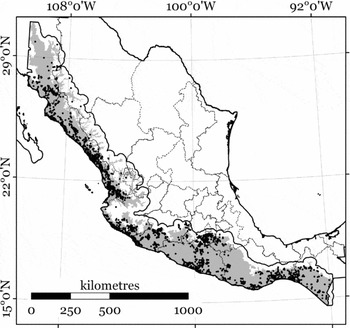
Twenty ecoregions (Olson et al. Reference Olson, Dinerstein, Wikramanayake, Burgess, Powell, Underwood, D'Amico, Itoua, Strand, Loucks, Allnutt, Ricketts, Kura, Lamoreux, Wettengel, Hedao and Kassem2001; Appendix 1, see supplementary material at Journals.cambridge.org/ENC) were used to define our study region's boundaries, delineating a continuum along Mexico's Pacific slope (Fig. 1). A 25-km buffer around the region was used to finally define the study region of about 564 011 km2 (26% of the country's area), including altitudes from 0 m to 5413 m above sea level.
Location of study region within Mexico and species locality records used (black dots). The grey areas represent ecoregions where species were recorded as present.

The seasonally tropical dry forest (STDF) is the most important vegetation type in the areas currently occupied by the endemic amphibian species. All species and specimens included in this study have been collected within the STDF, but some of these could also inhabit other vegetation types, such as temperate forests.
According to a recent land cover map (INEGI [Instituto Nacional de Estadística, Geografía e Informática] 2005) and as a result of including a 25-km buffer zone, our study region comprised 34% temperate forests, 28% STDF and 24% agriculture, cattle- rising grassland, human settlements and water bodies. The remaining 14% includes other vegetation types, both native (for example 2% tropical evergreen forests) and introduced (such as 6.5% savannah grasslands).
Species’ historical occurrence data
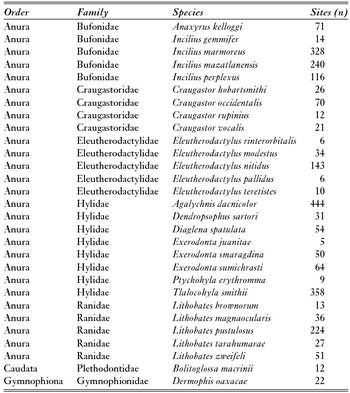
The amphibian species database used in this study is part of a larger database (García Reference García2006) and consists of 8800 single species locality records for 63 amphibian species. We used 2412 locality records that corresponded to 29 endemic amphibian species distributed on the western slope of Mexico (Table 1).
Endemic amphibian species included in this study and the number of collection sites used for ecological niche modelling.

Current climate scenario
For predicting species’ climatic envelopes (a proxy of potential distributions) under current climatic conditions, we conducted an ecological niche modelling analysis (Guisan & Zimmermann Reference Guisan and Zimmermann2000), using climate interpolated variables obtained from the WorldClim Project (http://www.worldclim.org/) for the periods 1960–1990 and 1950–2000 (Hijmans et al. Reference Hijmans, Cameron, Parra, Jones and Jarvis2005).
From an original set of 19 bioclimatic variables (1-km2 spatial resolution), seven were chosen on the basis of correlation analyses and their documented relevance to amphibian ecophysiology (Caldwell Reference Caldwell1987; Hutchison & Dupré Reference Hutchison, Dupré, Feder and Burggren1992; Duellman Reference Duellman1999). These were: mean temperature of coldest quarter, maximum temperature of warmest month, precipitation of driest quarter, precipitation seasonality, precipitation of wettest quarter, temperature seasonality (standard deviation multiplied by 100) and precipitation of the warmest quarter. Pairs of selected prediction variables showed correlation coefficients (r) < 0.80.
Future climatic scenarios
Scenarios of future climate projections were obtained from the Intergovernmental Panel on Climate Change Data Distribution Centre (IPCC-DDC, United Nations Environment Programme). We used the Coupled Global Climate Model CGCM2, which is the second version of the Canadian Centre for Climate Modelling and Analysis (CCCma).
Within the CGCM2 dataset, we used the A2 scenario, which projects a relatively high temperature increase compared to other scenarios. Data were provided at a 3.75° latitude × 3.75° longitude spatial resolution. Four modelled climate variables (difference estimates) were downloaded from the IPCC-DDC dataset (http://www.ipcc- data.org/sres/cgcm2_download.html): monthly mean, maximum and minimum temperatures and monthly total precipitation, corresponding to the mean values of three periods in the future, namely 2010–2039, 2040–2069 and 2070–2099 (from here on referred to as 2020, 2050 and 2080, respectively).
Ecological niche modelling algorithms
Considering that a wide variety of niche modelling algorithms have been proposed (Guisan & Thuiller Reference Guisan and Thuiller2005), we decided to use three of the most reliable approaches for presence-only data (Appendix 2, see supplementary material at Journals.cambridge.org/ENC): Maximum Entropy (MaxEnt; Phillips et al. Reference Phillips, Anderson and Schapire2006), Genetic Algorithm for Rule-set Production (GARP; Stockwell & Peters Reference Stockwell and Peters1999) and Bioclim (Busby Reference Busby, Margules and Austin1991).
Training and validation species occurrence samples
To predict species climatic envelopes using GARP, MaxEnt and Bioclim, the collection-point data corresponding to 29 endemic amphibian species (Table 1) were classified into two groups according to their size: (1) species with >20 distinct geographic coordinates and (2) species with <20 distinct geographic coordinates. For group 1, modelling was performed by splitting the data in training (75%) versus validation (25%), following the rule proposed by Hubberty (Reference Hubberty1994). We validated the results using the receiver-operating characteristic (ROC) curve (Fielding & Bell Reference Fielding and Bell1997), particularly by looking at the area under the curve (AUC) values for models produced with MaxEnt and Bioclim; an AUC value ≈ 0.5 indicates no predictive capability and AUC ≈ 1.0 indicates the highest predictive power. We applied a χ2 test to models produced with GARP (Anderson & Martínez-Meyer Reference Anderson and Martínez-Meyer2004); for all models we calculated the omission rate (the percentage of points incorrectly predicted). For group 2, we did not allow the use of alternative data sets for accuracy assessment purposes, even though both algorithms provide measures of model performance, based on training data (model parameters applied in each approach are available in Appendix 2, see supplementary material at Journals.cambridge.org/ENC).
Comparison among algorithm predictions
Using a geographic information system (ArcMap version 9.2), models generated with each of the three algorithms were compared by calculating the proportion of spatial correspondence. We used boxplots to summarize the overall (median) spatial correspondence between pairs of algorithms for both current and climate change conditions.
Considering the principles of ensemble modelling (for example see Araújo & New Reference Araújo and New2006) and model consensus (Marmion et al. Reference Marmion, Parviainen, Luoto, Heikkinen and Thuiller2009) for addressing the uncertainty resulting from using several modelling approaches, we intersected models generated by each of the three algorithms to obtain composite models; the spatial correspondence in values between at least two algorithm models was defined as a surrogate of species predicted presence. We applied this procedure for both current and future conditions.
Climate change effects on species spatial concurrence
We used individual binary composite models of species climatic envelopes (potential distributions) for current and future climate conditions to assess future changes in species geographic extent (Thuiller et al. Reference Thuiller, Lavorel and Araújo2005). For each species we first calculated the differences in areas predicted to have potential presences in the years 2020, 2050 and 2080, in relation to current climate predictions. By adding the 29 individual species’ binary models, we built a potential species richness model (map) for each time period, representing the areas in which different species’ climate envelopes coincide. Characterization of spatial patterns of species envelopes’ co-occurrence, at each climate change period, were conducted by comparing area percentages. Particular attention was paid to changes in area percentages of the greatest potential species richness intervals (hotspots) for each climate change period, in relation to current climate conditions. Distributional changes and shifts in species’ potential richness areas were evaluated by calculating predicted area percentages in different ecoregions (Olson et al. Reference Olson, Dinerstein, Wikramanayake, Burgess, Powell, Underwood, D'Amico, Itoua, Strand, Loucks, Allnutt, Ricketts, Kura, Lamoreux, Wettengel, Hedao and Kassem2001) and altitudes in each climate period. As an estimate of species persistence in the different climate change periods, species’ composite predicted presences for the current climate conditions were intersected to predicted presences in each time period (2020, 2050 and 2080). We then calculated median species persistence for each climate change period in order to visualize potential changes in the overall species persistence.
Predicted changes in species geographic ranges and configuration of natural areas for conservation
We assessed the impact of climatic change on the effectiveness of NPAs and TPRCs for including species predicted distributional areas by overlying and cross-tabulating potential species richness models with existing NPAs and TPRCs. Consequently, area percentages were used to identify changes in the representation of the different potential richness intervals within NPAs and TPRCs. A high resolution land use/land cover map, known as INEGI-Serie III (INEGI 2005), was used to determine the percentages of human transformed areas (introduced grassland, agriculture, cattle-raising, forestry, human settlements and bare soil) in each NPA and TPRC. CONANP (2010) provided NPA data and CONABIO (Comisión Nacional para el Conocimiento y uso de la Biodiversidad 2004) provided TPRC data. A summary of areas included by each NPA type accounts for 6.4% of total study area (Appendix 2, see supplementary material at Journals.cambridge.org/ENC).
Uncertainty estimates in projection models
Model uncertainty was calculated when projecting current models into future climate change conditions. For MaxEnt we used the ‘clamping’ feature which treats variables as constrained to remain within the range of values in the training area (Elith et al. Reference Elith, Phillips, Hastie, Dudík, Chee and Yates2011). After identifying those areas clamped by MaxEnt, we calculated the proportion of such areas in relation to the total area predicted as presence (using the ‘10 percentile training presence’ threshold). For the models generated by GARP, we estimated uncertainty by looking at the consistency of the projection models; because the generation of GARP's models consisted in selecting the best subsets, we calculated the percentage of area finally determined as presence (highest spatial correspondence values) relative to the total area predicted as presence by the 10 best GARP models. Overall uncertainty estimates were provided for the 29 species by using boxplots.
In all boxplots, whiskers enclose about 95% of values while boxes represent the 25% and 75% percentiles.
RESULTS
Validation tests indicated good model predictive capacity for the 21 species for which we had independent data for validation. MaxEnt and Bioclim species models had AUC-values that ranged from 0.75 to 0.9 for eight and seven species, respectively, and AUC-values >0.9 for 13 and 14 species, respectively. For GARP, all models predicted much better than random expectations (χ2, p < 0.01). All models generated with the three algorithms had omission values below 10%.
Model variability and ensemble modelling
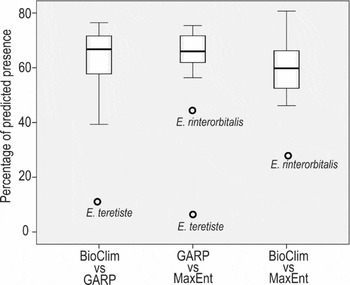
There were some variations among the three models for the same species. In general, GARP models showed more extensive distribution patterns and Bioclim generated the smallest predicted envelopes. Combining the three models, Bioclim models showed highest overall spatial correspondence percentages (67.6 ± 20.4%) and GARP the lowest (22.4 ± 10.9%), while MaxEnt was intermediate (45.6 ± 21.3%). However, considering that we applied the criterion of assembling models based on selecting spatially corresponding areas between at least two algorithms, it is important to examine the results on the overall spatial correspondence between pairs of models’ predicted presence (Fig. 2); Bioclim versus GARP and GARP versus MaxEnt showed basically the same overall correspondence (66.7 ± 13.3% and 66.3 ± 13.6%, respectively), while for Bioclim versus MaxEnt the value was slightly lower (61.4 ± 10.5%).
Median spatial correspondence between pairs of algorithms predicting current species’ climatic envelopes (presence). Y-axis represents median percentage of areas predicted as containing current species’ climatic envelopes for 29 amphibian species.

Changes in the geographic range of individual amphibian species
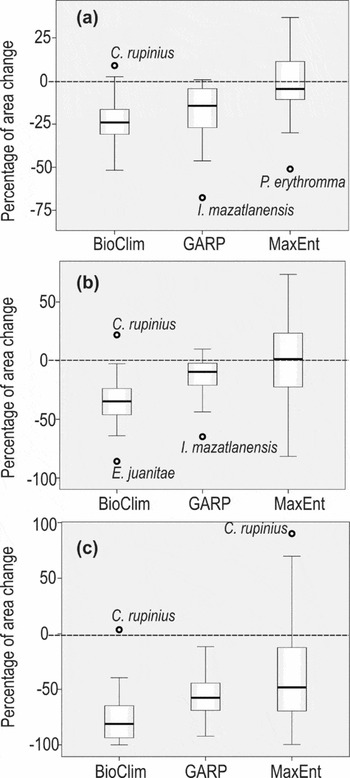
Projections of species distributions resulting from future climate conditions varied widely among species and algorithms (Fig. 3). Bioclim and GARP tended to project significant loss of most species distributional areas, while MaxEnt projected area increases for several species, even under 2080 climate conditions (Fig. 3). The combination of results (median) from projections made by the three algorithms revealed an overall pattern of area decrease in the current geographic range of all 29 endemic amphibian species, based on predictions of future climate (Fig. 3).
Projected overall (median) change in area, calculated by comparing area under current climate conditions with future climate change scenarios for (a) the 2020 projection, (b) the 2050 projection and (c) the 2080 projection, as predicted by three niche modelling algorithms (Bioclim, GARP and MaxEnt).

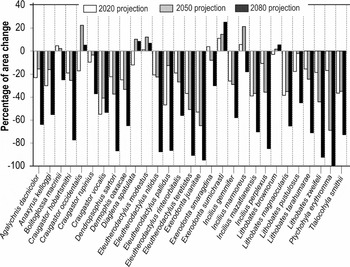
Considering that current species’ climate envelope models showed high accuracy (AUC and χ2 values above), we proceeded to assemble composite models. The areal percentages change when composite current models are compared to composite climate-change models (Fig. 4). Although there were species that increased in extent (Craugastor occidentalis, Diaglena spatulata, Eleutherodactylus modestus and Exerodonta sumichrasti), most species showed significantly reduced ranges (Fig. 4). For the 2020, 2050 and 2080 projections there were overall decreases in median values of 19 ± 17.2%, 24 ± 24.2% and 64 ± 36.1%, respectively.
Projected changes in area (percentage of area gained or lost) per species comparing current climate conditions with future climate change conditions, as predicted by composite models.

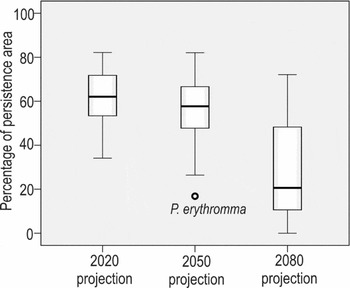
Species showed median global persistence estimates of 63% and 59% for the years 2020 and 2050, respectively (Fig. 5), however, for the year 2080, the global estimated persistence dropped to 22%, but with high variation among species (SD = 23.4) (Fig. 5).
Median species persistence in the study region, modelled using three climate-change predictions, calculated by intersecting predicted species presence for each climate-change model with predicted species presence under current climate conditions.

Uncertainty of projection models
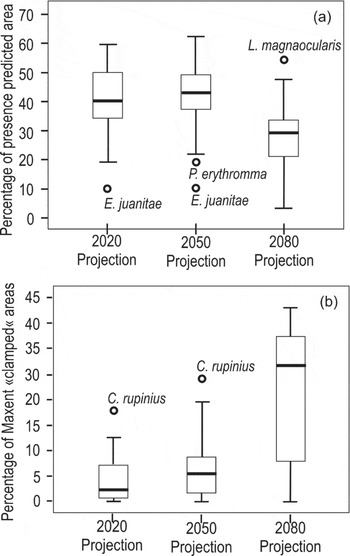
GARP's projections for 2020 and 2050 consisted of 40–42% median highest spatial correspondence values, in relation to total area predicted by all best subset models (Fig. 6 a); the 2080 projections showed a much lower consistency among predictions (28%). For MaxEnt, the ‘clamped’ areas corresponded to 2–5% median values for the years 2020 and 2050, in relation to total areas predicted as presence, while for 2080 this percentage increased to 27% of predicted presence (Fig. 6 b). Variations in uncertainty estimates among species were high for the three climate conditions of GARP's projections (SD ≈ 12; Fig. 6 a) and for the 2080 projection generated by MaxEnt (SD = 13; Fig. 6 b).
Estimates of uncertainty in the climate change projections generated by the niche modelling algorithms GARP and MaxEnt, corresponding to the geographic distribution of 29 endemic amphibian species in western Mexico. (a) Percentage area modelled as still occupied by species for the 2020, 2050 and 2080 projections, relative to total area where amphibians are predicted to be present using the GARP model's best subsets (10 models); and (b) percentage of area clamped by MaxEnt for the 2020, 2050 and 2080 projections, relative to total area where amphibians are predicted to be present.

Co-ocurrence of current and future patterns of species’ climatic envelopes
Potential species richness models for each period suggest potential significant climate effects on future geographic distribution patterns (climate envelopes) of endemic amphibian species (Appendix 1, Fig. S1, see supplementary material at Journals.cambridge.org/ENC). In current climate conditions (Appendix 1, Fig. S1a, see supplementary material at Journals.cambridge.org/ENC), hotspots (namely areas with 16–21 concurrent species) were mainly in ecoregions associated with STDF; 57% of highest potential richness areas fell within southern Sinaloan Dry Forest, Marismas Nacionales-San Blas Mangroves and Jalisco Dry Forest, and to a lesser extent in the Chiapas Depression Dry Forest. Thirty-one per cent of these hotspot areas were also located in pine-oak temperate ecoregions, such as in the Trans-Mexican Volcanic Belt, Sierra Madre del Sur and Central American (Chiapas).
Changes in the geographic patterns of species climate envelopes (Appendix 1, Fig. S1, see supplementary material at Journals.cambridge.org/ENC) suggested a general trend of range contraction, and even disappearance, of current high potential richness areas through time (Appendix 1, Fig. S1b, c, d, see supplementary material at Journals.cambridge.org/ENC). As predicted, highest potential richness areas (with 16–21 spp.) accounted for only 3.2% of total area in current climate conditions, decreasing to 0.14% under the predicted climate conditions for 2080. In the internmediate projections for the years 2020 and 2050, highest potential richness decreased to 1.3% and 1.1%, respectively.
Changes in the proportions of habitat types (ecoregions) that corresponded spatially to the predicted potential species rich areas (regardless of changes in total areas) showed that while the STDF ecoregions included 68% of the highest current potential richness (16–21 species), future projections were represented in higher proportions (81–85%). Similar results were shown for the median elevation above the sea level at which potentially species rich areas were located; the areas with the greatest potential richness (16–21 spp.) were located at higher elevations for current conditions than for future predicted conditions. Only the lowest potential rich areas (1–5 spp.) showed a trend in which median elevations for current conditions (1082 m) were lower than those predicted by future climate scenarios; namely 1224 m for year 2020, 1271 m in 2050 and 1330 m in 2080.
Current and future distribution patterns of endemic amphibians related to current areas for conservation
Currently, 8% of the areas predicted to have the greatest potential species richness (16–21 spp.) are included within Mexican Areas for Protection of Natural Resources (APNR: 5.2%) and Biosphere Reserves (BR: 2.8%) (Appendix 1, Fig. S2a, see supplementary material at Journals.cambridge.org/ENC). In our models, this percentage fell from 8% to 2% for 2020 and 3% for 2050; by the year 2080, areas with a high predicted potential richness (> 15 spp.) had almost disappeared, falling to < 1% of current predicted levels (Appendix 1, Fig. S2b, see supplementary material at Journals.cambridge.org/ENC).
Our study region contained 62 areas identified as TPRCs (CONABIO 2004); while 87% of predicted current highest potential richness areas were included within TPRCs, only six regions were responsible for 44% of such areas (Appendix 1, Fig. S2c, see supplementary material at Journals.cambridge.org/ENC). In our models, by the year 2080, only one TPRC (Sierra Vallejo-Río Ameca) would include 3% of current predicted highest potential richness (>15 spp.) (Appendix 1, Fig. S2d, see supplementary material at Journals.cambridge.org/ENC).
Considering the importance of estimating vulnerability indicators associated with the NPAs and TPRCs, we calculated the overall proportions of human-transformed landscapes within such areas. Among the NPA types, community, private and sanctuary amounted to only 1.7% of total NPA areas, with community showing the smallest (2%) and private the greatest (33%) proportion of transformed landscapes (an explanation of these types in available in Appendix 2, see supplementary material at Journals.cambridge.org/ENC). The largest NPAs had 11–18% of land transformed, a percentage comparable to the overall land transformation percentage for TPRCs, although TPRCs are much larger regions, albeit only identified as ‘important’ (Arriaga et al. Reference Arriaga, Espinoza, Aguilar, Martinez, Gomez and Loa2000) and lacking any formal conservation regime.
DISCUSSION
Predicting future species distribution under climate change
Our study represents a first approximation for identifying the dimensions of potential impacts associated with predicted climate changes on the geographic distribution of 29 endemic amphibian species inhabiting Mexico's Pacific slope. We emphasized the results concerning co-ocurrence of species climatic envelopes (a surrogate of species richness) or potential richness over individual species predicted responses, attempting to identify spatial patterns of biodiversity potential change.
The changes in geographic patterns identified in this study rely on the assumption that species’ climatic niches, represented by the seven variables used, would remain constant through time (niche conservatism) (Peterson & Holt Reference Peterson and Holt2003). Our analyses do not consider other phenomena derived from climate change, such as changes in composition and structure of original vegetation or the ability of species to disperse and colonize new areas. Therefore, our modelling results suggest extreme scenarios of distributional changes.
Model variability and ensemble modelling
There were significant variations among models (Figs 2 and 3), but our ensemble modelling approach allowed us to identify prediction coincidence among the algorithms, while identifying and filtering our potentially spurious results. The composite models allowed us to assess the large variability among algorithm models. Differences among current climate models obtained by the three algorithms seem consistent for predicting species presence at about 65% when pairs of algorithms are compared, with GARP and MaxEnt showing the narrower variation (Fig. 2). Conversely, MaxEnt showed the highest variability among species among future climate projections (Fig. 3). Differences between predictions from different methods have been widely documented (Thuiller Reference Thuiller2004; Araújo et al. Reference Araújo, Whittaker, Ladle and Erhard2005; Buisson et al. Reference Buisson, Thuiller, Casajus Lek and Grenouillet2010). Projection differences between GARP and MaxEnt have been attributed to the assumptions made by each algorithm; while GARP's extrapolation may behave either as a stepped decline or a constant value (Elith & Graham Reference Elith and Graham2009), MaxEnt extrapolates at the most extreme environmental value (Elith & Graham Reference Elith and Graham2009) when extrapolation goes beyond the range of data to build the model (Pearson et al. Reference Pearson, Thuiller, Araújo, Martinez-Meyer, Brotons, McClean, Miles, Segurado, Dawson and Lees2006).
Uncertainty of projections
There are many uncertainty sources in the niche modelling process (Wiens et al. Reference Wiens, Stralberg, Jongsomjit, Howell and Snyder2009); uncertainty associated with our future climate projections provided measures of consistency (GARP) and reliability (MaxEnt) that are not necessarily conclusive. For the GARP algorithm, our approach revealed how much information was omitted by conservatively thresholding the best subsets; we assessed whether the highest correspondence values were the result of combining consistent or discrepant outputs. Following other studies that predicted distribution areas for amphibian species (Rödder et al. Reference Rödder, Kielgast, Bielby, Schmidtlein, Bosch, Garner, Veith, Walker, Fisher and Lötters2009; Fouquet et al. Reference Fouquet, Ficetola, Haigh and Gemmell2010; Murray et al. Reference Murray, Retallick, Puschendorf, Skerratt, Rosauer, McCallum, Berger, Speare and VanderWal2011), we used MaxEnt clumping to identify uncertain areas when projecting distributional changes caused by future climate conditions. However, such a procedure may not identify multivariate combinations of non-analogue future conditions (Fitzpatrick & Hargrove Reference Fitzpatrick and Hargrove2009). More research is needed to analyse the potential statistical artefacts resulting from extrapolating distributional projections, along with predicted distributional shifting and area contractions (Elith et al. Reference Elith, Phillips, Hastie, Dudík, Chee and Yates2011). Unsurprisingly, we obtained greater uncertainty levels and higher among-species variability from all algorithm projections into future climate change conditions.
Potential distributional changes of endemic amphibians due to climate change
Our results suggest potentially significant climate effects on future geographic distribution patterns of endemic amphibian species and species’ potential richness. For instance, by 2080, potential richness hotspots will be considerably smaller and much more isolated than they are currently (Appendix 1, Fig. S1, see supplementary material at Journals.cambridge.org/ENC Similarly, changes in the spatial correspondence between habitat types and potential richness areas suggest that high potential richness areas will become confined to those habitat types more typically associated with predictions of current climate conditions, as a result of drastically declining future predicted species concurrence; the highest potential richness values are located at lower altitudes in 2050, with hotspot areas almost disappearing by the year 2080 at higher altitudes.
These results vary from documented predictions of the effects of climate change on distributions of vertebrates, which suggest species will move to higher altitudes (Markham Reference Markham1996; Lawler et al. Reference Lawler, White, Neilson and Blaustein2006), especially in tropical areas where species may move into more temperate zones as they track their niches (Walther et al. Reference Walther, Post, Convey, Menzel, Parmesan, Beebee, Fromentin, Hoegh-Guldberg and Bairlein2002; Parmesan Reference Parmesan2006). The GARP single modelling algorithm showed the distribution-shifting effect of climate change, a condition that was not replicated by our model ensemble procedure; such contrasting findings will be the subject of future research.
The marked effects of climate change on amphibian distributions, as compared with other vertebrate groups, are expected to strongly influence amphibian biology, ecology and physiology (Pounds et al. Reference Pounds, Fogden and Campbell1999; H-Acevedo & Currie Reference H-Acevedo and Currie2003; Buckley & Jetz Reference Buckley and Jetz2007; Lawler et al. Reference Lawler, Shafer, White, Kareiva, Maurer, Blaustein and Bartlein2009). Our study suggests an average reduction of about 64% in the current geographical range of all endemic amphibians in Mexican STDFs by the year 2080 as a consequence of climate change. Peterson et al. (Reference Peterson, Ortega-Huerta, Bartley, Sánchez-Cordero, Soberón, Buddemeier and Stockwell2002) reported a reduction by up to 50% of the present distributional area in 20% of 1870 Mexican mammal, bird and butterfly species by the year 2050. Added to such comparison between taxonomic groups, our study reveals that by the years 2050 and 2080, 13% and 50% of Mexican endemic amphibians will have reductions greater than 40% and 60%, respectively, in their current distributional areas in western Mexico (Figs 4 and 5).
Spatial correspondence between predicted species co-ocurrence and conservation areas under climate change scenarios
Shifts in the distribution patterns of diversity, vegetation and general environmental conditions are predicted under climate change scenarios (see for example Donelly 1998; Peterson et al. Reference Peterson, Martínez-Meyer, González-Salazar and Hall2004; Lawler et al. Reference Lawler, Shafer, White, Kareiva, Maurer, Blaustein and Bartlein2009), making NPAs more important for diversity conservation in a changing world. Although the federal Mexican government has added a number of new areas to the recognized NPA national network (CONANP 2010), modelled distributions for the west of the country continued to demonstrate drastic reductions in both high and moderate potential richness areas for amphibians within current NPAs (Appendix 1, Fig. S2a, b, see supplementary material at Journals.cambridge.org/ENC), as a consequence of changes in climatic conditions. Six TPRCs together contained 44% of predicted highest potential richness areas (16–21 species) for the current climate scenario, whereas, by the year 2080, only 3% of such potential richness areas were present, contained within one TPRC (Appendix 1, Fig. S2c, d, see supplementary material at Journals.cambridge.org/ENC).
As a result of expected migrations of species and changes in vegetation under climate change scenarios, some current NPAs will probably contain different ecosystems and species than they were initially designed to protect (Mansourian et al. Reference Mansourian, Belokurov and Stephenson2009). Clearly, TPRCs such as Chamela-Cabo Corrientes, Sierra Vallejo-Río Ameca, Marismas Nacionales and Río Presidio will have an important role in protecting a considerable proportion of Mexico's western biodiversity, but these same regions will probably no longer include diverse areas for amphibians by the year 2080.
Community and private are new categories within the Mexican NPA system with no significant contribution to the current network's total area; community showed the lowest proportion of human-transformed landscapes (≥ 5 times lower than the largest NPAs, APNR, BRs and areas for the protection of wildlife [APW]). Considering that disturbed ecosystems may be more vulnerable to global climate changes (Dockerty et al. Reference Dockerty, Lovett and Watkinson2003; Leemans & Eickhout Reference Leemans and Eickout2004) our general indicators of spatial transformation suggest that identified TPRCs should be considered as candidates for prioritized conservation programmes. These TPRCs are large regions, largely recognized by their environmental heterogeneity (for example different ecosystem types associated with the topographic gradient), which provides important conditions for mitigating processes resulting from climatic change (Noss Reference Noss2001; Hannah et al. Reference Hannah, Midgley and Millar2002)
The apparently poor spatial correspondence between NPAs and high predicted species’ correspondence areas (hotspots), added to detrimental climate change effects, increases the importance of conserving the identified TPRCs. It should be a priority in conservation strategies to confront such change scenarios, beyond the boundaries of current NPAs (Hannah et al. Reference Hannah, Midgley, Andelman, Araújo, Hughes, Martinez-Meyer, Pearson and Williams2007).
CONCLUSIONS
We applied a consensus approach for summarizing the variability among prediction models, as opposed to identifying the best model type. Uncertainty sources were identified and quantified, but more research is needed into assessing the significance of our and other model ensemble modelling approaches. It is necessary to explicitly assess model uncertainty, not only related to model projections but also that associated with data (quality) and model (type) dimensions (Beale & Lennon Reference Beale and Lennon2013).
Further studies on potential distributional changes on amphibian endemic species as a result of climate changes should incorporate information on how climatic and vegetation seasonality affect breeding activity, metamorphic timing, clutch size and the intra- and interspecific relationships within the amphibian community, integrating local and regional scales, not only for the adult stages but also for their larvae. Coupled or hybrid models, such as hierarchical frameworks, have been proposed to integrate niche-based models with demographic or process models (Anderson et al. Reference Anderson, Akcakaya, Araújo, Fordham, Martinez-Meyer, Thuiller and Brook2009; Fordham et al. Reference Fordham, Akcakaya, Aráujo, Elith, Keith, Pearson, Auld, Mellin, Morgan, Reagan, Tozer, Watts, White, Wintle, Yates and Brook2012).
Although the dispersal capabilities of species should be considered in predicting their future distribution under climate and land-use change scenarios (Munguía et al. Reference Munguía, Peterson and Sánchez-Cordero2008; Sinclair Reference Sinclair, White and Newell2010), it seems that the low dispersal abilities of amphibian species (Blaustein et al. Reference Blaustein, Wake and Sousa1994; Marsh & Trenham Reference Marsh and Trenham2001) may significantly affect the species’ opportunities to move across current and future landscapes and climatic conditions to colonize new habitats.
Our species climatic envelopes can also be interpreted as habitat suitability maps (Guisan & Thuiller Reference Guisan and Thuiller2005; Keith et al. Reference Keith, Akcakaya, Thuiller, Midgley, Pearson, Phillips, Regan, Araújo and Rebelo2008), areas with key climatic conditions appropriate to the occupying species (Pulliam Reference Pulliam2000). However, because our focus was on the potential distribution patterns of species, we related these to current ecological conditions in ecoregions to visualize the new conditions where species distributional changes would occur as a result of climate change. A more comprehensive analysis is required to model habitat changes as a result of climate change, focusing on vegetation changes and not just climate. For instance, Rehfeldt et al. (Reference Rehfeldt, Crookston, Sáenz-Romero and Campbell2012) predicted that there would be expansion of climates suitable for the STDFs of Mexico, according to low and high greenhouse gas emission scenarios for 2030, 2060 and 2090.
Integration of species and habitat modelling is required to provide the scientific basis to formulate contingency actions for counteracting potential biotic impoverishment due to climate change.