In the early era of stage 1 reconstruction for hypoplastic left heart syndrome, technical issues were a frequent cause of early postoperative mortality.Reference Bartram, Grunenfelder and Van Praagh 1 Although improved surgical techniques and management principles have improved survival rates, the mortality remains significant and often unexplained.Reference Brann, Brawn, Raafat and Sreeram 2
The presence of a restrictive or intact atrial septum has been found to negatively impact survival following surgery for hypoplastic left heart syndrome, including staged palliation and cardiac transplantation.Reference Canter, Moorehead, Huddleston and Spray 3 – Reference Rychik, Szwast, Natarajan, Quartermain, Donaghue and Combs 5 In addition, the presence of other congenital lung diseases – for example, bronchopulmonary dysplasia – is associated with higher mortality and prolonged ventilation following surgical procedures for CHD, especially in those with single-ventricle physiology.Reference McMahon, Penny and Nelson 6 Increased left atrial pressure resulting from a restrictive or non-existent atrial communication may lead to lymphovascular changes in the lungs – namely, congenital pulmonary lymphangiectasia. The resultant impairment in lung function and oxygenation may be severe and may manifest early after birth or surgery.Reference Noonan, Walters and Reeves 7 – Reference Graziano, Heidelberger, Ensing, Gomez and Ludomirsky 9 In a review of 316 neonates with hypoplastic left heart syndrome treated at the Children’s Hospital of Philadelphia, 18 (5.7%) were found to have an intact or restrictive atrial communication, and 12 of these patients died during or immediately after initial palliation attempts;Reference Rychik, Rome, Collins, DeCampli and Spray 8 moreover, postmortem analysis indicated that lymphovascular changes were most prominent in patients with the most restrictive degree of atrial-level communication as demonstrated in autopsy specimens. Others have observed similar findings in cases of early mortality following stage 1 palliation procedures for hypoplastic left heart syndrome.Reference Graziano, Heidelberger, Ensing, Gomez and Ludomirsky 9
Given that congenital pulmonary lymphangiectasia may adversely affect outcomes in neonates with single-ventricle physiology who undergo stage 1 reconstruction, our objective was to characterise the incidence of congenital pulmonary lymphangiectasia in cases of early mortality in a large series of patients who underwent stage 1 reconstruction.
Materials and methods
Using an institutional surgical database, we identified all patients who underwent a stage 1 reconstruction between 1 January, 1984 and 31 December, 2013 at the Children’s Hospital of Philadelphia. Only mortalities that occurred within 30 days of the stage 1 reconstruction were included to account for early deaths. During that period, a total of 1669 stage 1 procedures was performed. Clinical characteristics and full autopsy records including histological specimens were available for review for 54 cases. This retrospective study was approved by the Institutional Review Board.
Clinical characteristics assessed included basic demographics – for example, birth weight, gestational age, race, and sex – cardiac anatomy, postoperative events, and cause of death. In addition, the institutional surgical database was queried for technical details of the stage 1 reconstruction – for example, shunt size and type, cardiopulmonary bypass, and deep hypothermic circulatory arrest times – for each case. Patients who died of suspected technical issues – for example, shunt obstruction, aortic root, and/or arch obstruction – based on postmortem analysis were excluded.
Histopathological evaluation of the pulmonary vasculature was performed on lung samples obtained at autopsy. Autopsy lung specimens were reviewed by a paediatric pathologist (J.E.P.) who was blinded to the clinical details of each case. Lymphangiectasia was evaluated as present when it was diffuse and involved both bronchovascular and pleural lymphatics. Lymphatics were identified by location and morphology and highlighted in selected cases by immunohistochemistry for D240. Where the autopsy report designated differential perfusion of lungs, the lymphangiectasia was evaluated only in the uninflated lung.
Results
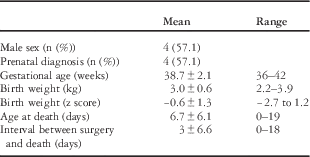
Of the 113 patients for whom autopsy reports were available, 54 had sufficient pulmonary pathological specimens available for review by a paediatric pathologist. Of these, seven cases (12.5%) of pulmonary lymphangiectasia were identified (Table 1). More than half of these patients were male (57%) and had been diagnosed with hypoplastic left heart syndrome prenatally (57%). The mean gestational age at birth was 38.7±2.1 weeks, and the mean birth weight was 3.0±0.6 kg. The mean interval between stage 1 reconstruction and death was 3.0±6.6 days (with a range from 0 to 18 days). In all cases, death occurred after an acute episode of hypotension and cardiorespiratory arrest.
Patient characteristics.

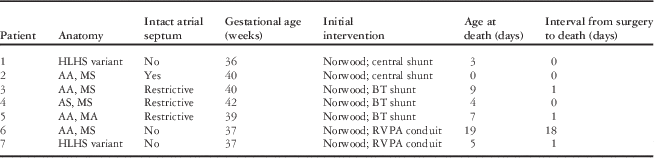
Table 2 describes the clinical characteristics for each patient found to have pulmonary lymphangiectasia. Hypoplastic left heart syndrome anatomic subtypes included aortic atresia/mitral stenosis (n=3, 42.9%), aortic atresia/mitral atresia (n=1; 14.3%), aortic stenosis/mitral stenosis (n=1, 14.3%), and hypoplastic left heart syndrome variants (n=2; 28.6%). The type of shunt used in the stage 1 reconstruction included a modified Blalock–Taussig shunt in three patients (42.8%), a right ventricle–pulmonary artery shunt in two patients (28.6%), and a central shunt in two patients (28.6%). The atrial septum was found to be intact in one patient (14.3%), restrictive in three patients (42.9%), and unrestrictive in three patients (42.9%).
Clinical characteristics.

AA=aortic atresia; AS=aortic stenosis; BT shunt=Blalock–Taussig shunt; HLHS=hypoplastic left heart syndrome; MA=mitral atresia; MS=mitral stenosis; RVPA=right ventricle–pulmonary artery.
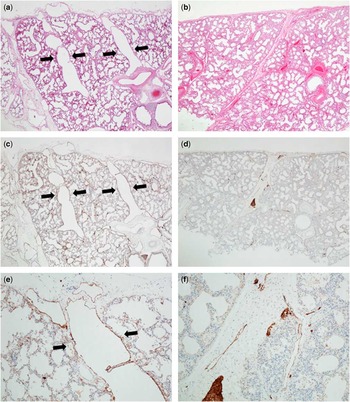
Representative histopathological images from lung specimens with or without pulmonary lymphangiectasia are shown in Figure 1. Lungs with pulmonary lymphangiectasia exhibited significant lymphatic space dilation within bronchovascular bundles and pleura (Fig 1a) compared with control samples (Fig 1b). D240 staining of the lymphatic endothelium highlighted increased-calibre lymphovascular structures in the lymphangiectasia (Fig 1c and e) compared with the controls (Fig 1d and f).
( a ) Lung with marked lymphangiectasia in the interlobular septa and pleura (hematoxylin and eosin, 2×). Arrows designate dilated lymphatic spaces. ( b ) Control lung without lymphangiectasia (hematoxylin and eosin, 2×). ( c and d ). D240 staining of the lymphatic endothelium highlights dilated ( c , 2×) and normal ( d , 2×) lymphatic channels. ( e and f ) D240 staining at 10× magnification demonstrating dilated ( e ) and normal ( f ) lymphatic channels.

Discussion
By analysing cases of very early death not due to technical causes following stage 1 reconstruction for hypoplastic left heart syndrome or its variants, this study is the first to describe the findings of congenital pulmonary lymphangiectasia not only in cases with an intact or restrictive atrial septum but also in patients with an unrestrictive atrial septum. This finding may hold prognostic significance in that congenital pulmonary lymphangiectasia may adversely affect the outcome of stage 1 reconstruction procedures independent of the actual procedure and even in the setting of a more common scenario of an unrestrictive atrial septum. These findings also emphasise the value of postmortem analyses to identify unknown factors that may adversely affect survival.
Initial results of the Single-Ventricle Reconstruction trial revealed contemporary 30-day and hospital mortality of 11.5 and 16.0%, respectively.Reference Tabbutt, Ghanayem and Ravishankar 10 Even in the current era of surgical palliation for hypoplastic left heart syndrome and its variants, the survival rate remains only 64% at 3 years.Reference Newburger, Sleeper and Frommelt 11 It is possible that other patient-specific factors may play a role in these outcomes. For instance, the presence of an intact or restrictive atrial septum and/or congenital pulmonary disease have been found to be independent risk factors for mortality after stage 1 reconstruction procedures; however, it is not clearly understood what degree of restriction of the interatrial communication is needed to yield these pulmonary changes. Searching for such patient-specific congenital factors, especially non-cardiac, may yield insights into the management of this challenging group of patients as well as clinicians’ ability to provide accurate prognoses and counselling. Including assessments of interatrial gradients in prospective analyses may identify potential correlation between degree of restriction and the presence of pulmonary lymphovascular changes.
Although congenital pulmonary lymphangiectasia or other pulmonary disorders cannot usually be routinely diagnosed perinatally, given the invasive nature of a lung biopsy, non-invasive imaging modalities are gaining interest for their potential to render prenatal diagnoses. Fetal MRI has been successful in detecting pulmonary lymphangiectasia in the setting of hypoplastic left heart syndrome.Reference Seed, Bradley, Bourgeois, Jaeggi and Yoo 12 In particular, fetal MRI has been used to detect “nutmeg lung”, which refers to the pathological appearance of pulmonary lymphangiectasia.Reference Victoria and Andronikou 13 Nutmeg lung is associated with high mortality, particularly in the setting of hypoplastic left heart syndrome and restrictive atrial septum.Reference Saul, Degenhardt and Iyoob 14 Interestingly, not all patients with a restrictive atrial communication develop nutmeg lung, but those who do fare worse than patients with a restrictive or absent atrial communication but no evidence of nutmeg lung. These early reports are small in scale, and the full prognostic significance of this finding remains to be determined, but further evaluation of the diagnostic potential of pulmonary lymphangiectasia by fetal MRI is warranted. Refinement of the accuracy of non-invasive imaging may enable prospective evaluation of its possible impact on postoperative outcomes. Recent advances in MRI have facilitated postnatal recognition of lymphatic abnormalities in single-ventricle patients as well as enabled catheter-based percutaneous interventions.Reference Dori, Keller and Fogel 15 , Reference Dori, Keller and Rome 16
The management of patients with hypoplastic left heart syndrome with intact or restrictive atrial septa remains challenging, and several groups have used protocols that involve intervening in the prenatal period to enlarge the atrial communication;Reference Marshall, van der Velde and Tworetzky 17 , Reference Vida, Bacha and Larrazabal 18 however, it remains unknown whether this approach improves survival at any stage. Even with prenatal diagnosis and early postnatal surgical or catheter-based intervention, the 30-day survival for hypoplastic left heart syndrome with a restrictive atrial septum remains low.Reference Glatz, Tabbutt and Gaynor 19 The question of whether prenatally enlarging the atrial communication impacts the development of pulmonary lymphangiectasia also remains unanswered.
Limitations
There are important limitations to this study. First, identification of lymphangiectasia in pathological specimens can be complicated by technical artefacts secondary to inflation of the lungs via either the pulmonary arteries or the airways, leading to postmortem lymphatic dilation. Although the pathology department’s current standard autopsy protocol is to inflate one lobe, this was not always clearly documented in the autopsy reports over the last two decades. The possibility of artefact-related dilation of lymphatics cannot be excluded, although the absence of dilation in the majority of specimens would argue that this does not routinely occur. Second, not all patients underwent autopsy, and full autopsy results were not available for all patients; therefore, we were unable to more precisely define the true incidence of congenital pulmonary lymphangiectasia in the full series. Although these cases were drawn from a large series of stage 1 procedures, selection bias may have occurred, although the finding of pulmonary lymphangiectasia without a restrictive or intact atrial septum is significant alone. Finally, this was a retrospective study without a control group, and the impact of the presence of pulmonary lymphangiectasia on survival cannot be estimated. As tissue analysis is not available for survivors, it is possible that lymphangiectasia may be a finding present in stage 1 survivors as well. It is conceivable that milder degrees of lymphangiectasia or other associated lymphatic channel abnormalities may manifest not as early mortality but as later morbidity, such as pleural effusions or plastic bronchitis following cavopulmonary surgery.
Conclusions
Congenital pulmonary lymphangiectasia may be a risk factor for early mortality following stage 1 reconstruction for hypoplastic left heart syndrome. The present findings indicate pulmonary lymphangiectasia may develop in the presence or absence of a restrictive atrial septum. Earlier identification with prenatal non-invasive imaging may offer better prognostication and risk stratification.
Acknowledgements
None.
Financial Support
This research received no specific grant from any funding agency or from commercial or not-for-profit sectors.
Conflicts of Interest
None.
Ethical Standards
This study was conducted in accordance with Institutional Review Board approval.