Introduction
Schema-focused therapy (SFT; Young, Reference Young1990) is very popular in residential settings (Pauwels et al., Reference Pauwels2013) and has been proven to be an effective treatment for adults diagnosed with a personality disorder (PD) (Giesen-Bloo et al., Reference Giesen-Bloo2006) or other severe psychiatric syndromes, such as major depression disorder (Young, Reference Young1990). Nowadays, SFT is gaining popularity in older cohorts as well (Videler et al., Reference Videler, Van Royen and Van Alphen2012; Pauwels et al., Reference Pauwels2013). Videler et al. (Reference Videler, Van Royen and Van Alphen2012) stressed the urgent need for more research on the assessment of early maladaptive schemas (EMS), one of the central constructs in SFT, at older age as part of developing an evidence-based treatment protocol for older adults. The EMS are implicit beliefs about one's self-concept and relationship with the environment and can be assessed by the Young Schema Questionnaire – Long Form (YSQL2; Young and Brown, Reference Young, Brown and Young1994). The EMS are considered to be pervasive themes that form the core of one's self-concept. Notwithstanding their maladaptive nature, these are self-perpetuating and are considered to be relatively stable over time (Schmidt et al., Reference Schmidt, Joiner, Young and Telch1995). However, the presumed stability of EMS at older age remains unverified in the current EMS literature.
In contrast with the lack of research on EMS at older age, the stability and the differential presentation of adaptive and maladaptive personality traits across the lifespan are well documented in the personality assessment of older adults (Debast et al., Reference Debast2014). Although personality traits are considered to be relatively stable over time, with strong stability being achieved after the age of 50 years (Oltmanns and Balsis, Reference Oltmanns and Balsis2011), these may also attenuate, reemerge, or even present themselves for the first time in older adulthood (Abrams and Bromberg, Reference Abrams and Bromberg2007; Van Alphen et al., Reference Van Alphen2012). A relatively recent explanation for these trends is provided by the heterotypical continuity hypothesis, stating that personality traits can present themselves differently at different occasions. Heterotypic continuity can be described as the stability of underlying traits but with a changing presentation of these traits throughout time. These changes can be assigned to natural development (e.g., decreased impulsivity), a changing context (e.g., occupational context), or a change in the opportunity for the presentation of a trait (e.g., less or different encounters can lead to a smaller probability of exhibiting a trait) (Balsis et al., Reference Balsis, Gleason, Woods and Oltmanns2007; Van Alphen et al., Reference Van Alphen2012).
Given the significant relationship between EMS and personality disorder symptoms, the presumed stability of EMS across the lifespan is not obvious (Pauwels, et al., Reference Pauwels2013). Turning to the YSQL2 (Young and Brown, Reference Young, Brown and Young1994), for example item 95 of the schema scale, Incompetence/Dependence, is formulated as follows: “I’m inept in most areas of life.” Due to physiological changes throughout adulthood, it might be possible that older adults feel more incompetent and are more dependent from others, but are not necessarily in nature dependent or inept from others in terms of making decisions as in a dependent personality disorder (Segal et al., Reference Segal, Coolidge and Rosowsky2006).
These behavioral changes in presentation make it difficult to investigate the stability of personality traits and personality in general across the lifespan and in older adults in particular (Abrams and Bromberg, Reference Abrams and Bromberg2007). Van Alphen and colleagues (Reference Van Alphen2012) postulate that one of the main reasons that Diagnostic and Statistical Manual of Mental Disorders, Fourth Edition (DSM-IV) personality disorders decrease with age is because the criteria cannot be applied to older adults due to heterotypic continuity factors. Several criteria of DSM-IV reflect on behavior and are sensitive to context factors. An age-neutral instrument, resistant to these changes in presentation, by using items that are equally applicable to younger and older adults, is required to make conclusions about stability in personality and the presentation of personality traits across the lifespan and therefore also in EMS. Personality assessment tools specially designed for older adults may have good face validity for this particular age group, but in turn are problematic to follow up personality across the lifespan because they are probably not applicable in younger adults (Van Alphen et al., Reference Van Alphen, Engelen, Kuin, Hoijtink and Derksen2006; Oltmanns and Balsis, Reference Oltmanns and Balsis2011; Van den Broeck et al., submitted).
So ideally the perfect assessment tool contains items that are written in an age neutral way, work equally well for both younger and older adults, and are investigated in a broad sample across different age groups. Differential Item Functioning (DIF) analyses are well suited to detect a different endorsement of an item between age groups, controlling for the overall level of the underlying trait (Balsis et al., Reference Balsis, Gleason, Woods and Oltmanns2007). As mentioned before, in the case of traits there is often heterotypic continuity, but it is possible that questionnaires based on cognitions will be far less influenced by context factors.
Up until now, item bias analysis on the YSQL2 was only performed by Rijkeboer et al. (Reference Rijkeboer, van den Bergh and van den Bout2011) for gender differences, differences in educational level, and for psychopathology versus normality. They did not find DIF for most YSQL2 items. For gender, none of the items showed DIF. For educational level, only one item showed DIF, and for the presence or absence of psychopathology, only 5% (ten items) of the items showed DIF. One of the limitations put forward by Rijkeboer et al. (Reference Rijkeboer, van den Bergh and van den Bout2011) was that they only included general psychopathology because the number of patients per disorder was too small. Given the influence of Axis I psychopathology on the presentation of EMS, lots of questions remain unanswered for the influence of specific psychopathology on item level (e.g., Waller et al., Reference Waller, Ohanian, Meyer and Osman2000; Pauwels et al., Reference Pauwels2013). Therefore, it is advisable to control for psychopathology in further research of EMS (Rijkeboer et al., Reference Rijkeboer, van den Bergh and van den Bout2011; Pauwels et al., Reference Pauwels2013). However, as far as we know, the YSQL2 is never investigated on age neutrality.
Therefore, the first aim of the present study is to examine the age neutrality of the YSQL2 by investigating the DIF of the YSQL2 between young (<34 years old), middle-aged (35–59 years old), and older (>60 years old) adults. As several items of the YSQL2 refer to context factors that may not be applicable to older age groups (e.g., working context, parents), one would expect that these YSQL2 items would lack face validity. Second, once age neutrality of the items is confirmed, the impact of DIF on schema level is estimated using differential test functioning (DTF) analyses (Penfield and Algina, Reference Penfield and Algina2006). Analogous to the first hypothesis, one would expect DTF on schema level in schema scales where several items lack face validity. Third, if age neutrality on schema level is established, the stability of EMS in different age groups across the lifespan will be investigated in a cross-sectional design. According to the Young Schema Theory, one would expect the EMS to be relatively stable across different age groups.
Since the item bias analysis study (Rijkeboer et al., Reference Rijkeboer, van den Bergh and van den Bout2011) indicated the heterogeneity of their patient sample as being a limitation in their study, we have chosen to investigate a homogeneous sample with regard to Axis I psychiatric disorders to get a more clear understanding of age neutrality of the questionnaire. At our treatment facility such a homogeneous sample was found in the group of substance-dependent patients.
Method
Participants and procedure
Three hundred twenty-one inpatients with an alcohol and substance use disorder (AD) from a psychiatric hospital in Belgium participated in this study. Diagnoses were assessed by a psychiatrist of a multidisciplinary team according to DSM-IV criteria (American Psychiatric Association, 2000).
Pharmacological treatment varied mostly in function of the type of substance abuse. For alcohol dependence, the most common treatment comprised Vitamin B1 supplements and a benzodiazepine tapering schedule for detox in the first week of the treatment program. Medication to reduce craving (disulfiram or acamprosate) was occasionally prescribed at the end of the treatment to support relapse prevention. Patients with hypnotic or sedative dependence were usually given a benzodiazepine tapering schedule during the first couple of weeks after admission. In case of drug abuse, regular pharmacological treatment was only required in the case of opioid dependence, usually a methadone of buprenorphine tapering schedule during detox starting from the first day of admission.
At admission in the hospital, all patients provided a written informed consent to use their clinical assessment data for scientific purposes. Questionnaires were filled out during the first two weeks after admission by paper and pencil or personal computer. Patients in an acute state of mental crisis and patients who could not complete the questionnaire due to practical or cognitive limitations were not included in this study. The ethical committee of the hospital approved the study.
All patients aged 60 years and older were selected from a database containing records from 2008 to 2013 and were included in the study. Patients for whom the YSQL2 was missing were excluded. The comparison groups of young and middle-aged adults were matched with the records of the group of older adults from the same database based on sample size and gender rates. All subgroups consisted of 62% males and 38% females. In answer to one of the limitations about the influence of Axis I psychopathology on the presentation of EMS, postulated by the item bias analysis study (Rijkeboer et al., Reference Rijkeboer, van den Bergh and van den Bout2011), we tried to make our sample as homogenous as possible. Not only did all our patients have a substance use disorder, they were also admitted at the same treatment unit. Finally, we retained three subgroups of 107 patients each: a sample of young adults aged between 18 and 34 years (mean = 28.68, SD = 4.15), a sample of middle-aged adults between 35 and 59 years (mean = 47.26, SD = 6.93), and a sample of older adults aged between 60 and 75 years (mean = 63.31, SD = 3.30).
Measures
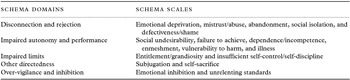
The YSQL2 (2nd edition) (Young and Brown, Reference Young, Brown and Young1994; Young and Pijnaker, Reference Young and Pijnaker1999 (Dutch version)) was used to assess the 16 early maladaptive schema scales. Table 1 shows a summary of the EMS and the corresponding schema domains. The questionnaire consists of 205 items divided in 16 subscales corresponding to the 16 EMS scales. The items are rated on a 6-point Likert scale ranging from “Completely untrue of me” to “Describes me perfectly.” The overall score of the schema scale is calculated by the summation of the schema scale items, as such higher scores are indicative of more maladaptive beliefs. There are a number of studies that have investigated the psychometric properties of the YSQL2, and overall they show good results for construct validity on schema level, internal consistency of the scales, and convergent/divergent validity with other constructs (e.g., Schmidt et al., Reference Schmidt, Joiner, Young and Telch1995; Lee et al., Reference Lee, Taylor and Dunn1999; Pauwels et al., Reference Pauwels2013). In the present sample, the Cronbach's α coefficients of the subscales ranged from 0.86 to 0.93, indicating good to very good internal consistency of the YSQL2 scales. For the three age groups separately, Cronbach's α ranged from 0.78 to 0.95 for young adults, from 0.77 to 0.96 for middle-aged adults, and from 0.78 to 0.93 in the older age sample.
Schema domains and corresponding schema scales (Young, Reference Young1990)

To screen for clinical symptoms, we used the DSM-IV diagnoses given by the psychiatrists and the Symptom Checklist-90-R (SCL-90-R; Arrindell and Ettema, Reference Arrindell and Ettema1986), which measures a broad array of psychiatric problems. The questionnaire consists of 90 items to be rated on a 5-point Likert scale (ranging from “not at all applicable” to “to strongly applicable”), indicating to what degree the psychopathological symptoms were present during the last week. The items are divided over the following nine subscales: anxiety, phobic anxiety, depression, somatization, obsessions and compulsions, interpersonal sensitivity and paranoid ideation, hostility, sleeplessness, and psychoneuroticism (total score). The SCL-90-R demonstrates good to very good levels of concurrent, convergent, discriminant, and construct validity (Arrindell and Ettema, Reference Arrindell and Ettema1986).
The Drug Use Screening Inventory – Revised (DUSI-R; Tarter and Kirisci, Reference Tarter and Kirisci2001) is a self-report questionnaire with good construct validity and internal consistency, and was used to assess the type of substance use. The questionnaire assesses 20 types of drug use. We divided them into three categories as follows: alcohol use, illicit drug use, and dual usage. We excluded smoking as an addiction due to the high comorbidity with other substances and given the fact that smoking is not treated as an addiction during hospitalization.
Data analyses
Group characteristics
We explored associations between the three age samples and the type of substance use disorder and clinical symptoms. χ 2 score was calculated to compare type of abuse (alcohol use, illicit drug use, and dual usage) across the three age groups by means of DUSI-R (Tarter and Kirisci, Reference Tarter and Kirisci2001). To explore the mean level differences in psychopathology dimensions of the SCL-90-R (Arrindell and Ettema, Reference Arrindell and Ettema1986) between different age groups, we performed a multivariate analysis of variance (MANOVA) with the SCL-90-R scales as dependent variables and the three age groups as independent variables. To investigate as to which particular age groups differed from each other, we performed the Bonferroni post hoc tests. All analyses were performed by means of SPSS 20.
Missing values
During the DIF analyses, cases for which the stratifying variable is missing are omitted from the entire analysis by list-wise deletion. Missing cases ranged from 0.6 to 5% with the lowest on Entitlement and the highest on Self-sacrifice. Most of the missing data were situated in the oldest sample due to procedure (partly paper and pencil, which allows missing data). Given that item responses (and accordingly scale scores) were not missing at random but situated in the oldest sample, the presence of missing data could bias the DIF results. Therefore, to control the impact of missing data on the DIF analyses, external stratifying variables were computed based on imputed missing item values before importing the data into Differential Item Functioning Analysis System (DIFAS). A regression-based imputations approach was used, in which values are predicted based on existing relations between all present variables. As constraints for the imputed values, the minimum and maximum values were set as 1 and 6 respectively, corresponding to the response options in the YSQL2. Finally, because DIFAS only stratifies on integer values, these values were requested via the rounding option.
Differential item functioning (dif)
In this study, the functioning of the YSQL2 items in the three age groups was examined, controlling for the overall level of the underlying trait. Current analyses were conducted using an odds ratio approach within the Classical Test Theory (CTT) framework using the freely available DIFAS 4.0 program (Penfield, Reference Penfield2007). The advantage of using the DIFAS program is its applicability in smaller samples, but the program is only able to perform pairwise comparisons. Therefore, we made three pairwise comparisons between the three age groups, with the oldest comparison group as a reference group, and the younger age group (middle age or younger adults) as a focal group.
In accordance with the method that Van den Broeck and colleagues (Reference Van den Broeck, Bastiaansen, Rossi, Dierckx and De Clercq2013) used to investigate Personality Inventory for DSM-5's (PID-5) age neutrality, to detect DIF as a function of age, the Mantel χ 2 was calculated. In addition, the Liu–Agresti Cumulative Common Log-Odds Ratio (L-A LOR) and the Cox Noncentrality Parameter Estimator (Cox's B) were calculated to measure the direction and size of DIF. Negative values for L-A LOR and Cox's B indicate DIF against the reference group (the in-comparison younger adults have higher scores than the in-comparison older adults), positive values are interpreted in favor of the reference group (the in-comparison older adults have higher scores than the in-comparison younger adults). To make conclusions at a more stringent level, Bonferroni corrections were applied (0.05/Number of items × Total test statistics). Due to the rigorous procedure, only one of the three parameters has to show DIF to draw conclusions about the possible presentation of DIF.
Differential test functioning (dtf)
The impact of DIF at scale level was calculated by the DTF analyses (Penfield and Algina, Reference Penfield and Algina2006), considering v2 > 0.07 as a small effect, 0.07 < v2 < 0.14 as a medium effect, and v2 > 0.14 as a large effect. To make conclusions at a more stringent level, Bonferroni corrections were applied (0.05/Number of items × Total test statistics).
Exploratory analyses of age group differences
When DIF results are acceptable (i.e., the amount of DIF is below the cut-off of 25% as proposed by Penfield and Algina, Reference Penfield and Algina2006), age group comparisons for the YSQL2 are allowed. To investigate group differences with respect to the YSQL2 scales, we performed a MANOVA with the YSQL2 scales as dependent variables and the three age groups as independent variable. To investigate as to which age groups statistically differed from each other, we performed the Bonferroni post hoc tests. All analyses were performed by means of SPSS 20.
Results
Group characteristics
Table 2 shows the prevalence of drug use across the three age groups. We found a significant relationship between type of substance and age group (χ 2 (6, N = 270) = 19.116, p < 0.05). Young and middle-aged adults were more prevalent in the categories “dual usage” and “alcohol,” whereas older adults were more prevalent in the “alcohol” category compared with the young adults.
Prevalence of alcohol and substance use in the three age groups

As for clinical symptoms, we found a significant difference between the three age groups for the subscale hostility (F(2, 317) = 4.49, p < 0.05), with higher scores for young adults in comparison with both older age groups. We found no significant difference between the DSM-IV diagnoses of comorbid clinical symptoms and personality disorders between the three age groups (χ 2 (18, N = 292) = 30.043, p > 0.05). Overall, the majority had no comorbid Axis I diagnoses (80.1%). Most common comorbid Axis I disorders were bipolar and related disorders (7.9%), anxiety disorders (2.1%), and relational problems (2.7%). As for comorbidity with Axis II personality disorders, no significant differences were found between the three age groups (χ 2 (12, N = 294) = 16.891, p > 0.05). The majority had no comorbid Axis II personality disorder (86.1%), and the most common comorbid Axis II diagnoses were the borderline personality disorder (3.1%) and the personality disorders NOS (6.5%).
Differential item functioning
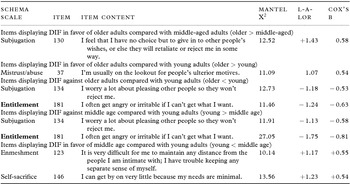
To investigate the possible presence of DIF at the YSQL2 scale level, three pairwise analyses between the different age groups were conducted, with the 16 YSQL2 scales serving as stratifying variables. In sum, 48 separate analyses were performed. The Bonferroni-adjusted LA-LOR confirmed large DIF for six items, divided across five schema scales (Mistrust/Abuse, Subjugation, Entitlement, Enmeshment, and Self-sacrifice). Table 3 presents the items meeting the Bonferroni-adjusted criteria for large DIF. Two items showed DIF in favor of older adults, indicating that these were more readily endorsed by older adults in spite of equal levels of Subjugation and Mistrust/Abuse. One item (Subjugation) was in favor of older adults compared with middle-aged adults, and one item (Mistrust/Abuse) was in favor of older adults compared with young adults. Next, two items showed DIF against older adults, controlling for equal levels of Subjugation and Entitlement, meaning that these were more readily endorsed by younger adults compared with older adults. Then, two DIF items were found against middle-aged adults and in favor of young adults, indicating that those items were more likely to be endorsed by young adults in comparison with middle-aged adults when controlling for Subjugation and Entitlement. Finally, two DIF items were found in favor of middle-aged adults, meaning that notwithstanding equal levels of Enmeshment and Self-sacrifice, those items are more readily endorsed by middle-aged adults in comparison with younger adults.
Items meeting the Bonferroni adjusted criteria for large DIF

Notes: L-A-LOR = Liu–Agresti common log odds ratio; Cox's B = Cox's noncentrality parameter estimator.
Schema scales with large DTF are given in bold.
Differential test functioning
Table 3 presents the impact of DIF items on schema scale level. Of the six items that presented DIF, only one item had a significant impact on schema level. The schema scale Entitlement showed large DTF due to DIF item 181 between young and middle-aged adults and young and older adults.
Exploratory analysis of age group differences
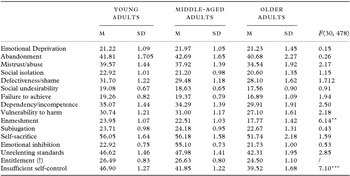
In order to investigate the stability of the YSQL2 scales, the schema scale Entitlement was eliminated due to the large DTF. Table 4 shows the results of MANOVA with the YSQL2 scales as dependent variables, age group as independent variable (fixed factor), and the SCL-90 subscale hostility and DUSI-R type of abuse as covariates. The results of MANOVA showed a significant overall effect (Wilks λ = 0.75, F(30, 478) = 2.44, p <.05). On scale level, we found significant differences for Enmeshment (F(2, 255) = 6.14, p < 0.01) and Insufficient Self-control (F(2, 255) = 7.10, p < 0.01). After controlling for hostility and type of substance abuse, older adults report significantly lower levels of Enmeshment in comparison with both young and middle-aged adults. For Insufficient Self-control, young adults show significantly higher levels of poor self-control in comparison with both middle-aged and older adults.
Mean scores and standard deviations of all schema scales for the three age groups with MANOVA results

Notes: *p ≤ 0.05, **p ≤ 0.01, ***p ≤ 0.001.
(!) Comparisons across age groups for Entitlement are not advised in the given DTF.
Discussion
The main focus of this study was to investigate the age neutrality of the YSQL2 between young (aged 18–34 years), middle-aged (aged 35–59 years), and older (aged 60–75 years) adults in a clinical sample of alcohol and substance use disorders in Belgium (Flanders). Although far more influence of age was expected according to our hypothesis, only 3% of the items of the YSQL2 showed DIF, which is below the cut-off of 25% to consider the instrument as being biased (Penfield and Algina, Reference Penfield and Algina2006). This implies that the vast majority of the YSQL2 items were similarly endorsed across the three age groups with the same score on the underlying schema scale. The YSQL2 can therefore be considered as an age neutral instrument and can be used in a sample of older adults in an AD population.
In line with the previous research on “heterotypic continuity,” we expected DIF for items that show lack of face validity, that is, items containing context factors that are not applicable to older age groups such as work, school, family, or origin (Balsis et al., Reference Balsis, Gleason, Woods and Oltmanns2007; Van den Broeck et al., Reference Van den Broeck, Rossi, Dierckx and De Clercq2012). However, none of the YSQL2 items concerning occupation, school, family, or origin contains DIF. It seems that face validity is not necessarily an obstacle for the comprehension of the underlying schema that is measured, and people seem to automatically adapt to a fitting context or imagine how the item translates itself in that specific context. One can assume that a reference to the actual relation with “parents” would lead to potential item bias in older age groups, but the one item that shows DIF on schema scale, i.e., Enmeshment, is the one where “parents” are not mentioned (Young and Brown, Reference Young, Brown and Young1994). Another potential explanation is the focus on cognitions in the YSQL2 that are considered to be highly stable over time (Schmidt et al., Reference Schmidt, Joiner, Young and Telch1995) in contrast to the DSM-IV and DSM-5 criteria, which also contain items more directly linked to behavior, and will be more difficult to adapt to another context and therefore more under the influence of “heterotypic continuity.”
The current results suggest that the comparison of mean scale scores between the three age groups is justifiable for 15 of the 16 schema scales. The aggregated DIF impact at scale level was ignorable for most schema scales, except for Entitlement. Schema scale Entitlement stands for the belief that one is superior to other people or one is entitled to special rights. This schema scale can focus on superiority in comparison with other people, but it can also involve the idea that one has to satisfy ones needs immediately regardless of cost. The item that causes DTF is item 181 (“I often get angry or irritable if I can't get what I want”). It was more easily endorsed by young adults in comparison with both middle-aged and older adults with equal levels of Entitlement. As this item focuses more on lack of self-regulation or impulsivity, it may be possible that the content does not reflect narcissism in terms of excessive vanity or self-centeredness, but rather aspects of age-related lack of self-regulation or impulsivity. Previous research shows that impulsivity diminishes with age (Roberts et al., Reference Roberts, Walton and Viechtbauer2006; Segal et al., Reference Segal, Coolidge and Rosowsky2006), which might be an explanation for DIF and aggravated DTF on schema scale level. Moreover, analyses of the subgroups showed influence of clinical psychopathology, namely, level of hostility, which is significantly lower in older adults in comparison with young and middle-aged adults.
After establishing the age neutrality of the YSQL2, mean comparisons between schema scales across the lifespan are allowed and the presumed stability of EMS over time can be investigated in 15 of the 16 scales controlling for the type of substance use and SCL-90-R hostility. Thirteen scales did not show significant differences when comparing young adults, middle-aged adults, and older adults, implying stability of these EMS throughout the lifespan. However, significant differences were found for schema scales Insufficient Self-control and Enmeshment. We found a significant lower score on Insufficient Self-control for middle-aged and older adults in comparison with young adults. Insufficient Self-control is defined by the lack of self-regulation in achieving one's goals and to control the expression of one's emotions or impulses (Young, Reference Young1990). This finding seems to be in line with the DIF item Entitlement and can possibly be considered as a decline of impulsivity with age (Roberts et al., Reference Roberts, Walton and Viechtbauer2006; Segal et al., Reference Segal, Coolidge and Rosowsky2006).
On the other hand, older adults showed a lower level of Enmeshment in comparison with middle-aged and young adults. Enmeshment is defined by the idea that one cannot survive without the continued support of significant others, often accompanied by an excessive emotional involvement with those significant others. A lower score on Enmeshment implies a certain amount of independence, emotional stability, and maturity. Moreover, emotion regulation seems to improve in adults and older adults (Carstensen et al., Reference Carstensen, Fung and Charles2003). The lower score on Enmeshment seems to be in accordance with the findings on changes in Big Five personality traits throughout the lifespan characterized by a decrease of neuroticism (or increase of emotional stability), extraversion and openness to experience, and an increase of agreeableness and conscientiousness (Costa et al., Reference Costa, McCrae, Zonderman, Barbano, Lebowitz and Larson1986; Van den Broeck et al., Reference Van den Broeck, Rossi, Dierckx and De Clercq2012).
Some limitations of the study need to be addressed. First, some methodological issues should be mentioned, starting with the relatively small sample size. Research in larger samples is needed in order to use more profound statistical procedures such as IRT-analyses. Second, our contingency procedure only detects uniform DIF, where the DIF is present for each item score. However, non-uniform DIF, where DIF is not present for each item score, remains undetected, therefore the results could be an underestimation of DIF. Third, research in other clinical samples is needed. In line with the findings of research on the scale level, items could be biased due to pathology-specific biases such as hostility and influence in the type of abuse. Fourth, there are some methodological and practical concerns that need to be addressed when using the YSQL2 in samples of older adults. Despite proven age neutrality, the questionnaire containing 205 items is quite long. Therefore, it would be advisable to create a shorter version of the questionnaire based on the current findings. In this paper, we chose to use the long form as a starting point because the age neutrality was never investigated on any of the existing YSQs. Fifth, the older adults were relatively “young” (60–75 years old), some of them were still working, which may result less item bias. It is advisable to include the older adults (aged above 70 years) or perhaps the oldest old adults in the future research.
In sum, we can conclude that the YSQL2 is a reliable age neutral instrument to assess EMS, but caution is needed for the schema scale Entitlement in older adults (middle-aged and older adults). The age neutrality of the YSQL2 results in several clinical opportunities that enable psychological and therapeutic assessment (Van Alphen et al., 2006). To start with the instrument shows good face validity on item level and is reliable for use in different age samples in clinical personality assessment where reliable age neutral instruments are scarce. Other advantages of using YSQ in clinical practice are the dimensional approach (in contrast to the categorical DSM-IV approach), which is hypothetically more sensitive to subtle changes in personality (Oltmanns and Balsis, Reference Oltmanns and Balsis2011). Also, the conceptual framework of EMS is, partly due to emphasis on cognitions, better designated to develop case conceptualization as a treatment plan in SFT (compared with the DSM-based questionnaires, which are often more designated to assist in diagnosis). Therefore, the YSQL2 is highly appropriate for therapeutic assessment. Above all, the recognizable framework of reference and the accessible language use of the YSQL2 (and SFT) form a therapeutic tool to explain dysfunctional patterns in psychotherapy. Besides the numerous therapeutic opportunities, an age neutral instrument can give more insight in the research of maladaptive personality traits and dysfunctional cognitions across the lifespan, which can in turn result in a better understanding of personality and its assessment. Moreover, an age neutral assessment tool of EMS can form the basis of a custom-made treatment protocol of SFT in older adults and can stimulate efficacy research in this gap in science.
Conflict of interest
None.
Description of authors’ roles
E. Pauwels designed the study, supervised the data collection, and wrote the paper. L. Claes and E. Dierckx, supervisors, helped in designing the study and assisted in writing the paper and supervising the analyses. I. Debast contributed to statistical design, carried out DIF analyses, and assisted in writing the paper.
B. Van Alphen contributed with his knowledge of SFT, personality research in older adults, and clinical expertise.
G. Rossi contributed with her knowledge of personality research and statistical expertise in DIF analyses.
C. Schotte contributed with his knowledge of personality research and clinical expertise.
E. Santens and H. Peuskens are addiction psychiatrists in the treatment unit where the data were gathered. They facilitated the study with their clinical expertise in substance use disorders, and assisted in writing the paper.
Acknowledgments
This study was made possible by the research funding of the Brothers of Charity, Ghent, Belgium.