Introduction
Autoimmune anti-NMDA-receptor-autoantibody encephalitis (ANRE) is increasingly recognised as an important differential diagnosis to schizophrenia. Many of the symptoms are alike, both tend to have a disease onset in adolescence, and both can have a long and relapsing course. Recent research also indicates that both disorders are associated with dysfunction of the N-methyl-d-aspartate glutamate receptors (NMDA-R) subunit 1 (Reference Hughes, Peng and Gleichman1,Reference Weickert, Fung and Catts2). The clinical case described here also raises the possibility that these apparently distinct disorders share aetiological factors. We describe a Swedish patient with an extensive family history of psychotic disorders who presented with ANRE. The case also highlights some of the difficulties in treating a patient with ANRE who is a Jehova’s witness, and why testing for ANRE should be performed on cerebrospinal fluid (CSF). The patient and her grandmother provided written consent to the publication of this case history.
Case history
The index patient, for whom we will use the pseudonym ‘Ms. A’, was a 16-year-old girl, living with her father, stepmother, two younger sisters, and two younger half siblings.
Ms. A’s first significant illness occurred when she was 3 years old. She required 4 days of respiratory and circulatory support in a paediatric intensive care unit because of septic shock caused by a streptococcal infection.
Ms. A’s mother committed suicide at the age of 32 when Ms. A was 6 years old. Her father later remarried.
Despite this early trauma Ms. A performed well in primary and early high school. Her father recalled no problems with her behaviour or socialisation in primary school. Until the abrupt onset of illness with which this history is concerned Ms. A maintained good grades at school, especially in mathematics, but performed poorly in physical disciplines like gymnastics.
When she was 12 years old, Ms. A attended a psychiatric service for assessment and management of ‘inappropriate sexual behaviours’. At that time they were diagnosed as autistic traits and no specific treatment was undertaken.
Ms. A’s apparently sound cognitive function was maintained at this time and she continued to perform well academically, though her inappropriate behaviour continued, for example she required prompts from her parents to change her clothing.
When she was 16, Ms. A sought emergency medical care for seizures. She had experienced seizure-like episodes of vaired semiology. Some with whole of body jerky movements, some apparent absences, and other episodes characterised by right-sided facial spasms. There was no contemporaneous electrographic evidence to confirm that these were epileptic seizures. She was treated with oxcarbazepine.
At that time the patient reported high levels of generalised anxiety and she became more socially withdrawn. She reported obsessional ideas about symmetry and reported having thoughts inserted into her mind. She also became forgetful and described some strange mental and somatic phenomena: she felt her thoughts were ‘stronger and clearer’, she was irritable and erratic, she said one eye felt cold, and she experienced one foot as extraordinarily heavy.
Initial investigation showed no obvious abnormality: magnetic resonance imaging (MRI) of the brain and electroencephalography were normal, standard tests of CSF were negative (including tests for Borrelia and Herpes), blood counts were normal and plasma neural autoantibodies (including antibodies against the NMDA-R) were not detected.
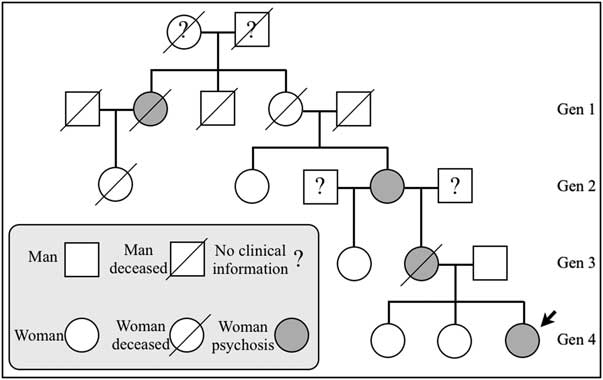
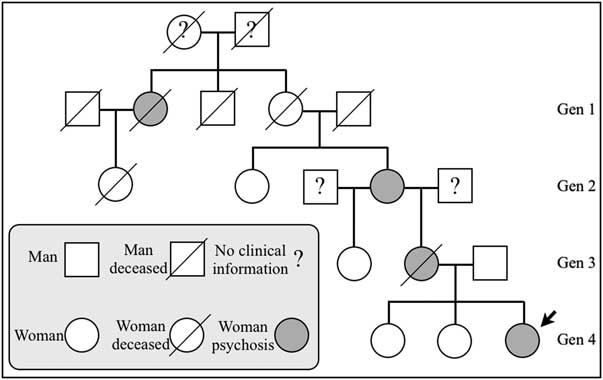
Given these results and her family history – showing three previous generations with women affected by psychotic disorders (see pedigree in Fig. 1) – a psychiatric diagnosis seemed likely. In that light the seizures were reevaluated by a neurologist, and diagnosed as ‘functional’. She was referred to the Child and Adolescent Psychiatry Unit where she was diagnosed with psychotic disorder not otherwise specified.
Pedigree showing the index patient in the fourth generation. Women in three prior generations were diagnosed with psychotic disorders. The index patient is indicated with an arrow.
In the psychiatric unit Ms. A was started on a low dose of olanzapine for her psychotic symptom and her regular oxcarbazepine was changed to valproic acid.
Within 3 weeks she improved considerably. The seizures-like episodes abated and her cognitive impairment partially resolved. Valproic acid was ceased after an additional 6 months. Neuropsychological assessment showed good intellectual functioning, an above-average, superior visual memory, and superior processing speed. Owing to side effects olanzapine was switched to aripiprazole.
The psychotic symptoms returned, <10 months later, when she was 17 years old. Initially she exhibited delusions and perceptual disturbances: she was preoccupied with changes in the quality of her faeces that could not be objectively demonstrated and described constant stroboscopic visual hallucinations. She also described anomalous ipseity, having the feeling that she was ‘losing herself’, was subjectively forgetful and experienced a generalised fearfulness associated with significant distress. She displayed markedly bizarre behaviour and took to staring menacingly at family members in an uncharacteristic way.
Ms. A was again admitted to a psychiatric acute inpatient unit where her symptoms progressed further. She became confused losing spatiotemporal orientation and exhibited echolalia and echopraxia. At times she exhibited monosyllabic perseveration of speech. Abnormal movements also arose, in particular she had a left sided upper limb tremor, and right-sided perioral fasciculation. This time the differential diagnoses were acute heritable porphyria, prion disease, interictal schizophreniform psychosis, and seronegative autoimmune encephalitis (ANRE, anti-GAD encephalitis, anti-AMPAR encephalitis, anti-DPPX encephalitis).
A battery of laboratory investigations was undertaken for definitive diagnosis.
ANRE was diagnosed when the anti-NMDA-receptor IgG antibodies that are pathognomonic for ANRE were detected in the CSF. No antibodies were detected for the other of the above mentioned encephilitis subtypes (however, there were no local lab facilities available to test for DPP6 autoantibodies). This new presentation also prompted reinvestigation of the CSF sample from the year before and confirmed the presence of anti-NMDA-receptor-autoantibodies at that time.
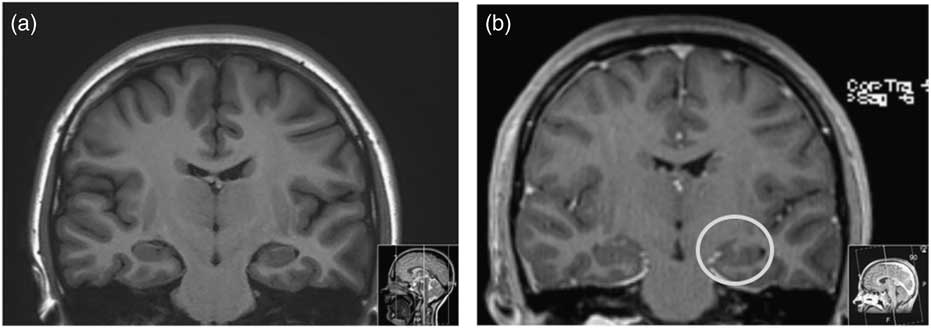
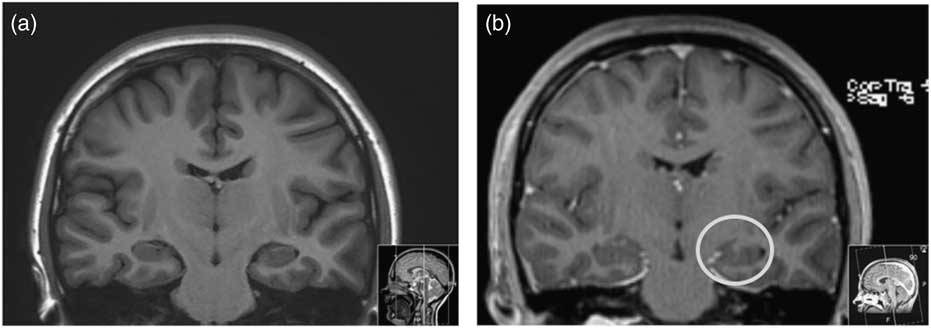
MRI with intravenous contrast showed increased uptake (indicating inflammatory activity) in the left hippocampal region (see Fig. 2). Owing to her behavioural dysregulation the patient was kept on a psychiatric inpatient unit with continued input from the neurology department.
MRI scans, T1 weighted, performed on different 3 T scanners. (a) From the first episode, patient aged 16, no contrast. (b) From the second episode, patient aged 17, MRI with contrast; shows increased uptake in left hippocampus indicating inflammatory activity. Left is right in the picture.
Gammaglobulin treatment was indicated but Ms. A declined because, as a Jehovah’s Witness, the use of medical blood products was prohibited by her religion. Instead she underwent plasmapheresis and received rituximab. Her condition stabilised and she was moved to a neurological rehabilitation unit; 1 year after the beginning of this second episode, her condition has improved dramatically, though her long-term memory is still demonstrably impaired.
The dual diagnosis of schizophrenia preceding ANRE was initially considered but ruled out after immunotherapy resulted in the resolution of her symptoms. In any event the autoimmune condition would have excluded a strict categorical diagnosis of Schizophrenia according to DSM-5 criteria.
In retrospect, given the family history and the patients symptomatology, we also acknowledge the possibility that Ms. A could have had a co-existing ANRE and anti-dopamine receptor encephalitis (also known as basal ganglia encephalitis or PANDAS). However, Ms. A is now much improved, so these additional tests were not undertaken.
About ANRE
The mean age of onset for ANRE is 23, but an extensive age range has been reported, from new born to age 80; 90% of affected patients are female. The incidence is unknown, most research is based on case reports, most likely it is heavily under-diagnosed (Reference Dalmau, Lancaster, Martinez-Hernandez, Rosenfeld and Balice-Gordon3,Reference Titulaer, McCracken and Gabilondo4). We are only aware of one previously published case where the diagnosis and treatment of a child or adolescent with ANRE was initiated by a psychiatric service (Reference Maggina, Mavrikou and Karagianni5).
In 70% of the reported cases, the first symptoms of ANRE are psychiatric: schizophreniform psychosis, mania, cognitive impairment, sleep disturbances, psychomotor disturbances. Other symptoms include seizures, hypertonia, tachycardia, and disorientation (Reference Dalmau, Lancaster, Martinez-Hernandez, Rosenfeld and Balice-Gordon3,Reference Kuo, Tsai, Lai, Lin and Yang6–Reference Tsutsui, Kanbayashi and Tanaka9).
The intensity of symptoms seems to correlate to the titre of antibodies. The disease frequently has a relapsing course. There are also milder forms of ANRE – these usually with onset later in life (Reference Pruss, Holtje and Maier7).
ANRE arises from endogenous production of antibodies against NR1 subunit of the NMDA receptor (NMDA-R) in the brain. When they bind to the receptor, the complex is embedded intracellularly, resulting in a decreased density of post-synaptic NMDA-R (Reference Hughes, Peng and Gleichman1). The receptor is expressed in most brain regions, with high density in the limbic system especially the hippocampus. The antibodies may be of paraneoplastic origin (usually related to ovarian teratoma), or a parainfectious phenomenon, but many causes remain idiopathic (Reference Dalmau, Lancaster, Martinez-Hernandez, Rosenfeld and Balice-Gordon3).
Diagnosis is made by identification of the anti-NMDA-receptor-autoantibodies. They are more likely to be detected in CSF than in blood, especially in the early phases of illness (Reference Fang-Chun Chen and Dalmau10).
Recommended treatment is immunotherapy and surgical removal when a teratoma is present. The prognosis improves considerably with early treatment (Reference Kayser and Dalmau11).
Why did our patient get ANRE?
No teratoma was identified in Ms. A, and there was no obvious proximal parainfectious cause. Her ANRE should be considered idiopathic. However, her earlier symtoms and her family history taken into account, we allow ourselves to make two propositions about the ethiopathological mechanism.
First, given her earlier symptoms, we propose that her ANRE could be of a juvenile onset type, with a parainfectious origin – from the time of her streptococcal infection in early childhood – and that she suffered low-grade symptoms of ANRE from that time. This explanation may also account for her autistic traits. However, we could not test this idea in Ms. A’s case.
Second, the family history of psychotic illness also raises the possibility that her ANRE was associated with hitherto unidentified heritable factors. The pattern of heredity in this family is striking: the fact that one woman in every generation as far back as the relatives could remember was affected, and the demonstrable heritability of other autoimmune disorders makes a compelling case for the investigation of heritable factors. Furthermore, dysfunction of the NMDA-R NR1 subunit is a factor in the emergence of schizophrenia (Reference Weickert, Fung and Catts2), and anti-NMDA-receptor-autoantibodies are present in a small minority of schizophrenia patients (Reference Pollak, McCormack, Peakman, Nicholson and David12).
The patient did consent to our investigation for markers of heredity. The only living relative affected by psychosis was her grandmother, who lived in another town. Neurological examination uncovered no signs of autoimmune encephalitis though she did report impaired short- and long-term memory, as well as irritability, vivid hallucinations, and delusions. Ms. A’s grandmother had no history of seizures. No anti-NMDA-receptor-autoantibodies – IgG, IgA, IgM – were identified in her CSF.
DNA was extracted from blood samples from both Ms. A and her grandmother and sequenced for the region of the GRIN1 gene coding for the NMDA-R NR1 subunit. Exons 1, 2, 3, 5, 6, 9, 10, 11, 12, 13, 14, and 19 did not display any variants outside of the published sequence. Exons 4, 7, 8, 15, 16, 17, and 18 could not be analyzed due to incomplete polymerase chain reaction amplification. This testing was highly speculative, but we thought it was warranted to exclude the possibility that the affected members of this family shared a gene coding for an abnormal configuration of the NMDA receptor subunit 1 that predisposed both to psychosis in earlier generations and to the autoimmune reaction seen in this patient. As it were, no such genetic abnormality was detected.
Discussion
In summary, a young woman with a family history of psychosis presented with ANRE. We could not support our hypothesis that there is a genetic link in this family between other psychotic disorders and ANRE despite the compelling case for heredity and the pathophysiologic similarities between schizophrenia and ANRE with regard to NMDA-R dysfunction. One may speculate that genetic or epigenetic variants of this protein may alter its structure such that both dysfunction and new epitopes for antibody generation result (Reference Diamond, Bloom, Al Abed, Kowal, Huerta and Volpe13).
Clinical teaching points are as follows:
-
∙ If seronegative for anti-NMDR-R (R1), then investigate prescence of ANRE in CSF. Ms. A might have received specific immunotherapy 1 year sooner had that been the protocol at her first presentation.
-
∙ Be aware of ANRE in child and adolescent psychiatry, especially for atypical presentations of psychosis or cognitive decline, even where there is a family history of psychotic disorders.
-
∙ In the event that plasmapheresis is not an option, treatment with rituximab may be an effective alternative. However, one must also consider the potential serious side effects of rituximab.
Acknowledgements
The authors thank the patients and their families; Dr. Ulla Lindbom, consultant neurologist, Karolinska University Hospital Huddinge, Sweden, for valuable clinical advice leading to the diagnosis; Dr. Alex Karlsson-Parra, The Rudbeck Laboratory, Uppsala, Sweden, for valuable cooperation in the analyses of the blood and cerebrospinal fluid samples; Dr. Lena Cavallin, Neuroradiology Department, Karolinska University Hospital Huddinge, for assessments of the magnetic resonance imaging scans. This study was supported by grants from the Schizofreniförbundet, Swedish Research Council, Hjärnfonden, Karolinska Institutet and Karolinska University Hospital.
Conflicts of Interest
The authors report no conflicts of interest.
Supplementary material
To view supplementary material for this article, please visit http://dx.doi.org/10.1017/neu.2015.32