Extended mind is a hot topic these days. In this literature, one sometimes finds the claim that consciousness does not supervene on just the brain, but on the entire organism and perhaps even its environment. Rather than searching for a neural correlate of consciousness, the advocates of extended consciousness maintain that scientists should search for a broader biological correlate of consciousness. According to Alva Noë, one of the view's boldest advocates,
It is misguided to search for neural correlates of consciousness – at least if these are understood, as they sometimes are, to be neural structures or processes that are alone sufficient for consciousness. There are no such neural structures. How could there be?Footnote 1
Consciousness is not something the brain achieves on its own. Consciousness requires the joint operation of brain, body, and world. Indeed, consciousness is an achievement of the whole animal in its environmental context. I deny, in short, that you are your brain.Footnote 2
Seeing is an activity of exploring the world, one that depends on the world and on the full character of our embodiment.Footnote 3
It is now clear, as it has not been before, that consciousness, like a work of improvisational music, is achieved in action, by us, thanks to our situation in and access to a world we know around us.Footnote 4
This paper will push back (yet again) against the excesses of extended mind. Here the resistance will take place at three points. The first point, to be presented in section 1, is to rebut one of Noë's arguments that there are no neural correlates of consciousness. In Out of Our Heads, Noë proposes that experiments involving the ‘rewiring’ of ferret brains, carried out by Mriganka Sur and his colleagues, show that the intrinsic character of the brain is irrelevant to explaining the difference between vision and audition. Rather than focusing narrowly on the brain, we should focus on the whole organism. The rebuttal to this consists of showing how Noë either misinterprets or misconstrues the results of these experiments. Section 2 will challenge what we might call Noë's ‘strong enactivism’. This is the view that bodily movement is necessary for perception or perceptual consciousness. Contra Noë's strong enactivism, there is solid empirical evidence against the view that consciousness requires the joint operation of the brain, body, and world or that seeing is an activity of exploring the world. This evidence consists of certain experiments and clinical observations involving neuromuscular blockade that reveal perception without bodily movement. Section 3 will challenge what we might call Noë's ‘weak enactivism’. Noë claims that ‘For mere stimulation to constitute perceptual experience – that is, for it to have genuine world-presenting content – the perceiver must possess and make use of sensorimotor knowledge’.Footnote 5 Perhaps we can drop the idea that a perceiver must make use of sensorimotor knowledge in the form of bodily movement in order to perceive. Perhaps instead, in the absence of the joint operation of the brain, body, and world, tacit knowledge of sensorimotor contingencies has the role in perception that Noë attributes to it. The contrast between the strong and the weak views comes to this. The weak view requires only possessing a particular body of knowledge, where the strong view requires possessing a particular body of knowledge and putting it to work through active exploration of one's environment or through the joint operation of the brain, body, and world. The difficulty for weak enactivism is that certain simple experiments falsify some of its apparent predictions.
1. Noë on the Neuroplasticity of ‘Rewired’ Ferrets
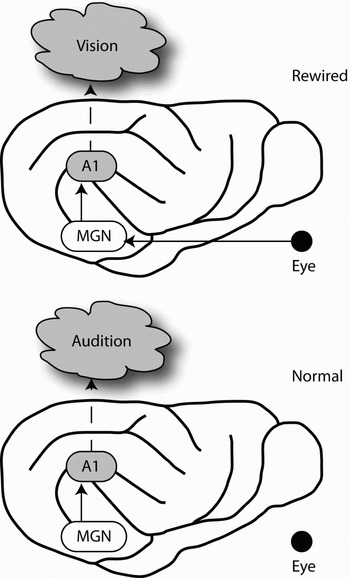
In Out of Our Heads, Noë argues that Mriganka Sur's work on ferrets shows that conscious experience does not depend on the intrinsic character of the brain.Footnote 6 He thinks this work shows that the brain alone is not the supervenience base for conscious experiences. In these experiments, Sur performed surgical interventions on newborn ferrets. These interventions induce the formation of neural connections between the eye and the medial geniculate nucleus (MGN) which in turn connects to primary auditory cortex, A1. Noë proposes that this procedure transforms a ferret so that area A1 in adults gives rise to visual experiences, rather than auditory experiences, while leaving A1 itself unchanged. (See Figure 1). It is because A1 itself is supposed to be unchanged and yet to give rise to visual experiences that we must look beyond A1, and indeed beyond the brain, to explain the visual character of experience. In other words, his goal is to show that the brain by itself is not the supervenience base of conscious states.
Noë's Interpretation of Sur's Experiments.

As it may be surprising to think that Noë interprets Sur's work in this way, it is worthwhile reviewing Noë's discussion in detail. In doing this, it is important to distinguish the vast majority of what Noë gets right about Sur's work from the important bit that he gets wrong. Early in his discussion of Sur's work, Noë writes:
Until now, [scientists] have not been able to bridge what is sometimes called ‘the explanatory gap’ between neural states on the one hand and conscious experience on the other. From my perspective, this is not surprising. The reason we cannot explain the quality of experience in terms of the intrinsic nature of the brain's action is that, in fact, there is nothing distinctively visual about the brain's action.Footnote 7
We can take it as common ground that there is currently an explanatory gap between neural states and consciousness. Noë, however, wants to go further than this and say that the reason there is an explanatory gap is that we are looking in the wrong place for the biological correlate of consciousness. We should not be looking at the brain; we should be looking at brain-body-world interactions. We should not be looking for a neural correlate of consciousness; we should be looking for an ecological correlate of consciousness. This argument, however, is not the same as Noë's neuroplasticity argument, since nothing in it depends on neuroplasticity.Footnote 8 A bit later, Noë writes:
[Sur's work] shows that the link between brain areas and conscious experience (e.g. the link between the auditory cortex and auditory experiences and that between the visual cortex and visual experiences) is malleable.Footnote 9
Here is a conclusion that one can accept consistent with believing in a neural correlate of consciousness. One who believes in neural correlates of consciousness can comfortably say that, in Sur's experiments, auditory cortex gives rise to visual experiences. That just means that the tissue that normally gives rise to audition now gives rise to visual experience. This, by itself, does not show that the intrinsic properties of the brain are an inadequate realization base for visual or auditory experiences. For what might be going on is that the surgical interventions convert tissue that once had a structure suitable for realizing auditory experiences into tissue suitable for realizing visual experiences. In fact, as we shall see, this is a fairly plausible interpretation of what actually happens. Next Noë writes:
The fact that it is possible in this way to vary consciousness in relation to its neural underpinnings teaches that there isn't anything special about the cells in the so-called visual cortex that makes them visual. Cells in the auditory cortex can be visual just as well. There is no necessary connection between the character of experience and the behavior of certain cells.Footnote 10
Here again, we have a conclusion that the advocate of neural correlates of consciousness can accept. One might say that cells from one area of the brain that normally do one task can be reconfigured to perform another task. And what might explain how cells that normally realize auditory experiences come to realize visual experiences has to do with the way in which the cells are interconnected, rather than their individual physiological properties. So, what Noë says to this point is correct, but nothing that challenges the hypothesis that there are neural correlates of consciousness. Noë, however, comes much closer to misleading his readers in the next passage:
And this finding in turn means that if we want to understand why certain cells or certain brain areas are participating in seeing and not hearing, or in hearing and not seeing, we need to look beyond the immediate neural activity itself. The character of conscious experience can vary even though the neural activity underpinning it does not change. This is the basic lesson of Sur's studies. It follows, then, that what determines and controls the character of conscious experience is not the associated neural activity.Footnote 11
Perhaps one can say that the neural activity is the same, maybe in the sense that both normal and rewired auditory cortex fire normal action potentials. But, it is easy enough to move from this to the idea that the tissue in area A1 is entirely unchanged by the surgical intervention. This is where Noë risks misleading his readers, since if it were true that the tissue in area A1 is entirely unchanged by Sur's intervention, then indeed, one could not appeal to changes in A1 to explain changes in perceptual experiences. If the brain did not change, but the experiences did, then the biological change that is responsible for the perceptual change must lie elsewhere, as in the ferret's connection to the external world. And, in fact, Noë needs the strong conclusion that A1 is entirely unchanged by Sur's intervention in order to have a compelling argument against a neural correlate of consciousness. After all, if A1 were only the same in some respects, that still leaves open the possibility that A1 is changed in other respects and that these other respects are the ones that are responsible for A1 subsequently giving rise to visual experiences, rather than auditory experiences. Noë is even more misleading when he claims that
What explains the consequences for consciousness of this sort of rewiring is not the intrinsic character of the neurophysiological changes themselves; it is, rather, the larger setting or context in which these neurophysiological changes occur.Footnote 12
Here it is possible to read ‘the neurophysiological changes’ as an explicit recognition on Noë's part that there are changes in rewired A1. One might take this to be the clearly charitable reading. If, however, one does this, then Noë's argument against a neural correlate of consciousness collapses for the reason just noted. If Noë accepts that there are neuroanatomical or neurophysiological changes in A1, then that opens the door to those changes being what is responsible for converting the tissue in A1 from a supervenience base for auditory experiences into a supervenience base for visual experiences. In fact, if we review Sur's original publications, it will be clear that there are changes in rewired A1 and that they are plausibly construed as changes that would indeed convert A1 into a supervenience base for visual experiences.
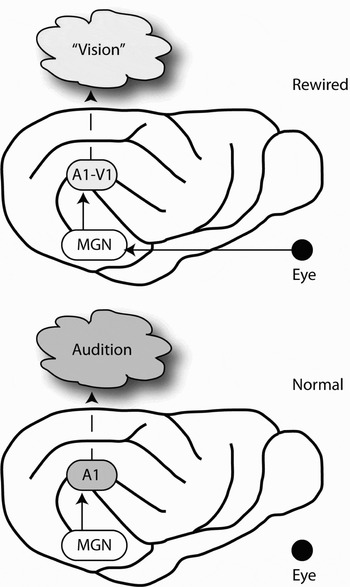
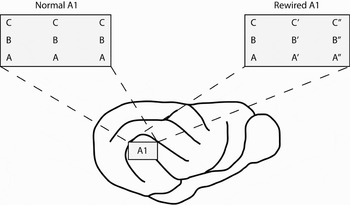
The fundamental flaw in Noë's use of Sur's work is that, while the tissue in the ferret's area A1 does not become exactly like normal ferret V1 after the surgical intervention, it does assume many properties that are like normal V1. (See Figure 2). Contrary to Noë's suggestions, if not explicit assertion, rewired ferret A1 becomes something of a hybrid between normal A1 and normal V1 and perhaps has enough features of normal V1 to make it a viable candidate for a realization base for visual experiences. First, consider some similarities between rewired A1 and normal V1. In the first place, it is not merely that rewired A1 responds to light, rather than sound. In addition, the cells in rewired A1 have response properties like those in normal V1: some cells are sensitive to oriented lines and bars and others are sensitive to the direction of moving lines and bars. Moreover, the cells in rewired A1 are organized into regions of the sort found in normal V1. As reported in Sur's work, normal A1 has a tonotopic structure in which a given sound frequency corresponds to a single band of tissue running horizontally in A1, where rewired A1 has retinotopic structure in which a given point in the visual field is mapped to a small region of rewired A1.Footnote 13 (See Figure 3). These are not obscure details. The abstract to one of these papers includes the following:
In these [rewired animals], the primary auditory cortex contains a systematic representation of the retina (and of visual space) rather than a representation of the cochlea (and of sound frequency). A representation of a two-dimensional sensory epithelium, the retina, in cortex that normally represents a one-dimensional epithelium, the cochlea, suggests that the same cortical area can support different types of maps.Footnote 14
Sur's Interpretation of Sur's Experiments.

Normal Auditory Cortex (Tonotopically Organized) Versus Rewired Auditory Cortex (Retinopically Organized).

In addition, other abstracts note that the precision of the tuning of oriented line detectors in rewired A1 is comparable to that of normal V1.Footnote 15
Despite these similarities, there are also differences between rewired A1 and normal V1. First, in rewired A1 the mapping of azimuths is more precise than the mapping of elevations, whereas in normal V1 azimuth is mapped as precisely as is elevation.Footnote 16 Second, in rewired A1 there is overlapping projection from MGN to rewired A1 which is unlike the projection from LGN to V1 in normal ferrets.Footnote 17 Third, rewired A1 has a less orderly map than does normal V1.Footnote 18 Finally, horizontal connections between orientation modules in rewired A1 are less patchy and periodic than are horizontal connections in normal V1.Footnote 19
The principal point to take away from this research is that Sur and his colleagues performed certain surgical interventions on newborn ferrets, then raised these ferrets to adulthood in the anticipation that these neonatal interventions will lead to differences in adult area A1. These anticipations have been borne out with Sur and his colleagues documenting the various ways in which rewired ferret A1 comes to resemble normal ferret V1. What these experiments suggest, contrary to Noë's view, is that when we look at the intrinsic features of the brain for a mechanistic explanation of the visual character of experience, we are probably looking in the right place.
2. Strong Enactivism and the Problem of Paralysis
To this point, the discussion has rebutted Noë's analysis of the implications of the rewired ferret experiments. This merely undercuts one of Noë's arguments for his view. Now, however, we shall take a step further and challenge Noë's positive view that we should expect to discover an ecological correlate of consciousness. This will proceed in two stages. The first stage will consider strong enactivism and the second will consider weak enactivism. So, this section will challenge the idea that action in the form of physical movement is necessary for consciousness. In other words, it will provide evidence that conflicts with Noë's view that ‘Consciousness requires the joint operation of brain, body, and world’Footnote 20 and that ‘[s]eeing is an activity of exploring the world, one that depends on the world and on the full character of our embodiment.’Footnote 21
The central problem for Strong Enactivism is the existence of perception despite complete immobilization.Footnote 22 There is a broad class of neuromuscular blockers that inhibit neuromuscular function by binding to the muscle receptors for the neuromuscular transmitter acetyl choline.Footnote 23 Acetyl choline cannot cause normal muscular contraction, since the muscle relaxer blocks its binding sites on muscles. For decades, both experimental and clinical research has shown that neuromuscular blockade induces paralysis, but not the loss of consciousness or perception or awareness. Indeed, muscle relaxers have generally been found not to affect cognitive activity at all. Present purposes will be served by reviewing just one experimental study and a handful of clinical studies.Footnote 24
Prior to administering their subjects the neuromuscular blocker vecuronium, Topulos and his colleagues applied a tourniquet to one arm.Footnote 25 This slowed the transmission of the vecuronium from the bloodstream to the neuromuscular junctions, so that the bound arm remained functional. This allowed the immobilized subjects to communicate with the investigators using a pre-established system of finger gestures. During this period, the experimenters asked subjects questions requiring yes or no answers. After the experiment, subjects could also recall events that took place during the paralysis. These results are extremely hard to reconcile with the strong enactivist idea that ‘Consciousness requires the joint operation of brain, body, and world’. Consider the details more closely. All subjects perceived or were conscious of the questions asked of them. All subjects found the process of tracheal intubation, which was part of the purpose of the study, to be ‘extremely uncomfortable’. They were conscious of discomfort. In addition, all complained of the bitter taste of the lidocaine spray that was used to facilitate the intubation. Two of the subjects worried about the discomfort of the procedure. Two subjects explicitly stated that they did not know when paralysis had set in until they tried to move. Presumably, on Noë's theory, consciousness should fade exactly when paralysis sets in, since loss of movement is loss of part of the minimal supervenience base for consciousness. But, that did not happen. As a summary, the investigators report that
Complete neuromuscular block caused no observable impairment of consciousness, sensation, memory, or the ability to think and make decisions. Objective evidence supported this assertion, as subjects responded promptly to questions. When the experimenter misunderstood their answers, subjects recognized this and made a correction. Subjects successfully used a questionnaire with many branching points to communicate their needs. Subjects also accurately recalled specific events that occurred in the room while they were paralyzed. This unimpaired mental function is consistent with the reports of previous investigators.Footnote 26
It is, of course, true that the failure to paralyze one arm does not lead to complete paralysis. Yet, it is unclear why the ability to move one arm (even were this ability exercised) would be the kind of sensorimotor skill that would be sufficient to maintain the apparent capacity to perceive bitter tastes, the discomfort of intubation, the questions of the investigators, and the anxiety over the procedure.
This experimental work is complemented by a large body of clinical work. Anesthesiologists have used muscle relaxers to enable surgeons to better control the body position of patients. In addition, muscle relaxers are useful in suppressing involuntary motor responses, such as gagging, that occur during intubation. An unfortunate side effect of the use of muscle relaxers, however, is that it makes it much more difficult to determine whether a patient is adequately anesthetized. Immobilized patients are able to provide very few signs of the distress they are suffering due to inadequate anesthesia. Consider some of the reports on awareness during surgery. In an anonymous 1979 editorial in the British Journal of Anaesthesia, a woman reported in graphic detail her recollections of being aware during a Caesarian section under general anesthesia and neuromuscular blockade.Footnote 27 Although immobilized by the anesthesiologist, she remembers feeling the pain of the incision, hearing her baby crying, and feeling the insertion of a nasogastric tube. In a more recent case study, a 74-year-old woman recalled that during her operation ‘1) she felt pain during the incision of the abdomen, 2) she heard the operator say, “It is difficult to remove all tumors because the adhesion is very strong,” and 3) she remembered someone had been walking around her’.Footnote 28 These post-operative recollections were independently confirmed by the surgical staff. Because of the obvious importance of the phenomenon of awareness during surgery, there have been numerous studies of its frequency in hospitals in the United States and Europe. In one study involving 45 patients, all recalled hearing sounds or voices, 33 understood and remembered conversations, 21 had visual perceptions, 29 felt being touched, six recalled moderate pain, and eight recalled severe pain.Footnote 29
Cases of awareness during surgery have their methodological drawbacks as a means of challenging Noë's theory of perception and consciousness. To begin with, these studies rely on patient recollection. Sometimes these putative recollections are rather vague, such as that the patient recognized the surgeon's voice and heard the sound of instruments. Such vague recollections could be recollections of dreaming or pure confabulations. In one prospective study of awareness during surgery, participants were interviewed on multiple occasions.Footnote 30 The multiple interviews, in conjunction with the procedures used to obtain informed consent, may have increased the chances of false memories. Despite these limitations, however, there do appear to be cases in which completely immobilized, completely paralyzed patients perceive auditory and visual events during their operations. Moreover, unlike the method used by Topulos and his colleagues, the methodology in these studies does not leave any of part of the body in a nearly fully functional state. The experimental methods and the clinical prospective studies thus depend on the truth of different sets of auxiliary hypotheses. Therefore, they provide, in some measure, independent methods for determining the effects of paralysis on perception. In short, paralysis does not eliminate consciousness.
3. Weak Enactivism and the Problems of Illusions and Metamers
Noë is clearly aware of the challenge posed by cases of paralysis, and so he offers a possible solution, namely, he backs away from the idea that perceptual experience, hence consciousness, requires exploratory behavior. Instead, experience requires only the possession of tacit sensorimotor knowledge (SMK). In Action and Perception, he writes:
Paralysis is certainly not a form of blindness. But isn't that precisely what the enactive view requires, that the paralyzed be experientially blind? No. The enactive view requires that perceivers possess a range of pertinent sensorimotor skills. It seems clear that quadriplegics have the pertinent skill. … More important, paralysis does not undermine the paralyzed person's practical understanding of the ways movement and sensory stimulation depend on each other. Even the paralyzed, whose range of movement is restricted, understand, implicitly and practically, the significance of movement for stimulation. They understand, no less than those who are not disabled, that movement of the eyes to the left produces rightward movement across the visual field, and so forth.Footnote 31
This seems to be a pretty clear endorsement of what we have called ‘weak enactivism’. Rather than perceptual experience requiring the exercise of sensorimotor skills through bodily movements or behaviors per strong enactivism, it requires only the possession of sensorimotor skills. This is a weaker theory in the sense that one could not exercise a skill one did not possess, but one could possess a skill one does not exercise. One could possess at time t the sensorimotor ability to ride a bike, but not exercise that ability at time t either physically or through mental simulation or imagination.
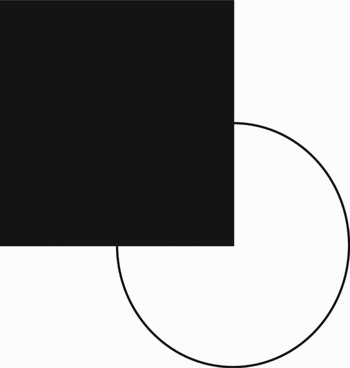
It is worth noting that this weakening of the theory is not an ad hoc move for Noë. At a number of points he invokes this weaker theory to explain other important perceptual phenomena, most notably, amodal completion.Footnote 32 To see this, we need some further elaboration of Noë's theory. A very simple illustration of amodal completion is useful here: a circular tile which, from a particular perspective, is occluded by a rectangular tile. (See Figure 4). The example is useful, since it is clear and simple, it is (relatively) phenomenologically salient, and its existence is supported by ‘objective’ psychophysical evidence.Footnote 33 Noë would say that, what one strictly speaking sees (from position p) is a black rectangle adjacent to a Pac-Man-shaped figure. By contrast, what one perceptually experiences (from position p) is a black rectangle occluding a circle.Footnote 34 Noë also describes what one strictly speaking sees and what one perceptually experiences in terms of two kinds of perceptual content.Footnote 35
Perceptual content has a dual aspect. There's the way experience presents the world as being, as it were apart from your perspective. This is one aspect of its content. And there is the way the world is presented in experience, a way that always incorporates some reference to how things look or sound or feel from your vantage point. So, for example, your experience presents you with the circularity of the plate, but also with the elliptical shape it presents from here.Footnote 36
An Instance of Amodal Completion of a Circle Occluded by a Square.

Thus, in our amodal completion example, experience ‘aperspectivally’ presents the world as having a black rectangular tile occluding a white circular tile, but experience ‘perspectivally’ presents the world having a black rectangular tile adjacent to a Pac-Man shaped tile.
Sensorimotor knowledge enters the picture by linking what one strictly speaking sees and what one perceptually experiences. It links perspectival to aperspectival perceptual content. ‘How [things] (merely) appear to be plus sensorimotor knowledge gives you things as they are’.Footnote 37 This SMK takes two forms: movement-dependent and object-dependent.Footnote 38 Movement-dependent SMK consists of such things as one's knowing how one's own movements away from p lead to changes in what one strictly speaking sees. Thus, as one moves one's head or walks around the two objects, progressively more or less of the circle is revealed or covered. Object-dependent SMK consists of such things as knowing how an object's movements will lead to changes in what one strictly speaking sees of it. Thus, as the occluding black rectangle moves from one place to another, more or less of the occluded circle will be presented.
Noë intends to extend this type of analysis of the simple case of amodal completion to an extremely wide range of cases. For example, he claims that one can perceptually experience a whole cat that is partially occluded by the slats of a picket fence or a whole tomato – including its back side – of which we strictly speaking see only the front face. He maintains that we perceptually experience the color and fine detail of the physical world in the periphery of our visual field, although we do not strictly speaking see it.Footnote 39 What links what we strictly speaking see to what we perceptually experience is SMK:
The ground of this accessibility is our possession of sensorimotor skills. … In particular, the basis of perceptual presence is to be found in those skills whose possession is constitutive, in the ways I have been proposing, of sensory perception. My relation to the cat behind the fence is mediated by such facts as that, when I blink, I lose sight of it altogether, but when I move a few inches to the right, a part of its side that was previously hidden comes into view. My sense of the perceptual presence, now, of that which is now hidden behind a slat in the fence consists in my expectation that by moving my body I can produce the right sort of ‘new cat’ stimulation.
In this way, we can explain our sense of the perceptual presence of, say, the whole tomato. Our perceptual sense of the tomato's wholeness – of its volume and backside, and so forth – consists in our implicit understanding (our expectation) that movements of our body to the left or right, say, will bring further bits of the tomato in view. Our relation to the unseen bits of the tomato is mediated by patterns of sensorimotor contingency. Similar points can be made across the board for occlusion phenomena.
In general, our sense of the perceptual presence of the detailed world does not consist in our representation of all the detail in consciousness now. Rather, it consists in our access now to all of the detail, and to our knowledge that we have this access. This knowledge takes the form of our comfortable mastery of the rules of sensorimotor dependence that mediate our relation to the cat and the bottle.Footnote 40
Noë's theory is clearly meant to have a very broad scope.
The general form of the problem for Noë's weak enactivism is that SMK does not appear to mediate between what one strictly speaking sees and what one perceptually experiences. SMK does not appear to form a bridge between ‘aperspectival’ perceptual content and ‘perspectival’ perceptual content. So, to begin to unravel Noë's theory, let us return to the black rectangle that, from perspective or position p, occludes a white circle. As is widely known, this perceptual experience occurs even when there is not a circle behind the black rectangle. If the part of the white figure that one strictly speaking sees is consistent with a circle, but the occluded portion is highly irregular, (from position p) one still experiences the white portion as circular. How can this be on Noë's theory? In this case, movement will not reveal a circle. Movement of one's head, the black rectangle, or the white irregular object will only reveal an irregular object. One cannot have SMK that such and such movements will reveal a circle, since no movements will reveal a circle. In such cases, SMK cannot connect what one strictly speaking sees, a black rectangle adjacent to a Pac-Man shaped figure, to the perceptual experience of a black rectangle occluding a circle, since there does not exist the appropriate SMK.Footnote 41
The ‘mistakes’ in amodal completion, among other examples, suggest that we should not take Noë to be speaking of ‘knowledge’ in the epistemologist's sense of something like justified true belief (or what have you), but of ‘knowledge’ in the psychologist's sense of something like belief or expectation. Moreover, this type of belief is not just any kind of belief or expectation. Noë apparently means the kind that is formed through long practice, and trial and error. It might be acquired only through extensive exploration of, and interaction with, the environment. One of Noë's discussions on this score is the way in which SMK is modified in Ivo Kohler's experiments with inverting and distorting goggles.Footnote 42 Very briefly, in these experiments one dons one or another form of distorting lens goggles which immediately proves to be disorienting. With extensive training over the course of several weeks, however, one comes to learn to compensate for the alterations, thereby restoring near normal levels of behavioral competence. It is this kind of sensorimotor knowledge or tacit understanding that Noë probably has in mind.
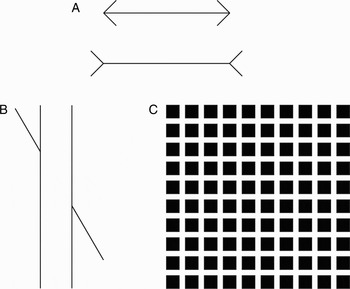
This refinement or clarification, however, does little to address the fundamental problem with Noë's view. Even repeated exposure to the fact that an occluded object is not a circle appears not to undermine the perceptual experience of a circle. The refractory character of amodal completion is, in fact, a familiar feature of many visual illusions. Consider the Müller-Lyer illusion, the Poggendorff illusion, or the Herman grid illusion. (See Figure 5). Repeatedly measuring the lines in the Müller-Lyer illusion does not make the lines look to be the same length. Repeatedly masking and unmasking the arrowheads and tails in the Müller-Lyer illusion does not make the lines look to have the same length once they are unmasked. Repeatedly aligning a straightedge with the diagonal line of the Poggendorff illusion does not make the apparent break go away when the straightedge is removed. Scanning around the Herman grid over and over does not make the smudges at the intersections go away once they are again viewed in the periphery. The simple sorts of learning that Noë describes with the inverting goggles do not suffice to make these illusions go away.
A) the Müller-Lyer Illusion, B) the Poggendorff Illusion, and C) the Hermann Grid Illusion.

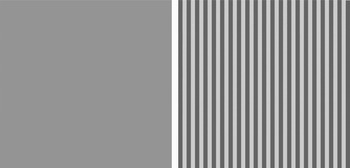
Take another category of problem cases: metamers. Consider the rectangular grid, G, and uniform gray patch, U, shown in Figure 6. At position p – a distance of about 20 feet or more – G and U look alike. If, however, one moves closer to a position p* – a distance of about 2 feet – G and U look different. G looks like a grid, where U looks like a uniform gray rectangle. Imagine protracted interaction with, and exploration of, G and U. Even with all this experience with the effects of movement on the perspectival appearance of G and U, when one returns to position p, G and U again look alike. Their perspectival appearance is not connected by SMK to a different aperspectival appearance.Footnote 43 In the case of amodal completion, it is supposed to be knowledge of the effects of movement that are supposed to lead a perceiver from how things merely appear perspectivally from position p – as a black square adjacent to a Pac-Man shaped figure – to the way things are aperspectivally – as a black square occluding a circle. The theory does not work in the case of amodal perception, but it clearly does not work in the case of the metameric G and U. SMK again does not take a perceiver beyond the perspectival to the aperspectival.
A Uniform Gray Rectangle and a Rectangular Grid.

The problem with G and U appears to generalize quite broadly. Metamers are physical objects or properties (such as U and G) that look the same under a given set of conditions C (such as distance). The recipe for making trouble for Noë is to take two objects M1 and M2 that are metameric under conditions C, and then repeatedly vary those conditions so that M1 and M2 are no longer metameric. The problem is that when one returns to conditions C, M1 and M2 will often remain metameric. Many metamers cannot be unlearned by the kinds of simple sensorimotor learning that Noë describes.
Return now to Noë's claim that perception has a dual aspect. On the one hand, there is the way experience presents the world as being, as when it presents a dinner plate as circular, and on the other hand, there is the way the world is presented from a specific perspective, as when it presents a dinner plate as elliptical. Noë believes that tacit sensorimotor knowledge links the way things look from a particular perspective to how things are:
perceptual experience is a way of encountering how things are, but it is a way of encountering how things are by making contact with how they appear to be. How they (merely) appear to be plus sensorimotor knowledge gives you things as they are.Footnote 44
The point that illusions and metamers make is that how things appear plus sensorimotor knowledge does not give you things as they are. One's tacit sensorimotor knowledge does not always mediate between how things look perspectivally and how things look aperspectivally.
To conclude this section, Noë's theory of the role of tacit sensorimotor knowledge in perception seems to make incorrect scientific predictions about what well-informed viewers will perceive. In many cases of visual illusions, sensorimotor knowledge plus visual stimulation under conditions C ‘tells you’ not to perceive things that you do perceive. In many cases of metamers, sensorimotor knowledge plus visual stimulation under conditions C ‘tells you’ to perceive things that you do not perceive. At the risk of overgeneralization, it appears that Noë's theory falsely predicts that there should be no visual illusions or metamers for the well-informed. By Noë's lights, genuine sensorimotor knowledge should let the well-educated perceptually experience the world as it really is, but there is no education that good.
4. Conclusion
The core message of this paper is that, for all Noë has argued, it still remains too early to abandon hope for a neural correlate of consciousness. First of all, upon closer examination of the results of Sur's experiments, we can see that the neonatal interventions external to A1 lead to adult differences internal to A1. The general character of the changes is that rewired ferret A1 becomes more like normal ferret V1. This gives us hope that the visual character of visual experience might be explained by properties intrinsic to the brain. Second, Noë's theory that perception requires action of the whole organism founders on the well-documented cases of consciousness in the face of neuromuscular blockade. Third, even the weak theory that perception requires merely the possession, rather than the exercise, of sensorimotor knowledge appears to conflict with certain relatively simple and well-known features of perception, namely, the persistence of visual illusions and metamers in the face of one's sensorimotor understanding of them. In short, for all Noë has said, it is still too early to adopt Noë's holistic approach to consciousness and give up on the brain.Footnote 45