Approximately 30% of antimicrobial use in the inpatient setting is unnecessaryReference Hecker, Aron, Patel, Lehmann and Donskey 1 and has contributed to the development of various adverse events including antimicrobial resistance and Clostridium difficile infection.Reference Holmes, Moore and Sundsfjord 2 – Reference Bell, Schellevis, Stobberingh, Goossens and Pringle 4 As a countermeasure, antimicrobial stewardship programs have been promoted in the general inpatient population and have been expanded to selected inpatient populations with challenging medical conditions, such as patients in intensive care units or the hematology-oncology ward or those with a terminal condition.Reference Lawrence and Kollef 5 – Reference Furuno, Noble and Fromme 7
Similarly, broad-spectrum antimicrobial agents are administered in end-of-life care based on immunocompromised status and the high prevalence of colonization by multidrug-resistant organisms in patients with advanced-stage disease despite their limited impact on overall prognosis and symptom relief and the possibility of causing further discomfort.Reference Tamma, Avdic, Li, Dzintars and Cosgrove 3 , Reference Mitchell, Shaffer and Loeb 8 , Reference Givens, Jones, Shaffer, Kiely and Mitchell 9 Moreover, the use of antimicrobials in end-of-life care despite the lack of any clear benefit may promote the emergence of antimicrobial resistance in the rest of the population.
Previous studies evaluating the factors associated with antimicrobial use at the end of life were mainly conducted prior to, or at the beginning of, the antimicrobial stewardship era. Furthermore, countries like Japan are now being confronted with the challenges of a rapidly aging demographic. These facts make our understanding of current antimicrobial use and the prescribing behaviors of physicians in the healthcare setting vital for reconsidering the judicious use of antimicrobial agents in terminally ill patients. The purpose of our study was to examine current antimicrobial use during the last 2 weeks of the life of terminally ill patients and to assess the factors influencing physicians’ prescribing behavior.
Methods
Participants and setting
This study was a retrospective cohort study conducted at Tokyo Metropolitan Tama Medical Center in Japan from January 2016 through December 2016. The aim of the study was to investigate current antimicrobial use by examining hospitalized patients with an advanced-stage illness who later died at the study institution. The study institution is a public, 790-bed tertiary-care center with 29 subspecialties and a division of infectious diseases that offers infectious disease consultations and operates an antimicrobial stewardship program. Although palliative care consultation is available, there are no palliative care units at the study institution.
We initially enrolled all patients who died during index hospitalization within the study period at the study institution. Because the purpose of the study was to demonstrate the status of antimicrobial use in patients with an advanced-stage illness beyond the first 48 hours of hospitalization, we excluded those who died within the first 48 hours of hospitalization. We then screened candidates by reviewing their electronic medical records and subsequently identified those with an advanced-stage illness who fulfilled the prespecified criteria for advanced-stage illness (Appendix 1) defined as an advanced-stage active malignancy (eg, stage III or IV malignancy) that is incurable or cannot be controlled with treatment, a condition or nonmalignant illness at an advanced-stage, or end-stage organ damage due to a wide spectrum of nonmalignant illnesses, based on current guidelines or definitions employed in previous studies.Reference Metra, Ponikowski and Dickstein 10 – 16 Two investigators (K.K. and Y.T.) manually performed the screening of eligible patients using these criteria. If the patients had multiple advanced-stage illnesses, we tracked the secondary and tertiary advanced-stage illnesses and identified the primary advanced-stage illness by reviewing the electronic medical charts. Patient consent was waived because the current study would not have influenced the management of participating patients’ health and consent was unobtainable due to their death. The institutional review board at Tokyo Metropolitan Tama Medical Center approved the study.
Variables of interest and data collection
The variable of interest was defined as at least 1 day of either oral or intravenous antimicrobial therapy in the last 14 days of life in patients with an advanced-stage illness.Reference D'Agata and Mitchell 17 We also reviewed the electronic medical records of the patients who achieved symptom relief after receiving antimicrobial therapy. Symptom relief was considered to have been achieved if the medical records indicated that the symptoms had improved after the administration of antimicrobial therapy. The objectives were (1) to scrutinize the descriptive epidemiology of antimicrobial use in the last 14 days of life in the context of current antimicrobial stewardship practices and (2) to identify factors influencing physicians’ prescribing behaviors when treating patients with an advanced-stage illness. The demographic characteristics, microbiological data, and clinical data were retrospectively obtained from the electronic medical records. Clinical data included present comorbidities, the primary advanced-stage illness, details of antimicrobial use, diagnostic testing (eg, obtainment of culture specimens) done prior to initiating antimicrobial therapy, efficacy of antimicrobial therapy, escalation of medical care in the last 14 days of life, and palliative care provided in the last 14 days of life. Efficacy of antimicrobial therapy was defined as the achievement of a resolution or improvement in new onset symptoms or a resolution of infection or signs prior to the prescription of antimicrobials. We also defined an escalation in medical care as the provision of new medical interventions besides antimicrobial therapy or palliative care in the last 14 days of life. The Charlson comorbidity index was used to assess patients’ chronic comorbidity status, and the score was dichotomized as 0–5 and ≥6 since the score was 6 if a metastatic solid malignancy was present.Reference Charlson, Pompei, Ales and MacKenzie 18 We also calculated antimicrobial use among the study patients. Antimicrobial use during the last 14 days of life was expressed as days of therapy (DOT) per 1,000 patient days. We used the patient days during the last 14 days of life as the denominator and DOT for each antimicrobial agent during the last 14 days of life as the numerator.
Statistical analysis
Categorical variables were compared between those with and without antimicrobial therapy in the final 14 days of life using the χ2 test or the Fisher exact test as appropriate. Continuous variables were compared using the Mann-Whitney test. All tests for significance were 2-tailed, with P<.05 considered significant.
We performed multivariate logistic regression to predict the administration of antimicrobial agents in our study population. The factors associated in previous studies with antimicrobial use during advanced-stage illness, including underlying illnesses (active malignancies versus nonmalignant advanced-stage illness),Reference Lau, Tse, Tsan Chen, Lam, Lam and Chan 19 – Reference Ahronheim, Morrison, Baskin, Morris and Meier 21 device use (ie, central venous catheters),Reference Nakagawa, Toya and Okamoto 22 , Reference Ramadas and Feijo Barroso 23 younger age (<65, 65–80, and >80 years),Reference Albrecht, McGregor, Fromme, Bearden and Furuno 20 lack of palliative care consultation,Reference Tse, Chan, Lam, Leu and Lam 24 and chronic lung diseases (eg, chronic obstructive pulmonary diseases and interstitial pneumonitis),Reference Lau, Tse, Tsan Chen, Lam, Lam and Chan 19 , Reference Albrecht, McGregor, Fromme, Bearden and Furuno 20 were forced into the final model. Additionally, for factors with P<.10 in univariate analysis, we assessed multicollinearity by examining the tolerance value and the Pearson correlation to ensure the independence of the explanatory variables. Backward selection was used with a cutoff of P<.05. Variables were retained in the final model if P<.05. The Hosmer-Lemeshow test was used for goodness of fit for the logistic regression model. All analyses were performed using SPSS version 25.0 software (IBM, Armonk, NY).
Results
In total, 742 patients who died at the study institution during the study period were screened for eligibility. Among them, 482 patients (65.0%) were excluded either because they died within 48 hours of admission (n=290; 39.1%) or did not have an advanced-stage illness (n=192; 25.9%). Of the 260 patients included in the study, 136 patients (52.3%) received antimicrobial therapy in the last 14 days of life and 124 patients (47.7%) did not.
The demographic characteristics and clinical data of the 260 patients, and the details of the antimicrobial therapy given to the 136 patients are shown in Appendix 2 and Table 1, respectively. Symptom relief was a primary indication for antimicrobial use in 60 patients (44.1%). Common symptoms leading to initiating antimicrobial therapy included dyspnea followed by fever. Pneumonia was the most common presumptive diagnosis for the indication of antimicrobial therapy. Culture-based diagnostic tests (ie, blood, urine, or sputum) prior to antimicrobial administration were performed for 102 patients (75.0%). The proportion of positive cultures was 27 of 48 (56.3%) for sputum, 27 of 91 (29.7%) for blood (1 positive culture was considered as indicating contamination); 25 of 47 (53.2%) for urine, and 3 of 13 (23.1%) for other specimens. In total, 70 patients (51.5%) received antimicrobial therapy until death, and 95 patients (69.9%) failed to achieve symptom relief via antimicrobial therapy. The initial antimicrobial therapy used in the last 14 days of life is described in Appendices 3 and 4. The total amount of antimicrobial use (DOT per 1,000 patient days) in the last 14 days of life was 421.9 DOT per 1,000 patient days. The DOT per 1,000 patient days for each antimicrobial class is shown in Appendix 5.
Details of Antimicrobial Use in the Last 14 Days of Life in Patients With an Advanced-stage Illness (n=136)

Note. IQR, interquartile range; MRSA, methicillin-resistant Staphylococcus aureus; CAUTI, catheter-associated urinary tract infection; CRBSI, catheter-related bloodstream infection.
a Unless otherwise specified.
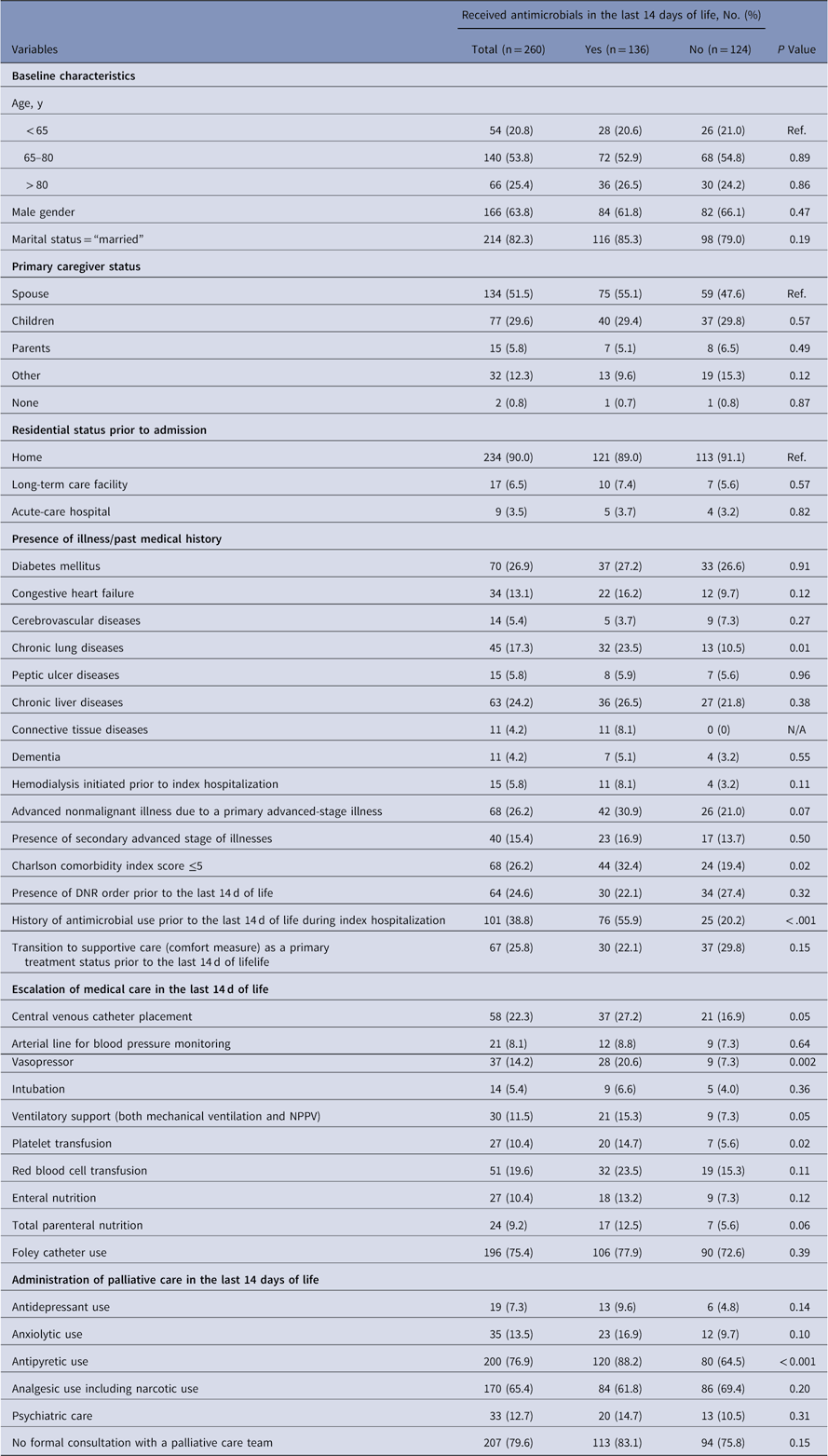
Table 2 shows a comparison of the 260 patients who had an advanced-stage illness with or without antimicrobial use in the last 14 days of life. The predictors of antimicrobial use in the last 14 days of a patient’s life are shown in Table 3.
Comparison of Patients With an Advanced-stage Illness With or without Antimicrobial use in the Last 14 days of Life (n=260)

Note. Ref., reference; N/A, not available; DNR, do not resuscitate; NPPV, noninvasive positive pressure ventilation.
Predictors of Antimicrobial Use in the Last 14 Days of Life in Patients With an Advanced-stage Illness

Note. CI, confidence interval. The outcome variable was the receipt of antimicrobial therapy in the last 14 days of life. In total, 11 variables were included in the final model based on the total number of instances of antimicrobial use, following the rule-of-thumb of one covariate per ten events. The Hosmer Lemeshow test was used for goodness-of-fit for logistic regression with a P value of .23. Variables considered but not retained in the final model were age, advanced illnesses due to non-malignancies as the primary advanced-stage illness, central venous catheter use in the last 14 days of life, platelet transfusion in the last 14 days of life, no formal consultation with a palliative care team, and ventilator support in the last 14 days.
Discussion
Significant debate is underway regarding whether antimicrobial use is a desirable treatment option for patients with an advanced- or terminal-stage illness.Reference Furuno, Noble and Fromme 7 , Reference Juthani-Mehta, Malani and Mitchell 25 Unnecessary or inappropriate antimicrobial therapy at the end of life may produce an array of undesirable results including the prolongation of the dying process, the emergence of multidrug-resistant organisms, and a financial burden on the healthcare system.Reference Baghban and Juthani-Mehta 26 Moreover, the overall antimicrobial use in end of life care was heavy.Reference D'Agata and Mitchell 17 , Reference Baghban and Juthani-Mehta 26 Given the current advances in antimicrobial stewardship, it is time to reconsider antimicrobial use for terminally ill patients.
In our retrospective cohort, 136 patients (52.3%) with an advanced-stage illness received antimicrobials in the last 14 days of life for various indications. Multiple studies have shown that antimicrobials are commonly prescribed in terminally ill patients and that the proportion of antimicrobial use varies according to the study period and country. For example, a study in the United States published more than 20 years ago revealed that 88% of terminally ill patients received antimicrobials, while a recent study using a US national database revealed that 27% of hospice patients received antimicrobials in the final week of life.Reference Albrecht, McGregor, Fromme, Bearden and Furuno 20 , Reference Ahronheim, Morrison, Baskin, Morris and Meier 21 Similar trends were found internationally as well.Reference Rosenberg, Albrecht and Fromme 27
Although antimicrobial use as a palliative measure is deemed appropriate, symptom relief may not be achievable by antimicrobial therapy alone.Reference Givens, Jones, Shaffer, Kiely and Mitchell 9 Our findings cast further doubt on the efficacy of antimicrobial agents for symptom relief. As seen in the Table 1, 44% of patients with an advanced-stage illness received antimicrobials in the last 14 days of life for symptom relief. However, only 23% of these patients experienced symptom relief. Several retrospective studies also revealed that the proportion of symptom relief achieved with antimicrobial therapy in terminally ill patients ranged from 15% to 48%.Reference Nakagawa, Toya and Okamoto 22 , Reference Vitetta, Kenner and Sali 28 – Reference Helde-Frankling, Bergqvist, Bergman and Bjorkhem-Bergman 31 Other studies also indicated that antimicrobial therapy contributed to symptom relief in urinary tract infections but was less likely to do so in pneumonia or bloodstream infections.Reference Givens, Jones, Shaffer, Kiely and Mitchell 9 , Reference White, Kuhlenschmidt, Vancura and Navari 32 , Reference Reinbolt, Shenk, White and Navari 33 A potential explanation for the relatively lower efficacy of antimicrobials for symptom relief in the current study was the difference in the predominant symptoms (dyspnea and fever) leading to the initiation of antimicrobial therapy. Moreover, up to 75% of patients who received antimicrobials had undergone a culture-based diagnostic test, including a urine culture (34.6%), sputum culture (35.3%), or blood culture (66.9%) prior to initiating antimicrobial therapy. Although culture-based diagnostic tests can identify the causative organisms, false-positive results may prompt unnecessary antimicrobial therapy.Reference Morgan, Malani and Diekema 34 Culture-based tests without a clear therapeutic aim, especially with regard to antimicrobial use for symptom relief in a terminally ill population, may be of little value. Due awareness of these limitations is important for improving both antimicrobial and diagnostic stewardship practices.
Several factors were significantly associated with the prescription of antimicrobials in the target population. The factors retained in our final model identified certain prescribing behaviors; the precedent use of an antimicrobial during index hospitalization potentially attenuates the concept of overprescribing antimicrobials.Reference Teixeira Rodrigues, Roque, Falcao, Figueiras and Herdeiro 35 The development of these behaviors lowered the threshold for prescription when symptoms (eg, fever) developed in patients at the end of life. Antipyretic use in the last 14 days of life can be considered a surrogate marker for the presence of fever. Although fever is a common symptom and noninfectious fever due to a wide spectrum of medical conditions can occur in terminally ill patients, antimicrobials were commonly prescribed in the absence of adequate clinical symptoms to support the diagnosis of a bacterial infection,Reference Juthani-Mehta, Malani and Mitchell 25 , Reference Baghban and Juthani-Mehta 26 possibly out of fear of possible future complications or from the desire to resolve the fever quickly despite diagnostic uncertainty.Reference Teixeira Rodrigues, Roque, Falcao, Figueiras and Herdeiro 35
Vasopressor use representing an escalation in medical care, chronic lung diseases, and a lower Charlson comorbidity index, may be relevant to antimicrobial use at the end of life. In a US study, terminally ill patients frequently received nonpalliative interventions.Reference Ahronheim, Morrison, Baskin, Morris and Meier 21 It is reasonable to assume that these nonpalliative interventions may lead to the escalation of similar interventions including antimicrobial use. As in previous studies, patients with a chronic lung disease in our study frequently received antimicrobial therapy as part of the treatment for the exacerbation of the underlying lung disease.Reference Lau, Tse, Tsan Chen, Lam, Lam and Chan 19 , Reference Albrecht, McGregor, Fromme, Bearden and Furuno 20 Advanced cardiovascular diseases and pulmonary diseases accounted for a large proportion of patients with a lower Charlson comorbidity index score in the current study. Because a higher Charlson comorbidity index score generally predicts shorter life expectancy,Reference Cho, Klabunde and Yabroff 36 the estimate of survival probability in those with a lower score is challenging despite the advanced stage of illness, and this perplexity may lead physicians to prescribe antimicrobials. Although the ideal strategy for appropriately assessing an advanced stage of a noncancerous illness remains unclear, the use of other clinical parameters including performance status, advanced age, and nutritional status might help predict terminally ill conditions in these populations more precisely.Reference Salpeter, Luo, Malter and Stuart 15 More importantly, advanced care planning including infection management at the end of life and close communication with the patient and their family regarding withholding antimicrobial agents is required for more judicious use of antimicrobials.Reference Juthani-Mehta, Malani and Mitchell 25 , Reference Heyland, Barwich and Pichora 37 , Reference van der Steen, Ooms, van der Wal and Ribbe 38
The study has some limitations. Although we defined advanced-stage illness based on current evidence contained in guidelines and previous studies, the definition has not been validated. Although requests for antimicrobial use from patients or their caregivers may have influenced physicians’ prescribing behavior,Reference Heyland, Barwich and Pichora 37 , Reference Yao, Hsieh and Chiu 39 we did not evaluate because such information is rarely documented. We extensively reviewed physicians’ and nurses’ notes to assess symptom relief after antimicrobial therapy; however, some instances may not have been recorded. Furthermore, the impact of antimicrobials on prolonging life or on the dying process could not be evaluated because of the retrospective nature of the study. Because some patients might have had underlying indications for antimicrobial therapy, it was difficult to be certain whether our findings were associated strictly with inappropriate or unnecessary antimicrobial use. As with other observational studies, even after adjusting for known predisposing factors, other unmeasured factors may have accounted for antimicrobial use in terminally ill patients. Lastly, because end-of-life care may be influenced by cultural differences, findings at hospitals in different nations or regions may be dissimilar. A multicenter, prospective study using similar populations is needed to address these limitations.
The current study demonstrated that approximately one-third of patients who died in an acute-care hospital had an advanced- or terminal-stage illness and that half of these received antimicrobials at the end of life. Antimicrobials were commonly prescribed, and their overall consumption was significant despite their limited efficacy. The decision to initiate antimicrobial therapy at the end of life was likely influenced by patient factors as well as the physicians’ prescribing behaviors. From the ethical and antimicrobial stewardship perspectives, we should reconsider antimicrobial use at the end of life to provide the best end-of-life care for patients with advanced-stage illness.
Acknowledgments
We are indebted to James R. Valera for his assistance editing the manuscript.
Financial support
No financial support was provided relevant to this article.
Conflicts of interest
All authors report no conflicts of interest relevant to this article.
Supplementary material
To view supplementary material for this article, please visit https://doi.org/10.1017/ice.2018.167