Introduction
The early modern urban experience was synonymous with periods of crisis – be they war, pestilence, famine, natural disasters or – in the case of this article – fire, and the Great Fire of London in 1666. During times of crisis, structures and perceptions of the city are brought sharply into focus. The process of coping with a disaster generates large volumes of records, enabling the period to be used as a ‘look out’ point from which to examine the city in a new, wider, perspective. The ways in which a city organized relief effort and reached outside for help reflect its position in larger political and economic networks.Footnote 1 Studying urban catastrophe therefore offers a powerful tool to answer questions about the history of the city: the resilience of its social and administrative structures and its relationship with the wider community of the nation.
All early modern urban areas were vulnerable to fire for the same reasons that London was in 1666: flammable building materials, close-packed housing, domestic and trade use of hearths and limited fire-fighting technology.Footnote 2 The most pressing concern created by major fires is the destruction of homes, and the attendant social dislocation caused by mass homelessness. In the aftermath of a fire, the homeless must be fed and housed before any long-term recovery can be envisaged. Long-term recovery is not just in the form of reconstructing the built environment but in reconstructing lives and business. Frequently, this required help from central authorities and from non-fire affected areas of the city and the nation at large.
The 1666 Fire destroyed approximately 13,200 houses in London, making as many as 100,000 homeless, which means that its scale was far in excess of any other English early modern fire and the challenge of recovery commensurately greater. A more useful comparison is between the 1666 Fire and other ‘Great Fires’ which devastated major early modern cities, for example, the Great Fires of Edo (1657) and Istanbul (1660). The Edo Fire ruined three-quarters of the city, and killed about one seventh of its population of 600,000. The Istanbul Fire destroyed two-thirds of the city, razing 280,000 houses and killing as many as 40,000.Footnote 3 In the aftermath of both fires, central authorities played an important role in organizing the rebuilding. In both cases, the political and economic importance of both cities ensured they were rebuilt within a decade and continued their pre-Fire status and importance. Similarly Peter Borsay's study of Warwick's recovery from its Great Fire of 1694 demonstrated that its ability to cope with disaster and to recover was evidence of its flourishing state at the time. Studies of modern urban crises have shown that cities are highly robust in withstanding exogenous shocks, even of immense size, especially if they are of high socio-economic importance. Over time, it appears that even if the shock was large, its effects tended to undo themselves eventually.Footnote 4
This article will examine how local and national society aided in the recovery from urban disasters using the exemplar of England, and London's reaction to the Great Fire. This will illuminate connections between metropolis and locality and, by showing how London extracted resources from the rest of the country, will examine a key process in recovery from urban disaster. The article uses the records of a major national charitable collection undertaken with the aim of aiding Londoners who had suffered as a result of the Fire. It shows what the charitable priorities of the post-disaster early modern city were, and what the determinants of generosity may have been. External assistance was often vital in a city's recovery from fires. Sometimes this took the form of formal government assistance: after the 1657 Great Fire of Edo, for example, the Shogun set up kitchens to feed survivors, dug mass graves, constructed a new temple and conferred money upon merchants to help rebuild the city. Following the 1827 Great Fire of Turku, the tsar opened warehouses of the Russian garrison to supply flour and grain, exempted the city from taxation and the obligation to accommodate soldiers and established a construction fund to give interest-free loans. A city's hinterland usually played a key role – for example, in the aftermath of the 1728 Great Fire of Copenhagen, food supplies were carted into the town from surrounding villages.Footnote 5
London's recovery benefited from both these forms of assistance, but it is the role of the hinterland – the nation at large – that provides the focus of this article. The article considers a nationwide charitable collection for Londoners after the Great Fire, and analyses what it reveals about the city's recovery and the perception of London in the rest of England. The collection for Londoners recovering from the Fire started on 10 October 1666, and took the form of a ‘brief’. Briefs had been the chief method of collecting charitable donations in England since the medieval period. Well-organized and promoted briefs could raise substantial sums. The main mode of transmitting briefs was through the parish. Warrants for briefs were issued for a set time, area and subject.Footnote 6 Donations were either collected after a service or via a house-to-house collection by the churchwardens or another parochial official. Roger Lowe of Ashton-in-Makerfield (Lancashire), for example, recorded in his diary a house-to-house collection on 16 October 1666 for the brief for distressed Londoners. The parish priest asked Lowe and two ‘friends’ to see what the people of the village would donate ‘towards the reliefe of such needie psons as had sustained losse by the great fire in London and to set their names down’.Footnote 7
Briefs to raise money for relief of victims of fire were commonplace in seventeenth-century England. In London especially briefs were principally used to raise funds for fire damage. From 1674 to 1701, 94 briefs were read in Clayworth (Nottinghamshire) and c. 80 per cent of these were to raise money for victims of fires. Similarly, from 1672 to 1706, 136 briefs were read in Clent (Staffordshire) and three-quarters of these were for victims of fires. Donna Andrew's study of eighteenth-century appeals for charitable assistance in the London press found that when the appealer was a victim of a crime or accident, fire was especially cited.Footnote 8 The relationship between the size of the fire and the amount raised was not linear. A 1653 fire in Marlborough (Wiltshire) caused £70,000 worth of damage and its brief raised £18,000, whereas the 1694 Great Fire of Warwick destroyed £120,000 worth of property but its brief raised only £11,000. Analysis of a sample of 46 briefs for fire and inundation damage in England from 1805 to 1819 found there was almost no correlation between the financial loss caused and the sum collected (Spearman's Rank Correlation Coefficient was 0.135).Footnote 9 It is clear that the magnitude of a fire did not determine the amount its brief would raise. Charitable collections for cities recovering from disaster could be international. In the aftermath of the Boston (Massachusetts) Fire in 1760, the city received £7,000 from churches and people in other colonies and £3,000 from London merchants. A century later, in the aftermath of the Great Fires of Sundsvall and Umeå in 1888, these Swedish towns received donations from as far away as Turkey and Brazil.Footnote 10
The brief for distressed Londoners was the second in a series of three major national briefs from 1655 to 1678, starting with a collection for the Vaudois, an embattled Protestant group in the Savoy, and finishing with a collection for the rebuilding of St Paul's Cathedral. The 1666 brief can be followed at every stage – from collection across England to distribution in London. The details of each donation were noted in the order received in a posting book.Footnote 11 There are 2,096 returns in the 1666 brief, the majority of them (1,898) from individual parishes. They recorded the amount and date of the donation and from where and whom it was received. The collection was complete in terms of area covered, with all English counties represented. Details of the distribution of the brief were gleaned from a variety of sources. When money was allotted, it was noted in the same book that was used to record when money was brought to London. There are also two sets of documents detailing individual payments. One is a bundle of 204 receipts, each of which notes the amount given to a specific person, parish or ward, and occasionally including information on the circumstances of the payment. The other is a bundle of 140 orders to the city chamberlain asking him to pay money to various individuals, parishes and wards.Footnote 12 When they detailed the same payment, in every case, the date and amount they record is the same, and also matched the amount and date recorded in the book noting the sums paid. Some of the amounts paid out were also recorded in the Repertory of the Court of Aldermen. These sources are vital as the extant parish and ward records do not shed much light on how the 1666 brief was distributed.
The collection of the charitable contributions in England
The brief was begun a few weeks after the Fire, and the total amount collected was £16,486.92. This was not distributed evenly geographically (see Table 1). London and surrounding counties donated nearly 30 per cent of the total given. This was in spite of the fact that for the 1666 brief London's absolute contribution was low compared to its usual levels of charitable donation. For example, in a 1583 collection for fire relief for Nantwich (Cheshire) London gave nearly 20 per cent of the total raised. In the Vaudois brief, London contributed one quarter of the total collected. Even in the 1678 brief for the rebuilding of St Paul's Cathedral, London (still recovering from the Fire) donated 15.3 per cent of the total.Footnote 13
Contributions to the 1666 brief

Source: LMA, COL/SJ/03/006–007.
In absolute monetary terms, the 1666 brief was twice as successful as the St Paul's brief, which raised £7,329.97. However, neither approached the total for the Vaudois brief, which rose to over £40,000. The higher rate of the return for the Vaudois may have been due to some antipathy towards London. After the Civil Wars, there was a widespread distrust of London, as many Royalists saw it as the cradle of rebellion.Footnote 14 Residents of provincial towns may have resented the increasing centralization of the economy on London.Footnote 15 In some quarters, London's rapid growth was viewed as parasitic, and this too may have lessened willingness to contribute to the city.Footnote 16 The higher rate of return for the 1666 brief compared to the St Paul's brief (the mean donation per parish was 50 per cent higher) suggests that the magnitude of the Fire may have overwhelmed some of these negative perceptions.Footnote 17 This difference reflected a shift in English charitable giving: as the poor became the most significant focus of charity, interest in other foci, like the maintenance of churches, fell away.Footnote 18
When the geography of donations for the 1666 brief is examined, two of the largest counties, Devon and Yorkshire were amongst the highest contributors, giving 9 and 7.4 per cent of the national total, respectively. ‘Generosity’ in terms of charitable giving cannot be wholly quantified by the absolute amount given by each county, given their differences in size and population. To allay this, the mean sum per parish contributing was calculated to give an indication of the average size of each parochial donation per county. (However, this excluded returns from divisions other than the parish such as the diocese or borough.) Overall, the most generous area was London, where 21 parishes donated at a mean of £20.81. The most generous counties were Devon, which donated a mean of £8.47 per parish, Lancashire, which donated a mean of £11.61 per parish (although it must be remembered parishes in Lancashire were generally larger than the rest of the country, so this may have artificially risen its average contribution) and Middlesex, which donated a mean of £15.80 per parish.
Levels of generosity were further explored by creating crude parish populations using the 1676 Compton Census. Combined with calculations based on the bills of mortality, this gave information on per capita levels of donation for 288 parishes across all regions of England except the North.Footnote 19 Three parishes gave more than 1s per inhabitant (that is, over £50 per 1,000), and the parish with the highest level of donation was Tilsworth (Bedfordshire) which donated £86.25 per 1,000, or around 20d per inhabitant. Overall, the national total was £2.68 donated per 1,000. This represented around two-thirds of a penny per person residing in each parish that donated to the collection. The region with the highest levels per capita donation was London, which donated £13.55 per 1,000. This represented around 3d per person, which is a considerable sum when it is considered that it was in addition to poor rate contributions – annual poor rate yields per capita in inner London c. 1660–80 were about 6d to 7d.Footnote 20
The average parochial donation from urban parishes was higher (£12.99) than non-urban ones (£2.64).Footnote 21 Over one in ten (13.2 per cent) of the parishes donating to the collection were urban – a total similar to the national urban population of England,Footnote 22 yet they represented 42.8 per cent of the total donated to the collection. Urban communities which had previously experienced fires tended to give more money.Footnote 23 In total, 30 parishes that had experienced a fire since 1500 donated to the 1666 brief, at an average of £20.01. This was higher than the national (£4.00) and urban average (£12.99). When comparing the 1666 brief to other briefs, the trend becomes clearer. The levels of donation from fired communities were four times higher for the 1666 brief compared to the St Paul's brief.Footnote 24 Clearly, the 1666 brief struck a more universal chord of sympathy than the St Paul's brief in communities that had been damaged by fire.
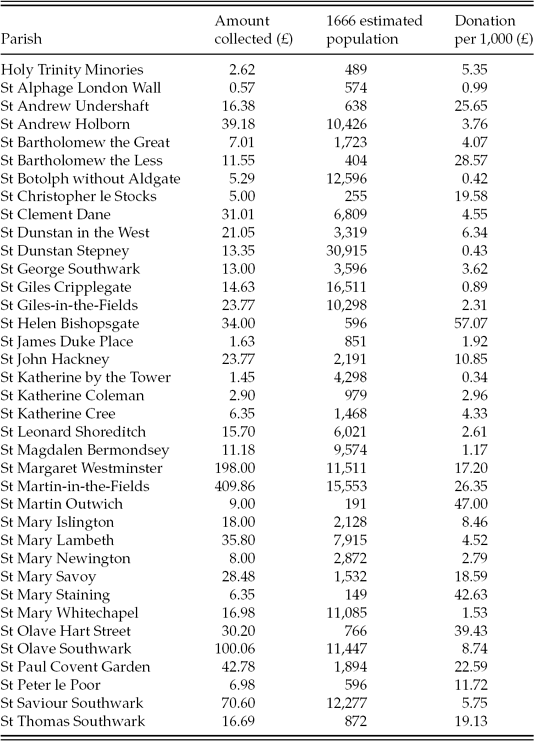
London was traditionally the centre of charitable giving in England, and when measured by mean sum given per parish and per capita, London and its suburbs gave at the highest level in England. In London parishes not directly affected by the Fire, per capita contributions were higher (see Table 2). The contribution of these parishes may have been buoyed slightly by the parliament in session between September 1666 and May 1668, which would have brought wealthy short-term residents. Most of the contributions came from the outlying parishes unaffected by the Fire, although the parishes with the highest levels of donations still tended to be those central ones like St Mary Staining or St Olave Hart Street (although the latter parish was largely directly unaffected by the Fire). Western parishes tended to have given more than the parishes to the south and east of the Walls. Despite the effects of the Fire, levels of donations in areas directly affected by the Fire and areas not directly affected did not differ significantly.Footnote 25 This was probably due to the fact that the usual wealth advantage of the richer central parishes compared to suburban parishes was tempered somewhat by the deleterious effects of the Fire.
Donations per 1,000 in London for the 1666 brief, 1666–76

Source: see table 1; Collection, ed. Birch.
Distributing the collection: charity in London after the Fire
The previous section examined how England reacted to the Great Fire in terms of charitable giving. This section will use the prism of charity to examine the recovery from the Fire. Using the records of the distribution of charitable monies to Londoners ‘distressed’ by the Fire will show which social groups civic authorities deemed to be the most deserving of aid.
Figure 1 shows the breakdown of how the £16,250 collected was distributed. Most of the money was distributed to the wards, which were tasked with distributing the money to the ‘poore sufferers by fire’.Footnote 26 A large proportion of the collection money was given to parishes affected by the Fire. Smaller proportions were spent on measures to relieve the poor of London and individuals ‘distressed’ by the Fire who had petitioned the lord mayor, bishop of London or the Court of Aldermen for money. The rest was spent on the administration of the brief, and on legal costs and lobbying. The breakdown of how the money was spent in each of the individual categories will be examined in detail, but first the timing of how the money was spent will be briefly examined.
Breakdown of payment of money collected for 1666 brief, 1666–79

As Figure 2 shows, the money collected from the 1666 brief was not used for the immediate relief of Londoners recovering from the Fire. A national collection of this magnitude could not immediately switch from collection to distribution. However, the pace of collection and the relative tardiness of its distribution is striking. In the first eight weeks after the brief was proclaimed, £2,327.91 had been collected. However, only £9.86 had been spent in this period – and all of this had been on legal and administrative costs. Even one year after the brief had been proclaimed, and £13,462.06 (81.6 per cent of the total collected) had been collected, only around half of this money (£6,804.85) had actually been distributed. It took over two years for the amount distributed to approach within 5 per cent of the amount collected. The fact that the money from the 1666 brief was distributed in this fashion shows that London was capable of catering for, in the short term at least, the needs of those ‘distressed’ by the Great Fire without relying on charitable contributions from the rest of the country. Early modern cities may have had the means to deal with the immediate problems of disaster ‘in house’.
Time series of the collection and distribution of the 1666 brief, 1666–79

Carrying out the 1666 brief entailed some administrative costs. Money was spent on the task of bringing contributions from the provinces to London, but it was not a large amount. Bringing money to London was mostly carried out by residents of the parish, who delivered 42.8 per cent of the money brought to London. Local and parochial officials brought 17.0 per cent and clergy 32.3 per cent.Footnote 27 Almost none of these groups received payment for this – no doubt many combined bringing monies to London with a business or social journey to the metropolis. However, £13.10 was spent paying those who had brought charitable money to London. These sums were mostly small payments. For example, 1s was given to a man who brought £52.41 from three parishes in Nottingham and £1.57 was paid to the carrier of Bedford for bringing money from that county.Footnote 28 Small amounts were spent on stationery, printing, sending out proclamations and giving gifts to administrators, and £114.76 was spent on lobbying for a 1671 act allowing London's government to obtain money collected for the metropolis in the provinces.Footnote 29 The rest of the money collected was recorded as being used for charitable distribution. The potential for embezzlement was high, but there only seems to have been one recorded case.
Sir William Bolton was lord mayor after the Fire, and misappropriated £1,800 from the 1666 brief. Samuel Pepys noted: ‘basenesse of the Late Lord Mayor . . . in cheating the poor of the City (out of the collections made for the people that were burned) of 1800l, of which he can give no account’.Footnote 30 Bolton never admitted fault and claimed that the actions against him stemmed from jealousy at a royal petition to make him surveyor general of the rebuilding of London. He was eventually forced out of his position as alderman and never again held civic office. On 19 March 1677 he petitioned the Court of Common Council for a pension, as he was ‘reduced to a low Condicon and utterly unable to support himself’. He was granted £3 a week.Footnote 31 Metropolitan government was assiduous in using legal mechanisms to ensure that all the money collected went to London, and that any misappropriations in how it was spent were revealed.
There was one payment made to a charitable foundation from the 1666 brief – £500 was paid to Christ's Hospital because of its ‘great losses’ of ‘the late dismall fire . . . besides a great decay of their revenue by many houses consumed & other losses occasioned by the . . . fire’. Considering that the finances of most charitable foundations relied heavily on rents from properties they owned, it is surprising that there was only one payment to a charitable foundation. However, only Christ's and Bridewell out of London's five major hospitals were damaged during the Fire. Bridewell was rebuilt through money from coal dues, whereas Christ's relied mainly on charitable contributions.Footnote 32
Some £1,504.20 was distributed to be spent on relieving ‘poor sufferers’ of the Fire. This was separate from the individual payments made to people who claimed to have suffered losses as a result of the Fire. These mass payments were large. On 3 May 1667, Mr Randall Bolton was given £500 to distribute amongst the poor tradesmen of London. Sir William Bolton received £1,000 in summer 1667 to relieve the poor who had suffered as a result of the Fire. There is no record of exactly how this money was distributed, which may have led to the later legal proceedings against Bolton. Some payments were smaller. For example, £4.20 was spent on 9 October 1666 on bread for the poor.Footnote 33
London's parishes were not immediately granted money from the 1666 brief. The first payments were in spring 1667, to St Leonard Foster Lane and St Michael Cornhill. The last payment made was in July 1670 to St Peter Paul's Wharf. In all, 38 parishes received money. The money given to the parishes was not spent on outdoor relief of the inhabitants of the parish who had suffered as a result of the Fire. This is unsurprising, as most of the payments were made over a year after the Fire, when short-term subsistence needs of those made homeless would have been met already. This again shows that London probably had the mechanisms needed to deal with the immediate consequence of the Fire. Rather, 28 out of the 38 parishes spent the charitable money on placing out poor children who were on the common charge of the parish. This represented 65.3 per cent of the total amount given to the parishes. The money was used to shore up parochial finances, not directly help those ‘distressed’ by the Fire.
The main determinant of how much money a parish was given depended on its size, population and perhaps its relative wealth. As Figure 3 shows, small, centrally located parishes such as St Pancras Soper Lane and St Andrew Hubbard received smaller grants of money (£20 and £30 respectively) than larger parishes on the peripheries of the City, like St Bride Fleet Street and Christchurch Newgate (£360 and £300 respectively). There was a significant statistical relationship between a parish's population and the amount of money that it was granted.Footnote 34 This conclusion was echoed by the significant correlation between the amount given to a parish and two other variables; the total acreage of a parish and the total number of households in a parish.Footnote 35 It is clear that larger, more populous parishes received more money. The distribution did not match the areas of London destroyed by the Fire. As Figure 3 shows, many of the central parishes in London that were burnt did not receive (and presumably did not apply for) any money from the brief. These wealthy, compact parishes would have not needed any charitable money, which was instead focused on the larger, poorer parishes to the west of the City, which had been growing in size even before the Fire. These areas became the home of many Londoners forced to move because of the Fire.Footnote 36 This was reflected in the distribution of money to the wards. The inner wards received less than the outer wards, as Figure 4 shows. Indeed, Farringdon Without, a large ward to the west of the Walls (most of which was not devastated by the Fire) received nearly one quarter of the total given to the wards. Farringdon Without, like other outer wards, received more because of its larger size, and the fact that it had to absorb more displaced people both because its housing stock and charitable mechanisms were more intact and because London's population growth was highest in the western suburbs before the Fire. A case in point of the type of influx the ward may have had to deal with was Frances Aske, a spinster who received £2 from the 1666 brief on 14 December 1667. She claimed: ‘her whole substance and maintenance . . . was utterly consumed’, in addition she ‘is now friendless & helpless aged threescore and nine years also blind (as she hath been for many years past) & under other distempers & great weakness of Body which doe not only disable her to doe anything towards her Maintenance’. The Court of Aldermen requested that ‘shee bee recommended to ye Ward of Farringdon without for a further epporcon of the money that shall bee distributed in the sd Ward for reliefe of those poore that suffered by the sd fire’.Footnote 37
Map of payments made to London parishes from the 1666 brief, 1667–69

Map of payments made to wards from the 1666 brief, 166–72

It is notable that Cripplegate Without, the location of Moorfields, a key temporary site for those made homeless after the Fire, received no money. Possibly by the time the money was distributed they had moved on. The money seems to have been earmarked for Londoners with settled residences, and those seeking shelter in Moorfields by definition were living in quickly built shelters of dubious legality.
The ward records themselves do not illuminate much about how this money was distributed. The money was given to the wards in two forms: four £5 grants to each ward's beadle for their extra work after the Fire and money for the ward's poor, given to the wards in five blocks. The first was in December to February 1666/67, to the total of £2,967.60. There were four further payments; £2,149 in December to January 1667/68, £1,971 in December 1668, £1,717 in November to December 1669 and £333 in January to February 1672. The bishop of London authorized the poor relief payments to the wards on 24 December 1666. He specified that they were to aid in the economic recovery of those affected by the Fire, directing that the money should go to ‘Tradesmen who have suffered & are disabled to continue their Trade’. He also desired that ‘none that have kept Alehouses or Tipling houses may have any Share in this Releif’.Footnote 38 A letter from the lord mayor to the alderman of Bridge Ward dated 25 December 1666 is typical of the advice given to the wards. It requested him to obtain information on ‘ye most distressed late Inhabitants of ye said Ward who have suffered by ye said fire & to distribute to & amongst such of them who are qualifyed accordingly’.Footnote 39 The other later payments to the wards were aimed at the ‘poore distressed by the sd fire in aporcon to evre ones condicion sufferings and necessities’.Footnote 40 Payments to wards were the preferred mode of distributing money for the Court of Aldermen. On 10 November 1668, the Court declared ‘it inconvenient to order any further sumes of money to particular psons . . . but to order moneyes to ye wards that ye distributions may bee made . . . in proportion to their respective wants & necessities’.Footnote 41 This delegation was probably part of an attempt to match need to resources at the local level, as well as enabling metropolitan central government to focus more on the actual rebuilding process.
The final category examined is that of the individual payments, which were made to people who had suffered as a result of the Fire up to 13 years after the event. Although in proportional terms, this group was not one of the largest, these payments illuminate the priorities of the post-disaster administration and the ‘blurred lines’ between institutional and face-to-face charity. The Court of Aldermen administered these grants, and each of the payments was a result of an individual petition. Patronage could exist within charitable bureaucracy,Footnote 42 and the outcomes of these petitions for money from the 1666 brief show the charitable targets identified by the metropolitan government.
These individual payments were made after the grantee (or someone acting on their behalf) petitioned the Court of Aldermen. These petitions survived for 93.6 per cent of the amounts paid to ‘distressed’ individuals, and contain varying degrees of information about the means and circumstances of the petitioner, as well as giving an indication of their literacy (the petitioner ‘signed off’ upon receipt of the money, and those who left their ‘mark’ were deemed to be illiterate). In total, there were 220 payments made to a value of £986.13, giving a mean of £4.48 per payment. This was a large amount – about a month and a half's wages for a labourer in London. It was also larger than usual charitable dolls in London – when intramural parishes gave out money from charity bequests, individual entitlements at cash distributions were at most around £2.Footnote 43 The lowest payment made was 4s 2d to Ann Williamson on 29 July 1679, and the largest was £40 to the widow Clara Bolton (none of the sources suggests she was a relation of the former lord mayor) on 15 January 1668 as ‘the whole remainder of her estate consisting in houses holden by Lease from the City was destroyed’. Bolton's problems after the Fire were in fact more serious. She had been granted an annual royal pension of £200 for the loyalty of her late husband, and for sheltering Royalist soldiers during the Civil Wars. However, the pension had been stopped when her nephew, a Major Wood, complained that the pension had been partly for his maintenance also and that Bolton had turned him and his family out of her home and wished to remarry.Footnote 44 ‘Respectable’ people fallen on hard times such as Clara Bolton were traditionally key recipients of parish pensions and payments.Footnote 45 This extended to the 1666 brief – 36 of the petitioners were citizens, gentry, ‘Mr’ or ‘Mrs’, and the mean amount granted to this group was £7.30, compared to £3.91 for the rest of the petitioners.Footnote 46
Widows were a major component of the ‘deserving poor’ and usually were a significant proportion of those given payments from the parish poor rates.Footnote 47 They were particularly vulnerable to poverty. Wealthier widows may have been able to escape poverty, but lower down the social scale, widowhood left many in a precarious position, making them more likely to become dependent on the goodwill of neighbours and the parish.Footnote 48 This is reflected in the petitions for the 1666 brief – widows were recipients of over half of the grants paid out (117 out of 220). A particularly full example of such a widow is Elizabeth Peacock, who received £10 on 5 March 1667. She claimed that her
husband & eldest sonne (in whome were her greatest hopes) being both lately dead (and) her dwelling house . . . on Snow Hill (a faire and hardye Inne wherein she had a Terme of 4 yeares left past) . . . and expended 800 s in building . . . was utterly consumed by the late dreadful fire together with her whole stocke of hay coales & beere layd in for her winter provision & alsoe all the furniture of her said home to a greate value.
She was left with only 39s, five small children and ‘not soe much as A stoole to sitt uppon’.Footnote 49
The petitions can also be used to show whether the object of the charity had informal ‘social credit’. This can be demonstrated in terms of who authored the petition. For example, the bishop of Norwich wrote two petitions in February 1667, and in both cases the subject of the petition was given £20. For one of these individuals, the bookseller Philemon Stephens, the bishop of Norwich had informed the bishop of London about ‘the great losse that he had sustained by the late dreadfull fire, to his utter undoing, as alsoe of his Age, & greate charge of Wife & Children’.Footnote 50 If the petitioner was related to a person of high esteem it could raise the chances of them receiving a higher amount from the 1666 collection. Mr John Anderson, the grandson of a former sheriff of London, received £20 on 3 June 1668. Likewise, Magdalen Burroughs, the widow of the late recorder of the City, received £10 on 21 April 1668.Footnote 51 Finally, a petition could have attached to it the recommendation of a person of high social standing. Widow Bennett Crosse received £10 on 13 January 1669 on the recommendation of the duchess of Albemarle.Footnote 52 In total, the average sum given to the 27 individuals with informal social status indicators received a mean of £9.97, whereas all other individuals received an average of £3.71; this difference is statically significant.Footnote 53 ‘Connections’ to esteemed individuals or groups raised the chances of receiving a higher payment. Social patronage clearly had an impact on the distribution of money from the 1666 brief.
As the petitioners had to sign the petition on receipt of money from the 1666 brief, the levels of literacy and its effect on the amount given could be examined. First, in 49 cases, the petitioners did not receive their money in person. This was probably because they were unable physically to reach the Chamber of London. For example, widow Anne Southwicke, who received £2 on 30 April 1668, had her brother John Jackson receive the money for her as ‘The Peticoner is soe weake that shee can not come herself.’Footnote 54 There were 172 people granted money who received it in person. Of these, 59.9 per cent were literate and able to sign the petition – the rest were only able to leave their mark. This was higher than the levels of illiteracy determined by David Cressy for 1641–44, based on returns to the Vow and Covenant and the Solemn League and Covenant – 22 per cent of his sample was illiterate.Footnote 55 This difference was probably due to the high proportion of women applying for money from the 1666 brief, which may have decreased the levels of literacy, even if women in the London area tended to be more literate than in the rest of the country.Footnote 56 Literate petitioners, possibly because of higher social status, were given more – the literate received an average of £6.13, whereas the illiterate received an average of £2.73.
Conclusions
Payments to individual petitioners followed partly along the lines of existing charitable habits in early modern England. The most vulnerable members of society, particularly widows and the aged, were the main recipients of the 1666 brief. The wellbeing of these groups was highly sensitive to crises such as trade depression and bad harvests – situations where they would be forced to rely on charity. These individuals probably lived in what Paul Slack termed ‘shallow poverty’. The crisis of the Fire forced them to seek cash doles.Footnote 57 However, in addition to these traditional objects of charity, the 1666 brief also granted money to individuals who would probably not have required poor relief before the Fire. For these people, their social standing before the Fire had an impact on how much they would receive. Pre-Fire differences in social status made a significant difference to the amount of money an individual was likely to receive. Social credit in the form of being a citizen, having relations of standing in the community or of having the support of an individual with social clout in their petition all contributed to a higher likelihood of receiving a larger sum of money from the brief. The social and economic resources of these individuals would probably have ‘insulated’ them somewhat from traditional crises, yet an event such as the Fire, which destroyed goods and property on a wide scale, may have forced some of them to seek charitable relief. However, the fact that wards and parishes outside London's wealthy centre received relatively little charitable money in favour of poorer areas, and that widows dominated the payments made to individual petitioners, showed that in the aftermath of disaster, charity continued along pre-crisis lines.
Ultimately, London persevered. The city was able to gather large sums of money from the provinces in the official capacity of the 1666 brief. There seems to have been a degree of ‘urban solidarity’ at play here. Urban areas, especially those that had experienced fires, showed a propensity to give at relatively high levels. This overcame any possible ongoing prejudices against the metropolis. When compared to the brief for the rebuilding of St Paul's, it is clear that the brief for distressed Londoners had a greater impact. Considering the frequency of briefs for individuals who had suffered as a result of fire, and the high incidence of fires in early modern England, it is probable that most people would have had either a direct or second-hand experience of suffering as a result of fire, not to mention the fact that around one in six people in England had lived in London at one time in their lives.Footnote 58 The money raised from the 1666 brief was mostly used to shore up traditional structures of metropolitan government in the short term, perhaps contributing to the remarkable lack of wide-scale disorder in the aftermath of the Fire. In addition to formal charity, it is certain that there was a ‘dark figure’ of face-to-face charity,Footnote 59 particularly given that many Londoners had relatives in the provinces who may have offered help after the Fire. Evelyn recorded on 7 September 1666 that many of those burnt out who had sought refuge in the open spaces near London then repaired ‘into the suburbs about the Citty, where such as had friends . . . got shelter & harbour’.Footnote 60
After the Great Fire, it is clear that London's social structure did not collapse. London's socio-economic functions continued. The Fire had spared the political centre of the metropolis – Westminster – and London's economic function was able to continue mainly because its core – shipping – was largely unaffected by the Fire.Footnote 61 London's burgeoning suburbs were also mostly untouched. As a result, there were resources available with which to support many of those burnt out. Many Londoners would have had sufficient resources, social or material, to recover from the disaster without formal charitable help. Urban spaces and city dwellers, it seems, are strongly resilient to even the most severe disasters, as shown by the continuity between the pre and post-Fire charitable mechanisms and priorities of seventeenth-century London.