Determination of the factors that rule the preference of birds for certain fruits is fundamental to the understanding of the co-evolution of plants and their dispersers (Alves-Costa & Lopes Reference ALVES-COSTA and LOPES2001). Plants might compete for dispersers, and the response of dispersers will differ according to the variety of fruits available in nature (Denslow & Moermond Reference DENSLOW and MOERMOND1982, Herrera Reference HERRERA1981). Seed dispersal by birds is directly related to certain features of fruit, including colour, size, shape, abundance, nutritional value, habitat and distance between plants that are fruiting (Alves-Costa & Lopes Reference ALVES-COSTA and LOPES2001, Galetti et al. Reference GALETTI, ALVES-COSTA and CAZETTA2003, Levey et al. Reference LEVEY, MOERMOND, DENSLOW, McDade, Bawa, Hespenheide and Hartshorn1994, Murray et al. Reference MURRAY, WINNETT-MURRAY, CROMIE, MINOR and MEYERS1993). To understand how birds integrate these features in terms of fruit choice is a complex and widely misunderstood problem (Levey et al. Reference LEVEY, MOERMOND, DENSLOW, McDade, Bawa, Hespenheide and Hartshorn1994).
The use of artificial fruits made of clay is one way to manipulate fruit traits, facilitating the understanding of the attraction mechanism of the frugivores (Alves-Costa & Lopes Reference ALVES-COSTA and LOPES2001, Arruda et al. Reference ARRUDA, RODRIGUES and IZZO2008, Galetti et al. Reference GALETTI, ALVES-COSTA and CAZETTA2003, Kuchta Reference KUCHTA2005, Vasconcellos-Neto et al. Reference VASCONCELLOS-NETO, SOUZA, GUIMARÃES and FARIA2000). Most studies addressing the ways by which fruits attract birds have analysed the difference in the detection of fruit colour by the birds (Alves-Costa & Lopes Reference ALVES-COSTA and LOPES2001, Gervais et al. Reference GERVAIS, NOON and WILLSON1999, McPherson Reference MCPHERSON1988, Willson et al. Reference WILLSON, GRAFT and WHELAN1990), usually speculating that the observed patterns result from the contrast between the fruit colour and the background vegetation colour (Arruda et al. Reference ARRUDA, RODRIGUES and IZZO2008).
There is strong evidence that the colour of the background vegetation influences the selection of fruits by diurnal visual-feeding frugivores, because the colour of the background vegetation may increase or decrease the conspicuousness of the fruits (Burns & Dalen Reference BURNS and DALEN2002, Schmidt et al. Reference SCHMIDT, SCHAEFER and WINKLER2004). Arruda et al. (Reference ARRUDA, RODRIGUES and IZZO2008), in a field experiment on a local scale, found no difference in the number of pecks between red and brown artificial fruits, and assumed that the conspicuousness of the red and brown fruits in the green vegetation of the Amazonian understorey was the same for the local birds. In the present study, we manipulated the fruit conspicuousness to test the hypothesis that the contrast between the fruit colour and the background vegetation affects the detection of fruits by the local frugivores.
We conducted the experiment on the edge of a clearing in the riparian forest along the Miranda River (19°34′07′′S, 57°01′19.50′′W), in the southern Pantanal Miranda sub-region, Corumbá, Mato Grosso do Sul state, Brazil. The data were collected at the end of the field course on Pantanal ecology, offered by the Postgraduate Program in Ecology and Conservation of the Federal University of Mato Grosso do Sul, during a 5-d period in the dry season (September 2008).
We shaped 232 spherical fruits (approximate diameter 15 mm) made of non-toxic and odourless red modelling clay. To each fruit we attached a 5-cm length of string, in order to suspend them on branches of bushes 1 to 2 m above the ground. We used only red artificial fruits, because this colour contrasts most with the green vegetation (Schmidt et al. Reference SCHMIDT, SCHAEFER and WINKLER2004), and because it is the most common colour in natural fruits, which are widely consumed by birds (Gervais et al. Reference GERVAIS, NOON and WILLSON1999, McPherson Reference MCPHERSON1988, Wheelwright & Janson Reference WHEELWRIGHT and JANSON1985, Willson & Whelan Reference WILLSON and WHELAN1990, Willson et al. Reference WILLSON, GRAFT and WHELAN1990). However, studies that found a preference for red fruits were performed with a green background (Gervais et al. Reference GERVAIS, NOON and WILLSON1999, Puckey et al. Reference PUCKEY, LILL and O'DOWD1996). Under these circumstances, the birds may have selected red fruits because of their greater conspicuousness in the area, and not because of an innate preference for the colour itself.
We selected 58 bushes in a clearing of the riparian forest, with a minimum distance of 5 m between individual bushes. Although the bushes belonged to different species, we selected bushes with the same leaf shapes in order to exclude the plant as a random factor. Using green, red and white crepe paper, we made artificial leaves in order to change the background vegetation colour, with similar size and shapes to the natural leaves of the selected bushes. On each bush we suspended four fruits on different branches, and whenever needed, we replaced the natural leaves by the artificial ones, placing each fruit against different backgrounds, so as to comprise a matching experiment on each bush. Only plants without fruits and/or flowers were used in the experiment.
By means of the artificial fruits and leaves, we simulated four levels of contrast: fruit with green artificial leaves (the normal contrast with red fruits, usually found in the locale), fruit with red leaves (reduced contrast), fruits with white leaves (increased contrast), and fruits with natural leaves (in order to assess whether the use of artificial leaves had any influence on fruit consumption). The fruits remained exposed for a 5-d period, and we checked the occurrence of fruits that had been visited (pecked or removed) daily. We then replaced all the pecked and removed fruits. To confirm whether there was a difference in the frequency of location of fruits at different levels of contrast, we used a general linear model, considering the ‘day’ factor as nested in the background treatment.
We did quantitative colour measurements of the material used in the experiment. The colour reflectance of the artificial and natural background and the artificial fruit was measured using an Ocean Optics USB4000-UV-VIS spectrometer, an Ocean Optics 84-UV-25 lunette, an optical fibre cable of 50 μm in diameter and 2 m length, and a tungsten lamp to simulate sunlight. First, we measured the reference value (the measure that the spectrometer gave just with the light), after we measured the dark current (measured by closing off all external light, to capture the instrument interference), and finally we measured the reflectance of our materials, with the lunette always at the same angle. The final values were giving through the follow equation: Reflectance = ((Sample Reflectance − Dark Current)/(Reference Value − Dark Current)) × 100.
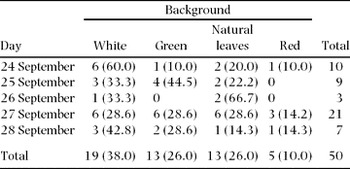
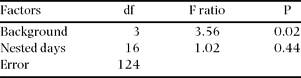
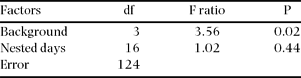
We recorded the location of 50 artificial fruits, of which 41 were pecked and nine were removed. The treatment with the lowest level of contrast, red fruits in a red background, had the lowest number of located fruits (10% of the pecked or removed fruits); whereas the treatment with the highest level of contrast, red fruits on a white background, had the highest number of locations (38%). In the treatments with a green background, both treatments, the one with artificial green leaves and the one with natural leaves, we recorded intermediate levels of location (26% each) (Table 1). The frequency which the birds located the fruits was significantly related to the variation in the contrast level, but the day of sampling did not affect the location of the fruits in each contrast scheme (Table 2).
Number of red artificial fruits pecked or removed during 5 d of the manipulation treatment of the contrast with the background colour, in the southern Pantanal, Brazil. The percentage of fruit pecked or removed for each day are in parentheses.

Nested analysis of variance results for the number of red artificial fruits pecked or removed, during 5 d of the manipulation treatment of the contrast with the background colour, in the southern Pantanal, Brazil. The factors Background and Nested days refer to the contrast level.
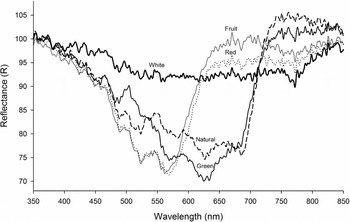
The reflectance was similar in the red artificial fruits and the red artificial leaves; in the same way, the green artificial and natural leaves were related. However, the white artificial leaves showed the most different reflectance (Figure 1).
Reflectance measurements of red artificial fruit (Fruit), red artificial leaves (Red), white artificial leaves (White), natural leaves (Natural) and green artificial leaves (Green) used in the experiment of contrast colour between fruit and background in the southern Pantanal, Brazil.

The contrast between the fruit and the vegetation seems to be a major factor in the visualization of these resources by the local frugivore community. Schmidt et al. (Reference SCHMIDT, SCHAEFER and WINKLER2004) recorded random selection of artificial fruit colours by frugivores; in their study, they analysed only the colour of the fruit, out of context with the surrounding vegetation. These results reinforce the hypothesis that the contrast, and not the fruit colour itself, is the major factor in detection of the resource by the birds. The most plausible interpretation for this interaction is that the contrast between a particular fruit colour and the background vegetation increases the conspicuousness and therefore the perception of the fruit by the bird (Burns & Dalen Reference BURNS and DALEN2002).
Another factor is that birds can use fruit conspicuousness to discern appropriate fruits for consumption, recognizing interspecific differences in the size and shape of fruits and leaves, since they appear to be highly selective of the fruits that they consume (K.C. Burns. pers. comm.). Therefore, we must consider that this selectiveness could influence the experimental results to some degree, because the birds may have learned to associate particular fruit phenotypes with particular leaf shapes. Thus, differences in removal rates between treatments might result from past learning of appropriate food items, in addition to their conspicuousness.
However, the evidence for the fruit-conspicuousness hypothesis is much stronger. In this case, it is expected that, in a plant dispersed by visually oriented frugivores, the fruit colour will contrast with the colour of its leaves (Schaefer et al. Reference SCHAEFER, SCHAEFER and VOROBYEV2007). Thus, the different colours of fruits found in nature may be related to the high interspecific variation between plants in the colours of their leaves (Lev-Yadun et al. Reference LEV-YADUN, DAFNI, FLAISHMAN, INBAR, IZHAKI, KATZIR and NE'EMAN2004). Burns & Dalen (Reference BURNS and DALEN2002), working in North America, found this pattern: they observed that in species with reddish fruits, the fruit ripens in summer, when the vegetation is composed predominantly of green leaves. In species with black fruits, the fruit matures in autumn, when the leaves have a reddish tone.
The hypothesis of the contrast between the leaf and fruit colours is similar to the foliar flag hypothesis proposed by Stiles (Reference STILES1982), which suggests that the leaves influence the conspicuousness of the fruit. However, regardless of the fruit colour, certain species of plants lose their leaves early to increase conspicuousness, while the leaves of other, co-occurring species remain green. Little evidence has been advanced to support this hypothesis, and no relationship between the variation of fruit colour and the time of leaf abscission was found (Willson & Hoppes Reference WILLSON, HOPPES, Estrada and Fleming1986).
The results of the present study corroborate the hypothesis which states that the colour of the surrounding vegetation contrasts with the fruit, increasing the conspicuousness of the fruit to the dispersers (Burns & Dalen Reference BURNS and DALEN2002, Giles & Lill Reference GILES and LILL1999). When the fruit is made conspicuous only because of the contrast with the vegetation, birds more frequently detect the set with higher contrast, which in this study was represented by the replacement of the natural green leaves by the artificial white leaves. For a more thorough explanation of the diversity of colours of fruits available in nature, other aspects that may also influence fruit detection by the dispersers must also be analysed. In addition to contrast, the colour of the fruit, the intensity of light, the effect of density, and the reflection of ultraviolet colour are other important aspects of this process (Cazetta et al. Reference CAZETTA, SCHAEFER and GALETTI2009, Sargent Reference SARGENT1990, Schaefer et al. Reference SCHAEFER, SCHAEFER and VOROBYEV2007).
ACKNOWLEDGEMENTS
To the Base de Estudos do Pantanal (BEP) for logistical support, and to the organisers and colleagues of the Curso de Campo Ecologia do Pantanal 2008, especially Milena Delatorre. To Roberto F. dos Santos for crucial help with the colour measurements. We also thank Erich Fischer for encouragement for the publication of this paper, and Kevin C. Burns and Nilton C. Cáceres for suggestions to improve the manuscript.