The prognosis of neonates with hypoplastic left heart syndrome has improved significantly over the last decade due to the development of the options of cardiac transplantation.Reference Chrisant, Naftel and Drummond-Webb1 and the Norwood sequence of operations.Reference McGuirk, Griselli and Stumper2 The first stage of Norwood palliation is still associated with considerable mortality.Reference McGuirk, Griselli and Stumper2, Reference Lim, Peeler, Matherne, Kron and Gutgesell3 In seeking to reduce the mortality, some have developed the so-called hybrid approach, which consists of postnatal bilateral surgical banding of the pulmonary arteries and stenting of the arterial duct, followed by surgical reconstruction of the aortic arch and creation of a bidirectional cavopulmonary connection at the age of 3 to 6 months.Reference Akintuerk, Michel-Behnke and Valeske4 Independent of the chosen palliative surgical strategy, nonetheless, it is essential that there has to be an appropriate interatrial shunt in the neonatal period to avoid the pulmonary hypoperfusion caused by pulmonary venous hypertension. Should the interatrial communication be severely restrictive, or the atrial septum intact, opening the septum or enlarging a small defect is mandatory for successful palliation. Despite aggressive management, the outcomes for the proportion of infants born with hypoplastic left heart syndrome and intact or highly restrictive atrial septum remains poor.Reference Rychik, Rome, Collins, Decampli and Spray5, Reference Vlahos, Lock, McElhinney and van der Velde6
Balloon atrial septostomy, first introduced in 1966, has been shown to be valuable in many cyanotic newborns. A balloon, however, is not always effective when the atrial septum is thickened, which is often the case in patients with hypoplastic left heart syndrome. Furthermore, in newborns with duct-dependent retrograde coronary arterial perfusion, the risk of ischemia has also to be considered. Furthermore, the size of septal defect created by the balloon is unpredictable.Reference Schneider, Zartner and Magee7, Reference Sandoval, Gaspar and Pulido8 Rupture of the septum as it is induced by an effective classical Rashkind procedure might also be one, if not the main, reason for thromboembolic events.Reference McQuillen, Hamrick and Perez9
The possibility of creating an interatrial communication by stenting has been demonstrated in the setting of several diseases,Reference Danon, Levi, Alejos and Moore10, Reference Seib, Faulkner and Erickson11 especially in patients with the Fontan circulation.Reference Mertens, Hagler, Sauer, Somerville and Gewillig12, Reference Stumper, Gewillig and Vettukattil13 A stent has already been placed for 14 months in one patient with hypoplastic left heart syndrome,Reference Daehnert, Hennig, Walther and Kostelka14 while stents have been placed in neonates for a mean of 5 days prior to the first stage of the Norwood sequence.Reference Bar-Cohen, Perry, Keane and Lock15 Others have compared the various possibilities for creating or enlarging restrictive atrial defects in patients with hypoplastic left heart syndrome.Reference Atz, Feinstein, Jonas, Perry and Wessel16, Reference Gossett, Rocchini, Lloyd and Graziano17
In our institution, newborns with hypoplasia of the left heart are usually treated by banding bilaterally the pulmonary arteries and stenting the arterial duct. We have observed that restriction of a patent oval foramen often occurs in the first days of life. In these cases either a Rashkind manoeuvre or radial balloon dilation is performed. If restriction occurs after one month, we prefer to dilate using a balloon. If this proves insufficient, however, or should re-restriction occur, then it seems promising to implant a stent. We report here our experience of stenting the atrial septum in five such newborns with hypoplastic left heart syndrome.
Materials and methods
We reviewed the records, echocardiograms and catheterization data of all patients with hypoplastic left heart syndrome in whom we placed stents across the interatrial septum since January 1, 2004.
This was performed in 5 infants, three females and two males, placing the stents at a median age of 49 days, with a range from 21 to 77 days. The procedural time was 98 minutes, with a range from 63 to 117 minutes, and the mean period of fluoroscopy was 9 minutes, with a range from 5 to 25 minutes.
In 2 of the patients, we had previously performed a Rashkind manoeuvre in the first months, while balloon dilation had taken place in another at the age of 5 weeks. These 3 patients developed re-restriction of the interatrial communication. In the fourth patient, a stent was implanted directly after ineffective attempted balloon dilation. In all these patients, catheterization was performed electively because of decreasing saturations of oxygen and increasing Doppler gradients across the atrial septum during follow-up of the hybrid approach performed at the age of 11 days, with a range from 5 to 16 days, and whilst the patients were awaiting further surgery.
In the final patient, the atrial septum was stented as a rescue procedure. This patient was diagnosed with hypoplastic left heart syndrome at the age of 21 days, and at admission, the saturations of oxygen ranged between 30 and 40%, and did not respond to either mechanical ventilation or administration of prostaglandins. Echocardiography confirmed the initial diagnosis, revealing severe mitral stenosis, aortic stenosis, a still patent arterial duct, and showed the atrial septum to be bulging to the right, with restriction of the oval foramen, a Doppler gradient of more than 25 millimetres of mercury being measured between the atriums.
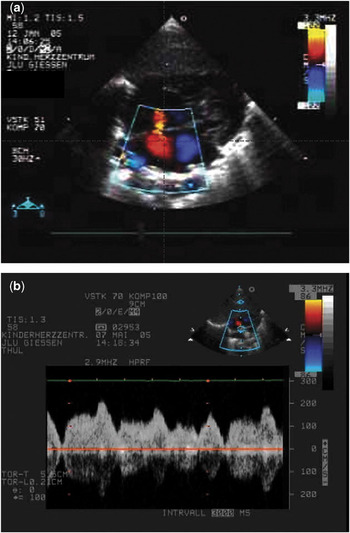
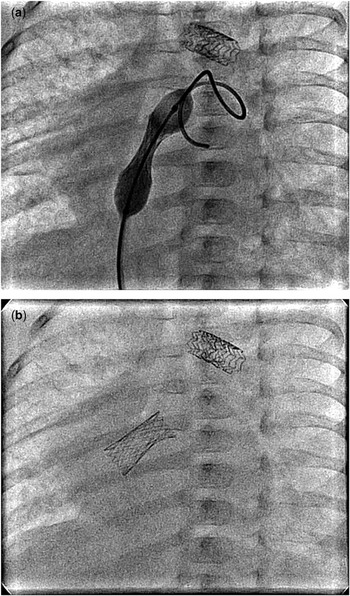
Catheterization was performed under conscious sedation, achieved by giving repetitive doses of Diazepam at 0.2 mg per kg, and Ketamine at 0.5–1 mg per kg. The intervention was based on clinical and echocardiographic data (Fig. 1), and was focussed on creation of a definitive interatrial communication. Femoral venous access was used in all. The residual patent oval foramen was crossed using a 4 French Cobra- or right Judkins catheter, guided by a 0.014 inch floppy guide wire. In three patients, the oval foramen was predilated with a balloon catheter of 4 by 20 millimetres calibre (Maverick, Boston Scientific), and a 6 by 20 millimetres catheter (Savy, Cordis). After inflation, the waist of the balloon exactly delineated the dimensions of the interatrial septum, albeit that the septal anatomy was additionally documented by hand injections of contrast medium into the left atrium. Having made the decision to place a stent, a 0.035 inch guide-wire with a hand-rounded tip was placed in the left atrium, and a 6 French long sheath was carefully advanced, having achieved a stable position for the guide wire in the left atrium. In the first two patients, we placed a Jo-stent of 17 millimetres handcrimped on a balloon of 10 by 20 millimetres. In the other 3, we used a premounted Genesis stent of 19 by 10 millimetres. Exact placement within the septum was guided as necessary by repetitive hand injections of contrast medium through the long sheath. We expanded the stents to create a diabolo, flaring the stent at the edges, and leaving a slight central waist at the site of the septum. Inflation and expansion were not performed to the maximal diameter of the balloon, but rather were guided by fluoroscopy, which allowed visualization of the residual waist during expansion (Fig. 2).
A restrictive interatrial communication (a) is visualized by transthoracic cross-sectional echocardiography in the subcostal view. A Doppler tracing (b) confirms the restrictive nature of the interatrial communication prior to implantation of the stent.

Expansion of the stent to a slightly diabolo shape is controlled by fluoroscopy (a), using a 30 degree left anterior oblique projection. The position of the diabolo shaped stent is then confirmed (b) after removal of the balloon.

For retrieval of the balloon catheter, the balloon was deflated by a maximal negative pressure generated by the completely emptied inflator syringe. When the stent was seen to move during retrieval, the balloon was slightly re-inflated and maximally deflated again, and the balloon catheter was smoothly screwed clockwise until it could be removed completely, maintaining a stable position of the stent.
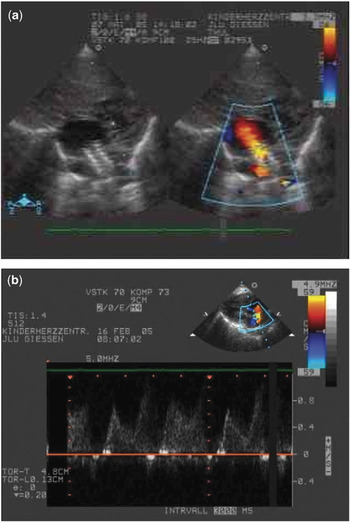
As soon as the long sheath had been placed in the left atrium, we gave a bolus of 100 International Units Heparin per kilogram, followed by 300 International Units Heparin per kilogram for the next 24 to 48 hours so as to avoid intracardiac formation of thrombus. A final left or right atrial angiogram was performed to ensure the correct position of the stent. We show the desired diabolo configuration of the stent in Fig. 3. In the 4 patients treated electively, echocardiography was performed immediately after intervention, and one to three days later prior do discharge, to confirm patency of the stent (Fig. 3). In the remaining patient, who was critically ill, the hybrid approach was undertaken subsequent to initial recovery. After an additional 3 days, we surgically banded both pulmonary arteries. After a further 5 days, we stented the patent aterial duct under conscious sedation, using a 7 by 12 millimetre Sinus repostent, manufactured by Optimed. At the age of 4 months, we successfully reconstructed the aortic arch, combining this with construction of a bidirectional cavopulmonary connection.
The location of the stent in the septum is visualized by transthoracic cross-sectional echocardiography and colour Doppler flow, shown in a subcostal view (a). A Doppler tracing after placement of the stent (b) confirms unrestricted flow of blood between the atriums.

Results
From 1 January, 2004 to 30 June, 2006, we stented the arterial duct, and banded both pulmonary arteries, in 35 of 39 patients with various obstructive lesions of the left heart. In 18, we also performed procedures to ensure the adequacy of the interatrial communication. Over this period, effective balloon dilation was performed in 11, 2 of these having had prior Rashkind procedures and one a previous surgical atrial septostomy. A stent had been implanted secondarily in the oval foramen of 1 patient after initial balloon dilation.
It proved feasible to stent the interatrial septum in all 5 patients. In one patient in whom we inserted an uncovered handcrimped Jo-stent, the stent slipped slightly from the balloon, and was implanted in the hepatic part of the inferior caval vein. The second attempt at stenting, achieved using a long sheath, proved uneventful. We stented the interatrial septum successfully at our first attempt in the other 4 patients, achieving the desired slight diabolo configuration of the stent in all. It proved possible to fix the handcrimped stents, as well as the premounted ones, in the interatrial septum in all patients. Left atrial pressure measured in 4 of 5 patients before the procedure varied from 18 to 29 millimetres of mercury (mean 22 millimetres of mercury). In the critically ill patient with severe hypoxemia, and arterial saturation of oxygen between 30 and 40%, we did not measure pressures, the atrial septum bulging to the right due to a restrictive patent oval foramen, with a Doppler interatrial gradient of more than 25 millimetres of mercury having been documented by echocardiography prior to the stenting.
After placement of the stents, the clinical condition of all patients improved significantly, and remained stable until the subsequent operations. Saturations of oxygen increased significantly from 64.4%, with standard deviation of 18.5%, to 87.5%, with standard deviation of 7.1%. This difference, as calculated using Students T-test, was significant at the level of p equal to 0.05 (Table 1).
Changes in the transcutaneous saturations of oxygen.

Taking note of the potential risk of dislocating the stent, we avoided recrossing the stent for additional measurements of left atrial pressure. There were no complications such as pericardial effusion or interference of the implant with the atrioventricular valves. The residual Doppler gradient was 3 millimetres of mercury, with standard deviation of 3.12 millimetres of mercury. The mean follow-up until the surgical removal of the interatrial stents was 2.5 months, with a range from 1 to 4 months. During this time, the patients did not receive either antiplatelet or anticoagulative drugs. There was no clinical evidence of thromboembolic or other stent-related complications. Stenting of the duct, combined with banding of both pulmonary arteries and placement of the interatrial stents, proved successful in bridging to reconstruction of the aortic arch and establishment of a bidirectional cavopulmonary connection in 4 patients, and to cardiac transplantation in the other patient. Surgical removal of the stents was uneventful. Of the patients, one, born with hypoplastic left heart syndrome accompanied by Byler’s syndrome postnatally, died 2 months after reconstruction of the aortic arch and creation of a bidirectional cavopulmonary connection whilst waiting for heart transplantation because of respiratory distress, possibly caused by residual lymphangiectasis.
Discussion
Based on their clinical condition, increasing hypoxemia, and particularly echocardiographic evidence of restriction of the oval foramen, we determined to decompress the left atrium interventionally. In 2 patients, we implanted the atrial stents because of re-restriction after a Rashkind manoeuvre. In another patient, we placed the stent to relieve re-restriction after prior balloon dilation of the oval foramen. In the fourth patient, balloon dilation had been judged to be ineffective, so we placed the stent in the same intervention. In the final critically ill newborn, balloon dilation had not improved oxygenation, so we stented the interatrial septum as a rescue procedure, seeking to create a definitive interatrial communication. Because the thickened atrial septum had recoiled immediately after pure balloon dilation, we judged stenting to be the most promising alternative approach.
Although we implanted stents as part of our new approach, we chose not to use preformed stents as has been previously described.Reference Stumper, Gewillig and Vettukattil13 We used the restrictive nature of the septal deficiency to create a diabolo configuration for the stent when the balloon is not inflated to its maximum. We used fluoroscopic observations so as to expand the ends of the stent during inflation of the balloon, permitting us to centre the stent in the atrial septum.
When placing stents across the interatrial septum, particularly in patients with hypoplastic left heart syndrome, we suggest the following options:
• If balloon dilation is needed prior to placing the stent, the final diameter should be less than that suggested for the balloon on which the stent is mounted. This approach has the advantage of sizing and delineating the patent oval foramen.
• The stent has to have a minimal length. We used handcrimped stents 17 millimetres long, and 19 millimetre premounted stents. If the stent is too short, it might slip into either the right or the left atrium. Longer stents, permitting free flow of blood between the atriums, seem to be less susceptible to formation of thrombus. Despite the fact that none of our patients received either antiplatelet or anticoagulative drugs, we did not encounter any formation of thrombus. The size and the anatomy of the left atrium have to be studied carefully prior to implanting the stents to avoid interference with left atrial structures. Selection and location of the stent is also influenced by these findings. Balloon dilation of the interatrial septum using conventional balloons, cutting balloons, or implanting stents, might be more secure with respect to thromboembolic events than the classical Rashkind procedure. We cannot resolve this possibility based on our current experience, so further studies are needed.
• Use of a 6 French long sheath seems favourable for placing the stents. Such as sheath can easily be advanced into the left atrium, and can be slowly retrieved into the right atrium so that the mounted stent can be positioned exactly within the septum. It has the additional advantage that the position of the stent can be confirmed by hand injections of contrast medium through the sheath.
In conclusion, our data show, albeit in a limited number of patients, that creation of an appropriate interatrial communication in patients with hypoplastic left heart syndrome treated with the hybrid approach significantly increases both their clinical condition and oxygenation. Self-centred placement of such stents to ensure fenestration of the atrial septum is safe, effective, and provides good results over the short term. Surgical removal of the stents proved uneventful, and thromboembolism was not an issue.