Introduction
Children who are exposed to maltreatment, a potent interpersonal trauma, are at risk for dysregulated emotion processes throughout their life span. Emotion dysregulation is one process by which maltreatment is thought to initiate and maintain psychopathology symptoms (McLaughlin, et al., Reference McLaughlin, Colich, Rodman and Weissman2020; Milojevich, et al., Reference Milojevich, Norwalk and Sheridan2019). During emerging adulthood, a transitional period between the ages of 18–29, individuals often experience changes to their social and occupational roles (Arnett, Reference Arnett2000). This period of development is also associated with a high incidence of psychiatric disorders (Caspi et al., Reference Caspi, Houts, Ambler, Danese, Elliott and Hariri2020). The confluence of biological, social, and psychological factors at play during this developmental period makes it an important epoch in which to study the effect of maltreatment on emotion regulation because these skills underlie variation in social and emotional wellbeing. The present study uses a person-centered approach to identify associations between heterogeneous maltreatment exposure patterns and multiple dimensions of emotion regulation in a sample of emerging adults with and without a history of maltreatment exposure.
Childhood maltreatment and emotion regulation
The developmental psychopathology perspective emphasizes the organizational impact that environmental influences, such as child maltreatment, have on adaptation and maladaptation of interconnected functional domains (e.g., biological, developmental, behavioral, emotional; Cicchetti, Reference Cicchetti, Cicchetti and Carlson1989; Cicchetti & Toth, Reference Cicchetti, Toth and Cicchetti2016). Emotion regulation abilities depend on complex interactions between brain-based processes, attention, cognition, behavior, and context. The two major approaches shaping research on emotions and emotion regulation include constructionist and functionalist perspectives. Although there are points of convergence and divergence between these two theories (see Beauchaine & Haines, Reference Beauchaine, Haines, Beauchaine and Crowell2020), both aid in conceptualizing and studying emotion regulation in the context of maltreatment exposure. Specifically, functionalist perspectives conceptualize specific emotions (e.g., happy, sad) as discrete states and emphasize the context-specific function of emotion and regulatory processes (Aldao, Reference Aldao2013). Alternatively, constructionist perspectives conceptualize emotions as products of the complex interaction between historical experiences and neural processes to yield core affective processes that can be characterized by dimensions of valence and arousal that subsume discrete emotional categories (Barrett, Reference Barrett2017). Drawing from these perspectives and the developmental psychopathology framework, we conceptualize emotion regulation as a process by which individuals modulate emotions to function adaptively (Beauchaine & Cicchetti, Reference Beauchaine and Cicchetti2019; Cicchetti, et al., Reference Cicchetti, Ackerman and Izard1995; Cicchetti, et al., Reference Cicchetti, Ganiban, Barnett, Garber and Dodge1991).
Emerging adulthood emotion regulation capacities are the result of the consolidation of previous adaptions to the social environment. Starting at birth, parents and caregivers form children’s immediate developmental environment and help children learn to express, regulate, and make sense of their emotions (Thompson & Meyer, Reference Thompson, Meyer and Gross2007). Maltreatment experiences are defined by discrete parenting behaviors that endanger or harm children, such as physical or sexual abuse, neglect, or emotional maltreatment (Barnett, et al., Reference Barnett, Manly, Cicchetti, Cicchetti and Toth1993). Furthermore, maltreatment often occurs in family contexts characterized by a lack of consistency in care (Rogosch, et al., Reference Rogosch, Cicchetti, Shields and Toth1995). In maltreating households, children also tend to have greater exposure to caregivers who display more negative affective expressions and a restricted range of emotions (Bugental et al., Reference Bugental, Blue and Lewis1990; Camras et al., Reference Camras, Ribordy, Hill and Martino1988, Reference Camras, Ribordy, Hill and Martino1990; Herrenkohl, et al., Reference Herrenkohl, Herrenkohl, Egolf, Wu, Starr and Wolfe1991). As a result, maltreating parents or caregivers often function as both the main source of safety for children, but may also frighten, endanger, or harm their child (Carlson, et al., Reference Carlson, Barnett, Cicchetti and Braunwald1989). Because maltreatment often is characterized by not only exposure to harm (e.g., physical abuse, domestic violence), but also by neglectful caregiving experiences, children who experience maltreatment may also be chronically deprived of typical and expected input (e.g., language, emotional reciprocity) and experience trauma or violence in their family of origin. These exposures can alter underlying neurobiological structures and connectivity highly relevant to regulating behavior and emotions (Cole, et al., Reference Cole, Ram and English2019; Demers et al., Reference Demers, Hunt, Cicchetti, Cohen-Gilbert, Rogosch, Toth and Thomas2021; McCrory, et al., Reference McCrory, De Brito and Viding2012). Reviews and meta-analyses suggest that exposure to childhood maltreatment is related to greater dysregulation of emotional processes throughout the life span (Gruhn & Compas, Reference Gruhn and Compas2020; Lavi, et al., Reference Lavi, Katz, Ozer and Gross2019; Luke & Banerjee, Reference Luke and Banerjee2013). Individual studies investigating links between maltreatment exposure and different aspects of emotion regulation are reviewed below.
Emotion identification and attention biases
A meta-analysis from 2013 found that maltreated children are less accurate at identifying emotions than non-maltreated peers, suggesting that maltreatment affects the encoding of emotional information (Luke & Banerjee, Reference Luke and Banerjee2013). Studies investigating attention biases for emotional information in samples of maltreated children have largely focused on children who experienced physical abuse. Results suggest that physical abuse exposure is related to greater facility recognizing angry affective expressions (da Silva Ferreira, et al., Reference da Silva Ferreira, Crippa and de Lima Osório2014; Pollak, et al., Reference Pollak, Cicchetti, Hornung and Reed2000; Pollak, et al., Reference Pollak, Messner, Kistler and Cohn2009; Pollak & Kistler, Reference Pollak and Kistler2002; Pollak & Sinha, Reference Pollak and Sinha2002) and the development of attention biases toward angry affective expressions (Pollak, et al., Reference Pollak, Cicchetti and Klorman1998). Additionally, children who have experienced physical abuse tend to identify anger more quickly and disengage more slowly from angry faces than non-maltreated peers (Pollak & Kistler, Reference Pollak and Kistler2002; Pollak & Tolley-Schell, Reference Pollak and Tolley-Schell2003).
Studies with adults have found that individuals with a history of maltreatment show an overall diminished accuracy at identifying emotional content and greater sensitivity to detect angry faces (Gibb, et al., Reference Gibb, Schofield and Coles2009; Young & Widom, Reference Young and Widom2014). Moreover, two studies with women found that a history of abuse predicted greater working memory impairments during an emotional distraction task and worse performance on an implicit emotion regulation task, suggesting that maltreatment affects shared processes between executive functioning and emotion regulation in adulthood (Cromheeke, et al., Reference Cromheeke, Herpoel and Mueller2014; Powers et al., Reference Powers, Etkin, Gyurak, Bradley and Jovanovic2015).
Emotional reactivity, appraisal, and regulation
Results of a recent meta-analysis suggest that compared to non-maltreated children, children with substantiated maltreatment experience display more negative emotions and have greater emotion dysregulation (Lavi et al., Reference Lavi, Katz, Ozer and Gross2019). Specifically, maltreatment exposure was associated with more difficulty coping with emotions, controlling emotions, and finding solutions to problems. In adulthood, measurement of emotion regulation strategies and abilities is typically done via self-report through questionnaires like the Emotion Regulation Questionnaire or the Difficulties in Emotion Regulation Questionnaire (Gratz & Roemer, Reference Gratz and Roemer2004; Gross & John, Reference Gross and John2003), as opposed to the behavioral observation method that is often used to assess emotion regulation capacities in children (Shields & Cicchetti, Reference Shields and Cicchetti1997). Studies have found that in adulthood, maltreatment (typically self-reported) is related to more challenges with emotion regulation broadly (Krause-Utz et al., Reference Krause-Utz, Erol, Brousianou, Cackowski, Paret, Ende and Elzinga2019; Mueller & Peterson, Reference Mueller and Peterson2012; Vilhena-Churchill & Goldstein, Reference Vilhena-Churchill and Goldstein2014), and with specific difficulties with aspects of emotion regulation, such as impulse control and difficulty engaging in goal-directed behavior when distressed (Oshri, et al., Reference Oshri, Sutton, Clay-Warner and Miller2015).
Future directions for research on maltreatment and emotion regulation
Investigation of multiple dimensions relevant to emotion regulation
Research on the effect of maltreatment on emotion regulation and dysregulation has largely focused on single dimensions of emotion regulation. Given the dynamic conceptualization of emotion regulation (Cole, et al., Reference Cole, Martin and Dennis2004; Cole et al., Reference Cole, Ram and English2019; Gross, Reference Gross2015), which includes generation of emotions, attention to external and internal affective information, appraisal of emotions, and responses or regulation of affect and behavior, integration of multiple aspects of emotion regulation is a complex but vital area of research. For instance, one notable paper by Weissman et al. (Reference Weissman, Bitran, Miller, Schaefer, Sheridan and McLaughlin2019) investigated four emotion regulation processes in a sample of children and adolescents and found that maltreatment exposure was associated with greater subjective emotional reactivity, maladaptive response-focused regulation strategies (suppression and rumination), and bias to threat. Emotional reactivity and rumination mediated the effect of maltreatment exposure and severity on a transdiagnostic psychopathology factor, suggesting that studying a combination of processes relevant to emotion regulation is helpful to understand variation in psychopathology symptoms.
Although individual self-reported emotion regulation strategies (e.g., cognitive reappraisal, expressive suppression) are related to mental health outcomes in western cultures (Hu et al., Reference Hu, Zhang, Wang, Mistry, Ran and Wang2014), there is evidence that reliance on a single regulation strategy, even a cognitive flexibility-based strategy like reappraisal, is not always effective or universally related to positive mental health outcomes across situations (Haines et al., Reference Haines, Gleeson, Kuppens, Hollenstein, Ciarrochi and Labuschagne2016). The use of emotion regulation strategies is often not an “either/or” choice. Instead, individuals notice, evaluate, and regulate their emotional experiences through complex and interactive dynamics (Aldao & Nolen-Hoeksema, Reference Aldao and Nolen-Hoeksema2013; Gross, Reference Gross2015). Therefore, research on single-dimension regulation strategies is more limited in clinical and practical significance than a multifaceted approach.
Person-centered methodological approaches are useful to determine common patterns of regulation strategies. A person-centered approach can take into account the use of multiple dimensions relevant to emotion regulation by using measured variables (e.g., self-ratings of different regulation strategies) to inform latent, or unobserved, common patterns based on measured dimensions (Bergman, et al., Reference Bergman, Von Eye, Magnusson, Cicchetti and Cohen2006; Lanza, et al., Reference Lanza, Bray, Collins, Schinka, Velicer and Weiner2013). This approach can help identify prototypical patterns of emotion regulation and further clarify the complex relationship between different facets of emotion appraisal and regulation.
There are a handful of studies that have included multiple measures of emotion regulation processes in children, adolescents, and emerging adults to inform profiles of emotion regulation (e.g., physiological responsivity, behavioral responses, emotion appraisals, coping; see Turpyn et al., Reference Turpyn, Chaplin, Cook and Martelli2015; Zalewski et al., Reference Zalewski, Lengua, Wilson, Trancik and Bazinet2011a, Reference Zalewski, Lengua, Wilson, Trancik and Bazinet2011b). For example, Lougheed and Hollenstein (Reference Lougheed and Hollenstein2012) identified six profiles of self-reported emotion regulation strategies in a sample of adolescents and found that a pattern characterized by limited access to any regulation strategy was associated with more mental health symptoms (Lougheed & Hollenstein, Reference Lougheed and Hollenstein2012). Another study that included young adults at high risk for substance use found a profile typified by expressive suppression of emotions that was related to earlier developmental onset and more recent substance use (Wong et al., Reference Wong, Silva, Kecojevic, Schrager, Bloom, Iverson and Lankenau2013).
Given the well-documented relationship between childhood maltreatment and multiple aspects of emotion regulation in children (see Lavi et al., Reference Lavi, Katz, Ozer and Gross2019), investigating childhood maltreatment as a predictor of emotion regulation profiles across development is an important next step to extend the literature in this area. A notable study by Maughan and Cicchetti (Reference Maughan and Cicchetti2002) identified profiles of emotion regulation in a sample of maltreated and non-maltreated children (age 4-6) and found that maltreatment predicted increased odds of membership in both under-controlled and overcontrolled regulation patterns, suggesting that characterizing emotion regulation as a pattern helps discern the effect of maltreatment on qualitatively different expression and regulation styles. Wong and colleagues (2013) tested associations between physical, sexual, and emotional abuse experiences and emotion regulation profiles in emerging adulthood and did not find any significant effects. However, maltreatment subtypes were tested as individual predictors of class membership, which perhaps limited the detection of nuanced effects of maltreatment on profile membership. Further investigation of the link between childhood maltreatment and dimensions of emotion regulation and processing in emerging adulthood would advance our understanding of how maltreatment affects emotional development at this transitional stage of development.
Measurement of maltreatment
The measurement of maltreatment experiences in the studies reviewed above is variable. In studies of children exposed to physical abuse, experiences were generally coded from CPS records, or parents were asked about the child’s physical discipline history, often without assessing exposure to other maltreatment subtypes. The frequent overlap between physical abuse and other subtypes of maltreatment (see Vachon et al., Reference Vachon, Krueger, Rogosch and Cicchetti2015) limits the generalizability of these studies to broader samples of childen who experience maltreatment. Studies that assessed multiple subtypes of maltreatment often investigated the effect of one subtype of maltreatment controlling for others, which does not reflect the pattern of trauma experienced in the rearing environment or advance understanding of the impact that multiple subtype exposure patterns can have on emotional development. Additionally, only one study of emotion regulation with adults was able to include prospectively ascertained maltreatment experiences, suggesting that more longitudinal work is needed in this area (Young & Widom, Reference Young and Widom2014). Advances in quantitative methods have helped address the problem of overlap between maltreatment subtypes and allowed for patterns of maltreatment exposures to be identified in different samples of children and adults (Rivera, et al., Reference Rivera, Fincham and Bray2018).
The current study
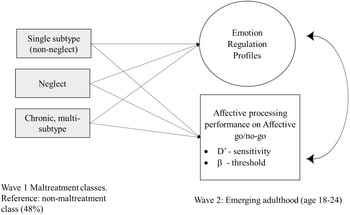
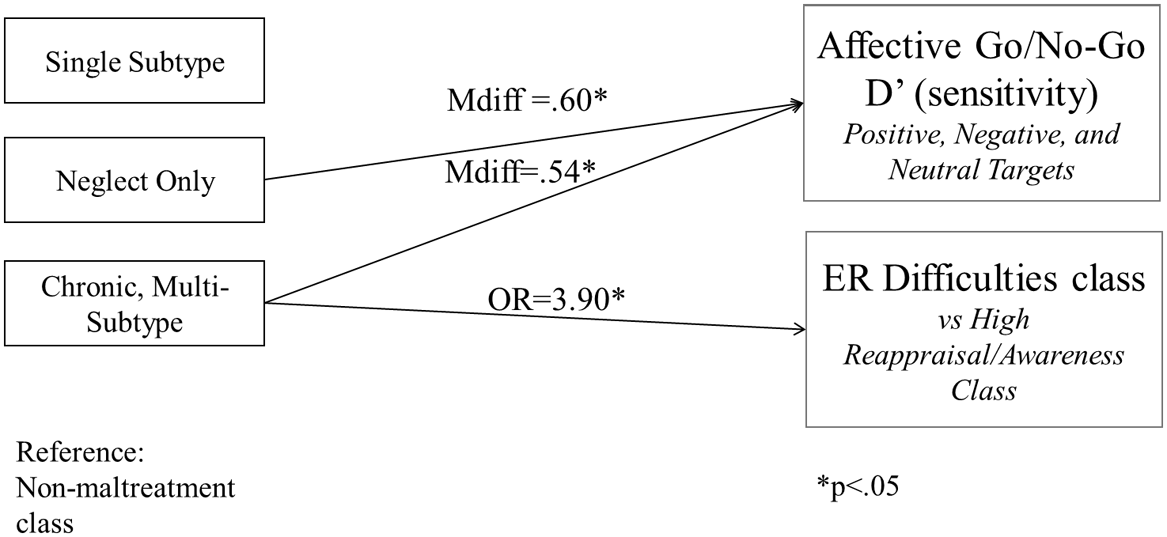
There is currently limited research that tests associations between patterns of maltreatment exposure (ascertained prospectively) and multiple dimensions of emotion regulation. The current study aimed to extend this literature by testing relationships between empirically derived patterns of childhood maltreatment subtype and chronicity (identified in Warmingham et al., Reference Warmingham, Handley, Rogosch, Manly and Cicchetti2019) and performance and self-report measures that assess different aspects of emotion regulation in emerging adulthood. Specifically, the current study sought to determine if patterns of maltreatment were predictive of different emotion processing and regulation patterns and to identify how emotion regulation patterns were related to implicit processing of affective information. The first aim of the current study was to identify profiles of emotion appraisal/regulation strategies using Latent Profile Analysis (LPA; Aim 1a) and test attention bias and sensitivity toward emotional information across profiles of emotion appraisal/regulation (Aim 1b). The second aim was to identify relationships between common patterns of childhood maltreatment experiences (identified in Warmingham et al., Reference Warmingham, Handley, Rogosch, Manly and Cicchetti2019) and affective processing scores and profiles of emotion appraisal/regulation identified in the first aim (Aim 2; see Figure 1).
Testing associations between childhood maltreatment class (wave 1), profiles of affective appraisal and regulation strategies (wave 2), and affective go/no-go (AGN) performance (wave 2). Profiles of childhood maltreatment experiences were specified in the wave 1 sample in a prior study (see Warmingham et al., Reference Warmingham, Handley, Rogosch, Manly and Cicchetti2019).

We hypothesized that profiles of emotion regulation would emerge with at least one profile characterized by high use of suppression, low reappraisal, and challenges with multiple aspects of emotion regulation (i.e., low insight into emotions, difficulties with emotional and/or behavioral regulation when experiencing distress). Furthermore, we expected profiles of self-reported emotion regulation and appraisal would be associated with implicit processing of affective information, consistent with theoretical models that suggest levels of emotion generation and appraisal/valuation interact (Gross, Reference Gross2015). However, we did not have specified hypotheses about the associations between affective processing and emotion regulation profiles because profiles were identified via a data-driven approach (latent profile analysis) and were not pre-specified. We hypothesized that multi-subtype, chronic maltreatment confers greater difficulties with emotion regulation and greater affective processing biases (e.g., less sensitivity and accuracy when completing the affective go/no-go task).
Methods
Participants and procedures
Participants included N = 427 emerging adults who participated in wave 2 of a larger study of children recruited at wave 1. At wave 1, children (n = 680; aged 10–12 years) with documented maltreatment or no involvement with Child Protective Services (CPS) were recruited. Non-maltreated children were socio-demographically comparable to those with documented maltreatment; all participants were recruited from families whose household income level was below the 200% federal poverty threshold. A Department of Human Services (DHS) liaison contacted eligible families and interested parents signed consents to study procedures and provided permission for study staff to review DHS CPS records. Children provided signed assent for study procedures. Study enrollment and participation were voluntary. During the 35-hour, week-long summer research camp, children completed self-report and performance-based research measures. For a full description of summer research camp procedures, see Cicchetti and Manly (Reference Cicchetti, Manly, Brody and Sigel1990). Children’s maltreatment experiences were coded from CPS records using the Maltreatment Classification System (Barnett et al., Reference Barnett, Manly, Cicchetti, Cicchetti and Toth1993).
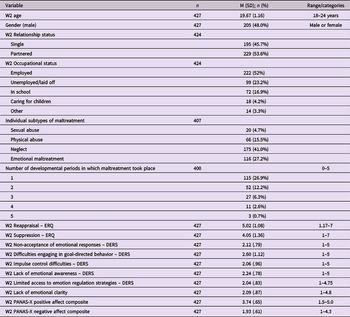
At wave 2, participants were re-contacted in emerging adulthood for a follow-up study. Those who were interested in participating signed consents for study procedures. Participants were aged 18–24 years, 48% Male, 52% Female, 75.9% Black, 10.8% White, 7.5% Hispanic, and 6% Other race. Prior studies published using the wave 2 sample reported no differences between those included at wave 2 and participants who only took part at wave 1 in regards to maltreatment status, gender, or other socio-demographic measures (Handley, et al., Reference Handley, Russotti, Rogosch and Cicchetti2019). All study procedures conducted at both waves were approved by the appropriate institutional research subjects review board. Descriptive statistics relevant to the Wave 2 sample are presented in Table 1.
Descriptive statistics

Note: W2 = assessments were done during emerging adulthood; ERQ = Emotion Regulation Questionnaire; DERS = Difficulties in Emotion Regulation Scale; PANAS-X = Positive and Negative Affect Scale – Expanded Form.
Measures
Childhood maltreatment (wave 1)
The Maltreatment Classification System (MCS; Barnett et al., Reference Barnett, Manly, Cicchetti, Cicchetti and Toth1993) was used to code CPS records for occurrence of childhood maltreatment from birth to late childhood. The MCS codes severity and developmental timing of four subtypes of maltreatment, including sexual abuse, physical abuse, emotional maltreatment, and neglect. Four types of neglect were coded: lack of supervision, failure to provide, educational neglect, and moral/legal neglect. Developmental timing was categorized into the following stages: infancy (birth–17 months), toddlerhood (18 months–2 years), preschool age (3–5 years), early school age (6–7 years), and later school age (8–12 years). See Table 1 for the rates of each subtype of maltreatment and chronicity of exposures (i.e., number of developmental periods in which maltreatment was coded) in the wave 2 sample.
Children often experience multiple subtypes of maltreatment (Vachon et al., Reference Vachon, Krueger, Rogosch and Cicchetti2015). To contend with the overlap in subtypes and the challenge of considering maltreatment subtype and chronicity simultaneously, a prior study (Warmingham et al., Reference Warmingham, Handley, Rogosch, Manly and Cicchetti2019) employed latent class analysis to identify four distinct classes of children based on MCS codes for the presence of each subtype and chronicity of maltreatment in the wave 1 sample. By study design, one class included non-maltreated children (48%; non-maltreated class). Three maltreatment classes were identified. In the smallest class (6.2%; single subtype class), children generally experienced a single subtype of maltreatment that took place during one developmental period. Within this class, the prevalence of emotional maltreatment was 45%, the prevalence of physical abuse was 45%, and the prevalence of sexual abuse was 16%. The second-largest class was the neglect class (16% of the entire sample). All of the children who fell in this class experienced neglect (without any other exposures) that occurred mostly in a single developmental period (i.e., 79% of participants had exposure in one developmental period). Finally, the largest class of maltreated children (30% of the entire sample; chronic, multi-subtype class) was characterized by moderate to high probabilities for each subtype of maltreatment (within-class prevalence: sexual abuse: 13%; physical abuse: 43%, emotional maltreatment: 85%, neglect 94%). All of the children in this class experienced two or more subtypes of maltreatment, and most of the children (61% within this class) experienced maltreatment in two or more developmental periods. These classes represent common patterns of maltreatment subtype and chronicity among a CPS-involved sample.
There was significant separation between classes in the final solution (i.e., entropy was 1.0, and the average posterior probabilities for the most probable class ranged from .96–1.0). Therefore, maltreatment class membership was designated based on the highest posterior probability. A four-level categorical class membership variable (non-maltreated, neglect, single subtype, and multi-subtype/chronic maltreatment classes) was created. This categorical variable representing maltreatment pattern was then related to dimensions of emotion regulation in Aim 2 in the sub-sample that completed wave 2 data collection.
Affective go/no-go task (AGN) (wave 2)
The AGN is a performance-based task that was administered at wave 2 as part of the Cambridge Neuropsychological Testing Automated Battery (CANTAB Eclipse; Cambridge Cognition). The CANTAB eclipse is a touch-screen-enabled computerized assessment battery used extensively to assess neuropsychological functioning in adult populations with and without psychiatric and neurological conditions (e.g., De Luca et al., Reference De Luca, Wood, Anderson, Buchanan, Proffitt, Mahony and Pantelis2003; Levaux et al., Reference Levaux, Potvin, Sepehry, Sablier, Mendrek and Stip2007). The Affective Go/No-Go is a behavioral inhibition task that uses emotional stimuli. In other words, it requires participants to inhibit prepotent responses in response to emotional cues (Schulz et al., Reference Schulz, Fan, Magidina, Marks, Hahn and Halperin2007). Scores on the AGN measure bias and sensitivity toward emotional words.
During the AGN, a series of positive (e.g., joyful), negative (e.g., hopeless), and neutral (e.g., element) words appeared on a computer screen. Stimulus words were drawn randomly (without replacement within block) from a bank of 180 total words (45 positive, 45 negative, and 90 neutral words). In each block, 18 words from two valence categories were presented in random order (e.g., 9 positive and 9 negative words). Participants were informed that one valence was the “target” and one valence was the “distractor.” Participants were asked to respond by clicking the mouse when target words appeared on the screen (“go” trials) and refrain from responding when distractor words appeared on the screen (“no-go” trials). For example, a block might have positive words as targets, and neutral words as distractors. Research assistants first explained the task to the participants and then asked them to click the mouse quickly and accurately only for target words, and not for distractor words for each block.
The task began with two practice blocks that were not scored: block 1 had positive word targets, and block 2 had negative targets. Then, participants completed eighteen blocks of scored trials. Target word valences for each block were ordered: positive, positive, neutral, neutral, negative, negative, positive, positive, neutral, neutral, negative, negative, positive, positive, neutral, neutral, negative, negative. Each word was displayed on screen for 300 ms and the inter-word interval was 900ms. There was a pause between blocks and then participants were re-oriented to target and distractor words for the next block.
Scoring Affective Go/No-Go (AGN) affective processing variables. Outputted variables scored by the AGN were used to compute measures of attentional bias and sensitivity based on guidance from signal detection theory (see Schulz et al., Reference Schulz, Fan, Magidina, Marks, Hahn and Halperin2007) for positive, negative, and neutral target words. Responses on trials during the AGN fall into one of four categories: Hits (i.e., clicking for a target word); Correct Rejections (i.e., not clicking during a distractor word); Commissions (i.e., false positives, or clicking for a distractor word); and Omissions (i.e., false negatives, or failing to click for a target word). There was a pre-empt delay of 100 ms which means that if the subject responds in the first 100 ms, it is recorded as an inaccurate response. Of note, all participants analyzed had a “hit” rate above 0% (indicating engagement in the task).
To summarize participants’ performance on this task, perceptual sensitivity scores (d’) and attention bias scores (β) were computed for each target word type (positive, negative, and neutral). Sensitivity scores (d’) were calculated based on the total number of hits (calculated as 54 opportunities to have a correct “hit” for each target type minus the number of omissions) and the number of commissions, or false-positive responses using the following formula:
d’target = Z(Hits) − Z(Commissions)
The d’ score was calculated by computing z-scores for the number of hits and commissions for each of the target words (i.e., for positive, negative, and neutral targets separately). As a result, higher d’ scores indicate more “hits” and greater accuracy (less false alarms) in response to that target valence. Greater d’ scores are generally associated with greater perceptual sensitivity to the target stimulus (Schulz et al., Reference Schulz, Fan, Magidina, Marks, Hahn and Halperin2007).
Attention bias or threshold scores (β) were computed for each target word type by adding the number of hits and commissions:
β target = −[Z(Hits) + Z(Commissions)]/2
Because hits and commissions are summed, individuals with low scores have more hits and more errors, indicating an over-response to the target word type. Scores on β, also known as the criterion for a target stimulus, indicate the minimum threshold of certainty needed for a participant to respond to a stimulus. Lower values on β indicate a greater response bias, or minimum threshold needed to respond to positive, negative, or neutral stimuli (Schulz et al., Reference Schulz, Fan, Magidina, Marks, Hahn and Halperin2007).
Measures of self-reported emotional experiences and regulation (wave 2)
Difficulties in Emotion Regulation Scale (DERS; Gratz and Roemer, Reference Gratz and Roemer2004). The DERS is a self-report scale used to assess multiple dimensions of an individual’s emotional experience, including subjective emotion regulation strategy use and effectiveness at coping with strong emotions. Items included 36 statements rated on a scale from 1-Almost Never to 5-Almost Always. The DERS has 6 subscales. Each is linked to conceptually important aspects of emotion regulation: 1) The non-acceptance of emotional response subscale measures an individual’s tendency to reject one’s one emotional experience; 2) higher scores on the difficulty engaging in goal-directed behavior subscale indicate greater difficulties completing tasks and/or concentrating when experiencing strong emotions; 3) the impulse control difficulties subscale contains items reflecting challenges controlling prepotent responses when experiencing strong emotions; 4) the lack of emotional awareness subscale (reverse scored) measures the level of attention given to emotion responses; 5) the limited access to emotion regulation strategies subscale measures an individual’s subjective beliefs about what can be done when they are upset (experiencing strong emotions), and 6) the lack of emotional clarity subscale measures how clearly participants experience their emotions. For each scale, higher scores on each subscale indicated greater problems in that area of emotion regulation. In the current sample, subscales of the DERS showed adequate internal consistency (α = .75–.87) and generally normal distributions when items were averaged to create subscale scores (skew: .65–1.01, kurtosis: −.98 to 1.08).
Emotion Regulation Questionnaire (ERQ; Gross and John, Reference Gross and John2003). The ERQ is a 10-item self-report measure that asks participants about their response to their emotional experience. Participants were asked to rate each item on a scale of 1-Strongly Disagree to 7-Strongly Agree. Two subscales are scored: The reappraisal subscale (six items) and the suppression subscale (four items). The ERQ demonstrated measurement invariance across race (Black vs non-Black) and gender in an independent sample of 1188 college students (Melka, et al., Reference Melka, Lancaster, Bryant and Rodriguez2011). In the current sample, internal consistency for the suppression and reappraisal subscales was adequate (α = .66–.73).
Positive and Negative Affect Scale – Expanded Form (PANAS-X; Watson & Clark, Reference Watson and Clark1999). Participants completed the PANAS-X, a 60-item self-report form intended to measure self-reported affect. Participants rated the extent to which they felt each of the 60 emotions during the past few weeks. Scale responses included: 1 – very slightly or not at all; 2 – a little; 3 – moderately; 4 – quite a bit, and 5 – extremely. The Negative Affect subscale was computed by averaging scores on 10 negative emotion words (e.g., afraid, scared, hostile, ashamed, distressed), and the Positive Affect subscale was computed by averaging scores on 10 positive emotion words (e.g., alert, enthusiastic, excited, interested, strong). In the current sample, the internal consistency for positive and negative affect subscale was high (α = .81 and .80, respectively).
Data analysis plan
Aim 1a – Identifying profiles of emotion regulation
LPA is a person-centered technique to identify subgroups with similar patterns on manifest, or measured variables. LPA is used when manifest indicators are continuous, as they are in the current study. Indicators of the LPA included DERS subscales (i.e., Non-acceptance of Emotional Responses, Difficulties Engaging in Goal-Directed Behavior, Impulse Control Difficulties, Lack of Emotional Awareness, Limited Access to Emotion Regulation Strategies, and Lack of Emotional Clarity), ERQ subscales (Reappraisal and Suppression), and PANAS-X subscales (Positive and Negative Affect; see Table 1 for descriptive statistics).
The LPA model was estimated as the most restrictive (i.e., least parameterized) model to aid with convergence and estimation. Means and variances for each indicator within class were estimated, and local independence was assumed (i.e., covariances between indicators were not estimated). Class enumeration began with a 1-class model and proceeded with models specified with k latent classes (up to a 6-class model) using the same ten manifest indicators. Consistent with best practice recommendations, the selection of a final, best-fitting class solution depends on multiple fit indices as well as the interpretability of the profiles (Morgan, et al., Reference Morgan, Hodge and Baggett2016). Classes with lower values on Akaike Information Criterion (AIC; Akaike, Reference Akaike1987), Bayesian Information Criterion (BIC; Schwarz, Reference Schwarz1978), Consistent Akaike Information Criterion (CAIC; Bozdogan, Reference Bozdogan1987), and adjusted Bayesian Information Criterion (aBIC; Sclove, Reference Sclove1987) indicated comparatively better solutions. Higher entropy and greater average posterior probabilities indicate greater separation, or distinction, between classes within a solution. Solutions with greater class separation were preferred. Additionally, there was a preference for solutions where each class was greater than five percent of the sample (∼20 people). Class solutions indicated to fit best were examined for interpretability by examining the patterning of indicator means across classes.
Aim 1b – Testing relationships between profiles of appraisal/regulation and AGN performance
Repeated-measures ANOVAs. Emotion regulation class membership was saved as a categorical variable based on each person’s highest posterior probability. Using repeated-measures ANOVAs, mean differences on scored dimensions on the Affective Go/No-Go were investigated, including d’ (perceptual sensitivity) and β (response bias) scores. The ANOVAs were specified with emotion regulation class as a between-subjects variable and valence (positive, negative, and neutral) as a within-subjects variable for both d’ and β scores.
Aim 2 – Testing the relationship between maltreatment profiles and dimensions of emotion regulation
Participants were classified into their most likely maltreatment class based on average posterior probabilities for maltreatment class identified in Warmingham and colleagues’ 2019 paper. Two repeated-measures ANOVAs were used to investigate mean differences across maltreatment class membership (4-level between-subjects factor) for scored variables on the AGN affective processing variables for each target word (3-level within-subjects factor: positive, negative, neutral). Outcome measures included d’ (perceptual sensitivity) and β (response bias).
To evaluate the association between maltreatment patterns and ER profiles, a set of dummy codes were created representing maltreatment class membership. The non-maltreated class was used as the reference group. The dummy codes were entered as simultaneous predictors of the emotion regulation profiles identified in Aim 1 using the R3STEP command in Mplus (Vermunt, Reference Vermunt2010). This approach treats predictors of the latent class solution as auxiliary to the model and estimates odds ratios based on a set of multinomial logistic regressions. Odds ratios estimate the relative effect of each maltreatment pattern (vs non-maltreated class) on the likelihood of membership in an emotion regulation class, compared to every other emotion regulation class.
Results
Identifying profiles of emotion regulation (aim 1a)
Class enumeration
One to seven latent classes were estimated using the ten continuous indicators (from PANAS-X, DERS, ERQ) using LPA. Table 2 summarizes fit information for the estimated class solutions. The 7-class solution’s log-likelihood did not replicate even when iterations were increased, suggesting that the class solution was untenable for interpretation. The fit indices were somewhat contradictory and were considered together. The AIC and ssBIC both continued to decrease through the 7-class solution, but the 4-class solution had the lowest CAIC value and the 5-class solution has the lowest BIC value. The BLRT was evaluated but produced unreliable estimates, so IC indices, class separation, and class characteristics were considered when selecting a final class solution. After considering indicator mean patterns for the 4- and 5-class solutions, we decided that the 5-class solution provided the most informative and interpretable solution, particularly because the BIC was lowest in the 5-class solution and has been shown to be a reliable fit index in simulation studies (Nylund, et al., Reference Nylund, Asparouhov and Muthén2007).
LPA fit indices for 1–6 classes (n = 427)

Note. LL = Log-likelihood, AIC = Akaike’s Information Criterion, BIC = Bayesian Information Criterion CAIC = Bozdogan’s consistent AIC, ssBIC = sample size adjusted BIC.
The 7-class solution’s log-likelihood did not replicate, meaning that this solution’s estimates could be sourced from a local maximum and were not trustworthy.
Five-class solution
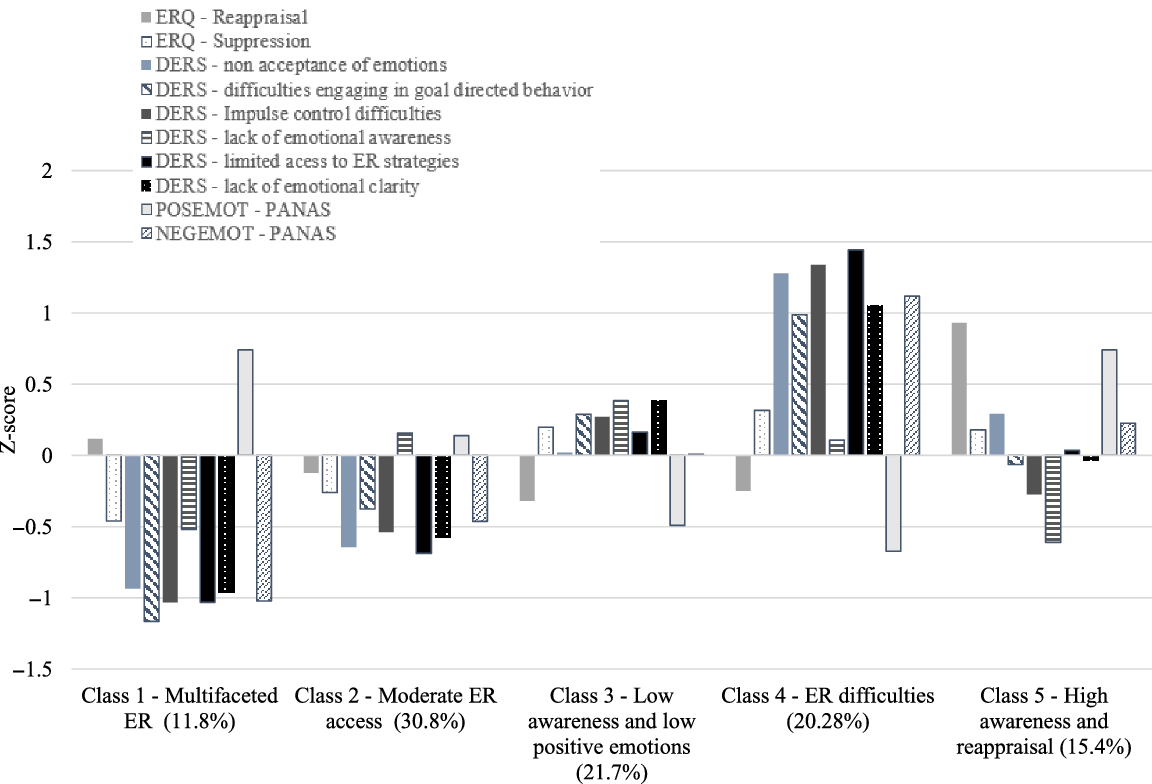
Standardized indicator means within each class for the 5-class solution are presented in Figure 2 (see Table S.1 for unstandardized within-class means and standard errors).
LPA 5-class solution profile with standardized indicator means.

-
1. Class 1 (Multifaceted ER, 11.8%) was characterized by low negative emotion, high positive emotion, and fewer difficulties in multiple facets of emotion and behavioral regulation, including high awareness of emotions, access to strategies, and low difficulties engaging in goal-directed behavior.
-
2. Class 2 (Moderate ER access; 30.8%) was characterized by relatively low negative emotion, high clarity and acceptance of emotions, and high access to emotion regulation strategies with low difficulties with behavioral regulation.
-
3. Class 3 (Low awareness and low positive emotions, 21.7%) included those with low positive affect and moderate challenges in some areas of ER, including elevated lack of emotional clarity and lack of emotional awareness. The use of reappraisal was notably lower in this class.
-
4. Class 4 (ER difficulties, 20.3%) included those who had significant challenges in multiple areas of ER and low positive affect and high negative affect. This class was marked by high lack of emotional clarity, limited access to ER strategies, and poor behavioral regulation (high impulse control difficulties and difficulty engaging in goal-directed behavior).
-
5. Class 5 (High reappraisal and awareness, 15.4%) included individuals high in reappraisal use and emotional awareness. Their mean positive emotions were high and negative emotions were average.
Emotion regulation profiles and affective go/no-go performance (aim 1b)
A 5-level categorical variable was created representing most likely class membership using the 5-class solution that identified profiles relevant to emotion regulation. A set of repeated-measures ANOVAs were conducted to test affective processing sensitivity (d’) and threshold (β). Specifically, emotion regulation class was specified as a 5-level between-subjects factor, and target word valence was a 3-level within-subjects factor (positive, negative, and neutral).
Associations between ER profiles and affective processing sensitivity
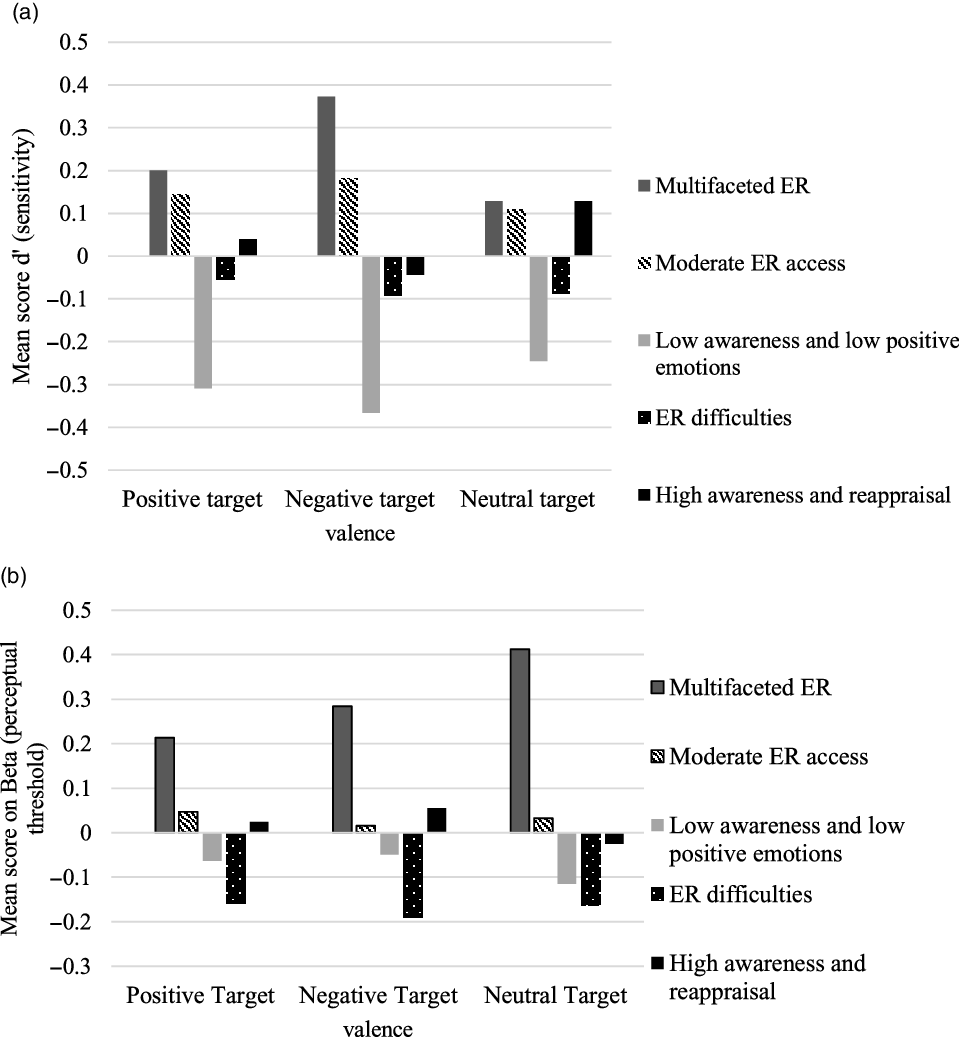
Mean d’ scores for each ER class and valence are presented in Figure 3a. For the d’ outcome, there was no significant effect of target word valence (Huynh-Feldt corrected F(31.96, 803.37) = .009, p = .99), but there was a marginal effect of emotion regulation class on d’ scores (F(4, 410) = 2.12, p = .078). The interaction of valence and ER class was non-significant (Huynh-Feldt corrected F(7.84, 803.37) = 1.20, p = .30). To test differences between classes within targets, one-way ANOVAs were conducted for each valence target. There were differences in the d’ score for negative targets (F(4, 414) = 2.69, p = .013). Specifically, the low awareness and low positive emotions class had lower scores on the d’ score for negative targets when compared to those in the multifaceted ER class (class 1; Mdiff = −.74, SE = .26, p = .005) and the moderate ER class (Class 2; Mdiff = −.55, SE = .21, p = .008).
(a) Scores on d’ (sensitivity) across emotion regulation classes. (b) Scores on β (perceptual threshold, indicating attention bias) across emotion regulation classes.

Associations between ER classes and affective processing threshold
The same ER class x valence repeated-measures ANOVA was conducted on the β (sensitivity threshold) variable. See Figure 3b for a plot of means. Overall, there was a significant effect of emotion regulation class membership on β score (F(4, 410) = 4.75, p = .001), no effect of valence (Huynh-Feldt adjusted F(1.88,779.99) = .19, p = .82) and no interaction of valence and ER class (Huynh-Feldt adjusted F(7.61, 779.99) = 1.61, p = .12). Collapsing across target valence, those in the multifaceted ER class had higher perceptual thresholds than those in the moderate ER access class (Mdiff = .27, SE = .11, p = .01), the low awareness and low positive emotions class (Mdiff = .38, SE = .11, p = .001), ER difficulties class (Mdiff = .48, SE = .11, p < .001), and the high awareness and reappraisal class (Mdiff = .29, SE = .12, p = .02). The moderate ER access class also showed higher threshold scores than those in the ER difficulties class (Mdiff = .20, SE = .09, p = .03). A similar pattern of results was found on 1-way ANOVAs conducted on the threshold scores for each valence.
Child maltreatment classes and emotion regulation dimensions (aim 2)
Effect of maltreatment classes on affective processing sensitivity
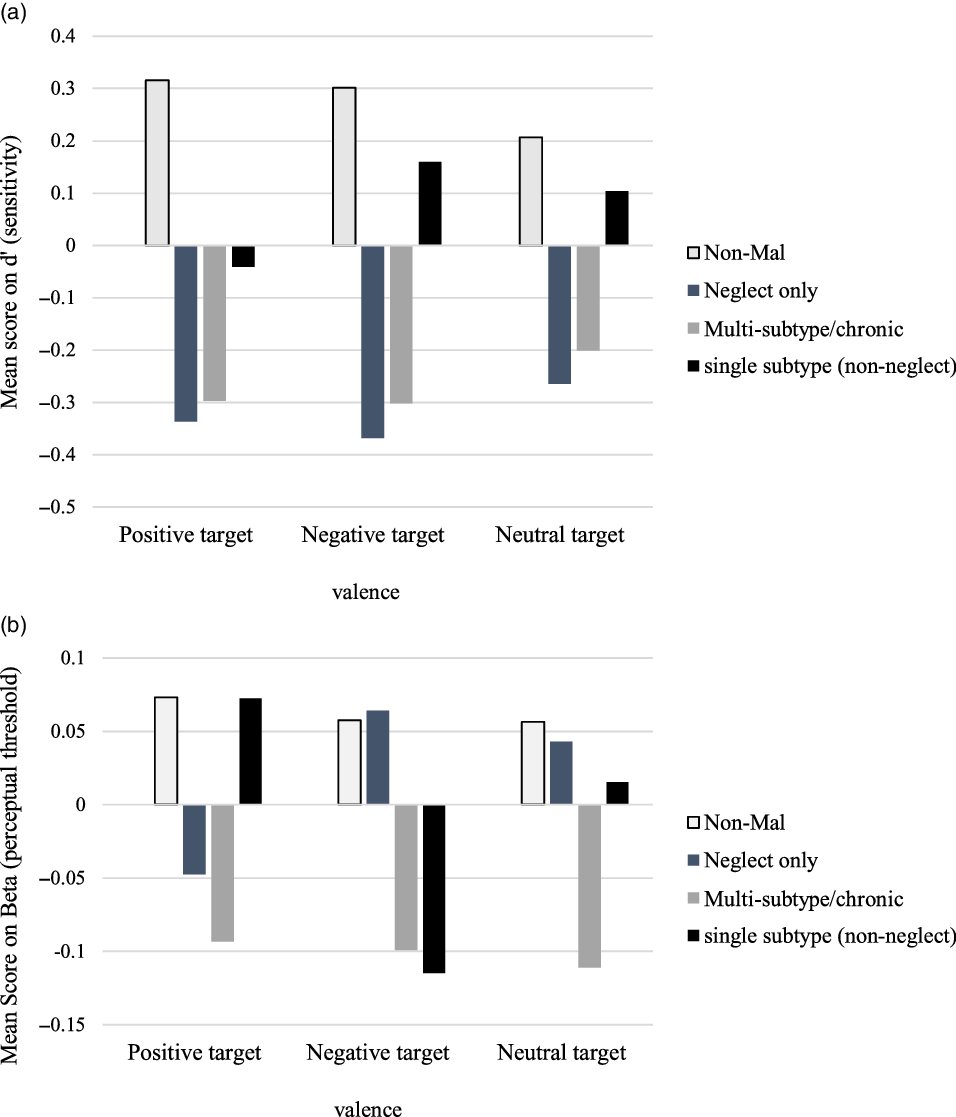
A repeated-measures ANOVA was also conducted testing the effect of maltreatment class on d’ scores for each valence (positive, negative, and neutral targets). There was no main effect of target valence (Huynh-Feldt adjusted F(1.95,169.75) = .47, p = .62), but there was a main effect of maltreatment class (F(1,365) = 5.83, p = .001). Specifically, those in the non-maltreated class had higher d’ scores than those in the neglect only class (Mdiff = .60, SE = .19, p = .002) and those in the multi-subtype, chronic maltreatment class (Mdiff = .54, SE = .15, p < .001). This pattern of results was consistent when one-way ANOVAs were conducted on d’ scores for each valence target. There was no valence × maltreatment class interaction (Huynh-Feldt adjusted F(5.85, 769.75) = 1.35, p = .24). Means are presented in Figure 4a.
(a) Scores on d’ (sensitivity) across maltreatment classes. (b) Scores on β (perceptual threshold) across maltreatment classes.

Effect of maltreatment classes on affective processing threshold
A final repeated-measures ANOVA was conducted on the sensitivity (β) scores across maltreatment classes. There was no main effect of target valence (Huynh-Feldt adjusted F(1.88, 743.27) = .40, p = .66), maltreatment class (F(3, 395) = 1.60, p = .19), and no valence × maltreatment class interaction (Huynh-Feldt adjusted F(5.65, 743.27) = 1.38, p = .23). Means are presented in Figure 4b.
Maltreatment classes predicting ER profiles
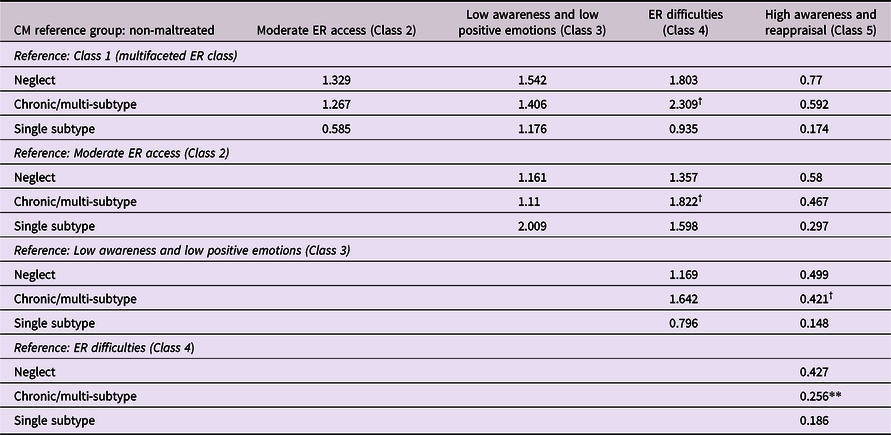
Maltreatment latent classes (identified in Warmingham et al., Reference Warmingham, Handley, Rogosch, Manly and Cicchetti2019 ) were represented with three dummy codes entered as predictors of the LPA 5-class solution (described above) using the automated 3-step approach using the R3STEP command in Mplus v8.0 (Muthén & Muthén, Reference Muthén and Muthén2017). The non-maltreatment class was the reference group. All odds ratios for multinomial logistic regressions predicting emotion regulation classes are presented in Table 3. Maltreatment classes distinguished emotion regulation profiles. Specifically, chronic/multi-subtype childhood maltreatment exposures (vs. no maltreatment) increased odds of membership in the ER difficulties class as compared to the high reappraisal and awareness class (OR = 3.90, 95% CI [1.50, 10.14], p = .01). Multi-subtype/chronic maltreatment also marginally increased odds of membership in the ER difficulties class vs the multifaceted ER class (OR = 2.309 95% CI [.92, 5.79], p = .07) vs the moderate ER access class (OR = 1.82, 95% CI [.92, 3.62], p = .09). Multi-subtype/chronic maltreatment also increased odds of membership in the low awareness and low positive emotions class vs the high awareness and reappraisal class (OR = 2.38, 95% CI [.88, 6.45], p = .09). Multinomial logistic regressions comparing the effect of multi-subtype/chronic maltreatment vs neglect and single subtype exposures in predicting emotion regulation profiles were non-significant (at α = .05). Figure 5 summarizes results of Aim 2.
Maltreatment patterns relate to affective processing and emotion regulation in emerging adulthood. Note: ER = Emotion Regulation; Mdiff = mean difference; OR = odds ratio. Marginal effects denoted in Table 3 are not shown in this figure.

Maltreatment classes predicting emotion regulation profiles

Significant odds ratios less than 1 indicate that the maltreatment class (vs nonmal) decreases odds of membership in the target ER class, as compared to the reference ER class. Odds ratios greater than 1 indicate that the maltreatment class increases odds of membership in the target ER class, as compared to the reference ER class.
† p = .10–.05.
* p = .05–.01.
** p < .01.
*** p < .001.
Discussion
Guided by the developmental psychopathology framework and leading conceptualizations of emotion and emotion regulation (Barrett, Reference Barrett2017; Beauchaine & Cicchetti, Reference Beauchaine and Cicchetti2019; Beauchaine & Haines, Reference Beauchaine, Haines, Beauchaine and Crowell2020; Cicchetti et al., Reference Cicchetti, Ganiban, Barnett, Garber and Dodge1991), the current study investigated the effect of maltreatment subtype and chronicity on multiple aspects of emotion regulation, including patterns of self-reported affect and emotion regulation capacities and performance on an affective go/no-go task that measures affective processing. Five distinct classes characterized by different patterns of self-reported affect and emotion regulation were identified in a sample of emerging adults, all of whom experienced poverty and half of whom experienced maltreatment during childhood. Patterns of emotion regulation reflected the heterogeneity in emerging adults’ emotional experiences and access to strategies to cope when emotions are overwhelming. Further, specific emotion regulation profiles related to affective sensitivity and bias, aligning with theoretical models that suggest links between within-person affective processing, appraisal, and regulation of affective states (Gross, Reference Gross2015). Patterns of childhood maltreatment chronicity and subtype predicted both self-reported patterns of emotion regulation and sensitivity to emotional information. The current study adds to a growing body of literature that applies person-centered approaches to characterize complex patterns and associations between childhood maltreatment exposures and emotion regulation to advance research on transdiagnostic factors underlying the development of psychopathology in emerging adulthood.
Emotion regulation profiles
Five emotion regulation patterns were identified using LPA, a person-centered approach that identifies latent, or unobserved patterns based on measurable features of an underlying construct. The multifaceted emotion regulation class had the lowest mean levels of emotion regulation challenges, including low challenges with behavioral regulation, higher access to strategies to cope with distress, and low difficulties engaging in goal-directed behavior when emotions were high. This class also reported the highest levels of positive emotion and lowest levels of negative emotion. This class was the smallest of the five classes (11.8% of the sample) but represents a pattern of significant socioemotional adaptation in a sample of emerging adults exposed to high levels of trauma and sociodemographic stress.
The largest class identified was the moderate emotion regulation access class (30.8% of the sample). This class reported lower than mean levels of negative emotion, high acceptance and clarity of emotions, and reported greater access to strategies to deal with distress. They also reported low challenges with behavioral regulation during times of distress. Unlike the multifaceted emotion regulation class that showed high levels of positive affect, this class reported average levels of positive emotions.
The low awareness and low positive emotions class (21.7% of the sample) represented a pattern marked by greater challenges with certain aspects of emotion regulation. Specifically, individuals in this class reported more difficulties with clarity and awareness of their emotions (e.g., not acknowledging emotions when upset, having a hard time making sense out of feelings). A meta-analysis showed that emotional clarity and attention to emotions tend to co-vary, suggesting that the pattern found in the current study may be picking up on a common manifestation of emotion dysregulation (Boden & Thompson, Reference Boden and Thompson2017). This class also had notably lower positive emotions than the mean in the sample. Members of the low awareness and low positive emotions class had lower mean sensitivity to negative affective information on the emotion processing task when compared to the two classes marked by greater regulatory adaptation (moderate ER access and multifaceted ER classes). This finding suggests that self-reported awareness and clarity challenges may also “show up” through attenuated attention or responsivity to emotional information.
The emotion regulation difficulties class made up about 20% of the sample or about 85 people. This pattern was characterized by high self-reported negative affect, low positive emotion, and difficulties with multiple aspects of emotion regulation, including access to ER strategies and difficulties with behavioral regulation (i.e., impulse control difficulties and difficulties engaging in goal-directed behavior when upset or overwhelmed). Additionally, this class reported challenges with emotional clarity and had a higher endorsement of non-acceptance of emotions and use of suppression as a strategy to cope with emotions. Given the significant and aggregated difficulties reported by members of this class, we consider this a class marked by greater emotion dysregulation, defined as emotional processes that interfere with goals or contribute to maladaptation (Beauchaine, Reference Beauchaine2015).
Notably, individuals in the emotion regulation difficulties class showed greater response bias when they were asked to respond to emotional words on the affective go/no-go task (i.e., showed a lower threshold for identifying words) as compared to every other profile, indicating that greater emotional distress and dysregulation is associated with a heightened sensitivity to affective information. Although this study did not find valence or threat-specific effects identified in other studies (Bardeen & Daniel, Reference Bardeen and Daniel2017; Weissman et al., Reference Weissman, Bitran, Miller, Schaefer, Sheridan and McLaughlin2019), results add to theoretical and empirical literature suggesting that high levels of reported emotion dysregulation and vulnerability to psychopathology is associated with heightened detection and attention to affective information (Van den Bergh et al., Reference Van den Bergh, Brosschot, Critchley, Thayer and Ottaviani2021).
The last class, called the high reappraisal and awareness class (15.4% of the sample), had a pattern of responses consistent with individuals who have high insight into their experience and use top-down cognitive strategies to cope with things when emotions run high. Notably, this class had average scores on aspects of behavioral regulation challenges in response to distress (e.g., mean scores on difficulties engaging in goal-directed behavior, impulse control difficulties). This class did not have marked differences in their affective processing than other classes but did have a lower threshold for identifying words than the multifaceted ER class. This difference could indicate that the individuals in the high reappraisal and awareness class display attention biases toward emotional information, similar to the classes marked by greater emotion dysregulation, but have more effective strategies to regulate their emotional experiences.
Taken together, the current findings add to a growing literature that has applied a pattern-based approach to the study of emotional regulation rather than focusing on individual strategies or discrete emotions (Aldao & Nolen-Hoeksema, Reference Aldao and Nolen-Hoeksema2013; Haines et al., Reference Haines, Gleeson, Kuppens, Hollenstein, Ciarrochi and Labuschagne2016; Turpyn et al., Reference Turpyn, Chaplin, Cook and Martelli2015). Using this approach, we were able to characterize nuanced heterogeneity in emotion regulation in a sample of emerging adults at high risk for psychopathology due to exposure to trauma and poverty. Findings identified that both adaptive emotion regulation and maladaptive emotion regulation (i.e., emotion dysregulation) can be characterized by multiple qualitatively different patterns. Identifying multiple patterns of adaptive emotion regulation is particularly notable because the current sample was made up of individuals who faced high rates of socioeconomic and traumatic stress during their early lives.
Results also align with constructionist models of emotion that suggest that attention processes play a role in generating emotions, leading to appraisals of the emotion and the individual’s situational circumstances (Gross, Reference Gross2015). For example, individuals in the current sample reporting low distress tended to also report higher levels of positive emotion and had less vigilance toward affective information. In contrast, higher levels of distress and challenges coping with distress were associated with attenuated positive emotion, high negative emotion, and more vigilant attention and response patterns in a performance task involving emotional information. Transdiagnostic psychopathology perspectives suggest that affective processing biases and appraisals of emotions as negative and overwhelming, combined with lack of access to emotion regulation strategies, has the potential to lead to maintenance of psychopathology symptoms (Van den Bergh et al., Reference Van den Bergh, Brosschot, Critchley, Thayer and Ottaviani2021; Weissman et al., Reference Weissman, Bitran, Miller, Schaefer, Sheridan and McLaughlin2019; Wilamowska et al., Reference Wilamowska, Thompson-Hollands, Fairholme, Ellard, Farchione and Barlow2010). Although the current study is not able to parse temporal ordering of emotional processes, the relationship between patterns of self-reported appraisals and attention bias scores align with constructionist approaches that suggest underlying neurobiological processes shape affective processing and influence the generation of emotions and behavioral responses (Barrett, Reference Barrett2017; Lindquist et al., Reference Lindquist, Wager, Kober, Bliss-Moreau and Barrett2012).
Maltreatment and emotion regulation
As established in prior studies (Handley et al., Reference Handley, Russotti, Warmingham, Rogosch, Todd Manly and Cicchetti2021; Warmingham et al., Reference Warmingham, Handley, Rogosch, Manly and Cicchetti2019), the prominent pattern of maltreatment in the current sample is characterized by exposure to multiple subtypes of maltreatment (including emotional maltreatment, physical abuse, sexual abuse, and neglect) occurring chronically during childhood. Results showed that multi-subtype, chronic maltreatment increased the likelihood that emerging adults were classified in the emotion regulation difficulties class, as compared to the high reappraisal and awareness class. Complex and chronic maltreatment was therefore predictive of a pattern typified by high negative affect, low positive affect, and significant difficulties coping with distress. Notably, chronically maltreated emerging adults were less likely to report emotion regulation patterns characterized by high awareness of emotions and the use of reappraisal to cope with strong emotions. These results are consistent with studies that have evaluated the effect of maltreatment on a single dimension of emotion regulation (e.g., maltreatment was related to limited access to strategies, difficulties engaging in goal-directed behavior; Krause-Utz et al., Reference Krause-Utz, Erol, Brousianou, Cackowski, Paret, Ende and Elzinga2019; Mueller & Peterson, Reference Mueller and Peterson2012; Oshri et al., Reference Oshri, Sutton, Clay-Warner and Miller2015; Vilhena-Churchill & Goldstein, Reference Vilhena-Churchill and Goldstein2014) and suggest that chronic, multi-subtype maltreatment exposures increase the risk of aggregated difficulties with emotional and behavioral regulation in emerging adulthood. Results also align with a prior meta-analysis that found that maltreatment is associated with increased negative emotions and greater behavioral reactivity to emotions in children, suggesting these difficulties can persist into adulthood (Lavi et al., Reference Lavi, Katz, Ozer and Gross2019) and suggest that this may be most true for children who experience multi-subtype, chronic maltreatment exposure. Notably, other patterns of maltreatment (e.g., neglect only) did not significantly predict specific emotion regulation patterns. Consistent with recent theoretical models of the development of emotion regulation after trauma (McLaughlin et al., Reference McLaughlin, Colich, Rodman and Weissman2020), there are complex mechanisms and moderators (unmeasured in the current study) that may help to explain the link between maltreatment exposure patterns and emotion regulation profiles later in life.
We also investigated maltreatment exposure patterns differences in affective processing. Exposure to neglect with and without other maltreatment subtypes predicted lower sensitivity to affective words. This finding aligns with a meta-analytic finding that maltreated children are less accurate at identifying emotions than non-maltreated peers and suggests that these affective processing deficits may also be present in emerging adulthood (Luke & Banerjee, Reference Luke and Banerjee2013). Results extend the literature in this area by comprehensively characterizing maltreatment subtype exposure and overlap and incorporating maltreatment chronicity.
Notably, maltreatment classes did not relate to the threshold values for detecting and responding to emotional words. There is a significant amount of research on the relationship between maltreatment exposure, particularly violence exposure (IPV and physical abuse exposure) and threat sensitivity. However, the current study’s performance task did not specifically present individuals with threat-specific stimuli. For example, negative word stimuli included those across the negative valence spectrum, including angry and sad words. The affective go/no-go task may not have provided strong enough threat cues to elicit threat hypervigilance responses seen in other studies (e.g., da Silva Ferreira et al., Reference da Silva Ferreira, Crippa and de Lima Osório2014; Gibb et al., Reference Gibb, Schofield and Coles2009; Pollak, et al., Reference Pollak, Cicchetti, Hornung and Reed2000; Young & Widom, Reference Young and Widom2014). However, the affective processing results combined with the effect of maltreatment on self-reported emotion regulation patterns align with literature suggesting that maltreatment affects brain-based processes, like attention and executive functioning, underlying emotion and behavior regulation (Cole et al., Reference Cole, Ram and English2019; Kavanaugh, et al., Reference Kavanaugh, Dupont-Frechette, Jerskey and Holler2017; Lavi et al., Reference Lavi, Katz, Ozer and Gross2019; Liu, Reference Liu2019).
Clinical implications
Emotion regulation is a core transdiagnostic feature relevant to the development and maintenance of psychopathology symptoms (Keyes et al., Reference Keyes, Eaton, Krueger, McLaughlin, Wall, Grant and Hasin2012; McLaughlin et al., Reference McLaughlin, Colich, Rodman and Weissman2020). The current results reinforce the long-term, organizational impact that childhood maltreatment can have on emotional processes that are implicated in multiple psychiatric disorders (Cicchetti & Toth, Reference Cicchetti, Toth and Cicchetti2016). For those who experience significant distress that affects emotional wellbeing after exposure to maltreatment, interventions are likely needed to address maladaptive processes underlying psychopathology, including emotional avoidance, difficulties with emotion differentiation, and coping with distress.
Importantly, most individuals in the current study identified as Black/African American or Hispanic, representing groups that continue to be disproportionally affected by intergenerational stress and trauma due to exposure to historical, systemic oppression in the United States. The complex stressors and traumas experienced by individuals in racial and ethnic minority groups in the United States have documented effects on emotional and physical health throughout the lifespan (Hampton-Anderson et al., Reference Hampton-Anderson, Carter, Fani, Gillespie, Henry and Holmes2021; Metzger et al., Reference Metzger, Salami, Carter, Halliday-Boykins, Anderson, Jernigan and Ritchwood2018; Saleem, et al., Reference Saleem, Anderson and Williams2020). Responses to trauma, including childhood maltreatment exposure, are closely intertwined with cultural history and context (NCTSN Core Curriculum on Childhood Trauma Task Force, 2012). Furthermore, emotion socialization is embedded in norms that can differ across racial and ethnic groups (Friedlmeier, et al., Reference Friedlmeier, Corapci and Cole2011; Labella, Reference Labella2018). It is therefore essential that interventions aimed at preventing and treating socioemotional sequelae of maltreatment in communities that experience co-occurring stressors, like poverty employ a culturally grounded biopsychosocial formulation to understand the strengths and challenges faced by families (Hampton-Anderson et al., Reference Hampton-Anderson, Carter, Fani, Gillespie, Henry and Holmes2021).
The current study suggests that chronic childhood maltreatment is a potent family-level risk factor that increases the odds that emerging adults will be armed with less adaptive emotion regulation skills and greater difficulty controlling their behavior and impulses when they are upset. Given that emerging adulthood is a time when individuals often start their own families and begin parenting, culturally sensitive, trauma-informed interventions for emerging adults could serve to break the cycle of maltreatment and psychopathology and promote emotional and behavioral health and emotional connection within families. Interventions for parents with histories of trauma, such as Child-Parent Psychotherapy (and more recently, Pre- and Perinatal Child-Parent Psychotherapy; Lieberman, et al., Reference Lieberman, Diaz, Castro and Bucio2020; Lieberman, et al., Reference Lieberman, Ghosh Ippen and Van Horn2015) help repair early childhood trauma and promote healthy relationships with significant others and children. Additionally, the Unified Protocol (UP) for the Treatment of Transdiagnostic Disorders is an individual therapy approach that targets underlying processes relevant to multiple psychiatric disorders. The UP provides a flexible model to help tailor treatment to an individual’s goals, symptoms, and cultural context and could be effective to promote emotion regulation skills for emerging adults struggling to effectively regulate emotions and cope with stress (Cassiello-Robbins, et al., Reference Cassiello-Robbins, Southward, Tirpak and Sauer-Zavala2020; Leonardo, et al., Reference Leonardo, Aristide and Michela2021; Wilamowska et al., Reference Wilamowska, Thompson-Hollands, Fairholme, Ellard, Farchione and Barlow2010).
Limitations
There are several limitations in the current study that should be noted. First, maltreatment records were only reviewed up until adolescence. It is likely that maltreatment or other trauma exposure at the family level occurred during adolescence and before the wave 2 assessment that could have unmeasured influences on emotional wellbeing and affective processing. Additionally, performance on the affective processing task used (verbal affective go/no-go) may be less generalizable to real-world affective processing because the stimuli used (words) are much different from emotional information experienced in daily life (e.g., emotions expressed in dynamic social interactions). Finally, although classification error was minimal in both childhood maltreatment and emotion regulation class solutions, the statistical method of categorizing individuals in their most likely latent class is limited because it does not allow for classification error to be estimated.
Conclusions
Childhood maltreatment is a major contributing factor to the development of mental health diagnoses and symptoms of psychopathology across the life span (Cicchetti & Toth, Reference Cicchetti, Toth and Cicchetti2016; Gilbert et al., Reference Gilbert, Widom, Browne, Fergusson, Webb and Janson2009; Keyes et al., Reference Keyes, Eaton, Krueger, McLaughlin, Wall, Grant and Hasin2012; Scott, et al., Reference Scott, Smith and Ellis2010). Emerging adulthood is a pivotal period of developmental and social change for many individuals and is also marked by higher rates of psychopathology (Caspi et al., Reference Caspi, Houts, Ambler, Danese, Elliott and Hariri2020). Yet, psychiatric disorders often co-occur, suggesting that research to delineate and predict the heterogeneity of underlying processes (including emotion regulation) is vitally important. The current study found that multi-subtype, chronic maltreatment is a common pattern of exposure for children involved with the CPS system that increases the risk for a pattern of aggregated maladaptive emotion regulation. Although maltreatment is a clear developmental pathogen that has the potential to alter emotional regulation processes, the current study also found patterns of adaptive emotion regulation in a sample of emerging adults who experienced significant trauma and poverty throughout their early lives. This finding suggests that emotion regulation is characterized by multiple forms of adaptation and maladaptation. Taken together, this study provides nuanced results about how childhood maltreatment that occurs in a family of origin has long-lasting effects on emotion regulation patterns in emerging adulthood. Culturally sensitive and trauma-informed interventions that target transdiagnostic processes relevant to psychopathology are vitally important to preventing sequelae of maltreatment that reach across the lifespan.
Supplementary material
For supplementary material accompanying this paper visit https://doi.org/10.1017/S0954579422000025
Funding statement
This research was supported by grants received from the National Institute on Drug Abuse (NIDA; R01DA17741), the Spunk Fund, Inc., and the National Institute of Child Health and Human Development (NICHD; P50HD096698 to SLT and DC).
Conflicts of interest
None.