Introduction
South Africa's youths are sexually active and this explains the high incidence of sexually transmitted diseases such as HIV/AIDS in this section of the country's population (see e.g. Pettifor et al., Reference Pettifor, Rees, Kleinschmidt, Steffenson, Macphail and Hlongwa-Madikizela2005; Hallman & Roca, Reference Hallman and Roca2011). According to Pettifor et al. (Reference Pettifor, Rees, Kleinschmidt, Steffenson, Macphail and Hlongwa-Madikizela2005), among the sexually active youths aged 15–19, 90% of the females and 73% of the males have had sex in the past 12 months. Despite the high level of sexual activity amongst them, the country's youths tend to be reckless in terms of protection against negative outcomes of sexual activity such as poorer health later in life, lower educational attainment and vulnerability to HIV and other infections (e.g. Warren et al., Reference Warren, Kann, Small, Santelli, Collins and Kolbe1997; Singh et al., Reference Singh, Wulf, Samara and Cuca2000; Harrison et al., Reference Harrison, Xaba and Kunene2001; Isiugo-Abanihe & Oyediran, Reference Isiugo-Abanihe and Oyediran2004; Pettifor et al., Reference Pettifor, Rees, Kleinschmidt, Steffenson, Macphail and Hlongwa-Madikizela2005; Shisana et al., Reference Shisana, Rehle, Simbayi, Zuma, Jooste and Pillay-van-Wyk2009; Hallman & Roca, Reference Hallman and Roca2011).
As a result of the increasing rates of adolescent pregnancy and the concomitant prevalence of sexually transmitted diseases such as HIV/AIDS in recent years, there has been considerable worldwide concern about the incidence of early non-marital sexual intercourse in particular and reproductive health in general and their implications for the welfare of the youth (see e.g. Isiugo-Abanihe & Oyediran, Reference Isiugo-Abanihe and Oyediran2004; Hallman & Roca, Reference Hallman and Roca2011). Even though studies examining the antecedents of the onset of such family-defining events such as sexual intercourse in South Africa exist (see e.g. Bakilana, Reference Bakilana2005; Shisana et al., Reference Shisana, Rehle, Simbayi, Parker, Bhana and Zuma2005; McGrath et al., 2008), they are almost entirely preoccupied with examining the prevalence of such behaviours. The examination of the social and economic conditions that predispose individuals to such behaviours is missing in the existing literature.
Needless to say, information about the age at which first sexual intercourse occurs and the myriad socioeconomic factors that affect the timing of first sexual debut are both important and required for the design of HIV prevention strategies. This means that studies of the onset of sexual debut that look at the problem from multiple and complex perspectives and in settings that are least suspected to be perpetuating such behaviours in a country with a high incidence of HIV/AIDS such as South Africa are needed to advance knowledge in the field. It is against this background of the scarcity of studies that look simultaneously at individual and contextual factors and those that examine in-school youths that the present study was undertaken. Specifically, the study employs Bronfenbrenner's (Reference Bronfenbrenner1979) biosocial ecological model to examine both individual-level characteristics such as age, gender, religion and living arrangements, and socioeconomic and contextual factors such as the influence of the family, peers, school and community on the age at first sexual intercourse in a sample of grade 9 and grade 11 pupils (aged 15 to 18) in the North West Province of South Africa. In South Africa, General Education and Training (GET) end at grade 9 and it is expected that learners are ready at the end of grade 9 to pursue Further Education and Training (FET). Grade 11 is the level in the school system where learners move to the final grade 12 where they sit the public matriculation examinations. It is expected that learners at this grade have secured firm foundations to pursue the grade 12 work. In fact, it is an unstated policy of schools to keep learners who are not well grounded for grade 12 work in grade 11 as schools become concerned about their pass rates in the matriculation examinations. Thus grades 9 and 11 are crucial in the basic education system in terms of the prevalence or lack thereof of such risky youth behaviours as the early onset of sexual intercourse.
Conceptual framework
Bronfenbrenner's (Reference Bronfenbrenner1979, Reference Bronfenbrenner1986) formulation of the manner in which social contexts beyond the individual may help shape adolescent functioning provides the theoretical framework for the present study. According to this formulation, social contexts such as the family through parents, peers, school and community serve as the principal links between environmental settings and adolescent functioning (Taylor et al., Reference Taylor, Jacobson, Roberts, Montemayor, Adams and Gullotta2000).
Contextual factors
Family
Among the range of family variables that have been shown to reduce adolescents' risk of pregnancy are the everyday styles or practices of parenting (e.g. parental support, control or supervision of teenagers). Several studies using Western samples have indicated that parent/child closeness is associated with reduced adolescent pregnancy risk through teens remaining sexually abstinent, postponing intercourse, having fewer sexual partners or using contraception more consistently. For example, the early onset of adolescent sexual intercourse has been related to mothers' report of rejecting behaviours, but not related to mother warmth and supportiveness (Whitbeck et al., Reference Whitbeck, Yoder, Hoyt and Conger1999). Rodgers (Reference Rodgers1999) found that parental support was not related to sexual risk taking among sexually active teens, while Upchurch et al. (Reference Upchurch, Aneshensel, Sucoff and Levy-Storms1999) found that high emotional support from parents is related to older age at first sex for sons but not daughters; however, the effect was not significant in full multivariate models. Manlove et al. (Reference Manlove, Ryan and Franzetta2007) found that delay in timing of first sex for girls was predicted by parent–teen closeness and parental monitoring. The present study examines the effects of parental psychological control, parental monitoring and parental limit-setting on the timing of first sexual intercourse by the youth.
Parental psychological control refers to parental behaviours that intrude upon, impede or manipulate the child's psychological development (e.g. constraining verbal expression, invalidating feelings, love withdrawal, guilt induction, excessive personal criticism and inconsistency). Parental monitoring has frequently been found to be associated with lower levels of child and adolescent deviant behaviour (e.g. Dishion & Patterson, Reference Dishion, Patterson, Stoff, Brieling and Maser1997). This commonly found association has been the basis for the assumption that parental knowledge of youth has the same regulating influence as more specific forms of limit setting, e.g. setting rules and curfews.
Peers
Several studies have found that peers constitute important social contexts that influence adolescents' attitudes and behaviours in important areas, especially adolescent problem behaviours (Steinberg et al., Reference Steinberg, Dornbusch and Brown1992; Taylor, Reference Taylor1994). Noting the increasing importance of peer acceptance to all adolescents, Brown et al. (Reference Brown, Mounts, Lamborn and Steinberg1993) showed that adolescents' behaviour and adjustment are associated with the kind of peers with whom they associate. They found that the more adolescents associated with peers who have positive attributes the better they performed in school, while affiliating with negative groups is not associated with academic achievement. The present study also looked at such peer influences as peer connection and peer psychological control, which refers to the negative behaviours or actions of peers that deprive an adolescent of the ability and opportunity to become aware of and express his or her own thoughts, feelings and ideas.
Community
Despite the fact that relatively little research has been done on the community/family nexus and its impact on family functioning in South Africa, the available evidence suggests that community or neighbourhood is an important social context that impacts family functioning (Crane, 1990; Lamborn et al., Reference Lamborn, Dornbusch and Steinberg1996; Taylor et al., Reference Taylor, Jacobson, Roberts, Montemayor, Adams and Gullotta2000). Furstenburg (Reference Furstenberg and Wilson1993) found that African-Americans living in transitional neighbourhoods shifted from ‘collective to individualistic strategies of family management’, while other studies have suggested that African-American parents may be more authoritarian in parenting because they are more likely to live in more dangerous communities (Baldwin et al., Reference Baldwin, Baldwin, Cole, Rolf, Masten, Cicchetti, Neuchterlein and Weintraub1990; Baumrind, Reference Baumrind, Brook-Gunn, Lerner and Peterson1991). Brooks-Gunn et al. (Reference Brooks-Gunn, Duncan, Klebanov and Sealand1993) found that neighbourhood poverty was positively correlated with teenage pregnancy, while African-American girls living in low-status neighbourhoods were less likely to use contraception in their first sexual experience than girls living in high-status neighbourhoods. In this study, two dimensions of community are used to assess the influence of community on adolescent sexual behaviour, namely, community disorganization and community psychological control.
School
School is viewed as a social context that brings economic, political and social forces to bear on all stages of adolescent development (Entwisle, Reference Entwisle, Feldman and Elliot1990). Existing empirical evidence suggests that the social ecology of schools has varied from their ethnic composition to their economic mix, teacher attitudes and the general school climate (Coleman, Reference Coleman1961; Entwisle, Reference Entwisle, Feldman and Elliot1990; Irvine, Reference Irvine1990; Mayer Reference Mayer, Jencks and Peterson1991). For instance, on the issue of the effect of teacher attitudes on adolescent functioning, studies show that the achievement of African-American students was negatively affected by the fact that European American students received more praise and had more meaningful interactions with teachers (Longshore & Prager, Reference Longshore and Prager1985; Irvine, Reference Irvine1990).
Aggressiveness
Aggressiveness refers to a range of behaviours that can result in both physical and psychological harm to oneself, others or objects in the environment. The expression of aggression can occur in a number of ways, including verbally, mentally and physically.
Individual-level factors
Gender has been found to be associated with the age at which sexual intercourse is initiated. For example, in the United States, Steinberg (Reference Steinberg2002) observed that by the age of 16 years, 40% of females and almost 50% of males have had sexual experiences and by age 17 years, the percentage jumps to approximately 50% and 60%, respectively. In a Nigerian study, Chukwuma & Sott (Reference Chukwuma and Sott2004) observed that boys are increasingly having their first sexual intercourse earlier, compared with the adult generation, and the proportions of male youths having their first sexual intercourse by age 15 and 18 has substantially increased. More worrying is the fact that the proportion of those who had first sexual intercourse by age 15 has increased by at least 20% across the country. Also, in a Nigerian national sample, Fatusi & Blum (Reference Fatusi and Blum2008) found that for the sexually experienced, the median age of sexual debut was slightly, but not significantly, lower for males (15 years) compared with females (16 years). However, for older adolescents, females were statistically more likely to report sexual experience than males (13% vs 9% respectively).
In a study among high school pupils in Ethiopia, Abebe & Mitikie (Reference Abebe and Mitikie2009) found that the median age at first sexual intercourse was 17 and 18 years for males and females respectively, while in Mexico, it was found that age at first sexual intercourse among male students was 13.6 and 14.3 years among female students respectively (Tapia-Aguirre et al., Reference Tapia-Aguirre, Arillo-Santillán, Allen, Angeles-Llerenas, Cruz-Valdéz and Lazcano-Ponce2004). In South Africa, 6% of young women aged 15–24 years reported having had sex by the age of 15, compared with 12% of young men. Moreover, by the end of their childhood (18 years), 42% of women and 63% of men had become sexually active (Department of Health, 2007).
As a salient family context, family structure affects the timing of sexual intercourse (Miller et al., Reference Miller, Benson and Galbraith2001). Moore and Chase-Landsale (Reference Moore and Chase-Lansdale2001) observed that young people residing with two biological parents at age 14 were less likely to have ever had sexual intercourse when compared with adolescents residing in other family structures; young people living in all other family structure types were at least 30% more likely to be sexually active. Also, Miller (Reference Miller2002) found that adolescents living with a single parent or a non-biological guardian were at greater risk of engaging in risky sexual behaviours.
In a study in the United States in which they examined the effects of two family structures – single- and two-parent homes – on adolescent sexual behaviour, Young et al. (Reference Young, Jensen, Olsen and Cunick1991) found that for males, the two-parent family was related to less sexual activity and older age at first intercourse, while for females the two-parent family was not as important as race in influencing sexual behaviour. The white females from two-parent families were more likely to be virgins, but once having had sexual intercourse, tended to have a higher level of sexual activity than did black females from two-parent homes. In South Africa, McGraath et al. (Reference McGrath, Nyirenda, Hosegood and Newel2009) found that the hazard of first sex was statistically significantly higher for women and men whose mother or father had died, respectively.
As far as socioeconomic status is concerned, Hallman (Reference Hallman2004) has argued that low socioeconomic status not only increases female odds of exchanging sex for money or goods, but also raises female chances of experiencing coerced sex, and male and female odds of having multiple sexual partners in the year before the survey; it lowers female chances of secondary abstinence in the year before the survey, female and male age at sexual debut, condom use at last sex and communication with most recent sexual partner about sensitive topics. Moreover, residing in a more highly educated household delays age at first sex for females but not males, while not residing with a living mother leads to earlier female sexual debut.
In their South African study, McGrath et al. (Reference McGrath, Nyirenda, Hosegood and Newel2009) found that both school attendance and being behind in terms of grade-for-age of the respondents were significantly associated with a later age at first sex for young men but not for the women. In terms of residence, they reported that the hazard of first sex was statistically significantly lower for women living in a rural area compared with those who lived in a peri-urban setting.
Multiple sexual relationships have become a norm among the youth. Mapfumo et al. (Reference Mapfumo, Shumba and Chireshe2007) found that students in Zimbabwe perceived multiple relationships as part of university life, although there is consistent evidence that men engage in multiple sexual relationships more often than women. Hoque (Reference Hoque2011) found that among male undergraduate students, more than half (55.3%) of the sexually active students had multiple sexual partners in the past 12 months and had a median of four sexual partners. A study in Kwazulu-Natal, South Africa, found that more than half (57%) of sexually active men also reported having at least one other partner during the period of the survey, compared with only 9% of women (Harrison et al., Reference Harrison, Cleland and Frohlich2008). Moreover, they found that young men with early sexual debut were ten times more likely to have had multiple partners, while a study conducted among South African youth found that male youths were eight times more likely to have multiple sexual partners than female youths (Zuma et al., Reference Zuma, Setswe, Ketye, Mzolo, Rehle and Mbelle2010).
Data and Methods
Data
The data for the present study came from a self-weighting sample of 1697 grade 9 and grade 11 pupils (aged 15 to 18) in the North-West Province of South Africa collected over two months between July and August 2007. The North West Province is located between Botswana in the west and the economic powerhouse and industrial heartland of Gauteng Province in the east. The province is made up of four district municipalities (Dr Ruth Mompati, Ngaka Modiri Molema, Dr Kenneth Kaunda and Bojanala Platinum) and 21 local municipalities, and covers about 9.5% of South Africa's land area. Its capital, Mafikeng, is near the South Africa–Botswana border and forms a single urban area with its neighbouring town, Mafikeng/Mmabatho. Potchefstroom and Klerksdorp are the biggest cities in the province. Other main towns are Brits and Rustenburg, which lie in the so-called Platinum Belt.
After procuring a list of all the schools in the province provided by the Provincial Department of Education, the multi-stage stratified random sampling procedure was used to select a total of 25 schools for the study. All 914 schools that qualified to be in the study were stratified according to region, type of area of residence and level of schooling.
The implementation of the sampling design involved several stages. In the first stage, the province was divided into four regions, namely Bojanala, Bophirima, Dr Kenneth Kaunda and Dr Ruth Mompati. In the second stage, the regions were divided into two parts, rural and urban. Within each type of area of residence, schools were divided into two strata, namely middle and high schools, and from each stratum an independent sub-sample of a suitable size was selected using the Probability Proportional to Size without Replacement (PPSWOR) sampling scheme making the size of a sub-sample from a stratum proportional to the sizes of the regions, types of area of residence and levels of schooling.
Written permission was obtained from both the Provincial Education Department officials and the principals of the selected schools after a letter explaining the aim and objectives of the study had been sent to them. Finally, on the day of the interviews, pupils' consent was sought through a similar process of explaining the aims and objectives of the study. Pupils were informed about the voluntary nature of their participation and the fact that they could withdraw from the study at any time if they so wished. The pupils completed a self-administered questionnaire in either a big hall or, in some cases, two classrooms selected for the exercise, usually by the school's guidance teachers. On average, it took an hour to complete the questionnaire. Due to absenteeism on the day of the interviews and outright refusal to participate in the study, the effective sample size was 1697 pupils, yielding a response rate of 85%. The study is limited to the black Africans in the sample since they constituted 88.2% of the total.
Measures of contextual factors
Parental behavioural control
To measure the parenting variable, both dimensions of the parental behavioural control variable are composite variables and are created by computing the means of the summed individual scores. For the parental monitoring variable, respondents are asked to answer on a three-point scale involving five parental behaviours each of the mother and father. The question is, How much does your mother/father know: ‘who your friends are’, ‘where you go at night’, ‘how you spend your money….?’ The three response categories are: ‘doesn't know’, ‘knows a little’ and ‘knows a lot’.
Parental limit setting
Parental limit setting is measured by a four-point scale involving six parental behaviours, e.g. Over the past 30 days, how often did one of your parents/guardians: ‘restrict the amount of time you could watch television’, ‘check to see whether your homework was done’, ‘go over your homework with you’, ‘check over papers you brought home that a teacher had graded?’ Responses are: 1 ‘never’, 2 ‘rarely’, 3 ‘sometimes’ and 4 ‘often’.
Parental psychological control
This is measured using the mean score of an eight-item Psychological Control Scale-Youth Self-Report (PCS-YSR) (Barber, Reference Barber1996). Subjects respond on a three-point Likert-type scale as to how well items describe their mothers and fathers: 1 ‘not like her/him’, 2 ‘somewhat like her/him’, 3 ‘a lot like her/him’. Sample items include: ‘changes the subject, whenever I have something to say’, ‘is less friendly with me, if I do not see things her/his way….’. A parental psychological control scale was computed by taking the mean of the mother and father scales.
Peer influence
For the influence of peers, three items are used, namely, peer connection, peer regulation and peer psychological control. Peer connection is measured by the mean of three questions on how often the respondents contact the friend through ‘phone call’, ‘go over to each other's houses’ and ‘go together for movie/skating/shopping/a sport event’. The responses are coded as ‘never’, ‘once a month’, ‘once a week’, ‘a few times a week’ and ‘every day’.
Peer psychological control is measured by the mean score of the responses to three questions on how often their peers ‘disagree with you, how often does he/she make you feel like your ideas aren't as good as his or hers’, ‘annoy or bug you’ and ‘put you down’. The responses are coded as: ‘never’, ‘once a month’, ‘once a week’, ‘a few times a week’ and ‘every day’.
Peer regulation refers to the influence of peers in obeying laws and regulations and is measured with two questions on how often the friend ‘helps you to do what is right’ and ‘encourages you to follow the rules’. The responses are coded as: ‘never’, ‘once a month’, ‘once a week’, ‘a few times a week’ and ‘every day’.
Community influence
Community disorganization is measured using the mean of a set of six questions on how often disturbances such as ‘litter or trash on the sidewalks and streets’, ‘graffiti on buildings and walls’, ‘alcoholics and excessive drinking in public’, ‘vacant or abandoned houses or storefronts’, ‘burglary’ or ‘sale of drugs/alcohol’ happen in the neighbourhoods. The responses range from ‘often’, ‘sometimes’ to ‘never’.
To measure community psychological control, the respondents respond to the following three statements about their neighbours: ‘always interfering in my businesses’, ‘are nosy’ and ‘always watching what I am doing’. A five-point scale ‘strongly disagree’, ‘disagree’, ‘neither agree nor disagree’, ‘agree’ and ‘strongly disagree’ is used to measure community psychological control.
School influence
To measure the influence of school on the timing of first sexual debut, three dimensions of the school environment are used, namely: the pupil's educational aspirations, pupil's current academic performance and teacher concern. Educational aspirations of the pupil are measured by the mean of four questions on the likelihood of completing high school, attending technical/vocational school, graduating from college and graduating from a tertiary institution. Respondents respond on a four-point Likert scale: ‘definitely would not’, ‘probably would not’, ‘probably would’ and ‘definitely would’.
Academic performance is measured by a single question measured on an ordinal scale: ‘In general, how well do you do in school?’ The responses are: 1 ‘well above average’, 2 ‘somewhat above average’, 3 ‘average’, 4 ‘somewhat below average’ and 5 ‘well below average’. After reverse-coding the responses, the responses are dichotomized into low/high academic performance. Teacher concern refers to the positive, personal relationship that a teacher develops with the pupil, which shows interest in the academic well-being of the pupil. Teacher concern about the pupil is measured by four questions on how much their teachers ‘believe you can do well in school’, ‘are willing to help you if you need help on schoolwork’, ‘would be willing to help you if you told them about a problem you had’ and ‘really listen to what you have to say’. The responses use a five-point scale: ‘none’, ‘some’, ‘about half’, ‘most’ and ‘all’.
Aggressiveness
Adolescent aggressiveness is measured by asking respondents to respond to a three-point scale ranging from 0 ‘not true’ to 2 ‘very true or often true’ as to how well items described them. Sample items included: ‘I destroy my own things’, ‘I destroy things belonging to others’ and ‘I get into many fights’.
Dependent variable
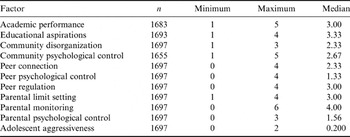
For the measurement of the outcome variable, respondents are asked two questions: (1) if they have ever had sex and (2) at what age they first had sexual intercourse (vaginal, oral, anal sex). Table 1 shows the distribution of descriptive statistics for the contextual factors in the analysis.
Descriptive statistics for measures of contextual factors, grade 9 and grade 11 pupils, South Africa, 2007

Analytical approach
The study employs survival analysis in which the outcome variable is the ‘amount of time a person “survives” without having sexual intercourse.’ For any person who has not yet had sexual intercourse, the ‘age at first intercourse’ is as yet unknown (except it is known that the age at first intercourse will be at least as large as his or her current age) and hence the time is considered to be ‘censored’. One advantage of such dynamic models as survival analysis is that they are able to incorporate information about ‘censored observations’.
A censored observation occurs when the observation period ends before a subject has experienced the event in question. For example, in the present analysis, the survey includes many people who have never had intercourse. In standard regression models predicting age at first intercourse, these persons who have never had sex would be treated as missing cases. However, the results would be biased by deleting such cases because these people would do so at later ages than those who have already had sex (see e.g. Heaton & Call, Reference Heaton and Call1995). In the survey, the age at first intercourse is given as the youth's actual age at the time of having first sexual intercourse. Thus, all ages are stated as integers.
In view of this truncation of ages, the method of analysis used in the present study is based on the ‘actuarial’ or ‘life-table’ method which looks at all events occurring in some time period rather than looking at the actual times of occurrence. In the SPSS program, the outcome variable is defined as ‘age at first intercourse’ if that variable has a value between 10 and 30 or the ‘current age of the respondent’ if they have never had sexual intercourse. In this case the instantaneous risk of having the event occur at time t is defined as:
 $$h(t)={lim}\,P(t+\Delta t > T\ge t/T\ge t)\\\Delta t\to t\Delta t$$
where T is the duration in a given state until the event occurs and t is a specific duration at which the rate is calculated. In other words, h(t) is the probability that the event will occur at a given instant if it has not already occurred. The cumulative survivor function S(t), which is given in equation 2, is the probability that the event has not yet occurred at any given duration and is defined as:
 $$S(t)=P(T\ge t)={exp}[-\int^{ t}_0h(u)\,du]$$
As far as multivariate analysis in the evaluation of the influence of independent variables on the rate of occurrence of events (hazard rates) goes, the one model that has often been used is the Cox Proportional Hazards model. This model is defined as:
 $$h(t)=h_0(t)e^\Sigma {_{kkk}}^{bX}$$
 $$h(t)]={ln}[h_0(t)]+\Sigma_kb_kX_k$$
where the dependent variable is the hazard rate at any given time t. The rate is modelled by a baseline hazard rate h 0, which is analogous to the constant term in a standard regressions model (see e.g. Heaton & Call, Reference Heaton and Call1995). An important difference between the standard regression model and proportional hazard model is that h 0 denotes values that change over time rather than a single value. The difference in hazard rates in the proportional hazards model is that the rates are assumed to be proportional for each subgroup delineated by values of the independent variables. As illustrated by equation (4), the COXREG procedure in SPSS for Windows estimates the logistic form of the model; the baseline hazard h 0 is not reported since the emphasis is actually on the difference in rates corresponding to values of the independent variables.
Results
Sample characteristics
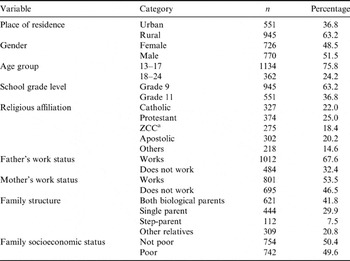
Table 2 shows the distribution of the sample characteristics. Sixty-three per cent of the respondents are from rural areas, while 37% are from urban areas. Males constitute 51.5% of the sample compared with 48.5% of females. Sixty-three per cent of the respondents are in grade 9 compared with 37% in grade 11. Seventy-six per cent of the respondents are in the age group 13–17 years, while 24% are aged 18–24 years. Sixty-eight per cent of the male parents/guardians and 54% of their female counterparts are in the labour force. Fifty-seven per cent of the respondents consider themselves to be very religious compared with only 14% who do not consider themselves to be religious.
Sample characteristics, grade 9 and grade 11 pupils, South Africa, 2007

a Zion Christian Church.
Sexual experience
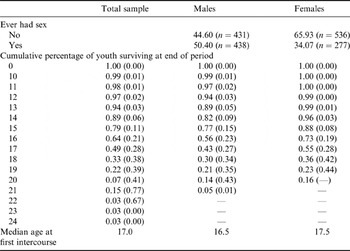
Table 3 shows the percentage distribution of the sexual experience of the pupils in the sample. Overall, 42.5% of the adolescents in the sample are sexually experienced compared with 57.50% who have never had sexual intercourse. Of those who are sexually experienced, 50.40% of males indicated that they were sexually experienced compared with 34.07% of females. The second part of Table 3 shows the cumulative proportions of youth who survived first sexual intercourse at the end of the period for the sample as a whole, and for males and females separately. According to the estimated survival probabilities for all respondents regardless of gender (second column of lower part of Table 3), the median age at first sexual intercourse is 17 years. It is important to note that with no censoring the median value for a sample is that value m for which at least half of the observations are less than or equal to m and at least half are greater than or equal to m.
Percentage distribution of sexual experience by gender, grade 9 and grade 11 pupils, South Africa, 2007

Note: hazard rates are in parentheses.
As illustrated in Table 3, the median ages at first sexual intercourse for males and females are 16.5 years and 17.5 years respectively. In fact, males report a higher incidence of sexual intercourse at every age than females. For example, by the onset of adolescence (age 13 years), 6% of males have had sex compared with only 1% of females, and by the onset of adulthood (18 years) 70% of males and 64% of females have had sex.
Multivariate analysis
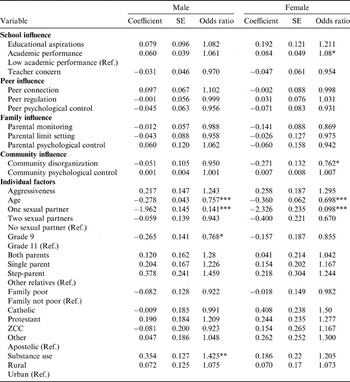
Table 4 shows estimates from hazard models of first sexual intercourse for males and females. Only two of the contextual factors in the model emerge as statistically significant for females, namely, academic performance and community disorganization. Academic performance is positively associated with age at first sexual intercourse amongst females, while community disorganization is negatively associated with age at first sexual intercourse amongst females. Youth who report high academic performance are more likely to postpone first sexual intercourse than their counterparts who report low academic performance. Specifically, girls who report high academic performance have an 8% lower risk of early sexual debut compared with those who report low academic performance.
Results from the analysis of discrete-time hazard models of first sexual debut, grade 9 and grade 11 pupils, South Africa, 2007

Males: −2 Log-likelihood=3661.339; χ2=366.022; df=26; p<0.001.
Females: −2 Log-likelihood=2148.421; χ2=245.41; df=26; p<0.001.
*p<0.05; **p<0.01; ***p<0.001.
Community disorganization is negatively associated with age at first sexual debut amongst girls. In other words, girls who report living in communities or neighbourhoods that are disorganized have a 24% higher risk of early sexual intercourse; the log hazard rate of sexual intercourse decreases by 0.271 for every unit increase in community disorganization.
The chances of both males and females having first sexual intercourse are elevated by age and having sexual partners. For example, the log hazard rate of sexual intercourse decreases by 0.278 and 0.360 for every year increase in age for males and females respectively. In other words, every year increase in age is associated with a 24% higher risk of early sexual intercourse for boys compared with a 30% higher risk of early sexual debut for girls.
Boys and girls who have at least one sexual partner are more likely to initiate sexual intercourse earlier than their counterparts who have no sexual partners. For example, boys who have one sexual partner have an 86% higher risk of early sexual intercourse compared with boys without any sexual partner. On the other hand, girls who have one sexual partner have a 90% higher risk of early sexual intercourse compared with girls without a sexual partner.
While grade level does not make any difference for girls, grade 9 boys are more likely than their counterparts in grade 11 to initiate sexual intercourse earlier. Specifically, grade 9 boys have a 23% higher risk of early sexual intercourse compared with grade 11 boys. Finally, substance use by boys appears to be associated with postponement of sexual intercourse as boys who report substance use initiate sexual intercourse later compared with those who do not use any substance; every unit increase in substance use is associated with a 43% lower risk of early sexual intercourse amongst boys.
Discussion
In recent years, studies of youth antisocial behaviours in South Africa have begun to contribute to the existing literature in more meaningful ways by looking beyond the conventional preoccupation with prevalence of behaviours and looking at the prediction of such behaviours by examining contextual factors such as the family, school, peer and community (see e.g. Amoateng & Kalule-Sabiti, Reference Amoateng and Kalule-Sabiti2014; Amoateng et al., Reference Amoateng, Kalule-Sabiti and Arkaah2014, Reference Amoateng, Barber and Erikson2006). Findings from these recent studies have been mainly consistent with empirical research findings in Western societies about the influence of such contextual factors. For example, as far as the family is concerned, the most consistent finding has been that parent/child connectedness in the form of support, warmth and closeness is inversely related to youth antisocial behaviours such as pregnancy risk, drug/alcohol use and lifetime and recent sexual activity (Amoateng et al., Reference Amoateng, Barber and Erikson2006). The present study, perhaps because of its limited coverage in terms of geography, race and ethnicity, could not provide conclusive support for the contextual influences of family, peer, school and community vis á vis individual-level factors. In fact, it is possible that within the context of black Africans of the North West Province of South Africa, personal characteristics of the adolescent such as age, number of sexual partners and substance use are more salient in explaining the onset of sexual debut as a sexual behaviour, even though the findings about gender and number of sexual partners have been found in several studies, in both South African and non-South African samples (e.g. Fatusi & Blum, Reference Fatusi and Blum2008).
Moreover, the cross-sectional nature of the survey limits our ability to establish the temporal ordering of the variables and hence our ability to establish causality with regards to the variables that are significantly associated with age at first sexual intercourse. For instance, the negative development of girls engendered by community disorganization has been found in settings other than South Africa. Specifically, Brooks-Gunn et al. (Reference Brooks-Gunn, Duncan, Klebanov and Sealand1993) found that African-American girls living in low-status neighbourhoods were less likely to use contraception in their first sexual experience than were girls living in high-status neighbourhoods. Yet, the association between number of sexual partners and age at sexual debut raises more questions than the present study could answer: Did early initiators of sex have more than one sexual partner before they debuted or did early initiation lead to increased prevalence of lifetime sexual partners?
It is also possible that the specific paths between the contextual factors, mediating mechanisms and such adolescent pregnancy risk variables as onset of sexual intercourse are more complex and therefore require much more complex models than the present study employed. As Miller et al. (Reference Miller, Benson and Galbraith2001) aptly observed, for example, it is likely that parent/child connectedness is more closely related to some mediating mechanisms than others (e.g. adolescents' sexual values/intentions), whereas parental monitoring and limit setting would be more closely related to other mediating mechanisms (e.g. dating and substance use).
Thus, future research would do well to delineate these specific paths by testing complex mediated models of the influences of family, peer and community on the onset of sexual debut among youths. Moreover, on the issue of the number of sexual partners and timing of first sexual intercourse, future research would do well to seek to answer this question with longitudinal data. The effect of age and number of sexual partners, the only two with reasonably large beta values in the multivariate model, virtually compels one to argue that in the social context of North West Province it seems sexual relations are a normal part of the development of heterosexual relationships. Thus, the age differences in sexual initiation are due to the development of partnerships deemed stable enough to permit sexual intercourse. If everyone becomes sexually active quite early, the difference may be simply the different times it takes some youths to pair up in satisfactory ways. In conclusion, the present study has corroborated existing studies in showing that youth development is a function of individual-level and contextual-level factors depending on which particular youth behaviour that is being studied.