Disasters are threatening incidents that influence the health and well-being of human beings. The incidence and severity of massive disasters have increased in recent years.Reference Veenema 1 , Reference Han, Liang and Jiang 2 Disasters destroy local health infrastructure such as hospitals, health care centers, and the like. They also cause the displacement of a large number of people and hinder access to health care services. Hospitals and health care facilities are destroyed and the ratio of health care professionals to victims is reduced. Poverty, trauma, and the spread of infectious diseases and other adverse events are other consequences of disasters.Reference Hellwig 3
Women constitute the most vulnerable groups in disasters and often are a throng of survivors after such incidents. Their vulnerability is due to various reasons such as a lack of income, having fewer assets, being responsible for caring for children and family members, having special nutritional requirements during pregnancy and lactation, having less ability to move,Reference Onyango, Hixson and McNally 4 and biological and social differences.Reference Giarratano, Sterling and Orlando 5
About 30% of the female population after disasters is in the reproductive age group and is prone to many undesirable factors influencing their maternal health. Pregnancy in itself requires special care. Women during pregnancy, lactation, and the provision of newborn care need frequent referrals to health care centers. Midwifery care must be taken continuously with the aim of monitoring the health of the mother, the fetus, and the newborn. Any delay in the diagnosis of critical issues such as preeclampsia and bleeding during pregnancy is associated with increased risks for fetal and maternal health. Infectious diseases and malnutrition during pregnancy can be dangerous for the mother and fetus.Reference Pfeiffer, Avery and Benbenek 6 A lack of contraception in the context of disasters and adverse conditions increases unwanted pregnancy, abortions, and infection. A lack of appropriate conditions for safe delivery increases maternal mortality during childbirth. 7 During disasters, hospital care is not available to mothers and the risk for adverse consequences is increased.
According to a report by the World Health Organization (WHO) in 2013, 8 out of 10 countries with the highest maternal mortality rate recorded had recently confronted disasters. 8 The United Nations Population Fund (UNFPA) reported in 2015 that about 61% of maternal deaths happen in countries with humanitarian situations. 9 Also, more than one-third of maternal mortality cases occur in the wake of disasters, owing to a lack of equipment and qualified personnel in the health care system.Reference Arillo 10 Therefore, prioritizing reproductive health services by educated staff has great importance in disasters.Reference Zotti, Williams and Robertson 11 , Reference Callaghan, Rasmussen and Jamieson 12
The preparation of disaster team members for the provision of reproductive health care services has attracted a lot of attention in recent years. Also, emphasis has been placed on improving the competencies of health care professionals.Reference Jose and Dufrene 13 Midwives as members of the disaster team are responsible for providing proper responses to the health care needs of women and their children. The main causes of maternal death in disasters are emergency obstetric problems, which are life-threatening but preventable. Timely response by midwives and proper management of obstetric emergencies can save the mother’s life. Therefore, improving midwives’ professional competence can help to control the major cause of maternal deaths in disasters.Reference Gasseer, Dresden and Keeney 14
Therefore, midwives should have sufficient competencies for providing reproductive health care services in disasters. Midwives’ competencies and awareness of their role in managing disasters prepare them to respond appropriately to mothers’ needs and decrease the rates of mortality and morbidity. 9
Different definitions have been suggested for the concept of competency in disasters. Such definitions mainly encompass a combination of health care professionals’ knowledge, skills, and perceptions of the significance of health care services in disasters.Reference Loke and Fung 15 In addition to the significance of knowledge and skills, the perceived importance of a subject is needed to reduce external motivations for performing and monitoring a task. Perceived importance leads to the prioritization of tasks and enhances people’s tolerance to heavy workloads.Reference Katula, Rejeski and Wickley 16
The assessment of professional competencies addresses available gaps in disaster planning and is considered the basis of educational interventions.Reference Walsh, Subbarao and Gebbie 17 The WHO states that the preparation of midwives and assessment of their professional competencies in disasters must be priorities in health care systems. 18
There is a growing tendency toward the improvement of the competencies of disaster team members worldwide. This includes midwives, who are on the frontline of disaster management.Reference Rokkas, Cornell and Steenkamp 19 While assessment of midwives’ professional competencies is important, few studies have investigated the competencies of midwives and their contribution to and expertise in disasters.Reference Hays and Prepas 20 Therefore, this descriptive study aimed to investigate midwives’ professional competencies for preventing maternal mortality in disasters in Iran.
METHODS
Design
This cross-sectional study was conducted in Tehran, Iran, in 2015. The research was approved by the ethics committee affiliated with the Tehran University of Medical Sciences, Tehran, Iran (registration code: 103012- 911137301).
Aim
This study aimed to investigate the professional competence of midwives for the prevention of maternal mortality in disasters. Disasters impose challenges to the provision of care. Therefore, qualified midwives can manage related issues and prevent maternal mortality.
Sample and Settings
The sample consisted of 361 midwives chosen by use of a cluster random sampling method. Tehran, the capital of Iran, is a large city with a population of around 9 million. It is the second largest city in Asia. In terms of socioeconomic levels, Tehran is composed of various people in different regions. The huge number of patients in the south of Tehran, for instance, of lower socioeconomic status, with lower hospital facilities, and overcrowding create different working conditions for midwives and impact their competencies. Therefore, the cluster randomization procedure was chosen based on sampling from different regions of Tehran.
Considering a 95% CI and d=1.5, the number of samples was determined on the basis of the following sampling formula:
 $$n {\,\equals\,}{{Z_{{1{\minus}\alpha }}^{2} {\times}S^{2} } \over {d^{2} }} {\,\equals\,}{{1.96^{2} {\times}13.27^{2} } \over {1.5^{2} }} {\,\equals\,} 300.6\,\cong\,301$$
Also, cluster effects were considered in order to provide the possibility of a homogeneous distribution of samples. Therefore, the final number of samples was calculated as follows:
 $$301{\plus}\left( {301{\times}0.20} \right){\,\equals\,}361$$
Next, a list of hospitals in Tehran and the number of midwives working in each hospital were provided. It was determined that 778 midwives were working in 86 hospitals in Tehran. Therefore, 22 hospitals were randomly selected according to their geographical locations: 5 hospitals in the north, 8 hospitals in the south, and 9 hospitals in the center of Tehran. These hospitals were at the same level in terms of providing health care services and being affiliated with academic centers.
The researcher referred to each hospital and invited all midwives working in the delivery, maternal, postnatal, prenatal, and neonatal care wards to participate in this study. The midwives were informed of the study’s methods and aim and the right to withdraw from the study at any time without being penalized. They were ensured regarding the confidentiality of the collected data and their anonymity throughout the study. Written informed consent was obtained from those midwives who agreed to participate.
Inclusion criteria were as follows: working as a midwife in the hospital, having at least 6 months of work experience, and being willing to participate in the study. Also, those midwives who did not provide answers to 4 or more items on the data collection questionnaire were excluded.
None of the midwives recruited were excluded, and all participants filled out the data collection questionnaire. Since the number of midwives working each shift at each hospital was only 3 to 8 midwives, the researcher referred to the hospitals several times. Therefore, the sampling process took about 4 months to complete.
Data Collection
A researcher-made questionnaire about midwives’ competencies for preventing maternal mortality in disasters was used for data collection. It was developed by using a thorough search in the international literature. The main causes of maternal mortality in disasters were searched in databases by using the keywords “disaster,” “emergency,” “humanitarian setting crisis,” “maternal mortality,” and “maternal death.” Also, a guide on public health in disasters, a chapter on reproductive health, 21 and a guide for the health of mothers, infants, and children by the Red Crescent organization 22 and related articles in the field were used.Reference Onyango, Hixson and McNally 4 , Reference Giarratano, Sterling and Orlando 5 , Reference Pfeiffer, Avery and Benbenek 6 , 7 , Reference Arillo 10 , Reference Callaghan, Rasmussen and Jamieson 12 , Reference Gasseer, Dresden and Keeney 14
The questionnaire was composed of 2 sections: (1) demographic data, and (2) midwives’ professional competencies for preventing maternal mortality in disasters. The style of the second section of this questionnaire was based on Veras et al’s questionnaires regarding global health competencies of health professionals,Reference Veras, Pottie and Welch 23 which were designed to measure perceived importance, knowledge, and skills of health care providers by use of the self-assessment method. The second part of our questionnaire consisted of 18 items to measure the perceived importance, knowledge, and skills of midwives (their professional competence) for dealing with the causes of maternal mortality in disasters.
The midwives’ perception of importance and skills had a 5-point Likert scale (1=very low, 2=low, 3=average, 4=high, and 5=very high). Also, midwives’ knowledge was evaluated by using the Likert’s 3-point scale (1=less, 2=average, and 3=sufficient). Therefore, the scores ranged from 18 to 90 for the perception of importance and skills. Also, scores ranged from 18 to 54 for the knowledge section.
Validity and Reliability
The validity and reliability of Veras’s questionnaire were determined previously. However, the new questionnaire was assessed in terms of validity and reliability in this study. Therefore, 15 faculty members in the field of nursing and midwifery and 5 midwives working in Tehran’s Red Crescent were asked to give us their feedback regarding the content and items for qualitative face and content validity, which led to the modification of some items. Also, for reliability, Cronbach’s alpha coefficient was calculated and reported as 0.94.
Data Analysis
The collected data were analyzed by using descriptive (means, percentages, and standard deviations) and inferential statistics via SPSS v. 16 software for Windows (SPSS Inc, IBM Corp, Armonk, NY). The K-S test was applied to assess the normal distribution of the data. ANOVA using the LSD ad hoc test was used to compare means based on workplaces. Also, comparison of means in both educated and uneducated, and experienced and inexperienced groups were performed by using the t-test. Spearman’s test was used to investigate the relationships between the mean of the midwives’ professional competency and their work experiences, educational level, and age.
The level of statistical significance was set at P<0.05. Also, the mean and standard deviation of the midwives’ scores in each of the domains of professional competencies and the frequency of the midwives’ answers to each item were calculated. The total scores for the domains of perceived importance, knowledge, and skills were 90, 54, and 90, respectively. Also, the total score of midwives’ professional competencies for preventing morbidities and mortalities in disasters was reported out of 234. The total scores were classified as good (score: 190-234), average (145-189), poor (100-144), and very poor (54-99). The above-mentioned cutoffs were determined by using the calculation of the mean and standard deviation with a range of scores between 52 and 234.
For making the items comparable, the total percentage of the frequency of midwives’ responses in the column of high and very high perceived importance, much and very much skilled, and sufficient knowledge were considered suitable levels of perceived importance, suitable levels of skills, and suitable knowledge, respectively. The answers in the columns of very low, low, average, and less were considered unsuitable levels of perceived importance, skills, and knowledge.
RESULTS
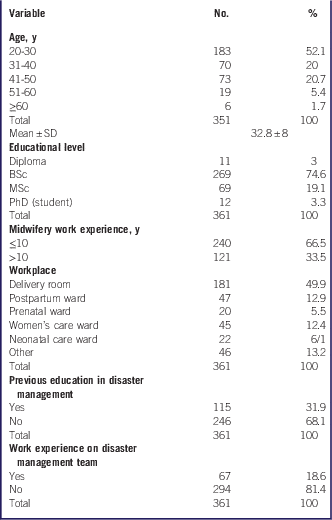
The participants were women. The age range of the sample was from 20 to 63 years. The majority of the sample was in the age group of 20 to 30 years. Most of the women (74.6%) had a bachelor’s degree. Their average length of work experience was 8.4±7 years. The majority of the midwives (66.5%) had work experience of less than 10 years. The women mostly worked in the delivery rooms at the hospitals. Given the probable effect of the university of education on the level of professional competency, the samples were divided according to place of education. The women had mostly (26%) graduated from Tehran University of Medical Sciences, Shahid Beheshti University of Medical Sciences and Iran University of Medical Sciences (9.4%), universities in northern Iran (16.4%), universities in central Iran (14.7%), and universities in east and west Iran (20.8% and 12.7%, respectively). Also, 31.9% of the midwives had no previous education regarding disasters. About 18.6% of them had work experience in disasters. In this respect, 44% and 16.7% described their skills as good and poor, respectively. The demographic characteristics of the sample are presented in Table 1.
Demographic Characteristic of the Sample (n=351)

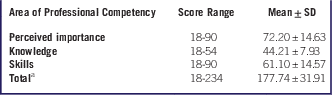
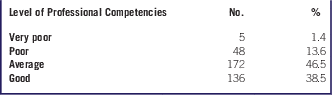
The total mean score of the midwives’ professional competencies was 177.74±31.9, which was reported in the domains of knowledge, skills, and perceived importance as shown in Table 2. The midwives’ professional competencies were at an average level. Accordingly, 46.5% of the midwives had average professional competencies for providing reproductive health care services in disasters (Table 3).
Mean of Midwives’ Professional Competency Scores for Preventing Maternal Mortality in Disasters

a The total mean score of the midwives’ professional competencies was reported as 177.74±31.91 out of 234.
Levels of Midwives’ Professional Competencies for Preventing Maternal Mortality in DisastersFootnote a

a Most of the sample (46.5%) stated that they had an average level of professional competencies for preventing maternal mortality in disasters.
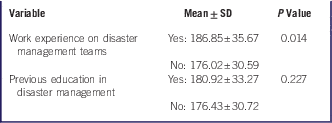
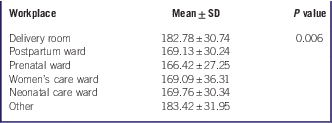
According to the t-test (Table 4), there was a significant relationship between the midwives’ professional competencies and experience working in disasters (P=0.014). However, no statistically significant relationship was found between midwives’ professional competencies and previous education on disasters (P>0.05). The ANOVA test (Table 5) revealed a significant relationship between the midwives’ professional competencies and workplace (P=0.006).
Comparison of Professional Competency Based on Work Experience in Disasters and Previous Education in DisastersFootnote a

a A statistically significant relationship was reported between the midwives’ professional competency and work experience in disasters (P=0.014). No statistically significant relationship was found for previous education in disasters (P>0.05).
Comparison of the Midwives’ Professional Competencies According to WorkplaceFootnote a

a There were statistically significant differences in the midwives’ professional competencies between the delivery room and the other workplaces (P=0.006); no statistically significant differences were reported between the other groups.
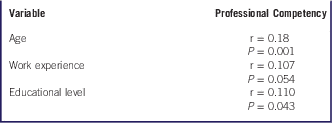
Table 6 shows the relationship between the demographic variables of age, educational level, and years of experience and the professional competencies by use of the Spearman correlation test. There was a significant relationship between midwives’ professional competencies and their age (P=0.001), educational level (P=0.043), and years of experience (P=0.054).
Relationships Between Professional Competency and Age, Work Experience, and Educational Level

The frequency of the lowest scores for the items in area of professional competency was analyzed. The midwives’ knowledge and skills for preventing morbidity and mortality in disasters was lower than their perceived importance. Although 65.3% of the midwives perceived management of the causes of morbidity and mortality as being important, only 33.7% had sufficient knowledge about it. Also, they had insufficient knowledge about referring mothers. They also showed low levels of knowledge and skills in handling mothers with trauma and chronic diseases.
The minimum knowledge scores were seen for “Recognizing and managing the major causes of maternal mortality,” “Identifying mothers with chronic diseases and taking care of them,” “Identifying mothers with physical trauma and taking care of them,” and “Preventing severe hemorrhage and recognizing the symptoms of shock.” The lowest scores for skill were seen for “Taking care of mothers with chronic diseases,” “Taking care of mothers with physical trauma,” “Referring mothers when required,” and “Stabilizing mothers when referring them.”
DISCUSSION
Despite the importance of providing health services in disasters and the attention dedicated to this area in recent years, the midwives in this study achieved an average score on related professional competencies. Similarly, Loke and FungReference Loke and Fung 15 reported that the professional competencies of disaster team members for responding to the needs of vulnerable groups were insufficient.
According to our findings, the midwives were not adequately educated in disaster management. Although the midwives had graduated from various cities across the country, they were insufficiently prepared to provide the required care.
Our findings indicated an unsuitable level of midwives’ competencies in disasters. Similarly, other studies have reported that the main reason for a lack of competency is insufficient education. The occurrence of disasters in the last few years has further highlighted the gaps in health care providers’ readiness to meet patients’ needs in disasters.Reference Yan, Turale and Stone 24 - Reference Hammad, Arbon and Gebbie 26
Midwives’ competencies are not affected by their previous education. Therefore, there is a need to provide education and create an environment to practice what has been taught in disasters. Also, a change in the educational curriculum and the time spent on disaster management is needed to help to prevent mortality in critical conditions.Reference Rokkas, Cornell and Steenkamp 19
A significant relationship was found between the midwives’ experience in previous disasters and their perceived professional competencies. In line with Baack’sReference Baack 27 findings, the most effective factors influencing the nurses’ perceived competencies for efficient performance in disasters were their self-regulation for managing disasters, previous participation in massive disasters, and participation in post-disaster health care centers. RokkasReference Rokkas, Cornell and Steenkamp 19 states that disaster response departments and the Red Crescent organization are responsible for disaster management, and few studies have been carried out on health care professionals’ roles in disasters.
The midwives’ professional competencies had a significant relationship with their educational level. The midwives gained higher knowledge as their level of education increased. Our results were in line with those of the study by Hankemeier et al,Reference Hankemeier, Walter and McCarty 28 which showed that those with higher education had a higher perceived importance of providing health care services. In Putra’s study,Reference Putra, Petpichetchian and Maneewat 29 a higher level of education was accompanied by greater knowledge and skills of disaster nurses. A statistically significant relationship was reported between the midwives’ workplace and their professional competency. Midwives who worked in the labor room had greater competency in the management of maternal death. A probable reason for such a finding could be that midwives working in the labor room are more experienced with the management of bleeding in their own workplace.
The significance of the relationship between midwives’ age, work experience, and their professional competencies may be due to their greater experience, especially for those midwives who had the experience of working during war and natural disasters.
In a crisis management team, individuals with various levels of expertise collaborate with one another. Although they make up a single team, they have different skills, knowledge, and roles. Therefore, all team members must be aware of their roles and their importance.Reference Rasmussen, Tolsgaard and Dieckmann 30 The recognition of each health care provider’s duties affects how individuals play their roles.Reference Barreto, Teston and Miranda 31 Probably, a lack of recent natural disasters in Tehran has hindered health care professionals’ understanding of the significance of the midwife’s role in disasters, which results in a lower perceived importance of providing health care services in such situations.
The maximum perceived importance was associated with postpartum hemorrhage, while the perceived importance of bimanual uterine massage achieved the minimum perceived importance. The probable reason for this result could be the application of medical methods to control bleeding and the ignorance of midwives’ clinical skills as well as working in the context of a lack of facilities and equipment. Despite the fact that the major causes of maternal mortality in disasters are hemorrhage (80% of the causes of maternal mortality), preeclampsia, hard labor, infection, and unsafe abortion, care delivered by midwives in disasters is not well prioritized.Reference Arillo 10 The midwives’ insufficient knowledge about the causes of maternal mortality in disasters is considerable and needs serious attention. Hemorrhage during pregnancy, especially postpartum hemorrhage, is the major cause of maternal mortality in developing countries and midwives’ inadequate knowledge to manage this condition represents a need for appropriate educational programs.Reference Gasseer, Dresden and Keeney 14
In the present study, the midwives had limited skills to manage physical trauma, to detect the time for referring mothers, and to stabilize the mothers before referral. Due to an appropriate referral system in Iran, midwives’ abilities for referral are essential in reproductive health care planning. In a study by Tucker et al,Reference Tucker, Hundley and Kiger 32 it was stated that the ability to refer mothers in critical situations is an important issue and one of the most essential competencies of midwives.
The most important skill needed in the first phase of disasters is the control of trauma in victims. In the second phase, which is from 4 hours to 2 weeks after the incident, there is an urgent need for prioritizing care, especially the control of chronic diseases, infections, and problems related to reproduction, gynecology, and health. In the recovery phase, ie, the third phase of disasters, all efforts are made to restore things to the pre-disaster status in which midwives have an important role.Reference Abbasi and Salehnia 33 There is a need to improve midwives’ competencies by designing appropriate educational strategies. The midwives who participated in this study worked in different hospital wards. Since they are able to play roles in different phases of disaster (preparedness, response, and recovery), it is critical to train midwives with the right competencies.
In addition, regarding our study, we found that current education did not increase the midwives’ professional competencies in the provision of health care services in disasters. Inadequate and irregular educational courses and not being specialized for preventing maternal mortalities in disasters may be a reason for such a finding. Arbon et alReference Arbon, Ranse and Cusack 34 in a study in Australia expressed concerns about not being specialized and coordinated and a lack of appropriate education for nurses and midwives in disaster management. In this respect, educational programs to respond appropriately to disasters are recommended. Also, more studies are needed to evaluate and improve midwives’ qualifications and assessment.
Limitations
One limitation of this study was the application of a self-administered method of data collection. Self-administration may lead to socially desirable answers and may not elicit rich, detailed information about professional competencies. Also, the midwives worked in overcrowded wards and faced heavy workloads that could have influenced the quality of filling out the questionnaires.
CONCLUSIONS
Given the average scores for midwives’ professional competency in the delivery of health care services to prevent maternal mortality and the inadequacy of prior training courses, extra educational programs for midwives are recommended. The focus of the educational programs could be mothers’ physical trauma, detection of patients who may need to be referred, and stabilizing mothers while referring them. Also, the ineffectiveness of the current educational program suggests that a need exists for a comprehensive revision of the midwifery degree curriculum.
Acknowledgments
The authors appreciate the midwives for their participation in this study.
Funding
This study was supported financially by Tehran University of Medical Science, Faculty of Nursing and Midwifery.
Author Contributions
Taghizadeh Z: Study conception and design, final approval of the version to be submitted. Khoshnam Rad M: Acquisition of data, drafting of manuscript. Kazemnejad A: Analysis and interpretation of data.
Conflict of Interest
No conflicts of interest are declared by the authors.
Supplementary Material
To view supplementary material for this article, please visit https://doi.org/10.1017/dmp.2017.58