Carbapenem-resistant Acinetobacter baumannii (CRAB) is increasingly recognized as an emerging cause of healthcare-associated infections, globally.Reference Dijkshoorn, Nemec and Seifert1-Reference Peleg, Seifert and Paterson3Acinetobacter baumannii has been reported to cause various nosocomial infections, including sepsis, hospital-acquired and ventilator-associated pneumonia, urinary tract infection, wound infection, and postneurosurgical meningitis.Reference Agodi, Voulgari and Barchitta4 In most instances, isolates are resistant to the vast majority of available antibiotic agents, including carbapenems,Reference Towner5 and are therefore extensively drug resistant.Reference Magiorakos, Srinivasan and Carey6 Carbapenem resistance is usually the result of a synergistic effect of various mechanisms, but it is most widely attributed to the production of carbapenem-hydrolyzing class D β-lactamases.Reference Poirel and Nordmann7 CRAB is associated with high morbidity and mortality rates, leaving colistin the only available treatment option.Reference Kwon, Oh and Song8 Although CRAB is typically an organism of low virulence, hospitalized patients are becoming ever more vulnerable to it, due to serious underlying conditions, indwelling catheters, mechanical ventilation, and increasing use of broad-spectrum antibiotics.Reference Playford, Craig and Iredell9 The organism’s inherent ability to tolerate desiccation enables it to survive on dry surfaces for prolonged periods.Reference Jawad, Seifert, Snelling, Heritage and Hawkey10,Reference Kramer, Schwebke and Kampf11 Because of this propensity to persist in the hospital environment, multiple outbreaks of CRAB have been reported, mostly in intensive care units (ICUs).Reference Bianco, Quirino and Giordano12-Reference Enfield, Huq and Gosseling14
Previous outbreak investigations have demonstrated that meticulous environmental decontamination combined with strict adherence to infection control practices is a key to successful outbreak control.Reference Choi, Kim and Jeon13-Reference Gray, Allard and Pare15 Although guidelines outline specific measures to control CRAB transmission, uncertainties concerning the optimal measures remain, especially in a hospital-wide outbreak.Reference Tacconelli, Cataldo and Dancer16
In our institution, we experienced an increased number of CRAB bloodstream infections in 2013. In response, we initiated documentation of infections and asymptomatic colonization due to CRAB. An increase in CRAB acquisitions was observed, starting in the ICUs and eventually spreading to almost all hospital wards. An effort to reduce CRAB acquisitions through interventions in each unit separately had limited success. We sought other approaches to control this outbreak and decided to adopt a successful, stricter approach used to contain carbapenem-resistant Enterobacteriaceae (CRE) in Israel. Beginning in 2006, Israel faced a nationwide outbreak of CRE. In 2007, a national strategy to contain the spread was successfully implemented,Reference Solter, Adler and Rubinovitch17 including uniform requirements for screening and isolation or cohorting patients and staff. Here, we describe the CRAB outbreak and its successful management based on the national Israeli policy guidelines originally developed for CRE control.
Methods
Clinical setting
The Meir Medical Center is a 740-bed, secondary-care teaching hospital in Kfar Saba, Israel. The hospital contains medical and surgical wards, including surgical subspecialties and 2 ICUs. The number of single-patient rooms is limited to 1 or 2 in each ward. On average, during the study period (2014–2018), the hospital had 66,746 admissions annually and 238,321 patient days per year.
Case patients were those who were either colonized or infected with a CRAB isolate, as defined by an international consensus committee.Reference Magiorakos, Srinivasan and Carey6 Acquisition of CRAB was defined as a positive culture taken at least 48 hours after admission or a positive sample identified upon admission in a patient who had been readmitted within 30 days after discharge from our institution, in patients not previously identified as carriers. Patients are routinely screened for CRAB carriage in the ICU units, upon admission and weekly thereafter, using rectal swabs. Additionally, weekly sputum cultures are obtained in mechanically ventilated patients. Patients are also screened if they shared a room with a newly discovered patient. A patient with a positive screening result was considered a carrier for the entire duration of hospitalization, and for any readmission in the subsequent 6 months. Screening strategy and compliance monitoring were similar during all phases of the intervention.
Microbiology
Acinetobacter baumannii isolates were identified by a Vitek 2 system using the AST-GN18 card (BioMerieux, France), and they were classified as multidrug resistant if they were resistant to antipseudomonal carbapenems and to all but 2 or fewer of the following antimicrobial categories: aminoglycosides, fluoroquinolones, antipseudomonal penicillins plus β-lactamase inhibitors, extended-spectrum cephalosporins, folate pathway inhibitors, polymyxin, and/or tetracyclines. Results were interpreted according to the Clinical and Laboratory Standard Institute (CLSI) criteria.18
The intervention
During the first phase of the intervention (2014–2015), routine infection control measures for patients with CRAB included standard and contact precautions (hand hygiene before and after patient care and use of gown and glove barrier precautions). Routine healthcare and patient education were also provided. The patient’s CRAB status was clearly marked on the bed and in the electronic medical record. Terminal cleaning and disinfection were performed upon discharge, and all disposable or washable items, including curtains and linens were removed. The patients were isolated in single- or multiple-patient rooms, and there was no cohorting of patients.
The second phase of the intervention included the following components: (1) A case registry of all newly and known colonized and infected patients with CRAB was established and updated daily. (2) Case patients from the entire hospital, once identified, were placed in separate rooms or were cohorted under strict contact isolation. (3) Dedicated nursing staff was assigned in intensive care units and in the cohort departments, while entry of other staff or visitors to the cohort area was supervised. (4) Dedicated equipment was used and disposable equipment was discarded once the patient was discharged from a single-patient room or if a cohort area was no longer occupied by patients. (5) Rigorous cleaning policies of the patient’s area, including any items that might have come into contact with carriers, were implemented daily and whenever the patient was transferred or discharged. (6) Timely education and status updates were held between infection control staff and unit leadership, reinforcing hand hygiene and contact isolation measures regularly. (7) Multiple proactive monitoring of healthcare worker practices were performed by infection control unit staff and representatives of the hospital management, allowing for revisions and education. (8) Enhanced care rooms in the internal medicine wards were redesigned to create more isolation options for medically complicated patients. All prevention measures were coordinated by the Infection Control Unit and the hospital management. At the end of 2016, the hospital’s infection control committee decided to apply the intervention components as a standard of care.
Statistical analysis
Demographic and clinical characteristics of patients before and after the intervention were compared the χ2 test for dichotomous variables and the Student t test for continuous variables, using SPSS version 25 statistical software (IBM, Armonk, NY). Acquisition rates before and after the intervention were compared, and the P for trend was calculated using Winpepi version 11.65 software. Because this was a quality improvement intervention, it was not subject to approval by the institutional review board, nor did it require written informed consent.
Results
Patient demographic and clinical characteristics
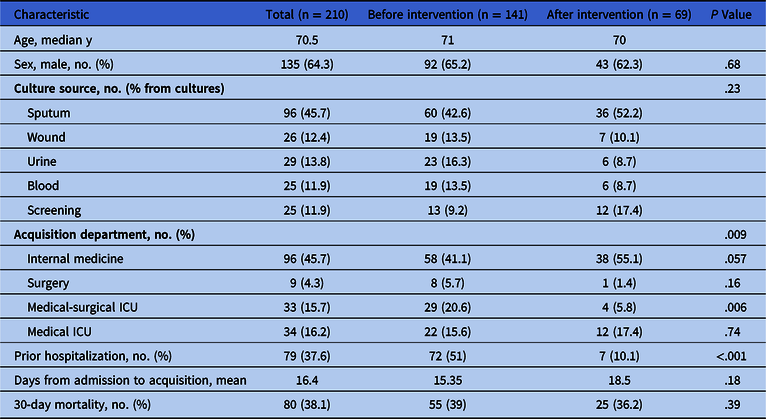
From January 2014 through December 2018, cultures performed for 291 patients were positive for CRAB; of these, 210 (72.2%) were defined as hospital acquired: 141 before the intervention and 69 after the intervention. Among these patients, 64% were men, and the median age was 70.5 years. The most common source of positive cultures was sputum (41.9%), and 29 patients (10%) had bacteremia. In the cohort, the screening cultures of 11.3% of these patients were positive. Positive culture for CRAB appeared an average of 16.4 ± 15.8 days after hospitalization, and more than half of these new acquisitions occurred in less than 14 days. Of the new acquisitions, 35% were identified upon readmission within a month. A total of 80 patients (38.1%) died within 30 days. The median time from positive culture to death was 14 days. Patient characteristics, including age, sex distribution, and mortality rates were similar before and after the intervention (Table 1). Notably, there was a significant decrease in the percentage of patients with prior hospitalization between the 2 periods (51% vs 10%, respectively; P = .001).
Demographic and Clinical Characteristics of Patients With Acquired Carbapenem-Resistant Acinetobacter baumanii (CRAB) Before and After the Intervention

Note. ICU, intensive care unit.
Outbreak control
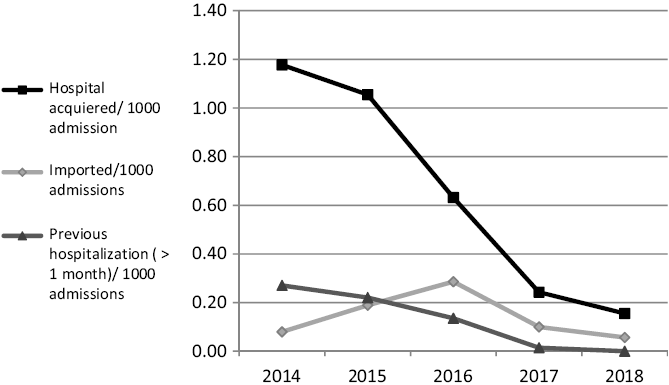
The CRAB acquisition rates decreased by 77%, from 1.3 per 1,000 admissions before the intervention (2014–2015) to 0.3 per 1,000 admissions after the intervention (2016–2018) (P < .001).
After implementing the intervention in January 2016, we observed steady decreases in acquisitions all over the hospital, year by year, starting at 1.18 acquisitions per 1,000 admissions in 2014 and declining to 0.16 acquisitions per 1,000 admissions in 2018. The decrease in rates reached statistical significance in 2017 (P for trend, <.0001) (Fig. 1). A parallel decrease occurred in cases hospitalized >30 days; thus, cases defined as not hospital acquired were also observed (P = .004).
Carbapenem-resistant Acinetobacter baumanii (CRAB) rates per 1,000 admissions 2014–2018.

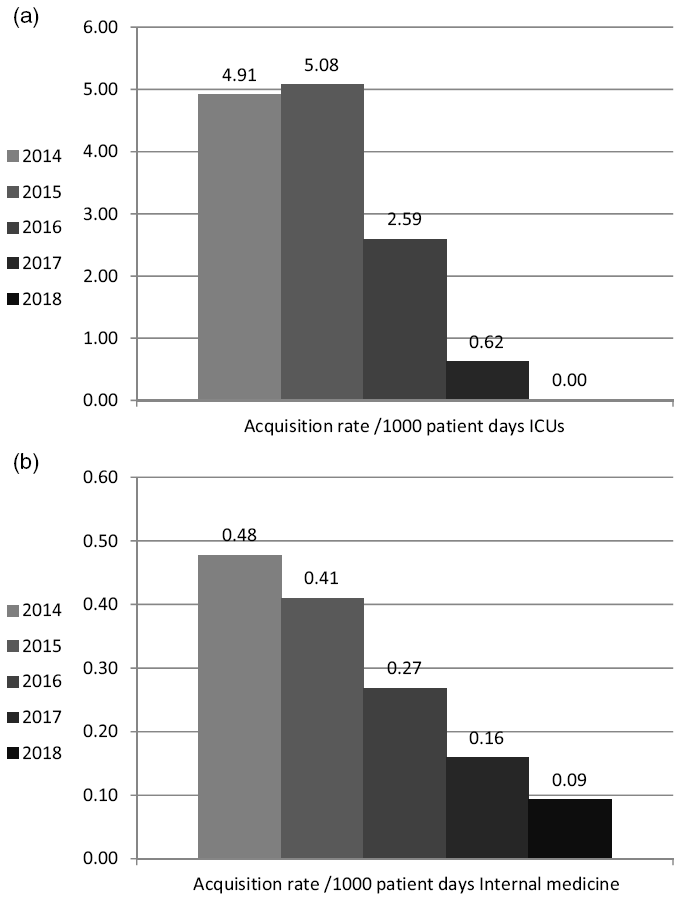
Most of the acquisitions occurred in the internal medicine departments and in the ICUs. In 2014, 39 acquisitions occurred in internal medicine wards and 25 occurred in ICUs. In 2018, only 7 new acquisitions were detected in internal medicine wards and none in the ICUs (P = .058 for internal medicine and P = .006 for the ICU) (Fig. 2). The average compliance for CRAB screening through both phases was 90.9%.
Acquisition by department, 2014–2018. A. Intensive care units, B. Internal medicine wards.

Discussion
Following a hospital-wide intervention, the rate of CRAB acquisitions decreased significantly over a 3-year period, from 1.18 per 1,000 admissions to 0.16 per 1,000 admissions. After failing to control repeated secondary outbreaks all around the hospital, we decided to apply the components of the national guidelines for CREReference Solter, Adler and Rubinovitch17 to CRAB, as well. The Israeli experience in controlling the spread of CRE is an example of the success of a coordinated, comprehensive infection control plan to reduce and contain acquisition of very resistant, fast-spreading bacteria. CRE in Israel has remained well controlled, whereas CRE has become endemic and continues to spread in many other countries.Reference Potter, D’Souza and Dantas19-Reference Yoo21
The key elements leading to the intervention’s success were timely identification of CRAB infections and colonization, linked with effective isolation measures. Once identified, carrier patients were flagged, which enabled them to be immediately recognized through the hospital computer systems while they are hospitalized and/or upon transfer or readmission.
Notably, our definition of an acquired infection was broadly inclusive. Positive cultures upon admission were still considered to have been acquired at our hospital if the patients were readmitted within 30 days. This decision was taken based on studies showing that readmission within 30 days is a predictor for persistent carriage upon readmission for multidrug-resistant Enterobacteriaceae.Reference Ciobotaro, Flaks-Manov and Oved22
With the decrease in acquisition rates, the number of readmitted patients carrying A. baumannii decreased accordingly. Even more importantly, parallel to the decrease in acquired cases, we witnessed a decrease in nonacquired cases, especially those readmitted after >30 days. Possible explanations for this observation are that these cases were unrecognized acquisitions at our hospital, and the intervention reduced these acquisitions as well. In support of our assumption, Marchaim et alReference Marchaim, Navon-Venezia and Schwartz23 demonstrated a mean duration of Acinetobacter carriage of 17.5 months.
The results of the intervention might demonstrate regression to the mean, as might be exemplified in 2015 before the intervention. However, we do not think that this is the case here because the decline after the intervention persisted for >3 years, and we reached zero transmission in the ICUs in 2018. Furthermore, an increase in CRAB rates has been observed country-wide, and it continued in adjacent hospitals in 2017 and 2018.24
CRAB outbreaks are notoriously difficult to control, mostly due to carriage persistenceReference Marchaim, Navon-Venezia and Schwartz23 in parallel with the characteristic, prolonged hospitalization of carriers and survival of the bacteria in the environment. Our intervention, like othersReference Ben-Chetrit, Wiener-Well and Lesho25,Reference Hong, Jang and Bak26 demonstrates that, by using a multifaceted infection control program, marked reduction in CRAB acquisition, accompanied by interruption of CRAB transmission can be achieved. Such an intervention, demanding increased manpower and resources, could not have been executed without hospital and ward management support. Moreover, following the near elimination of CRAB, we decided, along with the hospital management, to keep all measures in place to avoid facing another full-blown outbreak in the future. To the best of our knowledge, this is the first report demonstrating this type of hospital-wide policy change regarding CRAB.
Successful interventions in reducing CRAB have been published previously,Reference Ben-Chetrit, Wiener-Well and Lesho25-Reference Garnacho-Montero, Dimopoulos and Poulakou27 but their focus was mostly in ICUs. One study from Korea described a hospital-wide intervention focusing on hand hygiene campaign and cohorting patients with CRAB.Reference Cho, Bak, Baek, Park, Kim and Bae28 They witnessed decreased CRAB acquisition but no effect on extended-spectrum β-lactamase (ESBL), E. coli, or Klebsiella rates. These investigators suggested that cohorting patients improved the ability to comply with infection control measures and had greater effect on reducing acquisition than did hand hygiene and standard precautions used for ESBL. Their observation, together with our experience with CRAB and the Israeli experience with CRE, suggest that the vertical approach, targeting a specific organism, might be the preferred way to deal with multidrug-resistant bacteria, over the horizontal approach that focuses on improving general measures such as hand hygiene and washing with chlorohexidine. This approach might be especially advantageous in places with limited single rooms and nursing resources. One potential consequence of focusing on a single multidrug-resistant organism (MDRO) is increased acquisition of other MDROs in parallel to the decrease of the target MDRO, a “squeezing the balloon” effect. This did not happen in our hospital. The infection rates of the 2 MDROs that we targeted (CRAB and CRE) are close to zero, while infections with other target MDROs, such MRSA and ESBL have remained constant, without similar decreases but without parallel increases either (data not shown).
This study has several limitations. Although CRAB isolates showed a similar pattern of antimicrobial susceptibility, suggesting that the source of the outbreak was indeed the ICU, molecular typing was not performed, which would have enabled a more thorough understanding of the evolution of the outbreak. Another limitation is that we screened for CRAB with rectal swabs only, which lowers the detection rate. This strategy was chosen to decrease workload and confusion of nursing staff, who routinely use rectal swabs for screening for other MDROs, such as CRE and VRE. Nevertheless, active surveillance is considered cost-effective and beneficial, even with lower sensitivity.Reference Coyle, Kaye and Taylor29 The study was also limited because it is likely that case finding in the period preceding the detection of the outbreak was incomplete. The study was therefore descriptive in nature. Finally, because multiple control strategies were used simultaneously, it was impossible to assess the independent contribution of each component separately.
Antibiotic stewardship has the potential to affect CRAB acquisition, as suggested by previous studies.Reference Lin, Yang, Lin, Huang, Tu and Liou30 Since 1995, the hospital Infectious Diseases Unit has implemented a strict antibiotic stewardship program. There was no change in policy during the intervention.
In conclusion, this report is an example of a hospital-wide outbreak of CRAB, successfully and sustainably contained using the Israeli national CRE policy statement guidelines as a reference, leading to changes in hospital policy toward CRAB.
Acknowledgments
Financial support
No financial support was provided relevant to this article.
Conflicts of interest
All authors report no conflicts of interest relevant to this article.