Necessarily linked to the difficulty of resolving major relationships among modern groups and, later, the placement of ‘stem taxa’, the history of arthropod nomenclature at the highest taxonomic levels is a kaleidoscope of similar names with different definitions. This issue has recently been reviewed at length by Hegna et al. (Reference Hegna, Legg, Moller, Van Roy and Lerosey-Aubril2013) and Ortega-Hernández (Reference Ortega-Hernández2016). Arthropoda and Euarthropoda in particular have been used loosely, whereas the generic term ‘stem arthropod’ has commonly been invoked to designate any of the forms not placed in extant clades. In order to set a point of reference amid the diversity of ‘stem arthropods’, Ortega-Hernández (Reference Ortega-Hernández2016) proposed the name Deuteropoda for all arthropods whose frontalmost appendage is supposedly innervated by the deutocerebral neuropil of the brain, keeping Euarthropoda for the clade formed by Mandibulata and Chelicerata. With the relocation of hymenocarines to Mandibulata (Aria & Caron, Reference Aria and Caron2017 a; Vannier et al. Reference Vannier, Aria, Taylor and Caron2018), however, the absence of anatomical evidence for a proto- to deutocerebral appendage transition between dinocaridids (i.e. the likely paraphyletic grouping of opabiniids with radiodontans) and more derived arthropods becomes even more prominent (Aria & Caron, Reference Aria and Caron2015, Reference Aria and Caron2017 a). Such a change in frontalmost appendage identity has otherwise been put forward in interpretations of neural tissues in some taxa (Tanaka et al. Reference Tanaka, Hou, Ma, Edgecombe and Strausfeld2013; Cong et al. Reference Cong, Ma, Hou, Edgecombe and Strausfeld2014; Park et al. Reference Park, Kihm, Woo, Park, Lee, Smith, Harper, Young, Nielsen and Vinther2018), but the accuracy of those has not yet been evaluated in detail, and the evidence remains at odds with external morphology: isoxyid frontal appendages, for instance, have been shown to link those of radiodontans and megacheirans in both topology and structure (Aria & Caron, Reference Aria and Caron2015). Deuteropoda is also not clearly different from Euarthropoda sensu Lankester (Reference Lankester1904) outside of the presence of a deutocerebral frontalmost pair (see below). Hereafter, I propose a simplified but purposeful revision of high-level arthropod nomenclature based on latest phylogenetic results, reassigning both Arthropoda von Siebold and Euarthropoda Lankester to clades matching the actualized versions of these original diagnoses.
Euarthropoda, semantically, only makes sense relative to Arthropoda, and it would not be meaningful to discard the latter while keeping the former (contra what is implied by Ortega-Hernández, Reference Ortega-Hernández2016). Arthropoda is in fact quite a clearly formed term, referring to the fact that limbs are articulated; in other words, that limbs are arthrodized, that is, made of chitinous segments jointed by membranes. It has become largely consensual that radiodontans form a sister group to the other arthropods (see, e.g., Daley et al. Reference Daley, Budd, Caron, Edgecombe and Collins2009), and thus that arthrodized appendages evolved before the arthrodization of body segments (which is, to our knowledge, absent in radiodontans and at least unclear in Schinderhannes (Kühl et al. Reference Kühl, Briggs and Rust2009). For this reason, Arthropoda seems to be a perfectly relevant term to designate all ecdysozoans with arthrodized appendages. The grouping Arthropoda + Tardigrada + Onychophora (and lobopodians) remains the widely used Panarthropoda sensu Nielsen (Reference Nielsen1995). Hou and Bergström (Reference Hou, Bergström, Rong, Fang, Zhou, Zhan, Wang and Yuan2006) introduced the term Aiolopoda, grouping lobopodians and dinocaridids with euarthropods and related stem groups, to ‘avoid the confusion caused by the variable use of “Pan-Arthropoda” and “Arthropoda sensu lato”’. However, they did not clearly explain why Panarthropoda, or an emended version of it, had to be replaced by another name with an almost identical definition. Panarthropoda, representing all ecdysozoans with true metameric limb pairs, should thus be upheld.
For his definition of Euarthropoda, Lankester (Reference Lankester1904) outlined the following diagnostic characters:
(a) An integument made of articulating plates of chitinous cuticle, applicable to both body and appendages;
(b) Terminal claws on branches or rami arising from the biramous appendages (that he called ‘parapodia’ at the time by comparison with annelids), instead of being borne by what would be called today the protopodite or basipod;
(c) The head is considered to have ‘mandibles’ either on the second (‘diplopods’), third (‘arachnids’) or fourth somite (crustaceans) – that is, respectively, connected to deutocerebrum, tritocerebrum and post-tritocerebral ganglia. Although an interesting perspective for the time, today mandibles are regarded as homologous across mandibulates and analogous with respect to chelicerae (see also point (d) below);
(d) One or two pairs of appendages following the ‘mandibular’ somite carrying ‘jaws’. The rationale for this character stemmed from a homologization of gnathobases in merostomes with mandibles and chewing coxae in mandibulates. Since both structures are thought to have different origins (the former originating from the basipod, the latter from enditic, subdivided basipods; see, e.g., Walossek & Müller, Reference Walossek and Müller1990; Boxshall, Reference Boxshall2004; Aria & Caron, Reference Aria and Caron2017 a), this criterion is regarded as archaic;
(e) The remaining appendages bearing rami or branches borne by a ‘primitive axis’, he considered reduced. In addition, the presence of ‘gnathobasic outgrowths’ in the ‘primitive stock’ – as for points (c) and (d), this remark needs be re-evaluated in a new phylogenetic context;
(f) The property of having either a variable type of body organization or a more definite type (a type of early conception for variable versus canalized body plans). Lankester (Reference Lankester1904) considered that early members of each of the euarthropod classes described were generally variable compared to more derived forms (a quite perceptive intuition long before the significance of ancestral taxa in the Cambrian was first evaluated);
(g) A distinction between the optic spots of annelids and the eyes of arthropods – another archaic criterion given that, today, annelids are not included within Ecdysozoa (Giribet & Edgecombe, Reference Giribet and Edgecombe2017);
(h) All muscles consisting of ‘striped (i.e. striated) muscular fibres’ (as opposed to unstriated muscle fibres also occurring in annelids);
(i) The ‘coelomoducts being suppressed in most somites’ – another character comparing annelid anatomy to arthropod’s;
(j) A bilateral ventral nerve cord whose left and right branches converge and connect just posterior to the stomodaeum;
(k) A ventral nerve cord forming paired ganglia in each somite;
(l) Depending on the group, the genital ducts coming from a variety of different somites.
Of all these potentially diagnostic traits, many are based on anatomical views now obsolete or on comparisons between annelid and arthropod morphologies (c, d, g–i). Characters based on internal anatomy (j–l) are still potentially valid, but their exact phylogenetic appearance remains unclear, especially from dinocaridids to the first arthropods with segmented bodies. Having a variable anatomical organization as opposed to a more clearly defined body plan (f) is still an observation that needs to be quantified based on latest phylogenetic results, and may not provide a discrete set of values that could be used to separate clades. The presence of gnathobases (e) seems to be a synapomorphy of Arachnomorpha (Aria & Caron, Reference Aria and Caron2017 b), but in any case does not characterize most megacheirans (in the form of differentiated masticatory elements) and therefore is not suitable for Euarthropoda. Whether gnathobase-like elements found in radiodontans (Cong et al. Reference Cong, Daley, Edgecombe and Hou2017, Reference Cong, Edgecombe, Daley, Guo, Pates and Hou2018) are homologous to euarthropod basipods remains to be elucidated.
As a result, only a few of these characters stand out as having a diagnostic quality: the arthrodization of both body and all appendages (a) and the arthrodized biramous appendage, composed of basipod, endopod and exopod (b, e). Given that body arthrodization in addition to appendage arthrodization seems to be a characteristic of the first typical arthropods branching off from dinocaridids and isoxyids – the Cheiromorpha and other megacheirans (Aria & Caron, Reference Aria and Caron2017 a, b; Vannier et al. Reference Vannier, Aria, Taylor and Caron2018) – this set of characters appears appropriate for the designation of Euarthropoda.
In a series of papers based on the study of ‘Orsten’ crustaceomorph larvae, Walossek and Müller (Reference Walossek and Müller1990, Reference Walossek, Müller, Fortey and Thomas1998) described their conception of the ancestral euarthropod head tagma as four-segmented (or pentasomitic), consistent with recent phylogenetic topologies (Aria & Caron, Reference Aria and Caron2017 a, b). The formation of the head tagma as a diagnostic feature of Euarthropoda may only be valid in conjunction with body arthrodization, since a limb-based definition of cephalization already applies to isoxyids (Aria & Caron, Reference Aria and Caron2015) and perhaps also to anomalocaridids (i.e., with the size differentiation of the three pairs of anteriormost flaps, Daley & Edgecombe, Reference Daley and Edgecombe2014), all consistent with three post-frontal ‘cephalic’ pairs and with the pentasomitic definition of the original euarthropod head.
We coined a few years ago the clade Heptopodomera (Aria et al. Reference Aria, Caron and Gaines2015), meant to gather all arthropods sharing the strong apomorphy of bearing seven-podomerous endopods. As recent analyses suggest (Aria & Caron, Reference Aria and Caron2017a; Vannier et al. Reference Vannier, Aria, Taylor and Caron2018), all known euarthropods would share the ground pattern of heptopodomerous endopods, and hence this clade overlaps with Euarthropoda – further implying that this character could be used for the diagnosis of Euarthropoda until basalmost euarthropods with non-heptopodomerous endopods are described. The ‘multisegmented megacheirans’ Fortiforceps and Jianfengia have been reported to have endopods made of many podomeres (Hou, Reference Hou1987; Hou & Bergström, Reference Hou and Bergström1997), but a work currently in preparation challenges this view.
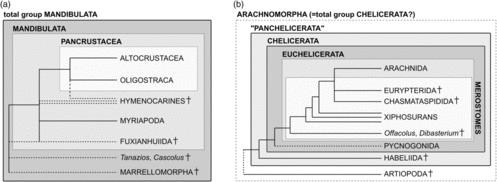
Figure 1 summarizes the views adopted herein about the evolution of the two clades of euarthropods containing extant lineages (crown groups or total groups, depending on the phylogenetic perspective). Mandibulata, containing Myriapoda and Pancrustacea, has been found to be robustly monophyletic based on combined molecular and morphological data (Rota-Stabelli et al. Reference Rota-Stabelli, Campbell, Brinkmann, Edgecombe, Longhorn, Peterson, Pisani, Philippe and Telford2011), and recent fossil revisions have secured the extinct hymenocarines within that clade (Aria & Caron, Reference Aria and Caron2017a; Vannier et al. Reference Vannier, Aria, Taylor and Caron2018). These analyses also found fuxianhuiids to be mandibulates or closely related to them, a result supported separately by their ocular morphology (Strausfeld et al. Reference Strausfeld, Ma, Edgecombe, Fortey, Land, Liu, Cong and Hou2016). The stem portion of the Mandibulata clade has been more difficult to reconstruct. Some analyses found marrellomorphs to be possible (adult) stem mandibulates (Legg, Reference Legg2016), but others found marrellomorphs to be either more basal or more closely related to artiopodans, with instead Silurian crustaceomorphs from the Herefordshire biota (such as Tanazios and Cascolus) to fulfil this role (Vannier et al. Reference Vannier, Aria, Taylor and Caron2018).
Taxonomy and hypotheses of internal relationships for Mandibulata and ‘Arachnomorpha’ adopted herein, including important extinct taxa. Dashed branches mark uncertain affinities.

Arachnomorpha is a traditional grouping of trilobites and their relatives (i.e., Artiopoda) with chelicerates (e.g. Edgecombe & Ramskold, Reference Edgecombe and Ramskold1999) the monophyly of Arachnomorpha has long been in contention with its alternative, Antennulata (i.e., artiopodans allied with mandibulates), possibly resulting from a polarization artefact related to the non-optimal coding of inapplicable states (Aria et al. Reference Aria, Caron and Gaines2015). Arachnomorpha is considered here as a potential equivalent to total-group Chelicerata (Fig. 1). Chelicerate relationships follow Selden et al. (Reference Selden, Lamsdell and Qi2015) and Aria and Caron (Reference Aria and Caron2017 b), with pycnogonids tentatively placed as basalmost chelicerates, considered here as the earliest taxa to possess chelicerae (called idiosyncratically ‘chelifores’). Chelicerata forms with habeliidans a clade provisionally called ‘Panchelicerata’ (sensu Aria & Caron, Reference Aria and Caron2017 b), which would include all taxa part of the chelicerate lineage that are not within Artiopoda.
It would seem unwise to add more terms to an already overcrowded and often confusing arthropod taxonomy. The problem is that the least inclusive monophyletic group including Mandibulata and Chelicerata still lacks a formal name, especially if one assigns Euarthropoda to taxa that correspond best to the original definition written by Lankester. Assigning a name to the clade of extant euarthropods is perhaps the most necessary nomenclatural addition for palaeontologists and neontologists alike, given the importance of this phylogenetic node as a point of reference. Hence I propose:
Clade CENOCONDYLA, nom. nov.
Derivation of name: From both καινóς and κoινóς, meaning respectively ‘new’ and ‘common’ in Greek, owing to the fact that this clade encompasses all extant representatives of the Euarthropoda; and from κóνδῠλoς, meaning ‘joint’. The latter root acknowledges in particular the term condylipodes coined by Latreille before Arthropoda but remained circumstantially unused (Hegna et al. Reference Hegna, Legg, Moller, Van Roy and Lerosey-Aubril2013).
Definition: Least inclusive phylogenetic bracket containing both Chelicerata and Mandibulata.
Tentative diagnosis: Euarthropods with antennules, protochelicerae or chelicerae and, in at least early representatives, with cephalon housing biramous appendages whose basis is differentiated as a masticatory device (dented gnathobase, spinose endites or mandible).
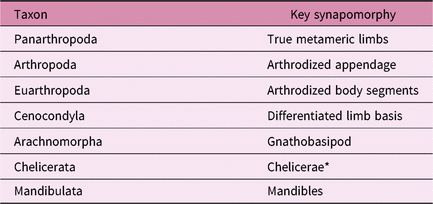
Remark: The definition takes precedence over the diagnosis. The presence of true gnathobases in some megacheirans (viz. Parapeytoia) along with the possible position of marrellomorphs as stem mandibulates (Legg, Reference Legg2016, marrellomorphs a priori lacking gnathobases) also implies that this diagnosis is likely subject to modification, perhaps more focused on the modification of the ‘great appendages’ or a more general differentiation of the limb basis. See a summary of key synapomorphies for higher-rank taxa in Table 1.
Key synapomorphies for higher-rank clades in panarthropods

* This taxon would also contain pycnogonids, whose chelifores are considered homologous to the chelicerae.
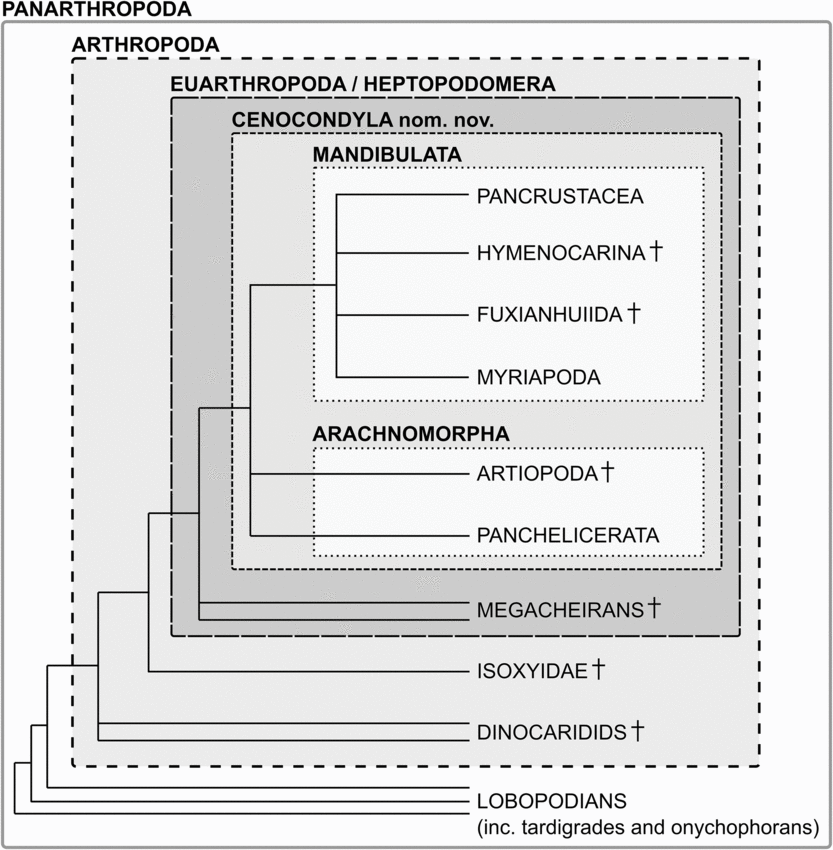
The immediate consequence of this nomenclatural revision is that Arthropoda, Euarthropoda and Cenocondyla are fossil-based terms and become strictly equivalent when considering extant species only (Fig. 2). A phylogenetic analysis based on molecular data, for instance, could use any of these names to refer to a Chelicerata+Mandibulata clade. Cenocondyla nom. nov. is the most restrictive substantive, but the possible inclusion of Artiopoda with chelicerates – as supported in a recent analysis Aria and Caron Reference Aria and Caron2017 b – may still make it a group containing major extinct lineages. I think that, in these cases, there are reasons – including nomenclatural precedence and simplicity – to prefer the use of Arthropoda.
Proposed higher-rank taxonomy for panarthropods, based on major extinct and extant groups. See text for definitions. Crosses mark extinct lineages.

It is also better to avoid the convoluted terms ‘lower’ and ‘upper stem group’, which do not contribute to a clearer description of the arthropod tree and are unnecessary in light of the existing nomenclature. In certain recent works (e.g. Yang et al. Reference Yang, Ortega-Hernandez, Gerber, Butterfield, Hou, Lan and Zhang2015, Reference Yang, Ortega-Hernandez, Lan, Hou and Zhang2016), ‘stem-group Arthropoda’ and ‘stem-group Euarthropoda’ have also been used as a taxonomic rank. This usage is inappropriate, not so much because it designates a paraphyletic grouping (many Linnaean ranks persist in spite of fluctuations in the configuration of cladograms), but because (1) it is not a character-based systematic entity, falsifiable through a diagnosis, and (2) it contradicts the very essence of the stem-group concept, which is to qualify an existing taxonomic rank. Any stem-group euarthropod is by definition not a euarthropod, and thus should not be placed under any variation of Euarthropoda Lankester, but under Arthropoda von Siebold (Hegna et al. Reference Hegna, Legg, Moller, Van Roy and Lerosey-Aubril2013).
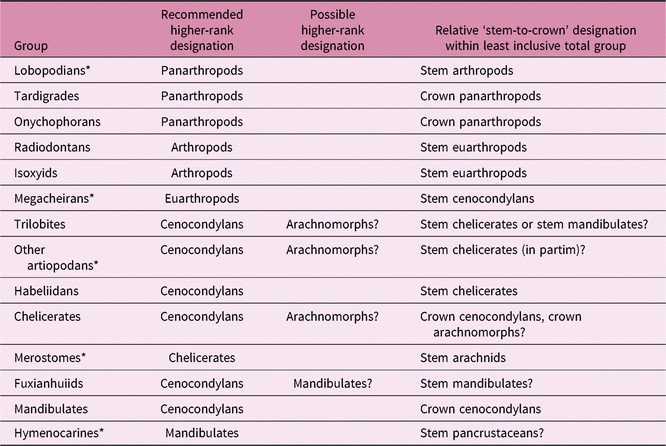
In the context of a ‘stem and crown’ perspective, dinocaridids, as well as, most likely, isoxyids, are stem euarthropods, while megacheirans are stem cenocondylans – which other taxa may also share that affiliation is not clear presently. Artiopodans are most likely cenocondylans (either within Arachnomorpha or within Antennulata) and hymenocarines are mandibulates (Table 2). As mentioned above, fuxianhuiids are here tentatively placed within the mandibulate total-group. The ‘stem-to-crown’ designation of lobopodians depends on the boundaries of this group, which have been historically unclear (Ortega-Hernández, Reference Ortega-Hernández2016). If taken not exclusively as stem taxa but in a broader paraphyletic sense, including onychophorans and tardigrades, lobopodians could generally be called stem arthropods.
Recommended higher-rank and relative ‘stem-to-crown’ designations of major panarthropod groups. The first column is equivalent to the ‘crown-group’ taxonomic approach while the third column is equivalent to the ‘total-group’ taxonomic approach, sensu Donoghue (Reference Donoghue2005)

* These groups are likely non-monophyletic.
In general, we should be wary of using stem and crown concepts with evolutionary connotations other than tree topology. Hennig’s conception of stem and crown is heavily rooted in the distinction between extinct and extant (Hennig, Reference Hennig1981; Donoghue, Reference Donoghue2005), insofar as living taxa provide more robust character-based diagnoses than fossils usually do, an approach which makes even more sense in the era of molecular systematics. This could be called the ‘cladistic’ definition of stem and crown, which bears only on the structure of cladograms and the temporal extent of taxa. In reviewing these concepts, Budd & Jensen (Reference Budd and Jensen2000) proposed to assimilate the concept of crown group with that of body plan, on the ground of having an objective criterion for the definition of a body plan. A body plan, however, is tied by etymology (a set architectural layout of an organism) and usage to factors intrinsic to the evolution of species, not the least being canalization (e.g. Valentine & Hamilton, Reference Valentine, Hamilton, Fortey and Thomas1997; Peterson et al. Reference Peterson, Dietrich and McPeek2009). This leads to assigning an ontological dimension to the issue of stem and crown groups, incompatible in fact with the restrictive definition these authors proposed, and in light of which there would be no reason to exclude taxa because they are extinct.
The conceptualization of Budd and Jensen would mean, for instance, that a body plan would be denied to trilobites, solely based on the fact that they were victims of the Permo-Triassic mass extinction. However, it would seem evident that trilobites are united by a distinctive body plan, although the reasons for this are perhaps often too implicit. A strict definition of a body plan as a body architecture defined by certain diagnostic characters would mean that any taxon down to every species would have its own body plan, regardless of morphological variability in sister taxa. A body plan has otherwise been attributed to phyla (Valentine, Reference Valentine, Raup and Jablonski1986; Valentine & Hamilton, Reference Valentine, Hamilton, Fortey and Thomas1997), that is, to ‘higher taxa’, to the extent that these taxa have at least one trait (e.g. arthrodization) clearly separating them at some evolutionary distance from other such phyla. This notion is more easily defined nowadays with the help of disparity and morphospaces, which allow identification quantitatively and graphically of clusters of taxa and their sets of defining traits within a distinct adaptive multidimensional space. In such terms, trilobites would represent a ‘crown group’, because they likely have all the characteristics of a body plan defined as a canalized developmental architecture containing the breadth of a large radiation.
For clarity, authors should keep to the cladistic definition of stem and crown, but it is true nonetheless that these concepts call for a more ontological significance, considering that often stem groups appear to display higher morphological variability and different disparity patterns than their relative crown (Hughes et al. Reference Hughes, Gerber and Wills2013; Brusatte et al. Reference Brusatte, Graeme, Wang and Norell2014; Hopkins & Smith, Reference Hopkins and Smith2015). This is ‘why we must strive to quantify morphospace’ (Gould, Reference Gould1991) and develop the appropriate terminology to describe these macroevolutionary phenomena. For descriptive purposes, a strong taxonomic system should prevail.
Author ORCID
Cédric Aria, 0000-0002-0567-1730
Acknowledgements
I thank two anonymous reviewers for their comments, which helped to greatly improve the earlier version of this paper.
Declaration of Interest
The author declares no conflict of interest.
Funding
The author’s research is supported by a President’s International Fellowship Initiative grant (#2018PC0043), a China Postdoctoral Science Foundation Grant (#2018M630616) and the Strategic Priority Research Program (B) of the Chinese Academy of Sciences (XDB26000000).