Adverse childhood experiences (ACEs) are negative, potentially traumatic events (e.g., abuse and neglect, community violence) linked to mental and physical health problems (e.g., Brown & Shillington, Reference Brown and Shillington2017; Cicchetti, Reference Cicchetti2013; Felitti et al., Reference Felitti, Anda, Nordenberg, Williamson, Spitz, Edwards and Marks1998). Unfortunately, ACEs are common (Felitti et al., Reference Felitti, Anda, Nordenberg, Williamson, Spitz, Edwards and Marks1998; Merrick et al., Reference Merrick, Ford, Ports and Guinn2018), with 48% of youth experiencing at least one (Bethell et al., Reference Bethell, Newacheck, Hawes and Halfon2014). Further, ACEs tend to co-occur (Anda et al., Reference Anda, Croft, Felitti, Nordenberg, Giles, Williamson and Giovino1999; Dong et al., Reference Dong, Anda, Felitti, Dube, Williamson, Thompson and Giles2004; McLaughlin & Sheridan, Reference McLaughlin and Sheridan2016) and have a dose–response association with negative outcomes (e.g., Felitti et al., Reference Felitti, Anda, Nordenberg, Williamson, Spitz, Edwards and Marks1998; Lewis et al., Reference Lewis, Arseneault, Caspi, Fisher, Matthews, Moffitt and Danese2019), making it critical to understand their cumulative impact. Previous research links ACEs to poorer physical and mental health outcomes generally (Belbasis et al., Reference Belbasis, Köhler, Stefanis, Stubbs, van Os, Vieta, Seeman, Arango, Carvalho and Evangelou2018; Green et al., Reference Green, McLaughlin, Berglund, Gruber, Sampson, Zaslavsky and Kessler2010; Hughes et al., Reference Hughes, Bellis, Hardcastle, Sethi, Butchart, Mikton and Dunne2017; McLaughlin et al., Reference McLaughlin, Weissman and Bitrán2019), and more specifically to delinquency (Brown & Shillington, Reference Brown and Shillington2017; Leban & Gibson, Reference Leban and Gibson2020), sleep problems (Turner et al., Reference Turner, Menzies, Fortier, Garces, Struck, Taillieu and Afifi2020), and self-control deficits (Meldrum et al., Reference Meldrum, Campion Young, Soor, Hay, Copp, Trace and Kernsmith2019). Additionally, both sleep problems (Connolly et al., Reference Connolly, Jackson and Semenza2021; Hambrick et al., Reference Hambrick, Rubens, Brawner and Taussig2018) and low self-control (Vazsonyi et al., Reference Vazsonyi, Mikuška and Kelley2017) are correlates of delinquency.
Developmental research supports cascade models of delinquency wherein risk factors (e.g., ACEs) in early development have a cascading effect on later developmental outcomes (Dodge et al., Reference Dodge, Malone, Lansford, Miller, Pettit and Bates2009). For example, ACEs may set off a psychological and biological reaction to stress, leading to the release of stress hormones (Lupien et al., Reference Lupien, McEwen, Gunnar and Heim2009), which leads to psychological and physiological arousal (McEwen, Reference McEwen1998), which may contribute to sleep problems (Buckley & Schatzberg, Reference Buckley and Schatzberg2005). Sleep problems may then contribute to executive function deficits, such as low self-control (Guarana et al., Reference Guarana, Ryu, O’Boyle, Lee and Barnes2021), which has been associated with delinquency (Meldrum et al., Reference Meldrum, Barnes and Hay2015). Understanding the mediational pathways connecting these risk factors and outcomes is critical to determining how these constructs are related, which can then highlight possible intervention targets (Cicchetti, Reference Cicchetti2016) and inform “high impact and enduring interventions” (McMakin & Alfano, Reference McMakin and Alfano2015). Accordingly, recent research suggests that the association between ACEs and delinquency partially operates through sleep problems (Hambrick et al., Reference Hambrick, Rubens, Brawner and Taussig2018), and additional studies point to the mediating role of low self-control between sleep problems and delinquency (Meldrum et al., Reference Meldrum, Barnes and Hay2015; Vazsonyi et al., Reference Vazsonyi, Ksinan Jiskrova and Ksinan2018). Whether both sleep problems and low self-control operate sequentially to link ACEs and delinquency remains unexamined. Guided by the ACE framework (Felitti et al., Reference Felitti, Anda, Nordenberg, Williamson, Spitz, Edwards and Marks1998) and developmental cascade models (Dodge et al., Reference Dodge, Malone, Lansford, Miller, Pettit and Bates2009), the present study addresses this gap in research by examining sleep problems in childhood and low self-control in early adolescence as mediators of the association between ACEs and delinquency in late adolescence using longitudinal serial mediation.
ACEs and delinquency
Research supports an association between cumulative ACEs and negative outcomes, including delinquency (Leban & Gibson, Reference Leban and Gibson2020). For example, adolescents experiencing more ACEs engaged in more delinquent behaviors (Brown & Shillington, Reference Brown and Shillington2017), tended to be younger at their first arrest, and had more total arrests in adolescence (Baglivio et al., Reference Baglivio, Wolff, Piquero and Epps2015). Additionally, adolescents who experienced maltreatment demonstrated high aggression (Fitton et al., Reference Fitton, Yu and Fazel2018), truancy, and other rule-breaking behaviors (Stouthamer-Loeber et al., Reference Stouthamer-Loeber, Loeber, Homish and Wei2001). Adolescence is a sensitive period of development, wherein youth experience many social, physical, emotional, and cognitive changes (Dahl & Gunnar, Reference Dahl and Gunnar2009), including biological changes that may leave their stress systems and brains vulnerable to adverse experiences (Heim & Binder, Reference Heim and Binder2012; Yoon, Reference Yoon2020). Indeed, when studying the timing of ACEs and their relative impact on externalizing behaviors, Yoon (Reference Yoon2020) found that participants experienced the most adversity at the age of 6 years and that the effect of this adversity was most prominent when participants were 11.5 years old. Yet, few longitudinal studies investigating mechanisms underlying the association between ACEs and delinquency exist, thus hampering efforts to establish causal effects.
Sleep problems represent one potential link in the association between ACEs and delinquency (Hambrick et al., Reference Hambrick, Rubens, Brawner and Taussig2018). For example, El-Sheikh and colleagues (Reference El-Sheikh, Buckhalt, Mize and Acebo2006) found that children living in homes characterized by significant marital conflict had poorer sleep quality using actigraphy. Additionally, researchers have also found a significant association between sleep problems and both delinquency and risk-taking behavior (Backman et al., Reference Backman, Laajasalo, Saukkonen, Salmi, Kivivuori and Aronen2015; Clinkinbeard et al., Reference Clinkinbeard, Simi, Evans and Anderson2011; Lin & Yi, Reference Lin and Yi2015; Partin & Lehmann, Reference Partin and Lehmann2021), as well as externalizing behaviors among youth aged 8–13 years old (Kelly & El-Sheikh, Reference Kelly and El-Sheikh2014; Vazsonyi et al., Reference Vazsonyi, Liu, Javakhishvili, Beier and Blatny2021). Furthermore, severe deficits in sleep duration and excessive sleep were associated with greater delinquency in a cross-sectional analysis of a nationally representative sample of youth (Mears et al., Reference Mears, Tomlinson and Turanovic2020), though other recent longitudinal research suggests that sleep quality, rather than sleep quantity, might be more consequential for delinquent and externalizing behavior (Connolly et al., Reference Connolly, Jackson and Semenza2021; Vazsonyi et al., Reference Vazsonyi, Liu, Javakhishvili, Beier and Blatny2021).
Low self-control is another potential mechanism linking ACEs and delinquency. For example, ACEs were negatively associated with self-control in a cross-sectional analysis across two separate samples of youth (Meldrum et al., Reference Meldrum, Campion Young, Soor, Hay, Copp, Trace and Kernsmith2019), as well as a more recent longitudinal analysis (Jones et al., Reference Jones, Pierce and Chapple2021). In addition, a recent meta-analysis reported that both sleep quality and, to a lesser extent, sleep quantity are positively associated with self-control across a wide variety of methodological specifications (Guarana et al., Reference Guarana, Ryu, O’Boyle, Lee and Barnes2021). Further, other studies have reported that low self-control partially mediates the association between sleep quality and delinquency (Meldrum et al., Reference Meldrum, Barnes and Hay2015; Vazsonyi et al., Reference Vazsonyi, Ksinan Jiskrova and Ksinan2018).
Researchers have also posited important underlying links between sleep and self-control, such as executive function deficits due to poor or inadequate sleep (Beebe & Gozal, Reference Beebe and Gozal2002; Guarana et al., Reference Guarana, Ryu, O’Boyle, Lee and Barnes2021; Langner & Eickhoff, Reference Langner and Eickhoff2013; Lim & Dinges, Reference Lim and Dinges2010). Indeed, negative effects to the prefrontal cortex have been noted in people with low sleep duration and quality (Chuah et al., Reference Chuah, Dolcos, Chen, Zheng, Parimal and Chee2010; Nilsson et al., Reference Nilsson, SÖDerstrÖM, Karlsson, Lekander, ÅKerstedt, Lindroth and Axelsson2005). While more research is still needed to determine causal pathways between sleep and self-control, it seems reasonable that adolescents with more sleep problems and less self-control may engage in more delinquent activities.
ACEs and sleep problems
Sleep is important to health and well-being, and late childhood – early adolescence appears to be a sensitive period in development for sleep problems and resulting mental health issues (Kelly & El-Sheikh, Reference Kelly and El-Sheikh2014; McMakin & Alfano, Reference McMakin and Alfano2015). Indeed, there is evidence of psychiatric problems, developmental disorders, and delinquency among adolescents with sleep problems (Meldrum & Restivo, Reference Meldrum and Restivo2014; Tesler et al., Reference Tesler, Gerstenberg and Huber2013). Furthermore, an association between ACEs and sleep problems has been documented (Lepore & Kliewer, Reference Lepore and Kliewer2013; Turner et al., Reference Turner, Menzies, Fortier, Garces, Struck, Taillieu and Afifi2020; Xiao et al., Reference Xiao, Wang, Huang, Wang, Zhao, Zhang and Lu2020). Of note, two longitudinal investigations support an association between ACEs and sleep problems. Noll et al. (Reference Noll, Trickett, Susman and Putnam2006) found childhood sexual abuse predicted sleep disturbances in adolescence/young adulthood, and Gregory et al. (Reference Gregory, Caspi, Moffitt and Poulton2006) found an association between family conflict in childhood and adolescence was associated with insomnia at the age of 18 years. While there is not one single explanation for this association between ACEs and sleep problems, research suggests that ACEs may be a catalyst to psychological and biological reactions to stress, causing a release of stress hormones (Lupien et al., Reference Lupien, McEwen, Gunnar and Heim2009), leading to increased psychological and physiological arousal (McEwen, Reference McEwen1998) which may contribute to sleep problems (Buckley & Schatzberg, Reference Buckley and Schatzberg2005). Indeed, altered hypothalamic–pituitary–adrenal axis activity, including cortisol production, has been observed among trauma survivors (Kuhlman et al., Reference Kuhlman, Geiss, Vargas and Lopez-Duran2015) and those with disturbed sleep (Abell et al., Reference Abell, Shipley, Ferrie, Kivimäki and Kumari2016; Minkel et al., Reference Minkel, Moreta, Muto, Htaik, Jones, Basner and Dinges2014), highlighting this as a potential mechanism. Furthermore, certain ACEs, like community violence (Hall Brown et al., Reference Hall Brown, Belcher, Accardo, Minhas and Briggs2016), may lead youth to develop symptoms of anxiety and feelings of insecurity in their environment, and introduce frightening noises at night (e.g., gunshots, tire squeals) that trigger sleep disturbance.
Research documenting whether cumulative ACEs influence later delinquency via sleep problems, however, is not widely established. One exception exists wherein researchers found ACEs to be partially associated with delinquency through poor sleep (Hambrick et al., Reference Hambrick, Rubens, Brawner and Taussig2018). These findings provide precedent for the current study and leave areas for further development given the use of cross-sectional data. The current study builds upon this work using a longitudinal design and measures reflecting a broad range of ACEs, sleep problems, and delinquency to determine if sleep mediates the association between adversity in childhood and delinquency in adolescence.
ACEs and self-control
Self-control, often thought of as the antithesis of impulsivity, is associated with positive outcomes including self-regulatory skills (Shoda et al., Reference Shoda, Mischel and Peake1990), health and well-being (Moffitt et al., Reference Moffitt, Arseneault, Belsky, Dickson, Hancox, Harrington and Caspi2011), and academic achievement (Duckworth & Seligman, Reference Duckworth and Seligman2005; Tangney et al., Reference Tangney, Baumeister and Boone2004). Self-control is also critical to one’s ability to delay immediate gratification (Gillebaart, Reference Gillebaart2018), and multiple meta-analyses find that low self-control is associated with delinquency and other problem behaviors (de Ridder et al., Reference de Ridder, Lensvelt-Mulders, Finkenauer, Stok and Baumeister2011; Vazsonyi et al., Reference Vazsonyi, Mikuška and Kelley2017).
Like sleep and delinquency, self-control may also be impacted by ACEs. Indeed, many studies have found impulsivity (Cicchetti & Curtis, Reference Cicchetti and Curtis2005; Narvaez et al., Reference Narvaez, Magalhães, Trindade, Vieira, Kauer-Sant’Anna, Gama and Kapczinski2012; Pears & Fisher, Reference Pears and Fisher2005) and impaired emotion regulation skills (Kim & Cicchetti, Reference Kim and Cicchetti2010; Peh et al., Reference Peh, Shahwan, Fauziana, Mahesh, Sambasivam, Zhang and Subramaniam2017; Titelius et al., Reference Titelius, Cook, Spas, Orchowski, Kivisto, O’Brien and Seymour2018) to be developmental sequelae of exposure to childhood adversity. Neurobiological studies also confirm exposure to ACEs alters stress–response systems (Sinha, Reference Sinha2008, Reference Sinha2009) and impairs neurocognitive functioning (Fava et al., Reference Fava, Trucco, Martz, Cope, Jester, Zucker and Heitzeg2019; Jaffee & Maikovich-Fong, Reference Jaffee and Maikovich-Fong2011; Nemeroff, Reference Nemeroff2004). Yet, despite evidence of direct associations between ACEs and self-control, and self-control and delinquency, few studies consider whether self-control mediates that association. One exception is a longitudinal study combining both quantitative and neurological imaging data (Fava et al., Reference Fava, Trucco, Martz, Cope, Jester, Zucker and Heitzeg2019) that supports a pathway from ACEs to externalizing behavior via lower functioning in the anterior cingulate cortex. A second exception is a cross-sectional study, which found low self-control partially mediated the association between childhood trauma and delinquency (Pechorro et al., Reference Pechorro, DeLisi, Abrunhosa Gonçalves and Pedro Oliveira2021).
Current study
Current knowledge about how ACEs impact delinquency is largely driven by cross-sectional research. Further, no previous studies have tested associations between ACEs, sleep problems in childhood, low self-control in early adolescence, and delinquency in late adolescence in one longitudinal model. Based on the reviewed literature, these development stages may represent sensitive periods for the different phenomenon in question; that is, middle to late childhood is an especially important time to assess and address sleep problems, early adolescence presents a time of malleability in self-control capacity, and late adolescence precedes adulthood wherein consequences for delinquent activities have a considerably higher cost. Testing multiple mediators at the same time helps reduce the risk of excluding important factors comprising the mechanistic process of an association (Preacher & Hayes, Reference Preacher and Hayes2008). Further, such an analysis could elucidate avenues for intervention, thereby providing multiple opportunities to intervene during childhood and early adolescence to prevent youth from starting on trajectories of serious delinquency and later adult offending. To this end, the current study builds upon previous research by testing a longitudinal, serial mediation model. Specifically, we examined associations between cumulative ACEs (≤age 11 years), sleep problems (ages 9–11 years), low self-control (ages 12–14 years), and adolescent delinquency (ages 15–17 years). Exposure to more ACEs was expected to predict more sleep problems in childhood, which in turn would predict less self-control in early adolescence, which would then predict greater involvement in delinquency in late adolescence.
Method
Participants
Participants were 480 adolescents (71.3% boys; 86.3% White) from the Michigan Longitudinal Study (MLS; Zucker et al., Reference Zucker, Ellis, Fitzgerald, Bingham and Sanford1996; Zucker et al., Reference Zucker, Fitzgerald, Refior, Puttler, Pallas, Ellis, Fitzgerald, Lester and Zuckerman2000) with available delinquency data during late adolescence. The MLS is an ongoing prospective, multi-wave study utilizing population-based methods for recruitment. The highest risk portion of the sample was ascertained by identifying all fathers in a circumscribed geographic area with drunk driving charges who met criteria for an alcohol use disorder (AUD). High-risk families (32.4%) were composed of the convicted fathers, their son, and the son’s biological mother. Additional families were recruited from the same neighborhoods as these families. Families with a parent who met criteria for an AUD diagnosis but had no substance use related conviction were considered moderate-risk families (34.2%). Families that did not include a parent who met criteria for an AUD diagnosis were considered low risk (33.4%). For a full explanation of the sample and study procedures, see Zucker et al. (Reference Zucker, Ellis, Fitzgerald, Bingham and Sanford1996, Reference Zucker, Fitzgerald, Refior, Puttler, Pallas, Ellis, Fitzgerald, Lester and Zuckerman2000). Participants included in the current analyses did not differ significantly from the full sample (N = 1252) on biological sex, race, income, sleep problems, low self-control, or delinquency. Given that female siblings and non-White families were included in later waves of the MLS, only a subsample of data included complete information for the constructs of interest in the current study. Participants in the current sample had a slightly greater number of reported ACEs (M = 4.62; F (1, 500) = 24.17, p < .001) compared to the those with available ACE data in the full sample.
Procedure
Parents and children completed assessments following initial recruitment (i.e., Wave 1, aged 3–5 years) with subsequent assessments occurring at 3-year intervals (e.g., Wave 2, aged 6–8 years). Adolescents completed self-report measures concerning their delinquent behavior, while parents reported on childhood sleep problems, low self-control, and ACEs. This multi-informant approach helps limit concerns regarding shared method variance.
Ethical considerations
Informed consent and assent were obtained from parents and adolescents, respectively. The Institutional Review Board where this study was conducted approved the procedures.
Measures
ACEs
Consistent with prior work (Fava et al., Reference Fava, Trucco, Martz, Cope, Jester, Zucker and Heitzeg2019), a measure of ACEs during childhood (≤11; i.e., data across Waves 1–3) was used based on a combination of items across several questionnaires. Sample items include: not being able to pay bills, lacking clean clothes, applying for welfare or unemployment, domestic violence, sexual abuse, physical abuse, death of a sibling, parent incarceration, bullying, and parental AUD. In total, 21 items were aggregated to derive a measure of ACEs (skewness = 0.14, kurtosis = −0.51). Although the internal consistency was modest (Cronbach’s α = 0.61), the cumulative approach to measuring ACEs has received psychometric support (Bethell et al., Reference Bethell, Carle, Hudziak, Gombojav, Powers, Wade and Braveman2017) and the reliability aligns with prior work (e.g., Whitaker et al., Reference Whitaker, Dearth-Wesley, Gooze, Becker, Gallagher and McEwen2014). All items were dichotomized to reflect whether the event occurred (1 = yes, 0 = no). If an item was endorsed at multiple time points, the event was still coded as 1 (i.e., possible max value = 21), similar to prior research (e.g., Finkelhor et al., Reference Finkelhor, Shattuck, Turner and Hamby2015; Hussong et al., Reference Hussong, Bauer, Huang, Chassin, Sher and Zucker2008).
Sleep problems
Problematic sleep was assessed at Wave 3 (ages 9–11)Footnote 1 using the mean of six items based on caregiver reports from the Child Behavior Checklist (CBCL; Achenbach & Edelbrock, Reference Achenbach and Edelbrock1991): has nightmares, overtired without good reason, sleeps less than other kids, sleeps more than most kids, talks/walks in sleep, and trouble sleeping. This measure is consistent with prior work (Becker et al., Reference Becker, Ramsey and Byars2015) except that the bedwetting item was omitted given a low correlation with the other six items. Items on the CBCL are rated on a 3-point Likert scale (0 = not true to 2 = very true or often true). Problematic sleep was normally distributed (skewness = 1.88, kurtosis = 4.21). Internal consistency was modest (Cronbach’s α = 0.54), yet consistent with recent research (Hambrick et al., Reference Hambrick, Rubens, Brawner and Taussig2018).
Low self-control
Low self-control was assessed at Wave 4 (ages 12–14 years) using the mean of 16 CBCL caregiver-reported items consistent with prior work (Hay & Forrest, Reference Hay and Forrest2006). Such items include: “My child throws temper tantrums or has a hot temper,” “My child cannot concentrate or pay attention for long,” and “My child is impulsive or acts without thinking.” Items are rated on a 3-point Likert scale (0 = not true to 2 = very true or often true). The scale was normally distributed (skewness = 1.37, kurtosis = 2.68) and internal consistency was good (Cronbach’s α = 0.87). Similar indexes of self-control have been used in previous research (e.g., Hay & Forrest, Reference Hay and Forrest2006; Meldrum et al., Reference Meldrum, Barnes and Hay2015; Raffaelli et al., Reference Raffaelli, Crockett Lj Fau-Shen and Shen2005; Willems et al., Reference Willems, Dolan, van Beijsterveldt, de Zeeuw, Boomsma, Bartels and Finkenauer2018; Zucker et al., Reference Zucker, Ellis, Fitzgerald, Bingham and Sanford1996) and when compared to measures of self-control/impulsivity drawn from the Weinberger Adjustment Inventory, substantively identical results were found (Meldrum et al., Reference Meldrum, Barnes and Hay2015).
Delinquency
Delinquency was assessed at Wave 5 (ages 15–17) using a sum of 24 items from the Antisocial Behavior Checklist-Adolescent version (ASB-R, Adol; Zucker & Noll, Reference Zucker and Noll1980; Zucker, Reference Zucker2005). Adolescents self-reported how often they engaged in 24 behaviors (e.g., shoplifting, fighting with others, and weapon carrying) in the last 3 years using a 4-point Likert scale (0 = never; 0 times in the last 3 years to 3 = often; 10 or more times during the last 3 years). Skew was not excessive (skew = 1.81, kurtosis = 3.67)Footnote 2 and internal consistency was good (Cronbach’s α = 0.85).
Demographic characteristics
All models controlled for biological sex (0 = boys, 1 = girls), race (0 = non-White, 1 = White), and household income. Average household income was determined across biological parent reports (1 = under $4,000 to 11 = over $100,000).
Data analytic plan
A serial mediation model was tested using the PROCESS macro for SAS v9.4. Of primary interest for the analysis was the indirect effect of sleep problems and low self-control on the association between ACEs and delinquency.Footnote 3 The model was analyzed with ACEs prior to the age of 11 years predicting sleep problems (aged 9–11 years), low self-control (aged 12–14 years), and delinquency (aged 15–17 years), controlling for biological sex, race, and household income. Sleep problems were included as a predictor of low self-control and delinquency. Lastly, low self-control was included as a predictor of delinquency. An advantage of using a longitudinal design is temporal precedence across the mediators and outcome (Kraemer et al., Reference Kraemer, Kiernan, Essex and Kupfer2008). Accordingly, we took methodological precautions to ensure temporal precedence within our sample. Out of a potential 502 participants, we identified 22 for whom an ACE was reported at approximately the same time or slightly after sleep problems were assessed (i.e., between the ages of 9 and 11 years where there was overlap between Waves 1 and 3), presenting a potential issue for causal ordering. Therefore, we excluded these 22 participants from the current analyses. Thus, on an individual level, each participant’s report of sleep problems occurred after the measured ACEs. However, for the sample as a whole, the reporting period for ACEs and sleep problems retains some overlap: ≤11 years old and 9–11 years old, respectively. The PROCESS macro provides a rigorous assessment of indirect effects. That is, indirect effects with bootstrapped confidence intervals (CIs) are estimated for simple mediation (ACEs sleep problems delinquency; ACEs low self-control delinquency) and serial mediation (ACEs sleep problems low self-control delinquency). Futhermore, statistical tests comparing each of the simple mediation effects to each other and the full serial mediation effects are provided for a total of three contrasts.
Results
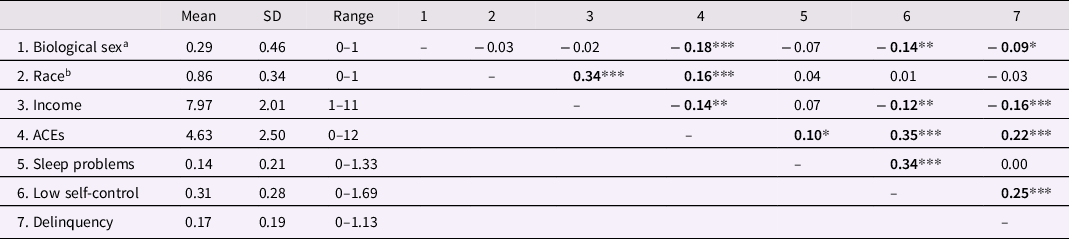
Table 1 provides the descriptive statistics and correlations for all study variables. ACEs were positively correlated with sleep problems (r = .10, p < .05), low self-control (r = .35, p < .001), and delinquency (r = .22, p < .001). In addition, sleep problems were positively correlated with low self-control (r = .34, p < .001), but not with delinquency (r = .00, p > .05). Lastly, low self-control was positively correlated with delinquency (r = .25, p < .001).
Means, standard deviations, and correlations of study variables

Note. N = 480; a0 = boys, 1 = girls; b0 = non-White, 1 = White; ACEs = adverse childhood experiences; bold = statistically significant values. *p < .05; **p < 0.01; ***p < 0.001.
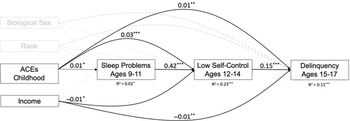
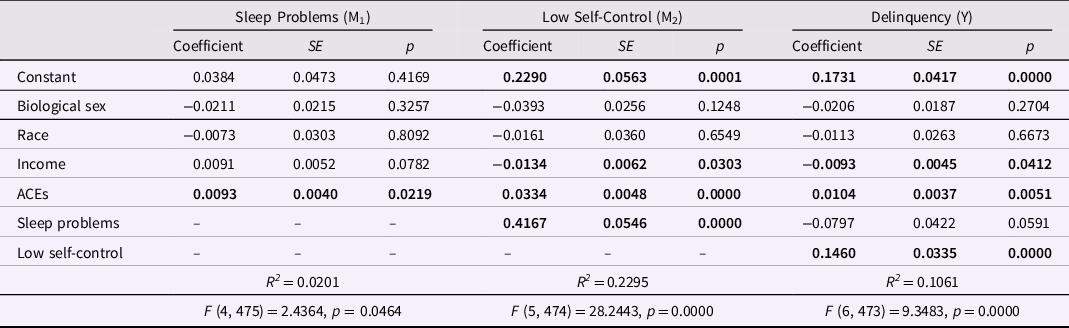
The serial mediation model accounted for approximately 11% of the variance in adolescent delinquency (Table 2 and Figure 1). Pertinent to our hypotheses, there was evidence for a significant positive association between ACEs and sleep problems (b = 0.0093, p < .05). There was also evidence for a significant positive direct effect of ACEs on low self-control (b = 0.0334, p < .001) and delinquency (b = 0.0104, p < .01). In turn, there was evidence for significant positive associations between sleep problems and low self-control (b = 0.4167, p < .001) and low self-control and delinquency (b = 0.1460, p < .001). Greater family income was also negatively associated with both low self-control (b = −0.0134, p < .05) and delinquency (b = −0.0093, p < .05). Thus, consistent with study hypotheses, more ACEs predicted more sleep problems in childhood, which in turned predicted less self-control in early adolescence, which then predicted greater involvement in delinquency in late adolescence.
We remind readers that even though for the sample as a whole there is overlap in the window of reporting on ACEs and sleep problems, at the individual case level we ensured reports of ACEs always preceded the measure of sleep problems. Black lines represent statistically significant effects, whereas gray dashed lines represent nonsignificant effects. *p < 0.05; **p < 0.01; ***p < 0.001. Note. ACEs = adverse childhood experiences.

Regression coefficients, standard errors, and summary information of serial mediation model predicting delinquency

Note. N = 480; ACEs = adverse childhood experiences; bold = statistically significant values.
Also consistent with our hypotheses, there was support for serial mediation whereby the association between ACEs and delinquency in late adolescence was mediated by sleep problems and low self-control (indirect effect = 0.0006, 95% CI 0.0001–0.0013). There was also support for simple mediation, whereby a significant indirect effect of ACEs on delinquency via only low self-control (indirect effect = 0.0049, 95% CI 0.0023–0.0080) was observed. The indirect effect for the simple mediation of ACEs on delinquency via only sleep problems, however, was not statistically significant (indirect effect = −0.0007, 95% CI −0.0021–0.0001). Contrasts between the indirect effects across the simple mediation models versus the serial mediation model indicated that the indirect effect of the serial mediation significantly differed from the indirect effect of the simple mediation via sleep problems (indirect effect = −0.0013, 95% CI −0.0031 to −0.0001), as well as the indirect effect of the simple mediation via low self-control (indirect effect = 0.0043, 95% CI 0.0019–0.0073). That is, the specific indirect effect inclusive of both mediators (sleep problems and low self-control) was statistically different and more robust than the other specific indirect effects inclusive of only one of the two mediators. Thus, consistent with study hypotheses, findings indicate that childhood ACEs predict greater delinquency in late adolescence, and greater childhood sleep problems and early adolescent low self-control represent potential mechanisms across development linking these constructs.
Discussion
The aim of this study was to bridge multiple lines of research to provide a more complete understanding of the processes through which ACEs relate to later delinquency by focusing on the intervening roles of sleep problems in childhood and low self-control in early adolescence. While prior research (e.g., Hambrick et al., Reference Hambrick, Rubens, Brawner and Taussig2018; Meldrum et al., Reference Meldrum, Campion Young, Soor, Hay, Copp, Trace and Kernsmith2019) provides relevant preliminary evidence supporting the mediating role of these factors, that evidence is based on cross-sectional data. Findings from the current longitudinal serial mediation analysis indicate that ACEs affect later delinquency indirectly through both sleep problems and low self-control. It is important to note that mediated effects were significant even when controlling for income and race, representing important correlates of sleep problems, executive functioning, and delinquency (Vazsonyi et al., Reference Vazsonyi, Ksinan Jiskrova and Ksinan2018). Vazsonyi et al. (Reference Vazsonyi, Ksinan Jiskrova and Ksinan2018) posit that invariance across socioeconomic strata are indicative of similar neurobiological processes underlying pathways linking sleep, executive functioning, and later adjustment across individuals regardless of SES and race/ethnicity. Moreover, consistent with prior research, our findings support direct associations between (1) ACEs and sleep problems (Hambrick et al., Reference Hambrick, Rubens, Brawner and Taussig2018; Turner et al., Reference Turner, Menzies, Fortier, Garces, Struck, Taillieu and Afifi2020) and low self-control (Jones et al., Reference Jones, Pierce and Chapple2021; Meldrum et al., Reference Meldrum, Campion Young, Soor, Hay, Copp, Trace and Kernsmith2019), (2) sleep problems and low self-control (Vazsonyi et al., Reference Vazsonyi, Ksinan Jiskrova and Ksinan2018), (3) low self-control and delinquency (Vazsonyi et al., Reference Vazsonyi, Mikuška and Kelley2017), and (4) ACEs and delinquency (Hambrick et al., Reference Hambrick, Rubens, Brawner and Taussig2018; Perez et al., Reference Perez, Jennings and Baglivio2018).
These findings align with developmental models of psychopathology and delinquency, which emphasize cascading effects of childhood adversity (Dodge et al., Reference Dodge, Malone, Lansford, Miller, Pettit and Bates2009; Felitti et al., Reference Felitti, Anda, Nordenberg, Williamson, Spitz, Edwards and Marks1998). Namely, there are multiple intervening pathways through which ACEs are likely to increase involvement in delinquent behavior. While our model offers support for the central relevance of low self-control as a mediator (and sleep problems to a lesser extent), the residual association between ACEs and delinquency suggests that additional social, cognitive, and emotional processes are at work. Existing research provides some direction as to these other potential mediating factors that could be investigated in future research. For example, ACEs are associated with increased depressive symptoms (e.g., Lee et al., Reference Lee, Kim, Nam and Jeong2020) and a large body of research links negative emotions to involvement in delinquency (e.g., Manasse & Ganem, Reference Manasse and Ganem2009; Ozkan et al., Reference Ozkan, Rocque and Posick2018). Given established links between sleep problems and depressive symptoms (Lovato & Gradisar, Reference Lovato and Gradisar2014), depressive symptomatology may explain some of the residual effect of ACEs on delinquency our models were unable to explain.
Additionally, the results of our analyses highlight multiple potential points for intervention regarding developmental precursors of delinquency. Programming aimed at reducing exposure to adversity and trauma is critical given the cascading effects observed herein. While some ACEs would be difficult to target (e.g., sexual abuse by a neighbor, exposure to extreme weather), many pertain to the home environment (e.g., physical neglect, emotional abuse) and are amenable to programming. For example, home visitation interventions like the Nurse-Family Partnership program have proven effective at reducing childhood exposure to abuse and neglect (Eckenrode et al., Reference Eckenrode, Campa, Morris, Henderson, Bolger, Kitzman and Olds2016; Olds, Reference Olds2006, Reference Olds2007). Additional interventions such as economic support to families, access to education and training in positive parenting practices, and quality childcare options may also prevent ACEs (Fortson et al., Reference Fortson, Klevens, Merrick, Gilbert and Alexander2016).
Poor sleep in childhood also emerged as an important target for intervention. Given the observed association between sleep problems and low self-control, programming directed at increasing healthy sleep habits is relevant (Hatch et al., Reference Hatch, Galland, Gray, Taylor, Sayers, Lawrence and Taylor2019). Broader level interventions, such as changes to school start times are another potential target to improve sleep among adolescents (Bowers & Moyer, Reference Bowers and Moyer2017; Minges & Redeker, Reference Minges and Redeker2016), and some research suggests that this type of policy change may also improve self-control (Semenza et al., Reference Semenza, Meldrum, Jackson, Vaughn and Piquero2019). Furthermore, a wealth of evidence exists supporting programmatic efforts to improve self-control as a way to reduce involvement in delinquent behavior (Piquero et al., Reference Piquero, Jennings, Farrington, Diamond and Gonzalez2016). Neurofeedback (Rogel et al., Reference Rogel, Loomis, Hamlin, Hodgdon, Spinazzola and van der Kolk2020; Schauss et al., Reference Schauss, Horn, Ellmo, Reeves, Zettler, Bartelli and West2019; van der Kolk et al., Reference van der Kolk, Hodgdon, Gapen, Musicaro, Suvak, Hamlin and Spinazzola2016) may be one way to help adolescents increase their self-control. Rogel et al. (Reference Rogel, Loomis, Hamlin, Hodgdon, Spinazzola and van der Kolk2020), for example, implemented neurofeedback with children, 6–13 years old, who had experienced chronic developmental trauma. These researchers observed significant decreases in posttraumatic stress disorder symptoms, internalizing problems, externalizing problems, and behavioral and emotional problems (Rogel et al., Reference Rogel, Loomis, Hamlin, Hodgdon, Spinazzola and van der Kolk2020).
Despite the many strengths of our analyses, certain limitations of the current study warrant discussion. First, measurement issues are relevant. Specifically, our measure of sleep included a 2-year time span. Developmentally, this important time from 10 to 12 years may mask some important nuances that are worth considering in future research by examining more discrete time periods between measurements. In addition, while used in prior research (Hambrick et al., Reference Hambrick, Rubens, Brawner and Taussig2018), the measurement quality of the indicator for sleep problems was less than desirable. This might explain, in part, why the association between ACEs and sleep problems was modest, considering that measurement error tends to attenuate the magnitude of associations (Cole & Preacher, Reference Cole and Preacher2014). Moreover, prior work has largely focused on cross-sectional associations between ACEs and sleep problems (e.g., Hambrick et al., Reference Hambrick, Rubens, Brawner and Taussig2018), which often result in larger effect sizes. It is possible that the use of more objective measures (e.g., actigraphy) or surveys specific to sleep problems (e.g., the Pediatric Sleep Questionnaire; Chervin et al., Reference Chervin, Hedger, Dillon and Pituch2000) could result in larger effect sizes. Second, our measure of ACEs was cumulative, therefore we were not able to assess the differential impact of certain ACEs, specific mechanistic pathways, or commonalities between similar ACEs (McLaughlin & Sheridan, Reference McLaughlin and Sheridan2016). For example, it may be important to determine the unique influence of one adverse event (e.g., child maltreatment vs. witnessing domestic abuse) over another or if ACEs comprising a similar dimension of adversity (i.e., threat vs. deprivation) differentially influence the trajectory of development. Indeed, the Dimensional Model of Adversity and Psychopathology (DMAP; McLaughlin et al., Reference McLaughlin, Sheridan and Lambert2014; Sheridan & McLaughlin, Reference Sheridan and McLaughlin2014) approach has shown utility in understanding developmental and neurological effects of ACEs, such that experiences of threat (e.g., sexual and physical abuse, medical trauma, violence) tend to affect emotion reactivity and regulation whereas experiences of deprivation (e.g., neglect, caregiver SU and mental illness) tend to affect cognition (Henry et al., Reference Henry, Gracey, Shaffer, Ebert, Kuhn, Watson and Compas2021; McLaughlin et al., Reference McLaughlin, Sheridan and Lambert2014; Sheridan et al., Reference Sheridan, Shi, Miller, Salhi and McLaughlin2020). Nonetheless, a cumulative measure of ACEs is still a robust predictor of developmental outcomes (Bethell et al., Reference Bethell, Carle, Hudziak, Gombojav, Powers, Wade and Braveman2017; Evans et al., Reference Evans, Li and Whipple2013) and ultimately, the measurement approach taken to the experience of ACEs is likely goal dependent, in that differences in approaches will serve different research aims (Henry et al., Reference Henry, Gracey, Shaffer, Ebert, Kuhn, Watson and Compas2021). Third, we were unable to account for genetic confounds. While Connolly et al. (Reference Connolly, Jackson and Semenza2021) recently found that the association between sleep quality and later delinquency is robust to familial confounds, other research suggests that the association between ACEs and delinquency is partly accounted for by genetically driven factors (Connolly, Reference Connolly2019). Given this, replication of our findigs using genetically sensitive designs is warranted. Fourth, given the primary aims of the Michigan Longitudinal Study, the sampling strategy involved recruiting a portion of youth at increased risk of initiating substance use as reflected in fathers meeting criteria for an AUD. Given that parental AUD is considered an ACE, and AUD is strongly associated with greater risk for negative social (e.g., domestic violence) and legal (e.g., incarceration) consequences, findings may not generalize to a community sample. Finally, claims of causality cannot be made given the limited set of controls and the nonexperimental nature of the analysis.
Conclusion
Our findings build on previous research (Hambrick et al., Reference Hambrick, Rubens, Brawner and Taussig2018) and underscore the negative impact that ACEs can have on diverse domains of development during adolescence. Through our longitudinal model, we bridged multiple domains of influence through a developmental lens. We found evidence of a significant association between ACEs and adolescent delinquency, both direct and indirect through sleep problems in childhood and low self-control in early adolescence. Our findings also provide a more accurate and complete explanation of the association between ACEs and adolescent delinquency by considering both mechanisms in the same model than if we only considered one of these mechanisms in isolation. By accounting for multiple interrelated factors as we did herein, we can better understand the complex association between ACEs and problematic outcomes, thus informing prevention and intervention programming for youth.
Acknowledgements
This work was supported by the National Institutes of Health under [K08AA023290 to EMT and U54 MD012393 to EMT and NMF].
Conflicts of interest
None.