Introduction
The development of children's executive functioning (EF), which is the ability to plan, focus on task relevant information, and execute goal-directed behavior, is influenced by various environmental factors and individual experiences (Diamond, Reference Diamond2013). One such experience is bilingualism (review in Bialystok, Reference Bialystok2017). Studies across the lifespan have shown that bilingualism positively impacts performance on tasks that require these demands (infants: Kovács & Mehler, Reference Kovács and Mehler2009; children: Yang, Yang & Lust, Reference Yang, Yang and Lust2011; adolescents: Chung-Fat-Yim, Himel & Bialystok, Reference Chung-Fat-Yim, Himel and Bialystok2019; young adults: Costa, Hernández & Sebastián-Gallés, Reference Costa, Hernández and Sebastián-Gallés2008; older adults: Bialystok, Craik, Klein & Viswanathan, Reference Bialystok, Craik, Klein and Viswanathan2004). Another line of research has shown that children's level of attentional abilities also impacts EF, such that poor attentional abilities have been associated with lower scores on EF tasks (Willcutt, Doyle, Nigg, Faraone & Pennington, Reference Willcutt, Doyle, Nigg, Faraone and Pennington2005). Although both bilingualism and attentional control represent continua along which individuals vary, most studies treat them categorically. Thus, attention is operationalized as typically-developing vs. clinically impaired (i.e., attention deficit hyperactivity disorder, ADHD) and bilingualism is operationalized as monolingual vs. bilingual. However, both categorizations are oversimplifications that mask nuances in the processes by which they affect EF performance. By dichotomizing bilingualism, the statistical power necessary to detect a relationship is reduced thereby increasing the likelihood of a Type II error (Kuss, Reference Kuss2013). The present study uses the full range of variability in bilingualism and attention to investigate their impact on EF performance. In both cases, a score is assigned to represent the child's position along a continuum.
Most of the research on bilingualism and EF has been conducted by placing participants into groups based on an arbitrary cut-off in second-language proficiency, usage, or age of acquisition. However, the multidimensionality of language experience makes operationalizing and measuring bilingualism challenging as there are many factors that characterize what it means to be bilingual (Surrain & Luk, Reference Surrain and Luk2017). Unfortunately, there is no consensus for determining these classification criteria because the societal pressures that shape the linguistic profile of its citizens are different across countries and within communities in a single country. To address this problem, recent studies have captured individual differences in experience by computing a “bilingualism score” instead of dichotomizing participants into groups. Following this approach, the more bilingual the linguistic profile, the better the behavioral (Incera & McLennan, Reference Incera and McLennan2018; Yamasaki, Stocco & Prat, Reference Yamasaki, Stocco and Prat2018), neural (Dash, Berroir, Joanette & Ansaldo, Reference Dash, Berroir, Joanette and Ansaldo2019; DeLuca, Rothman, Bialystok & Pliatsikas, Reference DeLuca, Rothman, Bialystok and Pliatsikas2019a, Reference DeLuca, Rothman, Bialystok and Pliatsikas2019b; Gullifer, Chai, Whitford, Pivneva, Baum, Klein & Titone, Reference Gullifer, Chai, Whitford, Pivneva, Baum, Klein and Titone2018; Sulpizio, Del Maschio, Del Mauro, Fedeli & Abutalebi, Reference Sulpizio, Del Maschio, Del Mauro, Fedeli and Abutalebi2020), and self-regulatory (Melzi, Schick & Escobar, Reference Melzi, Schick and Escobar2017) outcomes.
Similar to the categorical classification of bilingualism, much of the extant literature on attention and EF compares children with attention-deficit/hyperactivity disorder (ADHD) to age-matched controls. In a meta-analysis, Willcutt et al. (Reference Willcutt, Doyle, Nigg, Faraone and Pennington2005) confirmed that children who exhibited severe difficulties in attention performed more poorly on a variety of executive function tasks than those without ADHD. For example, on the flanker task, children who scored high on the ADHD Rating Scale based on the teacher's evaluation, indicating more severe attention problems, were slower on all trial types than those without ADHD, and this difference was especially pronounced for the incongruent trials (Shalev & Tsal, Reference Shalev and Tsal2003). Children with attention deficits have weaker interference control than those without such deficits (see Mullane, Corkum, Klein & McLaughlin, Reference Mullane, Corkum, Klein and McLaughlin2009 for review). However, attentional control exists along a continuum for typically-developing children; creating a binary distinction falsely implies that attention is something that children either have or do not have. To gain a better understanding of the dynamic interplay between attention and EF, it is necessary to capture the variability in individual differences in attention.
The possible association between bilingualism and attention has been previously investigated in two studies that compared monolingual and bilingual young adults with and without ADHD (Bialystok, Hawrylewicz, Wiseheart & Toplak, Reference Bialystok, Hawrylewicz, Wiseheart and Toplak2017; Mor, Yitzhaki-Amsalem & Prior, Reference Mor, Yitzhaki-Amsalem and Prior2015). Both these studies used categorical assignments to create four groups and reported that EF performance was poorest for bilinguals with ADHD. This finding represents an important reversal from the literature with non-clinical populations in which bilingualism is associated with better EF performance. Therefore, in the presence of clinical impairment to attention, bilingualism appears to exacerbate the attention problems of ADHD individuals.
These findings raise important questions about the relation between bilingualism and attention on EF performance and their possible interaction. To overcome the limitation of categorical assignment to groups, Sorge, Toplak, and Bialystok (Reference Sorge, Toplak and Bialystok2017) considered the full range of variability in attention and bilingualism in predicting EF performance for typically-developing children who were 8 to 11 years old (M = 9.2 years). Participants completed a flanker task in which they responded to the direction of a central chevron that was flanked by congruent (< < < < <) or incongruent (< < > < <) chevrons. A bilingualism score was computed from responses to the Language and Social Background Questionnaire (LSBQ; Anderson, Hawrylewicz & Bialystok, Reference Anderson, Hawrylewicz and Bialystokin press), with higher scores indicating more bilingual home environments. An attention score was obtained from parent and teacher ratings on the Strengths and Weaknesses of Attention-Deficit/Hyperactivity Disorder Symptoms and Normal Behavior Scale (SWAN; Swanson, Schuck, Mann Porter, Carlson, Hartman, Sergeant, Clevenger, Wasdell, McCleary, Lakes & Wigal, Reference Swanson, Schuck, Mann Porter, Carlson, Hartman, Sergeant, Clevenger, Wasdell, McCleary, Lakes and Wigal2012), again with higher scores indicating better attentional control. A linear regression conducted on performance from 132 children who had some L2 exposure using the bilingualism score to indicate their degree of bilingual experience showed that both attention and bilingualism independently impacted overall accuracy on the flanker task, indicating that performance was calibrated to both degree of bilingualism and degree of attentional scores, with higher values for each associated with better performance. There was also a significant interaction, such that children low in attention experienced a greater boost from bilingualism than those who scored high in attention.
In addition to bilingualism and attentional control, socioeconomic status (SES) has also been shown to be a strong predictor of EF and academic performance (Bradley & Corwyn, Reference Bradley and Corwyn2002 for review; Noble, Norman & Farah, Reference Noble, Norman and Farah2005). Calvo and Bialystok (Reference Calvo and Bialystok2014) found that both bilingualism and SES independently impacted overall accuracy on the flanker task in 6- and 7-year old monolingual and bilingual children from working- and middle-class families. Other studies reported that bilingualism provided a boost on cognitive tasks for children from low SES backgrounds (Engel de Abreu, Cruz-Santos, Tourinho, Martin & Bialystok, Reference Engel de Abreu, Cruz-Santos, Tourinho, Martin and Bialystok2012; Hartanto, Toh & Yang, Reference Hartanto, Toh and Yang2019; Mezzacappa, Reference Mezzacappa2004; Naeem, Filippi, Periche-Tomas, Papageorgiou & Bright, Reference Naeem, Filippi, Periche-Tomas, Papageorgiou and Bright2018). Again, these studies used categorical assignment to groups, but a study by Thomas-Sunesson, Hakuta and Bialystok (Reference Thomas-Sunesson, Hakuta and Bialystok2018) investigated the effect of degree of bilingualism in a sample of Spanish–English children from families with low SES. The authors reported that more balanced usage of Spanish and English predicted faster performance on both congruent and incongruent trials of the flanker task.
The present study extends the findings of Sorge et al. (Reference Sorge, Toplak and Bialystok2017) by applying a similar design to children who are in the process of learning another language through formal education and therefore vary in their level of bilingualism. Unlike most studies of bilingualism, these children were becoming bilingual in a controlled education setting rather than through home exposure to another language. All the children are typically-developing but, as in the Sorge et al. (Reference Sorge, Toplak and Bialystok2017) study, they also vary in their level of attentional ability. Like the study by Thomas-Sunesson et al. (Reference Thomas-Sunesson, Hakuta and Bialystok2018), the children belong to a homogeneous SES stratum, but in the present case, the families were from high SES. The children were recruited from a private school with high tuition fees. Classroom instruction is in French although the majority of the families are English speakers, making children's progress in French an indication of their degree of emerging bilingualism. In addition, children had different degrees of experience with other languages outside the classroom, creating a subgroup of trilingual children for whom the home language was neither English nor French. Bilingual and trilingual children have been found to perform similarly on EF tasks, with both groups outperforming monolinguals (Poarch & Bialystok, Reference Poarch and Bialystok2015; Poarch & Van Hell, Reference Poarch and Van Hell2012). The hypothesis is that both degree of bilingualism and attention will predict performance on the flanker task in typically-developing children from high SES households. The design also allows us to explore the role of multilingualism on the development of EF.
Method
Participants
Eighty-two participants (32 males, 50 females) in Grades 3 and 4 (8- to 10-years old) were recruited from a private bilingual school. Beginning in grade 2, 70% of the instruction is conducted in French, with the remaining 30% in English; prior to Grade 2, all instruction is exclusively in French. Thus, on average, children were in their fourth year studying through French. Children were given packages to take home that included a consent form, the child's version of the Language and Social Background Questionnaire (LSBQ; Anderson et al., in press), and the Strengths and Weaknesses of Attention-Deficit/Hyperactivity Disorder Symptoms and Normal Behavior Scale (SWAN; Swanson et al., Reference Swanson, Schuck, Mann Porter, Carlson, Hartman, Sergeant, Clevenger, Wasdell, McCleary, Lakes and Wigal2012) to be completed by the parent or guardian. Children who returned a completed signed package were included in the study. The trilingual group consisted of 39 children who had exposure to a third language in the home, specifically, Cantonese (3), Farsi (2), German (1), Greek (1), Gujarati (1), Italian (2), Kachi (2), Korean (1), Mandarin (15), Persian (1), Portuguese (2), Russian (2), Serbian (1), Spanish (3), Tagalog (1), and Tibetan (1).
Materials and tasks
Peabody Picture Vocabulary Test - III (PPVT-III; Dunn & Dunn, Reference Dunn and Dunn1997)
This is a standardized task of English receptive vocabulary that includes four practice items and 204 test items arranged in 17 sets of 12 in order of increasing difficulty. Each test item contains four black and white illustrations. The examiner says a word and the examinee's task is to select the corresponding picture that best illustrates the meaning of the word they heard. Raw scores were converted to standard scores using age-based norming tables.
Échelle de Vocabulaire en Images Peabody (ÉVIP; Dunn, Dunn & Thériault-Whalen, Reference Dunn, Dunn and Thériault-Whalen1993)
The ÉVIP is a standardized task of French receptive vocabulary that follows the same procedure as the PPVT. Raw scores were converted to standard scores using age-based norming tables. The standardized ÉVIP score was divided by 10 to create a score that is comparable to the Proficiency score (refer to section Language and Social Background Questionnaire for the Proficiency score).
Language and Social Background Questionnaire (LSBQ; Anderson, Hawrylewicz & Bialystok, in press)
The LSBQ includes demographic questions as well as items related to language use in the family environment. Parents assessed the child's French understanding and speaking on a 5-point Likert scale that ranged from “Poor” (1) to “Excellent” (5); these ratings correlated significantly with a standardized measure of French vocabulary, Échelle de Vocabulaire en Images Peabody (ÉVIP; Dunn, Dunn & Thériault-Whalen, Reference Dunn, Dunn and Thériault-Whalen1993), r(78) = .46, p < .0001 and r(77) = .40, p < .001, respectively. Parents’ ratings and ÉVIP scores were combined to create a French Proficiency Score out of 10. This score indicated the level of bilingualism.
Strengths and weaknesses of Attention-Deficit/Hyperactivity Disorder Symptoms and Normal Behavior Scale (SWAN; Swanson et al., Reference Swanson, Schuck, Mann Porter, Carlson, Hartman, Sergeant, Clevenger, Wasdell, McCleary, Lakes and Wigal2012)
The SWAN questionnaire was completed by the child's parent or guardian to assess attention ability. The instrument includes 18 items, each mapping onto the symptoms indicated for a diagnosis of ADHD as described in the DSM-5 (American Psychiatric Association, Reference Chung-Fat-Yim, Himel and Bialystok2013). Thus, the SWAN assesses symptoms related to inattention (9 items, e.g., “Stays focused on tasks and activities”), hyperactivity (6 items, e.g., “Can sit without constant fidgeting or squirming”), and impulsivity (3 items, e.g., “Easily waits turn, such as standing in line-ups”). Parents rated the child's behavior for each item using a seven-point Likert scale ranging from “Far below average” (1) to “Far above average” (7). The SWAN score was calculated by taking an average across all 18 items. The higher the SWAN score, the better the child's attentional abilities.
Raven's Progressive Matrices (RPM; Raven, Raven & Court, Reference Raven, Raven and Court2004)
The RPM was used as a measure of non-verbal intelligence. Participants select from an array of multiple-choice patterns the geometrical pattern that fits the missing piece. Raw scores out of 36 were converted to standard scores using an age-based norming table.
Flanker Task (Eriksen & Eriksen, Reference Eriksen and Eriksen1974)
The flanker task was programed in E-prime v. 1.0 (Psychology Software Tools, 2016) on a 15-inch KEYTEC Magic Touch computer. The task consisted of five blocks presented in a sandwich model: Baseline, Neutral, Mixed Incongruent/Congruent, Neutral, and Baseline, in that order. Each block began with six practice items with feedback to ensure the child understood the requirements of the task.
Participants were asked to indicate the direction the red chevron was pointing by pressing the left or right mouse key located on each side of the laptop. In the baseline condition, the red chevron was presented alone. In the neutral, congruent, and incongruent conditions, the red chevron was flanked by four surrounding stimuli. The chevron could be surrounded by black diamonds (neutral condition), four black chevrons pointing in the same direction (congruent condition), or four black chevrons pointing in the opposite direction (incongruent condition). For these three conditions, the red target chevron was in either the second, third, or fourth position. Each trial began with a fixation cross for 250 ms, followed by the stimulus for 2000 ms. There were 48 baseline trials (24 per block), 48 neutral trials (24 per block), and 48 mixed trials consisting of 24 congruent and 24 incongruent trials.
Analyses
A French Score was computed by taking the average of the ÉVIP Score and Proficiency Score (out of 10). As recommended by Kline (Reference Kline, Andrews, Saklofske and Janzen2001), a composite score for intelligence was computed by taking the average standardized score of the PPVT and Raven's Progressive Matrices. Age, Intelligence, Attention (SWAN score), and Bilingualism (French Score) were centered so that each variable had a mean of 0 and a standard deviation of 15. The last variable entered was Language Group, created as a dichotomous variable consisting of bilinguals (English and French) and trilinguals (additional home language). Variable were entered sequentially in a linear regression analysis to determine their unique variance in predicting performance on the flanker task. The dependent variable was the average reaction time across conditions on the flanker task. Most research indicates equivalent group effects for congruent and incongruent trials, with no flanker effect (review in Hilchey & Klein, Reference Hilchey and Klein2011) so collapsed scores were used.
Results
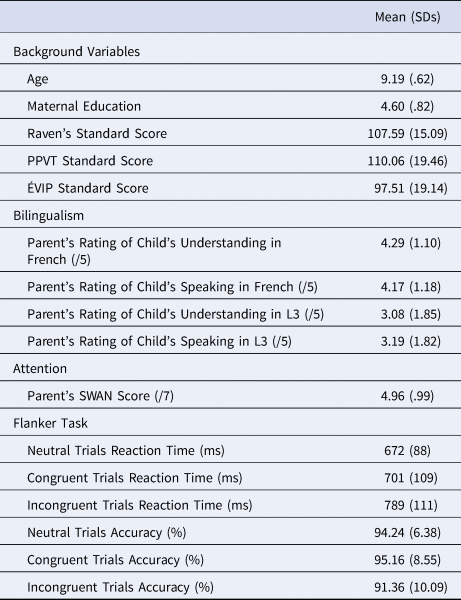
Descriptive statistics for all measures are presented in Table 1. One participant was removed because the mean reaction time for all conditions was 2.5 standard deviations above the sample mean. Accuracy across conditions was at ceiling. Due to the lack of variance, the accuracy rates were not analyzed further.
Descriptive statistics (and standard deviations) for all measures (N = 81).

Note. PPVT – Peabody Picture Vocabulary Test; ÉVIP - Échelle de Vocabulaire en Images Peabody; SWAN – Strengths and Weaknesses of Attention-Deficit/Hyperactivity Disorder Symptoms and Normal Behavior Scale.
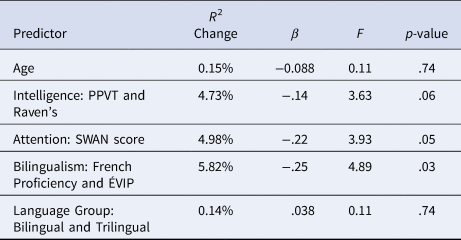
Results of the linear regression are shown in Table 2. The model was significant, F(5, 71) = 2.55, p = .03, with R2 = 15.24%. The control variables (Age or Intelligence) did not significantly predict reaction time, ps > .07. Attention (R2 = 9.80%, p = .05) and bilingualism (R2 = 15.62%, p = .03) both added significantly to the model. Language Group did improve the model, F < 1. Therefore, attention and bilingualism independently predicted overall reaction time on the flanker task. As in previous research, reaction time difference between the incongruent and congruent trials (flanker effect) yielded no significant predictors (cf. Sorge et al., Reference Sorge, Toplak and Bialystok2017).
Factors predicting overall reaction time on the Flanker Task.
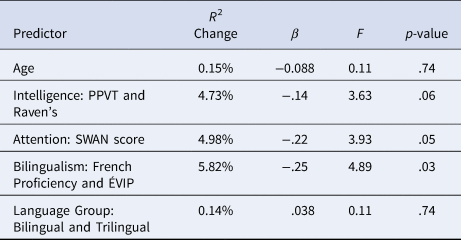
Note. All variables were centered.
Discussion
The current study treated attention and bilingualism as continuous variables and examined their contribution to performance on a flanker task. Within this group of emerging bilinguals with similar SES background and school instruction, bilingualism and attention independently predicted a significant portion of the variance. The higher the child's French abilities, the faster their responses on the flanker task. This finding is consistent with previous studies showing that bilingualism was associated with better EF performance, both when it was defined categorically (e.g., Blom, Boerma, Bosma, Cornips & Everaert, Reference Blom, Boerma, Bosma, Cornips and Everaert2017; Calvo & Bialystok, Reference Calvo and Bialystok2014; Poarch & Bialystok, Reference Poarch and Bialystok2015; Poarch & Van Hell, Reference Poarch and Van Hell2012) and continuously (Sorge et al., Reference Sorge, Toplak and Bialystok2017; Thomas-Sunneson et al., Reference Thomas-Sunesson, Hakuta and Bialystok2018). Furthermore, the higher the SWAN score, the faster the responses across conditions, consistent with the results reported by Sorge et al. (Reference Sorge, Toplak and Bialystok2017). Thus, within a group of high SES children, both bilingualism and attention ability are important for determining EF performance. Unlike some previous studies, however, there was no interaction between bilingualism and SES (e.g., Hartanto et al., Reference Hartanto, Toh and Yang2019), likely because of the narrow range of SES that was included in the sample. These results extend studies showing a positive effect of bilingualism for low SES children (Engel de Abreu et al., Reference Engel de Abreu, Cruz-Santos, Tourinho, Martin and Bialystok2012; Thomas-Sunesson et al., Reference Thomas-Sunesson, Hakuta and Bialystok2018) to those in a high SES environment.
As in results reported by Poarch and colleagues (Poarch & Van Hell, Reference Poarch and Van Hell2012; Poarch & Bialystok, Reference Poarch and Bialystok2015), exposure to a third language at home did not improve the prediction of flanker performance. Thus, it appears that practice managing attention between at least two languages is sufficient to reap the benefits in executive functioning. It should be noted that the scores for the other language (home language) were lower than the French scores, perhaps because parents were prioritizing French proficiency; parents had made a decision for their children to be educated in French. A more detailed investigation of the role of third language exposure is required to fully address this issue.
The main contribution of the present study is to confirm previously reported findings with a new sample that differs in SES and educational context. The novel feature of this study is that children are becoming bilingual through a controlled education experience rather than through home exposure, yet the results are similar to those previously reported for home bilingual children. Such replications are important: Many studies have reported no effect of bilingualism (e.g., children: Antón, Duñabeitia, Estévez, Hernández, Castillo, Fuentes, Davidson & Carreiras, Reference Antón, Duñabeitia, Estévez, Hernández, Castillo, Fuentes, Davidson and Carreiras2014; Morton & Harper, Reference Morton and Harper2007; young adults: Paap & Greenberg, Reference Paap and Greenberg2013; Paap, Johnson & Sawi, Reference Paap, Johnson and Sawi2015; older adults: Papageorgiou, Bright, Periche Tomas & Filippi, Reference Papageorgiou, Bright, Periche Tomas and Filippi2019), leading to an ongoing debate over whether experience with multiple languages leads to differences in cognitive performance (Antoniou, Reference Antoniou2019; Bak, Reference Bak, Sekerina, Spradlin and Valian2019). The context of the debate is the “replication crisis” in which some established findings have been found difficult to replicate. The replication crisis has led to a strong reaction in which researchers struggle to establish the validity of their results against the possibility of Type I error or flaws in the design of their studies that may be attributable to confounding variables. As a consequence, a new tolerance for the publication of “null results” has emerged as a means of “balancing” the record. Therefore, replication of positive effects is now as important as evidence of null effects to adjudicate the evidence regarding the possibility of bilingual effects on cognition. Examining bilingualism along a continuum is crucial in gaining insight into how factors associated with language experience can shape cognition.
Acknowledgements
This study was funded by grant R01HD052523 from the US National Institutes of Health to EB. The authors thank Lee Unger, Jasmin Filler, Aram Keyvani Chahi, Ryan Patak, Kornelia Hawrylewicz, and Michelle Goodman for their contributions to this study.