The achievement goal approach examines school achievement behavior in light of students’ motives. The basic assumption of achievement goal theory (Dweck, Reference Dweck, Gollwitzer and Bargh1996; Elliot, Reference Elliot, Elliot and Dweck2005; Nicholls, Reference Nicholls1984; Pintrich, Reference Pintrich2000) is that specific achievement goals - mastery goals and performance goals – generate different effects on students’ achievement behavior. Mastery goals represent a focus on the development of competence, and performance goals represent a focus on the demonstration of competence. Elliot and Church (Reference Elliot and Church1997) proposed the distinction between approach and avoidance tendencies. Following this distinction, which originated a “revised goal theory”, three main achievement goals are currently distinguished: Mastery goals, which focus on developing competence (e.g., “to learn”), performance-approach goals, which focus on attaining competence relative to others (e.g., “to do better than…”), and performance-avoidance goals, which focus on avoiding incompetence relative to others (e.g., “to avoid doing more poorly than…”). The mastery-approach and mastery-avoidance distinction has been less used.
These qualitatively different goals are found to be associated with different patterns of beliefs, cognitions, affect and behavior, which are differentially related with more and less adaptive learning outcomes (Elliot & Murayama, Reference Elliot and Murayama2008).
Research conducted within the first formulations of achievement goal theory (the so-called “dichotomous approach”) strongly supported a positive association of mastery goals with motivation and academic achievement (e.g., Dweck & Leggett, Reference Dweck and Leggett1988, Pintrich & De Groot, Reference Pintrich and De Groot1990). However, findings concerning performance goals were less consistent, revealing more complex goal effects (Bouffard, Boisvart, Vezeau, & Larouche, Reference Bouffard, Boisvert, Vezeau and Larouche1995; Greene & Miller, Reference Greene and Miller1996; Midgley, Kaplan, & Midleton, Reference Midgley, Kaplan and Middleton2001; Midgley & Urdan, Reference Midgley and Urdan1995; Pintrich & Garcia, Reference Pintrich, Garcia, Maher and Pintrich1991; Utman, Reference Utman1997; Wolters, Yu, & Pintrich, Reference Wolters, Yu and Pintrich1996).
One possible explanation for the variation in performance goal effects may lie in the very definition and operationalization of this type of achievement goals. In this line of thinking, the achievement goal literature has progressively scrutinized and illuminated the diverse components involved in performance goals, in order to allow a more precise definition and operationalization of these goals that might lead to a more sophisticated understanding of their effects (Barkoukis, Ntoumanis, & Nikitaras, Reference Barkoukis, Ntoumanis and Nikitaras2007; Brophy, Reference Brophy2005; Butler, Reference Butler2006; Elliot, Reference Elliot, Elliot and Dweck2005; Elliot & McGregor, Reference Elliot and McGregor2001; Elliot & Murayama, Reference Elliot and Murayama2008; Elliot & Thrash, Reference Elliot and Thrash2001; Grant & Dweck, Reference Grant and Dweck2003; Hulleman, Schrager, Bodman, & Harackiewicz, Reference Hulleman, Schrager, Bodman and Harackiewicz2010; Lemos, Reference Lemos1996; Urdan & Mestas, Reference Urdan and Mestas2006). This study expands this line of research by identifying the main dimensions implicated in achievement goals, by analyzing the variety of specific goals arising from the combination of those dimensions, and by assessing their relevance in organizing students’ motivation at different school levels. Moreover, the authors investigated the patterns of relationships of these goal dimensions with the three achievement goals traditionally considered by the revised achievement goal theory.
Next, the main dimensions intended to result in a more differentiated understanding of achievement goals will be presented.
Content dimensions of achievement goals
There still is no clear consensus about the conceptual definition of performance goals. For example, the goal ´to demonstrate competence' may have a range of different meanings such as overcoming a certain performance level, outperforming others, appearing able, or avoid looking unable.
Various reviews of the literature have identified two main dimensions of performance goals: the appearance dimension and the normative dimension (e.g., Elliot, Reference Elliot, Elliot and Dweck2005; Hulleman et al., Reference Hulleman, Schrager, Bodman and Harackiewicz2010; Urdan, Reference Urdan, Maher and Pintrich1997; Urdan & Mestas, Reference Urdan and Mestas2006). The appearance dimension refers to trying “to look competent”, to approval purposes. The normative dimension is apparent in strivings to “do better than others”, involving competition and social comparison.
Moreover, ideographic goal research relying on the description of what students say when directly asked about their goals, in their own words, in real classroom situations (Lemos, Reference Lemos1996; Lemos & Gonçalves, Reference Lemos and Gonçalves2004), highlighted a specific type of achievement goal related with evaluation concerns, which had not previously been considered in achievement goal theory. This type of achievement goal refers to getting positive (or avoid negative) evaluations, but does not encompass competition or self-presentation (e.g., “to get good grades”).
The pertinence of this type of goals, labeled either as simple evaluation goals, outcome goals or mastery extrinsic goals, has been subsequently acknowledged by different researchers (Grant & Dweck, Reference Grant and Dweck2003; Mouratidis, Lens, & Sideridis, Reference Mouratidis, Lens and Sideridis2010; Tuominen-Soini, Salmela-Aro, & Niemivirta, Reference Tuominen-Soini, Salmela-Aro and Niemivirta2008; Urdan, Reference Urdan, Pintrich and Maehr2004; Urdan & Mestas, Reference Urdan and Mestas2006).
Hence, besides mastery goals and various types of performance-related goals, focused on specific dimensions, it is apparent that students also pursue other achievement related purposes. In their review of the literature, Grant and Dweck (Reference Grant and Dweck2003) documented different subtypes of performance goals, including: 'ability’ goals, focused on validating or demonstrating one’s ability, ‘normative’ goals, focused on the competition-comparison with others, and ‘outcome’ goals, focused on achieving good results. The authors found different effects of ability goals and of normative goals. Only ability goals seemed to have a debilitating effect (after failure), predicting attributions to low ability, decreasing intrinsic motivation, low self-esteem and low achievement. As for the outcome goals, studies showed weak effects which were hypothesized to be because they share characteristics of both mastery goals and performance goals.
Mastery-extrinsic goals were conceptualized as a nuance within mastery goals (Tuominen-Soini et al., Reference Tuominen-Soini, Salmela-Aro and Niemivirta2008). While some mastery-oriented students use intrinsic criteria (mastery-intrinsic goals), mastery-extrinsic goals refer to the will to master a subject or to learn a new thing and to the use of grades or feedback as an external criteria of goal attainment (Niemivirta, Reference Niemivirta2002; Tuominen-Soini et al., Reference Tuominen-Soini, Salmela-Aro and Niemivirta2008). The evidence that mastery-extrinsic orientations shared similar motivational effects with mastery-intrinsic orientations on one-hand, and with performance-approach orientations on the other hand, indicated that similarly to outcome goals, the nature of mastery-extrinsic goals seems to lay between mastery and performance goals.
Thus, at least three subtypes of performance-related goals (i.e., ability goals, normative goals, and simple evaluation goals) should be distinguished, since they represent different specific purposes and seem to have a differential impact on students’ performance.
The relevance of performance goals
A further insight offered by ideographic goal research concerns the incidence of each type of goals in real classroom settings. Studies that used interviewing to elicit the meanings students attach to their goals (e.g., Lemos, Reference Lemos1996; Lemos, Leite, & Lopes, Reference Lemos, Leite and Lopes2007; Mansfield, Reference Mansfield2009; Urdan & Mestas, Reference Urdan and Mestas2006) revealed that students’ strivings mainly consist of goal statements such as getting good grades or avoiding poor grades. Above and beyond competition and self-presentation goals, non-competition, non-presentation, evaluation-related goals are the most frequent performance-related goals spontaneously reported by the students. This more frequently endorsed type of goals (labeled as simple evaluation goals) has been overlooked in achievement goal research. Note that Dweck’s (Grant & Dweck, Reference Grant and Dweck2003) “outcome goals” are more strongly phrased, challenging, and focused on good performance (e.g., “to perform really well”, “it is very important to me to do well…”), than simple evaluation goals, which are phrased more vaguely and seem to represent conformity with classroom minimal demands (e.g., “to get good grades”, “not to fail”).
Based on the relatively low natural incidence of competition and self-presentation, concerns have been raised about the degree to which students generate competitive goals spontaneously (Brophy, Reference Brophy2005). Traditional goal research focusing on competitive goals may have overly restricted the conceptual field of students' goals related to school performance. Given the different possible specific meanings that may be comprised within performance goals, research should acknowledge a larger variety of performance-related goals, in particular, including students’ simple evaluation goals, their nature and their role in motivating students’ learning and achievement.
The distinction between aims and reasons
Another approach to the clarification of the achievement goal construct and its associated outcomes is founded in the distinction between aims and reasons. Generally, goal theorists presuppose a link between goals and more basic psychological needs. The idea is that needs or motives (reasons) underlie specific concrete goals (aims), which make the cognitive mediation between more general motives and specific behaviors (Elliot & Church, Reference Elliot and Church1997; Elliot & Thrash, Reference Elliot and Thrash2001; Shan & Kruglanski, Reference Shan, Kruglanski, Boekaerts, Pintrich and Zeidner2000).
Basic psychological needs (e.g., the need for achievement) are viewed as providing the energization of goal-directed behavior. On the other hand, specific goals (the aim) provide direction, guiding behavior toward the accomplishment of needs or motives (Deci & Ryan, Reference Deci and Ryan2000; Ryan, Sheldon, Kasser, & Deci, Reference Ryan, Sheldon, Kasser, Deci, Gollwitzer and Bargh1996).
Observing that a goal or purpose can be defined in two ways – as an intended aim and as the reason behind the aim – goal theorists (Elliot, Reference Elliot, Elliot and Dweck2005; Elliot & Thrash, Reference Elliot and Thrash2001; Pintrich, Reference Pintrich2000) proposed an hierarchical model of achievement goals in which reasons (at the top level of the hierarchy) underlie more specific aims (at the bottom level). Most theorists have construed and measured achievement goals as a combination of aims and reasons, thus confounding the dimensions responsible for their effects (is it the reason or the aim?). The undifferentiated use of the goal concept (as reasons and as aims) might explain the mixed empirical results concerning the effects of performance goals.
In this line of thinking, those authors suggested a more precise and restrictive definition of the achievement goal construct as representing the aim to attain competence, “… extricating achievement goals from the reasons that they are being pursued for…” (Elliot & Thrash, Reference Elliot and Thrash2001, p. 144), such as to demonstrate competence to others or winning parents’ acceptance. Based on this reasoning, Elliot and collaborators advocated the measurement of goals and motives independently.
One concern to espousing this strategy is that performance goals extricated from the underlying reasons will be largely devoid of their meaning and consequently drained of their motivational power. Moreover, needs alone do not operate detached from a goal. When a need is not converted into 'something realistic to be done or achieved'- i.e., a goal- it creates a vague motivational state, a condition of helplessness (Nuttin, Reference Nuttin1984). Instead, as it is recognized by goal theorists, needs and goals “work closely together …The underlying reason is not left behind once it prompted goal adoption; rather it exerts its influence throughout the process of goal pursuit” (Elliot & Thrash, Reference Elliot and Thrash2001, p. 147).
In this sense, assessing goals alone may set up a misleading methodological artifice, by ignoring or eluding, rather than separating, the reasons or motives that are necessarily attached to the goals. An integrated assessment of goals, implying both reasons and purposes, also avoids the assumption that reasons represent the “real” motive behind the specific, conscious, “apparent” goals. Alternatively, an integrated assessment accounts for a conceptualization of goals as specific, concrete manifestations of more basic psychological needs (e.g., the need for achievement, the motive to avoid failure, the need for competence), deriving their motivating power from the need they are linked to but also from the specific goal-object.
In sum, in the present article it is argued that it is preferable to adopt an integrated approach to the disentangling of different types of achievement goals and its effects.
Dimensions organizing students’ goal pursuits at different grade-levels
Research has also attended to the role of the school context and of students’ age in determining students’ achievement goals and the effects of those goals (Matos, Lens, & Vansteenkiste, Reference Matos, Lens, Vansteenkiste, Kaplan, Karabenick and De Groot2009). It seems plausible that at different levels of schooling both individual developmental processes and contextual changes in the structure and dynamics of the school and classroom environment may accentuate or, conversely, attenuate the salience, distinctiveness and relevance of different achievement related dimensions such as mastery/learning, competition self-presentation/validation, evaluation, and approach/ avoidance tendencies.
For example, Urdan, Kneisel, and Mason (Reference Urdan, Kneisel, Mason and Urdan1999) evidenced that older students interpreted the performance-goal messages from their teachers differently than did younger students, who are less likely to interpret these messages in terms of performance goals. Other studies however have suggested that both younger and older children are susceptible to the effects of induced performance goals (Cain & Dweck, Reference Cain and Dweck1995; Smiley & Dweck, Reference Smiley and Dweck1994) although younger children seem to show a more general concern about self-worth in terms of “goodness” and “badness” (Burhans & Dweck, Reference Burhans and Dweck1995).
Age related cognitive shifts in conceptions of ability may also affect the focus of students’ concerns. According to Nicholls, only by adolescence students differentiate ability from effort, viewing ability as a fixed capacity (Nicholls, Reference Nicholls1984; Nicholls & Miller, Reference Nicholls and Miller1983, Reference Nicholls, Miller and Nicholls1984). These developmental differences are likely to impact which achievement related dimensions are attended to and affect students.
Also the context may influence which notion of ability will be used by students. There is evidence that the learning environment becomes more performance-focused when students move up in grade level (see Eccles & Midgley, Reference Eccles, Midgley, Ames and Ames1989; Harackiewicz, Barron, & Elliot, Reference Harackiewicz, Barron and Elliot1998; Midgley, Reference Midgley, Maehr and Pintrich1993; Stipek, Reference Stipek, Wigfield and Eccles2002), and this may imply that performance goals could be more adaptive in competitive contexts and for older students (Midgley et al., Reference Midgley, Kaplan and Middleton2001).
Thus, both age and co-occurring changes across school level will probably influence the dimensions organizing students’ goal pursuits as well as their effects.
Whereas research has reported differences in the relative endorsement of the different types of goals at different levels of schooling (see for example, Anderman, Austin, & Johnson, Reference Anderman, Austin, Johnson, Wigfield and Eccles2002), the present study analysed not only mean level differences in students’ achievement goals, but also differences in the dimensions organizing students’ achievement goals across school levels (middle school – grades 5th and 6th – and junior high school – grades 7th, 8th, and 9th).
Aims of the study
The actuality and pertinence of the debate about the nature and dimensions of achievement goals, their distinctiveness and effects is well reflected in the rather recent revisions of achievement goal theory (e.g., Brophy, Reference Brophy2005; Hulleman et al., Reference Hulleman, Schrager, Bodman and Harackiewicz2010; Kaplan & Maehr, Reference Kaplan and Maehr2007; Urdan & Mestas, Reference Urdan and Mestas2006) and in goal research (e.g., Elliot & Murayama, Reference Elliot and Murayama2008).
The aim of the present study was to contribute to a deeper understanding of the nature and dimensions involved in the goals that students pursue at school, expecting to lead to a more differentiated empirical definition of achievement goals.
The study tried to get a better understanding of students’ achievement goals by looking at goals that do not necessarily fit in the mastery-performance dimension. The aim is also to analyze goals which are pertinent to achievement striving but do not revolve around the self-presentation and competition dimensions. Moreover, instead of selecting pure competition and pure self-presentation goal items, and analyzing their distinctiveness and relations, this study added several hybrid goal items. In this sense, the present study expands Grant and Dweck’s (Reference Grant and Dweck2003) reasoning that goal combinations may be more ecologically valid, better reflecting students’ typical goal pursuits. To this effect, the three main goal dimensions referred in the achievement goal literature – competition, presentation, and goal valence – were systematically combined to form various types of achievement goals. Therefore, the eight resulting types of achievement goals represent a more extended operationalization of achievement goals, supporting the argument by Kaplan and Maehr (Reference Kaplan and Maehr2007) for the need to enhance the phenomenological realism of the achievement goal construct.
More specifically, the main aims of this study were: (a) to contribute to a deeper understanding of the conceptual and empirical scope of achievement goals, trying to establish the distinction and relevance of competition, and self-presentation dimensions potentially involved in those goals (b) to test the empirical distinction between approach and avoidance achievement goals in the academic context, and (c) to analyze the extent to which competition and self-presentation dimensions are implied in the three types of goals traditionally assessed in goal research (mastery goals, performance-approach and performance-avoidance goals). Considering the role of school grade-related factors the present study also (d) analyzed differences in the dimensionality of achievement goals across different levels of schooling.
Method
Participants
Students from two school levels participated in this study: 134 students from middle school (70 from the 5th grade, and 64 from the 6th grade) and 423 students from junior high school (135 from the 7th grade, 137 from the 8th grade, and 151 from the 9th grade), approximately equally divided by gender (44.8% and 47.2% boys, and 55.2% and 52.8% girls, in middle school and junior high school, respectively). The mean age of the participants from middle school were: 5th grade (M = 10.42, SD = .67), 6th grade (M = 11.43, SD = .68). The age of the participants from junior high school were: 7th grade (M = 12.17, SD = .92), 8th grade (M = 13.17, SD = .89), 9th grade (M = 14.05, SD = .78). Students attended three public schools in the north of Portugal, located in social-economical homogeneous middle-class areas.
Measures
Achievement goals
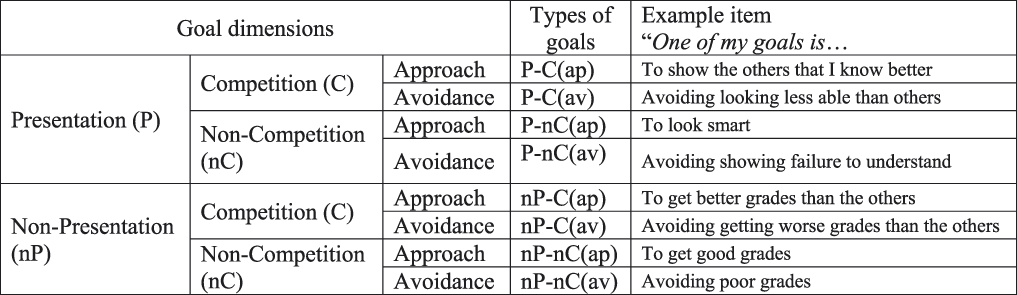
The present study tried to disentangle different types of achievement goals, while using an integrated assessment of goals, such that students’ achievement goals were assessed incorporating both reasons and aims. Hence, this study systematically combined the diverse achievement-related dimensions that may be embedded within a performance goal. As noted above, theoretical models of achievement goals have defined three major dimensions of performance goals: competition, self-presentation, and the valence (approach-avoidance) dimension. On the other hand, findings from interview studies evidenced a type of goals related with evaluation concerns, but with no reference to competition or self-presentation purposes (simple evaluation goals). In this study, a pool of goal items was constructed, based on the systematic combination of the three goal dimensions most often referred in the literature: (a) Competition, referring to the emphasis on interpersonal performance comparison; (b) Self- presentation, referring to concerns about one’s appearance of ability, and (c) valence, distinguishing approach and avoidance goals. Accordingly, in every goal item, self-presentation may be present (P) or absent (nP), competition may be present (C) or absent (nC), and valence may vary between approach (ap) and avoidance (av).
The specific phrasing of the achievement goal items was based on the operationalization of those goal dimensions identified by experimental, nomothetic or ideographic goal research (cf. major reviews of the goal literature by Elliot, Reference Elliot, Elliot and Dweck2005; Elliot & Murayama, Reference Elliot and Murayama2008; Hulleman et al., Reference Hulleman, Schrager, Bodman and Harackiewicz2010; Urdan, Reference Urdan, Maher and Pintrich1997; Urdan & Mestas, 2006).
Goal items were consistently formulated, using goal-relevant language, every item beginning by “One of my goals…”, maximizing interpretational equivalence. Goals were phrased generally, not tied to any specific subject matter domain (for a discussion of the domain specificity versus cross-domain generality assessment of goals, see for example Bong, Reference Bong2005).
These combinations form eight possible types of performance-related goals, as presented in Figure 1. The resulting goals do not represent goal types theoretically defined. Instead these exhaustive combinations of the dimensions previously identified aim to constitute a representative list of goals phrasing including single dimension and hybrid formulations.
Goal dimensions, types of goals, and example items.

Note that the two last types of goals are simple evaluation goals, without any reference to competition or presentation concerns. Finally, mastery goals were also included in the pool of items.
Personal Goals Scale
The personal goals scale of the Patterns of Adaptive Learning Strategies (PALS: Midgley et al., Reference Midgley, Maehr, Hruda, Anderman, Anderman, Freeman and Urdan2000) in its Portuguese version (Gonçalves, Lemos, & Rodrigues, Reference Gonçalves, Lemos, Rodrigues, Noronha, Machado, Almeida, Gonçalves, Martins and Ramalho2008), was also answered by middle school students. The aim was to analyze the relationship between performance-approach, performance-avoidance and mastery goals, as operationalized by the PALS, and the diverse goal dimensions considered in this study. This will allow clarifying the dimensions underlying the PALS’ traditional operationalization of achievement goals, and cross-validating the goal dimensions emerging from the present study against existing instruments.
Procedures
After obtaining the informed consent for data collection, students answered the achievement goals items in the classroom without the presence of the teacher. Two weeks later, middle school students also answered the personal goals scale of the PALS.
Results
Goal dimensions
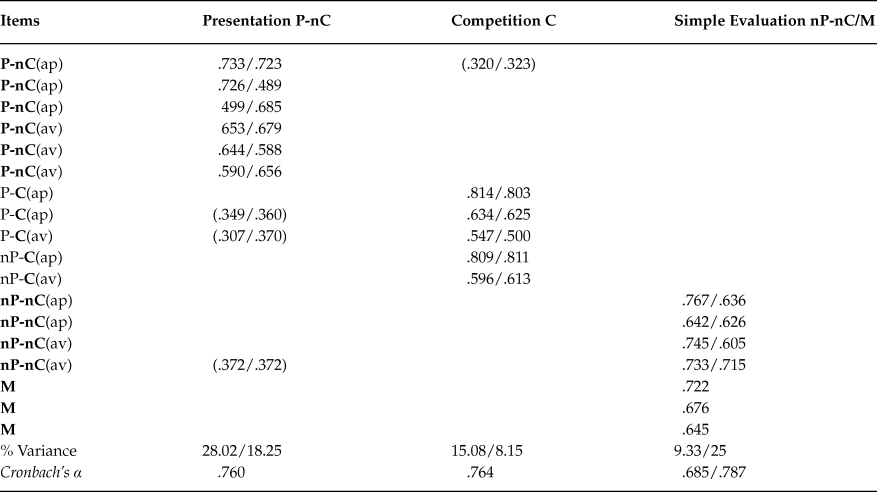
The results of principal components analysis (with oblique rotation) for middle school level revealed three factors (based on eigenvalues > 1) with high internal consistency (see Table 1). The first factor is marked by self-presentation goals/non-competition (P-nC), the second by competition goals (C), and the third by simple evaluation goals (nP-nC).
Dimensional Analysis (middle school)

Note: Values including mastery (M) items in the analysis are indicated after the dash (nP-nC/M).
The three factors are clearly different on goal-content. The approach-avoidance distinction did not emerge at this school level, each of the three factors integrating both approach and avoidance goal items.
In order to further explore the full 3 (content of goal) x 2 (approach-avoidance) framework underlying our items, separate factor analyses were conducted, one for each of the three (content of goal) factors, imposing the extraction of two factors. However, results did not evidence clear separate approach and avoidance dimensions for each goal content, at middle school.
When mastery items are added to the principal component analysis (see Table 1) they are fully integrated within the simple evaluation dimension, while the dimensional structure of the other factors remains entirely unchanged.
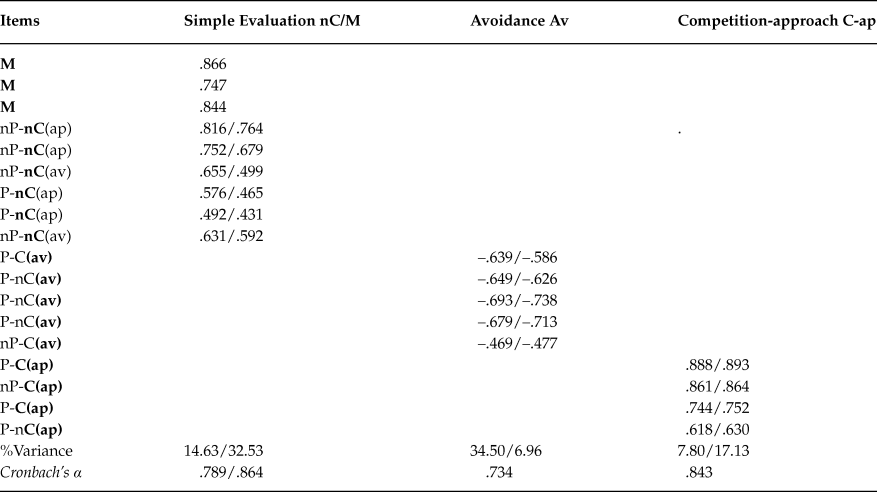
Exploratory principal components analysis (with oblique rotation) was also conducted on the data of the junior high school students. A three factors solution emerged (based on eigenvalues >1), as can be observed in Table 2. These factors revealed high internal consistency.
Dimensional Analysis (junior high school)

Note: Values including mastery (M) items in the analysis are indicated after the dash (nC/M).
Similarly to the simple evaluation goals found in middle school, one factor in junior high school was formed by all the non-presentation non-competition items (either approach or avoidance). However, in addition, two presentation non-competition (approach) items also belong to this factor. That is, all the items in this factor refer to non-competition goals (nC). An avoidance dimension emerged in junior high school (Av), bringing together all avoidance items (except for simple evaluation-avoidance items which converged in the previous factor). Finally a third separate dimension emerged (C-ap), marked by competition-approach (except for one PnC(ap) item, that was interpreted as competitive by older students, and also in part by younger students, as can be observed by the cross-loading in Table 1.
In sum, at junior high school, the approach-avoidance distinction underlies the extraction of two factors (the avoidance factor and the competition-approach factor). However, the simple evaluation goals factor was best defined by goal content, regardless of approach-avoidance valences. To further explore the approach-avoidance distinction within the simple evaluation goal factor, a subsequent factor analysis was conducted imposing the extraction of two factors on these goals. Still, results did not yield separate approach and avoidance tendencies.
When mastery goals were added to the principal component analysis the dimensional structure remained entirely unchanged, and mastery goals items were fully integrated within the simple evaluation dimension, as was observed for the middle school level.
Thus exploratory dimensional analysis conducted independently on the two samples (middle school and junior high school) revealed somewhat different structures of performance-related goals. Both structures are interpretable and indicate that the nature and dimensions of achievement goals may change along this grade range. The issue of structural goal differences has been usually overlooked, although the influence of developmental and contextual factors on students’ goals has been recognized (e.g., Fryer & Elliot, Reference Fryer and Elliot2007; Midgley et al., Reference Midgley, Kaplan and Middleton2001).
Grade-related structural differences
To further analyze the issue of a structural difference of the achievement goal construct across grade level we tested the two alternative factor models on both samples using a confirmatory approach with EQS 6.1 (Bentler & Wu, Reference Bentler and Wu2004). Model 1 is a three-factor structure (presentation goals, competition goals, and simple evaluation/mastery goals) with no distinction between approach and avoidance dimensions. Model 2 corresponds to a different three-factor structure consisting of one avoidance factor, one competition-approach factor, and the third factor comprising simple evaluation/mastery /presentation-approach goals. For each model it was specified that all items were constricted to load only on the corresponding factor, according to the EFA previous results.
Solutions were generated on the basis of maximum likelihood estimation. We used multiple indices of fit: chi-square, comparative fit index (CFI), normed fit index (NFI), nonnormed fit index (NNFI), root-mean-square error of approximation (RMSEA). Values above .95 for the CFI and values below .06 for RMSEA are indications of good fit (Hu & Bentler, Reference Hu and Bentler1999). In addition, the Akaike Information Criteria (AIC) index was used to compare the usefulness of the two models to accurately describe the data.
Based on the results of EFA and the modifications suggested in CFA, item 18 was excluded from the Model 2. This item has evidenced cross-loadings across the factors.
Results from CFA were consistent with the findings from EFA. The CFA analyses indicated that Model 1 provided a better fit to the data for the middle school sample: Model 1. χ²(132, N = 134) = 160.9156, CFI = .94, NFI = .74, NNFI = .93, RMSEA = .04, AIC = –103, 95% CI (.02 - .06); Model 2 χ²(116, N = 134) = 170.8320, CFI = .86, NFI = .68, NNFI = .84, RMSEA = .06, AIC = –61. For the junior high school sample, Model 2 provided a better fit to the data: Model 1. χ²(132, N = 423) = 490.9280, CFI = .85, NFI = .81, NNFI = .83, RMSEA = .08, AIC = 227; Model 2 χ²(114, N = 423) = 269.8638, CFI = .93, NFI = .88, NNFI = .92, RMSEA = .06, AIC = 42, 95% CI (.05 - .07).
Correlations between the goal dimensions and the PALS´s scales
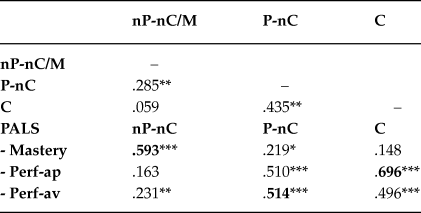
The correlations between goal dimensions and PALS’s scales were used for further explore convergent and discriminant validity. Results showed high and significant correlations between the PALS’s mastery goal scale and simple evaluation purposes (nP-nC). PALS’s performance-approach and performance-avoidance goal scales were also significantly correlated with competition purposes, and with presentation purposes (Table 3).
Correlations between Goal Dimensions and between Goal Dimensions and PALS scales (middle school)

* p < .05, **p < .01, ***p < .001.
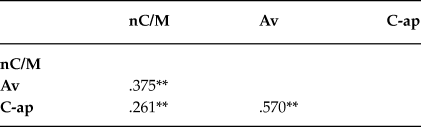
Correlations between goals dimensions are presented in Table 3 for middle school students and in Table 4 for junior high school students, showing low correlations between simple evaluation goals and competitive goals.
Correlations between Goal Dimensions (junior high school)

* p < .05, **p < .01, ***p < .001.
Moreover, avoidant goals, which emerged at junior high school as independent, still showed rather strong significant relations with competitive-approach goals.
Students’ goal priorities
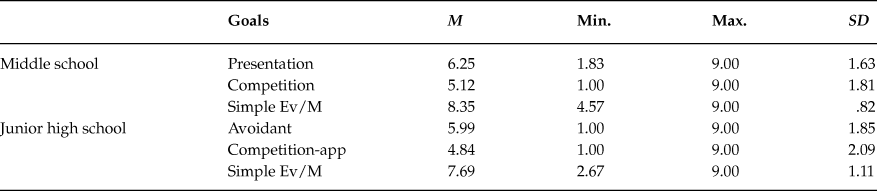
To examine the relative importance attached by students to the different types of goals, repeated measures (within-subject) comparisons were performed both for middle school students ‘goals (F(2, 266) = 220.98; p < .001; η2 = 0.624) and for junior high school students’ goals (F(2, 820) = 464.4; p < .001; η2 = 0.531). Pairwise comparisons showed significant differences between all types of goals (p < .001 for all comparisons).
Table 5 shows the relative importance attached by students to the different types of achievement goals.
Descriptive statistics of the Three Types of Achievement Goals by School Level

Results clearly evidence that either at middle school or at junior high school, mastery and simple evaluation goals are the main goals pursued by students, while other performance-related goals, in particular competitive goals, showed a relatively much lower mean.
Discussion
The aim of the present study was to contribute to a deeper understanding of the nature and dimensions of achievement goals. One of the specific aims was to disentangle the competition and the presentation dimensions involved in students’ achievement goals, and to test the distinctiveness of simple evaluation goals in relation to the other performance-related goals.
At both school levels a separate dimension emerged, formed by competition goals, focused on the comparison with others. These results suggest that students clearly distinguish between strictly competitive purposes and other types of performance-related purposes (such as to appear able and to get positive/avoid negative evaluations). These findings also provide empirical support to the proposed consideration of a specific type of competition performance goals (‘normative’ goals), as was suggested by Grant and Dweck (Reference Grant and Dweck2003). It should be noted however that students attach a significantly lower importance to competitive goals in relation to other achievement related purposes.
A second distinct type of performance-related goals was apparent in middle school students, representing a concern with appearing able. For these students self-presentation of ability emerged as an independent motivator, separated from the other performance-related dimensions. This particular type of goal is similar to the concept of ‘capability’ goals defined by Grant and Dweck (Reference Grant and Dweck2003), which the authors considered particularly debilitating of students’ motivation and achievement. However, the self-presentation dimension did not arise in isolation in the junior high school sample, where it appeared integrated in other factors, namely according to goal valence: presentation-avoidance items (to avoid looking unable), appear embedded in the avoidance dimension, whereas presentation-approach items (to look able), appear combined with both simple-evaluation goals and with competition goals. In other words, in older students, presentation purposes did not stand alone, being partially subordinated to their valence dimensions.
As hypothesized, findings also evidenced a simple evaluation factor, which formed a separate dimension in the middle school sample. To corroborate the nature of this type of goals this study analysed their relations with the other goal dimensions. Results clearly show simple evaluation goals to be closely linked to mastery goals. The similarity of the essence of the two goals is evidenced both because they load on the same factor when mastery goal items are entered in the EFA and because of the strong correlation found between simple evaluation goals and the mastery goals scale of the PALS’s system. That is, although simple evaluation goals refer to performance-related purposes, the nature of these goals is very similar to that of mastery goals. These results are in line with research on outcome goals conducted by Grant and Dweck (Reference Grant and Dweck2003) and with research on mastery-extrinsic goals (Niemivirta, Reference Niemivirta2002; Tuominen-Soini et al., Reference Tuominen-Soini, Salmela-Aro and Niemivirta2008). Moreover, simple evaluation goals are distinct from other types of performance goals, as was also suggested by their low correlations with performance-approach or performance-avoidance goals of the PALS system, and with other competitive goals.
The relations of this type of goals with achievement outcomes should be investigated in subsequent studies, especially as this was also the most important type of performance-related goals pursued by the students. Being so closely linked to mastery goals, these simple evaluation goals will probably not show the debilitating effects on student’s motivation and achievement that have been associated with other types of performance-related goals.
In sum, concerning simple evaluation goals the findings of this study provide empirical foundation for the arguments (see Brophy, Reference Brophy2005; Calado, Reference Calado2009; Grant & Dweck, Reference Grant and Dweck2003; Lemos, Reference Lemos1996; Lemos & Gonçalves, Reference Lemos and Gonçalves2004; Lemos et al., Reference Lemos, Leite and Lopes2007) to consider students’ non-competitive evaluation concerns in educational goal research. Moreover, contrary to outcome goals as defined by Grant and Dweck (Reference Grant and Dweck2003), which have been equally correlated with mastery and performance goals (Grant & Dweck, Reference Grant and Dweck2003; Sideridis & Mouratidis, Reference Sideridis and Mouratidis2008), the present research strongly suggests that simple evaluation goals are closely related to mastery goals, rather than to performance goals. Recently, in the physical education context, Mouratidis and colleagues (2010) also reported positive relations between goals focusing on attaining outcomes and mastery-related goals.
Another goal of this study was to further explore goal valence, analysing the distinction between approach and avoidance goals. The results of exploratory and of confirmatory factor analysis did not support the empirical approach-avoidance distinction for younger students. For these students, trying to achieve a good performance and trying to avoid poor performance seems equivalent.
However, results suggest a growing importance of avoidance motivation by junior high school. Two study findings pointed to this tendency. First, avoidance of failure appeared as an independent motivator for older students. Secondly, as previously stressed, results separated presentation-avoidance goals from the other presentation goals at this grade level. These findings suggest that once in place (by junior high school) avoidance motivation may overtake the role of presentation concerns as a more powerful organizer of students’ motivation. Given the generalized findings showing debilitating effects of performance-avoidance goals (Church, Elliot, & Gable, Reference Church, Elliot and Gable2001; Elliot & Harackiewicz, Reference Elliot and Harackiewicz1996; Skaalvik, 1997), these results would have important implications for the organization of the classroom goal structures and of the school climate aimed to minimize and cushion the older students’ apparent stronger avoidance tendency.
It is nevertheless interesting to note that whereas an avoidance factor was differentiated, a corresponding approach factor did not emerge. At this school level avoiding failure becomes salient, taking precedence over the goal content, gathering together all avoidant goal items, be they competition or presentation goals. In contrast, the positive valence of success did not override the specific content of the goal. In fact, the approach items were broken down according to goal content, in particular according to the presence or absence of the competition dimension. These findings offer support to previous suggestions to differentiate performance-related goals according to different specific goal content (e.g., Grant & Dweck, Reference Grant and Dweck2003; Midgley et al., Reference Midgley, Kaplan and Middleton2001). However, those authors focused only on the approach component of goals. The present study further suggested that in contrast with approach motivation, in what concerns avoidance motivation specific goal content seems less relevant.
An additional implication of these findings is that the distinction between approach-avoidance goals may not be pertinent before a certain level of schooling. Since most achievement goal research has been conducted with secondary school or university students it would be interesting to confirm a possible age-related trend in the role and effects of approach and avoidance motivation.
The present study also analysed differences in the dimensionality of achievement goals across school levels (middle and junior high school). The evidencing of specificities in the nature and dimensions of students’ goals at the two school levels suggested the existence of different meanings of success and failure as well as different students’ concerns, supporting the role of developmental factors in influencing the differentiation and relevance of specific goal dimensions. Findings from other studies also suggested structural goal changes along schooling (e.g., Bong, Reference Bong2009), but with a progressive stability among older students (e.g., Pulkka & Niemivirta, Reference Pulkka and Niemivirta2013).
For example, the emergence of avoidance goals in older students may be related to the age of the students and to a more competitive school climate at this educational level. The transition to junior high school is typically marked by more strict evaluation criteria, and a greater appreciation and focus on performance outcomes. This increased emphasis on normative evaluation provides greater salience of social comparison. Converging with the environmental salience, students of this age become especially attentive to how they perform relative to others and make a more defensive use of the social comparison information. Moreover, age-related cognitive shifts may also focus students on conceptions of ability as capacity (see, for example, Nicholls & Miller, Reference Nicholls, Miller and Nicholls1984). In future research it will be interesting to follow the evolution of the avoidance dimension and its relation to the school context goal structures as students move up to subsequent grade levels.
Trying to contribute to clarify the conceptual and empirical dimensions of the achievement goal construct, the present study examined the extent to which the various goal dimensions considered in this study are implied in the three types of goals typically assessed within achievement goal research (i.e., mastery goals, performance-approach and performance-avoidance goals). Besides the expected association previously referred between mastery goals (PALS) and simple evaluation goals, correlations also showed a strong association between the performance-approach (PALS), and competition and presentation dimensions, as well as between performance-avoidance goals (PALS) and these same dimensions. These results support the assumption made in this study, by showing that the personal goals scales of the PALS indistinctly assess competition and presentation, although students distinguish these two goal dimensions.
Further supporting these findings, a number of studies have suggested differential effects of the two dimensions - competition and presentation (Grant & Dweck, Reference Grant and Dweck2003, Wolters et al., Reference Wolters, Yu and Pintrich1996). Failing to recognize the distinction among the various goal dimensions can partially explain some contrasting results of research on the effects of performance goals. It seems therefore critical to distinguish these components in the conceptualization and operationalization of performance-related goals.
From the analysis of the dimensionality of students’ performance-related goals a separate competition dimension emerged at both school levels. Thus, students clearly distinguished between more 'muscled' purposes to outperform others and other evaluation-related goals. However, a distinction should be made between relevance and incidence in relation to competition goals. Whereas competition is a relevant dimension, this does not imply the frequency or importance of those goals to students. In fact, competition goals were the least endorsed type of achievement goals.
A second dimension, simple evaluation goals, deserves special mention. Results of this study support the contention that goals that involve competition and presentation only partially cover the conceptual field of performance-related goals. 'Wanting to have good grades' (or avoid bad grades) is also an important organizer of student performance-related motivation. In fact, it stands in this study as one of the more important types of students’ achievement goals. This type of goals appears similar in nature to mastery goals, being closely linked to them. Having good grades (or avoiding poor grades) is not definitely connoted with the competitive purposes that early goal literature typically assigned to performance goals, and which potentially undermine students’ concentration on learning. Thus, a concern with evaluation reflected in the pursuit of goals focused solely on absolute outcomes seems to be an integral part of students' perspective on the nature of school learning.
In what regards the approach and avoidance distinction, this study pointed to some interesting findings. First, only for older students goal valence seems to be a relevant motivator. For the younger students the concern about not doing worse than the others does not seem to be different from the desire to do better than others. Nevertheless, it would be important to understand whether performance-approach and performance-avoidance goals may still have differential effects at this level of education, even if students do not seem to experience the distinction.
The emergence of an avoidance dimension in junior high school reveals a greater defensive preoccupation with achievement among students at this level of education, which should prompt the identification of influencing grade-related factors. The second interesting finding concerning the approach-avoidance distinction is the hypothesis that was discussed above, claiming that avoidance tendencies may constitute more powerful motivators than approach tendencies in the school context. This implies that, once an avoidant motivation is in place, it will prevail in organizing students’ school-related strivings, possibly over and above goal-content or competence dimensions. The verification of this hypothesis would bear important implications for goal research and for the organization of classroom goal structures, namely in terms of efforts to prevent avoidance motivation because of its less adaptive outcomes.
In summary, findings of this study support the potentialities of a more differentiated goal model for confirming and developing traditional goal research, expanding our knowledge about the relationships between goals, motivation, and achievement outcomes, as well as their educational implications.