Implications
This study was conducted to evaluate organic acid salts inclusion in calf starters as a replacement to the traditional use of ionophore, since these antibiotics were banned as growth promoters in the European Union. Since all commercial starters include ionophores, an alternative additive that could result in the same pattern of animal performance should be studied. The organic acid salts were chosen because they lack the antibiotic effect but could have beneficial effects on the rumen development processes. In addition, as seen in the non-ruminant industry, acidified feeds may have a beneficial effect on the health of the lower gastrointestinal tract.
Introduction
Calf rumen development, crucial for the early weaning program, is strongly related to the intake of fermentable organic matter and the resulting short-chain fatty acids (SCFA; Greenwood et al., Reference Greenwood, Morrill and Titgemeyer1997). Ruminal metabolism studies have pointed out butyric and propionic acids as the main stimuli for rumen development and the maturation process (Quigley et al., Reference Quigley, Boehms, Steen and Heitmann1992), which suggests that additives that furnish higher SCFA concentrations or alter the rumen fermentation pattern may be used as a tool for reducing the milk feeding period.
The inclusion of ionophores in ruminant diets has shown changes in the SCFA concentrations, mainly with increases in propionic acid and reduction in acetic and butyric acid, as a result of its effect in selecting against Gram-positive bacteria in the rumen (Russell and Strobel, Reference Russell and Strobel1989). Moreover, positive effects are observed in animal growth in early weaning program systems with the use of ionophores (Fitzgerald and Mansfield, Reference Fitzgerald and Mansfield1984; Watkins et al., Reference Watkins, Wray, Basson, Feller, Olson, Fitzgerald, Stromberg and Davis1987; Anderson et al., Reference Anderson, Nagaraja, Morrill, Reddy, Avery and Anderson1988). However, other authors did not observe differences in performance when ionophores were fed via milk replacer (Quigley et al.,Reference Quigley, Boehms, Steen and Heitmann1992) or starter (Nussio et al., Reference Nussio, Huber and Nussio2002; Nussio et al., Reference Nussio, Santos, Zopollatto, Pires and Morais2003a; Klotz and Heitmann, Reference Klotz and Heitmann2006), probably because of variation in the rumen development among evaluated animals. However, even though in several countries sodium monensin is included in most commercial starters, the use of ionophores as growth promoters has been already banned in the European Union, which may be a tendency in other countries.
Salts of SCFA may be considered as an alternative to replace sodium monensin as additives for starters for calves with under-developed rumen. In vivo investigations with non-ruminant tissues have shown that sodium butyrate is effective in stimulating cellular growth (Janssens and Nollet, Reference Janssens and Nollet2002). Calcium propionate has been used as a readily available energy source to prevent metabolic disorders in cows. Even though in vitro and in vivo trials with infusion of acids suggest positive effects of the use of salts of butyric or propionic acids on rumen development, no literature was found regarding its inclusion in starters and effects on forestomach maturation and animal growth.
The objective of this study was to evaluate the effects of inclusion of sodium butyrate, sodium monensin and calcium propionate in starters on heifer calves’ performance and plasma metabolites, before and after weaning.
Material and methods
Twenty-four Holstein heifer calves were utilized in a completely randomized block experimental design. Trial was conducted at the Embrapa Southeast Cattle, SP, Brazil, between March and November 2006. After birth, calves were separated from the dams and housed in individual hutches, receiving 2 l of colostrum as soon as possible, and every 12 h during 2 days. After that, calves received daily 4 l of whole milk, split into two meals (7 and 18 h), starter ad libitum and water free choice.
Calves were blocked considering age and weight of birth, and distributed in one of the treatments according to the additive included in the commercial starter: (i) sodium butyrate (150 g/kg of dry matter (DM) basis; Adimix®Butyrate c, Inve Nutri-Ad, Karterlee, Belgium); (ii) sodium monensin (30 mg/kg DM, Rumensin®, Elanco Animal Health Ltd, Greenfield, IN, USA); and (iii) calcium propionate (150 g/kg DM, Fungiban®, Pfizer, Exton, PA, USA). Doses were calculated based on literature data with organic acids infusion directly into the animal’s rumen (Lane and Jesse, Reference Lane and Jesse1997). A single coarsely ground commercial starter, formulated as the National Research Council (NRC, 2001) recommendation with ground corn, soybean meal, wheat meal and mineral mixture, was fed. Each one of the additives was mixed to the starter using a Y mixer. The starter containing one of the additives was offered daily in individual buckets, after orts removal, which was weighted daily.
Weaning was done abruptly at the 8th week of life, regardless of concentrate intake. After weaning, coast cross hay (Cynodon dactylon (L.) pers.) was offered ad libitum, in individual buckets, and weekly intake was monitored.
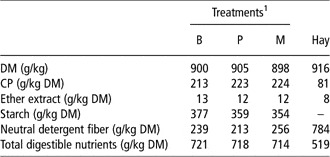
Starter and hay samples were taken monthly, dried at 55°C and ground through a 1-mm mesh for DM and organic matter determination according to the procedure of the Association of Official Analytical Chemists (AOAC, 1990); CP by combustion, according to the Dumas method, was determined using an N analyzer by LECO®, model FP-528 (St. Joseph, MI, USA); free-ash neutral detergent fiber was determined, according to the method of Van Soest et al. (Reference Van Soest, Robertson and Lewis1991), using sodium sulfite and thermostable amylase; and starch was determined as described by Poore et al. (Reference Poore, Eck, Swingle and Theurer1989). Values of total digestible nutrients (TDN) were calculated by the equations proposed by Kearl (Reference Kearl1982). Table 1 presents starters and hay chemical composition.
Chemical composition of starters feed and coast-cross hay

DM = dry matter.
1Starter containing B = sodium butyrate; P = calcium propionate; M = sodium monensin.
Calves were weighed at birth and once every week, before morning feeding, until 10 weeks of age. Using a ruler with a centimeter scale, wither heights and hip width were measured weekly; hearth girth was measured by a flexible tape, also graded in centimeters.
Blood samples were taken weekly, 2 h after morning feeding, from the 4th week of age until the end of the trial, via jugular venipuncture by vacuum tubes containing sodium fluoride and potassium ethylenediamine tetraacetic acid. Samples were centrifuged at 2000 × g (20 min at 4°C) and plasma was stored until analyses. As indicators of rumen development, plasma glucose, β-hydroxybutyrate (BHBA) and non-esterified fatty acids (NEFAs) concentrations were evaluated. Plasma glucose was determined by the auto analyzer YSI 2700 (Biochemistry Analyser, Yellow Spring, OH, USA). NEFAs were measured using the commercial kit NEFA-c (Wako Chemicals GmbH, Richmond, VA, USA), with modifications for a microplate reading (BIO-RAD, Hercules, CA, USA), using an absorbance filter of 540 nm. Determinations of plasma BHBA were conducted using a commercial kit by CATAGEM C444-10, with adaptations for a microplate reading (BIO-RAD, Hercules, CA, EUA), using an absorbance filter of 340 nm.
Data of DM intake, BW, average daily gain (ADG) and body measurements were analyzed as repeated measures by the PROC MIXED of SAS according to the model
(1). Plasma concentrations of glucose, NEFA and BHBA were analyzed by the PROC MIXED of SAS, including week of age in the model
(2). Significance was adopted for values of P < 0.05 for all parameters.


where, Yijk is the response variable, μ is the overall mean, Ti is the treatment effect, Bj is the block effect, Wk is the age effect and Eijk is the residual effect.
Results and discussion
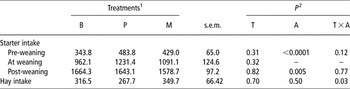
Table 2 presents DM intake of starter and hay. Starter intake was not affected by treatments; however, as expected, there was a significant age effect, with increasing starter intake as calves aged. Other authors have also observed increases in starter intake with age of calves, mainly as a result of rumen development and increased intake capacity during the first weeks of life (Klein et al., Reference Klein, Kincaid, Hodgson, Harrison, Hillers and Cronath1987; Luchini et al., Reference Luchini, Lane and Combs1991; Greenwood et al., Reference Greenwood, Morrill and Titgemeyer1997; Klotz and Heitmann, Reference Klotz and Heitmann2006).
Least-square means of starter (g DM/day) and hay (g DM/week) intake by heifer calves receiving starter containing sodium butyrate, sodium monensin or calcium propionate

DM = dry matter.
1Starter containing B = sodium butyrate; P = calcium propionate; M = sodium monensin.
2T = treatment effect; A = age (week) effect; T × A = treatment and age interaction effect.
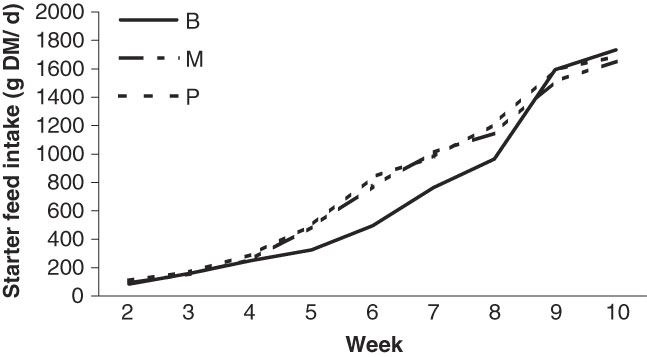
The interaction effect of treatment and age was significant, with lower starter intake for the sodium butyrate treatment as compared to the starter containing sodium monensin or calcium propionate during the 6th and 7th weeks and as compared only to calcium propionate during the 8th week (Figure 1). Even though the sodium butyrate-containing starter has resulted in lower intake during those weeks, there were no differences among treatments at weaning, when animals consumed about 1 kg DM/day.
Starter feed intake (g DM/day), according to week of age, by heifer calves receiving starter containing sodium butyrate (B), sodium monensin (M) or calcium propionate (P).
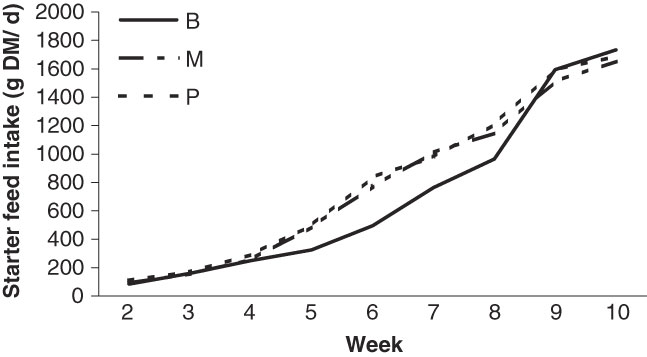
Starter intake values were higher than expected according to the review of Davis and Drackley (Reference Davis and Drackley1998), although observed starter intakes before weaning were similar to those presented by Quigley (Reference Quigley1996b). However, Nussio et al. (Reference Nussio, Santos, Zopollatto, Pires and Morais2003a) observed low intake by calves receiving starter with or without monensin inclusion during the milk feeding period, which may have decreased animal performance during the subsequent period.
Several authors have found lower starter intake by calves fed a starter containing monensin when compared to control. According to Nussio et al. (Reference Nussio, Huber and Nussio2002), inclusion of monensin in the starters for calves may have a negative influence on solid feed intake. These authors observed lower intakes of starter with monensin during the period after weaning, suggesting that the negative effect may occur when the animal presents the rumen partly developed. In addition, literature frequently shows the inhibitory effect of monensin on DM intake by adult animals (McGuffey et al., Reference McGuffey, Richardson and Wilkinson2001). However, no control treatment was tested during this trial, since most commercial starters have monensin in their composition.
Our results show adequate starter intake by heifer calves fed monensin, which may be fed to enhance performance in programs that use solid intake as a criterion for weaning, as recommended by Quigley (Reference Quigley1996a). In a review by Goodrich et al. (Reference Goodrich, Garret, Gast, Kirick, Larson and Meiske1984), monensin has no effect on feed intake.
In the only published work evaluating calcium propionate, the additive was fed via milk replacer and the starter intake was not monitored (Bunting et al., Reference Bunting, Tarifa, Crochet, Fernandez, Depew and Lovejoy2000). The inclusion of calcium propionate was supposed to reduce starter intake since propionate is associated with the feed intake-controlling process, probably by reducing the time to indicate satiety during a meal (Bradford and Allen, Reference Bradford and Allen2007). Theoretically, feeding readily available energy for growing calves could result in reduced starter intake or increased daily gain without changes in intake, since these animals are not on negative energy balance. However, this effect was not seen at the present trial.
Data of hay intake refer only to the post-weaning period and are presented in Table 2. Hay intake (g DM/day) was not different among treatments, even though there were significant effects of the interaction of treatment and age, with lower intake for sodium butyrate treatment during the week after weaning (week 9). After weaning, calves took about 3 to 4 days to initiate hay intake; however, after that, the intake was always increasing. The adequate starter intake and consequent ruminal development may have contributed to the satisfactory hay intake after weaning. Forage intake is important to promote rumen wall muscular growth and maintain ruminal epithelium health (Quigley, Reference Quigley1996a). Lizieri et al. (Reference Lizieri, Cunha, Martuschello and Campos2002) observed a lower starter intake when star-grass pasture or alfalfa hay was available during the milk feeding phase. According to those authors, hay feeding may reduce starter intake as a result of the low intake capacity, being recommended only after weaning. Nussio et al. (Reference Nussio, Santos, Zopollatto, Pires and Morais2003a) observed low hay intake by calves weaned with 6 weeks of age, probably because of a minor rumen development as a result of the low starter intake. Similar results were found by Bernardes et al. (Reference Bernardes, Coelho, Carvalho, Oliveira, Reis, Saturnino, Silva and Costa2007) and Suárez et al. (Reference Suárez, Van Reenen, Stockhofe, Dijkstra and Gerrits2007), who observed low hay intake during the first weeks of age of dairy calves.
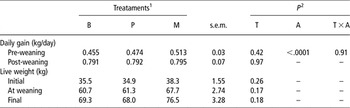
Table 3 shows ADG and live weight (LW) observed during periods before and after weaning. ADG and the average of LW were not affected by treatments during all evaluated periods. These animal growth rates are in agreement with those observed in the literature for milk-fed calves (Hoffman, Reference Hoffman1997; Heinrichs and Losinger, Reference Heinrichs and Losinger1998; Kertz and Chester-Jones, Reference Kertz and Chester-Jones2004), as a result of the adequate starter intake, which allowed adequate daily gains even after weaning.
Least-square means of average daily gain and live weight of heifer calves receiving starter containing sodium butyrate, sodium monensin or calcium propionate

1Starter feed containing B = sodium butyrate; P = calcium propionate; M = sodium monensin.
2T = treatment effect; A = age (week) effect; T × A = treatment and age interaction effect.
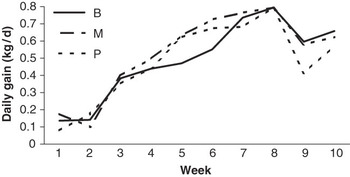
Figure 2 reveals the progression on daily gain during the experimental period as a result of the simultaneous increase in feed intake. The daily gain reduction after week 8 for all treatments resulted from the weaning process, a period in which large digestive and metabolic changes take place, with the cessation of milk feeding. Nevertheless, it can be seen that daily gain increased rapidly during the following week because of the increased starter intake. It is important to emphasize that starter intake was still increasing during the weaning week and after that, but probably not at an adequate rate to maintain animal growth rate.
Average daily gain (kg/day), according to week of age, by heifer calves receiving starter containing sodium butyrate (B), sodium monensin (M) or calcium propionate (P).

Even though calves on sodium butyrate treatment consumed a smaller amount of starter during weeks 6, 7 and 8 (Figure 1), it did not significantly affect weight gain (P = 0.85) or LW (P = 0.23). Figure 2 shows clearly the lower weight gain of this treatment exactly during the weeks when smaller intakes were seen, even though significant differences among treatments were not found.
The supplementation of monensin or other ionophore for dairy calves has resulted in inconsistent outcome with regard to animal performance. Although some authors have shown benefits from ionophore supplementation on animal performance (Fitzgerald and Mansfield, Reference Fitzgerald and Mansfield1984; Watkins et al., Reference Watkins, Wray, Basson, Feller, Olson, Fitzgerald, Stromberg and Davis1987; Sinks et al., Reference Sinks, Quigley and Reinemeyer1992; Quigley, Reference Quigley1996c), others have not (Stockdale et al., Reference Stockdale, Sheard and Tiffin1982; Foreyt et al., Reference Foreyt, Rice and Wescott1986).
In the study of Bunting et al. (Reference Bunting, Tarifa, Crochet, Fernandez, Depew and Lovejoy2000), the supplementation of calcium propionate via milk replacer had no effect on weight gain, as it was observed in the current trial. Sumner et al. (Reference Sumner, Valdez and Mcnamara2007) have also not observed better weight gains or LW of heifers with about 11 months of age-fed chromium propionate in several doses. Even though several commercial milk replacers have included sodium butyrate as an acidifier, data regarding the performance of calves fed this additive via a starter are scarce.
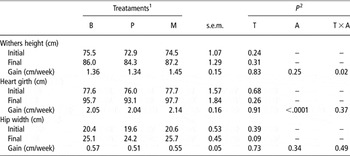
The final measures of wither heights and hearth girth were not affected by treatments and are presented in Table 4. Although initial measures of hip width were also not affected by treatments, there was a tendency (P = 0.09) for calves fed the starter containing calcium propionate to have smaller values at the end of the experimental period. Likewise, there were significant differences among treatments, with calves on calcium propionate starter presenting smaller average value of hip width as compared to the other treatments. According to Heinrichs et al. (Reference Heinrichs, Erb, Rogers, Cooper and Jones2007), the main body development measures have high correlation with LW and animal performance. Data of wither heights are in agreement with data from Heinrichs and Hargrove (Reference Heinrichs and Hargrove1987) and Hoffman (Reference Hoffman1997) with commercial herds in United States.
Least-square means of wither height, heart girth and hip width of heifer calves receiving starter containing sodium butyrate, sodium monensin or calcium propionate

1Starter containing B = sodium butyrate; P = calcium propionate; M = sodium monensin.
2T = treatment effect; A = age (week) effect; T × A = treatment and age interaction effect.
Weekly gains of all body measurements were not affected by treatments and are in agreement with those observed for calves of similar age by other authors (Cowles et al., Reference Cowles, White, Whitehouse and Erickson2006; Kehoe et al., Reference Kehoe, Dechow and Heinrichs2007). Wither heights are in conformity with values recommended in the literature for milk-fed calves, which suggest optimal weekly gains of around 1.3 to 1.4 cm for animals up to 2 months of age (Hoffman, Reference Hoffman1997).
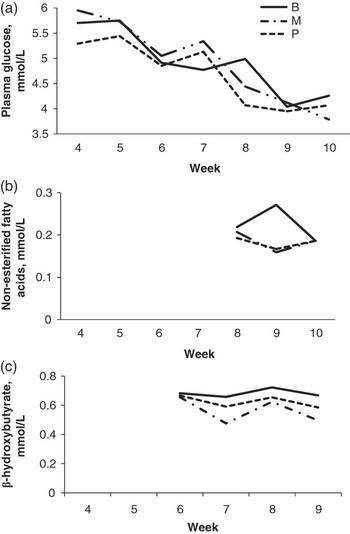
Figure 3 presents the average values for plasma glucose, NEFA and BHBA concentrations 2 h after morning milk feeding. There were no significant treatment effects for plasma glucose concentration in any of the evaluated periods. Observed values are in agreement with those found in the literature for calves of similar age (Quigley and Bernard, Reference Quigley and Bernard1992; Nussio et al., Reference Nussio, Santos, Zopollatto, Pires and Morais2003a).
Plasma glucose (a), non-esterified fatty acids (b) and β-hydroxybutyrate (c) concentration (mmol/l), according to week of age, of heifer calves receiving starter containing sodium butyrate (B), sodium monensin (M) or calcium propionate (P).

Owing to the ruminal fermentation pattern modification, as a result of monensin supplementation, with higher propionate concentrations (McGuffey et al., Reference McGuffey, Richardson and Wilkinson2001), a higher plasma glucose concentration was expected for calves fed starter containing the ionophore. Similarly, the direct supplementation of propionate via calcium propionate should have resulted in the same response, since propionate is the main glucose precursor in the liver (Bergman, Reference Bergman1990). However, these effects would be seen only in animals with the rumen already developed. Nussio et al. (Reference Nussio, Santos, Zopollatto, Pires and Morais2003a) also have not observed differences in plasma glucose concentration in calves fed starter with or without monensin.
Even though there were no differences among treatments, a significant age effect was observed on plasma glucose concentration. A reduction of the glucose concentration as animals aged, response correlated to the rumen development and the transition of calves from pre-ruminant to functional ruminant, was observed. Martin et al. (Reference Martin, Ramsey, Matrone and Wise1959) replaced calves’ diets with organic acid salts infused directly into the rumen and observed a reduction in plasma glucose concentration with progressing age. Other authors have also found a similar pattern for glucose plasma concentrations according to animal age (Quigley et al., Reference Quigley, Smith and Heitmann1991a; Nussio et al., Reference Nussio, Santos, Zopollatto, Pires and Morais2003a). However, Quigley and Bernard (Reference Quigley and Bernard1992) have not seen reductions in glucose levels according to week of age during the milk-feeding phase, probably because of the low DM intake observed and consequent delayed rumen development. According to Fraser (Reference Fraser1991), adult cattle plasma glucose concentrations fluctuate from 2.3 to 4.1 mmol/l, suggesting that calves already had the rumen developed by weeks 8 and 9 (Figure 3).
There were no significant differences among treatments for NEFA concentrations. The assessment of plasma NEFA concentration was carried out only at the weaning week and the weeks thereafter to evaluate possible body reserves mobilization as a consequence of the weaning. As emphasized by Quigley (Reference Quigley1996b), circulating NEFA is negatively correlated with solid diet intake, with reductions in the concentrations being expected with advancing age of calves. In the current trial, NEFA concentrations were not increased after weaning, suggesting no body reserve mobilization as a result of adequate starter intake. Plasma NEFA concentrations are comparable to data found in the literature (Quigley et al., Reference Quigley, Caldwell, Sinks and Heitmann1991b; Quigley and Bernard, Reference Quigley and Bernard1992; Nussio et al., Reference Nussio, Santos, Zopollatto, Pires, Morais and Fernandes2003b; Klotz and Heitmann, Reference Klotz and Heitmann2006) with calves of similar age.
The plasma BHBA concentrations were determined only during the period from weeks 6 to 9 and were not affected by treatments. The values observed are in agreement with those presented by others with calves of similar age (Quigley et al., Reference Quigley, Caldwell, Sinks and Heitmann1991b; Quigley and Bernard, Reference Quigley and Bernard1992; Klotz and Heitmann, Reference Klotz and Heitmann2006). The high BHBA values observed after the 6th week of life are related to the high starter intake (Figure 1), indicating rumen development and the beginning of metabolism of final fermentation products by the rumen epithelium (Bergman, Reference Bergman1990).
Even though there was a tendency (P = 0.08) for age effect, significant increases on BHBA concentrations were not observed. It is possible that the adequate starter intake already at the 6th week (about 800 g DM/day; Figure 1) resulted in early rumen development, suppressing the observation of age effect on plasma BHBA. On the other hand, evaluation of BHBA reveals an increase in plasma concentrations with advancing age of calves (Quigley et al., Reference Quigley, Boehms, Steen and Heitmann1992; Klotz and Heitmann, Reference Klotz and Heitmann2006). According to those authors, the BHBA concentration increase reflects the increased concentration of butyrate in the rumen, mainly because of the increased solid feed intake as animals mature.
Conclusion
The inclusion of sodium butyrate, calcium propionate or sodium monensin as additives in starter feeds resulted in equal animal performance, before and after weaning, suggesting that sodium monensin may be replaced by SCFA salts. Performance and changes in plasma metabolites suggest that rumen development is more dependent on starter intake than on feed additive.
Acknowledgments
The authors wish to express their appreciation for the financial support provided by the Fundação de Amparo à Pesquisa do Estado de São Paulo (FAPESP) as scholarship and research funding; and to Southeast Embrapa Cattle for the animals and housing use permission.