1. Introduction
Over the past two decades, scholarly work has emerged from diverse disciplines within the social sciences to delve into the negative economic and political phenomena commonly associated with natural resource-based development. Within this literature, various crucial concepts were formulated, including the “resource curse,” a term commonly attributed to geographer Richard Auty (Reference Auty1993). Auty argues that the observed underperformance of resource-rich countries is due to weak domestic linkages in mining development. The concept of “resource curse” gained significant academic popularity, largely due to the cross-country regression analysis by economists Jeffrey Sachs and Andrew Warner in (1997), which gave rise to many quantitative-based studies linking dependency on resource exports with poor economic growth rates. The association of these two variables became highly contested, as conclusions differed subject to sampled data, variable definitions and model specification (Lederman and Maloney Reference Lederman and Maloney2007; Van der Ploeg Reference Van der Ploeg2011; Venables Reference Venables2016; Wick and Bulte Reference Wick and Bulte2009). A recent new wave of econometrics-based research has emerged studying within-country rather than cross-country variation. Its findings in relation to the prevalence of the resource curse are less gloomy, yet still diverse (Allcott and Keniston Reference Allcott and Keniston2016; Caselli and Michaels Reference Caselli and Michaels2013). Concurrently, in light of noteworthy experiences with autocracies, corruption, and civil war in developing countries, political scientists question whether resource booms (and busts) benefit democracy (Brooks and Kurtz Reference Brooks and Kurtz2016; Dunning Reference Dunning2008; Karl Reference Karl1997; Ross Reference Ross2012).
Do institutions make the difference? A collection of quantitative-based studies claim that institutions mediate both economic and political outcomes. Whether the discussion revolves around economic growth rates or the ideal characteristics of democratic regimes, the argument remains that institutional quality determines success or failure (Mehlum et al. Reference Mehlum, Moene and Torvik2006; Robinson et al. Reference Robinson, Torvik and Verdier2006; Van der Ploeg Reference Van der Ploeg2011). Beyond its over-simplifications of rationality – unbounded rent-seeking behavior is commonly assumed rather than explained – the positivist approach to political economy presents a fundamental problem: the business perceptions-based data sets on which it relies say very little about narrowly defined institutions, or about state institutions specifically (Kurtz and Schrank Reference Kurtz and Schrank2007). Historically oriented political economy, yet another family of research, focuses on contextualized explanations of whether and how natural resource dependence “curses” nations. Case studies trace historical processes of institutions building (Brooks and Kurtz Reference Brooks and Kurtz2009; Dargent et al. Reference Dargent, Orihuela, Paredes and Ulfe2017; Saylor Reference Saylor2014; Thorp et al. Reference Thorp, Battistelli, Guichaoua, Orihuela and Paredes2012). A review of the paved road in research reveals a need to critically integrate approaches to studying the resource curse, as well as more insightful research on which institutions matter, how, when, and where.
This paper contributes to the literature by providing a taxonomy of the resource curse and making the case for more place- and institution-sensitive research. Expounding six governance challenges and thirteen development traps, I set out a simple yet crucial lesson for standard quantitative economic development literature: resource-based development presents both blessings and curses for any given resource-rich country in any given time period, and institutions are likely to be part of the explanation. I argue that within a given producing country, the rentier centers and the resource peripheries experience resource development in different ways; neither the consequences of resource development nor the institutions with which they interplay are the same across national space, which matters for every dimension of governance relating to the curse. Spatially uneven development is likely to intensify when the resource economy is located on the global periphery, where all too commonly poverty and inequality are high and state reach is limited. Thus, I challenge overly simplistic analyses of the cursing and blessing properties of resource dependence, question the narrow role often attributed to institutions, and explore the power of place, a frequently dismissed topic within the conversation.
The argument builds on, but also challenges, the conventional literature. That the consequences of resource development are heterogeneous across national space is, in one way or the other, already assumed by new research on the local resource curse: producing regions are commonly compared to non-producing ones, within quasi-experimental setups. Yet how are we to read this emerging evidence on the apparent absence of a local resource curse? If a “blessing” is found for a (set of) resource-rich site(s), in a given period, would that mean that “resource-based development works,” everywhere and every time? Would we just need to collect more within-country econometric studies to confirm the findings of some form of local treatment effect corresponding to mining/oil, irrespective of local context? I have two central objections to such a view: (1) the problem of external validity, as the estimated impact may be the outcome of an internal variable assumed not to be important, such as an economic, geographical or institutional factor; and (2) the problem that understanding how institutions matter demands that we researchers go beyond quantitative-based social science knowledge. I translate the central argument of Deaton and Cartwright (Reference Deaton and Cartwright2016)’s authoritative discussion on the possibilities and limits of randomized control trials (RCT), to argue that rather than looking for “what works” (resource-based development), we should ask “why it works,” given that we ignore how generalizable an RCT finding is outside of its context (Allcott Reference Allcott2012; Heckman and Vytlacil Reference Heckman, Vytlacil, Heckman and Leamer2007; Rosenzweig and Udry Reference Rosenzweig and Udry2016).Footnote 1 The problem of external validity has also been addressed by historians of economic development while reflecting on how to draw lessons from history (Chang Reference Chang2002) – and so experiments, regressions, and history have more in common than is normally presumed. To this line of argument, the article adds that (1) it is also important to ask where resource development works (and where it does not) and (2) answering why it works can benefit greatly from qualitative-based and mixed-method research strategies, because institutions are likely to condition the relationship between resources and development outcomes. In a nutshell, rather than asking whether a curse or blessing exists in universal terms, better to ask why and how there is a blessing (curse), and when and where there is such a blessing (curse).
The remainder of the paper is organized as follows. Section 2 introduces a resource curse taxonomy. Section 3 reviews the narrow “institutions matter” account that is prevalent throughout conventional resource-curse literature. Section 4 calls for an alternative and complementary “context matters” political economy perspective for the study of the curse. Section 5 sketches how such a perspective could guide future research, showing how institutions and place contextualize the governance challenges of resource development with illustrations from the Latin American experience. Finally, section 6 concludes by arguing that contextualized social science research can contribute important “nuanced, layered explanations” (Rodrik et al. Reference Rodrik, Subramanian and Trebbi2004: 133) of resource development traps and escapes to the resource curse conversation.
2. The resource curse: an integrative, cross-disciplinary taxonomy of traps and diseases
The resource curse debate has become a somewhat deadlocked academic conversation. The lack of consensus begins with varying definitions of the “resource curse” itself and ends with differences over what constitutes a legitimate finding. Curse or blessing? Well, it depends. I argue that the way in which resource curse mechanisms unfold are likely to vary with contextual specificities, and so theory and history need to talk to each other. It makes perfect sense to observe that resource wealth reaps success in some cases and failure in others; or that a case of a blessing (curse) becomes a curse (blessing) over time. If one understands economic development in terms of an evolutionary framework based on multiple equilibria, the single equilibrium is considered a feasible but unlikely possibility (David Reference David1985; Hirschman Reference Hirschman1958; Hoff and Stiglitz Reference Hoff, Stiglitz, Meier and Stiglitz2001; Rosenstein-Rodan Reference Rosenstein-Rodan1943). Yet too many social scientists – economists above all – have been searching for a universal law or theorized single equilibrium. For mainstream neoclassical economics in particular (prior to the incorporation of assumptions regarding increasing returns, complementarities, problems of information, coordination failure, and bounded rationality), it was common to assume that “every equilibrium is a Pareto optimum, and, in general, the equilibrium is unique” (Hoff and Stiglitz Reference Hoff, Stiglitz, Meier and Stiglitz2001: 389–90). Context mattered little to such scholarship, unlike the once influential work of early development economists.
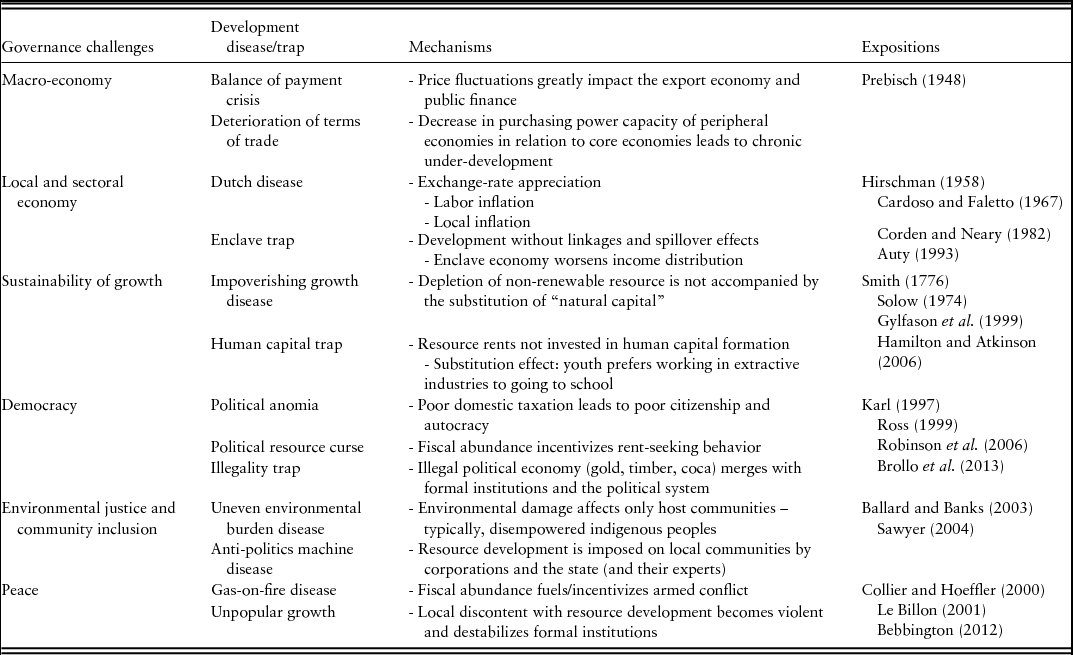
Therefore, an otherwise fruitful exchange of simplifying theories, statistical trends, and detailed qualitative research too often becomes a static quarrel among one-truth holders. If revised properly, the array of seemingly conflicting findings of resource-curse literature presents many lessons. What do we know? That there is a curse and there is a blessing, and there is no single typical case. Why and how? There are a number of stylized mechanisms (see Table 1) that could, in principle, be contributing to a curse. However, having a taxonomy of resource curse diseases does not mean that every single case of resource abundance is to fall into all of the identified development traps/diseases. Besides the fact that “natural capital” is not the only relevant factor contributing to development, historical contingency matters and it would be fallacious to assume that all units of analysis are subject to the same historical – temporal and spatial – context. Resource-based development does not take place in a void.
A Resource Curse Taxonomy

Acknowledging structural (factor endowments) and historical (contingent temporal and spatial social phenomena) complexity, the study of institutional environments constitutes a promising line of work in contributing to a better understanding of resource curses and blessings. Yet “institutions” are much more than a rule of law perception index, a discussion which I will return to below. This paper contends that it is time to move toward more nuanced empirical explanations of when, where and how resource wealth curses societies. Context-matters political economy has much to contribute to the resource curse debate because place and institutions are crucial dimensions to consider.
This article uses “resource curse” as an umbrella concept containing the diverse problems associated with the dependence on and/or abundance of natural resources. As such, the proposed resource curse taxonomy includes theories proposed decades before “resource curse” was even coined as a term (in the early 1990s), such as the Dutch disease or Latin American dependency theory. In fact, resource curse theories can be traced back to the foundational book of modern economics, Adam Smith's An Inquiry into the Nature and Causes of the Wealth of Nations. Discussing the colonies, Smith singled out extractives as an economic activity that reduced the wealth of nations (“instead of replacing the capital employed in them . . . [they] commonly absorb both capital and profit”) and so recommended formal institution makers (“a prudent law-giver, who desired to increase the capital of his nation”) not to encourage such projects (The Wealth of Nations, Book IV). Table 1 summarizes six governance dimensions, a dozen identified development diseases or traps, and corresponding mechanisms that define the political economy of development when an economy revolves around resource development. The table was based on the most influential texts and complemented with references for Latin America on environmental justice and conflict, secondary areas in the literature.Footnote 2 Table 1 schematizes what we already know from knowledge produced across the social sciences, offering an integrated taxonomy to identify the challenges commonly associated with resource-based development. The table is inspired by Rodrik's (Reference Rodrik2000) quest for institutions of high-quality growth, and draws upon Orihuela (Reference Orihuela2013). Resource-based development is multi-dimensional and any given governance dimension has a political economy of its own.
The taxonomy illustrates the variety of associated, but essentially different, social phenomena classified as the resource curse. When referring to the resource curse, conventional economists will commonly discuss national economic growth figures, which under this framework is classified as the macroeconomic variety of the resource curse. Many more governance dimensions of economic well-being come into play, each entailing one or more curse forms: the Dutch disease, the enclave curse, the unsustainability of economic growth curse, the political resource curse, the environmental justice curse, the conflict curse, and so on. Thus, governance challenges go beyond short-term GDP growth rates or equivalent short-term local economy income. In all governance challenges, place is significant, as discussed in more detail later.
I employ the term “governance challenges” to refer to the different dimensions of resource development and emphasize the importance of institutional context. I use “governance” instead of “government” because, in theoretical as much as in practical terms, the state is not the single relevant actor (nor arena) in resource development management. At the national level, depending on technocratic traditions, committees of independent experts from academia and think-tanks, rather than state officials, could be in charge of relevant macroeconomic or environmental policy to curb curse effects. Chile is a noteworthy example (Orihuela Reference Orihuela2013). At the local level, neighboring communities and their institutions will largely influence micro-political and -economic phenomena. These entities could support contentious collective action and/or provide social capital to maximize spill-over effects and linkage-formation policy. Overall, the legacy of state–society relationships will heavily influence the size of the state and its involvement in national economic development and the mining industry (Dargent et al. Reference Dargent, Orihuela, Paredes and Ulfe2017). I illustrate this contention below with examples from Latin America.
Defined governance challenges are not fully independent from one other. A poorly managed macro-economy and resulting social discontent could lead to a weakened democracy and violent conflict. Historical examples in Latin America are manifold. In the 1920s and 1930s, Chile – a state commonly portrayed as the politically stable Latin American success story – had about a dozen heads of state, depending on how one defines an actual presidency. This historical process of high political instability was shaped by dependence on nitrates in the context of global economy turmoil (Orihuela Reference Orihuela, Thorp, Battistelli, Guichaoua and Paredes2012). Over the last decade, amidst socioenvironmental discontent and high fiscal linkages to municipal governments, the price-driven volatility of transfers to local political units triggered protests across the Peruvian Andes (Arellano-Yanguas Reference Arellano-Yanguas2011; Haslam and Tanimoune Reference Haslam and Tanimoune2016). In turn, the political resource curse, and the activation of rent-seeking behavior, will likely lead to poor provision of public goods and therefore negative microeconomic impacts, both short- and long-term (Brollo et al. Reference Brollo, Nannicini, Perotti and Tabellini2013). However, some governance challenges are more associated with these phenomena than others. In particular, good macroeconomic governance could reduce the possibility of conflict, though it holds no evident relationship with the governance of environmental inequities.
I find that there is a need to “bring the structure back” into the analysis of economic development. In all six governance challenges defined in Table 1, institutions and place matter to some extent. However, because of the influence of narrow views within neoclassical economics, which has permeated the field of political science, most resource-curse literature either oversimplifies or ignores the significance of institutions, place and any other structure contextualizing human behavior. A well-established tradition within neoclassical economics presents a false dilemma for economic development students, erroneously forcing them to choose between mathematics and history, causing a fundamental epistemological problem (Hodgson Reference Hodgson2001). Inductive economic knowledge, which by virtue of beginning in the real rather than the abstract can be more in tune to the shaping roles of contextual factors, is largely disregarded (Arthur Reference Arthur1994, Reference Arthur2014). As a prominent contemporary economist once put it, economics all too commonly carries an unrestrained and exclusivist “willingness to do violence to the richness and complexity of the real world in order to produce controlled, silly models that illustrate key concepts” (Krugman Reference Krugman and Krugman1995: 40), often sacrificing accurate assumptions in the name of deductive prediction (Friedman Reference Friedman and Friedman1953). However, recent theoretical progress in development economics is enabled precisely because assumptions are not sacrificed in the name of prediction, within a multiple equilibria paradigm (Hoff and Stiglitz Reference Hoff, Stiglitz, Meier and Stiglitz2001). This is of much importance, because “predictive capacity” is not the same as “capacity to explain why things happen the way they happen”: while more than one theory can be capable of predicting a real-world phenomenon, not all of them will be capable of explaining it. My view is that because of the long-nurtured scholarly habit of evading human complexity, which in turn renders engagement with other social sciences impractical (Hoff and Stiglitz Reference Hoff and Stiglitz2016), neoclassical economists have been prone to ignore (North Reference North1990) or give a narrow meaning to institutions and the way they matter for human action (Greif Reference Greif2006). Ultimately, the study of institutions, in particular, and how context matters for economic systems, in general, demands interdisciplinary dialog (Greif Reference Greif2006; Ostrom Reference Ostrom2007). Next, I characterize the narrow and ultimately misleading conceptualization of institutions pervading resource-curse scholarship.
3. The narrow “institutions matter” standpoint of the conventional resource-curse literature
All too commonly, mainstream economic literature defines institutions and their roles in the narrowest terms. Flaws stem from assumptions on human behavior (ultra-selfish rationality) and what constitutes good institutions (property rights and the minimal yet efficient state), the quality of the data used, and the assumptions of how institutions evolve over time and (do not) vary across space. As Chang Reference Chang2011: 481) put it: “today's dominant discourse on institutions and development fails to recognize that the relationship is not linear, differs across societies, and changes over time even in the same society.”
Robinson et al. (Reference Robinson, Torvik and Verdier2006) illustrate the limits of the conventional wisdom that “institutions matter.” This stance maintains that the curse's political foundations are the incentives structure put in place for “rational” politicians by resource booms. Institutions that ameliorate such incentives would therefore be those promoting “accountability” and “state competence” – having them would allow nations to escape the curse. One could sympathize with the argument that “the critical factor of determining curse or blessing is the interaction between institutions and resources” (Robinson et al. Reference Robinson, Torvik and Verdier2006: 451 or Mehlum et al. Reference Mehlum, Moene and Torvik2006), but unbounded, ultra-selfish, rent-seeking behavior is not the only mechanism underpinning the two-way relationship. Such argumentation frequently builds upon the assumption that politicians cannot commit to long-term goals and that “each politician cares about his own utility and the utility of his own group (party, clan, ethnic group, etc.)” (Robinson et al. Reference Robinson, Torvik and Verdier2006: 451–2). However, while politicians care about their political careers, their rationality is contextualized by the institutional environments to which they belong. One way or the other, agency is socially embedded (Granovetter Reference Granovetter1985; Polanyi Reference Polanyi1944). Furthermore, politics repeatedly redefines the factors constituting group identity, socio-spatial consciousness and group goals (Jones Reference Jones2008; Paasi Reference Paasi1991). If short-sighted rent-seeking is okay, there must be an institutional environment that makes it okay.
The “political foundations of the resource curse,” to which the title of the seminal Robinson et al. (Reference Robinson, Torvik and Verdier2006) refers, are subject to the political conduct the authors assume, from which they derive a formal model. The argumentation is circular: the rent-seeking society equilibrium stems from the assumption of short-sighted, selfish agents. This is exactly the criticism made, two decades ago, by Peter Evans (Reference Evans1995) about neoclassical economists unable to explain the success of the interventionist East Asian states. If some bureaucracies end up in a rent-seeking equilibrium and others reach a developmental state equilibrium, the state official, assumed by law of nature to be rent-seeking, could not be behind both outcomes. Moreover, one should add, being non-uniform and dynamic, states could take on various ideal forms – rent-seeking or predatory and developmental, among others – across space and over time.
To understand the resource curse, it is time to assume less and explain more. Rather than sacrificing truth in the name of prediction, we need real-world micro-foundations to think about how resources and institutions interact, in particular places, at particular times. When used to explain all real-world phenomena, a theory built on wrong or oversimplified assumptions leads to overly simplistic discussions and misleading – or plain wrong – conclusions. To make things clear, I do believe that ultra-selfish behavior exists or can potentially exist everywhere in the world, and that if such behavior somehow becomes prevalent it will matter one way or the other for institutional evolution and development outcomes; what is erroneous is to assume short-sighted, rent-seeking conduct as the natural law of political development behavior and therefore cite it as key to explaining all resource-curse phenomena. Thus, Robinson et al. (Reference Robinson, Torvik and Verdier2006) argue that resource-rich Indonesia somehow escaped the curse because Berkeley-trained economists (presumably because they were taught to maximize social welfare at graduate school and/or due to self-selection), rather than non-committal, rent-seeking politicians, run macroeconomic policy. The argument holds an element of truth, of course, since macroeconomic policy requires expertise – but not so much accountability. However, for professional technocrats to run policy, political elites must also be committed to economic ideas, and/or have faith in economists’ credentials as scientists. It is also possible for a resource-rich country to be subject to a policy pact between proficient macroeconomists and corrupt state leaders, or for corrupt, rent-seeking economic authorities to run the macro-economy of a resource-abundant country reasonably well – after all, it is in their rational self-interest too! In such circumstances, there might be sustained economic growth and still bad institutions.
A reductionist assumption of the good (therefore “irrational”?) technocrat and the short-sighted, “rational” politician will not be sufficient to explain historical cases. Instead, such an assumption should be taken as one stylized theoretical case, which simplifies a phenomenon previously identified by qualitative-oriented research (Gelb Reference Gelb1988; Karl Reference Karl1997). That it exists in theory, and that it identifies one way to predict an equilibrium type previously described in a set of case studies, does not prove that it holds true in practice, everywhere and every time, as it constitutes one type of resource curse trap out of many feasible ones, in a world of multiple equilibria (see Table 1). Within mineral-abundant Latin America, Peru under Fujimori (1990–2000) provides an excellent example of good economic growth in spite of bad institutions, and economic growth not automatically creating good-for-all institutional development (Dargent et al. Reference Dargent, Orihuela, Paredes and Ulfe2017): while there was little accountability under this non-democratic regime, state competence developed almost exclusively in “islands of efficiency” (such as the Ministry of Finance). Transparency International's 2004 Global Corruption Report ranked Fujimori seventh in a list of the top ten corrupt presidents, citing his embezzlement of US$600 million. As the typical Latin American dictator or civil caudillo, President Fujimori was not known to build institutions for accountability. However, such corrupt figures and institutions did not stop Peru from growing. Even good student Chile exemplifies the compatibility between rent-seeking behavior and professional macroeconomic policy management:Footnote 3 Pinochet turned out to be a thief who kept his US$21 million fortune under the radar during his lifetime. In more of a gray area, the armed forces of Chile seized 10% of state-owned copper giant CODELCO's revenues, using the money to buy weapons and guarantee pensions to the military (Orihuela Reference Orihuela2013). Rent-seeking/corruption and economic growth can coincide, as the historical record shows (Quiroz Reference Quiroz2008), as long as rent-seeking/corruption do not stop the growth engine. Thus, despite the conventional argument, Peru led Latin America's economic growth rates (5.9% between 2005 and 2015) while accompanying Brazil and Paraguay at the top of the Latin American rankings for corruption and unfavorable perception of political institutions according to perception surveys (Latinobarómetro 2015). A cynical interpretation would be that, more than accountability and state competence, it is the predictability of corruption that matters for GDP growth; if corrupt pro-growth rules of the game, such as paying a “reasonable” bribe to technocrats and politicians running the state, are well-known and routinely practiced, the game becomes a “win-win” and the engine of growth keeps on running. There are many plausible explanations for the stylized phenomenon of reasonably good macroeconomic management under conditions of resource dependence.
In conventional resource-curse literature, which claims that institutions rule, next to the problem of unrealistic assumptions lies the issue of bad quality data. The quality-of-institutions database used in cross-country regressions not only betrays a narrow understanding of which institutions matter for economic development (Chang Reference Chang2011), but is also built on highly problematic perception surveys typically applied to business elites (Kaufmann et al. Reference Kaufmann, Kraay and Mastruzzi2009). As Kurtz and Schrank (Reference Kurtz and Schrank2007: 542) put it, reliance on such surveys “requires the assumption that the interests of investors (foreign investors in particular) and the interests of the nation are essentially coterminous,” an assumption stemming from the idea that the best government is the smallest one and the friendliest to big capital. Dominant measures of “good governance” suffer from perceptual biases, adverse selection in sampling, and conceptual conflation with economic policy choices (Kurtz and Schrank Reference Kurtz and Schrank2007).
Last but not least, besides the issue of what they really measure, indexes of “institutions” provide data for the national, rather than the sub-national level. Are we to believe that institutions are homogeneous within a national space? What does it mean to have “accountability” and “state competence” within a given developing country? And “state competence” to do what, other than protect property rights? Besides seeking quantitative data sets that can give us a better approximation to “the quality of institutions” at the sub-national level, we need a better conceptualization of institutions, why they matter, and the varied forms they can take across and within nations. I turn to this next.
4. A context-matters political economy framework of the resource curse
Once we reject the standard oversimplified “institutions matter” argument, we find ourselves back at the starting point: what are institutions and how ought we to think about them in relation to a spatial perspective of the curse? When stating that “institutions matter,” I refer to institutions as institutional environments, systems composed of formal and informal rules, organizations and belief systems (Greif Reference Greif2006; Polanyi Reference Polanyi1944), rather than to the conventional depiction of institutions as rules only (North Reference North1990). I define institutions as social constructs that shape cognition and set up incentive structures, enhancing and constraining agent-level behavior. Critical institutional economists find that Douglass C. North's canonical view of institutions as constituting “the rules of the game” biases the research agenda toward formal rules and away from habits and other forms of “informal rules” studied by old institutional economics in the tradition of Thorstein Veblen (Greif Reference Greif2006; Hodgson Reference Hodgson2006, Reference Hodgson2014). Informal rules matter because they also shape individual and collective behavior, as North himself underlines elsewhere in the same work (North Reference North1990: 3). Moreover, some organizations become institutions, in the sense that they come to embody beliefs and norms, and create esprit de corps, situating – rather than determining – the behavior of agents (Selznick Reference Selznick1966). These organizations are far more than simple players of the game and are certainly not exactly “equivalent to individuals.” The whole system of rules, organizations, and the belief systems that comprise and give them meaning matters for the configuration of incentive structures and the broader shaping of culture and agent-level behavioral functions (Greif Reference Greif2006; Hoff and Stiglitz Reference Hoff and Stiglitz2016; Martin Reference Martin and Sheppard2000). It is better, then, to expand our analytical focus to the arena of institutional environments, rather than to focus only on “the rule of law” and the property rights system. How do institutional environments evolve? To a large extent, they are subject to path-dependency, because of underpinning returns to scale and cognition mechanisms (David Reference David1985; Pierson Reference Pierson2004; Scott Reference Scott2008). The structural conditions for a “point of origin” (such as colonial institutions, which were shaped by geography and the distribution of factor endowments among social groups), matter a great deal (Coatsworth Reference Coatsworth2005; Engerman and Sokoloff Reference Engerman and Sokoloff1994). Historical contingency, in turn, has a significant influence on institutional paths, as external events (financial crises, natural disasters, or political regime change) create opportunities for institutional change (Collier and Collier Reference Collier and Collier1991; Pierson Reference Pierson2004). But institutional change is not always radical; it can also be piecemeal, resulting, for instance, from the progressive introduction of regulation and new organizational habits (Mahoney and Thelen Reference Mahoney and Thelen2010). Institutions evolve, moreover, because paradigms and institutional blueprints diffuse across borders, through normative, mimicry and coercion mechanisms, given that we in live in a global society of diverse cultural and knowledge networks (Campbell Reference Campbell2004; Scott Reference Scott2008). Ultimately, there seems consistently to be distance between centrally ruled institutions and decentralized informal practice because agents are capable of translating meanings, shaped by local institutional conditions (Ostrom Reference Ostrom2005; Scott Reference Scott2008). The world of institutions is complex; its understanding benefits critically from interdisciplinary dialog, as this critical integration of the literature shows.Footnote 4
The functions that institutions fulfill in relation to resource development can therefore be expected to be multiple and varying. To cite examples from Latin America beyond the area of macroeconomic policy management, mineral-dependent Chile established the development corporation CORFO (Corporación de Fomento de la Producción de Chile) in 1939 – with an earmarked tax on copper – to help industrialize the national economy. However, because institutions eventually evolve, rules and organizations may end up pursuing goals that diverge from the original ones. An entity established to promote electricity and later steel, CORFO ultimately fostered a number of other resource-related industries (such as pine, salmon, fruits, and wine). Then, three decades after its creation, socialist President Allende (1970–3) designated CORFO as the headquarters of all nationalized enterprises. Neoliberal Pinochet (1973–90) would later heavily downsize it, using it as a pivot for privatization while keeping it alive in its original guise. Finally, democratic governments from 1990 onward used CORFO as an institutional resource for much less ambitious but still significant industrial policy, the era of state-led industrialization now over. Thus, when the Chilean political system called for the establishment of a mining royalty system a decade ago – the tax regime for mining was too laissez-faire, the resulting policy deal required that the newly enacted yet rather small royalty be spent on long-term innovation policy led by CORFO as well as the science and technology bureau CONICYT (Orihuela Reference Orihuela, Thorp, Battistelli, Guichaoua and Paredes2012; Rivas Reference Rivas2012).
Contemporary Chilean economic policymakers finds themselves in a very different institutional environment than their counterparts in resource-rich Peru. Institutions embed policy as well as economic behavior, both enhancing and constraining public choice; they evolve but are highly idiosyncratic as agent-level behavior feeds back into social habit. For better and for worse, CORFO has shaped Chilean resource-based development for over eighty years. The social construction of a developmental state gained political legitimacy in Chile to such an extent that market reforms under Pinochet would not close CORFO, copper giant CODELCO, the national oil enterprise (both despite and because of Chile having no oil), and various other entities through which direct state intervention was carried out. A by-product of this developmental state's endurance is its contribution to the strongly held belief that the state can be competent and bureaucrats are not rent-seeking by nature; quite to the contrary, working for the government can be a source of professional prestige (Cavarozzi Reference Cavarozzi1975; Muñoz Reference Muñoz and Muñoz2009).
The inductive study of an institutional environment such as that of CORFO and the Chilean state gives different insights than those obtained from deductive formal modeling. It provides insights that explain a more general pattern observable in the Chilean resource-dependent political economy: (1) state structures tend to have long lives; (2) finding competent state officials is not exceptional; and therefore (3) over a sustained period, at least a critical mass of politicians has been able to commit to long-term state building and development policy. For instance, the “irrational” behavior that President Ricardo Lagos showed in 2000, when copper prices were expected to rise following the global financial crises of the late 1990s, is unsurprising in the light of Chile's historical process. In the interest of long-term national welfare he imposed a fiscal rule that would ultimately reduce his capacity to spend and therefore damage his re-election prospects (Orihuela Reference Orihuela2013). Political elites and agents in general sometimes manage to commit to long-term goals, ultimately giving rise to welfare-enhancing collective action and institutions, proving that resource curse, tragedy of the commons and prisoner's dilemma equilibria are not inevitable (Ostrom Reference Ostrom1990).
Institutional variation prevails both across and within countries. This contention is upheld by three research programs: the “varieties of capitalism” school of political economy, the “variegated capitalism” perspective of economic geography, and the “institutional diversity” view of the institutionalism of the commons (Hall and Soskice Reference Hall and Soskice2001; Peck and Theodore Reference Peck and Theodore2007; Ostrom Reference Ostrom2005). Indeed, institutional environments are not the same within Latin America. Subsequent to structural adjustment, more direct state involvement is quite feasible in Chile or resource-rich Brazil (Hochstetler and Montero Reference Hochstetler and Montero2013; Nem Singh Reference Nem Singh2014), although it looks unthinkable in Peru, where the developmental state came late and never did gain political legitimacy (Orihuela Reference Orihuela and Drinot2014b). National approaches to economic development policy diverge because the state organizations and state–society habits constructed in post-colonial history are simply not the same across Latin America, or the developing world. Though Chile and Peru are both mineral- and forest-rich (and had exactly the same settler mortality rate during the colonial era according to Acemoglu et al. Reference Acemoglu, Johnson and Robinson2001), national institutional evolution is highly idiosyncratic. Thus, there are “varieties of national resource-based development,” to draw on Hall and Soskice (Reference Hall and Soskice2001). The same line of reasoning applies to regions within countries. Two regions holding a comparable resource base should not be assumed to have developed the same sub-national institutional system (Peck and Theodore Reference Peck and Theodore2007), because, among other reasons, local collective action has managed to transform national and internationally defined formal rules into local practice (Ostrom Reference Ostrom2005).
The qualitative method-friendly perspective of this paper does not invalidate the knowledge that can be obtained from formal modeling and non-qualitative methods, as Table 1 shows. Instead, the call is to incorporate into the resource-curse conversation an analysis of why there is so much variation in resource-based development outcomes across space, and the role played by institutions in this regard. Economists and geographers alike have paid scant attention to this line of inquiry. Very little economic geography research exists on the curse, even though institutions are a fixture on the economic geography agenda (Essletzbichler Reference Essletzbichler2009; MacKinnon et al. Reference MacKinnon, Cumbers, Pike, Birch and McMaster2009; Martin Reference Martin and Sheppard2000; Rafiqui Reference Rafiqui2009), particularly where the burgeoning field of institutional economic geography (IEG) and evolutionary economic geography (EEG) are concerned (Boschma and Frenken Reference Boschma and Frenken2009). Resource peripheries and their institutions are peripheral in both IEG and EEG (Barnes et al. Reference Barnes, Hayter and Hay2001; Hayter et al. Reference Hayter, Barnes and Bradshaw2003).
If, on the one hand, economists studying the resource curse oversimplify institutions and dismiss place, and on the other, economic geographers claiming that development is geographically uneven do not pay attention to resource peripheries and their institutions, how is one to advance a “context matters” political economy of the curse? I propose the following as a common ground for future exchanges: (1) to conceptualize the resource curse as a complex phenomenon, made up of an array of potential governance challenges, development traps, and underpinning mechanisms, as listed in Table 1; (2) to think of development in proper evolutionary terms, that is to say as subject to historical – temporal and spatial – contingency and characterized by multiple equilibria, which means that expounding a theory (mathematically or not), testing a hypothesis (for a given population set, at a given time) or documenting a historical case does not neglect in principle the existence of conflicting theoretical or empirical evidence; (3) to accept that social science knowledge can also be produced from other disciplinary and methodological traditions; and, given the prior three, (4) to explore variation and ask why and how resource-based development works (or does not) when and where it does (not), and the role that institutions play in it. Next, I sketch how this could be done for resource-rich Latin America.
5. Institutions and place: contextualizing the six governance challenges of resource-based development in Latin America
Two overarching ideas should guide a “context matters” political economy of the curse: (1) resource-based development is geographically uneven; and (2) spatially heterogeneous institutions are likely to condition the relationship between natural resources and development outcomes. As the call is to embrace complexity, the proposed perspective also identifies development as multi-dimensional, with six governance challenges to recall in this regard: the macro-economy, the local and sectoral economy, the sustainability of economic growth, democracy, environmental justice and community inclusion, and peace. Thus, I am advocating research programs that improve our understanding of how institutions and place relate to these challenges of resource-based development.
The first challenge is macroeconomic governance. The geographical embeddedness of power relationships morphs over time, calling for the critical use of concepts from structuralist economic development thinking such as center and periphery and structural heterogeneity (Cardoso and Faletto Reference Cardoso and Faletto1967; Prebisch Reference Prebisch1948). Resource development creates different macroeconomic policy challenges based on levels of dependency, and so the challenges facing oil- and forest-rich Ecuador cannot be equated with those facing oil- and forest-rich Brazil, while Brazil of the 1930s is not the Brazil of today. In turn, each country has its own center and periphery, considering that structural heterogeneity characterizes much of the developing world, and in particular the world's most unequal region: Latin America. A phenomenon to take heed of is the macroeconomic governance challenges associated with being a resource periphery on the periphery; as a result of country-specific evolution of political economic systems, different fiscal institutions exist to deal with the allocation taxes arising from oil and mining, which may ameliorate or increase the volatility of resource-dependent local economic activity. At the sub-national level, the resource curse may take the form of high economic volatility given high fiscal dependence, aggravated by pro-cyclical rules and practice of expenditure.
A second governance challenge relates more directly to the local and sectoral economy. It is on this topic that one finds plenty of fresh spatially sensible resource-curse literature, produced by geographers documenting spatially uneven development patterns and asking whether mining regions look like enclaves or agglomerations (Arias et al. Reference Arias, Atienza and Cademartori2014; Rehner et al. Reference Rehner, Baeza and Barton2014). I think it reasonable to predict that the emerging local quantitative resource-curse literature will eventually end up concluding that “evidence on the curse is inconclusive”; for all the new micro evidence that emerges pointing to a curse, there will be a similar volume identifying a blessing, since there are a number of potential sub-national variables that could be conditioning the relationship, such as geographical conditions and sub-national institutional environments ameliorating/aggravating Dutch disease and enclave traps within a country. On the periphery, resource peripheries are not identical. Within Chile, one mine in the farthest-flung and driest area of the Atacama Desert and another closer to agriculture, urban centers and a seaport are not the same thing; on top of that, regional institutional settings might not be the same either. The enclave ideal type has a number of diverse, real manifestations (Cardoso and Faletto Reference Cardoso and Faletto1967; Hirschman Reference Hirschman1958). A way to continue exploring within-country regional development variation is to carry out historically oriented case studies to trace relevant institutions that incentivize agglomeration/enclave dynamics, and to innovate with mixed methods to ask why there is variation in regional development patterns.
The third governance challenge is sustainable growth. While Adam Smith said that mining reduced the capital of nations, cornerstone neoclassical economist Robert Solow (Reference Solow1974) stated that depleting non-renewable resources would not be a problem if the rent of exhaustible natural resources were used to increase the stock of “reproducible capital.” If one breaks down the national level, though, one can ask where the investment enabled by resource rents is going. Is it the case that new man-made capital could be generated somewhere else, so that a mine is a blessing for the mining company, the central government collecting the taxes, and those who benefited from the new assets, i.e. for world and periphery centers – but in the long run a curse for the periphery's periphery and those who may have enjoyed a short-term consumption boom but not capital formation? Where is the sustainable growth taking place, in short? Part of the observed local discontent in resource peripheries, then, could stem from national experiences with once flourishing but now abandoned mining towns (Barnes et al. Reference Barnes, Hayter and Hay2001). More research is thus needed on spatially differentiated resource-rent allocation and sustainable development. In particular, are resource rents creating human capital and reducing human capital (and human development) inequities between national groups within a mining country? In mining and non-mining regions? In all mining regions in the same way? What role are national and local institutions playing in all of that?
The fourth governance challenge is democracy. As mentioned, Peru, with its leading growth figures, makes a fascinating case of analysis. News of “corruption linkages” and rent-seeking politicians is more frequent in Peru than in its Andean neighbors. Given a bad quality national institutional environment (corruption, state weakness and uneven state spatial reach), fiscal decentralization of resource rent took place before the last commodity super cycle began. Corruption boomed along with the economy: most winners of the 2015 regional government elections had previous convictions or awaited trial on corruption charges. However, the “general case” as depicted does not provide a true characterization of all sub-national governments, as some seem not to fall into prevalent rent-seeking behavior. Do regional institutions that predate the resource boom account for the variation? Which institutions matter in taming the perverse rent-seeking incentive structure enabled by fiscal windfalls? If institutional change were only path-dependent, Peru would be doomed to perpetually bad institutional equilibria; studying apparently non-standard cases of non-corrupt sub-national governments would contribute to an understanding of how to escape a political resource-curse trap.
The fifth governance challenge is environmental justice, which receives the least attention in the resource-curse literature. Justice issues reach beyond the environmental, as (legal and illegal) mining can engender child prostitution and slavery linkages, according to extensive reports by journalists and NGOs (Boyd Reference Boyd2013; Ronderos Reference Ronderos2011; Verité 2013). Sawyer (Reference Sawyer2004) studied how national oil politics and indigenous politics interacted in Ecuador, showing how the “antipolitics machine” built by the partnership of state and corporate interests frames the debate on “the environment” as a “technical” rather than a “political” question. Resource development is commonly imposed. Moreover, as the cases of oil in the Ecuadorian and Peruvian Amazon richly illustrate, resource development can inflict major environmental leakages upon host communities and often exacerbates indigenous disempowerment. In a recent environmental disaster in Brazilian history, the bursting of an iron ore dam killed sixteen people, left hundreds homeless, and polluted an 800 km section of a river. The dam was owned by mining giant BHP Billiton and Vale (The Guardian 2015). Thus, not only the “linkages,” but also the “leakages” of resource-based development are unevenly distributed across national space, and institutions may play a part in intensifying or curbing such imbalanced consequences.
The sixth and last governance dimension, conflict, occurs fundamentally at resource peripheries and goes unseen until it threatens regional or national political stability. Sharing a macro-history of intergroup inequalities and two centuries of postcolonial history – quite different to the sub-Saharan African experience – national context in the region gives form to diverse political economies of resource conflict (Bebbington Reference Bebbington2012; Thorp et al. Reference Thorp, Battistelli, Guichaoua, Orihuela and Paredes2012). Extending the arguments of institutional economist John K. Galbraith, the “countervailing powers” of mining interests are diverse and, to a large extent, country-specific (Hayter Reference Hayter2004: 7), and maybe region-specific too. Spatially uneven conflict should also be part of a political economy agenda of the curse.
In conclusion, resource development interacts with institutional development in complex resource geographies. Institutions that matter go beyond property rights protection. Moreover, it is not only that “good” or “bad” pre-existing institutions determine the path of resource development. Instead, institutions and resource development interplay in varying directions and through different channels. Resource development produces habits, norms, regulations, new forms of state action, and emerging state–society practices – institutions, in a word – which in turn influence resource development itself. Countries end up “locked in” or manage to “escape the curse” through complex, historically built institutional environments. The study of the curse calls for better understanding of the role played by contextual factors.
6. Conclusion: contextualized social sciences research can greatly contribute with “nuanced, layered explanations” of resource curse phenomena
Resource-based development can be a simultaneous blessing and curse for any given resource-rich country at any given time period: governance challenges are not unidimensional and neither curse effects nor institutions are the same everywhere. Hence, it is time to move towards more nuanced explanations of how and where resource development curses societies. In particular, a “context matters” approach should re-enter the resource curse debate because institutions and place are crucial contextual factors. Across social science disciplines, the literature identifies a number of effects and traps by which resource wealth can become a curse: balance-of-payment crises, loss of competitiveness because of exchange rate appreciation, enclave development, unsustainable growth paths, rent-seeking mechanics, environmental exclusion and resource-fueled violence, among others. However, the real-world unfolding of stylized resource-curse phenomena is mediated by contextual factors. Institutions matter because they interplay with curse mechanisms, shaping and being shaped in a two-way relationship. Place matters because curse effects and institutional developments are not the same across national space.
Context matters for agency, but context is not been well understood in standard economics literature (Hoff and Stiglitz Reference Hoff and Stiglitz2016). First, seminal empirical work produced by development economists oversimplifies institutions and geography. In such studies, institutions mean perceptions-based quality of governance or risk of expropriation indexes, while geography means “land-locked country” and “distance of the capital city to the equator.” Second, while contemporary within-country econometric studies do not deal with institutional and geographic context, previous cross-country quantitative research commonly made “institutions” fight against “geography” in explaining economic development, with the goal of identifying the one variable that “trumps everything else” (Acemoglu et al. Reference Acemoglu, Johnson and Robinson2001; Rodrik et al. Reference Rodrik, Subramanian and Trebbi2004; Sachs and Warner Reference Sachs and Warner1997, Reference Sachs and Warner1999). Certainly most economists are not so naïve to believe that one “deep determinant” can explain development, but, overwhelmingly, economics literature favors parsimony over “nuanced, layered explanations where these factors interact with human choices and many other not-so-simple twists and turns of fate” (Rodrik et al. Reference Rodrik, Subramanian and Trebbi2004: 133). While quantitative studies reveal big-picture correlations and apparent causal relationships, and formal modeling provides a powerful toolbox for specifying particular dynamics under certain assumed conditions, qualitative research is necessary to provide contextualized, place-based knowledge on whether and how resource-curse mechanisms unfold in the real world. Resource-related or not, rationality – and therefore agency – is bounded, embedded in society, and shaped by temporal and spatial contingency. Qualitative research illuminates such complexity and provides the micro-foundations critical for social science analysis.
Context-matters political economy perspectives can greatly contribute to filling the gap with “more nuanced, layered explanations” of the resource curse. Thus, it is quite unfortunate to find that resource peripheries and their institutions are also peripheral in institutional and evolutionary economic geography. Diverse and dynamic, institutions matter but are unlikely to be the sole cause of geographically uneven development. Such is the claim of geographers traditionally focused on knowledge-based, innovative regional economies, but the claim also appeals as a general hypothesis for the study of resource peripheries and, more broadly defined, resource-based economic development.