





1 Introduction
It is a classic result in modal logic, known as the Segerberg–Maksimova theorem, that a normal extension of
$\mathsf {S4}$
 is locally tabular iff it is of finite depth [Reference Maksimova25, Reference Segerberg30]. Since a logic is locally tabular iff its corresponding variety is locally finite, this provides a characterization of locally finite varieties of
$\mathsf {S4}$
 -algebras (see Section 4).
An important extension of
$\mathsf {S4}$
 is the bimodal logic
$\mathsf {MS4}$
 —monadic
$\mathsf {S4}$
 —which axiomatizes the one-variable fragment of predicate
$\mathsf {S4}$
 [Reference Fischer-Servi14]. It is known that a direct adaptation of the Segerberg–Maksimova theorem is no longer true for varieties of
$\mathsf {MS4}$
 -algebras. Indeed, the well-known variety of two-dimensional diagonal-free cylindric algebras is not locally finite [Reference Henkin, Monk and Tarski18, Theorem 2.1.11], although it is precisely the variety of
$\mathsf {MS4}$
 -algebras of depth 1. This variety corresponds to the well-known bimodal system
$\mathsf {S5}^2$
 , which axiomatizes the (diagonal-free) two-variable fragment of classical predicate logic (or, equivalently, the one-variable fragment of predicate
$\mathsf {S5}$
 ). Things improve when the attention is restricted to the bimodal logic
$\mathsf {MGrz}$
 —the one-variable fragment of predicate
$\mathsf {Grz}$
 (Grzegorczyk’s well-known modal logic [Reference Grzegorczyk17]). In this case, the Segerberg–Maksimova theorem has a direct generalization: a variety
$\mathbf {V}$
 of
$\mathsf {MGrz}$
 -algebras is locally finite iff it is of finite depth [Reference Bezhanishvili5, Section 4.10].
It is natural to seek a characterization of locally finite varieties of
$\mathsf {MS4}$
 -algebras. In the special case of
$\mathsf {S5}^2$
 -algebras, such a characterization was given in [Reference Bezhanishvili6, Section 4], where it was shown that every proper subvariety of the variety
$\mathbf {S5}^2$
 of all
$\mathsf {S5}^2$
 -algebras is locally finite. As we pointed out above,
$\mathsf {S5}^2$
 -algebras are exactly
$\mathsf {MS4}$
 -algebras of depth 1. One of our main results (Section 6) shows that already a characterization of locally finite varieties of
$\mathsf {S5}^2$
 -algebras of depth 2 is at least as hard as characterizing locally finite varieties of
$\mathbf {S5}_2$
 —the variety corresponding to the fusion of
$\mathsf {S5}$
 with itself. This problem, as well as the related problem of characterizing locally finite varieties of (unimodal)
$\mathsf {KTB}$
 -algebras, remains wide open (see [Reference Shapirovsky31] for a recent treatment). This we do by demonstrating a translation of subvarieties of
$\mathbf {S5}_2$
 into subvarieties of
$\mathbf {MS4}[2]$
 —the variety of
$\mathsf {MS4}$
 -algebras of depth 2—that preserves and reflects local finiteness. Thus, already characterizing locally finite subvarieties of
$\mathbf {MS4}[2]$
 would solve the problem of local finiteness for varieties of
$\mathsf {S5}_2$
 -algebras. In addition, we show that our translation does not naturally extend to depth 3 or higher, suggesting that in the general case local finiteness in
$\mathbf {MS4}$
 might be even more difficult. To summarize, characterizing locally finite varieties of
$\mathsf {MS4}$
 -algebras is a hard problem.
On the positive side, we show in Section 4 that the Segerberg–Maksimova theorem has an obvious generalization to a family of varieties containing
$\mathbf {S4}_u$
 which corresponds to the well-known bimodal logic
$\mathsf {S4}_u$
 —
$\mathsf {S4}$
 with the universal modality—a logic that plays an important role in the study of the region-based theory of space (see, e.g., [Reference Aiello, Pratt-Hartmann and van Benthem1]). Both
$\mathbf {S5}^2$
 and
$\mathbf {S4}_u$
 are semisimple subvarieties of
$\mathbf {MS4}$
 . We identify in Section 3 the largest semisimple subvariety of
$\mathbf {MS4}$
 , which we denote by
$\mathbf {MS4_S}$
 . We prove that the corresponding bimodal logic
$\mathsf {MS4_S}$
 has the finite model property. Unfortunately, it is a hard problem to characterize local finiteness already in subvarieties of
$\mathbf {MS4_S}$
 as our translation lands in
$\mathbf {MS4_S}[2]$
 .
These difficulties manifest themselves in the structure of dual spaces of finitely generated
$\mathsf {MS4}$
 -algebras. While the well-known coloring technique [Reference Esakia and Grigolia12] does generalize to
$\mathsf {MS4}$
 -algebras, unlike finitely generated
$\mathsf {S4}$
 -algebras, the dual spaces of finitely generated
$\mathsf {MS4}$
 -algebras may have infinitely many points of finite depth. We demonstrate this by describing the dual space of the well-known Erdös–Tarski algebra, which is an infinite one-generated
$\mathsf {S5}^2$
 -algebra, thus has infinitely many points of depth 1. Some related open problems are posed in Section 5, and possible future directions of research are discussed in Section 7.
2 Preliminaries
Let
$\mathcal L$
 be a propositional modal language with two modalities
$\lozenge $
 and
$\exists $
 . As usual, we write
$\square = \neg \lozenge \neg $
 and
$\forall = \neg \exists \neg $
 .
Definition 2.1 [Reference Fischer-Servi14].
The bimodal logic
$\mathsf {MS4}$
 is the smallest normal modal logic in
$\mathcal L$
 containing
-
• The $\mathsf {S4}$
 axioms for
$\lozenge $
(i.e., the
$\mathsf {K}$
axiom along with
$p \to \lozenge p$
and
$\lozenge \lozenge p \to \lozenge p$
),
-
• The $\mathsf {S5}$
axioms for
$\exists $
(e.g., the
$\mathsf {S4}$
axioms along with
$\exists \forall p \to \forall p$
), -
• The left commutativity axiom $\exists \lozenge p \to \lozenge \exists p$
.


Remark 2.2. In the terminology of [Reference Gabbay, Kurucz, Wolter and Zakharyaschev15],
$\mathsf {MS4} = [\mathsf {S4}, \mathsf {S5}]^{\text {EX}}$
 ; that is,
$\mathsf {MS4}$
 is the expanding relativized product of
$\mathsf {S4}$
 and
$\mathsf {S5}$
 .
Algebraic semantics for
$\mathsf {MS4}$
 is given by the following Boolean algebras with operators, first considered by Fischer–Servi [Reference Fischer-Servi14] under the name of bimodal algebras.
Definition 2.3. An
$\mathsf {MS4}$
 -algebra is a tuple
$\mathfrak {A} = (B, \lozenge , \exists )$
 such that
-
• $(B, \lozenge )$
is an
$\mathsf {S4}$
-algebra, i.e., B is a Boolean algebra and
$\lozenge $
is a unary function on B satisfying the identities of a closure operator: $$\begin{align*}\lozenge 0 = 0 \qquad \lozenge (a \vee b) = \lozenge a \vee \lozenge b \qquad a \leq \lozenge a \qquad \lozenge \lozenge a \leq \lozenge a. \end{align*}$$
-
• $(B, \exists )$
is an
$\mathsf {S5}$
-algebra, that is an
$\mathsf {S4}$
-algebra that in addition satisfies
$\exists \forall a \leq \forall a$
(where we write
$-$
for Boolean negation and use standard abbreviations
$\square = {-} \lozenge {-}$
and
$\forall = {-} \exists {-}$
). -
• $\exists \lozenge a \leq \lozenge \exists a$
.


It is clear that the class of
$\mathsf {MS4}$
 -algebras is equationally definable, and hence forms a variety. We denote it and the corresponding category by
$\mathbf {MS4}$
 . The last axiom in the preceding definition has a few equivalent forms that we will make use of in the sequel.
Lemma 2.4. Each of the following identities is equivalent to the axiom
$\exists \lozenge \leq \lozenge \exists $
 :
-
(1) $\exists \lozenge \exists = \lozenge \exists $
(
$\exists $
preserves
$\lozenge $
-fixpoints). -
(2) $\forall \square \forall = \square \forall $
(
$\forall $
preserves
$\square $
-fixpoints). -
(3) $\exists \square \leq \square \exists $
. -
(4) $\lozenge \forall \lozenge = \forall \lozenge $
(
$\lozenge $
preserves
$\forall $
-fixpoints).


Proof. That the original axiom follows from (1) is obvious since
$\exists $
 is increasing. For the same reason, the axiom implies the
$(\geq )$
 direction in (1), while the
$(\leq )$
 direction follows since
$\exists $
 is idempotent. By taking Boolean negation, we see that (2) is equivalent to (1). That the axiom is equivalent to (3) is known, but not immediate; see [Reference Bezhanishvili and Carai3, Lemma 2.5]. Taking Boolean negation yields that (3) is equivalent to the inequality
$\lozenge \forall \leq \forall \lozenge $
 , which in turn is equivalent to (4) in the same manner that (1) is equivalent to the original axiom.
Definition 2.5. For an
$\mathsf {MS4}$
 -algebra
$\mathfrak {A} = (B, \lozenge , \exists )$
 let
$B_0$
 be the set of
$\exists $
 -fixpoints.
If
$\lozenge _0$
 is the restriction of
$\lozenge $
 to
$B_0$
 , then it is straightforward to see that
$(B_0, \lozenge _0)$
 is an
$\mathsf {S4}$
 -subalgebra of
$(B, \lozenge )$
 . We denote it by
$\mathfrak {A}_0$
 .
Write
$H_\square $
 for the set of
$\square $
 -fixpoints of an
$\mathsf {S4}$
 -algebra
$(B, \lozenge )$
 . It is well known (see, e.g., [Reference Esakia, Bezhanishvili and Holliday13, Proposition 2.2.4]) that
$H_\square $
 is a bounded sublattice of B which is a Heyting algebra, with Heyting implication given by
$a \to b = \square (-a \vee b)$
 . The Heyting algebra
$H_\square $
 is sometimes called the skeleton of
$(B, \lozenge )$
 , and it is well known that, up to isomorphism, each Heyting algebra arises as the skeleton of some
$\mathsf {S4}$
 -algebra (see, e.g., [Reference Esakia, Bezhanishvili and Holliday13, Section 2.5]). This plays a key role in proving faithfulness of the well-known Gödel translation of intuitionistic logic into
$\mathsf {S4}$
 (see, e.g., [Reference Rasiowa and Sikorski29, Section XI.8]).
Remark 2.6. Similar to monadic Heyting algebras (see, e.g., [Reference Bezhanishvili8, Section 3]), we have that
$\mathsf {MS4}$
 -algebras can be represented as pairs of
$\mathsf {S4}$
 -algebras
$(\mathfrak {A}, \mathfrak {A}_0)$
 such that
$\mathfrak {A}_0$
 is an
$\mathsf {S4}$
 -subalgebra of
$\mathfrak {A}$
 and the inclusion
$\mathfrak {A}_0 \hookrightarrow \mathfrak {A}$
 has a left adjoint
$(\exists )$
 .
We will make use of Jónsson–Tarski duality [Reference Jónsson and Tarski20] to work with the dual spaces of
$\mathsf {MS4}$
 -algebras. We recall some of the relevant notions:
Definition 2.7. A topological space X is a Stone space if it is compact, Hausdorff, and zero-dimensional—that is, X has a basis of clopen sets (sets that are both closed and open).
Definition 2.8. Let X be a Stone space. We say that a relation
$R \subseteq X^2$
 is continuous if
-
(1) $R(x) := \left \{y \in X : x R y\right \}$
is closed for each
$x \in X$
(R is point-closed). -
(2) $R^{-1}(U) := \left \{y \in X : yRx \text { for some } x \in U\right \}$
is clopen whenever
$U \subseteq X$
is clopen.


Specializing multimodal descriptive general frames (see, e.g., [Reference Blackburn, de Rijke and Venema9, Section 5.5]) to
$\mathsf {MS4}$
 yields.
Definition 2.9. A descriptive
$\mathsf {MS4}$
 -frame is a tuple
$\mathfrak {F} = (X, R, E)$
 such that X is a Stone space, R is a quasi-order (reflexive and transitive), and E is an equivalence relation on X such that
-
• both R and E are continuous relations,
-
• $RE {\kern-1.5pt}\subseteq{\kern-1.5pt} ER$
—that is,
$\forall x,y,y' {\kern-1.5pt}\in{\kern-1.5pt} X \; (x E y \text { and } y R y') {\kern-1.5pt}\to{\kern-1.5pt} \exists x' {\kern-1.5pt}\in{\kern-1.5pt} X{\kern-1.5pt} \; (x R x' {\kern-1pt}\text { and }{\kern-1pt} x' E y')$
.


We will refer to descriptive frames simply as frames because they are the only kind of frames we will deal with in this paper (as opposed to Kripke frames or the broader class of general frames studied in modal logic [Reference Blackburn, de Rijke and Venema9, Reference Chagrov and Zakharyaschev11]).
Remark 2.10. The subalgebra
$\mathfrak {A}_0 = (B_0, \lozenge _0)$
 of
$\exists $
 -fixpoints (Definition 2.5) is dually identified with the
$\mathsf {S4}$
 -frame
$(X/E, \overline {R})$
 of E-equivalence classes, where

The condition
$RE \subseteq ER$
 ensures that this is a well-defined quasi-order. In fact, this is a general construction arising from any correct partition of a descriptive frame [Reference Esakia and Grigolia12]. We discuss this in more detail in Section 5.
The next definition is well known (see, e.g., [Reference Blackburn, de Rijke and Venema9, Section 3.3]).
Definition 2.11. Let
$X, X'$
 be sets, S a binary relation on X, and
$S'$
 a binary relation on
$X'$
 . A function
$f : X \to X'$
 is a p-morphism (or bounded morphism) with respect to
$(S, S')$
 if
-
• $x S y$
implies
$f(x) S' f(y)$
; -
• $f(x) S' y'$
implies
$x S y$
for some
$y \in X$
with
$f(y) = y'$
.


Definition 2.12. An
$\mathsf {MS4}$
 -morphism is a continuous map
$f:(X, R, E) \to (X', R', E')$
 between
$\mathsf {MS4}$
 -frames such that f is a p-morphism with respect to both
$(R, R')$
 and
$(E, E')$
 .
Specializing Jónsson–Tarski duality to
$\mathsf {MS4}$
 -algebras yields:
Theorem 2.13. The category of
$\mathsf {MS4}$
 -algebras with homomorphisms and the category of descriptive
$\mathsf {MS4}$
 -frames with
$\mathsf {MS4}$
 -morphisms are dually equivalent.
Remark 2.14. The above dual equivalence is implemented as follows: with each
$\mathsf {MS4}$
 -frame
$\mathfrak {F} = (X, R, E)$
 we associate the
$\mathsf {MS4}$
 -algebra
$\mathfrak {F}^* = (\operatorname {\mathrm {Clp}} X, \lozenge _R, \lozenge _E)$
 of clopen subsets of X, where
$\lozenge _R$
 and
$\lozenge _E$
 are the dual operators of R and E, defined by

In the other direction, with each
$\mathsf {MS4}$
 -algebra
$\mathfrak {A} = (B, \lozenge , \exists )$
 we associate the descriptive frame
$\mathfrak {A}_* = (\operatorname {\mathrm {Uf}} B, R_\lozenge , R_\exists )$
 of ultrafilters of B, where
$R_\lozenge $
 and
$R_\exists $
 are the dual relations of
$\lozenge $
 and
$\exists $
 , defined by

and
$\operatorname {\mathrm {Uf}} B$
 is equipped with the Stone topology generated by the clopen basis
$\left \{\mathfrak {s}(a) : a \in B\right \}$
 , where
$\mathfrak {s}(a) = \left \{x : a \in x\right \}$
 . The unit isomorphisms of the duality are given by
-
• $\mathfrak {A} \to (\mathfrak {A}_*)^*$
;
$a \mapsto \left \{x : a \in x\right \}$
, -
• $\mathfrak {F} \to (\mathfrak {F}^*)_*$
;
$x \mapsto \left \{a : x \in a\right \}$
.


The dual of a morphism f (in both categories) is the inverse image map
$f^{-1}[\cdot ]$
 , and the natural bijection
$\operatorname {\mathrm {Hom}}(\mathfrak {A}, \mathfrak {F}^*) \cong \operatorname {\mathrm {Hom}}(\mathfrak {F}, \mathfrak {A}_*)$
 is given by associating to
$f : \mathfrak {A} \to \mathfrak {F}^*$
 the morphism
$\bar {f} : \mathfrak {F} \to \mathfrak {A}_*$
 defined by
$x \mapsto \left \{a \in \mathfrak {A} : x \in f(a)\right \}$
 , and to
$g : \mathfrak {F} \to \mathfrak {A}_*$
 the morphism
$\bar {g} : \mathfrak {A} \to \mathfrak {F}^*$
 defined by
$a \mapsto \left \{x \in \mathfrak {F} : a \in g(x)\right \}$
 .
3 Semisimple varieties
Recall [Reference Burris and Sankappanavar10, Section IV.12] that a variety
$\mathbf {V}$
 of algebras is semisimple if every subdirectly irreducible algebra from
$\mathbf {V}$
 is simple. It is well known that
$\mathbf {S5}$
 is the largest semisimple subvariety of
$\mathbf {S4}$
 . In this section we introduce the largest semisimple subvariety of
$\mathbf {MS4}$
 and its corresponding logic, which we denote by
$\mathbf {MS4_S}$
 and
$\mathsf {MS4_S}$
 , respectively. The variety
$\mathbf {MS4_S}$
 contains two well-known varieties
$\mathbf {S5}^2$
 and
$\mathbf {S4}_u$
 , whose corresponding logics are
$\mathsf {S5}^2$
 [Reference Gabbay, Kurucz, Wolter and Zakharyaschev15, p. 230] and
$\mathsf {S4}_u$
 [Reference Gabbay, Kurucz, Wolter and Zakharyaschev15, p. 38]. One of our main results in this section shows that
$\mathbf {MS4_S}$
 is generated by its finite algebras, and hence that
$\mathsf {MS4_S}$
 has the finite model property (and is decidable).
The standard correspondence between congruences and modal filters in BAOs (see [Reference Venema34, Section 4]) yields that the lattice of congruences of an
$\mathbf {MS4}$
 -algebra
$\mathfrak {A}$
 is isomorphic to the lattice of modal filters of
$\mathfrak {A}$
 , where a modal filter of
$\mathfrak {A}$
 is a filter F satisfying
$a \in F$
 implies
$\square a, \forall a \in F$
 . Under standard duality theory (as outlined in Remark 2.14), filters of
$\mathfrak {A}$
 closed under a modal necessity operator
$\square $
 correspond dually to closed subsets of
$\mathfrak {A}_*$
 that are
$R_\lozenge $
 -upsets, i.e., closed subsets U such that
$x \in U$
 and
$x R_\lozenge y$
 imply
$y \in U$
 (where
$R_\lozenge $
 is the dual relation of
$\lozenge $
 ). Hence, modal filters correspond dually to closed E-saturated R-upsets (we refer to E-upsets as E-saturated sets since they are unions of equivalence classes of E). We next give a nicer characterization of congruences of
$\mathfrak {A}$
 . For this we introduce an auxiliary
$\mathsf {S4}$
 -modality on
$\mathfrak {A}$
 , and the corresponding auxiliary quasi-order on the dual descriptive frame of
$\mathfrak {A}$
 .
Definition 3.1.
-
(1) For an $\mathsf {MS4}$
-algebra
$\mathfrak A=(B, \lozenge , \exists )$
, define
$\blacklozenge = \lozenge \exists $
. -
(2) For an $\mathsf {MS4}$
-frame
$\mathfrak F=(X, R, E)$
, define
$Q = ER$
.


Clearly
$\blacklozenge $
 is an
$\mathbf {S4}$
 -possibility operator on B and Q is a quasi-order on X. The next lemma shows that Q is the dual relation of
$\blacklozenge $
 . Let
$\blacksquare = \neg \blacklozenge \neg $
 . Then
$\blacksquare = \Box \forall $
 and
$\blacksquare $
 is an
$\mathsf {S4}$
 -necessity operator on B. We let
$H_\blacksquare $
 be the Heyting algebra of fixpoints of
$\blacksquare $
 .
Lemma 3.2. Let
$\mathfrak A$
 be an
$\mathsf {MS4}$
 -algebra and
$\mathfrak F$
 its dual
$\mathsf {MS4}$
 -frame. Then
$xQy$
 iff
$x\cap H_\blacksquare \subseteq y$
 for each
$x,y\in \mathfrak F$
 .
Proof. First suppose that
$xQy$
 and
$a\in x\cap H_\blacksquare $
 . Then there is z such that
$xRz$
 and
$zEy$
 . Therefore,
$x\cap H_\square \subseteq z$
 and
$z\cap B_0 =y\cap B_0$
 . Since
$a\in H_\blacksquare $
 , we have
$a=\Box \forall a=\forall \Box \forall a$
 (where the last equality follows from Lemma 2.4(2)), so
$a\in H_\square \cap B_0$
 . But then from
$a\in x$
 it follows that
$a\in z$
 , which then implies that
$a\in y$
 . Thus,
$x\cap H_\blacksquare \subseteq y$
 .
Conversely, suppose that
$x\cap H_\blacksquare \subseteq y$
 . Let F be the filter generated by
$(x\cap H_\square )\cup (y\cap B_0)$
 and I the ideal generated by
$B_0\setminus y$
 . We show that
$F \cap I = \varnothing $
 . Otherwise there are
$a\in x\cap H_\square $
 ,
$b\in y\cap B_0$
 , and
$c\in B_0\setminus y$
 such that
$a\wedge b \le c$
 . Therefore,
$a\le b\to c$
 , so
$a \le \Box (b \to c)$
 because
$a\in H_\square $
 . Since
$b,c\in B_0$
 , we have
$\Box (b\to c)\in H_\blacksquare $
 . Thus,
$\Box (b\to c)\in x\cap H_\blacksquare \subseteq y$
 , and so
$b\to c\in y$
 . Consequently,
$c \in y$
 because
$b \in y$
 . The obtained contradiction proves that
$F\cap I=\varnothing $
 . Therefore, there is an ultrafilter z such that
$x\cap H_\square \subseteq z$
 and
$z\cap B_0=y\cap B_0$
 . But then
$xRz$
 and
$zEy$
 , yielding that
$xQy$
 .
Definition 3.3. We call a filter F of an
$\mathsf {MS4}$
 -algebra a
$\blacksquare $
 -filter if
$a\in F$
 implies
$\blacksquare a \in F$
 .
We order the set of
$\blacksquare $
 -filters by inclusion. It is then clear that it is a complete lattice (because it is closed under arbitrary intersections). The next theorem generalizes the well-known correspondence (see, e.g., [Reference Esakia, Bezhanishvili and Holliday13, Sections 2.4 and 3.4]) between congruences and
$\square $
 -filters of
$\mathsf {S4}$
 -algebras and closed upsets of their dual
$\mathsf {S4}$
 -frames to the setting of
$\mathsf {MS4}$
 -algebras.
Theorem 3.4. Let
$\mathfrak {A}$
 be an
$\mathsf {MS4}$
 -algebra and
$\mathfrak {F}$
 its dual
$\textsf {MS4}$
 -frame. The following complete lattices are isomorphic:
-
(1) Modal filters (and congruences) of $\mathfrak {A}$
. -
(2) $\blacksquare $
-filters of
$\mathfrak {A}$
. -
(3) Modal filters (and congruences) of the $\mathsf {S4}$
-algebra
$\mathfrak {A}_0$
. -
(4) Filters (and congruences) of the Heyting algebra $H_\blacksquare $
. -
(5) Closed Q-upsets of $\mathfrak {F}$
(under reverse inclusion). -
(6) Closed E-saturated R-upsets of $\mathfrak {F}$
(under reverse inclusion).


Proof. The modal filters and
$\blacksquare $
 -filters are literally the same lattice. Therefore, so are the closed Q-upsets and the closed E-saturated R-upsets of
$\mathfrak {F}$
 . This gives the equivalence of (1), (2) and (5), (6). Note that the
$\blacksquare $
 -fixpoints of
$\mathfrak {A}$
 are exactly the
$\square $
 -fixpoints of
$\mathfrak {A}_0$
 , which yields the equivalence of (2) and (3), and also (4) by [Reference Esakia, Bezhanishvili and Holliday13, Theorem 2.4.17]. Finally, these are equivalent to (5) by [Reference Esakia, Bezhanishvili and Holliday13, Theorem 3.4.16].
Let
$\mathfrak {F} = (X, R, E)$
 be an
$\textsf {MS4}$
 -frame. We call
$x \in X$
 a Q-root of
$\mathfrak {F}$
 if
$Q(x) = X$
 . Then
$\mathfrak {F}$
 is Q-rooted if it has a Q-root, and strongly Q-rooted if the set of Q-roots is nonempty and open. A Q-cluster is an equivalence class of
$Q \cap Q^{-1}$
 . The previous theorem then yields a characterization of simple and subdirectly irreducible algebras (we abbreviate subdirectly irreducible by s.i.):
Theorem 3.5. Let
$\mathfrak {A}$
 be a (non-trivial)
$\mathsf {MS4}$
 -algebra and
$\mathfrak {F}$
 its dual
$\textsf {MS4}$
 -frame.
-
(1) $\mathfrak {A}$
is s.i. iff
$\mathfrak {F}$
is strongly Q-rooted. -
(2) $\mathfrak {A}$
is simple iff
$\mathfrak {F}$
is a Q-cluster.


Proof. (1) It is well known (see, e.g., [Reference Burris and Sankappanavar10, Section II.8]) that
$\mathfrak {A}$
 is s.i. iff
$\mathfrak {A}$
 has a least nontrivial congruence. By the above theorem, this is equivalent to
$\mathfrak {F}$
 having the largest closed Q-upset Y different from X. The complement of Y is the nonempty open set of Q-roots of
$\mathfrak {F}$
 .
(2)
$\mathfrak {A}$
 is simple iff the only nontrivial congruence is
$A^2$
 [Reference Burris and Sankappanavar10, Section II.8]. Thus, using (1),
$\mathfrak {A}$
 is simple iff
$Y=\varnothing $
 , which is equivalent to
$\mathfrak {F}$
 being a Q-cluster.
Remark 3.6. The above theorem also follows from a general result of Venema [Reference Venema33]. For this it is enough to observe that Q is the reachability relation in an
$\mathsf {MS4}$
 -frame, and thus the above theorem follows from [Reference Venema33, Corollary 1].
Let
$\mathfrak {A}$
 be a s.i.
$\mathsf {MS4}$
 -algebra. By the above theorem,
$\mathfrak {A}$
 is simple iff
$\blacklozenge $
 is an
$\mathsf {S5}$
 -possibility operator, which happens iff
$\blacklozenge \blacksquare a \le \blacksquare a$
 for each
$a\in \mathfrak {A}$
 . This motivates the following definition.
Definition 3.7. Define
$\mathsf{MS4_S} = \mathsf{MS4} + \blacklozenge \blacksquare p \to \blacksquare p$
 and its corresponding variety
$\mathbf{MS4_S} = \mathbf{MS4} + (\blacklozenge \blacksquare a \leq \blacksquare a)$
 .
Theorem 3.8.
$\mathbf {MS4_S}$
 is the largest semisimple subvariety of
$\mathbf {MS4}$
 .
Proof. Let
$\mathbf {V}$
 be a semisimple subvariety of
$\mathbf {MS4}$
 and let
$\mathfrak {A} \in \mathbf {V}$
 be s.i. Then
$\mathfrak {A}$
 is simple, so the dual
$\textsf {MS4}$
 -frame
$\mathfrak {F}$
 of
$\mathfrak {A}$
 is a Q-cluster by Theorem 3.5(2). Therefore, Q is an equivalence relation on
$\mathfrak {F}$
 , and hence
$\mathfrak {A}\models \blacklozenge \blacksquare p \to \blacksquare p$
 . Thus,
$\mathfrak {A}\in \mathbf {MS4_S}$
 , and so
$\mathbf {V}\subseteq \mathbf {MS4_S}$
 .
Remark 3.9. The above theorem also follows from a general result of Kowalski and Kracht [Reference Kowalski and Kracht21, Theorem 12 and Proposition 8] that semisimplicity of a variety of modal algebras in finite signature is equivalent to the definability of a universal modality.
The two logics
$\mathsf {S4}_u$
 and
$\mathsf {S5}^2$
 mentioned in the introduction are actually both extensions of
$\mathsf {MS4_S}$
 . We recall the definitions.
Definition 3.10.
-
(1) [Reference Bennett4, Reference Goranko and Passy16] $\mathsf {S4}_u$
is the smallest normal modal logic in
$\mathcal L$
containing the
$\mathsf {S4}$
axioms for
$\lozenge $
, the
$\mathsf {S5}$
axioms for
$\exists $
, and the bridge axiom
$\lozenge p \to \exists p$
. Algebraically,
$\mathbf {S4}_u$
is the variety
$\mathbf {MS4} + (\lozenge a \leq \exists a)$
. -
(2) [Reference Gabbay, Kurucz, Wolter and Zakharyaschev15, Section 5.1] $\mathsf {S5}^2$
is the product of
$\mathsf {S5}$
with itself, i.e. the smallest normal modal logic in
$\mathcal L$
containing the
$\mathsf {S5}$
axioms for both
$\lozenge ,\exists $
and the commutativity axiom
$\lozenge \exists p \leftrightarrow \exists \lozenge p$
. Algebraically,
$\mathbf {S5}^2$
is the variety
$\mathbf {MS4} + (\lozenge \square a \leq \square a)$
.


The variety
$\mathbf {S5}^2$
 is also known as the variety of diagonal-free cylindric algebras of dimension two [Reference Henkin, Monk and Tarski18, Definition 1.1.2]. Its subvarieties were studied in detail in [Reference Bezhanishvili6]. As we will see in Section 4,
$\mathbf {S5}^2$
 is the variety of all
$\mathsf {MS4}$
 -algebras of depth 1.
Note that
$\mathbf {S4}_u$
 and
$\mathbf {S5}^2$
 are incomparable. Indeed, consider the frames
$\mathfrak {F}$
 and
$\mathfrak {G}$
 depicted in Figure 1, where the black arrows represent R and dotted circles E. The dual algebra of
$\mathfrak {F}$
 belongs to
$\mathbf {S4}_u$
 since there is only one E-cluster, but evidently R is not an equivalence, so it does not belong to
$\mathbf {S5}^2$
 . On the other hand, the dual algebra of
$\mathfrak {G}$
 belongs to
$\mathbf {S5}^2$
 since R and E are commuting equivalence relations, but R-clusters are not contained in E-clusters, so the identity
$\lozenge a \leq \exists a$
 of
$\mathbf {S4}_u$
 is falsified. Consequently, both
$\mathbf {S4}_u$
 and
$\mathbf {S5}^2$
 are proper subvarieties of
$\mathbf {MS4_S}$
 .
The dual algebra of
$\mathfrak {F}$
 belongs to
$\mathbf {S4}_u$
 but not to
$\mathbf {S5}^2$
 , and the opposite holds for the dual algebra of
$\mathfrak {G}$
 .

While the characterization of locally finite subvarieties of these two varieties is known (see [Reference Bezhanishvili6] and Corollary 4.5 below), the question is dramatically more complicated for subvarieties of
$\mathbf {MS4_S}$
 , as will be demonstrated in Section 6.
We conclude this section by establishing that
$\mathbf {MS4_S}$
 is generated by its finite members, and hence that
$\mathsf {MS4_S}$
 has the finite model property (hereafter abbreviated fmp). For this we recall (see, e.g., [Reference Burris and Sankappanavar10, Definition II.10.14]) that an algebra is locally finite if every finitely generated subalgebra is finite.
Lemma 3.11. If
$\mathfrak {A} = (B, \lozenge , \exists )$
 is an
$\mathsf {MS4_S}$
 -algebra, then
$(B, \blacklozenge , \exists )$
 is a locally finite
$\mathsf {S5}^2$
 -algebra.
Proof. Since
$\mathfrak {A}$
 is an
$\mathsf {MS4_S}$
 -algebra,
$\blacklozenge $
 is an
$\mathsf {S5}$
 -operator. Moreover,

(the second equality follows from Lemma 2.4(1)). Therefore,
$(B, \blacklozenge , \exists )$
 is an
$\mathsf {S5}^2$
 -algebra that in addition satisfies
$\exists \blacklozenge a = \blacklozenge a$
 for each
$a\in B$
 . Thus,
$(B, \blacklozenge , \exists )$
 belongs to a proper subvariety of
$\mathbf {S5}^2$
 , which is locally finite by [Reference Bezhanishvili6, Section 4]. Consequently,
$(B, \blacklozenge , \exists )$
 is locally finite.
Let
$\mathfrak {A} = (B, \lozenge , \exists )$
 be an
$\mathsf {MS4_S}$
 -algebra. For a finite
$S \subseteq B$
 , let
$B'$
 be the subalgebra of
$(B, \blacklozenge , \exists )$
 generated by S. By the above lemma,
$B'$
 is finite. Let K be the fixpoints of
$\lozenge $
 , define
$\lozenge '$
 on
$B'$
 by

and set
$\mathfrak {A}_S=(B', \lozenge ', \exists )$
 .
Lemma 3.12.
$\mathfrak {A}_S$
 is a finite
$\mathsf {MS4_S}$
 -algebra.
Proof. As we already pointed out,
$\mathfrak {A}_S$
 is finite by Lemma 3.11. Moreover,
$\lozenge '$
 is an
$\mathbf {S4}$
 -operator on
$\mathfrak {A}_S$
 (see [Reference McKinsey and Tarski27, Lemma 2.3]). For the reader’s convenience, we sketch the proof of this result.
-
• That $\lozenge ' 0 = 0$
is clear since
$0 \in B' \cap K$
. -
• That $\lozenge '(a \vee b) = \lozenge ' a \vee \lozenge ' b$
follows from distributivity since the meets involved in the definition of
$\lozenge '$
are finite. -
• That $a \leq \lozenge 'a$
follows from the definition of
$\lozenge ' a$
. -
• To see that $\lozenge ' \lozenge ' a \leq \lozenge ' a$
, it is enough to observe that if
$b\in B'\cap K$
, then
$a\le b$
iff
$\Diamond ' a\le b$
.


We next show that
$\exists \lozenge ' a \leq \lozenge ' \exists a$
 , or equivalently that
$\exists \lozenge ' \exists a = \lozenge ' \exists a$
 , i.e. that
$\lozenge ' \exists a$
 is a
$\exists $
 -fixpoint for each
$a\in \mathfrak {A}_S$
 . First observe that if
$b \in B' \cap K$
 with
$\exists a \leq b$
 , then
$\forall b \in B' \cap K$
 (since
$\lozenge \forall \lozenge = \forall \lozenge $
 ) and
$\exists a \leq \forall b$
 . Because
$\forall b \leq b$
 , we have
$\lozenge ' \exists a = \bigwedge \left \{\forall b : b \in B' \cap K, \exists a \leq b\right \}$
 . But this is a finite meet of
$\exists $
 -fixpoints and hence an
$\exists $
 -fixpoint.
Finally, we check
$\blacklozenge ' \blacksquare ' a \leq \blacksquare ' a$
 for each
$a\in B'$
 , where
$\blacklozenge ' = \lozenge ' \exists $
 and
$\blacksquare ' = {-} \blacklozenge ' {-}$
 . Since
$\lozenge \exists a \in B'$
 (because
$B'$
 is closed under
$\blacklozenge $
 ),
$\lozenge ' \exists a = \lozenge \exists a$
 , so
$\blacklozenge ' = \blacklozenge \vert _{B'}$
 , and hence the inequality holds because
$\mathfrak {A}$
 is an
$\mathsf {MS4_S}$
 -algebra.
Theorem 3.13.
$\mathsf {MS4_S}$
 has the fmp.
Proof. If
$\mathsf {MS4_S}\not \vdash \varphi $
 , then there is an
$\mathsf {MS4_S}$
 -algebra
$\mathfrak {A} = (B, \lozenge , \exists )$
 and an n-tuple
$\overline {a}$
 such that
$\varphi (\overline {a}) \neq 1$
 in
$\mathfrak {A}$
 . Let S be the set of subterms of
$\varphi (\overline {a})$
 . Since S is finite,
$\mathfrak {A}_S = (B', \lozenge ', \exists )$
 is a finite
$\mathsf {MS4_S}$
 -algebra by the previous lemma. Moreover, the definition of
$\lozenge '$
 ensures that if
$\lozenge a \in B'$
 , then
$\lozenge ' a = \lozenge a$
 . Therefore, the computation of
$\varphi (\overline {a})$
 in
$\mathfrak {A}_S$
 is identical to that in
$\mathfrak {A}$
 , and hence
$\varphi (\overline {a}) \neq 1$
 in
$\mathfrak {A}_S$
 . Thus,
$\varphi $
 is falsified in
$\mathfrak {A}_S$
 .
As a corollary we obtain the following pair of results, where the first concerns the finite-depth extensions of
$\mathsf {MS4}$
 (a notion we will define in Section 4).
Corollary 3.14.
-
(1) $\mathsf {MS4_S} = \bigcap _n \mathsf {MS4_S}[n]$
. -
(2) $\mathsf {MS4_S}$
is decidable.


Proof. (1) If
$\mathsf {MS4_S} \not \vdash \varphi $
 , then by the previous theorem,
$\varphi $
 is falsified on a finite
$\mathsf {MS4_S}$
 -algebra
$\mathfrak {A}$
 . Let n be the depth of
$\mathfrak {A}$
 . Then
$\mathfrak {A}\models \mathsf {MS4_S}[n]$
 , so
$\mathsf {MS4_S}[n] \not \vdash \varphi $
 , and hence
$\bigcap _n \mathsf {MS4_S}[n]\not \vdash \varphi $
 .
(2) This is obvious since
$\mathsf {MS4_S}$
 is finitely axiomatizable and has the fmp.
4 Local finiteness
A classic result of Segerberg and Maksimova gives a characterization of local finiteness in the lattice of subvarieties of
$\mathbf {S4}$
 . By the depth of an
$\mathsf {S4}$
 -algebra
$\mathfrak {A}$
 or its dual frame
$\mathfrak {F}$
 , we mean the longest length of a proper R-chain in
$\mathfrak {F}$
 ; that is, a sequence of points
$x_1 R x_2 R \dots R x_n$
 where
$\neg (x_j R x_i)$
 for any
$i < j$
 . If there is no bound on such R-chains, then
$\mathfrak {A}$
 is of depth
$\omega $
 . We say a variety
$\mathbf {V} \subseteq \mathbf {S4}$
 has depth
$\leq n$
 if the depth of each algebra in
$\mathbf {V}$
 is
$\leq n$
 ; if
$\mathbf {V}$
 contains algebras of arbitrary depth, we say it is of depth
$\omega $
 . We will also apply these notions to (varieties of)
$\mathsf {MS4}$
 -algebras and their dual frames, understanding the depth of an
$\mathsf {MS4}$
 -algebra to be the depth of its
$\mathsf {S4}$
 -reduct (that is, the R-depth of its dual frame).
Consider the family of formulas
$P_n$
 defined by

It is well known (see, e.g., [Reference Chagrov and Zakharyaschev11, Theorem 3.44]) that a variety
$\mathbf {V} \subseteq \mathbf {S4}$
 has depth
$\leq n$
 iff
$\mathbf {V} \models P_n$
 . Following [Reference Shapirovsky and Shehtman32], we write
$\mathbf {V}[n]$
 to refer to the subvariety
$\mathbf {V} + P_n$
 . For example, since equivalence relations are precisely quasi-orders of depth 1, we have
$\mathbf {S4}[1] = \mathbf {S5}$
 . Similarly,
$\mathbf {S5}^2 = \mathbf {MS4}[1]$
 . There is a pleasant analogy between
$\mathbf {S5} \subseteq \mathbf {S4}$
 and
$\mathbf {MS4_S} \subseteq \mathbf {MS4}$
 in that
$\mathbf {S5}$
 is the largest subvariety of
$\mathbf {S4}$
 of R-depth 1, while
$\mathbf {MS4_S}$
 is the largest subvariety of
$\mathbf {MS4}$
 of Q-depth 1. We have (see, e.g., [Reference Chagrov and Zakharyaschev11, Section 12.4]):
Theorem 4.1 (Segerberg–Maksimova).
A variety
$\mathbf {V} \subseteq \mathbf {S4}$
 is locally finite iff
$\mathbf {V} \models P_n$
 for some
$n < \omega $
 .
The lattice of subvarieties of
$\mathbf {S4}$
 has the structure depicted in Figure 2. In particular, the variety
$\mathbf {Grz.3}$
 , the subvariety of
$\mathbf {S4}$
 defined by the formulas

is the least non-locally-finite subvariety of
$\mathbf {S4}$
 (and hence local finiteness below
$\mathbf {S4}$
 is decidable). In the figure, the varieties
$\mathbf {Grz.3}[n]$
 appearing on the right are the varieties generated by the single algebra whose dual space is the n-element chain, and
$\mathbf {Grz.3}$
 is the variety generated by all such algebras.
The lattice of subvarieties of
$\mathbf {S4}$
 , dually isomorphic to the lattice of normal extensions of
$\mathsf {S4}$
 . The locally finite varieties are precisely the ones below the dotted line.

It is natural to try to extend the Segerberg–Maksimova theorem to
$\mathbf {MS4}$
 . However, the theorem fails even in depth
$1$
 since the variety
$\mathbf {MS4}[1] = \mathbf {S5}^2$
 is not locally finite: the well-known Erdös–Tarski algebra is a one-generated infinite
$\mathbf {S5}^2$
 -algebra (see, e.g., [Reference Henkin, Monk and Tarski18, Theorem 2.1.11]). Thus, finite depth does not characterize local finiteness in subvarieties of
$\mathbf {MS4}$
 . To the authors’ knowledge, the only positive result in this direction is that the Segerberg–Maksimova theorem holds for the variety
$\mathbf {MGrz}$
 of monadic Grzegorczyk algebras (see [Reference Bezhanishvili5, Section 4.10]).
In this paper we will make the case that characterizing local finiteness in subvarieties of
$\mathbf {MS4}$
 is a hard problem. In fact, we will show that a characterization of local finiteness even in subvarieties of
$\mathbf {MS4_S}[2]$
 would yield one for
$\mathbf {S5}_2$
 . Here
$\mathbf {S5}_2$
 corresponds to the fusion
$\mathsf {S5}_2 = \mathsf {S5} \oplus \mathsf {S5}$
 , the bimodal logic of two
$\mathsf {S5}$
 modalities with no connecting axioms (discussed in more detail in Section 6).
We do have the following criterion of local finiteness in subvarieties of
$\mathbf {MS4}$
 , but item (2) is in general hard to verify (as we will see shortly).
Theorem 4.2. A subvariety
$\mathbf {V}$
 of
$\mathbf {MS4}$
 is locally finite iff
-
(1) $\mathbf {V}$
is of finite depth (
$\mathbf {V} \models P_k$
for some k); -
(2) there is a function $f:\omega \to \omega $
such that for every n-generated s.i.
$\mathfrak {A} \in \mathbf {V}$
, the algebra
$\mathfrak {A}_0$
is
$f(n)$
-generated as an
$\mathsf {S4}$
-algebra.


Proof. First suppose that
$\mathbf {V}$
 is locally finite. Then for every n, the free n-generated
$\mathbf {V}$
 -algebra is finite. Letting
$f(n)$
 be its cardinality,
$f:\omega \to \omega $
 is our desired function, and hence (2) is satisfied. Moreover, (1) is satisfied since the
$\mathbf {S4}$
 -reduct of
$\mathbf {V}$
 is a uniformly locally finite class (that is, there is a uniform finite bound on the size of an n-generated subalgebra of an algebra from this class), and so it generates a locally finite variety (see [Reference Mal’cev, Smirnov and Taĭclin26, p. 285]). Thus,
$\mathbf {V}$
 is of finite depth by the Segerberg–Maksimova theorem.
Conversely, suppose that
$\mathbf {V}$
 satisfies (1) and (2). By [Reference Bezhanishvili5, Theorem 3.7(4)], it suffices to give a finite bound on the cardinality of every n-generated s.i.
$\mathfrak {A} \in \mathbf {V}$
 . By (2),
$\mathfrak {A}_0$
 is an
$f(n)$
 -generated
$\mathsf {S4}$
 -algebra, and it is of finite depth because
$\mathfrak {A}$
 is of finite depth by (1). Thus,
${\lvert {B_0} \rvert } \leq k(n)$
 by the Segerberg–Maksimova theorem. Since
$B_0$
 is the
$\exists $
 -fixpoints of
$\mathfrak {A}$
 , we have that
$\mathfrak {A}$
 is
$(n + k(n))$
 -generated as an
$\mathsf {S4}$
 -algebra, and thus we have some
$m(n)$
 such that
${\lvert {B} \rvert } \leq m(n + k(n))$
 .
We next give a few applications of this theorem where (2) can be verified. For example, one can verify (2) by induction in the
$\mathbf {MGrz}$
 setting, as in [Reference Bezhanishvili5, Section. 4.10]. For another example, we need the following lemma.
Lemma 4.3. Let
$\mathfrak {A}$
 be a s.i.
$\mathsf {MS4}$
 -algebra. Then, for any
$k \geq 1$
 ,
$\mathfrak {A}$
 validates

iff
${\lvert {\mathfrak{A}_0} \rvert } \leq 2^k$
 .
Proof. The formula
$\mathsf {alt}_k^0$
 is obtained from the well-known formula

by substituting
$\forall p_i$
 for
$p_i$
 . Let
$\mathfrak {F} = (X, R, E)$
 be the dual of
$\mathfrak {A}$
 . Since
$\mathfrak {A}$
 is s.i.,
$\mathfrak {F}$
 is strongly Q-rooted by Theorem 3.5(1). Because the universe of the subalgebra
$\mathfrak {A}_0$
 is exactly
$\forall $
 -fixpoints of
$\mathfrak {A}$
 ,
$\mathfrak {A} \models \mathsf {alt}_k^0$
 iff
$\mathfrak {A}_0 \models \mathsf {alt}_k$
 . By Remark 2.10, the dual space of
$\mathfrak {A}_0$
 is
$\mathfrak {F}_0 = (X/E, \overline {R})$
 , which is a rooted descriptive
$\mathsf {S4}$
 -frame. Since
$\mathsf {alt}_k$
 is a canonical formula ([Reference Blackburn, de Rijke and Venema9, Definition 4.30] together with [Reference Chagrov and Zakharyaschev11, Theorem 5.16]),
$\mathsf {alt}_k$
 is valid on
$\mathfrak {F}_0$
 iff it is valid on the underlying Kripke frame of
$\mathfrak {F}_0$
 ([Reference Blackburn, de Rijke and Venema9, Proposition 5.85]). It is well known [Reference Chagrov and Zakharyaschev11, Proposition 3.45] that
$\mathsf {alt}_k$
 holds in a Kripke frame iff the number of alternatives of each point is
$\leq k$
 or, in the rooted transitive case, the number of points in the frame is
$\leq k$
 . Thus,
$\mathsf {alt}_k^0$
 holds on
$\mathfrak {A}$
 iff
${\lvert {X/E} \rvert } \leq k$
 or, equivalently,
${\lvert {\mathfrak {A}_0} \rvert } \leq 2^k$
 .
Theorem 4.4. For any
$k \geq 1$
 and
$\mathbf {V} \subseteq \mathbf {MS4} + (\mathsf {alt}_k^0 = 1)$
 ,
$\mathbf {V}$
 is locally finite iff it is of finite depth.
Proof. We show that in this case Theorem 4.2(2) is always satisfied and the criterion reduces to being of finite depth. Let
$\mathfrak {A} \in \mathbf {V}$
 be s.i. and n-generated. By the above lemma,
${\lvert {\mathfrak {A}_0} \rvert } \leq 2^k$
 . Thus,
$\mathfrak {A}_0$
 is (at most)
$2^k$
 -generated.
Since
$\mathbf {S4}_u \models \mathsf {alt}_1^0$
 (by Lemma 4.3), this also gives the following generalization of the Segerberg–Maksimova theorem to varieties of
$\mathsf {S4}_u$
 -algebras:
Corollary 4.5.
$\mathbf {V} \subseteq \mathbf {S4}_u$
 is locally finite iff it is of finite depth.
Remark 4.6. The formulas
$E_i^k$
 given in [Reference Bezhanishvili6, Theorem 4.2] bound the number of
$E_i$
 -classes in a s.i.
$\mathsf {S5}^2$
 -algebra (note that
$\mathbf {S5}^2$
 is semisimple, so being s.i. amounts to being simple) by k or, equivalently, the size of the subalgebra of
$\exists _i$
 -fixpoints by
$2^k$
 . Therefore, the local finiteness of the subvarieties of
$\mathbf {S5}^2$
 defined by the
$E_i^k$
 as given in [Reference Bezhanishvili6, Lemma 4.4] also follows from our criterion.
In the general case, however, verifying Theorem 4.2(2) is more complex. In Section 6 we demonstrate that completely characterizing local finiteness even in
$\mathbf {MS4_S}[2]$
 would also do so for
$\mathbf {S5}_2$
 , which is an open problem as mentioned in the introduction. We do this by demonstrating a translation from subvarieties of
$\mathbf {S5}_2$
 to subvarieties of
$\mathbf {MS4_S}[2]$
 that preserves and reflects local finiteness. Before that, we will focus our discussion on the behavior of finitely generated
$\mathsf {MS4}$
 -algebras.
5 Finitely generated algebras
In this section we obtain several results about finitely generated
$\mathsf {MS4}$
 -algebras, including the description of the dual space of the Erdös–Tarski algebra. We will see that they are significantly more complex than finitely generated
$\mathsf {S4}$
 -algebras. We conclude the section with several open problems about finitely generated
$\mathsf {MS4}$
 -algebras.
We start by recalling the notion of a (quasi-)maximal point (see [Reference Esakia, Bezhanishvili and Holliday13, Definition 1.4.9]).
Definition 5.1. Let X be a set and R a quasi-order on X. Given
$A \subseteq X$
 , we write

(so for us,
$\max $
 means “quasi-maximum”). We define the n-th layer of X inductively as

We may speak of the layers of an
$\mathsf {S4}$
 -frame or
$\mathsf {MS4}$
 -frame, always referring to the R-layers. In the case of arbitrary quasi-orders, some or all
$D_i$
 may be empty (e.g., when X contains infinite ascending chains). However, we have the following (see [Reference Esakia, Bezhanishvili and Holliday13, Corollary 3.2.2 and Theorem 3.2.3]).
Theorem 5.2. Let
$(X, R)$
 be a descriptive
$\mathsf {S4}$
 -frame. Then
$D_1 = \max X$
 is nonempty and closed.
Clearly this holds for descriptive
$\mathsf {MS4}$
 -frames as well. We concentrate on finitely generated descriptive frames; that is, frames
$\mathfrak {F}$
 whose dual
$\mathfrak {F}^*$
 is a finitely generated algebra. Finitely generated descriptive
$\mathsf {S4}$
 -frames have a relatively well-understood, but complicated structure. They consist of finite “discrete” layers, possibly with limit points of infinite depth.
Theorem 5.3 (see, e.g., [Reference Chagrov and Zakharyaschev11, Section 8.6]).
Let
$(X, R)$
 be a finitely generated descriptive
$\mathsf {S4}$
 -frame. Then every
$D_n$
 (
$n < \omega $
 ) is finite and consists of isolated points, hence is clopen.
Remark 5.4. The same result also holds for Heyting algebras and their dual spaces; see [Reference Bezhanishvili7, Theorem 3.1.8].
This result does not carry over to the monadic setting. In fact, the Erdös–Tarski algebra is an infinite one-generated
$\mathsf {S5}^2$
 -algebra (see [Reference Henkin, Monk and Tarski18, Theorem 2.1.11]). Thus, its dual is an infinite one-generated descriptive
$\mathsf {MS4}$
 -frame of depth 1. It follows that finitely generated descriptive
$\mathsf {MS4}$
 -frames may have limit points already in depth 1. One of the main goals of this section is to describe the dual frame of the Erdös–Tarski algebra. For this purpose, we adjust the notion of a correct partition to the setting of
$\mathsf {MS4}$
 -frames.
Definition 5.5 [Reference Esakia and Grigolia12].
Let
$\mathfrak {F} = (X, R, E)$
 be an
$\mathsf {MS4}$
 -frame. A correct partition of
$\mathfrak {F}$
 is an equivalence relation
$K \subseteq X^2$
 such that
-
(1) K is separated (or Boolean, as in [Reference Koppelberg, Monk and Bonnet22, Definition 8.3]), i.e., any $x, y$
with
$\neg (x K y)$
can be separated by a K-saturated clopen set. -
(2) $RK \subseteq KR$
(K is correct with respect to R); -
(3) $EK \subseteq KE$
or, equivalently,
$EK = KE$
(K is correct with respect to E).


The quotient
$\mathfrak {F}/K$
 is defined to be
$(X/K, \overline {R}, \overline {E})$
 , where
$\alpha \overline {R} \beta $
 iff
$\exists x \in \alpha , y \in \beta : x R y$
 (or, equivalently,
$\forall x \in \alpha , \exists y \in \beta : x R y$
 ), and
$\overline {E}$
 is defined similarly.
Correct partitions are the kernels of continuous p-morphisms. Hence, by standard duality theory (as outlined in Remark 2.14), the lattice of correct partitions of
$\mathfrak {F}$
 ordered by inclusion is dually isomorphic to the lattice of subalgebras of
$\mathfrak {F}^*$
 .
Remark 5.6. As noted in the previous definition, when a partition K is correct with respect to the equivalence relation E, the relations actually commute and we have
$EK = KE$
 . Thus, not only does E give rise to an equivalence relation
$\overline {E}$
 on K-classes, but K also gives rise to an equivalence relation on E-classes, which we denote by
$\overline {K}$
 . In particular, two E-classes are
$\overline {K}$
 -related iff every member of each class is K-related to some member of the other. This idea is put to use in Theorem 5.13 and Lemma 6.12.
We now adapt to our setting a dual characterization of finitely generated algebras; this criterion was given in the setting of
$\mathsf {S4}$
 -algebras and Heyting algebras in [Reference Esakia and Grigolia12], with an identical proof.
Definition 5.7. Let
$\mathfrak {F} = (X, R, E)$
 be an
$\mathsf {MS4}$
 -frame, and
$\overline {g} = (g_1, \dots , g_n)$
 a tuple of elements of
$\mathfrak {F}^*$
 . Define
-
(1) the coloring $c_{\bar {g}} : X \to 2^n$
by $$\begin{align*}c_{\bar{g}}(x)(i) = \begin{cases} 1 & x \in g_i, \\ 0 & \text{otherwise}; \end{cases} \end{align*}$$
-
(2) the relation $C_{\bar {g}} \subseteq X^2$
as the kernel of
$c_{\bar {g}}$
, i.e.,
$x C_{\bar {g}} y$
iff
$c_{\bar {g}}(x) = c_{\bar {g}}(y)$
.


We call
$c_{\bar {g}}$
 the coloring and
$C_{\bar {g}}$
 the partition induced by
$\bar {g}$
 . We will commonly drop the subscript
$\bar {g}$
 when unambiguous.
We call an equivalence relation K on X non-trivial if it relates two distinct elements of X (i.e., it is strictly above the diagonal in the lattice of equivalence relations).
Theorem 5.8 (Coloring theorem).
Let
$\mathfrak {F}$
 be a descriptive
$\mathsf {MS4}$
 -frame, and
$\bar {g} = (g_1, \dots , g_n)$
 a tuple of elements of
$\mathfrak {F}^*$
 . Then
$\mathfrak {F}^*$
 is not generated by
$\overline {g}$
 iff there exists a non-trivial correct partition K of
$\mathfrak {F}$
 with
$K \subseteq C$
 (that is, each class of K contains only points of the same color).
Proof. Suppose
$\mathfrak {F}^*$
 is generated by
$\bar {g}$
 , and let K be a non-trivial correct partition. Then K corresponds to a proper subalgebra of
$\mathfrak {F}^*$
 that couldn’t contain all of the
$g_i$
 . That is, there is some
$g_i$
 that is not K-saturated. So there are
$x \in g_i$
 and
$y \not \in g_i$
 that are K-related. Thus,
$xKy$
 but
$c(x) \neq c(y)$
 , and we’ve shown that any non-trivial correct partition K cannot satisfy
$K \subseteq C$
 .
Now suppose
$\mathfrak {F}^*$
 is not generated by
$\bar {g}$
 . Then
$\bar {g}$
 generates a proper subalgebra
$\mathfrak {A}$
 , which gives rise to a non-trivial correct partition K, defined by

Now, if
$c(x) \neq c(y)$
 , then
$x \in g_i$
 and
$y \in\ -g_i$
 for some
$g_i \in \mathfrak {A}$
 , so
$\neg (xKy)$
 . Thus,
$K \subseteq C$
 .
Remark 5.9. The previous definition and theorem hold more generally (with the same proof) for any boolean algebra with unary operators or, dually, any descriptive frame with binary relations.
With all the tools we need, we are now ready to give an explicit description of the
$\mathsf {MS4}$
 -frame that is the dual frame of the Erdös–Tarski algebra.
Example 5.10. Let
$\mathfrak {F} = (X, E_1, E_2)$
 where

The equivalence classes of
$E_1$
 are rows, the equivalence classes of
$E_2$
 are columns, and
$k_1, k_2 \in E_1(0, \omega ) \cap E_2(\omega , 0)$
 (so that
$\left \{k_1, k_2\right \}$
 is the only non-trivial equivalence class of
$E_1 \cap E_2$
 ); see Figure 3.

In the remainder of the section, we demonstrate that
$\mathfrak {F}$
 has the desired properties. To define the topology on X, we will describe it as a two-point compactification of the space
$X_0 = (\omega + 1 \times \omega + 1) - \left \{(\omega , \omega )\right \}$
 , where
$\omega + 1$
 has the usual interval topology, and
$X_0$
 has its usual topology of a subspace of the product. As an open subset of a Stone space,
$X_0$
 is zero-dimensional, locally compact, and Hausdorff (that is,
$X_0$
 is locally Stone). Define

Note that
$g_1$
 and
$g_2$
 are disjoint clopen sets that are neither compact nor co-compact (i.e., having a compact complement) in
$X_0$
 . In the terminology of [Reference Magill24, Definition 2.2],
$\left \{g_1, g_2\right \}$
 is a 2-star in
$X_0$
 —a pair of disjoint open sets with the property that the complement of their union is compact but the complement of each set itself is not. In [Reference Magill24, Theorem 2.1] it is shown that this datum gives rise to a 2-point compactification of
$X_0$
 ; specifically, we have the following basis for a compact Hausdorff topology on X:

(Note that
$\mathcal {B}$
 is not a clopen basis.)
Lemma 5.11. X is a Stone space.
Proof. By [Reference Magill24, Theorem 2.1], X is compact Hausdorff. We show that X is zero-dimensional. For this it suffices to separate distinct points of X by a clopen subset of X (see, e.g., [Reference Johnstone19, p. 69]). First suppose that
$x, y \in X_0$
 . Since
$X_0$
 is zero-dimensional, there is a clopen set
$U\subseteq X_0$
 containing x and missing y. Because
$X_0$
 is locally compact, x has a compact neighborhood K in
$X_0$
 . Therefore, there is a clopen set V with
$x\in V \subseteq U\cap K$
 . But then V is a compact clopen of
$X_0$
 , and hence a clopen subset of X separating x and y. The points
$k_1$
 and
$k_2$
 are separated by
$g_1 \cup \left \{k_1\right \}$
 which is clopen of X by definition. Finally,
$x \in X_0$
 and
$k_i$
 are separated by any compact clopen neighborhood K of x in
$X_0$
 , which is a clopen set of X.
Lemma 5.12.
$\mathfrak {F}$
 is a descriptive
$\mathsf {S5}^2$
 -frame.
Proof. Since X is a Stone space by the above lemma, it remains to show that
$E_1, E_2$
 are continuous. We show that
$E_1$
 is continuous. The proof for
$E_2$
 is symmetric. Observe that all finite-index rows (i.e.,
$[0, \omega ] \times \left \{j\right \}$
 for
$j < \omega $
 ) are evidently clopen, while the “top row”
$\left \{(i, \omega ) : i < \omega \right \} \cup \left \{k_1,k_2\right \}$
 is closed but not open (its complement is the union of all finite-index rows). Hence,
$E_1$
 is point-closed.
It is left to show that U clopen implies
$E_1(U)$
 is clopen. By [Reference Esakia, Bezhanishvili and Holliday13, Theorem 3.1.2(IV)], it is enough to verify the following two conditions:
-
(1) If $y \not \in E_1(x)$
, then there is a partition into two
$E_1$
-saturated open sets separating x and y. -
(2) For all x and open V, if $E_1(x) \cap V \neq \varnothing $
, then there is an open neighborhood U of x with
$E_1(y) \cap V \neq \varnothing $
for all
$y \in U$
.


For (1), since
$y \not \in E_1(x)$
 , x and y are in distinct rows. Therefore, one of them must be in a row of finite index, say
$R_n = [0,\omega ] \times \{ n \}$
 with
$n < \omega $
 (if both are in rows of finite index, take n to be the least index). Then
$[0, \omega]$
 and its complement provide a partition of X into two
$E_1$
 -saturated open sets separating x and y.
For (2), we consider cases: If
$x = (i, j)$
 for
$i, j < \omega $
 ,
$\left \{x\right \}$
 is an appropriate neighborhood. If
$x = (\omega , j)$
 for
$j < \omega $
 , then
$[0,\omega ] \times \left \{j\right \}$
 is an appropriate neighborhood. Suppose
$x = (i, \omega )$
 for
$i<\omega $
 . If
$E_1(x) \cap V$
 contains
$(i', \omega )$
 for
$i'<\omega $
 , then V contains a neighborhood
$\left \{i'\right \} \times [n, \omega ]$
 for
$n < \omega $
 , so
$\left \{i\right \} \times [n, \omega ]$
 is an appropriate neighborhood of x. If
$E_1(x) \cap V$
 contains
$k_1$
 , then V contains some
$V' \cup \left \{k_1\right \}$
 with
$g_1 - V'$
 compact in
$X_0$
 , as sets of this form are the only basic open neighborhoods of
$k_1$
 . Then there must be some n with
$(g_1- V')\cap [n, \omega ]^2 = \varnothing $
 (indeed any
$U \subseteq X_0$
 compact has this property since otherwise
$\left \{X_0-[n, \omega ]^2 : n < \omega \right \}$
 would be an open cover of U without a finite subcover). Therefore,
$g_1 \cap [n, \omega ]^2 \subseteq V' \subseteq V$
 , and again
$\left \{i\right \} \times [n, \omega ]$
 is an appropriate neighborhood of x. If
$E_1(x) \cap V$
 contains
$k_2$
 , then by the same argument we have an n with
$g_2 \cap [n, \omega ]^2 \subseteq V$
 and the same neighborhood works. Finally, suppose
$x = k_s$
 for
$s \in \left \{1,2\right \}$
 . If
$E_1(x) \cap V$
 contains
$(i, \omega )$
 for
$i < \omega $
 , then V contains
$\left \{i\right \} \times [n, \omega ]$
 for some n, and
$(g_s \cap [n, \omega ]^2) \cup \left \{k_s\right \}$
 is an appropriate basic open neighborhood of x. If
$E_1(x) \cap V$
 contains
$k_t$
 for
$t \neq s$
 , then by the same argument as before we have
$g_t \cap [n, \omega ]^2 \subseteq V$
 for some n, and the same neighborhood
$(g_s \cap [n, \omega]^2) \cup \{k_s\}$
 works.
Theorem 5.13.
$\mathfrak {F}$
 is one-generated and
$\mathfrak {F}^*$
 is isomorphic to the Erdös–Tarski algebra.
Proof. Let
$g = g_1 \cup \left \{k_1\right \}$
 (see Figure 3). We claim
$\mathfrak {F}^* = \langle g \rangle $
 . Suppose not. By the coloring theorem, there exists a non-trivial correct partition K of X such that every class of K is contained in g or
${-}g$
 . Since it is non-trivial, K must identify two points in distinct rows or columns (by assumption we cannot have
$k_1 K k_2$
 ). By Remark 5.6, this is to say that two distinct rows or columns must be
$\overline {K}$
 -related. Let
$C_i = \left \{i\right \} \times [0, \omega ]$
 be the i-th column and
$R_j = [0, \omega ] \times \left \{j\right \}$
 the j-th row. Observe that
$C_0$
 cannot be related to
$C_i$
 for
$i> 0$
 since otherwise a point in
${-}g \cap C_i$
 would be K-related to a point in
${-}g \cap C_0 = \varnothing $
 .
Now suppose
$C_{i_1}$
 and
$C_{i_2}$
 are
$\overline {K}$
 -related for
$0 < i_1 < i_2 \leq \omega $
 . Then there must be some
$j_2 \in [i_1, i_2)$
 so that
$(i_2, j_2) K (i_1, j_1)$
 for some
$j_1 \in [0, i_1)$
 (since all points in
${-}g \cap C_{i_2}$
 must be K-related to points in
${-}g \cap C_{i_1}$
 ). Therefore, rows
$j_1$
 and
$j_2$
 are
$\overline {K}$
 -related, with
$0 \leq j_1 < j_2 < i_2$
 . Thus,
$(j_2, j_2) K (i_0, j_1)$
 for some
$i_0 \in [0, j_1]$
 . We now conclude that columns
$i_0$
 and
$j_2$
 are
$\overline {K}$
 -related, and note that
$0 \leq i_0 < i_1$
 ,
$0 < j_2 < i_2$
 , and
$i_0 < j_2$
 . So from our assumption of two
$\overline {K}$
 -related columns, we have found two
$\overline {K}$
 -related columns of strictly lower index, and iterating this process will eventually reveal that column
$0$
 must be
$\overline {K}$
 -related to some non-zero column, which is a contradiction by the previous paragraph.
Finally, suppose
$R_{j_1}$
 and
$R_{j_2}$
 are
$\overline {K}$
 -related for
$0 \leq j_1 < j_2 \leq \omega $
 . Then
$(j_2, j_2) K (i, j_1)$
 (or
$k_1 K (i, j_1)$
 in the case
$j_2 = \omega $
 ) for some
$i \in [0, j_1]$
 . But then columns i and
$j_2$
 are
$\overline {K}$
 -related, with
$i < j_2$
 , which is a contradiction by the last paragraph.
Consequently, such a K cannot exist, and we conclude that
$\mathfrak {F}^*$
 is generated by g. There is an evident homomorphism
$f : \mathfrak {F}^* \to \mathcal {P}(\omega \times \omega )$
 given by
$U \mapsto U \cap (\omega \times \omega )$
 . Then
$f(g) = \left \{(i, j) : i \leq j\right \}$
 , and f is an isomorphism onto its image (because
$\omega \times \omega $
 is dense in X). Thus,
$\mathfrak{F}^*$
 is isomorphic to the subalgebra of
$\mathcal{P}(\omega \times \omega)$
 generated by
$f(g)$
 , which is exactly the Erdös–Tarski algebra.
This provides an example of a descriptive
$\mathsf {MS4}[1]$
 -frame whose (only) layer is infinite and contains limit points. Thus, the only part of Theorem 5.3 that has a hope to be salvaged in the monadic setting is that each layer may be clopen.
Question 5.14. Let
$(X, R, E)$
 be a finitely generated descriptive
$\mathsf {MS4}$
 -frame. Is
$D_1 = \max X$
 or any
$D_n$
 a clopen (admissible, definable) set?
Question 5.15. Does there exist a finitely generated descriptive
$\mathsf {MS4}$
 -frame whose finite layers consist only of limit points?
6 Translating
$\mathbf {S5}_2$
to
$\mathbf {MS4_S}[2]$


In this section we follow up on the promise made at the end of Section 4 and give a semantic translation from subvarieties of
$\mathbf {S5}_2$
 to subvarieties of
$\mathbf {MS4_S}[2]$
 that preserves and reflects local finiteness. Before doing so, we develop some basic facts about the variety of
$\mathsf {S5}_2$
 -algebras and their dual frames.
Definition 6.1 [Reference Gabbay, Kurucz, Wolter and Zakharyaschev15, Section 3.1].
The logic
$\mathsf {S5}_2$
 is the fusion
$\mathsf {S5} \oplus \mathsf {S5}$
 , i.e., the smallest normal modal logic in the language with two modalities
$\exists _1$
 and
$\exists _2$
 containing the
$\mathsf {S5}$
 axioms for each
$\exists _i$
 (and no other axioms).
Algebraic models of
$\mathsf {S5}_2$
 are triples
$(B, \exists _1, \exists _2)$
 , where
$(B, \exists _i)$
 is an
$\mathsf {S5}$
 -algebra for
$i = 1,2$
 . We call such algebras
$\mathsf {S5}_2$
 -algebras. Jónsson–Tarski duality specializes to yield that the corresponding variety
$\mathbf {S5}_2$
 is dually equivalent to the following category of descriptive frames.
Definition 6.2. A descriptive
$\mathsf {S5}_2$
 -frame is a triple
$\mathfrak {F} = (X, E_1, E_2)$
 where X is a Stone space and
$E_1,E_2$
 are two continuous equivalence relations on X (see Definition 2.8).
An
$\mathsf {S5}_2$
 -morphism between descriptive
$\mathsf {S5}_2$
 -frames is a continuous map
$f:(X, E_1, E_2) \to (X', E_1', E_2')$
 that is a p-morphism with respect to both
$(E_1,E_1')$
 and
$(E_2,E_2')$
 . When we depict
$\mathsf {S5}_2$
 -frames, we will depict
$E_1$
 -equivalence classes as horizontal lines and
$E_2$
 -equivalence classes with vertical analogues.
Definition 6.3.
-
(1) For an $\mathsf {S5}_2$
-algebra
$(B, \exists _1, \exists _2)$
, define
$\diamondsuit = \exists _1 \vee \exists _2$
. -
(2) For an $\mathsf {S5}_2$
-frame
$(X, E_1, E_2)$
, define
$S = E_1 \cup E_2$
.


It is straightforward to see that S is a reflexive and symmetric relation (or edge relation) on X and that S is the dual relation of
$\diamondsuit $
 . Hence,
$\diamondsuit $
 is a possibility operator validating the well-known
$\mathsf {T}$
 and
$\mathsf {B}$
 axioms, making it a
$\mathsf {KTB}$
 -modality. We write
$S^* = \bigcup _{n=0}^\infty S^n$
 for the reflexive transitive closure of S.
Definition 6.4 [Reference Venema33].
Let
$\mathfrak {F} = (X, E_1, E_2)$
 be a descriptive
$\mathsf {S5}_2$
 -frame.
-
(1) Call $x \in X$
a topo-root of
$\mathfrak {F}$
if
$S^*(x)$
is dense in X. -
(2) We say that $\mathfrak {F}$
is topo-rooted if it has a topo-root, and strongly topo-rooted if it has an open set of topo-roots.


The following is a consequence of general results in [Reference Venema33].
Theorem 6.5. Let
$\mathfrak {A}$
 be an
$\mathsf {S5}_2$
 -algebra.
-
(1) $\mathfrak {A}$
is s.i. iff
$\mathfrak {A}_*$
is strongly topo-rooted. -
(2) $\mathfrak {A}$
is simple iff every point of
$\mathfrak {A}_*$
is a topo-root.


Following [Reference Rautenberg28] (see also [Reference Kracht23, p. 74]), we call a variety
$\mathbf {V} \subseteq \mathbf {S5}_2$
 n-transitive if
$\mathbf {V} \models \diamondsuit ^{n+1} a \leq \diamondsuit ^n a$
 , and weakly transitive if it is n-transitive for some
$n < \omega $
 . The following is a consequence of a more general result of Kowalski and Kracht [Reference Kowalski and Kracht21, Theorem 12] (note that
$\mathbf {S5}_2$
 is automatically cyclic since each basic modality is
$\mathsf {S5}$
 , see [Reference Kowalski and Kracht21, Proposition 6]).
Theorem 6.6. A variety
$\mathbf {V} \subseteq \mathbf {S5}_2$
 is semisimple iff it is weakly transitive.
It is a consequence of [Reference Venema33, Corollary 1] (where weak transitivity goes by the name of
$\omega $
 -transitivity) that in a weakly transitive variety of
$\mathsf {S5}_2$
 -algebras, roots and topo-roots coincide (where x is a root of
$\mathfrak{F}$
 if
$S^*(x) = X$
 ); together with the previous theorem, this yields:
Theorem 6.7. Let
$\mathbf {V} \subseteq \mathbf {S5}_2$
 be a weakly transitive variety. The following are equivalent:
-
(1) $\mathfrak {A} \in \mathbf {V}$
is s.i. -
(2) $\mathfrak {A} \in \mathbf {V}$
is simple. -
(3) Every point of $\mathfrak{A}_*$
is a root.


We are now ready to describe our translation. We start by a construction producing a descriptive
$\mathsf {MS4_S}[2]$
 -frame from a descriptive
$\mathsf {S5}_2$
 -frame.
Construction 6.8. Let
$\mathfrak {F} = (X, E_1, E_2)$
 be a descriptive
$\mathsf {S5}_2$
 -frame. We let
$\mathcal {L} = X / E_2$
 be the quotient space and
$\pi _{\mathcal {L}} : X \to \mathcal {L}$
 the quotient map. We set
$T(\mathfrak {F}) = (X \cup \mathcal {L}, R, E)$
 , where
-
• $X \cup \mathcal {L}$
is the (disjoint) union of X and
$\mathcal {L}$
, -
• E is the smallest equivalence on $X \cup \mathcal {L}$
containing
$E_2$
along with $$\begin{align*}\left\{(x, \alpha) : x \in X, \alpha \in \mathcal{L}, x \in \alpha\right\}, \end{align*}$$
-
• $R = E_1 \cup (X \times \mathcal {L}) \cup (\mathcal {L} \times \mathcal {L})$
.


In the case that
$\lvert\mathfrak{F}\rvert$
 is finite, it follows that
$\lvert T(\mathfrak{F}) \rvert \leq 2\lvert \mathfrak{F} \rvert$
 and
$\lvert T(\mathfrak{F})^* \rvert \leq \lvert \mathfrak{F}^* \rvert^2.$

This construction is depicted in Figure 4. Under the definition of R,
$\mathcal {L}$
 becomes an R-cluster, which we think of as a “top rail”. To prove that
$T(\mathfrak {F})$
 is a descriptive
$\mathsf {MS4_S}[2]$
 -frame, we need the following.
Constructing an
$\mathsf {MS4_S}[2]$
 -frame from an
$\mathsf {S5}_2$
 -frame. In the
$\mathsf {S5}_2$
 -frame on the left,
$E_1$
 -clusters are horizontal lines while
$E_2$
 -clusters are bold vertical lines. In the
$\mathsf {MS4_S}[2]$
 -frame on the right, R-clusters are horizontal lines, proper R-arrows are drawn with arrowheads, and E-clusters are given by the shaded rectangles.

Figure 4 Long description
The diagram consists of two panels.
Left Panel: Labeled with a script F. It shows a series of black nodes connected by horizontal and vertical lines. The structure begins with a horizontal line, followed by a vertical drop, a horizontal segment, a vertical rise, a horizontal segment, a vertical drop, and a final horizontal segment. An ellipsis indicates the continuation of this pattern to a final isolated node.
Right Panel: Labeled T(F). It features a series of six vertical shaded gray rectangles representing E-clusters.
* A continuous horizontal line connects the top nodes across all planes.
* R-clusters are shown as horizontal lines connecting nodes between adjacent planes.
* Proper R-arrows are vertical or curved lines with arrowheads pointing upward to the top horizontal line.
* In the first two planes, a horizontal line connects nodes, and a vertical arrow points from the first node to the top line.
* In subsequent planes, curved arrows originate from lower nodes and point to the top nodes of the same or adjacent planes.
* Ellipses between the fifth and sixth planes indicate a repeating sequence.
Lemma 6.9.
$\pi _{\mathcal {L}}$
 is a clopen map, meaning that U clopen implies
$\pi _{\mathcal {L}}[U]$
 is clopen.
Proof. Suppose
$U \subseteq X$
 is clopen. Then
$\pi _{\mathcal {L}}^{-1}(\pi _{\mathcal {L}}[U]) = E_2(U)$
 , which is clopen by continuity of
$E_2$
 . Since
$\pi _{\mathcal {L}}$
 is a quotient map,
$\pi _{\mathcal {L}}[U]$
 is clopen.
Lemma 6.10.
$T(\mathfrak {F})$
 is a descriptive
$\mathsf {MS4_S}[2]$
 -frame; furthermore,
$T(\mathfrak {F})$
 is Q-rooted.
Proof. Note that
$E_2$
 is a separated partition of X (but in general not correct with respect to
$E_1$
 in the sense of Definition 5.5) since any
$(x, y) \not \in E_2$
 can be separated by a
$E_2$
 -saturated clopen (this is a property of any continuous quasi-order; see [Reference Esakia, Bezhanishvili and Holliday13, Theorem 3.1.2]). This ensures
$\mathcal {L}$
 is a Stone space [Reference Koppelberg, Monk and Bonnet22, Lemma 8.4]. Thus, so is
$X \cup \mathcal {L}$
 (the union is disjoint).
Clopen sets in
$T(\mathfrak {F})$
 are of the form
$U \cup V$
 , with U clopen in X and V clopen in
$\mathcal {L}$
 . We have
-
• $E(x) = E_2(x) \cup \left \{E_2(x)\right \}$
for
$x \in X$
; -
• $E(\alpha ) = \alpha \cup \left \{\alpha \right \}$
for
$\alpha \in \mathcal {L}$
; -
• $E(U \cup V) = E_2(U) \cup \pi _{\mathcal {L}}[U] \cup V \cup \pi _{\mathcal {L}}^{-1}(V)$
.


The first two items show that E-clusters are closed. In the third item, every set on the right hand side is clopen, by continuity of
$E_2$
 and the fact that
$\pi _{\mathcal {L}}$
 is a clopen map (Lemma 6.9). Thus, E is continuous. For R, we have
-
• $R(x) = E_1(x) \cup \mathcal {L}$
for
$x \in X$
; -
• $R(\alpha ) = \mathcal {L}$
for
$\alpha \in \mathcal {L}$
; -
• $ R^{-1}(U \cup V) = \begin {cases} E_1(U) & V = \varnothing , \\ X \cup \mathcal {L} & \text {otherwise}. \end {cases} $


By the first two items, R is point-closed, which together with the third yields that R is continuous.
Now observe that
$Q = ER$
 is the total relation on
$T(\mathfrak {F})$
 (i.e.,
$Q = (X \cup \mathcal {L})^2$
 ) because for each
$x\in X$
 we have
$\mathcal {L}\subseteq R(x)$
 , so
$X \cup \mathcal {L} = ER(x)$
 . Therefore, every point of
$T(\mathfrak {F})$
 is a Q-root and, in particular,
$RE \subseteq ER$
 . Finally,
$T(\mathfrak {F})$
 is of R-depth 2 by construction. Thus,
$T(\mathfrak {F})$
 is a Q-rooted descriptive
$\mathsf {MS4_S}[2]$
 -frame.
By construction,
$T(\mathfrak {F})$
 has exactly two layers
$D_1 = \mathcal {L}$
 and
$D_2 = X$
 . By design, we have
$E \vert _{D_2} = E_2$
 and
$R \vert _{D_2} = E_1$
 . Since
$D_1, D_2$
 are clopen, we can consider the relativization

where the relative complementation and modal operators are given by

The maps
$a \mapsto a \cap D_i$
 are Boolean homomorphisms. Considering the restrictions of R and E to each layer, we see that
$\mathfrak {A}_1$
 is an
$\mathsf {S5}^2$
 -algebra (and in fact belongs to a proper and hence locally finite subvariety of
$\mathbf {S5}^2$
 ), while
$\mathfrak {A}_2$
 is an
$\mathsf {S5}_2$
 -algebra isomorphic to
$\mathfrak {F}^*$
 :
Lemma 6.11.
$\mathfrak {A}_2 \cong \mathfrak {F}^*$
 , and the relative operations of
$\mathfrak {A}_2$
 are definable in
$T(\mathfrak {F})^*$
 .
Proof. This follows from the explicit description of
$R^{-1}$
 and E on clopen sets in Lemma 6.10. Also, the relative complementation and modal operators are definable using the clopen set
$D_2 \in T(\mathfrak {F})^*$
 , e.g., by using precisely the definitions from the preceding paragraph.
Recall from Remark 5.6 that, since
$E_2$
 is an equivalence, a correct partition K on
$\mathfrak {F}$
 yields an equivalence relation
$\overline {K}$
 on the set
$\mathcal {L}$
 of
$E_2$
 -classes of
$\mathfrak {F}$
 .
Lemma 6.12. Let K be a correct partition of
$\mathfrak {F}$
 . Define
$\widehat {K} = K \cup \overline {K}$
 , a relation on
$T(\mathfrak {F})$
 . That is,
$\widehat {K}$
 is the relation K on
$D_2 = X$
 , and the relation
$\overline {K}$
 on
$D_1 = \mathcal {L}$
 (and relates no points on different layers); see Figure 5.
-
(1) $\widehat {K}$
is a correct partition of
$T(\mathfrak {F})$
. -
(2) $T(\mathfrak {F}/K) \cong T(\mathfrak {F})/\widehat {K}$
.


Lifting a correct partition of
$\mathfrak {F}$
 to one of
$T(\mathfrak {F})$
 , as in Lemma 6.12: E-classes are depicted by dotted lines (as
$E_2$
 -classes of
$\mathfrak{F}$
 ) with the
$E_2$
 -class itself depicted as a solid dot above on the top rail. The correct partition
$\widehat {K}$
 is depicted by the shaded rectangles.

Figure 5 Long description
The diagram consists of two main horizontal components: a large rectangular base plane at the bottom and a narrow top rail positioned above it.
* The base plane is divided into four primary shaded rectangular regions from left to right.
* Within these shaded regions, vertical dotted lines represent E sub 2 classes of Fraktur F.
* The first region on the left is subdivided horizontally into two smaller rectangles.
* The third region from the left contains a smaller nested rectangle in its center.
* The top rail is a thin horizontal strip also divided into four corresponding shaded sections.
* Along the center line of the top rail, solid black dots are positioned directly above each vertical dotted line from the base plane, representing the lifting of the E sub 2 classes.
* Two curved arrows on the far left and far right edges point upward from the corners of the base plane to the corresponding corners of the top rail, indicating the mapping or lifting process.
Proof. (1) We first show
$\widehat {K}$
 is separated. If
$x, y \in D_2$
 and
$\neg (x \widehat {K} y)$
 , then
$\neg (x K y)$
 and they can be separated by a K-saturated clopen subset of
$D_2$
 , which is also
$\widehat {K}$
 -saturated (since
$\widehat {K}$
 relates no points in different layers). Any
$x \in D_2$
 and
$\alpha \in D_1$
 can be separated by
$D_2$
 which is
$\widehat {K}$
 -saturated by the same reason. Now suppose
$\alpha , \beta \in D_1$
 and
$\neg (\alpha \widehat {K} \beta )$
 . Then
$\neg (x K y)$
 for any
$x \in \alpha , y \in \beta $
 , and so any such
$x, y$
 can be separated by a K-saturated clopen
$A\subseteq D_2$
 . By Lemma 6.9,
$\pi _{\mathcal {L}}[A]$
 is a clopen subset of
$D_1$
 separating
$\alpha $
 and
$\beta $
 . To see it is
$\widehat {K}$
 -saturated, let
$\gamma \in \pi _{\mathcal {L}}[A]$
 and
$\gamma \widehat {K} \delta $
 . Then there is
$x \in A \cap \gamma $
 and
$y \in \delta $
 with
$x K y$
 (x may be chosen from A by the remarks at the end of Definition 5.5). Since A is K-saturated,
$y \in A \cap \delta $
 , and hence
$\delta \in \pi _{\mathcal {L}}[A]$
 .
We now show
$\widehat {K}$
 is correct with respect to R. Suppose
$x, y \in D_2$
 . If
$x \widehat {K} y R z$
 for
$z \in D_2$
 , then
$x K y E_1 z$
 , so
$x E_1 y' K z$
 by correctness of K, and hence
$x R y' \widehat {K} z$
 . If
$x \widehat {K} y R \alpha $
 for
$\alpha \in D_1$
 , then
$x R \alpha \widehat {K} \alpha $
 (by definition of R). Suppose
$\alpha , \beta \in D_1$
 . If
$\alpha \widehat {K} \beta R \gamma $
 for
$\gamma \in D_1$
 (the only possibility), then
$\alpha R \gamma \widehat {K} \gamma $
 (again by definition of R). In any case,
$R\widehat {K} \subseteq \widehat {K} R$
 .
Finally, we show
$\widehat {K}$
 is correct with respect to E. Suppose
$x, y \in D_2$
 . If
$x \widehat {K} y E z$
 for
$z \in D_2$
 , then
$x K y E_2 z$
 , so
$x E_2 y' K z$
 , and hence
$x E y' \widehat {K} z$
 . If
$x \widehat {K} y E \alpha $
 for
$\alpha \in D_1$
 , then
$\alpha = E_2(y)$
 , and
$E_2(x) \, \overline {K} \, E_2(y)$
 . So
$x \; E \; E_2(x) \; \widehat {K} \; \alpha $
 . Suppose
$\alpha , \beta \in D_1$
 . If
$\alpha \widehat {K} \beta E z$
 for
$z \in D_2$
 (the only non-trivial possibility), then
$\beta = E_2(z)$
 . So we must have
$z K x$
 for some
$x \in \alpha $
 , and hence
$\alpha E x \widehat {K} z$
 . In any case,
$E\widehat {K} \subseteq \widehat {K} E$
 . We conclude that
$\widehat {K}$
 is a correct partition of
$T(\mathfrak {F})$
 .
(2) We exhibit an isomorphism
$f : T(\mathfrak {F}/K) \to T(\mathfrak {F})/\widehat {K}$
 . Let
$f(K(x)) = K(x)$
 on K-classes (i.e., the identity on the common second layer of both frames) and
$f(\overline {E_2} (K(x))) = \overline {K} (E_2(x))$
 on the additional points. To check continuity, it suffices to check on clopen subsets of the top layer only (since
$\widehat {K}$
 identifies no points across layers and f is the identity on the bottom layers); such a clopen can be identified with a
$\overline {K}$
 -saturated clopen U of
$\mathfrak {F}$
 , and we have

The last set is precisely
$\pi _{\mathcal {L}}^{-1}(U)$
 , which is clopen since U is. Clearly f is surjective; for injectivity, suppose
$\overline {E_2}(K(x)) \neq \overline {E_2}(K(y))$
 . Then

and hence
$\overline {K}(E_2(x)) \neq \overline {K}(E_2(y))$
 .
Since f is a continuous bijection, it remains to show it preserves and reflects the relations [Reference Esakia, Bezhanishvili and Holliday13, Proposition 1.4.15]. For R, note (checking only the cases where f is not the identity on some input):
-
• $K(x) \; R \; E_2(K(y)) \leftrightarrow \widehat {K}(x) \; R \; \widehat {K}(E_2(y))$
(both are always true by definition). -
• $E_2(K(x)) \; R \; E_2(K(y)) \leftrightarrow \widehat {K}(E_2(x)) \; R \; \widehat {K}(E_2(y))$
(similarly).


For E we have

Thus, f is an isomorphism of
$\mathsf {MS4}$
 -frames.
Lemma 6.13. Let
$g_1, \dots , g_n \in T(\mathfrak {F})^*$
 and L be the correct partition of
$T(\mathfrak {F})$
 corresponding to the n-generated subalgebra
$\mathfrak {B} = \langle g_1, \dots , g_n \rangle _{T(\mathfrak {F})^*}$
 of
$T(\mathfrak {F})^*$
 . Let K be the correct partition of
$\mathfrak {F}$
 corresponding to the
$2n$
 -generated subalgebra

of
$\mathfrak {F}^*$
 . Then
$\widehat {K} \subseteq L$
 .
Proof. It is sufficient to show that each generator of
$\mathfrak {B}$
 is
$\widehat {K}$
 -saturated. Since
$\widehat {K}$
 relates no points across layers, and each
$g_i \cap D_2$
 is K-saturated (as a generator of
$\mathfrak {B}'$
 ), we need only check that
$g_i \cap D_1$
 is
$\overline {K}$
 -saturated. Suppose
$\alpha \in g_i$
 and
$\alpha \overline {K} \beta $
 . Then there are
$x \in \alpha , y \in \beta $
 with
$x K y$
 . Evidently,
$x \in E(g_i \cap D_1) \cap D_2$
 which is K-saturated (as a generator of
$\mathfrak {B}'$
 ), so
$y \in E(g_i \cap D_1) \cap D_2$
 . That is, y is E-related to something in
$g_i \cap D_1$
 , which could only be
$\beta $
 , and hence
$\beta \in g_i$
 .
We now adapt our translation on frames to one on varieties of algebras. For
$\mathfrak {A} \in \mathbf {S5}_2$
 , let

We write H, S, and P for the class operators of taking homomorphic images, subalgebras, and products, respectively. For a variety
$\mathbf {V} \subseteq \mathbf {S5}_2$
 , let
$\mathbf {V}_{\text {SI}}$
 be the class of s.i.
$\mathbf {V}$
 -algebras, and define
$T(\mathbf {V})$
 to be the variety generated by the translations of the s.i. members:

It follows from Lemma 6.10 that
$T(\mathbf {V})$
 is generated by a class of
$\mathsf {MS4_S}[2]$
 -algebras, so
$T(\mathbf {V}) \subseteq \mathbf {MS4_S}[2]$
 .
Theorem 6.14.
T preserves and reflects local finiteness; that is,
$\mathbf {V} \subseteq \mathbf {S5}_2$
 is locally finite iff
$T(\mathbf {V}) \subseteq \mathbf {MS4_S}[2]$
 is locally finite.
Proof. Suppose
$T(\mathbf {V})$
 is locally finite, and let
$\mathfrak {A} = \mathfrak {F}^* \in \mathbf {V}_{\text {SI}}$
 be generated by
$g_1, \dots , g_n$
 . Then each
$g_i$
 is a subset of
$D_2 \subseteq T(\mathfrak {F})$
 , and by Lemma 6.11 the operations of
$\mathfrak {A}_2 \cong \mathfrak {A}$
 are definable using the clopen set
$D_2$
 . By assumption, there is
$f:\omega \to \omega $
 such that the size of the subalgebra
$\langle g_1, \dots , g_n, D_2 \rangle \subseteq T(\mathfrak {A})$
 is bounded by
$f(n+1)$
 . This subalgebra contains every element of
$\mathfrak {A}$
 . Thus,
${\lvert {\mathfrak {A}} \rvert }\leq f(n+1)$
 . By [Reference Bezhanishvili5, Theorem 3.7(4)], we conclude that
$\mathbf {V}$
 is locally finite.
Suppose
$\mathbf {V}$
 is locally finite. To prove that
$T(\mathbf {V})$
 is locally finite, it is sufficient to show that the generating class
$\left \{T(\mathfrak {A}) : \mathfrak {A} \in \mathbf {V}_{\text {SI}}\right \}$
 is uniformly locally finite (see [Reference Mal’cev, Smirnov and Taĭclin26, p. 285]). Suppose
$\mathfrak {B}$
 is an n-generated subalgebra of
$T(\mathfrak {A})$
 , corresponding to a correct partition L of
$T(\mathfrak {A}_*)$
 . By Lemma 6.13, there is a
$2n$
 -generated subalgebra
$\mathfrak {B}' \subseteq \mathfrak {A}$
 such that the corresponding correct partition K of
$\mathfrak {A}_*$
 satisfies
$\widehat {K} \subseteq L$
 . Therefore,
$\mathfrak {B} \subseteq T(\mathfrak {B}')$
 . By assumption, we have
$f:\omega \to \omega $
 such that
${\lvert {\mathfrak {B}'}\rvert }\leq f(2n)$
 . Thus, it follows from Construction 6.8 that the size of
$T(\mathfrak {B'})$
 and hence of
$\mathfrak {B}$
 is bounded by
$f(2n)^2$
 .
7 Conclusion and future work
We have shown that, though the Segerberg–Maksimova theorem generalizes to certain subvarieties of
$\mathbf {MS4}$
 , it fails drastically for
$\mathbf {MS4}$
 in general, and already in
$\mathbf {MS4_S}$
 . As shown in Section 6, characterizing local finiteness even in
$\mathbf {MS4_S}[2]$
 is at least as hard as in
$\mathbf {S5}_2$
 . It is then natural to ask if the problem of local finiteness in
$\mathbf {MS4}$
 is strictly harder; i.e., would a characterization of local finiteness in
$\mathbf {S5}_2$
 yield one for
$\mathbf {MS4}$
 ? We finish with an example that suggests a negative answer.
The frame
$T(\mathfrak {F})$
 constructed in Section 6 has the property that the relativization
$\mathfrak {A}_1$
 to
$D_1$
 is a locally finite
$\mathsf {S5}^2$
 -algebra, while the relativization
$\mathfrak {A}_2$
 to
$D_2$
 is the original
$\mathsf {S5}_2$
 -algebra
$\mathfrak {F}^*$
 . In light of Theorem 6.14, the algebra
$T(\mathfrak {F})^*$
 is locally finite iff
$\mathfrak {A}_2$
 is locally finite, which happens iff the relativization to each of the layers of
$T(\mathfrak {F})$
 is locally finite. It is then natural to conjecture that the local finiteness of an
$\mathsf {MS4}$
 -algebra (of finite depth) is completely determined by the local finiteness of the
$\mathsf {S5}_2$
 -algebras of the relativizations to each layer. We show this is not the case already in
$\mathbf {MS4_S}[3]$
 . Indeed, the following figure gives an example of an
$\mathsf {MS4_S}[3]$
 -frame
$\mathfrak {F}$
 whose relativization to each of the three layers is a locally finite
$\mathsf {S5}_2$
 -algebra, and yet
$\mathfrak {F}^*$
 fails to be locally finite:
Example 7.1. Let
$\mathfrak {F}$
 be the frame in Figure 6. Topologically,
$\mathfrak {F}$
 is the disjoint union of three layers, where the topology on each layer makes the right-most point the limit point of a one-point compactification of the finite-index points with the discrete topology. An argument similar to the proof of Lemma 6.10 shows that R and E are continuous relations, and the “top rail” ensures that
$\mathfrak {F}$
 is an
$\mathsf {MS4}$
 -frame. Clearly the R-depth of
$\mathfrak {F}$
 is
$3$
 .
An
$\mathsf {MS4_S}[3]$
 -frame
$\mathfrak {F}$
 in which the relativization to each layer is a locally finite
$\mathsf {S5}_2$
 -algebra, but
$\mathfrak {F}^*$
 is not locally finite.

Figure 6 Long description
The diagram consists of five visible vertical gray planes arranged in a sequence from left to right, followed by ellipses and a final sixth plane. Three horizontal layers, indicated by dotted rectangular outlines, intersect these planes.
* Nodes and Connections:
* In the first plane on the far left, a node labeled g is circled in the middle layer. A curved arrow points from g to a node in the top layer of the same plane. A horizontal line connects g to a node in the middle layer of the second plane.
* In the second plane, the middle node has a curved arrow pointing to the top node. A diagonal arrow points from a node in the bottom layer of the third plane back to a node in the middle layer of the second plane.
* In the third plane, a horizontal line connects the middle node to the middle node of the fourth plane. A curved arrow points from the middle node to the top node.
* In the fourth plane, the middle node has a curved arrow pointing to the top node. A diagonal arrow points from a node in the bottom layer of the fifth plane back to a node in the middle layer of the fourth plane.
* In the fifth plane, the middle node has a curved arrow pointing to the top node.
* The top nodes of all planes are connected by a continuous horizontal line extending through the ellipses.
* In the final plane on the right, three nodes are vertically aligned. Straight arrows point from the bottom node to the middle node, and from the middle node to the top node.
Let g be the singleton set depicted in the figure and d the top layer. Then we can generate an infinite family of sets from the two clopen sets g and d as follows:

Thus,
$\mathfrak {F}^*$
 is not locally finite.
However, the relativization
$\mathfrak {A}_i$
 to each layer is easily seen to be a locally finite
$\mathsf {S5}_2$
 -algebra. As remarked in the discussion preceding Lemma 6.11,
$\mathfrak {A}_1$
 belongs to a proper subvariety of
$\mathbf {S5}^2$
 , hence is locally finite. The second and third layers, equipped with the restrictions of the relations R and E, form an
$\mathsf {S5}_2$
 -frame that is a compactification of an infinite disjoint union of a single finite frame (a 3-element frame in the case of the second layer, and a singleton frame in the case of the third). Thus, for
$i \in \left \{2,3\right \}$
 ,
$\mathfrak {A}_i$
 is a subalgebra of an infinite power of a single finite algebra, so
$\mathfrak {A}_i$
 belongs to a finitely generated variety, and hence
$\mathfrak {A}_i$
 is locally finite.
There are two natural directions of research suggested by the results in this paper. First, as was demonstrated in [Reference Bezhanishvili, Brantley and Ilin2], the monadic version of Casari’s formula plays an important role in obtaining a faithful provability interpretation of the one-variable fragment of intuitionistic predicate logic. Let
$\mathsf {M^{+}S4}$
 be the extension of
$\mathsf {MS4}$
 obtained by postulating the Gödel translation of this formula. The restrictions on the interaction of the relations R and E in
$\mathsf {M^{+}S4}$
 -frames make it plausible to expect a more manageable characterization of locally finite varieties of
$\mathsf {M^{+}S4}$
 -algebras akin the Segerberg–Maksimova theorem.
Another direction of research is suggested by the nature of the non-locally finite frames given in the paper. The
$\mathsf {S5}_2$
 -frame in Figure 4 and the frame in Figure 6 both exhibit a one-generated infinite subalgebra in a similar manner, by alternating through the (non-commuting) relations. It is worth investigating whether this phenomenon is the only reason for non-local finiteness in
$\mathbf {S5}_2$
 , and even in
$\mathbf {MS4}$
 .
Acknowledgments
We thank the referee for careful reading and useful feedback.

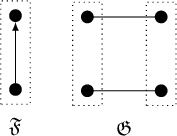


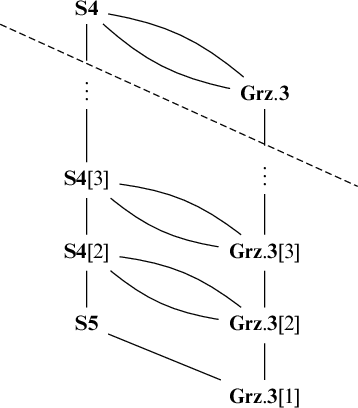


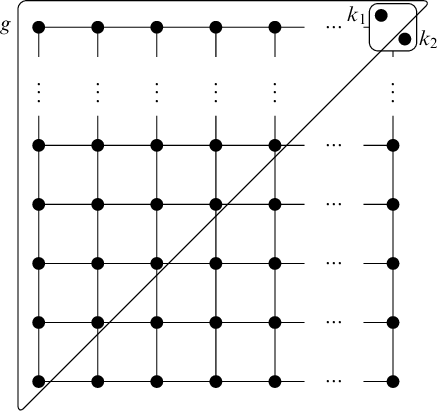
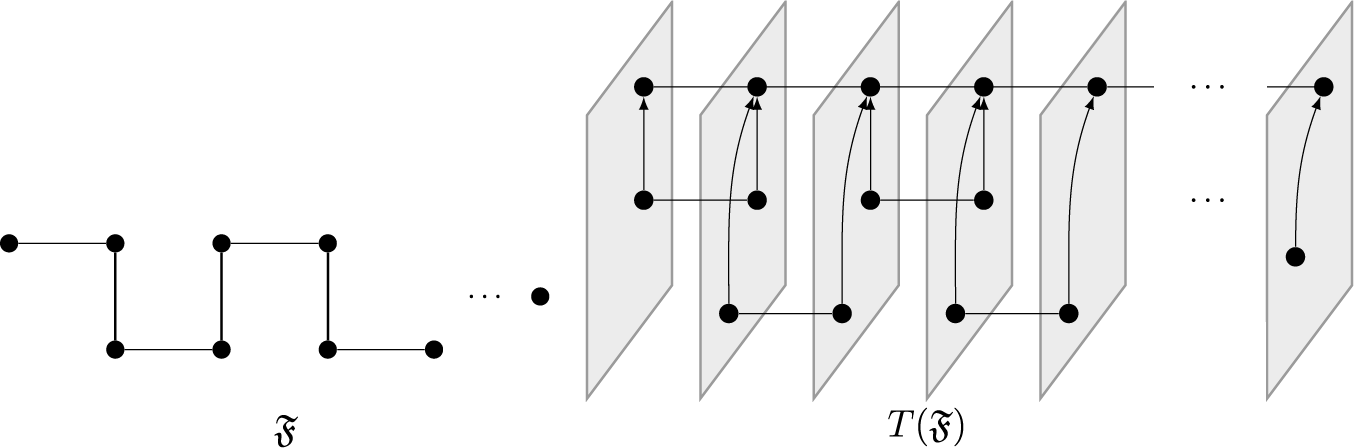


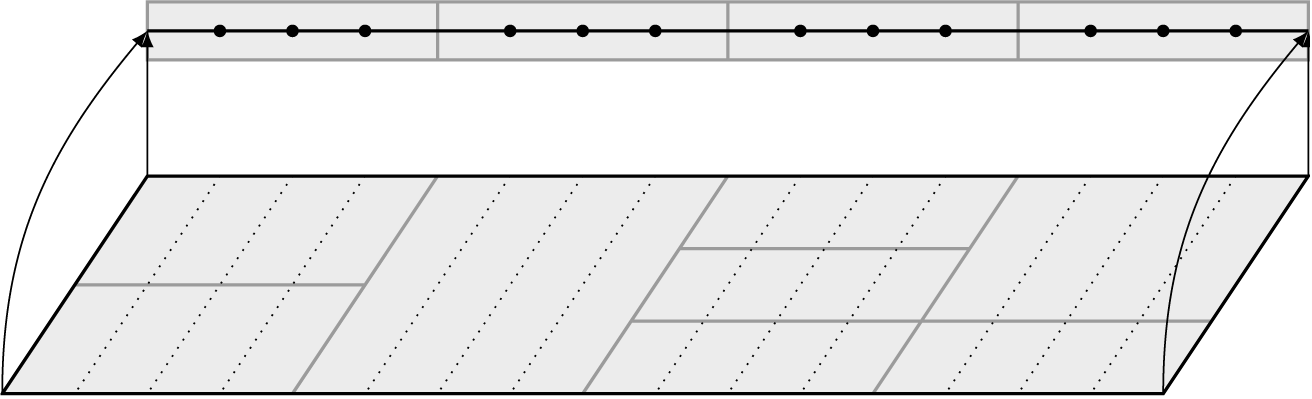


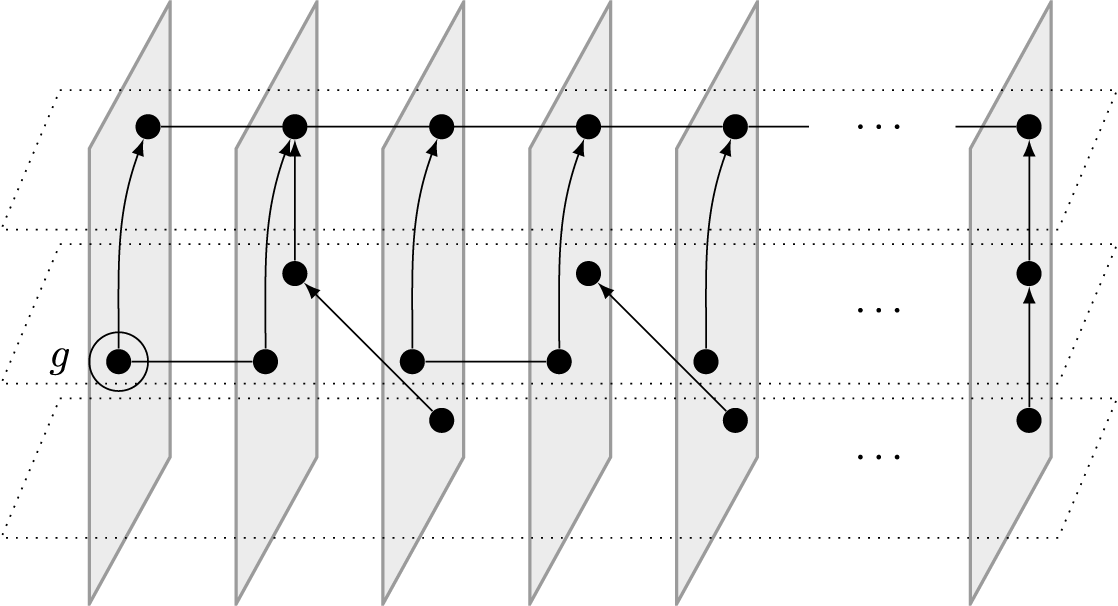


 Open access

