INTRODUCTION
A signature wound of the Iraq and Afghanistan Wars (Snell & Halter, Reference Snell and Halter2010) and declared a public health issue per the Centers for Disease Control and Prevention (Centers for Disease Control and Prevention, 2016), traumatic brain injuries (TBIs) can result in acute and long-term cognitive, behavioral, and physical effects. Since 2000, an estimated 383,947 TBIs have occurred in United States (U.S.) military service members, 82% of which were classified as mild TBIs or more commonly termed concussions (Defense and Veterans Brain Injury Center, 2018). Surprisingly, the majority of these injuries are not related to injuries during military deployments (Cameron et al., Reference Cameron, Marshall, Sturdivant and Lincoln2012). With roughly 11,000–33,000 concussions per year in the U.S. military (Defense and Veterans Brain Injury Center, 2018) and 1.6–3.8 million sports and recreation-related concussions within the U.S. civilian population (Langlois et al., Reference Langlois, Rutland-Brown and Wald2006), multiple organizations have suggested or endorsed baseline assessments for athletes (Broglio et al., Reference Broglio, Cantu, Gioia, Guskiewicz, Kutcher, Palm and Valovich McLeod2014; Herring et al., Reference Herring, Cantu, Guskiewicz, Putukian, Kibler, Bergfeld and Indelicato2011; McCrory et al., Reference McCrory, Meeuwisse, Dvorak, Aubry, Bailes, Broglio and Vos2017) and service members (Department of Defense, 2015) prior to athletic participation and deployment. Intended to provide a pre-morbid standard to allow a better measure of impairment following injury, baseline assessments remain difficult to interpret and incorporate into the evaluation and management of concussion. Establishing clinical interpretation ranges and understanding the foundational psychometric properties of these baseline assessments are vital to the clinical management of concussion.
The initial baseline and post-concussion test batteries emerged as part of the Sports as a Laboratory Assessment Model (SLAM) in the late 1980s (Barth et al., Reference Barth, Alves, Ryan, Macciocchi, Rimel, Jane and Nelson1989). The SLAM methodology was founded on the use of a pre–post neurocognitive test model to measure impairment post-concussion (Barth et al., Reference Barth, Alves, Ryan, Macciocchi, Rimel, Jane and Nelson1989). Current concussion baseline batteries have expanded the pre–posttest model to include neurological, postural, and symptom assessments, in addition to the neurocognitive test. Thus, with repeat exposure to these assessments, pre-, and post-injury, establishing reliability metrics is critical to interpreting scores and differentiating between normal variation within a test and variation due to injury. For repeat exposure, test–retest reliability is an important metric and typically measured as an intraclass correlation coefficient (ICC) or Kappa coefficient. ICC and Kappa scores ≥0.75 are considered good or clinically acceptable (Portney & Watkins, Reference Portney and Watkins2009). Scores <0.75 reflect moderate (0.50–0.74) to poor (<0.50) reliability and do not meet the accepted threshold for clinical utility (Portney & Watkins, Reference Portney and Watkins2009). Unfortunately, the results of prior reliability analyses of baseline assessments have varied and involved relatively small homogenous cohorts (Bell et al. Reference Broglio, Katz, Zhao, McCrea and McAllister2011; Broglio et al., Reference Broglio, Katz, Zhao, McCrea and McAllister2018; Farnsworth et al., Reference Farnsworth, Dargo, Ragan and Kang2017; McLeod & Leach, Reference McLeod and Leach2012).
The clinical tools and individual assessments included in a baseline test battery for concussion may vary; however, most are multidimensional and include a computerized neurocognitive test, as well as, balance, memory, and symptom assessments. The reliability of computerized neurocognitive tests has been less than desirable (Farnsworth et al., Reference Farnsworth, Dargo, Ragan and Kang2017). In a recent meta-analysis (Farnsworth et al., Reference Farnsworth, Dargo, Ragan and Kang2017), reliability coefficients for the Immediate Post-Concussion Assessment and Cognitive Test (ImPACT) and Automated Neuropsychological Assessment Metric (ANAM) ranged from 0.10 to 0.87 across 13 studies. While the Concussion Assessment, Research and Education (CARE) Consortium reported more consistent test–retest reliability values for the ImPACT across 1- (ICCs = 0.50–0.72) and 2- (ICCs = 0.34–0.66) year time periods in their cohort of roughly 3000 athletes, these values are still less than optimal (Broglio et al., Reference Broglio, Katz, Zhao, McCrea and McAllister2018). Other components of baseline concussion protocols have displayed similar variability across time. In the remaining CARE Consortium assessments (Broglio et al., Reference Broglio, McCrea, McAllister, Harezlak, Katz, Hack and Hainline2017) that include the Standardized Assessment of Concussion (SAC), Balance Error Scoring System (BESS), Sport Concussion Assessment Tool (SCAT)-Symptom Evaluation, and Brief Symptom Inventory-18 (BSI-18), test–retest reliability was not ideal (Broglio et al., Reference Broglio, Katz, Zhao, McCrea and McAllister2018). ICC values ranged from 0.34 to 0.51 and kappa statistics from 0.40 to 0.41 (Broglio et al., Reference Broglio, Katz, Zhao, McCrea and McAllister2018). With a shorter test interval (e.g., 50–60 days), BESS reliability in children (ICC = 0.70) (Valovich McLeod et al., Reference Valovich McLeod, Barr, McCrea and Guskiewicz2006) and young adults (G = 0.64) (Broglio et al., Reference Broglio, Zhu, Sopiarz and Park2009) has been moderate. Lesser values have been published for the SAC (ICC = 0.46) (Valovich McLeod et al., Reference Valovich McLeod, Barr, McCrea and Guskiewicz2006), BSI-18 (ICC = 0.37–0.69) (Lancaster et al., Reference Lancaster, McCrea and Nelson2016), and symptom components of the SCAT-2 (ICC ≤0.50) (Chan et al., Reference Chan, Vielleuse, Vokaty, Wener, Pearson and Gagnon2013), an earlier version of the SCAT, when administered at various time intervals (e.g., 7, 30, 45, 60, and 165 days). Thus, the time between administrations can influence reliability metrics consistent with diffusion drift models of cognition (Ratcliff et al., Reference Ratcliff, Smith, Brown and McKoon2016). In addition to the time interval between test administrations, other reliability confounders include sex, age, and testing environment (Broglio et al., Reference Broglio, Zhu, Sopiarz and Park2009; Lichtenstein et al., Reference Lichtenstein, Moser and Schatz2014). BESS test–retest reliability improved when male (G = 0.92) and female (G = 0.91) participants were analyzed independently, indicating that sex accounted for the largest source of variance in BESS scores (Broglio et al., Reference Broglio, Zhu, Sopiarz and Park2009). Furthermore, younger athletes (10–12 years) and larger test groups (≥20 per room) have increased the frequency of invalid ImPACT test scores (Lichtenstein et al., Reference Lichtenstein, Moser and Schatz2014). Given the contradictory findings in published reliability values and the various confounders known to effect baseline performance, further investigation into the stability of these tests is necessary, particularly in high-risk populations that have been under-represented in the literature such as service academy enrollees.
While test stability is critical to the serial administration of concussion assessments in the test–retest paradigm, much of the focus has shifted toward the clinical interpretation of scores. Thus, a variety of methods have been proposed to distinguish between normal test variation and clinically meaningful change. In the realm of concussion, reliable change indices have been used (Barr & McCrea, Reference Barr and McCrea2001; Hinton-Bayre et al., Reference Hinton-Bayre, Geffen, Geffen, McFarland and Frijs1999; Iverson, Reference Iverson, Kreutzer, DeLuca and Caplan2011). Reliable change indices have broad application to concussion because it identifies clinical change independent of measurement error (Iverson, Reference Iverson, Kreutzer, DeLuca and Caplan2011). By creating a confidence interval around the index, clinicians can estimate the measurement error on retest scores. The technique has been applied to a variety of concussion assessment tools to establish criteria that indicate significant change on neurocognitive (Barr & McCrea, Reference Barr and McCrea2001; Hinton-Bayre et al., Reference Hinton-Bayre, Geffen, Geffen, McFarland and Frijs1999) and postural control assessments (Broglio et al., Reference Broglio, Ferrara, Sopiarz and Kelly2008; Valovich McLeod et al., Reference Valovich McLeod, Barr, McCrea and Guskiewicz2006).
Administering a baseline test battery pre-injury enables the medical professionals treating concussed patients to not only measure impairment but to apply individualized performance metrics when making return-to-play or return-to-duty decisions. While some work evaluating the test–retest reliability of common concussion assessment tools has been completed in traditional athletic populations, to date, no investigation has examined the reliability of these test batteries among military service members or service academy cadets. Thus, the objective of the current study is to describe the test–retest reliabilities of the ImPACT, BESS, SAC, SCAT-Symptom Evaluation, and BSI-18 among service academy cadets. Furthermore, this study aims to establish clinical interpretation ranges for this particular baseline battery in the military service academy population.
METHODS
As part of the CARE Consortium, the U.S. Service Academies took part in a multi-site study investigating the natural history of concussion. All service academy cadets from the United States Military Academy (West Point), Air Force Academy, and Coast Guard Academy were eligible and invited to participate. Prior to data collection, each institution’s local Institutional Review Board (IRB) and the U.S. Army Human Research Protection Office (HRPO) approved the study protocol and all participants provided written informed consent.
The CARE study initially launched in 2014, thus the complete methodology has been described in an earlier article (Broglio et al., Reference Broglio, McCrea, McAllister, Harezlak, Katz, Hack and Hainline2017). From 2014 to 2016 or years 1 (Y1), 2 (Y2), and 3 (Y3) of the study, participants completed an annual baseline assessment. In summary, each athlete or cadet enrolled completed a detailed demographic questionnaire that included medical history, as well as a comprehensive baseline assessment. Each Service Academy addresses neurocognitive function, neurological status, motor control, and symptom domains using the same CARE Level A assessments. Their primary test battery includes the SAC, BESS, BSI-18, SCAT – Symptom Evaluation (Version 3), and the ImPACT. The outcomes associated with each test are briefly described below.
The SAC is an acute measure of cognitive function comprised of four components: orientation, immediate memory, concentration, and delayed recall (McCrea et al., Reference McCrea, Kelly, Randolph, Kluge, Bartolic, Finn and Baxter1998). Total SAC score out of 30 was used as the outcome variable for this study.
The BESS is a measure of posture stability that consists of three stances (double limb, single limb, tandem) performed on two surfaces (firm and foam) for a total of six balance trials (Riemann et al., Reference Riemann, Guskiewicz and Shields1999). Total BESS score out of 60 was used as the outcome variable for this study.
The BSI-18 captures symptoms related to anxiety, mood, and depression to measure psychological distress (Meachen et al., Reference Meachen, Hanks, Millis and Rapport2008). BSI-Total score out of 72 was used as the outcome variable for this study.
The SCAT-Symptom Evaluation captures physical, cognitive, sleep, and affective symptoms related to concussion and is summarized as the total number of symptoms and symptom severity (McCrory et al., Reference McCrory, Meeuwisse, Aubry, Cantu, Dvorak, Echemendia, Engebretsen and Turner2013). SCAT Total number of symptoms out of 22 and SCAT symptom severity out of 132 were used as outcome variables for this study.
The ImPACT is a neurocognitive computer assessment (Iverson et al., Reference Iverson, Lovell and Collins2003). ImPACT composite scores for verbal memory, visual memory, motor speed, and reaction time were include as outcome variables.
The current project aims to describe the test–retest reliabilities for the CARE Consortium’s Level A baseline test battery among cadets enrolled at the U.S. Service Academies. Thus, in June of 2017, all annual CARE Level A Service Academy baseline assessments were pulled from the repository. Between January 2014 and March 2017, the Service Academies participating in the CARE Consortium captured 16,061 baseline assessments. Participants were included in the current analyses if they had at least two baseline assessments recorded in the database. Participants with only one baseline record or those that sustained a concussion between annual baselines were excluded.
Statistical Analyses
Prior to any analysis, the data were cleaned. ImPACT scores were removed if the ImPACT system deemed the test session invalid. Overall, 41 cadets had ImPACT scores flagged as invalid. For these cadets, the invalid results were removed from subsequent analyses, but the other baseline assessments, if intact, were analyzed. Additionally, BSI-18 scores that were non-integer values were also excluded as scoring only allows for integers and therefore these were deemed data entry errors. All other assessments (i.e., SAC, BESS, SCAT-Symptoms) were checked by verifying scores fell within the possible test score limits. For example, the BESS total score was checked by determining all scores fell between 0 and 60. No tests were excluded for the SAC, BESS, or SCAT-Symptoms. All statistical analyses were conducted in R Version 3.6.1 Statistical Software Package (Vienna, Austria). Distribution metrics were calculated as mean, median, and quartiles. Test–retest reliability was calculated between Y1 and Y2 and Y1 and Y3. A two-way mixed-model analysis of variance (ICC3,1) (Shrout & Fleiss, Reference Shrout and Fleiss1979) was used for the SAC, BESS, BSI-18, and ImPACT scores to assess stability in these measures over time. Both “consistency” (ICCc) and “agreement” (ICCa) definitions were estimated for ICC. Both methods were estimated to provide a description of how well tests were rated in a consistent manner (e.g., high scores in both years) versus absolute agreement (e.g., getting the exact same score both years). The “psych” package was used to calculate both ICCs. Since many participants select zero symptoms at baseline, we considered the SCAT-Symptom Evaluation to be a categorical assessment. Thus, Cohen’s Kappa using linear weights was used to calculate test–retest reliability for the SCAT-Symptom Evaluation scores. The “rel” package was used to calculate weighted Kappa statistics. Both ICC and Kappa values are scored on a 0.0 to 1.0 scale with greater scores indicating more stable performance (Koo & Li, Reference Koo and Li2016). It is important to note that ICC calculations do not require the assumption of normality and therefore are appropriate estimates of reliability for SAC, BESS, BSI-18, and ImPACT scores (Mehta et al., Reference Mehta, Bastero-Caballero, Sun, Zhu, Murphy, Hardas and Koch2018).
The initial analyses included all cadets. However, secondary analyses were stratified by level of sports participation (varsity and non-varsity athletes). A secondary sub-analysis stratified cadets into freshmen and upperclassmen to determine whether baseline assessments completed during the transition from high school or prior military service to a Service Academy environment influenced score reliability and variability. ICC and Kappa values were not computed for analyses in which the sample size was less than 100.
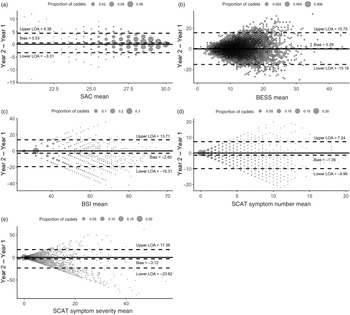
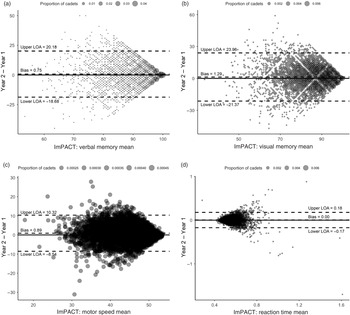
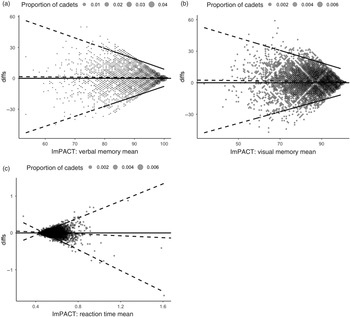
Bland–Altman plots were also generated to visualize the agreement between tests at both time points. The Bland–Altman plot is a scatter plot showing the difference in assessment scores (e.g., Y2–Y1 and Y3–Y1) on the Y-axis and the mean of both assessments on the X-axis. The mean of the difference in assessment scores provides an indication of the level of bias. A positive mean bias (>0) indicates that Y2 or Y3 scores are greater than Y1, and a negative mean bias (<0) indicates that Y2 and Y3 scores are less than Y1. The level of agreement is defined by 95% confidence intervals around the mean difference. To estimate the level of agreement bounds, the Bland–Altman analysis assumes homoscedasticity. The assumption of homoscedasticity was evaluated using the Goldfeld–Quandt test (Hoffman, Reference Hoffman and Hoffman2015) with the “lmtest” package in R. If the assumption of homoscedasticity was violated, then the level of agreement bounds was estimated to enable the bounds to increase/decrease with increasing mean of both assessments (Grilo & Grilo, Reference Grilo and Grilo2012).
Cohen’s d effect sizes were calculated to evaluate the magnitude of change over time between annual baseline assessments. Effect size estimates of <0.2, 0.5, and 0.8 were deemed small, medium, and large, respectively (Cohen, Reference Cohen1977). For clinical interpretation, rather than estimating the percentiles of the distribution under the assumption of normality (i.e., reliable change indices), non-parametric confidence intervals based on the observed distributions were applied to estimate the degree of certainty of change on each assessment or change scores. More specifically, these are one-sided confidence intervals used to represent change that may occur as a result of concussion. Following a suspected concussion, we would anticipate that poorer performance would be reflected by lesser scores on the SAC and verbal memory, visual memory, and visual motor speed sections of ImPACT, but greater scores on BESS, BSI-18, SCAT – Symptom Evaluation outcomes, and ImPACT reaction time.
RESULTS
Reliability Analyses
At the time of analysis, 4875 cadets (76.9% male) had completed the annual CARE baseline Level A test battery during back-to-back years without sustaining a concussion during the follow-up period and 207 cadets had additionally completed the baseline battery during Y1 and Y3. Of the 4875 cadets that completed baselines in Y1 and Y2, 28.45% (n = 1387) participated in varsity sports, 44.91% (n = 2177) were freshmen, and 18.79% (n = 908) reported a prior concussion. All of the cadets who completed baselines in Y1 and Y3 participated in varsity athletics, 86.47% were male (n = 179), 34.30% (n = 71) were freshmen, and 33.33% (n = 69) reported a prior concussion.
Distribution metrics and reliability analyses results for the clinical concussion assessments are reported in Table 1. The metrics and ICC values for the ImPACT appear in Table 2. ICCc values (showing score consistency) from Y1 to Y2 ranged from 0.28 to 0.67 and Y1 to Y3 from 0.17 to 0.57. ICCa values (showing score agreement) were similar ranging from 0.28 to 0.67 in Y1 to Y2 and 0.15 to 0.57 in Y1 to Y3. Kappa values for the SCAT Symptom Evaluations ranged from 0.16 to 0.21 from Y1 to Y2 and 0.29 to 0.31 from Y1 to Y3. Overall, the reliability analyses indicated poor consistency. ImPACT visual memory and visual motor speed were the only assessments greater than 0.50.
Measures of central tendency, reliability, and effect sizes for clinical concussion measures for all cadets

BESS, Balance Error Scoring System; BSI-18, Brief Symptom Inventory-18; SAC, Standardized Assessment of Concussion; SCAT, Sport Concussion Assessment Tool; ICCa, Intraclass Correlation Coefficient-Agreement; ICCc, Intraclass Correlation Coefficient-Consistency. λ Levels of agreement change with size of mean. *Bias confidence interval does not cover 0 mean difference.
Measures of central tendency, reliability, and effect sizes for ImPACT for all cadets

ICCa, Intraclass Correlation Coefficient-Agreement; ICCc, Intraclass Correlation Coefficient-Consistency. λ Levels of agreement change with size of mean. *Bias confidence interval does not cover 0 mean difference
Bland–Altman analyses revealed statistically significant, but clinically insignificant bias in all clinical assessments for both time points except for the BESS in Y1 and Y3 (Table 1). Cadets performed better on the SAC in Y2 and Y3 compared to Y1. BESS performance was worse in Y2 compared to Y1. Fewer symptoms were reported on the BSI-18 and SCAT Symptom Evaluations in Y2 and Y3 compared to Y1. For ImPACT, only verbal memory and visual memory performance demonstrated significant positive bias (Table 2). Better performance was observed for verbal memory scores in Y2 and Y3 compared to Y1 and visual memory performance improved in Y2 compared to Y1. The Bland Altman plots for level of agreement between Year 1 and Year 2 are presented in Figures 1 and 2. Figures 3 and 4 display Bland–Altman plots of a subset of clinical assessments where the assumption of homoscedasticity was not met.
Bland-Altman Plots of Year 1 and Year 2 Clinical Scores. Bland-Altman plots showing average level of agreement and bias between Year 1 and Year 2 for (a) Standardized Assessment of Concussion, (b) Balance Error Scoring System, (c) Brief Symptom Inventory-Total, (d) SCAT Symptom Number, and (e) SCAT Symptom Severity scores.

Bland-Altman Plots of Year 1 and Year 2 ImPACT Scores. Bland-Altman plots showing average level of agreement and bias along between Year 1 and Year 2 for (a) ImPACT Verbal Memory, (b) ImPACT Visual Memory, (c) ImPACT Visual Motor Speed, and (d) ImPACT Reaction Time.

Bland-Altman Plots of Year 1 and Year 2 for Clinical Scores Where the Assumption of Homoscedasticity Was Not Met. Clinical assessments pictured include: (a) Standardized Assessment of Concussion, (b) SCAT Symptom Number, and (c) SCAT Symptom Severity scores.

Bland-Altman Plots of Year 1 and Year 2 ImPACT Scores Where the Assumption of Homoscedasticity Was Not Met. Clinical assessments pictured include: (a) ImPACT Verbal Memory, (b) ImPACT Visual Memory, and (c) ImPACT Reaction Time.

Distribution and reliability analyses were conducted separately for varsity (Tables S1 and S2) and non-varsity cadet-athletes (Tables S4 and S5). The sub-analyses by class year, freshman versus upperclassmen, are presented in Supplementary Tables S7–S8 and S10–S11. Due to an inadequate sample size, the 2-year test interval could not be calculated for the non-varsity athletes or upperclassmen. Overall, the separate sub-analyses yielded similar ICC and Kappa values to the combined sample. However, SCAT Symptom Number and SCAT Symptom Severity decreased between Y1 and Y2 for freshmen (Kappa = 0.10–0.13) compared to upperclassmen (Kappa = 0.27–0.30). Overall, none of the reliability metrics neared 0.75 to suggest good stability from year-to-year for annual baseline concussion assessments.
Clinical Interpretation Ranges
Cohen’s d effect sizes are reported in Tables 1 and 2. Across all measures, the observed effects were small. From Y1 to Y2, effects ranged from 0.04 to 0.38 and from Y1 to Y3 from 0.01 to 0.44. The smallest effects (0.01–0.04) were observed for the BESS. The largest effects, still interpreted as small (0.44), were observed for the BSI-18, ImPACT visual motor speed, and ImPACT reaction time. Cohen’s d effect sizes for the varsity and non-varsity analyses appear in Tables S1–S2 and S4–S5. Medium effects were observed for the BSI-18 (0.58) and SCAT Symptom scales (0.55) in varsity cadets. Effect sizes for the freshman versus upperclassman comparison appear in Tables S7–S8 and S10–S11. Medium effects were observed for the BSI-18 (0.68) and SCAT Symptom Evaluation scales (0.72) in the freshmen from Y1 to Y2.
Change score estimates from 75% to 99% confidence are reported for each assessment in Table 3. Change scores for varsity cadets and non-varsity cadets were calculated separately and are available in Supplementary Tables S3 and S6, respectively. Freshmen and upperclassmen change scores are presented in Supplementary Tables S9 and S12, respectively.
Confidence ranks by change score for all cadets

BESS, Balance Error Scoring System; BSI-18, Brief Symptom Inventory-18; SAC, Standardized Assessment of Concussion; SCAT, Sport Concussion Assessment Tool. Scores are rounded to nearest integer.
DISCUSSION
The objective of this investigation was to establish test–retest reliabilities and clinical interpretation ranges for the annual concussion baseline test battery currently implemented at three U.S. Service Academies participating in the CARE Consortium. Annual baseline testing or testing every other year is a common clinical practice, thus both 1- and 2-year test intervals were examined in this study. Overall, the reliability for these instruments was less than optimal with none of the metrics nearing an ICC of 0.75, the clinical threshold to suggest optimal stability over time. The findings from this study are generally consistent with the CARE Consortium data that were previously published for NCAA student-athletes from 29 institutions (Broglio et al., Reference Broglio, Katz, Zhao, McCrea and McAllister2018), as well as, previous reports for the SAC and BESS (Chin et al., Reference Chin, Nelson, Barr, McCrory and McCrea2016), SCAT-Symptom Evaluations (Register-Mihalik et al., Reference Register-Mihalik, Guskiewicz, Mihalik, Schmidt, Kerr and McCrea2013), BSI-18 (Lancaster et al., Reference Lancaster, McCrea and Nelson2016), and ImPACT (Broglio et al., Reference Broglio, Ferrara, Macciocchi, Baumgartner and Elliott2007; Cole et al., Reference Cole, Arrieux, Schwab, Ivins, Qashu and Lewis2013; Nelson et al., Reference Nelson, LaRoche, Pfaller, Lerner, Hammeke, Randolph and McCrea2016; Resch et al., Reference Resch, Driscoll, McCaffrey, Brown, Ferrara, Macciocchi and Walpert2013). However, the ICC values reported from the current study are much lower than those previously reported.
Cohen’s d effect sizes were also calculated to evaluate change between baseline test administrations. No effect (Cohen’s d < 0.2) or small effects (Cohen’s d = 0.2–0.5) were observed for all assessments for both 1- and 2-year test intervals indicating a substantial overlap in test performance. Even statistically significant effects that have medium or (0.2–0.5) or small (<0.2) effect sizes represent a considerable 80% to 92% overlap on scores between baseline test administrations. Thus, despite the less than optimal ICC values, the limited range of effect sizes (0.01–0.44) suggests substantial overlap, and overall stability, between assessments. While this may seem counter intuitive to the ICC value interpretation, the tightly clustered values may have skewed the ICCs downward.
The effect sizes observed in the current study for SCAT and BSI-18 symptom scores and ImPACT (ES = 0.08–0.44) subscales were slightly greater than the effect sizes from the original CARE Consortium findings that were limited to NCAA student-athletes (ES = 0.05–0.23) (Broglio et al., Reference Broglio, Katz, Zhao, McCrea and McAllister2018). Thus, there may have been more variability in the cadets’ symptom and ImPACT scores between baseline test administrations than NCAA athletes at civilian universities. Although very slight, this difference may be attributed to the cadets’ ever-changing environments with additional stressors. However, a similar trend was observed for BSI-18 and SCAT symptom scores between varsity cadet-athletes and non-varsity cadet-athletes. While the ICC values were very similar, effect sizes for varsity cadet-athlete symptom scores (ES = 0.57–0.60) were much larger than non-varsity cadet-athletes (ES = 0.28–0.30). This suggests that there may be less overlap and more variability in varsity athlete symptom scores from year-to-year. The effect sizes observed for the SAC, BESS, and ImPACT subscales were fairly consistent in varsity and non-varsity cadet-athletes. The same trend was noted for symptom scores between cadets first baselined as freshmen year and cadets first baselined as an upperclassman. Effect sizes from Y1 to Y2 for freshman symptom scores (ES = 0.68–0.72) were substantially larger than those of upperclassman symptom scores in Y1 and Y2 (ES = 0.01–0.10). This is not surprising as this is most likely the first time many of these first year cadets are exposed to a military environment with added stressors, including basic training, limited contact with friends and family, low sleep, and a rigorous physical and academic schedule. From Y1 to Y2, BSI-18 and SCAT Symptom scores decreased approximately four points in those baselined as freshmen and <1 point in those baselined as an upperclassmen. Similar to the athlete comparison, the effect sizes and scores observed for the clinical assessments were fairly consistent regardless of class.
Based on the effect sizes, we can conclude that there was roughly 80% overlap across clinical assessment distributions between Y1 and Y2 (ES = 0.04–0.31) and Y1 and Y3 (ES = 0.01–0.44). Despite multiple raters, the BESS scores exhibited >92% overlap from year-to-year exhibiting very small effect sizes (ES = 0.01–0.04). This overlap suggests that the costs associated (i.e., staffing, supplies, time) with annual baseline testing may outweigh the benefits, particularly with the overlap observed in this data from year-to-year. However, those baselined as freshmen demonstrated greater variability between Y1 and Y2 with effect sizes ranging from 0.68 to 0.72 on the BSI-18 and SCAT Symptom assessments, dropping the overlap in assessment scores to roughly 70%. Therefore, re-baselining after freshmen year might be worth the cost benefit analysis.
Re-baselining after freshman year may also add value to post-concussion management. Despite significant overlap between assessments from year-to-year, using the most recent baseline data provided the greatest sensitivity when diagnosing concussions (Broglio et al., Reference Broglio, Harezlak, Katz, Zhao, McAllister, McCrea and Investigators2019). While there is not much variability in assessments from year-to-year, there appears to be value added by having annual baseline assessments. Additionally, other annual concussion efforts, like athlete education, may have a positive impact on concussion disclosure with similar time investment. Thus, moving forward clinicians should consider at least a single administration of these baseline assessments at the time of enrollment.
Following a suspected concussion, established ranges of change scores can provide confidence to the practitioner when interpreting performance on concussion assessments post-injury. To assist with clinical interpretation, change scores were calculated with confidence intervals to express an associated level of certainty that change (e.g., concussion) has occurred. For example, if a patient commits more than 19 errors on the BESS compared to their baseline, the clinician can have 99% confidence that the change is related to something other than normal test–retest variability (see Table 3). Similarly, a 2-point decrease on the SAC would carry 90% confidence. This approach should always be overlaid with clinical presentation and clinician expertise. However, these are the first published values for a unique service academy population.
Our study is not without limitations. The findings discussed in this paper are specific to military service academy cadets and may have application to active duty military service members of comparable age. However, they may not be applicable to younger athletes undergoing brain growth and development nor professional athletes who have likely attained brain maturation. It was also assumed that all participants provided honest effort and accurate answers during testing. Although ImPACT has a validity check, the other assessments do not and some athletes may have intentionally underperformed to hide poor post-concussion performance if injured (Leahy, Reference Leahy2011). It is also possible that the participants may have become apathetic after multiple years of testing. Lastly, we did not document if participants had completed any portion of the assessments prior to attending the service academy, so some may have had prior exposure performing the baseline assessment tasks that influenced their scores.
The SAC, BESS, ImPACT, SCAT – Symptom Evaluation, and BSI-18 scores demonstrated less than optimal reliability in service academy cadets. The ImPACT scores from Y1 to Y2 were the closest to an acceptable level for clinical utility with visual motor speed demonstrating the most stable scores. The SCAT Symptom Evaluation demonstrated the least stable scores from year-to-year. While none of the assessments met or exceeded the accepted clinical threshold (ICC ≥ 0.75), the effect sizes were relatively small suggesting an overlap in performance from year-to-year. Thus, the lack of stability in the scores combined with the weak effect sizes suggests that the clinical assessments are likely representative of state function of overt traits and will continue to vary with more testing. As such, baseline assessments beyond the initial evaluation in service academy cadets are not essential but could aid concussion diagnosis. Until a sound clinical tool is developed, we recommend at least an initial baseline assessment upon entry to a U.S. Service Academy. The baseline scores can be used in combination with the change scores to improve practitioner confidence when managing concussions.
ACKNOWLEDGMENTS
The authors would like to thank Bonnie Campbell, Lisa Campbell, Megan Jackson, Jennifer Miley, Joel Robb, and Kim Robb (United States Air Force Academy), Robin Miller and Jarrett Headley (United States Coast Guard Academy), Stephanie Carminati, Steven Malvasi, Story Miraldi, Jamie Reilly, Sean Roach, and Jesse Trump (United States Military Academy) for data acquisition, as well as, the research and medical staff that assisted with baseline data collection at each of the service academy sites. The authors would also like to thank Jaroslaw Harezlak, Jody Harland, Janetta Matesan, Larry Riggen (Indiana University), Ashley Rettmann, Nicole L’Heureux (University of Michigan), Melissa Koschnitzke (Medical College of Wisconsin), Michael Jarrett, Vibeke Brinck, and Bianca Byrne (Quesgen), Thomas Dompier, Erin B. Wasserman, Melissa Niceley Baker, and Sara Quetant (Datalys Center for Sports Injury Research and Prevention). This publication was made possible, in part, with support from the Grand Alliance Concussion Assessment, Research, and Education Consortium, funded by the National Collegiate Athletic Association and the Department of Defense. The U.S. Army Medical Research Acquisition Activity, 820 Chandler Street, Fort Detrick, MD 21702-5014, USA is the awarding and administering acquisition office. This work was supported by the Office of the Assistant Secretary of Defense for Health Affairs through the Psychological Health and Traumatic Brain Injury Program under Award no. W81XWH-14-2-0151. Opinions, interpretations, conclusions, and recommendations are those of the authors and are not necessarily endorsed by the Department of Defense (Defense Health Program funds).
CONFLICT OF INTEREST
The authors have nothing to disclose.
SUPPLEMENTARY MATERIAL
To view supplementary material for this article, please visit https://doi.org/10.1017/S1355617720000594