Introduction
The continent of Antarctica and its offshore islands are today the part of the planet with the lowest presence and impact of terrestrial biological invasions globally (Hughes et al. Reference Hughes, Pertierra, Molina-Montenegro and Convey2015b). The near-pristine status of the Antarctic region underpins calls for strengthening its conservation management regime (Chown et al. Reference Chown, Brooks, Terauds, Le Bohec, van Klaveren-Impagliazzo and whittington2017, Wauchope et al. Reference Wauchope, Shaw and Terauds2019). This inherently involves, amongst other actions, understanding the risk factors associated with human-assisted colonization and biological invasion processes (Hughes et al. Reference Hughes, Pescott, Peyton, Adriaens, Cottier-Cook and Key2020). In the very different culture of the early decades of Antarctic exploration and marine mammal exploitation in the nineteenth and first half of the twentieth centuries, no biosecurity measures were applied and a number of domestic species (livestock, companion animals, sled dogs and ponies) were deliberately introduced to the broader Antarctic region, along with a range of accidental introductions of plants, rodents and invertebrates, particularly associated with fodder (Frenot et al. Reference Frenot, Chown, Whinam, Selkirk, Convey, Skotnicki and Bergstrom2005, McGeoch et al. Reference McGeoch, Shaw, Terauds, Lee and Chown2015). While the greatest impacts of these introductions were felt in the sub-Antarctic islands, marine exploitation industries were active in this period in the Maritime Antarctic South Orkney and South Shetland islands and in at least the northern Antarctic Peninsula (e.g. Hart Reference Hart2006). The ‘heroic’ age of Antarctic exploration in the first half of the twentieth century saw dogs and ponies used in support of expeditions. Even after the start of the scientific research era after the Second World War, sled dogs continued to be used at multiple stations until the mid-1990s (Walton & Atkinson Reference Walton and Atkinson1996). In turn, the scientific fascination with understanding the limits for life under extreme environmental conditions led to multiple transplant experiments studying the survival of non-Antarctic plant species transferred into the region from elsewhere (Corte Reference Corte1961, Edwards Reference Edwards1980). Some of these experiments contributed to the further inadvertent establishment of other non-native plant (Smith Reference Smith1996) and invertebrate (Block et al. Reference Block, Burn and Richard1984) species.
With the negotiation and adoption of the Antarctic Treaty in 1961, protection and conservation of Antarctica's ecosystems came explicitly to the fore. Nevertheless, transplant experiments continued through the 1960s and early 1970s (Edwards Reference Edwards1980). Although such experiments appear to have ceased after that as environmental protection concerns rose (but see Braun et al. Reference Braun, Mustafa, Nordt, Pfeiffer and Peter2012, Hughes et al. Reference Hughes, Pertierra, Molina-Montenegro and Convey2015b), it was not until the negotiation of the Protocol on Environmental Protection to the Antarctic Treaty in 1991 - which formally came into force in 1998 - that strict regulations controlling any such deliberate introduction of non-native species were adopted, requiring permitting and confirmed removal of such material at the end of any experiments. This legislation has effectively banned deliberate introductions, but it remains unclear how it applies to accidental introductions associated with human activity (Hughes & Convey Reference Hughes and Convey2014) or to microorganisms (Hughes et al. Reference Hughes, Cowan and Wilmotte2015a). Emphasis on the application of biosecurity practices has increased since the Environmental Protocol came into force (Hughes & Convey Reference Hughes and Convey2010, Reference Hughes and Convey2012, Hughes et al. Reference Hughes, Convey, Pertierra, Vega, Aragón and Olalla-Tárraga2019), but it remains the case that these guidelines are not legally binding and there is no mechanism of enforcement. Their application across different national, industrial and tourist operations varies widely (e.g. Braun et al. Reference Braun, Mustafa, Nordt, Pfeiffer and Peter2012). Furthermore, and notwithstanding the current hiatus caused by the COVID-19 pandemic (Hughes & Convey Reference Hughes and Convey2020), the number of visitors to Antarctica has been increasing inexorably in recent years (Hughes et al. Reference Hughes, Pescott, Peyton, Adriaens, Cottier-Cook and Key2020). The protection provided by Antarctica's extreme environment, including climatic barriers that might previously have reduced the probability of establishment of non-native species, has weakened recently, at least in parts of the continent, due to the strong net regional warming experienced since the mid-twentieth century (Duffy et al. Reference Duffy, Coetzee, Latombe, Akerman, McGeoch and Chown2017, Convey & Peck Reference Convey and Peck2019). This combination of factors and effects has left Antarctica with a mix of naturalized (those that have proved capable of surviving in their new environment) and failed species (those that have not), making it challenging to establish success patterns. However, there are a low number of supporting cases specific to Antarctica (recognized in the Antarctic Treaty as the area beyond the 60° parallel of southern latitude). This limits the ability to conduct robust analytical assessments, and so we remain far from being able to disentangle patterns and processes of establishment vs failure and/or establishment vs invasive spread. Nonetheless, there is a considerable body of research addressing non-native species in Antarctica, with driving factors already explored as correlates in early works (Frenot et al. Reference Frenot, Chown, Whinam, Selkirk, Convey, Skotnicki and Bergstrom2005). Here, we explore this body of research by means of an evidence-based literature review and narrative synthesis.
As elsewhere, biological invasions in Antarctica are shaped by the integration of causal factors related to the intrinsic traits of each non-native species, the unique conditions of their arrival and the characteristics of the recipient abiotic and biotic environment (McGeoch et al. Reference McGeoch, Shaw, Terauds, Lee and Chown2015, Pyšek et al. Reference Pyšek, Bacher, Kühn, Novoa, Catford and Hulme2020). Several hypotheses and concepts have been formulated to help elucidate the key drivers of the outcomes of invasions (Catford et al. Reference Catford, Jansson and Nilsson2009, Jeschke Reference Jeschke2014, Enders et al. Reference Enders, Havemann, Ruland, Bernard-Verdier, Catford and Gómez-Aparicio2020). In this synthesis, we examine established invasion science hypotheses and discuss their explanatory value for understanding the existing patterns of the introduction and establishment of plants and invertebrates in terrestrial Antarctica. Using the existing case studies, we describe and examine key relevant concepts considered as success factors in the invasion process. The different hypotheses examined relate to species’ capabilities to meet specific conditions required for progression through the various stages of the invasion process (introduction, establishment and spread) following the introduction-naturalization-invasion stage continuum defined by Richardson et al. (Reference Richardson, Pyšek, Rejmánek, Barbour, Panetta and West2000). The hypothetical drivers of polar invasions are discussed in terms of the sequential steps required to colonize Antarctica. Finally, we discuss the utility of different existing and newly emerging methodologies in testing these hypotheses.
Materials and methods
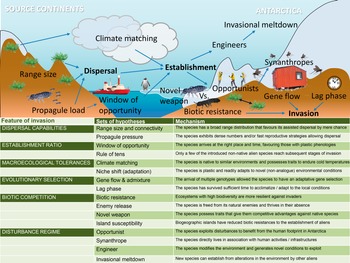
The established invasion science hypotheses to be explored were first selected from literature compendia and classified into six categories based on the nature of the study: 1) quantification of dispersal load and propagule pressure (dispersal hypotheses), 2) records of presence/abundance (establishment hypotheses), 3) evaluations of climate matching and abiotic tolerances (macroecological hypotheses), 4) genetic analyses and reported times of residence (evolutionary hypotheses), 5) descriptions of competitive traits and species interactions (biotic competition hypotheses) and 6) human association and management (disturbance hypotheses). These are illustrated in Fig. 1.
Visual illustration of the main classical hypothesis of invasion ecology applied to the context of the Antarctic region. Real examples are provided to illustrate the hypotheses with the depiction of both non-native and native plants and invertebrates.

Second, non-native species records in Maritime Antarctica were mapped, including those of four vascular plants (Poa annua L., Poa pratensis L., Nassauvia magellanica J.F.Gmel. and Gamochaeta nivalis Cabrera), six Collembola (springtails; Hypogastrura viatica Tullberg, Mesaphorura macrochaeta Rusek, Proisotoma minuta Tullberg, Protaphorura fimata Gisin, Ceratophysella succinea Gisin and Deuteraphorura cebennaria Gisin), two Diptera (flies; Trichocera maculipennis Meigen and Eretmoptera murphyi Schaeffer), two Acari (mites; Coccotydaeolus krantzi Baker and Terpnacarus gibbosus Womersley) and one enchytraeid worm (Christensenidrilus blocki Block & Christensen). These cases were selected based on the relatively well-documented history of research around their ‘successful’ establishment in Antarctica in comparison with a range of historically reported failed or uncertain plant and invertebrate species introductions. The latter include various often apocryphal records of plants growing in the vicinity of stations and/or visitor sites and the detection of invertebrates unintentionally brought with cargo to stations (e.g. Chwedorzewska et al. Reference Chwedorzewska, Małgorzata Korczak-Abshire, Olech, Lityńska-Zając and Augustyniuk-Kramm2013, Houghton et al. Reference Houghton, McQuillan, Bergstrom, Frost, Van Den Hoff and Shaw2016; see expanded list in Table S1). In order to conduct a systematic literature review of evidence-based studies in Antarctica, we ran the following query in the Web of Science repository: TOPIC: (('Antarctic')) AND TOPIC: (('invas*’ OR ‘naturali*’ OR ‘alien’ OR ‘introduc*’ OR ‘non-native*’ OR ‘non-indigen*')). This was done to obtain a comprehensive list of publications generated in the topic. The raw list obtained was filtered to retain only those publications that included information on the patterns or processes of any non-native species described as reaching Antarctica, thus excluding those focused on the sub-Antarctic or elsewhere. The selected publications were categorized in the predefined fields of study. The number of studies per individual non-native species or taxonomic group (multispecies or non-specific studies) was then plotted.
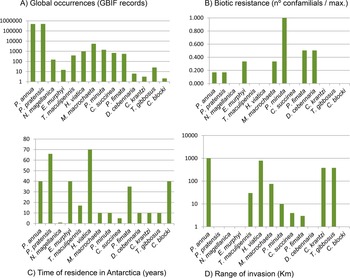
Finally, a set of indicators of the intrinsic (related to the general species ecology) and extrinsic (related to the Antarctic invasion features) parameters was compiled as being potentially relevant to explaining invasion success. These indicators help to visualize parameters of the driving pressures as well as the state of the invasion process in Antarctica:
1) Global records of any given species inform on its degree of cosmopolitanism. Global occurrence records of each non-native species were derived from the Global Biodiversity Information Facility (GBIF) repository (www.gbif.org). In the case of alien Collembola, GBIF records were supplemented with a biogeographical mapping of their global distributions across zoogeographical regions. The extent of these and the presence/absence records of each species in them were taken from www.collembola.org.
2) The term ‘biotic resistance’ encompasses the idea that related species may share similar niches and therefore that non-native species may experience stronger competitive exclusion from the increased presence of native sister species. However, biotic interactions are generally considered to be limited, especially in more extreme polar ecosystems (Hogg et al. Reference Hogg, Craig Cary, Convey, Newsham, O'Donnell and Adams2006), and some degree of functional redundancy between non-related groups would also be expected. To compare potential biotic resistances across phylogenetic groups, an index was generated by examining the fraction of Antarctic native con-familial species for each of the non-native species from the maximum co-occurring con-familials as an indication of maximum biotic resistance for any non-native group (in this case set as 6 from the compendium of native Isotomidae springtails occurring in Maritime Antarctica).
3) Extended time of residence increases the opportunities for naturalization success. The time of residence was taken from the earliest record of introduction with current persistence in Antarctica.
4) The extent of invasion, as a measure of the current invasion success, was calculated as the linear distance between the two most distant records of a species’ reported occurrence in Maritime Antarctica.
Results and discussion
Widely recognized invasion science hypotheses and their application to Antarctic terrestrial alien plants and invertebrates
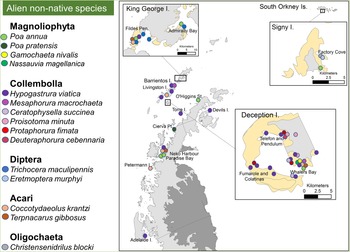
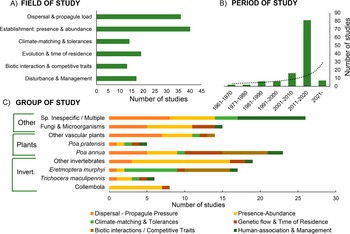
Reported terrestrial non-native species in Maritime Antarctica currently include vascular plants and invertebrates spread over several ice-free sites in the Antarctic Peninsula (Fig. 2). Several studies have examined these cases, as well as other failed introductions, generating a remarkable scientific production. A total of 1955 unfiltered publications on Antarctic non-native (or similar) species were obtained in the initial screening, which were reduced to a shortlist of 125 studies explicitly focused on Antarctica (Table S2). Overall, all major elements of the invasion process are explored across these studies (Fig. 3a), with those focusing on the early stages of introduction and establishment dominating. Notably, increased attention has been given over the decades to this issue (Fig. 3b). In a second level of analysis, we identified a number of studies focusing on various functional elements of establishment and invasion (Fig. 3c). Looking at the number of studies per taxon, we identified a large proportion of unspecific studies (covering multiple groups of species) examining general dispersal and establishment patterns and/or processes, but these broad studies still largely omit meta-analytic comparisons of functional competitive traits and biotic interactions. In contrast, very few individual species have been the subject of substantial numbers of studies (> 10), these being the grass P. annua (24) and the dipteran E. murphyi (17). The comparatively recent invasion of T. maculipennis is also receiving increasing attention (six studies so far since its comparatively recent arrival c. 2006). The invasions of these three species have been examined from multiple angles. Conversely, studies of other non-native invertebrates (in particular Collembola) have to date been largely limited to occurrence records, possibly as a result of their small size, cryptic habitats and challenging taxonomy. There are strikingly few studies of non-native Acari despite evidence that they might include some of the most widespread non-native species in the Maritime Antarctic.
Reported occurrences for the evaluated study cases of non-native species in the Antarctic Peninsula.

Published literature on non-native species in Antarctica. a. Number of studies generated per invasion discipline. b. Number of studies published per decade since the adoption of the Antarctic Treaty (1959). c. Number of studies produced per species and discipline. ‘Inespecific’ refers to unresolved species at the species level.

In the following sections, we evaluate in more detail all of the available information from the existing studies of non-native species occurrences in this region and discuss it in the context of widely recognized hypotheses of the drivers of the invasion process.
Dispersal risk hypotheses
Cosmopolitanism
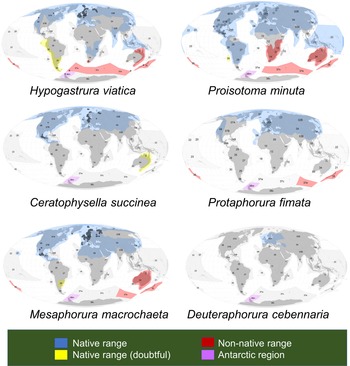
The first step in any non-native species invasion process is to travel the required distance, surpassing any geographical barriers along the way, and arrive in a novel environment (Blackburn et al. Reference Blackburn, Pyšek, Bacher, Carlton, Duncan and Jarošík2011). This set of probabilistic dispersal hypotheses is underlain by the basic idea that species with larger native range sizes (the extreme being cosmopolitan species that are widespread around the globe) and/or well-connected species (those species originating in areas with opportunities for more frequent entrainment with human traffic) are the most likely to be transported to a new region simply through having increased opportunities (Stolhgren et al. Reference Stohlgren, Jarnevich, Chong and Evangelista2006). The native range size hypothesis falls within the idea that the ‘rich get richer’ (Lockwood et al. Reference Lockwood, Cassey and Blackburn2009), integrating several breadth-related features (e.g. climate matching; see below), and so its importance becomes difficult to disentangle from other factors, particularly in the case of euryoic species (those with broad distributions), as many success factors converge (Dyer et al. Reference Dyer, Franks, Cassey, Collen, Cope and Jones2016). Most (but not all) non-native species currently established in Antarctica have a broad distribution worldwide and are also known non-natives in several other regions (see Table S3). This hypothesis appears particularly appropriate for the two grasses of the genus Poa (P. annua and P. pratensis) given their cosmopolitan distribution (Pertierra et al. Reference Pertierra, Aragón, Shaw, Bergstrom, Terauds and Olalla-Tárraga2017b). Figure 4 shows the global realized distribution for non-native collembolans currently established in Antarctica derived from collembola.org and GBIF.org records. The range size hypothesis also fits well with the cosmopolitan invertebrate species (e.g. H. viatica, P. minuta and M. macrochaeta) but cannot explain alone the transfer likelihood for other non-native soil invertebrates (P. fimata, C. succinea and E. murphyi), whose global distributions are comparatively more restricted (but see this idea paired with the source-sink connectivity hypothesis below). Lastly, it must be noted that for some species the accuracy of the realized ranges may be strongly biased by the availability of survey data and taxonomic expertise. For instance, little is known of the global distribution for the two examined Acari, but at least T. gibbosus could potentially also be considered highly cosmopolitan (Walter Reference Walter2001).
Global zoogeographical distribution of the six non-native Collembola known to be established in Antarctica. Blue regions represent parts of the native range and red regions represent non-native occurrences with doubtful regions in yellow (the Maritime Antarctic region is displayed in purple). Sources: www.collembola.org, Leihy et al. Reference Leihy, Duffy and Chown2018, Baird et al. Reference Baird, Janion-Scheepers, Stevens, Leihy and Chown2019. Global Biodiversity Information Facility (GBIF) repository (www.gbif.org) records are also displayed as data points.

Source-sink connectivity
The ability for a species to arrive at a new environment by surpassing geographical barriers with human assistance can also be related to the frequency with which the source (departure area) and sink (destination area) are connected by human transport activities. Indeed, invasion likelihood into and across Antarctica has also been related to specific pathways, suggesting differential source-sink connectivity features (Hughes et al. Reference Hughes, Convey, Pertierra, Vega, Aragón and Olalla-Tárraga2019). The Patagonian origin of N. magellanica and G. nivalis (where most tourist visitors depart from) in the northern Antarctic Peninsula (where most Antarctic visitors arrive) supports this hypothesis but also raises questions about differentiating between assisted introduction or potentially natural dispersal (Smith & Richardson Reference Smith and Richardson2011, Hughes & Convey Reference Hughes and Convey2012). In the case of the two European grasses P. annua and P. pratensis, their occurrence in Antarctica can also be linked to source-sink connectivity between proximal source areas where Antarctic research programmes also operate, such as Patagonia (Corte Reference Corte1961) and the sub-Antarctic islands (Frenot et al. Reference Frenot, Chown, Whinam, Selkirk, Convey, Skotnicki and Bergstrom2005).
Similar uncertainties could be raised around differentiating assisted introductions from colonization events for some invertebrates, as with the case of the migratory moth Plutella xylostella at sub-Antarctic Marion Island (Chown & Avenant Reference Chown and Avenant1992). However, both alien invertebrate species recorded close to the British Signy Research Station (South Orkney Islands), the midge E. murphyi and the enchytraeid worm C. blocki, are endemic to sub-Antarctic South Georgia, and their introduction events were most probably associated with plant transplant experiments carried out in 1960s or possibly with whaling station operation at this location in the 1930s (Convey & Block Reference Convey and Block1996, Dózsa-Farkas & Convey Reference Dózsa-Farkas and Convey1997). We know little to nothing of the introduction histories of non-native Collembola. Nonetheless, the high number of non-native species now known to occur on Deception Island (Greenslade et al. Reference Greenslade, Potapov, Russell and Convey2012, Hughes et al. Reference Hughes, Pertierra, Molina-Montenegro and Convey2015b), which includes Whalers Bay - one of the most visited sites in Antarctica - further reinforces the probable importance of the connectivity hypothesis of non-native invasion pathways to Antarctica. In contrast, we have few clues on the origins of the non-native Acari (Russell et al. Reference Russell, Hohberg, Potapov, Bruckner, Otte and Christian2014).
Propagule pressure
The propagule pressure hypothesis relates to the roles of rapid reproductive strategies, high numbers of propagules produced per area and/or strong dispersal capabilities as important drivers of invasions (Colautti et al. Reference Colautti, Grigorovich and MacIsaac2006, Blackburn et al. Reference Blackburn, Prowse, Lockwood and Cassey2013). Importantly, the role of natural establishment across the wider Antarctic region (i.e. including the sub-Antarctic) was assessed to be minimal by Frenot et al. (Reference Frenot, Chown, Whinam, Selkirk, Convey, Skotnicki and Bergstrom2005) in comparison with the numbers of human-assisted establishment events (possibly 2 natural events compared with > 200 human-assisted events known at that time). Similarly, no natural colonization events appear to have taken place on the entire Antarctic continent in the period since human contact with the region initiated. These observations support very low natural propagule pressures; thus, we explicitly refer here to the propagule load that can take advantage of a human-assisted introduction and establishment event but then spread and disperse with or without assistance once introduced into Antarctica.
In the case of non-native springtails present at various locations (e.g. H. viatica), we have no direct evidence of their inter-regional means of dispersal. Springtails have traits that allow them to take advantage of a variety of dispersal pathways. They can survive long periods of time on the sea surface, thanks to the presence of a hydrophobic cuticle and aggregation behaviour that also allows them to use their exuvia as both a temporary substrate and a food source (Hawes et al. Reference Hawes, Worland, Bale and Convey2008). The airborne dispersal pathway, both through zoochory with birds and simply suspended in the air column, has been verified in Antarctica (Krivolutsky et al. Reference Krivolutsky, Lebedeva and Gavrilo2004, Hawes et al. Reference Hawes, Worland, Convey and Bale2007). Although springtails generally have low resistance to desiccation as a result of lacking a cuticular surface wax layer (Convey et al. Reference Convey, Block and Peat2003), they still have sufficient resistance to enable their survival of short aerial dispersal events (Hawes et al. Reference Hawes, Worland, Convey and Bale2007), over periods of hours to possibly a day or so, especially if entrained in a humid air mass (see Worland & Block Reference Worland and Block1986 for studies of the duration of survival under desiccation stress). Clearly, there is the possibility of dispersal associated with human activities, such as in soil or vegetation accumulated on the wheels or chains of vehicles (Hughes et al. Reference Hughes, Convey, Maslen and Smith2010) or on the soles of boots. Parthenogenesis has been reported in many springtail species, including C. succinea, P. fimata and M. macrochaeta (Skarżyński Reference Skarżyński2002, Greenslade et al. Reference Greenslade, Potapov, Russell and Convey2012), a strategy that facilitates successful establishment in comparison with the limitation of mate location required by sexually reproducing species (Moore Reference Moore2002).
Establishment risk hypotheses
Window of opportunity. Those species that are most likely to establish would be those that arrive at the appropriate place at the right time (i.e. having compatible phenological timings; Jeschke Reference Jeschke2014). Naturally, species with plastic phenologies would have wider opportunities. For one, P. annua possesses ample opportunity windows gained from its very versatile flowering capabilities spanning for most of the year (March-Salas & Pertierra Reference March-Salas and Pertierra2020). Consequently, species that are pre-established in the Southern Hemisphere such as in the Patagonian range or the sub-Antarctic islands would be good candidates due to them sharing the optimal austral summer activity periods. In turn, this hypothesis would indicate that species with restricted phenological periods travelling from the North Hemisphere would have reduced capabilities to synchronize their life cycles with the optimal conditions in Antarctica. However, the validity of this hypothesis amongst Northern Hemisphere polar flora and fauna remains largely untested.
Rule of tens and the establishment ratio
Overall, little is known about the failed introductions of any non-native species globally, and we often have to rely on other indicators (such as the number of occurrences and relative abundances) as proxies to identify general establishment success ratios. The ‘rule of tens’ is a widely quoted overview of invasion success, whereby it is estimated that typically < 10% of the pool of species available from a given source will reach a new location, with only 10% of these then being able to establish and so on through the successive steps of the invasion process (Williamson et al. Reference Williamson, Brown, Holdgate, Kornberg, Southwood and Mollison1986). However, this ‘rule’ is frequently disputed (Jeschke et al. Reference Jeschke, Aparicio, Haider, Heger, Lortie, Pyšek and Strayer2012). Very little information is available relating to propagule pressures reaching Antarctica (but see Marshall Reference Marshall1996 and Pearce et al. Reference Pearce, Alekhina, Terauds, Wilmotte, Quesada and Edwards2016 for examples of the potential of aerobiological studies to advance this field of knowledge). Chown et al. (Reference Chown, Huiskes, Gremmen, Lee, Terauds and Crosbie2012) provided valuable data highlighting the likelihood of a strong contribution of human-assisted dispersal of propagules for certain groups.
Indirectly, establishment success can be assessed at later stages in the invasion process by examining the reproductive capabilities and population densities of successfully established non-native species on the continent (see Table S4). Studies have recently explored the key role of the now extensive seedbank of P. annua in its colonized area on King George Island in maintaining or expanding the population there (Galera et al. Reference Galera, Rudak, Czyż, Chwedorzewska, Znój and Wódkiewicz2019). In contrast, the related non-native species P. pratensis was unable to produce seeds at its Antarctic Peninsula introduction location (Pertierra et al. Reference Pertierra, Lara, Benayas and Hughes2013) (although it can on sub-Antarctic South Georgia, one of the coldest of the sub-Antarctic Islands; Convey Reference Convey2007) and ultimately failed to spread any distance vegetatively, allowing for a practicable and affordable eradication (Pertierra et al. Reference Pertierra, Hughes, Tejedo, Enríquez, Luciañez and Benayas2017c).
We also have very poor knowledge of the establishment ratio of invertebrates in Antarctica. Of the non-native invertebrates currently known to be established, there are no contemporaneous records of any of the species either around the estimated introduction times or associated with human or other vectors at their occurrence locations. However, it intuitively seems probable that transfer/arrival events of such species are very infrequent and involve small numbers of individuals. The only species amongst these that has been detected in association with a human vector is E. murphyi, a small number of living larvae of which were detected (along with multiple other native South Georgian invertebrate, microbe and plant species) in ~100 kg of soil accidentally transferred from South Georgia (53°S) to Rothera Research Station on Adelaide Island (68°S) on uncleaned construction vehicles (Hughes et al. Reference Hughes, Convey, Maslen and Smith2010). This discovery, although not it seems leading to an establishment event, highlights two particular concerns or risk elements. First, E. murphyi has subsequently been shown in a detailed potential distribution modelling study (Pertierra et al. Reference Pertierra, Bartlett, Duffy, Vega, Hughes and Hayward2020) to be highly likely to survive and establish even under current climatic conditions throughout the west coast of the Antarctic Peninsula at least as far as this more southern location. Second, the species reproduces parthenogenetically, which means only a single individual is required to achieve successful colonization, magnifying the risk of assisted transfer (Bartlett et al. Reference Bartlett, Convey and Hayward2019a, Reference Bartlett, Convey and Hayward2019b), as may well have happened in the species’ initial transfer to Signy Island. The observed high densities of H. viatica (Convey et al. Reference Convey, Greenslade, Arnold and Block1999, Enríquez et al. Reference Enríquez, Pertierra, Tejedo, Benayas, Greenslade and Luciáñez2019), with its wide though spatially separated invaded range in Antarctica from South Georgia to Adelaide Island (Convey et al. Reference Convey, Greenslade, Arnold and Block1999, Hughes et al. Reference Hughes, Pertierra, Molina-Montenegro and Convey2015b; although it has not proved possible to confirm its continued presence at the latter southern location - see Hughes et al. Reference Hughes, Greenslade and Convey2017), highlight the potential risk of onwards ‘stepping stone’ transfer of such species from already colonized locations in Antarctica. Similarly, the recently documented very high larval population densities of E. murphyi close to the research station on Signy Island increase the risk of its inadvertent entrainment with human movement (Bartlett et al. Reference Bartlett, Convey and Hayward2019b). Locations of known high density or diversity of established non-native species, such as Signy Island (Bartlett et al. Reference Bartlett, Convey and Hayward2019a), Fildes Peninsula and Point Thomas (King George Island; Volonterio et al. Reference Volonterio, Ponce De León, Convey and Krzemińska2013, Galera et al. Reference Galera, Rudak, Czyż, Chwedorzewska, Znój and Wódkiewicz2019, Remedios-de León et al. Reference Remedios-De León, Hughes, Morelli and Convey2021), Deception Island (Greenslade et al. Reference Greenslade, Potapov, Russell and Convey2012, Enríquez et al. Reference Enríquez, Pertierra, Tejedo, Benayas, Greenslade and Luciáñez2019) and other parts of the western Antarctic Peninsula (Molina-Montenegro et al. Reference Molina-Montenegro, Carrasco-Urra, Rodrigo, Convey, Valladares and Gianoli2012, Russell et al. Reference Russell, Hohberg, Potapov, Bruckner, Otte and Christian2014), require particular focus on effective biosecurity procedures to prevent the transfer of these potentially propagule-rich species along the well-used standard logistical and tourist traffic routes in this region (Hughes et al. Reference Hughes, Convey, Pertierra, Vega, Aragón and Olalla-Tárraga2019). Nevertheless, more data documenting propagule pressures for non-native taxa are clearly required in order to allow further evaluation of the introduction risk within the various gateways to Antarctica and to strengthen related biosecurity management strategies (Chown et al. Reference Chown, Huiskes, Gremmen, Lee, Terauds and Crosbie2012, Hughes et al. Reference Hughes, Convey, Pertierra, Vega, Aragón and Olalla-Tárraga2019).
Macroecological hypotheses
Climate matching
The climate matching hypothesis proposes that non-native species are more likely to thrive when the environmental conditions of the invaded range are similar to those of the native range and/or the species’ ecophysiological optima (Bomford et al. Reference Bomford, Kraus, Barry and Lawrence2008). Assessing the climatic similarity between two regions can, therefore, provide a good estimate of the establishment potential amongst the source flora and fauna (Hughes et al. Reference Hughes, Convey, Pertierra, Vega, Aragón and Olalla-Tárraga2019; Pertierra et al. Reference Pertierra, Bartlett, Duffy, Vega, Hughes and Hayward2020). The extreme abiotic environmental conditions of Antarctica are often considered to be one of the two major barriers (along with the scale of geographical isolation) to biological colonization of the continent (Hughes & Convey Reference Hughes and Convey2012), requiring incoming species to have effective pre-adaptations if they are to thrive. Experimental transplant studies in the 1960s and 1970s of a range of plant species from sub-Antarctic South Georgia, the Falkland Islands (Malvinas) and southern South America showed that some species could survive in the transplanted conditions, but few thrived (Corte Reference Corte1961, Edwards Reference Edwards1980), suggesting that the Antarctic climate conditions remain unsuitable for most vascular plant species (Pertierra et al. Reference Pertierra, Lara, Benayas and Hughes2013, Reference Pertierra, Aragón, Shaw, Bergstrom, Terauds and Olalla-Tárraga2017b), although it is again appropriate to note that these transplant experiments did result in the successful establishment of non-native plants and invertebrates that were not the targets of the experiments.
Arctic and alpine environments (especially in southern land masses and islands) are the most probable sources of niche-matched species. Importantly, in terms of human influence, Chown et al. (Reference Chown, Huiskes, Gremmen, Lee, Terauds and Crosbie2012) identified that a proportion of both scientific staff and tourists/support staff shared travel histories in both polar regions and montane regions globally, thereby forming a particular risk group for propagule transfer between these regions.
The climate matching hypothesis fits well with the source origin of the non-native species already known to be established in Antarctica, most of whose native distributions include northern boreal regions. In the case of the two established non-native plants (P. annua and P. pratensis), both belong to the family Poaceae and specifically to the subgroup of the ‘cold grasses’, as does the native Antarctic hairgrass Deschampsia antarctica, thus benefitting from their evolutionary cold hardening capacity (Dionne et al. Reference Dionne, Castonguay, Nadeau and Desjardins2001). Members of both genera are tolerant to environmental extremes in both northern and southern polar regions, hence fulfilling the pre-adaptation criteria (Gudleifsson et al. Reference Gudleifsson, Andrews and Bjornsson1986, Gilbert & Fraser Reference Gilbert and Fraser2013). The critical factors behind the failure to establish of G. nivalis on Deception Island are unknown, although the volcanic ash substratum on which the single known plant initially established is very unstable. As well as this single plant, several plants of N. magellanica were present at this location when first discovered, but only one well-grown plant of the latter remained when eradication took place (Hughes & Convey Reference Hughes and Convey2012).
Adaptation vs acclimatization
Long-term species adaptation to novel climates is an important factor in facilitating establishment and invasion. Importantly, even though climate matching is an important factor to consider at early stages, there is some evidence of rapid evolutionary niche shifts in non-native species, including P. annua (Petitpierre et al. Reference Petitpierre, Kueffer, Broennimann, Randin, Daehler and Guisan2012), suggesting that some organisms can adapt further to novel conditions beyond their original niche requirements. In turn, P. pratensis, while managed to acclimatize to the harsh conditions of Cierva Point, was not able to adapt towards reproducing effectively in such conditions. Most of the non-native invertebrates (Diptera and Collembola) introduced to the continent also possess good cold-tolerance capabilities (Bahrndorff et al. Reference Bahrndorff, Loeschcke, Pertoldi, Beier and Holmstrup2009, Bartlett et al. Reference Bartlett, Convey and Hayward2019a, Liu et al. Reference Liu, Phillips, Terblanche, Janion-Scheepers and Chown2020, Phillips et al. Reference Phillips, Aitkenhead, Janion-Scheepers, King, McGeoch and Nielsen2020) that make them readily adaptable to their Antarctic environments (Worland Reference Worland2010). In the case of the dipteran T. maculipennis, representing the latest threat, recent studies have confirmed the capacity of its larvae to withstand temperatures down to -5°C for short periods (Pertierra et al. Reference Pertierra, Escribano-Alvarez and Olalla-Tarraga2021), while the northern boreal parts of its native distribution expose it to similar or more severe thermal stresses than characterize its establishment locations on King George Island (Remedios-de León et al. Reference Remedios-De León, Hughes, Morelli and Convey2021). As yet, nothing is known of the thermal tolerances of the non-native Acari (Table S5). Adaptation to novel environments can be related to both intrinsic adaptive traits and/or facilitating extrinsic conditions, and both of these are explored in the next section.
Evolutionary hypotheses
Gene flow and the lag phase. Adaptation to novel conditions can be boosted by various factors. Firstly, biological invasions have been shown to benefit from repeated arrival events that enrich the source gene pool and increase the genetic viability relative to clonal populations (Colautti et al. Reference Colautti, Ricciardi, Grigorovich and MacIsaac2004). In this context, the lag phase refers to the time of residence required for a non-native species to acclimatize and/or adapt to aspects of the novel conditions and thrive in them (Aikio et al. Reference Aikio, Duncan and Hulme2010). As fitness increases over time, population numbers start to increase more rapidly, assisted by further genetic selection. Therefore, even though lag phases cannot be directly taken as specific traits (but see below for a discussion of the active role of genetic plasticity), elapsed time itself can be an important external influence on invasion success. Indeed, the combined effects of repeated introductions and increasing time of residence have been linked to the invasive success of P. annua in the sub-Antarctic Marion Island (Mairal et al. Reference Mairal, Chown, Shaw, Chala, Chau and Hui2021), making it worth exploring amongst Antarctic cases.
The antiquity of the first introduction records in Antarctica strongly varies between studied species (Table S6). Recent genetic studies indicate multiple origins for the non-native springtail H. viatica on sub-Antarctic Marion Island (Baird et al. Reference Baird, Moon, Janion-Scheepers and Chown2020), suggesting that repeated introductions, possibly over centuries, could help to explain its invasive success worldwide. This species has been present in Antarctica for over 70 years (Hack Reference Hack1949), making it the longest continuously present non-native species known in the continent, as the early P. annua populations on Deception Island that established around the whaling station in the 1930s and 1940s were wiped out as a result of volcanic eruptions (Longton Reference Longton1966). This springtail has a globally cosmopolitan distribution, and it and congeneric species are well-known invasives, including on the sub-Antarctic island of South Georgia, where it is also abundant (Convey et al. Reference Convey, Greenslade, Arnold and Block1999). However, there are also clear examples of non-native species that are now abundant and having high impact in specific locations in the Antarctic or sub-Antarctic that are highly likely to be the result of single introduction events of small numbers of individuals, or even a single individual. These include E. murphyi on Signy Island (Block et al. Reference Block, Burn and Richard1984), a parthenogenetic species, and the carabid beetles Trechisibus antarcticus (South Georgia) and Merizodus soledadinus (South Georgia, Kerguelen Islands; Convey et al. Reference Convey, Key, Key, Belchier and Waller2011, Lebouvier et al. Reference Lebouvier, Lambret, Garnier, Convey, Frenot, Vernon and Renault2020).
Amongst plants, the polyploidy of P. annua has been widely studied and is considered a key element of its invasive success through underlying the species’ remarkable phenotypic plasticity (Chwedorzewska & Bernarek Reference Chwedorzewska and Bernarek2012, Molina-Montenegro et al. Reference Molina-Montenegro, Galleguillos, Oses, Acuña-Rodríguez, Lavín and Gallardo-Cerda2016). The bluegrass P. pratensis, which survived at Cierva Point for nearly 60 years before eradication, appeared healthy under these conditions but only spread through vegetative means and did not produce flowers or seeds. This may suggest an indefinite lag phase entrapment where particular life history features (sexual reproduction) could not be completed by this species under these conditions (Pertierra et al. Reference Pertierra, Lara, Benayas and Hughes2013, Reference Pertierra, Hughes, Tejedo, Enríquez, Luciañez and Benayas2017c). In an analogous fashion, it is also known that a number of perennial non-native plants on sub-Antarctic South Georgia appear to face no physiological difficulty in surviving but cannot complete a key part of the reproductive element of their life cycles, in this case through the lack of invertebrate pollinators (Convey et al. Reference Convey, Key and Key2010). Similarly, many often widely distributed native Antarctic mosses cannot or only very rarely produce sporophytes, relying on asexual means of reproduction, while being able to reproduce sexually in the sub-Antarctic and lower-latitude parts of their distributions (discussed by Smith & Convey Reference Smith and Convey2002).
In the case of invertebrates, the long residence time of H. viatica in Antarctica (Hack Reference Hack1949) fits in explaining its invasive success. In addition, the recent arrival of C. succinea to Antarctica is consistent with its current local occurrence in low numbers (Enríquez et al. Reference Enríquez, Pertierra, Tejedo, Benayas, Greenslade and Luciáñez2019). Moreover, a lag phase has been documented in the fly E. murphyi on Signy Island, which, 20 years after its presumed initial introduction, was present in an area of only 1 m2, but 30 years later now occupies an area of at least 35,000 m2 (Bartlett et al. Reference Bartlett, Convey, Pertierra and Hayward2020). The second introduced fly in Antarctica, T. maculipennis, has experienced a much reduced lag phase, being recorded in the vicinity of multiple research stations on Fildes Peninsula within 4–6 years of its first sighting, and most recently it spread ~20 km to Arctowski Station in Admiralty Bay (Potocka & Krzemińska Reference Potocka and Krzemińska2018, Remedios-de León et al. Reference Remedios-De León, Hughes, Morelli and Convey2021). However, interpreting the factors influencing the range expansion of the latter species is complicated by the fact that it is still not confirmed whether it is established in the natural environment or only at research stations, although the former seems probable, or whether there was direct human involvement in the transfer of this fly between stations (Remedios-de León et al. Reference Remedios-De León, Hughes, Morelli and Convey2021). However, where a lag phase exists, it forms an escalating risk factor that reinforces the need for rapid response practices before the non-native species can effectively adapt or acclimatize to the new environment.
Biotic competition hypotheses
Enemy release and biotic resistance. The enemy release hypothesis refers to the consequence of movement from a native habitat where specific biotic pressures in the form of, for instance, competition or predation have a strong influence on a species’ population dynamics to one where these factors are absent and hence there is release from their pressure (Colautti et al. Reference Colautti, Ricciardi, Grigorovich and MacIsaac2004). In the new habitat, biotic resistance would be the reverse effect of enemy release (biotic pressures from native species affecting an invading species), most probably in the form of competition from functionally similar species, which in turn may be likely to be closely related and to have shared ancestry.
Very few studies have addressed the enemy release/biotic resistance dual hypothesis in Antarctica (Table S7). Amongst invertebrates, the lack of native counterparts or predators may have facilitated the establishment of T. maculipennis, and, if so, this would be consistent with the enemy release hypothesis. In the case of E. murphyi, on Signy Island this species is released from the predation pressure of carabid beetle species (themselves introduced) in its native range on South Georgia, which is suggested to lead to drastic population reductions in some native invertebrates (Convey et al. Reference Convey, Key, Key, Belchier and Waller2011, Lebouvier et al. Reference Lebouvier, Lambret, Garnier, Convey, Frenot, Vernon and Renault2020). However, if E. murphyi were to be transferred further to the Antarctic Peninsula, well within its environmental tolerances (Pertierra et al. Reference Pertierra, Bartlett, Duffy, Vega, Hughes and Hayward2020), it would probably co-occur with the closely related chironomid Belgica antarctica (actually thought to be a sister species, with the current generic assignment of E. murphyi being incorrect; Allegrucci et al. Reference Allegrucci, Carchini, Convey and Sbordoni2012), whose environmental and ecological requirements appear to be very similar. If this were to occur, it has been postulated that the invading rather than the native species might have a competitive advantage, as E. murphyi is parthenogenetic with an extended emergence season and no requirement for mating, while B. antarctica reproduces sexually with the emergence of both sexes being more tightly constrained within a shorter period in the summer (Bartlett et al. Reference Bartlett, Convey and Hayward2019a). Nothing is known of the biotic interactions amongst native and non-native Acari in Antarctica, with only local occurrences having been recorded (Pugh Reference Pugh2008, Russell et al. Reference Russell, Hohberg, Potapov, Bruckner, Otte and Christian2014).
Island susceptibility
In general, more complex (higher-biodiversity) ecosystems have increased resistance to invasion. The island susceptibility hypothesis proposes that there is a higher likelihood of invasions in geographical islands with reduced functional diversity due to isolation and the spatial restrictions of such environments; however, this has only been documented for non-vagrant vertebrates (Jeschke Reference Jeschke2008). Antarctica, including its offshore island groups, is one of the most isolated regions of the planet by geographical distance. Its ice-free areas comprise a network of generally small ‘island-like’ patches representing in total < 0.2–0.4% of the continental area (Bersgstrom & Chown Reference Bergstrom and Chown1999, Terauds et al. Reference Terauds, Chown, Morgan, Peat, Watts and Keys2012, Burton-Johnson et al. Reference Burton-Johnson, Black, Fretwell and Kaluza-Gilbert2016). Generalist species may perform well in these conditions, assuming they have appropriate pre-adaptations. For instance, the springtail P. minuta, which has been introduced to Deception Island, shows little habitat specialization in its native European range, with a low trait-environment association (Salmon et al. Reference Salmon, Ponge, Gachet, Deharveng, Lefebvre and Delabrosse2014). The typically low diversity of Antarctic terrestrial ecosystems suggests the existence of unoccupied niches, which may be a factor facilitating non-native species establishment. The predominance of abiotic over biotic factors and, in particular, the generally assumed lack of importance of competition (Convey Reference Convey1996, Smith Reference Smith1996, Hogg et al. Reference Hogg, Craig Cary, Convey, Newsham, O'Donnell and Adams2006) might also suggest that biotic resistance is unlikely to be an important factor influencing biological invasions in Antarctica. Molina-Montenegro et al. (Reference Molina-Montenegro, Bergstrom, Chwedorzewska, Convey and Chown2019) and Atala et al. (Reference Atala, Pertierra, Aragón, Carrasco-Urra, Lavín and Gallardo-Cerda2019) examined competition and facilitation interactions, respectively, between P. annua and the two native Antarctic vascular plants, finding various forms of positive and negative synergies between the native and non-native species. The low diversity of native vascular species in Antarctica is consistent with the concept of island susceptibility, but in the case of bryophytes, where several dozen species can occur in a small area, competitive exclusion could potentially reduce such opportunities. This could explain the absence of reports of non-native bryophytes, but this may also be related to the difficulty of tracing their history in the region, leading to uncertainties in their origins and dispersals.
Novel weapon
The novel weapon hypothesis explores this susceptibility further by proposing that invasive species may have a competitive advantage over native species because they possess a trait that is new to the resident community and therefore affects them negatively (Callaway & Ridenour Reference Callaway and Ridenour2004). At present, there is little to no evidence of non-native species in Antarctica that possess novel weapons, as both non-native plants and invertebrates occupy similar niches with similar ecological functions and do not to appear to outcompete native species at the moment. However, the high population density of H. viatica on Deception Island (Enríquez et al. Reference Enríquez, Pertierra, Tejedo, Benayas, Greenslade and Luciáñez2019) may suggest a competitive trait that gives this non-native species an advantage. It remains to be assessed whether morphological features (increased size) or the opportunistically synanthropic phenology of T. maculipennis provide it with unique capabilities in exploiting disturbed and human-altered Antarctic ice-free environments (Pertierra et al. Reference Pertierra, Escribano-Alvarez and Olalla-Tarraga2021, Remedios-de León et al. Reference Remedios-De León, Hughes, Morelli and Convey2021). In this regard, it is worth mentioning that autofertility in alien plants and parthenogenesis in alien animals could also pose a competitive advantage over native species, but the expression of these reproductive strategies amongst some native species limits its novelty aspect. Overall, novel weapon traits are one of the main disciplines requiring more research to address knowledge gaps around competitive traits.
To alleviate competitive trait uncertainties, comparison with other cool and cold regions may also be informative, particularly in the context of identifying high-risk groups or species for future invasions (Greenslade & Convey Reference Greenslade and Convey2012, Hughes et al. Reference Hughes, Convey, Pertierra, Vega, Aragón and Olalla-Tárraga2019). In general, the higher-taxonomic invertebrate groups present in Antarctica and the sub-Antarctic are also well represented across the Arctic and other highly snow-influenced environments, such as in Fennoscandia (Hågvar Reference Hågvar2010, Coulson et al. Reference Coulson, Convey, Aakra, Aarvik, Ávila-Jiménez and Babenko2014). In Antarctica itself, this includes the predominant groups of mites, springtails and chironomid midges and some freshwater crustaceans, while the sub-Antarctic shares certain beetle families (weevils and staphylinids), linyphiid spiders, some Lepidoptera and earthworms with these northern regions. There has been a single report of non-native Mecoptera (Boreas sp.), a group well represented in the Arctic, from the same location on the Antarctic Peninsula where 1950s transplant experiments and the establishment of P. pratensis took place (Convey & Quintana Reference Convey and Quintana1997). In southern South America, parts of the Magellanic sub-Antarctic ecoregion face temperatures that are colder year round than some of the ‘core’ sub-Antarctic islands Maturana et al. Reference Maturana, Rosenfeld, Naretto, Convey and Poulin2019) and share some Antarctic native species amongst their indigenous biota, such as the midge Parochlus steinenii and the freshwater crustacean Boeckella poppei (Maturana et al. Reference Maturana, Rosenfeld, Naretto, Convey and Poulin2019, Contador et al. Reference Contador, Gañan, Bizama, Fuentes-Jaque, Morales and Rendoll2020). Other invertebrate groups native to these Magellanic habitats may therefore be likely candidate future invaders, such as other Diptera, Coleoptera, Plecoptera and Trichoptera.
Disturbance hypotheses
Opportunist and synanthropic species
The human disturbance hypothesis suggests that areas that have been altered by human activities can provide new microhabitats for the establishment of opportunistic species that thrive in human-altered environments (Hobbs & Huenneke Reference Hobbs and Huenneke1992). Table S8 shows the reported occurrence sites of non-native species in the Maritime Antarctic, all found in close vicinity to human activities. Synanthropic species live directly in association with humans. The alien crane fly T. maculipennis may provide an example of this as, to date, all records of it reproducing in Antarctica involve human facilities, although this may also be a consequence of a lack of survey effort in the natural environment (Volonterio et al. Reference Volonterio, Ponce De León, Convey and Krzemińska2013, Remedios-de León et al. Reference Remedios-De León, Hughes, Morelli and Convey2021).
A key element of the human disturbance hypothesis is that native species may not display effective biotic resistance in such novel disturbed habitats, allowing opportunistic non-native species to gain a foothold (Grime Reference Grime2006). Antarctica has a history of human visitation (Leihy et al. Reference Leihy, Coetzee, Morgan, Raymond, Shaw and Terauds2020), with some highly visited areas with high human footprint (Pertierra et al. Reference Pertierra, Hughes, Vega and Olalla-Tárraga2017a). For instance, a number of studies have shown that the native invertebrate fauna is rapidly depleted in abundance in disturbed soils compacted by human trampling (Tejedo et al. Reference Tejedo, Justel, Benayas, Rico, Convey and Quesada2009, Greenslade et al. Reference Greenslade, Potapov, Russell and Convey2012). Some well-known invasive species, such as P. annua, have ruderal life history characteristics, thriving in disturbed areas assisted by characteristics of rapid growth and reproduction (Molina-Montenegro et al. Reference Molina-Montenegro, Carrasco-Urra, Rodrigo, Convey, Valladares and Gianoli2012, Reference Molina-Montenegro, Carrasco-Urra, Acuña-Rodriguez, Oses, Torres-Diaz and Chwedorzewska2014). However, terrestrial habitats in Antarctica also experience considerable natural disturbance regimes, particularly in periglacial areas and close to receding glacier fronts (Thomas et al. Reference Thomas, Fogg, Convey, Fritsen, Gilli and Gradinger2008), and also in the vicinity of marine mammal colonies and concentrations. Periglacial habitats are quickly and effectively colonized by a range of native species, including the grass D. antarctica (Parnikoza et al. Reference Parnikoza, Miryuta, Ozheredova, Kozeretska, Smykla, Kunakh and Convey2015), but have also proven suitable for the establishment the alien P. annua (Olech & Chwedorzewska Reference Olech and Chwedorzewska2011).
Ecosystem engineers and invasional meltdown
Ecosystem engineers are those species able to modify aspects of the environment, often to better suit their habitat conditions or simply by adding new functional dynamics to the ecosystem. Clear examples appropriate for this hypothesis are difficult to propose in Antarctic settings, but we discuss some cases that merit attention. Firstly, it may be appropriate to consider E. murphyi as a possible example on Signy Island, where it has been estimated that it achieves almost an order of magnitude greater turnover of the peat substrate occupied by its larvae than the entire native invertebrate community (Hughes et al. Reference Hughes, Worland, Thorne and Convey2013) and comparable increases in local nitrate-N concentrations to those in the vicinity of seal wallows (Bartlett Reference Bartlett2019). Although no studies have been carried out to test this, the non-native T. maculipennis, whose larvae are also generalist detritivores, may achieve a similar step change in ecological function in Maritime Antarctic terrestrial ecosystems if its establishment in the natural environment is confirmed. Similar impacts have been described for the non-native fly Limnopheles minimus on littoral habitats on sub-Antarctic Marion Island (Hänel & Chown Reference Hänel and Chown1998). Such species, which can drive major changes in ecosystem function, are sometimes referred to as ecosystem engineers. The sub-Antarctic islands, although not the focus of the current review, are already subject to a greater range of impacts of non-native species (Frenot et al. Reference Frenot, Chown, Whinam, Selkirk, Convey, Skotnicki and Bergstrom2005) and are regarded as providing a warning of potential future trajectories for regions further south, especially under climate warming. Particularly pertinent as examples of non-native ecosystem engineers bringing new and important ecological functions into sub-Antarctic ecosystems are the aggressively predatory carabid beetles (Convey et al. Reference Convey, Key and Key2010, Lebouvier et al. Reference Lebouvier, Lambret, Garnier, Convey, Frenot, Vernon and Renault2020) and true pollinating insects (Convey et al. Reference Convey, Key, Key, Belchier and Waller2011).
The invasional meltdown hypothesis is also related to human disturbance (Simberloff & Von Holle Reference Simberloff and Von Holle1999). The arrival and establishment of non-native species in disturbed areas can result in further altered conditions that other species can exploit, leading to new opportunities for invasion (e.g. host-specific invertebrates). Poa pratensis is known to form a dense root system and enrich the underlying soil with chemicals, aggressively excluding other plant species (Hendrickson & Lund Reference Hendrickson and Lund2010), and this feature was visually observed during its eradication in Antarctica (Pertierra et al. Reference Pertierra, Hughes, Tejedo, Enríquez, Luciañez and Benayas2017c). Invasional meltdown events are often promoted by invasive ecosystem engineers. These events occur when habitats are transformed into conditions more similar to the engineer's range of origin, and they can encourage the establishment of less opportunistic species. No cases of invasion meltdown have been documented in Antarctica, but there are some examples of highly altered environments in the sub-Antarctic. Such is the case of extensive hillside coverage by Taraxacum on the Kerguelen archipelago due to the interference of rabbits and their associated management (Chapuis et al. Reference Chapuis, Frenot and Lebouvier2004). Nonetheless, it must be noted that the relatively rich community of non-native springtails and mites now present at some locations, in particular Whalers Bay, Deception Island (Hughes et al. Reference Hughes, Pertierra, Molina-Montenegro and Convey2015b, Enriquez et al. 2017), strongly invites examination of this possibility. Notably, a differential edaphic community was observed beneath the single and spatially restricted mat of the grass P. pratensis at Cierva Point, with altered native soil invertebrate community compositions and abundances in contrast to the nearby flora, highlighting the potential for an invasional meltdown (Pertierra et al. Reference Pertierra, Hughes, Tejedo, Enríquez, Luciañez and Benayas2017c). It remains to be assessed whether more abundant aliens with wider distributions, such as P. annua or E. murphyi, show any evidence of this effect. No non-native spiders have yet been reported in natural Antarctic habitats, although several linyphiid spiders are native to sub-Antarctic islands, while members of this family are successful on the High Arctic Svalbard and in Greenland (Dahl et al. Reference Dahl, Yoccoz, Aakra and Cousin2018), where they survive conditions at least as cold as those of the Maritime Antarctic (Convey et al. Reference Convey, Abbandonato, Bergan, Beumer, Biersma and Bråthen2014). The abundance of potential prey (in particular both native and non-native springtails) could facilitate their future establishment (Hågvar Reference Hågvar2010).
Global assessment of the relative invasive success of the study cases
The relative success of invasion in Antarctica for the introduced and established non-native species evaluated here can be attributed to a combination of converging drivers of introduction, establishment and spread. The most successful species (P. annua and H. viatica) are both highly cosmopolitan species with broad occurrences worldwide (Fig. 5a), little or no con-familial biotic resistance (Fig. 5b) and a long time of residence in Antarctica (Fig. 5c). There is also evidence or suspicion of multiple introduction events and for highly favourable climate matching (Tables S5 & S6). In contrast, little can be inferred from the currently extremely limited knowledge of the two non-native Acari. The low success so far of other established collembolans could be tentatively attributed to the smaller (realized) time of residence and increased biotic resistance, but this remains to be tested empirically. In turn, E. murphyi represents a remarkable case of a locally successful persistent alien that now poses increasing invasive potential after being latent for a few decades of its lag phase. An opposed example can be found in P. pratensis, where the species failed to spread before being eradicated (but note that Pertierra et al. Reference Pertierra, Lara, Benayas and Hughes2013 observed more rapid vegetative growth in recent years). Perhaps a key point to consider here is that the step from remaining as a locally persistent non-native species to ultimately fully naturalizing and becoming considered invasive often becomes a matter of time and scale. Longer periods of residence are known to allow for increased adaptation and admixture while also being reinforced due to the greater likelihood of multiple introduction events and the amelioration of climate conditions over time (Mairal et al. Reference Mairal, Chown, Shaw, Chala, Chau and Hui2021). Nonetheless, the general patterns around these factors, and in particular how they influence each other, remain to be tested.
Indicators of spatial, temporal and ecological parameters of the invasion processes. a. Total occurrences in the Global Biodiversity Information Facility (GBIF) repository (www.gbif.org) as an indication of global abundance. b. Index of biotic resistance from the number of confamilial species native to Antarctica. c. Time of residence in Antarctica since the first reported record. d. Range extent of invasion in kilometres, taken from the two most distant points of occurrence in Antarctica.

Modern techniques to investigate invasion pathways, causality and interactions of invasion drivers
The management of non-native species in Antarctica requires decisive actions that assist in the decision-making process (McGeoch et al. Reference McGeoch, Shaw, Terauds, Lee and Chown2015). In this study, we identify substantial knowledge gaps around Antarctica's non-native species that remain to be addressed, particularly in disentangling the relative influence of reproductive (e.g. propagule load), macroecological (e.g. operating bioclimatic barriers), evolutionary (e.g. adaptive plasticities) and competitive terms (e.g. novel weapon). Emerging approaches in ecology will probably yield additional insights about biological invasion patterns and processes. For example, genetic information is rapidly gaining application in invasion science. Molecular dating techniques assist in tracking the sources, pathways and timescales of non-native species introductions (Baird et al. Reference Baird, Moon, Janion-Scheepers and Chown2020, Malfasi et al. Reference Malfasi, Convey, Zaccara and Cannone2020). Barcoding techniques for scanning environmental DNA offer the possibility of detecting traces of non-native species arriving in the environment that are difficult to observe (Rosa et al. Reference Rosa, Pinto, Convey, Carvalho-Silva, Rosa and Câmara2020). These molecular tools offer better understanding of the relative roles of time of residence and genetic diversity. Nonetheless, rapid detection and response will probably remain the most effective means of practical biosecurity management in Antarctica (Hughes & Convey Reference Hughes and Convey2014).
Geographical information systems also provide powerful tools in invasion science, underpinning better biogeographical understanding of spatial patterns. The potential geographical extent of an invasion is one of the most frequent questions posed by managers faced with assessing and managing invasion risk. Species distribution models (SDMs; Jiménez-Valverde et al. Reference Jiménez-Valverde, Peterson, Soberón, Overton, Aragón and Lobo2011) provide a means of addressing this. The particularly dominant role of abiotic conditions in Antarctica (Convey Reference Convey1996, Hogg et al. Reference Hogg, Craig Cary, Convey, Newsham, O'Donnell and Adams2006, Convey et al. Reference Convey, Abbandonato, Bergan, Beumer, Biersma and Bråthen2014) enhances the reliability and utility of SDMs based on the abiotic niche. Several recent studies have used SDM techniques to predict present and future potential distributions of both native and non-native terrestrial species in Antarctica (Duffy et al. Reference Duffy, Coetzee, Latombe, Akerman, McGeoch and Chown2017, Pertierra et al. Reference Pertierra, Aragón, Shaw, Bergstrom, Terauds and Olalla-Tárraga2017b, Reference Pertierra, Bartlett, Duffy, Vega, Hughes and Hayward2020, Contador et al. Reference Contador, Gañan, Bizama, Fuentes-Jaque, Morales and Rendoll2020). However, a major challenge to building SDMs for non-native species based on the climate matching hypothesis is the assumption of niche conservatism in a situation where there is no equilibrium with the environment (Jiménez-Valverde et al. Reference Jiménez-Valverde, Peterson, Soberón, Overton, Aragón and Lobo2011). This is due to the potential existence of niche novelty for one or more environmental factors (non-analogous conditions) that may or may not be relevant but are not expressed in the native range and thus cannot be accounted for. In other words, a species’ native distribution might not reflect their full potential for establishment. Species that are either able to adapt to novel conditions or simply have wider tolerances than previously expressed when in the absence of competition in a new environment cannot therefore be reliably evaluated using these methods alone. Furthermore, the effects of microclimate conditions remain challenging to evaluate (Bokhorst et al. Reference Bokhorst, Convey, Casanova-Katny and Aerts2021) and can have far more complex patterns of variation and ranges than the simple macroclimatic approximations generally used (Convey et al. Reference Convey, Coulson, Worland and Sjöblom2018). A further subtlety is that, where models are based on experimentally determined (eco)physiological ranges, these are often derived from a limited number of occurrence locations and may not reflect the full range of tolerance across the species. Notwithstanding these caveats, SDMs have found effective and practicable application in estimating the overall extent of invasion events, and methodologies continue to develop rapidly (Vega et al. Reference Vega, Pertierra, Benayas and Olalla-Tárraga2021).
Ultimately, it is desirable to be able to develop a single multi-causal formula that can inform on the main invasion risk factors applying to each group or species considered (Jeschke Reference Jeschke2014). Different statistical methods can contribute to identifying and establishing the relevance of causal effects amongst invasion factors. However, due to their structural nature, they largely rely on the existence of prior hypotheses to be tested (i.e. a short list of potentially operative drivers amongst the probabilistic, macroecological, competitive and disturbance mechanisms of invasion). For this reason, in the absence of robust evidence for causal explanations of the invasive role across traits, these effects can be first explored using meta-analytical techniques (e.g. Van Kleunen et al. Reference Van Kleunen, Weber and Fischer2010).
In the case of Antarctic invasion science, meta-analytical approaches remain challenging in the absence of sufficient studies for comparison, although the present literature compilation can provide a plausible starting point from which to explore further. Current research is on the verge of revealing the key factors underlying the relative success of the alien plant P. annua, but even this species represents a single case that cannot necessarily be generalized. Inclusion of studies on sub-Antarctic non-native species can provide additional information but also broadens the number of factors and range of conditions to consider. The confluence of causal factors with complex relationships leads to a second methodological approach: structural equation modelling.
Structural equation models (SEMs) are multivariate statistical analyses that help to express complex structural relationships and infer patterns of invasion (Liebhold et al. Reference Liebhold, Yamanaka, Roques, Augustin, Chown, Brockerhoff and Pyšek2018). They provide insights not only into the relationships between measured variables, but also into the latent constructs (i.e. non-realized interactions). Models can be estimated and compared in order to identify the best one for a given situation. However, they rely on the selection of appropriate variables to generate a set of plausible models from which to establish null hypotheses and to explore modifications. In the case of Antarctic invasion science, ‘modest’ SEMs can be built to establish relative risk factors between locations (e.g. island size and altitude). Such models will not truly inform on intrinsic species features or evolutionary processes, but they can inform on common extrinsic patterns of the recipient environment and so provide site rankings of vulnerability. Intrinsic drivers can also be assessed by means of a further approach entailing the inclusion of phylogenetic information, which remains largely unexplored in Antarctic invasion science.
Phylogenetic comparative methods use lineages to test evolutionary hypotheses (Fritz & Purvis Reference Fritz and Purvis2010). Several drivers of invasive success could be hypothetically rooted in adaptive traits that are expressed in a phylogenetically consistent manner. This can be used to test the evolutionary trajectory of selected relevant traits (e.g. litter size as a proxy for propagule pressure) or to examine the invasive signal (as a binary, discrete or continuous status) across a phylogenetic tree. The ‘invasive success’ or ‘status’, referred to hereafter as ‘invasiveness’, can be considered as the number of sites invaded (e.g. geographical islands) or the invasion step achieved (release, introduction, establishment, naturalization or invasion). The invasiveness signal provides a means of visualizing the strength of evolutionarily preserved forces vs random attributes in shaping the invasive success of particular species.
The connection between traits and invasive status may be investigated with individual phylogenetic generalized least squares regressions. However, this approach does not resolve complex relationships between causal variables. Instead, if all of the relevant data are available and plausible hypotheses have been generated, several factors can be combined into a single analysis (Gonzalez-Voyer & von Handerberg Reference Gonzalez-Voyer, non Hardenberg and Garamszegi2014). Phylogenetic path analyses examine these complex constructs while accounting for phylogenetic effects (von Handerberg & Gonzalez-Voyer Reference von Hardenberg and Gonzalez-Voyer2013, Olalla-Tárraga et al. Reference Olalla-Tárraga, Torres-Romero, Amado and Martinez2015, Reference Olalla-Tárraga, Amado, Bini, Martínez, Morales-Castilla, Torres-Romero and Villalobos2019). Ultimately, this approach can provide model variants showing the signal and strength for all of the relevant interactions between the drivers and ‘invasiveness’ independently of the phylogenetic structure. This approach has good potential for comparing invasion ecology hypotheses, as different models will be ranked according to their explanatory capacity (Van der Bijl Reference Van der Bijl2018), which is particularly helpful for interpreting and prioritizing the mitigation of the highest biosecurity risk factors. However, to our knowledge, this multidimensional confirmatory approach largely remains unexplored regarding the evaluation of the drivers of invasion success around non-native species on Earth, and so the study of the cases in Antarctica could provide novel and unique insights for general invasion theory.
In order to comprehend the patterns and processes around the introduction, establishment and spread of non-native species in Antarctica, these species need to be monitored systematically, as major uncertainties remain regarding their drivers, pressures, impacts and responses (McGeoch et al. Reference McGeoch, Shaw, Terauds, Lee and Chown2015). Phylogenetic research is required for many taxa in order to allow detailed assessments of phylogenetic effects. Finally, systematic and consistent data on the key functional traits of both native and non-native species are required. Achieving this will take time, and, for now, examining the specific conditions supporting or enabling existing non-native species establishment events in Antarctica provides a practical basis to build upon.
Conclusions
Antarctic invasion ecology addresses the factors or traits contributing to the detection, monitoring, control, management and eradication of non-native species in Antarctica. The different hypotheses examined here are typically interrelated and overlap, and, considered together, they can provide additional insights for the identification of causal processes. For instance, propagule load can be equated with reproductive success and viability at remote sites under stressful abiotic conditions. When considering site-specific features of invasion vulnerability, SEMs provide an analytical method that will potentially disentangle the complex relationships between the contributing variables. In the case of species-specific features (traits), confirmatory path analyses will allow examination of the evolutionary adaptations that make some species particularly invasive. Invasion ecology is a vital field in Antarctic science that can contribute to the understanding of biogeographical patterns and processes under global change, thereby informing the development and application of more robust conservation practices.
Supplemental material
To view supplemental material for this article, please visit https://doi.org/10.1017/S0954102022000037.
Acknowledgements
We are most grateful to the late Professor David Walton for his constant encouragement and invaluable devotion to Antarctic Science. Anonymous reviewers provided critical comments that helped improve the manuscript.
Author contributions
LP, PAM and MAO-T conceived this study. All authors took part in field research studies on one or more of the evaluated alien species that inspired the discussions depicted here. The literature review of relevant the biological information was carried out by LP and PC. PAM, MAO-T and LRP screened and synthesized the analytical methods. LP drafted the manuscript with the help of PC and all authors contributed to manuscript revision.
Financial support
This research was made possible thanks to an Antarctic Science Bursary (2017) granted to LP to conduct a research visit with PAM in the Federal University of Sergipe (UFS, Brazil). LRP, PT, JB and MAO-T are funded by the Spanish ANTECO project (CGL2017-89820-P) to MAO-T. PC is supported by NERC core funding to the British Antarctic Survey ‘Biodiversity, Evolution and Adaptation’ Team.