It is well established that a successful dialogue is an inevitable prerequisite for effectiveness and quality of doctor–patient collaboration and thus is critical for diagnosis and treatment of medical conditions (Reference Matusitz and Spear1). As a consequence, valuable communication leads to several improved physical and psychological outcomes including reduction of duplicative testing, hospital (re)admission, and mortality rates due to enhancement of patients´ knowledge (Reference Singh, Naik, Rao and Petersen2). In contrast, communicative difficulties between healthcare professionals and patients might cause severe medication errors and poor compliance.
Currently, an increasing number of consumers around the world have Web access by means of landlines and mobile phones. In 2011, 75 percent of Austrian households had Internet access at home including 32 percent mobile broadband (portable computer with modem, mobile phones), ensuring that a high proportion of the population is approachable by health-supporting Web-based information and communication technologies (ICT) (3). Addressing increasing financial challenges, Frisse and Holmes (2007) suggested that ICT enables cost-effective disease management for urban ambulatory care settings, at least in the United States (Reference Frisse and Holmes4).
Furthermore, consumer-driven, patient-centered ICT-based doctor–patient communication offers a new approach for empowerment and health promotion for consumers and patients (Reference Ueckert, Goerz and Ataian5;6). Nowadays, e-mediated consultation and knowledge exchange by means of emails and other online conversation tools already plays an important role in facilitating modern doctor–patient interactions. According to a recently published Israeli investigation, close cooperation and mutual responsibilities between healthcare staff and healthcare seekers is a key factor for the achievement of electronic communication (Reference Breen, Wan and Zhang7). In their potential to transform the relationship between doctors and their patients, electronic communication tools promise to revolutionize the delivery of health care as we know it. As foretold by Weiner (Reference Weiner8), ICT will increasingly replace the traditional face-to-face contact in medical counseling in the forthcoming years.
As a measure to facilitate access to Web-based Public Health promotion services, online health portals providing facts and administrative information are currently altered into more target group-specific and interactive communication surfaces such as online patient support groups (Reference Wentzer and Bygholm9). To fully integrate electronic communication about and exchange of health information within current healthcare systems, constant adaptation of design, development, and evaluation of innovative ICT requires skills from multiple professional disciplines. Therefore, evidence-based educative information for involved stakeholder groups including healthcare providers, policy makers, and consumers is required for their assessment of potential benefits and risks of future technical applications (Reference Ueckert, Goerz and Ataian5). Additionally, due to the rapid progress in ICT development, estimates of expectable benefits and challenges of future demands are of great value for decision-making processes in Public Health policy agendas.
In health and social care, the Delphi method is widely used to gather opinions of decision makers for subsequent anticipation of future ICT trends (Reference Rowe and Wright10;Reference Aichholzer11). The aim of the present study was to identify how different stakeholder groups (medical professionals, patient advocates, and administrative personnel) perceived future demands in Austrian ICT-assisted medical services. Benefits and challenges of implementation, degree of innovation, desirability as well as estimated dates of acceptance of two hypothetical scenarios addressing future ICT-assisted doctor–patient communication were assessed during a 2-round online Delphi process.
METHODS
The present two-round Delphi survey was structured along four parts: identification of future ICT scenarios, design and adaptation of a survey questionnaire, sample selection, and finally, data analysis and feedback of the survey results to the experts.
Identification of Future ICT Scenarios
Initially, we identified relevant literature addressing ICT-supported doctor–patient communication. The following two future scenarios depicted slightly over-exaggerated expected use of ICT to clearly picture opinions of the panelists and inter-group differences (see Supplementary File, which can be viewed online at http://dx.doi.org/10.1017/S0266462314000294). Scenario 1 described “Patient empowerment with new information and communication technologies has replaced the traditional asymmetric doctor–patient relationship with a cooperative partnership” (Reference Bissell, May and Noyce12;Reference Chaudhry, Wang and Wu13). Furthermore, scenario 2 illustrated “Telemedicine has lead to an intensified and cost-effective doctor–patient communication” (Reference Weiner8;Reference Feliciani14).
Design and Adaptation of Survey Questionnaire
As participants with heterogeneous professional background may lack knowledge of ICT-specific terminology, we strived at designing a commonly understandable, unequivocal questionnaire in German. Besides the section on personal background, five items based on the respective scenario were evaluated. First, we assessed future benefits of the presented scenarios using the multiple-answer question “Which factors are improved by widely acceptance of the specific scenario in Austria?” with the six possible choices doctor–patient relationship, patients´ knowledge, quality of social health care, funding of social health care, living standard, and no improvement. Second, potential challenges were measured by the multiple-answer question “Which factors hamper the implementation of the specific scenario in Austria?” with the nine possible choices acceptance by medical professionals, acceptance by patients, acceptance by administration, data security and privacy, cost/funding, technical prerequisites, regulations/standards, influence of stakeholders, and no obstacles. Third, degree of innovation of each of the scenarios was evaluated by the single-answer question “In your opinion, how innovative is this scenario for Austria?” using a 4-point scale ranging from “not innovative” to “very innovative” as well as the non-response type choice “not applicable.” Furthermore, participants stated desirability of each scenario on a dichotomous scale (desirable/not desirable) by answering the question “In your opinion, is this scenario desirable for Austria?”. Eventually, each scenario was accompanied with a time line ranging from 2010 to 2030 with which the experts could state the expected date when the specific scenario has become widely accepted reality in Austria.
For subsequent pilot-testing, 20 experts employed at the Medical University Vienna, Austria, analyzed feasibility and comprehension of a paper-pencil version of the questionnaire that included a space for comments at the end of each scenario. Adaptations of the questionnaire were performed according to the feedback and remarks of these participants resulting in adjustment of the response format. Furthermore, we developed a two-round online Delphi survey using Computer Aided Application of Written Questionnaires (CAAWQ) (Reference Atteslander15). After Web-based comparison of available online software tools, we selected soscisurvey (16) due to reasons of operability and existing interfaces. Design, content, and data of the software were modified using self-developed and community-based applications of Hypertext Markup Language (HTML), Cascading Style Sheets (CSS), and JavaScript.
Sample Selection
In the third step, we recruited a sample of Austrian German-speaking health care professionals using the online available email addresses of Austrian Public Healthcare providers and health maintenance organizations including all regional and teaching hospitals. To ascertain a high quality and the potential for realization of the Delphi survey outcomes, only agents in academic and high-ranking positions were eligible and invited for participation.
The online Delphi study was performed from September to November 2010, in adherence with the guidelines of the Declaration of Helsinki and the ethical university policies. Anonymity was guaranteed by assigning an individual participation number to each participant valid for a single participation to the survey. The investigators did not have any influence on the participants’ choices. In each round, panelists were asked to respond within 2 weeks and an email reminder was sent out 2–3 days before due date.
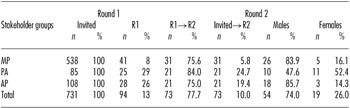
In round 1, potential panel participants were individually approached by personalized emails and informed about scope of the survey as well as expected amount and type of contribution. The attached online link enabled personalized Web access to a cover note explaining the study background and the self-administered scenario-based questionnaire. Panelists were requested to respond to each of the survey questions. In the second round, the link to the questionnaire was distributed again by email to all participants of round 1 along with the cover note explaining the tasks of round 2. This was done as experts were requested to re-consider and potentially adapt their responses of the first Delphi cycle. For all study questions, PHP-Program code-generated group-specific results were comprehensibly arranged using Microsoft Excel chart design. According to their professional background, participants were allocated to one of three panelist groups: representatives of (a) medical professionals, (b) patient advocates, and (c) administrative personnel, as shown in Table 1. Based on this group membership, each study participant found individual choices of round 1 simultaneously displayed underneath the respective survey question with aggregated findings of the respective expert group.
Panel Characteristics and Panel Mortality of a Two-Round Online Delphi Process, Stratified by Stakeholder Groups: Medical Professionals (MP), Patient Advocates (PA), and Administrative Personnel (AP)

Data Analysis and Feedback of the Survey Results to the Experts
In the final step, after discard of partially completed surveys, data of completed second-round questionnaires (n = 73) was statistically processed using Excel spread sheet (Microsoft, Seattle, WA) and SPSS version 17.0 (SPSS Inc., Chicago, IL). Picked choices of the respective questionnaire section were analyzed for both scenarios separately and additionally, total percentage means of scenario 1 and 2 were consolidated (Tables 2 and 3). Some figures may not sum to a total of 100 percent due to rounding. We examined differences between opinions of stakeholder groups using Kruskal-Wallis tests (Table 4). Group sizes were weighted to generate equal samples for statistically admissible inter-group comparisons. Eventually, study results were summarized in a final report which was sent to participants per email.
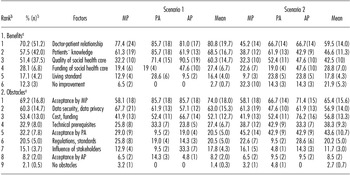
Ranking of Picked Choices of Factors Improved Future Scenarios in Austria and Perceived Obstacles for Their Implementation, Stratified by Stakeholder Groups: Medical Professionals (MP), Patient Advocates (PA), and Administrative personnel (AP)

aMultiple-answer questions: 1. Which factors are improved by widely acceptance of the specific scenario in Austria? [% (n)]; 2. Which factors hamper the implementation of the specific scenario in Austria? [% (n)]
bMean scenario 1 and scenario 2.
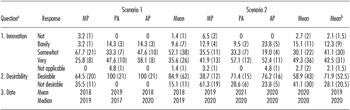
Degree of Innovation, Desirability, and Estimated Date of Implementation of Future Scenarios of ICT-Assisted Doctor–Patient Communication in Austria, Stratified by Stakeholder Groups: Medical Professionals (MP), Patient Advocates (PA), and Administrative Personnel (AP)

aResponses to three, single-choice questions: 1. In your opinion, how innovative is this scenario for Austria? [% (n)]; 2. In your opinion, is this scenario desirable for Austria? [% (n)]; 3. In your opinion, when will the scenario be widely accepted in Austria? (year).
bScenario 1 and scenario 2
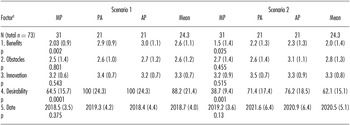
Group Size-Weighted (n = 24.3), Scenario-Based Inter-group Comparisons of Amount of Picked Choices

Note. Panellists (n = 73) were stratified by stakeholder groups: Medical professionals (MP), patient advocates (PA), and administrative personnel (AP). P: Kruskal Wallis test.
aResponses to multiple-answer questions: 1. Which factors are improved by widely acceptance of the specific scenario in Austria? (Amount of picked choices, 1–6 points, SD); 2. Which factors hamper the implementation of the specific scenario in Austria? (Amount of picked choices, 1–9 points, SD);
Single-choice questions:3. In your opinion, how innovative is this scenario for Austria? (Degree of innovation, 1–4 points); 4. In your opinion, is this scenario desirable for Austria? (%); 5. In your opinion, when will the scenario be widely accepted in Austria? (years).
RESULTS
In the first round of this nation-wide online Delphi survey, we addressed 538 medical professionals (approximately 20 percent general practitioners), 85 patient advocates, and 108 administrative personnel over the age of 18 years. Of these 731 persons, 94 individuals completed the online study questionnaire (response rate 13 percent, Table 1). Finally, 10 percent (n = 73; 74 percent males; mean age 43.9 years; SD 9.4) fully completed both rounds as 21 participants of round 1 did not successfully participate in the second Delphi cycle. Panelists were Austrian residents from all nine Austrian provinces. Regarding group assignment, medical professionals (n = 31) comprised clinicians who worked in hospitals (n = 29) and general practitioners (n = 2). Representatives of patients advocates (n = 21) were employees of offices of ombudsman (n = 11) as well as patient advocacies (n = 7), and also included communication scientists (n = 2) and one medical ethicist. Administrative personnel (n = 21) was employed in governmental positions (n = 11) and also in quasi-autonomous non-governmental organizations, such as hospitals (n = 10).
We ranked factors that could possibly benefit from ICT applications to demonstrate overall and inter-group opinions (Table 2). Ranking of the two scenarios separately was equivalent to the overall ranking. So, we report here mean percentages of consolidated results of scenario 1 and 2. Improvement of doctor–patient relationship achieved the highest overall rank (70 percent of all participants), followed by advancement of patients’ knowledge (58 percent), and quality of social health care (51 percent). Patient advocates and administrative personnel (overall mean scenario 1 and 2: 76 percent and 74 percent, respectively) were more optimistic that ICT will improve doctor–patient communication compared with medical professionals (overall mean 61 percent).
Furthermore, a ranking of eight factors revealed overall and inter-group opinions on issues perceived as possible obstacles for implementation of future scenarios on doctor–patient communication (Table 2). Again, ranking of the two scenarios individually corresponded to the overall ranking. By allowing multiple choices, panelists perceived acceptance by doctors (70 percent), data security (60 percent), and monetary aspects (53 percent) as three most relevant hampering factors of technological innovations. Patient advocates and administrative personnel (overall mean scenario 1 and 2: 76 percent and 79 percent, respectively) perceived the factor acceptance by medical professionals as far more hindering compared with representatives of doctors (58 percent).
Furthermore, Table 3 depicts opinions regarding degree of innovation and desirability as well as the estimated dates of acceptance of the respective scenarios. Compared with scenario 1, scenario 2 was considered to be more innovative (26 percent versus 36 percent, respectively) but less desirable (85 percent versus 59 percent, respectively). Perceived degree of desirability differed between groups, as medical professionals stated poorer desirability for both scenarios. Scenario 1 was not desirable for 35 percent of this group, whereas scenario 2 was not desirable for 15 percent. In contrast, all participants of the other two stakeholder groups regarded scenario 1 as being desirable in the future. Furthermore, only 29 percent of patient advocates and 24 percent of administrative personnel did not perceive scenario 2 as relevant. All stakeholder groups anticipated a similar year estimate (overall mean year 2019) for implementation of the ICT scenarios.
Furthermore, we were interested in differences of inter-group opinions (Table 4). Regarding amount of picked choices in the multiple-choice question, group size-weighted Kruskal-Wallis tests revealed significant inter-group differences as medical professionals perceived fewer factors beneficial for implementation of both ICT scenarios (p = .002 and .025, respectively). Additionally, regarding the single-answer question on the scenarios’ desirability, we found highly significant differences. So, medical professionals compared with the other stakeholder groups rated scenario 1 and 2 as being less attractive for future ICT-supported doctor–patient communication in Austrian health care (p = .0001 and .001, respectively).
DISCUSSION
The present Delphi survey provides so far lacking empirical insight in stakeholder group-specific expectations regarding future scenarios of ICT-assisted health communication. Austrian representatives of the three interest groups medical professionals, patient advocates, and administrative personnel participated in a 2-round online Delphi process. Evidence-based practice decisions may base on characteristics of these professional domains, and these three interest groups were identified as stakeholders in trend-setting, decision making, and implementation of Public Health-relevant ICT (Reference Windle17).
The Delphi process was developed for the systematic synthesis of participants’ opinions with defined study characteristics such as anonymity, iteration with controlled feedback from one round to the next and statistical aggregation of group responses. In this study, graphically and statistically processed findings of the first round were displayed for the according group in the second round and any results of the other groups were invisible. What is more, the Delphi method could be seen as a tool to encourage involvement from all stakeholders in removing restrictions regarding space and time. According to Geist (Reference Geist18), paper-pencil version compared with online Delphi studies showed higher participation rates with equal data quantity and quality. However, in this electronic self-administered questionnaire survey, employed software prevented item non-response and partial non-response (Reference de Leeuw19), whereas panel mortality, also called panel attrition, as shown in Table 1, had to be accepted.
In the literature, some Delphi surveys (Reference Pearce, Jones and Morrison20;Reference Mitha, Boulyana and Hue21) used over 70 participants, while others have involved as few as ten experts. Obviously, sample size is associated with the amount of generated data. However, there is rare empirical evidence on the effect of the number of participants, and expert panel qualities have more influence on the reliability or validity of opinion-building processes (Reference Aichholzer11).
Influence of occupational groups on response rates has already been reported decades ago by Cartwright (Reference Cartwright22). Compared with patient advocates and administrative personnel, response rates were lower in medical professionals in our panel. Of these, the vast majority were hospital-based doctors who usually receive a fixed salary. Although also eligible for participation, very few community-based general practitioners, who are usually independent contractors with performance-related pay, agreed participation in our uncompensated two-step survey. In line with a recently published review article (Reference Cho, Johnson and VanGeest23), we assume that this phenomenon of low and declining survey response rates among medical experts and the associated non-response bias might root in time investment-associated loss of earnings, concerns about workload and out-of-hours commitment. As opinions of clinicians were overrepresented in our panel and overall response rate was quite low, our results might not fully be representative for all Austrian doctors. As a consequence, we suggest increasing practitioners’ willingness to participate in future scientific studies including Delphi surveys by means of improved recruitment and incentive strategies as well as reduced barriers for involvement.
Continuous adjustment of ICT-based health care services could help to tackle current Public Health problems including low quality and high costs (Reference Chaudhry, Wang and Wu13;Reference Cabieses, Faba, Espinoza and Santorelli24). Also, ICT could support and facilitate patient empowerment on multilayered levels of communication, health promotion, disease prevention, and monitoring of health-relevant parameters for integration of complex diagnoses with patient-customized, preventive medicine, and lifestyle suggestions. Especially technologically mediated and supported communication could improve patient compliance considerably and thus also supports therapeutic success.
In the present survey, we aimed at approximating future prospects using scenario-based extrapolations of past and present knowledge. Nevertheless, these estimates remain tricky due to the unpredictability of complex political, economical, and social influences. Two comprehensible scenarios were presented to serve as hypothetical examples of future ICT exertions. As scenarios 1 and 2 yielded quite comparable results throughout the survey, we herein discuss consolidated data of both scenarios to report on the assessed experts’ opinions on overall doctor–patient conversation.
Among other items, we assessed perceived benefits of ICT-assisted medical counseling (Table 2). Experts anticipated doctor–patient relationship (70 percent), patients’ knowledge (58 percent), and quality of social health care (51 percent) as the three most improved factors of presented scenarios. This finding suggests that use of ICT in health care may foster a change of paradigm toward empowerment, autonomy, and self-assertion processes of consumers (Reference Ilioudi, Lazakidou and Tsironi25).
Inter-group differences in estimations of the three stakeholder categories were among the most noteworthy outcomes of this online Delphi survey on doctor/patient communication. In sum, doctors were less optimistic concerning the benefits of the future scenarios. Consequently, for this group of participants, the presented outlooks were neither exceedingly innovative, nor very desirable. It is quite unlikely that academic medical staff might be over-suspicious about ICT use in general and future ICT-driven changes in doctor/patient interactions. In our sample, potential reasons for this skeptic attitude among doctors could be possibly derived from the higher ranking of hampering factors for ICT (Table 2) such as data security and privacy aspects (scenario 1: 68 percent, scenario 2: 61 percent) and acceptance by patients advocates (scenario 1: 29 percent, scenario 2: 45 percent). Interestingly, compared with medical staff, representatives of patients and administration ranked the factor acceptance by medical professionals (70 percent) as most relevant obstacle for future accomplishment of these respective settings (Table 2). This observation could be reality in every-day decision-making processes in the Austrian healthcare sector, suggesting that stakeholders should be aware of this skeptic attitude of doctors when implementing ICT solutions. Also, these results are in line with a study conducted by Lupianez-Villanueva et al. (Reference Lupianez-Villanueva, Hardey, Torrent and Ficapal26), reporting that the majority of interviewed practitioners (61 percent) stated lower importance of ICT use.
Accessibility of digital medical information and knowledge by means of innovative ICT is influenced by numerous scientific concepts and disciplines, for example, medicine, psychology, ethics, law, and economics. The multidisciplinary use of ICT requires ethical considerations of confidentiality, security, and preservation of privacy for sensitive medical data, and their user-friendliness and reliability. However, data protection issues had always been matter of public discussion. While paper-based medical records have been subject to breaches of data security and privacy since old times, large volumes of “big” electronic data that could be quite easy accessed by means of computerized systems have elevated public concerns about potential privacy and security violations (Reference Simon, Evans and Benjamin27). In accordance, data security and privacy were ranked as second important critical factor (60 percent) of implementing the future scenarios in our study. Thus, patients’ privacy and security have to be addressed and adequately assured by the Public Healthcare providers in all phases of ICT development.
In line with aforementioned results on perceived beneficial and obstructive factors, further inter-group comparison regarding desirability of all scenarios revealed that participating representatives of both patient advocates and health administration personnel regarded more scenarios as being desirable compared with representatives of medical professionals. This finding also recommends that this group might be more critical regarding new health-associated technical innovations.
In this survey, estimates of the predicted date of public acceptance of presented ICT scenarios were used to seize the present level of awareness with and knowledge of experts involved in previous ICT use-related decision making. The consolidated findings indicated a date a decade ahead from 2010. This date represents a surprisingly long time period considering the fact that the depicted scenarios were already technically engineered in the year 2010 when this study was conducted. Nevertheless, we assume that participation in the Delphi process was likely to create awareness for electronic medical counseling and future innovative opportunities in Public Health. Thus, providing feedback on this aggregated date may have provoked stakeholders to reconsider the prospect priority of doctor–patient communication.
Strengths and Limitations of the Survey
As major strength, a large number of experts (n = 73) in high-ranking positions in the Austrian Public Health sector participated in this study. To ensure an impact of the outcomes of the Delphi process, selected experts should possible have influence to implement these results, at least on a national level. Furthermore, we did not find significant differences in the opinions on assessed ICT-supported developments in the groups of participants, even after adjusting for age and gender (data not shown). So, we assume a high level of confounder-independent professionalism in the panel. However, even designated experts in the field of health care are not able to predict future developments. Due to potential selection and non-response bias in the recruiting phase, our participants could not be fully representative of stakeholders in general. Although our findings were based on perceptions of Middle European German-speaking experts, these results could be of interest for health care stakeholders outside of this geographic area by providing a synthesis of existing ICT applications in hypothetical scenarios. Another Delphi process could be done with a larger study sample from various countries to confirm and refine these findings, and adjust the survey to ongoing changes of ICT-based technical capabilities.
Furthermore, software assistance enabled time-saving, precise data transfer between Delphi rounds and simplified subsequent data analysis. The developed methodological adaptations of the preexisting concepts of a Delphi survey presented in this study could serve as innovative model for hypothesis-driven research approaches.
The results of this study needed to be considered within the context of study design and associated limitations. We conducted this online Delphi survey among Austrian experts, and the attitudes and expectations of stakeholders elsewhere may differ. Nevertheless, the purpose of this study was to identify the span of nation-wide opinions about future developments and, as such, it is likely to have identified the relevant hot topics for members of society in general and decision makers in other communities.
The advantages inherent in the Delphi method are accompanied by potential disadvantages. These include the possible lack of panelist accountability and loss of unpredictable group dynamics achieved in face-to-face meetings. The study questionnaire was in German, the official Austrian language, which might have caused a language-associated sampling bias. However, this survey was intended to aggregate, analyze, and provide empirical data of the opinions of national German-speaking stakeholders.
CONCLUSION
The digitalization process is well under way within many health care systems. Over the coming decades, various groups of stakeholders will need to develop, implement, and evaluate ICT-based health infrastructures. This Delphi survey offers useful insights to physicians, clinicians, scientists as well as health managers and policy makers on the impact that ICT could exert on the doctor–patient dialogue.
SUPPLEMENTARY MATERIAL
Supplementary File 1: http://dx.doi.org/10.1017/S0266462314000294
CONTACT INFORMATION
Daniela Haluza, MDInstitute of Environmental Health, Center for Public Health, Medical University of Vienna
David Jungwirth, MScInstitute of Environmental Health, Center for Public Health, Medical University of Vienna; Department of Communication Science, ICT & Society Center, University of Salzburg, Austria
CONFLICTS OF INTEREST
The authors declare no conflicts of interest.