The excavation by the author of Building XXVII 2 at VerulamiumFootnote 1 proposed an historically important sequence of structures, with the late Roman house (itself built after c. a.d. 380 and displaying two, or possibly three periods) being replaced by a large buttressed hall or barn with bonding-courses entirely made of broken tiles. This strongly implied construction at a time when new tiles were no longer available and use had to be made of pieces wrenched from the remains of earlier buildings. Perhaps, as suggested below, they were obtained from the tile-course which had once capped the foundation-walls of its predecessor on the site. In turn the remains of this barn had been dug through by the trench for a wooden water-pipe with iron junction-collars. Direct dating-evidence was absent for all these after the initial date of c. a.d. 380 for the construction of Building XXVII 2; accordingly a sequence of suggested dates supplied by dead-reckoning was proposed as follows:
1. second-period mosaic in Room 15/16 c. a.d. 400 and lasting long enough to need patching;
2. corn-dryer inserted in Room 15/16 c. a.d. 420–425, the stoke-hole of which lasted long enough to need repair;
3. collapse of house c. a.d. 435;
4. buttressed barn in use c. a.d. 435–455;
5. pipe-line dug through the former barn, c. a.d. 455–470.
The chronology proposed for Building XXVII 2 itself gains some support from the sequence proved in a neighbouring, but less lavish house, Building XIV 3. The construction of the latter was dated to c. a.d. 375–385 by a coin of Valentinian I incorporated in the masonry of a channelled hypocaust; after a lengthy occupation, a second period saw extensive alterations which included demolition of walls and provision of a mosaic (which had later been entirely worn away except for part of its border) and a chalk floor renewed four times, all suggesting that occupation had lasted until c. a.d. 430–440.
In recent years these ideas have been challenged, first by David NealFootnote 2 and later by Neil Faulkner,Footnote 3 followed by a reply from the authorFootnote 4 and further correspondence in Current Archaeology issues 242 and 244. The principal cause of the controversy is the question as to whether dating of mosaics by stylistic comparison can take precedence over dating by stratified evidence when the two disagree; and since the answer to this question carries important implications for our view of fifth-century Britain, and because some of the statements made by Neal and Faulkner are based on a misunderstanding of the published evidence, it is hoped here to set the record straight.
The mosaic floor in Room 8 of Building XXVII 2 lay 70 cm (27.5 inches) above the floor of the previous house to occupy the site (Building XXVII 2 A), which had been burnt down in the conflagration of c. a.d. 155. Here at a late date the debris of that fire had been removed, probably during a search to recover tesserae; this search had extended north-westwards over Building XXVII 2 B, although in fact that house had lacked any tessellation. Elsewhere at Verulamium Antonine fire-debris varies in thickness between 35 cm (13.7 inches) and 40 cm (15.7 inches), although in one place it is recorded as being as much as 45 cm (17.5 inches) thick. If, therefore, we allow for a former thickness of 40 cm on top of the burnt floor, the surface of the deposit would have lain 30 cm (11.8 inches) below the level of the mosaic, proving the need for extra material for the make-up in addition to the burnt debris when this was tipped back in. The published sections illustrate this. The necessity for all this depth of make-up was caused by the contemporary street-surface which, because of frequent re-metalling, had risen some 70 cm (27.5 inches) above its Antonine level. This situation would have led to damaging flooding of adjacent properties after rain-storms if the floor levels had not been raised to counter the danger.
It was clear from their appearance and from the presence of offsets below the top of the make-up, that the walls of Building XXVII 2 were built free-standing within the large pit that had been created during the search for tesserae; the presence of these must have been revealed during preliminary trenching. It was also clear that these walls had never risen much higher than their present tops, for the surviving surfaces were very flat, indicating that a tile-course may have been removed (perhaps by the builders of the later barn). The structure of the walls above this masonry had been built of clay/brickearth, as proved by the survival of many fallen lengths of them. In this the builders followed an architectural tradition seen in other buildings at Verulamium, such as XXI 1 and XXI 2; such walls were sufficiently substantial to support an upper storey where required, as shown, for example, in XXI 1 over Room 3.Footnote 5
The use of similar make-up, mainly of burnt daub, to raise all the floors to a suitable level means that all such deposits within the house are contemporary, and the latest finds from below any one floor can be used to date the entire structure. It is, therefore, futile to assign different dates, as Neal has done,Footnote 6 to mosaics in the same house on the basis of particular coins or sherds below individual examples.
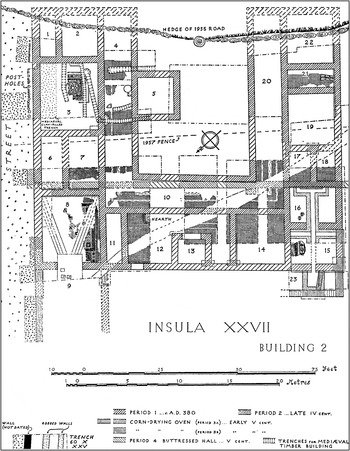
Room 15/16 contained what was interpreted as a corn-dryer, cut through the mosaic floor which had been laid down when Room 15 had been added in the second period, but which Neal contends was an original hypocaust provided to heat that floor.Footnote 7 This explanation had been rejected in the excavation report because of the relationship of one of the branch flues with the chalk foundation of the external wall. A more compelling argument is that the structure in Room 15/16 does resemble a corn-dryer (fig. 1) but bears no resemblance to what was a genuine contemporary hypocaust inserted in the similarly enlarged Room 8/9 with its central distribution-chamber and radial flues.
Site plan: Building XXVII 2.

One of the unexplained features found during the excavations was the presence of ‘floors’ of chalk, or of gravel which had sometimes been mixed with a slurry of mortar.Footnote 8 These ‘floors’ underlay the tips of make-up and sealed occasional patches of original debris from the fire of c. a.d. 155. Neal has suggested that these may represent unfinished preparations for a public building or else for a market area,Footnote 9 but their position shows that they intervene chronologically between the digging of the pit to recover tesserae and the re-depositing of burnt debris as make-up for the new building. It may be suggested, therefore, that they represent builders' work-places where materials had been assembled and used for constructing the fourth-century house, whose walls, as shown above, were built free-standing in the pit before the make-up was tipped back in. These walls themselves, with their angles turned in tile, overlay chalk-filled foundation-trenches, which would account for the chalk ‘floors’, while the other ‘floors’ of gravel and mortar were the remains of masons' building-activities. One of the chalk patches yielded sherds of two flanged dishes of the second half of the fourth century, with another sherd from one of them (No. 1718) being found embedded in the mortar basis of the tessellated floor of Room 4.Footnote 10
It has been shown that the construction of Building XXVII 2 is to be dated by the contents of the make-up layers used to raise its floors to a suitable level. These layers yielded seven coins, as follows: Gallienus (a.d. 253–268), Victorinus (two, a.d. 268–270), Carausius (a.d. 286–293), Constantine I (Urbs Roma, a.d. 330–335), Constantius II (barbarous, c. a.d. 360), and Valens (a.d. 375–378). Neal, however, has dated the mosaic in Room 3 (and, therefore, of course the construction of the house which received it) on stylistic grounds to the late second or early third century,Footnote 11 although elsewhereFootnote 12 he has written that the latest deposits beneath the mosaic date from a.d. 200–275, not realising that the date should depend on that of the make-up as a whole and not just on the part of it beneath that floor. That terminus post quem for the mosaic, and thus for the house itself, was later extended by FaulknerFootnote 13 to ‘early fourth century’ after he had realised the significance of the coins, although still rejecting the final two of the sequence (those of Constantius II and Valens) as intrusive. In forming this new conclusion Faulkner relied on a secondary source, the author's note in Current Archaeology 241, rather than consulting the primary source, the excavation report.Footnote 14 It is unfortunate that this secondary source contained a printer's error, naming Constantius I in place of Constantine I, the coin in question being an Urbs Roma issue of a.d. 330–335 as had been recorded in the excavation report. Thus his new terminus post quem must be advanced to c. a.d. 340–350. The shifting of the terminus by over a century surely confirms the impression that the stylistic dating of mosaics is too elastic to be reliable.
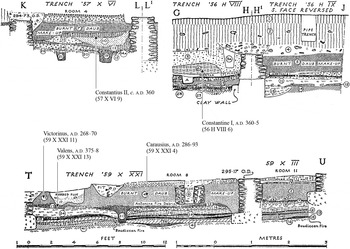
Both Neal and Faulkner are concerned to discredit the numismatic evidence, concentrating their arguments on the contexts of the coins of Constantius II (c. a.d. 360) and of Valens (a.d. 375–378), but there is no logical reason why inimical earthworms or incompetent excavators should (as suggested) have concentrated on these final two coins, save that acceptance of their contexts would undermine both Faulkner's theories of fifth-century history and Neal's typology. But the coin of c. a.d. 360 from Room 4 was not associated, as both of them assert, with a late repair to the overlying mosaic, but was found in a layer of clay beneath an undisturbed layer of burnt daub make-up 30 cm (11.8 inches) thick (fig. 2, section K–L: Trench VI 9) and could not possibly have been displaced thither, even by earthworms as Faulkner has postulated.Footnote 15 Likewise the coin of Valens (Room 8) was not found, as suggested by Neal,Footnote 16 directly below the robbed flue (of the later channelled hypocaust), for Mark Hassall, the experienced supervisor of the site, recorded its discovery in Trench XXI 13, a layer of pure fire-debris below the make-up of burnt daub (fig. 2, Section T–U). This thin layer had been left behind on the thick sandy floor of Room 11 in Building XXVII 2 B by those searching for tesserae after their disappointing discovery that Building 2 B contained none; they did not need to clear the floor after all, and the coin could well have been dropped and trodden in as the search was abandoned.
Sections showing the contexts of the relevant coins.

The author believes that he has proved that the house was built almost two centuries later than the date assigned on stylistic grounds by Neal to the mosaic in Room 3. How is this tangle to be unravelled? It has already been suggested that dating mosaics by that method is incapable of precision, but if Neal's dating is even approximately possible, it might perhaps be explained by the supposition that, during the search for tesserae in the early Antonine Building XXVII 2 A, this mosaic was found in one of its rooms (Rooms 4, 6 or 8 were all large enough to have housed it) and its central part was lifted for re-use. Donald Strong has noted the re-use of emblemata from the centre of mosaics elsewhere.Footnote 17 (The discussion of the stylistic dating of mosaics by Patricia Witts below, see appendix, probably makes serious consideration of this theory unnecessary.) Moreover, this explanation cannot be extended to the other mosaic fragments in Building XXVII 2, which all belong to its second period — unless indeed the collection and sale of second-hand mosaics had become a feature of the early fifth century, an idea not yet supported by evidence. Neal has published part of a mosaic which may have been found in a temple attached to the forum and which, if so, may indicate the source of one of our fragments.Footnote 18 No doubt, however, the use of old pattern-books provides a more palatable explanation. It is one thing to date the style of a complete mosaic by its comparisons, but quite another to date individual fragments of motifs in the same way.
Neal's cursory attitude towards the numismatic evidence when it does not suit his dating method is also revealed by his dismissal of a coin of Constantine I as a stray.Footnote 19 It was found below a mosaic in Building XIV 5, and had been described by the excavators as from the make-up for that floor.Footnote 20
A curious anomaly in the dating evidence, not previously noticed by either Neal or Faulkner or by the author, is that the remains of the clay walls of the superstructure, where intact lengths of it were found fallen, yielded seven coins, as follows: Gallienus (a.d. 253–268), Victorinus (a.d. 268–270), Claudius II (a.d. 268–270), Claudius II (posthumous, two, a.d. 270), Tetricus I (barbarous, a.d. 270–273), and Tetricus II (a.d. 270–273). These coins might have suggested a late third-century date for the structure had not that proposition been decisively contradicted by the coin-evidence from the building's make-up layers. The coins accordingly must have already entered the wall-clay at the place from which it had been obtained. A suggestive source for this is the pit which had been dug for the cellar in the adjacent Building XIV 5.Footnote 21 That pit had yielded c. 886 cubic metres of material from earlier stratified structures consisting very largely of clay/brickearth walls and floors; but when the cellar eventually was filled in, it was with ‘uniform tips of rubbly dark earth’.Footnote 22 A large dump from the original excavation of the pit must therefore have existed near by after c. a.d. 275 when the cellar was dug, and may well have contained the coins listed above, available for re-use a century later in the walls of Building XXVII 2. So obvious a source of material may well have been tapped to supplement the burnt-daub make-up in an earlier phase of operations, thus accounting for the pre-Carausian coins found therein.
The dates proposed for the rise and fall of Building XXVII 2 make it possible to suggest that in that house and in its neighbour Building XIV 3 we may catch a glimpse of the domestic circumstances of some of the richly clothed multitude of Pelagians who are said to have confronted Germanus in a.d. 429.Footnote 23 By that time an increasingly impoverished though still no doubt well-dressed upper-class family still occupied the great house, the mosaics of which they were compelled by a lack of craftsmen and materials to repair in a very amateurish way with home labour, and whose life-style was affected by the lack of coinage, the use of which Dr J.P.C. KentFootnote 24 has calculated to have ceased by c. a.d. 430; it was also affected by the collapse of the few surviving centralised centres of large-scale pottery production,Footnote 25 although upper-class families may still have had the use of plate such as the pewter bowl and platters found in the local riverbed in 1956.Footnote 26 If mass-produced pottery was by now unobtainable, it is scarcely surprising that the stoke-hole of the corn-dryer in Room 23 yielded nothing but residual sherds.Footnote 27
The great surprise of the sequence in Insula XXVII is that although the two successive buildings seem to have been the products of private or unofficial initiatives, the final feature, the pipe-line, must surely imply the survival of some civic authority or organisation.
The author believes that he has shown that the dating of the site set out above has not been overturned by stylistic dating of the mosaics, and that the adoption of a long chronology, although at first sight perhaps appearing rash, is vindicated when a link is made with the British enclave in the Chilterns and eastern Oxfordshire noted by Myres,Footnote 28 where a large area is devoid of early Saxon settlements and cemeteries, and which may have retained its independence until defeat in a.d. 571 at the Battle of Bedcanford. This enclave may well represent the western half of the territorium of the Roman municipium, and indeed before that the western core of the pre-Roman Catuvellauni. We may note that the Saxon cemetery at Verulamium in King Harry Lane, just outside the city wall, was established as late as the middle decades of the seventh century.Footnote 29 Verulamium, then, had a long sub-Roman survival within its surrounding enclave, as did Exeter and Cirencester,Footnote 30 the latter being captured by the Saxons in a.d. 577, as recorded in the Anglo-Saxon Chronicle; the site must have been still inhabited for its capture to be worth recording. These cities had fates very different from those of cities further east, such as Canterbury or Caistor-by-Norwich, which succumbed much more quickly; but by a.d. 500 there will have been little of their Roman material culture left.
Instead of attempting to overturn stratigraphical evidence for the dating of mosaics, it may be wiser for students of these designs to take on board the new evidence as an aid to improving the theory.
APPENDIX. SOME BRIEF COMMENTS ON THE STYLISTIC DATING OF MOSAICS WITH PARTICULAR REFERENCE TO VERULAMIUM BUILDING XXVII 2
By Patricia Witts
The debate about the dating of Building XXVII 2 at Verulamium highlights a potential conflict between archaeological and stylistic dating of mosaics. Professor Frere explains in his excavation report,Footnote 31 and summarises above, how the coin finds from his excavations indicate a late date for this building and its mosaics, with the sequence of development suggesting the continuation of urban life well into the fifth century. This dating is challenged by Neal who considers that, stylistically, the mosaics are significantly earlier.Footnote 32 As a specialist in Romano-British mosaics, the author offers the following comments to complement the argument that Professor Frere makes. The topic of dating by mosaics is to be addresssed at length in a forthcoming paperFootnote 33 and this Appendix will be confined, therefore, to highlighting the main points relevant to the Verulamium debate.
There is ample and well-argued evidence to support the broad concept of stylistic dating, but it has perhaps been developed beyond the point at which it can be helpful. It is one thing to note a close correspondence of design and motif between certain mosaics, especially those in the same area. This may well tell us something useful about how the craft operated. It is another matter entirely to focus upon isolated motifs from disparate mosaics and argue that they must have been contemporary. To do so involves adopting an unrealistically rigid approach to human love of pattern and creativity. It also introduces a degree of subjectivity: what one person regards as a stylistic similarity indicating some sort of link can be regarded by someone else as a wholly independent development of a common motif.
The recent discovery of the mosaic at Yarford in Somerset poses a challenge to the neat chronological categorisation of mosaics since it has a second-century design but features a style of cantharus used in fourth-century mosaics.Footnote 34 The building in which the mosaic was laid is thought by its excavator to have been constructed in the late third century, with the mosaic belonging to a phase of enlargement and embellishment in the early/mid-fourth century. If so, the mosaic cannot be a second-century survival into which the cantharus was inserted at a later stage. In any event, there is nothing in the appearance of the mosaic apart from the mixture of styles to suggest that it might have been laid at more than one period. If the fourth-century style of cantharus had not survived at Yarford and we had only been aware of the second-century scheme, a reliance on stylistic dating would have presented the conundrum of a mosaic apparently decorating a building that did not exist at the time.
Faulkner and Neal have suggested that stylistic dating of mosaics works on the same principles as pottery dating.Footnote 35 The design of a mosaic — a much greater surface than a pot — was not, however, a production-line affair. The sheer variety of figures depicted in many of the mosaics and the marked differences in the way they were depicted indicate that they were individual commissions. We know little about how mosaicists operated, but the production of a single pavement potentially involved a number of different people — the designer, the mosaicist(s) and, most importantly, the patron — each contributing their own knowledge, experience, ideas and preferences. Mosaics were more complex products than pots.
Neal's stylistic arguments about the mosaics in Building XXVII 2 at Verulamium start with the suggestion that no late fourth-century parallels can be found for the scheme of complex overall meander in the main panel of the Bacchus mosaic in Room 8/9.Footnote 36 The various volumes of the Neal and Cosh Corpus of Romano-British mosaics contain several comparable schemes, but they are few and of widely different — and uncertain — date.Footnote 37 It follows that they do not tie such a scheme firmly to a particular period, nor do they constitute evidence that the Verulamium mosaic must pre-date the late fourth century.
Secondly, Neal notes that the rhomboids in the eight-lozenge star in the adjacent panel of this mosaic are dark grey, and argues that they are an earlier type: ‘Later 4th-century examples would be expected to have coloured rhomboids filling the lozenges or with the rhomboids alternating in colour, for example red and dark grey, or with the rhomboids concentrically shaded’.Footnote 38 It is notable, however, that solidly-coloured rhomboids were found in a similar star in the Newton St Loe Orpheus mosaic, the only difference being the colour used: dark grey at Verulamium and red at Newton St Loe. Cosh and Neal attribute the Newton St Loe mosaic to the second half of the fourth century.Footnote 39 Both mosaics employed lozenges: as a border around three sides of the Orpheus panel at Newton St Loe and in the fragment — perhaps part of an otherwise lost border — adjoining the eight-lozenge star at Verulamium. Given these similarities, it must be questionable whether the dark grey colouring of the Verulamium rhomboids is sufficient to place the mosaic at a different period.
Neal's third argument concerns the Verulamium lozenge itself and its distinctive nature with its acute angles terminating in peltae. A similar lozenge was found in the fragments of the border of the mosaic in Room 15/16. Neal contends that parallels for these distinctive lozenges are not common, although he compares them to the lozenges in the border of the Bacchus mosaic from Leadenhall Street, London. He notes that the Leadenhall Street lozenges contained roundels of guilloche and draws attention to a fragment of such a roundel — although not within a lozenge — in the mosaic in Room 15/16 at Verulamium.Footnote 40 The Leadenhall Street mosaic was found in 1803 and there is no recorded dating evidence to give a secure starting point. Neal dates it stylistically to the third or perhaps the very early fourth century.Footnote 41
It is notable that other Romano-British mosaics with lozenge borders, albeit without the lozenges terminating in peltae, are considered by Neal and Cosh to be late. The Winterton Orpheus mosaic is attributed by them to c. a.d. 350,Footnote 42 and the mosaic with nine busts from Brantingham is described as mid-fourth-century.Footnote 43 A date in the second half of the fourth century is assigned to a geometric mosaic from Newton St Loe and to the Orpheus mosaic from the same site.Footnote 44 The Brantingham mosaic is particularly notable as its lozenges contain a variety of circular motifs, two of which are close parallels for the motif contained by the lozenge in Room 8/9 at Verulamium. The latter consisted of a small solid circle surrounded by the outline of a circle with a petal shape on either side. In the two Brantingham examples, the solid circle is replaced by a small cross. The basic motif recurs, although more prominently, in the lozenges flanking the Brading astronomer, where it takes the form of what Neal and Cosh describe as ‘a circular band’ and has a small concentric rather than a solid circle in the centre. The Brading mosaic is assigned by Neal and Cosh to the mid-fourth century.Footnote 45
The Leadenhall Street mosaic also had a vivid series of borders around the central Bacchus medallion. Awning, a relatively uncommon border motif, was used for the outer of these. Most examples of awning border appear in mosaics dated by Neal and Cosh to the fourth or mid-fourth century,Footnote 46 with only the mosaic from Bucklersbury in LondonFootnote 47 and the Leadenhall Street mosaic being assigned to the third century.
Although Faulkner and Neal contend that certain of the decorative features of the Verulamium Bacchus mosaic are ‘characteristically early’,Footnote 48 there is nothing in the motifs and borders discussed above that compels us to accept a third-century, or even early fourth-century, date. There is, however, an argument that some of those features are characteristically late.
Adopting the dating given by Neal and Cosh in the volumes of their Corpus of Romano-British mosaics, the presence of a single bust in an otherwise geometric mosaic seems to have been a fourth-century fashion. Frere has drawn attention to the busts in the spandrels of the Fullerton mosaic,Footnote 49 a pavement ascribed by Neal and Cosh to the first half of the fourth century.Footnote 50 Other examples can be cited from Bratton Seymour, Fifehead Neville, Itchen Abbas, Oulston, Thenford, Whittlebury, Winterton, and York, all mosaics featuring single busts and given fourth-century dates. In particular, Neal and Cosh date the Fifehead Neville and Whittlebury mosaics to the mid-fourth century,Footnote 51 the two mosaics from Winterton to c. a.d. 350,Footnote 52 and the Thenford mosaic to a.d. 350–360.Footnote 53
Another indication supporting a late date for the Verulamium mosaic is the circular motif in a compartment below the bust of Bacchus.Footnote 54 The closest parallels found for this motif come from the Lopen mosaic discovered in 2001. Neal and Cosh date the Lopen mosaic to the third quarter of the fourth century on the basis of its close similarity to mosaics from the nearby site of Halstock for which there is some archaeological dating evidence.Footnote 55
A stylistically-based chronology for mosaics is a useful guide but not a straitjacket. There is no compelling reason why Frere's theories about the continuity of urban life in late Roman Britain have to be rewritten.