Introduction
The rising demand and popularity of locally grown food has been a common topic in the popular mediaReference Pollan1–Reference Kingsolver3. The term ‘locavore’ was deemed the Oxford word of the year for 20074. For many farmers, selling local food may offer a valuable product differentiation strategy, meeting consumer demand for the ‘local’ attributeReference Porter5, Reference Lancaster6, while increasing their portion of the consumer food dollar.
‘Grower-only’ farmers' markets are important locations for consumers to source local foodReference Zepeda and Li7. The dramatic rise in the numbers of farmers' markets both nationally8 and in Michigan9 further suggests the growth in demand for local food. Farmers' markets are important venues for producers too: farmers can gain price premiums and/or a larger share of the food dollar from these direct sales, as well as entrepreneurial skill and information to meet consumer preferencesReference Hunt10, Reference Brown, Miller, Boone, Boone, Gartin and McConnell11. Several studies also document the social benefits of farmers' markets: building relationships with consumers and information exchange, as well as fun and entertainmentReference Hunt10, Reference Griffin and Frongillo12. Others have reported that extending the market season has positive impact on farmer incomeReference Brown, Miller, Boone, Boone, Gartin and McConnell11. Finally, some discuss spillover benefits from farmers' markets, such as bringing shoppers downtown and providing small business incubation opportunitiesReference Hilchey, Lyson and Gillespie13, Reference Lev and Stephenson14. All of this implies an opportunity for the use of season extension technology as a tool for increasing the direct market exposure of farmers in areas where seasonal markets predominate.
In many respects, Michigan is well placed to meet this demand: it is the second most agriculturally diverse state in the country, producing more than 125 different products15. However, the state's climate poses a challenge: most of the state is in agricultural hardiness zones 4 and 5, enjoying at most six frost free months annually16, 17. These factors severely constrain the state's ability to supply a wide array of foods year round. One promising solution to this seasonality challenge is the use of season extension technologies such as unheated, plastic covered hoop houses (aka, high tunnels), which serve as low cost greenhouses18.
This paper reports research results measuring consumer demand for locally grown food outside of the customary growing period, focusing on purchases at extended season farmers' markets in three Michigan regions. Here, we begin to answer the question: what is the potential market for hoop house grown produce? We asked, for example, if consumers will patronize extended season farmers' markets, how much they would spend and what they would buy. We investigated what product attributes most attract them and how these findings inform farmers' marketing strategies.
Previous Research
The meaning and value of local
Selfa and QaziReference Selfa and Qazi19 defined three broad types of attributes that may define and create value for local foods: geographic location or distance (place), quality of the food—especially freshness (taste) and relationships between participants (face-to-face). The meaning of local food markets varied greatly between farmers and consumers, and among these groups by location within Washington State.
Other studies highlighted similar consumer interest in foods reflecting these ‘local’ attributes. In a study conducted in Missouri, consumers recognized state boundaries in defining local, but had stronger preference for items grown in a smaller region within the stateReference Brown20. Another study, using focus groups of Wisconsin shoppers, found similar ways of defining and valuing local, including location (i.e. driving time, or county or state boundaries), freshness and flavor, and relationships with the farmersReference Zepeda and Leviten-Reid21. An Ohio studyReference Darby, Batte, Ernst and Roe22 utilized conjoint analysis to measure contributions to consumer utility of three dimensions of local: location (grown in Ohio and ‘nearby’), freshness (‘harvested yesterday’) and farm ownership structure, which roughly parallels the relationship aspect (e.g. ‘Fred's Berry Farm' versus ‘Berries, Inc.’). Each of the three attribute categories contributed significantly and positively to consumer purchase likelihood.
We theorize that an item meeting all three criteria (location, quality and relationship) would, all things being equal, hold the most value for consumers. The features promoted within the location dimension might include geographic boundaries (grown in a given state, region and county), or miles traveled (distance from farm to market), or supporting the state's or county's taxpayers. The quality dimension may be reflected in freshness (‘picked today’), using unique regional products (Michigan tart cherries or Great Lakes whitefish), or attributes not broadly available due to limited demand (grass-fed beef) or difficulty in transport (heirloom vegetables). The relationship dimension can include a range of familiarity, including extended friendships between growers–consumers, conversations at farmers' markets, and labels, brochures and other promotional materials that tell the ‘story’ of the food and farmers who grew itReference Conner, Campbell-Arvai and Hamm23.
Investigators have discussed a range of perceived benefits from local food systems associated with these three dimensions, as well as caveats and constraints. Possible, although controversial, benefits of eating food produced in close proximity included decreased ‘food miles’ (and concomitant wear on roads, infrastructure and pollution) and improved economic development opportunitiesReference Swenson24–Reference Cantrell, Conner, Erickek and Hamm28. Potential perceived quality benefits included improved food safety and nutrition. Food systems based on relationships among participants can bring a host of benefits, including improved land use and community problem-solving capacityReference Lyson29, Reference Conner and Levine30.
Other investigators have provided either outright critique of various stated attributes or tempered them with caveats. For example, investigators have critiqued the use of food miles as an indicator of sustainabilityReference Smith, Watkiss, Tweddle, McKinnon, Browne and Hunt31. PattersonReference Patterson32 mentioned a common industry belief that local often implies lower quality, as high quality goods are exported, in addition to questioning the net benefit to farmers of state promotion efforts. Bellows and HammReference Bellows and Hamm33 cautioned that local does not necessarily co-locate attributes of sustainability and fairness, while Born and PurcellReference Born and Purcell34 warned of a local ‘trap’ when assuming local is unambiguously more just and sustainableReference Born and Purcell34. Others expressed similar concerns, specifically cautioning against defensive localismReference Hinrichs35, Reference Winter36.
Several constraints or barriers to consumption of local foods have emerged as well. Only one consumer in a Wisconsin focus group (N=43) study equated local with season, an obvious constraint in temperate climates, absent the wide use of season extension technologyReference Zepeda and Leviten-Reid21. BrownReference Brown20 cited numerous studies that document consumer expectations that local should cost less. Both BrownReference Brown20 and Zepeda and LiReference Zepeda and Li7 mentioned the potential search, inconvenience and travel costs of buying local as impeding demand or requiring a lower price.
Effective marketing strategies will be needed to meet this demand. We next examine the literature regarding the four Ps of marketing (‘marketing mix’)—place, product, price and promotion—regarding these products. Where do consumers buy local foods and how does this impact demand? What products are consumers most interested in buying? What pricing and promotional strategies are likely to be effective?
Locally grown foods can be purchased at many locations. Zepeda and LiReference Zepeda and Li7 provided a narrow definition of local as bought directly from farmers in one's own or a neighboring county, often from farmers' markets, community supported agriculture (CSA) or farm stands. They stated that both farmers' markets and CSA are ‘unambiguously local’ (p. 2), although in Michigan and elsewhere, many farmers' markets allow the sale of products not grown by the farmer, or even grown out of state: these policies are established by the individual markets (Susan Smalley, Board Advisor, Michigan Farmers Market Association, personal conversation, December 2008). People who shop in health food stores were more likely to buy local food, but the amount or specific food items were not clearReference Zepeda and Li7.
In the Wisconsin studyReference Zepeda and Leviten-Reid21, fresh produce, particularly corn, tomatoes, melons and apples, were bought locally by all groups studied, a finding consistent with previous researchReference Kezis, Gwebu, Peavey and Cheng37, Reference Govindasamy and Nayga38. ‘Alternative’ shoppers (recruited from a food cooperative newsletter, Slow Food group and local food festival) gave a broader range of items. However, no mention was made of items consumers do not wish to source locally if availableReference Zepeda and Leviten-Reid21.
As with any item, price and quality drive the demand for local foods: if local food is seen as a superior product, consumers will more likely pay a premium. Consumers in Brown'sReference Brown20 study, who were primarily concerned with freshness and quality, were more likely to buy local, believing it to be fresher and more flavorful. However, only 28% were willing to pay any premium for local, while some (14%) demanded a discount to buy local. In contrast, almost three-fourth of consumers in a Maine study stated a willingness to pay (WTP) more for localReference Kezis, Gwebu, Peavey and Cheng37. BrownReference Brown20 cited numerous studies that document consumer expectations that local should cost less. Farmers' price-setting strategies may be informed by consumers' WTP as well set as a markup over production costs. Utilizing a cost-plus pricing strategy increases overall farm income as well as guaranteeing production costs are metReference Brown, Miller, Boone, Boone, Gartin and McConnell11, suggesting the benefit of this approach.
Howard'sReference Howard39 research found that most (81%) consumers prefer labels to communicate information about how food was produced, processed or sold (i.e. the impacts on the environment, animal welfare and social justice); slightly fewer (76%) consumers preferred signs or brochures. It is not clear if these findings extend to issues of where or by whom the food was produced, which were found to be less important to consumers' animal product intended purchase decisionsReference Conner, Campbell-Arvai and Hamm23. Better understanding of attributes most valued by consumers will inform the content of promotion activities whatever media are used. The remainder of this paper discusses research, which guides the marketing mix for hoop house grown produce sold at Michigan farmers' markets, with particular attention to the three dimensions of local discussed above.
Methods
The methods of this study were approved by Michigan State University's Institutional Review Board (IRB No. X06-340). We utilized four complementary data collection methods: dot poster surveys, written surveys, focus groups and experimental auctions. In aggregate, they provided both depth and breadth of understanding consumers' attitudes and intended behaviors with respect to extended season farmer's market purchases. Copies of surveys, interview guides and auction protocols are available on request from the authors.
Farmers' market data collection occurred between June and August 2007. Initial data utilizing dot surveys and written surveys were collected at three Michigan farmers' markets where farmers participating in a Michigan State University research project on the profitability of hoop houses sell their products [Ann Arbor Farmers' Market (AA), Sweetwater Local Foods Market (SW) in Muskegon and the Sault Sainte Marie Farmers' Market (SSM)]. Customer focus groups were conducted at SW and SSM during this same period. Three experimental auctions were conducted between March and June 2008: one at SW, one at Michigan State University's campus and one at a church in East Lansing.
Dot poster surveys
Dot poster surveys were conducted according to Lev and StephensonReference Lev and Stephenson40. Dot surveys are an effective method for gathering data from large numbers of respondents in a relatively quick and easy way, resulting in very high response rates. The method consists of simple questions with categorical answers on large posters where dot stickers are placed under appropriate answers by participants. Questions vary according to information desiredReference Lev and Stephenson40.
Each market had five dot posters, with the following questions (and response categories):
• What is the earliest month you attended this market in 2007? January or February; March or April; May or June.
• If local produce was available what is the earliest month you would be willing to come to this market? January or February; March or April; May or June.
• What is the latest month you attended this market in 2006? July or August; September or October; November or December.
• If local produce was available what is the latest month you would be willing to come to this market? July or August; September or October; November or December.
• How many miles did you travel to attend this market (one way)? 0–5, 6–10; 11–25; more than 25.
In each case, posters were located in a central location at the market and passing customers were asked by researchers and undergraduate research assistants if they were willing to take part in a research concerning this market. While no exact count of refusals was recorded, it appeared that a significant number of customers participated (442 answered at least one question). In cases when the shopper did not attend the market in 2006, they were told not to answer that question.
Written surveys
Following completion of the dot survey, researchers and assistants invited participants to take a written survey. A total of 195 people completed the survey. The survey was intended to solicit more detailed information concerning shopping habits and intended behaviors given certain market scenarios. The survey investigated:
• Market attendance over a specified period (2006 and 2007).
• Intended spending that day (choosing between $0–10, $10–25 and more than $25).
These figures were then combined to calculate the average (mean) expenditure per visit and per year, both for each individual and summed over all shoppers. The average expenditure per person was the weighted average of each category, where the midpoints of the categories were used for the $0–10 and $10–25 categories (i.e. $5 and $17.5, respectively) and $30 was used for the ‘more than $25’ category. This mean expenditure was then, multiplied by the number of 2006 visits and the number of respondents to give annual expenditure figures.
Shoppers were also asked to consider the following hypothetical scenario:
Suppose you are shopping for a bag of fresh salad greens. You have the option of buying (1) produce that was grown outside of the state, or (2) produce that was produced by a local farmer in an unheated greenhouse (hoop house). The two items are the same in size, quality and appearance. Suppose item (1), the salad greens grown outside of the state, cost $2.00 per bag. What is the most you would pay for item (2), local hoop house produce?
Next, the survey asked the consumer to consider the price they named above and asked them on what proportion of produce items they would pay that amount, choosing between these responses: only a few items I buy; many items I buy; most of the items I buy; all of the items I buy. Consumers were given a list of vegetables and asked to check off ones they would particularly like to buy or not buy (with the option to list items not named).
The survey gave a list of attributes pertaining to where and how products are produced, and asked consumers to rate the importance of each in their purchasing decisions on a scale of 1 to 10 (1 being not at all important, 10 being extremely important). The attributes were:
• Grown within 20 miles of this market.
• Grown within 100 miles of this market.
• Grown in Michigan.
• I personally know the farmer who grew it.
• Produce grown with organic methods.
Summary statistics were performed on the written survey data including mean, median and frequency. To determine whether the above values (number of visits, intended spending level, WTP and quantity of local purchases, importance of attributes) differed significantly by location, a Kruskal–Wallis (KW) analysis was usedReference Kruskal and Wallis41, as a Kolmogorov–SmirnovReference Massey42 test found none of these variables to be normally distributed.
Focus groups
The third phase of the research included focus groups conducted at two of the markets (SW and SSM). A total of 16 participants took part, eight at each session. Subjects were recruited via market e-mail newsletters circulated by the respective market managers. Focus groups were conducted in a meeting room near the market location. The focus groups included a set of nine questions concerning the shoppers' attitudes, motivations, preferences and behaviors at that market. Participants did not receive topics ahead of time, but instead discussed the questions as they were introduced during each session. Each subject was paid $25 for his/her participation and each focus group lasted about 1 h. The sessions were audio recorded and transcribed.
Focus group data were analyzed by creating a coding system to identify emerging themes. This process involved developing codes to assign meaning to the text of each verbatim transcript. A table was developed to clearly identify the theme, code, definition, rule for application and to provide examples of when to use the codes. Codes were then applied to the data and used for data labeling and data retrieval throughout the analysisReference Huberman, Miles, Denzin and Lincoln43.
Experimental auctions
Finally, we utilized experimental auctions as a tool to investigate customers' WTP. These have been used effectively for a number of product areas, including irradiated meat and non-GMO corn chipsReference Buzby, Fox, Ready and Crutchfield44, Reference Conner and Christy45. Auctions address a major shortcoming of stated preference methods by imposing a budget constraint on consumer choices.
Between March and June 2008, three experimental auctions were conducted to measure consumer WTP for locally grown salad greens. They took place at (1) SW, recruiting subjects via the market newsletter; (2) Michigan State University, using department list-serves and (3) a church in East Lansing using the church newsletter. A total of 46 people participated.
At each auction, two containers of organic salad greens (approximately one-half pound), one locally grown and one bought the day before in a grocery store, were sold using an English second price auction. The second price auction was used due to its incentive compatible propertiesReference Hoffman, Menkhaus, Chakravarti, Ray and Whipple46. Each item was auctioned three times, and participants were not told the number of rounds, to avoid wealth effects; the binding round was chosen by lot, as was order in each round (local first or second). Participants were given a $25 stipend, which was used to pay for any item won. Upon completion of the auction, participants filled out an exit survey and collected their winnings.
The experimental auction exit survey, in addition to standard demographic information, utilized the same attribute rating questions as the farmers' market written surveys (rate on a scale of 1–10 the importance of grown less than 20 and 100 miles from home, grown in Michigan, knowing the farmer and grown with organic methods). We also asked participants to compare the price they paid at the auction to the proportion of all produce they buy and price they would pay (by percent: 0, 10, 25, 50, 75, 90 and 100). In addition, we asked respondents to recall their bids on the items and to rate on a scale of 1 to 3 (1 if it was of little or no importance, 2 for moderate importance and 3 for great importance) the importance of the following attributes:
• Where the items were grown.
• The type of packaging and label.
• The mix of species/varieties.
• Any factor not listed above.
The respondents were then asked to circle each type of outlet where they acquire significant amounts of produce: supermarket or grocery store; farmers' market, CSA share, health food store/cooperative, farm stand and personal garden.
Results
Dot poster surveys
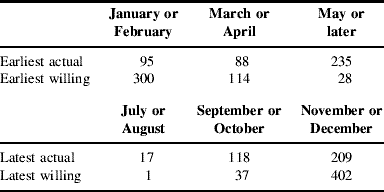
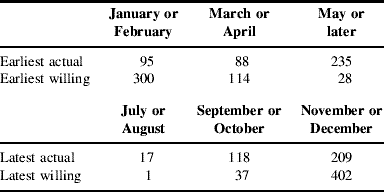
The dot poster responses indicated that most shoppers would attend the markets both earlier in the Spring and later in the Fall if fresh produce were available. While 23% actually attended markets in January–February, 69% indicted willingness to do so. Most (56%) indicated first attending in May or later. The SSM market did not open until May and those shoppers were therefore unable to attend any earlier. In the remaining two markets, 42% of respondents first attended in May or later. Similarly, 61% last attended in November or December, but 91% would be willing to do so. Full results are presented in Table 1.
First and last month of market attendance, actual and willingness, measured by dot posters (number of shoppers giving each response).
Finally, the majority of shoppers (59%) traveled less than five miles to attend the market: the percentages of responses declined as mileage increased. Only 11% traveled more than 25 miles, while 18% and 12% traveled between 6–10 and 10–24 miles, respectively.
Written surveys
Written surveys confirmed that shoppers attended the markets regularly. The mean and medium visits per shopper in 2006 were 18.8 and 12 visits, respectively. Mean and median 2007 visits (up to the date of the survey) were 9.9 and 6. Nine percent attended 50 or more times in 2006, nearly half the maximum total possible visits. When asked how much they intended to spend, 14% responded $0–10, 47% responded $10–$25 and 39% responded more than $25.
The mean expenditure, as calculated above, was $20.51. Multiplying by the mean number of 2006 visits (18.8) yielded the average annual expenditure of $386 per person. Assuming each of the 196 survey respondents spent this amount, the total annual expenditure was $75,586. Accordingly, if each of the 442 dot poster respondents spent this amount, the total would be $170,453.
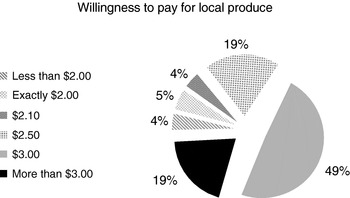
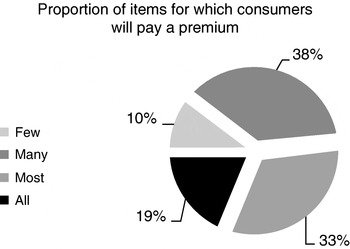
The shoppers also indicated WTP a premium for locally grown salad greens: 91% stated WTP a positive premium (Fig. 1). Of those willing to pay a positive premium, more than half (52%) would pay this premium for local on most or all produce they buy (Fig. 2).
Premiums that consumers (N=194) are willing to pay for locally grown produce. Results of written surveys administered to shoppers at Ann Arbor, Sweetwater and Sault Ste Marie (Michigan) Farmers' Markets, June to August 2007.

Proportion of produce purchases for which consumers (N=165) are willing to pay a premium. Results of written surveys administered to shoppers at Ann Arbor, Sweetwater and Sault Ste Marie (Michigan) Farmers' Markets, June to August 2007.

When provided a list of (local, hoop house grown) items they would most like to buy, the most common responses were tomatoes (85%), lettuce and spinach (70% each). The vegetable respondents were most likely not to buy was radish (26%).
Attributes pertaining to where and how food was grown were important to many of these shoppers, while knowing the farmer was less important. The attribute with the highest mean and median rating was grown in Michigan: the median of 10 indicates more than half of respondents rated this attribute with the highest score. Being produced with organic methods had the next highest mean and median score, while knowing the farmer who grows the food was the least important attribute by this measure (Table 2).
Mean and median rating of selected attributes (10 point scale).

The KW tests revealed that shoppers in different markets responded differently. KW analyses found that four variables: (i) number of visits in 2006 and (ii) 2007, (iii) intended spending and (iv) the importance of organic methods—differed significantly. The AA market, which had been operating year round for many years in a university town, had the highest group mean for visits both years, while SSM market, in the more rural and less prosperous eastern Upper Peninsula, had the lowest intended spending and rating of organic.
Focus groups
Focus group participants regularly shopped at farmers' markets, meaning that they both attended farmers' markets regularly and purchased a considerable amount of their total weekly food at the markets. Participants indicated that they ‘come every week’ and that ‘most of our produce comes from here.’ This behavior was driven by participants' preferences for quality products as well as fondness for the social element of markets.
Several recurring themes emerged as important product attributes or qualities that impacted their decisions to regularly shop at farmers' markets. The four product attributes most important included: (1) product freshness, (2) product taste, (3) locally produced and (4) chemical or pesticide free. Participants stated that they look for items that were ‘picked fresh’ and indicated the importance of taste compared to items available elsewhere explaining ‘it tastes better’. One participant affirmed, ‘tomatoes taste like tomatoes and onions taste like onions’. In addition, participants shopped at farmers' markets to support local farmers. For example, one participant described, ‘I'd rather buy local because I like to support the local growers’. Lastly, participants identified that they could purchase products grown without chemicals or pesticides at farmers' markets. Each of the three markets had farmers selling certified organic produce or produce grown according to organic practices. If not labeled organic, farmers' market consumers have the opportunity to ask farmers about their growing practices. Combined, these attributes were the most important factors influencing farmers' market purchases at the markets studied.
The social component of farmers' markets emerged as equally important. Participants valued the friendly interactions amongst shoppers and the personal relationships they have with farmers and vendors. Participants described the markets as a ‘friendly gathering’ and indicated that ‘personal relationships are important’. These personal relationships, in addition to the product quality, were important factors influencing consumer loyalty. Shoppers tended to return to vendors and continue purchasing from them once they developed a relationship with them. Participants agreed that ‘you kind of get to know the vendors—the ones that you want to be regular with’.
Participants also stressed that they enjoyed the diversity of the products available. A market shopper explained, ‘I really like the fact that it's a mix of foods. You know, I can get baked goods and I can get meat and eggs and produce and even soap and lotion’. While the price of these products was discussed, its importance varied across the participants.
Overall, both product attributes and social characteristics influenced focus group participants' decisions to regularly shop at farmers' markets. Shoppers selected products from markets based on perceived attributes of: freshness, taste, locally grown and chemical or pesticide free. Additionally, they were able to develop personal relationships with the producers and meet like-minded individuals from their communities.
Experimental auctions
The average bid, over three rounds, was $2.96 for the one-half pound of local greens and $2.26 for the non-local greens, implying a $0.70 (31%) premium. The average bids for local and non-local were significantly different, as measured by a paired means t test. Grown in Michigan and with organic methods again had the highest rating, although the auction participants rated organic highest and overall, had lower mean and median ratings on all but one attribute than did the farmers' market shoppers (Table 2).
On average, respondents would typically be willing to pay the local premium (as revealed by the bid) on 63% (mean response) of produce purchases. The median response was 75%. Eleven percent would pay the bid amount for all items. The factor most influencing the participants' bids was where the items were grown: 65% rated this as greatly important, whereas only 9% rated it as not important.
Packaging and label were the least important attribute: 65% rated it as not important and only 7% rated it as greatly important. Roughly equal numbers rated the mix of greens as not (28%), moderate (33%) and greatly (39%) important. Finally, supermarkets (86%) were the most commonly cited place of fresh produce purchases, followed by farmers' markets (67%), health food stores (41%), personal gardens (28%), farm stands (20%) and CSA shares (6%).
Discussion
For much of the nation, as demand for local food grows, the potential to maximize this market rests on addressing seasonality. We propose passive solar hoop houses as a relatively low cost means of extending the season for produce to meet this demand and contribute to farm viability. Our research at Michigan farmers' markets gives cause for optimism.
Based on the data presented above, it is clear that many shoppers at these farmers' markets are loyal customers for the farmer–vendors: appreciating locally grown food and gaining value from various aspects and combinations of local found in Selfa and Qazi'sReference Selfa and Qazi19 study. They found particular value in foods produced in Michigan (the ‘place’ dimension) but greater geographic proximity did not increase value, unlike results from MissouriReference Brown20. Relationships with farmers (the ‘face to face’ dimension) held the least value for written survey respondents. In contrast, farmer–customer relationships were important for the focus group participants, perhaps reflecting a difference between those who self-selected to participate in each activity.
Based on the frequency of visits to farmers' markets and levels of intended spending, these shoppers are already contributing to farm income. Their stated willingness to attend markets late and early in the season and pay premiums (as measured both by survey, stated choice, and auction, revealed choice, methods) on salad greens, and in many cases on other items, suggests potential for growth in the market for extended season produce. The WTP for local contrasted with prior researchReference Brown20 suggesting the need for a discount.
The results also inform hoop house farmers' marketing strategies. First, given frequency of visits, customer loyalty and full retail prices and assuming that logistical issues with year-round markets can be addressed, farmers' markets can be an even greater income source for farmers. Tomatoes, the most desired products, can be provided both earlier and later than the field-growing season; lettuce and spinach (the next two most desired products) can be supplied throughout the year. These shoppers expressed willingness to buy a wide range of vegetables: only one vegetable (radish) had more than 13% of survey respondents express particular unwillingness to buy. This suggests farmers' ability to sell a broad array of hoop house vegetables year round.
The results also suggest that many consumers will pay premium prices. Both survey and auction methods found consumer WTP premiums for locally grown salad greens (specifically) and other foods. The average premium expressed by survey respondents was slightly greater than that of auction respondents (a difference that is not statistically different), both in absolute and proportionate terms. It is not clear whether any difference in premium was due to method (stated/revealed choice) or sample. Farmers' market shoppers consistently rated importance of attributes more highly than did the auction subjects. In any case, these data suggest consumers' WTP more for local, evidence that a premium pricing strategy may be effective.
Finally, the most important ‘local’ promotion message may be ‘Grown in Michigan’ rather than distance (food miles). Knowing the farmer was overall the least important attribute as rated by the farmers' market shoppers, despite the importance of trust-based relationships expressed by some focus group participants. This result is consistent with Howard'sReference Howard39 study, which finds that consumers overwhelmingly prefer to get information (including ‘local’) about food products from labels or brochures rather than through interaction with the seller. This may come as welcome news for farmers, who may feel freer to focus on selling rather than socializing on busy markets days, while still perhaps making the time to chat with core customers. Growing with organic methods was also important to many consumers, which is not surprising; several studies have suggested organic growers add diversity and draw customers to farmers' marketsReference Hunt10, Reference Griffin and Frongillo12, Reference Kremen, Greene and Hanson47.
The results have policy implications as well. First, given the spillover benefits of farmers' markets, municipalities can assist in the establishment of later season markets by helping to find or construct sheltered locations. Internal market policies limiting the sale of non-local produce or requiring labeling of out of region/out of state produce can help to clarify product origins to consumers.
Conclusions
Season extension technologies such as hoop houses can potentially contribute to farm viability by helping farmers extend the market season, one of the major barriers to meeting local food demand. The research discussed in this paper suggests that farmers' market shoppers in Michigan would attend extended season markets and purchase fresh produce grown in hoop houses.
While the data present a consistent picture, they are limited to the shoppers at these three markets on the specific days the research was conducted, and may not be generalizable to other populations. Furthermore, many of the data are based on consumers' stated intentions and recollections, not on observations in the market place. While the experimental auction method does test WTP under a budget constraint, its subjects are not representative of other populations, nor are their actions observed under repeat purchases.
Finally, further research would help to better guide prospective hoop house farmers' marketing mix and overall contributions to local food systems. Conjoint analysis would measure consumers' comparative value of the three dimensions of local and guide effective promotion. Other important questions include: which products are most likely to be profitable? Even in light of farmers' markets sustained growth, will large numbers of the general public attend extended season markets? What policies and strategies are most likely to deliver ancillary social, economic and environmental benefits of local food systems to farmers, consumers and communities? We hope our research highlights the potential for season extension and generates further interest in efforts to address constraints to local food consumption.
Acknowledgements
This research was supported by The National Research Initiative of the USDA Cooperative State Research, Education and Extension Service, grant number 2006-55618-16922.