Introduction
Biological processes, such as endozoochory, involve the ingestion of seeds and their passage through the animal digestive tract. Seeds can be scarified, increasing germination speed, although the mortality potential increases if the seed coats weaken too much (Janzen et al., Reference Janzen, Demment and Robertson1985). These effects of herbivory are related to digestion, the gut retention period, seed size and the hardness of seed coats according to the maturity stage of propagules, etc. (Janzen, Reference Janzen1981, Reference Janzen1982; Janzen et al., Reference Janzen, Demment and Robertson1985). However, enhanced germination of seeds following passage through the herbivore gut may not always be beneficial (Traveset and Verdú, Reference Traveset, Verdú, Levey, Silva and Galetti2002).
The effect of endozoochorous dispersers on seeds also depends on their final destination. On the one hand, seed transport is beneficial for the plant by allowing it to occupy new environments (colonization hypothesis; Howe and Smallwood, Reference Howe and Smallwood1982) and to reduce predation risk, parasitism and competition near the mother plant (escape hypothesis; Janzen, Reference Janzen1970; but see Hyatt et al., Reference Hyatt, Rosenberg, Howard, Bole, Fang, Anastasia, Brown, Grella, Hinman, Kurdziel and Gurevitch2003). In some cases faeces can also provide a propitious environment for germination (Gokbulak and Call, Reference Gokbulak and Call2004). However, final seedling establishment is not ensured, because it depends on seedling and seed predation in the faeces, the suitability of the defecation site for seedlings, sibling competition for resources and the current environmental conditions (Janzen, Reference Janzen1981; Howe, Reference Howe and Murray1986). In view of the complexity of factors involved in endozoochory, it is not surprising that the effects of seed dispersal are sometimes contradictory, with frequent variations between different sites, plants and herbivore species (Traveset and Verdú, Reference Traveset, Verdú, Levey, Silva and Galetti2002; Verdú and Traveset, Reference Verdú and Traveset2005).
Exotic species can disrupt mutualistic plant–animal interactions such as seed dispersal (Traveset and Riera, Reference Traveset and Riera2005). When seed dispersal is a limiting factor, they can be effective seed dispersers of many native plants, but they can also have a detrimental effect if they compete with native dispersers and/or modify either the seed shadow or the germination patterns generated by native dispersers (see review by Traveset and Richardson, Reference Traveset and Richardson2006).
In the semi-arid areas of Argentina, species of the genus Prosopis (Fabaceae) play an important role in the functioning of plant and animal communities. Prosopis acts as an environmental stabilizer and yields a variety of useful products for rural populations. This genus maintains ecosystem complexity by creating microhabitats and is a valuable food resource for both humans and animals (Kingsolver et al., Reference Kingsolver, Johnson, Swier, Terán and Simpson1977; Mares et al., Reference Mares, Enders, Kingsolver, Neff, Simpson and Simpson1977; Or and Ward, Reference Or and Ward2003; Rossi and Villagra, Reference Rossi and Villagra2003). Domestic and wild herbivores can play a role in the endozoochorous dispersal of Prosopis seeds (e.g. Eilberg, Reference Eilberg1973; Peinetti et al., Reference Peinetti, Cabezas, Pereyra and Martinez1992, Reference Peinetti, Cabezas, Pereyra and Martinez1993; Campos and Ojeda, Reference Campos and Ojeda1997; Ortega Baes et al., Reference Ortega Baes, de Viana and Sühring2002; Kneuper et al., Reference Kneuper, Scott and Pinchak2003). In this interaction, seeds can lose viability and be subject to different effects on germinability, depending on the particular mammal and Prosopis species involved. Results of studies of P. ruscifolia, P. caldenia and P. ferox consider that in animals, such as cows, goats and donkeys, gut passage is not an important means of seed release from dormancy, and therefore endozoochory may not increase germination percentages (Eilberg, Reference Eilberg1973; Peinetti et al., Reference Peinetti, Cabezas, Pereyra and Martinez1992; Ortega Baes et al., Reference Ortega Baes, de Viana and Sühring2002). However, when other mammals (horses, wild mammals) participate in endozoochory, germination percentages increase significantly (P. ruscifolia, P. caldenia, P. flexuosa, P. glandulosa; Eilberg, Reference Eilberg1973; Peinetti et al., Reference Peinetti, Pereyra, Kin and Sosa1993; Campos and Ojeda, Reference Campos and Ojeda1997; Kneuper et al., Reference Kneuper, Scott and Pinchak2003). Therefore, the introduction of exotic herbivores may change Prosopis dispersal processes, with potential effects on the function of plant communities in the Monte desert where these species play a major role.
In this context, our specific goals were: (1) to quantify the P. flexuosa, P. chilensis and P. torquata seeds contained in the faeces of native (mara and guanaco) and exotic mammals (donkey and hare); and (2) to determine mortality, germination percentage and germination speed of faeces-borne seeds compared to those collected directly from trees.
Materials and methods
Study site
The study was conducted in the Ischigualasto Provincial Park (29°55′S, 68°05′W), 335 km from San Juan city, Valle Fértil Department, at 1300 m above sea level. The region has a desert climate, a wide day/night temperature range, summer rains below 100 mm per year, − 10°C absolute minimum in winter and 45°C absolute maximum in summer.
Approximately 90% of the area is part of the Monte phytogeographical province, with small sectors in the Chaco Serrano and the Cardonal districts (Acosta and Murúa, Reference Acosta and Murúa1999; Márquez, Reference Márquez1999). The predominant physiognomy is open scrubland, with heavy soil and moisture limitations on the plant communities (Márquez, Reference Márquez1999).
Some of the analysed mammalian species have conservation problems due to their restricted geographic distribution and low population densities. Moreover, available information is quite scarce, as in the case of mara (Dolichotis patagonum), a hystricognath rodent ranked as requiring ‘special attention’ (Acosta and Murúa, Reference Acosta and Murúa1999) and ‘vulnerable’ (Diaz and Ojeda, Reference Diaz and Ojeda2000), and guanaco (Lama guanicoe), ranked as ‘potentially vulnerable’ (Diaz and Ojeda, Reference Diaz and Ojeda2000). Although it has a wide distribution and flexibility in its use of food resources, guanaco populations are under heavy pressure from poaching and the introduction of alien species (Puig et al., Reference Puig, Videla, Cona and Monge2001). Recently, the guanaco population in Ischigualasto has been given the ‘highest conservation priority’ (Acosta and Murúa, Reference Acosta and Murúa1999). In addition, the Park supports exotic species, such as donkey (Equus asinus) and hare (Lepus europaeus), whose interactions with vegetation and native mammals are virtually unknown.
Seed and faeces collection
Prosopis fruit is a modified indehiscent legume with a thin epicarp, a mesocarp that can be fleshy, sugary or fibrous and several endocarp segments (Burkart, Reference Burkart1976). Prosopis germination is hindered by physical dormancy (Bewley and Black, Reference Bewley and Black1982; Peinetti et al., Reference Peinetti, Pereyra, Kin and Sosa1993), and seed scarification by different agents increases germination (Catalán and Balzarini, Reference Catalán and Balzarini1992; Peláez et al., Reference Peláez, Boó and Elia1992; Peinetti et al., Reference Peinetti, Pereyra, Kin and Sosa1993; Ortega Baes et al., Reference Ortega Baes, de Viana and Sühring2002).
Between January and April 2006, we collected seed samples of 10 fruits per tree directly from 9, 10 and 11 P. flexuosa, P. chilensis and P. torquata trees, respectively (henceforth tree seeds). During this period, we also collected fresh independent samples of faeces of exotic (donkey and hare) and native mammals (mara and guanaco). Independent faeces samples were defined as those more than 2 m apart for small mammals or 100 m for large mammals. The samples were collected in the habitats used most heavily by the herbivores within a roughly 200 km2 area.
We counted the Prosopis spp. seeds in a total of 574 g of air-dried faeces for mara, 1298 g for guanaco, 32.8 g for hare and 1300 g for donkey, taken from 100, 26, 15 and 13 independent samples, respectively. The seeds were classified as apparently healthy (with and without endocarps) or damaged, based on observations of external traits. Insect-damaged seeds (presence of insect exit holes) were counted separately from those with other damage (broken by chewing, open endocarps with malformed seed, etc.).
Germination experiments
During July 2006, germination tests were performed in incubators (Precision GCA Corporation, Scientific Model 818, Chicago, Illinois, USA) with constant light and temperature (30°C), using 9-cm diameter Petri dishes prepared with sand moistened to saturation. Mortality, germination percentage and germination speed were measured for seeds taken from trees (control seeds) and for seeds from herbivore faeces.
We used visually healthy P. flexuosa, P. chilensis and P. torquata seeds with endocarps collected from trees (two 25-seed replicates for each tree). In the case of P. flexuosa, two seed lots were used, with and without endocarps, as seeds in both conditions appeared in the faeces. Apparently healthy seeds collected from herbivore droppings were also cultivated, with sample sizes determined by seed availability. Thus, P. flexuosa seeds were found in mara faeces and donkey dung (16 replicates of 25 seeds used for each herbivore), hare (3 replicates of 25 seeds each) and guanaco (4 replicates of 25 seeds: 3 replicates of seeds without endocarp and 1 replicate of seeds with endocarp). P. chilensis seeds were found only in guanaco faeces (16 replicates of 25 seeds each). P. torquata seeds were taken from mara and guanaco faeces (16 replicates of 25 seeds for each herbivore) and hare faeces (3 replicates of 25 seeds).
Germination percentage and speed
To define the percentage of viable seeds, seeds that had not germinated in the previous experiment were manually scarified and placed under the above-mentioned conditions for 14 d. Scarified seeds that did not germinate after this period were subjected to the standard treatment with a 2,3,5-triphenyltetrazolium chloride test (Pili-Sevilla, Reference Pili-Sevilla1987), which detects seed viability by staining the embryo tissue pink/red.
Germination percentage was the number of germinated seeds in relation to the number of viable seeds known at the end of the trials. Seed mortality was obtained from the number of non-viable seeds in the tests, plus the number of damaged seeds (parasitized by insects, malformations, affected by herbivores, etc.) in relation to the number of seeds in the lots.
Seed germination speed was estimated for all seed sources, and the weighted germination percentage (germination speed) index was calculated for a 21 d period (Reddy et al., Reference Reddy, Metzger and Ching1985). This index gives maximum weight to the seeds that germinate first and a decreasing weight to subsequent germination. It is computed as follows:

where n 1, n 3,…, n 21 = number of seeds germinated on the first, third,…, twenty-first day, and N = total number of seeds. The value for germination speed varies between 100 (if all seeds germinate on the first day) and 0 (when none germinate in the study period).
Statistical analysis
The Kruskal–Wallis test was used to compare mortality, germination percentage and germination speed among seeds from different sources, due to the lack of normality in these variables. Post hoc comparisons were performed using the Mann–Whitney test (Zar, Reference Zar1984) with the sequential Bonferroni correction (Rice, Reference Rice1989). All statistical analyses were performed with SPSS 13.0 (SPSS Corp., Chicago, Illinois, USA).
Results
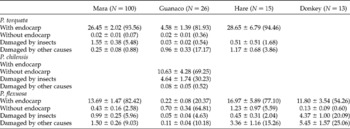
P. torquata and P. flexuosa seeds were found in guanaco, hare and mara dung, whereas only P. flexuosa seeds appeared in donkey faeces (Table 1). P. chilensis seeds were found only in guanaco faeces. In general, small herbivore faeces contained higher total densities of Prosopis seeds than those of the large herbivores (4–5 seeds g− 1 versus 1–2 seeds g− 1).
Seed content (mean±SE) of Prosopis species in the faeces of the four herbivores studied. The detected seeds were classified by appearance as healthy (with or without endocarp) or damaged (see text). Data show seeds/10 g of dung, with the relative percentage of each seed class for each species of Prosopis and herbivore shown in parentheses

Table 1 shows that P. torquata seeds in dung were generally embedded within their endocarps; however, small numbers without endocarp were found in mara and guanaco dung. In the case of P. flexuosa, most seeds occurring in the faeces of mara, hare and donkey were enclosed inside their endocarps. Seeds of P. chilensis only appeared in guanaco dung and they lost their endocarps during gut passage.
A surprisingly large number of damaged seeds were found in the faeces of guanaco (for P. torquata and P. chilensis) and donkey (P. flexuosa). Insect damage seemed to be particularly frequent in P. chilensis seeds contained in guanaco dung (Table 1).
Seed mortality
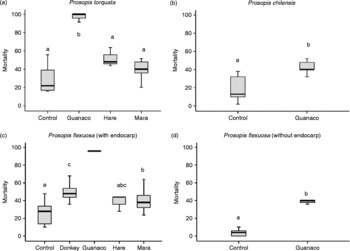
The mortality for P. torquata seeds differed significantly between groups (K = 34.07, P < 0.001, Fig. 1a). Seeds in guanaco faeces exhibited the highest mortality compared to control seeds, seeds in hare droppings and seeds in mara faeces. The latter three groups showed no significant differences. P. chilensis seed mortality was significantly higher in seeds dispersed by guanaco than in control seeds (U = 12.5, P < 0.001, Fig. 1b). Mortality for P. flexuosa seeds with endocarps showed significant differences between groups (K = 18.12, P = 0.001, Fig. 1c). Seeds collected from donkey dung exhibited the highest mortality, differing from seeds dispersed by mara and from control seeds. Seeds contained in mara faeces also showed a significantly higher mortality than control seeds, whereas seeds dispersed by hare showed no statistical differences from the other groups. Mean mortality for seeds found in guanaco faeces was generated by only one replicate of 25 seeds, thus preventing comparisons between this and the other groups. The mortality of seeds without endocarps was significantly higher in seeds dispersed by guanaco (U = 6.39, P = 0.011, Fig. 1d) than in control seeds.
Mortality of seeds (number of dead seeds/number of seeds in lots of 100 seeds) taken from trees (control) and dung of different herbivores for Prosopis torquata, P. chilensis and P. flexuosa (without endocarp and with endocarp). In this and other figures, different letters indicate significant differences between groups (control, donkey, guanaco, hare and mara) after correction for multiple testing (Rice, Reference Rice1989). Each box shows the range between 25th and 75th percentiles; the central line shows the median. Vertical bars represent the highest and lowest values that are not outliers or extreme values.

Germination percentage
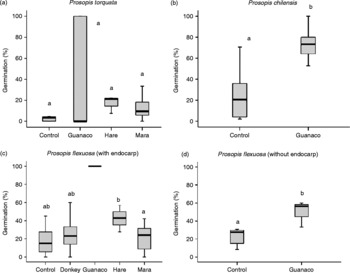
For P. torquata, germination percentage showed no significant differences between groups (K = 5.64, P = 0.130, Fig. 2a). In the case of P. chilensis, germination percentage was significantly higher in seeds dispersed by guanaco than in control seeds (U = 9, P < 0.001, Fig. 2b). For P. flexuosa seeds with endocarps, germination percentages showed only marginal differences between groups (K = 8.17, P = 0.08, Fig. 2c). Nonetheless, post hoc comparisons showed a higher germination percentage in seeds dispersed by hare than in those dispersed by mara. No significant differences were found in any other comparisons. P. flexuosa seeds without endocarps from guanaco faeces showed a higher germination percentage than the control seeds (U = 0, P = 0.013, Fig. 2d).
Germination percentages of seeds taken from trees (control) and dung of different herbivores for Prosopis torquata, P. chilensis and P. flexuosa (without endocarp and with endocarp). Symbols as in Fig. 1.

Germination speed
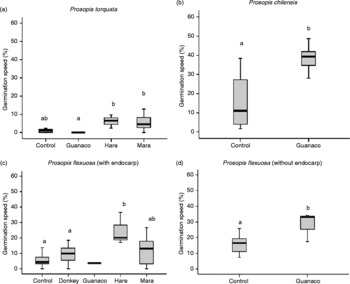
Germination speed for P. torquata was significantly different among groups (K = 18.2, P < 0.001, Fig. 3a). Seeds contained in guanaco faeces germinated more slowly than those from mara or hare faeces, but not control seeds. Seeds found in faeces of small herbivores showed a significantly higher germination speed than control seeds. P. chilensis germination speed was significantly higher in seeds dispersed by guanaco than in control seeds (U = 10, P < 0.001, Fig. 3b). For P. flexuosa seeds with endocarps, germination speed showed differences between groups (K = 9.69, P = 0.046, Fig. 3c). Seeds dispersed by hare showed a higher germination speed than seeds dispersed by donkeys and control seeds. Finally, P. flexuosa seeds without endocarps taken from guanaco faeces presented a higher germination speed than control seeds (U = 3, P = 0.05, Fig. 3d).
Germination speed (%) for seeds taken from trees (control) and dung of different herbivores for Prosopis torquata, P. chilensis and P. flexuosa (without endocarp and with endocarp). Symbols as in Fig. 1.

Discussion
All herbivores dispersed the seeds of one or more Prosopis species through their faeces, and in some cases, the passage of seeds through the animal gut modified their germinability. This is also the first record of dispersal by herbivores of P. torquata and P. chilensis, two significant species in the arid zones of Argentina (Burkart, Reference Burkart1976).
Seeds in faeces
Considerable numbers of Prosopis seeds were found in the faeces of the four analysed small- and large-sized herbivores. Although this has been found on several occasions for various herbivore species (e.g. Campos and Ojeda, Reference Campos and Ojeda1997; Kneuper et al., Reference Kneuper, Scott and Pinchak2003; Varela, Reference Varela2004), the present study is the first one to highlight differences between herbivores, with a special focus on the native versus exotic effect in an extremely arid protected area.
P. torquata and P. flexuosa seeds were found in high and similar densities in the faeces of the two smallest species. Studies of the trophic ecology of these herbivores show that their behaviour is opportunistic in the consumption of Prosopis spp. fruits, when available in large quantities (Campos, Reference Campos1997; Campos et al., Reference Campos, Ojeda, Monge and Dacar2001).
Major differences were found in larger herbivores, with a notable presence of all three Prosopis species in guanaco faeces, as opposed to the occurrence of only P. flexuosa in donkey dung. This undoubtedly reflects the use of a wide diversity of environments by guanacos and their browsing behaviour (Puig et al., Reference Puig, Videla and Cona1997, Reference Puig, Videla, Cona and Monge2001), in contrast to donkeys, which have a feeding strategy that is closer to that of bulk grazers and tend to concentrate around ephemeral watercourses (Lamoot et al., Reference Lamoot, Callebut, Demeulenaere, Vandenberghe and Hoffmann2005; Acebes et al., unpublished).
Large percentages of damaged seeds were detected in animal faeces, especially in the cases of guanaco (P. torquata 18% and P. chilensis 31%) and donkey (P. flexuosa 45%). Taking only insect damage into account, P. chilensis seeds are seriously affected in guanaco faeces (30%) as are P. flexuosa seeds in donkey dung (20%). The insect damage data should be used with caution and considered as estimates of the minimum number of damaged seeds; they are taken from external observations of holes in the endocarp produced by the emergence of adult insects, while seeds affected by larvae of arthropods and by plant infections were not quantified. This observation matches studies of the Prosopis genus that show predation by bruchids is high in both pods in trees (Smith and Ueckert, Reference Smith and Ueckert1974; Kingsolver et al., Reference Kingsolver, Johnson, Swier, Terán and Simpson1977) and pods in the soil (Lerner and Peinetti, Reference Lerner and Peinetti1996; Ortega Baes et al., Reference Ortega Baes, de Viana and Saravia2001), although our study did not reveal when the seeds were infected. With respect to the number of seeds damaged by other causes, we found a large number in guanaco faeces for P. torquata (17%) and in donkey faeces for P. flexuosa (25%). High percentages of death among seeds ingested by large herbivores could be associated with the long duration of gut passage, but differences across plant species found in any animal dung are more difficult to interpret, and may be related to pod traits such as dryness.
Mortality, germination percentage and speed
Seed mortality increased following passage through the animal gut, particularly in the case of the two largest herbivores. The change was significant in all cases with the guanaco, increasing in the most extreme situation from 20 to 100% (medians for P. torquata seeds). Similarly, passage through the donkey digestive tract increased the mortality of P. flexuosa seeds from 28 to 48%, contrary to the results of Ortega Baes et al. (Reference Ortega Baes, de Viana and Sühring2002), who found no effect from consumption by donkey on the viability of P. ferox seeds compared to seeds taken from plants.
Among the smallest herbivores, only passage through the mara digestive tract increased mortality in P. flexuosa seeds with endocarps, in comparison with control seeds. In a previous study in the Monte desert (Ñacuñán Reserve, Mendoza Province), mortality due to endozoochory by rodents such as mara was roughly 30% (Campos and Ojeda, Reference Campos and Ojeda1997), similar to the results of the present study.
Regarding percentage and speed of germination, comparisons between large herbivores showed that guanaco had larger effects on seeds than donkey, which did not increase either parameter. The low response of passage through the donkey digestive tract is consistent with studies that suggest that intake of Fabaceae pods by domestic herbivores (cattle, goat and donkey) does not appear directly to improve seed germinability in some Prosopis species (P. ruscifolia, P. caldenia and P. ferox), in comparison with healthy seeds scarified by mechanical or chemical means (Eilberg, Reference Eilberg1973; Peinetti et al., Reference Peinetti, Cabezas, Pereyra and Martinez1992, Reference Peinetti, Pereyra, Kin and Sosa1993; Ortega Baes et al., Reference Ortega Baes, de Viana and Sühring2002; Kneuper et al., Reference Kneuper, Scott and Pinchak2003). However, the guanaco significantly increased the germinable proportion and germination speed of P. chilensis seeds and P. flexuosa without endocarps, although it did not seem to alter these parameters in P. torquata seeds. Moreover, in the case of P. flexuosa, the seeds found in the faeces had been freed of their endocarps.
Among the smaller herbivores, few effects on germination percentage and speed were detected. Only hare seemed to increase the germination percentage of P. flexuosa seeds with endocarps. Previous studies did not find any effect of hare gut passage on germination (Izhaki and Ne'eman, Reference Izhaki and Ne'eman1997), although the lack of effects may be due to the comparisons having been made between seeds from hare faeces and manually scarified seeds. However, in the Monte desert (Ñacuñán Reserve, Mendoza Province), medium-sized rodents, such as mara, disperse P. flexuosa seeds with endocarps and enhance their germination capacity (Campos and Ojeda, Reference Campos and Ojeda1997).
The effects of herbivore gut passage on Prosopis seed survival and germinability are multiple and differentiated between plant species and animal dispersers. Large variability in seed germination capacity and speed after gut passage is usually found in comparisons of endozoochory by different animal species (for reviews see Traveset, Reference Traveset1999; Traveset and Verdú, Reference Traveset, Verdú, Levey, Silva and Galetti2002; Verdú and Traveset, Reference Verdú and Traveset2005). In our case, this variability was both direct, in terms of survival and germinability, and indirect, via the deposition of a percentage of the seeds released from the endocarp (P. flexuosa in guanaco faeces). In this case, gut passage partially released seeds from the physical dormancy imposed by hard impermeable seed coats and should facilitate subsequent environmental scarification by soil abrasion or extreme temperature cycles (Janzen, Reference Janzen1981; Izhaki and Ne'eman, Reference Izhaki and Ne'eman1997; Ortega Baes et al., Reference Ortega Baes, de Viana and Sühring2002). In any case, removal of P. flexuosa pods by animals should not be described just as a mechanism for seed loss (Villagra et al., Reference Villagra, Marone and Cony2002; Milesi and López de Casenave, Reference Milesi and López de Casenave2004; Campos et al., Reference Campos, Giannoni, Taraborelli and Borghi2007), since part of the removed seeds can remain viable and may give rise to the establishment of new plants. The final effect on the plant species depends on the costs associated with the loss of seeds through animal ingestion and digestion, and the effect of seed predators and environmental conditions for germination and establishment on the fate of dispersed seeds (Howe and Smallwood, Reference Howe and Smallwood1982; Maron and Gardner, Reference Maron and Gardner2000). Our data show changes in the seed availability and germinability parameters that determine this final effect, thus introducing the possibility of differential changes in Prosopis spp. recruitment linked to the presence of alien herbivores.
Finally, when evaluating the results, we must bear in mind that the experimental conditions can have consequences for the detected effects on the seeds (Rodríguez-Pérez et al., Reference Rodríguez-Pérez, Riera and Traveset2005; Samuels and Levey, Reference Samuels and Levey2005; Robertson et al., Reference Robertson, Trass, Ladley and Kelly2006; Traveset et al., Reference Traveset, Robertson, Rodríguez-Pérez, Dennis, Green, Schupp and Westcott2007). To minimize this problem in the present study, we compared seeds from trees and from faeces not released from endocarps, finding that germinability of control seeds was lower than in previous laboratory studies. However, in many experiments the effect on germinability is measured by comparing dung-borne seeds with healthy control seeds that have been scarified by mechanical or chemical means, which is optimal for breaking dormancy and maximizing germination under laboratory conditions (e.g. Catalán and Macchiavelli, Reference Catalán and Macchiavelli1991; Catalán and Balzarini, Reference Catalán and Balzarini1992; Cony and Trione, Reference Cony and Trione1996; Ortega Baes et al., Reference Ortega Baes, de Viana and Sühring2002).
In conclusion, although the directionality of changes associated with the presence of exotic herbivores is not easy to determine, there is a clear differential effect across herbivores on Prosopis spp. seed endozoochory and germination. Moreover, for the two analysed pairs of herbivore species, changes linked to dispersal in dung by hare in comparison to mara are smaller than those associated with endozoochory by donkey versus guanaco.
Acknowledgements
This research was funded by BBVA Foundation (INTERMARG Project). The Argentine authors are CONICET researchers and fellows. We thank the staff at the Ischigualasto Provincial Park for their support. Nélida Horak and Jamie Benyei assisted us in drafting the English version.