Isolated aortic coarctation is a congenital pathologic condition that can remain less symptomatic. The blood pressure gradient between the upper and lower extremities higher than 20 mmHg indicates significant aortic coarctation, which needs to be treated.Reference Baumgartner, Bonhoeffer and Groot 1 Treatment is also required in patients with proximal arterial hypertension, either at rest or during exercise, and in patients with claudicatio intermittens. When diagnosed in neonates and infants, surgical reconstruction is the treatment of choice. Surgical repairs via posterolateral thoracotomy have proved their safety. Currently, the technique of coarctectomy and extended end-to-end anastomosis is favoured.Reference Baumgartner, Bonhoeffer and Groot 1
A number of aortic coarctation cases are not diagnosed until adolescence or adulthood. When aortic intervention is needed beyond infancy, patch augmentation and various techniques of aortic bypass grafting are most commonly used. Late complications of these surgical variants include aneurysm formation, re-aortic coarctation, dissection, or aortic rupture. At present, more time-consuming and complex aortic reconstructions can be completed without significant risk of cerebral and spinal ischaemia using partial cardiopulmonary bypass.
In this retrospective clinical study, we report our experience with a surgical repair of aortic coarctation through a left posterolateral thoracotomy using cardiopulmonary bypass.
Material and methods
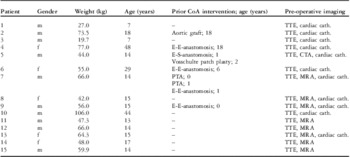
We identified 15 patients who had undergone surgical repair of aortic coarctation via left posterolateral thoracotomy using cardiopulmonary bypass between January, 1997 and December, 2011. The presenting symptoms included cardiac murmur, marked upper extremity arterial hypertension, claudicatio intermittens, or a significant blood pressure gradient between the right arm and lower extremities. Pre-operatively, all patients underwent transthoracic echocardiography to confirm the diagnosis and to rule out coexistent intra-cardiac lesions. Cardiac catheterisation was performed in 11 patients to determine the pressure gradient across the aortic coarctation and to evaluate the coronary arteries. Results of an advanced anatomic study were obtained with contrast medium magnetic resonance imaging in eight cases and computerised tomographic angiography in one case (Table 1).
Pre-operative data.

Cath. = catheterisation; CoA = aortic coarctation; CTA = computerised tomographic angiography; E-E anastomosis = end-to-end anastomosis; E-S anastomosis = end-to-site anastomosis; f = female; m = male; MRA = MR-angiography; PTA = percutaneous angioplasty; TTE = transthoracic echocardiography
Surgical records were reviewed to determine the details of the aortic coarctation anatomy and indication for cardiopulmonary bypass utilisation. All patients were followed up regularly by their paediatric cardiologist. Physical examination, chest radiograph, and echocardiogram were routinely performed during the post-operative period.
The aortic lesion was approached through left posterolateral thoracotomy. Dissection and mobilisation of the distal aortic arch, proximal descending thoracic aorta, and the main pulmonary artery was then accomplished. In order to assure the lower body perfusion, the blood pressures from the right radial and right femoral arteries were recorded. Then, the aorta was cross-clamped tentatively at the aortic coarctation site. If the lower body blood pressure dropped below 50 mmHg during cross-clamping, this confirms a lack of adequate collaterals, and surgical repair was performed with cardiopulmonary bypass. We also used cardiopulmonary bypass when a long cross-clamp time was expected such as in cases with complex elongate aortic pathology and in redo cases with the associated pleural and perivascular adhesions.
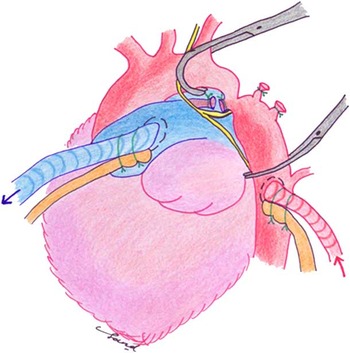
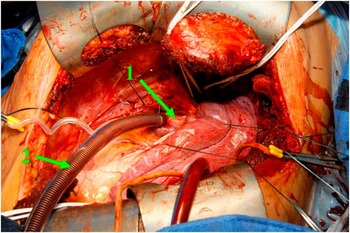
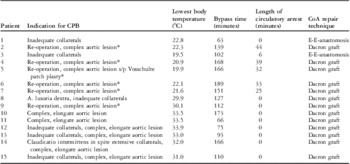
The descending thoracic aorta was cannulated distal from the aortic coarctation site and venous return was accomplished through the main pulmonary artery (Figs 1 and 2). After target-activated clotting time had been achieved, cardiopulmonary bypass was started. Lung ventilation was continued in order to secure upper body oxygenation. At the beginning of the study period, profound hypothermic circulatory arrest with a nasopharyngeal temperature of 20°C was carried out for added vital organ protection. Since 2007, slow cooling to nasopharyngeal temperature of 30°C was favoured (Table 2). This was accomplished before clamping the distal descending aorta. Surgical repair was then performed under partial cardiopulmonary bypass. In general, the venous return was restricted by the perfusionist to allow systolic arterial pressure in the right radial artery at 100 mmHg. The mean femoral artery pressure was maintained >65 mmHg and its systolic pressure was kept equally with the blood pressure in the right radial artery. We did not utilise near-infrared spectroscopy to additionally monitor the lower limb perfusion. The adapted, temperature-related cardiopulmonary bypass flow was in most cases ∼50% of the calculated full bypass flow (2.5 L/min/m2).
Cannulation for cardiopulmonary bypass. Note the arterial cannulation in the descending aorta. Also note the venous drainage via the main pulmonary artery.

Venous cannulation for cardiopulmonary bypass. Note the main pulmonary arteryReference Baumgartner, Bonhoeffer and Groot 1 and its venous cannula.Reference Lee 2

Intra-operative data.

CoA = aortic coarctation; CPB = cardiopulmonary bypass; E-E anastomosis = end-to-end anastomosis; s/p = status post
*Re-operation with a complex aortic lesion, where a long cross-clamp time and adhesion formation were expected
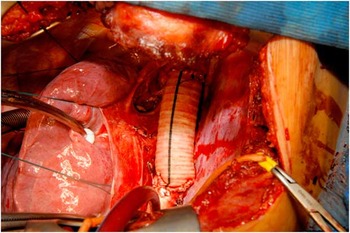
The proximal aortic cross-clamping was performed with a curved vascular clamp, which was placed across the origin of the left subclavian artery and distal aortic arch (Fig 1). In some cases, such as in patients with aneurysm, it was necessary to put the cross-clamp between the left carotid and left subclavian arteries to provide length for the proximal cuff. The distal aortic clamping was typically placed above the T7 of the vertebral segments. The aortic coarctation site was resected and the aorta was reconstructed using end-to-end anastomosis or a Dacron graft (Fig 3). After re-warming and separation from cardiopulmonary bypass were accomplished, we used protamine to reverse the heparin effect.
Aortic reconstruction via a Dacron graft.

Results
The median age at operation of the entire cohort was 14.5 years (mean age ± SD: 18.6 ± 11.7 years; range, 7–48 years) and the mean weight at operation was 43.8 ± 25.0 kg (range, 19.7–106.0 kg). In all, 10 of these patients were male, which is consistent with the reported striking male-to-female ratio of 2:1 seen with aortic coarctation.Reference Lee 2 There were four patients who presented with upper extremity arterial hypertension, who had been treated with at least one antihypertensive medication before hospital admission. There were two patients who were diagnosed with bicuspid aortic valves without significant valvular stenosis and one patient with aortic valve asymmetry.
Primary surgery was performed in nine patients, and one of them required re-operation for stenosis at the proximal anatomosis site. A total of six redo cases were noted: five correlate with re-coarctation and one case correlates with aortic arch stenosis. The estimated peak gradient at the level of the aortic coarctation, as determined by pulsed wave Doppler examination ranged between 20 and 60 mmHg (mean ± SD: 40.3 ± 13.4 mmHg). Pressure gradient in cardiac catheterisation ranged between 21 and 55 mmHg.
Surgical repairs were performed either by direct anastomosis (n = 2) or by graft interposition (n = 13). The diameter of Dacron grafts ranged between 16 and 36 mm (mean ± SD: 20.3 ± 5.1 mm). A 36-mm graft was used in a patient with a body weight of 106 kg and 36-mm descending aortic diameter. The mean duration of cardiopulmonary bypass was 128.9 ± 41.2 minutes (range, 63–189 minutes). The average of aortic cross-clamping time was 41.3 ± 17.1 minutes (range, 16–64 minutes). A total of six surgeries (cases 2–7) were performed under hypothermic circulatory arrest. No patient died post-operatively, and no post-operative bleeding was observed. Median hospital length of stay was 15 days (mean ± SD: 19.8 ± 11.7 days; range, 10–52 days). There was no statistically significant difference in post-operative bleeding, neurological outcomes, and length of hospital stay between surgeries performed under deep hypothermic circulatory arrest and surgeries performed under mild hypothermia.
Follow-up was complete for all patients, with a mean follow-up period of 5.5 years (range, 3.5 months to 14 years). No late mortality is documented during follow-up. The mean blood pressure in the right arm was 137/72 mmHg before surgical correction, 130/82 mmHg at hospital discharge, and 129/66 mmHg at the last follow-up examination. There was no statistically significant difference in blood pressure fluctuation over this period. All patients required antihypertensive treatment early post-operatively. Further maintenance therapy was required in seven patients. In all, three patients were treated with β-blockers, two patients with calcium antagonist, and two patients with an angiotensin-converting-enzyme inhibitor. None of the patients developed renal dysfunction or paraplegia post-operatively. There were three patients who developed transient left recurrent nerve palsy, and two of them were redo cases. A total of three patients demonstrated asymptomatic left diaphragmatic paresis.
A 15-year-old girl developed chylothorax, which was initially treated with somatostatin therapy and total parenteral nutrition for 20 days. Chest drainages were kept for 18 days. This patient also showed a systemic bacteraemia with Staphylococcus epidermidis associated with central venous catheter colonisation, which was successfully treated with antibiotics. After marked improvement of her chylothorax, medium-chain triglycerides diet was begun. Further follow-up during the 2-month period under medium-chain triglycerides diet showed no recurrent pleural effusion.
There were two patients (13%) who developed a residual stenosis at the proximal anastomosis, with one of them requiring re-operation.
Discussion
Aortic coarctation presenting during adolescence and adulthood most frequently represents cases of recurrent aortic coarctation following previous endovascular or surgical therapy or missed cases of native aortic coarctation. Without correction, the mean life expectancy of aortic coarctation patients is 35 years and 90% of patients die before reaching the age of 50 years.Reference Jurcut, Daraban and Lorber 3 Systemic arterial hypertension, accelerated coronary atherosclerosis, cerebrovascular injury, aortic dissection, and congestive cardiac failure account for the increased morbidity and mortality. The poor prognosis of this disease requires timely intervention.
Technical aspects in aortic coarctation repair
Endovascular management by means of balloon angioplasty with or without stent implantation is increasingly used for adolescents and adults with isolated aortic coarctation. Concerns that arise in patients after endovascular repair include strut fractures, metal fatigue, aortic deterioration, or aortic disruption at the aortic coarctation site.Reference Tanous, Collins, Dehghani, Benson and Horlick 4 Also, endovascular repair may be unsuccessful for several reasons, including elastic recoil of the aortic tissue or unfavourable anatomy such as long tubular narrowing of the aorta or complex aortic aneurysm after Vosschulte patch plasty, as observed in our patient cohort. Surgical repair on the other hand has been shown to improve the efficacy of post-operative antihypertensive treatment.Reference Luijendijk, Boekholdt and Blom 5 It is accompanied by a low rate of morbidity and mortality.
Incidence of re-aortic coarctation is highest when surgical repair is performed in neonates (up to 19%) and infants.Reference Rosenthal 6 Inadequate resection of the ductal tissue as well as higher tension at the anastomoses may play a major role in recurrence or persistence of aortic coarctation. Furthermore, aortic coarctation is frequently associated with hypoplasia of the aortic arch.Reference Rosenthal 6 Inadequate excision of a hypoplastic aortic arch poses another risk factor for residual aortic coarctation.Reference van Heurn, Wong and Spiegelthaler 7 In our series, two patients developed residual aortic coarctation at the proximal anastomotic site. One of them showed a hypoplastic aortic arch and he was treated successfully by re-operation with proximal extension of the repair using an additional Dacron graft to augment the hypoplastic arch.
Pathophysiologic considerations for cardiopulmonary bypass
The most consistent haemodynamic response to proximal aortic cross-clamping is an abrupt increase in preload, afterload, and proximal arterial pressure. These increases in preload and afterload raise myocardial oxygen demand and possibly cause myocardial ischaemia which could be shown as regional wall motion abnormalities in intra-operative transesophageal echocardiography.Reference Knapp, Bernhard, Rauch, Hyhlik-Dürr, Böckler and Walther 8 Arterial hypertension above the proximal aortic cross-clamp also causes expansion of cerebral vessels and increases the cerebrospinal fluid pressure.Reference Berendes, Bredée, Schipperheyn and Mashhour 9 Consequently, we found that control of the proximal hypertension is necessary to prevent left ventricular failure, myocardial infarction, and haemorrhagic cerebral injuries, especially in adolescence and adult population. This could be achieved through adequate proximal decompression via cardiopulmonary bypass's venous drainage. In infants and toddlers, on the contrary, aortic coarctation repair is usually performed without cardiopulmonary bypass. In these cases, the distal perfusion during surgery depends on collateral flow, and therefore the proximal hypertension should not be lowered.
The perfusion pressure to the spinal cord, defined by the difference between the distal arterial pressure and cerebrospinal fluid pressure, plays an important role in the pathogenesis of paraplegia.Reference Knapp, Bernhard, Rauch, Hyhlik-Dürr, Böckler and Walther 8 In order to elevate spinal cord perfusion pressure, it is essential to increase distal arterial pressure and to decrease cerebrospinal fluid pressure. Cardiopulmonary bypass can provide adequate perfusion of the circulation distal to the aortic cross-clamp while simultaneously reducing cerebrospinal fluid pressure through proximal decompression, therefore decreasing the incidence of postoperative paraplegia from spinal cord ischaemia. The use of cerebrospinal fluid drainage to decrease cerebrospinal fluid pressure has been reported to reduce the risk of postoperative paraplegia.Reference Fedorow, Moon, Mutch and Grocott 10 However, this method remains controversial and relates with some risks including meningitis, fistulation, epidural haematoma and subarachnoid haemorrhage.Reference Estrera, Sheinbaum and Miller 11 Crawford et alReference Crawford, Svensson and Hess 12 failed to demonstrate any benefit of cerebrospinal fluid drainage for improving neurologic outcome in their randomised controlled trial of thoracoabdominal aortic aneurysm repair. Therefore, cerebrospinal fluid drainage is not routinely employed in our surgical repair of aortic coarctation.
Venous cannulation was accomplished throughout the main pulmonary artery, below the pulmonary bifurcation. Some authors used left heart bypass, cannulating the left pulmonary vein or left atrial appendage.Reference Wong, Watson, Smith, Hamilton and Hasan 13 , Reference Backer, Stewart, Kelle and Mavroudis 14 Buckels et alReference Buckels, Willetts and Roberts 15 reported a patient with post-operative left sided hemiparesis related to air embolism. In order to prevent air entry into the left atrium and the related air embolism, the main pulmonary artery may be advantageous for venous drainage rather than cannulation of the left atrial appendage or pulmonary vein. We rarely cannulated the left pulmonary vein because of the possible volume reduction of venous drainage. Possible drawbacks of pulmonary artery cannulation include pulmonary artery stenosis in small children or bleeding complication from relatively fragile wall of pulmonary trunk. In our experience with older patients, however, no stenosis or bleeding complications have been observed.
The use of partial cardiopulmonary bypass allows precise cooling and re-warming. The oxygenator component improves distal oxygenation, particularly in patients with pulmonary disease. Although there were no major post-operative pulmonary, renal and hepatic failures observed in this series, the systemic inflammatory response related to the cardiopulmonary bypass initiation remains a concern. This results in a high threshold for the use of partial cardiopulmonary bypass in aortic coarctation repair, limiting its use only in complex cases with inadequate collaterals.
In our institution, the descending aorta distal from the aortic lesion is the preferred site of cannulation with a mean femoral artery pressure maintained >65 mmHg. This is achieved by adjustment of the cardiopulmonary bypass flow, volume replacement, and the administration of vasoactive drugs.
Indications to use cardiopulmonary bypass in aortic coarctation repair
The most devastating complication of surgical repair is a spinal cord ischaemia with subsequent paraparesis or paraplegia. In uncomplicated native aortic coarctation, the aortic lesion is limited at the isthmus area and extended aortic resection is not necessary. Therefore, the risk of spinal cord injury after native aortic coarctation repair is low in infants (0.4%). However, in older children, adults, and re-operations, this incidence rises up to 2.6%.Reference Wong, Watson, Smith, Hamilton and Hasan 13
According to the literature, the most important factor related to spinal cord injury is the inadequate development of collateral circulations.Reference Buckels, Willetts and Roberts 15 In our series, a high-aortic coarctation gradient and intermittent symptomatic claudication suggests a lack of collateralisation, which further delineated with pre-operative imaging studies. An intra-operative femoral blood pressure of <50 mmHg during tentative aortic clamping trial and the absence of large collaterals strongly suggest the need for cardiopulmonary bypass for spine and lower body protection. The routine use of an intra-operative aortic clamping trial during aortic coarctation repair was first reported by Pennington et al in 1979. They used partial left heart bypass when the lower body mean arterial blood pressure was below 50 mmHg.Reference Pennington, Liberthson, Jacobs, Scully, Goldblatt and Daggett 16
The majority of collaterals in patients with aortic coarctation originate from the subclavian arteries. There are rare cases of aortic coarctation in which both the left subclavian and aberrant right subclavian arteries arising at the coarcted segment are known.Reference Ravindranath, Moorthy, Palaneeselvam, Dwarakaprasad, Satish and Manjunath 17 , Reference Hamawaki, Narimatsu, Yamaguchi, Nishi and Eishi 18 There was one patient in our study who was identified to have an aberrant right subclavian arteries originating distal to the aortic coarctation site. This aberrant right subclavian arteries did not contribute to collateral circulation and might produce atypical steal phenomenon during aortic cross-clamp. Consequently, based on the above findings, we also utilised cardiopulmonary bypass in this patient.
The safety limit for aortic occlusion in the presence of distal hypotension is around 20 minutes.Reference Lange, Thielmann and Schmidt 19 As a result, a predicted long cross-clamp time in complex aortic reconstruction elevates the potential need for cardiopulmonary bypass. In our study, the mean aortic cross-clamp time was 41.3 ± 17.1 minutes (range, 16–64 minutes). This is considerably longer than the above-mentioned safety interval for aortic occlusion. Cardiopulmonary bypass utilisation extends the safe duration of aortic cross-clamping and thus provides a sufficient amount of time to complete the surgical repair, which allows a better anastomotic quality.
Severe intra-operative bleeding from extensive collateral blood flow at the aortic coarctation site or from adhesions is still challenging, particularly in redo cases. Patients with native aortic coarctation are at a lower general risk compared with patients with recurrent aortic coarctation because there are no pleural, intra-, and peri-aortic adhesion tissue related to the previous intervention. In the presence of a complex anatomy, severe bleeding, or when faced with intra-operative complications prohibiting aortic cross-clamping, cardiopulmonary bypass also offers the possibility of immediate transfusion and profound cooling before brief hypothermic circulatory arrest. As reported by Lange et al,Reference Lange, Thielmann and Schmidt 19 aortic coarctation repair can be done without any neurologic sequelae, using profound hypothermia to permit a safe interval of circulatory arrest. The nasopharyngeal temperature of 20–22°C for intermediate periods of circulatory arrest correlates with a very low paraplegia rate, as has been shown by Coselli et al.Reference Coselli, Bozinovski and Cheung 20 At the beginning (cases 2–7), our institution often utilises this method. Circulatory arrest provides access to the aorta despite avoidance of aortic cross-clamping and bloodless operative field in redo cases with potential catastrophic intra-operative bleeding. It reduces oxygen demand and provides adequate protection to the brain, spinal cord, kidneys, and abdominal viscera. Currently, we favour slow cooling to reach mild permissive hypothermia by means of a nasopharyngeal temperature of 30°C. This way, it is possible to perform the aortic coarctation repair in the “beating heart”, avoiding coronary ischaemic time. This technique also avoids the potential disadvantages associated with profound hypothermia such as cold-induced lung injury, coagulopathies, and prolonged operative time.
Limitation
With the increased use of percutaneous intervention, the number of aortic coarctation patients requiring surgery is decreased. From this patient population, only a few presented with a lack of adequate collaterals or with complex elongated aortic pathology that required partial cardiopulmonary bypass during the repair. In addition to the small number of cases, this study is subject to the typical limitations of a retrospective review with changes in the surgical approach and a differing duration and intensity of follow-up. These may limit the validity of the results.
Conclusion
On the basis of our study, the use of partial cardiopulmonary bypass in the beating heart via a left lateral thoracotomy offers protection against spinal ischaemia in patients with complex or recurrent aortic coarctation and minimal collateral circulation. However, it would be difficult to prove this entity without a large trial. Therefore, in the absence of contrary evidence, it is reasonable to maximise the spinal cord protection with cardiopulmonary bypass utilisation in this high-risk patient population.
Acknowledgements
We would like to thank all the dedicated medical staff and perfusionists at the department of cardiac surgery and paediatric cardiology, University of Heidelberg.