


INTRODUCTION
New constitutions were adopted in 93 of the 141 transitions to democracy that took place in the world between 1900 and 2010. During this period, 21 democracies of at least five years’ standing also replaced their constitutions. Today, amidst widespread citizen dissatisfaction with representative institutions, remaking constitutions is seen in several countries as a potential answer to address democratic crises. At these critical moments, popular movements that contributed to the fall of autocracies or questioned the quality of existing democracies often claim that the establishment or deepening of democracy requires political elites to be marginalized while the direct participation of the people in the making of a new constitution is expanded. The idea that participatory constitution making improves democracy derives from a strong tradition in democratic theory that sees the sovereign people as holding ultimate constituent power. It also underlies our current understanding of democratic legitimacy.
In contrast to this view, we argue that new constitutions are likely to enhance liberal democracy when they emerge through a plural agreement among political elites with distinct bases of social support. Power dispersion during constitution writing induces cooperation between contending political groups and favors the adoption of institutions that protect opposition forces from the arbitrary use of executive power without impeding governments backed by electoral majorities from making collective decisions. Yet incumbents may renege on the original bargain if opponents lose social support and institutional influence during the implementation stage. For this reason, the salutary effect of politically inclusive constitutional agreements on liberal democracy is likely to be larger during the early years of the new constitution, when the identity of negotiating political forces and the balance of power between them tend to remain stable. We find support for these arguments using an original global dataset on the origins of constitutions between 1900 and 2015 and a difference-in-differences design.
By advancing a theoretical framework that ties together insights from the literature on regime transitions and constitution making, this paper makes a significant contribution to understanding the link between the political origins of constitutions, the enforceability of institutions, and democratization. It also sheds light on contemporary debates about the potential uses of constitution making to address political crises in democratic regimes. From an empirical standpoint, we present the most comprehensive historical dataset on constitutional rewrites available to date and adopt a credible strategy to identify the effects of different modalities of constitution making on liberal democracy.
CONSTITUTIONAL ORIGINS AND LIBERAL DEMOCRACY
Although most definitions of democracy emphasize the crucial importance of electoral competition, fair elections and the possibility of alternation in power are unlikely to hold over time if incumbents can easily manipulate or transgress institutional constraints over the executive (see Bermeo Reference Bermeo2016; Ginsburg and Huq Reference Ginsburg and Huq2018). Constitutions that establish clear limits on state power thus play a central role in the maintenance and deepening of democracy. It is not apparent, however, how democracy-enhancing constitutional provisions emerge and what factors make their effective implementation possible.
We argue that constitutions drafted and approved through plural agreements among political elites representing distinct social camps create institutional safeguards that shield opposition forces and citizens from arbitrary government action without unduly impairing majority rule. These constitutions thus alleviate a core credible commitment problem of democracy—namely, that incumbents will not abuse their power to gain an unfair advantage over rivals once in office. Incumbents, however, may ultimately renege on the original agreement if the political and social opposition is too weak to monitor the government and block or punish constitutional transgressions. We therefore propose that the enforcement of constitutional bargains depends on the usually short-lived balance of social and institutional support among the political organizations that were involved in the constitution-writing process.
Our analysis builds on classic works on democratization that traced the emergence of a liberal-democratic order back to an agreement among political elites that succeeds in creating basic institutions that reduce the stakes of electoral competition (Przeworski Reference Przeworski1991; Rustow Reference Rustow1970; Weingast Reference Weingast1997). We also draw on previous works that have expressed skepticism about the democratizing consequences that popular participation in constitution making may have by itself or that raised concerns about its potential manipulation by self-dealing elites (Horowitz Reference Horowitz2013; Partlett Reference Partlett2012). We contribute to the existing literature, however, by specifying the mechanisms that link plurally approved constitutions with the deepening of liberal democracy by (a) addressing the problem of enforceability of constitutional provisions after enactment, (b) considering the interdependence between bargaining political elites and the mass of citizens during and after constitution making, and (c) deriving from this analysis a set of hypotheses that are subjected to rigorous empirical testing.
Democratic theories of power and sovereignty have been the first to extensively analyze the link between constitution making and democracy (Colon-Rios Reference Colon-Rios2012; Schmitt Reference Schmitt2008). A commonly held view in this literature is that wide popular participation during the creation or replacement of constitutions enhances democratization.Footnote 1 This theory, born out of the great revolutions of the late eighteenth century, claims that only the people are the legitimate holders of constituent power, so regular government institutions and ordinary representatives should be sidelined during the making of a new constitution. As Thomas Paine summarized it, “a constitution is not the act of a government but of a people constituting a government” ([1791] Reference Paine1995, 468).Footnote 2
In the early versions of the constituent power theory, the popular origins of constitutions often referred to a founding principle that could be satisfied by representative channels, such as the election of a constituent assembly. However, contemporary advocates of this tradition take the idea of popular authorship to its natural conclusion and claim the need for actual and direct citizen participation in processes of deliberation and voting for a constitutional (re)founding to qualify as legitimate and improve democratic practices. As Kalyvas argues, the democratic nature of a constitution depends on how inclusive and effective the direct participation of the people is during the exceptional moment of constitution making (Reference Kalyvas2005, 238). Negotiation or deliberation among representative elites is not necessarily excluded from this analysis but plays a less important role than does the direct engagement of citizens in creating the constitution to which they will be subject (Fishkin Reference Fishkin2011; Tierney Reference Tierney2012).
Most works in this literature are predominantly normative. Yet in spite—or perhaps because—of this normative goal, the idea of participatory constitution making as a vehicle for deepening democracy is extremely influential not only among democratic theorists but also in actual political practice. Popular social movements that contribute to democratic transitions or democratic reforms frequently demand that citizens be directly engaged in constitution making (Wheatley and Mendez Reference Wheatley and Mendez2013). At times of political crisis, populist forces also claim that rewriting the constitution through direct participatory channels allows the people to get rid of corrupt political elites and regain their collective power (Urbinati Reference Urbinati2019). Public participation in constitution making is also promoted by several international agencies in order to strengthen the legitimacy of new constitutional orders (Brandt et al. Reference Brandt, Cottrell, Ghai and Regan2011). For this reason, a growing number of scholars have attempted to articulate and test the mechanisms that might link direct citizen engagement in constitutional change with democratization.
As Widner explains (Reference Widner2008, 1519–20), the most general proposition underlying participatory theories is that direct popular involvement in the making of constitutions increases public awareness of accepted behavior under the new order, which, in turn, enables citizens to monitor elected officials and prevent transgressions (see also Carey Reference Carey, Barany and Moser2009; Voigt Reference Voigt, van Aaken, List and Lütge2004). This argument, however, rests on dubious assumptions about the preferences of citizens regarding the content of constitutions and their collective capacity to act in defense of legality.
Direct citizen participation in the formulation, discussion, or promulgation of a new constitution does not generate consensus about the rules and rights that should be included in it. “The people” is not an organic compact with a univocal or predefined will. As Weingast has argued (Reference Weingast1997), the most natural equilibrium in a society is a nondemocratic one in which citizens are unable to coordinate on punishing constitutional transgressions by the state because they are divided along ethnic, religious, ideological, or socioeconomic lines. These cleavages are not likely to disappear just because citizens engage in the process of constitutional change. Moreover, even if they were to agree on what rights should be universally protected, citizens do not normally have the ability to mobilize spontaneously against an incumbent government that transgresses the constitution. Aside from some episodic outbursts of protest, the capacity of the masses for sustained and effective mobilization is usually dependent on the leadership or organizational resources provided by political and social elites that oppose incumbents (Albertus and Menaldo Reference Albertus and Menaldo2018).
In a recent statistical analysis of modalities of constitution writing and democracy, Eisenstadt, LeVan, and Maboudi (Reference Eisenstadt, LeVan and Maboudi2015, 596; Reference Eisenstadt, LeVan and Maboudi2017) provide support for the hypothesis that participatory constitution making, by empowering citizens to monitor elites, makes democratic improvements after enactment more likely than when constitutions emerge from elite bargains. They interpret their findings as a demonstration of the “systematic benefits of direct citizen involvement” during constitutional change (Reference Eisenstadt, LeVan and Maboudi2017, 51–53). This interpretation is questionable, however, because Eisenstadt, LeVan, and Maboudi code the convening stage (the most important process variable in their analysis) as “popular” when there is “systematic civil society input or strong transparency or specially elected drafters freely and fairly elected” (Reference Eisenstadt, LeVan and Maboudi2017, 30). This conflates cases in which citizens had a voice through indirect representative channels with those in which citizens were directly involved in deciding the content of the constitution through mechanisms of public consultation.Footnote 3 Yet there is a difference of kind, not just of degree between representative and direct forms of citizen involvement, because elected drafters are usually party members or leaders with privileged influence on the final content of the constitution.Footnote 4
As we will argue, citizens play an important role in the electoral and social arenas for the enforcement of constitutional agreements. It is also likely that popular involvement in constitution-drafting processes is crucial to provide social support for a constitutional bargain when the linkage between citizens and political representatives has been eroded. Yet the inability of participatory theory to identify and empirically demonstrate the mechanism connecting direct citizen involvement in constitution making with ex post levels of democratization makes it unpersuasive. It also underspecifies how citizens and elites interact during and after constitution making to produce improvements in democracy. The analysis of this interaction is crucial and should start by acknowledging that while elite–mass linkages may exist at every stage in the process, the drafting of constitutions is a predominantly elite affair. Party and social movement leaders are usually the ones who decide how constitutions should be drafted, including, of course, whether and how citizens participate in the process (Saati Reference Saati2015). They also decide the specific content the constitution will have.
By contrast to participatory theories, classic democratization studies have implicitly or explicitly emphasized the prominent role that political elites play in constitution-making processes during the foundational moments of democratic regimes. This literature has argued that a procedural compromise among the leaders of contending political groups is crucial for a democratic opening (O’Donnell and Schmitter Reference O’Donnell and Schmitter1986; Rustow Reference Rustow1970). Such a compromise creates a set of rules of mutual security that make it unlikely that the competitive political process would result in outcomes highly adverse to the interests of any of the main political and social groups (Dahl Reference Dahl1971; Przeworski Reference Przeworski, Elster and Slagstad1988). The operation of such rules is also at the core of a self-enforcing democracy in which electoral winners do not abuse their power in office and losers accept their defeat (Higley and Burton Reference Higley and Burton2006; Weingast Reference Weingast1997).
Although highly suggestive, the possible link between elite constitutional compromises and democratization is underdeveloped in theoretical terms. In the first place, it is necessary to specify the nature of the negotiated constraints that may actually promote liberal democracy. The most common formulation in the theory of founding constitutional pacts is that in order to further democracy, an elite bargain should create checks and balances and counter-majoritarian institutions that mitigate the increasing returns to power, thus facilitating the acceptance of democracy by those who lose in competitive elections (see Alberts, Warshaw, and Weingast Reference Alberts, Warshaw, Weingast and Ginsburg2012; Przeworski Reference Przeworski1991, 36). Yet compliance among losers may be induced by extreme forms of majority-constraining institutions, such as veto powers in hands of unelected authorities or electoral rules that overrepresent privileged minorities, which may not strengthen a liberal-democratic order (see Jung and Shapiro Reference Jung and Shapiro1995). Moreover, these are exactly the kind of institutions that would emerge, not from politically inclusive constitutional agreements but from constitutions imposed by outgoing authoritarian elites to protect the interests of socially and economically powerful minorities with little chance to win competitive elections (Albertus and Menaldo Reference Albertus and Menaldo2018, 63–64).
We argue that constitutions emerging out of plural bargains between contending political forces produce an institutional arrangement that strikes a balance between restrictions on the use of state power and majority rule. When no political group has unilateral power to adopt the new constitution and at least some of the negotiating parties expect to alternate in government under competitive conditions, representatives in the constitution-making body are likely to agree on institutions that constrain executive authority but make it possible for democratically elected governments to actually govern. The parties to the agreement settle on this balanced arrangement so as to ensure that their basic rights will be protected when they are in the opposition but they will be able to pursue their agenda when they hold the levers of power. In other words, a plurality of constitutional reformers standing on opposite political sides is likely to emphasize horizontal (legislative as well as judicial) constraints on incumbent executives, while taking a more moderate view on restrictions to the power of electoral and institutional majorities.Footnote 5
By contrast, constitutions adopted by a single political group are unlikely to enhance liberal democracy. If this group expects to be a permanent minority or is uncertain about its ability to compete in democratic elections, as is usually the case with outgoing authoritarian elites, it will tend to establish veto powers that entrench the interests of privileged minorities and prevent majority governments from governing effectively. If, instead, the political force with unilateral control over constitution making enjoys the support of a strong electoral majority, as is usually the case with a dominant democratic party, it will tend to establish weak constraints on executive authority and lock in competitive advantages at the expense of the interests of the political opposition. In the first situation, democracy is captured by minority interests; in the second, it is hijacked by a political organization that seeks to turn its current majority into a permanent one.
A second problem with theories that attribute the rise or deepening of liberal democracy to an elite constitutional pact is how the agreement is enforced over time. Seminal works on democratization have tended to see foundational constitutional compromises among warring political elites as critical junctures that place a country firmly on the path to liberal democracy (see Dahl Reference Dahl1971, 36; Rustow Reference Rustow1970, 356).Footnote 6 Most constitutional pacts, however, tend to be opportunistic; they are based not on a real change of actors’ preferences toward a democratic plural coexistence but on their momentary inability to impose their preferred institutions and policies on others. Change from a preexisting pattern of polarized conflicts to stable cooperative relations would occur only if political actors across contending camps commit to following the actual norms of democratic behavior. This commitment may depend on economic factors, such as declining inequality (Boix Reference Boix2003, 9–10), or critical events, such as a costly and protracted elite conflict (Higley and Burton Reference Higley and Burton2006, 22), that precede constitution making.
What seems clear is that in the absence of a rather exceptional and largely unobservable transformation of normative preferences, political actors will likely attempt to renegotiate the terms of a constitutional agreement or renege on it ex post if they find the opportunity to do so. This suggests that the actual enforcement of a constitutional agreement requires that the plurality of actors that had representation and influence at the constitution-making stage survive and maintain their relative power after enactment.Footnote 7 This is usually granted in the short term because the identities of the negotiating political forces and the balance of power between them tend to remain stable during the early years of life of a new constitution. The vast majority of constitutions in the world have been drafted by assemblies that continue as ordinary legislatures after the new constitutional text is in force, which means that the original bargaining groups tend to keep the same representation and institutional power at least until the next round of ordinary elections (Elster Reference Elster2013; Negretto Reference Negretto and Thompson2017).
In the medium and long term, however, the balance of power is more likely to change. Whereas some of the political organizations that participated in the original constitutional compromise may suffer a sharp decline in electoral and social support or even disappear over time, others may turn dominant and reverse their prior commitments. New political groups opposed to the existing constitution may also gain an influential position. Because of this possibility, constitutional bargains will be effectively implemented only if those who lose in electoral competition retain the capacity to block government actions that violate the constitution, to organize mass actions against legal transgressions, or both.Footnote 8 Constitutional enforcement has power-distributional bases.
The most important implication of this analysis is that whereas political elites have a predominant role in deciding how constitutions are changed, they ultimately depend on the preferences and actions of citizens for the enforcement of the constitutional bargain. In particular, they depend on whether citizens are willing to vote against incumbents or able to engage in massive acts of social protest when the government breaches constitutional provisions. The strength of a democratic political opposition hinges on the electoral support of voters, which in turn translates into institutional influence. In addition, the success of elites that oppose authoritarian regimes or the arbitrary use of power in an electoral democracy is usually backed by pro-democratic social movements or groups with the capacity to mobilize (Bermeo and Yashar Reference Bermeo and Yashar2016; Tarrow Reference Tarrow1995).
To summarize, citizens need representative elites to bargain for them and produce a constitutional agreement that while not impeding majority rule, imposes limits on the arbitrary use of executive power. At the same time, political elites need the support of citizens both in their role as voters and as members of civil society organizations to maintain a plural equilibrium once the constitution has been adopted. The positive effect of constitution making on liberal democracy, we argue, is thus the product of successful interelite bargaining and a stable and balanced distribution of institutional and societal power. Without the former, the constitutional framework for liberal democracy does not emerge; without the latter, it cannot be sustained.
Based on this discussion, we propose that a constitutional replacement is most likely to improve liberal democracy when as a result of power dispersion in the constitution-making body, the new constitution is adopted by means of a cooperative agreement among representatives of contending political forces. However, since most constitutional bargains are opportunistic, we should expect the democratizing effects of plural constitutional agreements to be stronger during the first years after the establishment of a new constitution, when the identity of and the balance of power among the actors that created it tend to remain stable.
CONSTITUTION MAKING AND DEMOCRACY AROUND THE WORLD, 1900–2015
To explore the link between constitution making and democratization, we created the Comparative Constitution-Making Database. This dataset covers the period 1900 to 2015 and includes all new constitutions in the world adopted under democracy, as well as those which, although enacted under autocracy, governed democratic political systems for most of their legal lifetime. To our knowledge, this is the most comprehensive dataset on the constitution-making processes of the world’s democracies in the twentieth and twenty-first centuries.
For each of these processes, we coded relevant procedural and political features that might have shaped the constitution’s success in sustaining and deepening liberal democracy. To distinguish constitutional replacements from amendments, a constitution was considered “new” when its drafters claimed to be adopting a new text, and state institutions and official sources in the country acknowledged it as such.Footnote 9 To determine whether a constitution was adopted or implemented in democratic years, we relied on the minimal, electoral definition and coding of democracy by Boix, Miller, and Rosato (Reference Boix, Miller and Rosato2013).
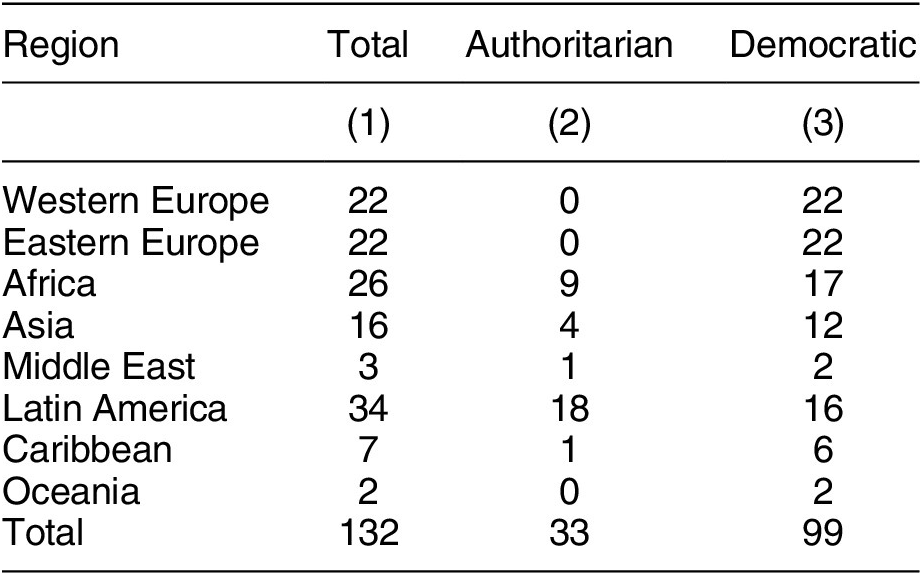
Following these criteria, we gathered information on the origins of all new constitutions in the world adopted in democratic years between 1900 and 2015 and those created in an authoritarian year but retained and implemented during democratic years for the largest part of their lives.Footnote 10 The first type includes cases such as the 1999 Swiss constitution and the 2010 Kenyan constitution; the second, cases such as the 1979 Peruvian constitution and the 1982 Turkish constitution. Only constitutions born and implemented exclusively or mostly during authoritarian years, such as Russia’s 1936 or Brazil’s 1967 constitutions, were excluded from the database. The total number of observations is 135, of which we were able to code 132. Table 1 lists these cases.
Constitutions Enacted or in Force in Democratic Regimes, 1900–2015

Note: Authors, Comparative Constitution-Making Database
(1) Constitutions enacted or in force during democratic years
(2) Constitutions enacted in authoritarian years but implemented during democratic years for most of their lives
(3) Constitutions enacted in democratic years
We consider that a constitution had a politically plural origin when (1) two or more distinct and independent political parties or groups achieved representation in the constitution-making body, either through elections, appointment, or mixed selection methods and (2) the collaboration between at least two of these parties or groups was necessary to decide on the constitution’s content and enact it, according to the decision rule governing the constitution-making body. While we acknowledge that political inclusion in the drafting of constitutions is a matter of degree, we believe that the key distinction lies in whether a single force or a plurality of political forces was required to approve the constitution. It is under this condition that the type of balanced institutional arrangement that we posit improves liberal democracy is likely to emerge.
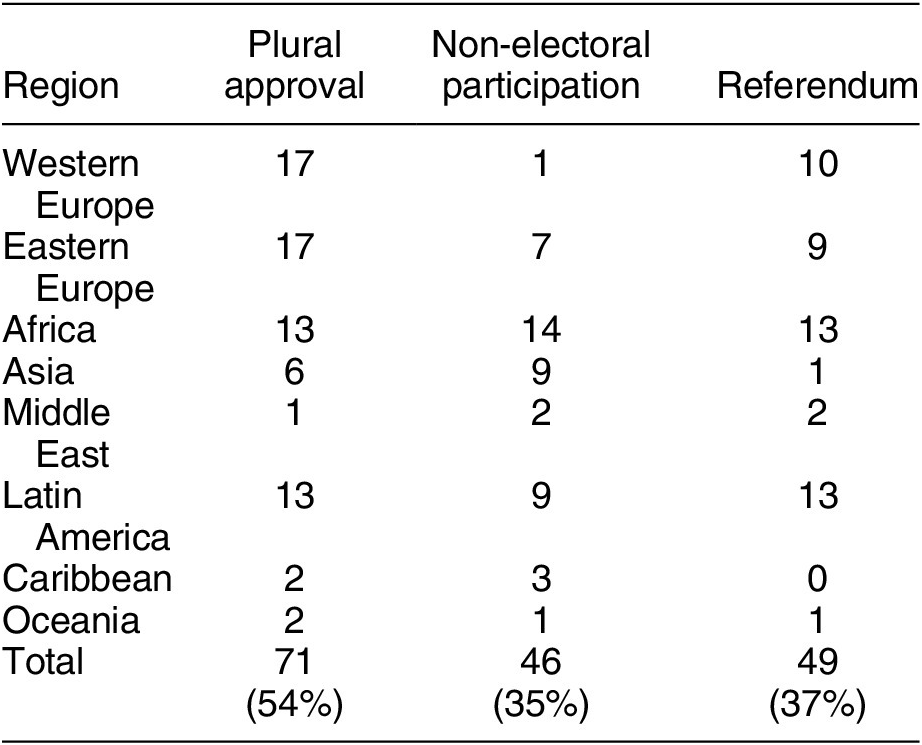
Procedural rules that regulate the way in which members of the constitution-making body are selected and make decisions have an influence on whether a constitution is approved by a plurality of political forces. As we show in the online appendix (Table A2), a plural approval is more likely when the constitution-making body is elected, a proportional or mixed electoral formula is used, and decisions are made by qualified majority. However, just as a single political group may obtain representation and influence in spite of consensual rules, pluralism may occur under majoritarian institutions. For this reason, our indicator is better than one that considers only formal election and decision rules or that simply counts the raw number of groups represented in the constitution-making body—it provides a factual measure of cooperation among different political forces during the process.Footnote 11 Table 2 shows that using this criterion, 71 constituent processes in our dataset (54%) were coded as plural and 61 (46%) as non-plural. While the first group includes cases such as the adoption of Italy’s 1948, Spain’s 1978, and Thailand’s 1997 constitutions, the second contains episodes such as the making of France’s 1958, Russia’s 1993, and Hungary’s 2011 constitutions.
Features of Constitution Making, 1900–2015

Note: Authors, Comparative Constitution-Making Database
The second relevant dimension of constitution making coded in our dataset is whether and under what mechanisms “the people” acted as a collective author of the constitution. In line with our theoretical discussion, we restrict the notion of popular participation to instances of direct citizen involvement. Although we do not measure the actual extent of popular participation, we capture the most important forms of citizen involvement in constitution making, which we disaggregate according to whether the mechanisms are non-electoral (public consultations and proposal submissions) or electoral (referendums).
Citizens can contribute to the formulation of reform proposals in various types of public consultation channels before the formal initiation of the process, after its activation but before the writing of the initial draft, and after the initial draft is completed but before its final approval (Widner Reference Widner2008). Some of these channels involve forms of collective deliberation, such as public forums that take place before the process is activated to determine the content of the future reform agenda. Others take the form of reform proposals or comments submitted by ordinary citizens and civil society groups, particularly during the writing and approval of a constitutional draft.Footnote 12 Sometimes citizens participate both before the writing of the initial draft and before its final approval, as in the making of the 1997 Polish constitution, the 2015 Nepalese constitution, the 2008 Ecuadorean constitution, the 1999 Venezuelan constitution, and the 1976 constitution of Trinidad and Tobago. It is rare, however, to find all three forms of non-electoral citizen participation present in the same constitution-making event.
Constitutional referendums, the second type of direct citizen participation mechanisms coded in our dataset, can be implemented before or after the drafting process is completed. In the first case, voting is used to decide on a particular matter before a new constitution is actually drafted, such as choosing between a monarchical or a republican form of government, as was the case with the referendum held in Greece in 1946. They may also be called to authorize replacing the constitution through the election of a constituent assembly when this procedure is not provided for in the existing constitution, as in Colombia’s 1990 referendum. The most common form of referendum, of course, is used to ratify or reject the new text after it has been voted on in a representative body.
As shown in Table 2, citizen participation through different forms of consultation or proposal submission took place in 46 cases (35%), and through voting in referendums in 49 (37%). Citizen consultation and voting are, however, less frequently used together. In only 19 of 132 (14%) episodes of constitution making were both forms of citizen involvement observed. In fact, the correlation between these two ways of involving citizens in constitution making is weak and not statistically significant. This suggests that, in practice, electoral and non-electoral mechanisms of citizen participation are often seen as different and not necessarily complementary forms of popular participatory politics.
As already argued, there is a key conceptual difference between inclusive representation and decision making at the political-elite level and participation at the citizen level. This difference also holds on empirical grounds. There is no significant association in our database between the existence of a politically plural constitution-making body and the implementation of different forms of direct citizen involvement, either jointly or separately. Constitutions such as those of Sweden (1974), Finland (2000), Bulgaria (1991), and the Czech Republic (1993) were drafted by plural constituent assemblies, but the process did not include any instance of direct citizen involvement. On the other hand, there are several cases, such as Chile 1980, Turkey 1982, Ecuador 2008, France 1958, Hungary 2011, Ireland 1937, Sri Lanka 1972, Trinidad and Tobago 1976, and Venezuela 1999, where there was centralized control by the executive or a single political party over the constitution-making body, yet some form of citizen consultation or voting was used during the writing or approval of the new constitution.Footnote 13
ESTIMATING THE EFFECTS OF CONSTITUTIONAL ORIGINS ON LIBERAL DEMOCRACY
Our core argument has been that new constitutions are most likely to enhance liberal democracy when they emerge from a plural political agreement and that the expected positive effects will be concentrated in the early years after enactment. We now test some key implications of our theoretical framework.
Dependent Variables: Liberal Democracy and De Facto Executive Constraints
In order to measure the level of liberal democracy and the implementation of liberal principles after constitutional replacements, we rely on data from the Varieties of Democracy (V-Dem) project (Coppedge et al. Reference Coppedge, Gerring, Knutsen, Lindberg, Teorell, Altman and Bernhard2019). Our main indicator for the existence of a democracy with operating constraints on arbitrary government action is the liberal democracy index. This index captures the extent to which, in practice, constitutionally protected civil liberties, strong rule of law, an independent judiciary, and effective checks and balances limit the exercise of executive power. It ranges from 0 to 1, with higher scores indicating democracies with a stronger liberal component.
By construction, the V-Dem liberal democracy index reflects the effectiveness of vertical as well as horizontal constraints on rulers. Because our theory is mostly concerned with the latter type of protections, we run additional tests that focus on variables that specifically measure the effectiveness of institutional constraints on the executive. Two of these variables are the legislative and judicial constraints indexes, also from V-Dem. The former captures the extent to which the legislature is capable of questioning, investigating, and exercising oversight over the executive. The latter measures the extent to which the executive respects the constitution and complies with the rulings of an independent judiciary. For robustness, we also employ the Polity IV executive constraints index (Marshall, Gurr, and Jaggers Reference Marshall, Gurr and Jaggers2019), which ranges from 1 to 7.Footnote 14
Our analysis is centered on the de facto implementation of liberal institutions in a democratic regime because their formal adoption is not a good indicator of their actual level of enforcement. However, our argument implies that certain types of formal institutions emerge from the plural approval of constitutions—namely, institutional constraints on the executive and moderate restrictions on majority rule. To verify that the evidence is consistent with this intermediate part of our broader argument, we used data from the Comparative Constitutions Project (CCP) on the de jure power of legislatures and executives (Elkins, Ginsburg, and Melton Reference Elkins, Ginsburg and Melton2017). In the online appendix, we show that the plural approval of constitutions is indeed robustly associated with the choice of stronger legislatures and institutionally constrained executives (Table A9). Using V-Dem data, we also show that plurally approved constitutions do not tend to excessively obstruct democratic legislative majorities. In particular, they are not more likely to introduce bicameralism, and when they do, second chambers are weaker than first chambers and include a higher percentage of directly elected members (Table A10).
Plural Approval and Direct Citizen Participation
Following our discussion in the previous section, we measure the effect of plural approval in constitution making using an indicator variable that takes the value of 1 when, as per the composition of the constitution-making body and the decision rule, two or more independent political parties or groups approved the new text. A value of 0 indicates that an unelected group or institution, an executive commission, or an elected dominant party was able to pass the constitution unilaterally. In the online appendix (Table A6), we show that an ordinal coding of the number of distinct political forces that approved the constitution does not explain additional variation in our main outcome variable.
Direct popular participation through non-electoral mechanisms is captured using a dummy variable (citizen consultation) that takes the value of 1 if ordinary citizens were involved in the formulation, discussion, or submission of reform proposals at any stage in the process. The voting alternative is measured through a dummy variable (citizen voting) coded as 1 if citizens participated in popular referendums either at the beginning or at the end of the process. The online appendix shows that our results remain unaltered if we instead use more disaggregated count measures of the number of times each type of citizen participation mechanism was used (Table A6).
Empirical Strategy
The main challenge in evaluating whether different modalities of constitution making—such as the existence of plural approval or direct citizen involvement—deepen liberal democracy is that relevant unobserved factors may drive cases into processes of a certain kind (selection), while certain variables that are jointly associated with the constitution-making type and patterns of liberal democracy after enactment may confound the relationship. To deal with this inferential challenge, we adopt a difference-in-differences (DiD) design, with constitution-level and year-in-the-process fixed effects. We examine changes in the liberal democracy index within a 20-year window around constitution-making episodes (10 years before and 10 after the process), which allows us to credibly isolate the differential influence of certain features of constitutional origins while accounting for the trajectory of democracy beforehand.Footnote 15 Specifically, we test whether liberal democracy improved more substantially in plural (treatment group) versus non-plural (control group) processes from the pre- to the postconstitution period, as well as for the effect of incorporating mechanisms of direct citizen participation.
We used information from the Comparative Constitution-Making Database to build a longitudinal database on the evolution of liberal democracy 10 years before the initiation of a constitution-making process and 10 years after it ended.Footnote 16 Conservatively, the process was considered to begin with the election or appointment of a constitution-making body and end with the promulgation of the new constitution. Although informal political negotiations and agreements usually take place before the integration of the constitution-making body formally inaugurates the process, we prefer to err on the side of caution and delimit processes with their official start date. Descriptive statistics for all variables in our panel are available in the online appendix (Table A3).
The basic estimation equation is given by
 $$ {\displaystyle \begin{array}{c}\mathrm{liberal}\hskip0.42em {\mathrm{democracy}}_{it}={\lambda}_i+{\delta}_t+{\gamma}_1\;\mathrm{plural}\hskip0.42em {\mathrm{approval}}_i+{\gamma}_2\hskip0.42em {\mathrm{period}}_t+\\ {}{\gamma}_3\left(\mathrm{plural}\;{\mathrm{approval}}_i\times {\mathrm{period}}_t\right)+\beta {\mathbf{X}}_{it}+{\varepsilon}_{it},\end{array}} $$
where
 $ \mathrm{liberal}\;{\mathrm{democracy}}_{it} $
is the liberal democracy index in a country with constitution-making process
 $ i $
in year
 $ t $
;
 $ {\lambda}_i $
is a fixed effect for each separate process, which accounts for all time-invariant characteristics that could confound the relationship of interest (e.g., the country where the replacement occurs, the underlying level of ethnic and cultural diversity, etcetera);
 $ {\delta}_t $
is a fixed effect for each year in the constitution-making process (10 at both pre- and post-treatment);
 $ \mathrm{plural}\;{\mathrm{approval}}_i $
is a binary variable equal to one if diverse political forces approved the constitution;
 $ {\mathrm{period}}_t $
is an indicator variable for the postconstitution era (starting with the year following its adoption);
 $ {\mathbf{X}}_{it} $
contains the time-varying control variables included in some specifications; and
 $ {\varepsilon}_{it} $
is the error term. Some specifications also add a full set of decade dummies to account for world-historical conditions during constitution-making episodes.
The DiD estimate is given by
 $ {\gamma}_3 $
, which reflects the differential increase in liberal democracy in cases where a plurality of political forces were involved in the approval of a new constitution, relative to those where a single political force dominated the process. Our theoretical argument predicts that
 $ {\gamma}_3 $
should be positive and significant, with effects concentrated during the early years after the enactment of the new constitution when we decompose the average treatment effect in the observed postenactment period. We estimate the equation above via OLS and cluster the standard errors at the constitution-making process level (i.e., the level of our identifying variation) to adjust for serial correlation (Bertrand, Duflo, and Mullainathan Reference Bertrand, Duflo and Mullainathan2004).
With this approach, we compare the levels of liberal democracy in the aftermath of a new constitution with the levels before the process started for plural vis-à-vis non-plural cases. Based on this comparison, the divergence in trends between treatment and control groups after adoption is attributed to the fact of cooperation among political representatives in the constitution-making body. The underlying identification assumption is that conditional on the unit and time fixed effects and the covariates, cases of plural constitution making (observed) would have mirrored the trajectory of non-plural cases had they not involved cooperation among different political camps to approve the constitution (the unobserved counterfactual).Footnote 17 We follow the same approach to examine whether direct popular participation mechanisms during constitution making strengthen liberal democracy.
In the online appendix, we show (Table A4) the basic unadjusted DiD estimate and the average levels of liberal democracy at pre- and post-treatment across plural and non-plural processes. We also provide a figure (A1), constructed from the model in column 1 of Table 3 in the next section, showing that levels of liberal democracy in plural cases differ markedly from those in non-plural cases after constitution making, but not before.
DiD Estimates of the Effect of Constitution-Making Modalities on Liberal Democracy, 1900—2015

Note: Robust standard errors clustered at the constitution-making process level in parentheses; + p < 0.10, *p < 0.05, **p < 0.01; ***p < 0.001.
RESULTS
The results for several model specifications using the liberal democracy index as the dependent variable are presented in Table 3. Because our database contains information on constitutions implemented in democratic years but drafted under both democratic and authoritarian conditions, we replicate the analysis of the full sample in a subsample of constitutions enacted exclusively when free and fair elections were held. The core finding across different political environments is that plural constitution-making processes are systematically associated with larger improvements in liberal democracy after enactment, relative to constitutional replacements in which a single political force dominated the process. This is the only feature of constitutional origins that consistently explains postpromulgation differential improvements in the liberal democracy index.Footnote 18
By contrast, the two forms of direct popular participation have no discernible effect on the trajectory of liberal democracy postenactment, on average. In none of our specifications are the interactions between these variables and the postconstitution indicator significant, and in fact, contrary to the expectations of participatory constitution-making theories, the coefficient estimates are generally negative. Also at odds with the arguments of several advocates of deliberative participation, we find no evidence that non-electoral channels of citizen engagement in constitution writing are better for democracy than are plebiscitarian mechanisms such as referenda.Footnote 19
The fact that only the plural approval of constitutions produces a differential improvement in liberal democracy after enactment implies that we cannot simply read future political developments from initial political conditions. Benin’s 1990 and Niger’s 2010 constitutions were enacted in an authoritarian year and during a transition to democracy, but while the former was approved by a constituent legislature appointed by a politically inclusive constitutional conference, a military junta imposed the latter. As a result, although in both cases liberal democracy improved after enactment, the positive change was significantly higher in Benin than in Niger. Both Colombia’s 1991 and Ecuador’s 2008 constitutions were drafted and implemented under democratic conditions, but whereas the former was approved by a multiparty agreement, the latter was unilaterally adopted by the executive’s party. As a consequence, and in line with our expectations, the liberal dimension of democracy improved in Colombia but deteriorated in Ecuador compared with their respective starting points.
Regarding the effect of popular participation, our findings suggest that direct citizen involvement during constitution writing has no independent democratizing effects and should certainly not be pursued at the expense of representative pluralism, as is typical of plebiscitary processes such as the making of Venezuela’s 1999 constitution. They do not contradict, however, the positive effects that public participation might have when such participation is held following political elite negotiations, as was the case in South Africa between 1993 and 1996 and Tunisia between 2011 and 2014 (see Saati Reference Saati2017). Direct and active citizen participation may also have a positive influence on democratization as a complement of politically plural constitutional agreements in contexts where public trust in representatives is low or declining and these mechanisms are adopted in response to demands from below.
Columns 1 and 4 in Table 3 report the baseline models with our main variable of interest for the sample including all constitutions and that including only those adopted in a democratic year, respectively. Models 2 and 5 show results for a specification adding the direct citizen participation variables, constitution fixed effects, and dummy variables for each year in the 20-year time window. Models 3 and 6 add controls to address potential confounding or selection effects, as well as variables that assess the plausibility of our argument about the sustainability of plural constitutional agreements. Before detailing these fully specified models, notice that the DiD estimate is substantive across columns, adding between 0.07 and 0.17 extra points to the liberal democracy index during the decade after the introduction of the constitution. For reference, 0.1 is approximately the difference in the index between current Tunisia and the USA or between Peru and Spain.
We added several controls to check that our estimates of the influence of plural approval on liberal democracy postenactment are not driven by other time-varying factors. One obvious control is the age of the democracy. Another is the international and historical context in which the constitutional replacement took place, which may affect both the prospects for liberal democracy and the standards followed during constitution making.Footnote 20 We account for this factor by adding an indicator variable for each decade from 1900 to 2015. We also test for the possibility that our results are driven by changes in country population size or wealth. A balance table reporting the associations between these covariates, as observed in the pretreatment period, and the type of constitution-making process (presence or absence of plural approval) appears in the online appendix (Table A5). Only wealth and certain decades are significantly correlated with plural approval, suggesting they might have an independent differential effect that can be controlled for by including them in the model.
Models 3 and 6 also examine whether there is support for our argument that plural constitutional agreements have a greater positive effect on liberal democracy, provided that the distribution of power resources among the political actors that negotiated the constitution remains relatively stable, and therefore opposition forces retain the capacity to mobilize should those in power renege on the agreed rules. In these specifications,
 $ {\mathbf{X}}_{it} $
in Equation 1 includes a time-varying measure of the underlying distribution of partisan power in the polity before and after constitution making. This measure comes from Vanhanen (Reference Vanhanen2016) and is calculated by subtracting from 100 the percentage of votes won by the most-voted party in the most recent parliamentary election or by the winning candidate in presidential elections. As such, it is a good proxy for the balance of forces between contending political camps.
The results are consistent with the notion that the maintenance of a relative balance between government and opposition forces facilitates the enforcement of a politically inclusive constitutional agreement. The plural competition coefficient is positive and precisely estimated, suggesting that incumbents are more likely to abide by the rules and honor citizens’ rights if electoral support remains stably dispersed among the relevant political forces. Instead, when one group grows dominant or the political arena remains highly volatile, the constitutional pact is more likely to break down or to be weakly and unevenly enforced. More specifically, these effects hold in additional tests where we interact the plural competition variable with our after-constitution indicator (see Table A7, Figure A2, and Figure A3 in the online appendix), suggesting that plural competition has a larger effect on liberal democracy after the constitution is enacted, in line with our argument that it plays a key role in the enforcement of constitutional agreements.
Reassuringly, the interaction between plural approval during constitution making and the postenactment indicator remains positive and significant after including the measure of plural competition. This alleviates the potential concern that a constitutional compromise and the observed improvements in liberal democracy postenactment may be jointly determined by the underlying distribution of partisan power. While the results support that the latter is indeed important for a new constitution to be enforced, they also indicate that the political origins of constitutions have an effect of their own.
Models 3 and 6 add another important variable for assessing the role of citizens in the enforceability of constitutional agreements—namely, the strength of civil society organizations (CSOs). Our theory implies that citizens contribute to sustaining interelite pacts after promulgation not only through their support for different political forces but also by organizing to monitor potential constitutional transgressions. It is also possible that the relative strength of CSOs such as labor unions, social movements, interest groups, professional associations, and other nongovernmental organizations is the key factor explaining both cooperation during constitution making and the trajectory of the liberal dimension of democracy. We therefore include the “core civil society index” from V-Dem, which is coded yearly from 0 to 1 and captures the number of CSOs, the level of participation of citizens in them, and the extent of government control or repression of these organizations.
Consistent with our argument about the social roots of enforceable constitutional agreements, the results show a strong positive association between the strength of civil society organizations and the liberal democracy index. Approval of the constitution by a plurality of political forces, however, remains robustly associated with deeper improvements in liberal democracy in the decade after enactment. Liberal democracy is thus unlikely to flourish in political and social environments where electoral competition is heavily skewed and civil society organizations are weak. Yet even after considering changes in these relevant factors, our results indicate that a politically plural agreement for adopting a new constitution enhances liberal democracy.
Finally, we examine another observable implication of our argument that constitutional rules adopted by agreement between contending groups are more likely to be effectively implemented when the balance of power remains stable and the different political camps retain the capacity to mobilize against transgressions. The DiD coefficients in Table 3 report the estimated average yearly effect of plural approval in the 10 years following the adoption of a new constitution. To more precisely analyze the duration and intensity of effects over time, we ran alternative specifications, performing pairwise comparisons for all postconstitution years. This allowed us to estimate a DiD effect of plural approval for every single posttreatment year.
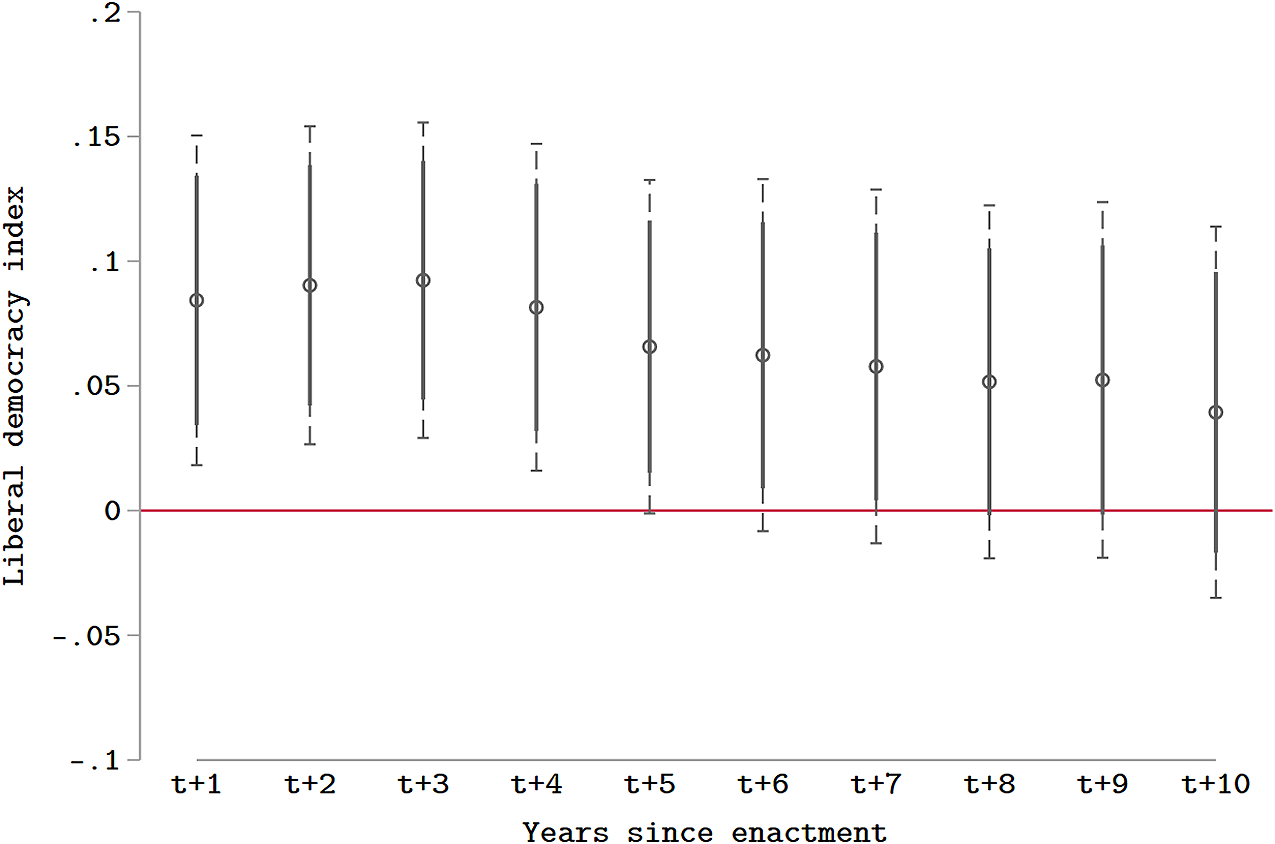
When we decompose the effects per year we observe that, consistent with our argument, the extra improvements in liberal democracy that result from plural approval of the new constitution are most visible during the first years following the enactment of the new constitution. Specifically, the extra positive effect becomes indistinguishable from 0 after the fourth year at the 99% confidence level and after the seventh year at the 95% level. We illustrate these temporal effects in Figure 1, which is based on the fully specified model in column 3 of Table 3.Footnote 21 Each point in the graph represents the estimate for the extra improvement in liberal democracy attributable to adoption of the constitution by more than a single political force (i.e., the difference in the differences).
Effects of Plural Approval on Liberal Democracy per Year
Note: DiD Estimates with 99% and 95% confidence intervals (Model 3, Table 3)

We replicated the fully specified models in columns 3 and 6 of Table 3 using the V-Dem legislative and judicial constraints indexes and the Polity IV executive constraints score as outcome variables.Footnote 22 The results appear in Table 4. As expected, the DiD estimates show that a plural constitution-making process is positively and significantly associated with more effective constraints on executive power. Direct popular participation at the constitution-making stage, whether through voting or nonvoting processes, has no systematic association with how effective institutional constraints on the power of the executive become, except for the negative effect of referenda on judicial constraints.
DiD Estimates of the Effect of Constitution-Making Modalities on Executive Constraints, 1900–2015

Note: Robust standard errors clustered at the constitution-making process level in parentheses; + p < 0.10, *p < 0.05, **p < 0.01; ***p < 0.001.
Additional Robustness and Falsification Tests
We conducted complementary robustness and falsification tests to assess the validity of our empirical approach. First, we evaluate the presence of preexisting trends by introducing leading terms in our baseline specification (no controls). To do so, we grouped the 20-year window around each constitution-making event by quinquennia. This results in four quinquennium indicators (two before and two after treatment), which we interact with our plural approval variable. Significant interactions with the pretreatment indicators would imply that cases of constitution making through a plural constitution-making body were already trending differently before the constituent moment (thus violating parallel trends).
The results support the validity of our identification assumption.Footnote 23 The interaction coefficients in the pre-period are small and statistically indistinguishable from each other at the 5% level, suggesting that liberal democracy trends together in plural and non-plural cases before constitutional replacement.Footnote 24 By contrast, the interaction coefficients become positive, large, and significant after the adoption of the constitution, consistent with our theoretical argument.
Second, we conduct a placebo test by dropping all the posttreatment years (after the adoption of a new constitution) and using the five years before the process starts as a placebo posttreatment period—that is, the analysis window is reduced from 20 to 10 years. Years -10 to -6 and years -5 to -1 in the actual process are artificially taken, respectively, as the five years before and after the constitution. When we run this hard test, we obtain a very small, albeit statistically significant coefficient for the interaction term of the placebo postconstitution indicator with our plural approval variable (
 $ {\hat{\gamma}}_3=0.036,\mathrm{SE}=0.014\Big) $
. However, this is not a major challenge to our theoretical conclusions, for two main reasons.
The first is that some indication of different behavior between plural and non-plural cases immediately before the official start of the constitution-making process is to be expected under our own theoretical framework. It is reasonable to observe a small trend divergence in liberal democracy levels shortly before treatment because constitution-making bodies are elected or appointed through certain procedures that are usually decided or adopted more or less cooperatively before the formal start date of the process. For instance, although the constituent legislature that approved the Polish 1997 constitution was elected in 1993, the essential features of the process were defined between 1989 and 1992. Such dynamics cannot be captured at a clearly identifiable point across cases, which is why we coded the constitution-making process as beginning when the drafting and approval body was officially elected or appointed. Consistent with these expectations, when we decompose the placebo analysis by year, we find that our plural approval variable starts predicting higher levels of liberal democracy only two years before the beginning of the constitution-making process (years +4 and +5 in the placebo test).Footnote 25 This is precisely the period when, if the cooperation among political elites in constitution making indeed matters, it should start producing initial differences between cases, an effect that we cannot capture in our coding.
The second reason why our conclusions remain strong is that leading effects are also very small relative to the posttreatment effect estimates. The estimate for the effect of plural constitution-making bodies on liberal democracy is almost five times larger than the coefficient in the placebo test (0.17 versus 0.036), indicating a sharp jump in liberal democracy after enactment in cases of plural approval.
CONCLUSIONS
We have proposed, inspired by seminal works on democratization, that constitutional replacements are more likely to result in significant improvements in liberal democracy when representatives of opposing political camps have to negotiate and jointly approve the new text. This effect should be stronger during the early years of life of the constitution, when the balance of power among contending political forces tends to remain stable, thus enabling the political and social opposition to monitor and mobilize against potential constitutional transgressions by incumbents. Analyzing the effects of direct citizen participation and cooperation among political representatives during the making of all constitutions adopted or in force during democratic years between 1900 and 2015, this paper has shown statistical evidence consistent with these theoretical arguments about the rise and stability of a liberal-democratic political order.
Although we do not find discernible democratizing effects of participatory constitution making, the arguments and findings of this paper are compatible with the idea that the actions and resources of ordinary citizens and civil society organizations, and not just of political elites, contribute to the success or failure of liberal democracies. In particular, we showed evidence in support of the idea that a plural distribution of voters’ support across parties and the existence of strong civil society organizations facilitate the emergence and consolidation of the liberal dimension of democracy. Moreover, our analysis only provides reasons to be skeptical about the democratizing influence of direct citizen involvement in constitution making with independence from the actions and decisions of political representatives. It is consistent, however, with the possibility that popular participation in constitution making may strengthen democracy when it follows and complements politically plural elite agreements.
Plural constitutional agreements provide representative elites with the opportunity to commit to norms of democratic behavior, which over time may also create a citizen consensus about the limits of state power. A sober analysis of these agreements, however, should lead us to expect temporally limited effects. Most constitutional agreements are opportunistic and induced by exogenous factors. For this reason, their democratizing effects are likely to last only as long as the plural distribution of institutional and societal power that prevailed at the constitution-making stage remains stable.
Even if most plural constitutional elite agreements produce beneficial effects on democracy only in the short term, the political and policy implications of the findings presented in this paper are clear. Direct citizen participation is consistent with our current understanding of democratic legitimacy, and social movements, political theorists, and international agencies engaged in assisting constitution-building processes around the world should continue promoting it for important political reforms. This advocacy of public participation, however, must not lose sight of the fact that mechanisms that induce political pluralism in constituent bodies, such as inclusive selection methods and qualified majority decision rules, are as desirable in the design of a democratic constitution-making process as participatory channels. More importantly, in a world where would-be autocrats often seek to erode democracy by legal and electoral means, we should be wary of the democratizing effect of processes of constitutional change in which popular participation is maximized at the expense of elite negotiation and deliberation.
SUPPLEMENTARY MATERIALS
To view supplementary material for this article, please visit http://dx.doi.org/10.1017/S0003055420001069.
Replication materials can be found on Dataverse at: https://doi.org/10.7910/DVN/FLV8GQ.





Comments
No Comments have been published for this article.