Introduction
In past decades, globalization has transformed the areas of food production, distribution and consumption, encouraging the process of industrialization of agriculture and the agri-food system initiated in the mid-20th century. The creation of the World Trade Organisation in 1995 fostered international food trade and increased competition between territories; at the same time it consolidated the export orientation of local agri-food systemsReference McMichael, Buttel and McMichael1. In a context of strong international competition, the specialization of food production in the different territories has increased and, consequently, local production systems have become simpler, while the pressure on the natural resources of rural environments is on the riseReference Ploeg2. Simultaneously, all territories, now focused on the production of a small number of food products, increasingly resort to global food stores in order to supply the food demands of their populations. This entails, at the same time, an irreparable loss of agricultural biodiversityReference Goland and Bauer3. This growing dependence on the global market can only be maintained through an equally growing dependence on fossil fuelsReference McMichael4. An alarming situation in a context of climate change and peak oil, in which global warming and the depletion of ‘cheap energy’Reference Nashawi, Malallah and Al-Bisharah5 constitute two of the greatest environmental and socio-economic problems. Consequently, one of the main focuses of attention and debate on sustainability and climate change lies in transportReference Zhang, Li, Zhou and Mu6 and, especially, in agri-food transport [in 2011, transport represented around 33% of the final consumption of energy in the EU7 and 38% in Spain, 95% of which derived from the use of fossil fuels8 (mostly gasoline, gas and diesel)]Reference Huang, von Lampe and van Tongeren9, Reference Sim, Barry, Clift and Cowell10.
After the signing of the Kyoto Protocol, many authors have considered who has the ultimate responsibility for greenhouse gas (GHG) emissionsReference Munksgaard and Pedersen11–Reference Subak14. Two methods most frequently used to assign responsibility for the emissions are: (1) a territorial approach or production perspective, derived from the Protocol itself, which considers the countries where the goods and services are produced responsible for the emissions, whether the products are locally consumed or exportedReference Munksgaard and Pedersen11; and (2) a demand or consumption approach, which is increasingly acknowledgedReference Dauvergne15, Reference Kissinger and Rees16, according to which it is the consumer who holds the responsibility for the emissions causing the climate changeReference Peters17, whether the products consumed are locally produced or imported.
From the 1990s, the analysis of food transport has gained notoriety in political and academic discussionsReference Schipper, Scholl and Price18–Reference Engelhaupt22. The environmental studies focusing on the analysis of food miles are especially relevantReference Schipper, Scholl and Price18–Reference Paxton20. Initially, food miles were defined as the distance, measured in miles or kilometers, traveled by food from its place of production to its place of consumptionReference Paxton20. Later on, food miles were associated with the accounting of GHG emissions and, particularly, with the calculation of the carbon footprint as a biophysical indicator of environmental pressure and sustainabilityReference Coley, Howard and Winter23, Reference Lal, Griyn, Apt, Lave and Morgan24. On the other hand, food miles constitute a conceptual and methodological tool incorporated into a wider and more complex debate on the need to build sustainable agri-food systems through the relocation and reterritorialization of both food production and consumptionReference Durham, King, Delgado and Roheim25–Reference Peters, Bills, Lembo, Wilkins and Fick26. Together with the shift from industrialized agricultural management and food processing systems toward agro-ecological formsReference Gliessman27, Reference Francis28 and the changes in the eminently meat-dominated industrialized diet, the location of production and consumption ruled by proximity criteria are identified as key elements for the construction of alternative agri-food systems and the design of sustainable rural development strategiesReference Durham, King, Delgado and Roheim25, Reference Ploeg, Renting, Brunori, Knickel, Mannion, Marsden, Roest, Sevilla Guzmán and Ventura29.
The physical proximity of production, the modal distribution of transport and food consumption are not the only factors of food (un)sustainability. There is a wide consensus according to which the analysis of the contribution of transport to global warming should be tackled by taking into consideration the agri-food system as a wholeReference Kissinger30, Reference Peter and Hertwich31. Heller and KoelainReference Heller and Koelain32 estimated that transport represents 16% of the total energy consumption in the agri-food system of the USA. Other authors have made a Life Cycle Assessment (LCA) of the product and have valued the importance of international food transport and its contribution in terms of GHG, showing that transport may even represent between 1 and 15% of the total GHG for meat, and between 15 and 78% for other agrarian productsReference Williams, Pell, Webb, Tribe, Evans, Moorhouse and Watkiss33–Reference Knudsen, Fonseca de Almeida, Langer, Santiago de Abreru and Halberg35.
To assign correctly the responsibility for the emissions related with the different economic activities is a precondition to design of a GHG reduction strategy that allows mitigating the climate change. This work is focused on the analysis of the external food miles, i.e., the environmental cost of transport directly linked to food imports as a relevant and essential element from the above-mentioned demand perspective. Consequently, the objective of this work is to analyze the environmental behaviour of food imports in Spain between 1995 and 2011 according to the mode of transport used (air, rail, road or water), that is, their external food milesReference Kissinger30. The ton (t) and ton-kilometers (t-km) imported, the kilometers traveled and the GHG emissions associated with the food transported have all been estimated and gathered into ten groups selected from the Standard International Trade Classification (SITC) of the United Nations, with special attention given to the two groups with greater quantitative weight on imports: cereals and animal feed. The analysis of the ‘food miles’ is especially relevant in the case of Spain, because this is a territory with a high food production capacity, given its geographical and climatic conditions, where food imports play an essential role for the comprehension of the agri-food system as a whole. Two periods are thus identified: an expansive one between 1995 and 2007, in which food imports increased, and a recessive one between 2007 and 2011, in which food imports and the environmental costs associated with them both decreased, although the two remained above the 1995 level. In 2011, food imports represented 11% of the total imported weight and 8% of the monetary expenditure36, which was equivalent to 2% of the Spanish GDP.
The remainder of this paper is in four sections. The first section presents the methodologies and methodological assumptions adopted. The main results are subsequently analyzed and discussed in the sections Results and Discussion; the latter also includes a reflection on the meaning of their main political implications. Finally, the last section summarizes the main conclusions.
Methodology and Sources
Statistical data and sources
The basic data on the amounts of food transported by modes of transport and countries of origin have been taken from public statistics on foreign trade published by the Department of Foreign Trade of the Ministry of Industry, Tourism and Trade and, more specifically, from the free-access database DataComex36. The calculations have been made by estimating the distances between the closest seaports (origin/destination) in the case of water transport, and the distance between the respective capital cities (origin/destination) for air, road or rail transport. The estimates have been calculated, every year from 1995 to 2011, for 136 products gathered into ten groups (1, live animals; 2, meat; 3, dairy products, eggs and milk; 4, fish and seafood; 5, cereals; 6, beans, vegetables and fruit; 7, sugar; 8, coffee, tea, cacao and spices; 9, animal feed; 10, processed food) from 113 different countries, which are the origin of 99% of Spanish imports. The data, related both to food production (agriculture, farming and fishing) and consumption, have been obtained from the databases of the Ministry of Agriculture, Food and Environment37.
Methodology used to calculate food miles
The average number of kilometers traveled by food imports has been estimated by taking as reference the weighted average source distance (WASD)Reference Pirog and Benjamin38. As shown in Equations 1 and 2, the estimates are made for each food group (G) according to the number of products (p) contained in it.
 $${\rm WASD}_p = \sum {{\rm (}mk_p \times dk_p {\rm )}/\Sigma mk_p} $$
 $${\rm WASD}(G) = \sum {(mg_p \times {\rm WASD}_p )/\Sigma mg_p } $$
where, p=products, mk=total amount transported of product ‘p’ according to place of origin ‘k’ (t), k=place of origin of product ‘p’, dk=distance traveled from the place of origin ‘k’ to the place of destination of product ‘p’ (km), G=food group, mg=total amount transported of product ‘p’ belonging to group ‘G’.
The WASD calculated for each product and group has been used as basic information to estimate the environmental pressure in terms of GHG emissions.
Calculation of the GHG emissions
The functional unit used in this study is the ‘ton-kilometer’. In this unit, and according to the different modes of transport, energy consumption is estimated by applying the energy analysis methodologyReference Corre, Schroder and Verhagen39. Once energy consumption is obtained, GHG emissions are estimated by implementing the IPCC methodology40. These two methods have been adapted in this work following Equations 3 and 4:
 $$Ip_{\alpha (i)} = Wp_{(i)} \times Dp_{(i)} \times Tp_{\alpha {\rm} (i)} $$
 $$TIG_\alpha = \sum {Ip_{\alpha (i)}} $$
where, Ip α=environmental pressure according to pressure indicator ‘α’ and product ‘p’, α=pressure indicator: energy (kJ) or emissions (CO2-eq), i=mode of transport (road, rail, air or water), Wp (i)=weight transported (t) of product ‘p’ in mode of transport ‘i’, D=distance (km) traveled by product ‘p’ (food miles estimate: WASDp) (km), Tα=technology coefficient associated to mode of transport ‘i’ according to indicator ‘α’ (kJ×t km−1 or g CO2-eq×t km−1), TIG α=total GHG emission of group G according to pressure indicator α.
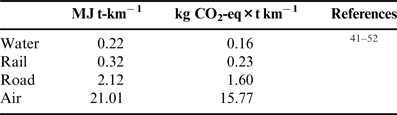
The critical element of this analysis, once the distances (km) and transported weights (t) are estimated, is to determine the coefficients (T α(i)) that represent the technological conditions in which food transport is performed. The coefficients used (T E and T CO2-eq) have been selected from a wide review of the specialized literatureReference Blanke and Burdick41–52. This review is summarized in Table 1.
Technology coefficients according to energy (T E) and GHG emissions  $(T_{CO_{2}-eq}$ by mode of transport.

In the case of meat, milk, dairy products, eggs, and fish and fruit imports, the CO2-eq emissions associated with the energy consumption of transport refrigeration have been taken into account. To that end, the values of 0.05 and 0.50 kg CO2-eq×t km−1 have been taken for maritime and road transport, respectivelyReference Williams, Pell, Webb, Tribe, Evans, Moorhouse and Watkiss33, 53, Reference Tassou, De-Lille and Ge54.
Limitations of the study
This work estimates the environmental pressure in kilometers traveled and GHG emissions, of food imports (termed ‘external food miles’36 in the literature), according to the direct energy consumption of transport. Therefore the other two components of apparent consumption, domestic production and exports (the complete estimation of the ‘consumption approach’, as a way of attributing responsibility for GHG emissions, implies estimating domestic production, adding imports and subtracting exports), have not been analyzed. Food import does not analyze the whole life cycle, and this is why the results obtained are an underestimation of the climate impact of food imports. In terms of GHG emissions, the underestimate is reinforced by the lack of consideration of the indirect use of energy and the maintenance and energy payback of vehicles and infrastructures. [Indirect energy is linked to the energy cost (and GHG emissions) of producing the energy consumed directly during transportationReference Van Wee, Janse and van Den Brink55; if this environmental pressure is taken into account, GHG emissions increase by an average of 14%. On the other hand, the energy consumption associated with the maintenance of capital has been excluded from the analysis due to the lack of availability and reliability of the information that puts in relation food imports and the use of infrastructures and vehiclesReference Copena, Simón Fernández, Pérez Neira, Delgado Cabeza and Soler Montiel56.] This underestimate is still further accentuated by: (1) the lack of consideration of the distances traveled or the associated environmental costs within the country of origin and the country of destination, given the absence of data; and (2) the available data refer to direct imports. In cases where a product is re-exported by another country, that is, imported and later on exported to Spain, only the impact of this last stretch is considered (for example, coffee or cocoa arriving in The Netherlands from where it is later re-exported to Spain). It is therefore a cautious estimation of the minimum environmental pressure exerted by the transportation of imported food and its contribution to global warming.
Results
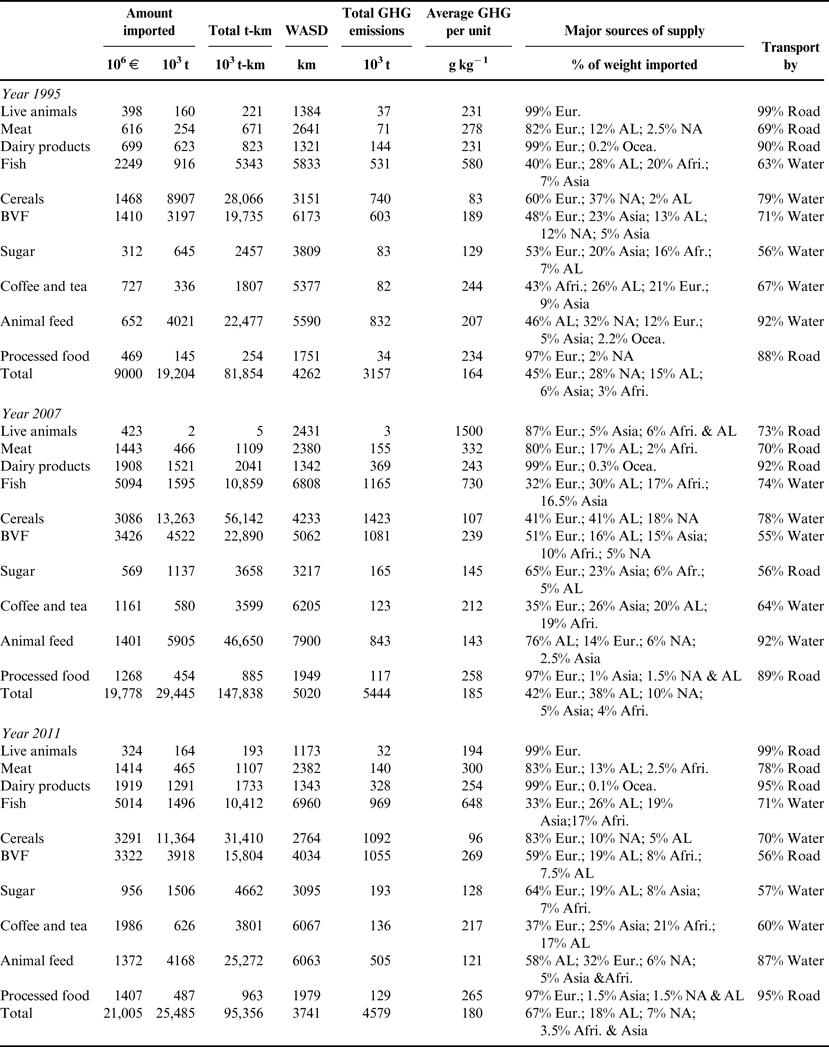
The evolution of the t, €, GHG emissions, km and t-km associated with the transportation of the food imported by Spain between 1995 and 2011 is shown in Figs. 1 and 2; and Table 2 summarizes the indicators associated in 1995, 2007 and 2011, for the ten SITC food groups and by main continents of origin and modes of transport used. As seen in Figs. 1 and 2, in terms of t, t-km and GHG, two periods are clearly identified. A period of growth between 1995 and 2007, in which all indicators increased (GHG emissions rose by 72.5%, t by 53% and t-km by 80.6%), and a period of crisis between 2007, the year of the outbreak of the economic crisis (in the case of Spain, a strong recession characterized the period between 2008 and 2009, with a −3.7% growth of the GDP and a 23% decline of imports in terms of monetary value; between 2009 and 2010, the economic recession was mitigated, with an economic growth of −0.9%57), and 2011, when GHG emissions, t and t-km diminished by 15.8, 13 and 35%, respectively. The average distances covered by imported food increased by 17.7% in the first period, and decreased by 25.4% in the second one, reaching values in 2011 that were lower than those of 1995. On the other hand, the data show that, throughout the period studied (1995–2011), the rest of the indicators considered clearly increased: the monetary volume by 133%, t by 32.7%, t-km by 42.7%, GHG emissions by 45%, and the GHG per unit transported by almost 10%. In other words, the reduction of the average distance traveled by food imports does not imply, as expected, a reduction of the environmental cost. In the recession period it is even possible to observe how the reduction of the average distance by 25.4% comes along with a reduction of only 15.8% of the total GHG emissions and of only 2.7% of the GHG per unit transported. The same is observed in Fig. 2, when the last 3 years in the series are compared with what happened 10 years before: the average distances traveled by the food are much shorter and the total emissions much higher.
Food imports (t and €) in Spain (1995–2011). Index numbers (base year 1995).

GHG emissions, km and t-km traveled by Spanish food imports (1995–2011). Index numbers (base year 1995).
Spain's import-related food miles: CO2-eq emissions by food category.
BVF, Beans, vegetables and fruit; Eur., Europe; NA, North America; AL, Latin America; Afri., Africa; Ocea., Oceania.
On the one hand, the evolution of these data is related with changes in the predominance of the geographical areas where the food was purchased during the period studied. Between 1995 and 2007, food imports from Latin America increased substantially and, in 2007, 39% of the food imported arrived from that region. During the period of crisis, imports were Europeanized, and in 2011 67% of the food imported was produced in Europe.
The results by food groups offer new explanatory arguments to reflect on the environmental sustainability of the Spanish agri-food system, which are not revealed by the global analysis. Cereals and animal feed were the groups with greater weights in terms of GHG emission, representing 49, 41 and 35% of the total in 1995, 2007 and 2011, respectively. If the GHG emissions derived from the transport of beans, vegetables, fruit and fish are added to those of these two groups, they reach 85.7, 82.9 and 79.1%, respectively, in the same years.
During the period of growth (1995–2007) the imports of all food groups increased except those of live animals. The increment in the imports of cereals and animal feed was especially relevant: they augmented by 48.9 and 46.8%, respectively. In 1995, these two items were estimated at 12.9 million t (67.3% of the total) and came primarily from the USA and France. At the end of the period of expansion, in 2007, the imports of these two food groups were estimated at 19.1 million t (65.1% of the total t and 46.6% of the total GHG emissions). The increase was accompanied by a shift in the places of origin of those imports, with Argentina and Brazil, linked to animal feed imports, gaining importance as countries of origin. Cereal and feed imports were mostly made by water when they came from out of Europe and by road in the opposite direction, with average distances estimated at 4233 km in 1995 and 7900 km in 2007. For the same period, beans, vegetables and fruit imports increased by 41% (79.1% in terms of GHG emissions), with France and Thailand as the two main countries of origin and an average distance of 5062 km traveled. The imports of fish and dairy products also increased significantly, both in volume (74 and 144%, respectively) and in GHG emissions (119 and 156%, respectively).
Imports of animal feed and cereals play an essential role within the Spanish agri-food system, especially in relation to industrial farming. Despite the fact that the consumption of meat (65 kg per capita per year), dairy products and eggs (342 kg per capita per year)37 in Spain is high, the factor that explains the increment of imports belonging to these groups is not related to consumption (which has maintained a similar level all through that period), but to the increase in the exports of products of animal origin. Between 1995 and 2007, meat exports multiplied by 3.9, and dairy products and eggs multiplied by 2.75. In 2007, 1.1 million t of meat and 0.54 million t of dairy products and eggs were exported36.
During the recession period, between 2007 and 2011, the imports of some food groups continued to increase, as was the case for fish, sugar, coffee and, especially, processed food. However, those of other groups decreased, especially cereals and animal feed imports (by 14.3 and 29.4%, respectively), which together represented 15.5 million t, 60.9% of the total, but still 20% above their 1995 level. In these years, some relocation of food imports was already noticeable, especially in the case of cereals, with imports from Argentina and Brazil losing weight in favor of European countries such as France and Ukraine. Consequently, the average distance traveled by cereals was reduced from 4233 to 2764 km between 2007 and 2011. Just as with the expansive period, it is necessary to resort to the relation between imports, exports and consumption to explain these results. For instance, in the case of the coffee, tea and spices group, imports grew by 10% between 2007 and 2011 and this increment is linked to that of the exports (60%) and of the total demand (10%), rather than to an increase in the consumption per capita, which remained stable at 6.5 kg per year. In the case of the fish and seafood group, the rise of imports is related to: (1) an increment in consumption (17.8% between 1995 and 2010, rising from 28 to 33 kg per capita per year), (2) the increase of exports (200%), and (3) a 25% reduction of captures between 1995 and 201137.
The cereals and animal feed groups are responsible for 59.4% of the total t-km in 2011 and this transport is made in the most efficient manner in terms of average GHG per unit of volume transported. In contrast, other groups with a lesser weight on the external food miles present a higher level of GHG per unit of volume transported: fish (648 g CO2-eq kg−1), meat (300 g CO2-eq kg−1), beans, vegetables and fruit (269 g CO2-eq kg−1), processed food (265 g CO2-eq kg−1), and coffee and tea (217 g CO2-eq kg−1) turn out to be the most inefficient groups. That year, the greenhouse effect gases associated with fish imports, which represented 5.8% of the transported weight and generated 21.2% of the GHG emissions, were especially relevant. The high environmental cost of fish imports is the result of the long distance traveled, 6960 km, the mode of transport used and the extra energy required for their preservation. The following two groups with a higher volume of GHG per unit transported (meat, and vegetables and fruit) also have extra energy requirements associated with their preservation during international transport.
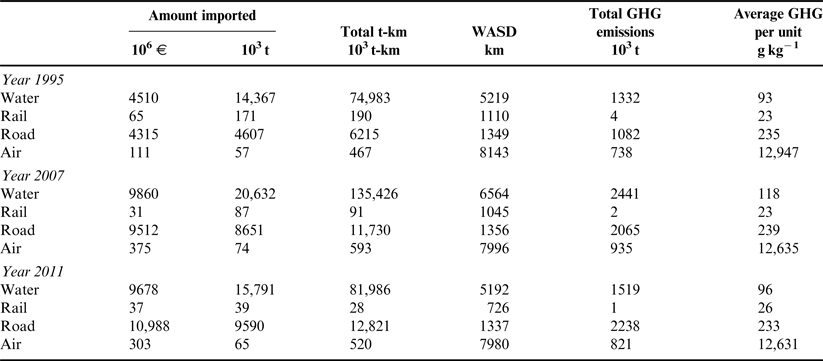
Looking at the modal distribution of food transport (Table 3), it is possible to observe that, between 1995 and 2007, food transport by water, road and air increased, respectively, by 88, 80 and 26% in terms of t-km (water and air transport are both subsidiary to land transport, because either road or rail will be necessary for the imports to reach their final destination; the GHG emissions of this internal transport are, however, not considered in this work). Only imports transported by rail, the less polluting means of transport, decreased (by 50%). During the recession period, road transport continued to increase, 9 and 8.4% in respect to 2007 in terms of t-km and GHG emissions, while the rest of the modes of transport lost relevance, especially water and rail. Between 1995 and 2011, the importance of road, air and water transport, measured in t-km, increased by 106, 11.2 and 9.3%, respectively, while rail transport decreased by 75%. In other words, the modes of transport with higher environmental costs gained relevance at the expense of those with lower environmental costs, as reflected in Table 3. In 2011, 61.9% of the imports were transported by water, 37.6% by road, 0.25% by air and 0.15% by rail. Although air transport had little weight in terms of tons transported, its environmental impact was very significant because 0.25% of the t transported by this means generated 17.9% of the GHG emissions in 2011. Food transport by air generates an impact that is 540% greater than that produced by road transportation.
Spain's import-related food miles: CO2-eq emissions by mode of transport.
The historical evolution of the modal distribution of food transport in Spain (Fig. 3) shows the reduction in the use of rail in favor of other means, especially road. The change in the modal distribution of food transport is the reason why the reduction of the amounts and distances traveled by food imports is not accompanied by a proportional reduction of GHG emissions.
Evolution of the modal distribution of import-related transport (1995–2011). Index numbers (t-km) (base year 1995).
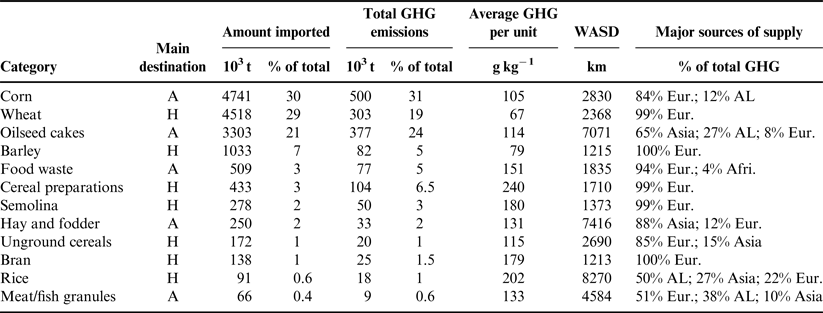
Cereal and animal feed imports are the most important ones, both quantitatively and in relation to the environmental costs associated with transport. For this reason, these food groups are analyzed with special attention (Table 4). In 2011, almost 60% of the cereals and animal feed imported by Spain traveled more than 2500 km and represented more than 53% of the GHG emissions. About 88% of the cereals transported and 79% of the GHG emissions derived from their transport in 2007 were linked to the import of four specific food products (corn, wheat, oilseed cakes and barley), coming mostly from France, Argentina, USA, Ukraine and Bulgaria, with an impact in terms of GHG in relation to the total of 33, 20, 7, 7 and 5%, respectively. Asia is an important provider of cereals and animal feed: 85% of the hay and fodder, and 27% of the rice imported are produced in Indonesia, Thailand and Malaysia. Cereal preparations were the food product with the highest GHG emissions per unit transported (240 g CO2-eq kg−1), followed by rice (202 g CO2-eq kg−1) and semolina (180 g CO2-eq kg−1), due to the conjunction of long distances and a modal distribution in which road transport prevailed.
Composition of the food miles of cereal and animal feed imports (2011).
A, Animal feed; H, human food.
Feed imports represent 57% of the t, 62% of the GHG emissions and 73% of the t-km of the two food groups analyzed in Table 4. Corn and oilseed cakes, more than 90% of which are made with soya, are strategic crops for the functioning and maintenance of industrial livestock farming in Spain. Corn and soya imports reached 10.7 million t in 2007, an amount equivalent to 36.5% of the total food imports.
Discussion
‘External food miles’ and GHG emissions are important elements in the debate on the need to relocate production with the objective of building agri-food systems that are more environmentally sustainable. However, controversy exists. There are works that question the statement ‘local food is best’Reference Schlich and Fleissner58, Reference Edwards-Jones, Milà i Canals, Hounsome, Truninger, Koerber, Hounsome, Cross, York, Hospido, Plassmann, Harris, Edwards, Dayd, Tomos, Cowell and Jones59 and others that categorically affirm that the relocation of production in terms of distance and the subsequent reduction of the transported volumesReference Pugliese, Zanasi, Atallah and Cosimo60, Reference Jarosz61 are necessary conditions for building more sustainable and biodiverse societiesReference Goland and Bauer3. In this sense, it is necessary to put into perspective the importance of transport within the agri-food system as a whole, as well as in the context of the different territories and sociocultural realities.
For the case of the USA, Heller and KoelainReference Heller and Koelain32 estimate that food transport represents 16% of the total energy consumed by the agri-food systems. Similar studies for the UK and Spain have estimated that food transport contributes 12% of the GHG emissions in the UKReference Garnett62 and 17.4% of the energy consumption of the agri-food system in SpainReference Infante Amate and González de Molina63. According to the estimations made for this work, the transport of imported food represents the equivalent of 12.3% of the direct GHG emissions of agriculture, and a volume equivalent to 25% of the national food production, a figure that is not included in the Inventory of Emissions in Spain64. By making an LCA of the product, Williams et al.Reference Williams, Pell, Webb, Tribe, Evans, Moorhouse and Watkiss33 and Knudsen et alReference Knudsen, Yu-Hui, Yan and Halberg34, Reference Knudsen, Fonseca de Almeida, Langer, Santiago de Abreru and Halberg35 have revealed that the transport phase is the origin of a high percentage of the total GHG emissions. In the case of the international trade of strawberries (Spain–UK), potatoes (Ireland–UK), tomatoes (Spain–UK), orange juice (Brazil–Denmark) and apples (New Zealand–UK), the GHG emissions associated with transport represented, respectively, 33, 40, 43, 58 and 78% of the total emissions. The least weight of transport on the total GHG emissions is estimated between 1 and 15% and corresponds to meat transport (beef, lamb and poultry from Brazil and New Zealand to UK)Reference Williams, Pell, Webb, Tribe, Evans, Moorhouse and Watkiss33 due to the high impact of the production phase (for instance, producing 1 kg of lamb meat in New Zealand has an impact in terms of GHG emissions that is 97 times higher than that of producing 1 kg of apples)Reference Williams, Pell, Webb, Tribe, Evans, Moorhouse and Watkiss33. The unit cost of transporting meat from Brazil and New Zealand to UK was estimated at 0.3 and 0.6 kg CO2-eq×kg−1, respectively. These figures are much higher than those obtained in this work for the case of Spain (0.15 CO2-eq×kg−1 in 2011), where the distances traveled were, on average, shorter (2382 km). Also, KnudsenReference Knudsen, Yu-Hui, Yan and Halberg34 shows how international transport (China–Denmark) is the most polluting phase [not only in terms of GHG emissions (51% of the total, 86% associated with international transport), but also in the rest of impact categories: non-renewable energy consumption, eutrophication and acidificationReference Knudsen, Yu-Hui, Yan and Halberg34] in the LCA of the soya bean, with a unit environmental cost of 0.19 kg CO2-eq kg−1 transported. These data agree with the estimations obtained in this work for the animal feed and beans and vegetables groups in Spain: 0.15 and 0.24 kg CO2-eq×kg−1 with average distances of 4034 and 6497 km (2011).
The greater or lesser importance of transport in terms of the LCA of the products and of the external food miles is, doubtlessly, an essential issue. However, it does not resolve the dilemma between producing local and importing. If the addition of local emissions and the preservation of the product in A is greater than the addition of local emissions in B and the preservation and transport from B to A, food imports could be the option contributing less to the climate change, either because there is a comparative ecological advantage between territories associated with their agro-climatic conditionsReference Foster, Green, Bleda, Dewick, Evans, Flynn and Mylan65, or because there are important divergences in terms of environmental efficiency associated with technological-productive differences. Thus, importing Spanish tomatoes to the UK may be up to 3.1 times more efficient than producing them locally in the UK due to the climatic and technological conditions, since heated greenhouses would be required in the latter caseReference Williams, Pell, Webb, Tribe, Evans, Moorhouse and Watkiss33. Similarly, in those cases where emissions in the production and preservation phases are comparable in A and B, the environmental cost represented by international transport would be difficult to justify in a context that really promotes environmental sustainability. Given that there are large regions in Spain with comparative ecological advantages and that food exports are also increasing and have important environmental impacts beyond climate changeReference Knudsen, Yu-Hui, Yan and Halberg34, the possibilities of reducing GHG emissions through the relocation of food production are multiple, making the environmental cost analysis of food imports especially relevant.
Another issue to be highlighted is the importance of the modal distribution when it comes to analyzing the environmental sustainability of agri-food systems. As shown by the data in this work, shorter average distances traveled by food imports come together with higher environmental costs, in absolute (GHG emissions) and relative (GHG emissions per unit transported) terms. This is the consequence of changes in the modes of transport used. The preferential use of road transport and the increase of air transport result in greater GHG emissions, to the detriment of the rail, which is the means with the lowest environmental cost. More specifically, road transport is responsible for 7–9 times more GHG emissions per unit of weight than rail transport. Carrying food by air generates over 98 times more GHG emissions per unit transported than doing it by water. In this sense, while it is necessary to build more sustainable agri-food systems, the improvements of the energy efficiency of transport and fuels57 and of the energy production chain (from primary to final energy)Reference Schlich and Fleissner58 are insufficient. A change in the modal distribution of transport toward more efficient modes of transport is absolutely necessary51. At the European Union level, these results do not go unnoticed. In effect, the Europe 2020 strategy66 moves toward a low-carbon economy, and fixed the objective of CO2 emissions for 2020 in an amount 20% smaller than that of 1990. However, the strategy does not mention the essential role of the modal reconfiguration of transport, and focuses exclusively on aspects related to the efficiency of the modes of transport.
On the other hand, the importance of the different food groups in relation to the imports made by the Spanish agri-food system, and their impact in terms of external food miles and GHG emissions, is closely related to diet and consumption habits, as well as to other sociocultural and economic issues. Both the non-seasonality of consumption, consuming seasonal products all year roundReference Edwards-Jones, Milà i Canals, Hounsome, Truninger, Koerber, Hounsome, Cross, York, Hospido, Plassmann, Harris, Edwards, Day, Deri Tomos, Cowell and Jones67, and the high consumption of meat per capita in developed countriesReference McMichael, Powls, Butler and Uay68 are at the origin of the agri-food system contribution to climate change. Consequently, the transition toward less meat-intensive and more season-adapted diets is both possible and desirable. In the second assumption, the analysis of the external food miles is especially relevant. As shown in this work for the case of Spain, it is not the external food miles of products considered ‘exotic’, which cannot be locally produced, such as cacao, coffee or tea, that generate the highest environmental costs. Despite their traveling long distances (6067 km in 2011), they have a relatively small impact, given their small volume (2 and 1.5% of the t and GHG emissions, respectively), as compared to other food groups, which could be produced seasonally in Spain, such as fruits and vegetables. On the other hand, 74% of the imported food (56% of the GHG emissions) has a direct or indirect relation with the production of animal proteins (meat, milk, eggs, animal feed, cereals, etc.) within the Spanish agri-food system, whether for internal consumption or to be exported. Some of the imports for the production of animal proteins could be obtained in Spain through the production of either the same products (cereals) or substitutes (green fodder) adapted to the local environmental conditions. In addition, changes in the diet could reduce the need to import food with high food miles.
In brief, if the purpose is to make progress in the reduction of emissions associated with transport, other analysis and reasoning schemes are necessary to favor the construction of sustainable agri-food systems. External food miles, GHG emissions in absolute and relative terms, and the average distance traveled by food are necessary indicators that must be complemented with other tools and perspectives considering, at least, territorial, climate and techno-productive issues, as well as the citizens' consumption preferences and habits. Only through multidisciplinary approaches that transcend the monetary arguments, is it possible to reach socially desired environmental objectives while providing an opportunity for new rural development policies.
Conclusions
The results show that the emissions associated with food transport are significant in quantitative terms, since they are equivalent to 12.3% of the total emissions associated with agriculture in 2011, but they are not recorded in the Spanish Inventory of Greenhouse Gases Emissions. At the same time, the results show the relation between the economic cycle and food imports in physical terms, and demonstrate that economic growth generates a greater GHG emission due to the increase in food imports. The economic crisis has caused a reduction of food imports and, consequently, of the environmental costs associated with their transport. Nevertheless, the reduction of the amounts and distances traveled by the food products imported by Spain during the period of crisis has not caused a proportional reduction of the GHG emissions and of the contribution to global warming. These results point out that, in order to be efficient, the policies designed to reduce emissions associated with the transport of food imports, must take into consideration any changes affecting the origin of those products and the modal distribution of the imports. The tendency throughout this period indicates an increase of the importance of the most polluting transport means.
In the construction of alternative local food systems it is necessary to take into account the geographical characteristics of the community, the scale, the agricultural methods and the dietReference Duram and Oberholtzer69. And it is also important to remember that, during the territorial reconfiguration of food chains, new aspects appear that hinder the decision-making processes, as do the logistics, economic, environmental and energy costs related to the new exchange areasReference Coley, Howard and Winter23. The previous considerations are not an obstacle to the potential reduction of environmental costs derived from the reduction of food imports and the relocation of food production under environmental and territorial sustainability criteria, thus promoting the development of alternative agri-ecosystems and new forms of production and consumption ruled by the principle of food equityReference Francis28.
In Spain, where there are large regions with comparative ecological advantages for the diversified production of food all year long, the possibilities to relocate local production and consumption are many in techno-productive terms. The analysis made shows that, in the case of Spain, apparently ‘exotic’ products (coffee, tea and spices) are not the ones traveling the longest distances, nor the ones with the greatest relevance in terms of the environmental pressure generated. Other foodstuffs, particularly cereals, animal feed, beans, vegetables and fruit, most of which are paradoxically also cultivated in Spain, are the ones primarily responsible for the environmental impact of food imports.
The results of this work open new doors to new public debate and to the design of food relocation policies, as well as to changes in eating habits toward diets less dependent on animal proteins. It is evident that the analysis of food issues cannot be reduced to a single indicator. However, external food miles analysis contributes with relevant data that allow us to understand the functioning of the agri-food system and to identify the objectives of new policies focused on sustainabilityReference Kissinger30 as promoted by the Europe 2020 strategy66.