Introduction
Over 4.4% of the global population live with depression (Friedrich, Reference Friedrich2017; World Health Organisation, 2017), which ranked as the leading cause of disability worldwide in 2017 (World Health Organisation, 2017). For many years, the monoamine hypothesis of depression prevailed (Coppen, Reference Coppen1967). However, one of the more recent hypotheses put forward is the ‘mitochondrial psychiatry’ model of depression (Gardner and Boles, Reference Gardner and Boles2011), which postulates that impaired mitochondrial bioenergetics functions in the development of depressive episodes (Klinedinst and Regenold, Reference Klinedinst and Regenold2015). Indeed, mitochondrial abnormalities, increased oxidative stress and brain metabolism changes are often observed in patients with depression (Karabatsiakis et al., Reference Karabatsiakis, Bock, Salinas-Manrique, Kolassa, Calzia, Dietrich and Kolassa2014; Chang et al., Reference Chang, Jou, Lin, Lai and Liu2015; Wang and Dwivedi, Reference Wang and Dwivedi2017).
The transcriptional coactivator peroxisome proliferator-activated receptor-γ coactivator (PGC-1α) regulates cellular energy production (Villena, Reference Villena2015), and is termed ‘master regulator of mitochondrial biogenesis’ (Fernandez-Marcos and Auwerx, Reference Fernandez-Marcos and Auwerx2011). PGC-1α was first identified as a cold-inducible peroxisome proliferator-activated receptor gamma (PPAR-γ) co-activator in brown adipose tissue (Puigserver et al., Reference Puigserver, Wu, Park, Graves, Wright and Spiegelman1998). It is also induced by caloric restriction and exercise (Rodgers et al., Reference Rodgers, Lerin, Haas, Gygi, Spiegelman and Puigserver2005; Agudelo et al., Reference Agudelo, Femenia, Orhan, Porsmyr-Palmertz, Goiny, Martinez-Redondo, Correia, Izadi, Bhat, Schuppe-Koistinen, Pettersson, Ferreira, Krook, Barres, Zierath, Erhardt, Lindskog and Ruas2014), all of which require energy expenditure. The PGC-1α gene, also known as PPARGC1A, maps to chromosome 4p15.1 (Esterbauer et al., Reference Esterbauer, Oberkofler, Krempler and Patsch1999), and encodes a 798 amino acid protein (Liang and Ward, Reference Liang and Ward2006). The 4p15–4p16 region has previously been linked to neuropsychiatric conditions, such as bipolar disorder and schizophrenia (Blackwood et al., Reference Blackwood, He, Morris, McLean, Whitton, Thomson, Walker, Woodburn, Sharp, Wright, Shibasaki, St Clair, Porteous and Muir1996; Als et al., Reference Als, Dahl, Flint, Wang, Vang, Mors, Kruse and Ewald2004; Christoforou et al., Reference Christoforou, Le Hellard, Thomson, Morris, Tenesa, Pickard, Wray, Muir, Blackwood, Porteous and Evans2007). PGC-1α has diverse functions and plays a role in gluconeogenesis and glucose homeostasis, glycogenolysis, fatty acid oxidation, reactive oxygen species (ROS) suppression, mitochondrial biogenesis and respiration and oxidative phosphorylation (Vega et al., Reference Vega, Huss and Kelly2000; Mootha et al., Reference Mootha, Lindgren, Eriksson, Subramanian, Sihag, Lehar, Puigserver, Carlsson, Ridderstrale, Laurila, Houstis, Daly, Patterson, Mesirov, Golub, Tamayo, Spiegelman, Lander, Hirschhorn, Altshuler and Groop2003; Lin et al., Reference Lin, Wu, Tarr, Lindenberg, St-Pierre, Zhang, Mootha, Jager, Vianna, Reznick, Cui, Manieri, Donovan, Wu, Cooper, Fan, Rohas, Zavacki, Cinti, Shulman, Lowell, Krainc and Spiegelman2004; St-Pierre et al., Reference St-Pierre, Drori, Uldry, Silvaggi, Rhee, Jager, Handschin, Zheng, Lin, Yang, Simon, Bachoo and Spiegelman2006; Kim et al., Reference Kim, Koh, Higashida, Jung, Holloszy and Han2015). It is implicated in the direct co-activation of various transcription factors, e.g. PPARs (Puigserver et al., Reference Puigserver, Wu, Park, Graves, Wright and Spiegelman1998; Vega et al., Reference Vega, Huss and Kelly2000), thyroid hormone receptors (Puigserver et al., Reference Puigserver, Wu, Park, Graves, Wright and Spiegelman1998), glucocorticoid receptors (Jang et al., Reference Jang, Kim, Park, Park, Choi, Kim, Kim, Kim, Lee and Lee2007), oestrogen-related receptors (Takacs et al., Reference Takacs, Petoukhov, Atkinson, Roblin, Ogi, Demeler, Potier, Chebaro, Dejaegere, Svergun, Moras and Billas2013) and the forkhead O-box (FOXO) family (Puigserver et al., Reference Puigserver, Rhee, Donovan, Walkey, Yoon, Oriente, Kitamura, Altomonte, Dong, Accili and Spiegelman2003). PGC-1α function can be influenced by post-transcriptional modifications, including phosphorylation, acetylation, SUMOylation and methylation (Rytinki and Palvimo, Reference Rytinki and Palvimo2009; Sugden et al., Reference Sugden, Caton and Holness2010). It is highly expressed in tissues with a high energy demand, including brain, liver, lung and skeletal muscle (Soyal et al., Reference Soyal, Felder, Auer, Hahne, Oberkofler, Witting, Paulmichl, Landwehrmeyer, Weydt and Patsch2012; Jiang et al., Reference Jiang, Kang, Zhang, Karuppagounder, Xu, Lee, Kang, Lee, Zhang, Pletnikova, Troncoso, Pirooznia, Andrabi, Dawson and Dawson2016). In the brain, PGC-1α is found in the cortex, hippocampus and cerebellum (Tritos et al., Reference Tritos, Mastaitis, Kokkotou, Puigserver, Spiegelman and Maratos-Flier2003), and is expressed in neurons (Lin et al., Reference Lin, Wu, Tarr, Lindenberg, St-Pierre, Zhang, Mootha, Jager, Vianna, Reznick, Cui, Manieri, Donovan, Wu, Cooper, Fan, Rohas, Zavacki, Cinti, Shulman, Lowell, Krainc and Spiegelman2004), astrocytes (Nijland et al., Reference Nijland, Witte, van het Hof, van der Pol, Bauer, Lassmann, van der Valk, de Vries and van Horssen2014; Aguirre-Rueda et al., Reference Aguirre-Rueda, Guerra-Ojeda, Aldasoro, Iradi, Obrador, Ortega, Mauricio, Vila and Valles2015) and microglia (Labuzek et al., Reference Labuzek, Liber, Gabryel and Okopien2010). It is highly expressed in GABAergic (gamma-aminobutyric acid) cells (Cowell et al., Reference Cowell, Blake and Russell2007) and, in mice, is required for normal inhibitory neurotransmission and synaptic function (Dougherty et al., Reference Dougherty, Bartley, Lucas, Hablitz, Dobrunz and Cowell2014).
PGC-1α has been implicated in several neurodegenerative disorders, such as Alzheimer's disease, Huntington's disease, Parkinson's disease and amyotrophic lateral sclerosis (Qin et al., Reference Qin, Haroutunian, Katsel, Cardozo, Ho, Buxbaum and Pasinetti2009; Clark et al., Reference Clark, Reddy, Zheng, Betensky and Simon2011; Thau et al., Reference Thau, Knippenberg, Korner, Rath, Dengler and Petri2012; Weydt et al., Reference Weydt, Soyal, Landwehrmeyer and Patsch2014) and also in depression (Nierenberg et al., Reference Nierenberg, Ghaznavi, Mathias, Ellard, Janos and Sylvia2018). In this regard, an association was found between a single nucleotide polymorphism in the PGC-1α/PPARGC1A gene and major depressive disorder in a sample of 974 Caucasian individuals, though this did not survive multiple testing correction and was not replicated in a second sample set (Schosser et al., Reference Schosser, Gaysina, Cohen-Woods, Domenici, Perry, Tozzi, Korszun, Gunasinghe, Gray, Jones, Binder, Holsboer, Craddock, Owen, Craig, Farmer, Muglia and McGuffin2011). In animal models, PGC-1α has been implicated in stress and the resilience to stress-induced depressive-like behaviours (Khalaj et al., Reference Khalaj, Nejad, Mohammadi, Zadeh, Pour, Ahmadiani, Khodagholi, Ashabi, Alamdary and Samami2013; Agudelo et al., Reference Agudelo, Femenia, Orhan, Porsmyr-Palmertz, Goiny, Martinez-Redondo, Correia, Izadi, Bhat, Schuppe-Koistinen, Pettersson, Ferreira, Krook, Barres, Zierath, Erhardt, Lindskog and Ruas2014; Glombik et al., Reference Glombik, Stachowicz, Slusarczyk, Trojan, Budziszewska, Suski, Kubera, Lason, Wedzony, Olszanecki and Basta-Kaim2015). Prenatal stress induces depressive-like behaviours in rats, which is accompanied by reduced PGC-1α mRNA levels in frontal cortex and hippocampus (Glombik et al., Reference Glombik, Stachowicz, Slusarczyk, Trojan, Budziszewska, Suski, Kubera, Lason, Wedzony, Olszanecki and Basta-Kaim2015). PGC-1α protein is also increased in rat hippocampus following acute restraint stress (Khalaj et al., Reference Khalaj, Nejad, Mohammadi, Zadeh, Pour, Ahmadiani, Khodagholi, Ashabi, Alamdary and Samami2013). Skeletal muscle-specific PGC-1α transgenic mice are resilient to chronic mild stress-induced depressive-like behaviours, but muscle-specific PGC-1α knock-out mice display depressive-like behaviours (Agudelo et al., Reference Agudelo, Femenia, Orhan, Porsmyr-Palmertz, Goiny, Martinez-Redondo, Correia, Izadi, Bhat, Schuppe-Koistinen, Pettersson, Ferreira, Krook, Barres, Zierath, Erhardt, Lindskog and Ruas2014). The resilience of mice overexpressing PGC-1α to chronic stress may occur owing to effects of PGC-1α on the kynurenine pathway, the main pathway involved in peripheral metabolism of the amino acid tryptophan (Muller and Schwarz, Reference Muller and Schwarz2007). Mice overexpressing PGC-1α show increased peripheral expression of kynurenine aminotransferases (KATs) and enhanced peripheral metabolism of kynurenine to kynurenic acid (Agudelo et al., Reference Agudelo, Femenia, Orhan, Porsmyr-Palmertz, Goiny, Martinez-Redondo, Correia, Izadi, Bhat, Schuppe-Koistinen, Pettersson, Ferreira, Krook, Barres, Zierath, Erhardt, Lindskog and Ruas2014), which may limit the levels of kynurenine available to the brain where it could be converted to metabolites like quinolinic acid, leading to detrimental effects on neurotransmission and behaviour (Muller and Schwarz, Reference Muller and Schwarz2007; Harkin, Reference Harkin2014). Additionally, mice overexpressing PGC-1α show no changes in hippocampal neurotrophins, e.g. brain-derived neurotrophic factor (BDNF), glial cell-line-derived neurotrophic factor (GDNF), or vascular endothelial growth factor A/B (VEGFA/B), astrocytic glial fibrillary acidic protein (GFAP), or structural synaptic genes, following exposure to chronic mild stress, all of which show alterations in patients with depression (Kang et al., Reference Kang, Voleti, Hajszan, Rajkowska, Stockmeier, Licznerski, Lepack, Majik, Jeong, Banasr, Son and Duman2012; Carvalho et al., Reference Carvalho, Kohler, McIntyre, Knochel, Brunoni, Thase, Quevedo, Fernandes and Berk2015; Lin and Tseng, Reference Lin and Tseng2015; Polyakova et al., Reference Polyakova, Schroeter, Elzinga, Holiga, Schoenknecht, de Kloet and Molendijk2015; Tseng et al., Reference Tseng, Cheng, Chen, Wu and Lin2015; Cobb et al., Reference Cobb, O'Neill, Milner, Mahajan, Lawrence, May, Miguel-Hidalgo, Rajkowska and Stockmeier2016). Thus, PGC-1α may be protective against stress-induced changes in synaptic transmission and plasticity, and therefore play a key role in depression and response to antidepressant therapies.
Electroconvulsive therapy (ECT) is the most acutely effective antidepressant treatment available for severe, treatment-resistant and sometimes life-threatening depressive episodes (UK ECT Review Group, 2003; Berlim et al., Reference Berlim, Van den Eynde and Daskalakis2013). However, despite being in use for 80 years, its molecular mechanism of action remains unclear. Electroconvulsive stimulation (ECS), the animal model equivalent of ECT, has provided insights into the molecular mechanisms of ECT (Duman and Vaidya, Reference Duman and Vaidya1998; Kato, Reference Kato2009). Interestingly, ECS has been shown to increase mitochondrial activity in rat brain (Burigo et al., Reference Burigo, Roza, Bassani, Fagundes, Rezin, Feier, Dal-Pizzol, Quevedo and Streck2006).
PGC-1α mRNA levels have thus far not been reported in patients with depression. Our aims therefore were to determine if whole blood PGC-1α mRNA levels differ between patients with severe depression and healthy controls, and to assess whether treatment with a course of ECT affects PGC-1α levels. We also performed exploratory analyses to examine PGC-1α levels in subgroups of patients with depression and to determine whether there is any relationship between PGC-1α mRNA levels and mood and response to ECT.
Materials and methods
Participants and blood collection
Patients with severe depression were recruited as part of the enhancing the effectiveness of electroconvulsive therapy in severe depression (EFFECT-Dep; ISRCTN23577151) trial, a pragmatic, patient- and rater-blinded, non-inferiority trial for patients with major depression that compared the effects of twice-weekly moderate-dose bitemporal (1.5× seizure threshold) and high-dose unilateral (6× seizure threshold) ECT (Semkovska et al., Reference Semkovska, Landau, Dunne, Kolshus, Kavanagh, Jelovac, Noone, Carton, Lambe, McHugh and McLoughlin2016). Recruitment was between 2008 and 2012 in St. Patrick's Mental Health Services, an independent non-profit organization that runs Ireland's largest ECT clinic (http://www.stpatricks.ie/). Patients who met diagnostic criteria for a major depressive episode were recruited and randomly allocated to a treatment group prior to their first ECT session. Inclusion criteria were: >18 years old, referred for ECT to treat a major depressive episode as diagnosed by the Structured Clinical Interview for DSM-IV Axis I Disorders (First et al., Reference First, Spitzer, Gibbon and Williams1996) and pre-treatment Hamilton Depression Rating Scale 24-item version (HAM-D24) score ⩾21 (Beckham and Leber, Reference Beckham and Leber1985). Exclusion criteria were: substance misuse in the previous 6 months, unfit for general anaesthesia, ECT in the previous 6 months, dementia or other axis I diagnosis, involuntary status or inability/refusal to consent. The study was performed in accordance with the Declaration of Helsinki (World Medical Association, 2013) and approved by St Patrick's University Hospital Research Ethics Committee. All participants provided written informed consent.
Fasting peripheral blood samples were taken 07:30–09:30 on the morning of the first ECT treatment and 1–3 days following ECT completion. Blood (2.5 mL) was collected into PAXgene© Blood RNA tubes (PreAnalytiX, Qiagen Ltd., Ireland) as per manufacturer's guidelines. Samples were stored at room temperature for 24 h, then at −20 °C for 24 h, followed by storage at −80 °C.
Healthy controls were recruited via local newspapers and social media. Fasting control blood samples were taken 07:30–09:30 on assessment days.
Participants with type I or type II diabetes, chronic immune disorders or major neurological illnesses (e.g. Parkinson's disease and stroke) were excluded from molecular analyses as alterations in PGC-1α have been detected in these conditions (Mootha et al., Reference Mootha, Lindgren, Eriksson, Subramanian, Sihag, Lehar, Puigserver, Carlsson, Ridderstrale, Laurila, Houstis, Daly, Patterson, Mesirov, Golub, Tamayo, Spiegelman, Lander, Hirschhorn, Altshuler and Groop2003; Kim et al., Reference Kim, Sweeney, Shigenaga, Chui, Moser, Grunfeld and Feingold2007; Clark et al., Reference Clark, Reddy, Zheng, Betensky and Simon2011; Nierenberg et al., Reference Nierenberg, Ghaznavi, Mathias, Ellard, Janos and Sylvia2018).
ECT and clinical assessments
ECT was administered twice-weekly with hand-held electrodes, using methohexitone (0.75–1.0 mg/kg) for anaesthesia and succinylcholine (0.5–1.0 mg/kg) as the muscle relaxant (Semkovska et al., Reference Semkovska, Landau, Dunne, Kolshus, Kavanagh, Jelovac, Noone, Carton, Lambe, McHugh and McLoughlin2016). Patients were maintained on their usual medications during the course of ECT.
Demographic and clinical data were documented. Depression severity and response to ECT were assessed using the HAM-D24. Response was defined as ⩾60% reduction in HAM-D24 score and a score ⩽16 at the end of treatment. Remission was defined as ⩾60% reduction in the HAM-D24 score and a score ⩽10 for 2 weeks.
Quantitative real-time polymerase chain reaction (qRT-PCR)
Whole blood mRNA was extracted using a PAXgene Blood RNA kit (PreAnalytix). Following reverse transcription using a high capacity cDNA archive kit (Applied Biosystems, UK), mRNA levels were assessed using qRT-PCR on a StepOnePlus™ instrument (Applied Biosystems) using TaqMan® Gene Expression Assays and TaqMan® Fast Advanced Master Mix (Applied Biosystems). Briefly, a master mix was made by combining 5 µL of TaqMan Fast Advanced Master Mix with 0.5 µL of the target primer (PGC1α, Hs00173304_m1) and 0.5 µL of the endogenous control (glyceraldehyde 3-phosphate dehydrogenase; GAPDH) primer (Hs02758991_g1). The master mix (6 µL) was added to each well of the PCR plates along with cDNA (4 µL), plated in duplicate. The cycling conditions consisted of an initial polymerase activation step of 95 °C for 20 s followed by 50 cycles of 95 °C for 1 s and 60 °C for 20 s. Relative quantification (RQ) levels were calculated using the comparative CT method (Livak and Schmittgen, Reference Livak and Schmittgen2001) after normalization to GAPDH. Interplate calibrators were included on each plate to compensate for the variation across qRT-PCR runs, which was accounted for using qBase+ software, version 3.1 (Biogazelle, Belgium; http://www.qbaseplus.com).
Statistical analysis
Statistical analyses were carried out using SPSS, version 21 (IBM Corporation, USA). All data were tested for normality using Q–Q plots and Shapiro–Wilk tests, and log-transformed where necessary. Baseline clinical and demographic characteristics are presented as means with standard deviations (s.d.) or number (%) per group where appropriate. Categorical data were analysed using Chi-square (χ2) tests.
Data were analysed using general linear models. We adjusted for potential variance owing to body mass index (BMI; kg/m2) and smoking, which have previously been associated with PGC-1α and mood (Kendler et al., Reference Kendler, Neale, MacLean, Heath, Eaves and Kessler1993; Simon et al., Reference Simon, Von Korff, Saunders, Miglioretti, Crane, van Belle and Kessler2006; Tang et al., Reference Tang, Wagner and Breen2010; Sajan et al., Reference Sajan, Ivey and Farese2015). Smoking status was dichotomized into current v. non-smoker. We also adjusted for age and sex. Correlational analyses were carried out using either Pearson's product-moment correlation coefficient (Pearson's r) or Spearman's rank correlation coefficient ρ (Spearman's ρ). For pre-/post-ECT analyses, we included polarity, depression severity at baseline, presence of psychosis and electrode placement as covariates where appropriate. Differences with a p value <0.05 were deemed statistically significant. For exploratory subgroup correlation analyses, a p value <0.01 was deemed statistically significant to account for multiple comparisons.
Results
Participants
Of the 138 patients with depression recruited into the EFFECT-Dep trial, samples for mRNA extraction and PGC-1α qRT-PCR were available for 83 people. Of these, 16 samples were omitted as participants met exclusion criteria for molecular analyses listed above (diabetes, n = 9; systemic lupus erythematosus, n = 1; Parkinson's disease, n = 3; stroke, n = 3). Thus, we included 70 healthy controls and 67 patients in our final analyses.
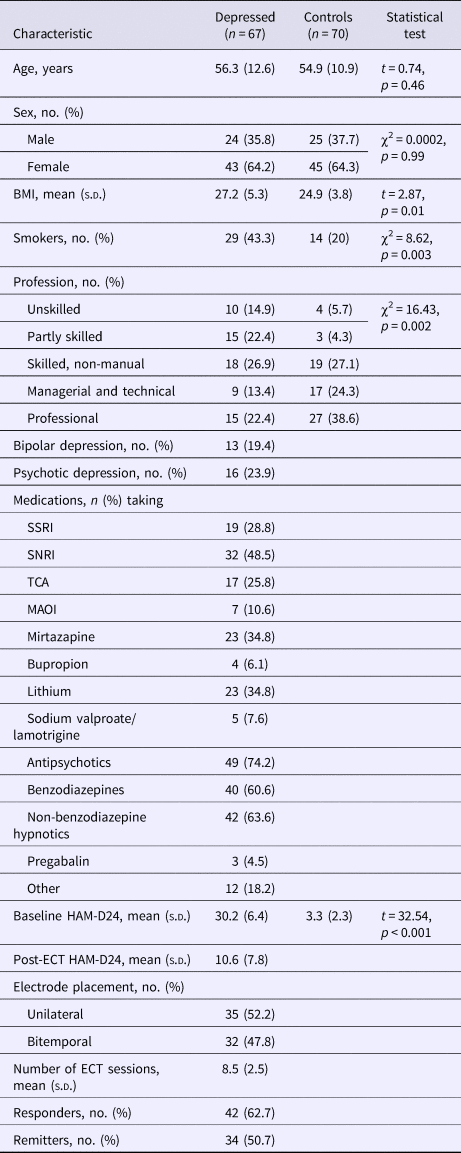
Demographic and clinical data for both controls and patients are summarized in Table 1. The groups were balanced for age and sex. While profession significantly differed between the groups (p = 0.002), it was not included as a covariate as we found no association between profession and PGC-1α levels (p > 0.05).
Demographic and clinical characteristics of participants

BMI, body mass index; ECT, electroconvulsive therapy; HAM-D24, Hamilton depression rating scale, 24-item version; MAOI, monoamine oxidase inhibitor; SNRI, serotonin-norepinephrine reuptake inhibitor; SSRI, selective serotonin reuptake inhibitor; TCA, tricyclic antidepressant.
Data are presented as means with standard deviations (s.d.) or number (%) per group where appropriate.
PGC-1α mRNA levels are lower in patients with depression compared with healthy controls
PGC-1α mRNA RQ data were log-transformed as they initially failed tests for normality, but were normal following log transformation. PGC-1α mRNA levels in patients with depression (n = 67) were initially compared with those of healthy controls (n = 70) without adjustment. PGC-1α levels were significantly lower (F 1,135 = 4.65, p = 0.03) in patients with depression at baseline (pre-ECT) compared with controls (Fig. 1). Adjusting for potential covariates (age, sex, BMI and smoking) did not alter this result (F 1,131 = 4.01, p = 0.047).
PGC-1α mRNA levels are lower in patients with depression compared with controls but are unaltered by ECT. PGC-1α mRNA levels were significantly lower in patients with depression at baseline, i.e. pre-ECT (n = 67), compared with controls (n = 70). PGC-1α mRNA levels were unaltered in patients with depression following treatment with ECT. Data are expressed as unadjusted mean log10RQ ± s.e.m.. *p < 0.05 v. control.

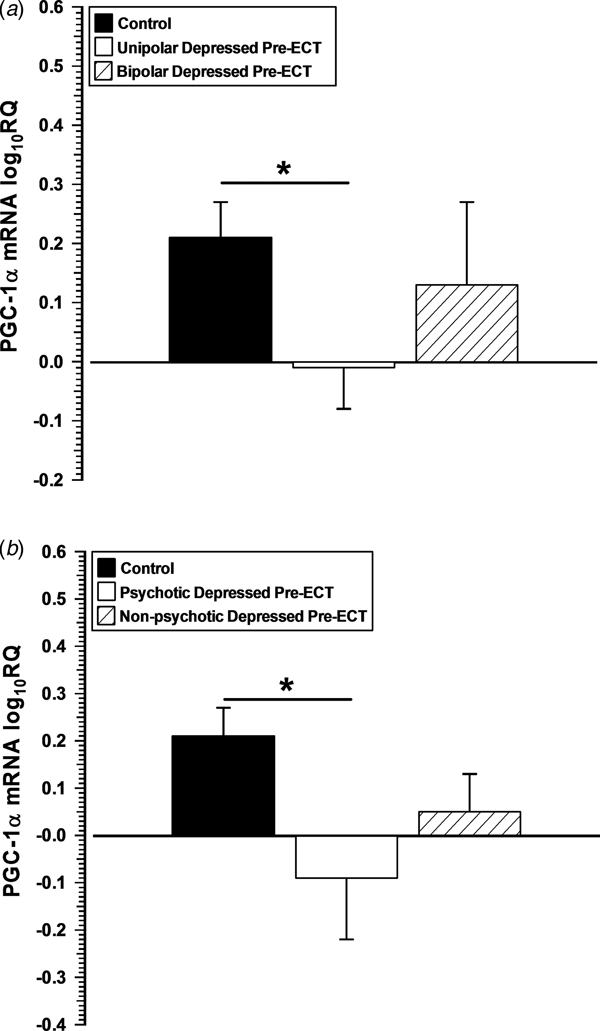
We subsequently compared PGC-1α levels in patients with unipolar or bipolar depression to those of age- and sex-matched controls (unipolar depressed v. controls: age, t = 1.19, p = 0.24; sex, χ2 = 0.08, p = 0.78; bipolar depressed v. controls: age, t = −0.86, p = 0.4; sex, χ2 = 0.51, p = 0.48). Baseline PGC-1α levels were significantly lower in patients with unipolar (n = 54; F 1,122 = 5.40, p = 0.02) but not bipolar (n = 13; F 1,81 = 0.28, p = 0.60) depression compared with controls (n = 70) (Fig. 2a). Adjusting for potential covariates did not alter the results (unipolar depressed: F 1,118 = 4.24, p = 0.04; bipolar depressed: F 1,77 = 1.08, p = 0.30).
PGC-1α mRNA levels are lower in patients with unipolar and psychotic depression compared with controls. (a) PGC-1α mRNA levels were significantly lower in patients with unipolar depression (n = 54) at baseline compared with controls (n = 70). There was no significant difference in PGC-1α mRNA levels in blood from patients with bipolar depression (n = 13) compared with controls or patients with unipolar depression. (b) PGC-1α mRNA levels were significantly lower in patients with psychotic depression (n = 16) at baseline compared with controls (n = 70). There was no significant difference in PGC-1α mRNA levels in blood from patients with non-psychotic depression (n = 51) compared with controls or patients with psychotic depression. Data are expressed as unadjusted mean log10RQ ± s.e.m.. *p < 0.05 v. control.

We then assessed PGC-1α mRNA levels in patients with psychotic and non-psychotic depression compared with age- and sex-matched controls (psychotic depressed v. controls: age, t = 1.81, p = 0.08; sex, χ2 = 0.11, p = 0.74; non-psychotic depressed v. controls: age, t = 0.12, p = 0.90; sex, χ2 = 0.03, p = 0.86). Baseline PGC-1α levels were significantly lower in patients with psychotic (n = 16; F 1,84 = 4.99, p = 0.03) but not non-psychotic (n = 51; F 1,119 = 2.73, p = 0.10) depression compared with controls (n = 70) (Fig. 2b). Adjusting for potential covariates resulted in a trend towards a significant difference in the psychotic depressed group (F 1,80 = 3.89, p = 0.05) but did not alter the result in the non-psychotic depressed group (F 1,115 = 2.91, p = 0.09).
Taking our analyses one step further, we found that patients with psychotic unipolar depression (n = 13) had significantly lower PGC-1α mRNA levels (F 1,81 = 9.05, p = 0.004) compared with age- and sex-matched healthy controls (n = 70; age, t = 1.80, p = 0.08; sex, χ2 = 0.12, p = 0.73; Fig. 3a). Adjusting for potential covariates did not alter the result (F 1,77 = 7.07, p = 0.01). Compared with age- and sex-matched controls (n = 70), we found no significant difference in PGC-1α levels in patients with non-psychotic unipolar depression (n = 41; age, t = 0.63, p = 0.53; sex, χ2 = 0.03, p = 0.87; F 1,109 = 2.20, p = 0.14; Fig. 3a). Adjusting for potential covariates did not alter these results.
PGC-1α mRNA levels are lower in patients with psychotic unipolar depression and increased by ECT. (a) PGC-1α mRNA levels were significantly lower in patients with psychotic unipolar depression (n = 13) pre-ECT compared with controls (n = 70). There was no significant difference in PGC-1α mRNA levels in blood from patients with non-psychotic unipolar depression (n = 41) compared with controls or patients with psychotic depression. (b) PGC-1α mRNA levels were significantly increased in patients with psychotic but not non-psychotic unipolar depression following treatment with ECT. Data are expressed as unadjusted mean log10RQ ± s.e.m.. *p < 0.05 v. control; +p < 0.05 v. pre-ECT.

ECT increases PGC-1α mRNA levels in patients with psychotic unipolar depression
PGC-1α mRNA levels were initially assessed in samples from patients with depression as a single group (Fig. 1). PGC-1α levels were not significantly altered in patients following treatment with ECT (F 1,66 = 0.09, p = 0.77).
We subsequently investigated PGC-1α levels in depression subtypes pre-/post-ECT, i.e. patients with unipolar/bipolar depression, patients with psychotic/non-psychotic depression, and patients with psychotic v. non-psychotic unipolar depression.
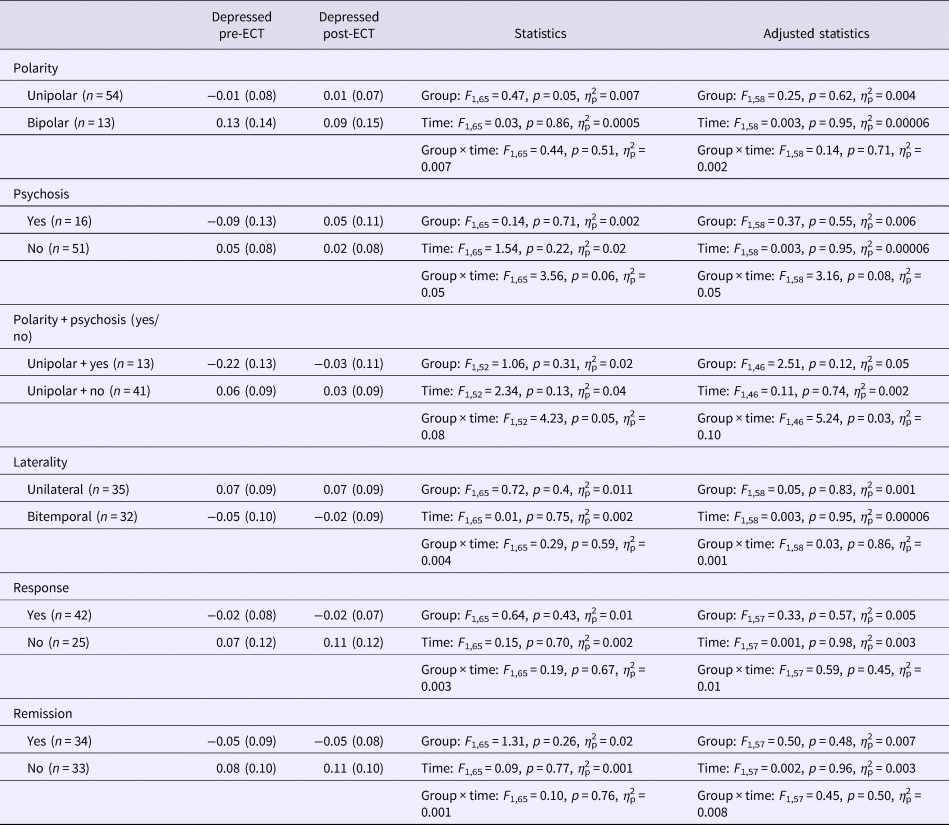
Our patient group consisted of 54 patients with unipolar and 13 patients with bipolar depression (online Supplementary Table S1 for demographics and clinical characteristics). We found no difference in PGC-1α levels between patients with bipolar or unipolar depression pre-/post-ECT, and adjusting for potential covariates did not alter the result (Table 2).
Subgroup analyses of PGC-1α mRNA levels based on clinical features

ECT, electroconvulsive therapy.
Data are presented as mean log10RQ (s.e.m.).
We investigated PGC-1α levels in patients with psychotic (n = 16) compared with non-psychotic (n = 51) depression pre-/post-ECT (online Supplementary Table S1 for demographics and clinical characteristics). PGC-1α levels did not differ between patients with psychotic depression and non-psychotic depression pre-/post-treatment, and adjusting for potential covariates did not alter the result (Table 2).
Interestingly, when we examined PGC-1α levels in patients with psychotic v. non-psychotic unipolar depression pre-/post-ECT we found a significant group × time effect (F 1,52 = 4.23, p = 0.045), with levels increased in the psychotic unipolar group following treatment (Fig. 3b; online Supplementary Table S1 for demographics and clinical characteristics). Adjusting for potential covariates did not alter this result (F 1,46 = 5.24, p = 0.027).
ECT laterality does not affect PGC-1α mRNA levels
We assessed PGC-1α mRNA levels in patients treated with high-dose unilateral (n = 35) or bitemporal (n = 32) ECT to determine if the form of ECT administered would result in differences in PGC-1α levels post-treatment (online Supplementary Table S1 for demographics and clinical characteristics). PGC-1α levels did not differ between patients treated with unilateral or bitemporal ECT pre-/post-treatment. Adjusting for potential covariates did not alter the result (Table 2).
PGC-1α mRNA levels are unrelated to response or remission status following ECT
PGC-1α mRNA levels were assessed in samples from ECT responder (n = 42) and non-responder (n = 25) patients (online Supplementary Table S1 for demographics and clinical characteristics). There was no difference in PGC-1α levels between responders and non-responders, and adjusting for potential covariates did not alter the result (Table 2).
PGC-1α mRNA levels were next assessed in ECT remitters (n = 34) and non-remitters (n = 33) (online Supplementary Table S1 for demographics and clinical characteristics). There was no difference in PGC-1α levels in remitters compared with non-remitters, and adjusting for potential covariates did not alter the result (Table 2).
As we found differences in PGC-1α levels in patients with unipolar depression with or without psychosis, we also explored PGC-1α levels in responders/non-responders and remitters/non-remitters in this subgroup. We found no differences in PGC-1α levels using unadjusted or adjusted models (data not shown).
PGC-1α mRNA levels and clinical outcome
We assessed the relationship between PGC-1α mRNA levels and HAM-D24 scores in the patient group as a whole (online Supplementary Table S2). We found no correlation between baseline PGC-1α levels and HAM-D24 scores (r = 0.16, p = 0.19), baseline PGC-1α levels and change in HAM-D24 score (r = 0.04, p = 0.75), or between the change in PGC-1α levels and the change in HAM-D24 score (ρ = 0.04, p = 0.75).
We subsequently examined the relationship between PGC-1α levels and HAM-D24 scores in the unipolar/bipolar depressed groups, psychotic/non-psychotic depressed groups, and the psychotic/non-psychotic unipolar depressed groups using exploratory analyses and found no significant correlation at the p < 0.01 level (online Supplementary Table S2). We also found no correlation between PGC-1α levels and HAM-D24 scores in the bitemporal/unilateral ECT groups, responders/non-responders or in remitters/non-remitters.
Discussion
This is the first study to report on circulating PGC-1α mRNA levels in patients experiencing a major depressive episode compared with healthy controls, and following treatment with ECT. We show that PGC-1α mRNA levels are significantly lower in patients with depression compared with controls, and that this difference survives adjustment for potential covariates. Our exploratory analyses show that these lower PGC-1α mRNA levels occur in patients with unipolar as opposed to bipolar depression, and are most profound in those with psychotic unipolar depression. ECT did not alter PGC-1α mRNA levels in the depressed group as a whole but did increase PGC-1α mRNA levels in the psychotic unipolar depressed group, though levels did not return to those of controls. We found no association between PGC-1α mRNA levels and mood scores.
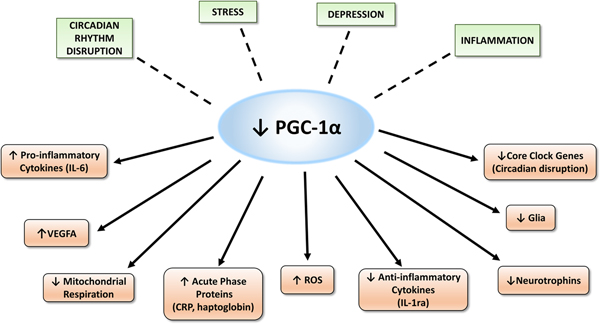
As outlined in the Introduction, PGC-1α has widespread functions, is found in numerous tissues including the brain, and is required for neurotransmission and synaptic function. Thus, alterations in PGC-1α could lead to widespread deleterious effects. Importantly, decreased PGC-1α may represent a common link between the various pathophysiological processes implicated in depression, including inflammation, neurogenesis, circadian rhythm disruption and alterations in mitochondrial respiration (Fig. 4).
Links between factors leading to lower PGC-1α mRNA levels and the association with pathophysiological processes implicated in depression.

PGC-1α is regulated by sirtuin-1 (SIRT-1), levels of which are reportedly decreased in patients with depression (Abe et al., Reference Abe, Uchida, Otsuki, Hobara, Yamagata, Higuchi, Shibata and Watanabe2011; Luo and Zhang, Reference Luo and Zhang2016). In mammals, SIRT-1 regulates PGC-1α transcriptional activity via deacetylation at specific lysine residues in an NAD(+)-dependent manner (Rodgers et al., Reference Rodgers, Lerin, Haas, Gygi, Spiegelman and Puigserver2005), leading to increased transcriptional activity and target gene activation (Rodgers et al., Reference Rodgers, Lerin, Haas, Gygi, Spiegelman and Puigserver2005; Lin et al., Reference Lin, Liu and Li2008). SIRT-1 overexpression drives an increase in PGC-1α in neuronal cells, which suggests high coupling of these two proteins (Chang and Guarente, Reference Chang and Guarente2013). We have recently shown that SIRT-1 is one of three shared targets of the microRNAs miR-126-3p and miR-106a-5p, both of which have been implicated in psychotic depression (Kolshus et al., Reference Kolshus, Ryan, Blackshields, Smyth, Sheils and McLoughlin2017), and that blood SIRT1 mRNA levels are significantly lower in patients with depression compared with controls (unpublished observations). Moreover, we and others have shown that VEGFA, another shared target of these microRNAs, is altered in depression (Carvalho et al., Reference Carvalho, Kohler, McIntyre, Knochel, Brunoni, Thase, Quevedo, Fernandes and Berk2015; Kolshus et al., Reference Kolshus, Ryan, Blackshields, Smyth, Sheils and McLoughlin2017) and PGC-1α has previously been implicated in VEGFA regulation (Arany et al., Reference Arany, Foo, Ma, Ruas, Bommi-Reddy, Girnun, Cooper, Laznik, Chinsomboon, Rangwala, Baek, Rosenzweig and Spiegelman2008). Of note, we have shown that protein levels of the neurotrophin pigment epithelium-derived neurotrophic factor (PEDF), which can also regulate VEGFA, are increased in patients with depression and levels are augmented by treatment with ECT (Ryan et al., Reference Ryan, Glaviano, O'Donovan, Kolshus, Dunne, Kavanagh, Jelovac, Noone, Tucker, Dunn and McLoughlin2017).
A dysregulated immune response is often observed in patients with depression, with increased levels of the pro-inflammatory cytokines tumour necrosis factor alpha (TNF-α), interleukin-6 (IL-6) and IL-1β reported (Howren et al., Reference Howren, Lamkin and Suls2009; Dowlati et al., Reference Dowlati, Herrmann, Swardfager, Liu, Sham, Reim and Lanctot2010), with ECT reported to induce changes in the levels of these cytokines (Jarventausta et al., Reference Jarventausta, Sorri, Kampman, Bjorkqvist, Tuohimaa, Hamalainen, Moilanen, Leinonen, Peltola and Lehtimaki2017; Yrondi et al., Reference Yrondi, Sporer, Peran, Schmitt, Arbus and Sauvaget2018). Of note, TNF-α and IL-1α, but not IL-6, decrease PGC-1α mRNA levels in liver cells in vitro and in vivo (Kim et al., Reference Kim, Sweeney, Shigenaga, Chui, Moser, Grunfeld and Feingold2007). PGC-1α has also been shown to down-regulate several pro-inflammatory cytokines, and up-regulate mRNA and protein levels of the anti-inflammatory mediator IL-1 receptor antagonist (IL-1ra) (Buler et al., Reference Buler, Aatsinki, Skoumal, Komka, Toth, Kerkela, Georgiadi, Kersten and Hakkol2012), an antagonist of the IL-1 receptor 1 through which IL-1β signals (Garlanda et al., Reference Garlanda, Dinarello and Mantovani2013). The PGC-1α-induced increase in IL-1ra in turn suppresses acute phase proteins, e.g. C-reactive protein and haptoglobin, provoked by IL-1β (Buler et al., Reference Buler, Aatsinki, Skoumal, Komka, Toth, Kerkela, Georgiadi, Kersten and Hakkol2012). Moreover, PGC-1α can reduce human astrocytic IL-6 production under both normal and inflammatory conditions, and PGC-1α overexpression in astrocytes also reduces ROS production and resistance to ROS-induced cell death following exposure to an oxidative insult (Nijland et al., Reference Nijland, Witte, van het Hof, van der Pol, Bauer, Lassmann, van der Valk, de Vries and van Horssen2014). Importantly, when neurons are co-cultured with astrocytes overexpressing PGC-1α they are protected against oxidative insult (Nijland et al., Reference Nijland, Witte, van het Hof, van der Pol, Bauer, Lassmann, van der Valk, de Vries and van Horssen2014). Hence, the increased levels of inflammation observed in patients with depression may be responsible for the low PGC-1α mRNA levels. Conversely, low PGC-1α levels may occur owing to other as yet unidentified mechanisms that in turn could lead to the increased inflammatory tone observed in depression.
As mentioned, PGC-1α may exert beneficial effects via the kynurenine pathway, the main pathway involved in peripheral metabolism of the amino acid tryptophan (Harkin, Reference Harkin2014). Disturbed tryptophan metabolism and dysregulation of the kynurenine pathway have been noted in depression, with decreased levels of kynurenine and kynurenic acid and increased levels of quinolinic acid observed in patients with depression compared with controls (Ogyu et al., Reference Ogyu, Kubo, Noda, Iwata, Tsugawa, Omura, Wada, Tarumi, Plitman, Moriguchi, Miyazaki, Uchida, Graff-Guerrero, Mimura and Nakajima2018). In animals, PGC-1α overexpression has been shown to increase peripheral expression of KATs and enhance the peripheral metabolism of kynurenine to kynurenic acid (Agudelo et al., Reference Agudelo, Femenia, Orhan, Porsmyr-Palmertz, Goiny, Martinez-Redondo, Correia, Izadi, Bhat, Schuppe-Koistinen, Pettersson, Ferreira, Krook, Barres, Zierath, Erhardt, Lindskog and Ruas2014). This has been suggested as a mechanism by which PGC-1α limits availability of kynurenine to the brain where it can be converted to neurotoxic metabolites like quinolinic acid (Harkin, Reference Harkin2014). Notably, ECT has been shown to increase serum levels of kynurenic acid and cause a shift in tryptophan–kynurenine pathway metabolites towards those with neuroprotective properties (n = 19 patients with unipolar or bipolar depression), which correlates with the antidepressant effects of ECT (Guloksuz et al., Reference Guloksuz, Arts, Walter, Drukker, Rodriguez, Myint, Schwarz, Ponds, van Os, Kenis and Rutten2015). In contrast, Schwieler et al. (Reference Schwieler, Samuelsson, Frye, Bhat, Schuppe-Koistinen, Jungholm, Johansson, Landen, Sellgren and Erhardt2016) reported that ECT does not affect plasma levels of kynurenic acid (n = 18 patients with major depressive disorder), though ECT was again found to cause a shift in tryptophan–kynurenine pathway metabolites towards those that are neuroprotective. Both of these studies included patient groups with small sample numbers. Thus, further studies of larger patient groups are required to determine the contribution of the PGC-1α/kynurenine pathway to depression and response to ECT.
Circadian rhythm and Clock gene disturbances are known to be associated with depression (Schuch et al., Reference Schuch, Genro, Bastos, Ghisleni and Tovo-Rodrigues2017; Zaki et al., Reference Zaki, Spence, BaHammam, Pandi-Perumal, Cardinali and Brown2017). Interestingly, PGC-1α plays a key role in linking the clock and metabolic pathways (Lin et al., Reference Lin, Liu and Li2008). PGC-1α displays diurnal variation and is itself regulated by circadian cues, such as light and nutritional status. It also stimulates core clock gene expression, including Bmal1, Clock and Rev-erb factors (Lin et al., Reference Lin, Liu and Li2008), via co-activation of RAR-related orphan receptor-a (RORA) (Geoffroy et al., Reference Geoffroy, Etain, Lajnef, Zerdazi, Brichant-Petitjean, Heilbronner, Hou, Degenhardt, Rietschel, McMahon, Schulze, Jamain, Marie-Claire and Bellivier2016). Thus, PGC-1α dysregulation could lead to the circadian rhythm alterations observed in depression.
In this study, PGC-1α mRNA levels were not altered by ECT in all patients. As mentioned earlier, patients recruited into the EFFECT-Dep trial were receiving treatment with pharmacotherapy as usual. The PGC-1α/PPARGC1A gene has previously been linked to the response to lithium in two independent Caucasian samples of bipolar disorder, though the association did not survive Bonferroni correction (Geoffroy et al., Reference Geoffroy, Etain, Lajnef, Zerdazi, Brichant-Petitjean, Heilbronner, Hou, Degenhardt, Rietschel, McMahon, Schulze, Jamain, Marie-Claire and Bellivier2016). Additionally, the selective serotonin reuptake inhibitor (SSRI) paroxetine can increase mitochondrial biogenesis with a concomitant increase in PGC-1α mRNA in vitro (Jeong et al., Reference Jeong, Park, Yoon, Kim, Lee, Lee, Namkoong and Kim2015). We found no association between PGC-1α levels and treatment with either lithium or paroxetine here (data not shown).
There are some limitations to our study. Firstly, all patients were receiving pharmacotherapy as usual. As EFFECT-Dep was a real-world trial, we had no patients who had undergone a drug washout period or who were drug-naïve and so were unable to establish whether our findings represent an antidepressant effect rather than a depression-related effect. Future studies should examine PGC-1α levels in antidepressant-naïve patients to determine whether our findings indeed represent a marker of depression. Secondly, we were only able to examine PGC-1α levels in peripheral blood, which may not be reflective of brain levels. Thus, further studies should examine PGC-1α in post-mortem brain tissue and cerebrospinal fluid. While PGC-1α may represent a new therapeutic target for depression, caution must be warranted regarding the use of drugs that might increase PGC-1α levels since high PGC-1α levels can have detrimental effects on the brain and have been shown to induce dopaminergic neuron loss (Ciron et al., Reference Ciron, Lengacher, Dusonchet, Aebischer and Schneider2012; Clark et al., Reference Clark, Silvaggi, Kiselak, Zheng, Clore, Dai, Bass and Simon2012). Thirdly, we only assessed PGC-1α mRNA levels and not protein here. Thus, it is unknown at present if the changes we observed at the mRNA level are also reflected at a functional level. This will be addressed by future studies. Fourthly, in this study we assessed PGC-1α levels at 1–3 days post-ECT and so we may have missed changes in PGC-1α levels following ECT. Thus, a time-course study is warranted to determine the temporal profile of PGC-1a post-ECT to define the optimal time-point for its measurement.
Ultimately, PGC-1α appears to represent a common link between the various pathophysiological processes implicated in depression. Thus, PGC-1α may represent a novel therapeutic target for treating mood disorders.
Supplementary material
The supplementary material for this article can be found at https://doi.org/10.1017/S0033291718002556.
Acknowledgements
The authors thank the patients and controls for participating in this study.
Financial support
This work was supported by the Health Research Board (HRB), Ireland (TRA/2007/5, HPF/2010/17).
Conflict of interest
D.M. McLoughlin has received a speaker's honorarium from MECTA. K.M. Ryan and I. Patterson have no conflicts of interest to declare.