INTRODUCTION
In the USA and the EU, 30–40% of workers are exposed to work stress, and these rates seem to have increased since the 1990s (NIOSH, 1999; Eurofound, 2005). Stressful work conditions predict poor mental health and there is growing concern that such conditions contribute to the population burden of psychiatric morbidity (Parkes, Reference Parkes1990; Phelan et al. Reference Phelan, Schwartz, Bromet, Dew, Parkinson, Schulberg, Dunn, Blane and Curtis1991; Bromet et al. Reference Bromet, Dew, Parkinson, Cohen and Schwartz1992; Stansfeld et al. Reference Stansfeld, Fuhrer, Head, Ferrie and Shipley1997, Reference Stansfeld, Fuhrer, Shipley and Marmot1999; Niedhammer et al. Reference Niedhammer, Goldberg, Leclerc, Bugel and David1998; Mausner-Dorsch & Eaton, Reference Mausner-Dorsch and Eaton2000; Tennant, Reference Tennant2001; Paterniti et al. Reference Paterniti, Niedhammer, Lang and Consoli2002). However, inference from past research is limited by several methodological shortcomings, which we aimed to address using data from a birth cohort followed from childhood to adulthood.
With notable exceptions (Bromet et al. Reference Bromet, Dew, Parkinson and Schulberg1988; Cropley et al. Reference Cropley, Steptoe and Joekes1999; Shields, Reference Shields1999; Mausner-Dorsch & Eaton, Reference Mausner-Dorsch and Eaton2000; Wang et al. Reference Wang, Beck, Berglund, McKenas, Pronk, Simon and Kessler2004), past research has focused on symptoms of psychological distress (Phelan et al. Reference Phelan, Schwartz, Bromet, Dew, Parkinson, Schulberg, Dunn, Blane and Curtis1991; Bromet et al. Reference Bromet, Dew, Parkinson, Cohen and Schwartz1992; Stansfeld et al. Reference Stansfeld, Fuhrer, Head, Ferrie and Shipley1997, Reference Stansfeld, Fuhrer, Shipley and Marmot1999; Niedhammer et al. Reference Niedhammer, Goldberg, Leclerc, Bugel and David1998; Tennant, Reference Tennant2001; Paterniti et al. Reference Paterniti, Niedhammer, Lang and Consoli2002), showing elevated rates in workers who report high job demands, low job control or insufficient work social support. However, the relationship between these work conditions and clinically significant psychiatric disorders associated with health care and lost productivity costs is not known. In this paper, we report on the risk of psychiatric disorder assessed using standardized diagnostic instruments. Additionally, past research has primarily focused on depressive symptomatology (Phelan et al. Reference Phelan, Schwartz, Bromet, Dew, Parkinson, Schulberg, Dunn, Blane and Curtis1991; Bromet et al. Reference Bromet, Dew, Parkinson, Cohen and Schwartz1992; Niedhammer et al. Reference Niedhammer, Goldberg, Leclerc, Bugel and David1998; Tennant, Reference Tennant2001; Paterniti et al. Reference Paterniti, Niedhammer, Lang and Consoli2002; Wang et al. Reference Wang, Beck, Berglund, McKenas, Pronk, Simon and Kessler2004), while there is evidence of strong co-morbidity and shared risk factors between major depressive disorder (MDD) and generalized anxiety disorder (GAD) (Mineka et al. Reference Mineka, Watson and Clark1998; Moffitt et al. Reference Moffitt, Caspi, Harrington, Milne, Melchior, Goldberg and Poulton2007). Thus, workers exposed to stressful work conditions could be at increased risk of depression or anxiety and in this study we examine both MDD and GAD.
We address three additional methodological problems. First, the effects of work stress on mental health need to be separated from the effects of low occupational status (Stansfeld et al. Reference Stansfeld, Fuhrer, Shipley and Marmot1999; Paterniti et al. Reference Paterniti, Niedhammer, Lang and Consoli2002) and our analyses are adjusted for participants' socio-economic position. Second, the association between work stress and mental health may be due to reporting bias wherein depressed or anxious workers describe their job characteristics in a negative light (Stansfeld et al. Reference Stansfeld, Fuhrer, Head, Ferrie and Shipley1997; Paterniti et al. Reference Paterniti, Niedhammer, Lang and Consoli2002), and our analyses control for participants' negative affective style. Third, individuals who experience depression and anxiety disorders in childhood are at increased risk of psychiatric disorder in adulthood (Kim-Cohen et al. Reference Kim-Cohen, Caspi, Moffitt, Harrington, Milne and Poulton2003) and could be selected into stressful jobs. Thus, the association between work stress and mental health problems in adulthood could be spurious, reflecting past psychiatric disorder. To our knowledge this hypothesis has not yet been tested and we examine it (1) by controlling for participants' prospective psychiatric diagnoses prior to their labour-market entry (ages 11–18) and (2) by testing the association between work stress and new cases of depression and anxiety at age 32.
METHOD
Study population
Participants are members of the Dunedin Multidisciplinary Health and Development Study, a longitudinal investigation of health and behaviour in a complete birth cohort (Moffitt et al. Reference Moffitt, Caspi, Rutter and Silva2001). Study members (n=1037; 91% of eligible births; 52% male) were born in Dunedin, New Zealand, between April 1972 and March 1973 and participated in the first follow-up assessment at age 3. The cohort represents the full range of socio-economic status in the general population of New Zealand's South Island and is primarily white. Assessments have been carried out at ages 3, 5, 7, 9, 11, 13, 15, 18, 21, 26 and 32. Data are collected at the study Research Unit during a full day of individual data collection. Each phase of the study was approved by the Otago Ethics Committee and study members gave informed consent before participating.
This investigation is based on participants who completed the age-32 assessment (n=972; 96% of the 1015 study members still alive in 2004–2005). Homemakers (65 women and four men) and participants with incomplete work data (six women and six men) were excluded from the analysis, yielding a sample of 891.
Measures
Psychiatric diagnoses
Psychiatric disorders were assessed using the Diagnostic Interview Schedule for Children (DISC; Costello et al. Reference Costello, Edelbrock, Kalas, Kessler and Klaric1982) at ages 11–15 years and the Diagnostic Interview Schedule (DIS; Robins et al. Reference Robins, Helzer, Cottler and Goldring1989, Reference Robins, Cottler, Bucholz and Compton1995) at ages 18–32 years, with a reporting period of 12 months at each age. At each assessment, participants were interviewed privately by trained research interviewers who had a tertiary qualification in psychiatry, psychology or a related discipline. Interviewers were blinded to participants' other data.
Psychiatric disorders were diagnosed using the then-current DSM-III (APA, 1980) at ages 11–15 years, the then-current DSM-III-R (APA, 1987) at ages 18 and 21 years, and the DSM-IV (APA, 1994) at ages 26 and 32 years.
Attesting to the validity of MDD and GAD diagnoses at age 32, mean impairment ratings on a scale from 1 (some impairment) to 5 (severe impairment) were 3·57 (s.d.=0·99) in participants with MDD and 3·62 (s.d.=0·95) in those with GAD; 62% and 49% of those with MDD and GAD said they had received mental-health services in the past year, and 31% and 25% said they took medication for their disorder. Past-year prevalence rates of MDD and GAD in the Dunedin study are comparable to past-year prevalence rates in the US National Comorbidity Study Replication (NCS-R) (Kessler et al. Reference Kessler, Berglund, Demler, Jin, Merikangas and Walters2005).
Juvenile psychiatric disorders included depression, anxiety disorders, conduct disorder and attention deficit-hyperactivity disorder (ADHD) between ages 11 and 18. Variable construction details, reliability, validity, and evidence of impairment for diagnostic groups have been described elsewhere (Moffitt et al. Reference Moffitt, Caspi, Rutter and Silva2001; Kim-Cohen et al. Reference Kim-Cohen, Caspi, Moffitt, Harrington, Milne and Poulton2003). Juvenile depression or anxiety disorders were combined into a juvenile internalizing disorders category, and conduct or ADHD into a juvenile externalizing disorders category (Krueger et al. Reference Krueger, Caspi, Moffitt and Silva1998).
New cases of MDD-or-GAD at age 32 were defined as (1) met diagnostic criteria for MDD or GAD at age 32 assessment and (2) had no prior diagnosis of MDD or GAD made by the study and (3) had no experience of MDD- or GAD-related hospitalization, medication or out-patient psychotherapy prior to the date they began the job held at age 32. Self-reports of MDD- and GAD-related treatment were recorded on a life history calendar (Caspi et al. Reference Caspi, Moffitt, Thorton, Freedman, Amell, Harrington, Smeijers and Silva1996; Belli et al. Reference Belli, Shay and Stafford2001), on which jobs were also recorded, thereby allowing us to ascertain timing.
Work characteristics
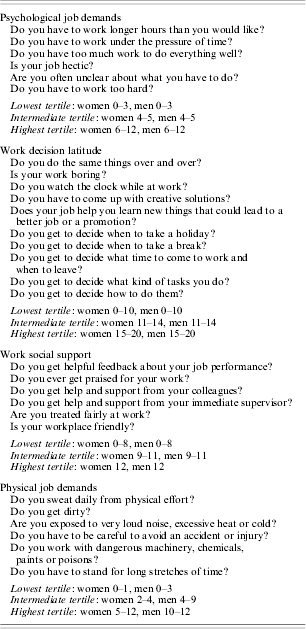
At age 32, participants' exposure to work stress was ascertained using questions derived from the work of Karasek & Theorell (Reference Karasek and Theorell1990) and Johnson et al. (Reference Johnson, Hall and Theorell1989) : psychological job demands (i.e. workload and time pressures, six items), work decision latitude (i.e. control over the content and execution of work tasks and level of skills required, 10 items), and work social support (i.e. feedback and support from colleagues and supervisors, six items) (Table 1). We also assessed physical work demands (i.e. work-related physical efforts and hazards, six items). All items were scored as no (0), sometimes (1) or yes (2). Summing all relevant items, we constructed subscales of decision latitude (0–20), psychological job demands, work social support and physical work demands (0–12); each scale was standardized and divided into tertiles (Stansfeld et al. Reference Stansfeld, Fuhrer, Head, Ferrie and Shipley1997). The internal consistency reliability was confirmed by satisfactory Cronbach's α coefficients (decision latitude: 0·72, psychological job demands: 0·68, work social support: 0·74, physical work demands 0·88). Correlations between work characteristics were 0·07–0·23.
Work characteristics measured in the Dunedin study

Each item was scored as no (0), sometimes (1), or yes (2).
Socio-economic position
Socio-economic position at age 32 was measured using the New Zealand Socioeconomic Index (Davis et al. Reference Davis, Jenkin and Coope2003). This occupation-based classification matches each job with a socio-economic rank of 0–100, based on the level of education required and average earnings. Following Statistics New Zealand (1999), we divided this index into quartiles. Typical occupations in each group are: quartile 1 (lowest): labourer, cashier, housekeeper, personal care worker, textile or food machine operator, salesperson; quartile 2: secretary, industrial plant operator, metal moulder, motor vehicle driver, forestry worker; quartile 3: technician, primary school teacher, nurse, sales associate, electrician, railway driver, animal farmer; quartile 4 (highest): manager, legislator, physician, high school teacher, university professor.
Negative affectivity
Negative affectivity was rated by the mental-health interviewer, who described the study member using the neuroticism scale from the Big Five Inventory (John & Srivastata, Reference John, Srivastata, Pervin and John1999). The negative affectivity score, ranging from 4 to 25, was standardized and studied as a continuous variable.
Statistical analysis
To study associations between work characteristics and psychiatric disorder, we calculated risk ratios (RRs) associated with psychological job demands (intermediate or high versus low), decision latitude (intermediate or low versus high), work social support (intermediate or low versus high) and physical work demands (intermediate or high versus low), using Cox regression models with robust variance in which the time of follow-up was held constant (Barros & Hirakata, Reference Barros and Hirakata2003). We chose this statistical method over logistic regression because depression and anxiety are frequent, causing odds ratios to overestimate relative risks by more than 10%.
First, we examined unadjusted relationships between each work characteristic and MDD and GAD. Next, we simultaneously included all work characteristics into a single statistical model. Then, we successively adjusted for socio-economic position, negative affectivity, and juvenile psychiatric disorders. Our final model included all four work characteristics, socio-economic position, negative affectivity, and juvenile psychiatric disorders. Additionally, we studied associations between work characteristics and new cases of MDD or GAD at age 32. The contribution of work characteristics to the overall burden of depression and anxiety was estimated by the attributable risk fraction [(RR – 1)/RR (no. exposed cases/no. cases)] (Hanley, Reference Hanley2001). Women and men work in different types of occupations and differ with regard to their baseline risk of depression and anxiety and analyses were stratified by sex.
Data were analysed using SAS version 9.1 (SAS Institute, Cary, NC, USA). The combined effects of multiple work characteristics were estimated using the lincom function in stata version 9 (Stata Corp, College Station, TX, USA).
RESULTS
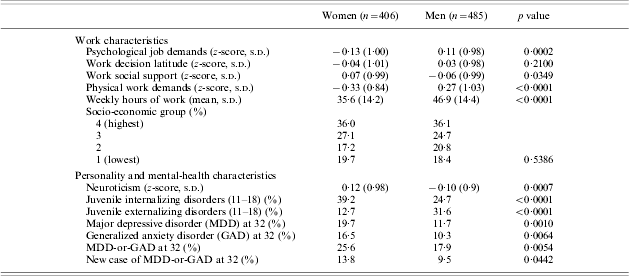
Among the 406 women and 485 men who were employed at age 32, men reported higher psychological job demands (p=0·0002), lower work social support (p=0·0349) and higher physical work demands (p<0·0001) than women (Table 2). Background factors and mental-disorder outcomes by sex are also shown in Table 2.
Work, socio-economic and mental-health characteristics of Dunedin study participants at age 32

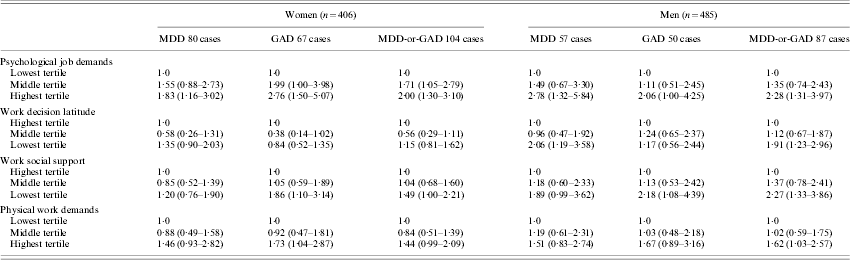
Of the four work characteristics examined, only psychological job demands were consistently associated with MDD, GAD and MDD-or-GAD in women and in men (Table 3). Compared to participants who reported the lowest level of exposure, those with high levels of psychological job demands were 1·83 (women) to 2·78 (men) times more likely to meet criteria for MDD, 2·06 (men) to 2·76 (women) times more likely to meet criteria for GAD, and 2·00 (women) to 2·28 (men) times more likely to have either diagnosis. Hence, our remaining analyses focused on psychological job demands. MDD and GAD are highly co-morbid (46% of MDD cases also met criteria for GAD and 54% of GAD cases also met criteria for MDD) and the effects of work stress were comparable and statistically significant when both disorders were analysed separately (supplementary tables available upon request). Hence, we used the combined MDD-or-GAD diagnosis as our main study outcome.
Work characteristics and major depressive disorder (MDD), generalized anxiety disorder (GAD) or MDD-or-GAD at age 32 in the Dunedin study (risk ratios, 95% confidence intervals)

Findings in women
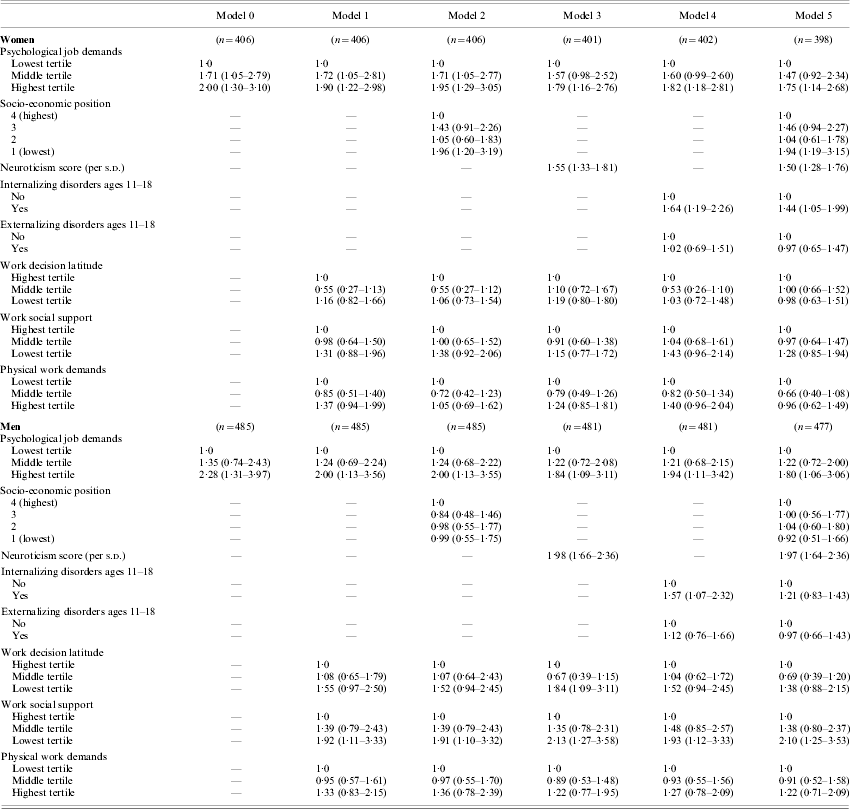
As shown in Table 4, controlling for all work characteristics, high psychological job demands were associated with women's increased risk of MDD-or-GAD [Model 1, RR 1·90, 95% confidence interval (CI) 1·22–2·98]. In Model 2, we found an increased risk of MDD-or-GAD among women who belonged to the lowest socio-economic group, but adjusting for socio-economic position had essentially no effect on the association between high psychological job demands and MDD-or-GAD (RR 1·95, 95% CI 1·29–3·05). In Model 3, negative affectivity was significantly associated with MDD-or-GAD, but only partly accounted for the increase in risk associated with high psychological job demands (RR 1·79, 95% CI 1·16–2·76). As expected, Model 4 showed continuity between internalizing disorders prior to entering the workforce and MDD-or-GAD at age 32. However, juvenile psychiatric disorders did not account for the association between high psychological job demands and MDD-or-GAD (RR 1·82, 95% CI 1·18–2·81). In the fully adjusted model (Model 5), women reporting high psychological job demands were 75% more likely to suffer from MDD-or-GAD than those who reported the lowest level of job demands.
Psychological job demands and major depressive disorder (MDD) or generalized anxiety disorder (GAD) at age 32 in women and men of the Dunedin study (multivariate risk ratios, 95% confidence intervals)

Findings in men
The results in men were similar to those in women (Table 4). Controlling for all work characteristics, high psychological job demands were associated with men's increased risk of MDD-or-GAD (Model 1, RR 2·00, 95% CI 1·13–3·56). In Model 2, we found no association between men's socio-economic position and the risk of MDD-or-GAD and socio-economic position did not contribute to the association between high job demands and MDD-or-GAD (RR 2·00, 95% 1·13–3·55). In Model 3, negative affectivity was associated with MDD-or-GAD, but only partly accounted for the effect of high psychological job demands (RR 1·84, 95% CI 1·09–3·11). In Model 4, internalizing disorders prior to entering the workforce were associated with MDD-or-GAD but only modestly contributed to the association between high job demands and MDD-or-GAD (RR 1·94, 95% CI 1·11–3·42). In the fully-adjusted model (Model 5), men reporting high psychological job demands were 80% more likely to suffer from MDD-or-GAD than those who reported the lowest level of job demands. Additionally, in the fully adjusted model, men who reported low work social support were also at increased risk of MDD-or-GAD (compared to the high work social support group: RR 2·10, 95% CI 1·25–3·53).
Psychological job demands predict new cases of adult-onset MDD-or-GAD
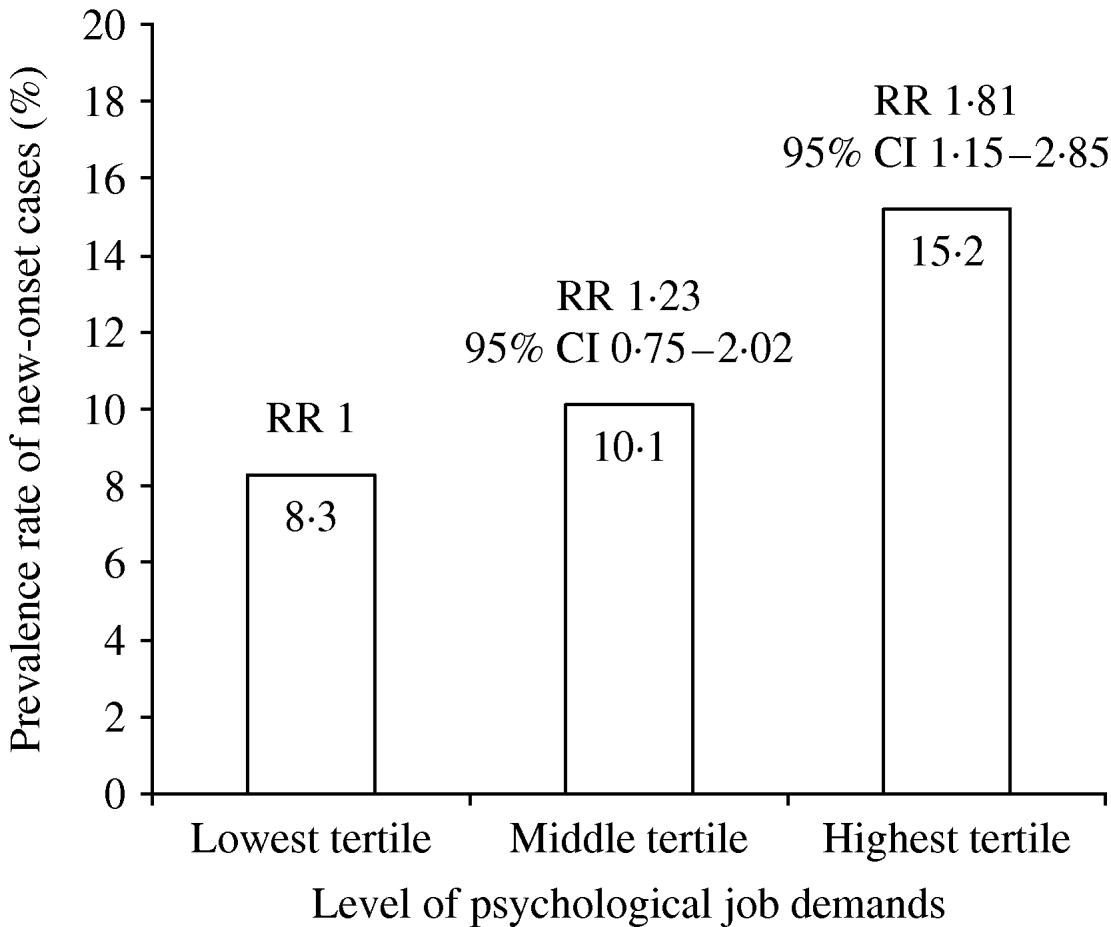
At age 32, 50 women and 52 men of the Dunedin cohort experienced MDD or GAD for the first time. Because of the small number of cases, this analysis combined women and men. The new case incidence of psychiatric disorder was elevated among participants who reported high psychological job demands (compared to those with low work demands: RR 1·83, 95% CI 1·14–2·93, Fig. 1). Overall, 45% of new cases were attributable to high job demands.
Psychological job demands and new cases of major depressive disorder (MDD) or generalized anxiety disorder (GAD) at age 32 (women and men, n=891, 102 cases).

Effects of multiple work stressors
Combined exposure to multiple work stressors can be especially detrimental to mental health (Cropley et al. Reference Cropley, Steptoe and Joekes1999; Mausner-Dorsch & Eaton, Reference Mausner-Dorsch and Eaton2000). In the Dunedin study, adjusting for socio-economic position, negative affectivity, and juvenile psychiatric disorders, high psychological job demands were associated with an especially high risk of MDD-or-GAD when combined with low work social support (women: RR 2·24, 95% CI 1·30–3·86; men: RR 3·77, 95% CI 1·79–7·94). In an additive model, simultaneous exposure to high psychological work demands, low work decision latitude, low work social support, and high physical job demands was estimated to confer a risk of 2·10 (95% CI 1·06–4·17) in women and 6·32 (95% CI 2·69–14·87) in men.
DISCUSSION
In a birth cohort of 32-year-old working women and men, we found a graded relationship between psychological job demands and the risk of depression or anxiety; in study members exposed to high psychological job demands, the risk was two times higher than in those with low demands. The combination of multiple work stressors conferred an even higher risk, especially in men.
Our findings are novel in two ways. First, whereas most prior studies focused on symptoms of psychological distress (Phelan et al. Reference Phelan, Schwartz, Bromet, Dew, Parkinson, Schulberg, Dunn, Blane and Curtis1991; Stansfeld et al. Reference Stansfeld, Fuhrer, Head, Ferrie and Shipley1997, Reference Stansfeld, Fuhrer, Shipley and Marmot1999; Niedhammer et al. Reference Niedhammer, Goldberg, Leclerc, Bugel and David1998; Paterniti et al. Reference Paterniti, Niedhammer, Lang and Consoli2002), we found that psychological job demands contribute to an increased risk of two common psychiatric disorders: MDD and GAD. Hence, work stress is associated with psychiatric outcomes of clinical significance that bear great health-care and societal costs. Second, we accounted for participants' history of psychiatric disorder prior to labour-market entry, attempting to rule out the possibility that the association between work stress and mental disorder reflects the selection of individuals with pre-existing disorder into more stressful jobs. In addition, in our study work stress predicted the first onset of depression and anxiety among individuals with no prior history of these disorders. Thus, it appears that work stress precipitates the occurrence of psychiatric disorder in previously healthy individuals. The mental health effects of work stress, an environmental exposure, may vary according to genetic susceptibility. Future research may seek to examine the genetic sources of this variability in response.
Job demands that exceed the individual's coping abilities are probably perceived as stressful and could influence the risk of psychiatric disorder through biological, psychological, psychosomatic and behavioural mechanisms. As suggested by animal and human studies, biological mechanisms could involve the dysregulation of stress hormones (i.e. glucocorticoids) (de Kloet et al. Reference de Kloet, Joëls and Holsboer2005). Persistently elevated stress hormone levels may have direct neurotoxic effects on the brain, particularly in the hippocampus (Sapolsky et al. Reference Sapolsky, Krey and McEwen1986), and can induce down-regulation of the glucocorticoid receptor, which impairs affect regulation (Avitsur et al. Reference Avitsur, Stark and Sheridan2001; Pariante & Miller, Reference Pariante and Miller2001). Psychological mechanisms include feelings of helplessness, which may result from individuals' perceived inability to influence their condition (Abramson et al. Reference Abramson, Seligman and Teasdale1978). In addition, work stress may lead to symptoms of fatigue, difficulty sleeping, poor concentration, and distress (McEwen, Reference McEwen1998; Schwarzer, Reference Schwarzer1998). Finally, behavioural mechanisms linking work stress to poor mental health might include an inability to engage in leisure activities and to maintain strong social networks (Berkman & Glass, Reference Berkman, Glass, Berkman and Kawachi2000).
Our results need to be interpreted in light of several limitations. First, work stress levels and psychiatric disorders were ascertained concurrently and it may be that depression influenced participants' ratings of their work characteristics. To address this concern, we followed the lead of other researchers who faced a similar issue and our analyses controlled for negative reporting style (Stansfeld et al. Reference Stansfeld, Fuhrer, Shipley and Marmot1999). Moreover, if depression influenced participants' work assessments, the effect should have been similar across all four measures of work stress, resulting in an association between all four types of work stress and depression or anxiety. Yet we found that high psychological job demands were uniquely associated with mental disorders, suggesting that job demands influence the occurrence of depression and anxiety rather than vice versa. Second, our study is restricted to one cohort in one particular country. However, New Zealand is comparable to other industrialized countries in terms of labour-market characteristics (70% of workers are employed by the service industry) (Statistics New Zealand, 1999; OECD, 2006), levels of work stress (Paterniti et al. Reference Paterniti, Niedhammer, Lang and Consoli2002), and rates of MDD and GAD (Kessler et al. Reference Kessler, Berglund, Demler, Jin, Merikangas and Walters2005). Third, we relied on self-reports of work stress, which may be biased by personality (negative affectivity), which is also associated with the risk of psychiatric disorder. Work stress can also be assessed by supervisors or co-workers, but such objective measures are generally less accurate than self-reports (Stansfeld et al. Reference Stansfeld, Fuhrer, Shipley and Marmot1999). Furthermore, with regard to mental-health outcomes, individual perceptions of the work environment may be especially relevant. In our study, negative affectivity was associated with depression and anxiety but did not account for the increased risk of mental disorder among participants exposed to high psychological job demands. Fourth, the gaps between Dunedin assessment windows may have led us to undercount cases and overestimate the number of new diagnoses at age 32. However, undercounting is probably trivial because only 4% of cohort members who reported that they received mental-health services between our diagnostic assessment years had never been diagnosed by the study.
A key strength of our study is that study members were 32 years old when work characteristics and depression and anxiety were assessed. This is an age when individuals settle into their professional careers and are less likely to have selected out of stressful jobs than older workers (on average, Dunedin study members were employed in their current occupation for one and a half years). It is also a period of elevated risk for psychiatric disorders (Kessler et al. Reference Kessler, Berglund, Demler, Jin, Merikangas and Walters2005). Thus, our results suggest that work stress may precipitate common mental disorders, which are a major cause of morbidity (as assessed by disability-adjusted life years, DALYS), poor quality of life, as well as social impairment and lost work productivity (WHO, 2001), setting in motion a cycle from work demands to mental disorders to lost work productivity.
As shown by work-site intervention trials that increase workers' ability to manage their workload, institutional-level decreases in work demands could help to reduce rates of depression and anxiety in the working population (Melin et al. Reference Melin, Lundberg, Soderlund and Granqvist1999), although institutional-level changes may be difficult to implement. At the individual level, effective coping skills and relaxation techniques may help workers to better manage work stress and reduce the risk of psychiatric disorder (Beck et al. Reference Beck, Rush, Shaw and Emery1979; Mino et al. Reference Mino, Babazono, Tsuda and Yasuda2006). In our study of young workers, 45% of new cases of depression and anxiety were attributable to work stress, suggesting that young adulthood is an especially propitious life stage for preventing new cases of common mental disorders.
Recent trends indicate that prevalence rates of depression and anxiety are increasing, but causes of this historical change are not well understood (Kessler et al. Reference Kessler, McGonagle, Nelson, Hughes, Swartz and Blazer1994; Twenge, Reference Twenge2000). Simultaneously, rates of work stress have also been rising (NIOSH, 1999; Eurofound, 2005), and deteriorating work conditions could contribute to an increased risk of mental disorders at the individual as well as the societal level.
ACKNOWLEDGEMENTS
This work was supported by the US National Institute of Mental Health, the UK Medical Research Council and the UK Economic and Social Research Council, the William T. Grant Foundation, the Health Research Council of New Zealand, and the Statistics and Research Division of France's Ministry of Health and Social Affairs. T.E.M. and A.C. are Royal Society Wolfson Research Merit Award holders. We thank the Dunedin study members, Unit research staff, study founder Phil Silva, and Rhiannon Newcombe.
DECLARATION OF INTEREST
None.